






Abstract
Loneliness is a risk factor for older adults, one exacerbated by the COVID-19 pandemic. Although time spent alone is associated with both loneliness and greater well-being, the experience of solitude may depend on the type of activity pursued. We examined formal prosocial activity as one facilitator of positive solitary experiences. Older adults (N = 165, Mage = 71.13, SD = 5.70) highly committed to prosocial-program work (e.g., tutoring) filled out surveys at six random times every day for a week. Using multilevel modeling, we investigated whether participating in prosocial-program activity alone was associated with greater well-being compared to other solitary activity. While prosocial-program activity did not buffer against negative affect in solitude, it promoted positive affect and relatedness when alone. To the extent that prosocial-program work can facilitate positive solitary experiences by enhancing feelings of connection, it may protect against threats to well-being posed by loneliness in later life.
Time spent alone increases with age, with older adults spending the majority of their time in solitude (Chui et al., 2014; Larson, 1990; Pauly et al., 2017). Solitude, the psychological experience of being alone (Nguyen et al., 2018), is defined as the absence of social interaction with others (Burger, 1995) irrespective of the physical presence or absence of others (Hoppmann et al., 2021; Lay et al., 2020). Solitude is often characterized as a negative experience marred by feelings of loneliness (Lay et al., 2019). Consequently, emotional experiences in solitude (i.e., when alone) tend to be perceived as worse than interactive experiences with others (Chui et al., 2014; Klumb, 2004; Larson, 1990). Furthermore, when functional decline in later life (Luo et al., 2012) or unprecedented circumstances such as the COVID-19 pandemic (Krendl & Perry, 2020) inhibit social contact with others, being alone despite wanting to be with others can be costly. Specifically, loneliness in later life is associated with poorer mental health (Coyle & Dugan, 2012), feelings of hostility (Segel-Karpas & Ayalon, 2020), and an increased likelihood of inactivity, hypertension (Shankar et al., 2011), coronary heart disease, and mortality (Steptoe et al., 2013). Thus, protective factors against the detrimental effects of loneliness warrant attention, especially among older adults.
Acknowledging the dark side of solitary experiences, solitude is not inherently unpleasant. For instance, solitary experiences are associated with a greater sense of control for older adults (Chui et al., 2014; Larson et al., 1985; Lay et al., 2020). Previous research also suggests that solitude is a more pleasant experience in older adulthood compared to earlier phases of life (Lang & Baltes, 1997; Larson, 1990; Pauly et al., 2017). Whether solitude is a positive experience accompanied by a sense of renewal and relaxation or a negative experience characterized by loneliness may depend on the type of activity in which one is engaged (Nguyen et al., 2018). Although recent research suggests that older adults feel less positive and more negative emotions, in addition to experiencing greater pain when involved in an activity alone (Lam & García-Román, 2020), these findings emerge from a sample of older adults whose solitary experiences were primarily spent in leisure or household activities; activities that are not necessarily productive. Past research has established that in general, productive activities positively predict well-being among older adults (Vozikaki et al., 2017), perhaps because they provide an avenue to fulfill the basic psychological need for competence, a key predictor of well-being (Ryan & Deci, 2000) that does not necessarily rely on the presence of others.
Amongst the many possible productive activities undertaken by older adults, formal prosocial activity (e.g., volunteering; Warburton et al., 2007) may be especially effective in attenuating the ill-effects of solitude. Volunteering is a common type of prosocial behavior in later life (Morrow-Howell, 2010) with 23.5% of U.S. older adults involved in such activities (Bureau of Labor Statistics, 2016). In general, previous research has mostly assumed that formal prosocial activities are socially interactive by nature and the salubrious effect of volunteer work is at least partly due to increased social interaction (e.g., Brown et al., 2012). While this may be true for some volunteer work, not all prosocial tasks are interactive. For instance, volunteer tutors may spend hours in solitude preparing teaching materials, just as non-profit program directors may work on a variety of administrative duties alone. These tasks do not fit the conventional impression of formal prosocial activity, but they are, inherently, activities with a greater purpose beyond oneself (Pilkington et al., 2012) and may offer opportunities for relatedness in addition to competence (Ryan & Deci, 2000). Taken together, formal prosocial activities may foster more positive solitary experiences in later life.
Not only is formal prosocial activity common in older adulthood, it is also negatively related to depressive symptomatology (Morrow-Howell et al., 2003) and positively to social well-being (Son & Wilson, 2012). Although research on the affective benefits of formal prosocial activity in daily life is scarce (e.g., Han et al., 2020), previous analyses of the current data suggest that it is associated with greater positive, but also greater negative affect at the momentary level (Nakamura et al., 2019; see also Chi et al., 2021). However, it is not known how affective experience associated with formal prosocial activity varies according to social context. In the absence of immediate social interaction, is solitary formal prosocial activity associated with a more positive emotional experience relative to other activities of daily life? The current study seeks to address this central question by exploring whether participating in formal prosocial activity moderates the emotional experience in solitude.
In addition to a positive affective balance, feelings of intimacy and connectedness may also emerge during solitude (Long & Averill, 2003), representing a direct contrast to the experience of loneliness. Previous analyses of the current data found a positive association between instances of prosocial activity and feelings of relatedness (Nakamura et al., 2019); whether this holds within the bounds of solitude is currently unknown but is reasonable to expect. For example, when alone, a volunteer may feel a greater sense of connectedness with others while planning the itinerary for the next food drive compared to drafting a list of personal errands. As social connectedness is a subjective psychological experience that individuals feel in relation to others (Haslam et al., 2017), it does not require the physical presence of others. Experimental research supports this notion and suggests that engaging in a prosocial act is positively associated with feelings of relatedness even when one has no direct contact with the task’s beneficiary (Martela & Ryan, 2016). In the current study, we seek to extend these findings within a naturalistic context via the experience sampling method (ESM; Hektner et al., 2007) among a sample of older adults by assessing whether involvement in formal prosocial activity, when alone, promotes greater feelings of relatedness in comparison to other solitary activities.
To summarize, the present study investigates whether pursuing formal prosocial activity in solitude predicts higher levels of well-being compared to pursuing other activities when alone (e.g., leisure and routine activities). We acknowledge that older adults, formally or informally, may be engaged in other forms of prosocial behavior (e.g., caregiving, other volunteer work, and preparing a meal for others) in their daily lives. However, we are specifically interested in formal prosocial activity affiliated with a prosocial program in the current study to focus on high-intensity prosociality and its effects on well-being (see Fried et al., 2004; Hong & Morrow-Howell, 2010). Accordingly, we hereafter refer to formal prosocial activity as prosocial-program activity. Examining whether prosocial-program activity moderates one’s experience of well-being in solitude will enable a deeper understanding of the role of formal prosociality in solitary contexts and shed light on avenues for older adults to maintain a sense of well-being when there are constraints on opportunities for interactions with others.
Research Design and Methods
Participants
Means and Standard Deviations of Key Variables.
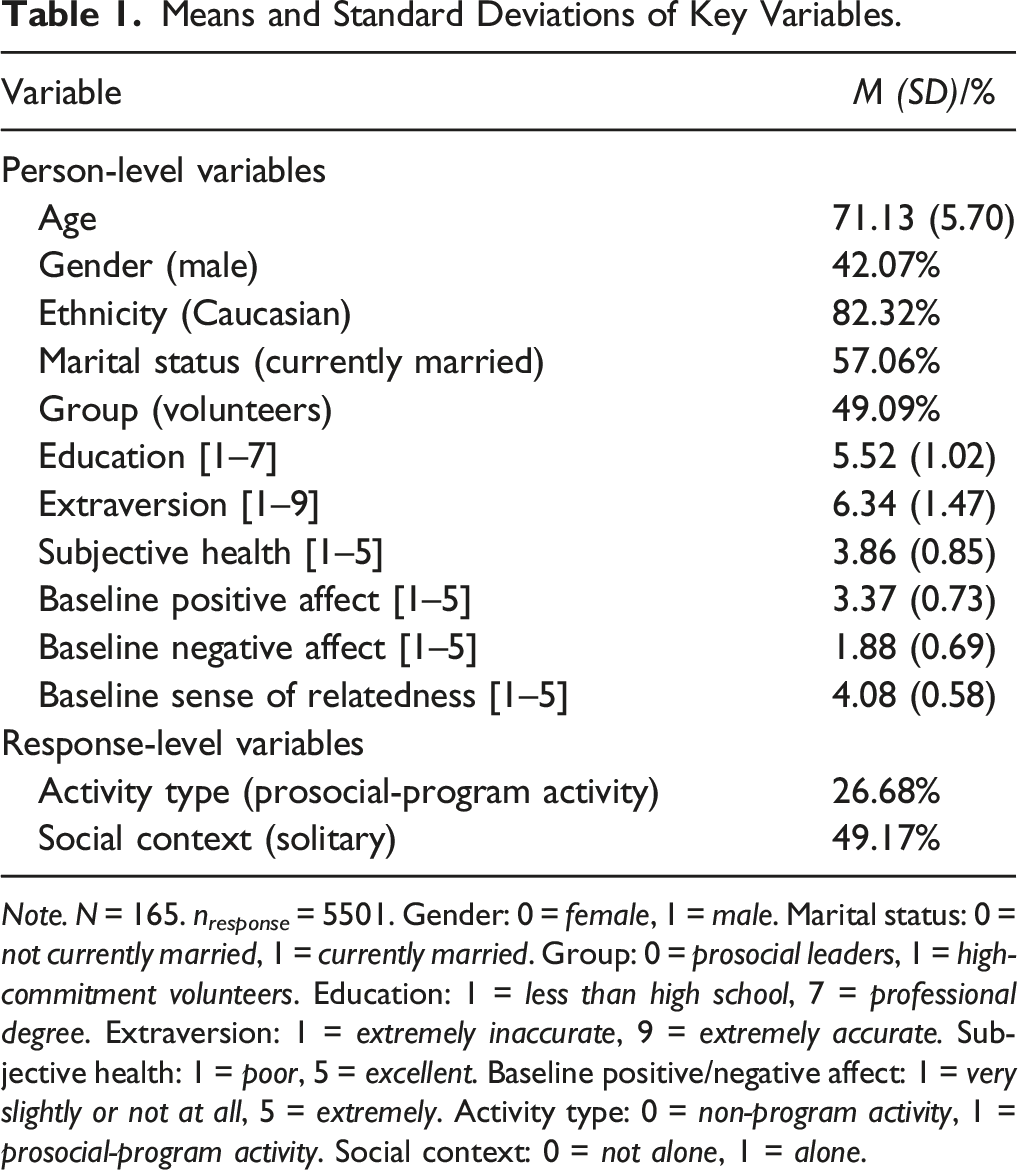
Note. N = 165. n response = 5501. Gender: 0 = female, 1 = male. Marital status: 0 = not currently married, 1 = currently married. Group: 0 = prosocial leaders, 1 = high-commitment volunteers. Education: 1 = less than high school, 7 = professional degree. Extraversion: 1 = extremely inaccurate, 9 = extremely accurate. Subjective health: 1 = poor, 5 = excellent. Baseline positive/negative affect: 1 = very slightly or not at all, 5 = extremely. Activity type: 0 = non-program activity, 1 = prosocial-program activity. Social context: 0 = not alone, 1 = alone.
Procedure
Participants were recruited as two subsamples; the first constituted older adults who held leadership positions in their prosocial program (n = 84) and had been nominated for the Purpose Prize, a national award that acknowledges the prosocial contributions of older adults. Members of the second subsample were involved in a formal volunteering program through a local or national volunteering organization (n = 81). During recruitment, all participants identified the prosocial program with which they were currently involved. If affiliated with more than one prosocial program, participants additionally identified the one that they considered to be their primary affiliation. Only individuals who reported spending at least 5 hours per week toward the designated prosocial program were invited to participate. Subsequently, participants were directed to respond to any survey questions pertaining to “program activity” in context of their self-identified prosocial program. Participants reported prosocial programs across a range of sectors, with education, youth, and poverty being the most common ones. Within participants’ involvement with their prosocial-program activity, the most frequently reported tasks were preparing for beneficiary-facing program work, communicating about program work with co-workers, and checking emails and messages.
We used ESM (Hektner et al., 2007) to collect data. Participants were signaled at six random times each day for seven days and asked to fill out experience sampling forms to assess their current context and momentary experience. Responses were considered valid only if participants responded within 30 minutes of being signaled. We also administered a one-time survey to collect demographics and baseline measures. From the original sample of 203 individuals who began the study, 188 completed it (92.6%). Further, 23 participants were excluded because they had less than 20 valid responses. The final dataset consisted of 5501 responses across 165 individuals, with a response rate of 75.2% and study completion rate of 81.3%. The study was approved as exempt via Claremont Graduate University’s Institutional Review Board (Protocol #2946).
Measures
Activity Type
When signaled, participants categorized the main activity they were doing into one of nine categories (e.g., active leisure, socializing, prosocial-program activity, etc.). We created a dichotomous variable denoting activity type to represent the main activity (0 = non-program activity, 1 = prosocial-program activity).
Social Context
Participants indicated who they were interacting with each time they were signaled (e.g., nobody, partner, prosocial-program coworker, etc.). In the current study, we defined solitude as the absence of social interaction with others (Burger, 1995) irrespective of whether others are present in one’s immediate environment (Hoppmann et al., 2021; Lay et al., 2020). Accordingly, interactions could either be in-person or involve various forms of telecommunication. For example, participants could categorize a Zoom call with other people as an interactive experience despite being alone in their physical environment, whereas working on a solitary task in a coffeeshop could be characterized as a solitary experience despite others being present in the physical environment. We created a dichotomous variable indicating whether participants were alone or not (0 = not alone, 1 = alone) at the time they were signaled.
Positive and Negative Affect
Participants indicated the extent to which they felt excited, calm, and proud (positive affect), and stressed, bored, and discouraged (negative affect) at the moment they were signaled on a 7-point Likert scale (1 = not at all, 7 = extremely). Affect items were based on the affective valuation index (AVI; Tsai et al., 2006) and intended to capture both low and high arousal affect. The number of items for each of the two measures was limited to three each in order to reduce participant burden over the course of repeated assessments during the study week (Mehl & Conner, 2012). Within- and between-person internal consistencies (Shrout & Lane, 2012) were .49 and .98 for positive affect, and .58 and .97 for negative affect. Within-person internal consistency can be expected to be low when a heterogeneous set of items is used (here, items capturing both low and high arousal affect) while still offering adequate longitudinal reliability (Chui et al., 2014; Shrout & Lane, 2012).
Sense of Relatedness
Means, Standard Deviations, Intraclass Correlations, and Within- and Between-Person Correlations of Outcome Variables.
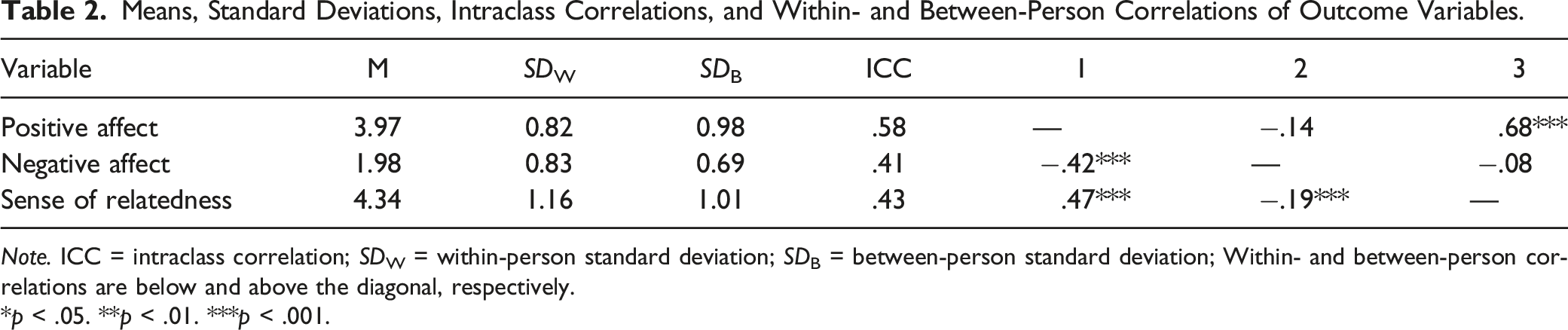
Note. ICC = intraclass correlation; SDW = within-person standard deviation; SDB = between-person standard deviation; Within- and between-person correlations are below and above the diagonal, respectively.
*p < .05. **p < .01. ***p < .001.
Covariates
Multiple person-level variables were used as covariates, including age, gender, subjective health, education, and marital status. Additionally, we included a binary covariate (“group”) to account for any effects that might arise from differences between participants’ roles in their primary prosocial-program (i.e., whether they hold leadership positions in their prosocial-program or not). We also included an 8-item person-level composite of extraversion based on (Saucier, 1994) Big-Five personality mini-markers (α = .85) as a covariate in all multilevel models as those who are more extraverted tend to spend less time in solitude (Burger, 1995; Leary et al., 2003). Finally, we included retrospective one-time measures of participants’ average positive affect (excited, calm, and proud), negative affect (stressed, bored, discouraged), and sense of relatedness (caring, cooperative, connected to others) experienced over the week before the study began.
Analysis Plan
We employed multilevel modeling in SPSS version 26 to investigate our research questions due to the hierarchical nature of the data (i.e., momentary reports of experience nested within the individual). Multilevel modeling takes into account the non-independence among observations (Hayes, 2006), given that repeatedly sampled data from one participant is likely to correlate across time points (Hox, 2010). We followed a bottom-up model building procedure as outlined by Hox (2010). For each of the three outcome variables of positive affect, negative affect, and sense of relatedness, respectively, we first ran three intercept-only independent models to compute intraclass correlation coefficients (see Table 2). Next, we added all momentary and person-level covariates to each of the three models. Then, we included main effects for activity type and social context in addition to the covariates. Finally, we included the interaction between activity type and social context in addition to their main effects and covariates in all three multilevel models. To further probe the interactions, we ran simple slope analyses using Preacher et al.’s (2006) simple slope analysis tool. Simple slope analysis allows the investigation of the relationship between the predictor and outcome variables at each conditional value of the moderator (Preacher et al., 2006). In the current study, we ran simple slope analyses to highlight the effect of activity type on well-being outcomes under solitary and non-solitary conditions, independently. Response-level variables were centered on the individual’s mean and person-level variables were centered on the sample mean for easier interpretations.
Results
On average, participants spent 49.2% of their time in solitude, and 26.7% of their time engaged in their prosocial-program activity. The percentages of reports classified as solitary prosocial-program, solitary non-program, non-solitary prosocial-program, and non-solitary non-program activity were 12.0%, 37.3%, 15.7%, and 35.0%, respectively. Participant responses categorized as non-program activity included active leisure (11.3%), passive leisure (20%), other paid work (2.2%), other volunteering (4.3%), relaxing/resting (3%), socializing (5.4%), routine activities (20.6%), and other activities (6.6%).
Positive Affect
Multilevel Modeling Investigating Activity Type, Social Context, and Their Interaction to Predict Positive Affect, Negative Affect, and Sense of Relatedness, Respectively.
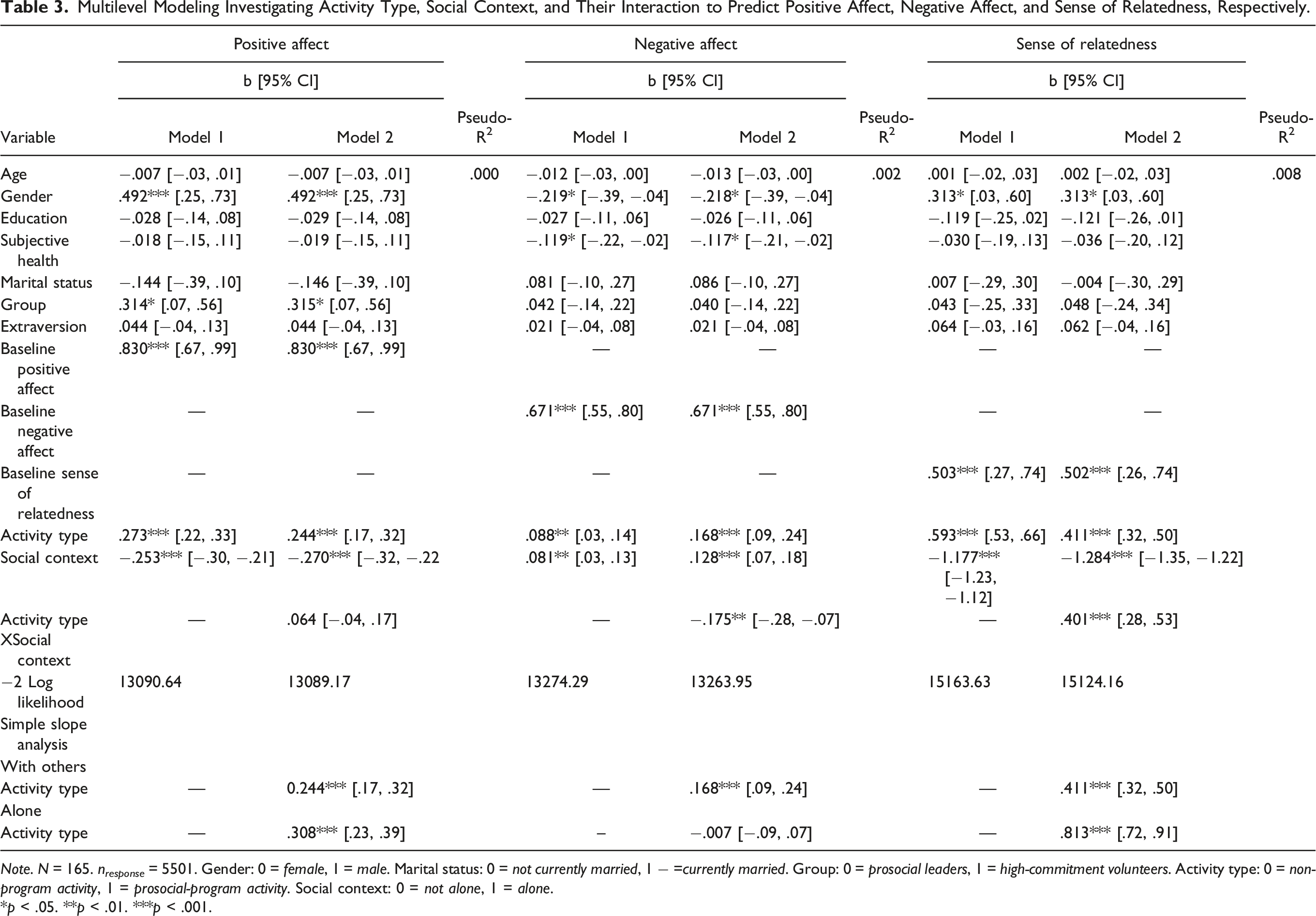
Note. N = 165. n response = 5501. Gender: 0 = female, 1 = male. Marital status: 0 = not currently married, 1 − =currently married. Group: 0 = prosocial leaders, 1 = high-commitment volunteers. Activity type: 0 = non-program activity, 1 = prosocial-program activity. Social context: 0 = not alone, 1 = alone.
p < .05. **p < .01. ***p < .001.
Negative Affect
The effect of social context (i.e., with others or alone) on negative affect was moderated by the type of activity (i.e., non-program or prosocial-program activity) participants were involved in (b = −0.18, p = .001, 95% CI [−0.28, −0.07]; see Table 3 and Supplementary Figure S1). The main effects of these two predictors along with their interaction, however, only explained 0.4% additional variance in negative affect, above and beyond the variance explained by other covariates, including baseline negative affect. Furthermore, simple slope analysis revealed that levels of negative affect were not significantly different in solitary prosocial-program activity compared to other solitary activities (b = −0.01, p = .862, 95% CI [−0.09, 0.07]); however, it was greater in prosocial-program activity (compared to other activities) when interacting with others (b = 0.17, p < .001, 95% CI [0.09, 0.24]).
Sense of Relatedness
The effect of social context on sense of relatedness was moderated by activity type (b = 0.40, p < .001, 95% CI [0.28, 0.53]; see Table 3 and Supplementary Figure S1). Activity type, social context, and their interaction term explained 29.3% of the variance in sense of relatedness, above and beyond the variance explained by other covariates, including baseline sense of relatedness. Simple slope analysis revealed that when alone, relatedness was significantly greater in prosocial-program activity compared to other activities (b = 0.81, p < .001, 95% CI [0.72, 0.91]). When with others, sense of relatedness was significantly higher in prosocial-program activity as well (b = 0.41, p < .001, 95% CI [0.32, 0.50]), albeit to a lesser extent relative to the difference between solitary conditions.
Discussion and Implications
On the one hand, being alone can engender loneliness, which is associated with a plethora of negative outcomes (Pinquart & Sorensen, 2001; Shankar et al., 2011; Steptoe et al., 2013). On the other hand, formal prosocial activities such as volunteering, which can be pursued alone, have been linked to psychological and physical benefits in daily life (Han et al., 2018, 2020). Our study furthers previous research by investigating whether the type of activity one is involved in when alone moderates their momentary well-being. Specifically, we highlight the beneficial effects of prosocial-program activity on solitary experience. Positive affect was greater during prosocial-program activity both when alone and when with others, whereas negative affect was only greater during prosocial-program activity when it occurred in the presence of others. Most importantly, older adults experienced greater feelings of relatedness when involved in prosocial-program activity during solitude compared to other solitary activities.
Our study expands upon previous empirical work and provides a more in-depth understanding of how solitary experience is impacted by the type of activity one is pursuing. In general, as some studies have previously suggested (e.g., Chui et al., 2014; Klumb, 2004), interacting with others is a more pleasant experience with lower negative affect and higher positive affect than being alone. Using ESM, the current study was able to go beyond differences strictly between social contexts and assess differences in emotional experience across activity types as well. We found that prosocial-program activity was associated with higher levels of positive affect in both solitary and non-solitary conditions, highlighting the implications of formal prosocial activity for positive emotions in both types of social contexts. Furthermore, similar to recent studies capturing daily experiences (e.g., Lam & García-Román, 2020), the use of ESM allowed participants to self-report whether instances of a given activity type occurred in solitude or with others, as opposed to the researchers preemptively defining certain activities as solitary and others as interactive (e.g., Menec, 2003).
Our study also adds to previous research that primarily used negative affective balance as an indicator of negative solitude and, in turn, loneliness (e.g., Lay et al., 2019; Matias et al., 2011), by directly measuring momentary feelings of relatedness as well. Given that feelings of relatedness during solitude are greater when one is engaged in prosocial-program activity, prosocial-program work may have the potential to attenuate feelings of loneliness—a major risk factor for mental and physical illness in later life (Pinquart & Sorensen, 2001). Consistent with previous research (Long et al., 2003; Nguyen et al., 2018), our findings stress the importance of the type of activity one engages in for one’s solitary experience, especially when the solitary activity in question is prosocial in nature (Martela & Ryan, 2016).
Although data collection for the current study preceded the COVID-19 pandemic, the study’s findings have timely implications for older adults who are at greater risk of experiencing loneliness given current social distancing guidelines (Campbell, 2020; Macdonald & Hülür, 2020). Whereas some recent research posits that loneliness among older adults increased only during the initial phase of the pandemic (late March) and leveled off by the time shelter-in-place orders were employed in most of the U.S. (late April; Luchetti et al., 2020), increases in the expected length of the pandemic (Lin, 2020) may alter the course of perceived loneliness as the pandemic progresses. In general, loneliness and constraints on social interactions imposed by COVID-19 mitigation measures are some of the most frequently reported challenges among older adults (Heid et al., 2020; Whitehead & Torossian, 2021), and thus, initiatives to remedy these challenges are worth pursuing.
While many young adults are able to maintain social relationships through digital communication platforms, some older adults may not opt to use the internet whereas some others may not have experience doing so (Seifert et al., 2021). Capitalizing on generative concerns through solitary formal prosocial activity may be a developmentally appropriate solution that aligns with the relational needs of older adults. Virtual positions offered by volunteer matching programs may offer ripe opportunities for older adults to feel connected to others even when alone. It is important to note that a sense of relatedness emerging from solitary prosociality may depend on individual differences such as older adults’ motivations to volunteer (Okun, 1994; Principi et al., 2016) or their preferences for solitude (Burger, 1995); the inclusion of solitary formal prosocial activity into one’s daily life may not offer the same benefits for all older adults. Nevertheless, during the current COVID-19 pandemic when interactions with others may be a greater health risk than loneliness, prosocial programs that allow for remote work may offer a pathway to well-being for some, at least until more immediate, face-to-face interactions are deemed free of health risks.
Limitations
Complementary to its strengths, our study has noteworthy limitations. First, generalizability of the current findings is limited because the average amount of time participants spent in prosocial activity (24.64 hours per week) was much higher than the national average (1.81 hours per week among those aged 65 and above; Bureau of Labor Statistics, 2016). Previous research has noted that the positive effects of prosocial-program activity on health and well-being may be dose dependent in that the amount of time one invests toward their prosocial program can impact the extent to which benefits are reaped (Fried et al., 2004). However, some previous research assessing low-intensity formal volunteering asserts that the number of hours devoted to formal prosocial activity does not bear any moderating effect on measures of hedonic, eudaimonic, and social well-being (Son & Wilson, 2012). Whether greater time devoted to formal prosocial activity plays a significant role at comparatively higher levels of prosocial-program involvement remains an open question. Additionally, research investigating the upper extremes of a phenomenon (here, relatively higher numbers of hours devoted to prosocial-program activity) may help achieve greater understanding by accounting for processes that may not be observable at normative levels (Matsuba et al., 2013). At the same time, future research is encouraged to replicate our study with populations who demonstrate normative levels of prosocial commitment in their daily lives using alternative research methods that operate on a wider timescale and are appropriate for rarer events, such as the daily diary method (Mehl & Conner, 2012).
Second, our study did not inspect whether specific tasks nested within prosocial-program activity account for differences in levels of well-being. Some tasks may offer opportunities to realize the impact of one’s actions on others even in their absence (e.g., when preparing for a tutoring session), whereas other tasks may be clerical or administrative in nature (e.g., bookkeeping) where task beneficiaries are not particularly salient (Grant et al., 2007). Future research can assess the impact of specific tasks on well-being associated with solitary prosocial activity, especially as it relates to feelings of relatedness.
Third, we did not collect data regarding some factors that may impact the current study’s findings. For instance, we did not ask participants about the source of their motivation to engage in prosocial-program activity. Previous research suggests that social motives to volunteer are more prevalent in older adults compared to younger adults (Chi et al., 2021; Okun et al., 1998; Okun & Schultz, 2003), which may impact feelings of relatedness. We encourage future research to investigate mediating influences that explain the relationship between prosocial-program involvement and greater well-being, especially as it relates to volunteering motives (Okun & Schultz, 2003) as well as correlates of solitary experience (Ost Mor et al., 2020). Additionally, we did not assess momentary fluctuation or individual differences in preferences for solitude; previous research suggests that whether solitude is volitional or not can qualitatively change one’s experience of solitude (Ost Mor et al., 2020). As a proxy, we statistically controlled for levels of extraversion, given that extraversion and preference for solitude tend to be inversely related (Burger, 1995; Leary et al., 2003), and found the results consistent with or without extraversion as a covariate. We also did not include a measure of social desirability. However, the use of ESM allowed us to investigate the within-person relationship, above and beyond between-person comparisons, in emotional experience associated with prosocial-program activity across solitary and non-solitary social contexts. As a result, “the within-person relation between the variables should not be inflated due to self-enhancement biases, even when both variables elicit socially desirable responses” (Beal, 2015, p. 389). In general, the immediate nature of experience sampling data reduces the likelihood of socially desirable responses (Hektner et al., 2007).
Finally, the findings of the current study do not shed light on the causal relationship between prosocial-program activity involvement in solitude and the emotional benefits of positive affect and feelings of relatedness associated with it. Previous experimental research bolsters the notion that acting prosocially, even in the absence of one’s direct beneficiary, is positively associated with relatedness (Martela & Ryan, 2016). Future research is encouraged to pursue further experimental evidence to support the current study’s results. Nevertheless, the validity and reliability of the ESM as a tool to investigate patterns in subjective experience over the course of daily life is well documented (see Csikszentmihalyi & Larson, 2014). The use of ESM is also known to reduce the extent to which participants’ responses are impacted by memory biases and the degree to which participants report mental aggregations of events opposed to more nuanced reports of fluctuations in one’s experience (Beal, 2015). As a result, findings from the current study offer a nuanced view of emotional experience associated with prosocial-program activity in solitude.
Conclusion
Results from our study shed light on the possibility of solitary prosociality and the psychological benefits associated with it. Although interacting with others was always associated with higher positive affect irrespective of whether one was involved in prosocial-program activity or not, feelings of relatedness were higher when individuals engaged in prosocial-program work, significantly more so when alone. Levels of negative affect were comparable between prosocial-program activity in solitude and other solitary activity. The positive effects of engaging in formal prosocial work may allow older adults to reap emotional benefits and protect themselves against loneliness despite personal or environmental constraints that may limit their interactions with others. Toward this end, prosocial programs that have the capacity to offer remote volunteering positions are encouraged to facilitate this process.
Supplemental Material
sj-pdf-1-roa-10.1177_01640275211062124 – Supplemental Material for Solitary Prosociality in Later Life: An Experience Sampling Study
Supplemental Material, sj-pdf-1-roa-10.1177_01640275211062124 for Solitary Prosociality in Later Life: An Experience Sampling Study by Ajit Singh Mann, Jordan Boeder, Dwight C. K. Tse, Laura Graham and Jeanne Nakamura in Research on Aging
Footnotes
Declaration of Conflicting Interests
The author(s) declared no potential conflicts of interest with respect to the research, authorship, and/or publication of this article.
Funding
The author(s) disclosed receipt of the following financial support for the research, authorship, and/or publication of this article: This work was supported by Grant 60762 from the John Templeton Foundation. The opinions expressed in this publication are those of the authors and do not necessarily reflect the views of the John Templeton Foundation.

Supplemental Material
Supplemental material for this article is available online.
References
Supplementary Material
Please find the following supplemental material available below.
For Open Access articles published under a Creative Commons License, all supplemental material carries the same license as the article it is associated with.
For non-Open Access articles published, all supplemental material carries a non-exclusive license, and permission requests for re-use of supplemental material or any part of supplemental material shall be sent directly to the copyright owner as specified in the copyright notice associated with the article.
