






Abstract
Rapid population ageing has led many countries to extend statutory retirement ages, yet the mental health implications of post-retirement employment remain inconclusive, particularly in low- and middle-income countries. This study examines the association between working beyond statutory retirement age and depressive symptoms among older persons in Vietnam, a rapidly ageing middle-income country undergoing retirement-age reform. Using nationally representative data from the 2019 Vietnam National Aging Survey (N = 3,312) and propensity score matching to improve balance in observed characteristics, we compare economically active older persons with observationally similar non-working counterparts. Results show that post-retirement employment was significantly associated with lower depressive symptom scores. Associations were stronger among men and rural residents, while estimates were similar across educational groups. These findings suggest that continued labor force participation is linked to better mental health in later life, although estimates should be interpreted as associations rather than causal effects.
Introduction
Population ageing is reshaping labor markets, pension systems, and health-care needs across the world. As the number and share of older persons increase, many countries have promoted longer working lives to address labor shortages and improve the fiscal sustainability of social protection systems (Organisation for Economic Co-operation and Development, 2024). Yet the mental health implications of working beyond the statutory retirement age remain unclear.
Empirical evidence on post-retirement employment and mental health is mixed. Some studies suggest that continued work in later life is associated with better mental health, lower depressive symptoms, or higher subjective well-being, potentially because work maintains social roles and reduces isolation (Forbes et al., 2015; Park et al., 2025; Sun et al., 2025). Other studies find adverse associations, especially when employment after retirement is involuntary, financially motivated, or accompanied by poor working conditions (Baxter et al., 2021; Mizuochi, 2024; Raihan et al., 2023). These inconsistent findings suggest that the relationship between post-retirement employment and mental health depends on institutional context, pension coverage, job quality, work intensity, and older persons’ socioeconomic and health conditions. Importantly, the majority of existing evidence comes from high-income countries, where pension coverage is relatively comprehensive and continued work after retirement is often voluntary. Empirical evidence from low- and middle-income countries (LMICs), particularly in Southeast Asia, remains limited.
A central empirical challenge in this literature is selection into continued work. Older persons who remain economically active after retirement age are unlikely to be comparable to those who do not work. They may be younger, healthier, more educated, more socially connected, or financially different from non-working older persons. Health selection is particularly important: better physical and functional health may increase the likelihood of continued employment and may also be associated with lower depressive symptoms. Conversely, poor health and chronic illness may push older persons out of the labor force while also worsening mental health. Therefore, simple comparisons between working and non-working older adults may partly reflect pre-existing differences rather than the relationship between work and depressive symptoms. Ideally, this issue would be addressed using longitudinal data or quasi-experimental variation in retirement or employment conditions. In the absence of such designs, propensity score matching (PSM) offers a useful approach for reducing observable selection bias by comparing working and non-working older persons with similar measured characteristics.
Vietnam provides a particularly relevant context for examining the mental health implications of post-retirement employment. The country is ageing rapidly while pension and social protection coverage remain limited (Giang & Nguyen, 2017; World Bank, 2021). At the same time, Vietnam has recently begun to raise the statutory retirement age. Originally set at 60 for men and 55 for women, the retirement age has increased gradually since 2021, with annual increments of three months for men and four months for women under normal working conditions (Le & Giang, 2025; The National Assembly of The National Assembly of the Socialist Republic of Vietnam, 2019). These demographic and policy changes make it increasingly important to understand how continued employment after statutory retirement age is associated with older persons’ mental health. For many older adults outside the formal pension system, continued work may reduce financial strain, preserve social roles, and provide daily structure, all of which may support psychological well-being. However, when post-retirement employment is driven by financial pressure, inadequate social protection, or physically demanding informal work, it may also generate stress and psychological burden. Thus, in Vietnam, working beyond retirement age may reflect both financial pressure and personal preference, with potentially different implications for depressive symptoms.
Despite the relevance of this context, empirical evidence on post-retirement employment and mental health in Vietnam remains scarce. Existing Vietnamese studies have primarily focused on the determinants of continued labor force participation, emphasizing the roles of individual characteristics, household conditions, and social factors (Giang et al., 2024; Giang & Le, 2015, 2018; Giang & Nguyen, 2016). To address this gap, this study uses data from the 2019 Vietnam National Aging Survey (VNAS), also known as the 2019 Survey on Older Persons and Social Health Insurance (OP&SHI), to examine the association between post-retirement employment and depressive symptoms among older persons in Vietnam. We apply PSM to improve comparability between older persons who work beyond the statutory retirement age and observationally similar non-working counterparts. We also examine whether the association differs by socio-demographic characteristics since the association between post-retirement employment and depressive symptoms may differ across groups. Examining heterogeneity is also important for policy because it helps identify subgroups for whom post-retirement employment may be more strongly linked to mental health, thereby informing more targeted labor-market, pension, and social protection interventions.
This study contributes to the literature in several ways. First, it provides new empirical evidence on the mental health implications of post-retirement employment in a lower-middle-income country context, where institutional arrangements and labor market conditions differ substantially from those in high-income economies. Second, the study examines heterogeneity across demographic and socioeconomic groups, offering insights into which population subgroups may benefit from or be adversely affected by continued employment in later life. Third, by situating the analysis within Vietnam’s context of rapid population ageing alongside limited pension coverage and social protection, the study highlights how extending working lives may involve important mental health trade-offs when continued employment is shaped by economic necessity rather than individual choice. In doing so, the findings provide broader policy-relevant evidence for other LMICs undergoing similarly rapid demographic transitions while facing constraints in social protection systems.
Methods
Data
This study uses nationally representative data from the 2019 VNAS. The survey collected comprehensive information on the health status, sociodemographic characteristics, and patterns of healthcare access and utilization among Vietnamese individuals aged 50 years and older through structured questionnaires administered via face-to-face interviews. The VNAS employed a multistage stratified sampling design using probability proportional to size, a common method in household surveys to select provinces, districts, and communes across Vietnam’s six socio-economic regions. Within selected communes, villages and individual respondents were subsequently chosen through systematic random sampling. Following this sampling procedure, a total of 4,320 individuals were successfully interviewed. Given that the statutory retirement age in Vietnam prior to the 2021 reform was 60 years for men and 55 years for women (The National Assembly of The National Assembly of the Socialist Republic of Vietnam, 2019), individuals below these age thresholds were excluded from the analytical sample. After further excluding observations with missing information on key variables, the final study sample comprised 3,312 individuals, including 2,138 women aged 55 years and older and 1,174 men aged 60 years and older.
Measures
Depressive Symptoms
Respondents’ depressive symptoms were assessed using the 15-item Geriatric Depression Scale (GDS-15), a widely used screening instrument designed to measure depressive symptoms among older adults (Yesavage & Sheikh, 1986). The GDS has been used and validated in Vietnamese older populations. In particular, the longer Vietnamese GDS-30 has been translated, culturally adapted, and validated among adults aged 60 years and older in Vietnam, showing high internal consistency and satisfactory reliability (Nguyen et al., 2021). Although the GDS-15 version has not been validated in Vietnam yet, it was piloted before fieldwork to assess clarity and cultural appropriateness. The scale consists of 15 dichotomous (yes/no) questions capturing respondents’ emotional and psychological conditions during the week preceding the interview. Detailed descriptions of the survey questions are provided in Appendix Table A1.
In the absence of a validated GDS-15 cutoff point for identifying depression in the Vietnamese context, this study follows Le and Giang (2025) by integrating all GDS components to construct a continuous index of depressive symptoms. Specifically, the depressive symptom index was constructed through three sequential steps. First, positively worded questions were reverse-coded to ensure consistency in direction with negatively framed questions. Second, each question was standardized into a z-score using its sample mean and standard deviation. Third, the standardized scores were aggregated by calculating their simple average to form a composite index. Combining multiple components in this manner captures variation across individual symptoms and improves statistical power (Kling et al., 2007). Because all questions were coded to reflect adverse emotional states, higher values of the index indicate more severe depressive symptoms. As a robustness check, alternative measures of depressive symptoms are employed to assess the sensitivity of the main findings.
Independent Variables
The key independent variable in this study is post-retirement employment status, capturing whether older persons engage in income-generating activities after reaching the statutory retirement age. Employment status was constructed using survey information on respondents’ participation in paid or income-generating work, consistent with the definition of employment used in Vietnam’s Labour Force Survey conducted by the General Statistics Office. Specifically, working status was derived from three self-reported indicators: (i) whether the respondent worked for at least 1 hour during the week preceding the survey, (ii) whether the respondent engaged in income-generating activities during the past 12 months, and (iii) whether work constituted a source of income or financial support over the same period. Respondents reporting any form of work activity were coded as 1, while those reporting none were coded as 0. This definition captures both current and intermittent labor force participation. Such an operationalization is particularly appropriate for older populations, whose employment patterns are often irregular, seasonal, or temporary rather than continuous. By incorporating information from both short-term and longer-term reference periods, the constructed measure provides a more comprehensive assessment of post-retirement labor participation. However, the variable captures only the presence of income-generating work and does not include information on working hours, job intensity, or employment characteristics. Consequently, the analysis focuses on whether older individuals participate in work after retirement age rather than the extent or quality of labor engagement.
To reduce potential confounding in the relationship between post-retirement employment and mental health, the analysis controls for a comprehensive set of individual, household, and socioeconomic characteristics identified in prior literature (He et al., 2024; Lewin & Stier, 2025; Sun et al., 2025; Wang & Ge, 2025).
Individual characteristics include age measured in years (men aged 60 years and above and women aged 55 years and above, consistent with Vietnam’s statutory retirement age), sex (female = 1; male = 0), educational attainment (no schooling = 0, primary education = 1, secondary education = 2, and high school or above = 3), and ethnicity (Kinh majority = 1; ethnic minorities = 0). Additional individual characteristics include place of residence (urban = 1; rural = 0), marital status (currently married or cohabiting = 1; otherwise = 0), perceived income adequacy include three indicators: (i) respondents’ assessment of whether household income meets basic needs (adequate income = 1; otherwise = 0); (ii) changes in income compared to three years ago (better = 1; otherwise = 0); and (iii) financial status compared with neighbors (better = 1; otherwise = 0), saving status (yes = 1; no = 0), and income received from pensions or other allowances, measured in thousand Vietnamese dong. Health-related characteristics include experiences of sickness or injury during the past 12 months (yes = 1; no = 0), as well as health behaviors such as smoking and alcohol consumption, both of which have been associated with mental health outcomes in later life (He et al., 2024; Wang & Ge, 2025). Family characteristics include household size and receipt of monetary or in-kind transfers from adult children (yes = 1; no = 0), reflecting intergenerational financial and social support that may influence both labor participation and psychological well-being among older persons (Cheng et al., 2023; Sun et al., 2025; Wang & Ge, 2025). Finally, socioeconomic characteristics include health insurance coverage, household poverty status, and receipt of social assistance benefits, which have been shown to shape both employment decisions and mental health outcomes among older adults (Bedaso & Han, 2021; Lewin & Stier, 2025; Wang & Ge, 2025).
Empirical Strategy
Labor force participation beyond the statutory retirement age is unlikely to be randomly determined. Decisions to continue working are shaped by individual, household, and socioeconomic characteristics that are also closely associated with mental health outcomes, resulting in systematic differences between older persons who remain economically active and those who do not. A primary concern in this context is selection bias, particularly health selection, whereby healthier individuals are more likely to continue working. Failure to account for such differences may therefore confound the estimated relationship between post-retirement employment and depressive symptoms among older persons.
Consistent with previous studies examining employment and health outcomes in later life, this study employs PSM to mitigate selection bias arising from observable differences between working and non-working older individuals (Cheng et al., 2023; Sun et al., 2024; Wang & Ge, 2025). The central idea of PSM is to compare outcomes between treated individuals (older persons working beyond the statutory retirement age) and untreated individuals (those not working) who share similar observed characteristics (Rosenbaum & Rubin, 1983). Under this framework, conditional on observed covariates, participation in post-retirement employment is assumed to depend only on observable factors, implying that matched individuals are comparable in terms of characteristics influencing both employment decisions and mental health outcomes.
Although the conditional independence assumption underlying PSM cannot be directly tested, its plausibility can be enhanced by incorporating a comprehensive set of covariates that are strongly associated with both labor force participation and mental health. Accordingly, this study includes a rich set of individual, family, and socioeconomic characteristics, with particular attention to health-related factors. Importantly, the matching procedure controls for respondents’ recent health history, including experiences of sickness or injury in the past 12 months. By conditioning on recent health status, the analysis partially addresses concerns that better baseline health drives both continued employment and better psychological well-being. Incorporating these health measures enhances covariate balance between treated and control groups and strengthens the credibility of the estimated association (Austin, 2011). In addition, the analysis imposes the common support condition to ensure that comparisons are conducted only among individuals with overlapping propensity score distributions. This restriction is particularly important for kernel-based matching estimators, as it reduces the likelihood of poor matches and enhances the reliability of estimated associations within the region of common support (Caliendo & Kopeinig, 2008).
The empirical implementation proceeds in two steps. First, propensity scores representing the probability of participating in post-retirement employment are estimated using a logistic regression model based on the full set of observed covariates. Kernel matching is then applied to construct weights that match working older persons with observationally similar non-working counterparts. Second, depressive symptom index is regressed on employment status while controlling for the same set of covariates, with kernel matching weights applied as probability weights. This regression adjustment on matched samples helps further reduce residual covariate imbalance and improves estimation efficiency, an approach often referred to as a doubly robust estimation strategy (Le et al., 2024; Rosenbaum & Rubin, 1983; Rubin, 2001).
Standard errors are clustered at the primary sampling unit level to account for the survey sampling design. All analyses were conducted using Stata version 14 with the psmatch2 command (Leuven & Sianesi, 2018), and statistical significance was assessed at the 5% level.
Results
Descriptive Statistics
Descriptive Statistics Before Matching
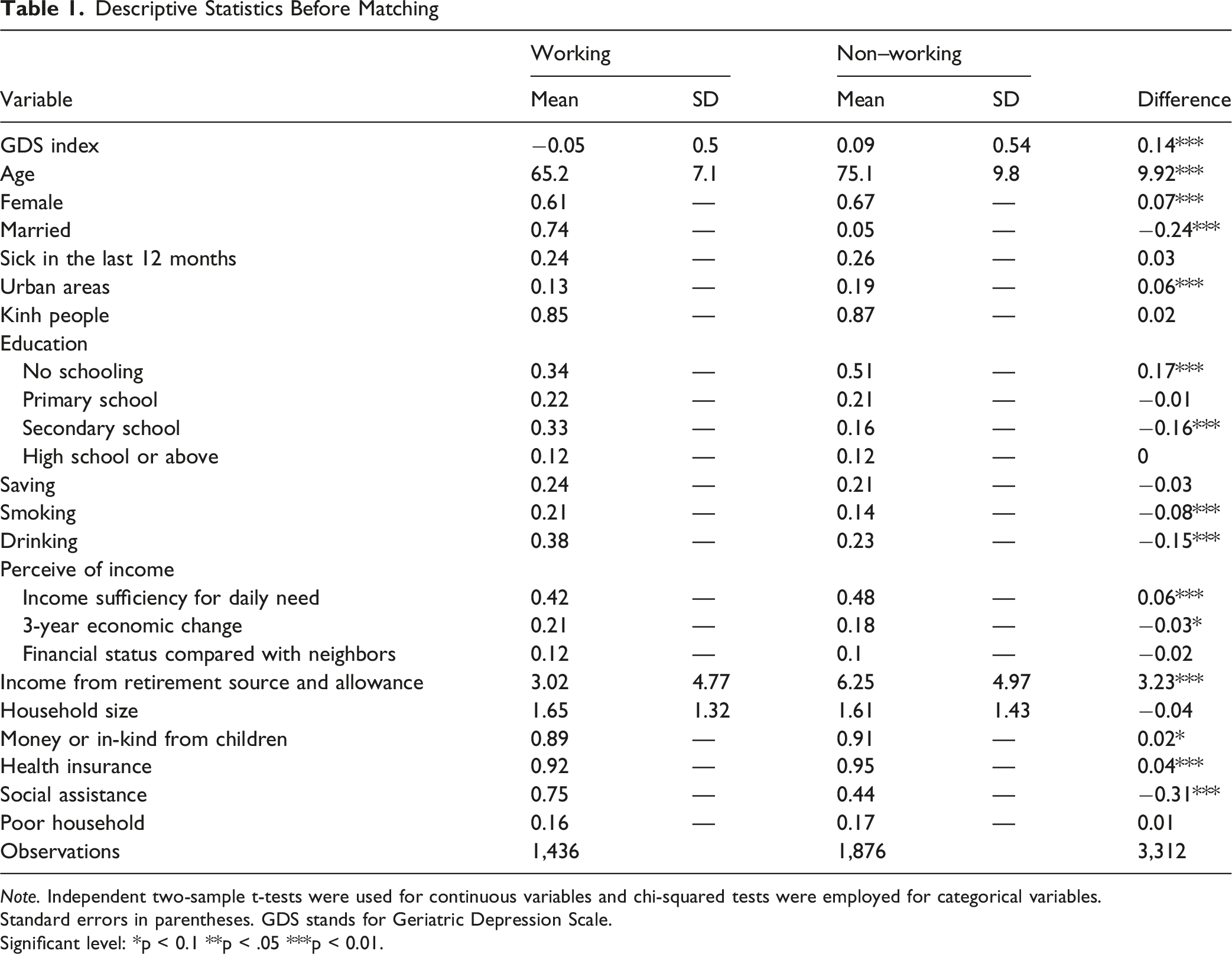
Note. Independent two-sample t-tests were used for continuous variables and chi-squared tests were employed for categorical variables.
Standard errors in parentheses. GDS stands for Geriatric Depression Scale.
Significant level: *p < 0.1 **p < .05 ***p < 0.01.
Figure 1 shows the propensity score distributions for working and non-working older persons before and after matching. Before matching, the two groups differed substantially, indicating observable selection into post-retirement employment. After matching, the distributions overlap much more closely across the common support region, suggesting improved comparability between working and non-working respondents with similar observed characteristics. The balance diagnostics in Appendix Table A2 support this visual evidence (detailed interpretations of this Table are provided in online supplements): the pseudo-R2 and standardized bias measures declined sharply after matching, and Rubin’s R moved into the recommended range. These results indicate that matching substantially improved balance in observed covariates, although unobserved confounding cannot be ruled out. The quality of matching.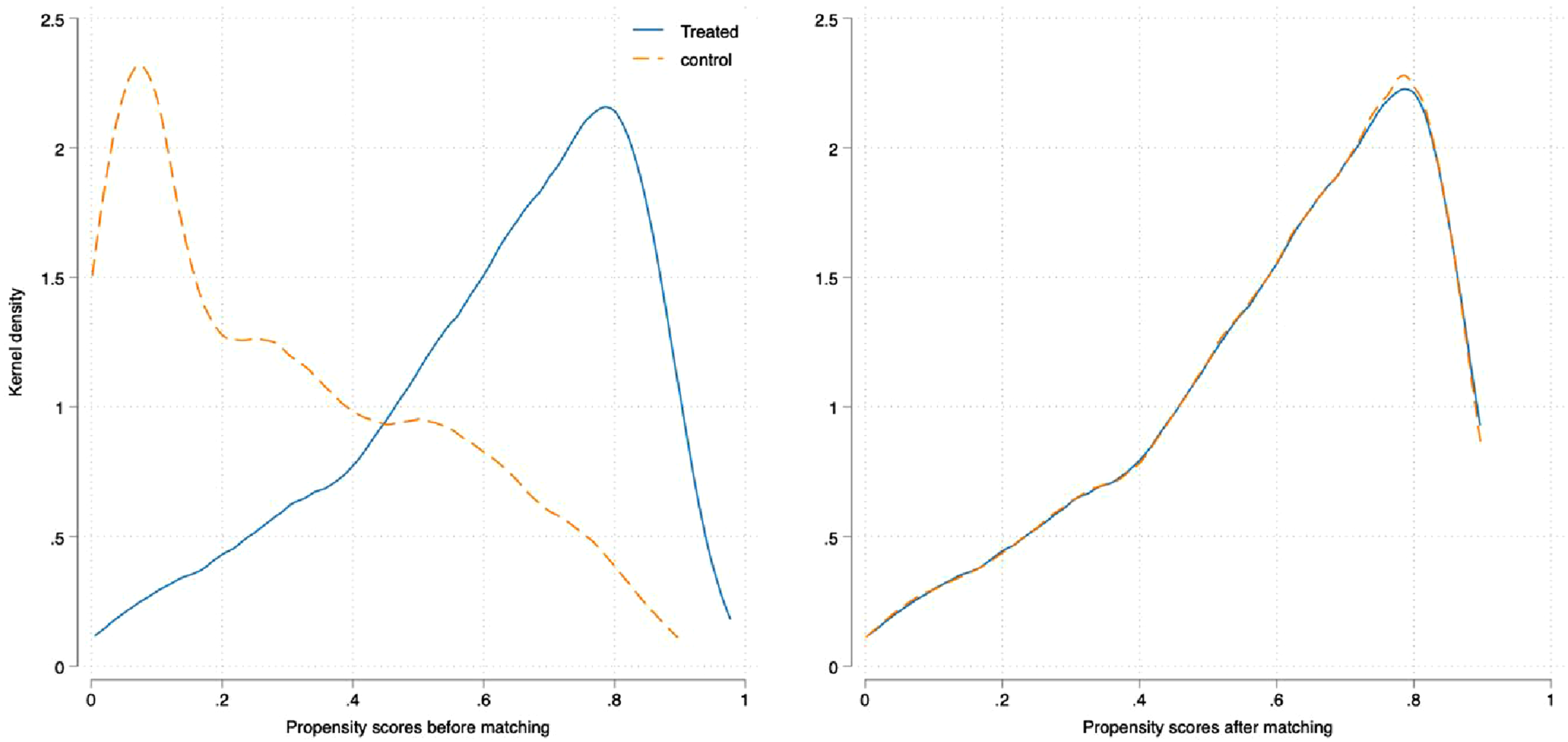
Determinants of Working Beyond the Statutory Retirement Age
Appendix Table A3 reports marginal effects from the logistic regression model used to estimate propensity scores for continued labor force participation after reaching the statutory retirement age. The results further confirm the presence of non-random selection into post-retirement employment. Older age and urban residence are associated with a significantly lower probability of continued work, while being married is positively associated with labor force participation. Economic incentives also appear to play an important role: higher income from pensions or allowances, larger household size, and receiving financial support from children are all associated with a reduced likelihood of working after retirement age. In contrast, smoking, alcohol consumption, perceived improvements in household economic conditions over the past three years, and relatively favorable financial status compared with neighbors are positively associated with continued employment.
PSM Results
Association Between Working Beyond the Retirement Age and Depressive Symptoms
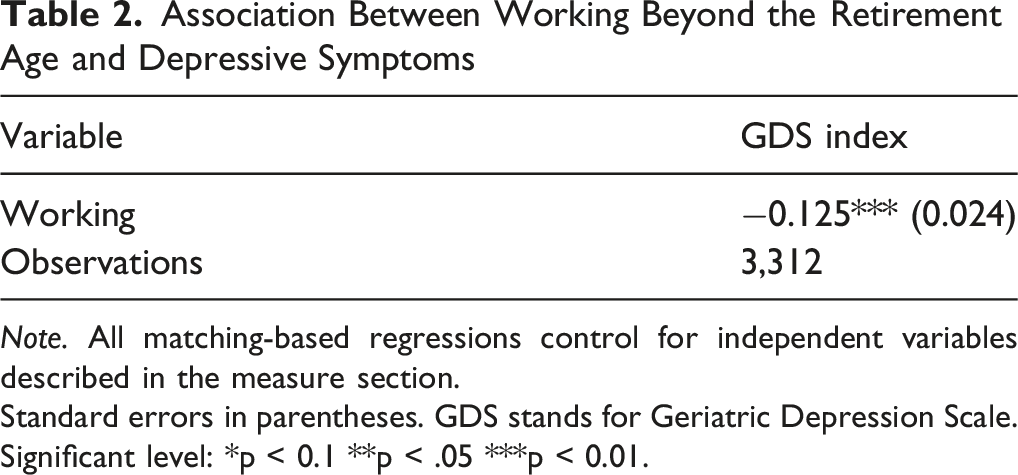
Note. All matching-based regressions control for independent variables described in the measure section.
Standard errors in parentheses. GDS stands for Geriatric Depression Scale.
Significant level: *p < 0.1 **p < .05 ***p < 0.01.
Given that the outcome variable is constructed as a standardized index, the estimated coefficient can be interpreted as a positive moderate association in mental health outcomes among older persons who continue working after retirement age. The magnitude of the estimate suggests that post-retirement employment is meaningfully associated with higher psychological well-being.
Heterogeneous Results
Heterogeneous Results of Working Beyond Retirement Age on Depressive Symptoms
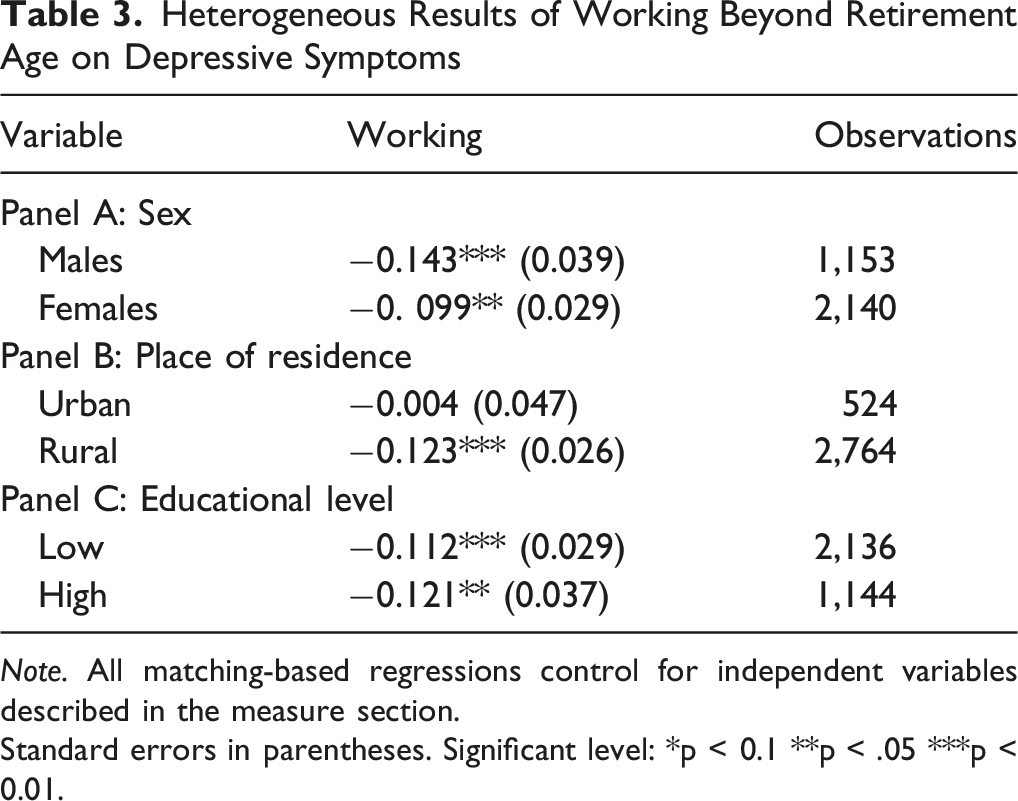
Note. All matching-based regressions control for independent variables described in the measure section.
Standard errors in parentheses. Significant level: *p < 0.1 **p < .05 ***p < 0.01.
Panel A reports heterogeneous results by sex. Continued employment beyond the statutory retirement age is associated with significantly lower depressive symptom scores for both men and women. However, the magnitude of the association is larger for men (−0.143 SD, p < 0.001) than for women (−0.099 SD, p < 0.01). Panel B reports heterogeneity by place of residence. The results indicate that post-retirement employment is associated with a statistically significant reduction in depressive symptoms among older persons residing in rural areas (−0.123 SD, p < 0.001), whereas the corresponding estimate for urban residents is not statistically significant. Panel C presents heterogeneous analysis by educational attainment, categorized into lower education (no schooling or primary education) and higher education (secondary education and above). The results show that post-retirement employment is associated with significantly lower depressive symptoms in both groups, with estimated coefficients of comparable magnitude.
Taken together, the heterogeneous analyses suggest that post-retirement employment is consistently associated with lower depressive symptoms among older persons in Vietnam, with more pronounced associations observed among men and rural residents. These findings underscore the importance of contextual and demographic factors in shaping the psychological implications of extended working lives and highlight that the benefits of post-retirement employment may not be uniform across population subgroups.
Robustness Checks
This section presents a series of robustness checks designed to assess the sensitivity of the main findings to alternative outcome definitions and matching specifications.
First, we examine whether the results are sensitive to alternative measurements of depressive symptoms. We construct two alternative outcome measures. The first is the raw GDS-15 score calculated as the unweighted sum of all 15 items, ranging from 0 (no depressive symptoms) to 15 (severe depressive symptoms). The second is a binary indicator of depression based on a commonly used cutoff in prior Vietnamese studies, where scores of 0–5 are classified as normal and scores above 5 indicate the presence of depressive symptoms (Nguyen et al., 2024). Second, to assess sensitivity to the choice of matching parameters, we modify the bandwidth used in the kernel matching procedure by doubling the baseline bandwidth from 0.03 to 0.06. Third, we replace kernel matching with radius matching to examine whether the results depend on the specific matching algorithm employed. Radius matching restricts comparisons to observations within a predefined propensity score distance, thereby providing an alternative weighting structure. Finally, using Vietnam’s sex-specific statutory retirement ages create an asymmetry in the sex-stratified analysis. To assess whether the findings are sensitive to this age-threshold difference, we also conducted an additional robustness check restricting the sample to respondents aged 60 and above for both men and women.
The results of these robustness checks, reported in Appendix Table A4, indicate that the estimated association between post-retirement employment and depressive symptoms remains statistically significant and similar in magnitude across all alternative specifications. These findings suggest that the main results are not driven by the choice of variable definitions or matching method and are therefore robust to reasonable variations in model specification.
Discussion
Population ageing has prompted many countries to reform pension systems and encourage longer working lives in order to enhance the fiscal sustainability of social protection systems (OECD, 2024). As a result, an increasing number of older persons remain economically active beyond the statutory retirement age. While extended working lives may help maintain income and ease pension burdens, their implications for older persons’ mental health remain debated. Existing international evidence has yielded mixed findings (Baxter et al., 2021), reflecting differences in institutional contexts, labor market conditions, and methodological approaches. Against this backdrop, our study provides new evidence from Vietnam—a rapidly ageing middle-income country that is simultaneously reforming its retirement age policy (The National Assembly of The National Assembly of the Socialist Republic of Vietnam, 2019; World Bank, 2021).
Using nationally representative data from the 2019 VNAS and applying a PSM approach, we find that post-retirement employment is associated with significantly lower depressive symptoms among older persons. These findings are broadly consistent with evidence from other Asian contexts (Cheng et al., 2023; Park et al., 2025; Wang & Ge, 2025) and Western settings (Forbes et al., 2015; Sun et al., 2025), although they differ from studies documenting neutral or adverse effects (Mizuochi, 2024; Raihan et al., 2023). Such cross-country heterogeneity underscores the importance of contextual factors in shaping the mental health implications of extended working lives.
The protective association observed in our study can be explained as follows. First, continued employment may enhance social integration. Work provides structured opportunities for interpersonal interaction, reinforces social networks, and sustains role-based identities developed over the life course (Cheng et al., 2023). Role enhancement and activity theory suggest that maintaining meaningful social roles in later life supports psychological well-being by preserving a sense of purpose and belonging (Sieber, 1974; Teles & Ribeiro, 2019). In settings where retirement may otherwise lead to reduced social participation, continued engagement in productive activities can mitigate social isolation—an established risk factor for depression. Second, employment may provide structure and routine in daily life. Regular participation in work-related tasks can foster a sense of purpose and continuity, buffering against the psychological adjustment challenges that sometimes accompany retirement (Henning et al., 2016; Kim & Moen, 2002). Maintaining daily routines and responsibilities may also shift attention away from age-related physical limitations or stressors, thereby contributing to more stable emotional states (Patel, 2018). Third, work may sustain cognitive and social stimulation. Many forms of employment require ongoing interaction, problem-solving, and memory use, which may help preserve cognitive engagement in later life (Sun et al., 2024; Takase et al., 2024; Vance et al., 2016). Although our study does not directly measure cognitive outcomes, cognitive stimulation and mental health are closely linked, and sustained engagement may indirectly contribute to lower depressive symptoms. Fourth, continued employment may reduce financial strain. In Vietnam, pension coverage and benefit adequacy remain limited, particularly outside the formal sector (Castel & Pick, 2018; Giang & Nguyen, 2017). Additional earnings from work may alleviate economic insecurity and reduce stress related to healthcare expenses and daily living costs (Giang et al., 2022; Tran et al., 2022). Financial strain has been consistently linked to depressive symptoms among older adults, and income may partially mediate the association between employment and mental health (Cheng et al., 2023). In contexts where post-retirement work is partly motivated by economic necessity, its psychological associations may therefore reflect both social and material mechanisms.
Our heterogeneous analyses further reveal that the association between post-retirement employment and mental health is not uniform across subgroups. The protective association is stronger among men than women. This pattern may reflect gendered labor market roles and social expectations that persist across cohorts in Vietnam and other East Asian societies (Wang & Ge, 2025). Men are more likely to derive identity, status, and social recognition from paid work, such that retirement may represent a greater disruption to established social roles. Continued employment may therefore mitigate the psychological implications of role loss more strongly for men.
The association between post-retirement employment and depressive symptoms appears stronger among rural residents, whereas the estimate for urban older persons is small and statistically insignificant. This urban null finding should be interpreted cautiously because the urban subsample is much smaller, reducing statistical power. Substantively, the rural–urban difference may reflect variation in pension access, work opportunities, and the meaning of work in later life (Le, Leon-Gonzalez, & Giang, 2020; Le, Leon-Gonzalez, Giang, et al., 2020). For rural older adults, work may provide supplemental income, daily structure, social interaction, and a sense of usefulness, particularly where formal pensions and organized social activities are less accessible. By contrast, urban older adults may have greater access to pensions, savings, services, and alternative forms of social engagement, weakening the marginal association between work and depressive symptoms (Tran, 2024). At the same time, the stronger rural association should not be interpreted as evidence that all forms of rural post-retirement work are beneficial. Rural employment may involve agricultural, informal, or physically demanding work. Prior studies show that working conditions and job quality are important for older workers’ health and mental well-being (Wahrendorf et al., 2013). Because our data do not distinguish occupational type, working hours, job intensity, voluntariness, or working conditions, the estimates should be understood as average associations across heterogeneous forms of post-retirement work. Future research with richer job-quality measures is needed to determine whether flexible and voluntary work differs from physically demanding or necessity-driven work in its association with mental health.
The association does not appear to differ substantially by educational attainment. This suggests that continued income-generating activity may be linked to lower depressive symptoms across human-capital groups, possibly through routine, purpose, and social interaction. However, because education is closely related to lifetime socioeconomic status, occupational opportunities, and mental health in later life, this result should be interpreted cautiously.
Several limitations of this study warrant consideration. First, the survey data do not provide detailed information on the characteristics of post-retirement employment, such as occupational type (e.g., manual versus non-manual work), job demands, working conditions, or levels of job control. Prior research suggests that job quality and psychosocial working conditions may exert heterogeneous results on mental health (Carthy et al., 2017). In the absence of such information, our estimates capture the average association between employment participation and depressive symptoms and may mask important variation across different types of work environments. Second, the data do not include detailed measures of work intensity, such as weekly working hours, employment duration, or continuity of labor force participation. Existing evidence indicates that the relationship between working hours and mental health may be nonlinear, with both underemployment and excessive work hours potentially associated with poorer psychological outcomes (Kim et al., 2023). Without information on work intensity, our analysis cannot assess whether mental health benefits vary according to the extent of labor engagement. Third, although PSM improves balance between working and non-working older persons on observed characteristics, the estimates should not be interpreted as causal effects. Unobserved factors may jointly influence post-retirement employment and depressive symptoms. These include baseline physical and mental health, long-term health trajectories, functional capacity, personality traits, motivation, resilience, social connectedness, and preferences for work. In particular, our control for sickness or injury in the past 12 months is useful but crude. It does not capture chronic disease severity, frailty, disability, prior depression, or changes in health before the survey. Therefore, residual confounding and health selection remain possible. Future research using longitudinal data, fixed-effects models, or quasi-experimental designs (e.g., policy reforms affecting retirement age) would help strengthen causal inference.
Conclusion and Policy Implications
This study provides new empirical evidence on the relationship between post-retirement employment and mental health among older persons in Vietnam. The study shows that continued labor force participation beyond the statutory retirement age is associated with significantly lower depressive symptoms. The association is particularly pronounced among men and rural residents, suggesting that the mental health implications of extended working lives vary across demographic and contextual factors.
The study’s findings carry several policy implications. First, retirement-age reforms should incorporate flexibility. Rather than uniformly extending retirement age, policymakers should promote phased retirement options and part-time employment arrangements that allow older workers to adjust their labor participation according to health status and personal circumstances. Such flexibility may help maximize the psychological benefits of continued engagement while minimizing potential strain. Second, fostering age-inclusive labor markets is essential. Strengthening enforcement of anti-age discrimination regulations and promoting age-friendly workplace practices—such as adjusted workloads and roles that leverage experience rather than physical demands—can help ensure that continued employment remains supportive rather than burdensome. Particular attention should be given to rural areas, where employment may serve as a crucial source of both income and social engagement. Third, policies addressing population ageing should adopt a life-course perspective. Investments in education, lifelong learning, and financial preparedness can enhance individuals’ capacity to engage in meaningful work in later life. Strengthening pension adequacy and access to social protection—especially for those outside the formal sector—remains equally important to ensure that extended working lives are a matter of choice rather than necessity.
Overall, as Vietnam continues to adjust its retirement policies in response to rapid demographic ageing, attention should be paid not only to fiscal sustainability but also to the psychosocial well-being of older persons. Creating supportive, flexible, and equitable labor market conditions may help harness the potential mental health benefits of continued work in later life.
Supplemental Material
Supplemental Material - Working Beyond Retirement Age and Mental Health in Later Life: Evidence From Vietnam
Supplemental Material for Working Beyond Retirement Age and Mental Health in Later Life: Evidence From Vietnam by Thuy Thu Truong, Hong Anh Tran, Duong Thi Thuy Le, Thao Thi Nguyet Pham, Dung-Duc Le, Long-Thanh Giang in Research on Aging.
Footnotes

Ethical Considerations
The need for ethical approval was waived because the study used only secondary data and no personally identifiable data was used in the analysis or dissemination of the results of this study.
Author contributions
All authors conceptualized and designed the study. TTT, HAT, DLTT, and TPTN explored and analyzed data under supervision by DDL. TTT, HAT, DLTT, and TPTN wrote manuscript under guidance and supervision by LTG and DDL. All authors contributed to and have approved the final manuscript.
Funding
The authors received no financial support for the research, authorship, and/or publication of this article.
Declaration of conflicting interests
The authors declared no potential conflicts of interest with respect to the research, authorship, and/or publication of this article.
Data Availability Statement
Data can be made available from Corresponding Author upon reasonable request.
Supplemental Material
Supplemental material for this article is available online.
Author Biographies
References
Supplementary Material
Please find the following supplemental material available below.
For Open Access articles published under a Creative Commons License, all supplemental material carries the same license as the article it is associated with.
For non-Open Access articles published, all supplemental material carries a non-exclusive license, and permission requests for re-use of supplemental material or any part of supplemental material shall be sent directly to the copyright owner as specified in the copyright notice associated with the article.
