







Abstract
The importance of emotional awareness (EA) and emotion regulation (ER) for children’s and adolescents’ development has been suggested in numerous studies, but longitudinal trajectories of these aspects of emotional competence have rarely been examined. Therefore, the main aim of this study was to investigate developmental trends of EA and ER in early and middle adolescence over a 1-year period. Longitudinal increases of different aspects of EA (emotion differentiation, bodily unawareness, attention to others’, and analyses of own emotions) and dysfunctional ER, and decreases of functional ER were expected. Furthermore, it was explored whether these trajectories as well as their initial levels were associated with gender and age. Three-wave longitudinal self-report data of N = 1,225 German adolescents (aged 10–15 years at initial assessment, 54% female) who had completed the Emotion Awareness Questionnaire and the Regulation of Emotions Questionnaire were analyzed. After establishing at least partial scalar measurement invariance for the longitudinal models, the second-order Latent Growth Curve Models (LGCMs) were computed. Regarding EA, increases of emotion differentiation and bodily unawareness, as well as adolescents’ attention to others’ emotions, but also a decrease of their willingness to analyze own emotions were found. For ER, results suggested stability of dysfunctional and decreases of functional strategies. Conditional LGCMs (including gender, age, and the interaction between both) indicated that the increase of emotion differentiation and the decrease in the use of selected functional ER strategies were more pronounced for younger participants. Gender differences were found only for baseline but not for developmental trends, and no significant interaction with age was found. Overall, this study illustrates the developmental trajectories of EA and ER over the course of 1 year and emphasizes that adolescents have difficulties in applying functional ER strategies with increasing age, despite improvements in EA.
The role of emotional competence in the development of children and adolescents has been widely researched in the past, and emotion-related core competencies have been described in several theories (e.g., Halberstadt et al., 2001; Lemerise & Arsenio, 2000; Saarni, 1999). All these theories consider emotional awareness (EA) and emotion regulation (ER) as important components, which might be due to the fact that both have been found to be associated with positive developmental outcomes, such as empathy and prosocial behavior, but also with the development of problem behavior and psychopathologies (e.g., Aldao et al., 2010; Rieffe & Camodeca, 2016; Rueth et al., 2017; Rueth & Lohaus, 2022; Schäfer et al., 2017; Sendzik et al., 2017).
According to Rieffe and colleagues (Rieffe & Camodeca, 2016; Rieffe et al., 2008; Rieffe & de Rooij, 2012), EA can be defined as an attentional process related to the perception and evaluation of emotions and can be described by three components: (1) The willingness to face and understand one’s own and others’ emotions, and to be aware of them. (2) The ability to keep an external focus during an emotion experience, which allows for the identification and differentiation of distinct emotions, as well as the location of their antecedents, and is accompanied by paying little attention to emotion-related bodily signals. Because if individuals overly focus on their physiological arousal, this may prevent them from analyzing the emotion-evoking event, which is important, however, for their emotion understanding. (3) The communication of emotions by showing and verbally expressing them. However, as the latter was not consistently considered a core element of EA in previous research, but rather has been examined in the context of emotional communication and expression (e.g., Halberstadt, 1991), this study focuses only on the first two components.
EA has further been described as the initial stage of ER (Gross, 2015; Gross & Jazaieri, 2014), which enables individuals to choose appropriate strategies to deal with emotions once they have perceived and identified them (Harris et al., 2018; Saarni, 1999). In more general terms, ER is defined as “the extrinsic and intrinsic processes responsible for monitoring, evaluating, and modifying emotional reactions, especially their intensive and temporal features, to accomplish one’s goals” (Thompson, 1994, pp. 27–28). As part of these ER processes, individuals use various strategies that can be classified as functional or dysfunctional, depending on their relations to psychosocial adjustment and well-being (Aldao et al., 2010; Rueth & Lohaus, 2022). In addition, they can be described as internal (e.g., rumination, suppression, reappraisal) or external strategies (e.g., aggressive reactions, seeking social support, physical activity), depending on the resources individuals rely on when dealing with emotions (Phillips & Power, 2007).
Both EA and ER are of importance in early and middle adolescence (10–16 years), which represents a transition period in which individuals experience many physical, psychological, social, and environmental changes. These are often accompanied by numerous emotionally challenging situations, in which individuals face more frequent negative and less frequent positive affective states (Bailen et al., 2019; Riediger & Klipker, 2014). This phase is also characterized by an increased risk for the development of psychosocial problems (Costello et al., 2011), and even though EA and ER have been suggested as transdiagnostic predictors of psychopathological symptoms (Aldao et al., 2016; Kranzler et al., 2016), studies on their developmental trajectories in this age group are scarce (Booker & Dunsmore, 2017; Zimmer-Gembeck & Skinner, 2011).
Development of EA and ER in Adolescence
The development of EA has mostly been examined in cross-sectional studies by looking at associations with age or by comparing different age groups. Empirical findings and literature reviews suggest an increase of different facets of EA, such as emotion differentiation, attention to others’ emotions, and the ability to identify others’ emotional cues (Booker & Dunsmore, 2017; Lahaye et al., 2010; van der Veek et al., 2012). In one of the few longitudinal studies, Rubenstein et al. (2015) also found an increase of adolescents’ ability to identify, label, and characterize their own emotions between the age of 12 and 14 years. Thus, it can be expected that older adolescents have a higher EA compared to younger adolescents and that this competence increases over time.
Regarding the development of ER, it is more difficult to derive a coherent picture (Klipker et al., 2017). In the only study using a longitudinal approach, Gullone et al. (2010) examined 2-year developmental trajectories of early and middle adolescents’ use of two selected internal ER strategies. They found a decrease in dysfunctional suppression and stability for the use of functional reappraisal. However, cross-sectional studies comparing different age groups and examining a broader variety of strategies (Cracco et al., 2017; Zimmermann & Iwanski, 2014) suggest a less frequent use of functional (e.g., problem-solving, social support seeking) and more frequent use of dysfunctional ER strategies (e.g., emotion dysregulation) of 15-year-olds compared to 11-year-olds. Although Zimmermann and Iwanski (2014) also report that the frequency of use of some strategies (e.g., suppression, rumination) is relatively stable, a “maladaptive shift” in adolescence has been suggested (Cracco et al., 2017). This is in line with studies on the neurophysiological development (for comprehensive overviews, see Casey et al., 2010; Somerville, 2018): In general, the period of adolescence is characterized by progressing brain maturation. On the one hand, maturation of the prefrontal cortex, responsible for cognitive control mechanisms, can be observed, which should result in improved control mechanisms. On the other hand, subcortical regions (especially the limbic system) develop earlier and more rapidly in early adolescence, resulting in a high reactivity to emotional cues. Overall, this leads to an imbalance of the two systems, and it can be assumed that—with regard to ER—individuals do not benefit from brain maturation processes until late adolescence (Steinberg, 2005). As this study focused on pre-, early, and middle adolescents, it was expected that older participants use more dysfunctional and fewer functional ER strategies compared to younger adolescents and that an increase of dysfunctional and a decrease of functional ER over time would be observed.
Adolescent Gender
Adolescence is also an age period in which gender differences become increasingly apparent and often the question arises, whether this needs to be addressed, for example, when implementing emotion-based prevention programs (i.e., whether girls and boys need different support). Regarding gender differences in EA, previous studies consistently found higher scores on emotion differentiation for boys. In contrast, girls reported a higher willingness to face one’s own and others’ emotions, and higher attention to bodily sensations during an emotion experience (Lahaye et al., 2010; Rueth et al., 2019; van der Veek et al., 2012). However, gender differences in the developmental trajectories of EA have not yet been examined.
Regarding the role of gender for ER, most studies suggest meaningful cross-sectional differences, in terms of girls using more functional strategies, both internal (i.e., reappraisal) and external (i.e., social support seeking; Koglin et al., 2013; Kullik & Petermann, 2013; Zimmermann & Iwanski, 2014). In contrast, boys seem to use more external dysfunctional strategies (i.e., verbal and physical aggression; Koglin et al., 2013). For internal dysfunctional strategies, girls have been reported to use more rumination, whereas boys use more expressive suppression (Gullone et al., 2010; Zimmermann & Iwanski, 2014). Beyond gender differences in means, it seems likely that boys and girls also differ in their developmental trajectories. For example, Cracco et al. (2017) found that the decline in functional ER is stronger for girls for selected strategies (e.g., cognitive problem-solving). Furthermore, in their 2-year longitudinal study, Gullone et al. (2010) found that the interaction between gender and age (at the first assessment) predicted the decline of suppression: For boys, a uniform decrease over time was observed, but girls showed a smaller decrease the older they were at the first assessment. This might suggest that girls mature earlier and hence the use of ER strategies stabilizes earlier. Overall, gender seems to be important for the development of emotional competencies in adolescence and was therefore included in this study.
Aim of the Study and Hypotheses
Taken together, there is a general lack of longitudinal investigations on the development of ER and EA, which is addressed in this study by simultaneously taking age and gender effects into account. Based on previous research, we expected longitudinal increases of adolescents’ EA (Hypothesis 1) represented by their willingness to face (a) others’ and (b) their own emotions, and the ability to keep an external focus during the emotion experience, represented by (c) differentiating emotions and locating their antecedent, and (d) bodily unawareness. With regard to ER (Hypothesis 2), it was expected that the use of (a) dysfunctional strategies increases, and the use of (b) functional strategies decreases over time. In addition, this study examined whether initial levels and developmental trends of EA and ER are related to (a) gender, (b) age, and (c) the interaction between gender and age.
Materials and Methods
Participants and Procedure
Three-wave longitudinal self-report data on EA and ER were collected in a research project supported by the German Research Foundation (DFG) with school-based assessments in spring 2015 (T1), autumn 2015 (T2), and spring 2016 (T3). Procedures were ethically approved by the ethics committee of the German Psychological Society (DGPs; approval number: MV 09_2013). Participation in the study was voluntary, but only possible if parents gave their consent (overall participation rate: 55%). Adolescents filled out questionnaires during a 45-min school lesson. In addition to presenting the questions on paper, trained instructors read each question aloud to minimize the impact of reading difficulties. Participants had the chance to win €50 for their class fund and individual shopping vouchers (€15–50).
A total of 1,959 adolescents participated in this project, but only adolescents with data from at least two measurement points were included in the analyses of the current study, to keep the number of missing values to be estimated to a reasonable size. This resulted in a final sample of N = 1,225 adolescents (54% female). 1 At T1, participants were 10–15 years old (with the majority of 76% being aged 11–13 years; M = 12.14, SD = 1.24) and attended grade 5 (26%), 6 (28%), 7 (26%), or 8 (20%) of secondary school (grammar school: 56%; comprehensive school: 13%; intermediate secondary school: 31%). The majority of adolescents (98%) were born in Germany, and so were their mothers (77%) and fathers (78%).
Measures
Emotional Awareness
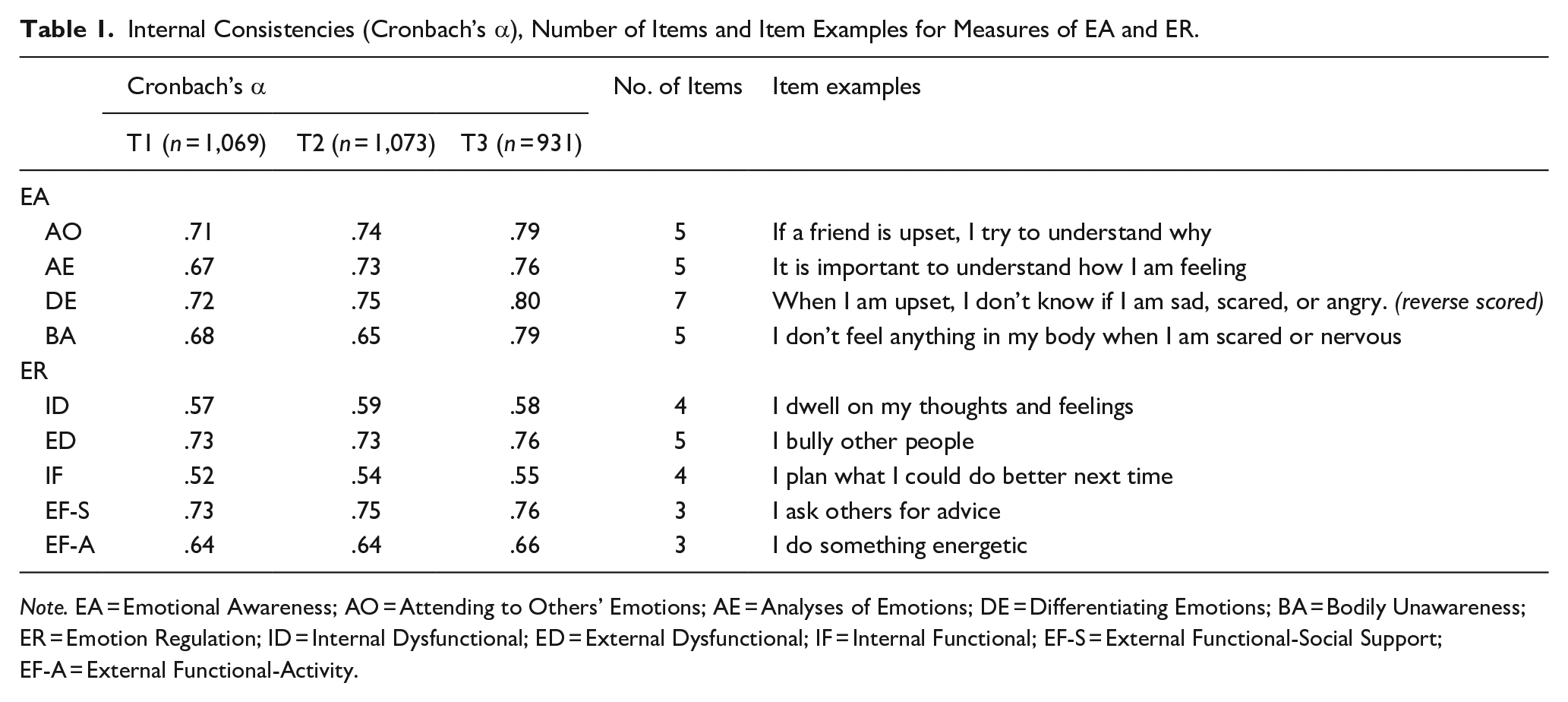
The German version of the Emotion Awareness Questionnaire (Emotion Awareness Questionnaire; Rieffe et al., 2008; Rueth et al., 2019) was used to measure EA. 2 Items were rated on a 3-point scale (1 = not true, 2 = sometimes true, 3 = often true). Adolescents’ willingness to face emotions was assessed with the two subscales Attending to Others’ Emotions (Attending to Others’ Emotions) and Analyses of One’s Own Emotions (Analyses of One’s Own Emotions). Another two Emotion Awareness Questionnaire subscales refer to adolescents’ ability to keep an external focus when experiencing emotions: Differentiating Emotions (DE) and Bodily Unawareness (BA). Higher scores on Attending to Others’ Emotions, Analyses of One’s Own Emotions, and DE indicate higher awareness, whereas higher scores on BA indicate that fewer bodily sensations of emotion experiences are perceived. Item examples and internal consistencies of the four subscales, which were acceptable and comparable to other studies using the Emotion Awareness Questionnaire (e.g., Lahaye et al., 2010), are presented in Table 1.
Internal Consistencies (Cronbach’s α), Number of Items and Item Examples for Measures of EA and ER.
Note. EA = Emotional Awareness; AO = Attending to Others’ Emotions; AE = Analyses of Emotions; DE = Differentiating Emotions; BA = Bodily Unawareness; ER = Emotion Regulation; ID = Internal Dysfunctional; ED = External Dysfunctional; IF = Internal Functional; EF-S = External Functional-Social Support; EF-A = External Functional-Activity.
Emotion Regulation
The Regulation of Emotions Questionnaire (REQ; Phillips & Power, 2007) was used to assess ER, and the German translation (e.g., Kullik & Petermann, 2013) was administered to the participants. Adolescents rated their habitual use of different ER strategies on a 5-point scale (1 = never, 5 = always). The questionnaire is based on two assumptions (Phillips & Power, 2007): First, ER strategies can be either functional or dysfunctional. Second, individuals can rely on internal/personal or external/environmental resources to deal with their emotions. Thus, the REQ comprises four subscales: Internal Dysfunctional (ID), External Dysfunctional (ED), Internal Functional (IF), and External Functional (EF). Internal consistencies were low for both internal subscales and, as suggested by reliabilities and confirmatory factor analyses (CFA) across all measurement points, one item of each internal subscale was deleted (ID: “I keep the feeling locked up inside”; IF: “I review (rethink) my thoughts or beliefs”). This improved the fit of the measurement models, and also slightly improved the internal consistencies. However, the fact that Cronbach’s alphas for ID and IF were still poor (Table 1) may indicate a heterogeneous set of items. Internal consistencies of the external subscales were acceptable, but CFA suggested that the EF items represent two different aspects of external functional ER: relying on social support and carrying out an activity. As these two aspects of external functional ER might develop differently, Social Support (EF-S) and Activity (EF-A) were analyzed separately. Item examples and internal consistencies for the five REQ subscales are shown in Table 1.
Statistical Analyses
The main analyses were conducted using Mplus Version 8.8 (Muthén & Muthén, 1998-2017) and unconditional as well as conditional Latent Growth Curve Models (LGCMs) were computed to test the hypotheses of this study. Following Hu and Bentler (1999), model fit was considered good with a comparative fit index (CFI) close to or larger than .95, values close to or smaller than .06 for the root mean square error of approximation (RMSEA), and .08 for the standardized root mean square residual (SRMR). Because no multivariate normal distribution was found, the robust maximum likelihood estimator (MLR) was used. It is robust to non-normality, and provides mean-adjusted χ2-values and corresponding scaling correction factors, which were used to compute χ2-difference tests for model comparisons (Muthén & Muthén, 2017). Missing values on the items measuring EA and ER (average: 17% across all measurement points; predominantly missing completely at random, but at least missing at random) were handled using full information maximum likelihood estimation (FIML). There were no missing values for adolescent gender or age.
Most studies report results from first-order LGCMs, using the composite scores of the measured variables as manifest indicators. However, these models require full scalar measurement invariance (MI; equal loadings and intercepts across time; Geiser, 2013; Little et al., 2007; Meredith & Horn, 2001; Newsom, 2015), and this premise is rarely examined in psychological research. This could result in questionable conclusions because differences between measurement models at various time points might be interpreted as changes in the construct (Geiser, 2013; Newsom, 2015). Consequently, longitudinal MI was initially tested (invariance across three measurement time points for the total sample) for all latent variable models in this study. At least partial scalar MI was established, and the loadings and intercepts of all referent variables (first indicators of the latent variable) were invariant, which constitutes an important requirement for further analysis (Jeon & Kim, 2021). As only partial (but not full) scalar MI was found for most models, second-order LGCMs were computed. These models include the variables of interest as measurement models, with latent variables (instead of manifest variables) at the first-order level and latent intercept and slope factors at the second-order level. Compared to first-order models, second-order LGCMs offer several advantages, such as higher reliability and the opportunity to account for sources of MI (Geiser et al., 2013; Jeon & Kim, 2021; Newsom, 2015).
First, unconditional second-order LGCMs were computed for each subscale of EA and ER to examine adolescents’ general longitudinal development on these aspects of emotional competence over the course of 1 year (Hypotheses 1 and 2). Following Geiser (2013), we tested for the presence of development over time by comparing an intercept-only model (Model 1) to the full model (Model 2), including the intercept (with loadings fixed to 1, representing the starting point of the estimated curve at T1), a linear slope (with loadings set to 0, 0.5, and 1, representing change over the course of 1 year) and the intercept-slope covariance. Only if Model 2 fits significantly better compared to Model 1, it can be assumed that there is considerable development over time. Second, to examine the role of gender and age for initial levels at T1 and changes in EA and ER, conditional second-order LGCMs were computed. 3 Adolescents’ gender, age at T1 (mean-centered), and the interaction between these two variables were included as time-invariant predictors of intercept and slope. In case the intercept-only model (Model 1) provided the best fit, only the intercept was regressed on the predictors.
Results
Unconditional LGCMs for EA and ER
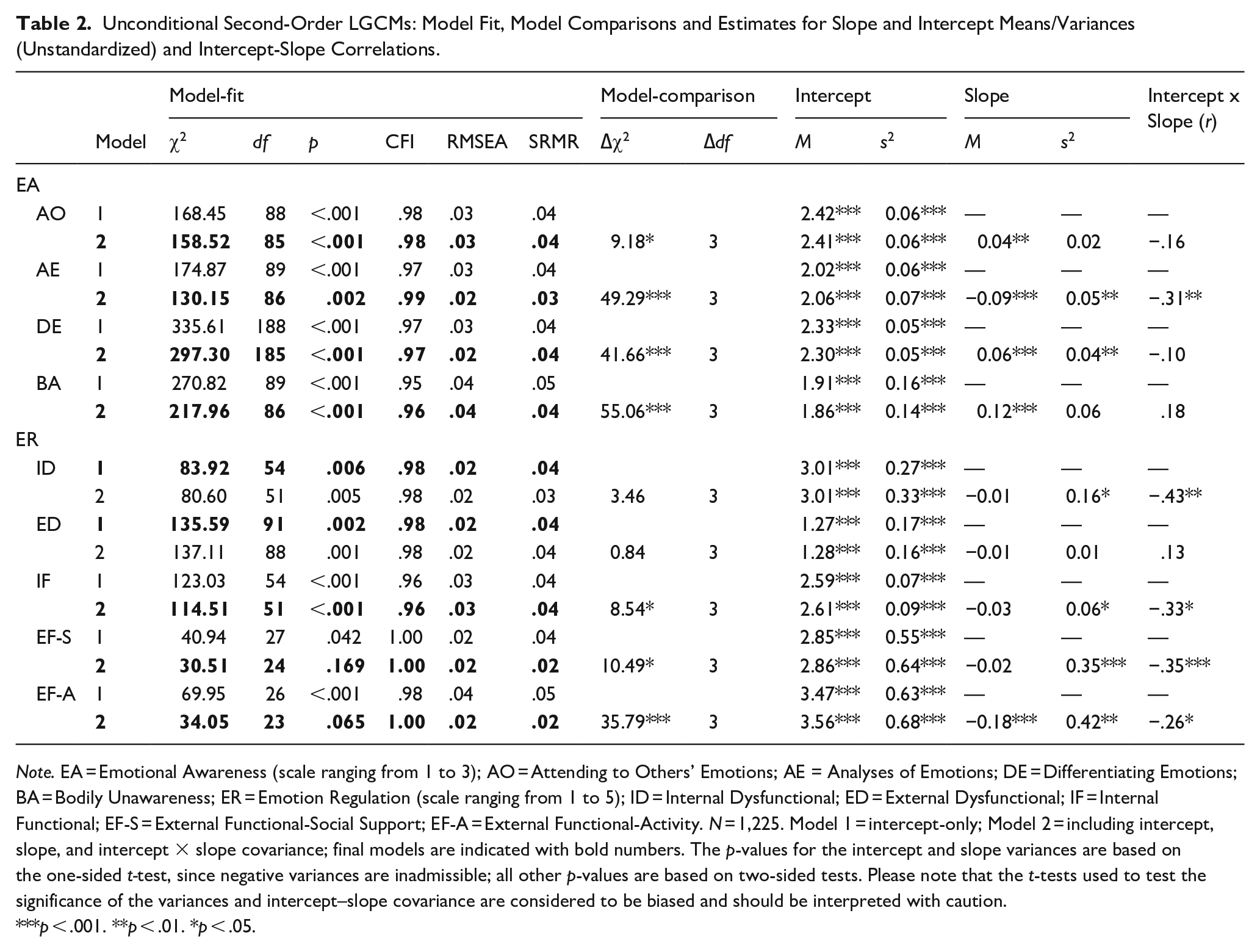
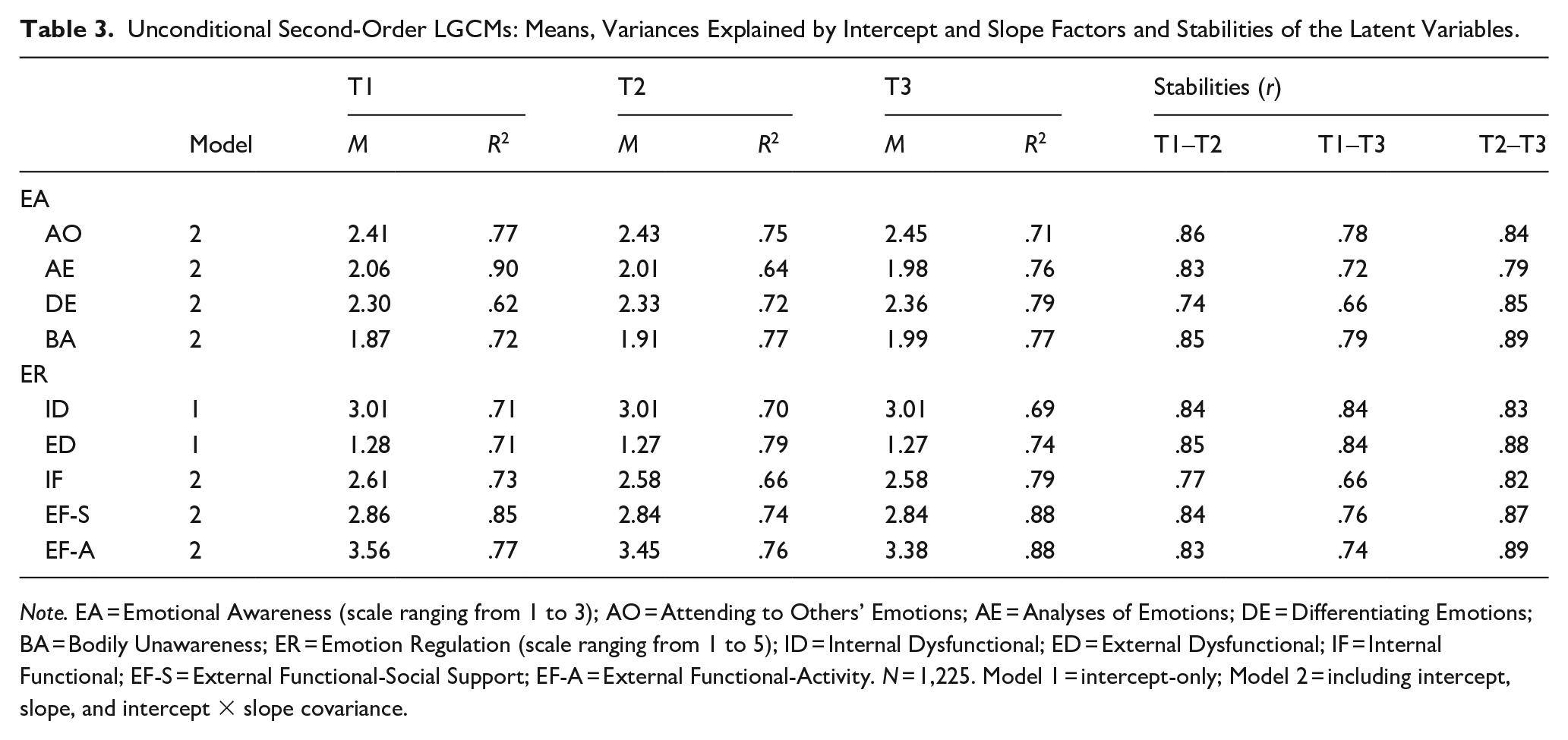
All models fit the data well. Fit-indices, model comparisons, intercept and slope means/variances, and intercept–slope correlations are presented in Table 2. The latent mean scores, explained variances, and stabilities of the latent variables over time are presented in Table 3.
Unconditional Second-Order LGCMs: Model Fit, Model Comparisons and Estimates for Slope and Intercept Means/Variances (Unstandardized) and Intercept-Slope Correlations.
Note. EA = Emotional Awareness (scale ranging from 1 to 3); AO = Attending to Others’ Emotions; AE = Analyses of Emotions; DE = Differentiating Emotions; BA = Bodily Unawareness; ER = Emotion Regulation (scale ranging from 1 to 5); ID = Internal Dysfunctional; ED = External Dysfunctional; IF = Internal Functional; EF-S = External Functional-Social Support; EF-A = External Functional-Activity. N = 1,225. Model 1 = intercept-only; Model 2 = including intercept, slope, and intercept × slope covariance; final models are indicated with bold numbers. The p-values for the intercept and slope variances are based on the one-sided t-test, since negative variances are inadmissible; all other p-values are based on two-sided tests. Please note that the t-tests used to test the significance of the variances and intercept–slope covariance are considered to be biased and should be interpreted with caution.
p < .001. **p < .01. *p < .05.
Unconditional Second-Order LGCMs: Means, Variances Explained by Intercept and Slope Factors and Stabilities of the Latent Variables.
Note. EA = Emotional Awareness (scale ranging from 1 to 3); AO = Attending to Others’ Emotions; AE = Analyses of Emotions; DE = Differentiating Emotions; BA = Bodily Unawareness; ER = Emotion Regulation (scale ranging from 1 to 5); ID = Internal Dysfunctional; ED = External Dysfunctional; IF = Internal Functional; EF-S = External Functional-Social Support; EF-A = External Functional-Activity. N = 1,225. Model 1 = intercept-only; Model 2 = including intercept, slope, and intercept × slope covariance.
EA (Hypothesis 1): Willingness Facing Emotions (Attending to Others’ Emotions, Analyses of One’s Own Emotions) and External Focus (DE, BA)
Regarding EA, all model comparisons were significant and suggested significant linear change over time. For adolescents’ attention to others’ emotions (Attending to Others’ Emotions), a linear increase was found (positive slope mean), Δχ2(3) = 9.18, p = .027. By contrast, a significant decrease (negative slope mean) in adolescents’ analyses of their own emotions (Analyses of One’s Own Emotions) over the course of 1 year was found, Δχ2(3) = 49.29, p < .001. Results for both indicators of adolescents’ ability to maintain an external focus during an emotion experience suggested linear increases (positive slope means) for differentiating emotions (DE), Δχ2(3) = 41.66, p < .001, and bodily unawareness (BA), Δχ2(3) = 55.06, p < .001. The changes in all four aspects of EA are also reflected in the latent means (Table 3).
ER (Hypothesis 2): Dysfunctional (ID, ED) and Functional Strategies (IF, EF-S, EF-A)
Model comparisons did not support linear development of either internal dysfunctional (ID), Δχ2(3) = 3.46, p = .326, or external dysfunctional ER strategies (ED), Δχ2(3) = 0.84, p = .841. This is also apparent in the stable latent means (Table 3). For all types of functional strategies, however, the significant model comparisons suggested meaningful linear development of internal functional (IF), Δχ2(3) = 8.54, p = .036, external functional social support, Δχ2(3) = 10.49, p = .015, and external functional activity-related strategies (EF-A), Δχ2(3) = 35.79, p < .001. While IF and EF-S values decreased only slightly over time across individuals, decreases for EF-A were substantial.
Conditional LGCMs
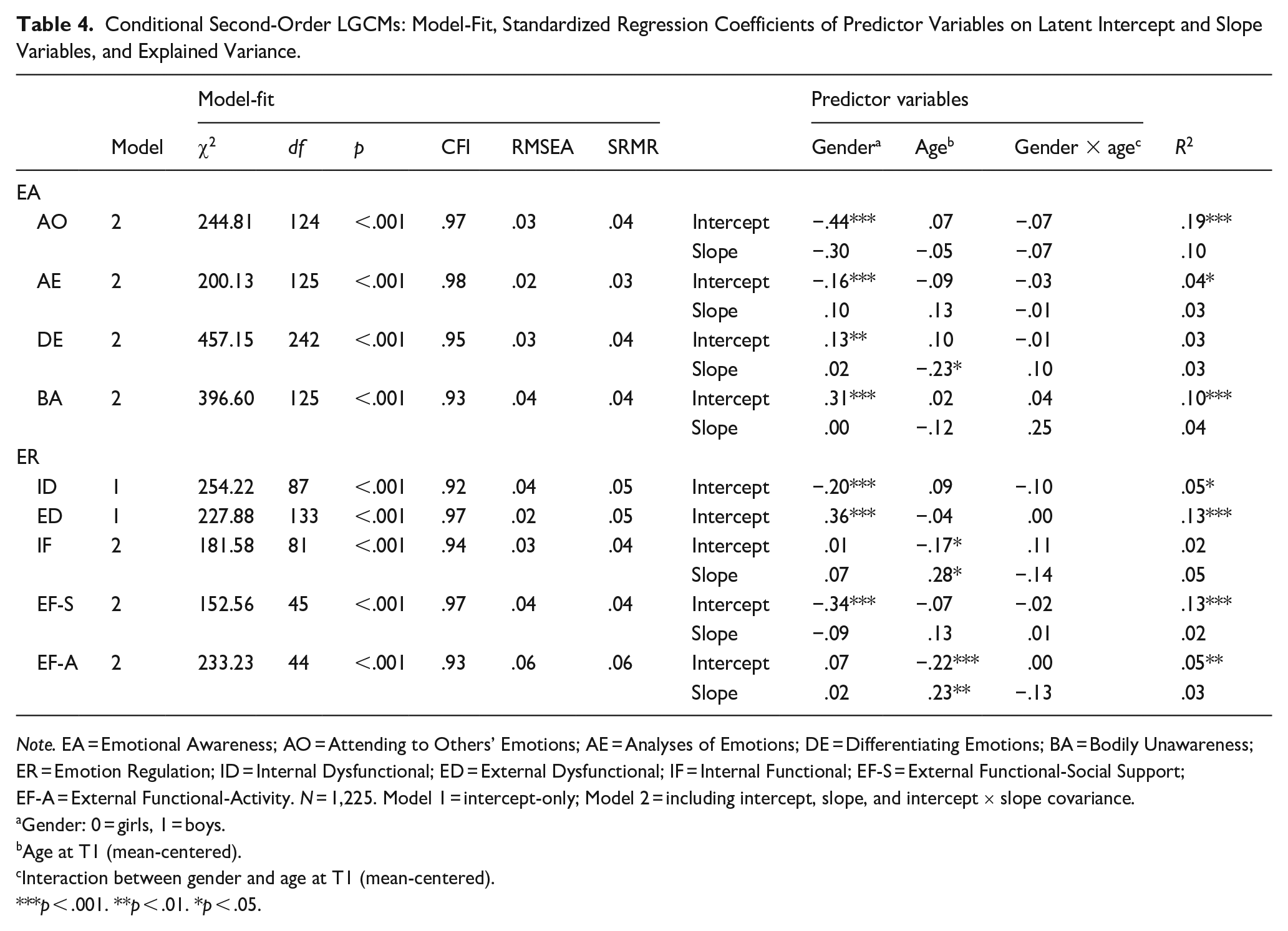
Fit indices of the conditional models, which indicated good or acceptable model fit, standardized regression coefficients, and variances explained by the predictor variables are shown in Table 4. In brief, adolescents’ age at T1 significantly predicted selected intercepts and slopes, while gender significantly predicted most intercepts, but none of the slope variables. The interaction between age and gender neither predicted the intercepts nor the slopes. The statistically significant results on age and gender are presented in more detail below.
Conditional Second-Order LGCMs: Model-Fit, Standardized Regression Coefficients of Predictor Variables on Latent Intercept and Slope Variables, and Explained Variance.
Note. EA = Emotional Awareness; AO = Attending to Others’ Emotions; AE = Analyses of Emotions; DE = Differentiating Emotions; BA = Bodily Unawareness; ER = Emotion Regulation; ID = Internal Dysfunctional; ED = External Dysfunctional; IF = Internal Functional; EF-S = External Functional-Social Support; EF-A = External Functional-Activity. N = 1,225. Model 1 = intercept-only; Model 2 = including intercept, slope, and intercept × slope covariance.
Gender: 0 = girls, 1 = boys.
Age at T1 (mean-centered).
Interaction between gender and age at T1 (mean-centered).
p < .001. **p < .01. *p < .05.
Conditional effects of age on EA revealed that younger adolescents show more positive slope scores for differentiating emotions (i.e., stronger increase; DE: mean slope = 0.06, βage = −.23, p = .011). With regard to ER, younger adolescents showed higher initial levels (intercepts) of internal functional (IF: βage = −.17, p = .011) and external functional activity-related strategies (EF-A: βage = −.22, p < .001), and also more negative slope scores (i.e., stronger decrease) for these two types of functional ER (IF: mean slope = −0.03, βage = .28, p = .010; EF-A: mean slope = −0.18, βage = .23, p = .008). More detailed graphical inspections (Figure 1) revealed that the observed trajectories (increases in DE, and decreases in IF and EF-A) were evident across almost all age groups, with trends being most pronounced for 10- and 11-year-olds, and less pronounced but still apparent for 12- and 13 year-olds. For DE and EF-A, this trend continued for 14-year-olds, but reversed for 15-year-olds, showing decreases for DE and increases for EF-A. However, the number of 15-year-olds in the sample was very small (n = 12). For IF, the developmental trend reversed for 14- and 15-year-olds, showing increases over time.
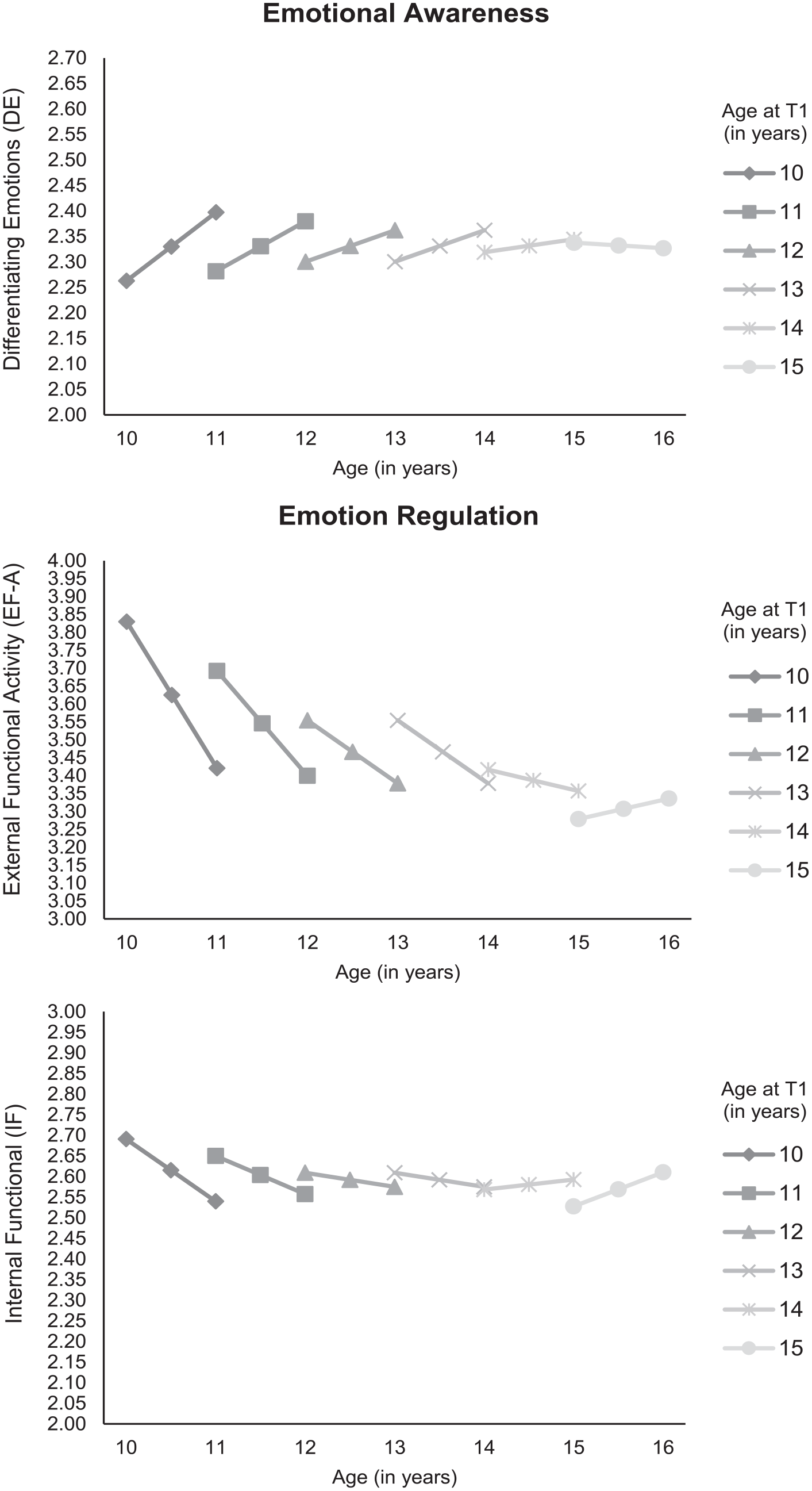
Age-Specific Developmental Trajectories of Emotional Awareness and Emotion Regulation.
Adolescents’ gender significantly predicted all intercepts except for IF and EF-A, but none of the slopes. Regarding EA at T1, girls reported a higher willingness to face emotions (Attending to Others’ Emotions: βgender = −.44, p < .001; Analyses of One’s Own Emotions: βgender = −.16, p < .001), and a lower ability to maintain an external focus during an emotion experience (DE: βgender = .13, p = .002; BA: βgender = .31, p < .001). Regarding ER, girls reported more internal dysfunctional (ID: βgender = −.20, p < .001) and more external functional social support strategies (EF-S: βgender = −.34, p < .001), whereas boys reported more frequent use of external dysfunctional strategies (ED: βgender = .36, p < .001).
Discussion
Previous research has demonstrated the importance of EA and ER for youth development, yet longitudinal studies of developmental trajectories of these aspects of emotional competence are lacking (Booker & Dunsmore, 2017; Zimmer-Gembeck & Skinner, 2011). Hence, the main aim of this study was to investigate the developmental trends of early and middle adolescents’ EA and ER over the course of 1 year. Furthermore, the role of gender and age for initial levels and development was examined.
Developmental Trends of EA and ER, and Associations with Age
Based on previous research (e.g., Rubenstein et al., 2015), it was hypothesized that EA increases in early and middle adolescence, and results of the unconditional LGCMs supported this assumption for most aspects of EA: Adolescents attention to others’ emotions (Hypothesis 1a) as well as their ability to keep an external focus during an emotion experience, namely their emotion differentiation and bodily unawareness (Hypotheses 1c and d), showed linear increases over time. This supports the assumption that youth gain better access to their own and others’ emotions as they develop and adds longitudinal findings with a focus on adolescence to the mostly cross-sectional findings from samples covering a broader developmental range (i.e., elementary and secondary school children; Lahaye et al., 2010; van der Veek et al., 2012). The greater age heterogeneity in previous studies increases the likelihood of detecting age effects, but the current study shows that development also occurs within a relatively short period of time in early and middle adolescence. The additional finding (from the conditional LGCMs) that the increase in emotion differentiation was more pronounced in younger than in older participants further suggests that the overall improvement diminishes, which might be due to the emotional challenges associated with puberty (for an overview see Bailen et al., 2019). In contrast to the increase in most aspects of EA, and also contrary to our expectations, a longitudinal decrease over the 1-year period was found for adolescents’ willingness to face their own emotions (Hypothesis 1b, unconditional LGCMs). The opposite trend could be explained by the finding that peers who are perceived as tough have a higher social status (Vaillancourt & Hymel, 2006). Therefore, as adolescents grow older, they may perceive an emotionally oriented person as unpopular, which could lead them to report less about the emotions they experience.
With regard to ER, an increase of dysfunctional and a decrease of functional strategies were expected. However, results of the unconditional LGCMs indicated that adolescents’ use of (internal and external) dysfunctional ER strategies (Hypothesis 2a) is relatively stable over the course of 1 year. In line with this, no significant associations with age were found in the conditional LGCMs. This contradicts the hypothesized “maladaptive shift” (Cracco et al., 2017), but is consistent with Zimmermann and Iwanski (2014), who reported stability of some selected dysfunctional strategies (e.g., suppression, rumination). It should be noted, however, that these results were based on cross-sectional data and comparisons of different age groups with respect to the use of specific strategies. Therefore, the current findings extend the existing literature by providing a longitudinal perspective and a broader categorization of ER strategies and suggest that adolescents—despite the challenges they face in this developmental period of increased vulnerability (Steinberg, 2005)—are not more likely to use dysfunctional strategies.
For functional ER (Hypothesis 2b, unconditional LGCMs), however, the model comparisons suggested longitudinal decreases for all strategies under investigation. In addition, the older participants were, the fewer internal functional ER as well as external functional activity-related strategies were reported (conditional LGCMs). This corresponds to studies reporting a decrease of both internal (e.g., problem-solving) and external (e.g., social support seeking) functional ER in early and middle adolescence (Cracco et al., 2017; Zimmermann & Iwanski, 2014). Based on this, it can be assumed that youth have increasing difficulties in using functional strategies effectively, which might be due to their high emotional reactivity, especially in early and middle adolescence (Casey et al., 2010; Somerville, 2018; Steinberg, 2005). Furthermore, adolescents may evaluate the situational demands as too high in relation to their resources and skills and are thus unable to flexibly select situationally appropriate functional strategies (Zimmer-Gembeck & Skinner, 2016). However, it should be mentioned that only the overall decrease of external functional activity-related ER was substantial, and it appears that this strategy in particular is undergoing considerable development. This is in line with observations of low energy and increased daytime sleepiness in adolescence resulting from inadequate sleep behavior on school days (Baum et al., 2014; Ohayon et al., 2004), which could also contribute to the decrease in ER strategies involving activities.
Conditional LGCMs indicated that the decline in internal functional ER and external functional activity-related ER strategies was more pronounced in younger adolescents, and the developmental trend (i.e., decrease) for internal functional strategies was reversed (i.e., increase) for participants aged 14 and 15 years (at T1). Thus, it seems particularly challenging to use functional strategies (i.e., reappraisal) in early adolescence, which might reflect that this period is not only characterized by considerable neurophysiological development and higher emotion intensity (Bailen et al., 2019; Somerville, 2018) but also by numerous social and environmental changes (e.g., changing school; Meschke et al., 2012; Riediger & Klipker, 2014). This could contribute to a steeper decline in early adolescence that attenuates as development progresses through mid-adolescence (and even reverses for internal functional ER).
Associations with Gender
The conditional LGCMs revealed no gender-specific developmental pathways of EA and ER, but significant mean differences at T1. Regarding EA, girls reported a higher willingness to face emotions, whereas boys seem to be better at keeping an external focus during an emotion experience, which is consistent with previous studies (Lahaye et al., 2010; Rieffe & Camodeca, 2016; Rueth et al., 2019; van der Veek et al., 2012). Girls’ higher attention to others’ emotions also corresponds to findings that girls show more empathy (e.g., Rieffe & Camodeca, 2016). Emotional engagement is considered an important characteristic of femininity, and girls might be more willing than boys to present themselves as emotion-oriented and empathetic (Eisenberg & Lennon, 1983). Boys’ lower bodily awareness complies with the finding that males report less somatic symptoms and are less sensitive to pain (Gijsbers van Wijk & Kolk, 1997), which could also be reflected in the lower awareness of bodily sensations during an emotion experience. This could contribute to boys’ better ability to maintain an external focus and thus also to distinguish between different emotions because they are less overwhelmed by bodily sensations.
With regard to dysfunctional ER, boys use more external (e.g., physical aggression) and girls use more internal strategies (e.g., rumination), which is in line with previous findings (e.g., Koglin et al., 2013; Zimmermann & Iwanski, 2014) and the stereotype that boys are more impulsive, whereas girls are more introverted and prone to rumination. In addition, girls (compared to boys) are more likely to use external functional social support strategies, which corresponds with previous studies (e.g., Eschenbeck et al., 2007) and the finding that girls are more socially oriented (Frydenberg & Lewis, 1993) and femininity is associated with more emotional and social support seeking (Reevy & Maslach, 2001). Overall, despite gender differences in puberty onset and maturation (Fechner, 2003; Klimstra et al., 2009) and previously found longitudinal gender-specific developmental trends for suppression (Gullone et al., 2010), we found no evidence in this regard for the broader categories of ER strategies examined in this study. However, cross-sectional studies (Cracco et al., 2017; Zimmermann & Iwanski, 2014) also found significant interaction effects of age and gender only for specific strategies. This may suggest that gender-specific developmental trends only occur for selected ER strategies, but not at a more general level.
Strengths, Limitations, and Future Directions
Notable strengths of this study are the large sample size covering early and middle adolescence, and the analysis of longitudinal data comprising three measurement points. Thus, this study is one of the few that not only compares different age groups using cross-sectional data but also analyzes developmental trends of emotional competence over time for different age groups. Furthermore, an important methodological strength of this study is that the premise of longitudinal scalar MI was tested. Non-invariant loadings and intercepts were considered by conducting second-order LGCMs, rather than using composite mean scores in which longitudinal differences between measurement models might mistakenly be interpreted as development (e.g., Geiser, 2013; Newsom, 2015).
Beyond these strengths, there are also some limitations to be mentioned: This study only used adolescents’ self-reports and it is desirable to include different perspectives in future research. In addition, the results on internal ER should be interpreted with caution because the reliabilities of the two subscales were low. In comparison to many other questionnaires, the subscales of the REQ (Phillips & Power, 2007) comprise items related to several different ER strategies, rather than measuring only selected strategies (e.g., reappraisal, suppression). Therefore, the low reliabilities could reflect the heterogeneity of items or strategies within each of the subscales that were built upon the theoretically assumed dimensions of internal versus external ER, as well as the empirically based categories of functional and dysfunctional ER (Phillips & Power, 2007). The second-order LGCMs used in this study address this problem as they are more reliable, have greater statistical power, and better account for measurement errors than first-order LGCMs (Geiser et al., 2013; Newsom, 2015). However, future studies should carefully select more reliable measures of ER, covering a wide range of different strategies (e.g., Garnefski et al., 2001; Rueth & Lohaus, 2022). Further limitations are that this study comprised only three measurement points within the short period of 1 year and that it was not possible to apply the multigroup approach to our data (see Note 3). Future studies should include at least four measurement points (to allow analyses on quadratic trends), and the aim should be to cover a longer period of time by either extending the longitudinal assessment or by using the cohort structure of the data. Corresponding to these limitations, the longitudinal changes in the latent means were small and a stronger development, which is also of practical relevance, may only emerge in longer periods of observation. However, the fact that significant development was found even in a 1-year period underlines that early and middle adolescence (and not only childhood) is characterized by a considerable development of emotional competencies. Finally, in comparison to the full sample, only 63% of the participants were included in the analyses of this study. However, dropout analyses (see Note 1) revealed very few significant differences and their effect sizes (odds ratios) were small.
Conclusion
This study shows significant developmental trends for both EA and functional ER strategies even over the course of 1 year in early and middle adolescence. Despite improvements in most aspects of EA, a reverse trend for ER was found, namely a decline in the use of functional strategies (with steeper declines especially in younger age groups). As both components of emotional competence have been proposed as transdiagnostic predictors of psychopathologies (Aldao et al., 2016; Kranzler et al., 2016), future research in this area should address how adolescents can use improvements in EA to functionally regulate their emotions, even during emotionally challenging periods of life such as early and middle adolescence. Further insights could help to improve prevention and intervention programs to promote mental health.
Footnotes
Authors’ Note
The raw data supporting the conclusions of this manuscript will be made available by the first author to any qualified researcher upon request without undue reservation.
Declaration of Conflicting Interests
The author(s) declared no potential conflicts of interest with respect to the research, authorship, and/or publication of this article.
Funding
The author(s) disclosed receipt of the following financial support for the research, authorship, and/or publication of this article: The study was funded by grants LO 337/28-1 and VI 651/2-1 from the German Research Foundation (DFG).
