






Abstract
This study investigates how institutional context influences the implementation and use of digital technologies for openly sharing and reusing open research data at public universities. Using an institutional work lens, we develop a conceptual model and apply it to three case studies involving Dutch universities. The institutional work lens proved useful for identifying influencing mechanisms in the context of open research data sharing and reuse in universities, enabling us to distinguish historical trajectories, such as culture; contextual conditions, such as the type of research data; and institutional contexts, such as regulative mechanisms and the daily activities of individual researchers. Eight of the nine identified mechanisms appeared in all three cases. While this study is among the first to examine open research data from an institutional work lens, it finds that applying this lens is not always straightforward. Our contributions include an adjusted theoretical model of institutional work tailored to the context of open research data. In addition, it expands the limited number of case studies available on institutional contexts and institutional work influencing the use of digital technologies for open research data sharing and reuse, while providing in-depth insights into such contextual factors across different universities in the Netherlands. Furthermore, our findings highlight for practitioners which mechanisms can be influenced to promote open research data within specific contexts and which are more resistant to change.
Keywords
1. Introduction
Open research data concern the publication of data underlying the findings of researchers’ studies in an open and proactive manner without any restrictions [1]. Open research data have considerable value [2]. Economically, open research data hold value for peer researchers who can (partially) reuse the data in future studies [3,4] and save time and money by accessing existing data instead of paying for subscriptions or reproducing data sets, which accelerates research uptake, efficiency, and innovation [5]. Moreover, developers, citizens, and companies that otherwise would not have had access to this data are now able to develop or improve applications and services on top of this data [6]. Socially, open research data may add value by enhancing research transparency [7,8] and researchers’ accountability, responsiveness, acknowledgment, and participation [1,6,9]. Open research data make it possible to reproduce each other’s research [3], ferret out any possible poor analyses and fraud [10], increase the visibility of research output [11,12], and improve political processes [13]. For society and science as a whole, open research data promote democratizing scientific knowledge and science to better address societal needs and challenges. The vast amount and diversity of data generated by digital information systems nowadays have the potential to make significant contributions toward addressing major challenges and promoting societal welfare [14].
The publication of open research data and the reuse of this data extensively draw on digital technologies. Examples of digital technologies used in the context of open research data include research data platforms [15,16] and powerful search engines to make data findable [17], web interfaces and application programming interfaces (APIs) to make data accessible [18–20], metadata standards [21,22], persistent identifiers (PIDs) to make data interoperable [23], and technologies for visualizing, analyzing, linking, combining, and assessing data sets to make data reusable [24]. Altogether, these digital technologies form technical instruments that facilitate or hinder openly sharing and reusing research data.
The institutional context affects the implementation and use of digital technologies used for open research data sharing and reuse. For example, previous research found that institutional and professional recognition of data sharing efforts can promote open research data sharing [25], and a stimulating academic culture can positively influence open research data sharing [26–28]. Moreover, customized data management approaches and institutional models that cater to the needs of researchers can stimulate the sharing of research data [29]. The provision of institutional support [30,31] and a conducive organizational environment [30], which may involve technical or human support available to researchers through their affiliated institutions or organizations, can foster the sharing of research data in an open manner. The institutional context also affects the reuse of open research data [26]. For instance, strong social influence from, for example, colleagues can potentially drive the reuse of openly available research data [32].
While the abovementioned institutional factors, also referred to as institutional instruments, can promote open research data sharing and reuse, a lack of these instruments can hinder or demotivate open research data sharing and reuse. Moreover, various institutional contexts affect the implementation and use of open research data technologies. For example, within their institution, researchers may work with confidential or otherwise sensitive data [33–36]. Openly sharing and reusing research data can be time-consuming or perceived as such [37] and require additional effort [26], or the research budget leaves no room to outsource data sharing, resulting in researchers opting out of open research data [29,38]. Hence, despite the enormous potential of open research data and the willingness of many stakeholders to publish this data, the adoption rate of open data remains low in academic research [1,9].
Previous research extensively identified both drivers and inhibitors for researchers to adopt open research data [1,34,39–42], as well as instruments capable of (partially) mitigating these barriers and exploiting the motivators [28,43]. Moreover, there is already some insight into how different institutional contexts affect the sharing and reuse of open research data [26–28]. However, many existing studies on this topic address a specific aspect of the institutional context, whereas a more holistic view of the various contexts of universities has received less attention. Moreover, existing research barely provides insight into how the institutional context of public universities affects the implementation and use of digital technologies for open research data sharing and reuse.
This study aims to investigate how institutional context influences the implementation and use of digital technologies for openly sharing and reusing open research data at public universities in the Netherlands. We build on theoretical notions from institutional work and apply those in the literature on open research data sharing. Moreover, focusing on three Dutch universities, this study’s scientific contributions originate from extending the number of case studies available on institutional contexts influencing open research data sharing and reuse at Dutch universities and comparing such factors among different cases. This study’s scientific contributions include the provision of in-depth insights into how institutional work, including different institutional contexts, influences open research data sharing and reuse by academic researchers in three Dutch universities. Simultaneously, this study’s findings are societally relevant because they reveal to open data policymakers, support staff, and researchers which of the identified contextual factors can be influenced to promote open research data within specific contexts and which ones are more difficult to change. This helps them decide which factors to focus their attention and efforts on.
This study is structured as follows. The next section provides the background of this research, including an analysis of research on digital technologies and institutional instruments used to stimulate open research data sharing and reuse. Then, we discuss the theoretical framework of institutional work that is applied to this research, followed by the research design, including the case study research approach. Subsequently, the case study descriptions and analysis are presented. Finally, the research findings are discussed in the context of the institutional work lens, and the scientific and practical implications are highlighted.
2. Research background
2.1. Digital technologies for open research data
There is no widely accepted definition of digital technologies [44]. Some scholars simply define digital technologies as “computers and other information technology” [45] (p.4) or as “social media, mobile, analytics, or embedded devices” [46] (p.2). In this study, we take a broader view and follow Loebbecke [47], who states that digital technologies encompass all technologies used for creating, processing, transmitting, and utilizing digital goods, which can be categorized under the umbrella term information, communication, and media technologies. Furthermore, we adopt the view that digital technologies differ from the traditional understanding of information technology [48], extending beyond infrastructure-enabled automation and connectivity. Because digital technologies are embedded in products and services and play an increasingly immersive role in society, they serve a broader range of purposes than conventional information technologies [49].
In their layered architecture of digital technology, [50] differentiate between four digital technology layers: service, content, network, and device [51]. They further elaborate on these layers, stating that the service layer defines the objective of digital technologies by relating to their application functionality, distinguishing between the degree of human participation and the aim of digital technology. The content layer delineates how the data is used and processed, such as whether it concerns data collection, aggregation, analysis, execution, or transmission. The network layer relates to the interaction of digital technologies with their socio-technical environment. Finally, the device layer caters to the requirements of digital technology for the devices that underlie its operations, where the scope of the device can be physical or cyber-physical [50,51].
In addition [51], distinguish seven digital technology archetypes: platform, connectivity, actor-based product, sensor-based data collection, analytical insight generation, analytical interaction, and augmented interaction. Applied to the context of open research data, the first key technology concerns research data platforms. Such platforms promote the large-scale sharing and reuse of open research data [15]. Similar to digital platforms in general [52], open research data platforms allow various groups to join the platforms as users or providers of goods and services. In this case, open research data platforms allow humans and machines to locate open research data. Open research data platforms are often referred to as research data repositories in this field [53,54].
Second, in terms of connectivity, powerful search engines and a range of query interfaces allow researchers to search for data and increase the findability of open research data [17]. Furthermore, APIs contribute to the connectivity of open research data [55], and so do search standards for APIs. In addition, the provision of metadata in various formats by the repository should enable its harvesting by diverse search engines [24]. Controlled vocabularies and ontologies form meticulously regulated lists of terms that delineate and signify a particular area of interest and that can be used to consistently describe data sets [56], such as the Data Catalog Vocabulary [57] and the Ontology of Biomedical Investigation [58]. Non-proprietary data formats and open standards enhance the openness of research data [59]. Finally, research data backup and long-term data storage, two other digital technologies that remain mostly invisible to users, should ensure that data are always available for reuse. Open data platforms should be secured against breaches and accidental data loss so researchers can trust these platforms [43,60].
A third digital technology archetype relevant to open research data concerns actor-based products. Examples of relevant digital technologies in this category include web interfaces and APIs. These technologies allow researchers, developers, and other actors to access research data [18–20]. Other examples of actor-based products relevant for research data sharing and reuse include representations that are both human (HTML) and machine-readable (RDF, JSON, XML) [61]. Moreover, actor-based products can be applications using open research data, such as mobile applications that provide their users with information about the planets and the universe. Another example concerns displaying data visualizations based on open research data on a screen. Finally, we consider digital object identifiers (DOIs) and other persistent identifiers (PIDs) as typical of the actor-based archetype. PIDs are globally unique names assigned to resources, including data sets [23].
As a fourth digital technology archetype, sensor-based data collection allows for collecting research data. For example, sensor-based digital health technologies enable the continuous collection of physiological, functional, and performance data in both clinical and real-world settings [62]. As another example, sensors measuring air quality may be used to collect data on the concentration of pollutants in a particular area over time [63] and study the effects of air pollution on public health.
Fifth, in the context of open research data, analytical insight generation refers to researchers utilizing various data analysis techniques to elicit relevant insights and knowledge from open research data. Such insights may be useful for informed decision-making and may advance scientific knowledge. For example, researchers may apply data mining, qualitative analysis, or statistics to available public research data on student behavior to forecast their performance and to develop targeted strategies for improving student performance [59,64]. As another example, predictive safety analytics can be applied to massive vehicle trajectory data to identify accident-prone areas and predict traffic risks [65,66].
Analytical insights can also be generated from open research data using artificial intelligence techniques, such as machine learning methods that identify patterns in large data sets and build predictive models from longitudinal data [67]. This may lead to novel discoveries and a deeper understanding of complex problems. As another example, citizen data science has proven to be useful in generating analytical insights in the fields of ecology, biodiversity, and biology [68], environmental sciences [69,70], astronomy [71], social sciences and humanities [72], and other disciplines [73]. Finally, through citizen-sourcing, public organizations involve citizens in problem-solving tasks, such as proposing ideas or solutions to the government, or in task execution, such as helping governments monitor urban maintenance issues [74].
The sixth digital technology archetype identified by Berger et al. [51] concerns analytical interaction. Analytical interaction applied to the open research data context involves collaborating with others to generate new insights and knowledge by using data analysis techniques. For example, during the COVID-19 pandemic, researchers collaborated globally to share ideas and insights based on research data analysis [75,76]. Research data can be visualized, analyzed, linked, combined, and assessed to make this data reusable [24]. As another example, the ClimateSpark web portal uses SQL queries and Scala/Python notebook functionalities to facilitate collaboration among climatologists, climate data, computing resources, and analytic operations [77]. In this way, analytical interaction can lead to more robust and comprehensive analyses that can inform decision-making, address global and societal challenges, and advance scientific understanding.
Finally, Berger et al. [51] identify the digital technology archetype of augmented interaction. An example of augmented interaction in the context of research data concerns a smart laboratory where researchers use interactive digital technologies, including augmented reality, to collect and transmit data from physical experiments [78]. In such smart laboratories, the researchers may use wearable systems featuring a head-up display, point-of-view video recordings, voice recognition, and hand gesture recognition to interact with the technology [79], providing physical input that is then processed, analyzed, and possibly shared openly. This approach can streamline data collection, reduce human error, and enhance the efficiency of research data processing. As another example, Ard et al. [80] illustrates how the viewing of digital data can be seamlessly incorporated into existing publication workflows via web-based and augmented reality technologies.
Altogether, these digital technologies form the infrastructure and its application instruments that can either facilitate or hinder openly sharing and reusing research data. Digital technologies are part of the institutional context in which universities operate to realize the sharing and reuse of open research data.
2.2. Institutional instruments for open research data
The previous section provided background information concerning digital technologies and their infrastructural instruments relevant to the context of open research data. This section discusses the relevant institutional instruments for realizing open research data. Simultaneously, digital technologies and institutional instruments affect the institutional contexts of universities. These contexts then affect open research data sharing and reuse by researchers employed by public universities.
In this study, we follow Hodgson [81] in defining institutions in a broad way as “integrated systems of rules that structure social interactions,” where the term “rule” refers to “norms of behaviour and social conventions, as well as legal rules” (p. 501). Institutions employ institutional instruments to form and endorse such institutional rules. In general, combining various institutional instruments is critical for digital transformation [82]. Aligned with the focus of institutional theory [83,84] on how various structures, such as schemas, rules, norms, and routines, are established and gain recognition as authoritative principles for regulating social conduct [83], institutional instruments can be used to influence the fundamental and enduring elements of social organization. In the context of open research data, institutional theory has been investigated primarily in combination with the theory of planned behavior [85,86]. For example, Kim [87] explains how practices of research data sharing are influenced by institutional pressure, individual motivation, and technological resources. Kim [87] refers to the integrated theoretical framework developed by Kim and Zhang [88] and Kim and Stanton [89], which takes into account the broader institutional contexts in which researchers operate, including funding agencies and data sharing support services, by incorporating institutional theory. In addition, the framework by Kim and Zhang [88] and Kim and Stanton [89] utilizes the theory of planned behavior to describe the underlying individual motivations, such as researchers’ perceptions and norms, and the resource-facilitating conditions within an institutional environment, such as metadata, data repositories, and other digital technologies, that shape data sharing behaviors.
Institutional instruments refer to the combination of formal structures, informal structures, and enforcement characteristics or operational mechanisms that institutions can put in place to incentivize open data sharing and reuse [90,91]. Examples of such formal structures are policies and processes. Informal structures include the existing norms and culture. Enforcement characteristics or operational mechanisms are mechanisms that can be used on the work floor, such as training, education, and support for openly sharing and reusing open research data. In general, institutional instruments can be hierarchy-based (authority and rules), market-based (competition, exchange, and interaction between actors), or network-based (cooperation between actors, trust, mutual dependencies, and actor responsibilities) [92]. Following [93], the literature on institutional instruments to stimulate open research data can be classified into (1) instruments that support the management and governance of data sharing and reuse processes, (2) instruments that actively support the operational aspects of open research data sharing and reuse, and (3) instruments covering costs that open research data sharing and reuse incur.
The first category of instruments encompasses institutional instruments that support the management and governance of data sharing and reuse processes. Mostly, this category is about policies, for example, developing institutional data management policies or policies around sharing and reusing open research data [43,94]. This category also includes instruments around data management plans, such as introducing these plans as a tool to make researchers familiar with the subject of open research data, standardizing data management plans across research domains, or making them “machine-actionable” [93].
A second category of institutional instruments to enhance open research data concerns institutional instruments that actively support the operational aspects of open research data sharing and reuse. Educational programs and training fall into this category [38], as well as the creation of communities and peer-to-peer networks in which knowledge can be shared between researchers around best practices regarding open research data [43,95]. Furthermore, the appointment of data stewards is an institutional instrument that supports operational aspects of open research data sharing and reuse. Such data stewards can then answer researchers’ questions about open research data or point researchers to available instruments for open research data [60,96,97]. Moreover, Piwowar et al. [37] and Patel [43] argue that support should be provided to researchers to choose the right license under which to publish their work to protect copyright and intellectual property concerns. A final instrument within this category is spreading knowledge about which infrastructures are suitable for which domain, especially when it comes to choosing a data repository by researchers [98].
The third category refers to institutional instruments covering costs that open research data sharing and reuse incur. Even if researchers have the internal motivation to share their data openly, they may still lack the funds to do the work required to clean up the data and make it fit for publication [93]. The appointment of data managers by a university could also help in that regard, as it is an in-kind way of taking away researchers’ concerns about who will cleanse the data and prepare it for publication [99].
Each of the abovementioned institutional instruments contributes to implementing institutional rules, following the definition of Hodgson [81] regarding rules as behavioral norms, social conventions, and legal rules. We argue that together, digital technologies and institutional instruments can affect the institutional contexts of universities. These contexts, in turn, affect open research data sharing and reuse by researchers employed by public universities. The following section discusses the theoretical framework that we use to examine the impact of institutional contexts on open research data sharing and reuse in specific cases.
3. Theoretical framework
In this study, we build on theoretical notions from institutional work. Institutional work is a specific focus within institutional studies of organization [100]. The concept of institutional work describes “the practices of individual and collective actors aimed at creating, maintaining, and disrupting institutions” (Lawrence et al. [100], p.52). It focuses on comprehending how practical actions affect institutions [101]. Central to the study of institutional work are both the intentional and sometimes highly visible actions taken in relation to institutions and the often nearly invisible actions in the daily adjustments, adaptations, and compromises of actors in their endeavors to maintain institutional arrangements [101].
Much of the literature on institutional studies of organization examines the recursive relationship between institutions and action [102,103]. On one hand, institutions offer frameworks for actions and utilize regulative mechanisms that enforce those templates. On the other hand, the actions of the actors within the institutions exert an influence on both these frameworks and the regulative mechanisms. Institutional work is focused on the second aspect of this recursive relationship, namely, on how the actions of actors affect institutions. While it does not ignore the influence of institutions on actions, its unit of analysis concerns the effects of actions and actors on institutions [101].
Institutional work is centered on the countless, everyday, ambiguous acts of agency that, despite their intent to impact the institutional structure, encompass a multifaceted blend of agency forms. Such forms include acts that are both successful and unsuccessful, simultaneously radical and conservative, strategic, and emotional, filled with compromises, and those laden with unforeseen repercussions [100]. In contrast, institutional work rejects the notion that “the only agency of interest is that associated with ‘successful’ instances of institutional change—cases of institutional entrepreneurship that produce new structures, practices, or regimes” (Lawrence et al. [100], pp. 52–53). The concept of institutional work encourages scholars to focus on the intricate interaction between institutions and the individuals within them instead of the “organizational field” and vast social transformations [100]. This focus suits our research well since university researchers conduct many everyday activities that shape the institution and its processes, structures, and practices.
In this article, we apply the key concepts of institutional work to the context of open research data. The theoretical perspective of institutional work has barely been investigated in the open data literature. Less than a handful of studies, including Heimstädt and Dobusch [104], Lasthiotakis [105], and Al-Farsi [106], used an institutional work lens to investigate open data, with most of them focusing on open government data [104,106] and paying less attention to open research data.
Figure 1 depicts the theoretical framework used in this study, building on the work of Beunen et al. [107]. The original framework by Beunen et al. [107] was developed based on their research into the role of institutional work in producing stability or flexibility in governance systems. For our research, we adjusted the framework by Beunen et al. [107] to the context of our research. For example, while the original framework shows that contextual conditions, such as environmental, social, economic, and political conditions, affect the institutional context, we added technical conditions. This was performed because Section 2.1 illustrated the importance of technical conditions for open research data sharing and reuse, such as research data repositories [54] and APIs [18–20].
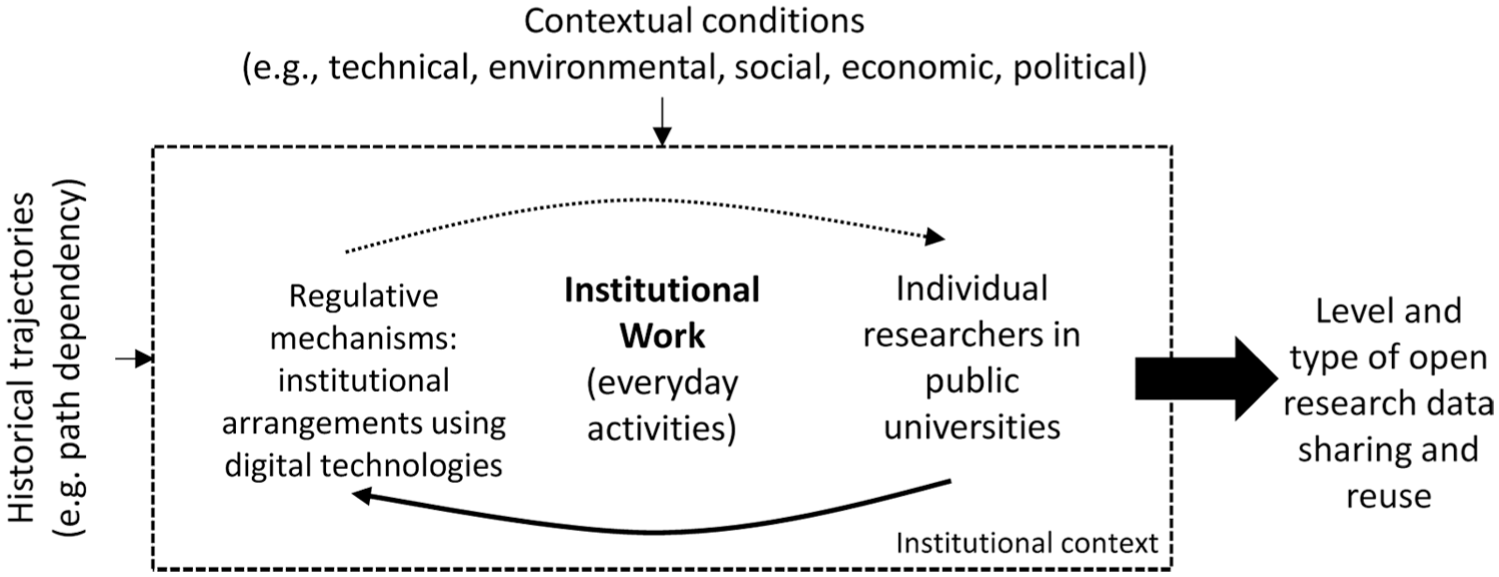
Conceptual framework used for study analysis (adjusted from Beunen et al. [107]).
The original institutional work framework by Beunen et al. [107] also shows that the institutional context is shaped by the historical paths of institutions. In the context of our research, these historical paths could, for instance, refer to a stimulating academic culture that can positively influence open research data sharing [26–28].
In the original framework by Beunen et al. [107], institutional structures affect agency through everyday activities, that is, institutional work. Adjusting this to the topic of open research data sharing and reuse, we hypothesize that within the institutional context, the actions of individual researchers affect the institution, namely, public universities. This is performed through their everyday activities, the institutional work. The everyday activities of individual researchers influence the institutional structures, which we interpret as regulative mechanisms of universities, where the regulative mechanisms should be understood as the institutional arrangements that use digital technologies. The arrow between regulative mechanisms and individual researchers emphasizes the mutual influence between those two elements: regulative mechanisms are enacted by individual researchers, and individual researchers can influence and express the need for using specific regulative mechanisms. Together, these adjustments to the framework by Beunen et al. [107] led to the framework in Figure 1.
The following section discusses our approach toward gaining more insight into how institutional contexts affect open research data sharing and reuse by researchers in public universities. We apply the conceptual framework as depicted in Figure 1 using a multiple-case study approach.
4. Research design
This section discusses the design of our research, outlining the case study research approach (Section 4.1), the case selection (Section 4.2), and the case study data collection (Section 4.3).
4.1. Case study research approach
This study adopts a case study research approach. Yin [108] (p.32) argues that “case studies are the preferred strategy when ‘how’ and ‘why’ questions are being posed, when the investigator has little control over events, and when the focus is on a contemporary phenomenon within some real-life context.” A case study is uniquely positioned to combine multiple sources and data collection procedures, such as interviews, documents, and observations, which makes case studies very valuable for explorative research aimed at investigating contextual factors (e.g. personal experiences or specific behavior) over which the researcher has little control [108,109]. In case studies, researchers conduct an in-depth analysis of a case, which can, for instance, be a program, event, activity, or process, and which is bounded by time and activity [110]. Considering the abovementioned characteristics, a case study research approach is suitable for our study objectives. This study asks such a “how” question as it investigates how institutional contexts affect the implementation and use of digital technologies for openly sharing and reusing open research data at public universities in the Netherlands. Hence, we have little to no influence on the phenomenon under investigation.
Criticism of the case study research strategy mostly points to the absence of a basis for generalizable conclusions or its low external validity [108,111]. Case studies, indeed, do not lend themselves to being generalized to populations or universes; however, that is not the goal of case study research [108,111]. Instead, case study findings can inform broader theoretical understanding [108,111]. The developed theory then becomes more plausible when the study is replicated in multiple cases, comparable to experiments [108]. Hence, we conducted a multiple-case study approach.
4.2. Case selection
Selecting a case in case study research is typically performed by composing a list of criteria [108]. We formulated the following criteria for the case selection:
1. The cases concern open research data sharing and reuse behavior in the Netherlands and enable access to relevant interviewees. We focused on Dutch cases because the Netherlands is widely recognized as a leader in Open Science, supported by long-standing national initiatives such as the National Plan Open Science [112], actions to make all publications available through open access [113], and the development of regional open science communities [95]. Another example can be observed in the establishment of the coordinating body Open Science NL, the national program that promotes and accelerates the transition to open science through targeted funding, strengthening communities, and building capacity and infrastructure [114]. Selecting case studies from a country advanced in open science allows the research to draw on established best practices and benefit from the rich, transparent data such contexts provide, enabling a thorough and evidence-based analysis.
2. In these cases, digital technologies, infrastructural instruments, and institutional instruments are used to stimulate open research data sharing and reuse. Because our study examines how institutional contexts shape the implementation and use of digital technologies for open research data, it is essential to select cases in which these technologies and instruments are actively in use. Institutional work can only be meaningfully analyzed in settings where actors interact with concrete technological and organizational arrangements that structure, enable, and constrain their practices. This criterion ensures that our case selection aligns with our theoretical framework in Section 3 and provides the institutional activity needed for meaningful analysis.
3. The cases concern public universities, as prior studies suggest that non-public and commercial research organizations generally have fewer incentives to share data openly [115–117]. This is due to, for example, intellectual property concerns and trade secrets [115].
4. The universities examined in the cases have at least a reasonable level of experience in stimulating research data sharing and reuse. Institutions that have already taken concrete steps in research data sharing and reuse are more likely to have developed practices, challenges, and organizational responses that can be meaningfully examined. This ensures that the cases contain sufficient empirical richness to illuminate the mechanisms and conditions underlying research data sharing and reuse. As this experience is hard to measure, we created an overview of all Dutch public universities and selected those that: a. have a research data management policy available on the Internet; and b. supplement this policy with publicly available faculty-specific policies for most of their university faculties.
This approach offers a systematic basis for determining institutional experience in research data sharing and reuse, as we rely on publicly verifiable policy documents rather than informal impressions.
5. The universities examined in the cases have implemented a research data management service, which at least consists of data stewards’ availability for researchers. By focusing on universities with established research data management services, we ensure that our case selection is grounded in settings where institutional work related to data sharing is not merely aspirational but enacted in day-to-day organizational practice.
Five cases met the criteria above. Out of these cases, one could not be selected since the potential interviewees did not have time to participate in our research, and another one had already been investigated in previous research [93] (although with a different research focus), which we assumed would lead to less willingness of potential participants to participate in our study. Therefore, we selected the three remaining universities (see Figure 2).

Selection of cases and units of analysis.
4.3. Case study data collection
This section discusses the case study data collection, including the measures we took to enhance the reliability and credibility of data collection. First, we combined various information sources, namely documents and semi-structured interviews, to create a more comprehensive view of the cases. Table 1 provides an overview of these information sources. In addition, an interview protocol was created, which included scripted questions, definitions of key terms, and instructions for follow-up prompts (see the Supplemental Appendix). In a mock interview, we jointly discussed the different questions, potential pitfalls, and how to handle potential ambiguous responses. Moreover, the first, second, and third authors each conducted an initial internal pilot test to identify obvious issues related to wording, sequencing, and alignment with the research objective. This internal pilot was not intended to replace participant-based testing but to refine the interview protocol before engaging actual respondents. Following the internal pilot, the interview guide was further refined during the first interviews with participants, using an iterative approach common in qualitative research. This ensured that clarity and comprehensibility were assessed from the participants’ perspective as well. Hence, the internal pilot focused on conceptual alignment, while participant feedback informed clarity and comprehensibility.
Information sources used in the multiple-case analysis.

Although the sequence of questions was similar, the questions themselves differed by target group, as different target groups were interviewed (i.e. researchers, support staff, and policy makers). The interview protocol shows that some of the questions asked were similar for the different groups of interviewees involved, while some of them were slightly different (see Supplemental Appendix). For example, the question “To what extent does the existing culture within your university play a role in stimulating openly sharing and reusing open research data?” was asked in the same way to the interviewed researchers, policymakers, and support staff. The question “To what extent do you have access to the described instrument?” was asked to researchers but transformed into the question “To what extent do researchers in your university have access to the described instrument?” for policymakers and support staff. The same questions were asked in all three case studies.
All three case studies were conducted simultaneously between April and July, 2022. In this period, we held regular team meetings to discuss emerging patterns, ambiguities, or issues in interviewing. The case studies were part of the bachelor’s thesis projects of the first, second, and third authors as part of their study Systems Engineering, Policy Analysis, and Management at Delft University of Technology, in The Netherlands. The case study and interviews at University A were conducted by the third author, those at University B by the second author, and those at University C by the first author, while supervised extensively by the fourth author. All authors had been educated and trained in qualitative research, including desk research, case studies, and interviewing techniques, in various courses.
We created a data management plan, a risk assessment and mitigation plan, and an informed consent form. We obtained approval for this study from our university’s Human Research Ethics Committee in April 2022. We anonymized the university names of the cases and sensitive information due to the sensitivity of assessing universities’ progress in terms of open research data adoption.
To identify relevant documents, we performed desk research and mainly identified policy documents and annual reports. For the interviews, we used a semi-structured approach, since this approach gave us both the opportunity to gather structured results and left room for deeper exploration in case of unexpected answers by the interviewee [118]. In each of the three selected universities, we used a snowballing approach [119] to identify interviewees that fit into at least one of the following three groups: (1) researchers employed by the university working on various research topics, (2) policymakers concerned with creating and evaluating policies around open research data, standardizing data management policies, or planning infrastructures around research data, and (3) support staff supporting researchers with decision-making surrounding openly sharing and reuse research data, primarily data stewards and data management trainers. The snowballing sampling approach was necessary to identify interviewees who can be considered a hard-to-reach population. We assume that we could not have identified these interviewees through other sampling approaches.
In addition to snowballing, we searched for interviewees through multiple other channels, including websites about support for research data management for each university, LinkedIn posts to call for study participants, Twitter (now X) to identify followers of the open science communities of each respective university, and the digital employee register of the selected universities to identify potential interviewees. Upon finding names through one of these channels, we consulted publicly available resources such as the university’s employee registry or their public Twitter (now X) or LinkedIn profile to determine whether they would possibly fit one of the target groups. If this appeared to be the case or was plausible to be assumed, the person’s email address was derived from the public registry of the university, and he or she would be emailed with the question to schedule an interview, along with a summary of the research goal and the informed consent form. We also asked identified interviewees whether they could recommend other possible interviewees who fit any of the target groups.
Table 2 provides an overview of the selected interviewees, including their current roles at their respective universities and their experience with open research data. All 20 interviewees had at least moderate experience with open research data, and 9 had extensive experience. This sample size is appropriate for the aims of this study, as qualitative interview research typically prioritizes depth of insight over numerical breadth. Empirical research by Guest et al. [120] found that thematic saturation is often reached within 12 interviews among relatively homogeneous groups. Similarly, Hennink et al. [121] demonstrated that while code saturation can be achieved with approximately nine interviews, a richer understanding of thematic issues (so-called “meaning saturation”) typically requires 16 to 24 interviews. In our study, no new substantive themes emerged in the final interviews, indicating that saturation had been achieved.
Overview of interviewees with their roles and level of experience.
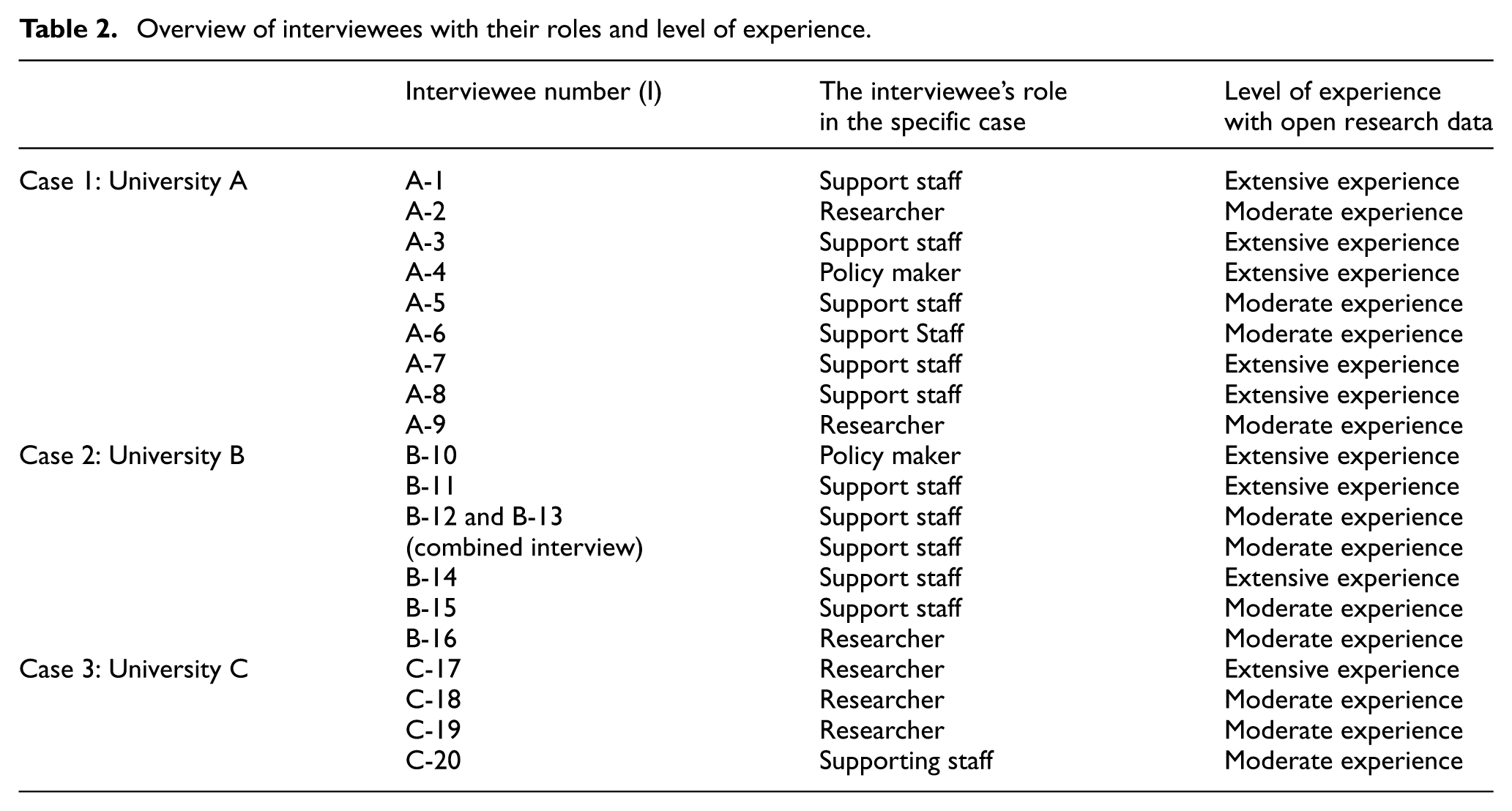
Because all participants possessed at least moderate experience with open research data, the data set was informed by individuals with substantial practical knowledge of the topic, enhancing the credibility and relevance of the findings. The variation in experience levels also enabled comparison across different degrees of expertise, supporting a more nuanced understanding of the research objective. Taken together, the combination of achieved saturation, information-rich participants, and diversity of experience demonstrates that the sample was sufficiently large to capture a comprehensive range of perspectives while remaining manageable for rigorous, in-depth qualitative analysis.
Each interview covered 15 (mostly open) questions, divided into five categories: (1) the interviewees’ background; (2) their involvement in open research data, open research data sharing, and open research data reuse; (3) digital technologies including infrastructural instruments that influence their motivation, and behavior toward open research data sharing and reuse; (4) institutional instruments that influence their motivation and behavior toward open research data sharing and reuse; and (5) the role of contextual aspects.
The interviews were conducted in May and June 2022 and lasted between 38 and 90 min. We based our questions on the infrastructural and institutional instruments discussed in Section 2 (see Supplemental Appendix for the interview protocol). Where possible, the interviews were held in an in-person setting, mostly at the campus of the respective university. If, for some reason, this was not desirable or feasible, the interview took place online via Microsoft Teams. We audio-recorded most of the interviews (not all since not all interviewees agreed with this) and created a summary for each interview. The summaries were anonymized and sent to the interviewees for review and verification. We also added literal quotes of interviewees’ key statements to the summaries. In the summaries, we marked relevant statements and used the institutional and infrastructural instruments as listed in the interview protocol as a coding scheme. Subsequently, we derived relevant contextual factors, infrastructural instruments, institutional instruments, and other relevant information from the interview summaries. These are further explained in Sections 5 and 6.
5. Case study descriptions
This section describes the three cases that we examined. First, Table 3 provides an overview of the main characteristics of the three examined cases at the time that the case studies were conducted. All examined universities are Dutch public universities. University A and B were founded relatively long ago, whereas University C is a relatively young university. University B is the largest of the three selected universities in terms of student numbers, while University A has the largest staff. The three examined universities have a relatively similar number of faculties, yet they focus on different disciplines. All three universities cover the domains of science, social sciences, and behavioral sciences. In addition, University B involves the Humanities and Medicine domains, while University C includes the Engineering domain.
Main characteristics of the public universities in the three selected Dutch cases.

All three universities have already made progress in the area of open research data. In 2003, all Dutch universities signed the Berlin Declaration on Open Access to Knowledge in the Sciences and Humanities [122], thereby committing themselves to making scholarly research results freely accessible and reusable for other scientists and the general public [122]. At the time the case studies were conducted, all three universities in our sample have implemented an open research data policy, in some cases supplemented by faculty or department-specific policies. The guiding principle of these policies, which have been in place for several years, is that open research data should be “as open as possible and as closed as necessary.” The three cases are also comparable in that they provide support for research data management and sharing through data stewards and for researchers with questions about research data infrastructure, data management, or privacy issues. For example, interviewee A-6 noted that each department at the university has its own data steward. In addition, Universities A and C have a digital competence center, University B provides support through a shared service center and privacy officers, and all three universities have supporting libraries. In all three cases, various open research data repositories are used for openly sharing and reusing open research data. Universities A and C have an institutional repository that they share with several other Dutch universities. University B uses other national repositories that are available to all Dutch universities. All universities in our sample offer education and courses concerning open research data. For example, the library of University A offers a research data management course for PhD candidates and postdocs four times per year. Universities B and C offer similar courses to PhD candidates. Finally, in all three cases, an open science community has been established within the university.
To summarize, the case study descriptions show that the three universities involved in our study are relatively comparable in terms of their general characteristics as well as their experience with and process in terms of open research data.
6. Case study findings: institutional contexts influencing open research data sharing and reuse
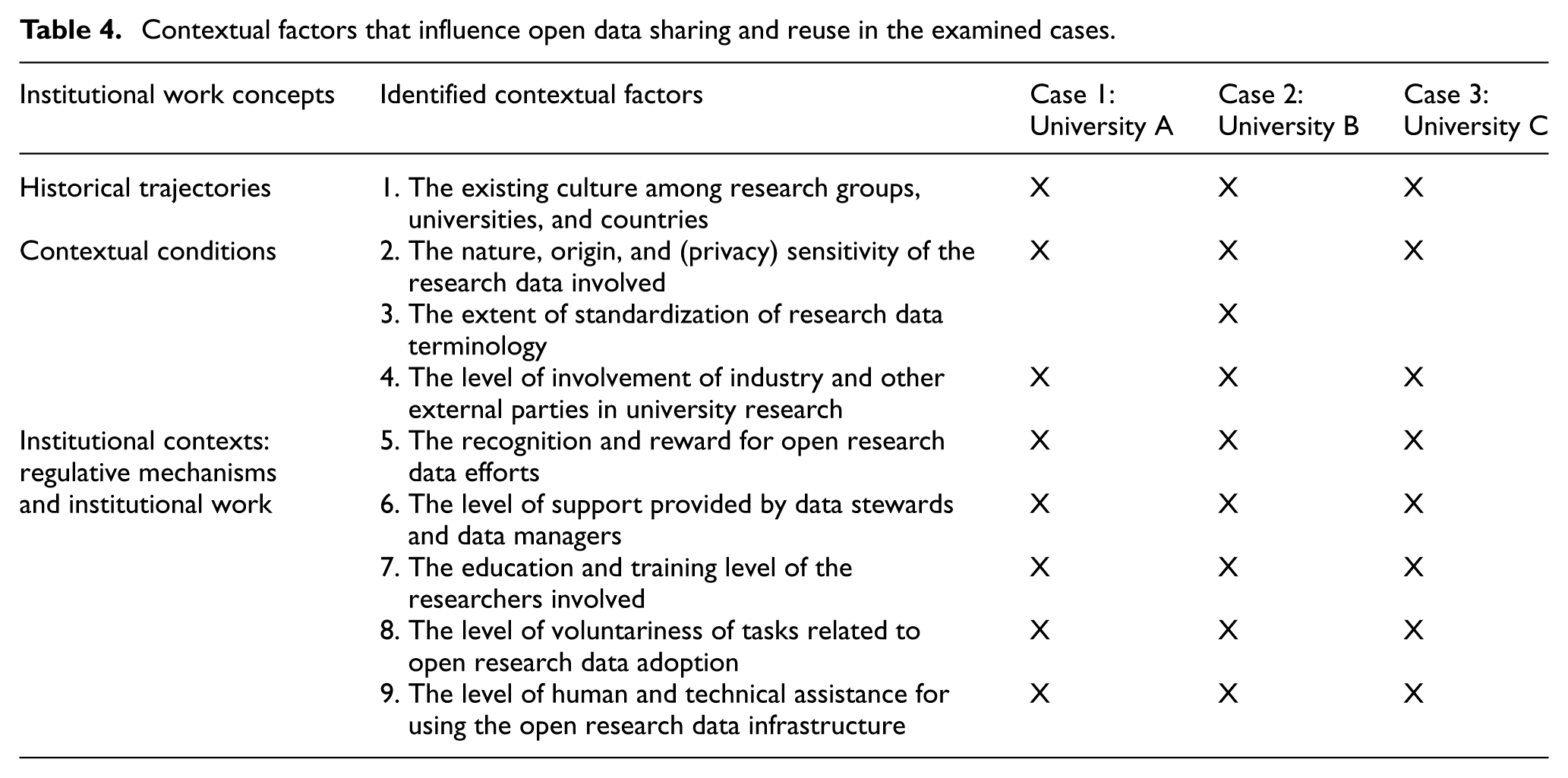
Using the conceptual framework, which focuses on various notions from institutional work as the analytical lens, this section discusses the identified factors related to historical trajectories (Section 6.1), contextual conditions (Section 6.2), and institutional contexts (Section 6.3) in the three analyzed cases. The identified factors are summarized in Table 4. Finally, Section 6.4 presents the refined conceptual model of institutional work for open research data.
Contextual factors that influence open data sharing and reuse in the examined cases.
6.1. Historical trajectories
In terms of historical trajectories, our case studies identified one factor influencing such trajectories, namely the culture among research groups, universities, and countries (factor 1 in Table 4). In all three examined cases, the culture appeared to influence open research data sharing and reuse at different levels, including the culture of specific research groups, the university as a whole, and the countries in which the university is located. For instance, in the case of University A, it was stated that the university’s culture has a positive influence on the effectiveness of using infrastructural and institutional instruments to stimulate open research data sharing and reuse. In particular, respondents stated that a culture in which employees are open to change can significantly influence and even lead to differences among research groups. Moreover, in the case of University C, respondent C-17 stated, “I have the feeling in general in the Netherlands there’s a better culture regarding open science in general and open data in particular than I was used to in Germany.”
The culture could either positively or negatively influence open research data sharing and reuse. An interesting observation in the case of University C was that all interviewees mentioned they felt that the university as a whole promotes open research data. Respondent C-18 stated, “I don’t think you can work here and say you don’t get anything from open science, then you really have to bury your head in the sand, it’s not to be missed. […] That strikes me as very strong.” Both in cases B and C, several respondents indicated that the culture was influenced by the ambitions set by the board of directors, which had not gone unnoticed by all the interviewees in these cases and had stimulated them to continue the adoption of open research data. In the case of University A, interviewee A-2 stated that changing the culture requires changes to the university’s reward system, where data sharing should be acknowledged as a valuable contribution.
Having an open science community within the university might positively influence the university or department culture in terms of open data sharing and reuse. For instance, in the case of University C, an interviewee stated that it is important to build a community and stimulate peer-to-peer communication through such a community (C-18). However, interviewees in this case also noted that the university itself did not clearly stimulate those kinds of community creation processes, as mentioned by C-17, “… I don’t know whether the [University] really fosters that [behavior], I did not recognize that”, and C-19: “I don’t see a very strong stimulation from the [University] side […], we don’t get an incentive to tell [our experiences with open research data] to our department, for example.”
No other factors related to historical trajectories were identified.
6.2. Contextual conditions
Our case studies revealed three factors related to the contextual conditions influencing open research data. The first factor can be considered a technical factor: the nature, origin, and (privacy-)sensitivity of the research data involved (factor 2 in Table 4), and it was identified in all three cases. In the case of University B, the size of the data was a contextual factor that influenced data sharing and reuse. It was found that large data sets could not be processed well by the infrastructure, and processing large data sets is costly. The high costs for storing certain types of research data were also mentioned in the case of University A: “the costs per storage system are the biggest problem” (A-1). Furthermore, the research area of researchers strongly influences their possibilities for adopting open research data. In the case of University B, the interviewees mentioned that compared with researchers working in STEM areas, social science researchers are more concerned with acquiring privacy-sensitive personal data, making it more difficult to open up and reuse research data. Moreover, besides technical studies, medical and clinical studies also make up a good part of the research conducted at University C. These kinds of studies often include patient data, which finds itself particularly difficult to make public, while protecting the privacy of these patients (C-18, C-19, and C-20). Policies are under development (C-19), but until then, much of this data cannot be made publicly available. Moreover, our case study at University C shows that medical studies, for example, have no standard way yet to deal with sensitive patient data, which also results in an absence of available open research data for reuse.
The second factor related to contextual conditions for open research data is also a technical factor: the extent of standardization of research data terminology (factor 3 in Table 4), and it was identified in case B only. In the case of University B, it was found that the standardization of terminologies used for openly sharing research data would positively influence the openly sharing of research data. Such standardization may need to be carried out by a research discipline and is a complex task. The extent of standardization of research data terminology was not mentioned as a contextual factor influencing open research data sharing and reuse in the cases of Universities A and C.
Moreover, our case studies highlighted a third factor related to the contextual conditions of open research data sharing and reuse: the level of involvement of industry and other external parties in university research (factor 4 in Table 4). This factor was identified in all three cases and is an economic factor. The interviewees employed at University A mentioned the strong relationship this university has with industry. One interviewee stated that the research institutes of the university often do research commissioned by companies and the government. This sometimes leads to contracts that prohibit openly sharing the research data collected in this research. Companies pay for the research and, therefore, own the research data (A-6). Similarly, much of the research carried out at University B is funded by companies, which often do not allow researchers to openly share the collected research data, even if they want to. One interviewee stated, “Especially with medical data, the question arises: which part of the data do you openly share with other researchers? Then, also the wishes of the university and other financiers in the industry are to be taken into account” (B-7). This is confirmed in the case of University C, where it is a barrier “[…] that you use data from hospitals that are not yours ultimately. So then you can use the data, but it does not become property and so you cannot put it online.” In sum, collaborations with other parties outside the university sometimes result in barriers to openly sharing research data.
Although we can imagine that political and social factors also play a role in the contextual conditions of open research data sharing and reuse, such factors were not identified in our case studies. Since we did not inquire about these factors specifically, it is possible that they did play a role in the cases.
6.3. Institutional contexts: regulative mechanisms and institutional work
Our case studies revealed five factors related to the institutional context influencing open research data. As depicted in the conceptual model, the institutional context includes the regulative mechanisms and the institutional work conducted by individual researchers. The five factors were found to influence all three cases.
The first factor related to the institutional context concerned the recognition and rewards for open research data efforts (factor 5 in Table 4). In the case of University A, it was found that the effectiveness of infrastructural and institutional instruments is reduced by the fact that those instruments are often not developed from the perspective of the researcher but from a manager’s perspective at the university’s top level. Hence, many researchers do not see the importance of using the institutional and infrastructural instruments provided by the university and continue working the way they were used to.
In all three cases, the recognition and awarding of openly sharing research data appeared to be of great importance. The interviewees perceived that researchers’ efforts toward openly sharing research data are insufficiently recognized, especially when this is compared with the publication of scientific articles. In the third case, C-17 stated, “For me it’s not beneficial actually, to care much about open data sharing, because what the [university] wants to see is publications and funding, so that I get grants, […] I think it’s not really valued yet in terms of promotion […, and] I think this is something that needs to be solved because in the end everyone just wants to get promoted, at least until you reach a certain position.” (C-17).
This was also addressed by other interviewees in this case (C-18 and C-19). Moreover, interviewee A-2 stated that the institution should change its reward system for openly sharing research data since sharing data adds to researchers’ workload and is insufficiently rewarded and, therefore, not performed very often. This reward system can be considered an important regulative mechanism when using the institutional work perspective.
Currently, there is no reward model for individual researchers to publish open research data, so researchers tend to focus on other activities they actually get rated on, like teaching activities. To quote from C-17, “In my impression, the key really is time. A lot of researchers at [my university], and not only at [my university] but also in other universities, are employed with a lot of teaching responsibilities. I think it really would help to reduce, for example, the teaching load, to make room for additional research tasks, like data sharing. And the solution to making more time is really in the work contracts, or to offer additional help as we already discussed from data managers, student assistants, or whoever.”
In sum, the currently applied reward model undermines the goals of open research data. All instruments are focused on getting people to publish their data openly, but if an incentive is missing, the instruments might not function optimally.
The second identified factor associated with the institutional context is the level of support for open research data by data stewards and data managers (factor 6 in Table 4). Although the availability of data stewards to support researchers was one of the selection criteria for our cases, the cases of University A and B revealed that there were too few data stewards available to sufficiently support researchers with data management and sharing in these universities. For instance, in the case of University A, it was stated that the university’s data stewards have very limited time to support all the researchers who approach them. This has a negative effect on the ability of data stewards to answer researchers’ questions concerning open data sharing and reuse. Interviewees B-12 and B-13 stated that their faculty has only one data steward, which is perceived as not enough. Finding new data stewards is also very difficult: “Even if we have positions for data stewards, then the people who should fulfill these positions are not available” (B-10). Nevertheless, data stewards are considered crucial for open data sharing, and they can be an important regulative mechanism: “Had they [data stewards] not been there, we would have given up a long time ago” (C-19).
In addition to data stewards, data managers can support the management of research data, including its description, documentation, curation, and subsequently, the archiving and possibly openly sharing of the data. Data managers provide more hands-on and operational support than data stewards, and data stewards have a more advisory role. In the case of University C, the idea of having data managers is very much welcomed. For instance, interviewee C-17 stated, “[…] I would appreciate that because that is exactly the help I would need actually,” and interviewee C-19 stated, “Despite how important and interesting we find [open research data], in the end, it is a side issue in our entire job. That is a pity, but it is how it is. The more convenient the task is made, the more likely you are to do it.”
Nevertheless, in the cases of Universities B and C, concerns were raised about the budget available for data management: “Often the question is how to pay for data managers” (B-10).
The third factor related to the institutional context included the education level and training of the involved researchers (factor 7 in Table 4). In all three cases, it was mentioned that researchers’ education and training influence data sharing and reuse practices. For example, B-11, B-12, and B-14 explicitly mentioned that there is training at faculties or institutes as well as central training by the university. Such training deals with writing a data management plan or depositing research data and is provided by the university’s library. Interviewee B-14 noted the positive impact of such training, as participants of the training events ask more and more informed questions to data stewards and data managers than those who do not attend the training events.
While offering researchers educational programs and training was also perceived as valuable in the case of University C, the current activities surrounding this instrument are mostly concentrated on first-year PhDs through the Graduate School. Also, in the case of University B, interviewees B-13 and B-14 stated that training in data management does not reach everyone, and more needs to be performed to involve those who need the training the most. In this case, it was stated by one interviewee that more attention should be paid to data management in the education of young researchers in particular, while other interviewees (also in the other cases) stated that most training is mandatory for PhD candidates (usually relatively younger people), while they are voluntary for other employees.
Interviewee C-20 said that although this education is open to anyone, it is hard to reach the right people and motivate them to attend such training. A new instrument was proposed by C-20 to try and mitigate this issue, namely, going to the research groups at the university to present the benefits of open research data, instead of asking them to come to you.
The fourth identified factor associated with the institutional context encompassed the level of voluntariness of tasks related to open research data adoption (factor 8 in Table 4). An observation made during the interviews at all three universities is that researchers employed by them are not obligated by the institution to write a data management plan. Although “handles are always offered to those who ask” (C-18), the general agreement was also that the data management plan would be a good tool to introduce people to open research data. In this study, we found that keeping tasks such as data management plan voluntarily can lead to a lower level of open research data adoption. While we note that all three universities in our case studies are promoting open research data, at certain moments, more (positive) pressure from the universities might be beneficial.
At the same time, in all three cases, the interviewees emphasized the importance of researchers’ intrinsic motivations for openly sharing research data. For example, they stated, “I also think it has to come primarily from intrinsic motivation. This also has to be a bit of a bottom-up movement” (C-19) and “for me, and I think this is true for a lot of other researchers, a lot of motivation comes from intrinsic things. If you infringe this intrinsic motivation with too much regulation and enforcement, [it could be counterproductive]” (C-17). Interviewee A-4 emphasizes that when openly sharing data becomes part of “doing good science,” then the researcher can be reached better and be intrinsically motivated to openly share data as opposed to being obliged to do so by management.
The fifth factor linked to the institutional context concerned the level of human and technical assistance for using the university’s open research data infrastructure (factor 9 in Table 4). Particularly, assisting researchers in choosing the right license and appropriate metadata to describe data sets that could potentially be shared openly appeared to be important. Regarding choosing the right license, interviewee C-19 stated that “If that support had not been there, we would have already given up.” For the instrument of integration with other research data management tools, C-19 imagined the possibility that “[…] upon writing your data management plan, it would be very convenient if certain fields in the metadata, like title, would be prefilled in the data repository. This would also help people in finding the possibility of open data publishing.”
In the case of University A, it was also mentioned that the university has a data storage finder tool with various storage options. After researchers answer a number of questions, the tool allows researchers to determine what kind of storage is appropriate for their data. Another important form of assistance, as mentioned in the case of University C, is offering a powerful search engine for finding open research data, which is currently unavailable, or at least not widely used by most researchers.
6.4. Refined institutional work model for open research data
Section 3 presented our conceptual model of institutional work in the area of open research data sharing and reuse by researchers in public universities. In Sections 6.1 to 6.3, we refined this framework based on the insights from three case studies. Figure 3 depicts the refined model, which now also includes the factors that we derived from the examined cases (where “F” refers to the corresponding factors in Sections 6.1, 6.2, and 6.3). We further discuss the implications of this model, the underlying mechanisms, and other key findings in the next section.
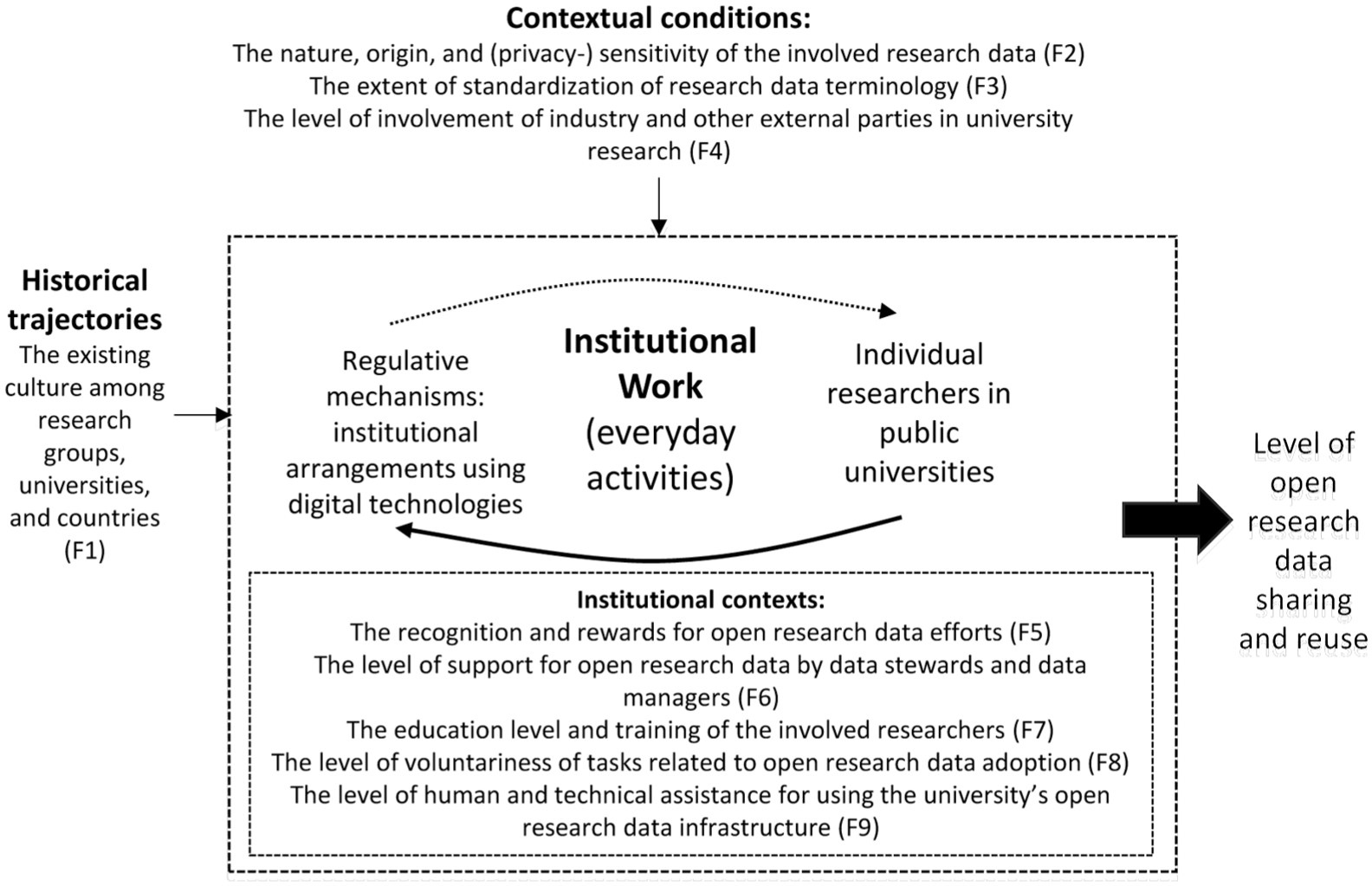
An empirically enhanced framework based on the case study analysis (F = identified factor).
7. Discussion
7.1. Discussion of case study findings and limitations
Through our within-case and across-case analyses, we identified nine factors that affect open research data sharing and reuse by researchers in public universities in the Netherlands. Most factors were found in all three cases, while the factor “the extent of standardization of research data terminology” is the only factor that was found only in the case of University B. It is not immediately clear why this factor did not play a role in Universities A and C. One reason might be that these universities address different research domains than University B. Some research domains have already reached a relatively high level of standardization of research data terminology, such as geosciences [123], while others have not reached such levels of standardization, which is why the extent of standardization of research data terminology may have a smaller influence on openly sharing research data and may receive less attention.
Five of the nine identified factors (the ones related to the institutional context) can more easily be changed than the other four. For the five institutional factors that can relatively easily be changed, this is possible, for instance, by making data sharing and data management training more mandatory, by better rewarding and acknowledging data sharing efforts, by increasing human and technical assistance for handling data and data infrastructures, and by increasing data management skill training. The other four institutional factors concern less tangible aspects, such as culture and types of collaborations among various actors involved in data sharing and reuse, as well as types of data used in scientific research. Although these four institutional factors are less easily changed, changing them may still be possible in the long term. For instance, agreements can be made between university researchers and industry that allow for data sharing (possibly under certain conditions). Moreover, digital technologies such as multi-party computation may lead to increased protection of privacy-sensitive data in the future [124].
This study adopted a case study research approach, which was deemed relevant and appropriate for achieving the study’s aims. However, in general, the case study approach has been criticized for a lack of rigor and a limited basis for scientific generalization [108,111,125]. To address the concern of the perceived inability of case studies to generate generalizable conclusions, our analysis of case study findings focuses on generalizing findings to theoretical propositions rather than to populations. We explicitly described our theoretical framework (see Section 3) and how the case study findings relate to this theoretical framework (see Section 6). A multiple-case study design was used rather than a single case design. This approach allows findings from one case to be examined within the context of the others, enhancing the robustness of the conclusions. External validity is further strengthened by providing detailed information about the case study design, making replication possible. Such replication enables future researchers to test the findings and assess whether certain findings can be generalized. Moreover, a case protocol was developed and applied consistently across the three cases. Intermediate findings were discussed among the authors in weekly or biweekly meetings while the study was conducted, leading to the realization that the protocol was both robust and practical within the scope of the cases. Interviewees were invited to provide feedback on the study’s findings, leading to additional validation. Finally, multiple sources of evidence were employed to establish a chain of evidence, further enhancing the methodological rigor.
Nevertheless, it is important to acknowledge that this study investigated three cases, each focusing on a specific type of open data within a particular context in the Netherlands. We selected Dutch cases because the Netherlands is a leader in the field of Open Science. For countries that are less advanced in this area, the findings may be less applicable, as they may face additional barriers that must be addressed before Open Science can gain significant traction, including foundational, infrastructural, and cultural challenges. Such challenges often take decades to address. Universities in other countries may also have insufficient resources to develop Open Science policies and support for researchers. This again shows the importance of the context influencing open research data sharing and reuse. Although the selected cases come from a country with a more advanced open science landscape than many other countries, their relevance to less advanced contexts lies in the transferable insights they provide. By examining mature systems, it is possible to identify core principles, effective policies, and proven practices that can be adapted to different resource levels and cultural settings. Lessons from these cases can inform capacity-building strategies, highlight critical success factors, and provide realistic benchmarks, enabling less advanced countries to develop progressive, context-sensitive pathways to strengthen their own Open Science ecosystems.
It is also relevant to note that practices surrounding open research data may have changed over time. While the findings apply within the context of these cases and the time frame of this study, they may not be generalizable beyond this specific scope. Additional case studies are necessary to test whether theoretical findings hold under varying circumstances [126]. This approach is not unique to case studies but also applies to other methods, emphasizing the importance of testing and confirming the generalizability of theories across diverse situations. To facilitate such testing, sufficient information should be provided to enable the replication of case studies. To enhance transparency and facilitate further research, this study provides detailed insights into the data and documentation collected, which underpin the findings of the case studies. Future research should examine whether these findings are more widely applicable in other situations.
7.2. Scientific implications of the institutional work lens
Institutional theory has become a widely accepted point of reference in modern organization theory textbooks [127]. At the same time, it has faced criticism from scholars such as Leca et al. [101] and Miner [128], who argue that institutional theory has had a limited impact on real-world conversations among organizational managers and members beyond academia. This study used the theoretical perspective of institutional work, which allows researchers to bring back individuals into the analysis of institutions [100]. Moreover, in contrast to more traditional institutional studies, institutional work is more concerned with incorporating “conscious intentionality” and examining “practices” and “routines” [129].
The lens of institutional work applied in this study allowed us to examine open data sharing and reuse from this detailed perspective. Only a few open data studies have used this theoretical lens so far, with most of them focusing on open government data [104,106] and paying less attention to open research data (except [105]). Hence, this study is among the first to examine open research data from an institutional work perspective. The institutional work lens appeared to be useful in separating the various influencing mechanisms in the context of open research data sharing and reuse by researchers in universities. It enabled us to separate the historical trajectories, contextual conditions, and institutional contexts, including regulative mechanisms and daily activities by individual researchers.
However, applying the institutional work lens in this study also had several limitations. First, the direction of some of the influencing mechanisms was not clear. For instance, the influence of regulative mechanisms on the behavior of individual researchers remains unclear. Second, it is unclear whether the related concepts that we examined, including the regulative mechanisms and institutional work, are merely correlated or whether there are causal relationships. Third, the application of the institutional work lens is not always straightforward. For example, in the application of the institutional work lens, it was sometimes difficult to distinguish between daily practices (i.e. institutional work) and contextual conditions. A factor such as the level of support for open research data (factor 6) could be considered a contextual condition since the political environment may determine whether such support is available to researchers employed by universities. However, we placed the level of support in the category of institutional context, since specific support mechanisms can also be observed as regulative mechanisms in the institutional context.
For some factors, it was also difficult to determine whether they belong to the category of historical trajectories or contextual conditions. One such factor was the nature, origin, and privacy sensitivity of the research data involved (factor 2). There may be historical trajectories in universities and faculties that led to the use of certain data, making this factor connected to the historical trajectory category. On the contrary, the use of data can also be considered a contextual condition, since it does not influence the institutional work in isolation but rather in interaction with other factors, such as technological factors that enable the use of privacy-sensitive data. Thus, the distinction between factors through the institutional work lens is not always obvious and can sometimes be arbitrary.
7.3. Other scientific implications
When we compare our findings to the literature on institutional factors affecting openly sharing research data, we can consider many of our findings to be confirmatory. For example, various studies found that open research data sharing can be influenced by a stimulating academic culture [27,28] and a disciplinary culture [40,130]. Moreover, the institutional context of lacking recognition incentives, which is essential in promoting open research data, was already identified by Piwowar et al. [28]. In addition, Borgerud and Borglund [131] found that openly sharing research data is easier in certain domains, such as physics, astronomy, mathematics, and various natural sciences, than in others that involve more personal data and data protection issues. This study also found that the nature, origin, and (privacy-)sensitivity of the involved research data are important contextual factors that influence the level of open research data adoption at universities. Moreover, this study supports the studies by, for example, [7,132] which discuss the need to support and coach researchers in research data management, both in terms of data literacy and training, and in terms of technical assistance for metadata management and other daily research data management practices.
Moreover, the contextual factors that we identified are relatively comparable to those listed by Zuiderwijk et al. [38]. This is interesting because the contextual factors mentioned in the work by Zuiderwijk et al. [38] were elicited from a literature review that concerned open research data adoption in various research institutes and research disciplines in multiple countries. The contextual factors identified in this study concern three Dutch universities. The relatively high similarity of contextual factors identified in these two studies may suggest that various factors are generalizable to a wider context.
We started this article by stating that most studies concerning institutional contexts affecting open research data sharing and reuse tend to focus on a particular facet of the institutional context, while scant attention is given to a comprehensive overview of the diverse contexts in which universities operate. What distinguishes this study from previous studies on institutional contexts affecting open research data sharing and reuse is that we examined these institutional contexts and how they affect open research data sharing in their entirety. This comprehensive “system perspective” allowed us to show interdependencies between various contextual factors that we identified, including whether they can be changed or not. The institutional contexts are strongly interdependent, and implementing only a selection of these solutions would lead to less successful outcomes than implementing them as a whole. For instance, if a university’s board of directors were to make it mandatory for all researchers employed by that university to openly share their research data publicly, this would not have the desired outcomes if those researchers are not also trained in the skills needed to fulfill this task. Even if they had the skills, not recognizing and rewarding them for data sharing efforts is expected to still result in little commitment from researchers to openly share their data and thus meet the university board’s requirements.
Furthermore, the comprehensive “system perspective” used in this article allowed us to examine the interaction between institutional contexts and the various digital technologies used within those contexts. In Section 2.2, we discussed various digital technology archetypes as identified by Berger et al. [51] and examples of digital technology in the area of open research data sharing and reuse. Some of the institutional contexts that we identified in Section 5 are interwoven with some of these digital technologies, both with those that can and cannot easily be influenced. For instance, the institutional context of the nature, origin, and sensitivity of the involved data determines which open research data platform can be used to publish or find the data. Most research data repositories are focused on specific research disciplines, such as the social sciences or astronomy. This context of the nature, origin, and sensitivity of the involved data also relates to the way that the data have been collected. For instance, the origin of data may concern sensors. As another example, the institutional context of the level of human and technical assistance influences whether certain analyses can be conducted and specific analytical insights can be generated. The availability of more human and technical assistance can lead to enhanced analytical insight and interaction.
7.4. Practical implications
This section discusses the practical implications of our research. Section 5 reported on the factors that appeared to influence open research data in the cases we studied. Some of the identified contextual factors are actionable, meaning that they can be influenced by various actors. For each of the actionable factors, we will discuss several recommendations for how they might be addressed to improve open research data sharing and reuse.
The first actionable factor is improving recognition and rewards for open research data efforts. There are only limited rewards for researchers openly sharing their research data [133,134]. We recommend that rewards be improved both at the level of universities and at the level of “the system.” For example, many universities are starting to develop recognition and reward initiatives. There are also examples of national initiatives, such as the revision of the Standard Evaluation Protocol (SEP), which is used in the Netherlands to evaluate, among others, university faculties. The new protocol that was published by UNL (Universities of the Netherlands), NWO (Netherlands Organisation for Scientific Research), NFU (Netherlands Federation of University Medical Centres), and ZonMw (Netherlands Organisation for Health Research and Development) in 2019 contains various principles of the new recognition and rewards framework and specifically emphasizes contributions to the open science movement [135]. At the time of our study, universities in the Netherlands were now working on a roadmap of concrete plans for the near future to develop new career and development paths for academic researchers [136]. Furthermore, data sharing is increasingly promoted by funding agencies and journals. Reichman et al. [133] claim that making data sharing a requirement of funding and publications, and rewarding those researchers who meet those expectations, would be most effective.
The second actionable factor concerns increasing the level of support by data stewards and data managers, which may also be supported through technical assistance (see the discussion of the fifth factor below). Data stewards appear to play an important role in translating information from universities’ open data policies into practical advice for individual researchers. While university policies on open research data are usually relatively abstract, data stewards are the human nodes that can explain how such policies should be applied in practice in specific cases. Moreover, data stewards are usually researchers themselves who can function as the node between researchers within university faculties and support providers such as university libraries, ICT support, and legal support. Where data stewards can be valuable intermediaries and provide useful advice, data managers can offer operational support by processing research data and providing hands-on support that reduces the workload of researchers who are already under considerable time pressure. We recommend that universities create an extensive network of data stewards and data managers with different expertise and capabilities to support academic researchers in various tasks related to open research data sharing and reuse within their universities. Ideally, the consultation and use of services provided by data stewards and data managers should be free to the researchers who want to make use of them.
Third, improving the education level and training of researchers is another actionable factor. The universities in our case studies already have various courses and training in place. However, not all researchers know where to find them. Academic researchers may also find the time investment for such courses too high. We recommend that universities (1) create more awareness of courses and training that are already available, (2) provide “lightweight” training that requires little time investment by researchers, and (3) exchange their offerings in terms of courses and training also with other universities, not to duplicate efforts.
Fourth, another actionable factor that we derived from our case studies relates to the level of voluntariness of tasks related to open research data adoption. While it is clear that the universities we studied are promoting open research data, more progress might be achieved when universities put more (positive) pressure. An interesting question is what the balance should be between the reinforcement of open research data and completely leaving this up to the researchers themselves. While considering this balance, universities might put pressure by making certain processes mandatory for all researchers within the university. For example, universities could make the creation of data management plans mandatory for each new research project, similar to the requirement of many funding agencies that such a plan must be created for newly funded projects. At the same time, interviewees in our third case study stated that the reinforcement of certain behavior through policies, where one is expected to share or reuse certain amounts of open research data, might not have the desired effects. Researchers might then start to share or reuse open research data for the wrong reasons. This could lead to all sorts of problems, such as openly sharing research data that is of insufficient quality or that lacks metadata and other documentation. Future research could address the question of what positive and negative effects increased reinforcement of open research data policies would have.
Fifth and final, we identified the actionable institutional factor related to the level of human and technical assistance for using the open research data infrastructure. This factor shows various opportunities for improving open research data sharing and reuse. For instance, several interviewees enthusiastically welcomed the idea of creating “machine-actionable” data management plans. Such a tool would not only be convenient, but it could also lead to more targeted support for academic researchers. For example, when a researcher completes a research data management plan and describes when the data will be collected, a data manager could approach the researcher to ask whether any hands-on support is needed in terms of data curation and documentation. Similarly, machine-actionable applications to human research ethics committees can be used to provide more targeted support to academic researchers. For instance, when the risk assessment by researchers shows that personal data will be processed and when personal data will be deleted, researchers could receive personalized alerts when it is time to remove personal data from data sets and information about training on how to anonymize personal data.
8. Conclusion
This study’s objective is to investigate how institutional context influences the implementation and use of digital technologies for openly sharing and reusing open research data at public universities in the Netherlands. We used an institutional work perspective to develop a conceptual framework, which we then applied to three case studies involving Dutch universities. The institutional work perspective allowed us to distinguish various interrelated factors influencing open research data sharing and reuse. We identified factors related to historical trajectories, including the culture among research groups, universities, and countries. Moreover, we identified contextual conditions, such as the extent of standardization of research data terminology and the level of involvement of industry in university research. The factors associated with the historical trajectories and the contextual conditions both influence the institutional contexts, which in turn influence open research data sharing and reuse. We identified institutional contexts, including their specific regulative mechanisms and institutional work, such as those concerning researcher training and education, and those associated with technical assistance for using the open research data infrastructure. Moreover, the institutional work lens encouraged us to look at detailed aspects of factors that positively and negatively influence open research data. Subsequently, it enabled the development of various practical recommendations regarding how public universities can influence the institutional contexts to stimulate value creation.
Focusing on three Dutch universities, this study’s scientific contributions stem from extending the number of case studies available on institutional contexts influencing open research data sharing and reuse at Dutch universities and comparing such factors among different cases. This study provides in-depth insights into how different institutional contexts influence open research data sharing and reuse by academic researchers in three Dutch universities. This study is among the first to apply an institutional work perspective to open data research. Moreover, we develop an adjusted theoretical model of institutional work applied to the context of open research data. Simultaneously, this study’s findings are societally relevant because they reveal to open data policymakers, support staff, and researchers which of the identified contextual factors can be influenced to promote open research data within specific contexts. Universities may prioritize the contexts that can be influenced while being aware of the contexts that are more difficult to change.
Our cases concern Dutch universities that appear to be relatively comparable in terms of support for open research data sharing and reuse. Other universities in the Netherlands and in other countries are expected to be influenced by different institutional contexts that affect open research data sharing and reuse by individual researchers employed by them. Future research should focus on the identification of contextual factors in other cases and examine what causes potential differences in contextual factors. It should also investigate how the institutional work lens can be refined to examine causal relationships in the context of open research data more closely. Moreover, future research should consider other characteristics of universities that we could not consider in this research, such as their ongoing open science programs and whether these influenced open research data adoption within the university. Finally, this study used a qualitative research approach to gain in-depth insights. Future research adopting a quantitative approach would allow for identifying the extent to which our findings hold in larger populations of researchers within public universities.
Supplemental Material
sj-docx-1-jis-10.1177_01655515261457860 – Supplemental material for The role of institutional work in open research data sharing and reuse: A comparative case analysis
Supplemental material, sj-docx-1-jis-10.1177_01655515261457860 for The role of institutional work in open research data sharing and reuse: A comparative case analysis by Maurits Misana, Jasmijn van Reeuwijk, Vera Schuurman and Anneke Zuiderwijk in Journal of Information Science
Footnotes
Acknowledgements
The authors would like to thank the interviewees of the three involved Dutch universities for their time and support of this study. This research was conducted while Maurits Misana, Jasmijn van Reeuwijk, and Vera Schuurman were bachelor students at Delft University of Technology, Faculty of Technology, Policy and Management. The authors acknowledge the support and resources provided by the institution during the course of this research.

Funding
The authors received no financial support for the research, authorship, and/or publication of this article.
Declaration of conflicting interests
The authors declared no potential conflicts of interest with respect to the research, authorship, and/or publication of this article.
Supplemental material
Supplemental material for this article is available online.
References
Supplementary Material
Please find the following supplemental material available below.
For Open Access articles published under a Creative Commons License, all supplemental material carries the same license as the article it is associated with.
For non-Open Access articles published, all supplemental material carries a non-exclusive license, and permission requests for re-use of supplemental material or any part of supplemental material shall be sent directly to the copyright owner as specified in the copyright notice associated with the article.
