






Abstract
Open data are increasingly promoted as a key mechanism to enhance transparency and reproducibility in science. Yet, empirical evidence on the impact of open data practices in specific disciplines remains limited. In this study, we ask whether sharing research data enhances the citation impact of psychology publications. Drawing on 3319 articles from four leading psychology journals, we employ a multi-layered causal inference framework to control for confounding factors and address selection bias. Our analysis reveals that, after accounting for other factors influencing citations, articles with open data receive 20% more citations on average. We also observe that the citation advantage is especially pronounced for non-open-access publications, unfunded research, internationally collaborative work, and articles from high-reputation authors. These findings offer robust evidence for the benefits of open data sharing in psychology and support policy efforts to incentivize data transparency. This study represents one of the first comprehensive investigations into the citation impact of open data within this field.
1. Introduction
Open science is increasingly embraced across research communities as a means to enhance transparency, inclusivity, accountability, and the overall quality of scientific work [1–3]. However, the definition and scope of open science remain somewhat ambiguous [4], despite efforts to develop rigorous conceptual frameworks [5]. A key challenge in establishing a centralized definition is that open science is an expansive and continuously evolving field, with newer developments such as open peer review [6] and open artificial intelligence [7] further shaping its boundaries. Nevertheless, the benefits of open science have been widely recognized across various stakeholders—including researchers, academic institutions, the broader scientific system, and society at large [8–10]. These advantages include greater accessibility of knowledge, enhanced reproducibility, and stronger public trust in scientific research, making open science a key pillar of contemporary research practices.
Open data have become a cornerstone of the open science movement and a defining feature of contemporary research practice [11,12]. By increasing transparency and accessibility, data sharing helps democratize scientific knowledge and open the “black box” of research [13–15]. Frameworks such as the Findability, Accessibility, Interoperability, and Reusability (FAIR) principles [16] have provided structured guidelines to promote data accessibility, but implementing open data in practice ultimately depends on researchers’ willingness and ability to share their data.
Hence, data sharing is not merely a technical process—it is also a complex social practice shaped by disciplinary norms, institutional policies, and individual incentives [17]. While the benefits of open data for research integrity, reproducibility, and collaboration are widely acknowledged, many barriers persist, including limited time, infrastructure, incentives, and concerns about control and privacy [18–20]. Consequently, data under-sharing and data loss remain widespread across scientific fields [21–23].
A growing body of research suggests that data sharing may also enhance scholarly visibility, often linked to higher citation counts and broader research influence [24,25]. However, evidence on this “open data citation advantage” remains mixed, particularly given the numerous factors that can influence the number of citations received by individual papers [26,27]. In addition, most existing studies rely on methodologies with relatively weak statistical power (such as descriptive methods) or indirect measures of data publication (such as tracing the influence of data papers).
In this study, we systematically assess whether open data practices contribute to increased citation counts received by research articles in the field of psychology by employing a multi-layered causal inference framework to address potential confounding factors and selection bias in the sample, to bridge the above gaps. To mitigate endogeneity concerns, we incorporate a theoretically grounded set of covariates—such as research funding, number of authors, and the academic impact of the corresponding author—all of which have been shown to influence citations. By controlling for these factors in a fixed-effects regression model, we aim to isolate the effect of data sharing on citation frequency. To further reduce selection bias, we apply propensity score matching (PSM), which balances observable characteristics between articles that share data and those that do not, ensuring that differences in citation impact are not simply due to non-random data-sharing decisions. In addition, we conduct a series of robustness checks, including extreme value truncation and alternative model specifications, to confirm that our results are not driven by methodological choices. By combining these analytical techniques, this study provides rigorous empirical evidence on the relationship between open data practices and academic impact in psychology, offering a more comprehensive understanding of how data-sharing behaviors influence research visibility and recognition.
We chose psychology as the site of this research because it is a highly data-driven field [28] and at the center of discussions on open science and open data in the 21st century [29–31]. However, a major reproducibility crisis was found in the 2010s that challenges the empirical basis of this field [32,33]. In response, various stakeholders in psychology have established a series of policies aimed at improving transparency in knowledge production [34]. At the highest level, the American Psychological Association (APA) has implemented open data policies and endorsed the transparency and openness promotion (TOP) Guidelines, developed by the Center for Open Science [35]. The TOP Guidelines, developed by a community working group in collaboration with the Center for Open Science, aim to promote open science practices in academic publishing. They provide a structured framework of standards and tools to help journals gradually transition toward greater transparency and openness in research [36]. Following these broader policy shifts, psychological journals have increasingly adopted policies to encourage open data sharing among researchers [37]. Despite these efforts, empirical evidence on the actual state of open data in psychology remains limited, making it a critical gap that this study seeks to address.
This research specifically aims to address the following two research questions:
Our study provides a comprehensive examination of the benefits of open data sharing for individual researchers in psychology. By employing a causal inference framework, we establish robust conclusions that openly sharing data can enhance scientific impact in the field of psychology. To the best of our knowledge, this is one of the first empirical studies on this topic conducted in psychology. In addition, our findings expand existing knowledge on this topic by exploring how different scenarios of data sharing—such as sharing first- versus secondhand data sets or data sharing in open-access (OA) versus non-OA papers—affect citation impact. By providing systematic quantitative evidence on the relationship between open data and research impact, this study contributes to ongoing discussions in the open science literature and offers valuable insights for future policy and research data management practices.
1.1. Literature review
Open data have become a defining feature of the open science movement, reflecting a broader cultural and epistemic shift toward transparency, accountability, and collective knowledge production [11,12]. It embodies the ideal of democratizing science by enabling public access to research outputs and fostering a more participatory and equitable system of knowledge creation [15]. By making research processes and materials visible, open data contributes to dismantling the scientific “black box” [13,14] and aligns with global policy initiatives promoting openness, such as the FAIR principles, which emphasize data findability, accessibility, interoperability, and reusability [16].
Implementing open data in practice depends not only on technical infrastructures but also on institutional and behavioral factors. Data sharing is a complex socio-technical process that requires coordinated support from policies, researcher incentives, and robust platforms for data management and preservation [17]. Studies have consistently documented both the motivations and barriers associated with data sharing. On one hand, openness promotes research integrity, reproducibility, and collaboration [18,19,38]. On the other hand, researchers face multiple obstacles: time and resource constraints, technical challenges, lack of recognition, and concerns about privacy, misuse, or loss of competitive advantage [20,21]. As a result, actual data-sharing rates remain low across disciplines [23,39].
Data-sharing norms vary substantially across fields. For instance, disciplines with stronger traditions of collaboration and standardized data formats (e.g. genomics and astronomy) tend to exhibit higher openness compared with those relying on qualitative or proprietary data [40–42]. Furthermore, open data practices are entangled with power asymmetries in global science. Scholars from well-resourced institutions or countries may benefit disproportionately from open data infrastructures, while others face structural disadvantages in contributing to or benefiting from data reuse [43,44]. These disparities raise questions about how openness may inadvertently reinforce, rather than reduce, existing inequalities in knowledge production.
A growing body of empirical research has examined the relationship between open data and scholarly impact. Numerous studies report a positive correlation between data availability and citation rates, suggesting an “open data citation advantage” [24,25,45–48]. This effect is commonly attributed to two mechanisms: first, shared data provide additional pathways for discovery and reuse, increasing a paper’s visibility; and second, the availability of data enhances the perceived credibility and quality of research, making it more likely to be cited.
Beyond correlational evidence, a smaller set of studies has employed quasi-experimental or longitudinal methods to assess causality. Christensen et al. [49] found that actual data sharing—rather than the mere existence of policies—was associated with increased citations. Fu et al. [50] showed that publishing a data paper in Data in Brief raised the visibility and citation impact of the associated research. Similarly, Zhang and Ma [51,52] demonstrated that open data policies in Chinese economics journals led to higher long-term impact.
Despite these findings, evidence remains limited and uneven. Citation impact is influenced by numerous factors—including disciplinary citation norms, publication venue, author characteristics, and collaboration patterns [26,27]—which complicate the isolation of causal effects. Moreover, most studies focus on quantitative metrics while overlooking qualitative dimensions such as knowledge reuse, public engagement, or policy influence.
Taken together, the literature highlights both the promise and the persistent challenges of data sharing. While open data are widely recognized as a pillar of transparent and impactful science, actual sharing practices are constrained by disciplinary norms, infrastructural capacity, and systemic inequities. The evidence linking openness to research impact remains suggestive but inconclusive, calling for more systematic, comparative, and methodologically robust investigations into how and under what conditions data sharing translates into academic influence, which is the most important motivation of the present research.
2. Data and methods
2.1. Data
In this study, we selected the following four journals as our sample: Developmental Psychology (DP), Journal of Experimental Psychology: Learning, Memory, and Cognition (JEP), Journal of Personality and Social Psychology (JPSP), and Psychological Science (PS). These journals were chosen for several reasons. First, they represent diverse subfields within psychology, including clinical psychology, developmental and educational psychology, cognitive psychology, and social psychology. Second, these journals are high-impact venues, indexed in the Science Citation Index (SCI) and/or the Social Science Citation Index (SSCI), ensuring that they feature high-quality research across different psychological fields. Third, all four journals are signatories to the TOP Guidelines and have implemented open data policies in accordance with these guidelines.
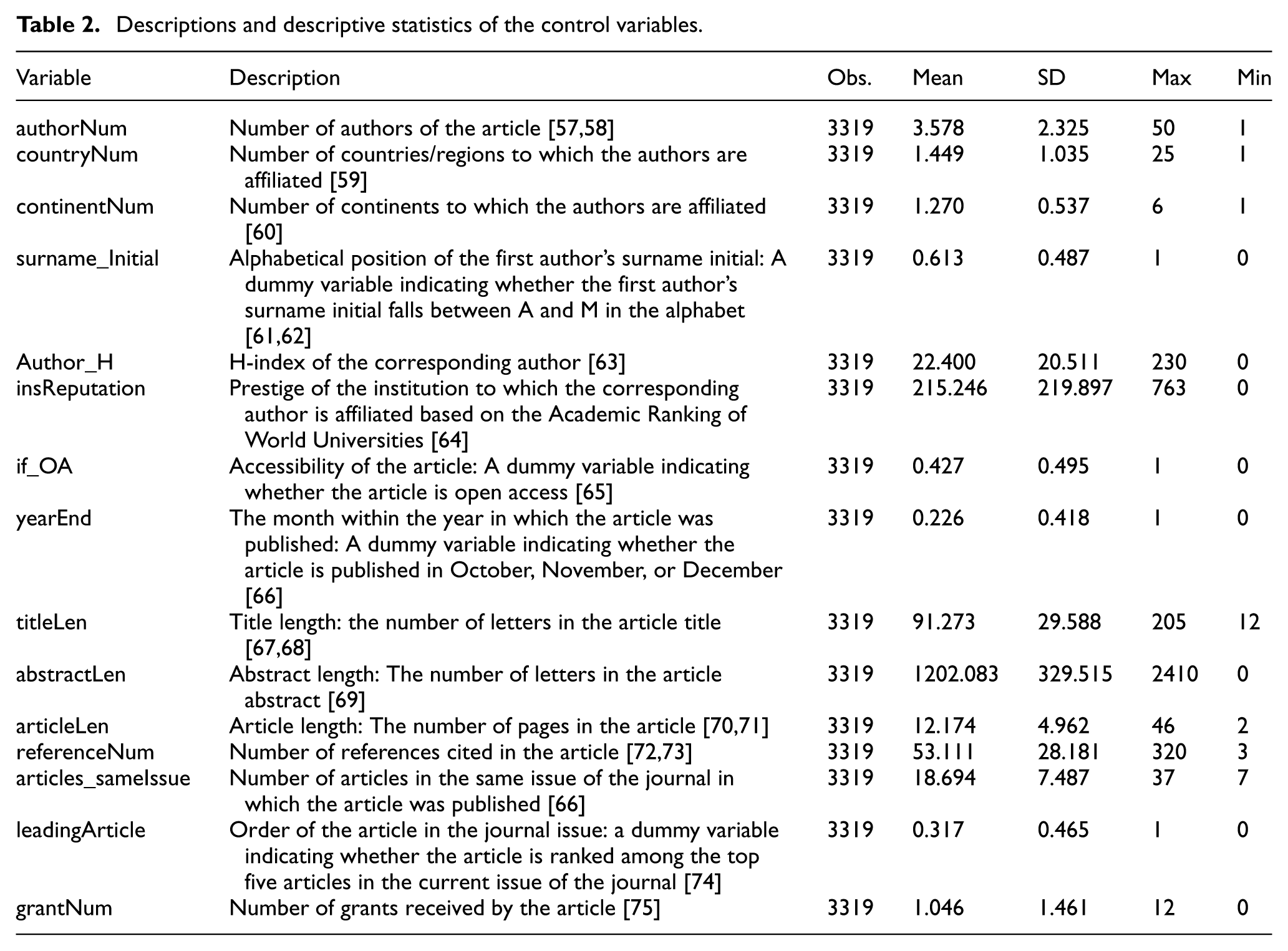
Within the four selected journals, we examined research articles published between 2012 and 2016 to allow for a sufficiently long citation window. Editorial materials, review articles, letters to the editor, corrections, and other non-research content were excluded during data collection. The final data set included 3319 research articles. We collected the bibliographic records from the Web of Science database for each paper, including author details, affiliations and addresses, abstracts, keywords, journal names, publication year and date, volume and issue numbers, funding information, number of references, number of pages, research areas, and OA status. Based on the collected bibliographic records, we further derived several variables for use as control variables in the subsequent regression analysis, including the number of authors, number of countries, number of continents, the alphabetical position of the first author’s surname initial, article title length, abstract length, number of grants, and article accessibility. These variables are described in detail in Section 2.2. We also used the corresponding author’s name and affiliation information from the collected bibliographic records to retrieve the corresponding author’s h-index (as of 2016) from the Scopus database, to control for the influence of the author’s individual scholarly impact on article citations. In addition, we collected the institutional ranking of the corresponding author’s affiliation for the relevant year from the Academic Ranking of World Universities (ARWU), to control for the effect of institutional prestige on article citations. Finally, we obtained the total number of citations received up to December 2023 from the Web of Science Core Collection for each paper.
To accurately identify whether a paper openly shared its primary research data set, we implemented a rigorous verification protocol. First, we manually examined key paratextual and textual sections of the paper, including footnotes, title-page declarations, and open data statements at the end of the paper, to locate any indications of data sharing. We also supplemented this search by scanning for terms such as “data” or “http” in the main text and acknowledgments to detect potential data-sharing links. Any identified links were then carefully verified to ensure they were active and directly pointed to a data set, rather than to supplementary materials, code repositories, or external tools. For valid links, we further cross-checked the full text to confirm that the data set indeed represented the author’s own primary research data. If no data-sharing links were identified through these steps, we conducted a final manual review of the methods section to determine whether the authors’ own primary research data set was explicitly described as being openly shared and to confirm that these shared data sets were indeed accessible. Papers were ultimately categorized as either containing open data or not based on these stringent checks.
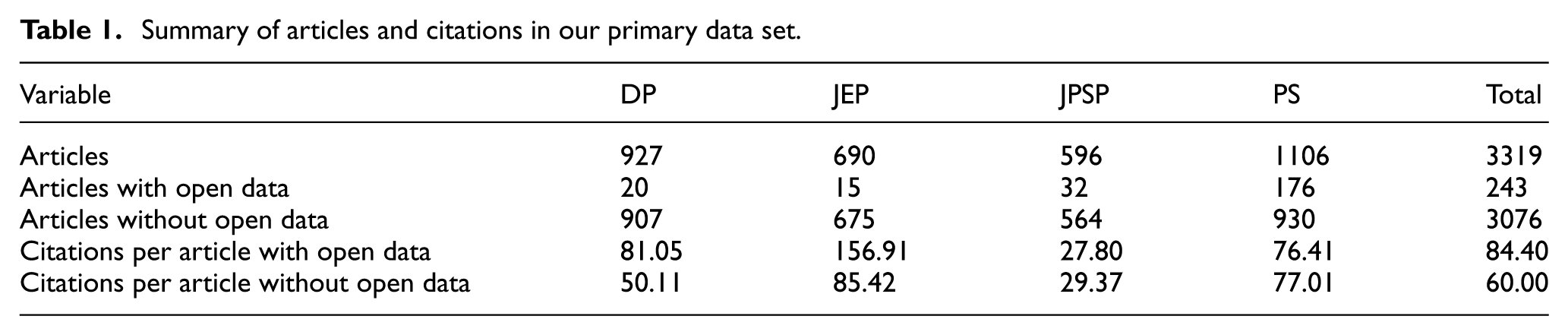
To minimize annotation variability, two trained annotators independently reviewed the data, and a third experienced annotator resolved any discrepancies and made the final decisions. Articles with open data were assigned to the experimental group, while those without open data were classified as part of the control group. The primary data set includes 243 articles with open data and 3076 articles without open data. When expanding the definition of open data to include secondhand data sharing, we identified 269 articles with open data and 3050 articles without open data. A summary of the data at the journal level is presented in Table 1, which shows that the majority of open data articles are from Psychological Science.
Summary of articles and citations in our primary data set.
2.2. Methods
To investigate the relationship between the article citation counts and open data, we designed the regression model described below

where
Descriptions and descriptive statistics of the control variables.
Estimation results from the benchmark model and alternative specifications.
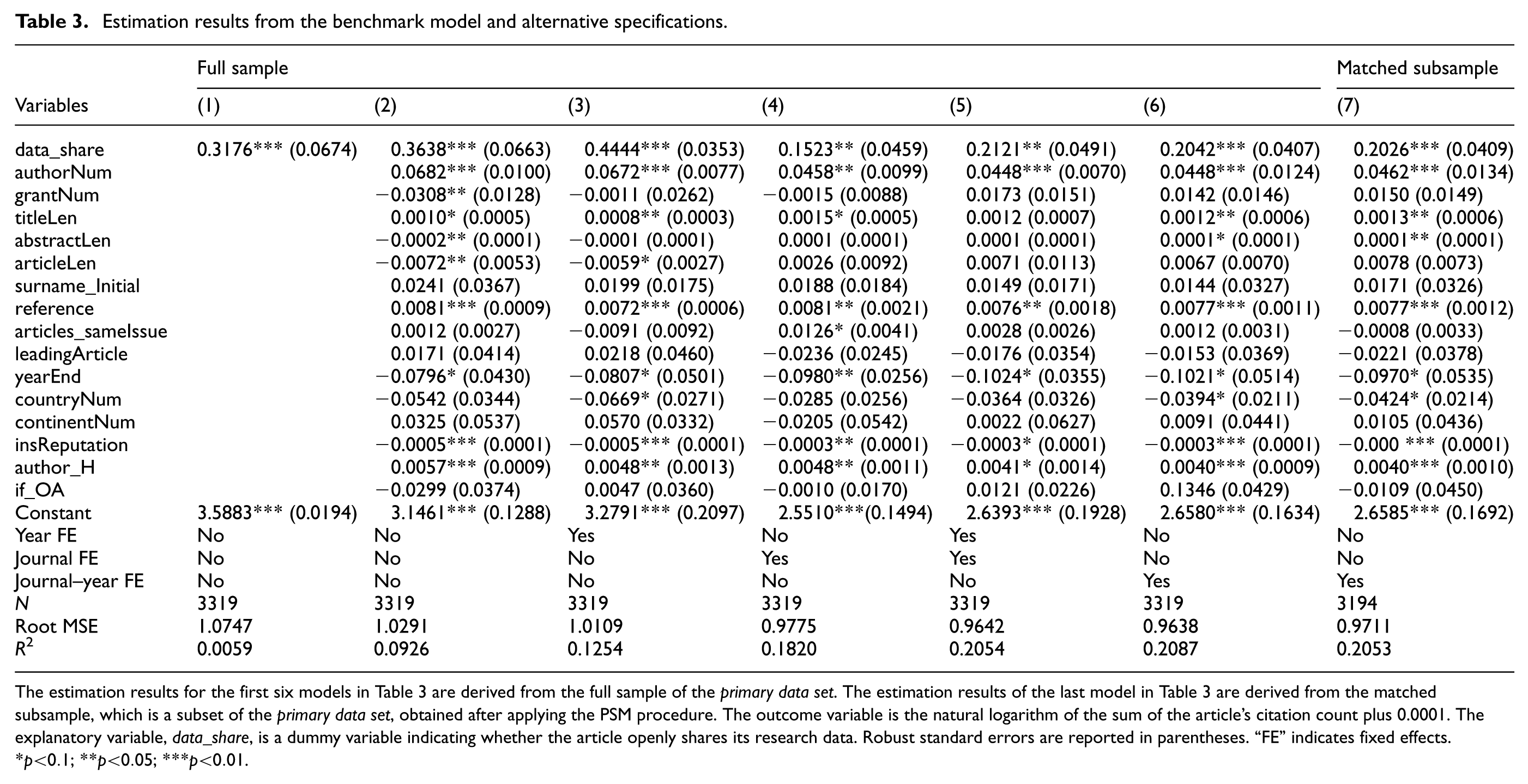
The estimation results for the first six models in Table 3 are derived from the full sample of the primary data set. The estimation results of the last model in Table 3 are derived from the matched subsample, which is a subset of the primary data set, obtained after applying the PSM procedure. The outcome variable is the natural logarithm of the sum of the article’s citation count plus 0.0001. The explanatory variable, data_share, is a dummy variable indicating whether the article openly shares its research data. Robust standard errors are reported in parentheses. “FE” indicates fixed effects.
Model estimation results with data trimming, alternative outcome measures, alternative specifications, and stratified matching.
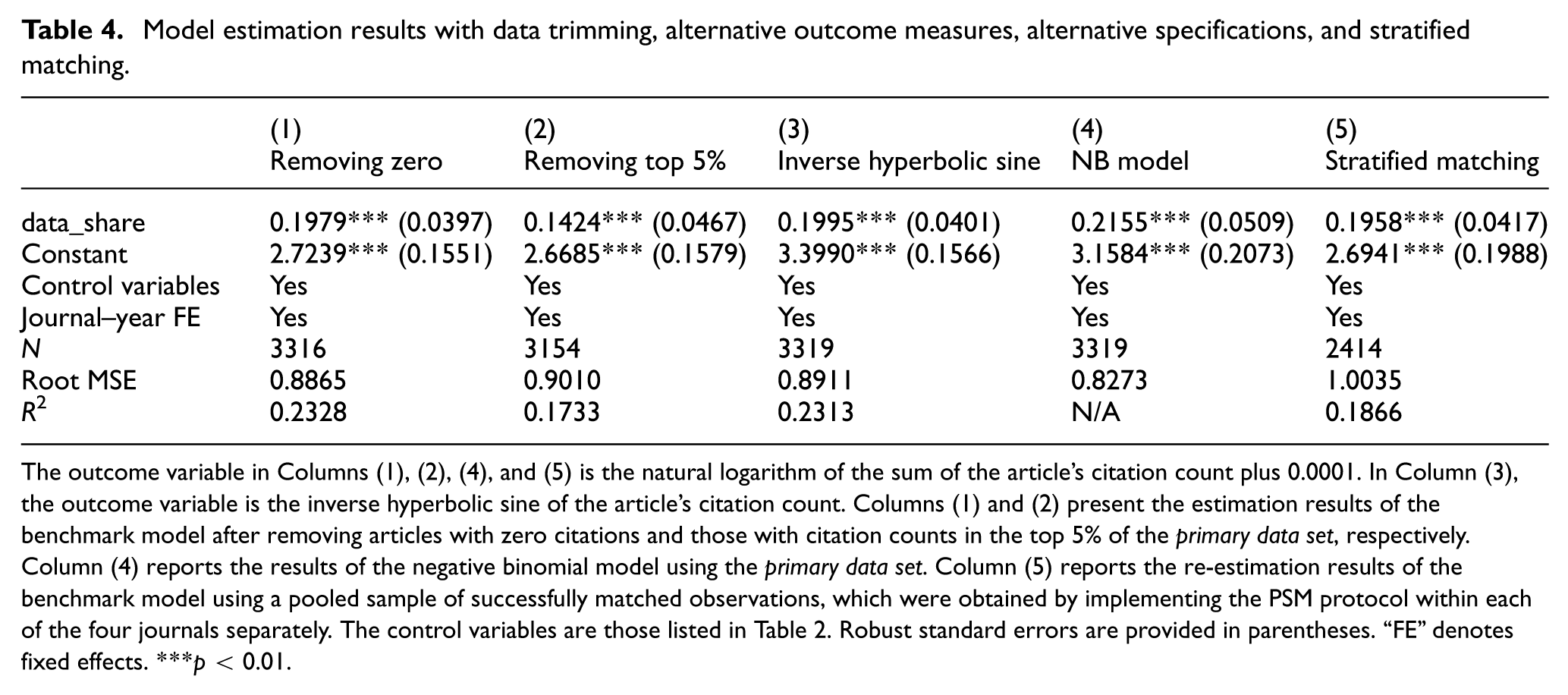
The outcome variable in Columns (1), (2), (4), and (5) is the natural logarithm of the sum of the article’s citation count plus 0.0001. In Column (3), the outcome variable is the inverse hyperbolic sine of the article’s citation count. Columns (1) and (2) present the estimation results of the benchmark model after removing articles with zero citations and those with citation counts in the top 5% of the primary data set, respectively. Column (4) reports the results of the negative binomial model using the primary data set. Column (5) reports the re-estimation results of the benchmark model using a pooled sample of successfully matched observations, which were obtained by implementing the PSM protocol within each of the four journals separately. The control variables are those listed in Table 2. Robust standard errors are provided in parentheses. “FE” denotes fixed effects. ***p < 0.01.
Previous studies have shown that articles with certain characteristics—such as those authored by high-impact first or last authors, published as OA, or funded by larger grants [76,77]—are more likely to share their research data. This pattern suggests that data-sharing practices are not randomly distributed but are instead associated with specific author and article characteristics. Consequently, the observed relationship between data sharing and author characteristics may introduce selection bias into our sample. To mitigate potential sample selection bias, we implemented the propensity score matching (PSM) method, initially proposed by Rosenbaum and Rubin [78]. This method is designed for constructing statistically comparable treatment and control groups with balanced covariates and has been widely used in studies exploring causal relationships [79–81]. Kernel matching with a bandwidth of 0.06 was used to match treated and control samples based on propensity scores estimated from the journal of publication, publication year, and the control variables listed in Table 2, ensuring that the matched samples were comparable in terms of observed characteristics. The benchmark model was then re-estimated using the matched subsample to verify the robustness of our findings. It is worth noting that we adopted widely accepted econometric methods—namely fixed-effects models and propensity score matching (PSM)—that are widely validated in the literature for identifying causal effects in observational data [82–85].
In addition, we conducted subgroup regression analysis to examine whether the effect of open data sharing on citation counts varies across different article and institutional characteristics. Separate regression models were estimated for each subgroup, allowing for a more granular understanding of how data-sharing benefits may differ across contexts.
3. Results
3.1. Effects of open data on citation impact of articles
Columns (1) through (6) of Table 3 present the results based on the full sample of the original data set (i.e. primary data set), including both the benchmark model and alternative model specifications. Column (1) reports estimates from a restricted specification that includes only the
Although the magnitude of the coefficient for
Following the application of the PSM procedure, a sample of 3194 matched observations was obtained, comprising 242 treatment cases and 2952 control cases. Figure 1 presents the results of the balancing test, conducted to assess whether the significant differences in the mean values of each covariate between and the treatment and control groups were mitigated after the matching process. Figure 1 shows that the absolute values of standardized biases for all covariates are below 10% after matching, indicating a negligible difference between the matched treatment and control groups [86]. The t-test results further reveal no significant differences in any of the covariates between the two matched groups. These findings suggest that balance was successfully achieved for all covariates following the matching procedure. We subsequently estimated the benchmark model using the matched subsample derived from the PSM procedure, with the results presented in Columns (7) of Table 3. Our results show that the coefficient of the data_share variable remains positive and statistically significant (
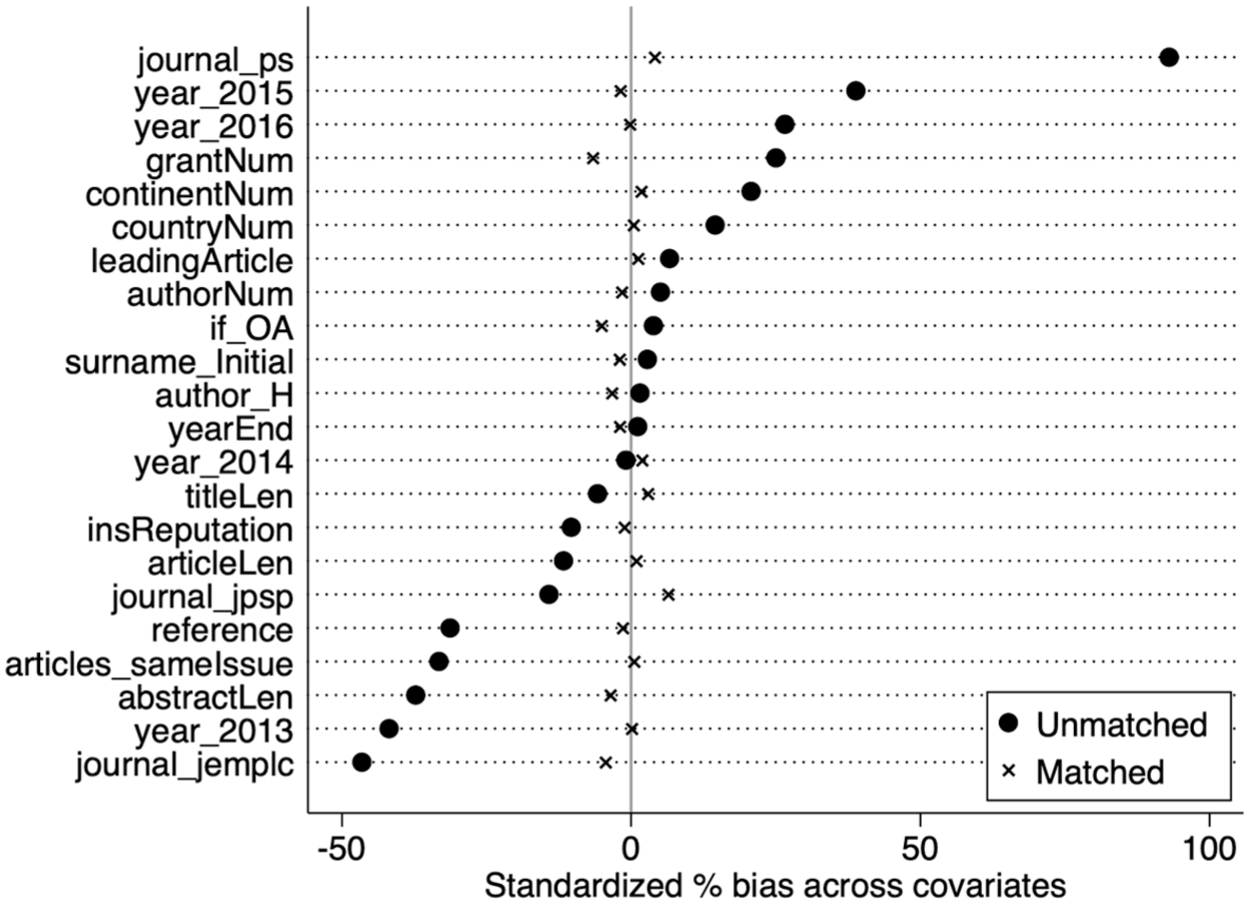
Standardized bias (%) scatter plot for each covariate between the treatment and control groups before and after PSM.
3.2. Robustness checks
We conducted additional robustness checks to assess the stability of the effect of open data on articles’ scientific impact, as reported in the previous analysis. First, to mitigate the influence of extreme citation values, we separately removed articles with zero citation and those with citation counts within the top 5% of the primary data set and then re-estimated the benchmark model for each subset, with the results presented in Columns (1) and (2) of Table 4. As shown in these columns, the coefficient for the data_share variable remains statistically significant and positive in both cases.
Second, to address the potential impact of adding 0.0001 to the outcome variable before applying the natural logarithm, we used the inverse hyperbolic sine (IHS) transformation on the outcome variable (i.e. the number of citations for an article) and re-estimated the benchmark model. The results are presented in Column (3) of Table 4, where the coefficient for data_share remains statistically significant and positive. Third, given the counting nature of the outcome variable, we replaced the benchmark model with a negative binomial model to better account for non-linearity in the data. The results from this model are reported in Column (4) of Table 4, where the coefficient for data_share continues to show statistical significance and being positive.
Third, we conducted an E-value sensitivity analysis to assess the robustness of our primary finding (from PSM-matched samples) to unmeasured confounding. The E-value for the estimated effect of open data sharing on citation counts was 1.907, indicating that an unmeasured confounder would need to exhibit a minimum association strength of 1.907 with both open data sharing and citation counts to fully explain away the observed association. Notably, the E-value for the lower bound of the 95% confidence interval was 1.414—substantially higher than the maximum E-values for all measured confounders (1.333 for yearEnd). This suggests that any unmeasured confounder capable of nullifying our results would need to demonstrate a substantially stronger joint association with both the likelihood of open data sharing and citation impact than empirically observed factors such as funding intensity, team size, institutional prestige, or authors’ prior impact. Given that E-values exceeding 1.4 correspond to a minimum confounding strength of 1.4 (i.e. a 40% stronger association with both open data sharing and citation counts), a magnitude rarely documented in bibliometric research, the unmeasured confounding required to fully explain away the observed effect appears implausible. Consequently, while E-value analysis cannot establish causality, the results demonstrate that the estimated effect of open data sharing on citation counts is robust to unmeasured confounding at levels typically observed in this domain.
Furthermore, to more rigorously control for potential confounding effects driven by journal-specific characteristics, we refine our matching strategy by implementing the PSM protocol within each of the four journals separately. The balance checks after matching suggest satisfactory covariate balance in each subsample. We then combine the matched observations from all four journals into a pooled sample and re-estimate the benchmark model, while controlling for journal–year fixed effects and employing robust standard errors. The results are presented in Column (5) of Table 4, where the coefficient on data_share remains positive and statistically significant at the 1% level. Moreover, the estimated effect size is highly comparable to our benchmark estimate (0.2026), suggesting that the citation advantage associated with open data sharing is not only statistically robust but also stable in its size. These findings indicate that our main results are unlikely to be driven by journal-specific selection differences or journal-level heterogeneity.
Overall, the results of the robustness analyses provide consistent evidence that the positive effect of open data on the academic impact of articles is robust across alternative model specifications and robustness checks. Regardless of the approach taken—whether excluding extreme observations, using alternative outcome measures, modifying the statistical model, or implementing PSM within each journal—the relationship between open data availability and increased citation counts remains consistent and statistically significant. Moreover, the E-value sensitivity analysis shows that an unmeasured confounder would need to exert an implausibly strong joint association with both open data sharing and citation impact to fully explain away the estimated effect, further underscoring the robustness of our findings. Collectively, these results reinforce the argument that open data serves as a valuable scientific practice, enhancing the visibility and reach of research.
3.3. Heterogeneity analysis
Previous evidence suggests that article characteristics (e.g. OA status, funding status, and international authorship) and institutional characteristics (e.g. institutional prestige) affect the scientific impact of articles [59,64,75,81]. Building on such findings, we hypothesize that the citation premium associated with open data sharing may vary across these dimensions. To test this hypothesis, we grouped the sample based on article OA status, funding status, international authorship, and institution prestige, estimating a separate regression model for each subgroup using the benchmark model. The results, presented in Figure 2, reveal distinct patterns.
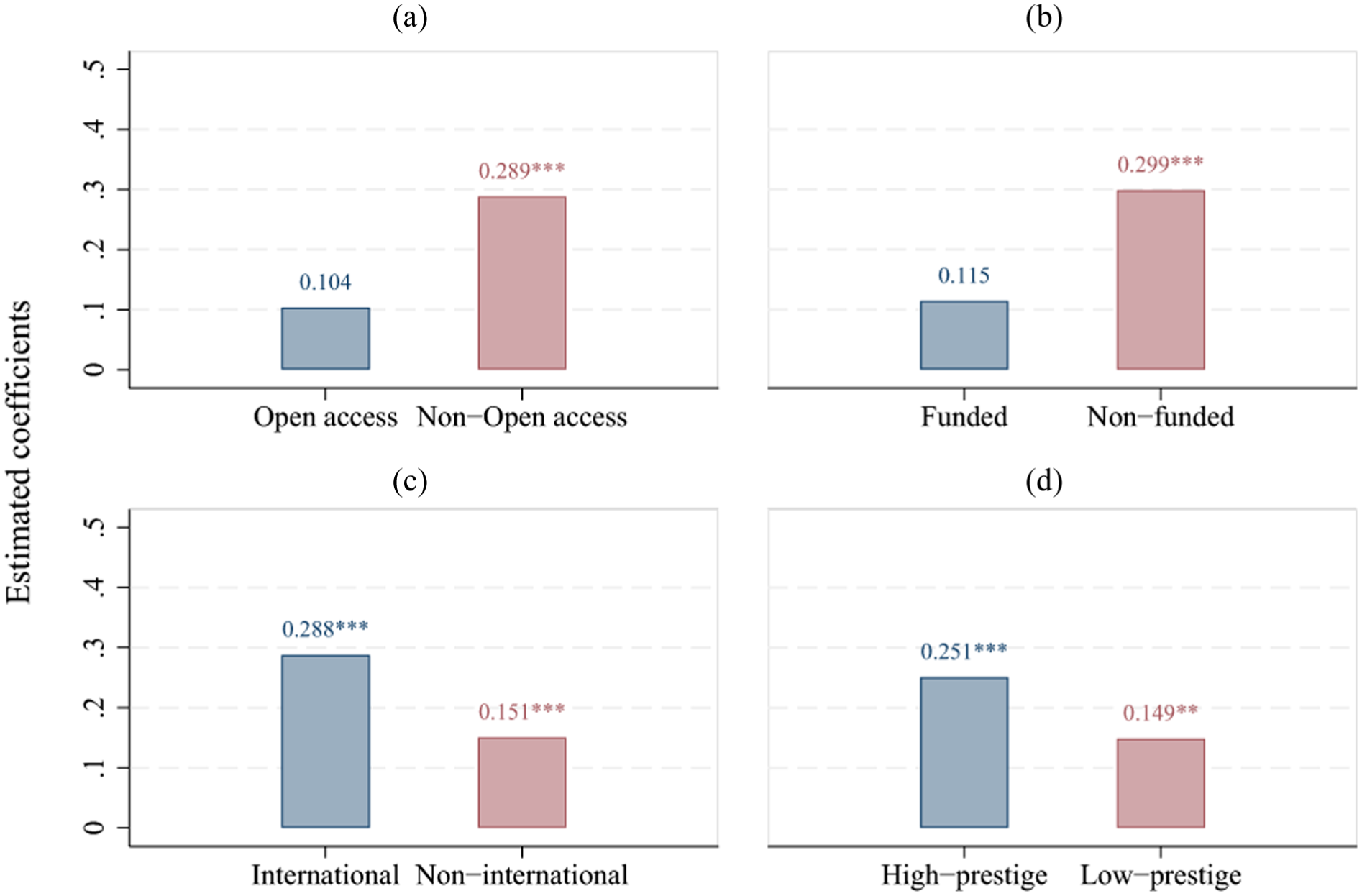
Heterogeneity analysis across article and institutional characteristics: (a) Across open-access status, b) across funding status, (c) across authorship composition, and (d) across author’s institutional prestige. ***p < 0.05; ***p < 0.01.
Figure 2(a) shows that the effect of open data sharing on scientific impact is only statistically significant for non-OA articles, whereas no significant effect is observed for OA articles. One explanation for this finding is that open data may serve as a compensatory mechanism for articles that lack the broader accessibility benefits of OA publishing. This raises interesting questions about the relationship between open data and open access, two important themes in open science.
Similarly, Figure 2(b) indicates that open data sharing significantly enhances citation impact for non-funded articles, while no significant effect is observed for articles receiving funding from agencies. This result suggests that open data sharing may provide additional visibility and credibility to research that does not benefit from external funding, potentially increasing its reach and recognition in the scientific community.
Figure 2(c) shows that open data sharing significantly enhances the scientific impact of both internationally collaborative and non-internationally collaborative articles. Notably, the effect size for articles with international authorship is nearly twice as large as for those without, suggesting that open data sharing exerts a considerably stronger positive influence on articles involving international collaborations.
Figure 2(d) further demonstrates that open data sharing has a statistically significant impact on citation performance for articles with corresponding authors from both high-prestige and low-prestige institutions. However, this effect is more pronounced for articles affiliated with high-prestige institutions, suggesting that researchers from these institutions may derive greater visibility and influence from open data sharing compared with their counterparts from lower-prestige institutions.
Taken together, these findings indicate that open data sharing acts as an equalizing mechanism for visibility and impact but is more beneficial in contexts where other traditional advantages (such as funding or open access) are absent or weaker. Articles that lack alternative forms of accessibility (e.g. paywalled research) or independent visibility tend to gain the most from open data sharing, as it increases their discoverability and reuse potential. However, the reinforcing role of prestige and international collaboration suggests that open data alone may not fully level the playing field, as existing hierarchies in academia still shape citation impact.
4. Discussions
Our research aims to systematically assess whether open data practices contribute to increased citation counts in the field of psychology. While a number of empirical studies have been conducted to understand the correlation between open data sharing and the citation impact of research articles—and have confirmed the positive relationship between these factors [24,25,47,48]—our research adopts a novel approach by employing a multi-layered causal inference framework to examine how this relationship is potentially influenced by various confounding factors in the research system known to affect research impact.
We report that open data sharing is positively associated with the citation impact of psychology articles: articles with open data receive approximately 20% more citations on average than those without. This citation advantage remains consistent after controlling for potential confounding variables and was validated through multiple robustness checks (such as removing zero- or top-cited articles). Our number is largely aligned with those reported in existing research, which often range between 5% and 20% [24,45,46]. We should note that it is difficult to compare our results directly with those of the studies cited above, given the different disciplinary contexts and how open data is measured in such findings.
Prior research suggests that the measurements of open data play a critical role in shaping estimated research impact. For example, Christensen et al. [49] reported that direct data sharing, rather than alternative forms like journal open data policies, has stronger impact. Building on this insight, this study adopts a stringent, article-level identification strategy that focuses on the actual public availability of authors’ own primary research data sets. Given this manually verified measure of open data sharing, the observed citation advantage should be interpreted with appropriate caution.
Specifically, our operationalization primarily captures whether research data are made publicly available and thus aligns most closely with the “accessible” component of the FAIR principle. It does not directly assess variation in data quality, interoperability, or formal reuse conditions. Consequently, our findings reflect the impact of data accessibility per se, rather than the effects of sharing high-quality or fully FAIR-compliant data sets. Heterogeneity in data quality and reuse potential among openly shared data sets may, therefore, contribute to variation in citation outcomes.
From this perspective, our results underscore the importance of moving beyond coarse or policy-based indicators of openness and paying closer attention to the specific modes through which research data are shared. Future studies could further differentiate between repository-based data sharing and data papers [87,88] and examine how these distinct approaches—together with variation in data quality and FAIRness—differentially shape the visibility and impact of scientific research.
More importantly, Table 3 shows that if we do not account for any confounding factors, the perceived benefit of open data sharing on citation count is larger. This can be explained by the fact that many characteristics of highly cited papers—such as being produced at top universities and having greater research resources—are also factors that correlate with researchers’ propensity to share their data.
The second major finding of this research is that this benefit is not uniformly distributed across all types of publications and scenarios. For example, we find that the citation advantage is significantly more pronounced in non-OA articles, non-funded research, and papers involving international collaboration or authors from prestigious institutions. Taken together, these findings suggest that open data sharing has two distinct impacts on the research impact. On the one hand, it serves as an equalizing mechanism for visibility and impact where some traditional advantages (such as funding or open access) are absent or weaker. Articles that lack alternative forms of accessibility (e.g. paywalled research) or independent visibility tend to gain the most from open data sharing, as it increases their discoverability and reuse potential. This finding also sheds light on the relationship between open data and open access as two mechanisms for citation advantage, as the latter factor has received extensive attention in scientometric research [89–91].
However, interestingly, we also find a reinforcing effect for papers enjoying institutional prestige and international collaboration, which generally enjoy relative citation advantages over their counterparts [59,64,92]. We believe this suggests that open data alone may not fully level the playing field, and there are more complex interactions between open data practice and the nuanced power structure within the scientific system. Such diverging findings suggest that more research is needed to fully understand how open data contributes to the rewarding system in science and how we can develop better policies to encourage researchers to share their data.
Our findings have two major theoretical implications. First, they provide quantitative support for the idea that open data sharing functions not only as a tool for transparency and reproducibility but also as a mechanism for enhancing visibility, as discussed by Piwowar and Vision [24]. This reinforces the theoretical link between open science practices and the broader scientific system, which can be leveraged to promote wider adoption of open science practices in the future. Second, the variations in effect size across subgroups of publications shed new light on the power structures within the scientific system. Traditional perspectives often treat open science as uniformly beneficial. However, these views have increasingly been challenged by more critical approaches that emphasize inequalities in access, resources, and recognition within science [93], particularly in the context of open data [43,94]. In line with critical theory, our results suggest that socio-political factors—such as institutional prestige, international collaboration, and funding status—can significantly affect the extent to which researchers benefit from data sharing. This calls for a more nuanced, socially embedded theory of open science that accounts for disparities in how openness is enacted and rewarded across different academic and institutional settings.
From a policy and implementation standpoint, this study offers several actionable insights. First, our findings provide empirical justification for funders, journals, and academic institutions to continue supporting and incentivizing open data practices. Given the strong citation advantages associated with data sharing—especially for under-resourced researchers and institutions—encouraging open data practices can be an effective way to promote equity in scholarly visibility. Second, our results suggest that a well-established data sharing infrastructure is still essential for researchers and the broader scientific system. This requires coordinated input from all major stakeholders, including data repositories, journals, scholarly databases, and individual researchers. Even in psychology—despite recent progress in promoting open science—the journals we examined still exhibit uneven adoption of open data practices. Improving visibility and providing citation credit for data contributors could further incentivize participation in data-sharing ecosystems and help recognize non-traditional research outputs as legitimate contributions to science.
5. Conclusion
This research contributes to the existing literature on open data by analyzing a sample of psychology papers and employing a multi-layered causal inference framework to systematically examine the relationship between open data sharing and article impact. To ensure the robustness of our findings, we conducted a series of robustness checks. Using this approach, our study provides the first empirical evidence of the benefits of open data sharing in psychology: publications with open data receive, on average, approximately 20% more citations than those without. Our findings align with previous research conducted in other contexts, reinforcing the broader impact of data sharing and supporting future advocacy efforts for open science practices. Specifically, our research confirms that openly sharing the data can lead to increased scientific impacts, even after considering various confounding factors and has a significant impact on the theory in information science and scholarly communication.
Despite the contributions of this study, several limitations of this research should be acknowledged. First, our sample is a relatively limited subsample publications in psychology. This implies that the results might primarily reflect patterns within this specific subfield of psychology rather than the whole field. Therefore, caution is warranted when attempting to generalize these findings to other subfields or disciplines. Future work could strengthen generalizability by incorporating a broader selection of psychology journals, conducting cross-disciplinary comparisons. Second, we examined citation counts as a static measure of impact rather than exploring the dynamic citation process over time, as suggested by Christensen et al. [49]. While this decision was made for feasibility reasons, future research could investigate how open data influences citation trajectories over different time windows, offering deeper insights into the evolving impact of data sharing. Third, this study does not account for an important factor influencing data reuse: the quality and reusability of data sets. Future research should incorporate dataset attributes to better understand their role in shaping citation impact. These limitations will guide our future work in further exploring the benefits of open data and how data-sharing practices are reshaping the scientific system.
Footnotes
Acknowledgements
The authors thank Dr Zhichao Fang (Renmin University of China) for providing part of the data, as well as Dr Ya Tang (Nanjing University) and Dr Yurong Hu (Ningbo University) for their valuable feedback on the method of this paper. Also, they are grateful to the reviewers for their helpful suggestions.

Funding
The authors disclosed receipt of the following financial support for the research, authorship, and/or publication of this article: Humanities and Social Sciences Youth Foundation, Ministry of Education of the People’s Republic of China, Grant Number: 22YJC870011.
Declaration of conflicting interests
The authors declared no potential conflicts of interest with respect to the research, authorship, and/or publication of this article.