







Abstract
Emerging regional powers, such as Brazil and India, are reshaping world politics. We conduct a game-theoretic analysis to examine how growing regional powers compete for influence against a global power, such as the United States, in different circumstances. If the global power regards dominant positions in different regions as strategic substitutes (complements), a stronger regional power in region A increases (decreases) the global power’s efforts to dominate in region B. For example, if Iran grows stronger, the United States should increase its efforts to secure energy resources in Central Asia as substitutes for Middle Eastern oil. Conversely, suppose the United States fails to create support for stringent intellectual property rights protection in Latin America because Brazil opposes new rules. In this case, we expect the United States to have fewer incentives to create support in other regions because intellectual property rights rules are most valuable when they constitute a complementary global standard.
Introduction
Emerging regional powers are reshaping world politics. In Asia, the rapidly growing economic and military power of China and India threatens the previously hegemonic position of the United States (Christensen, 2006). In Latin America, Brazil now competes with the United States for the hearts and minds of the surrounding countries (Bandeira, 2006). In Eastern Europe, Russia has used the threat of suspending gas supplies to ensure that its neighbours do not align with the European Union and the United States against Russia’s geopolitical interests (Finon and Locatelli, 2008).
How does influence competition between a global power, such as the United States, and the emerging regional powers affect political-economic outcomes at the international level? When can we expect regional powers to strive for dominance in their geographic surroundings, and how does this affect a global power’s grand strategy? Although the extant literature recognises the importance of rising regional powers (Bandeira, 2006; Chin, 2010; Christensen, 2006; Shambaugh, 2004/2005; Walt, 2009), it does not answer these questions. Given the rapidly growing prominence of regional powers in the shadow of American hegemony, this omission is both theoretically and empirically troubling. The power transition literature identifies the rise of dissatisfied states as the most war-prone condition but does not explore influence competition between dominant and challenging powers short of major wars (Kugler and Lemke, 1997; Organski and Kugler, 1980).
To fill this research gap, we develop a game-theoretic model of influence competition between a global power and regional powers. In the model, the global power has strategic interests in multiple regions while the regional powers are primarily interested in their own surroundings. Within each region, the global and regional powers compete over the political-economic alignments of smaller states. The equilibrium analysis allows us to characterise the regional and global ramifications of power shifts within one region.
We adopt a game-theoretic approach because it helps understand the consequences of strategic interaction between the global and regional powers, as well as the third parties who can choose how to align themselves between the two competitors. To explain and predict the nature of influence competition in a world of regions, it does not suffice to describe the incentives of regional challengers (Bandeira, 2006) or describe recent developments (Chin, 2010). Outcomes depend on the joint effect of multiple strategies, and each player considers the responses of others to their strategies. As Christensen (2006) finds, for example, traditional approaches to interactions between China and the United States in East Asia are not, because of lacking nuance, enough to explain current strategies. Game theory allows us to tease out the potentially complex consequences of interactions among multiple players in a deductively valid fashion, thus complementing available case studies and policy analyses.
We find that the consequences of emerging regional powers depend on the strategic interests of the global power. If the global power regards dominant positions in different regions as strategic substitutes, an increase in the capabilities of a regional power in region A will increase the global power’s efforts to consolidate its dominance in region B. For example, if the United States is interested in a secure oil supply and China successfully challenges it in Central Asia, our model predicts that the United States should increase efforts to secure reliable oil supplies in other regions, such as Africa and the Middle East.
But if the global power regards dominant positions in different regions as strategic complements, an increase in the capabilities of a regional power in region A will decrease the global power’s efforts to consolidate its dominance in region B. For example, if the United States attempts to combat violations of intellectual property rights (IPR) but Brazil manages to lure other Latin American countries to oppose the stringent rules that the United States proposes, then the United States should reduce efforts to combat such violations in other regions. After all, successful policies in other regions would simply result in a global shift in piracy and copyright violations from other regions to Latin America. 1
The model offers a theoretical and an empirical contribution to the study of international relations. Theoretically, the model begins to address the previously neglected issue of regional power dynamics. While the Cold War era and the following ‘unipolar moment’ inspired much important theorising about global hegemony (Gilpin, 1981; Kindleberger, 1986; Lake, 1993) and political competition under bipolarity (Lake, 1996; Organski, 1958; Waltz, 1979), these accounts did not develop analytical models of regional power shifts in the shadow of global hegemony. Nor does the power transition literature pay much attention to how shifts in relative power at the regional level influence patterns of competition and cooperation (Kugler and Lemke, 1997; Organski and Kugler, 1980). We show that the consequences of emerging regional powers for grand strategy and outcomes depend both on regional characteristics and the nature of the issue in focus. The model suggests that blanket statements about the United States’ strategy in different regions have limited explanatory power, as the details of that strategy are contingent on whether or not the issue at hand features strategic complementarity or substitutability across regions. This goes to show that generalisations based on a single region, be it East Asia or Latin America, probably lack external validity and should be regarded with suspicion.
Empirically, the model provides scholars and policymakers with a toolkit for understanding the implications of the rise of regional powers. We show that if the leading global power can achieve its overarching geopolitical goals in some regions while losing the influence competition in others, rising regional powers will induce the global power to shift its efforts to regions that do not have a growing regional power. But if the global power cannot achieve its aims without dominating over its competitors in multiple regions, then rising regional powers may induce the global power to revert to a more isolationist strategy.
Influence competition between global and regional powers
Our analysis focuses on influence competition between different regional powers and a global power. By influence competition, we refer to competition between two major powers over political, economic and security alignments of third parties. Influence competition could be based on foreign aid, preferential trading agreements, military alliances and many other inducements that major powers can offer to third parties. 2 A regional power is a country with the ability to project power in its own region, while a global power is a country with the ability to project power in multiple regions.
Currently, the United States is the leading global power in most issue areas. However, many regional powers exist: China, India, Brazil, South Africa and others. 3 Given this set-up, our interest is in different regional powers’ abilities to secure political-economic alliances with other countries in their own regions, under the assumption that each regional power’s interests are to some extent in opposition to the global power’s interests.
Examples of such conflictual situations abound. In Asia, China has emerged as the leading regional power, and China’s emergence has created a situation of competition with the United States for allies in the region (Christensen, 2006). For example, Pakistan has recently been a pivotal country for the United States because of the military operation in Afghanistan. Many policymakers in Washington worry that Pakistan may deepen its ties with China. This would prevent the United States from effectively influencing Pakistan’s policies. Indeed, China and Pakistan have already formed a preferential trading agreement in 2006. 4 As Pakistan’s ability to secure economic benefits and security guarantees from Beijing increases, the United States must pay a higher price for Pakistan’s policy concessions, such as domestic efforts to combat terrorism. This is particularly worrying for American policymakers now that relations with Pakistan are already strained. When the United States cancelled US$800 million in military aid to Pakistan in July 2011, Pakistan’s former ambassador to the United States, Meleeha Lodhi, noted that ‘Washington is going to be left without any influence with the Pakistan army and with the people of Pakistan because this will be seen as an action that will punish Pakistan rather than provide an incentive for cooperation’ (BBC, 2011). China’s increased influence worsens the problem because Pakistan’s dependence on the United States’ military aid is declining. 5
The assumption that the global power can operate in multiple regions is key to our analytical approach. While a regional power is primarily interested in forming international coalitions within its own region, the global power can coordinate activities across different regions. For example, the United States can simultaneously form military alliances in the Middle East and East Asia or preferential trading agreements in Latin America and North Africa. While each regional power treats activities in other regions as exogenous and only indirectly relevant, the global power can coordinate its policies across regions.
For this reason, the notion of cross-regional interdependence plays an important role in our model. Such interdependence refers to the possibility that coalition formation in region A affects the global leader’s ‘willingness to pay’ for political-economic allies in region B. If Brazil forms a coalition with other countries in Latin America, for example, how does this influence the urgency of finding allies in other regions for the United States? Logically, at least three stylised possibilities exist:
regions are not interdependent;
allies in one region are substitutes for allies in other regions; and
allies in one region are complements to allies in other regions.
In the first case, strategies and outcomes within one region do not influence strategies and outcomes in another region. For example, the United States could be concerned about narcotics and related violence in Latin America regardless of outcomes in other regions. In the second case, the global power’s willingness to expend resources to find allies in region B decreases if it has already found allies in region A. For example, the United States may be satisfied with trade cooperation in Latin America, and thus be less interested in creating new trade treaties in Africa. In the third case, this willingness in region B increases if it has already found allies in region A. For example, securing an ally in the war on terror in the Horn of Africa may not be useful if countries in the Middle East continue to offer safe havens for terrorists.
Scholars of international politics agree on the importance of such interactions between regional powers and global powers (Bandeira, 2006; Chin, 2010; Christensen, 2006; Drezner, 2007; Schirm, 2010), but a dearth of analytical models capable of generating empirically testable hypotheses exists. We now review the bodies of literature from political economy and international security to which our analysis contributes.
The political economy of anarchy and hierarchy
One traditional line of inquiry is the theory of hegemonic stability (Gilpin, 1981; Ikenberry, 2000; Keohane, 1984; Kindleberger, 1986; Krasner, 1976; Lake, 1993). According to this literature, a hegemonic power can help other countries achieve international cooperation. The hegemon has a strong interest in international public goods and the ability to enforce cooperation, so it can create international institutions and coordinate behaviour within groups of states. However, the hegemonic stability literature does not characterise the implications of rising regional powers for international cooperation and conflict.
A large body of literature has analysed the formation of international unions and the possibility of hierarchic relations in international politics (Alesina et al., 2005; Lake, 1996; Morrow, 1991; Urpelainen, 2010). This literature emphasises the strategic decisions that states face as they attempt to form international coalitions. Some studies focus on major powers (Lake, 1996; Morrow, 1991), while others focus on a wider variety of issues in coalition formation (Alesina et al., 2005; Urpelainen, 2010). However, these studies do not allow for the possibility of influence competition. As such, they ignore the important nexus of cooperation and conflict.
Power transitions and international security
Another relevant body of research examines competition between states. Building on traditional realism, several scholars have examined competition for power between states (Gowa and Mansfield, 1993; Grieco, 1988; Snyder, 1997; Walt, 1987; Waltz, 1979). These studies emphasise that states may be concerned about relative gains, and thus forgo seemingly profitable opportunities to cooperate. Focusing on generic distributional conflict between major powers, this literature neither illuminates the competitive relationship between global and regional powers nor sheds light on the role of third parties. Our analysis builds on realist scholarship by introducing third parties as targets of influence competition between global and regional powers.
One partial exception to the neglect of regional influence competition is Mearsheimer (2001), who examines the ‘tragedy of great power politics’ from the perspective of competition between multiple major powers seeking hegemony. He argues that major powers have incentives to compete for global hegemony. Since achieving the military capability to become a global hegemon is unlikely, however, great powers seek to become the world’s only regional hegemon and block the rise of potential regional hegemons in distant areas. In pursuing these goals, great powers usually attempt to pursue the strategy of buck-passing, letting other great powers check the rise of regional hegemons. An alternative strategy to buck-passing is military intervention as an offshore balancer. While his theory provides insight into how global powers respond to rising regional powers, the interaction with minor powers and the use of non-military strategy play a limited role in his theory.
The power transition literature suggests that the rise of a dissatisfied state on a par with the dominant state dramatically increases the probability of war (Kugler and Lemke, 1997; Organski and Kugler, 1980). This theoretical insight was further developed and empirically tested in several recent studies (Abdollahian and Kang, 2008; Kim, 1991; Tammen et al., 2000), but still missing in the literature is the impact of regional power shift and a dominant power’s strategy in anticipation of rising power. While Lemke (2002) extends the power transition theory to cover the regional level, his application is restricted to the examination of regional war and peace, paying little attention to how a global power competes for influence with regional powers more generally. He recognises the possibility of the global power’s interference given strong interest in the issue at stake but dismisses it as a factor of only minor importance.
Finally, Palmer and Morgan (2006) introduce a ‘two-good theory’, which provides some insight into how relative power change influences a state’s foreign policy behaviour. Bringing in foreign policy substitutability, they assert that a foreign policy used to change (maintain) the international status quo substitutes another foreign policy adopted for change (maintenance). Specifically, foreign aid is a substitute for conflict initiation because both are intended to produce change. Also, they assume that a stronger state has comparative advantage in change-seeking foreign policy, which implies that a state would increasingly pursue change-seeking foreign policies with an increase in relative power. The broad scope of their analysis, however, prevents them from exploring how the use of a foreign policy instrument in a certain region would substitute or complement the use of the same instrument in other regions. In particular, while they assume that forming an alliance with a weaker power substitutes conflict initiation or foreign aid, they do not pay attention to how forming an alliance with one weaker power would substitute or complement an alliance with another weaker power.
Model
The game is played by five players. The first player is a global power. The global power has strategic interests in two regions. The second and third players are regional powers, indexed by I =A,B. Each regional power is only interested in its own region. A small country i = a,b is located in regional power I’s region. This small country can choose between forging an alliance with the global or the regional power. Of course, it can also choose to remain independent.
The game is played as follows:
The global power offers side payments
Each small country i selects between remaining independent and accepting the higher offer,
By using this sequence of moves, we model influence competition within a region as an ‘auction’. The global power offers a side payment to small countries in both regions, while each regional power offers a side payment to the small country in its own region. The small country observes these offers and either accepts the higher one or rejects it. Both offers cannot be accepted because accepting an offer entails forging an alliance with one power in a competition against the other.
The model is not premised on any particular issue. Influence competition could capture military alliance formation or regional trade cooperation. It could also focus on regulatory standardisation or preferential access to energy resources, such as oil. The analytical scope of the model is therefore wide. However, for applying the model, it is necessary that the global power and regional powers face distributional conflict.
Small country i’s payoff from this game is zero if it rejects the offer and
Empirically, the competing powers could offer various side payments. One conventional way of creating political-economic alignments is foreign aid (Alesina and Dollar, 2000). Powerful countries could also offer preferential market access in exchange for policy adjustments (Shadlen, 2005).
Consider now the regional powers. If regional power I secures an alliance, it obtains a payoff
Substantively, it seems plausible to assume that
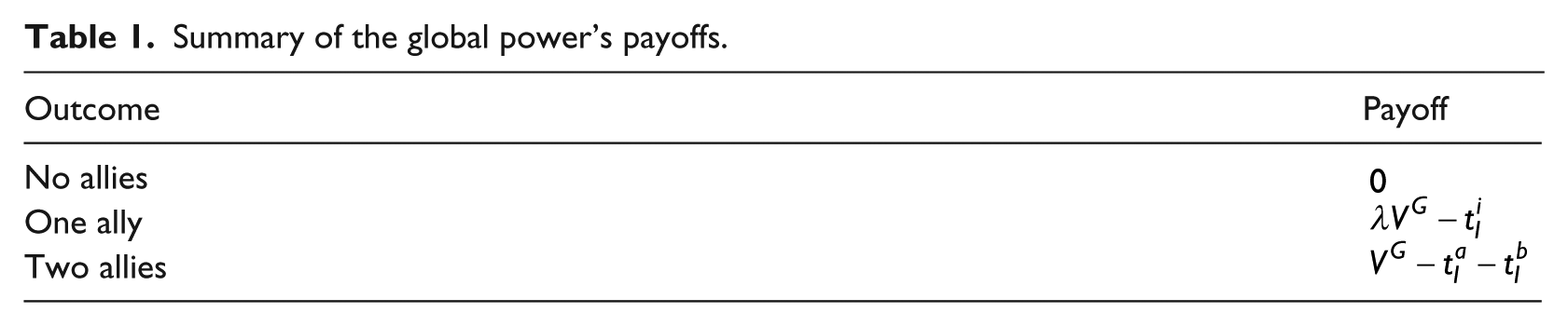
The global power’s payoffs are somewhat more complex because it can secure zero, one or two allies. If the global power secures no ally, it obtains a payoff of zero. If the global power secures two allies, it obtains a payoff of
If the global power secures an alliance with small country i, then it obtains a payoff of
These payoffs are summarised in Table 1. When
Summary of the global power’s payoffs.
In the case of complementarity,
Equilibrium
Solving the game requires examining the global power’s ability to compete with the regional powers for influence. In this section, we characterise the subgame perfect Nash equilibrium of the game. Formally, an equilibrium is a strategy vector
We present the equilibrium analysis as follows. First, we illustrate the logic with the particularly simple case of unrelated regions, namely,
Unrelated regions
Suppose first that
Recall that competition is modelled in the form of rival offers. If the global (regional) power is to dominate in one region, it offers the lowest side payment such that the minor power is willing to accept it and the competitor has no incentive to offer a larger side payment.
First, suppose
Second, suppose
These dynamics are illustrated in Figure 1, which shows that equilibrium outcomes in one region are orthogonal to equilibrium outcomes in the other region. In each region, only the relative willingness to pay is relevant. If the global power values dominance more than the regional power, the global power prevails. Therefore, the regions are not interdependent.
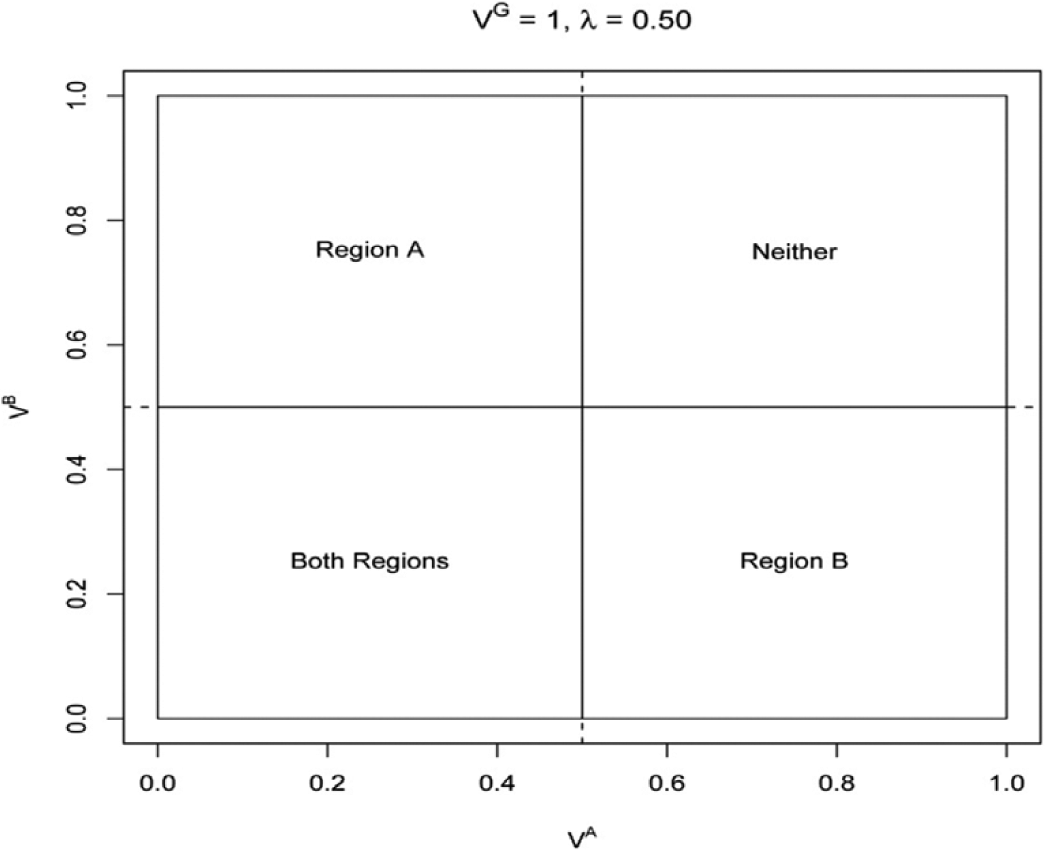
Equilibrium outcomes for unrelated regions.
But what if the global power has incentives to coordinate strategies across regions? The next two sections focus on this issue. Regional interdependence turns out to have interesting implications for the global power’s strategy and ability to influence dynamics in the two regions.
Substitutability
To understand the implications of regional interdependence, we begin with the case of substitutability, or
Again, competition is modelled in the form of rival offers. Suppose, for example, that
This intuition is illustrated in Figure 2. The figure shows how rare it is for the global power to dominate in neither or both regions. Given substitutability, the global power’s overriding priority is to secure dominance in one region. If
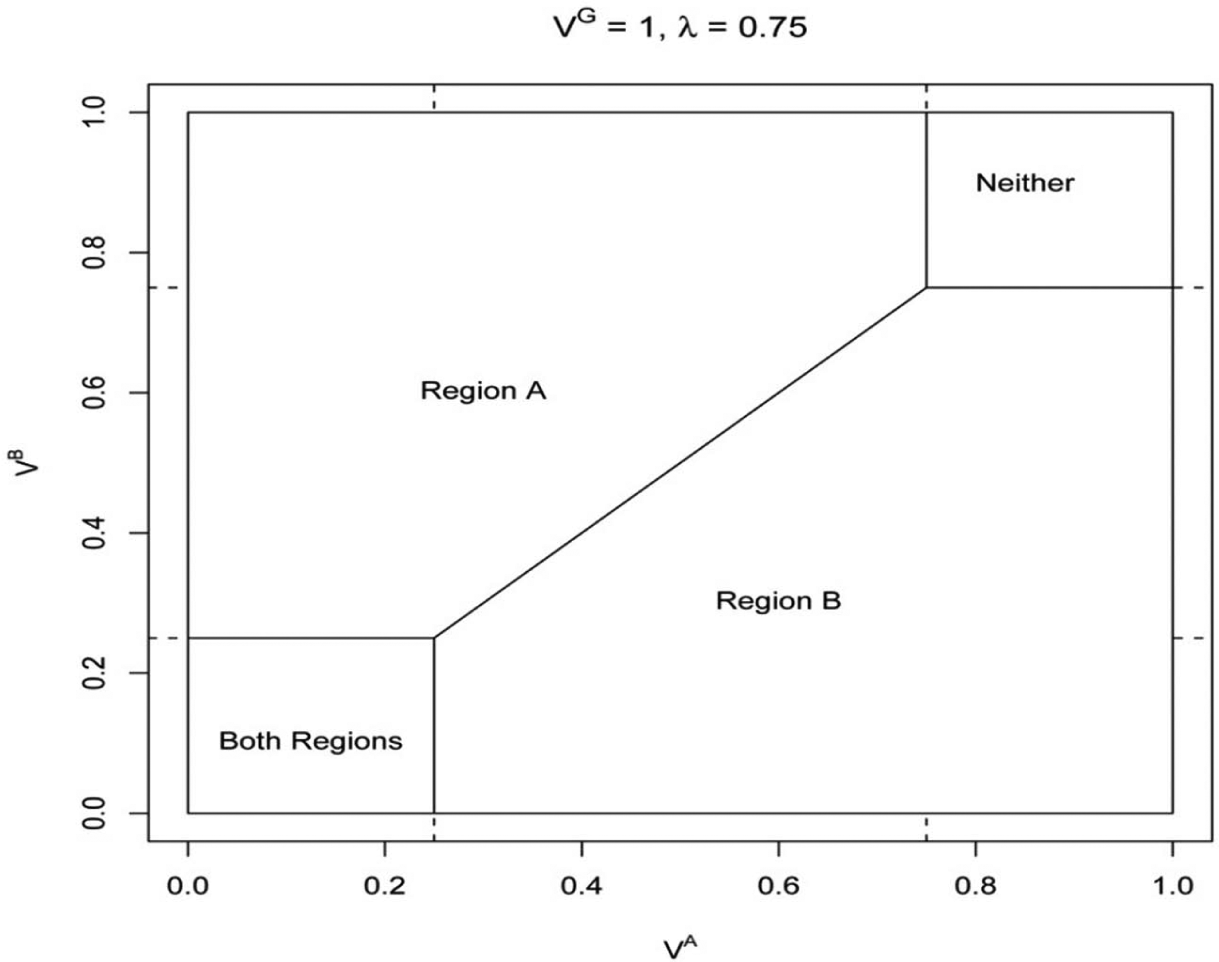
Equilibrium outcomes under substitutability.
Under substitutability, the set of parameter values that induce the global power to dominate over one region, instead of zero or two, is large. Given substitutability, the global power’s primary interest is in securing dominance in one region. Whether it also dominates in another region is much less important.
Complementarity
Exactly the opposite is true when one considers the case of complementarity, so that
This result is illustrated in Figure 3. As long as neither regional power’s valuation of regional dominance,
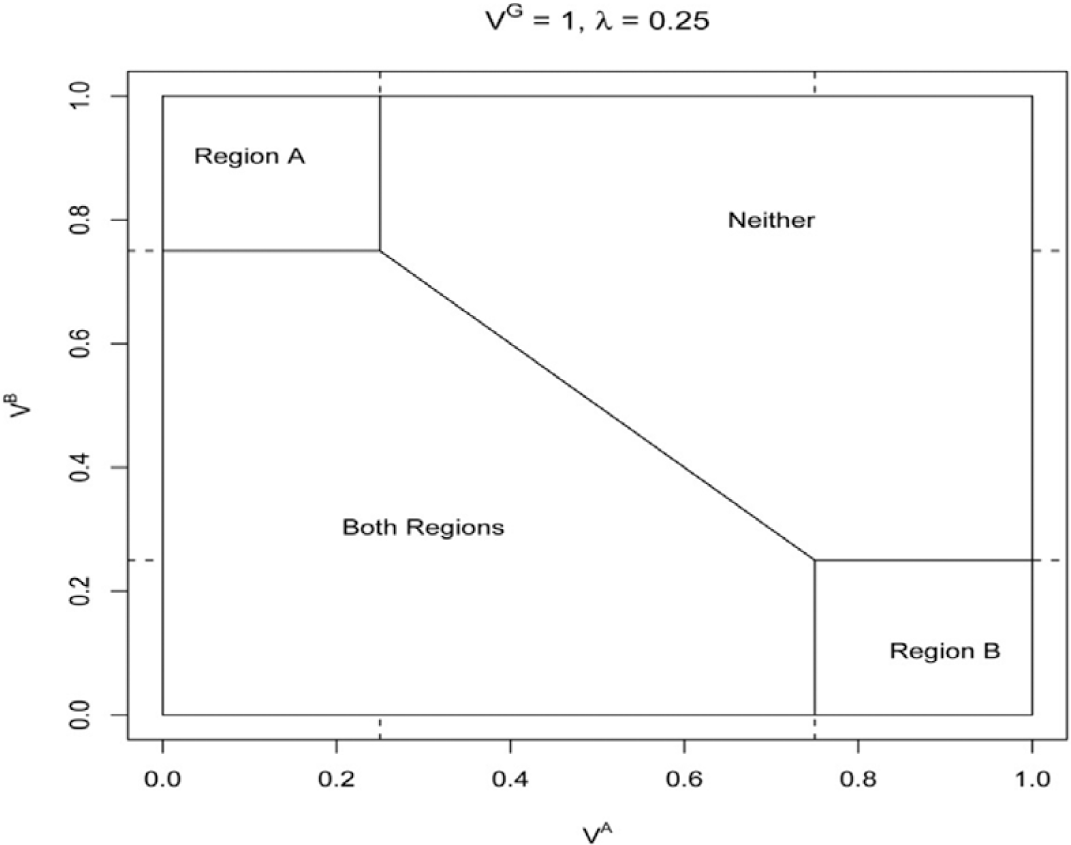
Equilibrium outcomes under complementarity.
Empirical implications
The equilibrium analysis provides a variety of interesting hypotheses. In particular, suppose that the strategic interests of one of the regional powers, say A, begin to grow, so that
How does this influence (i) regional political-economic alignments and (ii) the side payments that the global and regional powers offer to secure dominance in the two regions? We separately examine the effects of regional power shifts on these two dependent variables under substitutability and complementarity.
First, it is useful to establish the basic fact that the global power’s payoff decreases if a regional power becomes more powerful:
Suppose
While this fact is straightforward to establish, the role of regional interdependence is less obvious. Let us first examine the consequences of regional power shifts under substitutability: the global leader loses dominance in this region whenever the growth in regional power A’s strategic interest the global leader’s behaviour in the other region remains unchanged whenever the other regional power B’s strategic interest the global leader achieves dominance in the other region whenever the other regional power B’s strategic interest
As regional power A’s strategic interest
This result is illustrated in Figure 4. The figure shows, for different values of
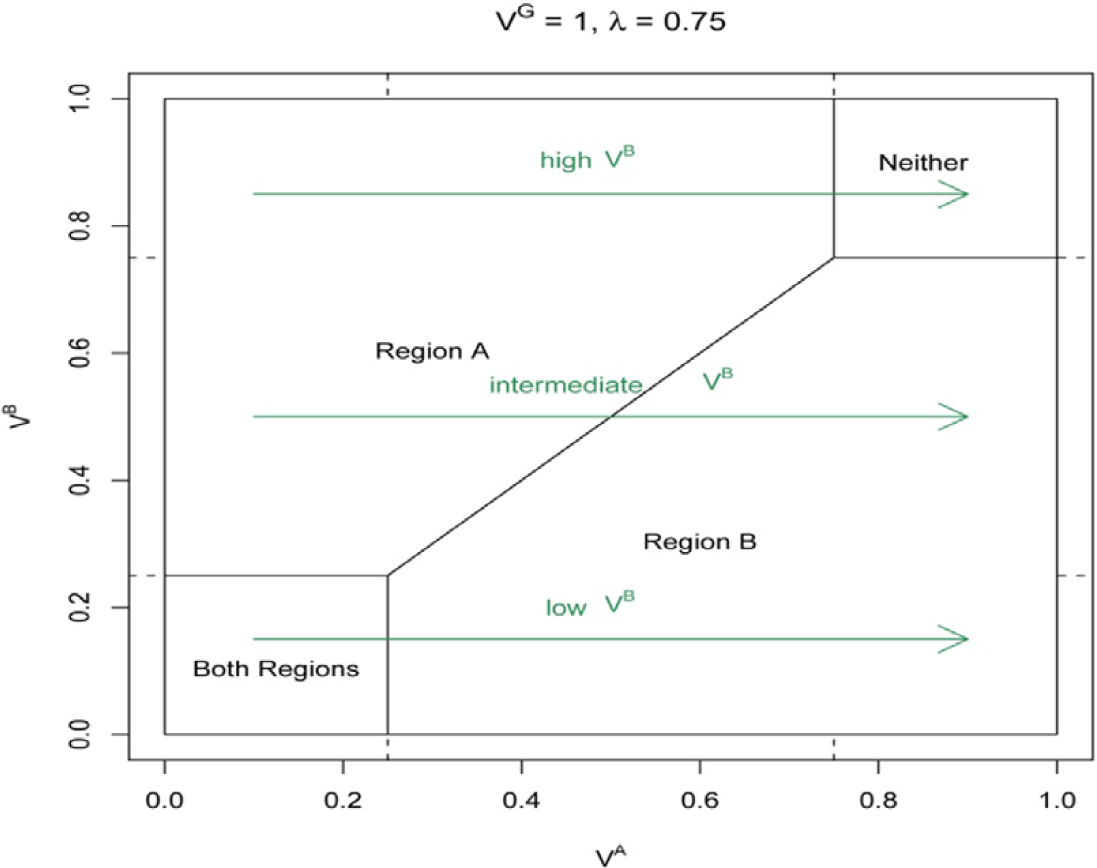
Effects of changes in regional power A’s strategic interest
But when
To illustrate, consider the issue of energy security. Since the 1973 oil crisis, policymakers in industrialised countries have worried about disruptions in oil imports from politically unstable areas, such as the Middle East (Yergin, 2006). In our model, the United States would be the global power trying to secure oil supplies in different regions of the world. Since the importance of securing oil supplies from one region is less important when other regions have already been secured than when these other regions are in danger, the case of energy security would be coded as substitutability, or
The United States’ policy in resource-rich Central Asia nicely accords with these expectations. In the early 1990s, when international oil prices reached the lowest levels in two decades and the United States had successfully prevented Saddam Hussein’s Iraq from conquering Kuwait, Central Asia ‘was seen as peripheral to US interests … [t]here was in particular little evidence of military interest’ (Macfarlane, 2004: 451). As long as the United States was able to secure oil imports in the Middle East, the United States chose not to incur the cost of developing alternative supplies in other regions.
But as the United States’ relations with Iran continued to deteriorate, President Clinton’s strategy changed. In 1995, the United States imposed a total trade embargo on Iran in view of punishing ‘the Iranian Government’s open support for terrorism and its pursuit of nuclear weapons’ (New York Times, 1995). Given the worsening relations, the United States had to deal with an increasingly hostile regional power in the region responsible for a large share of the world’s oil resources. These worsening relations coincided with increased domestic and global oil consumption.
Although the United States imports oil from a range of sources, including Canada and Mexico, there is no question about the centrality of the Middle East for global oil markets. Any disruptions in Middle Eastern supply would increase the global price of oil, and historical evidence shows that rapid price increases tend to wreak havoc in the American economy (Hamilton, 1985). At the time, shale oil was not yet available to the United States. Therefore, it would have been dangerous for the United States not to respond to the worsening security situation in the Middle East.
As our model predicts, the United States began to develop a substitute for the Middle East by cooperating with resource-rich Central Asian countries, such as Kazakhstan. As Macfarlane (2004: 451) writes: Washington became preoccupied by the region’s potential as a source of energy outside the Middle East … [t]he issue of how to get oil and gas out of the region did require consideration of the matter of interstate cooperation, since any export route would inevitably involve passage across the territory of at least two states.
For example, the United States ‘promoted more active Partnership for Peace (PfP) and “in the spirit of PfP” military assistance programmes’.
Examine now the case of complementarity: the global leader loses dominance in this region whenever the growth is large enough; the global leader’s behaviour in the other region remains unchanged whenever the global leader loses dominance in the other region whenever
Regional power A’s willingness to pay for dominance is growing. This again means that the global leader’s ability to dominate in that region decreases. But the effects on the global leader’s strategy in the other region are diametrically opposed to those in the case of substitutability. Since the global leader’s payoff from dominating in one region is much less than the payoff from dominating in two regions, failure to secure dominance in region A actually reduces the global leader’s willingness to invest in region B. Unless the other regional power’s willingness to pay for dominance
A graphic illustration is given in Figure 5. The figure shows, for different values of
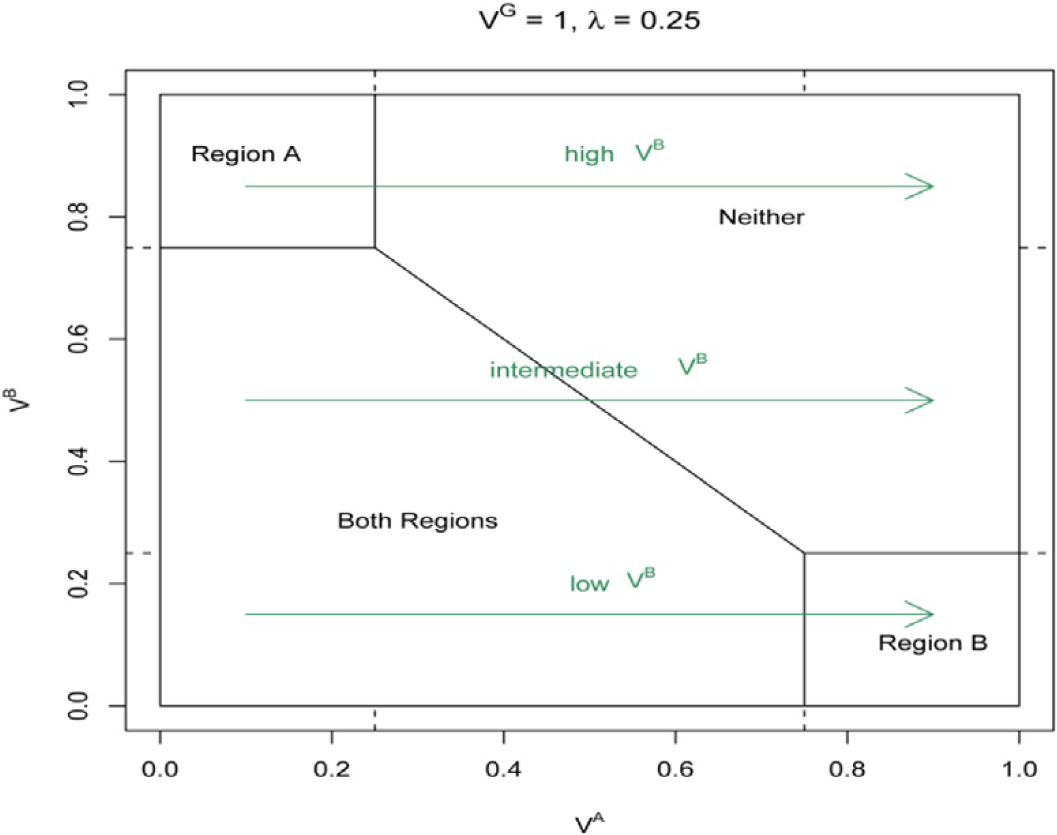
Effects of changes in regional power A’s strategic interest
For a brief illustration, consider the case of IPR protection. In contrast to the case of securing oil imports, this issue features strategic complementarity,
Recent efforts led by the United States and the European Union to form a global Anti-Counterfeiting Trade Agreement (ACTA) can help demonstrate this logic. The United States can be conceived as a global power striving to create an effective global IPR regime. The European Union shares interests with the United States in implementing stringent IPR rules and can be understood as a global power’s ally that plays a considerable role in IPR regime-building. While we do not explicitly model the role of a global power’s ally, the presence of an ally does not change our model’s main prediction. Key actors to be included in IPR regime-building efforts are countries in other regions such as Latin America and Asia where the United States undoubtedly plays a more important role. Moreover, the European Union members do not compete with the United States to increase their influence over other regions. Thus, we can apply our simple model to our framework without introducing additional actors. We could regard the United States’ strategic interests as
ACTA would be a historically stringent IPR treaty exacting large costs on developing countries whose governments ‘fear the border enforcement provisions in ACTA could have a dangerous effect on access to medicines by disrupting shipment of goods such as pharmaceuticals’ and ‘are uncomfortable with the prospect that ACTA could force them to allocate resources toward intellectual property enforcement ahead of other important policy concerns’ (Geist, 2010: 143).
Amid increasing opposition from emerging regional powers, notably, Brazil and India, the United States has led plurilateral treaty negotiations among interested parties. Instead of relying on the multilateral World Intellectual Property Organization, dominated by developing countries, the United States chose to negotiate first with sympathetic countries (Sell, 2011).
However, ACTA will not help the United States impose more stringent IPR rules on pivotal countries unless ACTA becomes the new global standard for IPR rules. As Geist (2010: 142) notes: While, at first, it seems odd to conclude an anti-counterfeiting treaty without the participation of the countries most often identified as the sources or targets of counterfeiting activities, we should expect that ACTA member countries will work quickly to establish the treaty as a ‘global standard’ … [n]on-member countries will face great pressure to adhere to the treaty or to implement its provisions within their domestic laws, particularly as part of bilateral or multilateral trade negotiations.
Our model suggests that such efforts may abruptly lose steam if the political influence of regional powers opposing ACTA continues to grow. Under strategic complementarity, difficulties in implementing more stringent IPR rules in one region can be expected to have the ‘domino effect’ of reducing the value of implementing these rules in other regions. However, this also means that the United States has a very strong incentive to fight for those global rules.
Model extension: Two global powers
In the main model, one global power competes with two regional powers in two regions. How would our analytical results change if two global powers were competing for influence in two regions? For example, suppose that China’s political clout continues to rise to the extent that it can challenge American hegemony. In this case, China’s strategic interests would begin to extend beyond its immediate geographic surroundings. Indeed, we already see some evidence of this. China has begun to form coalitions with resource-rich African countries, such as Angola and Sudan (Taylor, 2006).
In the modified model, there are only four players. The first and second players are global powers
We separately examine the equilibrium strategy of four players for the cases of unrelated regions (
Second, consider the case of issue substitutability (
The result is illustrated in Figure 6, which shows that under substitutability, only very asymmetric strategic interests between the global powers result in one’s dominance of both regions. In most instances, they instead prevail in different regions. For example, this result suggests that China’s rise may very soon weaken the position of the United States in some regions for issues characterised by substitutability, such as energy supply. However, only massive power imbalance in favour of China would cause China to begin to dominate in most regions.
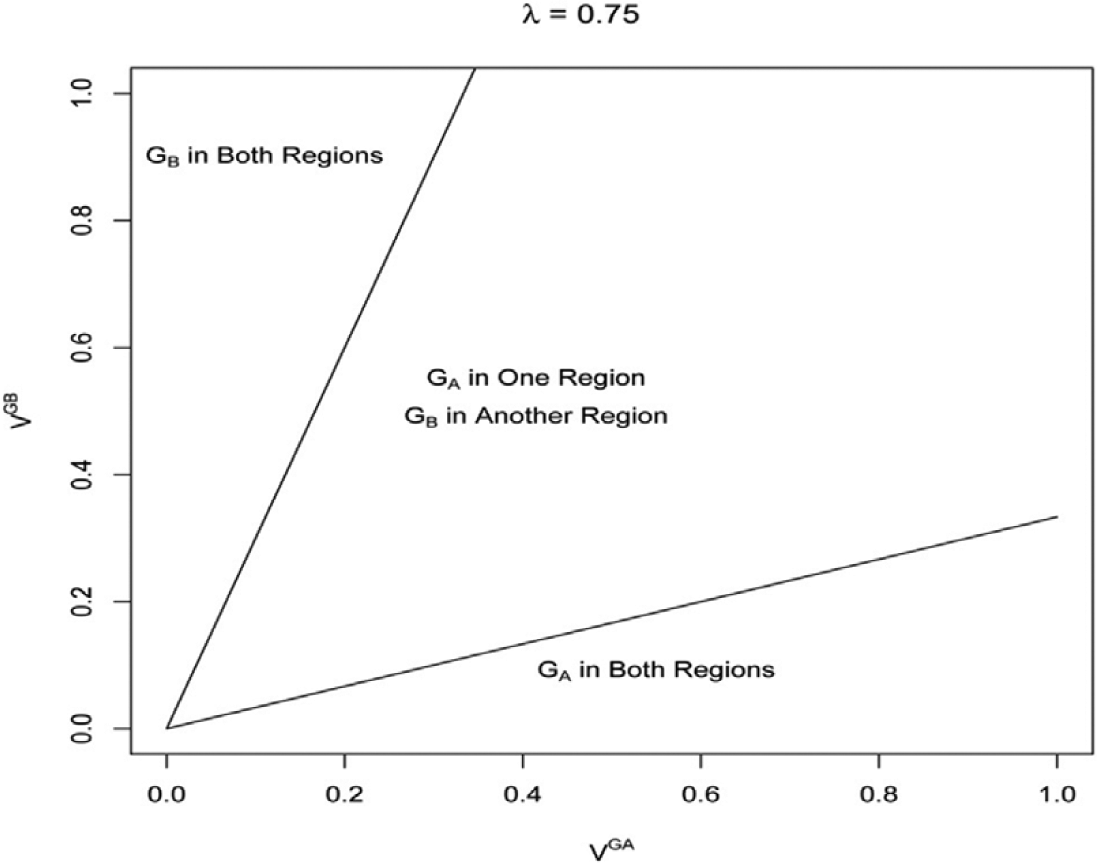
Influence competition with two global powers under substitutability.
Finally, consider the case of issue complementarity (
Figure 7 illustrates the result. It shows that even slightly asymmetric power balances result in the dominance of one global power in both regions. Under complementarity, neither global power is willing to invest in one region only. Interestingly, even small changes in the global power balance could have dramatic implications for political-economic alignments in multiple regions.
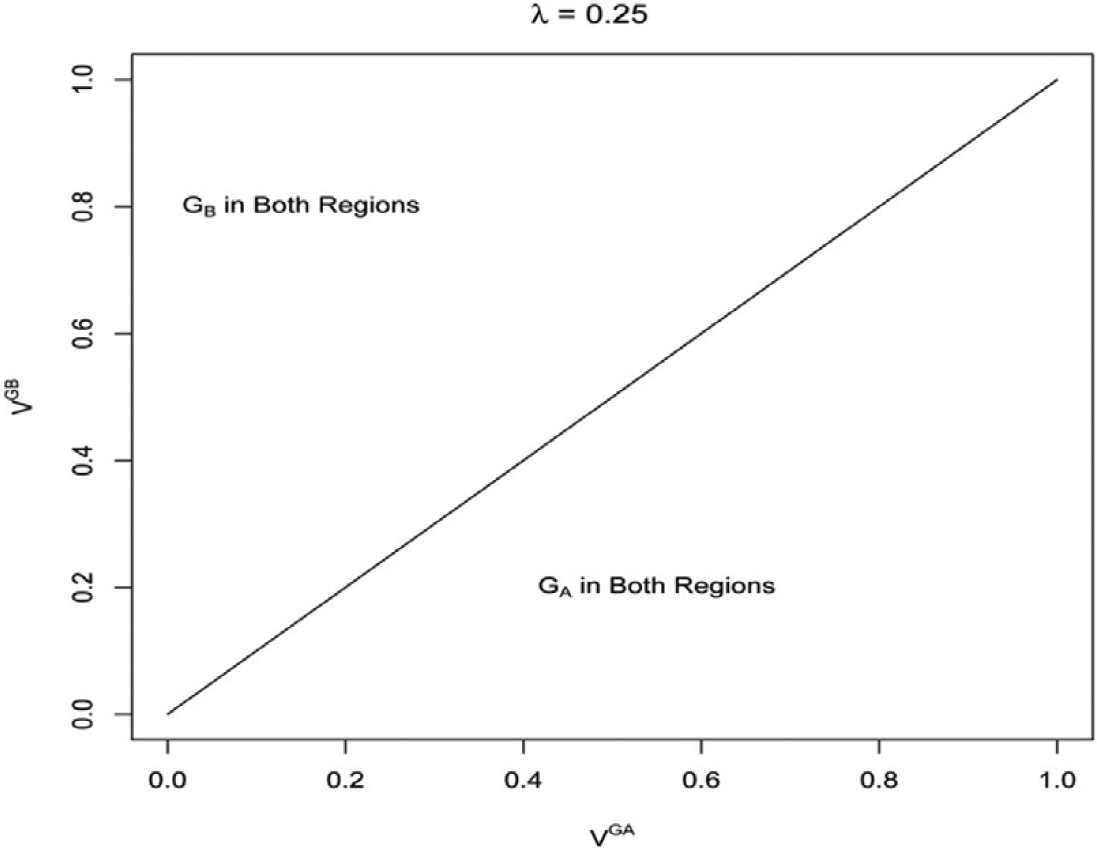
Influence competition with two global powers under complementarity.
During the Cold War, global influence competition between the United States and the Soviet Union seems to have featured elements of complementarity. For example, according to Snyder (1991: 3), the United States fought wars in Korea and Vietnam even though: Neither Korea nor Vietnam was thought to have great economic, military, or cultural value to the United States. Rather, they were thought to be worth fighting for primarily because defeats there might create precedents for areas of greater intrinsic value.
Indeed, complementarity may explain why the United States so aggressively responded to the spread of communism in seemingly peripheral areas. If Snyder (1991) is correct to argue that defeats in certain regions, such as South-East or East Asia, reduce the United States’ ability to control outcomes in other regions, then, according to our model, the United States should respond to even seemingly unimportant threats with great vigour. This is consistent with the global strategy of fighting communism during the Cold War.
This extension is particularly useful for understanding the potential implications of China’s rise as a global power. The model extension suggests that as China’s political ambitions become increasingly globalised, under substitutability, this should soon result in increased Chinese influence in some but not all regions. Indeed, the energy security issue suggests that such developments are already under way. China’s ‘oil diplomacy’ has resulted in increased Sino-African cooperation, and this increase has in turn reduced Western countries’ influence in the region (Taylor, 2006). Given the results from the model extension under substitutability, this is as expected: since Western countries are able to find energy resources elsewhere, they need not respond to China’s oil diplomacy in Africa with particular aggression. At the same time, Africa is a natural place for China to engage in oil diplomacy because the Western powers already have a strong position in many other regions, including the Middle East. Thus, our model can explain why the substitutability of regional influence in energy policy allows China to increase its influence in Africa.
In contrast, an immediate increase in China’s influence on issues such as IPR protection and industrial standard-setting is not expected. Given strong complementarity, China’s growing power should not anytime soon result in an overhaul of global IPR and other standards according to China’s political-economic interests. While there is no systematic evidence on this issue, we are not aware of any evidence of China becoming increasingly dominant in these issue areas.
Conclusion
The defining feature of the Cold War was the bipolar influence competition between East and West. However, we now live in a world with multiple regional powers. These regional powers are challenging the hegemony of the United States. In this article, we have developed a theory of influence competition between rising regional powers and global powers. Our findings suggest that the effect of emerging regional powers on world politics depends on the issue in focus. If the incumbent global power regards dominance in different regions as substitutes, a regional power’s emergence causes the global power to shift its focus to other regions. However, if the incumbent global power must dominate multiple regions to achieve its aims, a regional power’s emergence causes the global power to withdraw from multiple regions.
This article offers the first analytical model of emerging regional powers. The simple model generates contingent predictions on regional power shifts. These predictions lay the foundation for systematic empirical research. In conjunction with a qualitative coding of issue characteristics, temporal variation in different regional powers’ ability and willingness to pay for political influence in their own regions can be used to test our hypotheses. The model extension to two global powers also shows how outcomes change when some regional powers, such as China, begin to develop global strategic interests and power projection capabilities.
The policy implications are no less important. If regional powers continue to emerge, United States’ policymakers may confront difficult choices. Our model suggests that the appropriate strategy for coping with increasingly confident regional powers is highly dependent on the issue in focus. If the United States can achieve its strategic goals by creating allies in one region, the rise of any given regional power requires but a shift in regional focus. However, if the United States cannot achieve these goals without loyal allies in multiple regions, the rise of a single regional power will force the United States to expend more resources also in other regions. Ultimately, the growing strength of a single regional power may have disruptive effects on the global strategy of the United States.
Footnotes
Acknowledgements
We thank Erica Borghard, Andrew Cheon, the anonymous reviewers and Mark Kesselman for their insightful comments on this article.
Funding
This research received no specific grant from any funding agency in the public, commercial or not-for-profit sectors.
Notes
Author biographies
References
Supplementary Material
Please find the following supplemental material available below.
For Open Access articles published under a Creative Commons License, all supplemental material carries the same license as the article it is associated with.
For non-Open Access articles published, all supplemental material carries a non-exclusive license, and permission requests for re-use of supplemental material or any part of supplemental material shall be sent directly to the copyright owner as specified in the copyright notice associated with the article.
