







Abstract
Although past research has found that news exposure correlates with strong partisanship, insights are based on single-country studies. Other studies have shown that cross-national variations in news systems correlate with turnout, but have not explored partisanship. The current study fills this gap by testing the strength of the relationship between news exposure and partisanship cross-nationally. We argue that the greater the political parallelism in news systems, the stronger the correlation between news exposure and partisanship and the smaller the gaps in partisanship between those most and least educated. Multivariate analyses of the cross-national European Social Survey find empirical support for both hypotheses.
Keywords
Introduction
The importance of partisanship strength and information environments merits further investigation, because of the consequences of partisanship strength or lack thereof for voter turnout (Bartels, 2000). It is particularly unclear what sort of information environment strengthens or weakens partisan attitudes. While limited evidence from the USA suggests that increased exposure to news media increases partisan attachment, this has not been tested in other countries or in an explicitly comparative manner. One significant gap in the approach that has been used in past single-country studies is that they overlook important variations in information environments. News media systems differ in their level of overlap with the political system. In some countries, the polarisation of news sources closely parallels the spectrum of the political parties, also called political parallelism (PP). This overlap between news outlets and the political system has been shown to increase political participation (Van Kempen, 2007: 314). Partisanship strength, however, has not been examined.
This article argues that media exposure correlates with greater partisanship when the media channels’ alignments are consistent with party alignments in a country. Thus, exposure to a more mixed (‘cross-cutting’) media environment will correlate with less party attachment, while exposure to a more consistent, overlapping media environment will correlate with gains in partisanship. Furthermore, media environments with greater political parallelism can help close gaps in partisanship between citizens. This article finds support for the argument that individual-level exposure to an information context with greater consistency between politics and media systems correlates with higher partisanship. It also finds limited support for the argument that an information context with greater consistency between politics and the media reduces the gap in partisanship between more educated and less educated citizens.
Partisanship and news exposure in previous research
The amount of news media an individual consumes has been thoroughly researched; studies find that it increases the strength of partisanship and overall interest in politics (Albright, 2009: 249, 256; Beck et al., 2002: 68–9; Brynin and Newton, 2003: 59, 70; Iyengar and Hahn, 2009: 33–34; Prior, 2005: 579). Several researchers point out that media exposure tends to increase partisanship because viewers are most likely to choose news that aligns with their prior beliefs and preferences, which in turn reinforces those preferences and makes them stronger. The repeated exposure to news and opinions that echo a viewer’s prior beliefs justifies and cements the legitimacy and strength of that viewer’s opinion (Coe et al., 2008: 215; Hollander, 2008: 23; Mendelsohn, 1994: 95; Senior, 2008: 444, 450; Stroud, 2010: 569). Another way by which news exposure may increase partisanship happens when viewers are confronted with the fact that their party holds views not in accord with their own, and consequently update their own political views to match their party’s. As a result, partisans with higher news exposure may actually hold views that are overall more similar to their party’s platform than nonviewers and will be likely to feel a greater sense of identity with their party’s ideals (Dancey and Goren, 2010: 697; Lenz, 2009: 835). Additionally, viewers who are confronted with news they dislike will often attribute it to bias. This mitigates any negative effects that exposure to news media might have incurred. In addition, the act of mentally or verbally defending one’s party may again reinforce identification with the party (Coe et al., 2008: 215; MacCoun and Paletz, 2009: 62).
These mechanisms ensure that individuals are more likely to experience concord, rather than dissonance, in their news exposure, which strengthens their beliefs. Even studies which doubt the clarity of the media’s effects note that news with a clear and partisan viewpoint that coincides with the viewers’ previously held beliefs will be likely to increase partisanship (Dalton et al., 1998: 124). Overall, this means that in highly partisan news environments viewers will choose to tune in to news outlets that clearly reinforce their existing beliefs and attachments, which may in turn increase partisanship. The studies mentioned examine only one environment, the USA, but other countries may have different information environments and levels of political parallelism in their media systems. This is problematic because, as noted, the nature of the media message, its overall clarity, and partisan or nonpartisan nature, may affect how viewers process the news. The USA differs from other news environments both in its political system and the nature of its media. Without having comparative knowledge of how partisan the US media are we cannot be confident that these findings apply to other countries that have different forms of government and traditionally more partisan presses. One relevant dimension of comparison is political parallelism, which we discuss next.
Political parallelism
Political parallelism refers to the degree of overlap between political alignments and media alignments in a country (Van Kempen, 2006: 407). When news media outlets strongly favour certain parties, or have historically been sponsored by or associated with those parties, parallelism is said to be high. This overlap between political systems and news content carries at least two important consequences for partisanship strength. First, parallelism can act as a mobiliser: news with a clear and partisan viewpoint may strongly reinforce and mobilise political opinions and partisanship. Second, parallelism can act as an equaliser: weak partisans who are repeatedly exposed to partisan channels can crystallise stronger preferences faster than in systems with little parallelism. Below, we will detail these expectations further.
Parallelism as a mobiliser
Higher political parallelism has been shown to increase political participation. Using Swedish election studies and newspapers from 1979 to 2002, Van Kempen (2007: 314) finds that the level of press–party parallelism, similar to political parallelism, varies and heavily influences political participation. Higher PP could have a similar correlation with partisanship.
The reasoning for this hearkens back to the research on why media exposure leads to an increase in partisanship. A plausible mechanism for this association is that repeated exposure to reinforcing messages leads to a strengthening of opinion, in this case partisanship, while exposure to contradicting messages may weaken previously held political beliefs (Mutz, 2002). In media environments with higher political parallelism, viewers are more likely to exercise de facto selective exposure so as to be exposed to highly like-minded views, whereas in a media environment with less political parallelism viewers are more likely to come across both agreeable and disagreeable views. High parallelism implies that the chance of media outlets exposing viewers to any message that contradicts their party beliefs decreases because the outlets are openly supportive of a certain party or viewpoint. Since countries do differ in their degree of political parallelism, we test how these variations affect partisanship. We hypothesise the following.
H1: Exposure to political news correlates with stronger party identification. H2: In countries with more politically parallel news systems, increased news exposure will correlate higher with partisan identification strength.
Parallelism as equaliser
Parallelism of the media and political environment may be operating as a contextual influence and thus not only correlate with levels of partisanship, but also affect the relationship between socioeconomic status and partisanship. Studies of political participation in Denmark, Finland, Norway, and Sweden found that levels of participation were higher among people of higher socioeconomic status, compared with those of lower status (Shehata, 2010; Van Kempen, 2007). However, these studies also found that exposure to both newspapers and television increased levels of political participation for both classes. This suggests that, depending on the degree of parallelism, news exposure may either close or widen the existing gap in partisanship between people of lower and higher socioeconomic status.
In a context with low parallelism, the convergence between party messages and news channels is lower, and therefore more confusing; people who have the educational and motivational resources to participate are at a greater advantage than people with fewer resources. The effect of news exposure on political participation would be unequalising, increasing or maintaining the already apparent differences across strata. However, in contexts with high parallelism, the overlap between news channels and parties is greater, the cues are more consistent, and therefore it is easier to understand the differences between parties and to form a stronger partisan preference. The ‘equaliser’ logic is similar to the argument of television having what Shehata (2010) has referred to as a ‘low-class bias’; television’s effect was equalising because citizens from lower socioeconomic strata were more likely to watch television, whose content then helped them make better sense of politics, which translated into higher political participation levels, closing gaps with citizens from higher socioeconomic strata. It is important to note that the media’s effects on participation depended both on newspaper and television exposure and on each medium’s class bias (Shehata, 2010: 295–318).
The media’s mechanisms for increasing or decreasing gaps in participation may also work similarly with gaps in partisanship. Specifically, researchers note that people with lower education seem to have higher gains in partisanship from news exposure (Baum and Jamison, 2006: 946–9; Newton, 2006: 225; Prior, 2005: 586). A review of the literature and this line of reasoning lead us to expect that different levels of parallelism (lower versus higher overlap of the party and media systems) can attenuate in an important way the relationship between education and partisanship. Lower parallelism would weigh resources heavier, and thus widen partisanship gaps between those more and less educated, whereas high parallelism would narrow them. We hypothesise accordingly: H3: In countries with more politically parallel news systems, a higher frequency of news exposure correlates with greater partisan strength among both the educated and less educated (smaller gaps). Conversely, in countries with less politically parallel news systems, a higher frequency of news exposure correlates with greater partisan strength among the better educated (greater gaps).
The next section details the methodology and research design of this study.
Methodology
Determining high and low parallelism in systems
This article uses Hallin and Mancini’s models (2004) to categorise countries as having high, medium, or low political parallelism. They term the three models ‘The Mediterranean or Polarized Pluralist Model’ (high PP), ‘The Northern European or Democratic Corporatist Model’ (moderate PP), and ‘The North Atlantic or Liberal Model’ (low PP). Hallin and Mancini’s rankings are based on a historical and in-depth look at whether newspapers and media outlets in each country were at one time aligned with a particular party (that is, a party press) and whether the viewpoints of these outlets still reflect a particular political viewpoint today. In the Mediterranean model, both newspaper and television coverage are expected to be highly partisan. According to Hallin and Mancini, this stems from the later historical development of democracy in the region and a ‘strong tradition of regarding them [the mass media] as a means of ideological expression and political mobilization’ (2004: 89–90). The Northern European model is situated in between the Mediterranean model and the North Atlantic model on the spectrum of political partisanship in the press. This is because both a strong sense of professionalism, encouraging reporters to be more neutral, and a strong history of political parallelism in the media coexist (Hallin and Mancini, 2004: 143–5). Finally, in the North Atlantic model newspaper coverage and television coverage will be more neutral, because of strong professionalism (Hallin and Mancini, 2004: 198–9).
Sample
We used data from the European Social Survey (ESS) Round 1, which was conducted from September 2002 to September 2003, to test the hypotheses. Collection time for the data ranged from only two months (in Greece) to eight months (in Austria). We selected two countries from each system in Hallin and Mancini’s model cited above. We selected Italy (N = 1207) and Greece (N = 2566) from the ‘polarised pluralist’ model (high PP), Austria (N = 2257) and Germany (N = 2919) from the ‘democratic corporatist’ model (moderate PP), and Great Britain (N = 2050) 1 and Ireland (N = 2046) from the ‘liberal’ model (low PP). In choosing which countries to examine, we relied on Hallin and Mancini’s model and the countries which they stated exemplified the model, because an in-depth examination of each country’s media system was beyond the scope of our research. 2 As noted above, there was significant variation between the sample sizes of each country. However, these differences had no effect on the results we report, because individual regressions were conducted to test the interaction between news exposure and education within each country. In the overall model, which tested the differential impacts of high, medium, and low system parallelism on partisanship, the variation among the population of each system was a little more pronounced, with Ns of 3733, 5176, and 4096 for high, medium, and low PP, respectively.
None of the surveys were conducted during election years, with two exceptions. Italy’s survey data were collected during the election time for a minor referendum. Germany’s collection began in November 2002, which was right after the parliamentary elections in September 2002.
Independent variables
To measure exposure to news, we used a scale based on three items in the survey, which asked ‘On an average weekday, how much of your time listening to the radio/watching TV/reading the newspaper, is spent listening to news or programmes about politics and current affairs?’ Responses ranged from no time (value of 0) to more than three hours (value of 7). We combined the three items to create a scale whose values ranged from ‘no time spent watching any news’ (value of 0) to ‘over 9 hours watching news’ (value of 21). The values were collapsed to a trichotomy of nonviewers (value of 0) and low viewers who were exposed to less than one hour a day; medium viewers who were exposed to less than two and a half hours a day; and high viewers who were exposed to more than three hours a day. We also centred the scale for conducting regression analyses. Cronbach’s alpha for the scale, grouped into high, medium, and low viewers, was .59. Table A1 in the Appendix shows the mean news exposure for each country on the final scale. On the whole, the countries were relatively similar to each other. Italy and Greece, however, had slightly lower than average news exposure scores.
To measure education, we used the number of full years of education of the interviewee and grouped the years into meaningful categories: 0, 1–4, 5–8, 9–12, 13–16, and 17+. Some 4.5 per cent of the sample had less than 8 years of schooling; 39.2 per cent had 9–12 years of schooling; 33.0 per cent had 13–16 years and 23.3 per cent had 17 or more years of education. We centred the education variable for regression analysis. Appendix Table A1 shows the mean education years for all countries. Like news exposure, the countries were relatively similar to each other on educational attainment, but Italy and Greece had significantly lower averages and greater variance among respondents.
As noted, we used Hallin and Mancini’s model of news systems to classify countries. Countries could receive one of three values: high parallelism systems, moderate parallelism systems, or low parallelism systems. We created dummy variables for the high parallelism and medium parallelism systems and used low parallelism systems as a reference category.
Dependent variables
To measure the strength of attachment to a political party, the European Social Survey asked interviewees if they felt closer to a specific party, and from among those who responded in the affirmative, asked ‘How close do you feel to this party?’ (the responses being on a scale of 1–4, from ‘not at all’ to ‘very close’). Countries had relatively similar means, with Greece having the highest and Italy the lowest (see Appendix Table A1). We centred the variable for regression analysis.
Control variables
Multiparty system was measured as a dichotomy (yes = 1), because having greater choice and more particular niche parties may encourage higher levels of partisanship, which could be an alternative explanation for the correlation between media parallelism and partisanship in certain countries. As noted, German federal elections were held on 22 September 2002 and data for the ESS Round 1 in Germany were collected from November 2002 through to May 2003. Thus, November 2002 and December 2002 were part of an election year, though the data were collected after the election. We included a dummy variable noting whether data collection occurred during a month in the year in which the country held general elections (value of 1) or not. Additionally, gender (46.1 per cent male and 53.9 per cent female) and age were measured. Some 7.7 per cent of the sample were under 20; 14.1 per cent were under 30; 19.5 per cent were under 40; 17.4 per cent were under 50; and 41.3 per cent were older than 50.
Analytical procedure
To analyse the survey’s findings, we first used Spearman’s rho and partial correlations to examine the relationship between education, news, and party identification. Following this, we ran individual regression models for each country using a two-way interaction model to examine how news and education interplay. The following is the regression model used

We also created a regression model to compare the three types of news systems, using the same two-way interaction and dummy variables to test how news systems correlate with partisanship. We included a variable for multiparty systems to test such systems as an alternative explanation

Additionally, we tested a separate regression model for Germany that included a dummy variable noting whether the respondent was interviewed during the last two months of the election year (value of 1). The key performance indicators we examined were the significance levels of the overall model and individual independent variables, as well as the R-squared value.
Results
The relationship between news exposure and education across countries
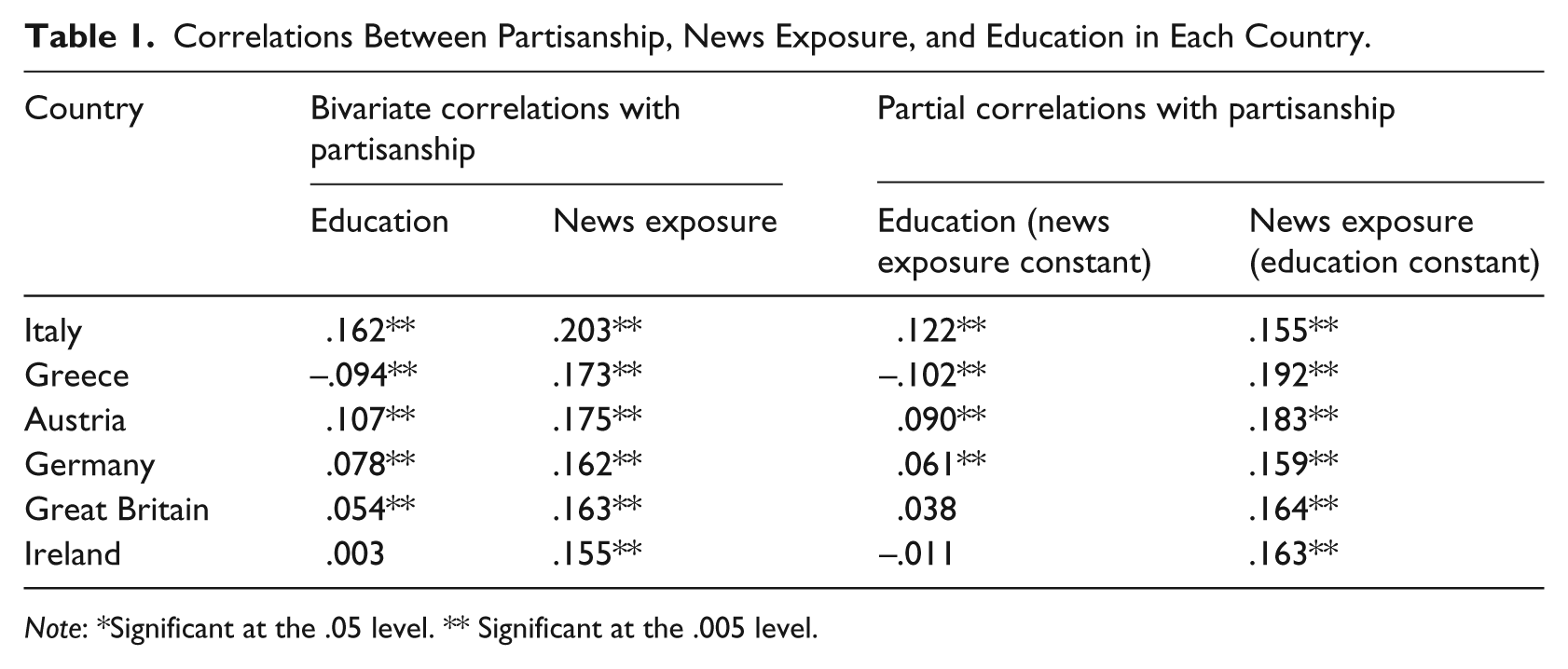
Table 1 shows bivariate and partial correlations for the relationship between the independent variables and partisanship (column heads) in each country (rows). Out of the six countries, all except Ireland evidenced a significant correlation between education and partisanship. Four were positively correlated and a fifth, Greece, was negatively correlated. When levels of news exposure were equal, the significant correlation between education and partisanship in Great Britain disappeared. With the exception of Greece, the correlations between education and partisanship dropped in magnitude when levels of news exposure were held constant. This highlights the interrelationship between education, news, and party-identification strength.
Correlations Between Partisanship, News Exposure, and Education in Each Country.
Note: *Significant at the .05 level. ** Significant at the .005 level.
In all six countries, there was a positive significant relationship between news exposure and the strength of partisanship, which remained even after taking into account the contribution of education. In Greece and Austria, two countries where both education and news exposure were significant, the relationship between news exposure and party identification actually increased when education levels were held constant. For Greece, this was because education had a negative relationship with partisanship. Examining the linear regression models of each country assisted in further examining the interaction between education and news exposure in those countries where both were significantly correlated with partisanship.
The interaction between news exposure and education across countries
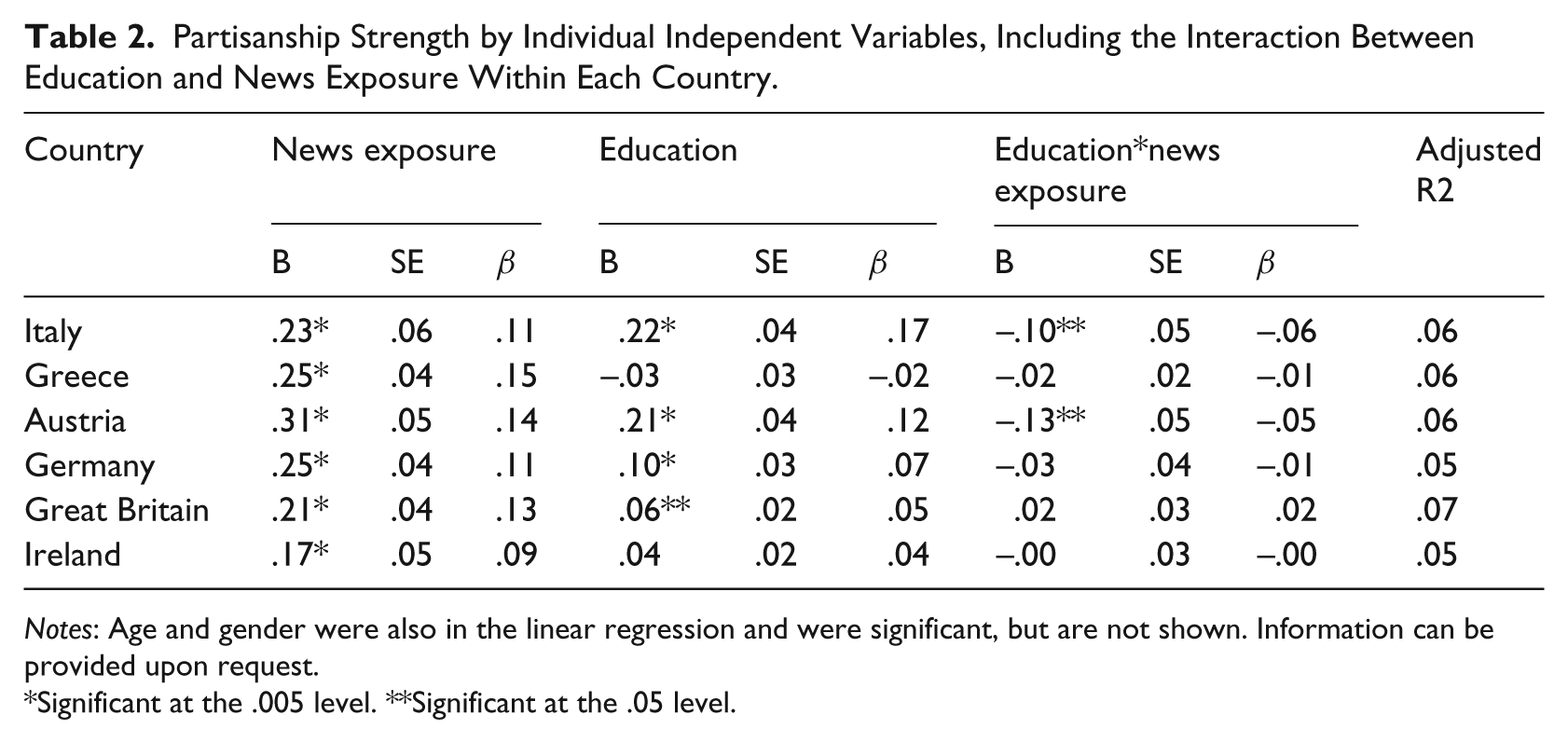
The results described above point to the influence of education and news exposure on partisanship and hint at the interaction between the two. Table 2 shows the relationship of education and news exposure with partisanship in a linear regression, and the influence of the interaction between the two. The column heads show the B coefficient, standard error, and standardised β for each of the independent variables: news exposure, education, and education*news exposure (the interaction term). The rows note which country the values are for. Though in all the countries the R-squared values were relatively low, several countries showed significant correlations. Both Italy, in the category of high press–party parallelism, and Austria, in the category of moderate press–party parallelism, had significant interaction variable coefficients.
Partisanship Strength by Individual Independent Variables, Including the Interaction Between Education and News Exposure Within Each Country.
Notes: Age and gender were also in the linear regression and were significant, but are not shown. Information can be provided upon request.
Significant at the .005 level. **Significant at the .05 level.
More importantly, the results indicate that the interplay of news exposure and education in both Italy and Austria showed an equalising trend. The coefficients of the interaction term in these two countries were significant and negative, suggesting that news exposure benefits the less educated more. To facilitate the interpretation of the coefficients, Figure 1 shows a graphical representation of how news exposure, education, and their interaction narrowed the partisanship gap between those of low and high education in Italy. The pattern is similar for Austria.
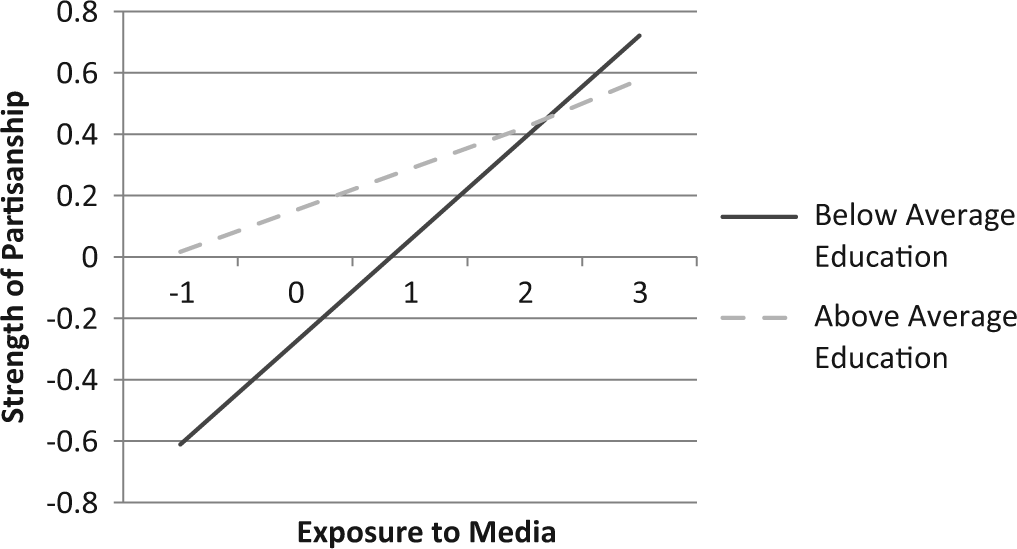
In Countries with High Political Parallelism, Exposure to News Narrows the Partisanship Gap Between Respondents with Different Levels of Education (Data for Italy).
By contrast, in Germany (moderate political parallelism) and in Great Britain (low parallelism), both news exposure and education had an important influence on party identification, but the interplay between education and news exposure did not. Increases in news exposure resulted in equal increases for both those with high and low education, contrary to the expectation in Hypothesis 3. Additionally, those with above average education started with greater partisanship. Moreover, it is important to note that news exposure’s correlation with partisanship was much stronger than that of education.
In neither Greece (high political parallelism) nor Ireland (low parallelism) did education have a significant influence on partisanship. Consequently, the interplay between education and the media was not important for partisanship. However, greater exposure to news did lead to greater partisanship.
In sum, with regards to the individual country regressions, there are three key insights. First, education had no significant correlation in Greece and Ireland, therefore the interaction between education and the media did not have significant correlation with partisan identification. Only news exposure had a significant correlation. Second, in Germany, one of the moderate parallelism systems, and in Great Britain, one of the low parallelism systems, the interaction between news exposure and education also had no significant correlation, but both news exposure and education individually did. Those with high and low education benefited equally from an increase in news exposure. News exposure did not help the less educated narrow the gap in partisanship. Third, in Italy and Austria (high and moderate parallelism, respectively) the interaction between education and news exposure showed the equalising potential of parallelism, narrowing the gap in partisanship between those with below and above average education.
News systems’ correlation with partisanship
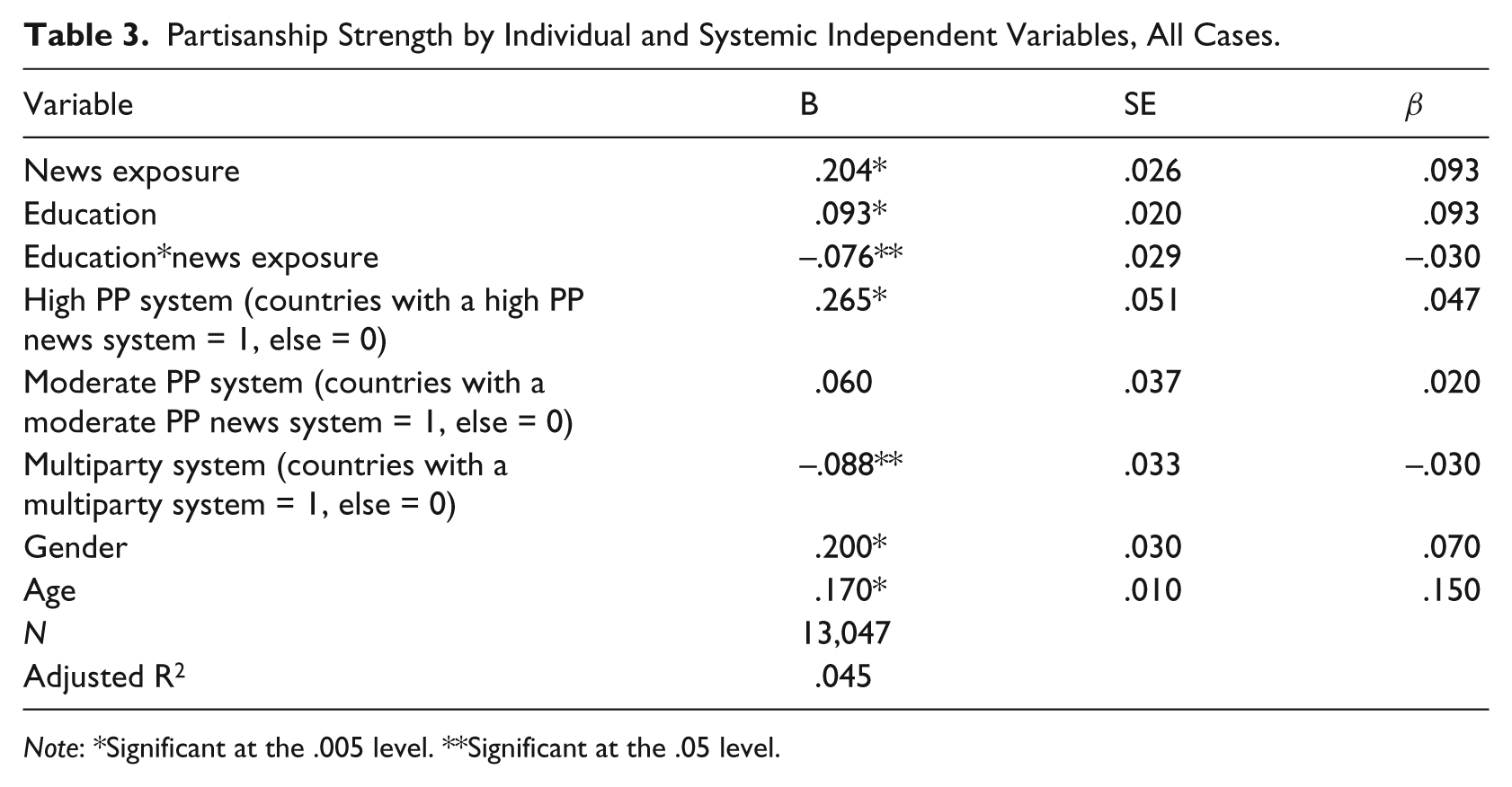
The examination of individual countries above sheds light on how the interaction between news exposure and education affected partisanship in each country. The results below show how news systems affected partisanship in each media system. Table 3 displays the indicators in the rows and the B value, standard error, and standardised β value as the column heads. The indicators include news exposure, education, and education*news exposure as before, as well as dummy variables for the high parallelism news systems and the moderate parallelism news systems, with the low parallelism news systems as a reference category. As with the individual country regressions, R-squared was relatively low, but several independent factors had significant relationships.
Partisanship Strength by Individual and Systemic Independent Variables, All Cases.
Note: *Significant at the .005 level. **Significant at the .05 level.
In the overall regression, the high parallelism news systems as well as education, news exposure, and the interaction variable were all significantly correlated with partisanship. The interaction between news exposure and education showed an equalising potential, similar to the patterns in Italy and Austria above. News exposure had a stronger correlation than education, when examining the full model, as well as the models for each individual country. Most importantly, parallelism in news systems explained the remaining variance in partisanship; high parallelism differed significantly from low and medium parallelism.
Alternative explanations to party-press systems
The presence of more parties in the system correlated significantly with partisanship, but in the negative direction, that is, more parties meant weaker partisanship. More importantly, education, news exposure, and the interaction between them remained significant correlates of partisanship. Also, a highly parallel politics–news system was still a significant correlate of partisanship. Our examination of statistical tolerance levels and variance inflation levels assuaged any concerns about potential multicollinearity (not shown, but available by request). The higher tolerance levels and low variance inflation factor (VIF) that we saw bolster our conclusions that the different factors operated independently of each other. Additional analysis was also used to examine if the election year had any effect in Germany, and it was determined that it did not have a significant influence on partisanship.
Additionally, when calculating the regressions for the relationship between individual-level exposure to news, its interaction with education, and political parallelism’s correlation with partisanship, we also took into account age and gender, two traditional correlates of partisanship. Other traditional predictors of partisanship such as employment status and group membership were also tested. Employment status was measured by a self-report of either being employed or unemployed. It was removed from the regression equation because it was not determined to have a significant influence on partisanship. To measure group membership, the ESS asked interviewees if they were members of 12 different groups, ranging from sports groups to religious groups to professional organisations. Membership of a subset of these groups (leisure and professional groups) correlated significantly with partisanship, while other covariates remained significant as well (not shown, but available by request).
Beyond the alternative explanations that we took into account empirically (age, gender, employment, and associational memberships), there may be a concern with reverse causality. Rather than politically parallel media systems increasing partisanship among their viewers, one could argue that more partisan viewers consume more news. Our reasoning, however, is consistent with the data and models we analysed; we are shy of advancing sweeping causal claims and testing them with cross-sectional data. This article showed how parallelism in politics–media systems correlates with greater partisanship. Our analyses were guided by theoretically derived hypotheses that were grounded in previous research. As we detail below, future research would benefit from utilising different designs that are better equipped to assess the direction of causality.
Discussion
Findings and implications
In this article, we reasoned why greater political parallelism in a country would be correlated with greater partisanship among its citizens. As we discussed earlier, partisans are more likely to view news that reinforces their viewpoints, and repeated exposure to reinforcing messages leads to a strengthening of opinion, which in this case is partisanship. The greater the consistency between the political and communication-information landscape, the more consistent the cues, and the easier it is to form an enduring partisan preference. Our data analysis showed tentative support for the first two of our hypotheses. Our first hypothesis stated that individual-level exposure to political news correlates with stronger party identification. This is supported within each individual country (see Tables 1 and 2), as well as in the sample as a whole (see Table 3). Our findings concur with former findings from studies that were conducted in the USA, which report that individual news exposure predicts partisanship strength (Albright, 2009: 259, 265; Beck et al., 2002: 68–9; Brynin and Newton, 2003: 59, 70; Iyengar and Hahn, 2009: 3; Prior, 2005: 579).
Our second hypothesis stated that news systems with greater political parallelism would correlate with stronger partisanship more than news systems with lower political parallelism. This hypothesis was supported by the positive regression coefficient of the high parallelism variable in the regression equation (see Table 3). Thus, news systems with political parallelism were significantly and positively related to greater partisanship levels.
Our third hypothesis was partially confirmed as well. It stated that in countries with more political parallelism, the gaps in partisanship strength for those with high and low education who were news viewers would be small. This was partially true. Italy, where parallelism was high, and Austria, where parallelism was moderate, showed narrower gaps between those with high and low education among those who watched the news. However, this was not the case in Greece. As noted previously, Greece had the lowest average years of education, but the highest average partisanship, suggesting that education may play a different role in partisanship altogether. One plausible explanation is that labour unions in Greece are stronger when compared with the rest of Western Europe and that they have more of a role in organising and leading civil society (Sotiropoulos, 2004: 18). Because larger and stronger organised labour tends to be concentrated in professions with low average education there may be a spurious connection between low education and strong partisanship identity. However, Greece seems to have been the exception; in other high parallelism countries, results may well confirm those found for Italy.
Austria, a moderate political parallelism country, also showed narrower partisanship gaps between the more and less educated (an ‘equalising’ pattern). However, Germany, the other moderate political parallelism country, did not. It is unclear what difference between Germany and Austria contributed to the divergent findings. As Van Kempen (2007: 307–10) noted, Germany proves a challenging case in general because although its press displays a moderate level of political parallelism, the overall partisanship in the country has been recorded to be very low.
As for countries with low political parallelism, none of the empirical models showed that news exposure was associated with larger partisanship gaps between educational strata. In Germany and Great Britain, as mentioned, the media’s association was additive, but not unequalising. On the individual exposure level, the final analysis of how news correlates with partisanship also depends on the differences in news consumption between citizens with high and low educational levels. If those with low educational levels tend not to be consumers of news media, while those with high educational levels are, then in a country where news media exposure has an additive pattern (Shehata, 2010), such as Germany and Great Britain, it will correlate with larger gaps between the educated and less educated. By contrast, if those with low educational levels tend to be high consumers of news media and those with high educational levels are not, then in a country where news exposure has an additive pattern, news exposure will correlate with narrower gaps in partisanship.
Limitations
Our study is not without limitations. The news exposure scale we used was a composite, instead of modelling the different news media separately. Different types of media exposure may vary widely in their nature and perhaps as a consequence Cronbach’s alpha for the scale was less than the minimum cutoff (that is, 0.70). We opted for the composite scale instead of multiple items (television, radio, or newspaper exposure) due to the following considerations. Each single news exposure item had fairly low variation; most people reported no exposure or less than 30 minutes per day. Follow-up analyses did not show that the single items were correlated with the outcomes. We followed the general recommendation to use a multiple-item scale to tap the underlying dimension of news exposure.
In addition, though we took into account various other socioeconomic and demographic factors, none significantly increased the explanatory power of the model. This may be indicating the need to explore further what strengthens partisanship. There is much research on political participation and political interest, and their correlation with partisanship, but less research on what actually strengthens party identification. In addition, most research on partisanship deals with the initial bequeathing of a viewpoint from parent to child or as a result of a certain socioeconomic strata (Dalton and Weldon, 2007: 182; Sheng, 2007: 275–93). The specific factors strengthening or weakening partisanship have been less explored. Voting may be motivated by social respect, emotional reward, or family traditions, which are different from identifying with a party. Because of this, one may vote regularly and consistently for one party without really knowing or identifying with that party’s views.
Additionally, in the case of Germany, for which answers were collected from respondents close to an election campaign for much of the time, the election year was not found to be significant. However, this may not have real bearing on the effects of election years on our hypothesis because even the months we considered from the ‘election year’ in Germany were two months after the voting had already taken place. It could be that the effects of the increased news coverage had diminished by then and that if the surveys had been conducted right before the elections, the results would have been very different.
Another limitation in our study was the inability to account empirically for both the ‘time-length’ and content of news exposure. Our research reported the correlation between news exposure and partisanship at one point in time, with no control over the amount of time between the last news exposure and the data-collection point. We also did not have knowledge of the exact content of the news exposure and whether it contradicted or supported the viewers’ partisan attachment. Conducting a cross-national experiment controlling for content and time would further explore the nature of the relationship between news exposure and partisanship, but such an experiment was beyond the scope of our research.
Lastly, though our study looked at several different types of news systems from Hallin and Mancini’s model, the overall homogeneity of our sample should be noted. All the countries examined were Western European democracies with free presses. Different results might be obtained from examining countries with another type of regime or with a government-controlled press.
Future research
This discussion has highlighted prime areas for future research. First, we noted that we used a composite measure of news exposure because of the limitations of the sample. But examining each type of media separately may yield different and interesting results. This would also allow researchers to think about the different preferences of people with varying levels of education toward different types of media and how that might affect the final results, as Shehata (2010) notes. Second, while looking more in depth into the particular countries, researchers should also consider examining the different education systems and why in some countries educational attainment is associated with stronger partisanship and in others it is not.
Conclusion
This article finds support for the argument that countries with higher levels of press–party parallelism show higher levels of aggregate partisanship. It further finds that in countries with high and medium political parallelism, news media exposure can help narrow gaps in partisanship between those with low education and those with high education.
However, many questions still remain in regards to how political parallelism influences partisanship over time and what other factors may influence the relationship between news exposure and partisanship. Additionally, further research is needed to determine the role of education in attenuating the relationship between news exposure and partisanship. In one country with high political parallelism and another with low political parallelism, education was not correlated with partisanship, but in all other countries it was. What is different about these education systems? One country with moderate political parallelism and another with low political parallelism did not have significant interactions between news exposure and education, even though both the former and latter were significant. Further research would do well to shed additional light on the interrelationship between political parallelism, education, news exposure, and partisanship.
Footnotes
Appendix
Notes
Author biographies
References
Supplementary Material
Please find the following supplemental material available below.
For Open Access articles published under a Creative Commons License, all supplemental material carries the same license as the article it is associated with.
For non-Open Access articles published, all supplemental material carries a non-exclusive license, and permission requests for re-use of supplemental material or any part of supplemental material shall be sent directly to the copyright owner as specified in the copyright notice associated with the article.
