







Abstract
Do presidential campaigns matter outside the United States? We examine how public opinion responds to campaign events during Korean presidential campaigns. The fundamental variables of the election year influence vote intention before the campaign begins and substantially influence eventual vote choice. Campaign events assist voters to learn more about the fundamental variables – regionalism, party identification, and retrospective evaluations of the incumbent administration – and this leads to more informed intentions during the campaign. The results suggest that there is substantial congruence in the explanatory power of Holbrook’s ‘equilibrium’ theory and Gelman and King’s ‘enlightenment’ theory in presidential campaigns held in the US and in Korea.
Introduction
How and to what extent do presidential campaigns matter? Decades of research have shown that voting behavior in US presidential elections is mainly determined by partisanship (Campbell et al., 1960; Finkel, 1993; Lazarsfeld et al., 1944) and retrospective evaluations (Fiorina, 1981; Key, 1966; Lewis-Beck, 1988). US presidential election outcomes can be explained by a few variables such as presidential approval and economic performance (Kramer, 1971; Markus, 1988). Forecast models have shown that the national popular vote can be predicted well using a similar set of variables (Abramowitz, 1988; Campbell, 1992; Holbrook, 1991; Lewis-Beck and Rice, 1992). These models do not incorporate any campaign variables; they are based entirely on pre-existing national conditions. These studies imply that campaigns have little or no influence on electoral outcomes.
Some studies have shown that presidential campaigns are potentially influential because the number of late deciders is growing (Flanigan and Zingale, 1987; Holbrook, 1996), voters’ intentions fluctuate during the campaign (Allsop and Weisberg, 1988; Campbell et al., 1992; Geer, 1988; Gelman and King, 1993; Holbrook, 1994; Shaw, 1999), and campaign events and media coverage are voters’ main sources of information (Gelman and King, 1993; Popkin, 1991; Salmore and Salmore, 1989; Shively, 1992).
The controversy is succinctly stated in the titles of Gelman and King’s article ‘Why are American Presidential Election Polls so Variable when Votes are so Predictable?’ and Holbrook’s book Do Campaigns Matter? These authors offer theories that explain how campaign events move public support of the candidates towards the predicted outcome by assisting voters to become more aware of pre-existing factors and their connection to electoral decisions. These theories challenge the conventional notion that campaigns do not matter and offer alternative perspectives on US campaigns.
Are these effects unique to US presidential elections? If a theory of campaign effects in US presidential elections is generalizable, it could be applied in a variety of electoral settings, although the variables in the model may vary across nations. This paper applies such a theory, based on US presidential campaigns, and tests it in a very different cultural and political setting. We analyze campaign effects in South Korean presidential elections. 1 To develop and test a theory concerning the effects of presidential campaigns on vote choice in Korean presidential elections, we apply Holbrook’s (1996, 1994) ‘equilibrium’ theory and Gelman and King’s (1993) ‘enlightenment’ theory to Korean elections, adjusting to the Korean context and data limitations as necessary.
We argue that both presidential campaigns and the fundamental variables of the election year influence vote choice. In Korean presidential elections, the fundamental variables are regionalism, partisanship, and retrospective evaluations of the incumbent administration. These variables influence vote intentions before the campaign begins and to a large extent determine the eventual vote choice. Nonetheless, campaign events substantially explain fluctuations in public opinion during the campaign, and help voters connect current political conditions to the fundamental variables. As voters become more ‘enlightened’, their vote intentions move in the direction expected based on the fundamental variables. To empirically test this theory, models of Korean campaigns will be applied to the presidential elections of 1997, 2002, 2007, and 2012. These elections are recent and thus represent the state of modern Korean campaigns. Also, much of the necessary data are not available for earlier Korean elections.
Towards a theory of campaign effects in Korean presidential elections
Holbrook (1996) argued that in each American presidential campaign, fluctuations in voters’ candidate intentions are primarily in response to campaign events. As voters receive information from campaign events, they update their evaluations of the candidates and thus their vote intention (Lodge et al., 1995). Since national conditions set the equilibrium level of candidate support throughout the election year, which can be estimated by the forecast models, it is expected that campaign-induced shifts in public opinion will tend toward the equilibrium level as the campaign progresses. Presidential campaigns can have the greatest effect on changes in candidate support when early public opinion polls deviate substantially from the expected election outcome. In this way, presidential campaigns and the national conditions of the presidential election year jointly produce presidential election outcomes.
Most US forecasting models use data from the post-WWII elections (Abramowitz, 2008; Campbell, 2001; Campbell and Lewis-Beck, 2008; Erikson and Wlezien, 1999; Lewis-Beck and Rice, 1992; Nadeau and Lewis-Beck, 2001). However, Korea has conducted only six presidential elections since the democratization of 1987; it is not possible to develop a statistically valid forecast because of the small sample. Thus, the equilibrium theory cannot be tested here in the same way that Holbrook did.
To get around the obstacle, we apply Gelman and King’s (1993) ‘enlightenment’ theory to Korean campaigns. Gelman and King argue that voters cast their ballots based on their ‘enlightened’ intentions. 2 Enlightenment means that during the campaign, voters learn more about the fundamental variables of the election year, such as the state of the economy, differences between the parties, and the performance of the incumbent administration, to make informed judgments. At the start of the campaign, many voters either lack sufficient information, or fail to see connections between fundamental variables and the available political alternatives to make informed voting decisions. Early vote intention may differ from eventual vote choice to the extent that the voters’ information set changes. Presidential campaigns play a central role in providing such information. As voters become more informed, through campaign events, their preferences become more sensitive to the fundamentals. Thus, the importance of the fundamentals on vote intention increases as the campaign unfolds.
Subgroups of the electorate, categorized by party, region, etc., react differently to information acquired during the campaign. When campaign events occur, individual subgroups learn more about the fundamentals and adjust their vote intentions. Hence, vote intentions become more homogeneous within groups and more heterogeneous across groups as the campaign progresses. That is, vote intentions tend to move in the direction indicated by the pre-campaign fundamental variables.
Though Korean presidential campaigns bear much in common with US presidential campaigns, there are some important differences. One major difference involves the long-term stability of the party systems. Korean political parties are not as stable as US parties (Jin, 2008; Kang and Jaung, 1999); they offer voters a less consistent set of policy positions than US parties do. In the US, the ideologies of the two major parties are well-known to voters. Although new issues arise, some issues have reliably divided the parties for decades. In Korea, although there are two major parties, their issue positions are not as firmly established – even the names of the parties sometimes change from election to election.
Furthermore, it is common in Korean presidential elections for a third candidate to emerge as a viable alternative to one or both of the major parties. 3 This is rare in US presidential elections. In the past 100 years, no non-major party candidate has received more than 20% of the vote. Although third candidates are not uncommon in Korean elections, such candidates usually form an alliance with, or drop out and support, one of the two major party candidates.
Previous studies on voting behavior of Korean presidential elections suggest that regionalism, party identification, and retrospective evaluations of the performance of the incumbent administration are the fundamental variables of presidential elections. Studies have shown that after the democratization of 1987, regionalism emerged in Korean elections and is one of the most important factors explaining vote choice (Kang, 2008; Kim, 1998; Lee, 1999). Regionalism in Korean elections means that a political party or its candidate typically gains overwhelming support from one of two southern regions: Youngnam (southeast) and Honam (southwest) (Choi, 1996).
Table 1 shows that voters in Honam and Youngnam Provinces supported their regional party candidates far beyond the nationwide average in the 1997–2012 Korean elections. Over 80% of Honam voters chose their regional party candidates in all four elections. Youngnam voters also strongly and consistently supported their regional party candidates.
Election outcomes by regions in Korean presidential elections (%).
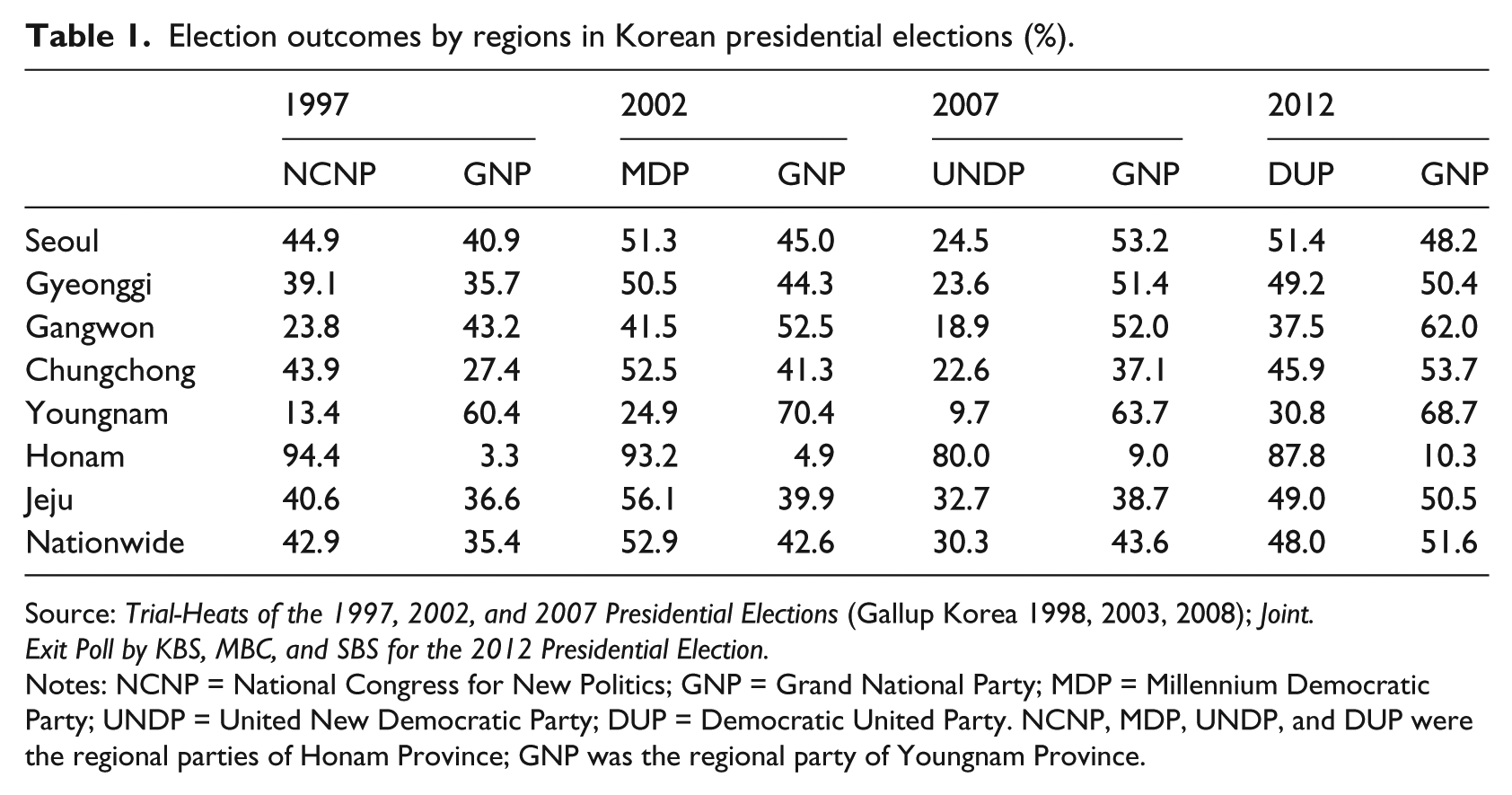
Source: Trial-Heats of the 1997, 2002, and 2007 Presidential Elections (Gallup Korea 1998, 2003, 2008); Joint.
Exit Poll by KBS, MBC, and SBS for the 2012 Presidential Election.
Notes: NCNP = National Congress for New Politics; GNP = Grand National Party; MDP = Millennium Democratic Party; UNDP = United New Democratic Party; DUP = Democratic United Party. NCNP, MDP, UNDP, and DUP were the regional parties of Honam Province; GNP was the regional party of Youngnam Province.
Party identification influenced vote choice in the 2002 and 2007 presidential elections (Kim, 2007; Kwon, 2008; Park et al., 2008). Kwon (2008) found that voters who supported the opposition party in 2002 were likely to support that party’s candidate in the 2007 election. Retrospective evaluations of the performance of the incumbent administration also influenced voting behavior of Korean elections. The president of Korea is limited to one five-year term but an incumbent party candidate cannot be free from voters’ evaluations of governmental performance since the candidate runs with the incumbent party label (Lee, 2006: 43). Retrospective evaluations of the job of the incumbent administration significantly influenced vote choice in the 2007 presidential election (Jeong and Oh, 2008; Kwon, 2008).
Korean presidential campaigns have the potential to influence public opinion. Campaigns function as a primary source of information for voters, whose intentions tend to fluctuate over time. In 1997, 52% of voters did not reach a decision until two or three weeks before election day (Gallup Korea, 1998); in 2002, 40% did not decide until two weeks before election day (Lee, 2006). Similarly, 36% of voters in 2007 and 23% in 2012 decided within one week of election day (Gallup Korea, 2008; Gallup Korea, 2012). In addition, voters’ intentions fluctuated throughout each presidential election year. The identity of the front-runner changed three times in 2002 and once in 1997. Such fluctuations in public opinion suggest that something other than the fundamental variables (which remain relatively stable during the election year) affect vote intentions. Since 1997, campaign events have functioned as major sources of information. For example, in 1997, 82% of voters reported that campaign events influenced their vote decisions (Kang, 2003).
We argue that both presidential campaigns and fundamental variables influence vote choice in Korean presidential elections. Before the campaign begins, the fundamentals have the potential to influence vote preferences; this potential is activated by voters’ increasing knowledge of the parties and their candidates. Campaign events provide voters with information, voters learn more about the fundamentals and adjust their vote intentions. 4 Thus, voters’ intentions tend to move in the direction ‘predicted’ by the fundamental variables.
As the campaign begins, many individuals within subgroups of the electorate (such as regional voters, partisans, and voters who approve or disapprove of the incumbent administration) may be undecided or have only tentative preferences because their information is limited. Campaign events provide them with information about the identity of the candidates, the ideologies of the parties, etc. Thus, the influence of the fundamentals on subgroups’ vote intentions becomes greater as the campaign progresses. Subgroups develop more homogeneous intentions within groups and more heterogeneous intentions across groups over time. As a result, they become more likely to cast their votes in line with the fundamental variables.
The influence of the fundamental variables on voter support
We argue that the fundamentals of the election year influence vote intention before the campaign and largely determine eventual vote choice. We measure the influence of the fundamental variables in the 1997, 2002, 2007, and 2012 Korean presidential campaigns using logistic regression analysis. The dependent variable is vote intention. It is measured with a dichotomous variable scored 1 for those who supported the incumbent party candidate. The main independent (fundamental) variables are regionalism, party identification, and retrospective evaluations of the incumbent administration. Two dichotomous variables are employed to measure regionalism. We anticipate that Honam voters and Youngnam voters were likely to move toward their regional party candidate. For party identification, a dummy variable measures whether a respondent identifies with the incumbent party. We expect that voters who identify with a particular party are likely to move toward that party as the election approaches. Retrospective evaluations of the performance of the incumbent administration are captured with presidential approval. We expect that voters who approved of the incumbent president would likely move toward the incumbent party. Socio-demographic variables (age, education, and income) are used as controls.
We employ survey data and Korean Election Study data for 1997 and 2002, and panel survey data for 2007 and 2012. The data for the 1997 and 2002 presidential elections were made available by Korean Social Science Data Center (KSDC). The 2007 and 2012 data were made available by East Asia Institute (EAI).
Campaign events in Korean presidential elections
The authors of The American Voter (1960) differentiated between long-term and short-term influences on an individual’s political attitudes. Long-term influences include one’s parents’ socio-economic status; short-term influences include an individual’s current thoughts and feelings about parties, issues, and candidates. Holbrook (1996) differentiates between national conditions, such as the state of the economy, that exist before the campaign begins, and campaign events, such as conventions, scandals and debates, that occur during the campaign. Similarly, we use the term ‘fundamental variables’ to refer to those factors that are set before the campaign begins – in particular, partisanship, region, and evaluation of the incumbent’s performance. By ‘campaign events’, we refer to certain kinds of non-exogenous events that occur during the campaign – in particular, the nominations of the candidates, campaign-related scandals, successful or failed alliances, and the debates.
It is impractical and unnecessary to include every event in the analyses. To select major campaign events (see Holbrook, 1996: 126), this study sets a threshold by referring to the findings of previous research about campaign events in Korean presidential elections and by relying on surveys showing voters’ perceptions of which campaign events they considered important for their vote decisions. Major campaign events in Korean presidential elections typically include major scandals, electoral alliances, and presidential debates. The alliances of 1997 and 2002, and Ahn’s withdrawal in 2012 enlightened voters as to the identity of the two major candidates.
Campaign events and voter support for the candidates
We argue that major campaign events lead to fluctuations in vote intention during the campaign. At the beginning of the campaign, voters have less information and are less likely to see connections between politics and fundamental variables. As campaign events provide additional information, voters learn more about the parties, issues, and candidates, and adjust their vote intentions accordingly. Thus, voters’ intentions are likely to fluctuate as campaign events occur. For example, it is expected that when a scandal is revealed to the public, voter support for the candidate involved will decrease because voters’ evaluations of that candidate decline. When one candidate succeeds in forming an alliance with another candidate or party, it may be seen as a sign of electoral strength and informs voters who the final candidates are.
Hypothesis 1: Major campaign events lead to fluctuations in voters’ intentions.
To empirically test hypothesis 1, we compare vote intention before and after campaign events, using the trial-heat polls of the four most recent presidential elections, made available by Gallup Korea (2012, 2008, 2003, 1998). In addition, the 2007 and 2012 election panel data allow us to employ intervention models that examine whether campaign events affected changes in vote intention during the campaign. 5 The dependent variable is whether a respondent switched his/her vote intention during the campaign. Dummy variables are employed to measure the impact of the BBK scandal in 2007 and Ahn’s withdrawal from the race in 2012 on changes in vote intention. Logistic regression analysis is employed for the dichotomous dependent variable.
Campaign events and the vote intentions of specific subgroups
We posit that campaign events assist voters by providing them with information about the candidates’ party, ideology, and regional affiliation. This information influences different subgroups of the electorate differently. Subgroups include partisans, regional voters, and those who approve or disapprove of the incumbent administration. Each subgroup is predisposed to favor a particular party’s candidate. For example, those who approve of the incumbent administration are predisposed to favor the incumbent party’s candidate. Likewise, those who disapprove of the incumbent administration are predisposed to oppose the incumbent party’s candidate. These two can be labeled ‘opposing’ subgroups. Similarly, Youngnam and Honam voters represent opposing subgroups. This also applies to the subgroup of voters who identify with the more liberal party versus voters who identify with the more conservative party.
As individuals in each subgroup receive information, they become better able to see connections between the candidates and the fundamental variables, potentially leading to changes in their vote intentions. In particular, voters tend to alter their intentions to match their regional, partisan, and other political predispositions. Accordingly, the influence of the fundamentals on subgroups’ voter intention becomes greater over time as individuals, and thus their subgroups, develop more informed vote preferences. We expect opposing subgroups to develop more homogeneous intentions within each group and more heterogeneous intentions between the groups as the campaign progresses.
Hypothesis 2: The influence of the fundamental variables on vote intention becomes greater toward the end of the campaign.
Hypothesis 3: ‘Opposing’ subgroups develop more homogeneous vote intentions within the groups and more heterogeneous intentions across the groups as the campaign progresses.
To empirically test hypotheses 2 and 3, we examine changes in the influence of the fundamental variables on vote intention and investigate whether ‘opposing’ subgroups developed more distinct vote intentions during the 1997 through 2012 presidential campaigns. The dependent variable is vote intention. The main independent variables are regionalism, party identification, and approval of the incumbent party’s performance. Age, income, and education are also employed as socio-demographic controls. For data, we employ five surveys conducted during the 1997 presidential campaign and the 1997 Korean Election Study, five surveys conducted during the 2002 presidential campaign and the 2002 Korean Election Study, 6 and five waves of the 2007 and 2012 presidential panel survey data.
Results
The influence of the fundamental variables on voter support
We estimated the influence of the fundamental variables on vote intention before the campaign began and on the eventual vote choice in each of the four presidential elections. The results are presented in Table 2.
Logistic regression analysis of vote intention before and after the 1997, 2002, 2007 and 2012 Korean presidential campaigns.

Statistically significant at .01 level.
Notes: Before = voters’ candidate intentions before the campaign began; Eventual = the eventual vote choice on election day. The influence of approval on vote intention in 1997 is not examined because data are not available.
All the fundamental variables significantly influenced voter support for the candidates before and after the campaign, and all were in the expected direction. In every case the coefficient was greater in magnitude (i.e. greater impact) at the end of the campaign than at the beginning. Furthermore, the results show that the vote intentions of ‘opposing’ subgroups became more distinct from each other over time. For example, in 2002, the difference in the coefficients between Honam and Youngnam voters’ support for Roh increased from 1.604 to 3.115 during the campaign. Similar patterns are found for partisans and for voters who approved or disapproved of the performance of the incumbent. These findings suggest that the influence of the fundamentals was greater at the end of the campaign than at the beginning. If campaign events lead to changes in public support for the candidates and these changes move specific subgroups in the direction ‘predicted’ by the fundamental variables, then our general thesis, that campaign events enhance the impact of the fundamentals, is supported.
Campaign events and voter support for the candidates
To test whether voters’ intentions fluctuate as a result of campaign events (hypothesis 1), we begin by comparing vote intentions before and after specific campaign events in each election. In addition, intervention models are employed to test the extent to which the BBK scandal in 2007, and Ahn’s withdrawal from the 2012 race, explain fluctuations in vote intentions.
The 1997 presidential election
As shown in Figure 1, public opinion fluctuated throughout the election year and apparently responded to campaign events (Gallup Korea, 1998).
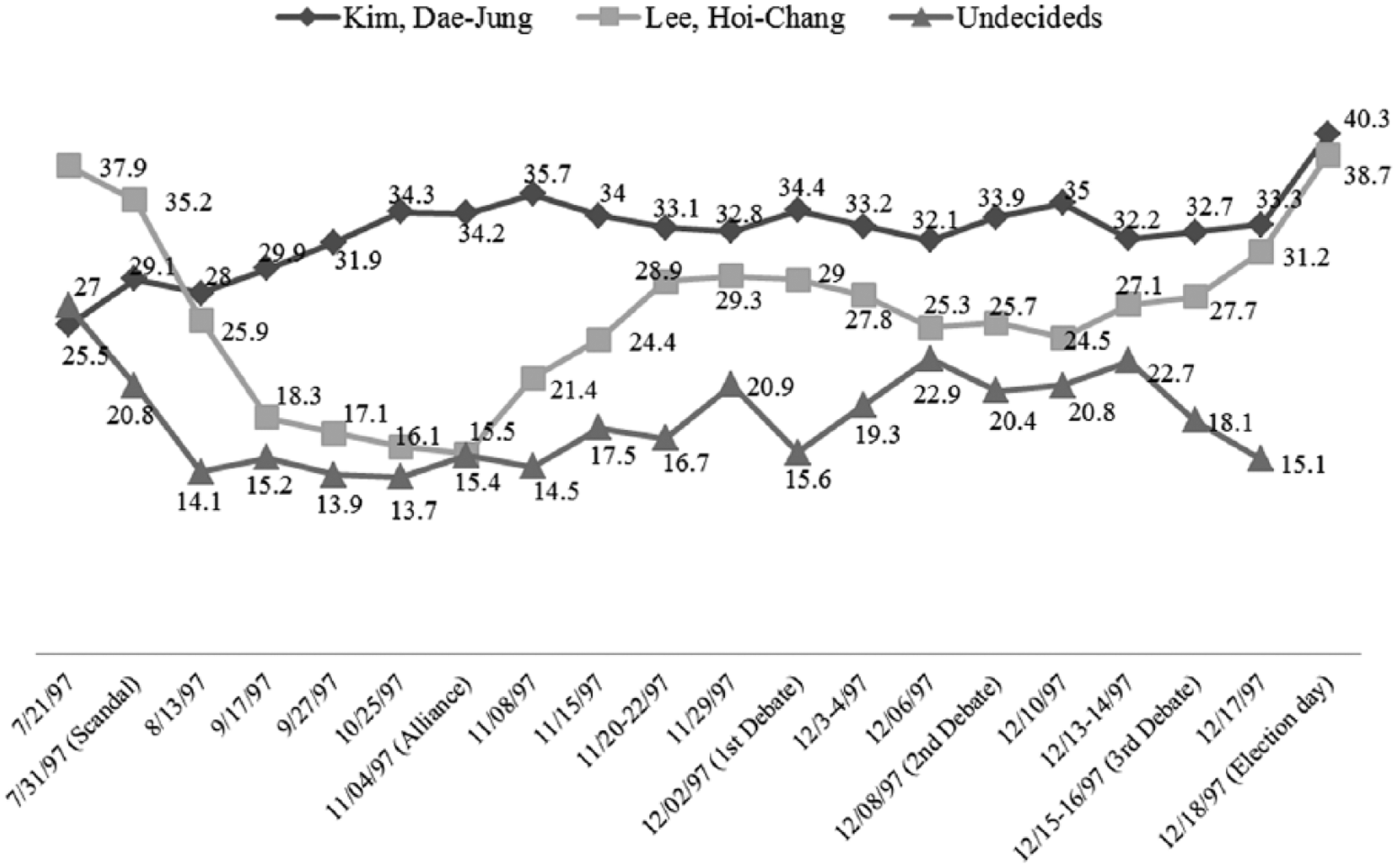
Changes in Voter Support during the 1997 Presidential Campaign.
Voters’ intentions fluctuated after the scandal of Lee, Hoi-Chang’s two sons of evading military service was revealed on July 25. According to the August 13 survey, voter support for Lee dropped by 8%, and Lee continued to lose support until the DJP alliance in early November. Support for Kim, Dae-Jung increased gradually until the DJP alliance. These changes suggest that the scandal influenced vote intentions.
The DJP alliance also influenced voter support. The November 8 survey, conducted five days after Kim, Dae-Jung succeeded in the electoral alliance with Kim, Jong-Pil, reported that voter support for Lee increased by 5.3% compared to the October 25 survey. During the 18 days after the alliance, support for Lee nearly doubled. These changes suggest that the alliance influenced vote intentions.
Three surveys, conducted a day after each debate, in December show that voter support for the candidates slightly increased after the debates and contributed to undecided voters’ decisions. The December 2 survey reported, for instance, that the proportion of undecided voters decreased by 5.3% after the first debate.
The 2002 presidential election
As shown in Figure 2, the 2002 presidential campaign experienced fluctuations in public opinion throughout the election year (Gallup Korea, 2003).
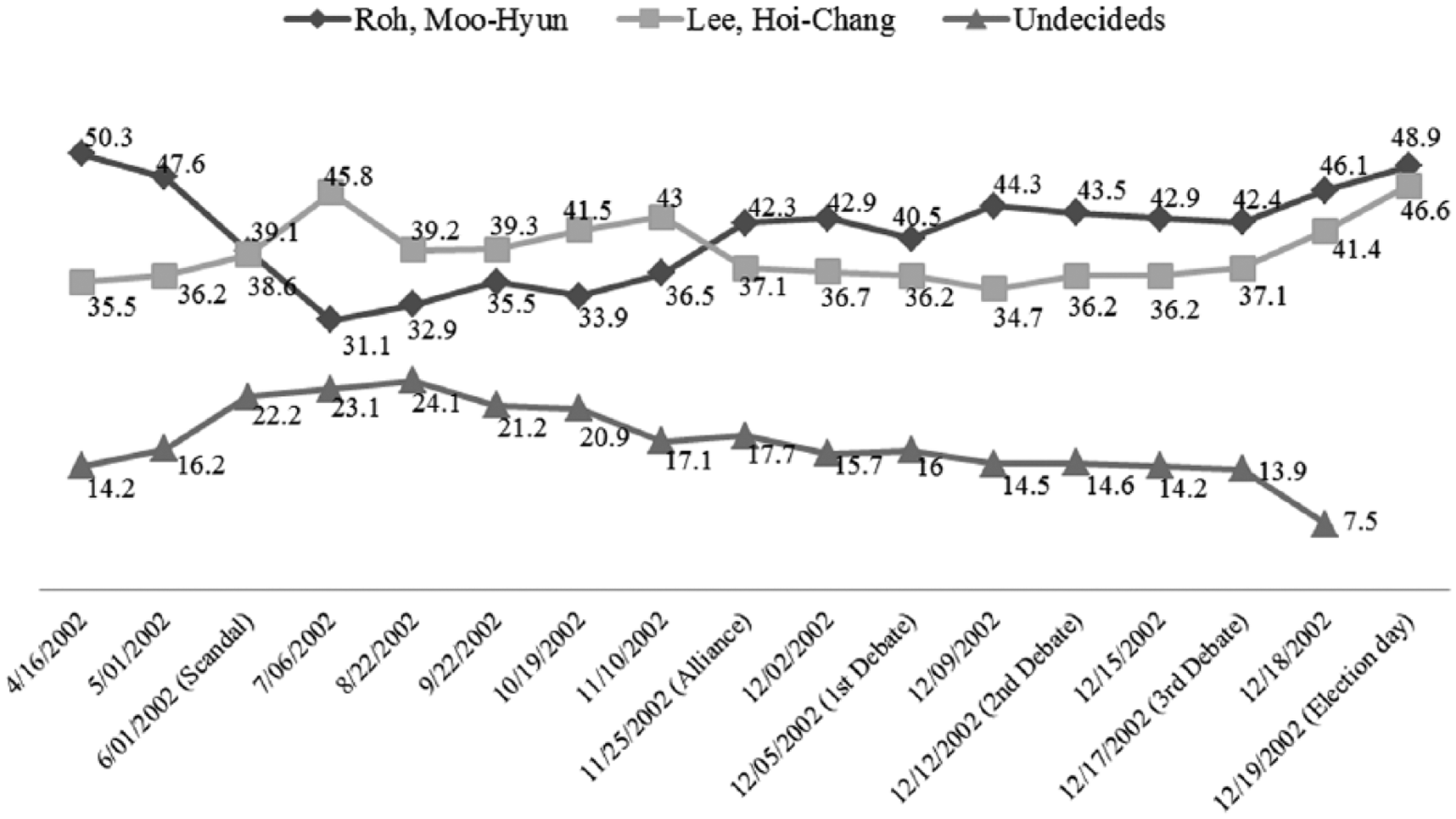
Changes in Voter Support during the 2002 Presidential Campaign.
The May 1 survey showed that Roh, Moo-Hyun led Lee, Hoi-Chang by 11.4% after winning the nomination of MDP. However, after the scandal of President Kim, Dae-Jung’s sons and confidants was revealed in May, the June 1 survey reported that voter support for Roh decreased by 9% and voter support for Lee increased by 2.9%. Vote intentions significantly changed after Roh succeeded in an electoral alliance with Chung. According to the November 25 survey, support for Roh increased by 5.8%, while support for Lee dropped by 5.9%. Three presidential debates were conducted in December. Although support for Roh dropped by 2.4% after the first debate, the net effect of the debates was minimal.
The 2007 presidential election
Lee, Myung-Bak of the opposition GNP defeated Chung, Dong-Young of the ruling UNDP by a large margin (22.6%) in 2007. Figure 3 presents changes in vote intention during the 2007 campaign.
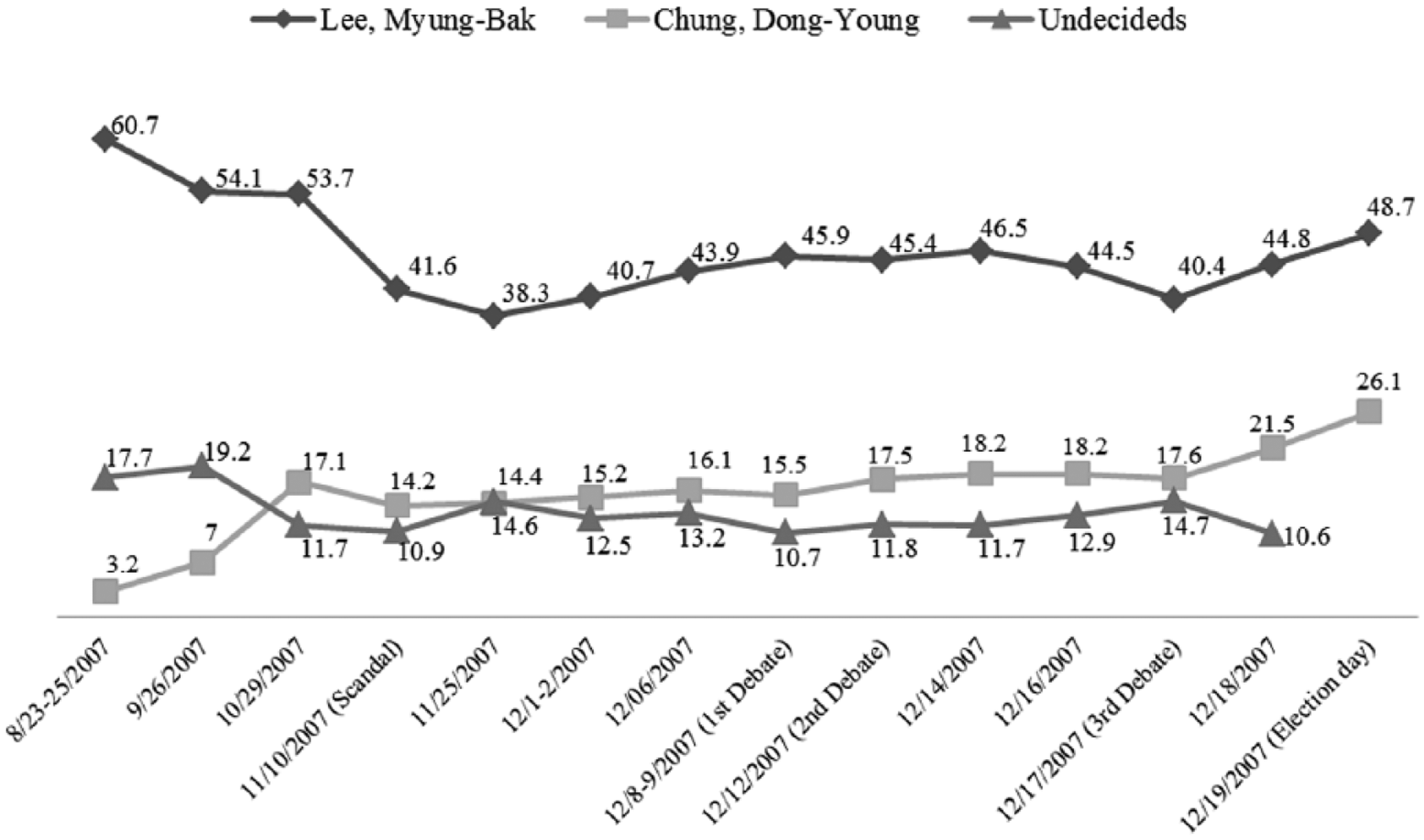
Changes in Voter Support during the 2007 Presidential Campaign.
The November 10 survey reported that voter support for Lee, Myung-Bak dropped by 12.1% after the BBK scandal was revealed in late October. Likewise, undecided voters decreased by 8.3% compared to the September 26 survey. Lee, Myung-Bak’s support dropped from 53.7% in the October 29 survey, 11 days before the scandal, to 38.3% in the survey taken on November 25. The reason why voter support for Chung did not increase right after the scandal might be explained by the emergence of Lee, Hoi-Chang, the unsuccessful GNP candidate in 1997 and 2002, who officially declared his candidacy on November 7. For some GNP supporters and conservatives disappointed in Lee, Myung-Bak due to the scandal, Lee, Hoi-Chang could be an alternative, based on his conservative ideology and his popularity in GNP (Gallup Korea, 2008). Overall, the findings suggest that the BBK scandal influenced vote intention mainly by causing voter support for Lee, Myung-Bak to decrease. Three presidential debates were conducted in December. Surveys conducted a day after each debate suggest that the debates had little influence on vote intentions. After the first debate support for Lee increased by 2%; support for Chung increased by 2% after the second debate and support for Lee decreased by 4.1% after the last debate.
The 2012 presidential election
In 2012, Park, Geun-Hye of the ruling Saenuri Party defeated Moon, Jae-In of the opposition Democratic United Party (DUP) by a small margin. Figure 4 shows changes in vote intention during the 2012 campaign.
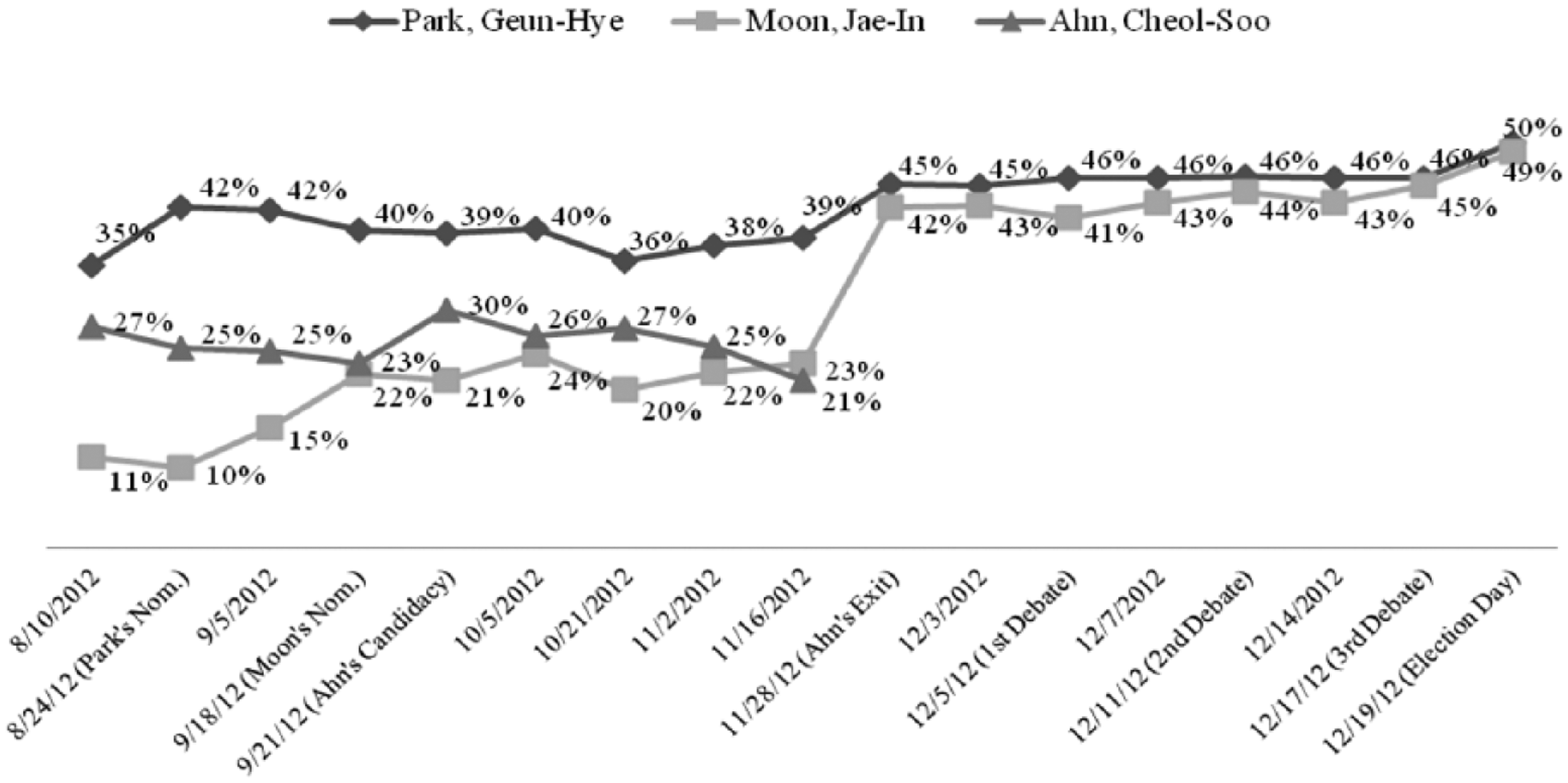
Changes in Voter Support during the 2012 Presidential Campaign.
The August 24 survey reported that, after winning the Saenuri nomination, Park, Geun-Hye led Moon, Jae-In by 32%. After Moon became the DUP nominee, the September 18 survey showed Park leading by only 18%. Aggregate vote intention changed after Ahn, Cheol-Soo dropped out of the race on November 23 leaving Moon as the major opposition candidate. According to the November 28 survey, support for Moon increased by 19% (compared to the November 16 survey). This suggests that Ahn’s withdrawal substantially influenced vote intention. Three presidential debates were conducted in December. Three surveys, conducted a day after each debate, suggest that the debates had little or no influence on vote intention.
Analysis of panel survey data during the 2007 and 2012 elections
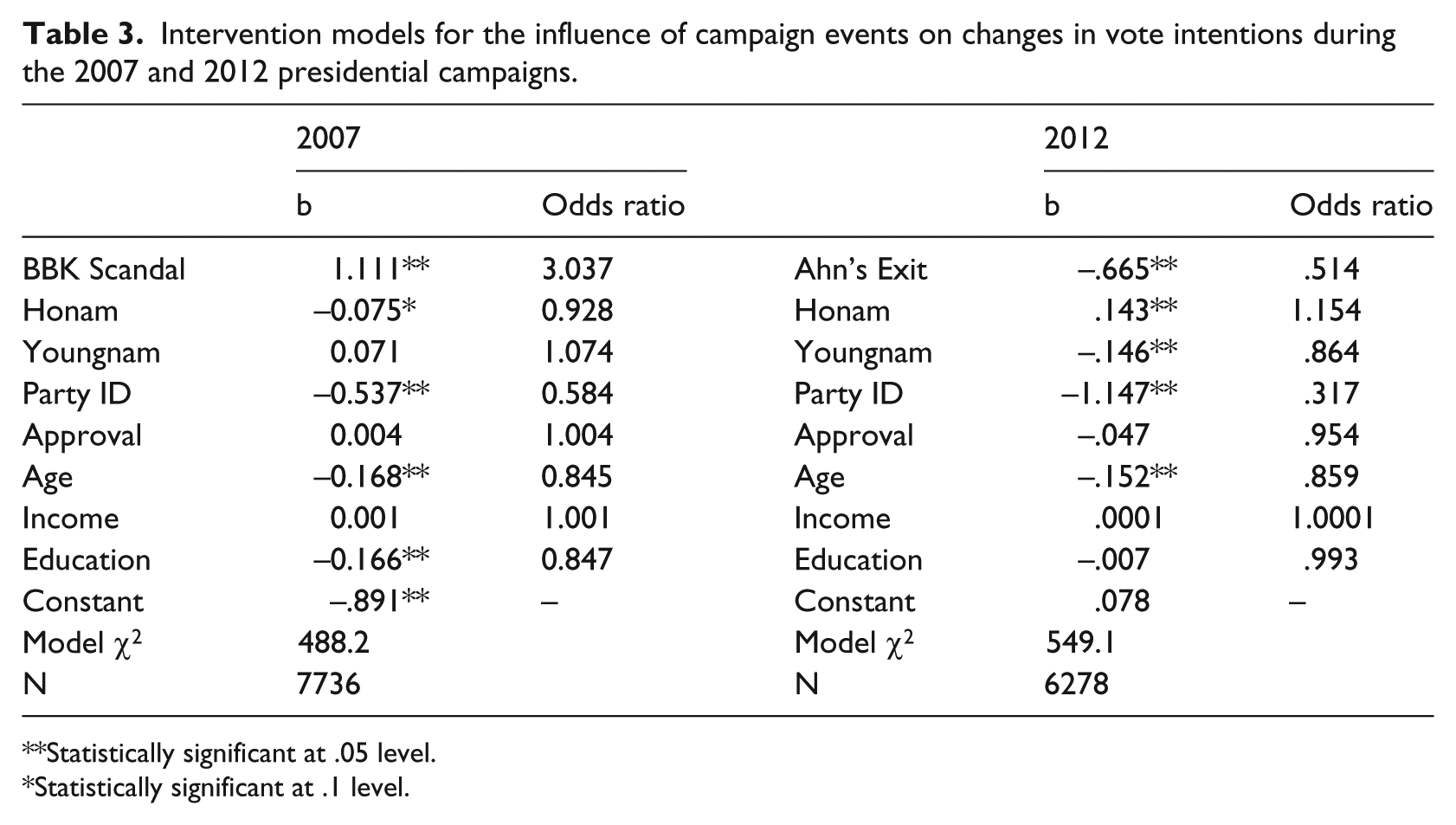
Using the 2007 and 2012 presidential election panel survey data, we employ two intervention models to examine the influence of the BBK scandal in 2007 and Ahn’s withdrawal from the 2012 race on changes in vote intention, controlling for the fundamentals and socio-demographic variables. The dependent variable is whether a respondent changed his/her vote intention during the campaign. Table 3 presents the results of the logistic regression analysis.
Intervention models for the influence of campaign events on changes in vote intentions during the 2007 and 2012 presidential campaigns.
Statistically significant at .05 level.
Statistically significant at .1 level.
The results of the analysis show that the BBK scandal and Ahn’s withdrawal significantly influenced changes in vote intention during the campaign. The odds ratio of the BBK scandal indicates that the odds of a voter switching his/her vote intention because of the BBK scandal were approximately three times higher than they would have been without the scandal. The odds ratio of Ahn’s withdrawal indicates that the odds of a voter switching his/her vote intention because of the withdrawal were about twice as high as they would have been had he not withdrawn. These findings suggest that these two campaign events played an important role in explaining changes in vote intention during these two presidential campaigns.
In sum, the overall findings of the analysis of the influence of campaign events on vote intention during the four campaigns demonstrate that campaign events consistently influenced vote intention. These findings confirm our hypothesis that fluctuations in vote intention during Korean presidential campaigns can be attributed, to a large extent, to campaign events.
Campaign events and individual subgroups’ vote intentions
We hypothesize that the influence of the fundamentals on vote intention is likely to become greater, via campaign events, over time (hypothesis 2) and that ‘opposing subgroups’ develop more homogeneous vote intentions within the groups and more heterogeneous intentions across the groups as the campaign progresses (hypothesis 3). To empirically test the hypotheses, we examine changes in the influence of the fundamental variables on specific subgroups’ vote intentions and investigate whether opposing subgroups developed more distinct vote intentions during the four campaigns. 7
The 1997 presidential election
To measure the changing influence of the fundamental variables in the 1997 presidential campaign, we employ logistic regression analysis, using five surveys and the 1997 Korean Election Study. The dependent variable is vote intention. Party identification, regionalism, and three control variables are included in the analysis. (The 1997 election survey data do not include a question about presidential approval.) Figure 5 presents changes in the odds ratios of the fundamental variables during the campaign.
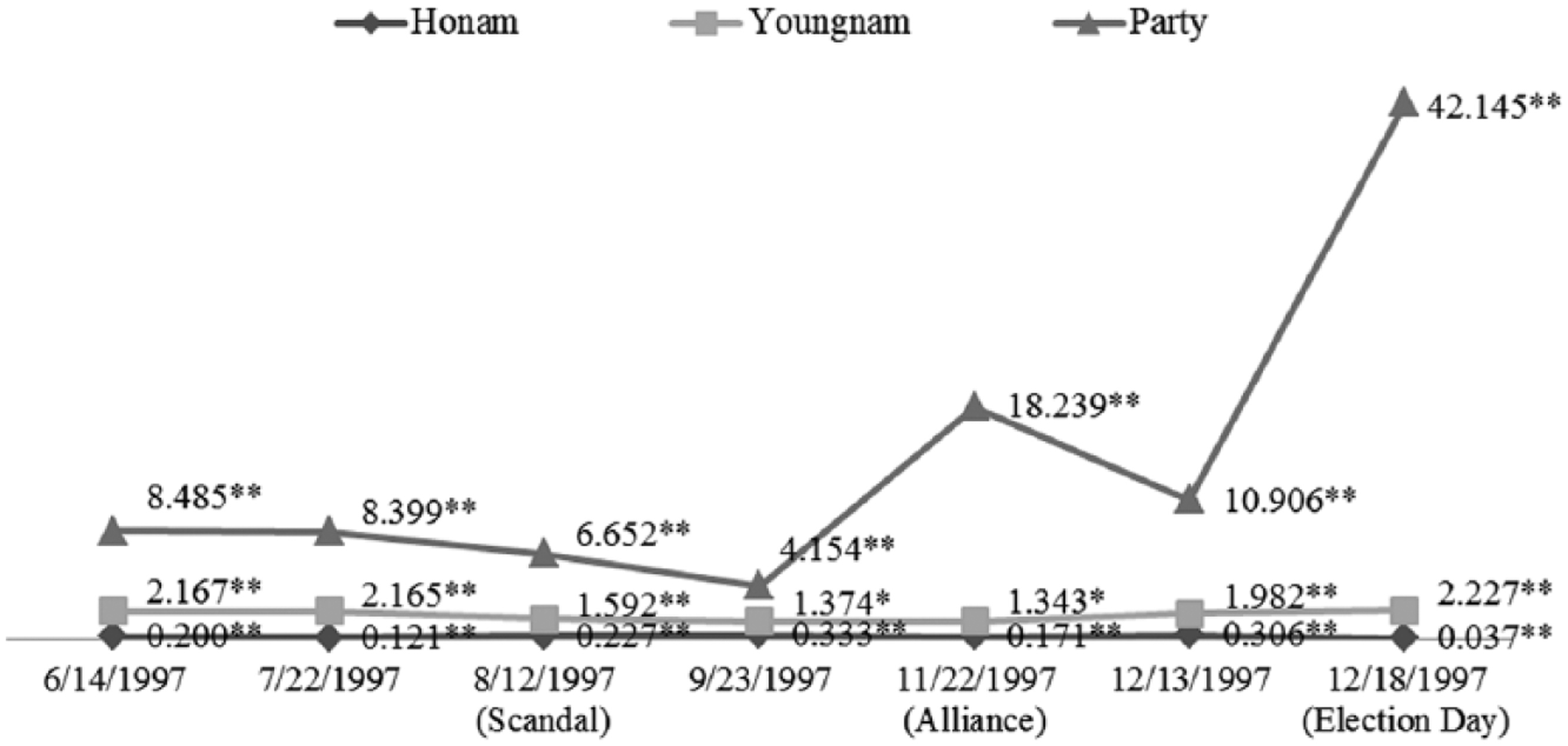
The Influence of the Fundamental Variables during the 1997 Presidential Campaign.
The results of the analysis show that the influence of partisanship on vote intention became much greater toward the end of the campaign: the odds ratio increased by 33.47 over the course of the campaign. The odds ratios of regionalism did not change much during the campaign. The analysis also shows that the influence of partisanship significantly changed after campaign events occurred. It decreased by 21% (8.399 to 6.652) after the scandal. The odds ratio of partisanship increased dramatically after the DJP alliance occurred; the November 22 survey increased by 14.085 compared to the preceding survey.
The overall findings suggest that the scandal and the DJP alliance affected the influence of partisanship; overall the influence of partisanship became greater over time. Additional analysis (not shown) indicates that subgroups’ vote intentions became more homogeneous within the groups and more heterogeneous across the groups by the end of the 1997 presidential campaign. On election day, 95% of GNP supporters and 85% of UNDP supporters voted for their party’s candidate. Similarly, 86% of Honam voters and 60% of Youngnam voters eventually chose their regional party candidate.
The 2002 presidential election
Logistic regression analysis is used to examine changes in the impact of the fundamental variables on vote intention during the 2002 presidential campaign, using five surveys and the 2002 Korean Election Study. The dependent variable is vote intention. Regionalism, approval, and three control variables are employed in the analysis. (Because of data limitations, we do not examine the influence of partisanship on vote intention in the 2002 campaign; similarly, analysis of the influence of approval is restricted.) Figure 6 presents changes in the odds ratios of the fundamentals during the 2002 campaign.
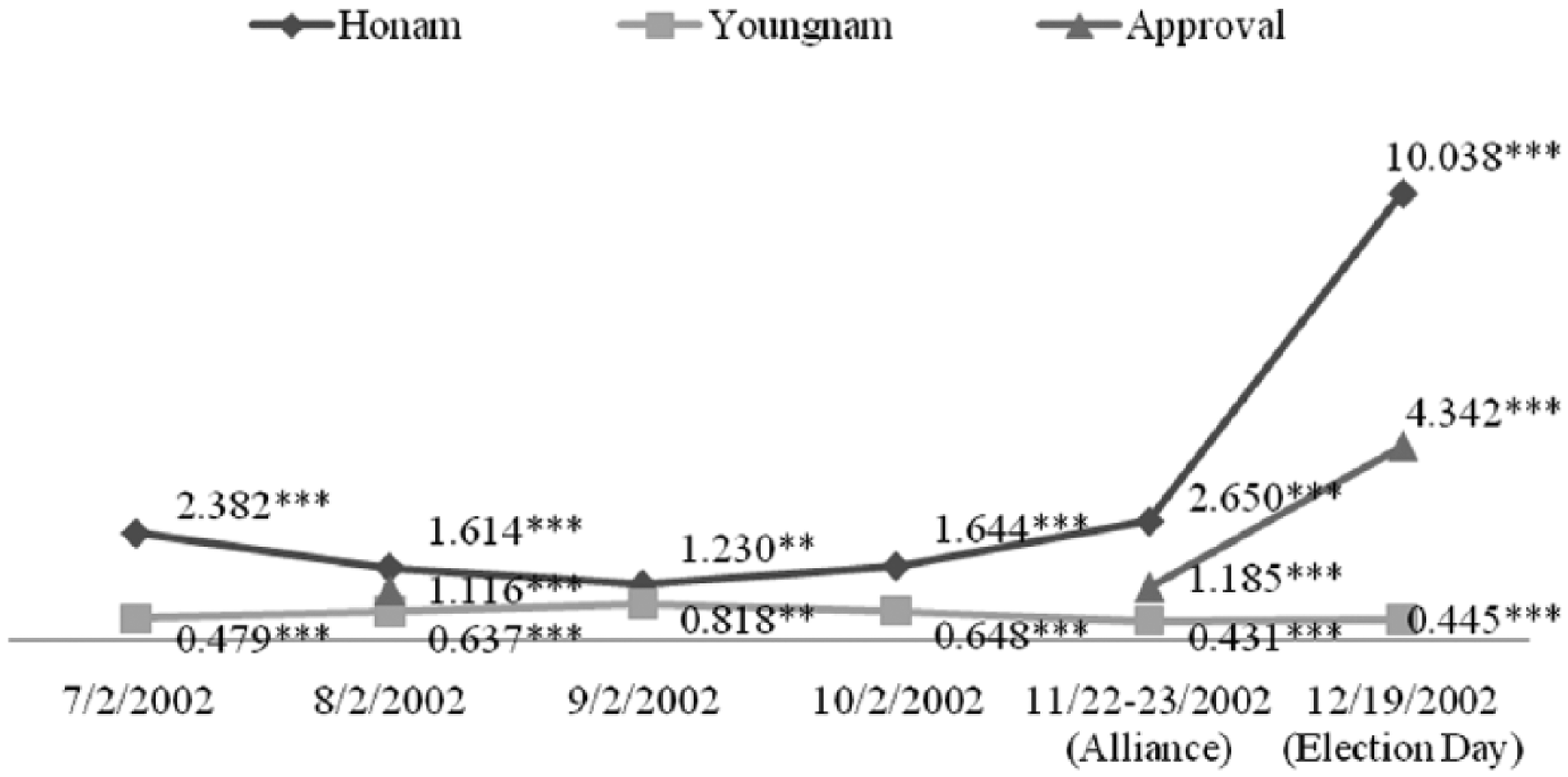
The Influence of the Fundamental Variables during the 2002 Presidential Campaign.
The results of the analysis show that the influence of the fundamentals on vote intention became greater toward the end of the 2002 campaign. The odds ratios of Honam and approval increased by 7.66 and 3.23, respectively. In addition, the findings show that the electoral alliance primarily accounted for changes in the influence of the fundamental variables on vote intention. Before the alliance occurred, the odds ratio of the Honam variable did not change much; however, it increased dramatically after the alliance, from 1.644 to 2.650, compared to the preceding survey. Such increase continued until election day. The odds ratio of approval also increased dramatically after the alliance occurred.
As a result of the increased influence of the fundamental variables, the subgroups’ vote intention became more homogeneous within the groups and more heterogeneous across groups by the end of the campaign: 98% of Honam voters and 68% of Youngnam voters eventually chose their regional party candidate. Likewise, 88% of voters who approved the job of the Kim administration supported the in-party candidate on election day, while 58% of those who disapproved of the performance of Kim administration voted for the opposition party candidate.
The 2007 presidential election
Using five waves of the 2007 presidential panel surveys, we employ logistic regression analysis to examine changes in the impact of the fundamentals on vote intention during the 2007 campaign. The dependent variable is vote intention. Regionalism, party identification, approval, and three control variables are included in the model. Figure 7 presents changes in the odds ratios of the fundamental variables during the 2007 campaign.
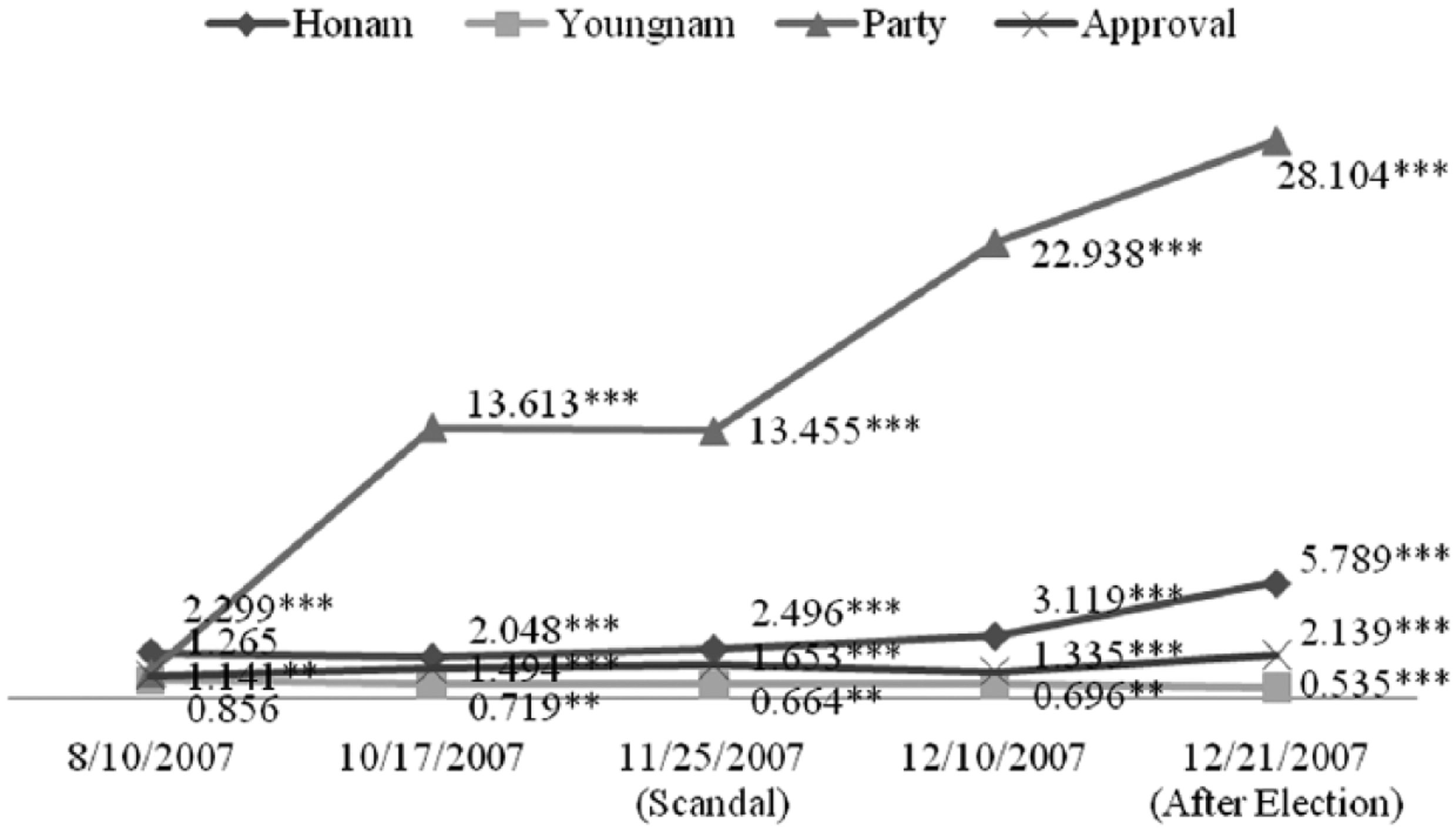
The Influence of the Fundamental Variables during the 2007 Presidential Campaign.
The results of the analysis show that the influence of the fundamental variables on vote intention generally became greater toward the end of the 2007 presidential campaign. In particular, the influence of partisanship and the Honam region increased substantially after the BBK scandal occurred. The odds ratios of partisanship approximately doubled from 13.61 (in the October 17 survey) to 28.10 (in the survey just after the election). Before the BBK scandal, the odds ratio of Honam variable did not change much; however, after the scandal occurred, that ratio increased from 2.05 to 5.79.
Thus, the subgroups’ vote intentions became more distinct from each other over time. On election day, 84% of GNP supporters and 85% of UNDP supporters voted for their party candidate. Similarly, 68% of Youngnam voters and 60% of Honam voters chose their regional party candidate. The difference in the homogeneity of Honam voters’ intentions by the end of the 2002 and 2007 presidential campaigns suggests the role of campaign events in producing the eventual vote choice. In 2002, 98% of Honam voters supported their regional party candidate (Roh, Moo-Hyun) on election day, while 60% of Honam voters chose their regional party candidate (Chung, Dong-Young) in 2007. During the 2007 presidential campaign, Honam voters increased their support for Chung by 26% (34.2% to 60.2%); in 2002 Honam voters increased their support for Roh by 53% (44.4% to 97.5%).
The differences suggest that campaign events play an important role in producing subgroups’ eventual vote decisions: the degree to which the subgroups rely on the fundamental variables to make informed decisions depends on the extent to which campaign events increase information during the campaign. In 2002, the electoral alliance provided Honam voters with information about Roh’s electoral strength and made them more aware of their regional party candidate support. However, in 2007, the Chung campaign apparently did not provide Honam voters with as much useful campaign information as did the electoral alliance in 2002. Chung attempted to form an electoral alliance with Moon, Kook-Hyun, a liberal third party candidate, but he could not because of their contrasting interests in the alliance (Gallup Korea, 2008).
The 2012 presidential election
With five waves of the 2012 presidential panel surveys, we ran a logistic regression model to examine changes in the influence of the fundamental variables on vote intention during the 2012 presidential campaign. The dependent variable is vote intention. Regionalism, party identification, approval, and three control variables are employed in the model. Figure 8 presents changes in the odds ratios of the fundamental variables during the 2012 presidential campaign.
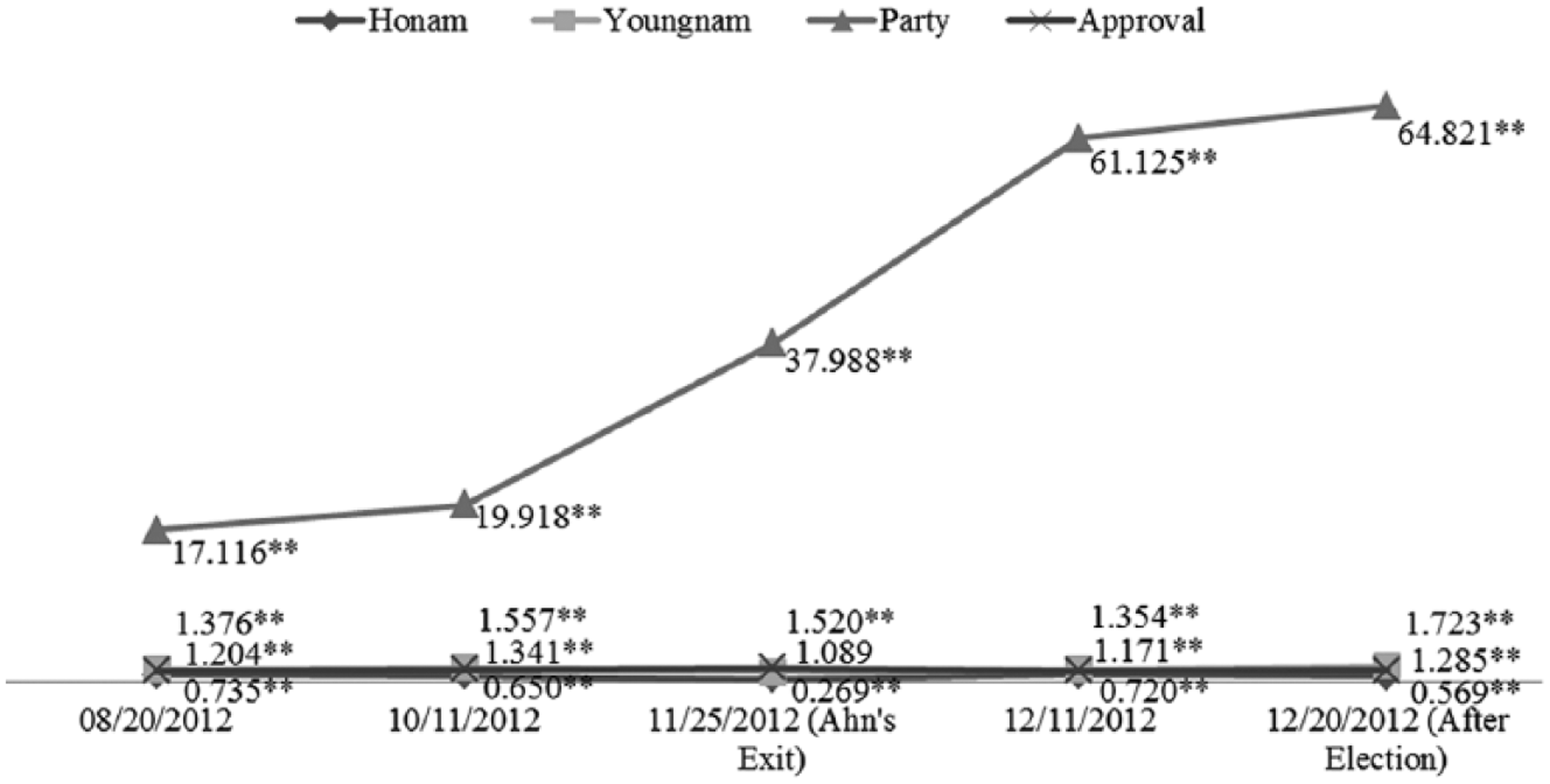
The Influence of the Fundamental Variables during the 2012 Presidential Campaign.
The results of the analysis show that the influence of the fundamental variables on vote intention generally became greater toward the end of the campaign. For instance, the odds ratio of party identification increased from 17.12 in August to 34.82 in the December survey taken immediately after the election. The findings also indicate that the influence of the fundamentals significantly increased after Ahn withdrew: party identification exerted a far greater influence in November and December (ranging from 37.99 to 61.12) than it did earlier in the campaign (17.12 to 19.92). The odds ratios of Youngnam variable also increased after Ahn’s withdrawal and became greater on election day.
Subgroups’ vote intentions became more distinct from each other over time. In the August surveys only 10–11% indicated a preference for Moon, yet by Election Day 90% of the DUP supporters picked their party candidate. Similarly, only 35–42% indicated preference for Park in the August surveys, yet 95% of the Saenuri supporters chose her as their eventual vote choice. Similarly, 63% of Youngnam voters and 75% of Honam voters voted for their regional party candidate. 86% of those who approved of the performance of Lee, Myung-Bak administration supported the in-party candidate (Park, Geun-Hye), while 57% of voters who disapproved of the job of Lee administration chose the opposition party candidate (Moon, Jae-In).
In sum, the overall findings concerning the 1997, 2002, 2007, and 2012 presidential campaigns generally confirm our hypotheses. They demonstrate that campaign events did influence public support for the candidates (hypothesis 1). Furthermore, they demonstrate that campaign events accounted for substantial changes in the influence of the fundamental variables and that the influence of those variables became greater over time (hypothesis 2). As subgroups became more aware of the identity of the candidates (as well as the candidates’ ideology, region, character, etc.) through the campaign events, they developed more informed vote intentions. As a result, opposing subgroups’ vote intention increasingly differentiated from each other over time (hypothesis 3).
Conclusion
In developing a theory of Korean presidential campaigns, we applied the equilibrium and enlightenment theories to Korean elections. The overall results of the analysis support the theory that both campaign events and fundamental variables influence eventual vote choice in Korean presidential elections. The fundamental variables influence vote intention before the campaign begins and largely determine the eventual vote choice. Campaign events assist voters to learn more about the candidates, parties, etc. by providing them with information during the campaign. As voters become more informed, they more fully develop their intentions. As a result of greater information, voters’ intentions move in the expected direction toward their eventual vote decisions. The overall findings of the analysis suggest that both the enlightenment and the equilibrium theory help explain the impact of Korean presidential campaigns.
This study contributes to the academic literature in that it establishes a foundation for understanding campaign effects in Korean presidential elections for future research. In addition, this study has implications about the applicability of the theories of American presidential campaigns to other electoral settings. By applying these theories of American presidential campaigns to Korean campaigns, this study suggests that theories of American presidential campaigns may have general importance in explaining vote choice in presidential elections outside the United States. If the fundamental variables in another country are established and known, if parties and campaign processes are reasonably well-developed, and if the electorate has access to campaign information (either through mass media or via personal communication), the theoretical framework of this study can be applied. Of course, different countries may have different fundamental variables, which may affect the applicability of the basic theoretical framework.
Last but not least, analyzing changes in vote intention of subgroups of the electorate to examine campaign effects has implications for the study of American presidential campaigns. This research found that presidential campaigns play an important role in certain subgroups developing informed vote intentions during the campaign. More attention to the functions of presidential campaigns in the electoral process, rather than simply estimating the impact of campaign events, can shed light on how voters process information, how candidates make strategic decisions and the types of candidates who are elected. This approach to analyzing campaign effects can contribute to broadening our understanding of how campaigns matter.
Footnotes
Funding
This research received no specific grant from any funding agency in the public, commercial, or not-for-profit sectors.