







Abstract
We present a theory that addresses the question of why autocracies with a regime legitimation which ties the destiny of the members of the ruling elite, namely the nobility or ideocratic elite, to the survival of the autocracy, namely (ruling) monarchies and communist ideocracies, are more durable than other kinds of autocracies. Using logistic regression analysis and event history analysis on a dataset on autocratic regimes in the period 1946 to 2009, we are able to show that ruling monarchies and communist ideocracies are indeed the most durable autocratic regime types.
Introduction
The recent wave of autocracy research focuses primarily on the stabilizing effect of institutions for autocracies such as cooptation mechanisms (Brownlee, 2007; Blaydes, 2011; Cox, 2009; Gandhi, 2008; Gandhi and Lust-Okar, 2009; Gandhi and Przeworski, 2007; Magaloni and Kricheli, 2010; Schedler, 2009; Svolik, 2012). For example, researchers claim that autocracies with a legislature are more durable because they use this institution as a forum for policy concessions (Gandhi and Przeworski, 2007) and/or as a forum to distribute patronage and other spoils (Lust-Okar, 2009). Geddes (1999: 130–138) argues, in a game theoretical model, that competing factions of ruling parties are always better off together and, hence, one-party autocracies are more durable than military and personalist autocracies. Geddes names cooptation as the decisive causal mechanism.
However, reliance on cooptation, understood as the ‘intentional extension of benefits to challengers to the regime in exchange for their loyalty’ (Frantz and Kendall-Taylor, 2014: 2), entails a practical hazard. If the ruling elite distributes spoils to its potential challengers, the material benefits might empower them to act against the regime. To rely on repression also involves a practical hazard: ‘the very resources that enable a regime’s repressive agents to suppress its opposition also empower it to act against the regime itself’ (Svolik, 2012: 10). It is therefore likely that autocracies that rely on cooptation and repression alone are – at least during times of crisis – in a ‘relatively unstable situation’ (Weber, 1978: 213; see also Easton, 1965a: 124; Easton, 1965b: 278).
While we agree that cooptation and repression are important tools in the toolbox of autocrats – especially in times of crises – we emphasize the regime’s legitimation as the most important mechanism for survival (Backes and Kailitz, 2015; Kailitz, 2013). Even non-democratic regimes need to legitimate their authority vis à vis the ruling elite and the masses of ordinary citizens (Ulfelder, 2005). The ruling elite’s own sense of legitimacy is of particular importance (Rothschild, 1977). It is crucial for any autocratic regime that at least the great majority of the regime’s elite has the desire for the regime to survive (Brownlee, 2007; Geddes, 1999; Levitsky and Way, 2012; Svolik, 2009). There are different possible objects of political legitimation – the nation, the state, the regime, the rulers, and specific policies. We focus here on regime legitimation (Pakulski 1993: 69), which we define as a ‘political formula’, that is able – if well-designed –to play both ‘a unifying and [a] self-legitimizing role’ (Pakulski, 1993: 77) for the political elite. A strong claim to legitimacy enhances considerably the unity of the elite (Barker, 2001; Grauvogel and Von Soest, 2014; Kailitz, 2013); it minimizes uncertainty among the members of the ruling elite about their future and/or maximizes their regime support (Higley and Lengyel, 2000; Higley and Pakulski, 2000).
According to our theory, autocracies are durable if the regime legitimation as a ‘political formula’ of the regime defines a narrow ruling elite that is strongly tied to the fate of the regime. The desire of the ruling elite in such regimes to maintain the status quo does not necessarily rest on an actual normative belief in the regime’s legitimacy, but could be based on rational calculations by its members (i.e. members of the ruling elite are aware that they might be worse off when the regime changes). In particular, during times of crises, such a ‘political formula’ can serve as ‘a basis for elite re-unification and coercive measures’ (Pakulski, 1993: 77). To test our theory we use a polythetic classification of regime types (Bailey, 1973a; Bailey, 1973b) which places the regime’s justification of power at its center (Kailitz, 2013). We use various autocratic regime types (i.e. military autocracy, communist ideocracy, electoral autocracy, (ruling) monarchy, personalist autocracy, one party autocracy) as simple proxies to measure differences in patterns of regime legitimation. 1
The article is structured as follows. First, we present our classification of autocratic regime types (Kailitz, 2013; Kailitz, 2015). Second, we outline our theory and present hypotheses on how claims of legitimacy of these autocratic regime types affect elite unity and hence the durability of these regime types. Third, we discuss the methodological procedures adopted for this research. To answer our research question, we employ a two-step research strategy, using descriptive statistics and discrete time survival modeling on global cross-country data from the period 1946 to 2009. Our means’ test and our regression models, in which we control for economic wealth, economic growth, resource dependency, ethnic fractionalization, cooptation and repression, indicate that ruling monarchies and communist ideocracies endure the longest. Finally, we summarize the main findings of this research and suggest avenues for future research. 2
Classification of political regimes
We use Kailitz’ (2013) typology and distinguish between (ruling) monarchy, ideocracy, military autocracy, (non-monarchic) personalist autocracy, (non-ideocratic) one-party autocracy, and electoral autocracy. 3 These regime ‘clusters’ (6 and Bellamy, 2012: 149), with their multiple attributes, are deeply rooted in the qualitative literature on political regimes and, except for the ideocratic regime type (Backes and Kailitz, 2015), are also labeled as such. 4 Because some conceptual ‘overlap’ between various regime ‘clusters’ may exist, we used a list of sequential coding rules that allowed us to assign a country to a specific category. The first step in categorizing autocracies is to sort out all non-regime phases such as civil war or the occupation of a country; the second step in categorizing autocracies is to verify who actually rules an autocratic country.
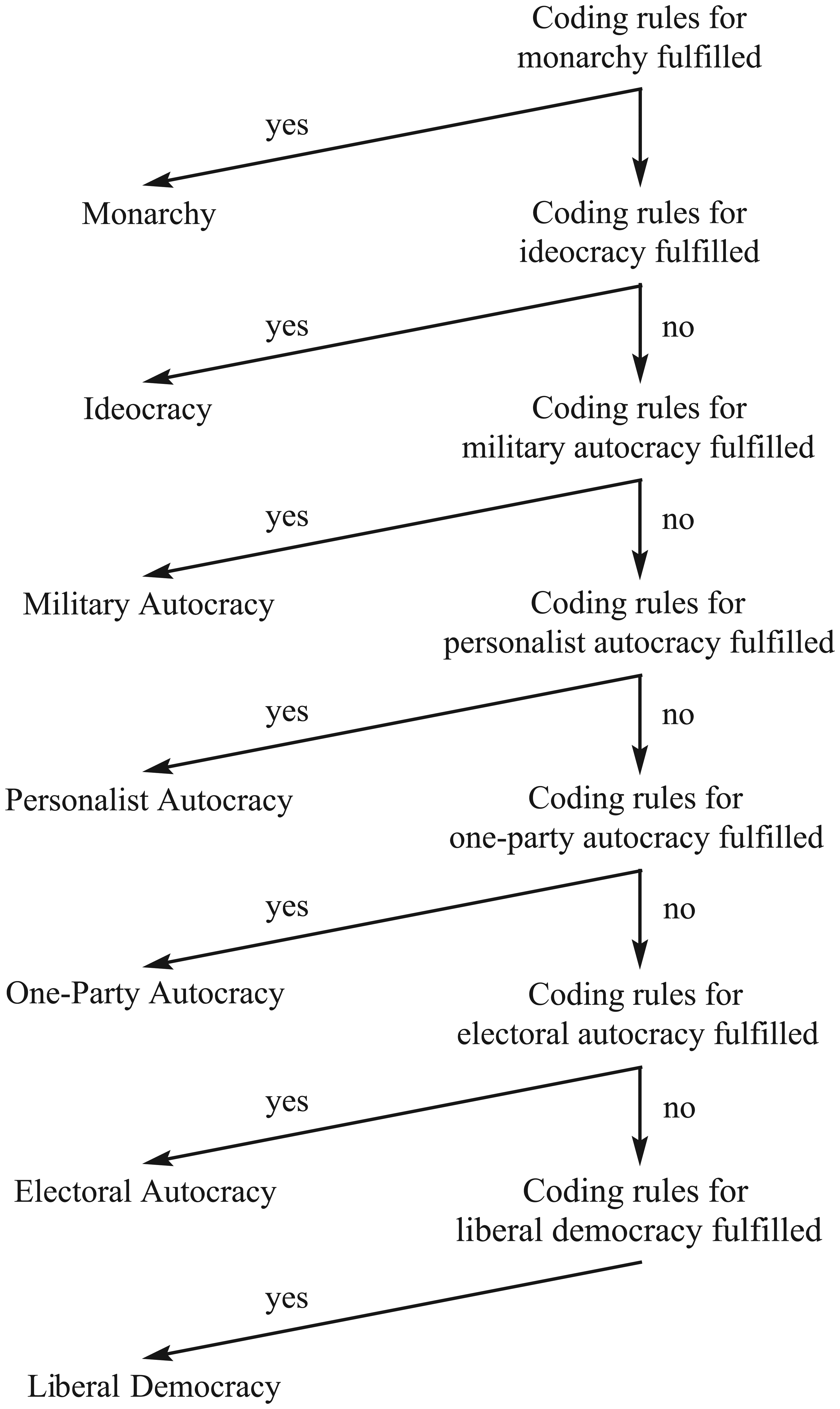
Coding rules for categories of regimes.
Following the proposed sequence of our coding rules, the vast majority of empirical cases can be classified unambiguously to one regime category. A regime is coded as a (ruling) monarchy if the ruler has a monarchic title such as ‘King’ or ‘Emir’. This simple criterion excludes all regimes, as non-monarchies, in which a former king – such as Mohammed Dhaud in Afghanistan or Mutesa in Uganda – rules as a non-monarchic elected ruler. Parliamentary monarchies, in which the monarch does not rule, as in today’s Denmark, are also excluded from the ‘monarchy’ regime type. Examples of ruling monarchies are Saudi Arabia and the United Arab Emirates.
The second autocratic regime type is ideocracy. While it is true, in the words of Mosca and Pareto, that every political regime has some sort of ideological basis of legitimacy, ideocracies are characterized by a totalitarian regime ideology. A totalitarian ideology promises its followers that it will pave the way to a utopian future (Friedrich and Brzezinski, 1965; Linz, 2000). There are three basic variants of regimes with a totalitarian ideology: communist, national-socialist/fascist and Islamist regimes. 5 In the period studied, ideocratic regimes are equal to communist regimes. 6 A country is coded as a communist ideocracy if it (1) officially claims that it is a communist/socialist regime; and (2) if it is ruled by a Leninist party that proscribes opposition parties and exercises control over the society and economy. 7 Examples of communist regimes are the Soviet Union, Yugoslavia and PR China.
The third regime type is military autocracy. Preconditions for coding a regime as a military autocracy are that (1) it cannot be coded as a monarchy or an ideocracy; and (2) there are no popular multi-party/multi-candidate elections for president. Rather, a political regime is coded as a military autocracy if the country is ruled by a junta of high-ranking military officers – in which civilian bureaucrats may play a role, or not – or by a high-ranking military officer who is selected by the military as the ruler. 8 Examples of military regimes are Argentina (1976–1983) or Turkey (1980–1983).
The fourth autocratic regime type is personalist autocracy. Personalist autocracies are (almost) ‘institutionless polities’ with no established rule of succession of power. (Brooker, 2008: 139; Jackson and Rosberg, 1982: 8). Preconditions for coding a regime as a personalist autocracy are that (1) it cannot be coded as a monarchy, an ideocracy, or a military autocracy; and (2) there are no (direct or indirect) popular multi-party/multi-candidate executive elections. In the subset of cases that fulfill these criteria, the defining feature that allows us to code a regime as personalist autocracy is that the personalist ruler has (almost) unlimited authority and hence there is no institutional non-violent option to topple him/her and select a new ruler. A case (in the above defined subset of cases) is always coded as a personalist regime if the ruler becomes president for life – such as in the case of Idi Amin in Uganda (1976) or Saparmurat Niyazov in Turkmenistan (1999). In these cases it is unimportant if legislative elections take place, as in Turkmenistan under Niyazov, or if they do not happen – as occurred, for instance, during the rule of Hissene Habre in Chad.
The fifth autocratic regime type is (non-ideocratic) one-party autocracy. Preconditions for coding a regime in this category are that (1) it cannot be coded as a monarchy, an ideocracy, a military autocracy, or a personalist autocracy; (2) there are no (direct or indirect) popular multi-party/multi-candidate executive elections; and (3) the country is de jure and/or de facto a single party state. Examples of (non-ideocratic) one-party autocracies are Belarus (since 1991), Kenya (1982–1991) and Malawi (1964–1970).
The sixth autocratic regime type is electoral autocracy. Preconditions for coding a regime in this category are that it cannot be coded as one of the previous five autocratic regime types. In this subset of cases, a country is coded as an electoral autocracy if there are (direct or indirect) popular multi-party/multi-candidate executive elections and direct popular legislative elections. What distinguishes electoral autocracies from democracies is, first, that the elections are not free and fair; and/or, second, that the power of the ruler is not effectively constrained by the legislature. 9 Examples of electoral autocracies are Mexico (1945–1987) and currently Russia (since 2000).
While the great majority of cases can be classified mostly unambiguously, the categories of the classification presented above are in a strict sense not mutually exclusive (Sartori, 1970). Some autocratic regimes are in fact hybrids of our ‘pure’ autocratic regime types. For instance, it might be argued that the Brazilian military dictatorship (1964–1985) fulfills all or, at least, most criteria for an electoral autocracy. However, if we apply rigorously the sequence of our coding rules presented above, and if we start with our initial question – who actually rules? – our coding becomes clear. In Brazil from 1964 to 1985 it was the military, not a civilian party or a monarch, that ruled. In more detail, we find that the strongest indicator of military influence, namely ‘the ability of the officer corps to enforce term limits’(against military strongmen) and ‘manage succession’ (Geddes et al., 2014: 153) apply to the Brazilian case. The top of the military negotiated every few years over planned presidential successions (Stepan, 1971) and the presidents of Brazil were chosen by the military and then approved by Congress, in order to give the impression of free elections having taken place.
In contrast, military-led regimes established by junior officer coups, as in Uganda (1971–1979) are classified as personalist autocracies and not as military regimes, because the military did not rule as an institution in these cases. For instance, during the rule of the military strongman Idi Amin in Uganda, no other officer had substantial influence on basic policy decisions. In many monarchies the monarch does not actually rule (e.g. Denmark). While these cases are clearly not ruling monarchies, there are cases on the borderline between a ruling and non-ruling monarch: the Thai monarch represents such an example. However, in our terms, the Thai monarch is not a ruling monarch because he, unlike his peers in the Gulf monarchies, neither rules the country himself nor does he manage the succession of the government.
Theory: regime legitimation, regime type and elite unity
An autocratic regime should be most durable if it has a narrow elite with shared values and beliefs that is strongly integrated into the regime. High elite unity and narrow elite differentiation are the keys to a durable autocratic rule. Elite unity covers normative and interactive components. The normative dimension is the extent to which members of the elite share values and beliefs; the interactive dimension ‘is the extent of inclusive channels and networks through which elite persons and groups obtain relatively assured access to key decision-making centers’ (Higley and Lengyel, 2000: 2). Elite differentiation is narrow when members are organizationally unified and have little autonomy from each other and the state. An autocratic regime should be most durable if it has a narrow elite with shared values and beliefs that is strongly integrated into the regime (Higley and Lengyel, 2000; Higley and Burton, 1997). An ideocratic elite provides the only elite configuration that ensures non-democratic durability. Different from Higley and Burton (2006), we argue that a monarchic elite is also unified and shares the goal of regime survival (Herb, 1999) (see Table 1).
Configuration of ruling elites and regime types.
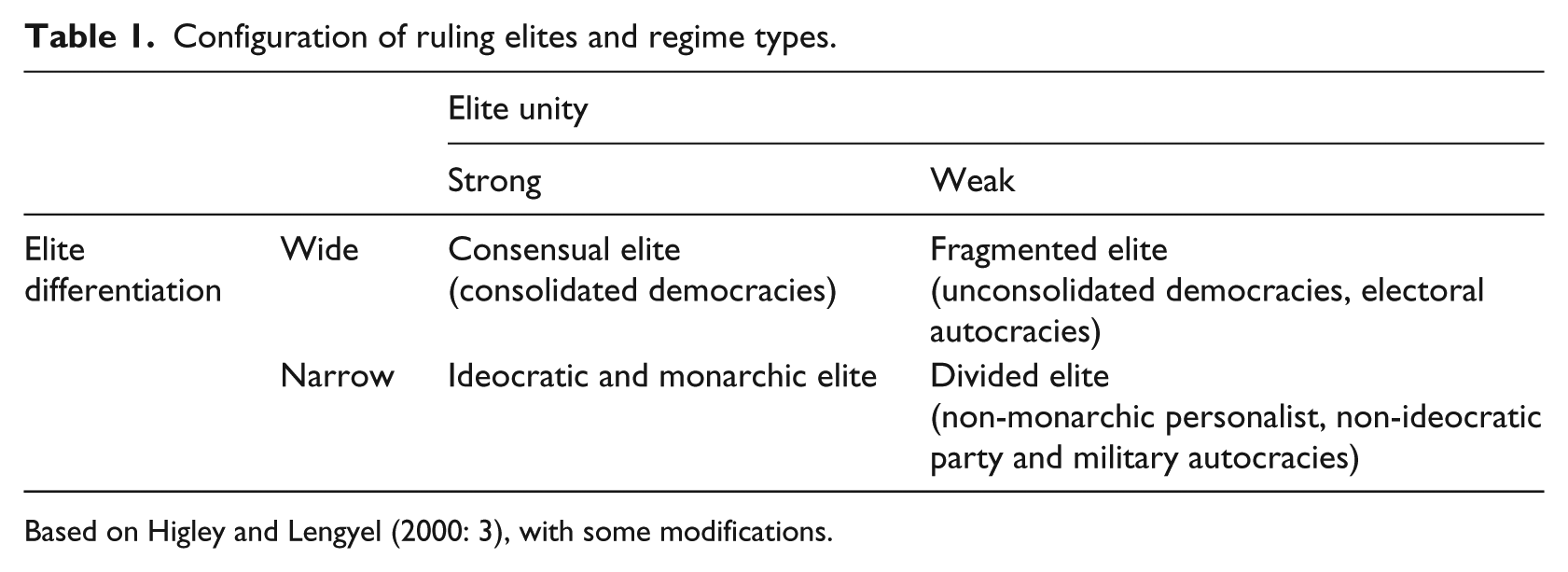
Based on Higley and Lengyel (2000: 3), with some modifications.
Following their totalitarian regime ideology, ideocracies claim variously to fulfill the laws of nature, history or God (Backes and Kailitz, 2015; Bernholz, 2001; Piekalkiewicz and Penn, 1995). In an ‘ideocratic regime’, the ‘status and privileges of the ruling elite are justified with reference to a sacred heritage of which the elite is the current trustee and embodiment’ (Breslauer, 2002: 55; see also Best, 2012: 74). We expect communist ideocracies to be more durable than all kinds of non-ideocratic party-regimes, for two main reasons.
First, the communist cadres are – more or less – united by the strong utopian vision of rule. Even if they do not personally believe in the totalitarian ideology, they act in public as if they do believe in it. The members of the ideocratic elite work together closely in ‘networks running through a highly centralized party’ (Higley and Lengyel, 2000: 7). The destiny of the members of the ideocratic elite is closely tied to the destiny of the ideocratic regime. To become a member of the communist elite, citizens are required to demonstrate commitment to the ideology and to the actual work of the party. If members of the ruling elite fail to do so, they risk being removed during ‘purges’. 10 Through this process a very strong, ideologically unified ruling elite is created, which practices social closure and self-recruitment of the ruling class, as well (Best, 2012; Djilas, 1957; Voslensky, 1984).
Mosca (1939) argues convincingly that according to the ‘law of intergenerational status conservation’, which is very strong in Soviet-type regimes, every member of the ideocratic elite seems better off when the regime survives, but faces an uncertain future when a regime change occurs. 11 It is important to keep in mind that elite defections are not impossible in communist ideocracies (see the Soviet Union and Yugoslavia in the final period of these regimes); however, we maintain that they are just less likely than in non-ideocratic party autocracies.
Second, in communist ideocracies that come to power as the outcome of a revolution, the ideocratic elite is united, at least initially, due to its common struggle against the previous regime. Levitsky and Way (2012: 869) state that during crisis ‘identities, norms, and organizational structures forged during periods of sustained violent, and ideologically-driven conflict are a critical source of [elite] cohesion’. We agree that this source of elite cohesion is very important at the beginning of revolutionary regimes. However, in later phases of the regime, more and more elite cadres do no more than pay lip service to the official ideology. This might apply in particular to communist ideocracies which were externally imposed on a country (e.g. GDR, Hungary and Poland) through the occupation by the Soviet Union. There (and elsewhere) the members of the ideocratic elite might become cynical about the communist ideology. However, they may still identify with the ideocratic regime because it provides them personal, social and professional benefits. Hence, we hypothesize that, once established, the ‘law of intergenerational status conservation’ contributes to the survival of ideocracies regardless of whether its actual members still believe in the regime legitimation or not.
Similar to ideocracies, we hypothesize that elite unity should be strong in a ruling monarchy. The common justification of a monarch to rule is that she/he has a God-given, natural or at least established historical right to rule because of his or her descent, regardless of the political outcome of his or her rule (Lust-Okar and Jamal, 2002: 353; Richards and Waterbury, 1996). The power of a monarch relies – usually –upon the institution of an established aristocracy (e.g. Herb, 1999). For the sake of simplicity, we take the aristocracy in a monarchy as given. 12 Aristocrats may fight each other to become the new monarch, but they can be expected to stand united against any attempt to abolish the huge privileges bestowed upon them by aristocratic birthright. In the absence of strong pressures from outside the aristocratic elite it is highly unlikely that the monarchic elite would voluntarily open the gates for a mass of new potential members of the regime elite.
If our theory is correct, communist ideocracies, all other things equal, should be considerably more durable than both non-ideocratic kinds of party-based autocratic regimes. In contrast to communist ideocracies, in (non-ideocratic) one-party autocracies, with their vague political vision, the members of the party elite are more loosely tied with the fate of the political regime and – usually – much less integrated into the regime. The same is basically true for the ruling elite in electoral autocracies.
We also expect, all other things being equal, that ruling monarchies are much more durable than (non-monarchic) personalist regimes, because there are no significant parts of the monarchic elite that wants to overcome the monarchy. In (non-monarchic) personalist autocracies, there is no institutionalized ruling class like the aristocracy: the ruling elite is fragmented and very loosely tied with the fate of the political regime. Because there are neither institutional nor traditional boundaries to the ruler’s will, all members of the ruling elite in personalist regimes are continuously in danger of being excluded from the ruling elite. Under these circumstances, it is much more likely, in a personalist autocracy than in a monarchy, that members of the current regime elite defect to the opposition in a regime crisis. As soon as the personalist autocrat cannot provide enough booty, members of the elite will start to look for an alternative, which eventually might leave the personalist autocrat alone in his/her fight to survive. We reject Geddes’ hypothesis that in personalist regimes patrimonial ruling elites can be expected voluntarily to ‘sink or swim’ with the personal autocrat (Geddes 1999: 130).
Probably even more so than personalist autocracies, military autocracies do lack a ‘recognizably valid source of authority’ (Beetham, 1991: 233). Whether or not the military is partially legitimized by the constitution to govern (temporarily) in (defined) cases of emergency (e.g. Turkey), it always lacks legitimacy to rule in the long run because the military is simply not designed to govern a country permanently. The military elite knows this and usually acts accordingly. It has to justify its temporary rule with the presence of an internal or external threat to the country, and promise that once this threat is removed it – the military – will return authority to civilians.
In fact, a military autocracy is the only form of a political regime that might fall even when the ruling elite is united. The military as an institution might decide – without any struggles inside itself – to return to its barracks. In our view, many short-lived military regimes, such as those in Turkey or Honduras, did not fail in the strict sense of the word, but the military kept its promise to return to the barracks. Nevertheless, in those cases where some parts of the military, including the leaders of the coup, would prefer to stay in power – for instance, the junta in Peru after 1968 – the military government is in permanent danger of being toppled by that faction of the military which wants to hand over the responsibilities of government to a civilian administration (Balmaseda, 1992; Geddes, 1999).
In this study, we focus on two comparisons.
We compare party-based autocracies with a strong claim to legitimacy, namely ideocracies, with party-based autocracies with a – usually – weak claim to legitimacy.
We compare personalist regimes with a strong claim to legitimacy, namely monarchies, with non-monarchist personalist regimes with a weak claim to legitimacy.
If our theory is correct, communist ideocracies should be much more durable than non-ideocratic one-party autocracies and electoral autocracies; and monarchies should be much more durable than non-monarchic personalist regimes.
Variables and operationalization
Dependent variable: durability
Our dependent variable, regime durability, is measured by the years a regime has persisted without interruption. Our data on regime survival are from the dataset compiled by Kailitz (2013, 2015).
Independent variable: autocratic regime type
To operationalize the regime categories as proxies for the type of regime legitimation, we created five dummy variables, with one-party autocracy serving as the reference category.
Control variables
Economic wealth
There is a broad consensus in the literature that rich (materially wealthy) democracies are unlikely to break down (Barro, 1991; Boix and Stokes, 2003; Przeworski et al., 2000). However, less is known about how the extent of wealth affects the durability of autocratic regime types. We could find only one article in the literature, by Sanhueza (1999), which tested the link between economic wealth and the durability of autocracies. Sanhueza (1999: 337) reported that ‘rich autocracies do not show a lower hazard rate than less developed autocracies’. To measure material wealth we included the natural logarithm of GDP per capita and compiled the data from Maddison (2009).
Economic growth
Economic crises often foster political crises. This is largely true for both democracies and autocracies (Gasiorowski, 1995; Svolik, 2013). Consequently, we expect that fast economic decline in the form of low or negative growth fosters the breakdown of all autocratic regime types (Przeworski et al., 2000; Przeworski and Limongi, 1997). Economic growth was calculated on the basis of GDP data from Angus Maddison (2009). The formula used – well-known – is: GDPt – GDPt-1/(GDPt-1)×100.
Natural resources
In line with previous research, we argue that oil revenues or, more generally, non-tax revenues (i.e. revenues that the state gains through sources other than taxing its citizens) increase the durability of all types of political regimes. The mechanism linking rents and regime survival is that regimes with high non-tax revenues are less dependent upon taxation – and hence on their population (Morrison, 2009; Ross, 2001; Smith, 2004). For autocracies, selectorate theory further assumes that a dictator having oil or gas, or some other natural resource, at his disposal is able to raise enough money for themself and their winning coalition without the need of the active support of his citizens (Crespo Cuaresma et al., 2011). Based on the coding of Haber and Menaldo (2011) we classified 56 countries (see Appendix 3, available online at: http://ips.sagepub.com) as resource dependent (coded 1). These countries may depend on gas, oil, copper, diamonds, gold or other natural resources.
Ethnic fractionalization
We were unable to locate literature on any study that measured directly the relationship between ethnic fractionalization and autocratic regime survival. However, researchers have argued again and again that a democratic regime in particular will struggle to survive if it is made up of different nationalities (Bryce, 1912; Dahl, 1971; Muller, 1995; Horowitz, 1985; Linz, 1978: 64; Rustow, 1970). Ethnic fractionalization might foster insurgency and civil war which, in turn, are strong risk factors for the survival of any political regime. Despite the fact that the empirical results on relationships between ethnic fractionalization and insurgency and civil war are mixed (Montalvo and Reynal-Querol, 2005; Easterly and Levine, 1997), we have decided to include this factor. To measure ethnic fractionalization we use data from Fearon and Laitin (2002; Fearon, 2003).
Methodology
We have excluded all non-regime (e.g. foreign occupation and transition) and democratic episodes from our analyses and collected all possible data on autocratic regime survival for the period 1946 to 2009, which covers 3,597 observations. We have included all periods of autocratic regime apart from 37 countries with no data for at least one of the independent variables (see Appendix 1, available online at: http://ips.sagepub.com). With very few exceptions these countries are small states with a population under 700,000. Thus our results do not apply to small states. The few countries with a population of more than 700,000 (e.g. East Germany) for which data were not available came from various regions, had various levels of development and distinct political cultures: it is therefore unlikely that missing data for these countries biases our results for autocratic regime survival (for a list of excluded cases please see Appendix 2, available online at: http://ips.sagepub.com).
We use our data for a three step research process. In the first step, we present some descriptive statistics on the mean duration rate of any of the six autocratic regime types. In the second step, we present two regression models. First we fit a logistic regression model to our data (Singer and Willett, 1993; Jenkins, 1995) (see Table 3, Model 1) in which we code country years during which a regime change occurs as 1 and all other years as 0 (zero). On the left hand side are our independent variables of interest – our five autocratic regime type dummies with one-party autocracies serving as the reference category – as well as the covariates (i.e. log GDP per capita, GDP growth, natural resources, log and ethnic fractionalization). To account for possible differences across time, we also include dummy variables for each decade in the observation period, with the 1940s serving as the reference category. To calculate this equation, we use ‘Clarify’, a program developed by Michael Tomz, Jason Wittenberg and Gary King (Tomz et al., 2003) which allows us to transform the log odds into probabilities.
The second type of model is a discrete time survival model (Rabe-Hesketh and Skrondal, 2012: 749–796) (Table 3, Model 3). The approach is identical with the method Beck et al., (1998) have named ‘binary time series, cross section analysis’. Our dependent variable in the equation is the time until the breakdown of an autocracy occurs. This variable is right-censored (i.e. for some regimes breakdown could not be observed because the period of observation ended before an actual regime breakdown) and left-censored (for autocracies that came into being before 1946). The independent variables remain the same as in the previous model. We use a discrete time-survival model rather than a continuous time-survival model, because we include time-varying covariates.
In the third step, we run both models with two additional control variables – cooptation and repression, which are highly correlated with our regime dummies and which for repression is only available starting in the 1970s (see Table 3, Models 2 and 4). Despite the fact that Gandhi (2008: 178) has only presented an empirical null finding, we hypothesize for the first indicator, cooptation, that the presence of an elected parliament should enhance the durability of autocratic regimes. Like Gandhi we measure cooptation by the existence and significance of a legislature. The data for cooptation come from Cheibub et al. (2010). The variable is a three value ordinal scale, coded 0 if no legislature exists, including cases in which there is a constituent assembly without ordinary legislative powers; coded 1 if non-elective legislature exists (examples include legislators nominated by the effective executive, or on the basis of heredity or ascription); and coded 2 if elective legislators, or members of the lower house in a bicameral system, are selected by means of either direct or indirect popular election.
Finally, we include a control variable for state repression. Researchers have argued that repression is a main instrument for autocrats to stay in power (Escribà-Folch, 2013; Gerschewski, 2013; Levitsky and Way, 2006). However, there are very few empirical studies in the published literature that link state repression to autocratic regime survival. Results are mixed: while Bueno de Mesquita and Smith (2010) found that repression had no effect on the longevity of regimes, Escribà-Folch (2013) reported that restrictions on civil liberties are effective in deterring threats of upheaval. Our data for repression come from the Political Terror Scale (see Gibney et al., 2013), a five-item scale ranging from countries under a secure rule of law, coded 1, to countries where terror has expanded to the whole population, coded 5.
Results
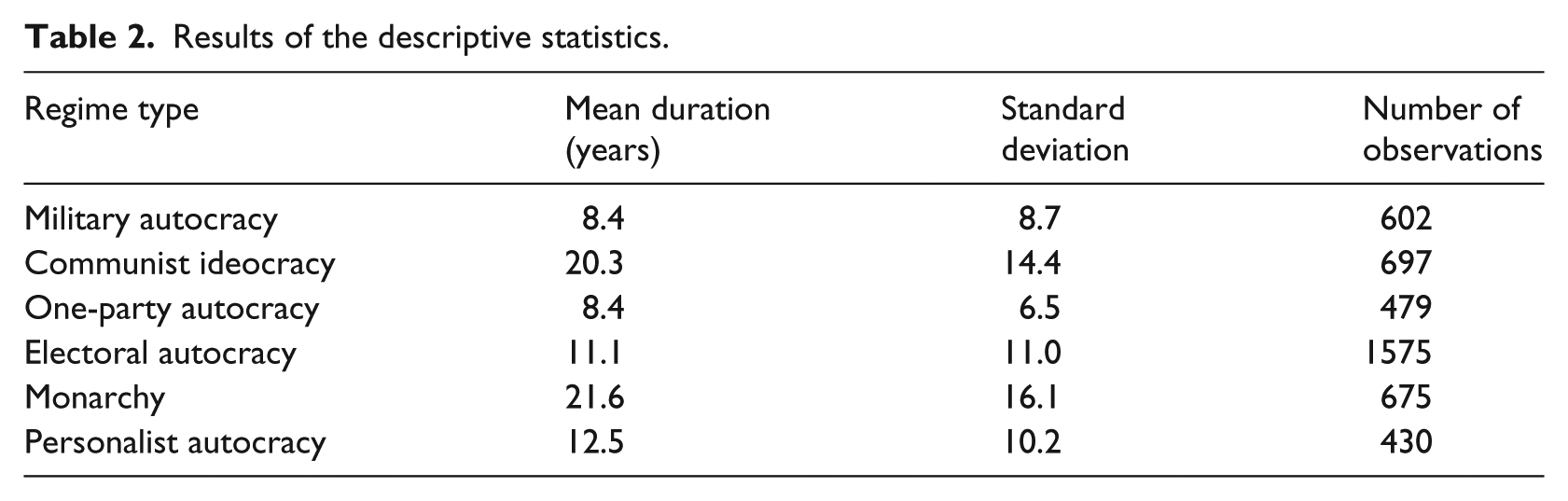
Between 1946 and 2009 a political regime lasted for 13.7 years on average. In line with our theory, communist ideocracies and ruling monarchies endured considerably longer – approximately 20 years. With their united and narrow ideocratic elites, ideocracies are much more durable than other kinds of party-based autocracies, namely one-party autocracies and electoral autocracies that usually have fragmented or disunited elites. We find – also as expected – that monarchies with their united and narrow aristocratic elite are much more durable than non-monarchic personalist autocracies. Military autocracies are the most volatile and hence susceptible to being overthrown. Enduring non-ideocratic party autocracies like Singapore are exceptions. The fact that extraordinary economic growth has been delivered by the ruling party for a long time might explain the resilience of this country and therefore might account for the most deviant case in this category. Finally, our descriptive results, as listed in Table 2, indicate that electoral autocracies and personalist autocracies, are slightly more durable than military-, or one party autocracies but by far not as resilient as communist ideocracies or ruling monarchies.
Results of the descriptive statistics.
Our two main multivariate models (see Table 3, Models 1 and 3) mostly confirm the results from the descriptive statistics. This strengthens the robustness of the findings. Our results indicate that, compared to our reference category, one-party autocracies, communist ideocracies and monarchies survive much longer. Substantively, the probability transformations from Model 1 (see Table 4) indicate the following: a hypothetical country in the 1990s that is not dependent on natural resources and whose other independent variables are at the median has an annual likelihood to fall of less than five percent if it is a communist ideocracy or monarchy. This annual likelihood increases to over 13% if the regime is a one-party autocracy or a personalist autocracy and almost 27% if the regime is a military autocracy.
Results of the logistic regression analyses (Models 1 and 2) and discrete time series model (Models 3 and 4).
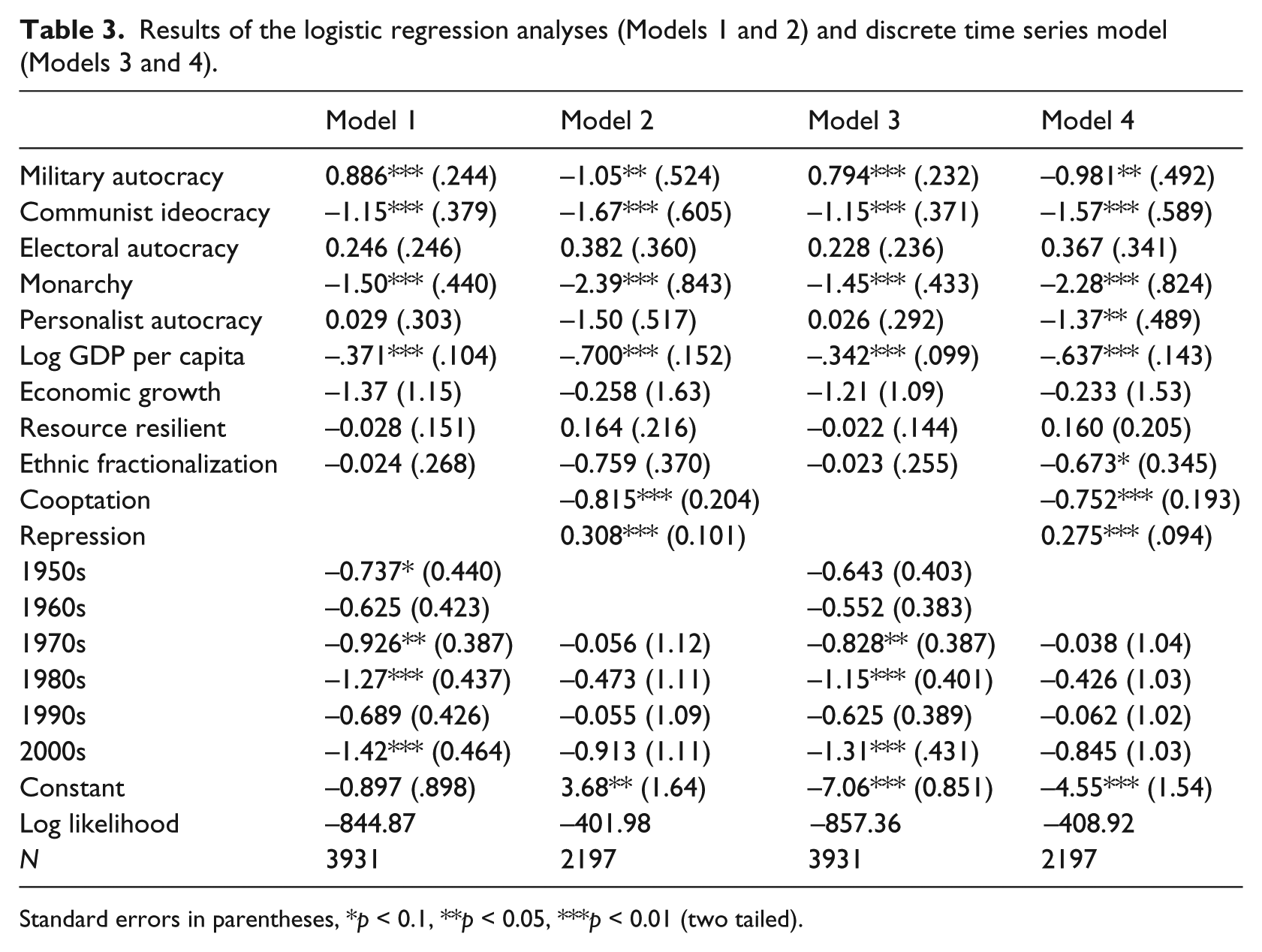
Standard errors in parentheses, *p < 0.1, **p < 0.05, ***p < 0.01 (two tailed).
Probability that an autocratic regime falls at any given year.
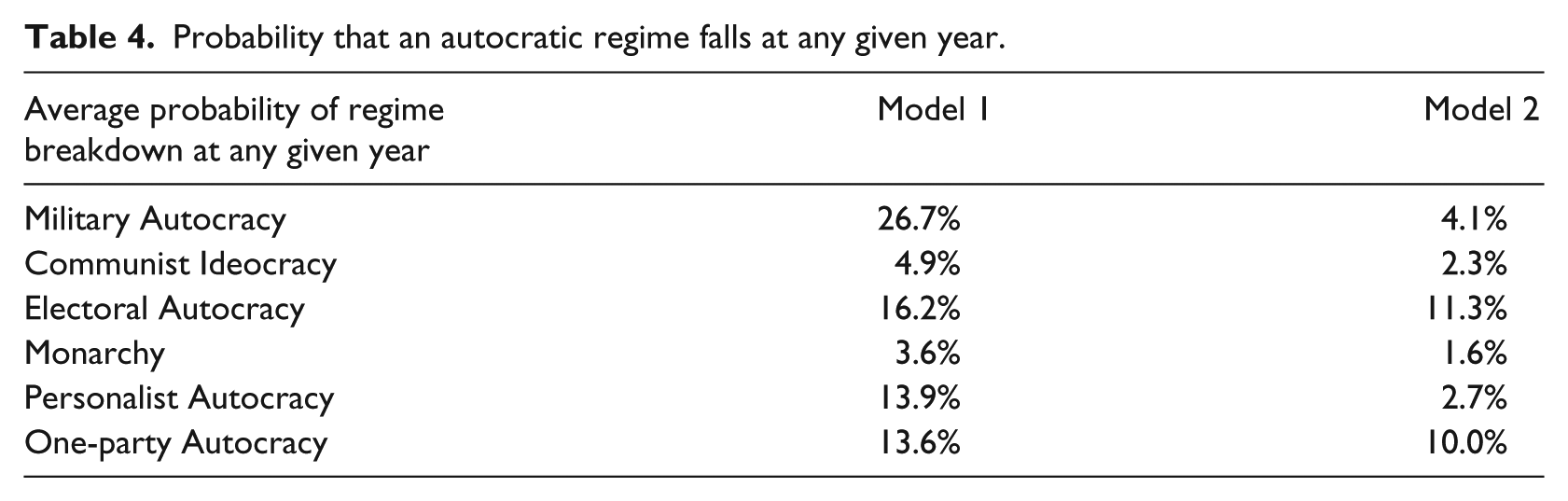
Models 2 and 4 highlight that repression and cooptation strongly influence autocratic regime survival (i.e. both repression and cooptation decrease autocratic regime survival). While these results are not in line with most theories, they follow our argument that cooptation and repression entail a practical hazard and are risky strategies for autocratic rulers. In addition to cooptation and repression, the only other control variable we find to have an influence on autocratic regime survival is the country’s level of economic development: richer (material wealth) autocracies have a lower likelihood to break down. The three remaining control variables: economic growth, ethnic fractionalization and natural resources do not appear to influence autocracies’ likelihood of survival.
To assure the robustness of our findings from the main models, we ran several more specifications (not reported here). First, we added regional dummies to Models 1 and 3; more precisely, we included 15 regional dummy variables (the Caribbean, Central America, Central Asia, Eastern Asia, Eastern Europe, Micronesia, Middle Africa, Northern Africa, South America, Southern Africa, Southern Asia, South-East Asia, Southern Europe, Western Africa, and Western Asia, with Western Europe serving as the reference category). The inclusion of these dummy variables does not influence the likelihood of regime change for our regime type dummies. Second, we used a rare events logistic regression analysis (Tomz et al., 1999), choosing this additional statistical test because regime changes are relatively rare events. On average, regime changes happened roughly every 14 years in our period of investigation. In datasets such as ours, where non-events make up the greater part of the data, there is a danger that the effects of independent variables on the occurrence of an event may be seriously underestimated (King and Zeng, 2001). However, running this additional model essentially provided identical findings with our two main equations. This applies both for the sign and magnitude of the coefficients, as well as for the probability transformations. Finally, we ran a time series binary logistic regression model with random intercepts (Menard, 2009). We ran this model with and without the regional dummy variables, and for both additional specifications we obtained results almost identical to those from our two main models.
Conclusion
In the first part of our article we proposed a theory of why autocracies with a ‘political formula’ that enhances elite unity – namely communist ideocracies and ruling monarchies – are more durable than all other types of autocracy. Next, we supported our theoretical claims with empirical results. Our research helps us explain why communist ideocracies (e.g. China, Cuba or North Korea) and monarchies (e.g. Bahrain, Saudi Arabia) are, on average, so durable. An autocratic regime legitimation that fosters elite unity and narrows elite differentiation renders it difficult for opposition forces to overthrow the elites in power. Based on our theory and empirical evidence, we reject one of Geddes’ (1999: 129f) core assumptions: that in all party dictatorships those with a ‘vocation in politics are typically incorporated in the regime, lowering the likelihood that such individuals will seek to overthrow it’ (Ezrow and Frantz, 2011: 198; see also Geddes, 1999: 129f.).
Our findings are at odds with Geddes’ hypothesis that, on average, party-based regimes last longest because authoritarian parties are ‘stabilizing factors in dictatorships’ (Wright and Escribà-Folch, 2011). Rather, we argue that authoritarian parties are not the decisive stabilizing factor in autocracies, but that regime legitimation is more important for enhancing elite unity. In non-ideocratic party regimes, parties or factions of a party consisting of individuals will always exist. These forces might periodically think that they are better off with a regime change. In particular, at the beginning of the regime and when the economic conditions are poor, forces within the regime might seek its overthrow. In line with Geddes (1999) and Hadenius and Teorell (2007), we find that military autocracies survive for much shorter periods than party autocracies. However, our argument differs considerably from that of Geddes. We argue that most military autocracies are the least durable autocracies because the military lacks a justification to rule permanently. Thus military autocracies might be short-lived because the ruling military elite is united (in its will to turn back power to civilian rulers).
One caveat regarding our research is that our focus is on autocratic regime survival and not on regime establishment. We suggest that it is very important to distinguish between conditions for the survival and establishment of autocratic political regimes. In the ‘age of democratization’ (Brownlee, 2007) and a ‘Western’ liberal hegemony in the international system (Levitsky and Way, 2010), establishing a new communist ideocracy or a new ruling monarchy seems hardly possible. In addition, we argue here that ideocratic and monarchic regimes are durable; but, of course, this does not mean that they last forever. It seems that these kinds of regimes become vulnerable when popular pressures force the regime elite to modify the regime legitimation. To support this reasoning, Gill (2013: 12) argues that in the final years of the Soviet Union ‘the ideocratic regime’s legitimation […] became subject to popular calibration in a way it never had in the past’. The effect of this change was to ‘dilute the ideocratic message and to render it more diffuse and ambiguous’ (Gill, 2013: 12). Therefore it seems that ruling monarchies and communist ideocracies are less vulnerable to elite-driven breakdowns than all other autocratic regime types; but, in the long run, they may well be taken down by mass-driven breakdowns. In fact this is exactly how, historically, most communist ideocracies and ruling monarchies have been overthrown.
Footnotes
Funding
This research received no specific grant from any funding agency in the public, commercial, or not-for-profit sectors.