







Abstract
The Arab Spring exemplifies to many a kind of globalisation from below. It cuts across borders and challenges liberal and technocratic élites. But how far does its global resonance really go? Are publics still largely corralled within national political spaces? Are waves of revolt confined by civilisational breakwaters? Or is the cosmopolitan space that many leftists envision taking shape? Based on a three-country survey of university students, this article probes these assumptions. It finds far-reaching solidarity with the aspirations of the Arab Spring, driven by the rise of a cross-border global society. But on probing the bases of such solidarity, it also finds that the cosmopolitan cohort emerging in the Global South does not fit a simple liberal or leftist mould. The Arab Spring resonates on multiple frequencies at the same time. This complex cosmopolitanism has implications for layers of common ground as global political opportunity structures emerge.
The eruption of the Arab Spring in 2011 unnerved élites in the Middle East and farther afield. Such nervousness stemmed from the uprisings’ content and scale. First, once the initial protests by middle-class activists gave way to political gains by the Muslim Brotherhood, Salafis and the like, it became clear that this wave of democratisation threatened to empower poor and traditionalist publics of a sort alien to the recent winners from globalisation. Second, from the catalysing release by Wikileaks of details on Tunisian corruption, to the foreign fighters converging on Syria, the Arab Spring embodied new energy from cross-border networks rooted in society. The revolts threatened to spread and to breach the sovereign compartments of world order.
Despite a cross-border element, however, this wave of revolts has not yet spread beyond the Arab world. There might be breakwaters on the sea of global society, in other words. This article considers the Arab Spring as a test case amid globalisation. It explores solidarity with the Arab Spring in distant parts of the world, though a drill-down survey of university student opinion in Peru, Pakistan and Kenya. The findings offer insight into the Arab Spring’s resonance with a global public.
Global society versus cellularity?
The literature connected to this puzzle clusters around several dimensions of emerging cosmopolitanism.
Cross-border interactions are sometimes considered to make up an emerging ‘world society’. Buzan (2004) sees ‘world society’ as a third layer of global integration, alongside the realpolitik of the ‘international system’ and the norms that constrain governments in ‘international society’. Lechner (2009) likewise argues that markets, migration and the ‘global association revolution’ are creating cross-border spaces beyond sovereign states. Norris and Inglehart (2009) find that beyond in-person interactions, internet usage is another powerful driver of cosmopolitanism, though mainly among Western-oriented ‘core societies’ with open economies and media. In more ‘parochial’ parts of the world, the cosmopolitan potential of electronic communication is slowed by ‘societal firewalls’ of censorship and protectionism, as well as by ‘individual firewalls’, namely poverty and distrust of foreign media.
The extent of global society in the Global South specifically is underexplored. Much of the literature presumes an overlap of the cosmopolitan, the liberal and the Northern. While all roads no longer lead to Rome, they are thought at least to lead to somewhere between Hollywood and Stockholm. Empirically, that view may be dated. Internet penetration of the Global South has grown rapidly among the young, for example, even in the seven years since the Norris and Inglehart study. It is currently at 35% worldwide and rising. More broadly, the paths of cosmopolitanism are diversifying. Werbner (1999) identifies a ‘vernacular’ or ‘working-class cosmopolitanism’ driven by ‘boundary-crossing demotic migrations’, which parallel the globetrotting of the business class and intelligentsia. And Furia (2005) and Pichler (2012) found a surprising number of people in parts of the Global South self-identifying as global citizens.
One vital point of intersection between global society and cosmopolitanism is cross-border political solidarity. Particularly on the left, movements have long borrowed slogans and styles of protest across borders (e.g. Markoff, 1996: 20–31; Thörn, 2007). Yet what solidarity really means globally, rather than nationally, is contentious. Featherstone (2012) and Gould (2007) suggest that such solidarity among movements rests not on pre-existing common identities, but rather on loose networks and contested ‘political imaginaries’, linked together only by diffuse empathy. Olesen (2005a, 2005b) likewise warns against ‘the problem of global longsightedness’, namely overlooking that ‘transnational framing’ often merely supports tactics within countries. He suggests that today’s ‘global consciousness’ involves ad hoc cooperation among ‘a plurality of transnational publics rather than the singularity of a global civil society’. Tarrow (2001) likewise predicts that true transnational social movements will be scarce for some time to come, until global institutions gain more power and become targets of high-stakes contestation from below.
In short, while cosmopolitanism is proliferating in unlikely places, there are debates over how far it goes, what drives it, what content it takes outside the Western core, and how politically salient it is. Warnings against over-reading political solidarity within global society are also compelling, if taken in a limited way.
The Arab Spring is a promising case for exploring these points. It is the first large-scale wave of popular revolts since globalisation accelerated in the 1990s and since internet usage more recently penetrated the Global South, even though its social base – economically hard-pressed and ideologically traditionalist – is rarely seen as a prime breeding ground for cosmopolitanism. If the Arab Spring resonates farther afield, then we can gain a fuller picture of a South-centred version of global society. Any cross-border solidarities the Arab Spring elicits might even foreshadow a global public of sorts.
There are three lenses through which we might view the scope and logic of such solidarity.
One lens, which I shall call leftist-cosmopolitan, follows the logic of Marx’s (1848) claim that ‘the working men have no country’. Many on the left expect capitalist globalisation to be matched by a scaling-up of popular resistance. The World Social Forum has tried as much among left-liberal networks, and world-systems theorists (e.g. Chase-Dunn et al., 2006) predict cross-border ‘global parties’ emerging in coming decades. Glasius and Pleyers (2013) make much of mutual referencing among activists of the Arab Spring and the Occupy and anti-austerity protests. Wallerstein (2011) situates the revolutions amid the ‘secular left’ sensibility of the ‘1968 current’. According to this logic, such diverse movements stem from a ‘global generation’ with more information and similar grievances. ‘The “Arab Spring” should thus be seen as part of a growing global uprising against the basic structures of the world economic and political system’ (J Smith, 2011).
A second lens, which I shall call cellular-sovereigntist, holds that just as Marxist cosmopolitanism sputtered amid the realities of nationalism during World War I, so is politics today largely confined to national horizons. Élites often aim, even while encouraging cross-border economic and cultural flows, to reinforce breakwaters on cosmopolitan political energy from below. Beijing’s hostility to the Arab Spring is obvious (Olimat, 2013: 89–115; Wilson, 2010), but Arab despots have also been shored up by Washington and the Gulf oil states (Held and Ulrichsen, 2014; Kamrava, 2012). Even democratic governments in Africa and Latin America have hesitated to encourage the Arab Spring revolts, since they ‘see themselves as states first, and democracies second’ (Grovogui, 2011; Gvosdev, 2011; Traub, 2012). This networking of élites, above politically corralled publics, is seen by some to be strengthening in contrast to the global society narrative. Formerly West-centred global civil society and norms may be yielding to the realist-inflected worldviews of rising Southern and Asian establishments (Mirilovic and Ollapally, 2012), such that a ‘World Without the West’ (Barma et al., 2007) hinges on deal-making among élites, dominant within their own national spaces. It is debatable whether such top-down efforts to fragment the global public map on to insular opinion on the ground, or whether they are merely a last-ditch attempt to slow the rise of global society.
So far, we have seen two different lenses for examining cross-border political solidarity. From the left, social movements’ resonance with a global public is natural given the structures of globalisation. From the right, the expectation is that such revolts will remain largely confined within states.
A third lens focuses on a middle ground, beyond states but still short of a global political consciousness. This involves civilisational breakwaters. A D Smith (1990) has noted the absence of a common global culture but foresees deepening cultural integration within world regions. Huntington (1996) divides the world into clashing civilisations. In the Muslim world, Islamist resistance to authoritarian régimes has often crossed borders while stopping at the edges of the ummah (Jones and Mas, 2011). Transnational broadcasts by al-Jazeera and other networks downplay nationalism and emphasise pan-Islamic identities (Nisbet and Myers, 2010). Concrete political cooperation has also tended to remain within civilisational boundaries, as with Palestinian solidarity movements and the flows of volunteers to fight in Afghanistan, Bosnia and Syria (Hegghammer, 2010; Hijab, 2011). If this lens is accurate, publics would be more civilisational than global. Élites would still look down on a cellular landscape, even if each cell might be larger than before.
This article thus will examine not only the extent and distribution of solidarity with the Arab Spring among educated youth in the Global South, but also will probe the drivers of such solidarity. What kinds of educated youth are more likely to sympathise? What are they seeing in the Arab Spring when they do so? How well do appeals travel on the global landscape? At the end, I shall also present some further reflexions on how these various layers and logics of solidarity might interact in future, as global political opportunity structures allow a shift from empathy to more concrete action.
The Arab Spring as global spectacle
Ultimately, which of these three lenses best helps understand the Arab Spring’s place on the global landscape comes down to evidence. From a leftist-cosmopolitan angle, we might expect people elsewhere in the world to feel solidarity around class interests and secular revolutionary impulses. From a cellular-sovereigntist angle, we might expect little solidarity, since events beyond one’s own nation would be other people’s battles. From a civilisational-breakwaters angle, we might expect more solidarity among Muslims and indifference or opposition from outsiders. These three lenses are abstract, second-order frameworks, of course; they are not directly testable in the wording of an accessible survey. In the conclusion of the article, however, I shall revisit them on a more theoretical level in light of the empirical findings.
What does existing evidence suggest? Empirical studies of the Arab Spring’s resonance so far have been limited. Two analyses have been done of responses in sub-Saharan Africa during the heady days of 2011. Short-lived protests happened in 26 countries, with some rhetorical inspiration and parallel themes of economic hardship, corruption and unresponsive élites. African governments managed to crack down more effectively, however. Structural factors such as lower literacy and social media penetration levels also may have hampered such revolts for the time being (Clark, 2012; Helle et al., 2011).
Beyond limited comparisons of protests, there has also been some research on foreign media coverage. Bady (2012) noted the global visibility of the Tunisian fruit vendor’s suicide as catalyst. Under Western audiences’ ‘spectatorial authority’, sympathy hinged on perceptions of the earliest protesters as secular. A comparative study (Alasuutari et al., 2013) of the Egyptian revolution’s coverage in British, Finnish and Pakistani newspapers found that perceptions were shaped not only by journalists but also by other political actors who ‘domesticated’ the news. In Latin America, fascinating shifts in media coverage occurred (Di Ricco, 2012). The Arab Spring at first got sympathetic coverage from the TeleSUR satellite network, founded in 2005 and funded by Latin American leftist governments, especially Venezuela. TeleSUR followed the framing by its partner, al-Jazeera. Then, under pressure from Hugo Chávez, who sympathised with Muammar al-Gadhafi and Bashar al-Assad, the tie with al-Jazeera was broken and coverage aligned with authoritarian Arab régimes. TeleSUR faced some backlash from leftists in civil society who supported the revolutions. Beyond media coverage, very little research has been done on the Arab Spring’s resonance with distant publics. One exception is a survey done in 14 countries, albeit none in Africa or Latin America (Pratto et al., 2014). It found that sympathy for the Arab Spring uprisings was associated with egalitarian ideology, including a low ‘social dominance orientation’ and a rejection of interventionist foreign policy.
One theoretical starting point is my earlier study (Webb, 2015) of Arab Spring solidarity outward. Based on interviews with Islamists, Salafis and other activists in Cairo, I suggested that this wave of democratisation marks ‘the rise of the cosmopolitan traditionalists’. Contrary to stereotypes, many Arab Spring activists of a religious bent mentioned inspiration from, and solidarity with, movements beyond the Muslim world. While opportunities to put such cosmopolitanism into practice were scarce, the activists in Cairo considered themselves global citizens, along lines adumbrating a global public. I also distinguished among types of solidarity. Sympathy was greatest with counterparts around the world fighting for democracy. Knowledge about social questions of poverty and inequality in other countries was uneven. And common ground with adherents of other religious traditions as such was mentioned only in passing.
That earlier study considered the Arab Spring’s cosmopolitanism from the inside out: how its participants looked out on the world. Here, the empirical question goes from the outside in: how the Arab Spring is viewed from abroad. This has important theoretical implications beyond one moment of history. This wave of democratisation is playing out mainly within states, yet its distinct social base is large enough to have much influence in coming decades. How it resonates on the world stage thus may suggest what the global public sphere will look like, as cross-border political opportunities take shape.
Methodology
As an empirical exploration of responses to the Arab Spring, this study is necessarily limited in scope. While it involves multiple countries, it cannot capture the full range of diversity across regions and social strata within any one, let alone across the entire world. It aims instead to identify some compelling patterns on a small scale, which flesh out the theoretical issues identified above. It also highlights the need for more broad-based research on the Arab Spring and other movements on the emerging global landscape.
The data analysed here were collected in a three-country survey on university student opinion in the Global South. Alongside the Arab Spring, the 47-question survey also included two other themes analysed elsewhere: the rise of China, and long-term global integration (Webb, 2016).
The survey included three countries: Peru (June–July 2013), Pakistan (January–March 2014) and Kenya (April–May 2014). These three countries offer diversity along several theoretically relevant axes. Peru is in Latin America and largely Catholic. Pakistan is majority-Muslim but situated in South Asia, and culturally quite distant from the Arab world. Kenya is in sub-Saharan Africa, with a Christian majority and Muslim minority. Per capita income is $11,775 in Peru, $4699 in Pakistan and $2265 in Kenya. Peru is 77% urban, Pakistan 36% and Kenya 24%. Internet penetration is 50% in Kenya, 38% in Peru and 16% in Pakistan.
These three countries have varying political histories, ranging from a longer or medium period of democratic consolidation in Peru and Kenya to interruptions of democracy in Pakistan. Yet for capturing a range of opinion, it bears noting that all three countries today have competitive political landscapes and diverse media. Their foreign policies in recent years have balanced engagement with the West, China and the Global South, so they are not outliers on the world stage. In Norris and Inglehart’s (2009: 158–159) Cosmopolitanism Index, measuring international connectedness, Peru ranked slightly below the global average and Kenya and Pakistan further down. Since these countries are not unusually cosmopolitan, any cosmopolitan responses to the Arab Spring would be all the more suggestive.
Of course, asking event-based questions can only capture impressions of the moment, often influenced by news coverage. Yet the timing of the surveys (June 2013 to May 2014) was arguably appropriate in relation to events. The vicissitudes of the political transitions were playing out – from the peaceful democratic consolidation in Tunisia, to the skirmishes in Libya, to the Egyptian coup, to the Syrian civil war. While the initial euphoria had worn off, the ‘Arab Winter’ was only partly underway. Deaths in Syria were moderately high throughout the period of the survey, yet the rise of ISIS to great visibility (such as the turning point with the capture of Mosul) had not yet occurred. The timing of events may have influenced respondents somewhat. Overall, however, informed respondents would know enough of the Arab Spring’s popular uprisings and ideological orientations, but would not focus on news coverage of wars over territory. A loose analogy would be probing opinions in Europe during the Spanish civil war, rather than after Germany invaded Poland.
The survey involved a convenience sample of 1934 respondents (662 in Peru, 760 in Pakistan and 512 in Kenya). All were undergraduates in the social sciences and adjacent fields such as law, management and education. Educated youth were the focus for three reasons: (1) to capture the youth bulge that will dominate public opinion in these countries in coming decades, (2) to ensure familiarity with the topics, and (3) to target respondents likely to pursue occupations with influence on public life. Inevitably, focusing on university students in these fields involves some limits. First, the sample excludes doctors, engineers and others who will rise to public influence in future, though science students who pursue more socially and politically engaged career paths may have similar awareness. Second, more educated youth in general will have higher levels of awareness and cosmopolitanism, though the backgrounds within this sample allowed casting the net over diverse experiences. In Peru, for example, two universities were targeted to capture different social backgrounds: the upscale private Universidad Pontificia La Católica del Perú in Lima, and the state-run Universidad Nacional San Cristóbal de Huamanga in the highland city of Ayacucho. In Pakistan, analogously, the survey included Forman Christian College, a private university which despite its name now has mostly Muslim students, and the University of the Punjab, a state-run university with significant Islamist presence. Both universities are in Lahore, though their students are drawn from across the country. In Kenya, only the University of Nairobi was surveyed, because low fees make it accessible while its quality attracts top students.
The survey was in Spanish in Peru, in English in Kenya, and in a bilingual English-Urdu version in Pakistan. My familiarity with all three languages allowed me to work closely with native speakers on the translations. It was not practical to do a random sample of the student population at each university. This was also unnecessary given that the study aimed to examine the relationship among answers, more than to map the distribution of views in a larger population. Specific quotas of students with different characteristics (such as subject, gender and age) were targeted, however. Subsequent examination also revealed that the respondent pool was typical along other known axes of student diversity (such as rural/urban origin and voting behaviour), suggesting that it roughly mirrored the target demographic. While the lack of random sampling does limit general claims, therefore, the breakdown of views is suggestive of broader opinion.
At each university, a team of research assistants conducted the survey, consisting of paper instruments filled out anonymously by respondents. As a quality-control mechanism, respondents were entered into a raffle and recorded contact information on a separate list. A random selection were contacted (by mobile phone call, text message, or email) to verify that the contact details corresponded to a real person who had completed a survey. Surveys were then digitised and verified for coding consistency.
Statistical analysis included bivariate correlational analysis to identify relationships among key variables for the three countries separately as well as combined. Analyses of variance (ANOVA) then were performed for mean-level differences across all three countries. Finally, post hoc comparisons included the Bonferroni test to identify the specific source of differences found through the overall ANOVA test.
Findings
First, I shall briefly cover survey findings as they relate to respondents’ general background, outlook and level of knowledge. Then, I shall look in depth at solidarity with the Arab Spring. Statistical summaries omit non-responses and round to 100% where appropriate.
Cosmopolitan horizons
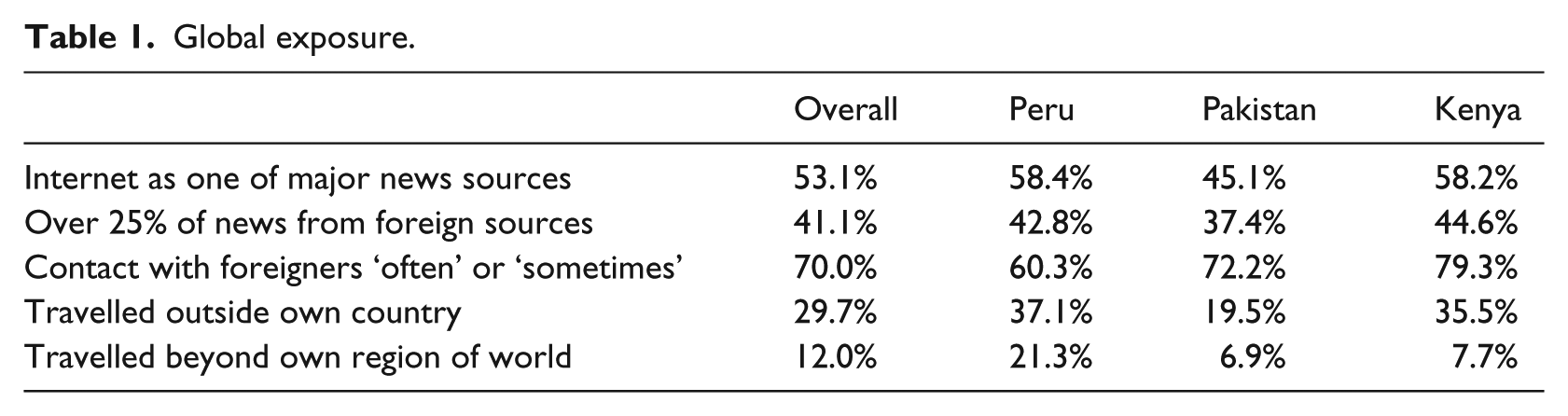
Respondents were broadly exposed to the global public sphere (Table 1). They had ample exposure to the internet and foreign news sources. Substantial majorities had regular personal contact with foreigners, and important minorities (especially of more comfortable backgrounds) had travelled abroad.
Global exposure.
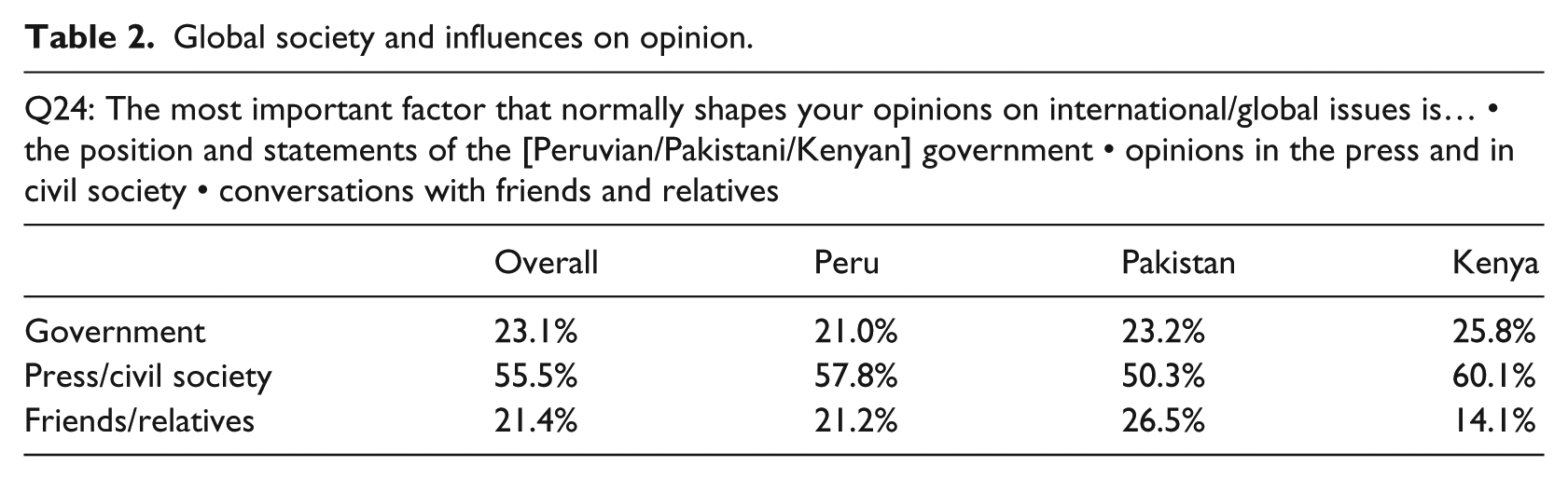
Survey results also suggested a strengthening global society (Table 2). Most respondents followed influences in the press and civil society, rather than the lead of their own governments, in forming opinions on global issues.
Global society and influences on opinion.
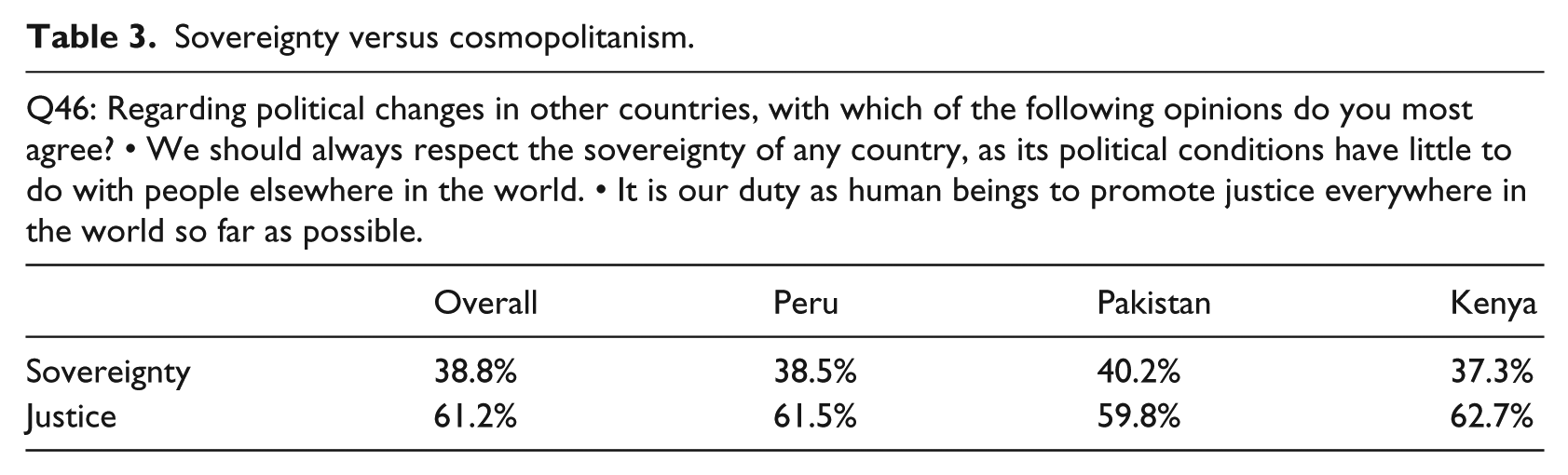
Levels of political cosmopolitanism were also quite high. When asked to weigh national sovereignty and non-intervention, versus a universal duty to promote justice, substantial majorities preferred the more cosmopolitan position (Table 3).
Sovereignty versus cosmopolitanism.
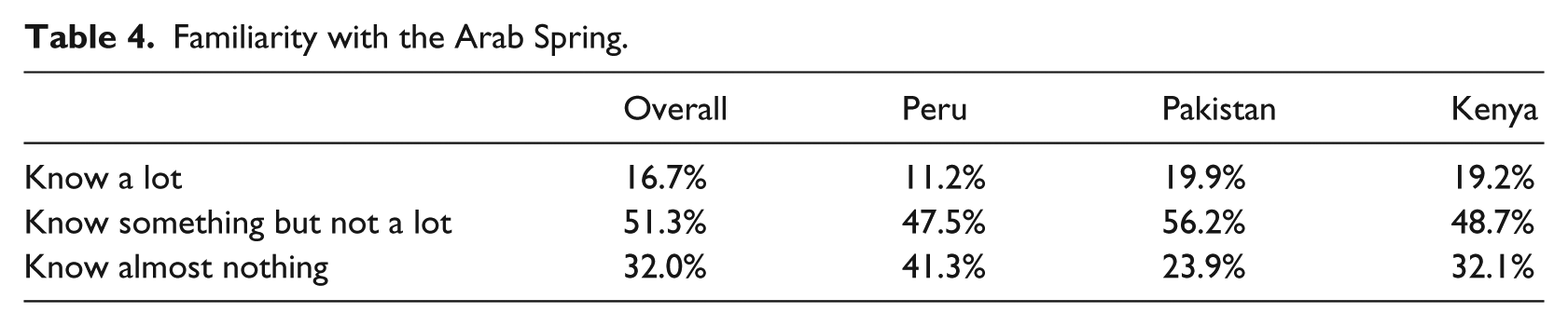
Against this background, we can turn to the survey section on the Arab Spring specifically. An initial question assessed respondents’ familiarity with those revolutions (Table 4). Over two-thirds had at least some knowledge. While familiarity dropped somewhat with distance from the Muslim world (Peru being most distant geographically and culturally), it did not drop as drastically as a compartmentalised view of the global public sphere might predict (i.e. less than a two-to-one ratio).
Familiarity with the Arab Spring.
To avoid uninformed guessing, respondents who knew ‘almost nothing’ about the Arab Spring were asked to skip other questions on this topic; the few who ignored this instruction had their answers to those questions omitted. The more detailed discussion of solidarity below thus focuses on the two-thirds of respondents who claimed at least some knowledge of the Arab Spring.
Solidarity
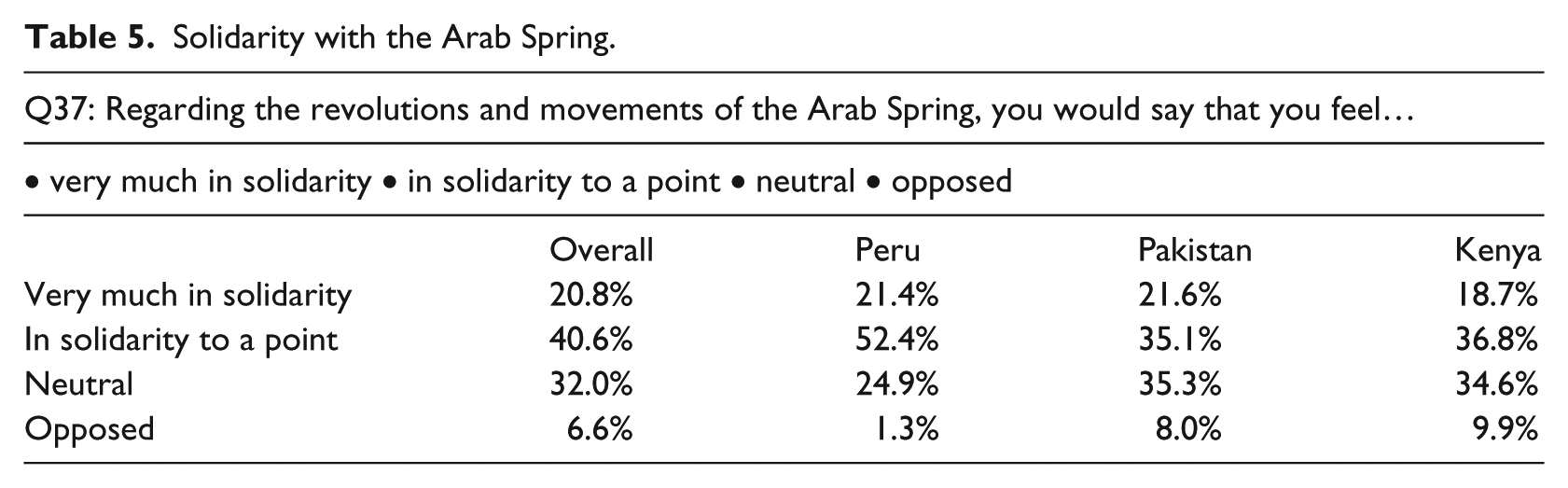
We can now explore the core question, about political solidarity in a global space. Respondents who claimed at least some knowledge of the Arab Spring were asked about the extent of their solidarity with it (Table 5). Being ‘in solidarity’ (‘en solidaridad’/‘حامی’) was left to the respondent to define. While solidarity can imply various attitudes and behaviours – a point to be revisited in the conclusion – the range of connotations in all three languages is broadly similar if one translates in different directions. Translation of the term did not obviously shape responses as such. Clear majorities everywhere were at least somewhat sympathetic, and outright opposition was rare. Notably, Peruvian respondents, despite their distance from the Arab world, were the most positive of the three country samples if one combines strong and moderate support.
Solidarity with the Arab Spring.
Statistical analysis revealed an array of factors driving greater solidarity (Table 6).
Drivers of level of solidarity with the Arab Spring.
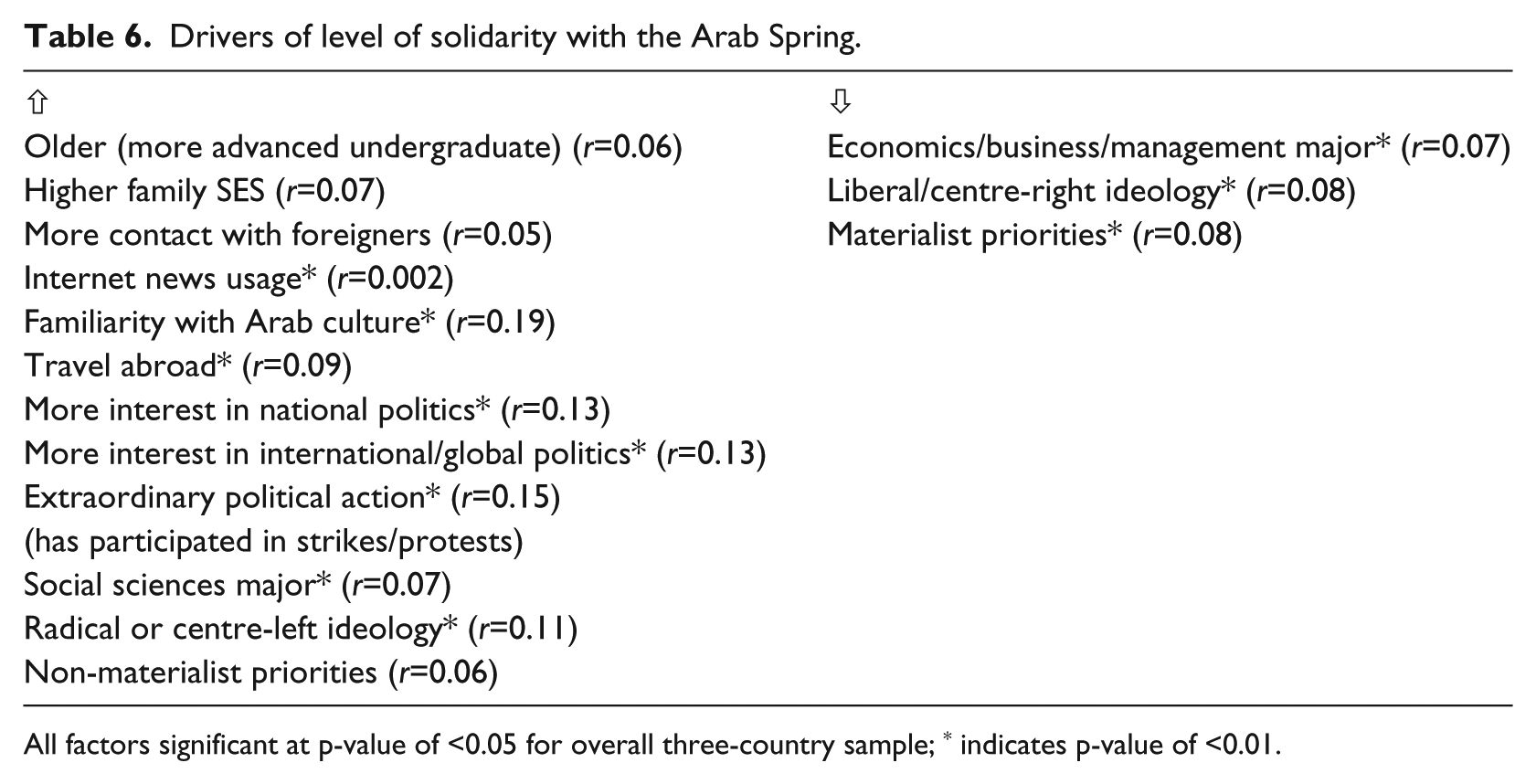
All factors significant at p-value of <0.05 for overall three-country sample; * indicates p-value of <0.01.
In terms of personal background, students who were older and better off were more likely to feel solidarity. Several markers of denser ties to global society were significant: more frequent contact with foreigners, reliance on the internet as a news source and knowledge of Arab culture. Foreign travel also made people more sympathetic (except in Pakistan). Greater interest in national and international politics, as well as experience of extraordinary political action, unsurprisingly were linked to more solidarity.
Academic and professional direction mattered somewhat. Studying the social sciences pushed significantly towards solidarity overall. Studying economics, business, or management made people more likely to oppose the Arab Spring. In the same vein, while this did not rise to statistical significance, those expecting to work in civil society or the public sector were weakly more sympathetic than those aiming at the private sector (except in Kenya). These patterns fit the intuition that revolutions make those in the business world uneasy.
Political ideology was associated with solidarity in clearer ways. Across the global sample, those identifying as radical left or centre left supported the Arab Spring more than those identifying as liberal or centre right. The conservative right/religious conservatives 1 in Peru and Kenya were less sympathetic, though only for the former was it statistically significant. In Pakistan, religious conservatives (in effect, Islamists) were more supportive, though not at a statistically significant level. A likely explanation is that such conservatives in Peru may view the revolts through a lens of political order, while in Kenya many religious conservatives are Protestants, and Pakistani Islamists may find more affinity with the Muslim Brotherhood and other currents that propelled the Arab Spring. More generally, solidarity with the Arab Spring was associated with non-materialist political values (taking environmental protection, democratic participation, moral values and cultural identities as policy priorities, in contrast to employment and economic growth, public security and increasing the country’s international influence). Non-materialists may have projected idealism on to the revolutions.
As far as worldviews are concerned, there were also some suggestive but statistically insignificant associations between solidarity with the Arab Spring and more general attitudes to world order. Elsewhere in the survey, respondents were asked whether they expected inequality among countries to widen or narrow in coming decades, and whether they expected opportunities for democratic participation at the global level to grow or shrink. Those who expected the world to become more equal and/or democratic were weakly more likely to feel solidarity with the Arab Spring. Those who opted for universal justice were more likely to feel solidarity than those who opted for national sovereignty (Table 7).
Other factors in solidarity.
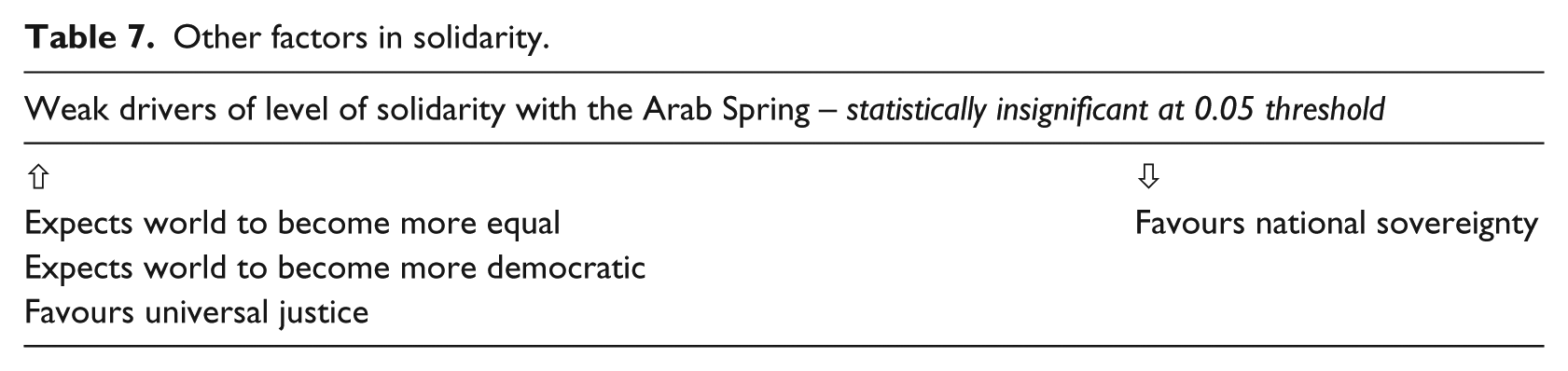
We should not over interpret such weak associations. But alongside the rest of the findings, they make sense. Those who foresee the world becoming a ‘gentler’ place – more equal and more democratic globally – may see the Arab Spring as part of that process or at least as fitting into a common global space of aspiration. Solidarity likewise comes naturally to those who see moral obligations across borders.
Religious affiliation had a complex relationship with solidarity (). As context, it bears noting that a background question elsewhere in the survey showed fairly high levels of religious belief among respondents, as is typical of the Global South.
Religiosity.
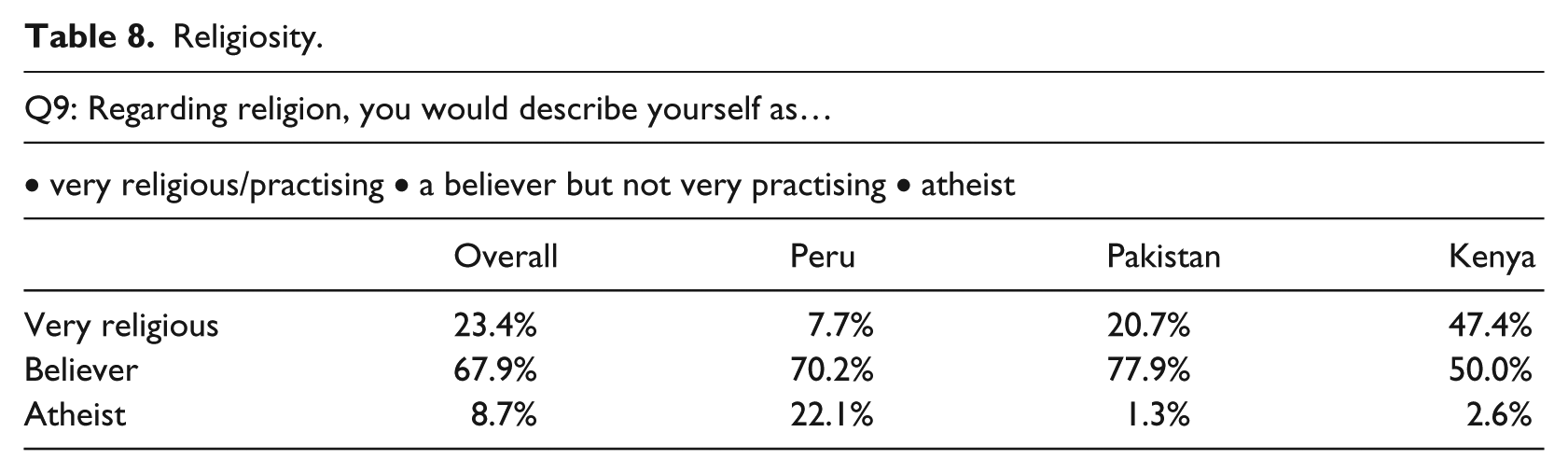
If the civilisational-breakwaters lens were correct, then one would expect Muslims to be most sympathetic to the Arab Spring while the rest of the world would be opposed or indifferent. The survey paints a much more globalised picture. Among Muslims, for example, Sunni and Shia responses varied widely, with no significant associations overall. Shia were weakly in solidarity, and Sunni solidarity rose to a significant level only among Kenya’s Muslim minority. Contrary to narratives in the Middle East of the ‘Sunni’ Arab Spring, such fault lines apparently do not divide Sunni and Shia farther afield in Africa and South Asia. Beyond Islam, interesting patterns also emerged. Protestants in all countries felt less solidarity (r=0.11, p<0.01), though the effect should not be exaggerated, since the strongest opposition among Protestants (in Kenya) was still a low 11.4%. This tendency may reflect influence by American-funded evangelical denominations that view Islam negatively, though in absolute terms it does not amount to a deep civilisational or religious fault line. Atheists were in solidarity overall (r=0.14, p<0.01). High levels of solidarity among Peruvian atheists, for example, may reflect a more leftist and revolutionary orientation in general, which overcomes any civilisational breakwater based on religion between the Muslim world and Latin America. A revealing exception was that Pakistani atheists (a tiny 1.3% of Pakistani respondents) felt less solidarity. This may be because as a secular minority, they find the Islamist undertones of the Arab Spring threatening.
To complement the drivers of solidarity already detailed, the survey also probed underlying reasons for solidarity. In other words, when respondents felt solidarity, what were they seeing in the Arab Spring worthy of support? One question asked them to identify the motives of the Arab Spring revolutions (Table 9).
Perceived motives of the Arab Spring.
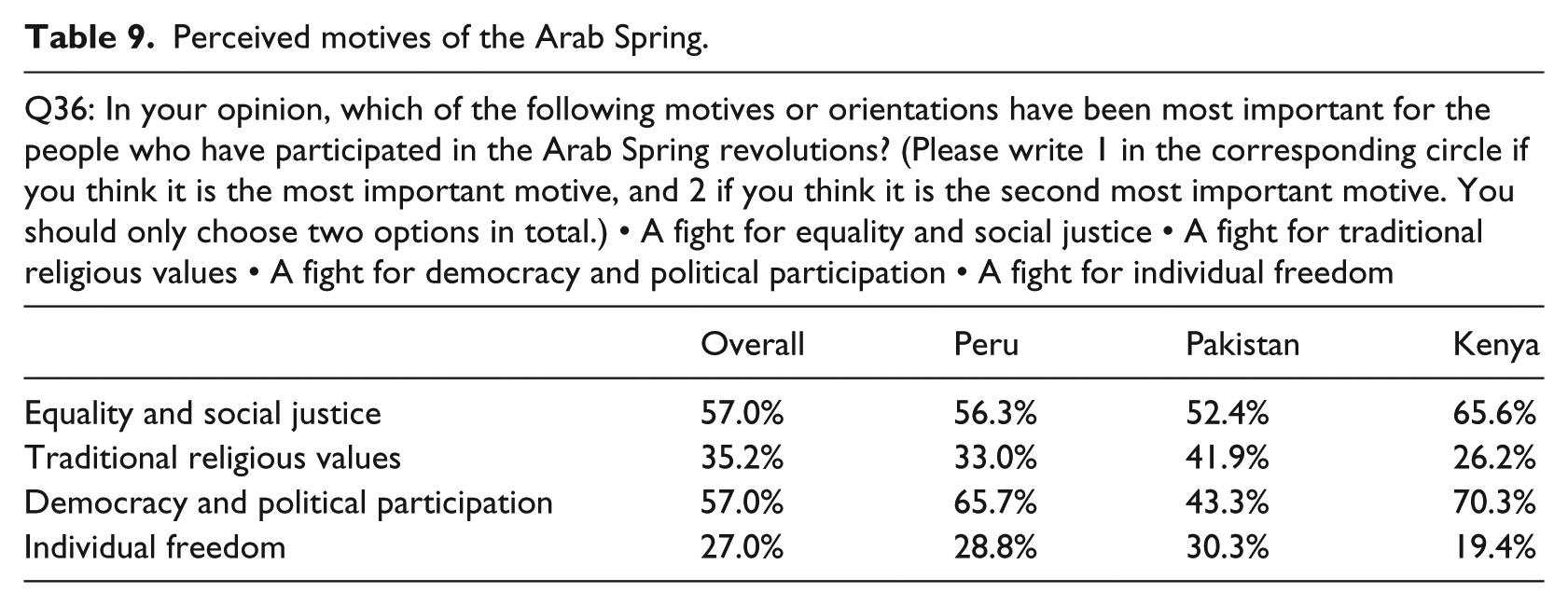
Equality and social justice, and democracy and political participation, were the most widely perceived motives across all three countries. Traditional religious values were somewhat more visible for Pakistani respondents than for Peruvians and Kenyans, however.
Statistical analysis also explored the crucial question of whether imputing a given motive to the Arab Spring activists increased or decreased solidarity with them (Table 10).
Perceived motives and solidarity.
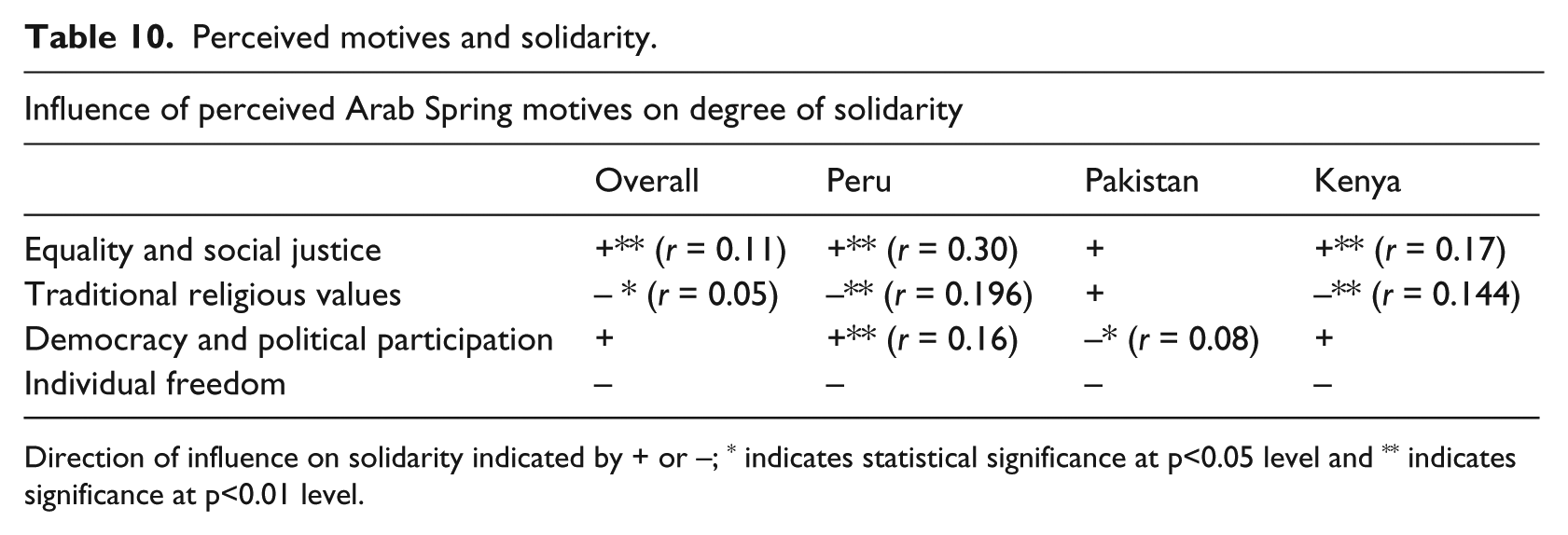
Direction of influence on solidarity indicated by + or –; * indicates statistical significance at p<0.05 level and ** indicates significance at p<0.01 level.
The most straightforward driver of solidarity was perceiving the Arab Spring as a struggle for equality and social justice. Since all three countries have high levels of inequality and corruption, the social question is a powerful common concern. Perceiving the Arab Spring as a struggle for individual freedom was not only the least often perceived motive, but when perceived, tended (albeit insignificantly) to reduce support. Respondents were not liberal individualists, by and large. Their pan-Southern solidarity does not follow the logic of the modern West or of the post-1968 ‘new social movements’.
Perceiving the Arab Spring as a struggle for democracy and political participation increased solidarity strongly in Peru and somewhat more weakly in Kenya. Like equality, democracy travelled well across cultural and geographic distances. Conversely, a perception of the Arab Spring as a struggle for traditional religious values attracted some sympathy in Pakistan (where it was more visible than typical as a motive), while diminishing solidarity in Peru and Kenya. It is likely that the Islamist elements of the Arab Spring met scepticism among, for example, Christians and atheists in Peru and Kenya, while also appealing to Islamist-leaning respondents in Pakistan.
These findings suggest two broader observations. First, traditional religious values as a motive run into difficulty travelling across world regions. Second, within a country like Pakistan, the ambivalent attitude towards democracy as a motive may mirror what happened in many Arab countries. Respondents wary of the Islamist agenda may have seen the upsurge as illustrating the perils of empowering a populace with values different from their own.
Of course, these findings are merely suggestive given the constraints of the sample and the survey. Given the limit of two perceived motives, there may be complex crowding-out effects in which some motives are excluded from responses. With a larger and more diverse sample, a more fine-grained analysis of the interplay of motives might be revealing. Perceived motives are also, inevitably, something of a Rorschach test in which respondents project their own priorities onto the Arab Spring.
The findings do connect in a striking way with my earlier (Webb, 2015) study of Arab Spring activists in Cairo, however. I found then that they were most likely to find common ground with movements elsewhere for democratisation, while the social question was a matter of uneven awareness and vaguer solidarity, and a sense of common ground among traditions weakest. Looking at solidarity with the Arab Spring elsewhere, the present study mirrors the pattern. Equality and social justice as a perceived motive travels very well, as does democracy, if one makes allowances for the peculiarities of the Pakistani context. The version of traditional religious values visible in the Arab Spring is more contentious even within a given society, and does not resonate much in other parts of the world.
Conclusion
The cosmopolitan leanings of the students surveyed may or may not be representative of the broader global public, both across other countries and across age cohorts. More extensive and probing studies would be necessary to develop such a line of research fully. If we step back from the drill-down empirical evidence here, however, some important theoretical implications of this study become clearer.
First, most of the drivers of solidarity are quite universal. Many involve exposure to global society, of the sort that is strengthening over the long term. The growth of internet usage, foreign news exposure, foreign travel and interaction with foreigners could make publics in the Global South more sympathetic to future waves of aspiration like the Arab Spring.
Second, the threshold for entry to this emerging global public is low. That respondents knew as much as they did about the Arab Spring is revealing. To be sure, university students are more informed than the broader population, but many of those surveyed came from humble backgrounds. The fact that differences within this educated demographic were not wider is also noteworthy. Contrary to prevailing expectations, not only the upper middle class in the Global South is engaging the global public sphere. Geographically, too, barriers to information flow are falling. Pakistanis knew the most about the Arab Spring, and Peruvians the least, which makes sense from a civilisational and distance standpoint. But the difference between them was modest, at 19.7% versus 11.0% knowing a lot, and 23.8% versus 40.6% knowing almost nothing, respectively. Once one enters the global public space, it is flat enough.
Third, we come back to the three possible lenses for looking at the scope of global responses to the Arab Spring: leftist-cosmopolitan, cellular-sovereigntist and civilisational-breakwaters. These are not merely theoretical accounts of what solidarity means; they also have real implications for emerging networks of political activism.
The findings suggest that, when it comes to both awareness and solidarity, the cellular-sovereigntist lens does not correspond to the contours of opinion. The legitimacy of national horizons seems well eroded in the layers of global society that the survey explored.
The civilisational-breakwaters lens is of limited usefulness at most. On the one hand, the religious aspects of the Arab Spring, to the extent respondents considered them important, did have modestly different effects on solidarity in Pakistan versus Peru and Kenya. The Islamist undertones increased support somewhat within the same civilisation, so to speak, and drove it down farther afield. Religious aspirations do run into breakwaters to some extent.
On the other hand, even within the Muslim world, the sectarian fault lines between Sunni and Shia lost salience away from the theatres of conflict. On a grander scale, despite the effect of the religious dimension on solidarity, none of these factors, even when statistically significant, shifted the absolute proportions of overall solidarity or opposition far in any of the three countries. Perceptions of the Islamist undertones did not have a knockdown effect either way along sectarian or civilisational lines. Even if the breakwaters are there, they do not seem to stop much getting past them, because solidarity with the struggle for equality or democracy overwhelms other considerations. That is why Peruvian respondents, despite their distance both geographically and culturally from the Middle East, could feel slightly more solidarity with the Arab Spring than Pakistanis or Kenyans.
The findings somewhat better support the leftist-cosmopolitan lens. The prominence of equality and social justice, and democracy and political participation, as attractive motives of the Arab Spring does align with leftist aspirations. Greater solidarity among leftist respondents reinforces this view. If this lens is correct, then the resonance of the Arab Spring may imply a global convergence of sorts on leftist idealism. The greater strength of leftism and non-materialism among Peruvian students, with their higher living standard, and their slightly greater solidarity even at a distance, may suggest that Peru is further along a trajectory that Pakistan and Kenya will follow.
Yet this may not be the whole picture. That the Arab Spring appealed to many leftists need not make the emerging global public leftist as such, but rather a global public into which some leftist currents flow. After all, social justice and an urge to overthrow despots can animate diverse ideological blocs, including traditionalists. Support for the Arab Spring in the Muslim world came more from Islamists than leftists, for example. Moreover, survey respondents were broadly religious and not well disposed to liberal individualism. Even when specific religious values raised misgivings for some, they did not overwhelm other sources of solidarity. While there are leftist-cosmopolitan layers of solidarity, and the aspirations for democratisation and equality may be quite readily translated, resonance overall cannot be reduced to a leftist echo chamber. The overall picture is complex, therefore. Resonance of the Arab Spring broadly has been global, transcending civilisational and especially national limits for the most part, though for reasons compatible with but not reducible to leftist cosmopolitanism.
Of course, solidarity is not only a question of ‘who’ and ‘how far’. It is also raises issues of intensity and commitment. Geographic distance and the lack of political opportunities may allow empathy but limit concrete manifestations of solidarity. None of the respondents were volunteering to go and fight in the Arab world, or to donate money. Even with greater proximity, national power structures may still be able to fetter cross-border activity somewhat – though the flows of foreign fighters across borders in the Middle East mean the point should not be overstated.
Diffuse identification and imagined spaces of solidarity often do precede and condition concrete engagements, however. In the long run, waves of attention-getting political effervescence like the Arab Spring may prime global public opinion for an erosion of remaining barriers to concrete activism across borders. The Arab Spring may thus be best thought of as a stage on a trajectory of bottom-up globalisation.
The ideological content of the solidarity revealed in this study is particularly important here. As the Arab Spring itself showed, much of the energy of Southern publics pushes in directions different from the West, away from both liberal individualism and secularism. The empirical findings from the survey align with the intuition, for example, that the two centres of gravity of opinion in the Global South are, approximately, a leftist concern for social justice and a traditionalist concern for religious and civilisational values, with democratic aspirations hovering somewhere between them. When the Arab Spring resonates far afield, it resonates on multiple frequencies, so to speak.
Solidarity can operate on multiple frequencies when it is a matter of diffuse empathy. But what happens when global political opportunity structures emerge in due course, and the global public sphere is not only about discourse but also about concrete political cooperation? How might Latin American leftists and Middle Eastern Islamists, for example, look at one another’s struggles when they have more common objects, within a global space in which no one civilisation has a majority? Concrete cooperation may demand more convergence of frames and agendas. Perhaps, as the findings imply, democratisation and equality provide easy bridges, while religious values need bracketing; or perhaps religious values merely need framing in more open terms than the Arab Spring has done. Whatever the future answers to those questions, the Arab Spring’s foreshadowing today may force us to reimagine the sort of people who will lay claim to the future global public sphere.
Footnotes
Acknowledgements
The author wishes to thank multiple contributors for their efforts facilitating the execution of this survey project on the ground: Sergio Canchari, Catalina Romero and David Sulmont in Peru; Basharat Mughal, Charles Ramsey, Sanee Sajjad and Saeed Shafqat in Pakistan; Samuel Kiiru and Samuel Balongo in Kenya; as well as the many members of the survey and digitisation teams. He also wishes to thank Ayumi Nagase of the University of California, Berkeley, for her work on statistical analysis, and Di Hu for comments on earlier drafts.
Funding
This research received no specific grant from any funding agency in the public, commercial or not-for-profit sectors.
Notes
Author biography
References
Supplementary Material
Please find the following supplemental material available below.
For Open Access articles published under a Creative Commons License, all supplemental material carries the same license as the article it is associated with.
For non-Open Access articles published, all supplemental material carries a non-exclusive license, and permission requests for re-use of supplemental material or any part of supplemental material shall be sent directly to the copyright owner as specified in the copyright notice associated with the article.
