







Abstract
This article discusses three main challenges to gaining a better understanding of whether state capacity contributes to the resilience of electoral authoritarian regimes. First, the concept of state capacity is multi-dimensional and can be entangled with regime organizational structures. Second, there is a range of different mechanisms through which elections may draw upon capacity in these different dimensions to affect authoritarian resilience. Third, good indicators of the dimensions of state capacity for empirical work are sorely lacking. To address these challenges, this article outlines the connections between extractive, coercive and administrative dimensions of state capacity with regard to how electoral authoritarian regimes address threats arising from society and from within the ruling elite. It then assesses different approaches to measuring these dimensions for empirical work.
Introduction
The route to a better understanding of whether state capacity facilitates the survival of electoral authoritarian regimes involves navigation through conceptual, theoretical and empirical challenges. First, state capacity is multi-dimensional, and it can be difficult to disentangle the state from the regime’s organizational structure. Thus, it is important to develop conceptual clarity about the relevant dimensions of state capacity and to distinguish them, as much as possible, from features of regimes.
Second, producing clear theoretical expectations is tricky. Authoritarian rulers can employ a range of strategies to survive in the face of challenges emanating from within the ruling elite and arising from the broader society. Holding multiparty elections is a component of this strategic choice set. In the introductory article to this special issue, Hellmann and Croissant review the vibrant scholarly debate about the ways in which elections may affect the survival of authoritarian regimes, concluding that elections can have both regime-strengthening and regime-weakening effects. The key question addressed in this special issue is the extent to which and how state capacity shapes these effects. In this article, I argue that there is no single answer to the question. Elections serve different strategic purposes, and have different effects, across different combinations of state capabilities. Additionally, strategic decisions at one point in time lead to investment in state capacities, or their atrophy, affecting subsequent strategic options. This argument provides a framework for thinking about these contextual effects.
Third, measuring the various dimensions of state capacity is a significant challenge for empirical research, and good indicators are sorely lacking (Hanson and Sigman, 2013; Hendrix, 2010). Observing ‘state capacity’ is inherently difficult, for we typically are limited to outcome variables that we believe are connected to it. This is hazardous, on the one hand, since capacity is not necessarily fully utilized. On the other hand, indicators that we may believe are correlated with state capacity, such as gross domestic product (GDP) per capita, often have an important direct effect on our phenomena of interest. A review of available measures aims to guide empirical research.
This article addresses these conceptual, theoretical, and empirical challenges in turn, developing propositions for further research in this area and guidance for empirical testing. Its key theoretical contribution to the literature comes through fleshing out the argument that contextual factors, such as the state’s administrative and coercive capacities, shape the effects of authoritarian elections (Seeberg, 2014). Different combinations of state capabilities are associated with the utility of different strategies, such as performance-based legitimacy, the creation of an aura of dominance, or the clientelistic provision of resources. These strategies manage threats to the regime in different ways, and they break down in different ways.
Conceptualizing regimes, states, and state capacity
The question of whether state capacity contributes to the survival of electoral authoritarian regimes presupposes a conceptual distinction between states and regimes. Although disentangling regime from state is often difficult empirically, we require some basic conceptual distinctions. A useful definition of the state appears in Fishman (1990: 428): ‘a more permanent structure of domination and coordination including a coercive apparatus and the means to administer a society and extract resources from it.’ The basic functions of territorial control and administration, including the collection of revenues, are the essential features of states.
Regimes are a set of formal and informal rules that identify who holds power, their means of selection or appointment, the relations between them, and the extent to which their powers are constrained vis-à-vis each other and society writ large (Skaaning, 2006). In more institutionalized regimes, these rules are implemented and enforced by organizations and institutions such as political parties, politburos, and legislatures. As the ‘prevailing form of access to political power’ (Mazzuca, 2010: 342), regimes constitute a configuration of control over the state. The state is thus a more elemental concept. Over time, regimes tend to come and go, while states have an enduring quality (Fishman, 1990).
Electoral authoritarian regimes, then, are autocratic regimes in which multiparty elections are held but these elections are systematically biased in favor of the ruling party (Schedler, 2002).The underlying purpose of elections is not to select which set of actors has control over the state but instead to help incumbent autocratic rulers manage the range of intra-elite and societal pressures that threaten their survival. Brownlee (2009) and Magaloni (2010) subdivide this category into regimes in which there is some genuine uncertainty about election outcomes – competitive authoritarian regimes – and those in which the elections are mere window dressing.
As forms of political organization, electoral authoritarian regimes have institutional capacities of their own, such as the ruling party organization. For purposes of this inquiry, we should separate as much as possible the effects of these capabilities on regime stability from those provided by states. To the extent that the organizational and institutional capabilities of regimes insulate them from societal pressures, maintain a supporting coalition, or regulate intra-elite competition, we may observe greater regime resilience that does not result from state capacity despite appearances. This represents a narrower focus than Levitsky and Way (2010), who describe incumbent power as emanating from both effective state and party organizations and argue that these organizations can substitute for each other.
Table 1 illustrates some basic tendencies that are associated with different combinations of state capacity and regime strength. The extent to which state capacity serves the interests of regime officials depends both upon the state’s capabilities and the regime’s strength (i.e. its degree of control over the state and its level of institutionalization). The cases of Indonesia, South Korea, and Malaysia are discussed in detail in this issue (see the contributions from Mietzner, Hellmann, and Ufen, respectively).
Regime strength and state capacity.
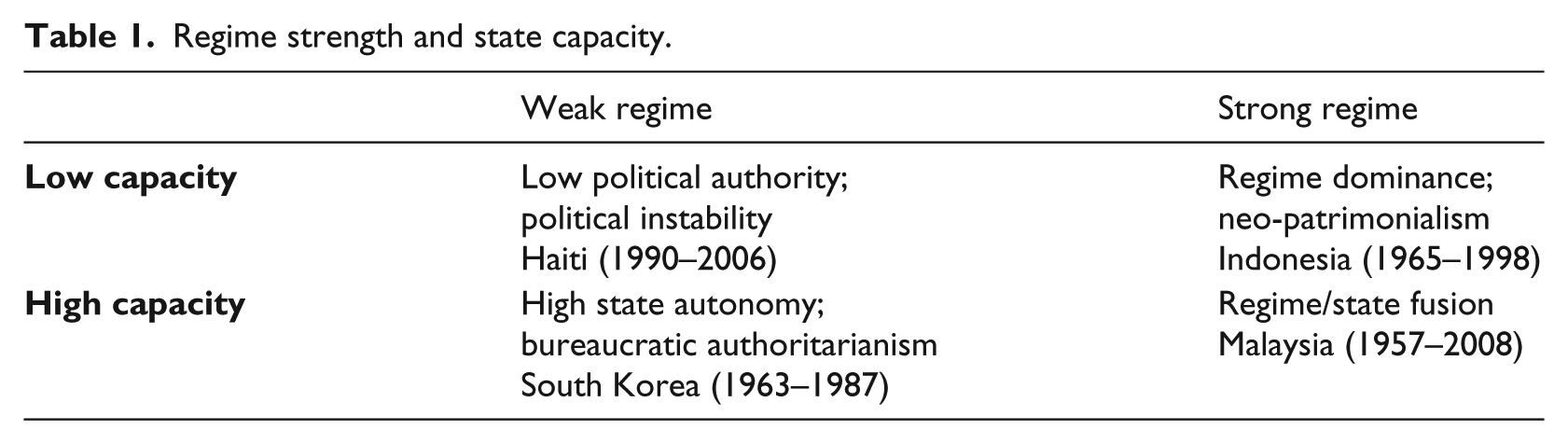
The differences across these cases provide evidence for the claim that the role of state capacity in fostering the survival of electoral authoritarian regimes depends a great deal on context. There is no single relationship. Different patterns for organizing authoritarian rule are connected with differences in state and regime capabilities, and holding elections can serve different strategic purposes as part of these patterns. Given this heterogeneity, and given that states perform a variety of functions, we need conceptual clarity about the state’s potential roles.
What, then, is state capacity? In general, it is the ability of state institutions to effectively implement official goals (Sikkink, 1991). The concept is both broad, since the goals of states are wide-ranging and dependent upon the nature of the regimes that control them, and multi- dimensional, since different types of capabilities are needed to implement these goals.
Skocpol’s (1985) identification of ‘the general underpinnings of state capacities’ as plentiful resources, administrative–military control of a territory, and loyal and skilled officials provides an encompassing framework with three analytically distinct dimensions: extractive capacity; coercive capacity; and administrative capacity. The ability to raise revenues (extractive capacity) is not only essential for funding state activities of all types but also serves as a marker for the capabilities that underlie state power. These include the legibility of the population, the capacity to gather and maintain information, and the presence of administrative agents to carry out these functions ably. Coercive capacity reflects the ability of the state to dominate society, maintain order within its borders, apply force to overcome opposition, and defend the territory from external threat. Finally, administrative capacity involves the ability to design and implement policies throughout the territory, and regulate the social and economic spheres.
This level of disaggregation is useful from a theoretical standpoint: the three dimensions logically can be connected with different mechanisms through which authoritarian elections may affect regime stability. Empirically, it usefully guides our measurement strategy for state capacity.
Three additional points are pertinent. First, these dimensions of state capacity accord with Mann’s (1984) distinction between state infrastructural and despotic power. Infrastructural power involves ‘the capacity of the state to actually penetrate civil society, and to implement logistically political decisions throughout the realm’ (Mann, 1984: 189), while despotic power is the “range of actions the elite is empowered to undertake without routine, institutionalized negotiation with civil society groups” (Mann, 1984: 188). Distinguishing the state’s infrastructural power from its despotic power is especially useful when considering the relationship between regime survival and state capacity. Despotic power emanates from the organization of the regime, which surely affects its longevity yet remains separate from the infrastructural characteristics of the state.
Second, these three dimensions are deeply intertwined. Raising revenues is a function of both administrative and coercive capabilities, and revenues in turn are necessary to build and maintain both administrative and coercive capacity. Coercion can come in various forms, including the use of common thugs, but it is likely most effective when the coercive apparatus is administratively sophisticated, and supported by intelligence gathering and targeted actions that require planning and organizational discipline. Likewise, administrative capacity throughout the territory assumes the basic capacity to keep order and implement policies in the face of social opposition, through coercion if necessary.
Third, when thinking about electoral authoritarian regimes, we should not assume that administrative capacity means a Weberian bureaucratic state. For example, Darden (2008) argues that graft and corruption can be quite consistent with a stable administrative hierarchy. As he writes, “If we take a broader and more historical view of the state as a form of organized domination that is not necessarily based on law, it becomes clear that bribery and other corrupt practices can provide the basis for robust states of a different type” (Darden, 2008: 54). Such a state can be effective from the standpoint of the regime even if it falls short of Weberian ideals of impersonal, technocratic management.
As argued below, the distinction between Weberian administrative capacity and other forms of organizing an administrative apparatus, such as hierarchy-enhancing graft, highlights different mechanisms through which administrative capacity can be part of a strategy of using elections to stabilize authoritarian rule. Highly-capable Weberian bureaucracies are more likely to be connected with strategies of legitimation, while other forms of administrative capability are more likely part of a strategy of regime dominance.
In summary, this section argues that extractive, coercive, and administrative capacities are the core dimensions of state capacity. They have analytical utility, and they serve as the foundation for a wide range of state capabilities that may affect the resilience of electoral authoritarianism. Additionally, by focusing on these attributes of states, we can steer clear of the despotic powers of states that emanate from the characteristics of the regime.
State capacity and electoral authoritarian resilience
The act of holding elections in an authoritarian context reflects a strategic choice about the optimal form for organizing authoritarian rule. The extent to which state capacity influences this choice and facilitates the success of the strategy depends upon its role in fostering the effectiveness of elections for managing two types of challenges: horizontal threats from within the ruling elite; and vertical pressures arising from mass society. Svolik (2012) labels these challenges the problems of authoritarian power sharing and authoritarian control.
There are several ways in which elections can help solve these problems. I organize them into four categories. First, elections can serve to legitimize the regime (Levitsky and Way, 2010; Schedler, 2006; Seeberg, 2014). Second, elections can be a way to demonstrate ruling party dominance, fostering the belief that the regime is the ‘only game in town.’ Third, elections can strengthen patronage and clientelist networks, securing the support of potential rivals within the political elite and building linkages between common citizens and ruling party officials (Lust-Okar, 2006). Fourth, elections can provide information to the regime about the extent and location of its support (Gandhi and Lust-Okar, 2009; Miller, 2015), facilitating efforts to co-opt potential opponents both inside and outside the regime (Magaloni, 2008), and work out policy compromises.
Elections are not without risk to the regime, however. As argued in Knutsen et al. (2015), there are at least two types of threats that emerge. First, elections can serve as a mobilization tool for the opposition. The occurrence of an election can facilitate collective action by opponents of the regime that normally fail to organize. Second, despite the best efforts of regime officials to produce a commanding electoral result, the opposition may perform unexpectedly well, thus signaling the regime’s weakness. Indeed, Wig and Rød (2016) find that regime elites are more likely to launch a coup against the dictator following elections, apparently seeking to forestall a popular uprising.
Accordingly, elections in some cases help solve the problems of authoritarian control and power sharing but in other cases have the opposite effect. The question addressed here is whether the three dimensions of state capacity have a role in determining which outcome transpires. I explore theoretical connections between the dimensions of state capacity and the ability of regime officials to address vertical and horizontal pressures via elections.
Notably, we may be able to distinguish whether the different dimensions of state capacity help solve the problems of authoritarian power sharing and authoritarian control by disaggregating the ways in which authoritarian regimes break down. As Svolik (2012) demonstrates, a much higher percentage of dictators lose power due to coups or assassinations than to popular uprisings or transitions to democracy. Coups and assassinations reflect failures of authoritarian power sharing, and they should be more likely when levels of coercive and extractive capacity are lower, which is generally consistent with available evidence (Powell, 2012).
Legitimation
For elections to help legitimize the ruling party in the eyes of the mass public, the party should win comfortably without committing overt electoral fraud. This goal is easier to attain when citizens believe the regime is performing well, producing economic growth, providing public services, improving infrastructure, engaging in pork-barrel spending, and so forth. Rulers signal strength by building popular support through economic distribution, thus reducing the extent to which electoral manipulation is necessary (Andersen et al., 2014a; Higashijima, 2015). Performance-based legitimacy of this kind clearly has a strong connection to administrative capacity of the Weberian variant. To be effective in this strategy, furthermore, states must have access to adequate resources, meaning that extractive capacity or access to natural resource rents is also an important element.
A strategy of performance-based legitimacy likely is less reliant on coercive capacity through repressive force. This does not mean such capacity is absent, and the regime will still skew the electoral environment by manipulating voter choice, harassing political activists, and controlling media coverage. Yet, heavy-handed repression is not the central element of the regime’s strategy. Additionally, access to discretionary economic power, such as state-owned enterprises, can be a substitute for repression, giving rulers the power to punish political opponents through economic policies, access to credit, and licensing (Levitsky and Way, 2010). Opponents are thus kept within the political system but with constraints upon them.
Dominance
The strategy of using elections as a show of dominance, by contrast, is much more heavily reliant upon coercive capacity. Brutal repression of opposition and widespread electoral fraud create the hegemonic variant of electoral authoritarianism in which resistance becomes widely regarded by the mass public as futile despite the regime’s lack of legitimacy. Electoral dominance most likely mitigates the problem of authoritarian power sharing as well, since regime elites will have fewer reasons to challenge the dictator, and the prospects of failure are higher given the difficulty of collective action against the ruler in these circumstances (Seeberg, 2014).
The success of this strategy is connected with high coercive and extractive capacities but not logically with administrative capacity of the Weberian sort. Technocratic, rule-based bureaucracies are more autonomous and thus harder to penetrate. Instead, administrative capacity in the form of hierarchy-reinforcing graft and corruption is more compatible with this kind of strategy. The coercive power required to sustain this level of repression requires ample extractive capacity. As noted by Levitsky and Way (2010), there is a strong connection between fiscal health and coercive capacity. Electoral authoritarian regimes with bankrupt states unable to pay their security forces adequately are vulnerable to collapse.
Distinguishing between engineering electoral victories through performance-based legitimacy versus a show of dominance, and identifying the forms of administrative capacity that are connected with these strategies, help resolve seemingly conflicting arguments in the literature. For example, Seeberg (2014) argues that administrative capacity is necessary to produce election manipulation, since it must be organized from the center and implemented in localities. Fortin-Rittenberger (2014a), on the other hand, argues that state infrastructural capacity should decrease the regime’s ability to engage in electoral fraud. In this viewpoint, infrastructural capacity is interpreted as stronger enforcement of electoral law by independent agencies that supervise elections, leaving less room for corruption of the process.
The difference between these two claims highlights the importance of conceptual clarity. Seeberg’s (2014) definition of administrative capacity involves the basic territorial reach of the state bureaucracy and its competencies, explicitly noting that this does not necessarily equal Weberian professionalism. This definition is consistent with the discussion of infrastructural capacity in Soifer and vom Hau (2008) and employed here. Fortin-Rittenberger (2014a), by contrast, describes infrastructural capacity as akin to traditional Weberian bureaucracy. Yet, the two perspectives are compatible if we identify different kinds of administrative capacity and connect them with different types of electoral authoritarian strategies. In the first, there is extensive fraud and repression supported by a well-organized, but thoroughly corrupt, administrative system. In the second, there is performance-based legitimacy, combined with comparatively less repression and supported by an administrative bureaucracy capable of delivering public welfare enhancements. The coercive apparatus need not be as extensive in the latter case.
Strengthening networks of support
The third mechanism through which elections can help solve the problem of organizing authoritarian rule is by strengthening patronage and clientelist networks, which can also serve as an important vehicle for mobilizing support for the regime. Distribution of state resources, and the threat of their withdrawal, help keep potential rivals in line, and providing access to these resources can buy off opponents to the regime. Thus, rather than gain general public approval through more broadly-based public welfare enhancements, this approach employs the selective provision of benefits. Rent distribution thus helps grapple with both the problems of authoritarian control and power sharing.
As Grzymala-Busse argues, the decision to allow political competition and distribute rents to supporters is based upon ‘existing organizational endowments, the costs of buying support, and the trade-offs between costs and the probability of exit from office’ (Grzymala-Busse, 2008: 645). Accordingly, the robustness of these clientelist networks can be connected to the dimensions of administrative and extractive capacity. This strategy is most successful when the regime is able to target benefits to supporters in a selective manner that maximizes electoral impact, which requires the legibility of citizens to the regime (Grzymala-Busse, 2008: 653). This depends both upon the sophistication of the administrative apparatus of the state and the regime’s ability to penetrate it. 1
Access to a steady stream of rents is key to successful strategies of co-optation and power sharing (Haber, 2006). The regime as a consequence must be able to mobilize resources to make these networks robust. When the extractive capacity of the state is weak, making such resources scarce, strategies of co-optation will face greater challenges. Accordingly, there should be fewer breakdowns of power-sharing agreements, and fewer mass uprisings, where extractive capacity is greater.
Coercive capacity likely is lower in this scenario. The fact that the regime permits political competition and engages in extensive resource distribution in the first place may reflect a situation in which costs of repression are high. Levels of coercive capacity are not sufficient to contain vertical pressures on their own. Comparatively, buying support through rent distribution is a more viable approach. If the organizational capacity to provide selective benefits in exchange for political support is not pre-existing, it must be created.
Notably, the initial decision to embark on a strategy of this kind has consequences for the subsequent development of state capacity, since rulers may invest in the capacities that support their strategy of state capture (Grzymala-Busse, 2008). A clientelist strategy, for example, may facilitate the development of the welfare state’s administrative apparatus. In other words, the causality of the relationship between state capacities and the organization of authoritarian regimes flows in both directions. Initial capacities influence the choice of strategy, and implementation of these strategies over time affects state formation. We thus should be cognizant of time dynamics and the developmental trajectories of authoritarian regimes. To the extent that we can measure the dimensions of state capacities accurately, we also should take account of the points in time at which we measure them.
The contribution to this special issue from Mietzner illustrates this point well in the case of Malaysia under Suharto. In early stages of his rule, Suharto relied upon coercive power to repress opponents while investing in the state’s administrative and extractive capacities. What began as a military dictatorship evolved into a ‘civilianized autocracy’ that relied upon its extractive capabilities to fund an extensive patronage system in the 1970s and 1980s. By the 1990s, administrative capacity had developed sufficiently that a strategy of performance-based legitimacy became feasible. Ultimately, the 1997 financial crisis, and the lack of a succession plan, brought down the regime.
Gathering information
The fourth reason to hold elections – to gain information about the extent and location of the regime’s support – is logically of greater necessity where the administrative and intelligence-gathering capabilities of the state are poor. Regime officials can respond to this information with carrots and sticks directed to where the need is greatest. Yet, this situation also entails risk for the regime to the extent that its support turns out to be weak and the election serves as a vehicle for mobilizing against the regime. When states are administratively capable and/or the security apparatus is highly sophisticated, by contrast, elections are less critical as a source of information for the regime.
Overall, then, there are theoretical reasons to believe that all three dimensions of state capacity can help electoral authoritarian regimes manage horizontal and vertical threats, but they appear to come in different combinations (see Table 2). 2 One pattern relies upon high administrative capacity – not of the Weberian kind – and high coercive capacity to engineer dominating electoral victories that signal the strength of the regime to potential rivals. This level of regime dominance may exemplify the regime/state fusion cell depicted in Table 1. Extractive capacity must be sufficient to pay for the large coercive apparatus needed to secure the regime’s hold on power.
Dimensions of state capacity and effects of elections on regime resilience.
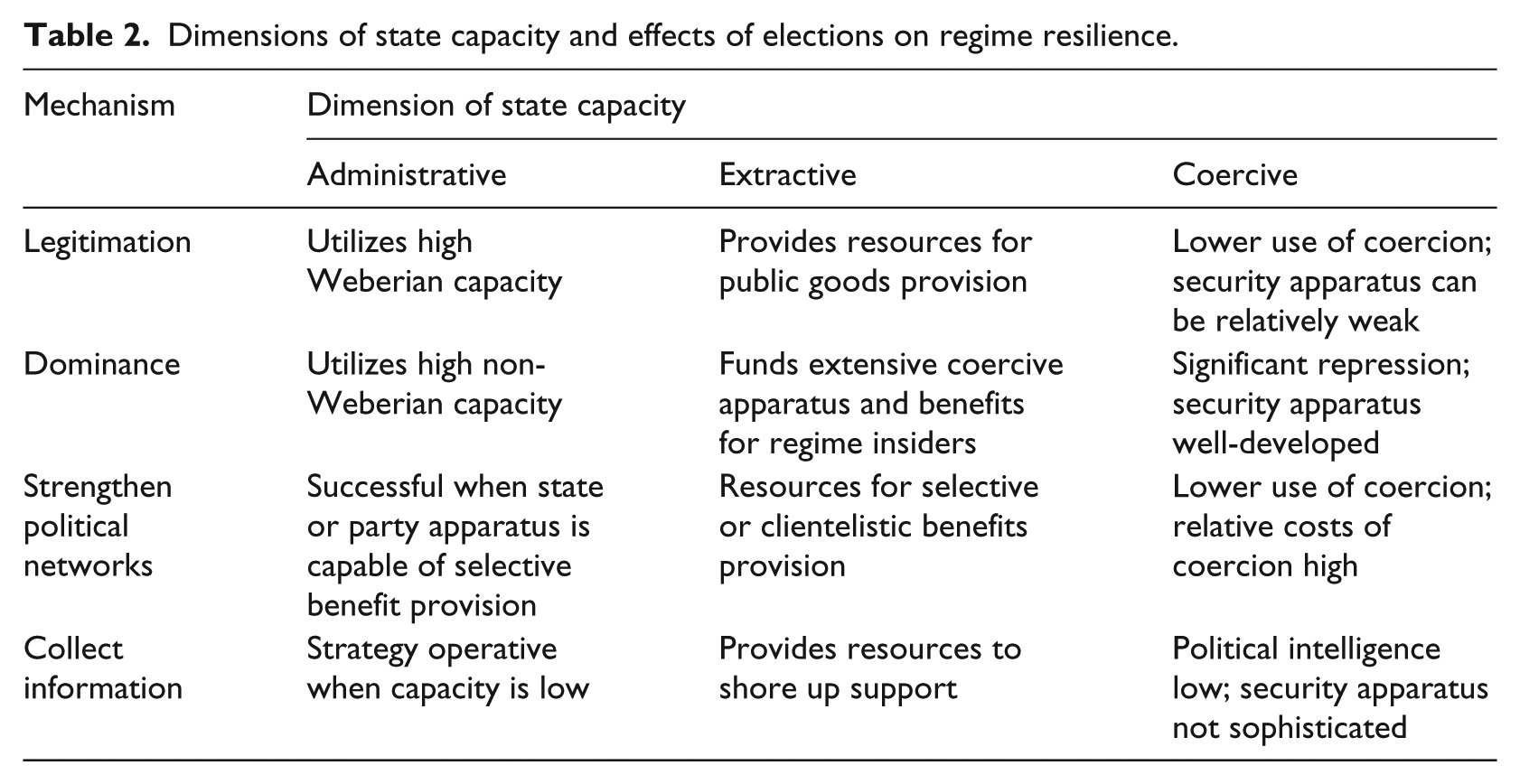
Proposition 1: A strategy of dominance is applicable when states have strong coercive capabilities and high, non-Weberian administrative capacity.
The success of this strategy depends, in part, upon the extent to which extractive capabilities of the state can support an extensive coercive apparatus and provide resources to actors that are part of the regime coalition. Failure of this strategy is likely to be observed in the form of a coup or some other collapse of authoritarian power-sharing.
A second pattern relies on administrative capacity of a Weberian sort to generate performance-based legitimacy through public welfare gains that reduce the vertical threats to the regime from the mass public, making high levels of coercive capacity less necessary. A strategy of this type is more suitable in situations where the level of bureaucratic autonomy is higher. The competence of the administrative bureaucracy is such that regime officials can utilize the information that elections provide about regime support and design effective responses.
Proposition 2: A strategy of legitimacy is applicable when states have high administrative capacity of the Weberian kind and comparatively low coercive capacity.
The capabilities of the Weberian administrative state facilitate the use of broad provision of social benefits to build support for the regime. These benefits can also serve as a form of soft coercion to the extent that the regime can withdraw them selectively. Extractive capacity is needed to supply resources to maintain these benefits. Repression is also employed, but to a lesser degree than in the strategy of dominance. Failure of this strategy is more likely to be observed in the form of a popular uprising, perhaps leading to democratization, than is the case with other patterns. In this issue, Hellmann presents the case of South Korea as an example of a failure of a performance-based strategy to legitimize the regime in the face of societal change.
Where administrative capacity is low, conversely, the information that elections provide about the location and extent of regime support may be a critical early warning signal for regime officials. In this scenario, the state is less able to deliver a policy response, so the regime will be forced to rely upon the party organization and informal clientelistic networks to buy political support. This third pattern, accordingly, relies heavily upon access to resources and coercive capabilities.
Proposition 3: Low administrative capacity is associated with a strategy of clientelistic resource distribution and unsophisticated forms of repression.
Regime officials in this scenario are more reliant on their party organization as a delivery mechanism for benefits to supporters. The weakness of the administrative arms of the state, and the lack of a sophisticated internal security service, leave these officials in a comparatively low-information environment. Elections can help provide information about where support is weakest, facilitating the targeting of resources. Continued operation of this strategy may lead to the augmentation of the state’s administrative capabilities over time. As the state’s administrative apparatus becomes more sophisticated, a shift to a strategy of performance-based legitimacy may be possible. Alternatively, these administrative capabilities may instead be employed to produce more sophisticated forms of selective benefits provision. A failure of this strategy is likely to be observed in the form of a failure of power sharing rather than a popular uprising.
Observing the way in which authoritarian regimes fall provides a good empirical test of whether the above claims have validity. Since coups indicate failures of authoritarian power sharing, we may be more likely to observe them when regimes cannot rely upon sophisticated administrative and coercive capacities to produce convincing electoral margins. Alternatively, it may be that resource scarcity disrupts the regime’s rent distribution system, leading to failure of cooptation.
With respect to mass uprisings and transitions to democracy, we might see different effects, depending on the state’s degree and form of administrative capacity. Specifically, the capacity to implement electoral manipulation and fraud should inhibit transition to democracy, but traditional “bureaucratic quality” indicators based on Weberian characteristics may not show an effect of this kind. When autocratic parties engage in strategies of performance-based legitimacy that rely upon a professional bureaucracy, they are behaving in a manner similar to democratically-elected governments. The likelihood of transition to democracy may be higher under these circumstances.
Testing these propositions requires that we have a good strategy for measuring state capacity for each of the three dimensions. The next section explores existing options.
Operationalizing and measuring state capacity
This section discusses the challenge of finding appropriate ways to measure state capacity in empirical work and explores existing options. As a general rule, state capacity is not observable directly. We instead observe its effects: outcomes that are a function not only of state capacity but also of other factors. As argued above, policy outcomes depend both upon political decisions about priorities as well as the state’s ability to implement these policies. Many empirical measures are subject to this problem.
Operationalizing administrative capacity
There are several approaches to measuring administrative capacity in large-sample empirical work (see Table 3). Two of the most common are expert assessments and output-based measures, such as the level of provision of basic public services. Among the expert assessment measures, the Bureaucratic Quality index from the political risk analysis firm PRS Group, Inc. offers the widest country and temporal coverage, extending back in time to 1984. This rating reflects the assessment that the “bureaucracy has the strength and expertise to govern without drastic changes in policy,” has some autonomy from political pressure, and has an “established” mechanism for recruitment and training (Howell, 2011: 7).
Possible measures for state capacity dimensions.
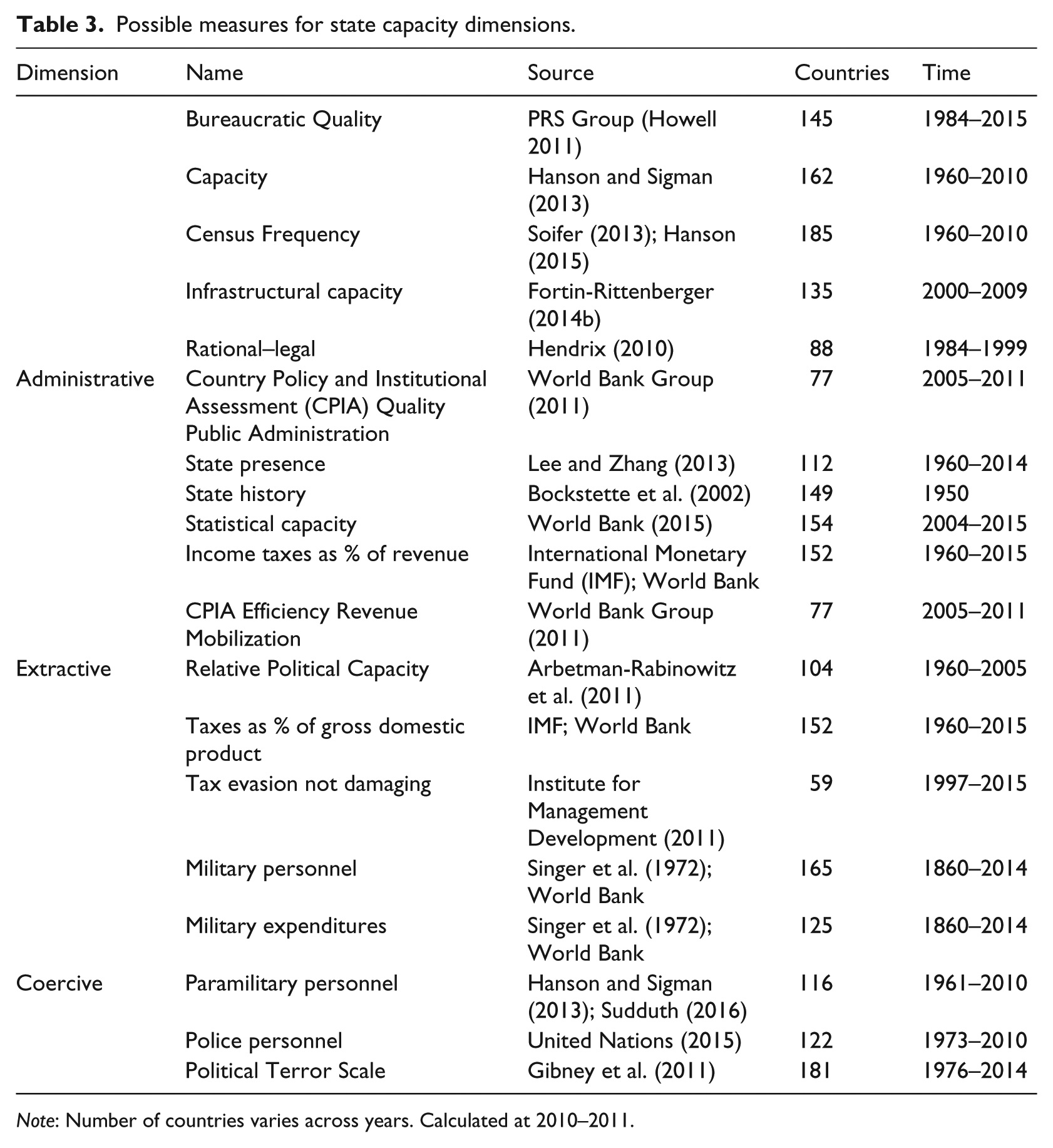
Note: Number of countries varies across years. Calculated at 2010–2011.
Indicators that capture Weberian characteristics of administrative bureaucracy, however, like expert ratings, may not be optimal for the electoral authoritarian context. It may be precisely the capacity to pursue electoral manipulation and delivery of clientelistic benefits that facilitates regime resilience. Accordingly, bureaucratic autonomy fostered by meritocratic recruiting practices and insulation from political pressure could hinder the ability of the regime actors to utilize state capabilities for electoral manipulation, such as the mobilization of state employees for electioneering activities.
Other approaches may be better for measuring state capabilities in the electoral authoritarian context. For example, a more basic measure of state administrative capacity involves the regularity with which national censuses are taken. As Centeno (2002) argues, taking a census requires that the state’s representatives are able to ask difficult questions and be protected from violence while so doing. Censuses also provide legibility of citizens to the state, adding them to tax rolls. A different approach comes from Lee and Zhang (2013), who develop a measure of state presence based upon the smoothness of the age distribution in census data. 3 Finally, the Statistical Capacity Indicators from the World Bank (2015) also can serve as a measure of basic administrative capacity for recent years (2004 and up).
Many researchers also use measures of tax collection as a general measure of state capacity. In the literature on authoritarian regimes, two examples are Darden (2008) and Andersen et al. (2014a), who use taxes collected as a percentage of GDP. This percentage measures general state capacity rather crudely. As stated above, for states with moderate-to-high capacity, the tax rate may more closely reflect a policy choice than it does the level of state capacity. Additionally, as Lieberman (2002) argues, it may be more fruitful to consider the composition of the taxes collected rather than the total amount. With respect to administrative capacity, for example, the percentage of total taxes that comes from income taxes, which are more difficult to collect, may reflect administrative capacity more accurately. 4 Taxes as a percentage of GDP could be used to proxy for extractive capacity instead.
Each of the above methods measures vital state capabilities without incorporating Weberian bureaucratic characteristics per se or introducing subjective assessments that can be colored by normative impressions of regimes. Given the characteristics of electoral authoritarian regimes, these measures may be preferable in many situations.
Finally, some approaches to measuring state capacity use multiple indicators to construct indexes or perform a latent variable analysis. Fortin-Rittenberger (2014b), for example, performs an exploratory factor analysis with seven different indicators to construct a measure of infrastructural capacity. Finding that they are highly correlated, she then uses the indicator with the broadest coverage, the PRS Bureaucratic Quality index, for subsequent analysis on the relationship between infrastructural and coercive state capacity (itself constructed from five indicators). As argued above, this measure likely captures Weberian aspects of the bureaucracy. Hendrix (2010), similarly, uses factor analysis with 15 indicators to identify three main factors: rational-legality; rentier-autocraticness; and neopatrimoniality. The use of the Polity2 index as one of the indicators, however, makes this approach problematic for use in analyses that involve the survival of electoral authoritarian regimes.
Hanson and Sigman (2013) use a Bayesian latent variable analysis with 24 different indicators. The resulting “State Capacity Dataset” has more extensive coverage since the method can work around missing data. Yet, they find it difficult to identify all three dimensions clearly, due to the extent of their interrelationship. The most robust set of results instead comes from assuming there is just one dimension. The resulting variable thus represents state capacity in an encompassing sense.
In Figure 1, the Corruption Perceptions Index of 2003 from Transparency International is plotted against the Hanson–Sigman Capacity variable as calculated for the same year. Levels of corruption are much lower (i.e. the Corruption Perceptions Index is higher) where Capacity is high. This figure is presented for purposes of comparison with Figures 1 and 2 in Darden (2008). Darden uses tax revenues as a percentage of GDP and government expenditures as a percentage of GDP to measure state capacity, finding that there is no clear relationship between these measures and corruption. He takes this as evidence that the presence of graft does not imply an ineffective state. The Hanson–Sigman measure suggests otherwise, but it may well capture state administrative capacity in the Weberian sense and thus not be suitable for measuring hierarchy-enhancing graft.
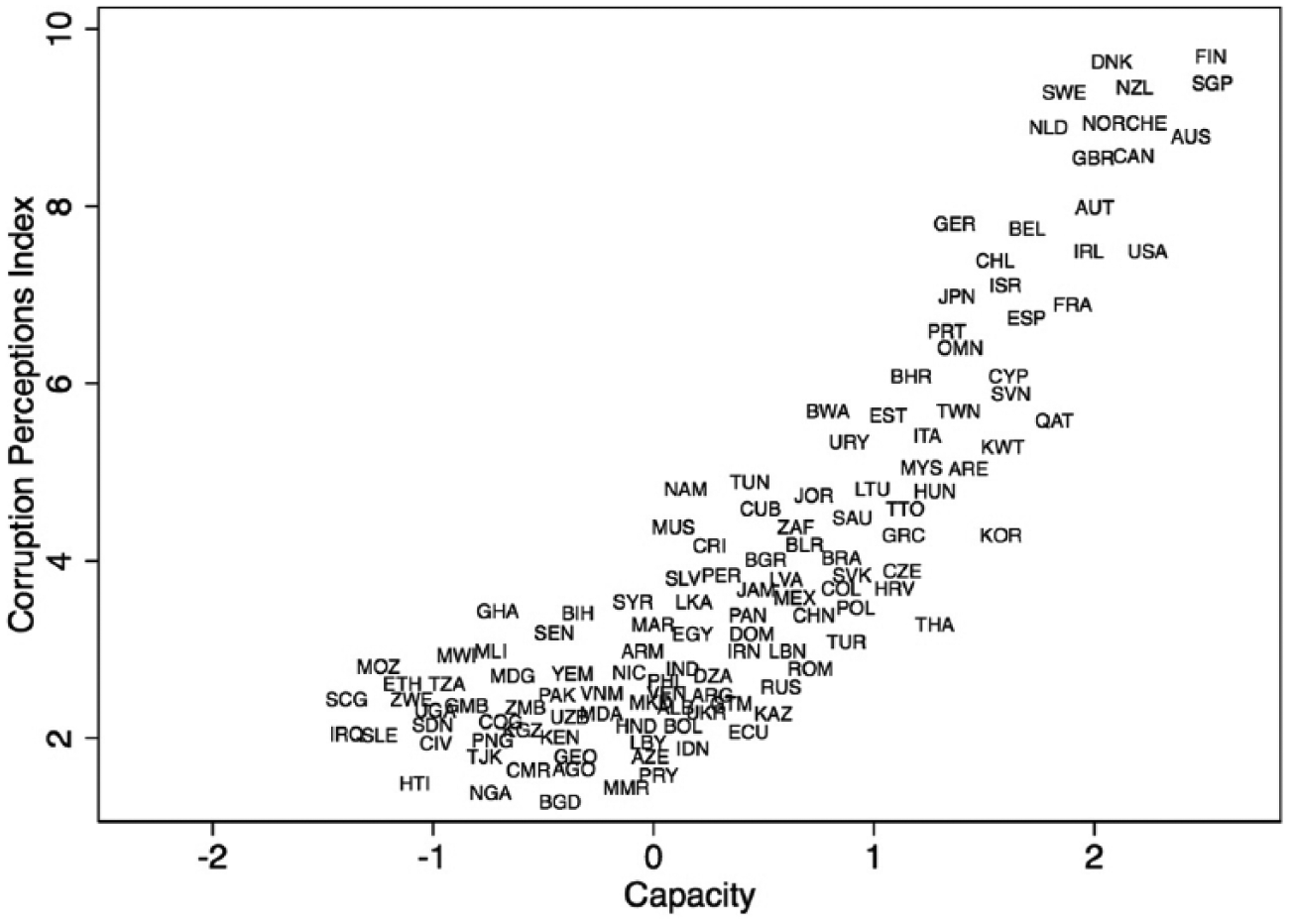
Capacity (Hanson and Sigman) and corruption perceptions.
Operationalizing extractive and coercive capacities
As discussed above, total tax revenue as a percentage of GDP represents overall extractive capacity better than it does administrative capacity, but there remain problems with this interpretation. Arbetman-Rabinowitz et al. (2011) seek to address the fact that countries at different levels of development, and with different levels of resources, should have different expected levels of taxation. They develop a Relative Political Capacity index that compares the actual level of taxation with this expected level. Countries with high values on this index are considered to have high ability to extract resources from their populations. It is not clear, however, that this measure performs any better at distinguishing between the capacity to tax and the political decision to tax.
Other possibilities for measuring extractive capacity include the census frequency measure described above and an item on the World Bank’s Country Policy and Institutional Assessment index called Efficiency of Revenue Mobilization (World Bank Group, 2011), which measures the breadth of the tax base, the quality of the tax administration, and tax collection and compliance costs. Finally, for data from commercial sources, the Institute for Management Development World Competitiveness Yearbook has a measure of the extent to which tax evasion is damaging for revenue collection. Coercive capacity typically is measured by using data on military personnel or military spending per capita (Singer et al., 1972). For example, Andersen et al. (2014a), Fortin-Rittenberger (2014b), and Seeberg (2014) use measures like these to capture coercive capacity. In terms of conceptual validity, one potential problem with this approach is that militaries are not the agent of day-to-day political repression. Were data available, it would be preferable to have measures of the budget for the internal security apparatus or the number of internal security personnel. A second problem with these data is that military budgets and troop levels are correlated with situations of conflict, potentially biasing inferences drawn from these indicators.
Another option to proxy for the size of the internal security operation is to use numbers of regular police personnel (United Nations, 2015). Although these officers are not likely part of the political security operation, they are more likely to be called out to deal with typical street unrest than are military forces. Finally, the number of paramilitary forces per capita may serve as another proxy for coercive capacity. Data quality on paramilitary force size is poor, however, especially going back in time. 5
Other researchers measure repressive capacity using observed political repression and human rights violations. The Cingranelli–Richards Human Rights Data Project (Cingranelli et al., 2014) and the Political Terror Scale (Gibney et al., 2011) are two sources of such data. These datasets are built from the annual country reports of Amnesty International and the US State Department Country Reports on Human Rights Practices. Although it is plausible that observed use of political terror is correlated with repressive capacity, there may be problems that arise due to the fact that use of repression may indicate that the regime faces a crisis of stability and turns to repression as a consequence. Additionally, highly effective coercive capacities may be more hidden.
This review has discussed a broad range of quantitative indicators that may be correlated with some facet of state capacity, but there is no ideal solution. At minimum, we need to think carefully about which dimension of state capacity a particular measure most closely represents and be specific about the mechanisms through which this dimension affects electoral authoritarian survival. Ideally, each dimension of state capacity could be operationalized separately in order to explore these mechanisms.
More broadly, there may be considerable value in case studies and small-sample comparative approaches that permit more nuanced measurement. The ability to distinguish between Weberian administrative capacity and hierarchy-enhancing graft, for example, should be much greater when researchers can draw upon rich, contextual understanding. Researchers can find clearer information on the technocratic capabilities of state officials and their degree of autonomy. With respect to coercive capacities of the state, case study approaches can better measure the strength of the internal security apparatus. Likewise, case studies should also be better for disentangling the role of regime organizational factors from those connected with state capabilities. Do regime officials use the party organization, or state administrative agencies, to deliver resources to citizens? The various country case studies included in this issue illustrate these points well.
Conclusion
In summary, this article seeks to contribute to the scholarship on the relationship between state capacity and the stability of electoral authoritarian regimes by focusing on three key challenges. First, it addresses the matter of conceptual clarity by identifying three core dimensions of state capacity and distinguishing them from aspects of regime organization. It then explores different mechanisms through which these three dimensions may interact with the strategies that electoral authoritarian regimes use to manage political threats, raising some questions for further research. Finally, it reviews different measures of these dimensions of state capacity that may be useful empirically.
The analysis calls attention to several issues. First, there are likely different combinations of strategies for maintaining power that are linked with different levels of the three dimensions of state capacity. Strategies involving performance-based legitimacy do not involve the same kinds of state capabilities as those more heavily reliant upon co-optation, electoral fraud, and repression. Empirical work should focus on the appropriate dimensions of state capacity and attempt to use measures related to these dimensions.
Second, the state’s capacities in different dimensions both affect, and are affected by, the strategies that authoritarian regimes use to maintain power. As a consequence, we should think about how the relationship between state capacity and regime stability evolves over the course of the regime. The levels of the various dimensions of state capacity that a regime inherits may affect its initial strategy, but its policy choices over time determine how state capacities evolve.
Third, the degree to which regime actors are able to capture control over the state matters significantly, for it determines the extent to which the capabilities of the state can be used to support their goals rather than, potentially, work against them. Without strong regime parties to penetrate bureaucratic mechanisms, state capacity may not serve the goal of regime stability.
Finally, when assessing the mechanisms that connect the different dimensions of state capacity to regime stability, it is important to consider the different ways that regimes break down. Do regimes end due to failures of power sharing, as evidenced by coups, or through failures of authoritarian control, as manifested in popular uprisings? Are some configurations of state capacities more conducive to democratization than others? Answering questions like these will provide important insights about the role of state capacity in the stability of electoral authoritarian regimes.
Footnotes
Acknowledgements
The author would like to thank Aurel Croissant, Olli Hellmann, Merete Bach Seeberg, and all the other participants in Workshop III of the Power of Elections in Authoritarian Regimes workshop series for their helpful comments and suggestions.
Funding
This research received no specific grant from any funding agency in the public, commercial, or not-for-profit sectors.