






Abstract
Comparative economic voting studies have found great instability in economic voting across countries and over time. In explaining this instability, we highlight the role of welfare systems because strong welfare protection attenuates voters’ incentives to base their vote on government economic performance. By analyzing 174 legislature elections in 31 Organisation for Economic Co-operation and Development (OECD) countries from 1980 to 2010 and by taking into account clarity of responsibility, we find that welfare protection weakens the linkage between macroeconomic outcomes and incumbent electoral fortunes. This result implies that strong welfare protection enables politicians to avoid blame for economic failures.
Introduction
Is the effect of economy on incumbents’ electoral fortunes always the same across countries and over time? While decades of scholarship has shown that the economy matters for election outcomes, a burgeoning literature has explored great instability in the strength of the economic vote in different political and economic contexts. For instance, much scholarship has focused on how the economic vote is affected by political contexts including clarity of responsibility (e.g. Powell and Whitten, 1993), global governance (Hobolt and Tilley, 2014), and democratic transitions in post-communist countries (Fidrmuc, 2000; Roberts, 2008). On the other hand, a growing literature has focused on economic contexts such as the welfare state (Pacek and Radcliff, 1995), level of economic development (Gélineau, 2013; Remmer, 1991), and globalization (Hellwig and Samuels, 2007).
In this article, we focus on lack of welfare protection as an important factor in the instability of economic voting. More specifically, our research examines whether high levels of welfare protection weaken the linkage between macroeconomic outcomes and incumbent electoral fortunes. Several things drew our attention to this welfare state hypothesis. First, there is disagreement on the role of welfare state in economic voting. Some argue that good welfare systems protect voters against economic adversity, thus voters in welfare state are less likely to blame politicians for economic failures (Pacek and Radcliff, 1995; Singer, 2011a). On the other hand, there are scholars who find that there is no substantive association between welfare protection and economic voting (Palmer and Whitten, 2002; Van der Brug et al., 2007).
Second, previous studies do not properly account for the role of clarity of responsibility. Clarity of responsibility has been considered as one of the most important factors which causes fluctuations in economic voting because citizens need to identify who is responsible in order to either reward or punish incumbents for economic conditions. For example, divided government, coalition government or federal systems may undermine voters’ ability to assign accountability for economic performance, which eventually weakens the role of the economy in arriving at a vote choice. That said, excluding clarity of responsibility in economic voting models might cause omitted variable bias.
Third, existing studies, particularly Pacek and Radcliff (1995), contain methodological problems, such as including a lagged dependent variable (LDV) in fixed effects (FE) model. Scholars in modern econometrics have argued that using FE in panel data with a LDV yields biased coefficients because a LDV among the regressors violates the ‘strict exogeneity assumption’ (Wooldridge, 2013).
Fourth, social expenditure as a percentage of gross domestic product (GDP), which has conventionally been used to measure the level of welfare state development, has limitations in validity and in cross-national comparisons. Spending does not capture the central concepts in welfare state scholarship, namely decommodification and social protection, which together imply emancipation from market dependency (Esping-Andersen, 1990). Thus, a measure of social expenditure is less valid to the extent that it does not measure the underlying concept that was meant to be measured. In addition, the value of spending at a given time depends on other factors such as economic performance and different demographic mixes rather than the extent of social rights. Accordingly, using this measure makes cross-national analysis more difficult. To address these shortcomings, we use the Combined Generosity Index in Comparative Welfare Entitlements Dataset 2 (CWED2) (Scruggs et al., 2014). This dataset is useful for three reasons: (1) it measures what our theory tries to capture; (2) the comprehensive information on systematic institutional features makes the comparative analysis more reliable; and (3) the dataset covers most of countries in our sample.
By using a new set of observations on recent elections and an improved methodology, we revisit the welfare state and economic voting hypothesis. Methodologically, this article offers more accurate estimates of economy’s impact on the incumbent’s vote share by using an improved welfare measure (combined welfare generosity index) and taking clarity of responsibility into account. In examining the impact of welfare generosity on economic voting, we expect the effect of macroeconomic conditions on electoral outcomes to be weaker in generous welfare states than in stringent welfare states because strong welfare protection provides a safety net that alleviates voter sensitivity to economic fluctuations. After analyzing 174 legislature (lower chamber) elections in 31 Organisation for Economic Co-operation and Development (OECD) countries from 1980 to 2010, we find evidence supporting this expectation. The effects of the economy – GDP per capita growth and unemployment – on the incumbent vote vanish as the level of social protection or welfare generosity of a country increases, though the inflation rate does not have an impact regardless of levels of welfare. Our findings imply that strong welfare protection enables politicians to avoid blame for macroeconomic failures.
The remainder of the article proceeds as follows. First, we review the literature on economic voting, with particular emphasis on the effect of welfare state development. Second, we develop a causal argument that explains why generous welfare systems mitigate the economic vote by affecting voters’ sensitivity to economic fluctuations. Third, we outline the research design and provide the model specification including data and methods. We then discuss the results of the regression analysis. Finally, we conclude the article with implications and suggestions for future research.
Literature review
The degree of economic voting varies across countries and even over time within a country. Scholars have developed various political and economic explanations for the magnitude of economic voting, such as clarity of responsibility or the impact of globalization. Despite these considerations, the role of welfare development has received little attention in comparative economic voting studies.
Does the welfare state weaken the relationship between the economy and the electoral success of an incumbent? Pacek and Radcliff (1995) is the first work to answer this question cross-nationally, and their response was affirmative. They argue that the magnitude of the economic vote is determined by citizen sensitivity to economic fluctuation. Since welfare systems affect citizen attitudes toward changes in the economy, a good social safety net tends to decrease individuals’ sensitivity to economic changes.
When governments provide a broad variety of material benefits (health care, child care, and other social services) and guarantee income maintenance programs (unemployment benefits, unemployment, or retrenching working hours), fewer individuals have their material living standards threatened during economic downturns (Pacek and Radcliff, 1995: 48). Given that government programs may alleviate people’s concerns about fluctuating income levels, we would expect that the coefficient of the economic vote depends on the level of welfare state development. Indeed, Pacek and Radcliff (1995) divide countries based on the percentage of GDP spent on social welfare protection and find that in countries with generous welfare spending, the economy plays a modest role in electoral outcomes. In countries with low to moderate levels of welfare expenditure, economic conditions have a greater impact on incumbent electoral fortunes.
On the other hand, subsequent studies which employ alternative measures of welfare protection and control variables for a cross-national analysis find no substantive relationship between level of welfare protection and economic voting (Palmer and Whitten, 2002; Van der Brug et al., 2007). Van der Brug et al. (2007), for instance, examine the impact of a welfare state regime on voting behavior. Following Esping-Andersen’s (1990) work, Van der Brug et al. (2007) divide countries into three types of welfare-state regimes: (1) the liberal welfare state which features ‘mean-tested assistance’ and ‘modest universal transfer of modest social-insurance’; (2) the conservative welfare state where public insurance programs are more than social assistance, and are differentiated based on insurance contribution; and (3) the social democratic welfare state, which is characterized by universalism and benefit uniformity of social insurance programs (Esping-Andersen, 1990: 26–27).
Van der Brug et al. (2007) hypothesize that the economy has a greater impact on electoral outcomes in liberal welfare states than in social democratic states or in conservative welfare states. Yet, using data from 15 advanced countries, they find no significant difference, which leads the authors to an indecisive conclusion about the effects of different welfare states on economic voting (Van der Brug, 2007: 112). Focusing on the impact of unemployment benefits, Palmer and Whitten (2002) also fail to find evidence that welfare protections mitigate the impact of the economy on voting.
In contrast to studies which attempt to identify the impact of welfare protections on economic voting across countries, Margalit (2011) and Singer (2011a) reexamine this relationship using country-specific analyses. Singer (2011a) demonstrates that the empirical results from prior cross-national studies might be contaminated by omitting clarity of responsibility, one of the most important factors affecting the magnitude of economic voting. Singer (2011a) tests whether differences in welfare provisions across states in the US affect the relationship between voters’ support for the president’s party in legislative elections and national economic performance. Singer (2011a) finds that the existence of safety-net programs lowers the salience of economic issues even during an economic recession. Voters are less concerned with national economic performance in states with anti-poverty programs. In a similar vein, Margalit (2011) examines how job dislocation due to off-shoring affects US presidential vote share. He finds that trade-related job losses significantly reduce the vote share of the president’s party. However, this negative electoral consequence is muted where there is a government-funded compensatory scheme that aims to help workers re-adjust in the labor market.
Table 1 summarizes the various economic indicators and welfare state measures that each work in the literature uses, as well as the methodological features and findings on the effect of the welfare state on economic voting.
Summary of previous studies.
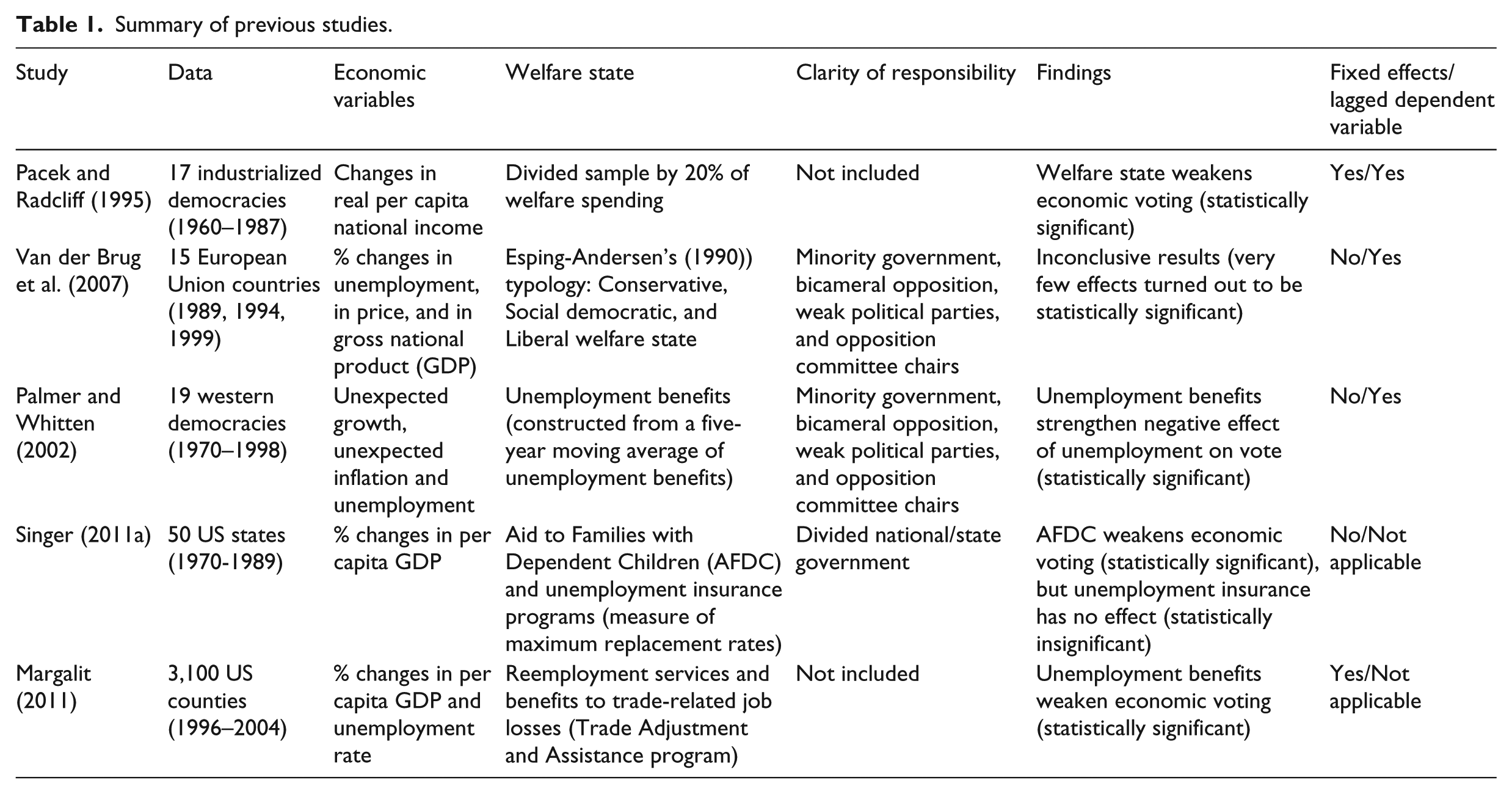
As the literature suggests, only a few studies have examined the effect of the welfare state on the economic vote across countries. Those studies that do explore the relationship between the welfare state and economic voting fail to reach a consensus. Furthermore, many studies do not take clarity of responsibility into account or only examine a small portion of macroeconomic conditions such as national income growth (Pacek and Radcliff, 1995) or unemployment (Palmer and Whitten, 2002). By controlling for clarity of responsibility and including a variety of macroeconomic indicators (GDP per capita growth, inflation, and unemployment) which affect electoral outcomes, our study offers a new perspective on effects of the level of welfare protections on economic voting across countries.
Theory
We argue that the effect of macroeconomic conditions on electoral outcomes is conditioned by the level of the welfare state. Macroeconomic conditions affect electoral outcomes because voters are concerned about their material well-being, and levels of well-being fluctuate according to macroeconomic conditions. Consequently, the intensity and magnitude of economic effects on voting behavior should vary depending on voter sensitivity to changing macroeconomic situations.
The elasticity of economic voting (whether to reward or to punish the incumbent) is a direct function of voter sensitivity to the economy (Pacek and Radcliff, 1995: 48). If voters are relatively less sensitive to diminishing incomes, the economy will have a smaller impact on their vote. Conversely, when voter sensitivity to changes in their level of income is higher, economic effects will be more significant.
In line with this logic, our arguments are informed by two causal components. First, we assume that an individual’s sensitivity to the economy depends on risk-exposure to economic fluctuation (Fossati, 2014). The economically insecure will be more sensitive than their rich counterparts to economic fluctuations (Aguilar and Pacek, 2000; Radcliff, 1992; Singer, 2011b) because poor people are more vulnerable to economic recession.
Singer (2011b) shows that individuals in vulnerable economic conditions are more likely to indicate that the economy is the most important issue in choosing their politicians. In a later piece, Singer (2013) argues that economic voting is more prominent in those whose employment is volatile, such as voters with insecure job positions or lower levels of employability. Similarly, Dorussen and Taylor (2002) contend that low-skilled workers are more willing to vote according to the condition of the economy. Strong welfare protections, however, reduce risk-exposure, especially for the economically insecure, by providing cushions against economic hardships. Brady et al. (2009) show that welfare spending has a negative and statistically significant effect on overall poverty levels even when considering both macro-level (GDP, demographic structure, and employment rates) and micro-level (the role of transfers and taxes on the income structure) effects.
Additionally, Radcliff (1992: 445) contends that ‘in a situation where the socio-political system has significant cushions against minor economic perturbations. . . many citizens may tend to be more politically sensitive to other than strictly economic issues, it may be that the economy has less of an impact on the decision to vote’. Therefore, we expect that the welfare state functions as a protective buffer zone for those who are vulnerable and makes them less sensitive to economic fluctuation. This leads citizens to be less concerned about economic issues in a given election and eventually dampens the link between macroeconomic performance and electoral outcomes.
The second component of our causal argument is informed by the classic theories of Maslow and Inglehart. According to Maslow’s Hierarchy of Needs (1954), human beings tend to strive for higher level needs (i.e. self-esteem and self-actualization) once the most basic level needs (i.e. safety and physiological needs) are satisfied. Following this logic, Inglehart (1997) found that in a welfare state, the core values of a citizen shift from material desires to the non-material. This shift is only possible when the needs for security and economic stability have been fulfilled and are preconditioned.
We argue that high levels of welfare protection fulfill the precondition of economic security and stability by providing several safety nets such as unemployment benefits, health care, or child care. As individuals shift away from a materialistic perspective, they may care less about the economy and instead place more value on other social issues. Consequently, citizens are less likely to vote based on the economy as levels of welfare protection increase. Based on this information, we generate two hypotheses:
We test these hypotheses by taking clarity of responsibility into account. According to the conventional wisdom of the economic voting literature, we expect that an increase in welfare generosity reduces the effects of GDP growth, inflation, and the unemployment rate on incumbent vote only when clarity of responsibility is high. Conversely, there should be no relationship between economic conditions and incumbent vote regardless of levels of welfare protection when clarity of responsibility is low.
Research design
To test our hypotheses, we analyze 174 lower chamber legislative elections in 31 OECD countries from 1980 to 2010. 1 We test whether the level of the welfare state shapes the relationship between macroeconomic conditions and the incumbent vote share including LDV. We estimate the following model with a one-year lag (t-1) of economic and political covariates.
Dependent and independent variables
Our dependent variable, incumbent vote, is measured as the percentage of votes received by the incumbent party. When there is a coalition government, we use the percentage of votes earned by the executive party (the prime minister’s party) as the dependent variable because the extant studies found that voters do not always reward or punish all parties in a coalition government in the same way (Anderson, 1995). Voters may consider each party’s degree of responsibility or perceived competence when making a decision on party support (Narud, 1996), so they typically blame or praise the prime minister for economic policies in parliamentary systems (Lewis-Beck, 1997) because the prime minister’s party has greater roles in economic policy-making (Williams et al., 2016). Moreover, Lewis-Beck (1988) argued, voters may shift their support between parties within a governing coalition, which may hide evidence of economic voting that is occurring. 2
Our independent variables are national economic performance measures: gross domestic GDP per capita growth; the unemployment rate; and the inflation rate. 3 These three macroeconomic indices have been used as consistent and important indicators in estimating economic voting at the aggregate level in the literature (Lewis-Beck, 1988; Powell and Whitten, 1993; Whitten and Palmer, 1999). Unlike the study by Pacek and Radcliff (1995), which included only an income variable, we posit that the unemployment and the inflation rates must be included in our regression models because significant welfare provision is allocated for the unemployed in most countries. Good welfare programs, as research has shown, may protect people from their fear of losing jobs or of higher inflation.
Welfare state variable
To test the effect of levels of welfare protection on the magnitude of economic voting, we use the CWED2 (Scruggs et al., 2014). Based on Esping-Andersen’s (1990) decommodification idea, the combined generosity index measures institutional features of three social insurance programs: unemployment insurance; sick pay insurance; and public pensions. More specifically, the index is based on comprehensive information for each of the programs including benefit replacement rates, qualifying conditions, benefit duration, waiting duration, and elements of the insurance coverage or take-up rates (Scruggs, 2014).
There are several reasons to use this newly introduced dataset. First, the generosity index is theoretically compelling and corresponds with the aims of our work. As explained earlier, our theory emphasizes the role of welfare state in buffering individuals from wage fluctuations and alleviating sensitivity to wage dependence. The generosity score captures the concept of this protection well. For instance, the generosity score is based on replacement rates which measures the ability of welfare benefits to reinstate the purchasing power of individuals and households that have experienced wage cuts or losses.
Second, the coverage of the CWED2 dataset is almost identical to our sample. While there are several alternative measures such as Esping-Andersen (1990) and Olaskoaga-Larrauri et al. (2010), their data focus on North American and Western European democracies and only 18 countries, so it leaves 13 countries out from our sample. Fortunately, CWED2 adds information on all 13 countries.
Third, we use the generosity index because the widely-used variable, share of GDP represented by social expenditure, has several limitations. For instance, social spending may not be a good indicator for cross-national comparison because the value at any given time is based on many factors other than the extent of social rights. Put differently, the same value of social spending in a country may not represent the same level of welfare state in other countries with different demographic mixes (Alaex et al., 2008; Olaskoaga-Larrauri et al., 2010). Furthermore, using social spending as a percentage of GDP is also problematic because the value expresses changes in both social expenditure and GDP simultaneously. This makes the value of welfare state (as share of GDP) highly contingent upon the performance of the denominator, which is a country’s economic output (Olaskoaga-Larrauri et al., 2010). Finally, and more importantly, spending as a percentage of GDP has weak content validity (Kellstedt and Whitten, 2013: 102) because it excludes some of the essential elements of the concept of welfare protection and decommodification (Esping-Andersen, 1990). Indeed, social expenditure on its own does not provide information on replacement rates, duration of benefits, qualifying conditions, take-up rates etc., and accordingly, it shows little about the role of the welfare state as a protection against income fluctuations.
Clarity of responsibility variables
We include clarity of responsibility to control for the impact of clarity of responsibility on the relationship between levels of welfare protections and economic voting. When there is low clarity of responsibility, it is complicated to gather information about who is responsible for policy outputs. Thus, voters are not able to assign accountability to the government for policy outcomes. Since Powell and Whitten (1993) introduced the concept of clarity of responsibility, numerous studies (Anderson, 1995; Nadeau et al., 2002; Whitten and Palmer, 1999) have found evidence that low clarity of responsibility reduces the strength of economic voting by blurring the relationship between the economic outcomes and incumbent government’s performance. In this sense, it may be problematic to estimate the conditional effects of welfare efforts on economic voting without controlling for clarity of responsibility (Singer, 2011b).
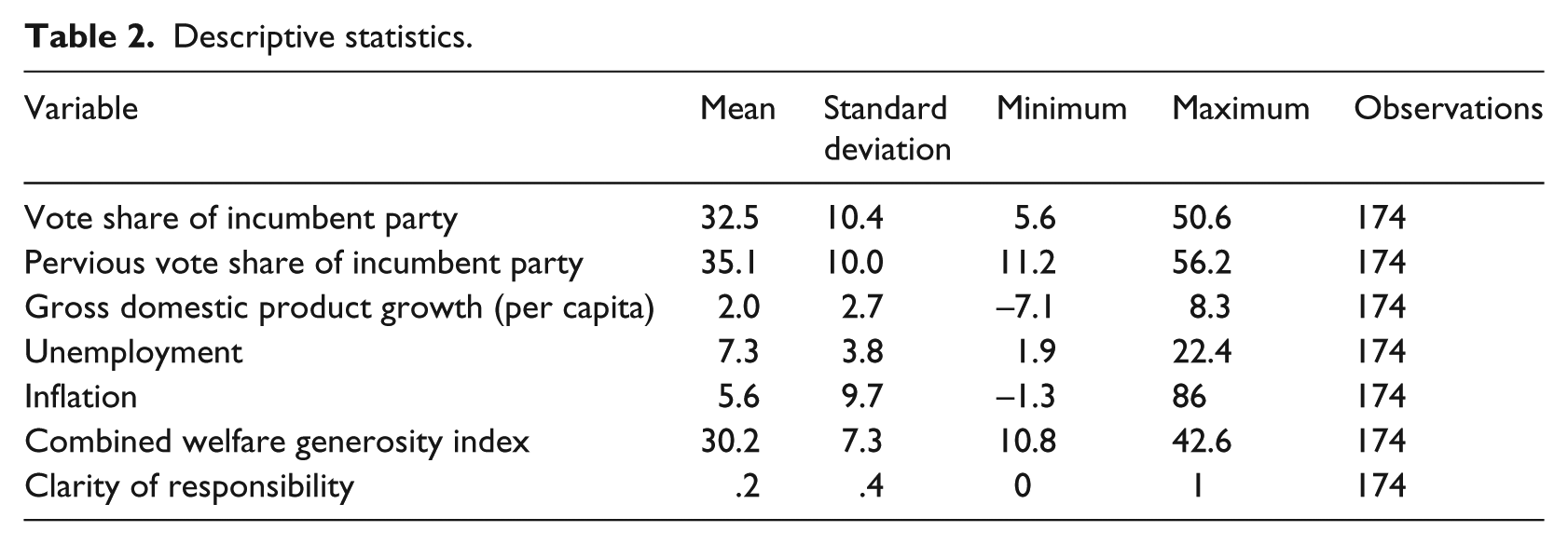
Although several variables have been used to measure clarity of responsibility, we select four essential measurements that are commonly used as main components of clarity of responsibility in the literature (Hobolt et al., 2013; Powell, 2000; Powell and Whitten, 1993): a coalition government; a minority government; bicameral opposition where the government only controls one house of a bicameral legislature; and cohabitation where the president is from a different party than the prime minister. By using the four measurements, we create a low clarity of responsibility variable. It is measured as a dummy variable. If there are at least more than two of four features, it is coded as 1 (low clarity of responsibility), otherwise 0. Then, we include three-way interaction terms by interacting clarity of responsibility with the economic indicators and the welfare variable in our model. This is because, theoretically, each dummy variable itself does not affect the vote share of incumbent party, but they affect the vote share of the incumbent party in their interaction terms with the economic and social protection variables. Table 2 shows the descriptive statistics for all variables.
Descriptive statistics.
Model specification
The data structure of the sample is not a typical cross-sectional time series. Because the unit of analysis is country–election year, the data are strongly unbalanced and have a number of gap years between elections. Given the nature of the dataset, there are a few methodological issues that require particular attention.
First, we need to consider the dynamic process of vote share. This means that the vote share in previous elections is one of the powerful factors that predicts today’s vote share. Indeed, scholars in the voting behavior literature have long included LDVs in vote-share models (Pacek and Radcliff, 1995; Palmer and Whitten, 2002).
Second, given that our sample consists of 31 OECD countries with an average of about six time points each in 1980–2010, spatial units are far more dominant than temporal units (large n and small t). Due to this cross-sectional dominance in our sample, we assume that country-specific effects are in the composite error terms, which causes a violation of the error assumption in ordinary least squares (OLS). This is why Pacek and Radcliff (1995) used FE to control for time-invariant unit-specific error in their models. However, using the FE model in panel data with a LDV yields biased coefficients. This is because it violates the principle of strict exogeneity which assumes a zero correlation between the error terms and all covariates across time (Wooldridge, 2013). A model with a LDV cannot satisfy this principle (Wooldridge, 2013: 384), and thus, FE and a LDV are not compatible in the same model.
With regards to this methodological challenge of using FE and LDV, we believe that theory should play a larger role in using one versus the other. As explained in the preceding paragraphs, vote share models have heavily and frequently been constructed by including LDV because current vote share is a direct function of the previous election’s outcome, implying a dynamic process. As such, if the processes in vote share models are dynamic, ‘excluding a theoretically appropriate lagged dependent variable produces misspecification’ (Keele and Kelly, 2006: 187). Indeed, Keele and Kelley (2006) have found that OLS with a LDV yields estimates that are superior to other models or estimators when there is a dynamic process.
Furthermore, the threat of unit-specific error in our model may not be as serious as is alleged. Particularly, the variation in political institutions is the greater source of heterogeneity across units and we control for this variation in institutional characteristics by including a clarity of responsibility variable. By doing this, we believe that the threat of unit-specific error is considerably reduced.
Findings
To test our hypotheses, we regress incumbent vote on: (a) economy; (b) a measure of welfare generosity; (c) a measure of clarity of responsibility; and (d) the interaction term of economy, welfare generosity, and clarity of responsibility in the model.
Table 3 displays the regression results. Model 1 estimates a simple economic voting model that includes economic variables with lagged dependent variable. According to the literature on economic voting, in simple economic voting models, GDP growth helps incumbent parties to increase their vote shares, whereas increased inflation and high unemployment rates hurt them. Therefore, GDP growth should have a positive coefficient, while inflation and the unemployment rate should show negative coefficients. In a simple economic voting model (Model 1), coefficients for GDP per capita growth and the unemployment rate are statistically significant but the inflation is not. Our findings are consistent with the previous findings of the economic voting literature. Both growth and unemployment are the ‘big two’ macroeconomic variables that account for incumbents’ electoral outcomes (Nannestad and Paldam, 1994). Growth has widely appeared as the most important predictor in cross-national studies from different parts of the world (Dassonneville and Lewis-Beck, 2014; Pacek and Radcliff, 1995). Recent work has also concluded that unemployment has a clear electoral impact (Fidrmuc, 2000; Roberts, 2008). Inflation, in contrast, has received mixed support from scholars as a determinant of incumbent vote share with relatively few papers recognizing its importance (Lewis-Beck and Stegmaier, 2013).
The effects of the economy on incumbent vote share conditional on welfare generosity and clarity of responsibility.
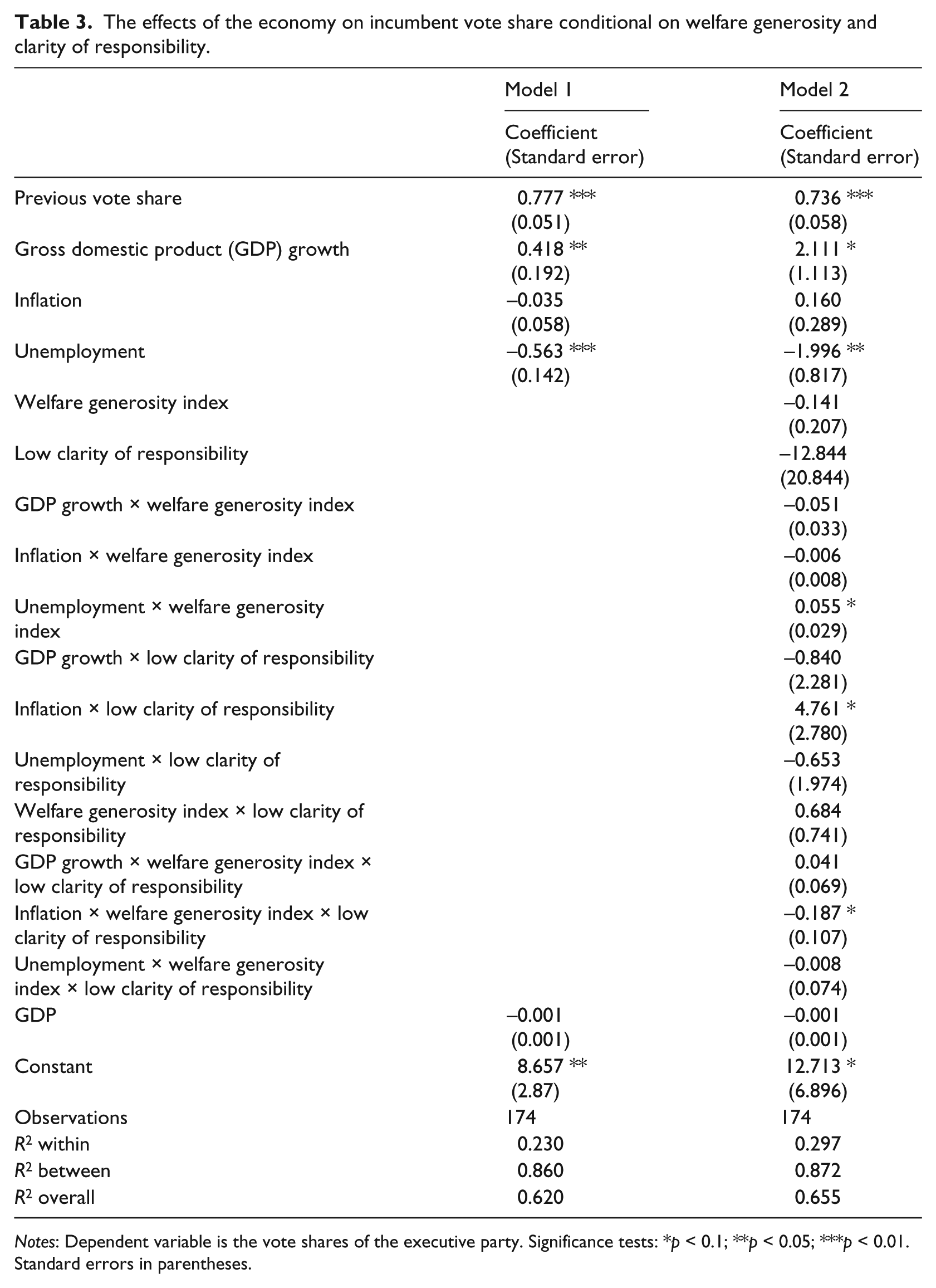
Notes: Dependent variable is the vote shares of the executive party. Significance tests: *p < 0.1; **p < 0.05; ***p < 0.01. Standard errors in parentheses.
In turn, Model 2 presents regression coefficients including the three-way interaction terms. 4 We estimate Model 2 to test whether strong welfare protection would mitigate the effects of the economy on incumbent vote by taking clarity of responsibility into account. However, it is not possible to directly interpret the impact of the macroeconomic conditions on incumbent vote conditional on welfare generosity. This is because the significance level of coefficient does not reveal anything when interpreting interaction terms between continuous variables, (Berry et al., 2012; Brambor, Clark, and Golder, 2006). The interaction coefficients of typical results tables report only the marginal effect of X when the conditioning variable is zero. As a result, an interaction term between two continuous variables should be interpreted with marginal effects, not merely with the coefficients and significance of the interaction terms (Berry et al., 2012; Brambor et al., 2006).
We present the marginal effect graphs showing the degree to which exposure to welfare protection conditions the effect of the economy on election outcomes. Following the conventional wisdom from the economic voting literature, we expect economic voting to occur when clarity of responsibility is high. Hence, we calculate the marginal effects of economic conditions on incumbent vote share conditional on welfare generosity index and high clarity of responsibility. Figures 1–3 present the marginal effects of the economic conditions produced by our model across the sample range of the welfare generosity index and for high clarity of responsibility. In all figures, solid lines display the marginal effect of the economy conditional on the welfare generosity index, and dashed lines display 95% confidence intervals.
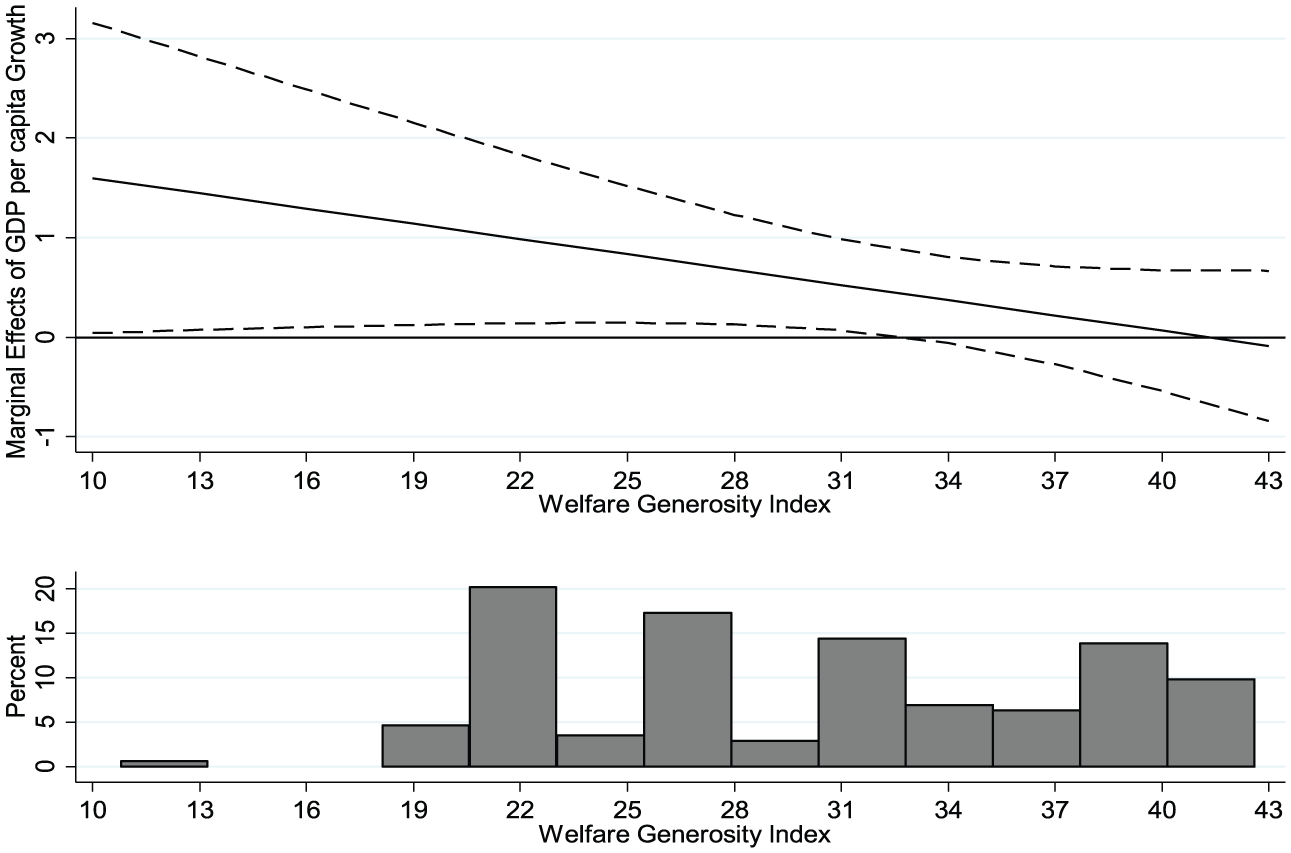
Effect of gross domestic product per capita growth on incumbent vote conditional on levels of welfare generosity with high clarity of responsibility (95% confidence interval).
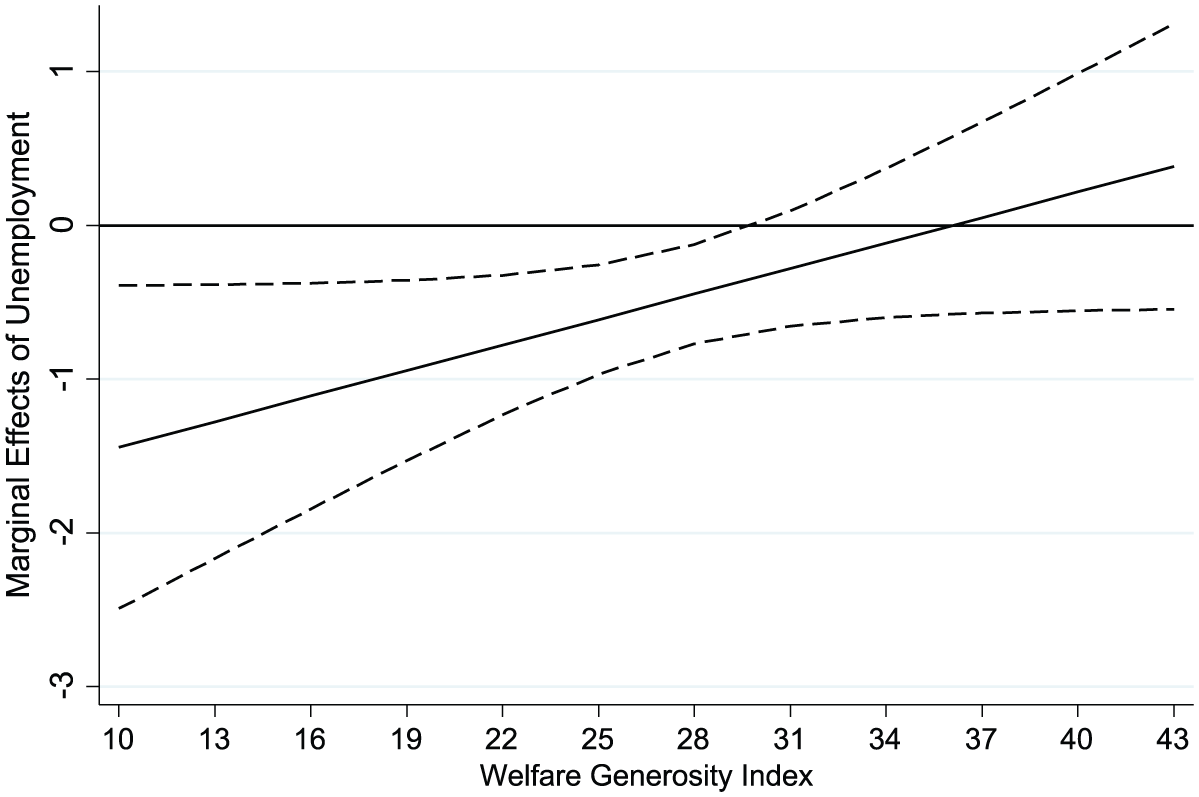
Effect of unemployment on incumbent vote conditional on levels of welfare generosity with high clarity of responsibility (95% confidence interval).

Effect of inflation on incumbent vote conditional on levels of welfare generosity with high clarity of responsibility (95% confidence interval).
Figure 1 shows the marginal effect of GDP growth per capita on incumbent vote conditional on the welfare generosity index and the histogram shows the sample distribution across levels of the welfare generosity index. We hypothesize that welfare benefits will reduce the positive relationship between GDP per capita growth and incumbent vote share. As Figure 1 shows, we found support for this expectation. The marginal effect of GDP per capita growth is positive, but its effect becomes zero as welfare generosity increases. Specifically, for the non-welfare state (the welfare generosity index = 10), the effect of a 5% increase in GDP per capita growth increases the vote share of the incumbent party by 8% (5×1.6). When the welfare generosity index is 31, a 5% growth in GDP per capita contributes the vote share of the incumbent by only 3% (5×0.6). Once the welfare generosity index exceeds 32, the positive effects of GDP per capita growth on incumbent vote is no longer statistically significant. At generous levels of welfare protection, the marginal effect becomes statistically indistinguishable from zero.
Figure 2 demonstrates the marginal effect of unemployment on incumbent vote conditional on social expenditure. As we expected, the marginal effect of unemployment is negative and becomes insignificant when social expenditure reaches to a generous level. To be specific, a 5% increase in the unemployment rate reduces the vote share of the incumbent by 7.5% (5×1.5) for the worst welfare protection (the welfare generosity index = 10). But for a generous level of welfare protection (the welfare generosity index = 30), a 5% increase in unemployment deteriorates the vote share of the incumbent by only 2.5% (5×0.5). Finally, the marginal effect of unemployment becomes statistically indistinguishable from zero at about 31 of the welfare generosity index with a 95% confidence-interval.
Figure 3 depicts the marginal effect of inflation on incumbent vote conditional on the welfare generosity index. The inflation rate does not have a significant effect on the incumbent party’s vote share at all levels of welfare generosity. This result is not surprising because the inflation rate does not have a significant impact on the vote share of the incumbent even in our simple economic voting model. Singer (2013) argues that citizens are likely to place more weight on the economic indicator which directly affects their livelihoods. In periods of hyperinflation, inflation was a more pressing concern than growth or unemployment, but its salience has faded from public attention as prices have stabilized in the last few decades. In line with Singer’s argument, we assume that the impact of inflation in OECD countries where bouts of hyperinflation are rare is not significant for electoral outcomes (as appeared in Model 1 and the Figure 3). In contrast, growth and unemployment remain as the prime drivers up to the relatively higher level of welfare generosity (as appeared in Figures 1 and 2).
Figure 4 shows the marginal effects of GDP per capita growth, inflation, and unemployment on the incumbent party’s vote share conditional on the welfare generosity index when clarity of responsibility is low. According to conventional wisdom, the impact of the economy on the incumbent party’s electoral outcomes weakens when clarity of responsibility is low. Thus, we expect that impacts of GDP per capita growth, inflation, and unemployment on incumbent vote share will be statistically insignificant no matter which levels of welfare generosity a country has when there are lower levels of clarity of responsibility. It is shown in Figure 4 that when clarity of responsibility is low, GDP per capita growth and inflation are statistically insignificant at all levels of the welfare generosity index. In turn, although unemployment has a significant impact on incumbent vote at some levels of welfare generosity, it does not show a systematic pattern in relation to our hypothesis.
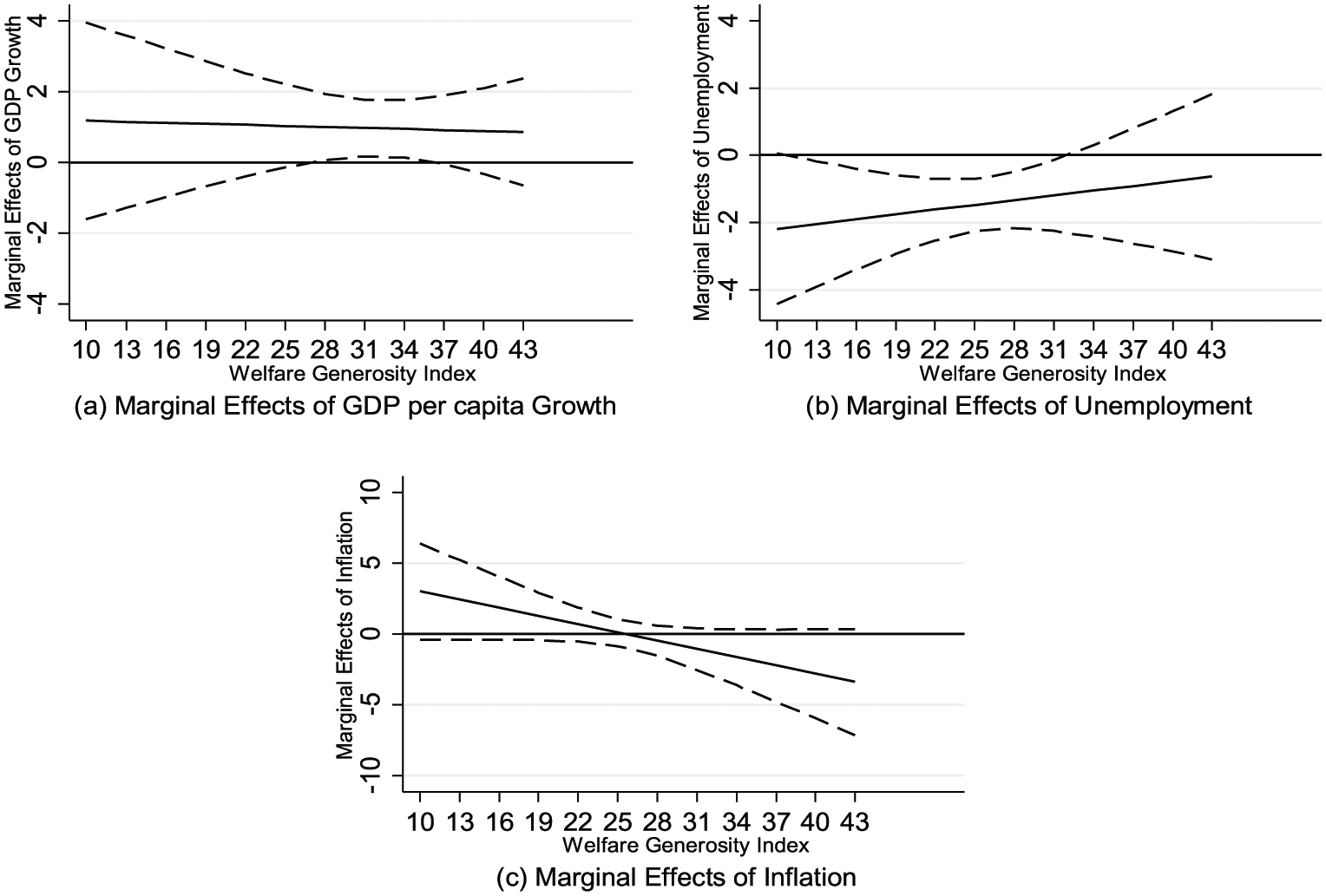
Impacts of gross domestic product per capita growth, unemployment, and inflation on incumbent vote conditional on welfare generosity with low clarity of responsibility (95% confidence interval).
Overall, our results show support for our hypotheses. We expected the effects of national economic conditions on the incumbent vote share to disappear as levels of welfare protection increase because we assumed that economically secure voters no longer prioritize the economy. The marginal effects of GDP per capita growth and unemployment on incumbents’ vote share become statistically indistinguishable from zero at the similar level welfare protection though inflation does not affect the incumbents’ vote share regardless of the welfare protection levels.
This finding remains significant even when we include clarity of responsibility. The economic vulnerability that people feel decreases as a society provides more social welfare security to their members. Therefore, the government’s economic performance may not be an important criterion for citizens evaluating incumbent performance in a strong welfare state. Based on this rationale, we find that there is evidence to support the relationship between the economy, welfare generosity, and governing party support.
Conclusion
The dominant explanations for the great instability in economic voting have mainly focused on political contexts such as clarity of responsibility. Much less attention has been devoted to the hypothesis that strong welfare protection reduces the effect of economic fluctuations on incumbent electoral fortunes, and evidence for this hypothesis remains inconclusive. However, levels of welfare protection affect not only the magnitude of economic voting, but also a vote choice to reward or punish an incumbent (Shin, 2016). By using a fresh set of observations and an improved welfare measure, by taking clarity of responsibility into account, and by using more accurate statistical estimations, we revisit this hypothesis.
We find strong support for the claim that generous welfare protection weakens the linkage between national economic performance and incumbent electoral outcomes. This result implies that voters living with lower levels of welfare protection are likely to sanction and reward incumbents for economic outcomes, but voters with higher levels of welfare protection are relatively less likely to blame or reward national leaders for past economic performance. This result implies that strong welfare protection enables politicians to avoid blame for their economic failures.
More generally, our results provide reason to believe that the magnitude of economic voting varies not only with the political context but also with the economic context. These results are consistent with the findings of the previous studies that examined non-political institutional variables that affect the magnitude of economic voting such as economic vulnerability (Fossati, 2014), anti-poverty programs (Singer, 2011a) and exposure to globalization (Hellwig and Samuels, 2007). The results from this study suggest that future work on economic voting should control for political contexts as well as for economic contexts (like degree of welfare development) to avoid omitted variable bias.
Our study also confirms the clarity of responsibility hypothesis that low clarity of responsibility reduces the impacts of macroeconomic conditions on incumbent electoral fortunes. When clarity of responsibility is clear, macroeconomic conditions have significant impacts on incumbent vote at low levels of welfare protection. However, macroeconomic conditions do not have significant effects on the vote share of the incumbent party, regardless of welfare protection levels, when clarity of responsibility is blurred. Thus, economic voting is less likely to occur when there is low clarity of responsibility.
Furthermore, our study could motivate further work on economic voting and welfare protection. Like previous studies (Pacek and Radcliff, 1995; Singer, 2011a), our research uses aggregate-level data to test the effects of welfare protection on the magnitude of economic voting. Economic voting, however, is indeed a phenomenon at the individual level. Future work at the individual level should investigate the connections between economic evaluations, vote choice, and welfare protection. Research, in particular, should examine whether voters where there is strong welfare protection are more or less likely to hold governments responsible than where there is weak welfare protection.
Finally, our study has implications for larger questions of citizen values and the development of democracy. As our results demonstrate, the economy dominates the outcome of elections in democracies unless citizens are protected by sufficient welfare expenditure. The implication here is that the economy remains the most salient issue in elections, and that this tendency makes citizens who are not protected by welfare programs ignore some other important democratic values such as tolerance, transparency, environmental protection, or equality when making decisions. Increasing welfare spending enables citizens to be free from fear of economic hardship and provides them with room to pay attention to other important democratic values. Welfare spending may enable society to become more tolerant and democratic in nature.
Footnotes
Appendix
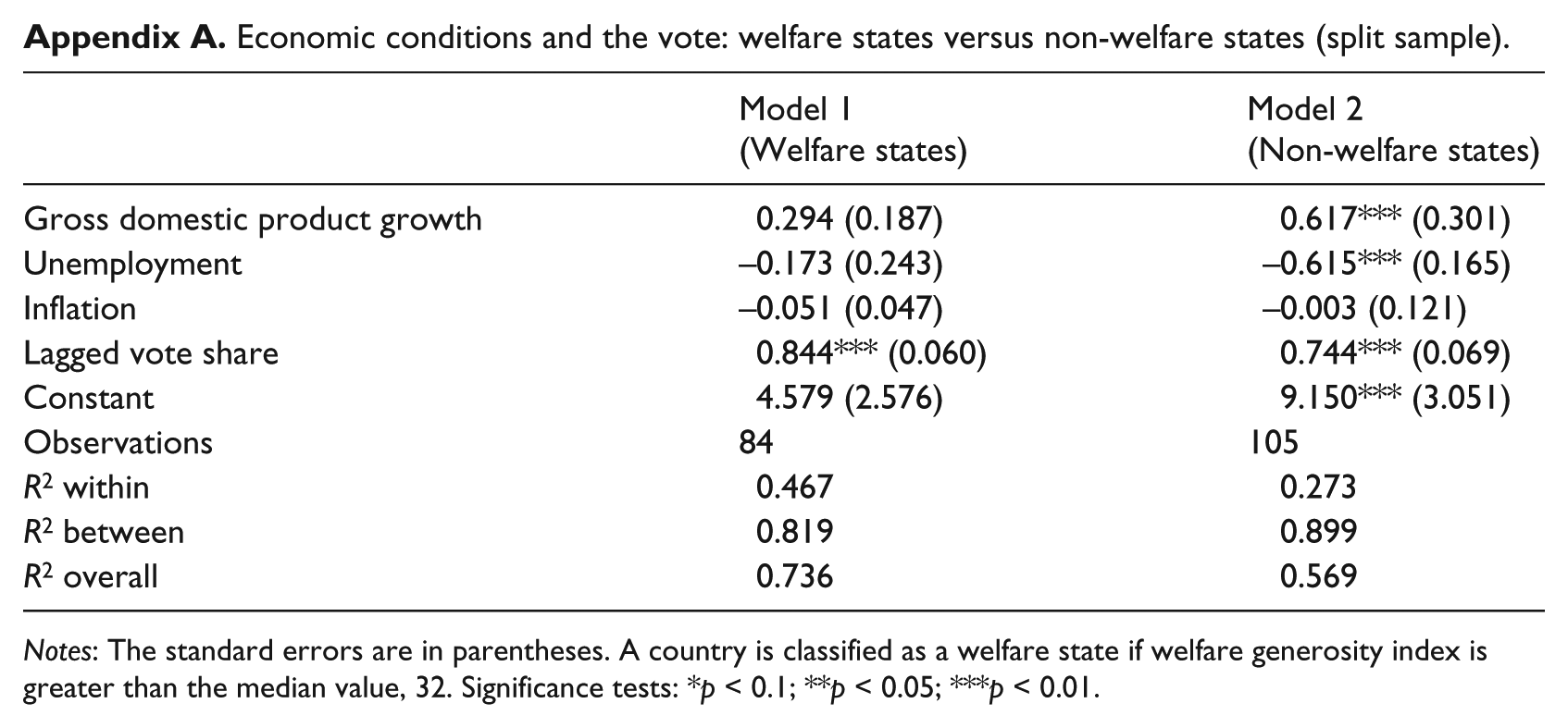
Economic conditions and the vote: welfare states versus non-welfare states (split sample).
| Model 1 |
Model 2 |
|
|---|---|---|
| Gross domestic product growth | 0.294 (0.187) | 0.617*** (0.301) |
| Unemployment | −0.173 (0.243) | −0.615*** (0.165) |
| Inflation | −0.051 (0.047) | −0.003 (0.121) |
| Lagged vote share | 0.844*** (0.060) | 0.744*** (0.069) |
| Constant | 4.579 (2.576) | 9.150*** (3.051) |
| Observations | 84 | 105 |
| R2 within | 0.467 | 0.273 |
| R2 between | 0.819 | 0.899 |
| R2 overall | 0.736 | 0.569 |
Notes: The standard errors are in parentheses. A country is classified as a welfare state if welfare generosity index is greater than the median value, 32. Significance tests: *p < 0.1; **p < 0.05; ***p < 0.01.
Acknowledgements
We greatly appreciate the advice and comments from Laron K. Williams, Mary Stegmaier, Chaegyung Jun, Andreas Murr, Saumil Dharia, Marian Sawer and Aaron Kushner, and four anonymous reviewers of the International Political Science Review.
Funding
This research received no specific grant from any funding agency in the public, commercial, or not-for-profit sectors.
Notes
Author biographies
References
Supplementary Material
Please find the following supplemental material available below.
For Open Access articles published under a Creative Commons License, all supplemental material carries the same license as the article it is associated with.
For non-Open Access articles published, all supplemental material carries a non-exclusive license, and permission requests for re-use of supplemental material or any part of supplemental material shall be sent directly to the copyright owner as specified in the copyright notice associated with the article.
