







Abstract
This article seeks to explain the varied policy responses to the large wave of emigration from Central and Eastern European states during the last two decades, focusing on the cases of Hungary, Bulgaria, Romania, and Poland. Differing degrees of emigrant engagement by these states are explained by the role of internal minorities as active members of the emigrant population and the overall political and demographic relevance of historical kin. This study contributes to our understanding of what shapes state policies towards different types of external populations. It also highlights the particular challenges of state-led transnational engagement in a supranational border regime.
Introduction
One of the major challenges facing Central and East European states following the collapse of communist regimes in 1990 has been the large wave of emigration from the region, a trend which has been exacerbated by European Union (EU) membership and economic crisis in Europe. The vast majority of these emigrants left for Western Europe as Central and East European states became members of the EU and gained access to visa-free travel throughout Europe (Horváth and Kiss, 2015: 110). Alarmingly, East–West emigration within the EU has been ‘dominated by educated and young people’ and ‘appears to be permanent, with indications of only limited return migration so far’ (Atoyan et al., 2016: 5). The decision to leave their country of origin made by seemingly large numbers of citizens in a relatively short amount of time has worsened problematic demographic trends towards aging populations, negative population growth, and rural depopulation, and has created labor shortages in some key sectors. Emigration has also been seen as a commentary on the ineptitude and corruption still present in many post-communist governments, and as a threat to ‘the physical and cultural survival of the nation’ in Central and East European states (Dumbrava, 2016: 1).
With such troubling news on emigration numbers, the leaders of the affected states have been forced to respond. Yet, despite the visible anxiety around East–West emigration, responses to the most recent wave of emigration from Central and Eastern Europe have been more varied and less robust than we might expect given the magnitude of the problem. Looking at the cases of Hungary, Bulgaria, Romania, and Poland, we can see significant variation in how these states relate to intra-EU emigrants and the degree to which they prioritize engagement with these populations. Some states, such as Romania and Poland, have done more to engage recent emigrants by incorporating them broadly into the transnational political community and institutionalizing a range of programs to establish and maintain ties with them. Other states, such as Hungary and Bulgaria, have shown a more conflicted and less robust institutional and political relationship with intra-EU emigrants. This article seeks to explain these variations. To do so, I offer an account that focuses on the increasingly-salient issue of East–West emigration not just as a challenge of diaspora governance in a context of relatively open European borders. I argue instead that the policy responses to this wave of emigration from Central and Eastern European states have been shaped and constrained by pre-existing political and institutional structures driven by the state’s relationship to historical kin communities in neighboring and nearby states, and in some cases, to internal minority communities.
Hungary, Bulgaria, Romania, and Poland have much in common: they share similar post-communist political trajectories; became EU members between 2004 and 2007; experienced spikes in East–West migration within the past decade; and have long-standing relationships with politically significant historical kin communities in neighboring states. Exploring the variations among them provides insight into how different segments of the external population are institutionally and politically targeted by states. The existing literature offers plausible explanations of why states have different policies towards different emigrant communities (Tsourapas, 2015), what shapes hierarchies of identity in immigration policy (Triandafyllidou and Veikou, 2002), and even why some states are more or less concerned with ethnic kin in neighboring states (Csergő and Goldgeier, 2013). Yet, we still do not have a good account of what shapes state-based targeting and differentiation towards different types of external populations. The comparison that follows contributes to answering this question by focusing on states within the same supranational environment all faced with the challenge of crafting relationships with multiple and quite distinct external populations simultaneously. To take advantage of these comparative possibilities, I limit my universe of cases to post-communist EU member states that have both a significant cross-border ethnic diaspora and that experienced a politically and demographically significant emigration wave over the past decade. 1
The article proceeds as follows. The first section briefly compares and contrasts how the four states have incorporated recent emigrants into: (a) official bodies and institutions of external engagement; and (b) external voting policies. I then turn to explaining variations among the four cases. My explanation focuses on the role of internal minorities as active members of the emigrant population and the overall political and demographic relevance of historical kin communities as the two factors that shape and constrain state responses to intra-EU emigration.
Responses to emigration
As a recent report on emigration pointed out, ‘governments cannot stop their citizens and residents from leaving, nor can they compel them to return’ (Papademetriou, 2015: 10). However, states can cultivate emigrants as members of potential diasporas communities, who may relocate permanently in their new state, and also as short-term migrants who may return home. This engagement requires the state to foster political, economic, and cultural ties with citizens abroad. States can recognize emigrant communities as important members of the national community by offering them special services and support, from consular services to institutional representation of emigrant issues in government agencies and documents (Gamlen, 2014). States can also grant special political or legal rights to emigrants as a way to maintain important ties of citizenship and belonging (Papademetriou, 2015: 8). In Central and Eastern Europe, however, state officials have often downplayed institutional engagement with intra-EU emigrants in favor of maintaining a political and institutional focus on other external populations, such as ethnic kin in neighboring countries or members of older, more established diasporas. The marginalization of more recent emigrants has occurred despite the fact that this external population represents those most likely to send remittances, maintain homeland citizenship, and have strong cultural, linguistic, and family ties to the homeland (OECD, 2013).
One reason for the dislocation between the economic and symbolic importance of intra-EU emigrants and their official treatment is that this population presents a set of particular challenges for the state. While we might expect that a supranational environment may be more conducive to state-led transnationalism, in many ways it has made emigrant engagement more difficult. Intra-EU emigrants enjoy a relatively privileged position compared to other economic migrants in Western Europe because they have access to guaranteed rights and cannot as easily be denied admission or the right to work. This also gives them a high degree of ‘autonomy’ from their state of origin, which allows them to be less dependent on home-state protection and policies (Koinova, 2012: 100). Intra-EU emigrants’ increasing ability to acquire and maintain citizenship and political rights in both their country of origin and host country and the relative ease of mobility they enjoy within the EU make it easier for them to engage in informal transnational activities, such as cultivating personal and family ties in both home and host country. Private labor networks and extensive professional, personal and family networks have replaced and surpassed the previous role of the state in managing emigration through bilateral trade agreements (Moreh, 2014: 99). In addition, statistical information on emigration is ‘notoriously unreliable and fluid’ (Collyer, 2013: 9). Intra-EU emigrants, particularly those engaged in temporary or circular migration, may not be accurately counted as residents in the states in which they live and work, and they may continue to claim residency in their home state if there are few incentives for ‘deregistering’ (Papademetriou, 2015: 2). This makes it particularly difficult to ‘count and categorize’ emigrants, which is key for making them part of the ‘governable population’ of the state (Delano and Gamlen, 2014: 49). At the same time, the complex, multilevel structure of the EU ‘in which the rights, allegiances and identities of individuals are bundled at different administrative levels within and across national borders’ (McMahon, 2015: 12) makes it difficult for the emigrants themselves to make coherent claims on their states of residence and the states they left behind.
Intra-EU emigrants also represent a more difficult legacy and less reliable symbolic resource than cross-border historical kin communities. Recent emigrants are likely to be much more heterogeneous and reflective of ethnic and partisan divisions within the state, in contrast to cross-border kin romanticized as bulwarks of a historically and territorially-specific national identity (Waterbury, 2014). In the ‘hierarchy of ethnicity’ (Mylonas, 2013: 8) that shapes attitudes towards external populations, members of a cross-border ethnic diaspora may be perceived by state actors as more loyal and integral members of the nation than those who left voluntarily. Intra-EU emigrants have also been shown to have higher democratic expectations and be more vocal on issues of corruption and government mismanagement back home (Levitz and Pop-Eleches, 2010).
While the particular features of intra-EU emigration help explain why policy-makers have struggled to respond robustly and effectively to this challenge, they do not explain variations in the degree to which state officials have institutionally prioritized engagement with recent emigrants in their external engagement policies. I use two dimensions of comparison to highlight these variations. The first is to what extent intra-EU emigrants have been integrated into existing institutional and policy frameworks of external engagement. At one end of the spectrum, official documents and institutions dedicated to engaging external populations are highly ethnicized and/or territorialized, focusing primarily on historical kin communities in neighboring or nearby countries. Recent emigrants may only have a peripheral position in these institutions, and lack any significant institutions of engagement targeted to their specific situation. At the other end of the spectrum, a state may create a more transnationally-oriented set of policies and institutions dedicated to the development of economic and cultural ties to recent economic emigrants, as well as to other external populations.
The second dimension of comparison looks at how and to what extent intra-EU emigrants have been integrated into a transnational political rights framework that allows equal access to external voting. On one end of this spectrum, the state may do little to engage new diaspora members politically other than the minimum required for them to exercise their right to vote externally. In contrast, the home state may create special representation for diaspora members and place emphasis on the political participation of this population. More specific variations can be found in the presence or absence of ‘institutional constraints’ that can make it harder for external citizens to vote or that reduce the electoral weight of external votes. If external citizens can only vote in person at consulates, they can be seen as having more limited access to the ballot than those who can utilize postal or e-voting (Hutcheson and Arrighi, 2015).
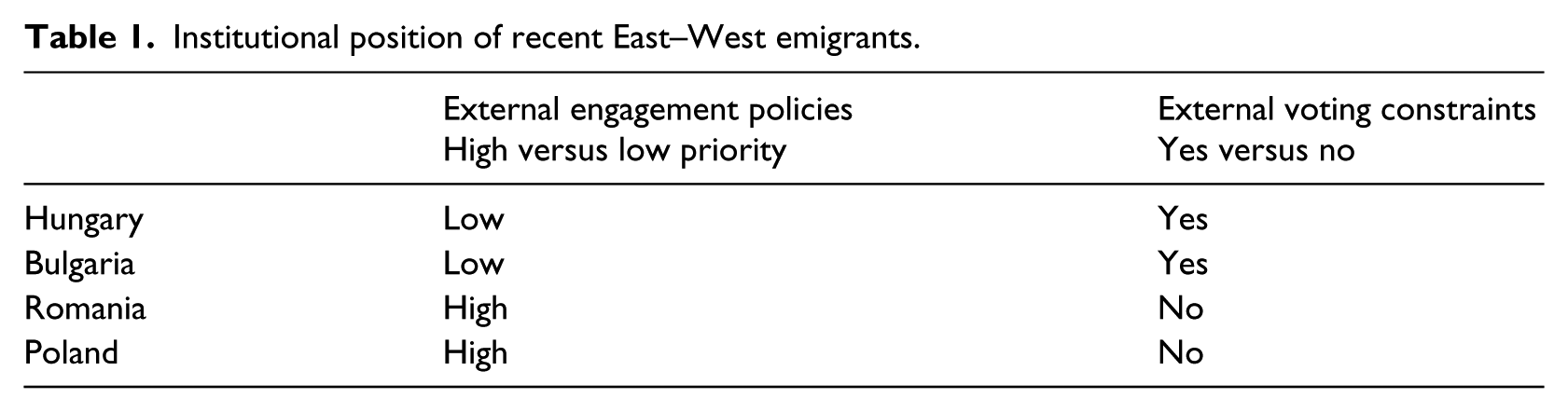
As Table 1 shows, when we apply these two dimensions of comparison to the four cases under investigation here, we can see that both Hungary and Bulgaria have maintained relatively ethnicized external engagement and external voting policies, which have marginalized the needs and concerns of intra-EU emigrants. Romania and Poland, in contrast, have broadened or shifted official priorities towards engagement with these newer emigrants, incorporating them into existing policy frameworks and expanding their scope transnationally, in addition to giving expanded access to external voters from the emigrant communities. In what follows, I highlight these variations by providing brief sketches of the four cases and their emigrant engagement policies in relation to other external populations. The data informing the case studies come primarily from country expert reports on citizenship, migration, and voting rights commissioned by organizations such as the EU Democracy Observatory on Citizenship (EUDO Citizenship Observatory) and the Organisation for Economic Co-operation and Development’s Continuous Reporting System on Migration (known by its French acronym, SOPEMI); government reports, action plans, and programs pertaining to emigrants and other external populations; and secondary sources analyzing emigration, diaspora, and kin-state policies of the four countries.
Institutional position of recent East–West emigrants.
Hungary
Hungary is the classic case of the committed kin-state, 2 having made relations with and protection of the approximately three million ethnic Hungarians living as minorities in neighboring Romania, Slovakia, and Serbia a major policy priority since the end of communism (Waterbury, 2014). In Hungary, the outsized political and institutional commitment to cross-border ethnic Hungarians has continued to dominate even in the face of continuing emigration and demographic pressures. The official government discourse towards recent emigrants focuses less on their role as economic actors, and more on their ethnocultural membership in the Hungarian nation (Pogonyi, 2015: 73). Engagement policy towards Hungary’s newer diaspora has been extremely limited and currently occupies only a peripheral place within existing institutions and policies. Until relatively recently, the vast majority of institutions and funding instruments regarding Hungarians beyond the border dealt almost exclusively with the ethnic Hungarian communities in neighboring countries. It was only in 2010 that the government set up a Diaspora Council, which created the first forum of representation and consultation for diaspora Hungarians and instituted a number of programs around cultural preservation. Most of these newer diaspora-oriented policies, however, are geared towards the more established diaspora communities in North America (Herner-Kovács, 2014: 63). A government strategy document on ‘Hungary’s Diaspora Policy’ was drafted in the fall of 2016, but this also gives little direct attention to intra-EU emigrants. The primary goal of the government towards those who ‘recently left’ Hungary as stated in the document is to have them move back home (Nemzetpolitikai Államtitkárság, 2016).
Hungarian emigrants throughout Europe have also had reason to feel excluded from the recent expansion of the Hungarian state political community through the introduction of non-resident citizenship and external voting rights offered by the Hungarian government. After the 2010 parliamentary elections the Hungarian parliament passed a modification to the law on citizenship, which made it possible for ethnic Hungarians around the world to receive Hungarian citizenship without residency in Hungary. The new citizenship law came into effect at the beginning of 2011, and by the end of that year, the parliament had also modified the constitution to allow non-resident Hungarian citizens to vote for party lists in parliamentary elections (Waterbury, 2014). 3 The parliamentary elections held in April 2014 was the first time that non-resident Hungarian citizens had the opportunity to register and vote in a Hungarian state election. Individuals of voting age that took advantage of external citizenship were able to vote by mail, but resident Hungarian citizens who emigrated to another country were only able to vote in person at consulates. This appeared to make it easier for external Hungarians with dual citizenship to vote in the election than for Hungarians from Hungary living abroad.
Bulgaria
Even as Bulgaria faces one of the steepest drops in working-age population within the EU, state responses to significant intra-EU emigration have been relatively weak and underdeveloped. Bulgaria’s relationship to the 2.5 million ethnic Bulgarians in ‘historic communities’ within neighboring territories, such as Macedonia, has dominated the institutions devoted to engaging external populations (Smilov and Jileva, 2010: 15–16). The State Agency for Bulgarians Abroad, the primary office for external Bulgarian relations, maintains as one of its main functions the granting of descendant certificates for ethnic Bulgarians who apply for citizenship, but has few concrete policies for emigrants. A prominent nationalist and well-known advocate for deeper relations with the historic Bulgarian communities, Bozhidar Dimitrov, was also appointed as the first Minister without Portfolio for Bulgarians living Abroad, again signaling the institutional prioritization of non-emigrant Bulgarians. Laws and draft laws produced to institutionalize links with external Bulgarians also include language with a highly selective and ethnic character, which has drawn criticism from members of the intra-EU emigrant community. For example, the 2000 Law on Bulgarians Living Outside the Republic of Bulgaria and a 2012 draft law on a new diaspora strategy both included language about the state’s responsibility towards those with ‘Bulgarian consciousness’. This language seemed to privilege a romanticized and historicized idea of ethnicity over the political, social, and economic ties of citizenship that emigrants felt should drive government policy (Smilov and Jileva, 2010: 22–24).
Intra-EU emigrants from Bulgaria have also been marginalized in their political representation and access to external voting. For example, in April 2016 the Bulgarian parliament passed new changes to the electoral law that included a ban on expanding the locations for external polling sites and rejecting a special voting district for Bulgarians living abroad (Fumarola and Marinov, 2016). These changes were widely seen as attempts to limit the electoral influence of the Movement for Rights and Freedom (MRF), a Bulgarian political party which is known for representing the interests of Bulgarian Turks. Bulgarian President Rosen Plevneliev was pressured by diaspora Bulgarians to veto the legislation, 4 particularly since Prime Minister Borisov had promised to push for a voting district with discrete representation for external Bulgarians in 2015 at a meeting in Switzerland. This change would have expanded the limited impact of external votes, which are assimilated into the final tally for national party lists (Dobreva, 2013: 14).
Romania
In Romania, engagement with intra-EU emigrants has strengthened over time, while commitment to historical kin communities has been maintained at a steady, but low-key, level. During the first post-communist decade, Romania had limited diaspora engagement but displayed significant concern for ethnic Romanians in the region, and particularly for the descendants of former Romanian citizens in Moldova. In 1995, the Romanian government set up the Department for Romanians Everywhere/Living Abroad, which was primarily concerned with the Romanian communities in neighboring countries. The government instituted a number of cultural support policies targeted mostly at ‘the Romanian autochthonous ethnics living abroad in the neighboring countries’, such as scholarship programs for study in Romanian high schools and universities (Culic, 2013: 136). In the intervening years, Romania shifted to a broader set of external engagement policies with a less overtly ethnic character. In 2008, the government changed the language in the law governing Romanians abroad to have a less ethnic character. The charter now demands that the state act to protect ‘ethnic Romanians and Romanian citizens who expect the support of the Romanian state in their effort to maintain Romanian identity’ (Tanasescu, 2009: 162).
External Romanian voters have special forms of representation, and played a crucial role in the last two presidential elections. The government has strengthened external voting rights for emigrants and created additional electoral districts for them, which were introduced in 2008 and reflect the growing importance of a Romanian economic diaspora throughout Europe (Burean, 2011). Early on Romania offered voting rights to all external communities, but did so by splitting historical kin communities and emigrants into different overseas voting constituencies, which means that the two communities were not in direct competition. The incumbent in the 2009 presidential election, Traian Băsescu, earned the vast majority of diaspora votes particularly from Moldova, which helped him win the very close race (Knott, 2016: 3). Intra-EU emigrants also played a large role during the 2014 presidential election and preceding campaign. Candidates for president took trips to court the votes of Romanian emigrants in Spain and Italy, and the state’s relationship to recent emigrants and their role in the election emerged during candidate debates. During the first round of voting at the beginning of November 2014, controversy erupted when a significant number of Romanian voters throughout Europe were unable to cast their ballots because there were too few polling stations to accommodate the turnout. The challenger, Klaus Iohannis, took every opportunity to criticize the government for their response to this scandal and Iohannis received significant support from diaspora voters, who became highly mobilized by the scandal to vote in large numbers in the second round and helped Iohannis to win (Knott, 2016). The new president Iohannis has since advocated for the adoption of new legislation on e-voting and including representatives from the diaspora in parliament, rather than the current system of electing domestic representatives for the diaspora via special geographic districts (Popescu, 2012).
Poland
In Poland, more effort and debate occurred in the first decade and a half after communism relating to ethnic Poles and their descendants in neighboring Belarus, Lithuania and Ukraine and former exiles in other areas of the former Soviet Union. Once debates over how to institutionalize a special relationship with ethnic Polish non-citizens were relatively settled, however, the Polish government renewed its focus on migrant return and made a significant shift in the governance of diaspora policy to reflect the increased priority placed on engagement with intra-EU emigrants (Fihel, 2011). Institutionally, the first major change was to move control of diaspora financing and policy from the Polish Senate to the Ministry of Foreign Affairs. This shift reflected a desire to move diaspora policy focus away from the symbolic politics of Polish minorities in Lithuania and Belarus, which tended to dominate the Senate’s diaspora policy agenda, to the ‘area of interest’ based on the specific needs of the Polish state (Nowosielski, 2012). The Government Programme of Cooperation with [the] Polish Community abroad, adopted in August 2015, lists as its most pressing challenge the migration of its citizens to EU member states, representing ‘the biggest wave of economic migration’ since the early 1900s (Government Programme, 2015).
In terms of voting rights, a new electoral law passed in 2011 regulates voting rights for foreigners and enshrines external voting rights for Polish citizens, regardless of residency, in national elections. The law also included provisions for postal voting for all external voters, which previously was possible only for disabled voters. The importance of the intra-EU emigrants as political constituents has, therefore, increased along with their growing importance in official diaspora politics (Korzec and Pudzianowska, 2013). The assimilated representation of the diaspora votes into a single district around central Warsaw somewhat limits the impact of external votes in Polish elections, but is applied equally to all external voters.
Explaining variation in responses to emigration
The variation among the four cases described above calls into question earlier analyses which saw state policies towards emigrants as being driven primarily by the desire to secure continuous access to economic resources (Østergaard-Nielsen, 2003). The different degrees to which these four states have prioritized intra-EU emigrants in external engagement policies cannot be explained by the overall size of the emigrant population nor by the levels of remittances sent home by them. As Table 2 shows, Bulgaria and Hungary have the highest and the lowest percentages of population abroad, with Romania and Poland in the middle, and Hungary and Poland had the highest flows of remittances in 2015. Other scholars have explained variation in the political incorporation of emigrants by looking at the degree of democratization and normative concerns about representation and physical presence within the state (Hutcheson and Arrighi, 2015). However, while there are some important distinctions among the four cases in terms of quality of democracy, as we see from the first column of Table 2, these differences also do not map to variations in policy response.
Democracy scores, size of emigrant population, remittance flows.
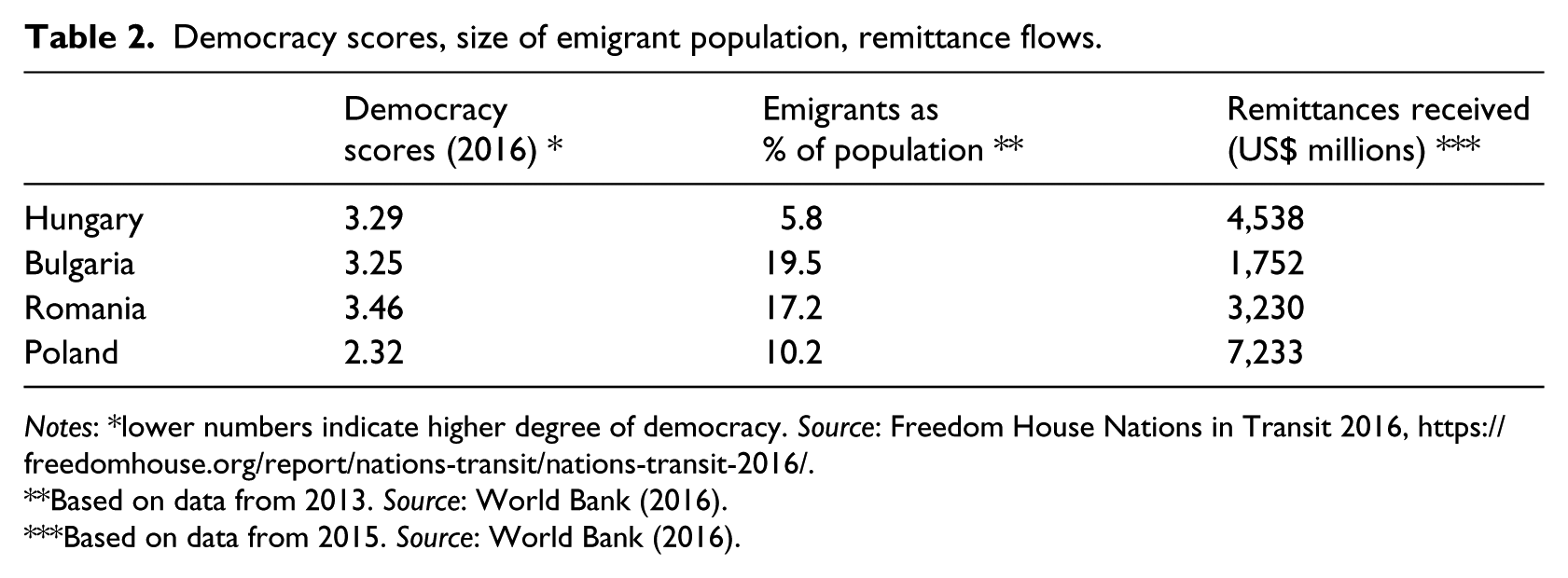
Notes: *lower numbers indicate higher degree of democracy. Source: Freedom House Nations in Transit 2016, https://freedomhouse.org/report/nations-transit/nations-transit-2016/.
Based on data from 2013. Source: World Bank (2016).
Based on data from 2015. Source: World Bank (2016).
In order to understand how Central and East European states respond to recent emigration, I argue that we must take into account the state’s relationship to pre-existing political and institutional structures that privilege or exclude specific subsets of external populations in these states. The extent to which emigrants are incorporated into national narratives of belonging shapes the development of emigrant engagement policies and institutions (Mügge, 2012). During the first post-communist decade states such as Hungary, Bulgaria, Romania, and Poland were most visibly engaged in policies of external engagement focused on reaching out to and taking responsibility for communities of ethnic kin living in neighboring states as national minorities (Brubaker, 1996). States such as Bulgaria and Romania also had to contend with significant internal national minority communities, which had relationships to their own neighboring kin-states. The incorporation of intra-EU emigrants into ‘the body politic’ (Collyer, 2013: 16–20) of these states has, therefore, been complicated by a highly ethnicized and symbolic politics that privileges relations with historical kin communities across the border and seeks to maintain national homogeneity within the borders of the state. As a consequence, while some post-communist states developed expansive notions of citizens abroad that encompassed both historical kin communities as well as recent emigrants, others maintained a clear distinction between the two, often privileging the former and marginalizing the latter.
The remainder of the article outlines two factors that explain the specific variations we see among the cases and highlights why and under what conditions historic kin might or might not be institutionally privileged relative to recent emigrants. The first factor reflects the complex intersection of interests and identity that occurs when a state has a significant internal minority population and members of that internal minority community make up a politically active subsection of the emigrant community. The second factor reflects the overall political and demographic salience of the state’s relationship to historical kin communities across the border in neighboring and nearby states.
Internal minorities as politically active emigrants
Two of the four cases analyzed here have a significant internal national minority (defined as more than 5% of the overall population), but that difference cuts across the main distinctions among the cases outlined in Table 1. Hungary and Poland have relatively small national minority populations, compared to the large ethnic Hungarian minority in Romania (6.5% of population) and the ethnic Turks in Bulgaria (8.5% of population). So, how can we explain the variation in emigration responses between the two states with significant internal minorities, Romania and Bulgaria? Here, I argue that what matters is whether those internal minorities are politically active members of the overall emigrant and regional diaspora community.
In both Romania and Bulgaria emigration to a neighboring kin-state by members of the minority constituted a large proportion of those who left in the late 1980s and early 1990s. Hungarians and Germans made up a sizable proportion of early Romanian emigrants, and Turks were by far the largest group of emigrants from Bulgaria during the transition period (Dobreva, 2013: 4–6; Horváth and Kiss, 2015: 117). This early trend of ethnic unmixing did not trigger the kind of nationalist anxieties about ethno-demographic survival (Dumbrava, 2016) that would come later on with an increase in the long-term migration of young, well-educated members of the majority. In fact, Turkish Bulgarian emigration in the late 1980s was the direct, and intended, result of systematic exclusion by the Bulgarian state (Koinova, 2013: 35–36). Later on, in the democratization process, however, the presence of hundreds of thousands of Bulgarian Turks in neighboring Turkey, who remained politically active in Bulgarian politics by returning home to vote and later by having access to external voting rights, deeply impacted Bulgarian state responses to emigrant political participation. Turkish Bulgarians living in Turkey have tended to vote in large numbers in local and national elections in Bulgaria, usually for the MRF. Concerns over block voting and electoral tourism from Turkey by voters with dual Turkish/Bulgarian citizenship over time has led to electoral reforms by Bulgarian policy-makers that would limit the ballot access of all emigrant Bulgarians (Dobreva, 2013: 5–8). Emigrant Bulgarians in Western Europe have, therefore, been caught in the attempts of some lawmakers to limit the political influence of Bulgarian Turks who live in Turkey.
In Romania, the impact of ethnically differentiated emigration was much less dramatic. Ethnic Germans from Romania were welcomed back to Germany and given German passports, but they could not as easily remain active members of the Romanian political community. Germany did not allow for dual citizenship at the time, so many ethnic migrants had to give up their Romanian citizenship. Germany was also not geographically adjacent to Romania, nor did the German government have any interest in organizing Romanian Germans to return home to vote, the way the Turkish government did. The German minority community in Romania had also been shrinking for decades, and was not nearly as politically organized or engaged as either the Turks in Bulgaria or the Hungarians in Romania. Ethnic Hungarians who moved across the border from Romania to Hungary were greeted with a somewhat more ambiguous welcome. They were offered a privileged path to citizenship in Hungary, but in the early 1990s this was not automatic and still required a period of residency. Those who left Romania had the option to permanently settle in Hungary, but did not constitute a significant voting bloc that would change the fortune of the ethnic Hungarian party back in Romania. In addition, worsening economic conditions in Romania in the early transition period led to an increase in non-ethnic emigration from rural farming and post-industrial areas, which quickly came to balance the number of ethnic Germans and Hungarians who had left (Horváth and Kiss, 2015: 105). Therefore, external engagement and voting policies in Romania were never significantly impacted by concerns that such policies would empower internal minorities living elsewhere the way that they did in Bulgaria. As a result, Romania’s policies have done more to expand political and institutional access for emigrant populations than those that have developed in Bulgaria.
Political and demographic salience of historical kin communities
Given the powerful symbolic and often emotional connection to communities of ethnic kin living as national minorities in neighboring states throughout Central and Eastern Europe, we might expect all such kin-states to privilege that trans-border relationship over all others. However, as a number of studies have shown (Csergő and Goldgeier, 2013; Saideman and Ayres, 2008; Waterbury, 2014), there are important differences in the degree and intensity of kin-states politics, which result in varying foreign and domestic policy stances regarding historical kin communities. These differences help account for why some states, such as Hungary and Bulgaria, may prioritize external kin communities over emigrants in institutions of external engagement, and why other states, such as Romania and Poland, may not.
One set of variables that explains differences among kin-state policy stances has to do with ‘the place of external kin in a modern national story’ (Csergő and Goldgeier, 2013: 93). If a rhetorical and policy focus on external kin in neighboring states can support rather than undermine governing elites’ primary ‘identity project’ (Waterbury, 2014) or their brand of nationalism (Saideman and Ayres, 2008), then the logic of domestic politics will privilege ethnic kin communities over others. Similarly, if there is major partisan contestation over external kin policy, then this will likely drive increased engagement with this external population (Csergő and Goldgeier, 2013: 114). Another set of variables focuses on the degree to which the historical kin communities in neighboring countries are seen as ‘besieged’ minorities in need of protection and more interventionist support from the kin-state, and to what extent members of that community are mobilized to request and receive such support. External kin minorities in visible danger or facing assimilationist pressures in their state of residence will compel more attention and intervention by the kin-state (Saideman and Ayres, 2008: 43), and politically organized external kin populations with extensive institutional resources may be better positioned to make demands for support from the kin-state (Csergő and Goldgeier, 2013: 94). Finally, the political and policy salience of historical kin communities may be shaped by the degree to which members of these communities are seen as a potential source of an ethnically compatible demographic replacement for the kin-state (Dumbrava, 2016; Waterbury, 2014: 38). 5
Based on an assessment of these variables, I place Hungary and Bulgaria into the category of kin-states for which relations with external ethnic kin have a high degree of salience, and Romania and Poland into the category of kin-states for which external kin communities have a lower degree of salience. Hungary’s ranking of high salience is supported by the fact that Hungary has maintained a strong policy of protection and advocacy towards Hungarian minority groups in countries such as Romania and Slovakia, where the percentage of ethnic Hungarians is 6.5% and 8.5% of the total population respectively. The concern by Hungarian political leaders that Hungarian minorities communities are under siege by the assimilationist policies of neighboring governments, a concern supported by troubling demographic data on declining Hungarian minority communities, has led to an ‘assertive’ kin-state stance by Hungary (Saideman and Ayres, 2008: 106). This assertive stance has also been mirrored by the politically organized and resourceful Hungarian minority communities, which maintain strong political, social, and economic ties with the kin-state. In addition, Hungary has experienced a high degree of partisan fighting over the nature of kin-state policies (Waterbury, 2014: 43–44). Therefore, for Hungary, external kin in neighboring states has had a ‘continued presence in the national story’, making it ‘one of the most prominent themes in post-communist politics’ there (Csergő and Goldgeier, 2013: 116). The only area in which external ethnic kin has low salience for Hungary is in seeing this population as a realistic source of demographic replacement. Policy-makers occasionally tout the potential demographic advantages of having strong ties to a neighboring ethnic kin community, but fear making changes that will reduce the size and strength of the external kin communities (Dumbrava, 2016: 13).
Romania, in contrast to Hungary, has demonstrated a more ‘low-profile’ kin-state stance (Csergő and Goldgeier, 2013: 113). Romania’s largest historical kin community is seen as encompassing most of the population of neighboring Moldova (though there are smaller minority Romanian communities in Ukraine and Bulgaria). Policy priorities, therefore, have reflected a desire to incorporate Moldovans into the Romanian cultural sphere, rather than a need to protect a concentrated minority community fighting for basic rights and representation. Romanian Moldovans have also shown less inclination to organize politically around their relationship to Romania. Politics in Romania has also demonstrated more consensus and less partisanship around kin-state policies in general (Culic, 2013; Dobreva, 2013). Romania, for example, ‘restored’ citizenship to all former Romanian citizens, effectively offering citizenship upon request to about two-thirds of those living in newly-independent Moldova in the early 1990s. After ‘solving’ a big portion of the historical kin question so early, there was little political controversy going forward about Romania’s kin-state role.
Bulgaria has had a more ambiguous relationship with scattered communities of ethnic Bulgarians in Macedonia and other regional states, making its overall stance less consistently activist than Hungary’s. The state’s relationship to historical kin communities has also maintained a high degree of symbolic and rhetorical salience, though this has not always translated into clear partisan lines (Smilov and Jileva, 2010). However, the expectation that ethnic kin will be able to fill in demographic gaps from emigration and low birth rates has been a key part of Bulgaria’s national migration and development strategies. Starting around 2006, government ministers began to argue that Bulgaria needed to import ethnic Bulgarians from abroad to help offset the state’s demographic lapse due to high emigration and lower birth rates. Policies were targeted especially to those from the historic communities in neighboring Macedonia, Moldova, and Ukraine, who were more likely to speak the language and understand the culture (Smilov and Jileva, 2010).
In contrast, Poland, which has also experienced relatively low degrees of partisanship and a less intense politics of advocacy regarding ethnic Poles in Lithuania and Belarus (Gorny and Pudzianowska, 2013), has been quite cautious about inviting ethnic migration on any large scale. The government wanted to offer a path to ‘restore’ citizenship to forcibly displaced Poles and repatriate them in the early 1990s, but it was cautious about opening any floodgates of large-scale immigration that would threaten Poland’s tenuous economic transition. Fears of harming internal homogeneity by giving too much access to regional kin members trumped the more compensatory and moral concerns expressed on behalf of ethnic Poles in the region for most of the first post-communist decade. As a result, Poland only passed a very limited repatriation law for ethnic Poles in former Soviet republics in 1998, with further expansions to the law made in 2000 (Iglicka and Ziolek-Skrzypczak, 2010).
The variations in kin-state stances and the salience of the external kin communities among the four cases provide a useful way to understand why elevating the state’s relationship to historical kin communities, even at the cost of weaker engagement with intra-EU emigrants, might be a higher priority for some states than others. States in which a higher degree of political and demographic salience regarding historical kin is demonstrated, such as Hungary, are more reluctant to embrace a more broadly transnational set of external engagement institutions that puts citizens who chose to leave their homeland behind on equal footing with members of the historical nation who struggle to maintain cultural ties to their homeland. Similarly, in Bulgaria the state’s attempt to solve demographic problems through importing new ethnic citizens, and the institutional focus on historic kin communities, has left little room for engaging recent emigrants throughout Western Europe. As a result, Bulgarian emigrants’ institutional marginalization, uncertain partisan loyalties, and relative heterogeneity have kept them as a peripheral and untapped political constituency.
In contrast, in Romania a more expansive and inclusive set of political and bureaucratic institutions developed over time as the intra-EU emigrants became more politically salient. Romania’s conception of nationhood was able to encompass populations in its historically-affiliated territories as well as emigrants and incipient diaspora members in the West. 6 And in Poland there has been much more ambiguity and caution about the state’s commitment to cross-border ethnic Poles, and therefore, fewer constraints in moving away from this narrow population towards a broader transnational focus. Bringing together the relative salience of kin-state politics with the existence of a politically-active ‘minority’ emigrant community explains the variations between cases with particularly large emigrant communities (Romania and Bulgaria), as well as broader differences in approach among the four cases.
Conclusion
The states of Central and Eastern Europe that have experienced significant amounts of intra-EU emigration responded to this challenge in different ways. Hungary, which has only recently begun to acknowledge its emigration situation, has developed very limited institutions and policies to engage its newest diaspora. It continues to privilege support for cross-border minorities and more established diaspora populations in its policy and rhetorical emphasis, and approaches intra-EU emigration as an aberrant trend to be reversed or prevented. Bulgaria has a less developed institutional relationship with either its cross-border or its emigrant population, but it privileges engagement with the former through citizenship and symbolic policies to the detriment of the latter. In contrast, states such as Poland and Romania, have either diminished or maintained their focus on ethnic citizenship and repatriation schemes for large, territorially-concentrated external kin groups of historical importance, while growing their institutional and political focus on intra-EU emigrants. In these cases, regional ethnic politics is still salient, but their relationship to kin communities did not produce significant institutional and political barriers to dealing with the issue of intra-EU emigration.
There are a few general implications that can be taken from this study. First, we see that the more recent EU member states from Eastern Europe have responded to intra-EU emigration in different ways, despite similar discourses about the challenges emigration presents. Variation in broad policy responses to emigration seems to correlate with the degree to which domestic politics and institutional frameworks are dominated by a more exclusive relationship with cross-border ethnic kin. We also see important variations among cases in response to the politics of ethnicity and nationalism in each country. Specifically, it appears to matter whether other politically salient dimensions of ethnic politics crosscut or not the position of more recent emigrants. When emigrants are seen by the state as difficult subjects that do not correspond to the dominant political narrative about ethnicity and belonging, then their absence will not necessarily be treated as a problem to be rectified.
This suggests that diaspora and emigrant engagement policies are not written on a tabula rasa, nor are they always driven by a desire for remittances. Instead, they are shaped by existing policy priorities and institutional frameworks targeted to specific external populations. Political interests and institutional legacies entrenched in existing cross-border and transnational networks may in fact hinder the development of effective engagement policies. The cases explored here also demonstrate that not all members of an external population are engaged equally by the state. Some external populations, such as those dominated by political or ethnic minorities, may in fact cause the state to limit the political incorporation of emigrants. This suggests that more thorough analyses are needed not just of why states engage certain emigrant or ethnic kin populations, but of what factors shape engagement policies towards different types of external populations. Finally, states may be limited in their ability to formally engage specific diaspora populations, such as intra-EU migrants, not only by institutional entrenchment, but by the structural nature of those populations. Somewhat surprisingly, the post-accession wave and post-recession wave of intra-EU emigration have proven to be a particular challenge for state-led engagement policies. Future research into emigrant engagement should pay attention both to the ways in which conceptions of national belonging are institutionalized within the sending state, and to the potentially unique position of emigrant populations in regions of greater border fluidity.
Supplemental Material
resumes_Waterbury – Supplemental material for Caught between nationalism and transnationalism: How Central and East European states respond to East–West emigration
Supplemental material, resumes_Waterbury for Caught between nationalism and transnationalism: How Central and East European states respond to East–West emigration by Myra A Waterbury in International Political Science Review
Footnotes
Acknowledgements
I thank Maria Koinova and Gerasimos Tsourapas, as well as fellow participants in the 2015 British International Studies Association workshop on ‘Sending States, Emigrants and Diasporas’ and the 2016 International Studies Association workshop on ‘Unpacking the Sending State’ for their helpful feedback on earlier drafts of this work.
Funding
This research received no specific grant from any funding agency in the public, commercial, or not-for-profit sectors.
Notes
Author biography
References
Supplementary Material
Please find the following supplemental material available below.
For Open Access articles published under a Creative Commons License, all supplemental material carries the same license as the article it is associated with.
For non-Open Access articles published, all supplemental material carries a non-exclusive license, and permission requests for re-use of supplemental material or any part of supplemental material shall be sent directly to the copyright owner as specified in the copyright notice associated with the article.
