







Abstract
How do non-repressive state responses to a protest event affect future protest behaviour? And what are the psychological mechanisms driving these effects? While the repression–protest nexus has been extensively studied, the role of non-repressive responses, such as ignoring or accommodating dissent, remains underexplored. Challenging the prevailing assumption that these responses are inconsequential, this study argues that non-repressive state behaviours actively shape protest dynamics by influencing dissidents’ emotions, particularly anger and hope. To assess the relationship between non-repressive responses and future protest activity, this study conducted a survey experiment in Argentina. Findings reveal that ignoring decreases anger and hope, which, in turn, reduces the propensity to participate in future protests, while partial and full accommodation attenuates anger, which decreases the willingness to protest. These results highlight that non-repressive state responses have significant consequences for contentious politics.
Introduction
While the repression–protest nexus has been extensively studied, much less attention has been paid to how governments respond to protests through non-repressive tactics. The predominant focus on repression has yielded valuable insights into the dynamics of mobilization, but consequently, it has also left critical gaps in our understanding of alternative strategies governments use during protest events. While debates about whether repression suppresses dissent by increasing the costs of mobilization or whether it escalates protests by generating grievances and outrage continue (Aytaç and Stokes, 2019; Khawaja, 1993; Pierskalla, 2010; Tilly, 1978; Zhukov, 2023), little has been said about what happens when states choose a non-repressive course of action. This is partially due to the tendency to assume that when the state does not repress a protest, its response is either inconsequential or a residual category that merits little analytical distinction. However, this assumption is misleading.
Non-repressive governmental responses to dissent actively shape future protest behaviour by influencing how dissidents interpret government actions and assessing the prospect of success in future mobilization. More importantly, studies that explore psychological mechanisms behind the link between non-repressive state responses and protest behaviour are nearly 1 non-existent. It is unclear whether and how exactly emotions play a role in shaping individuals’ decisions to protest when the government adopts an alternative strategy to repression.
Despite their significant implications for understanding state-dissident interactions, important questions, therefore, remain largely unexplored in the literature. For instance, do non-repressive state responses to protest events affect future protest behaviour? If so, how? When a government ignores a protest, does it discourage further engagement in protest behaviour by fostering a sense of hopelessness, or does it increase protests by angering protesters? When a government partially or fully accommodates protesters’ demands, does accommodation satisfy grievances and thus demobilize movements? What are the psychological mechanisms behind protest decision when the government chooses not to repress protesters? And how exactly do they work?
This study aims to answer these questions and contributes to the literature by challenging the conventional repression-focused paradigm and arguing that non-repressive state behaviours – specifically ignoring and accommodating the demands partially and fully – play a crucial role in determining future protest activity. It diverges from the majority of the existing scholarship on non-repressive state responses by pointing out that the key to understanding the effects of ignoring and accommodating protesters’ demands lies in the psychological mechanisms, which, I argue, mediate the relationship between state responses and subsequent protest behaviour. In other words, this study further contributes to the literature by hypothesizing that emotions – particularly anger and hope – serve as the crucial mediating links between governmental actions against protesters and individuals’ decisions to engage in future protests. To test these arguments, I have conducted an online survey experiment in Argentina, aiming to offer fine-grained evidence on the psychological mechanisms at play.
Non-repressive state tactics: ignoring and accommodating
Whether it functions through grievances or the cost-benefit calculations of individuals, and whether it has a deterring or an increasing effect on protest, repression is undoubtedly one of the most fundamental predictors of protest behaviour. Nevertheless, repression is not the only option governments have when they face popular dissent. In addition to repression, the government can ignore or accommodate protesters’ demands – either partially (e.g. inviting protest leaders to a formal meeting) or fully (i.e. acquiescence). As such, from the government’s perspective, the option that is the opposite alternative of repression is not its lack thereof.
Notwithstanding, only a few studies move beyond a single category of state response and binary repression/no-repression categorization and analyze protest movements with a wider range of governmental responses (Bishara, 2015; Boudreau, 2005; Cai, 2008; Franklin, 2009; Ginkel and Smith, 1999; Goldstone and Tilly, 2001; Leuschner and Hellmeier, 2024; Moore, 2000; Pierskalla, 2010; Yuen and Cheng, 2017). Much research, in contrast, tends to combine government responses into a single variable and assumes that ignoring protests and accommodating protesters’ demands are residual categories of state reactions to protest and have negligible consequences on future mobilization.
Lumping non-repressive responses into one basket is problematic because accommodation and ignoring are as important state strategies as repression, and potentially account for future mobilization. For instance, responding to dissent with concessions may lead dissidents to express greater demands from the government, such as the elimination or transformation of the regime. This is because concessions increase protesters’ expectations that their goals will be achieved, and protesters perceive the regime as weak and thus, more can be extracted from the government (Muller and Opp, 1986). Building on this argument, Pierskalla (2010) demonstrates with a game-theoretical model that citizens will engage in mobilization, and the state’s reaction to dissent will be accommodation if protesters believe that they are facing a reasonably weak government.
Rasler (1996) argues that this is exactly what the world witnessed during the Islamic Revolution of 1979. Concessions offered by the Shah of Iran increased the expectation among the Iranian opposition that the desired public goods could be achieved via collective action. The result was the escalation and diffusion of protest behaviour. Carey (2006) tests the argument that concessions are seen as signs of regime weakness and finds that accommodation increases protest, but mostly in autocracies.
In this set of works, concessions are conceptually associated with a decrease in repression, implying that accommodation is a function of varying levels of repression. 2 That is, accommodation is defined as very little or no repression, and accommodating state behaviour is thus analytically derived from repression. Nonetheless, accommodation and the absence of repression should not be assumed to be analytically similar. Accommodation should constitute a separate government policy – a policy of its own, such as regional autonomy, land reforms, and the redistribution of government spending – and it should be distinguishable from other government policies like repression or its absence.
Exploring whether protest campaigns continue even after the government agrees to concessions, Leuschner and Hellmeier (2024) make this much-needed theoretical distinction between accommodation and repression. Focusing on autocracies, their analysis indicates a robust mobilizing effect of concessions, which, they argue, is because under conditions of shifting demands and diverse protest coalitions, autocratic leaders are unlikely to offer agreements that can appease the majority of protesters. And even if they do, promises of change are not credible.
While there exists a growing body of literature examining two governmental responses (i.e. repression versus accommodation) instead of a single response (i.e. repression versus its absence), and these studies lead to new valuable insights on how future protest activities are shaped by the state’s reaction to previous dissent, psychological mechanisms behind the relationship between governmental responses to protest and future dissent action remain understudied. For instance, the literature – to my knowledge – does not answer how the accommodation of protesters’ demands may shape future protest decisions through emotions that stem from the success of convincing the government to backtrack. Moreover, past studies do not explicitly address a frequently observed situation in which the government uses neither repression nor accommodation. In fact, only a handful of scholars pay some attention to a third type of government response to protests: simply ignoring dissent.
Boudreau (2005) is one of the few scholars who argue that ignoring is a state response to social challenges that weak governments may prefer over repression in order to conserve resources to undertake state-building. Cai (2008) also propounds that the state can show tolerance towards citizens’ resistance and defines tolerance as a situation where ‘citizens’ demands are ignored but the government also tolerates their resistance’ (p. 417). Franklin (2009) similarly contends that the government, in the face of a protest event, may choose to tolerate the challenge. Toleration, Franklin renders, is the absence of repression and concessions as the government response to contentious challenges. He argues that toleration discourages future mobilization in the long term by lowering individuals’ expectations of success.
However, a similar problem can be seen in the conceptualization of ignoring. Ignoring, like accommodation, is not a residual category of state responses. Ignoring is also a state policy of its own, distinct from the absence of repression. Bishara (2015) thus criticizes the concept of tolerance/toleration and argues that ignoring is a specific government behaviour that aims to ‘capture situations in which regime officials appear distant from the actions or demands of protesters’ (p. 962). Contrary to Franklin, Bishara anticipates that ignoring protests spurs subsequent protests by causing anger among dissidents.
Bishara’s introduction of anger as a psychological mechanism that might shape collective dissent is crucial for the progress in clarifying non-repressive state responses to popular mobilization. Nonetheless, understanding the psychological processes that connect state responses to protest dynamics requires us to delve deeper into various emotions, not just anger. For instance, the perceived lower expectations of a protest movement’s success, which might be followed by ignoring response from the government, may reduce hope. The emotion of hope, in addition to anger, must be taken into consideration in protest research because studies provide strong evidence that hope is one of the determinants of political judgements, opinions, and behaviours (Civettini, 2011; Feldman and Hart, 2016; Reading, 2004; Smith and Leiserowitz, 2014; Snyder et al., 1991
In sum, recent scholarship increasingly challenges the binary view of repression versus non-repression, emphasizing the variety of ways governments respond to dissent, including both accommodation and ignoring. While there has been some conceptual improvement, important gaps remain. This study addresses these gaps in the following sections and contributes to the existing scholarship on non-repressive state responses to protests by theorizing that emotions evoked by being ignored and accommodated by the government mediate the relationship between non-repressive state reactions to protest and individuals’ decisions to mobilize.
Theory
I begin to explore the link between non-repressive state responses to protest events and subsequent mobilization by clarifying and categorizing state responses. When a group of individuals gathers publicly to display opposition to the policies of a government and protest the political authorities, the government, as Figure 1 illustrates, can respond to a protest and protesters’ demands either negatively or positively. A negative response is the rejection of demands, and a positive response is the accommodation of those demands. The use of repression against protesters by arresting, beating, or even killing them is a negative response. Nevertheless, there exists another negative response that is an alternative to repression, and the government may choose it over repression to inform protesters that their demands are not accepted. This tactic is ignoring.
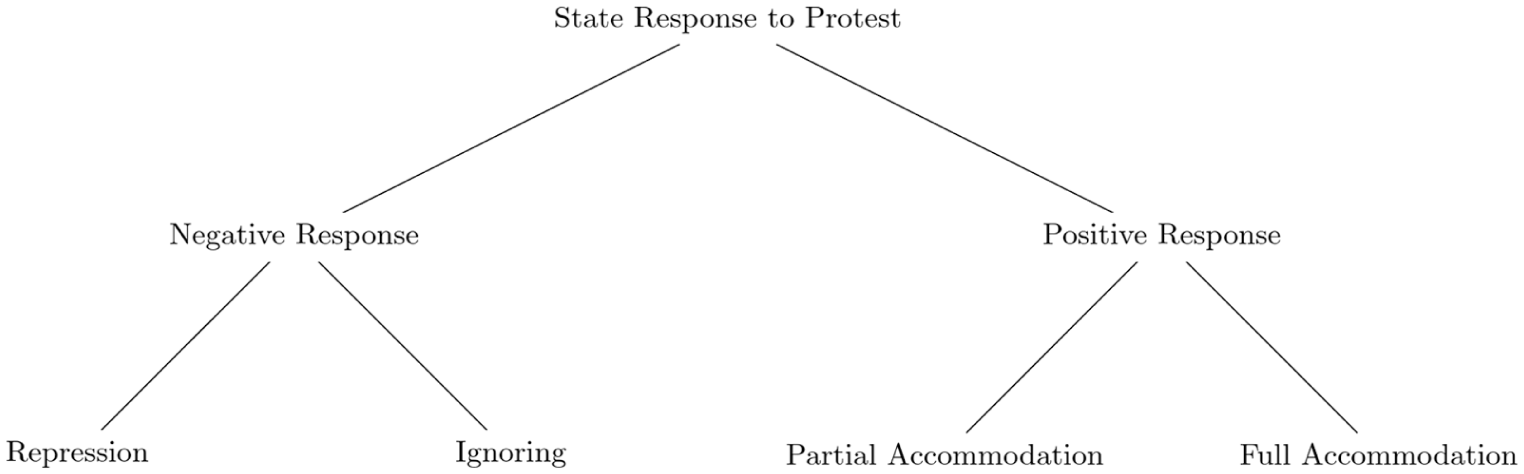
State responses to mobilization.
Ignoring ‘is a calculated government decision’ (Klein and Regan, 2018: 495). As such, the government may prefer to respond to a protest by ignoring it for various reasons. The state might ignore dissent and appear dismissive lest any reaction from the government grant credibility and legitimacy to protesters and their goals, which risks escalation. The state might also ignore protesters because it cannot devote resources to repression (Boudreau, 2005). Furthermore, the state might ignore dissent, thinking that the movement is irrelevant or expecting that it will wear out and die out soon (Yuen and Cheng, 2017).
Ignoring protesters instead of repressing them gives protesters the freedom to speak their minds publicly in opposition to the government. However, it does not put the government in a neutral policy position. Ignoring may be the absence of a state reaction (Cai, 2008; Franklin, 2009), but it is also the rejection of protesters’ demands by simply doing nothing. In other words, when the government ignores a protest, it dismisses protesters’ demands, but it does so without taking action against protesters. Therefore, ignoring, from the perspective of the government, is ‘both inaction and contemptuous actions’, as Bishara puts it (Bishara, 2015: 961).
Drawing on Bishara, Yuen and Cheng (2017) introduce another form of ignoring protesters, which they call attrition. Attrition is a form of ignoring state response to popular mobilization that denotes instances in which the government tolerates dissent, but toleration is not through inaction and contempt, as opposed to Bishara’s conceptualization. Instead, the government appears dismissive, while it proactively attempts to discredit, wear out, and increase the costs of participation in protest by mobilizing a countermovement against protesters and using court injunctions to impose legal pressure on protest participants. Although attrition is undoubtedly a part of governments’ tactical repertoire, this study understands ignoring in the way that Bishara conceptualizes it because the goal of this research is to understand the short-term effects of initial state responses to protest events. Whereas attrition is a viable strategy particularly against prolonged campaigns or large-scale social movements (e.g. the Umbrella Movement in Hong Kong).
Positive state response is not monolithic either (Cai, 2008; Goldstone and Tilly, 2001). Partial accommodation and full accommodation are two possible forms of positive response. The former involves the state agreeing to meet with protesters and engage in negotiations. While some demands may be met during this process, it remains an ongoing bargaining effort, and the state may ultimately reject most demands. Even so, securing a seat at the negotiation table represents a concession for protesters.
The latter, by contrast, signifies a complete victory for protesters, with the state acquiescing to or promising to fulfill their demands. Full accommodation refers to the scenario in which the government completely abandons its original preferred policy position and meets with that of protesters. Full accommodation might not happen overnight. Some demands may take time to materialize due to legislative or bureaucratic delays. In such cases, a public commitment from the government to reverse its policy can also be considered full accommodation.
A government might display accommodating behaviour for various reasons. All protests bring about disruption. The extent of disruption varies depending on a protest’s spatial and temporal diffusion, but at the end, disruption at some level is always the outcome of dissent. The government, facing mass protests, might calculate that the anticipated disruption is not worth insisting on the policy that upsets citizens, and it might decide to budge. Another reason could be to avoid risking the exodus of some of the coalition partners in a government who are sympathetic to protesters and their demands should their commitment to the coalition be needed to ensure that the government remains in power. Also, unlike protesters, the government is likely to have a solid understanding of its own capabilities. A government might choose to accommodate demands if it is aware that it lacks the necessary strength and resources to resist the demands for a policy change and survive a popular dissent.
During a prolonged protest movement, the government may adopt varying responses, such as initially using coercion to restore order before offering concessions or the reverse. As a result, the use of mixed strategies and their temporal sequences is vital for understanding long-term protest dynamics. Nevertheless, this study, once again, focuses on the effects of initial non-repressive responses to a protest on collective dissent action in the short term. Another scope condition for the theory is that it focuses on mobilization at the national level against central governments. Concordantly, the theory herein aims to explain the interaction between individual protesters and the political institution in which the chief executive is vested with the power of how to respond to dissidents (i.e. repression, ignoring, and accommodation).
Building on this classification, I argue that the government’s non-repressive responses to a protest affect individuals’ decision to participate in subsequent protests. Specifically, based on the corpus of literature that links emotions to protest behaviour (Jasper, 2014; Van Stekelenburg, 2013; Van Troost et al., 2013; Young, 2019), I propound that the effect of the state response to a protest on future mobilization is mediated by emotions generated by this very response from the government. This relationship is illustrated in Figure 2. As the figure shows, ignoring, partial accommodation, and full accommodation can have a direct effect on future mobilization decisions. However, the government response affects the decision to partake in future protest activity also indirectly via emotions stemming from the government response.
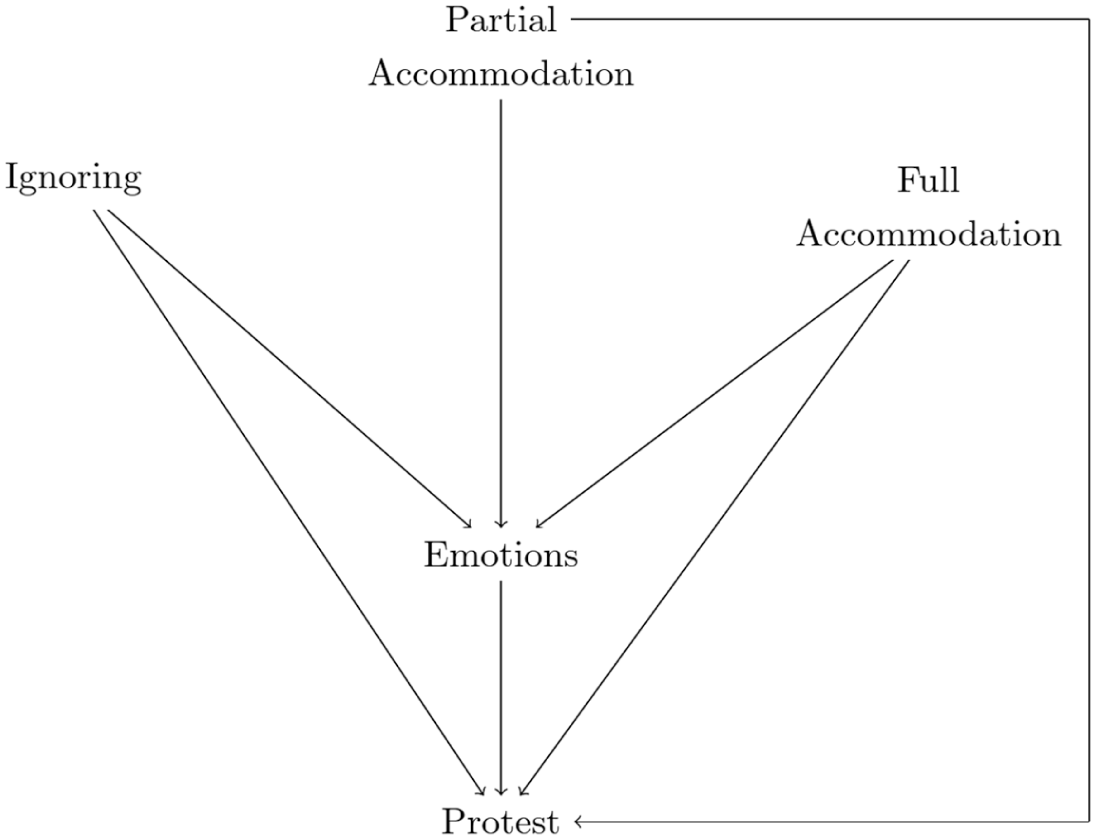
The relationship between non-repressive state response and protest.
There are potentially two emotions at work: anger and hope. Ignoring a protest leaves issues unaddressed for dissidents and offers no solutions to their problems. Furthermore, the state’s dismissive reaction to mobilization could reinforce protesters’ perception that the government holds them in contempt, does not take their grievances seriously, and, worse, will continue to subject them to injustice. Consequently, ignoring dissidents exacerbates existing grievances and fuels anger (Bishara, 2015). Empirical analyses usually indicate that anger functions as a politically motivating emotion (Aytaç and Stokes, 2019; Kleres and Wettergren, 2017; Valentino et al., 2011). It tends to encourage individuals to attempt to right the wrongs people are being forced to endure (Frijda et al., 1989; McAdam, 2004) and seek justice and retribution (Smith and Lazarus, 1990). As such, when experiencing anger, dissidents act aggressively and punitively (Hopfensitz and Reuben, 2009; Lerner and Tiedens, 2006; Lerner et al., 2003).
At the same time, anger proceeding from being ignored by the government could incentivize dissidents to continue protesting because when people experience anger, they believe they are more powerful than those they perceive as the source of their frustration (Benski, 2005). Anger often results in the belief that people have the power to do something about what they perceive as wrong (Mintz et al., 2021). That is, anger generated by the state ignoring dissidents’ demands could lead protesters to think that the government is weak and, by extension, future protest participation might not be met with repression. Therefore, it is plausible that the relationship between ignoring state response and future mobilization is a positive one because ignoring angers protesters, as Bishara theorizes.
A growing body of literature in psychology, however, challenges the assumption that emotions have a constant and deterministic effect on human behaviour (Barrett, 2006, 2011). This literature suggests that emotions, on the contrary, are not uniformly and universally triggered reactions, and they are constructed by environment and culture (Barrett, 2019). As a result, ignoring protesters may evoke anger, but it might function differently from Bishara’s expectations. In other words, ignoring response by the state might not result in the type or level of anger and outrage that we consistently find to be associated with repression (Aytaç and Stokes, 2019; Van Stekelenburg and Klandermans, 2013; Van Stekelenburg et al., 2011). After all, getting arrested, beaten, or shot by the police is certainly a much more traumatic experience than being ignored. Hence, even if being ignored frustrates protesters, anger stemming from being ignored might not be as motivating as the high levels of anger aroused by the exposure to state repression.
Moreover, protests generate multiple emotions and a combination of negative and positive emotions 3 depending on the dynamics of a protest (Jasper and Zhelnina, 2022). As such, at widespread protests with maximalist goals, anger might be a product of being ignored by the state, but at small-scale protest events, which represent the vast majority of protest events (Klein and Regan, 2018), anger might not be the only emotion protesters experience after their demands are ignored. Being ignored could induce hopelessness as well.
Hope is a feeling that emerges when individuals perceive a desired future goal as realistically attainable, and this belief motivates them to engage in actions they consider conducive to achieving it (Reading, 2004). An ignoring governmental response is the rejection of dissidents’ demands and thus connotes that protesters have failed to achieve their goals. Failures in the past could lead individuals to adopt a pessimistic assessment of future attempts, as some people have the predisposition to believe that the consequences of future attempts to deal with problems following past failures will be negative (Sanna et al., 2006; Tykocinski et al., 2002). As a result, hopelessness could emerge from being ignored by the government as an alternative emotion because being ignored – the contemptuous silence of the government – is an indicator that dissidents lack sufficient strength to persuade the government to backtrack from the policy that upsets citizens. In other words, the state might be weak, but being ignored could form a belief among protesters that they are weaker than the state.
Hope increases the predisposition to act because high hope gives individuals the confidence and inspiration they need to act and lead people to make higher estimates of the probability of accomplishing their goals (Snyder et al., 1991). Hope is, therefore, usually – although not always 4 – regarded as an impetus for activism (Civettini, 2011; Kleres and Wettergren, 2017; Nepstad and Smith, 2001). Then, loss of hope is a dispiriting emotion that should reduce the willingness to engage in protest. Putting it differently, ignoring mobilized dissent could alternatively lead protesters to lower their expectations of future success and, by extension, discourage future challenges, as Franklin (2009) points out.
Partial accommodation is not the brass ring, but it is an important concession secured by dissidents. It is a step taken by the government towards protesters. Partial accommodation shows the opposition that the road to a complete victory is not there yet, but they are on the right track. I argue that convincing the government to accept some of the protesters’ demands and thus achieving some of the goals of the movement leads dissidents to thinking that they can achieve more and get one more step closer to the achievement of all goals should they mobilize once again. In other words, by partially accommodating protesters’ demands, the government signals that protesting works and that it is weak. Hence, more can be extracted from the government (Ginkel and Smith, 1999; Goldstone and Tilly, 2001; Pierskalla, 2010).
Although it is a modest one, partial accommodation implies victory for dissidents. Modest or not, a win is a win, and it should fill people with various positive emotions. Positive emotions emerge when things are going well (Valentino et al., 2011), and partial accommodation is a strong cue that things are indeed going well for protesters. Hope is one of these positive emotions. It is ‘yearning for better’ (Lazarus, 1991: 826). Being hopeful about change is, therefore, an emboldening and, by extension, a politically mobilizing feeling (Pearlman, 2013). As such, assuming that concessions by the government suggest state weakness, one can plausibly argue that dissidents whose demands are partially accommodated are likely to mobilize again, hoping that next time, they will convince the government fully to accommodate their demands. That is, I argue that partial accommodation leads to the occurrence of future dissent activity through the mediating effect of hope.
If a positive emotion, such as hope, is expected to emerge following partial accommodation, it is possible that a negative emotion, such as anger, will decline. Since multiple emotions and a combination of negative and positive emotions can be generated at a protest event (Jasper and Zhelnina, 2022), it is essential that we consider the attenuated feelings of anger after the government partially accommodates protesters’ demands as an alternative explanation to the mediating effects of hope. Partial accommodation, by definition, does not solve all the problems citizens are experiencing. The solution the government offers is only partial. Grievances, therefore, continue to exist, and so does anger, but at relatively lower levels. Thus, I propound that partial accommodation does not eliminate angry emotions, but it reduces them, as it infuses a joy of empowerment to which protesters are attracted (Jasper, 1998). The alleviated anger then decreases individuals’ eagerness for future protest participation.
Finally, I anticipate that hope mediates the effect of state response only after partial accommodation, not following full accommodation. Full accommodation signifies a complete victory for protesters. It may thus generate some hope for protests in the far future, and it likely lowers the costs of protest and increases the perceived benefits of collective action. In fact, it is for these reasons that concessions are dangerous for governments (Ginkel and Smith, 1999). However, acquiescence by the state also resolves the grievances that drive dissent. Once the government meets most or all demands, I expect protesters to feel less angry, and the movement to lose its raison d’être. While I recognize that full accommodation may have different long-term impacts on mobilization, I argue that full accommodation in the short term terminates the reasons to protest and lowers the willingness to engage in protest behaviour by lowering anger.
H3: Full accommodation of demands at period t decreases anger, which, in turn, decreases the propensity to participate in protest at period t+1.
Research design
To seek evidence for the hypotheses, I designed an online survey experiment. I choose to conduct a survey experiment due to the difficulty of answering a research question that explores a political phenomenon at the individual level, such as this one, with country-level observational datasets on social movements. Survey experiments allow researchers to study protest behaviour and make inferences about protest participation at the individual level. As such, I administered the experiment in Argentina on 2,427 individuals 5 in March 2024. 6
I chose Argentina because its rich history of protest movements and the Argentinian government’s responses to these contentious challenges, which range from killing protesters to acquiescence of demands, will help survey respondents in Argentina relate to the objectives of this research. Moreover, as the descriptive evidence based on the Mass Mobilization Project dataset (Clark and Regan, 2016) between 1990 and 2020 demonstrates in Figure 3, protest trends in Argentina and its government’s responses to dissent are closely aligned with the rest of the world. The graph on the upper side shows that the greatest number of protests observed in both Argentina and the rest of the world is only once. The two graphs at the bottom demonstrate that Argentinian governments respond to mobilization in a similar fashion to those in other countries. Although people in Argentina do not seem to be as repressed as citizens of other nations, the percentages of ignoring and accommodating state responses in Argentina are very close to those in the world.
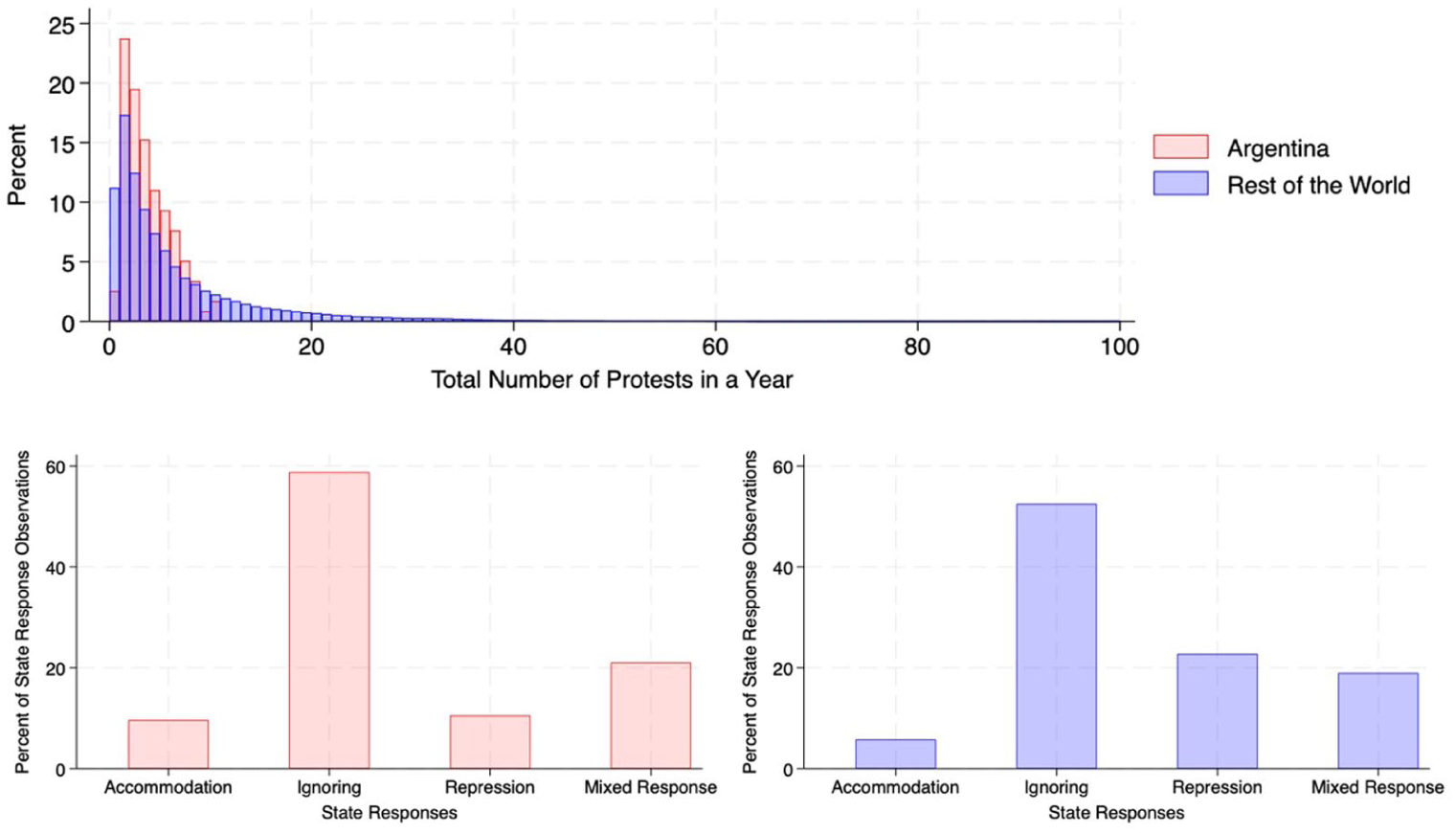
Protest trends Argentina vs. rest of the world (1990–2020).
The experiment randomly assigns participants to the control group or one of the three treatments, which are ignoring, partial accommodation, and full accommodation. Treatments are vignettes about a hypothetical protest (Table 1). Vignettes are accompanied by images that are relevant to the text to help participants concentrate better and improve the quality of the experiment (Couper et al., 2007; Shr et al., 2019). 7 Each experimental condition is represented as a binary independent variable. Participants exposed to a condition are compared with those in the control group, which is the baseline message of the vignettes.
Experimental conditions without accompanying images.
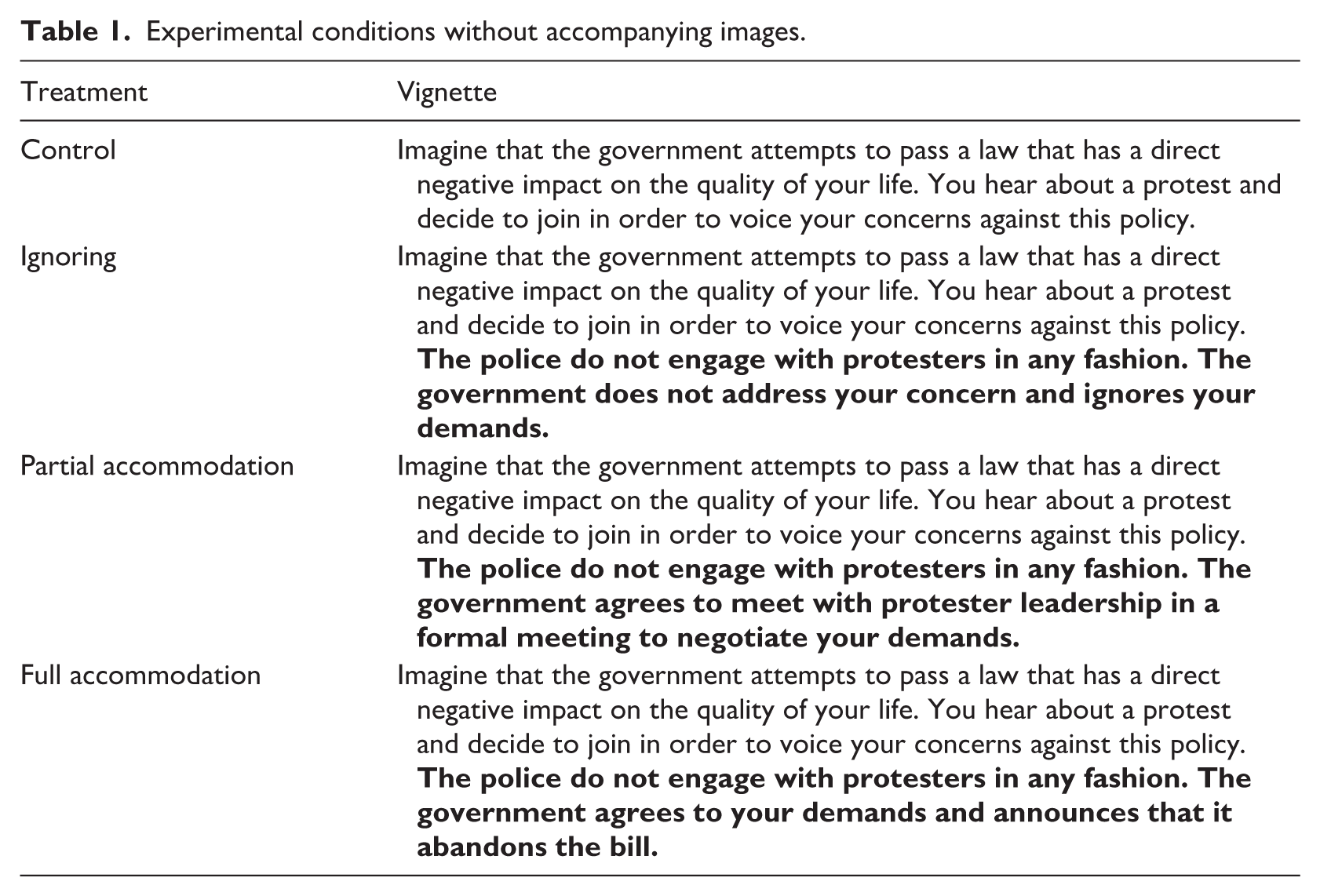
Although repression is illustrated as one of the possible initial state responses to a protest event (Figure 1), it is not one of the treatments. The exclusion of repression as an experimental condition allows for tighter control over the affective environment of the experiment. It ensures that respondents’ reactions are not driven by the possibility of state violence, which is known to trigger a complex mix of emotions such as fear, anger, and moral shock and outrage (Aytaç and Stokes, 2019; Van Stekelenburg, 2013; Young, 2019). By excluding repression, the analysis controls the emotional baseline so that all survey respondents are reacting within a non-violent and non-fear-inducing context. Whereas its inclusion could introduce a categorical outlier rather than a meaningful point on that continuum of non-repressive state responses. Additionally, all treatment conditions explicitly state that the police do not intervene in the protest. This statement is deliberately placed in the vignettes because the absence of any physical reaction from the police towards protesters is a vital component of the definition of non-repressive state responses to dissent.
The vignettes were written in general terms and deliberately omitted details about the undesired bill the government was said to pass. Including policy content could bias reactions, as issues vary in importance across individuals. For instance, raising the retirement age sparks dissent in many countries, but a 19-year-old student may care far less than a 40-year-old office worker. Furthermore, the final sentence in each condition is crucial, as it is designed to elicit anger and hope. In the ignoring condition, dismissive wording aims to provoke anger through perceived contempt and reduce hope by signaling futility. In partial accommodation, it conveys responsiveness, lowering anger and reducing hope by suggesting partial success. In full accommodation, it signals total success, resolving grievances and eliminating anger while boosting hope.
Following the exposure to treatments, based on a tool widely used by psychologists to measure the emotional state of the respondents, the Positive and Negative Affect Schedule (PANAS) (Watson et al., 1988), the survey asks a set of questions about the extent to which participants in the experiment feel a variety of emotions such as hope, hatred, bitterness, resentment, and anger with options ranging from ‘very slightly/not at all’ (coded as 1) to ‘extremely’ (coded as 5). Anger is the average of hatred, bitterness, resentment, and anger, as suggested by Marcus et al. (2006). I also test each item in the anger battery as a robustness check and share the results in Appendix 1. To measure post-treatment propensity to participate in the subsequent protest event, respondents are ultimately asked how likely they are to join the next round of the protest. Answers to the final question range from ‘extremely unlikely’ (coded as 1) to ‘extremely likely’ (coded as 7) and constitute the dependent variable.
Results
The models present results from the causal mediation analysis (Imai et al., 2013) on individuals’ willingness to continue protesting after state responses to dissent. 8 Each model has two stages: in the first, the dependent variable is emotion (anger or hope), and the independent variable is the state response; in the second, protest propensity is regressed on both state response and emotion. Lines with circle nodes represent first-stage results, while square and diamond nodes indicate second-stage effects. The average causal mediation effect (ACME) captures whether an emotion significantly mediates the effect and its direction; the average direct effect (ADE) shows the direct influence of state response. All variables are standardized for comparability, and sensitivity analyses appear in Appendix 1.
Models 1 and 2 in Figure 4 test the first hypotheses, H1anger and H1hope. Stage 1 in model 1 demonstrates that ignoring state response is negatively correlated with anger, and this negative effect is statistically significant. The second stage of the model shows that while ADE fails to attain statistical significance, ACME is statistically significant. That is, ignoring does not have a direct effect on individuals’ willingness to protest in the future, but it has a mediating effect via anger. Specifically, model 1 reveals that contrary to H1anger, ignoring reduces anger, and low levels of anger decrease the propensity to protest.
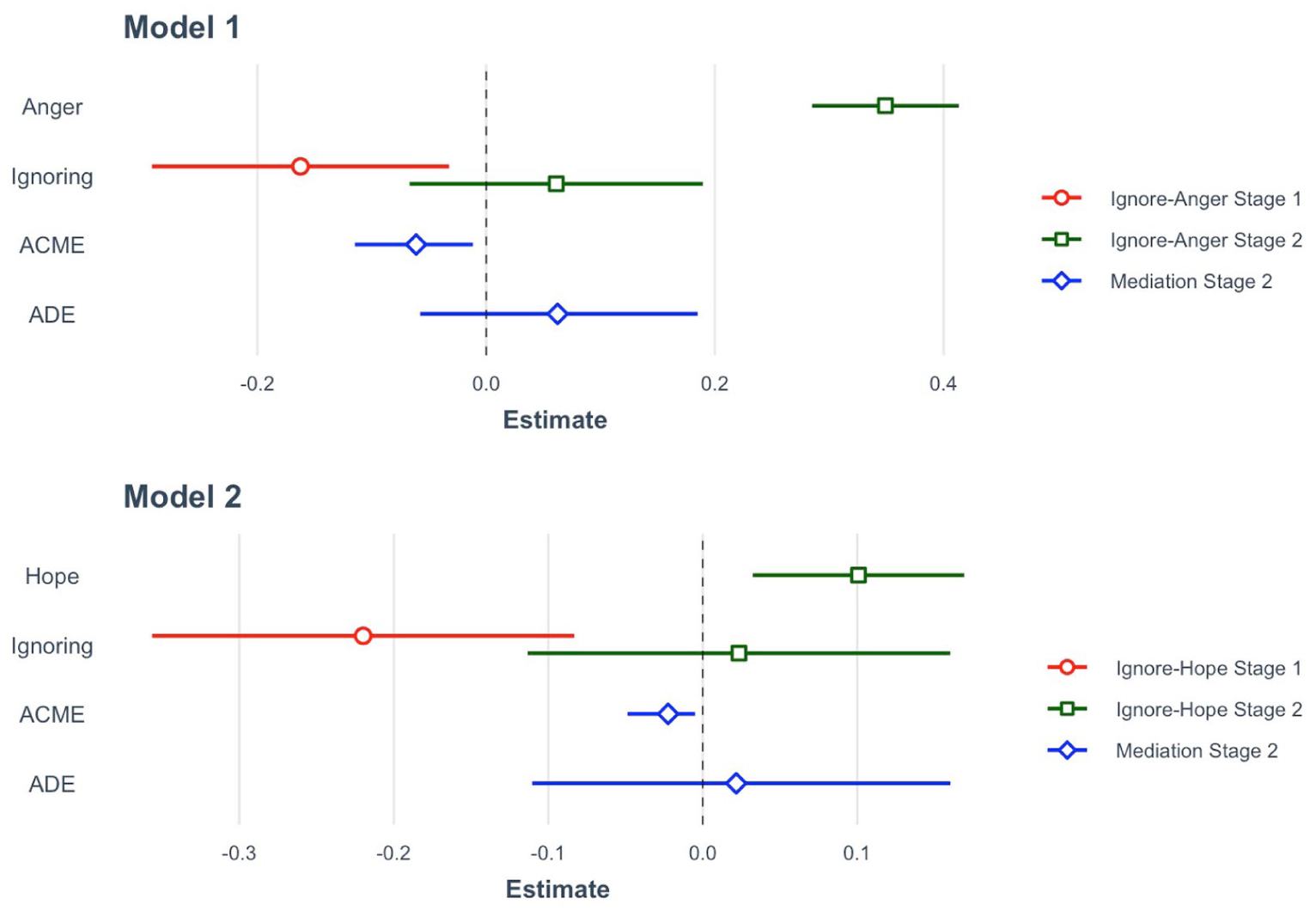
Mediation analysis of ignoring state response on propensity to protest.
Unlike H1anger, H1hope is supported by model 2. Stage 1 in model 2 indicates that ignoring governmental response has a statistically significant negative effect on hope. The second stage of the model illustrates that ignoring does not have a direct effect on future protest behaviour, as ADE fails to obtain statistical significance. Nonetheless, ACME in stage 2 demonstrates that ignoring has an indirect effect via the emotion of hope, which is statistically significant. Put differently, the ignoring response decreases hope, and low levels of hope reduce the propensity to participate in the subsequent mobilized dissent.
The results suggest that both reduced anger and reduced hope stemming from the ignore response lower the tendency to protest in the future. This finding is also in parallel with the literature on emotions, which consistently shows that hope and anger are mobilizing feelings (Civettini, 2011; Feldman and Hart, 2016; Lazarus, 1991; Valentino et al., 2011). Therefore, when these emotions are at low levels, they are to demobilize dissidents. Although it makes sense that low levels of anger reduce the intent to protest, it is puzzling that the results are the opposite of the hypothesized relationship in H1anger. It is also perplexing that two competing hypotheses – H1anger predicting mobilization and H1hope anticipating demobilization – point to the same outcome: demobilization. But why and how?
Anger is often triggered when people perceive injustice combined with a belief that they can hold someone accountable (Frijda et al., 1989; McAdam, 2004; Smith and Lazarus, 1990). When a government represses protesters, it creates clear evidence of antagonism and wrongdoing. This strengthens group identity (i.e. ‘us vs. them’), moral conviction, and the sense that the struggle is worth continuing (Aytaç and Stokes, 2019; Rasler, 1996; Van Stekelenburg and Klandermans, 2013). By contrast, ignoring denies protesters a visible adversary. When the government ignores protest movements, there is little or perhaps no emotional provocation or sense of moral outrage to amplify. Without a target to channel anger towards, the emotional motivation and energy dissipate. Protesters may begin to perceive the government as apathetic rather than hostile, which does not sustain a drive to resist and protest.
Hope, on the other hand, depends on the perception that action is effective – that change is possible, and the protest is moving the needle. Even when repression happens, it can paradoxically increase hope for some protesters by showing that the government feels threatened, which could be considered a sign that dissidents’ actions are having an impact. When a government ignores a protest event, it communicates a lack of threat perception and suggests that protesters lack power. This can be demoralizing as it undermines protesters’ sense of efficacy and their belief that further action will lead to meaningful change. Without hope, people are less likely to make the sacrifices necessary for sustained mobilization.
In other words, mobilization often relies on a combination of negative and positive emotions: anger provides urgency and motivation for confrontation, while hope sustains commitment over the long haul. When the government ignores a protest, it does not directly attack or concede. It instead starves the movement of emotional momentum on both fronts. Consequently, protesters experience neither sufficient levels of rage that push them into action nor the optimism that keeps them engaged. The outcome is a kind of emotional vacuum, where the perceived cost of continuing to protest outweighs any perceived benefit.
The next models in Figure 5 test the partial accommodation treatment for H2Hope and H2Anger. Model 3 explores the mediating effect of hope, followed by anger in model 4. Stage 1 in model 3 shows that partial accommodation is negatively correlated with hope, but this effect is not statistically significant. ACME and ADE fail to attain statistical significance as well. As such, the hypothesis that hope mediates the effect of partial accommodation is not supported.
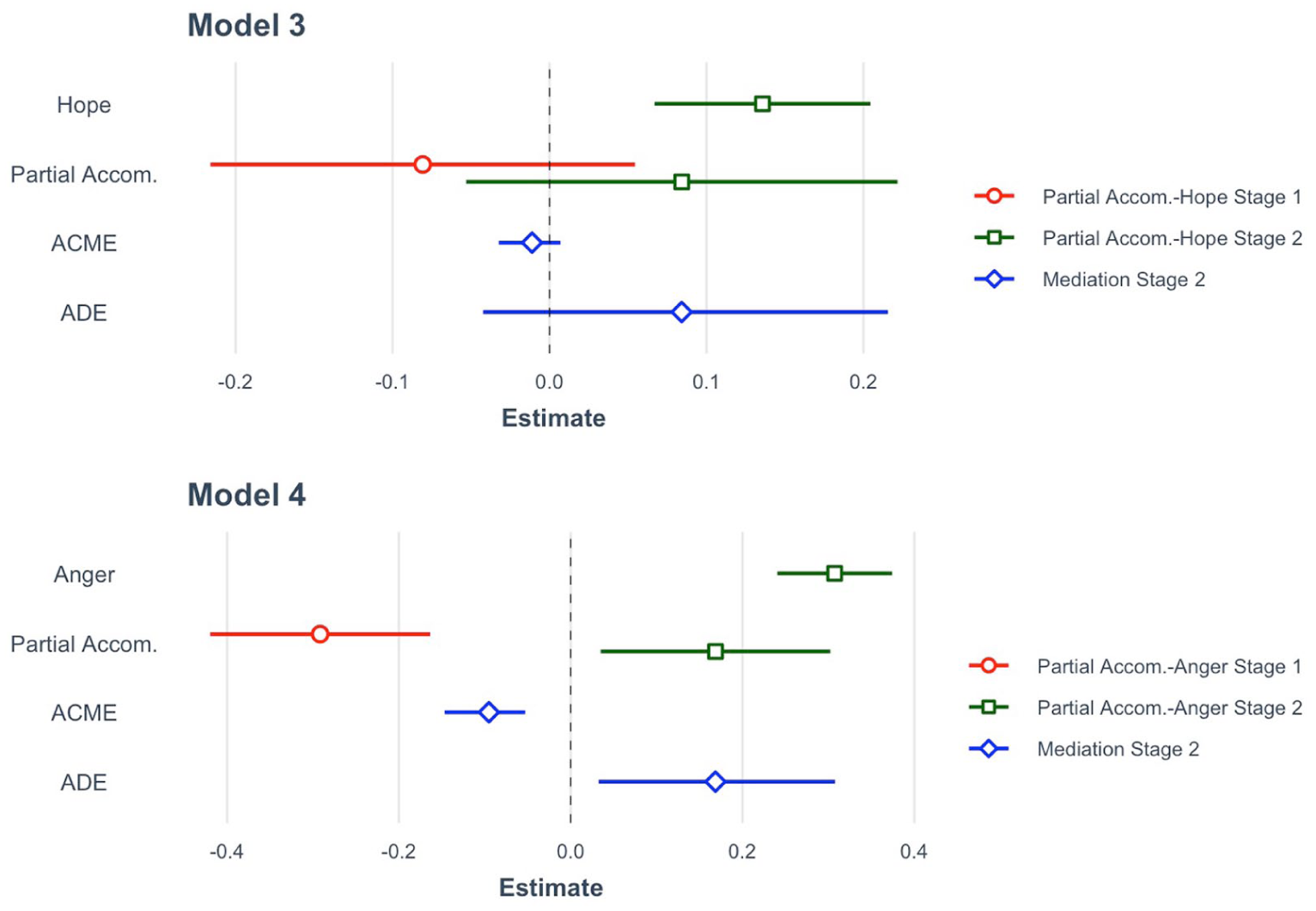
Mediation analysis of partial accommodation on propensity to protest.
Model 4, however, supports the alternative hypothesis, H2anger. Stage 1 indicates that the relationship between partial accommodation and anger is negative and statistically significant. Stage 2 shows that ACME and ADE are also statistically significant. That is, partial accommodation has a direct positive effect on the tendency to participate in future mobilization, and this effect is mediated by anger. Specifically, partial accommodation decreases anger, and low levels of anger alleviate the propensity to engage in protest behaviour. The negative correlation between partial accommodation and anger is plausible because partial accommodation suggests that protesters were heard, and the grievances were partially addressed, even if not fully resolved. Partial accommodation, therefore, deflates anger and lowers the perception of injustice that sustains mobilization. As anger is a mobilizing emotion, deflation of anger results in disinclination to protest.
The finding that hope is simply not the emotional mechanism at play and the key mechanism is the reduction of anger is where it gets counterintuitive. One would naturally expect that partial accommodation would increase hope because it implies that change is possible. One explanation for the discovery that partial concessions may not be altering levels of hope is that it sends mixed signals. While concessions indicate that some change is possible, they also introduce uncertainty about the government’s intentions and the likelihood of achieving further success. This ambiguity may blunt any clear shift in optimism and efficacy, leaving hope unaffected. Another potential explanation is that partial accommodation fragments protest movements instead of generating hope for achieving more. Although many protesters may demand more from the government following partial concessions, some dissidents may interpret partial accommodation as a signal to disengage, as they may believe that they have got enough from the state.
Finally, I test the third and final hypothesis in models 5 and 6 in Figure 6. Stage 1 in model 5 demonstrates that full accommodation does not influence hope, as the estimate of the effect is not statistically significant. The second stage shows that neither ACME nor ADE attains statistical significance. The absence of statistical significance for ACME is in line with the predictions of H3. In model 6, full accommodation is statistically significant with anger in stage 1, and in stage 2, ACME attains statistical significance. Hence, full accommodation, like partial accommodation, decreases anger, and low levels of anger decrease the willingness to protest in the subsequent period. Also, ADE is positive but not statistically significant within conventional levels.
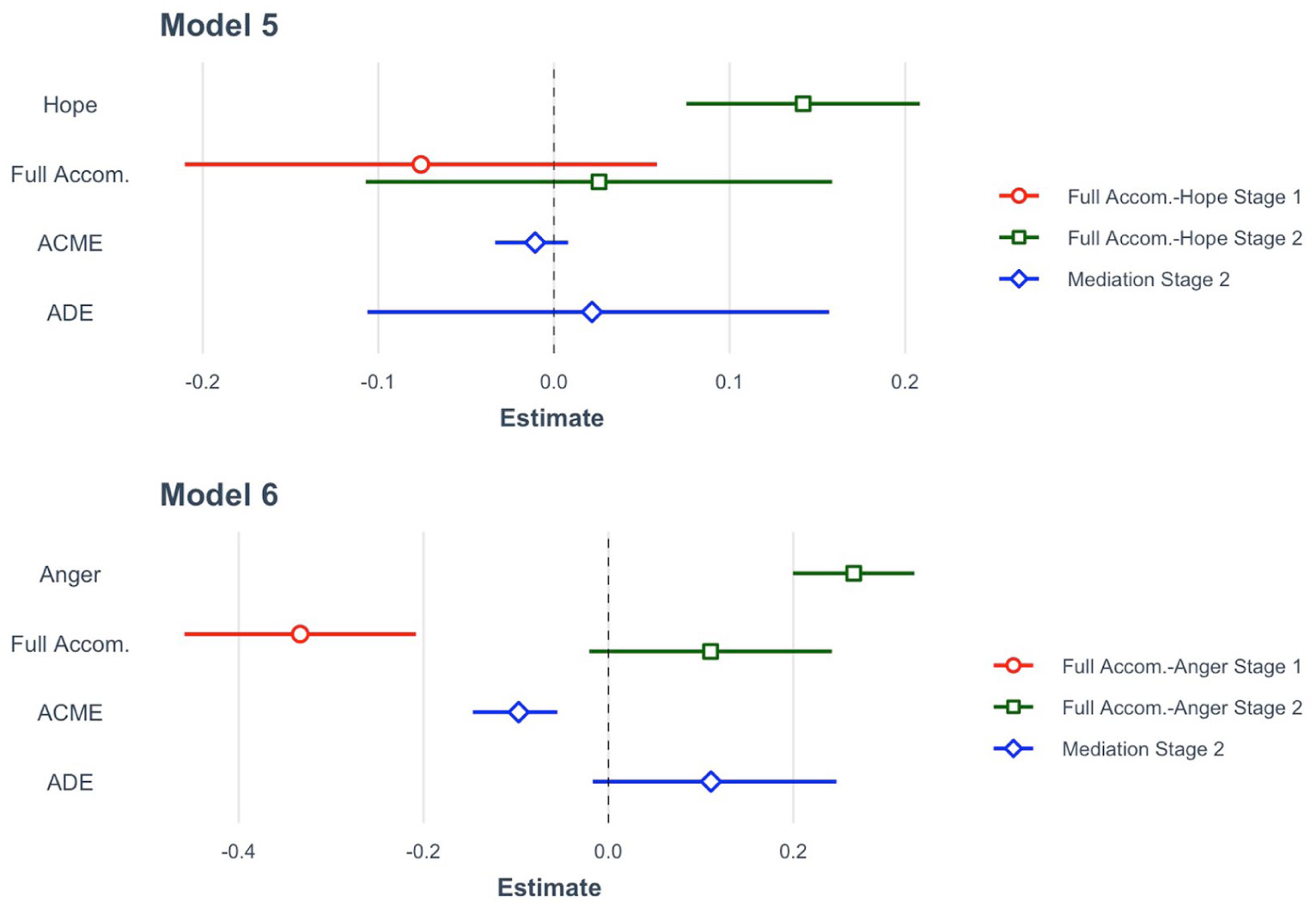
Mediation analysis of full accommodation on propensity to protest.
Conclusion
This study shifts attention beyond the traditional repression/non-repression framework to include ignoring and accommodating responses. Using an experimental survey, I show that non-repressive state actions shape future protest activity. Ignoring indirectly reduces mobilization by lowering hope and anger, while accommodation does so mainly through reduced anger. These findings suggest that Bishara is right to emphasize emotions as key mechanisms linking state responses to collective action, but Franklin is also correct in predicting a negative link between ignoring and protest.
Notwithstanding, this study and its results are not without limitations. Although Argentina is chosen inasmuch as protest trends in Argentina and the Argentinian government’s non-repressive responses to protests are closely aligned with the rest of the world (Figure 3), more samples from other countries must be collected and then tested to generalize the existence of the relationship indicated by the findings of this study to other national contexts. Furthermore, it should be noted that since the mediator – that is, emotions – is not exogenously manipulated, causal identification is limited to the path that connects treatments (non-repressive state responses) to the mediator (Imai et al., 2013). The design of the experiment does not allow us to claim that the mediator and outcome (protest decision) are causally related.
While this study focuses on the emotional mechanisms linking state responses to protest, future research would benefit from more explicitly integrating insights from appraisal theory, which emphasizes that discrete emotions arise through individual evaluations of the relationship between the person and their context. This perspective could help explain why the same governmental response might elicit different emotions across individuals or contexts. For instance, a government ignoring a protest may be appraised by one protester as a sign of contempt, generating anger, while another may interpret it as an indication of futility, leading to hopelessness.
Hence, future experiments could incorporate measures of appraisal dimensions, such as perceived injustice, efficacy, control, or legitimacy, as potential antecedents or moderators of emotional response. Doing so would allow scholars to unpack the cognitive processes that shape how state actions are emotionally internalized and translated into protest or withdrawal. Future work might explore how individual-level variation in appraisals of state responsiveness conditions emotional reactions to non-repressive state strategies. This line of inquiry would move towards a more nuanced understanding of how political actors’ behaviour becomes emotionally and behaviourally consequential, deepening both theoretical precision and empirical leverage in the study of social movements.
In conclusion, the findings challenge conventional views of the repression–protest nexus and highlight the need to move beyond binary understandings of state responses. Non-repressive actions are neither neutral nor passive; they actively shape contentious behaviour as much as repression does. Governments do more than repress or refrain – they may ignore or accommodate protesters, each choice producing distinct effects on future mobilization. Thus, state responses carry strategic consequences by generating emotions that either encourage or deter further protest.
Footnotes
Appendix 1
Acknowledgements
The author would like to thank Miguel Carreras, Indridi Indridason, Jennifer Merolla, Adam Hobbs, and participants of EPSA 2025 for their valuable feedback. He also thanks Adam Hobbs, Rudra Biswas, Thomas Kegler for their comments at the early stages of this project.
Funding
The author received no financial support for the research, authorship, and/or publication of this article.
Ethics statement
The study was reviewed and approved by the institutional review board at the University of California, Riverside on April 26, 2023.
Transparency statement
An early version of this project that includes some of the hypotheses in this manuscript was preregistered at https://osf.io/ckdrn/?view_only=6ab60efd0c524d20b3208fac3fd8b9a3. All materials including the dataset and codes used for the study will be uploaded to the Harvard Database for replication purposes at  .
.