







Abstract
This article examines the determinants of satisfaction with democracy in South Korea, focusing on the role of affective polarization within a broader structural and attitudinal framework. Using nationally representative data from the 2022 Korean Presidential Election Voter Attitudes Survey, the study employs hierarchical regression models across four domains: demographics, system and performance evaluations, political participation and efficacy, and ideological and affective orientations. The findings show that institutional trust and perceptions of electoral fairness are the strongest predictors of democratic satisfaction, while household-level economic evaluations also play an important role. Even after accounting for these factors, affective polarization remains negatively associated with democratic satisfaction, indicating that emotional hostility toward political opponents conditions how citizens interpret institutional performance. Robustness checks using ordinal logistic regression confirm the stability of these findings. Situating South Korea within the comparative literature, the study highlights the conditional yet consequential role of emotional polarization in consolidated democracies.
Keywords
Introduction
Recent years have witnessed a global erosion of democratic norms, as rising democratic dissatisfaction and affective polarization have fueled support for illiberal and authoritarian leaders. This pattern has been widely documented in the United States, Brazil, Hungary, Turkey, and several European democracies, where electoral victories—or near victories—by authoritarian-leaning candidates have exposed the vulnerability of democratic institutions (Levitsky and Ziblatt, 2018; Norris and Inglehart, 2019).
South Korea increasingly reflects these global dynamics. Like many western democracies, it faces growing affective polarization, declining trust in institutions, and political mobilization driven by resentment rather than programmatic competition. At the same time, the Korean case remains distinctive, shaped by a historical trajectory marked by authoritarian legacies, rapid democratization, and persistent national security pressures. These conditions produce a form of democratic vulnerability that resembles western cases in its symptoms while differing in its institutional foundations.
Against this backdrop, satisfaction with democracy constitutes a core indicator of democratic legitimacy and stability. When citizens lose confidence in how democracy functions, they are more likely to disengage from participation, distrust institutions, or support anti-system actors who promise simplistic solutions while undermining democratic norms. Sustained dissatisfaction thus erodes the reservoir of diffuse support that enables democratic systems to endure periods of conflict and crisis.
South Korea offers a particularly revealing case. Since democratization in the late 1980s, it has achieved rapid economic development and institutional consolidation. Yet public confidence has declined amid widening inequality, recurring corruption scandals, and intensifying partisan conflict. The impeachment of President Park Geun-hye and subsequent mass mobilizations exposed both the resilience of democratic accountability and persistent frustrations with corruption and elite privilege (Shin and Moon, 2017).
Concerns about polarization have become especially acute. Although partisan rivalry has long characterized Korean politics, recent developments differ in that political conflict has increasingly penetrated mass publics. Mass mobilization—including candlelight vigils and Taegukgi counter-rallies—has become recurrent, and online spaces now amplify distrust and partisan hostility. Survey evidence further indicates that ideological and partisan conflict are widely perceived as among the most severe social cleavages in Korean society.
Polarization manifests in two related forms: ideological and affective. Ideological polarization refers to divergence in policy preferences, whereas affective polarization captures emotional distance between partisan groups (Iyengar et al., 2019). Comparative research shows that even where ideological divisions remain stable, affective polarization has intensified significantly, including in Korea, where partisan identities have become increasingly antagonistic (Kim G and Lee, 2021; Kim S-Y, 2024).
Affective polarization poses distinctive risks to democratic governance. It undermines trust, fuels perceptions of illegitimacy, and impedes compromise (Hetherington and Rudolph, 2015). As hostility toward political opponents intensifies, tolerance for democratic outcomes may weaken even when procedures remain formally fair. Importantly, however, affective polarization operates alongside—rather than instead of—evaluations of institutional performance, economic conditions, and procedural fairness.
Electoral dynamics further interact with these divisions. Research on the “winner–loser gap” shows that supporters of the winning side tend to express higher democratic satisfaction, whereas those aligned with the losing side often report dissatisfaction and alienation (Anderson et al., 2005). In Korea’s polarized electoral context, such dynamics may reinforce emotional divisions and shape perceptions of legitimacy.
It is also important to clarify the meaning of the dependent variable. Satisfaction with democracy does not measure abstract support for democratic ideals, but rather citizens’ evaluations of how the political system functions in practice (Norris, 2011; Singh and Mayne, 2023). It therefore captures a hybrid attitude combining perceptions of institutional performance, procedural fairness, and regime functioning, making it particularly suitable for assessing democratic legitimacy under conditions of polarization.
Against this backdrop, this study examines the determinants of democratic satisfaction in South Korea using a multidimensional framework that integrates structural evaluations and emotional orientations. Drawing on nationally representative data from the 2022 Korean Presidential Election Voter Attitudes Survey, it employs a hierarchical regression approach to assess how four domains—demographic characteristics, system and performance evaluations, political participation and efficacy, and ideological and affective orientations—jointly shape democratic attitudes.
Rather than treating affective polarization as the dominant driver, the study conceptualizes it as a residual yet consequential influence that continues to shape democratic satisfaction once core performance-based factors are taken into account. By situating the Korean case within broader comparative debates, the study clarifies the hierarchical structure through which these factors operate and identifies the conditions under which affective polarization becomes politically consequential. Although the analysis is based on 2022 data, recent political developments further underscore the importance of understanding how emotional polarization conditions democratic legitimacy under intensified political conflict.
Literature review
Research on satisfaction with democracy has long emphasized that citizens’ evaluations of democratic performance are shaped by a constellation of structural, institutional, and psychological factors. Rather than reflecting a single underlying attitude, democratic satisfaction captures an integrative judgment through which citizens assess how well democratic systems function in practice (Singh and Mayne, 2023). Comparative scholarship shows that such evaluations are influenced by multiple domains, including socio-demographic characteristics, economic performance, institutional trust, political engagement, and ideological orientations.
At the same time, a growing body of research documents a global rise in democratic dissatisfaction across both established and emerging regimes. By 2020, nearly half of citizens in high-income democracies expressed dissatisfaction with how their democracies functioned, reflecting a broader legitimacy challenge often described as “democratic fatigue” (Foa et al., 2020; Singh and Mayne, 2023). Economic inequality, perceptions of unresponsive governance, and declining institutional trust have been identified as key drivers of this trend (Dalton, 2018; Berman, 2019), with populist and anti-establishment movements increasingly capitalizing on such discontent.
Building on this multidimensional tradition, this study conceptualizes democratic satisfaction as a layered evaluation in which structural assessments form the foundation, while political identities and emotional orientations condition how these assessments are interpreted. From this perspective, affective polarization is not expected to displace established determinants such as economic evaluations or institutional trust, but to operate as an additional influence that shapes democratic attitudes once these core factors are taken into account.
Existing research identifies system and performance evaluations—including perceptions of economic conditions, institutional integrity, and procedural fairness—as the most consistent predictors of democratic satisfaction across countries (Dalton, 2018; Singh and Mayne, 2023). At the same time, individual-level characteristics and political engagement further shape how citizens interpret democratic performance. Demographic factors structure expectations and exposure to political risks, while participation, efficacy, and media use influence whether citizens feel represented, informed, and capable of meaningful political action (Park and Hong, 2023; Singh and Mayne, 2023).
More recently, scholarship has increasingly focused on ideological and affective polarization as additional sources of democratic strain. Whereas ideological polarization reflects divergence in policy preferences, affective polarization captures emotional hostility and social distance between partisan groups (Iyengar et al., 2019). Importantly, affective polarization may undermine democratic legitimacy by eroding interpersonal trust and weakening acceptance of political opponents as legitimate competitors (Hetherington and Rudolph, 2015; Wagner, 2024). However, its effects are often contingent on broader institutional and economic contexts, suggesting that it operates as a residual influence that conditions, rather than replaces, performance-based explanations of democratic satisfaction.
South Korea provides a particularly useful context for examining these layered dynamics. The country combines relatively high levels of institutional consolidation with intense partisan conflict and emotionally charged political discourse. As such, it offers an opportunity to assess whether affective polarization contributes to democratic dissatisfaction after accounting for structural determinants emphasized in comparative research.
Accordingly, this literature review situates affective polarization within a broader theoretical framework of democratic satisfaction. The following sections examine four interrelated domains—demographic characteristics, system and performance evaluations, political participation and efficacy, and ideological and affective polarization—to assess whether emotional polarization retains explanatory relevance once established determinants are taken into account.
At the same time, political divisions in Korea have intensified beyond ideological disagreement into affective polarization, characterized by emotional hostility and social distance between partisan groups (Kim G and Lee, 2021; Kim S-Y, 2024). These dynamics, combined with regional cleavages and generational inequalities, have amplified mistrust and made consensus-building increasingly difficult, highlighting Korea as a useful case for examining how global patterns of democratic dissatisfaction intersect with context-specific conditions.
Building on this literature, this study conceptualizes democratic satisfaction as a layered evaluation in which structural assessments form the foundation, while political identities and emotional orientations condition how these assessments are interpreted. From this perspective, affective polarization is not expected to displace established determinants such as economic evaluations or institutional trust, but to operate as an additional, conditional influence shaping democratic attitudes.
This framework is organized around four domains: (a) demographic characteristics, which structure baseline expectations; (b) system and performance evaluations, which capture perceptions of institutional trust, fairness, and economic outcomes; (c) political participation, efficacy, and media environments, which shape how citizens engage with democratic processes; and (d) ideological and affective polarization, which reflects cognitive and emotional divisions within the electorate. This integrated approach enables a systematic assessment of whether—and under what conditions—affective polarization retains explanatory relevance alongside established determinants of democratic satisfaction.
Demographic foundations of democratic satisfaction
Demographic characteristics provide the baseline conditions under which citizens evaluate democratic performance. Age, education, income, and regional location structure both expectations of democracy and exposure to political and economic risks.
In the Korean context, generational differences are particularly salient. Younger cohorts, facing labor market insecurity and rising housing costs, tend to express greater dissatisfaction with democratic outcomes, whereas older generations—who experienced democratization and periods of rapid economic growth—often report higher levels of satisfaction (Park and Hong, 2023).
Socioeconomic status further shapes democratic evaluations. Higher levels of education are associated with greater political awareness and more critical assessments of institutional performance, whereas lower-income groups are more likely to express dissatisfaction due to perceived economic vulnerability. Regional disparities also continue to influence political attitudes, reflecting long-standing patterns of uneven development and political alignment.
Although demographic factors do not directly determine satisfaction with democracy, they structure the conditions under which citizens interpret political and economic performance.
System and performance evaluations
Perceptions of the broader political and economic system are among the most powerful determinants of democratic satisfaction. Citizens evaluate democracy not only on procedural grounds but also in terms of whether it delivers material benefits, fairness, and accountability (Singh and Mayne, 2023).
Economic evaluations constitute a central dimension of this assessment. In Korea, both perceptions of national economic performance and household-level financial well-being are strongly associated with democratic satisfaction (Lee and Kim, 2021). As inequality has increased, many citizens perceive the system as failing to deliver equitable outcomes, making dissatisfaction with material performance a key source of discontent.
Institutional trust is equally important. Trust in government, parliament, and the judiciary forms a reservoir of support that sustains democratic legitimacy, particularly in times of crisis (Norris, 2023). In Korea, however, recurring corruption scandals—notably the impeachment of President Park Geun-hye—have eroded confidence in political institutions (Shin and Moon, 2017). Such dynamics can create a reinforcing cycle in which perceived corruption undermines trust and amplifies dissatisfaction.
Perceptions of electoral fairness and democratic stability further shape evaluations of democracy. Citizens who view elections as fair and the system as stable are more likely to express confidence (Leiter and Clark, 2015), whereas controversies over electoral integrity have weakened these perceptions in the Korean context.
In addition, the experience of electoral victory or defeat—the “winner–loser gap”—has been shown to influence democratic satisfaction. Supporters of the winning candidate tend to evaluate democracy more positively, whereas those on the losing side often feel less represented (Anderson et al., 2005). This dynamic is particularly salient in Korea’s polarized presidential elections. Accordingly, this study incorporates a measure of whether respondents voted for the eventual winner of the 2022 election (Yoon Suk-yeol) to capture post-election differences in democratic evaluations.
Taken together, these dimensions—economic performance, institutional trust, perceptions of fairness, and electoral outcomes—constitute a core domain through which citizens evaluate democratic performance.
Political participation, efficacy, and media consumption
Political participation and efficacy are key mechanisms through which citizens relate to democratic institutions. Participation in elections and civic activities is generally associated with higher satisfaction, as engagement reinforces a sense of agency and ownership over political outcomes (Yoo, 2017). However, dissatisfaction can also lead to disengagement, creating a cycle of withdrawal and further disillusionment (Kim S-Y, 2024).
Political efficacy—encompassing both internal efficacy (belief in one’s capacity to understand politics) and external efficacy (belief that institutions respond to citizens)—is a particularly salient predictor. Lower levels of efficacy are consistently associated with dissatisfaction across contexts (Singh and Mayne, 2023). In Korea, perceptions of limited institutional responsiveness have been especially pronounced among younger and economically vulnerable groups (Park and Hong, 2023).
The information environment further shapes democratic attitudes. Trust in news media is positively associated with satisfaction, yet the expansion of partisan media and algorithmically curated platforms has contributed to polarization and distrust (Lee and Repkine, 2022; Park and Hong, 2023). Exposure to ideologically homogeneous content can reinforce negative views of opponents and weaken confidence in democratic institutions.
Taken together, participation, efficacy, and media use do not independently determine democratic satisfaction, but they shape how citizens experience and interpret democratic processes.
Ideological and affective polarization
Ideological and affective polarization have attracted growing attention as potential sources of democratic strain. Ideological polarization refers to increasing divergence in policy preferences between partisan groups (Abramowitz, 2010). Although such differences can complicate consensus-building, their effects on democratic satisfaction are often mediated by perceptions of representation and institutional responsiveness.
Affective polarization, by contrast, reflects emotional hostility and social distance between political groups. Iyengar et al. (2012) define it as the tendency to view opposing partisans with distrust and animosity, a pattern that has intensified across many democracies (Iyengar et al., 2019). This form of polarization is associated with lower democratic satisfaction, as political opponents come to be seen not simply as wrong, but as illegitimate or threatening (Wagner, 2024).
In South Korea, affective polarization has intensified alongside broader political and social conflicts. Partisan identities have become increasingly salient and emotionally charged, while cycles of mass mobilization have reinforced antagonistic narratives between political camps (Kim G and Lee, 2021; Lee, 2018; Lee and Kim, 2021). Online communities and partisan media environments further amplify these dynamics by normalizing distrust and hostility.
Existing research suggests that affective polarization undermines democratic legitimacy by eroding trust and weakening acceptance of political compromise (Hetherington and Rudolph, 2015; Hobolt et al., 2021). However, its effects are rarely independent of broader structural conditions. Rather than replacing evaluations of institutional performance or economic outcomes, affective polarization conditions how citizens interpret democratic processes and assess legitimacy.
Accordingly, this study treats affective polarization not as a dominant driver of democratic dissatisfaction, but as an additional, potentially erosive factor that operates alongside established determinants. The central empirical question is whether emotional polarization retains explanatory relevance once structural evaluations—such as institutional trust, economic experience, and perceptions of fairness—are taken into account.
In summary, democratic dissatisfaction in South Korea reflects the interaction of structural and psychological factors. Demographic characteristics shape baseline expectations, while system and performance evaluations—particularly institutional trust, perceptions of fairness, and electoral outcomes—form the core foundations of democratic legitimacy. Political participation, efficacy, and media use further mediate how citizens engage with and interpret democratic processes.
Within this framework, ideological and affective polarization contribute to dissatisfaction by intensifying perceptions of division and mistrust. Rather than operating independently, emotional polarization interacts with institutional and economic evaluations, shaping how citizens interpret political competition and democratic outcomes.
By adopting this integrated approach, this study clarifies not only whether affective polarization matters, but under what conditions it becomes politically consequential. In doing so, it contributes to a more nuanced understanding of democratic dissatisfaction in South Korea and offers insights relevant to broader comparative debates on democratic resilience in polarized societies.
Data, variables, and analytical strategy
Data description
This study draws on data from the 2022 Korean Presidential Election Voter Attitudes Survey conducted by the Korean Social Science Data Center (KSDC). The survey was administered nationwide in the weeks following the 20th presidential election and consists of a stratified sample of eligible voters aged 19 and above. Respondents were selected using multistage stratified random sampling to ensure representativeness across regions, age groups, and gender.
The dataset provides extensive measures of:
evaluations of economic conditions and democratic institutions;
political trust and participation;
ideological and affective orientations;
media use and information exposure;
socio-demographic characteristics.
Respondents reported their attitudes using Likert scales (typically 5-point or 7-point) and 11-point “feeling thermometers.” The survey also captured voting behavior, political efficacy, and trust in media. These data offer an unparalleled opportunity to investigate the micro-level determinants of democratic satisfaction in South Korea during a period of heightened political polarization. To enhance transparency, it is important to note that the survey was based on a stratified national sample (n = 1250), with full completion among selected respondents. Post-stratification weights were applied to adjust for age, gender, and regional distributions, thereby enhancing both the reliability and the generalizability of the findings.
Research hypotheses
Based on prior scholarship and the theoretical framework outlined in the literature review, this study advances a set of hypotheses reflecting the multidimensional nature of democratic satisfaction. Hypotheses H1 through H5 establish baseline expectations derived from well-documented comparative research on democratic legitimacy, and H6 examines whether affective polarization retains explanatory relevance once these established determinants are taken into account:
H1. Citizens with more negative evaluations of economic performance and stronger perceptions of inequality are more likely to express dissatisfaction with democracy.
H2. Lower levels of trust in government institutions and higher perceptions of political corruption are associated with lower democratic satisfaction.
H3. Higher levels of political efficacy and active political participation (e.g., voting) are associated with higher democratic satisfaction.
H4. Citizens who report greater trust in media and exposure to more diverse sources of political information are more likely to report higher levels of democratic satisfaction.
H5. (Exploratory.) Ideological self-placement may be associated with satisfaction with democracy, though prior research indicates that this relationship is likely to be context-dependent.
H6. Controlling for economic evaluations, institutional trust, political engagement, and ideological orientation, higher levels of affective polarization are expected to be associated with lower satisfaction with democracy.
These hypotheses reflect an integrative approach that treats democratic satisfaction as a layered evaluation shaped primarily by structural and institutional assessments, while allowing for the possibility that emotional polarization exerts an additional, residual influence on citizens’ democratic evaluations.
Independent variables
To examine the determinants of democratic satisfaction, this study employs a comprehensive set of independent variables, grouped into four conceptual domains: demographic characteristics, evaluations of system performance, political participation and efficacy, and ideological as well as affective polarization. This framework reflects both theoretical insights and empirical findings from prior research, allowing for a multidimensional assessment of how individual characteristics, institutional perceptions, and partisan divisions shape democratic attitudes in South Korea.
Demographic factors
Basic demographic variables are included as structural controls to account for variation in political attitudes across different social strata. Age is measured continuously, while gender is coded as a binary variable (female = 0, male = 1). Education is categorized into high school or less, some college, and university graduate, and recoded into dummy variables. Household income is measured on an ordinal scale, and region is represented by dummy variables for major geographic areas, including the Seoul metropolitan area, Gyeongsang, and Jeolla. These variables capture the socioeconomic and regional underpinnings of political attitudes, reflecting long-standing findings that demographic background conditions the ways in which citizens evaluate democratic institutions (Park and Hong, 2023).
System and performance evaluations
The second domain focuses on citizens’ assessments of institutional performance, fairness, and legitimacy—factors widely regarded as the most powerful predictors of democratic satisfaction. Economic evaluations are measured at both national and personal levels. Respondents assessed the state of the Korean economy and their own household’s financial situation on 5-point scales. Perceptions of distributive justice were captured by agreement with the statement that income distribution in Korea is unfair.
Institutional trust was measured as the average level of confidence in three core institutions: the government, the National Assembly, and the judiciary. Perceptions of political corruption were captured through responses to the question “How serious do you think political corruption is in Korea?” In addition, respondents evaluated the fairness of the 2022 presidential election and were asked whether they viewed Korean democracy as stable or in crisis. A binary indicator of whether the respondent supported the winning candidate, Yoon Suk-yeol, was also included, given that electoral outcomes often condition satisfaction with the system.
Together, these measures capture the multifaceted ways in which citizens connect performance evaluations to democratic legitimacy. Consistent with prior scholarship, they reflect the notion that satisfaction with democracy is not simply an abstract normative commitment but is shaped by concrete assessments of fairness, integrity, and institutional effectiveness (Park and Hong, 2023; Singh and Mayne, 2023).
Political participation, efficacy, and media consumption
The third domain centers on political engagement, efficacy, and the informational environment. Participation is measured by whether the respondent voted in the 2022 presidential election. Beyond actual participation, subjective efficacy is included in two forms. Internal efficacy is assessed through agreement with the statement “I consider myself capable of understanding politics,” and external efficacy is captured by the statement “Public officials care what people like me think.” These variables reflect the extent to which citizens feel both competent in and empowered by the political process.
Political interest was measured by self-reported levels of interest in politics, while media-related variables capture both confidence in and reliance upon different information channels. Trust in news media was measured on a Likert scale, and respondents identified their primary sources of political information—television, newspapers, internet portals, or social media—coded as dummy variables.
This set of variables highlights the broader role of political engagement in shaping democratic satisfaction. Citizens who feel efficacious and politically attentive are theorized to experience stronger democratic attachment, as they perceive institutions as more responsive to their input. Conversely, patterns of media consumption may either reinforce trust when information comes from credible and widely trusted outlets or erode it when exposure is dominated by partisan or distrusted platforms (Hobolt et al., 2021; Kim G and Lee, 2021; Singh and Mayne, 2023).
Ideological and affective polarization
The final domain addresses ideological orientations and affective polarization, both of which have become defining features of contemporary democratic politics. Respondents placed themselves on a left–right ideological scale ranging from 0 (liberal) to 10 (conservative). Partisan identification was measured categorically, indicating affiliation with one of the major political parties.
Affective polarization was operationalized as the difference in respondents’ thermometer ratings of their preferred versus opposing party, thereby capturing the intensity of partisan hostility relative to in-group attachment. To complement this individual-level measure, respondents were also asked to assess the severity of ideological conflict between conservatives and progressives in Korean society. This measure reflects perceptions of broader systemic division beyond personal partisan attachments.
The inclusion of these variables reflects a growing body of scholarship demonstrating that polarization undermines democratic satisfaction. Ideological polarization narrows the space for compromise, whereas affective polarization fosters mutual distrust and delegitimization of political opponents. Together, these dynamics erode the diffuse support that sustains democratic institutions (Iyengar et al., 2019; Wagner, 2024).
Analytical strategy: hierarchical regression models
Before estimating the regression models, all variables were coded such that higher values correspond to stronger agreement or more positive evaluations, unless otherwise noted. This coding scheme ensures comparability across measures and facilitates straightforward interpretation of regression coefficients. A key exception is the measure of affective polarization, which was operationalized following Iyengar et al. (2019) as the net emotional distance between respondents’ ratings of their in-party and their out-party. This measure captures the extent of partisan hostility relative to partisan attachment.
The dependent variable in this study is democratic satisfaction, measured using a 4-point Likert scale in response to the question “Overall, how satisfied are you with the way democracy works in Korea?” (response options: 1 = Not at all satisfied, 2 = Not very satisfied, 3 = Somewhat satisfied, and 4 = Very satisfied). This variable captures respondents’ overall evaluations of how democracy functions in Korea, rather than their satisfaction with any particular institution or administration. The 4-point format deliberately omits a neutral midpoint, thereby encouraging respondents to express a directional judgment—either satisfaction or dissatisfaction. Such a forced-choice design enhances the discriminatory power of the measure in identifying variations in democratic support. Following standard practice in survey-based research on democratic legitimacy, the variable is treated as continuous for the purposes of regression analysis.
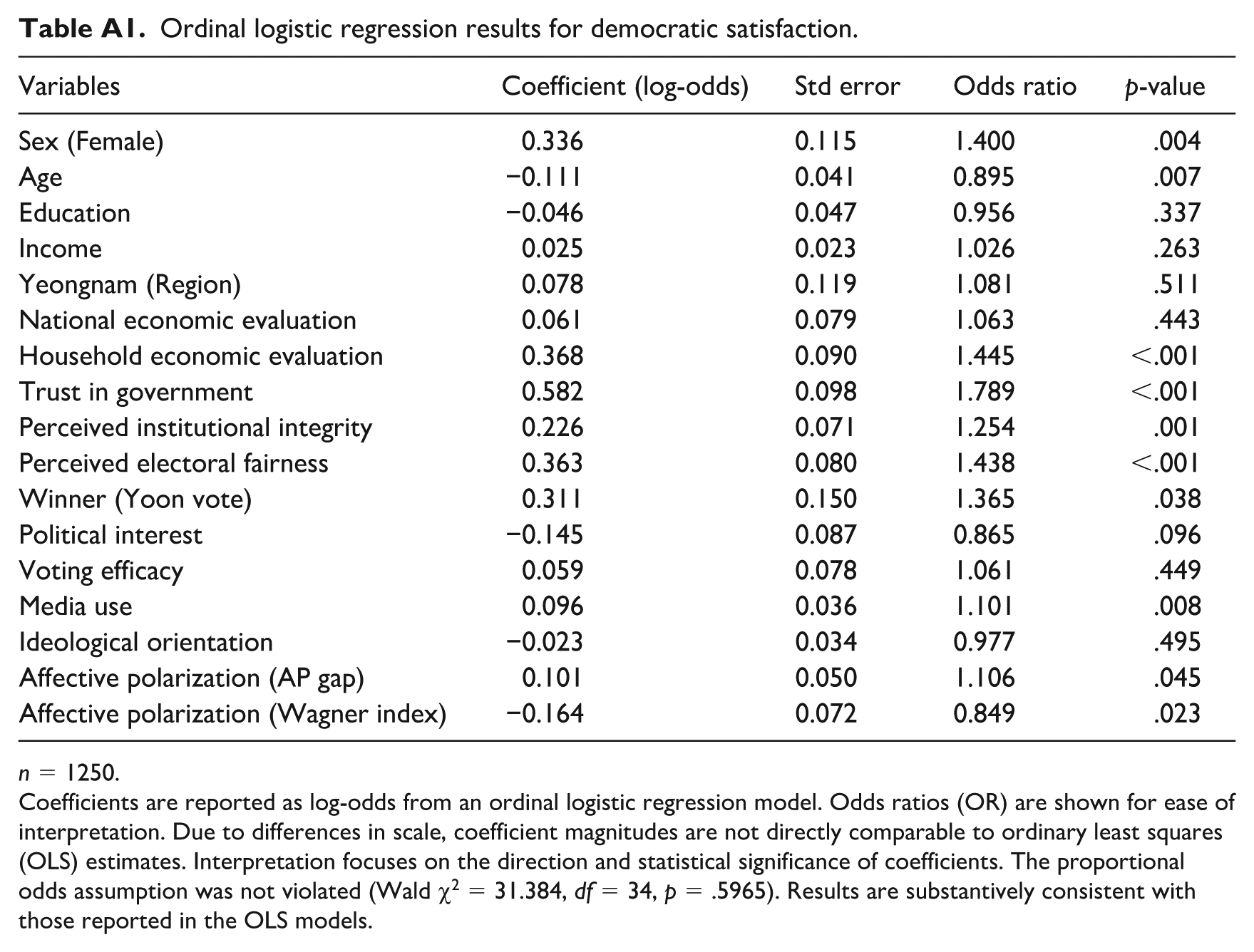
To estimate the effects of the independent variables, the study employs hierarchical ordinary least squares (OLS) regression. Given the ordinal nature of the dependent variable, we conducted additional robustness checks using ordinal logistic regression. To assess the proportional odds assumption, a Wald chi-square test was performed, which indicated no violation of the parallel lines assumption (Wald χ2 = 31.384, df = 34, p = .5965). Accordingly, the ordinal specification was deemed appropriate, and the substantive results from the ordinal logistic regression were fully consistent with those obtained from the OLS models. The full results of the ordinal logistic regression are reported in Appendix Table A1. OLS is retained as the primary specification for ease of interpretation and comparability with prior research. The modeling strategy proceeds as follows:
This stepwise modeling strategy allows for the identification of the unique contribution of each block of variables to democratic satisfaction, while also examining how the inclusion of additional predictors modifies the model’s explanatory capacity. By comparing changes in explained variance (ΔR2) across models, the analysis isolates the independent effects of each conceptual dimension beyond the influence of demographic factors. Variance inflation factors were below conventional thresholds, indicating no serious multicollinearity among predictors.
Results of analysis, discussion and implications
This section presents the results of hierarchical regression models assessing the determinants of democratic satisfaction in South Korea. Four models are estimated sequentially, introducing demographic characteristics, system and performance evaluations, political participation and efficacy, and ideological and affective polarization in turn.
Model 1: demographic factors
The baseline model including demographic variables explained a modest share of variance in democratic satisfaction (adjusted R2 = .015). Among predictors, gender and household income were statistically significant. Specifically, being male was associated with higher satisfaction (β = .084, p = .003), and higher income was also positively associated (β = .089, p = .002). Age exhibited a marginally significant negative association (β = –.055, p = .054), suggesting that older respondents tended to report slightly lower satisfaction. Education level and the regional dummy variable for Yeongnam were not significant predictors in this model. Overall, demographic characteristics alone accounted for a relatively limited proportion of the variance in citizens’ evaluations of democracy.
Model 2: system and performance evaluations
In Model 2, evaluations of economic conditions, trust in government, perceptions of public sector integrity, electoral fairness, and whether respondents supported the winning presidential candidate were added to the model. This substantially improved model fit (adjusted R2 = .143). Among these predictors, trust in government institutions remained the strongest positive correlate of democratic satisfaction (β = .176, p < .001). Perceptions that one’s household economic situation had improved were also significantly associated with higher satisfaction (β = .140, p < .001), whereas perceptions of the national economy were not statistically significant.
Beliefs that public officials had become more honest were positively related to satisfaction (β = .112, p < .001), and perceiving the election as fair and free was also associated with higher satisfaction (β = .128, p < .001). Additionally, supporting the winning candidate (Yoon Suk-yeol) exhibited a marginally significant positive association with democratic satisfaction (β = .060, p = .053). Notably, the inclusion of these performance and legitimacy evaluations reduced the significance of income, suggesting that perceptions of institutional performance may partially mediate the relationship between socio-economic status and satisfaction with democracy. The results of the hierarchical regression models are presented in Table 1.
Hierarchical regression models predicting democratic satisfaction.
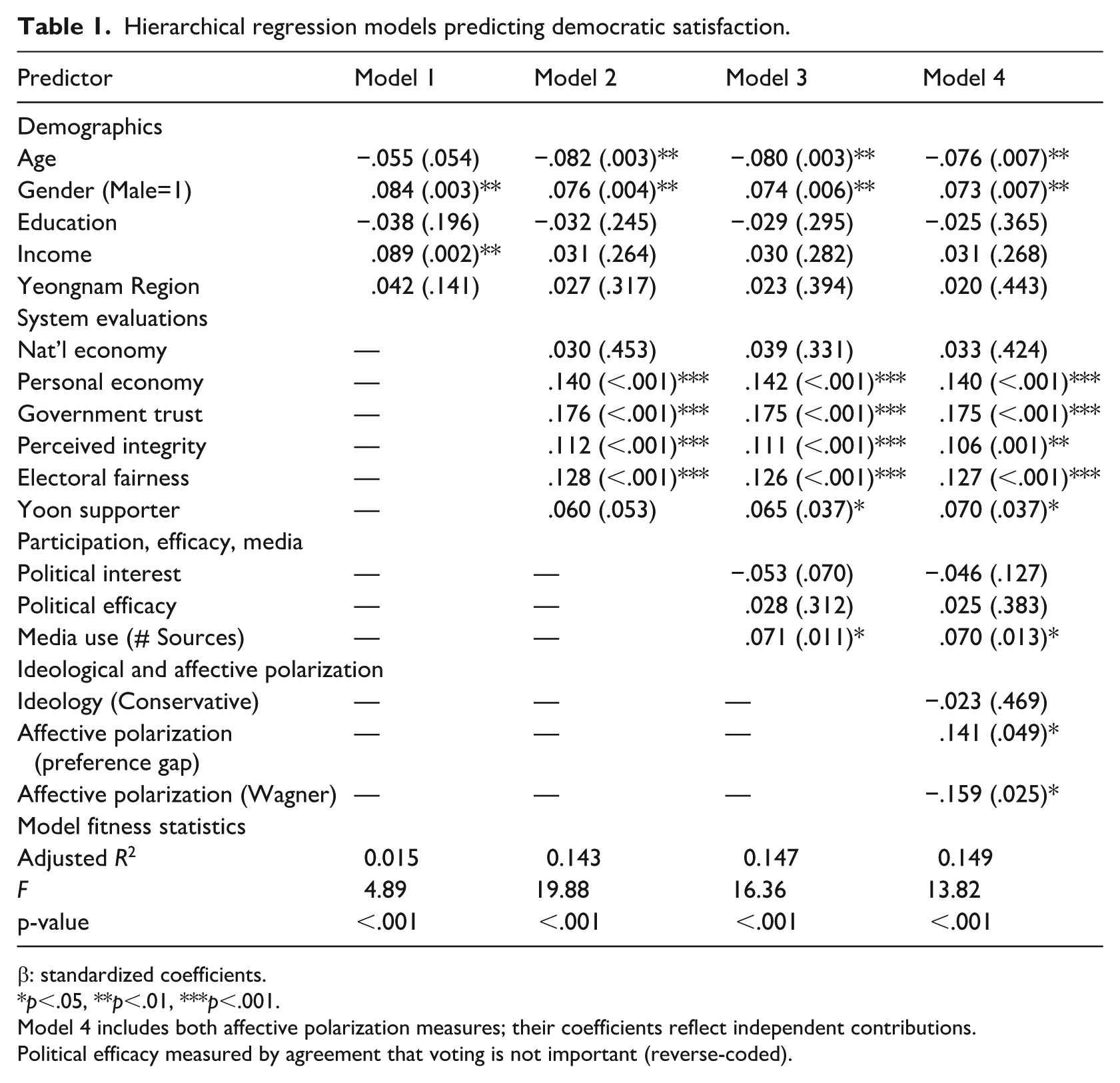
β: standardized coefficients.
p<.05, **p<.01, ***p<.001.
Model 4 includes both affective polarization measures; their coefficients reflect independent contributions.
Political efficacy measured by agreement that voting is not important (reverse-coded).
Model 3: political participation, efficacy, and media use
In Model 3, political efficacy, political interest, and media use variables were introduced. The inclusion of these variables slightly increased the explained variance (adjusted R2 = .147). Among the new predictors, the number of media sources used was positively associated with democratic satisfaction (β = .071, p = .011), suggesting that exposure to diverse information sources may reinforce confidence in the democratic system.
The variable indicating whether respondents supported the winning candidate became statistically significant in this model (β = .065, p = .037), indicating a “winner–loser gap” effect whereby supporters of the victorious candidate expressed higher satisfaction.
Contrary to expectations, political interest did not have a significant association, and agreement with the statement that “my vote does not matter” (an inverse indicator of political efficacy) also remained non-significant. Trust in government institutions (β = .175, p < .001), perceptions of electoral fairness (β = .126, p < .001), and perceptions of public sector integrity (β = .111, p < .001) remained the strongest predictors of democratic satisfaction.
Model 4: ideological and affective polarization
The final model introduced ideological self-placement and two measures of affective polarization. The inclusion of these variables modestly increased the model’s explanatory power (adjusted R2 = .149). Importantly, affective polarization measures demonstrated significant associations with democratic satisfaction, consistent with their respective conceptualizations.
The Wagner measure of affective polarization was negatively associated with democratic satisfaction (β = –.159, p = .025), indicating that stronger hostility toward opposing parties is linked to lower confidence in democracy. By contrast, the affective polarization measure based on the feeling thermometer difference was positively associated with dissatisfaction (β = .141, p = .049).
This divergence reflects differences in what the two indicators capture. The Wagner index primarily measures out-group hostility, emphasizing negative affect directed toward political opponents. In contrast, the feeling thermometer gap combines evaluations of both in-groups and out-groups and is therefore more sensitive to in-group favoritism and affective attachment to one’s preferred party. In the Korean context, stronger in-group favoritism may contribute to heightened dissatisfaction with democratic institutions when these are perceived as failing to deliver outcomes favorable to one’s political camp, even in the absence of extreme ideological positioning.
Together, these results suggest that distinct emotional components of polarization—hostility toward opponents versus affective attachment to one’s own partisan group—can influence democratic satisfaction through different pathways.
Trust in government institutions continued to be the most robust predictor across all models (β = .175, p < .001), followed by perceptions of personal economic conditions (β = .140, p < .001) and electoral fairness (β = .127, p < .001).
Discussion and implications
This study examined the determinants of democratic satisfaction in South Korea using a multidimensional framework incorporating demographic characteristics, system and performance evaluations, political participation and efficacy, and ideological and affective polarization. The findings contribute by clarifying the hierarchical structure through which these factors shape democratic evaluations and by identifying the conditions under which emotional divisions become politically consequential.
First, consistent with prior research, perceptions of institutional performance emerged as the strongest predictors of democratic satisfaction. Trust in government, perceptions of integrity, and beliefs about electoral fairness were all positively associated with satisfaction. In the Korean context—where corruption scandals and elite collusion have undermined public confidence—this underscores the central role of transparency and accountability in sustaining democratic legitimacy (Park and Hong, 2023; Shin and Moon, 2017).
Second, perceptions of personal economic well-being were robust predictors across all models. This supports performance-based theories of democratic legitimacy, which emphasize the importance of material security (Dalton, 2018). By contrast, evaluations of the national economy were less consistent, suggesting that proximate, household-level experiences weigh more heavily in shaping democratic attitudes. Together, these findings indicate that institutional performance and material conditions provide the primary baseline through which citizens assess democracy.
Consistent with mixed findings in prior research, ideological self-placement did not exhibit an independent association with democratic satisfaction once institutional performance and affective polarization were taken into account. This suggests that ideological positioning is less consequential than how political identities are emotionally experienced and mobilized, helping explain why affective polarization retains explanatory relevance even when ideological orientation does not.
Third, affective polarization was associated with lower democratic satisfaction even after controlling for institutional trust, economic evaluations, and ideology. Rather than outweighing structural determinants, it operates as an additional, erosive influence that conditions how citizens interpret democratic performance. Respondents expressing stronger hostility toward political opponents reported lower satisfaction regardless of ideological placement, consistent with findings that affective polarization undermines legitimacy by weakening interpersonal trust and acceptance of political opponents (Iyengar et al., 2019; Wagner, 2024). In Korea’s polarized political environment, emotional hostility appears to exacerbate dissatisfaction once core evaluations are taken into account.
Beyond these central dynamics, several secondary patterns further contextualize democratic evaluations. The number of media sources used was positively associated with satisfaction, suggesting that broader exposure to political information may reinforce confidence in institutions. This finding should be interpreted cautiously, however, as the measure captures the number rather than the ideological diversity of sources, and may instead reflect greater political attentiveness. The analysis also reveals a significant “winner–loser gap,” with supporters of the victorious candidate reporting higher satisfaction. This highlights how affective attachments interact with electoral outcomes rather than indicating that electoral results alone determine democratic evaluations.
Fourth, contrary to expectations, political interest and measures of political efficacy did not exhibit consistent significant associations with satisfaction with democracy. This pattern suggests that engagement and attentiveness alone are insufficient to bolster democratic confidence when perceptions of institutional failure or affective polarization remain unresolved. Rather than enhancing satisfaction, heightened engagement may coexist with frustration when citizens perceive institutions as unresponsive or biased.
These weak and inconsistent effects underscore the interpretive nature of the dependent variable. If satisfaction with democracy were primarily driven by participatory engagement or subjective empowerment, stronger and more consistent effects would be expected. Instead, the findings indicate that democratic satisfaction in South Korea is more closely tied to evaluations of institutional performance and procedural fairness than to everyday participatory experiences, pointing to a form of legitimacy that is performance-based and potentially fragile under conditions of polarization. Such a configuration points to a thinner form of democratic legitimacy—one that may remain stable under normal conditions, yet becomes fragile when institutional norms are challenged or political conflict intensifies.
Taken together, these findings indicate that democratic dissatisfaction in South Korea reflects the interaction of structural performance evaluations and emotional orientations. Efforts to improve economic security, strengthen institutional integrity, and enhance perceptions of electoral fairness remain foundational. At the same time, affective polarization represents a supplementary challenge that can erode democratic confidence even when these foundations are partially intact. Importantly, this study does not evaluate the effectiveness of specific interventions aimed at reducing affective polarization; thus, the implications should be understood as normative rather than prescriptive.
Finally, this study contributes to broader comparative debates on democratic resilience in an era of polarization. The Korean case illustrates that even democracies with consolidated institutions and sustained economic development are not immune to the destabilizing effects of emotional divisions. Rather than challenging existing explanations of democratic satisfaction, the findings refine them by showing how affective polarization adds an emotional layer to citizens’ evaluations of democratic performance.
Despite these contributions, several limitations remain. First, the measurement of affective polarization relies on two indicators—the feeling thermometer gap and Wagner’s index—which capture different dimensions of emotional distance. Although employing both provides a useful robustness check, future research should further refine their conceptual distinctions. Second, the explanatory power of the models remains modest (adjusted R2 ≈ .15), suggesting that additional factors—such as media ecosystems, civic networks, or longitudinal dynamics—may be needed to more fully account for variation in democratic satisfaction. Accordingly, the results should be interpreted as identifying meaningful associations rather than providing exhaustive causal explanations.
Conclusion
In summary, this study examined the determinants of satisfaction with democracy in South Korea using nationally representative data from the 2022 Korean Presidential Election Voter Attitudes Survey. Employing a hierarchical regression framework, the analysis integrated demographic characteristics, system and performance evaluations, political participation and efficacy, and ideological as well as affective orientations to assess how these factors jointly shape democratic evaluations.
The findings yield several important insights. First, consistent with established theories of democratic legitimacy, perceptions of institutional performance—especially trust in government and beliefs about electoral fairness—emerged as the strongest predictors of democratic satisfaction. Citizens who viewed public institutions as responsive, transparent, and fair were more likely to express confidence in the democratic system, underscoring the importance of institutional integrity and accountability, particularly in contexts marked by corruption scandals and political crises.
Second, personal economic assessments played a robust role across all models. Respondents who perceived improvements in their household economic conditions reported higher levels of satisfaction, supporting performance-based explanations of democratic legitimacy (Dalton, 2018). By contrast, evaluations of the national economy were less salient, suggesting that proximate economic experiences weigh more heavily than macroeconomic narratives.
Third, affective polarization was associated with lower democratic satisfaction even after accounting for institutional trust, economic evaluations, ideological orientation, and political engagement. This does not indicate that affective polarization outweighs structural determinants, but rather that it operates as an additional, erosive influence that conditions how citizens interpret democratic performance. In Korea’s polarized environment, emotional hostility appears to exacerbate dissatisfaction once core evaluations are taken into account.
The analysis also identified a significant winner–loser gap. Supporters of the winning candidate reported higher satisfaction, whereas those aligned with losing candidates expressed lower satisfaction. This pattern highlights how electoral outcomes interact with partisan attachments, rather than implying that electoral success alone determines democratic legitimacy. Taken together, these findings suggest that democratic dissatisfaction is best understood as the product of layered evaluations, in which institutional performance and economic experience form the core, while affective and partisan dynamics shape their interpretation.
At a broader theoretical level, this study contributes to the comparative literature on democratic dissatisfaction by refining—rather than displacing—existing explanations of democratic support. The findings suggest that affective polarization should be understood not as an overriding driver, but as a conditional factor that adds an emotional dimension to citizens’ evaluations of institutional and economic performance.
This perspective carries several implications for democratic support in an era of polarization. First, it reinforces the centrality of performance-based and institutional accounts of democratic legitimacy, while showing that these accounts are incomplete without attention to emotional and identity-based dynamics. Democratic legitimacy depends not only on perceptions of effectiveness and fairness, but also on citizens’ willingness to regard political opponents as legitimate participants in a shared democratic process.
Second, the Korean case provides comparative insight into how emotional polarization can become politically consequential even in democracies characterized by institutional consolidation and sustained economic development. Similar patterns observed in the United States, Europe, and parts of East Asia suggest that affective polarization is not context-specific, but part of a broader transformation of democratic politics.
Importantly, this study does not assess the effectiveness of specific interventions aimed at reducing affective polarization; thus, its implications should be interpreted as normative rather than prescriptive. Evaluating the causal impact of potential responses—such as inclusive political communication or the reinforcement of civic norms—remains a task for future research.
Future research would benefit from longitudinal and cross-national designs. Examining how affective polarization interacts with media environments, social networks, and repeated electoral cycles could clarify whether emotional divisions deepen over time or remain context-dependent. Comparative analysis across East Asian democracies would further illuminate whether the patterns observed in Korea are regionally distinctive or globally generalizable.
By highlighting the interplay between institutional performance, economic experience, and emotional division, this study underscores that sustaining democratic legitimacy requires more than institutional reform alone. It also depends on maintaining civic trust and norms of mutual tolerance, which serve as buffers during periods of political stress.
Recent political developments further underscore this perspective. In highly polarized environments, democratic satisfaction may coexist with elite behavior that strains democratic norms, revealing the fragility of legitimacy when political opponents are perceived as existential threats. In this sense, affective polarization does not directly cause democratic breakdown, but can render democratic systems more vulnerable when institutional safeguards are tested.
Importantly, these dynamics are not unique to South Korea. Affective polarization has become a global phenomenon reshaping democratic politics across both established and emerging regimes. Comparative experiences suggest, however, that such divisions are not necessarily irreversible. Democracies that have confronted deep polarization demonstrate that the corrosive effects of affective hostility can, under certain conditions, be mitigated.
These patterns indicate that although affective polarization poses a serious challenge, it does not predetermine democratic decline. The resilience of democratic systems depends on their capacity to sustain institutional trust while maintaining norms of mutual recognition and political coexistence. In this regard, the Korean case reflects a broader trajectory of democratic strain while also pointing to the possibility of institutional and societal adaptation.
Footnotes
Appendix
Ordinal logistic regression results for democratic satisfaction.
| Variables | Coefficient (log-odds) | Std error | Odds ratio | p-value |
|---|---|---|---|---|
| Sex (Female) | 0.336 | 0.115 | 1.400 | .004 |
| Age | −0.111 | 0.041 | 0.895 | .007 |
| Education | −0.046 | 0.047 | 0.956 | .337 |
| Income | 0.025 | 0.023 | 1.026 | .263 |
| Yeongnam (Region) | 0.078 | 0.119 | 1.081 | .511 |
| National economic evaluation | 0.061 | 0.079 | 1.063 | .443 |
| Household economic evaluation | 0.368 | 0.090 | 1.445 | <.001 |
| Trust in government | 0.582 | 0.098 | 1.789 | <.001 |
| Perceived institutional integrity | 0.226 | 0.071 | 1.254 | .001 |
| Perceived electoral fairness | 0.363 | 0.080 | 1.438 | <.001 |
| Winner (Yoon vote) | 0.311 | 0.150 | 1.365 | .038 |
| Political interest | −0.145 | 0.087 | 0.865 | .096 |
| Voting efficacy | 0.059 | 0.078 | 1.061 | .449 |
| Media use | 0.096 | 0.036 | 1.101 | .008 |
| Ideological orientation | −0.023 | 0.034 | 0.977 | .495 |
| Affective polarization (AP gap) | 0.101 | 0.050 | 1.106 | .045 |
| Affective polarization (Wagner index) | −0.164 | 0.072 | 0.849 | .023 |
n = 1250.
Coefficients are reported as log-odds from an ordinal logistic regression model. Odds ratios (OR) are shown for ease of interpretation. Due to differences in scale, coefficient magnitudes are not directly comparable to ordinary least squares (OLS) estimates. Interpretation focuses on the direction and statistical significance of coefficients. The proportional odds assumption was not violated (Wald χ2 = 31.384, df = 34, p = .5965). Results are substantively consistent with those reported in the OLS models.

Funding
The author disclosed receipt of the following financial support for the research, authorship, and/or publication of this article: This work was supported by the Ministry of Education of the Republic of Korea and the National Research Foundation of Korea (NRF-2025S1A5C2A02022297).
Declaration of conflicting interests
The author declared no potential conflicts of interest with respect to the research, authorship, and/or publication of this article.