






Abstract
This article connects the literatures of psychological effects of protest (for participants and non-participants) and vote choice, identifying five voter pathways: staying, conversion, protest voting, vote spoiling, and alienation. On a general level, the study examines whether there is evidence of a longer-term impact of protest on elections, that is, a durable afterlife. The analysis employs a difference-in-differences approach using municipal council election results from Bosnia- Herzegovina (BiH) 2008–2020 to see whether protests and the short-lived citizen assemblies (‘plenums‘) in 2014 triggered changes in subsequent electoral results, and if so, whether these changes persisted. Specifically, the study investgates whether citizen-led direct-democratic mobilisation affected electoral results for the predominant Bosniak Party, Party for Democratic Action. More broadly, the article explores whether bottom-up mobilisation can initiate political change long after protest activities have ended, even in places that are controlled by ethno-nationalist elites such as in BiH.
Introduction
Research on the impact of protest movements and social movements has generally tended to focus on their success relative to their stated objectives (Gamson, 1990). This emphasis on the achievement of short-term aims has been highly influential in narrowing the lens through which social movements are researched (Giugni, 1998). Such an understanding of social movements and their objectives leads to a ‘productivist vision of social action’, where anything short of the stated concrete aims is considered a failure (Castells, 2012).
Countering this ‘productivist vision’, the current study complements a growing body of literature that investigates the electoral effects of protest (McAdam and Tarrow, 2010) by exploring whether there is evidence of more durable post-protest electoral change, that is, an electoral afterlife beyond the stated protest aims.
In this article, we examine the protests in post-communist and post-conflict Bosnia-Herzegovina (BiH) that led to the creation of direct-democratic citizen assemblies (‘plenums’) in February 2014 in over 20 locations. Most of the plenums dissolved within three months, and predominant ethno-nationalist political parties made gains during the general election in the following October. However, our study analyses subsequent elections to ascertain whether there is evidence of a link between the establishment of plenums and electoral change, and whether these changes continued to 2020, thereby suggesting a durable afterlife.
We also develop a framework for understanding the pathways of electoral behaviour among protest bystanders based on empowerment and disempowerment, contributing to the emerging literature on the impact of protests on non-participants.
How, then, can an exploration of the seemingly idiosyncratic case of BiH be transferred or generalised? Although strongly influenced by the legacies of the wars in the 1990s and the post-authoritarian transition, BiH is undeniably an (albeit new) European electoral democracy, and the context of BiH speaks to two broader sets of cases.
First, divided societies can be found in other power-sharing democracies in Europe (Lijphart, 1969). Second, BiH is one case among others across post-socialist Europe that experienced a sharp upsurge in mass demonstrations in the wake of the global recession, despite the evidence that post-transition civil society in the region has been weak or quiescent (Beissinger and Sasse, 2004).
Looking more closely at the plenums, the 2014 dissent occurred almost entirely in the Bosniak-Croat-predominant Federation of Bosnia-Herzegovina (FBiH), with little mobilisation in Serb-dominated Republika Srpska (RS). Even within FBiH, plenums were mainly established in Bosniak-predominant municipalities (see online Appendix, Table 1); nationalist Serb (in RS) and Croat (in FBiH) elites successfully deployed rhetoric that they were Bosniak-only protests, to effectively foment fear that the mobilisations would hurt their communities (Belgioioso et al., 2018; Murtagh, 2016). The near total lack of mobilisation in RS was also due to the effective repression of dissent by political elites there (Belgioioso et al., 2018). In areas in FBiH where Croats initially participated actively, Croat elites intimidated activists and the assemblies became predominantly Bosniak (Murtagh, 2016). Furthermore, civil society did not connect its activities across the ethnic divide (Wimmen, 2018).
Because the plenums were almost exclusively located in Bosniak-predominant municipalities in FBiH, we focus our analysis on municipalities in FBiH and on the Party of Democratic Action (SDA), the leading Bosniak political party. In the 2012 municipal council elections preceding the plenums, SDA was the largest party in 41 municipalities and second place in 15 others, far more than for any other party in FBiH. SDA thus controlled and still controls the ‘electoral subsystem’ of Bosniak politics in FBiH, also wielding extensive extra-institutional power via patronage networks (Kapidžić, 2020).
Although many plenum demands were directed to cantonal governments in 2014, we are also interested in whether citizen mobilisation can be linked to electoral patterns in municipal elections. Our rationale was to establish whether plenums had a broader electoral impact, because they did not solely target cantonal authorities (Belyaeva, 2017). Many plenums continued in locations even after the corresponding cantonal governments had resigned, and several plenums’ demands were directed at all levels of government. 1 Consequently, this study both complements and extends the existing research on the impacts of plenums on municipal-level cantonal electoral results (Sircar, 2022).
This article explores the following research questions:
Did plenums affect electoral results in municipalities contested by SDA in FBiH?
If so, did these effects persist to the 2020 local elections?
The next section provides a brief overview of protests and electoral politics in the Bosnian context. We then discuss how protest exposure effects can link to different voter behaviour responses among protest bystanders. The following section summarises the data, outlining the difference-in-differences (DiD) regression models used in the analysis, and how the conceptual framework is applied to municipal-level data. The penultimate section presents the results of the analysis, and the final section offers concluding remarks, including avenues for further research.
Parties and protests in Bosnia-Herzegovina
The complex ethno-territorial power-sharing in BiH is a by-product of its piecemeal creation after the wars in the 1990s. There are four nested levels of domestic governance: weak state-level institutions; strong sub-state entities – the Serb-dominated RS and Bosniak-Croat FBiH; 10 cantons in FBiH; and the municipality/city.
Within FBiH (the focus of our analysis), the constitutional setup favours Bosniaks and Croats, with the former having a substantial numerical majority. For this reason, we will briefly introduce the main non-ethnic, Croat, and Bosniak parties in FBiH. The only nominally mainstream multi-ethnic party in the country is the Social Democratic Party of BiH (SDP). However, most of its supporters are Bosniaks in larger cities (Hulsey and Keil, 2019).
Fragmentation of the SDP and the concomitant increase of populist Bosniak rhetoric after 2010 led to its sharp decline even before the 2014 protests (BIRN, 2018). The main Croat party is the Croatian Democratic Union in Bosnia-Herzegovina (HDZ-BiH), which was established in 1990 and closely linked with the HDZ in Croatia (Manning, 2008). HDZ has remained the dominant party among Bosnian Croats, though the establishment of breakaway parties has since split the Croat vote.
The main Bosniak party and the focus of this article, the SDA, was founded in 1990 by Alija Izetbegović, the wartime president of BiH and first post-war Bosniak member of the BiH presidency. The Party for BiH (SzBiH) was founded by Haris Silajdžić, the wartime SDA prime minister who broke with Izetbegović to start his own party in 1996, though SzBiH support has waned in recent elections. The long-time mayor of Cazin, Nermin Ogrešević, left SDA and formed the conservative Stranka demokratske aktivnosti (Party of Democratic Activity, A-SDA) in 2008. Relevant for this study, SDA dissidents formed a number of breakaway political parties before the 2018 general election (Andjelić, 2018). Despite these challengers, SDA has remained the dominant political party for Bosniaks at all levels of government during the post-war period.
Owing to SDA dominance of the Bosniak ‘electoral subsystem’ (Kapidžić, 2020), its leaders are able to deploy state resources in order to consolidate power. In particular, Bakir Izetbegović – the SDA president since late 2014 and son of the party’s founder – has concentrated power among a few close associates and family members (Latal, 2015), further consolidating SDA’s patronage network through the control of state-owned enterprises and public procurement processes, and giving public funds mainly to party-aligned community organisations (Kapidžić, 2020).
Even against this backdrop of substantial formal and informal control by SDA and corresponding parties leading the Croat and Serb ‘electoral subsystems’, small-scale protests in front of government buildings by particular social groups have been common in post-war BiH (Jansen, 2015). Broader initiatives only came about with the rise of internationally funded NGOs who formed the Glas roditelja za djecu [Parents’ Voice for Children] (GROZD) coalition before the 2006 election, the informal network of younger activists Dosta!, as well as simultaneous initiatives in RS (Wimmen, 2018).
In 2008, Dosta! organised two large protests in Sarajevo – the latter in cooperation with GROZD – after a teenager was stabbed on one of the city’s trams (Touquet, 2015). Activists also staged protests in Sarajevo in 2013 when an infant girl was unable to travel internationally for urgent medical attention, due to policymakers’ inability to ratify a state-wide law on ID cards (Štiks, 2013).
The February 2014 protests started after the post-privatisation closures of five factories in the city of Tuzla. The redundant workers, along with other local citizens, protested in front of local government buildings to secure back pay, and healthcare and pension payments. Through social media, news of the protests spread, demonstrations were organised in towns across the country, and many protests became violent. The focus of the demonstrations quickly expanded from economic grievances to condemnation of the corrupt ethno-nationalist elites that had ruled since the end of the war in 1995. The protests and subsequent plenums in 2014 were unprecedented in post-war BiH and were far more widespread than the events in 2008 and 2013.
Activists in nearly two dozen cities and municipalities formed citizens’ assemblies, or ‘plenums’, in which all citizens had the right to participate and contribute equally to decision-making. Each individual took part in the plenum as an individual (‘one person, one vote’), and did not speak for any ethnic group, political party, or other organisation (Belloni et al., 2016). There were no plenum leaders, and two facilitators were elected by plenum participants for each session. Anyone could speak and had 2–3 minutes to voice their concerns. Plenum participants voted on the issues that were raised, and adopted concerns were forwarded to the authorities (Belloni et al., 2016).
The protests and plenums had majority public support, though violent protest was deemed ‘too high a price’ (Klix.ba, 2014a). Further details on the number of plenum meetings and participants are difficult to determine. Even using local media, Belgioioso et al. (2018) were only able to establish the estimated number of participants in a few instances: 200 in Sarajevo (12 February), 150 in Mostar (13 February), and 120 in Zenica (13 February). 2 In any case, the estimated numbers of plenum participants seemed to represent only a small percentage of the local population.
Under pressure from the protests and plenums, several cantonal governments resigned (Klix.ba, 2014b). With the crystallisation of the plenums, the economic grievances gave way to a systemic political critique based on notions of social justice directed at political elites (Lai, 2016).
However, in response to the devastating floods in May 2014, plenum participants highlighted the insufficient government response and reoriented their efforts towards volunteering for the relief effort and organising humanitarian aid (Belyaeva, 2017). Plenum activities ceased at this time, and it was unclear whether the plenums left behind any legacy for progressive politics. SDA and HDZ won the most seats in Bosniak-majority and Croat-majority cantons respectively in the elections in October 2014, and the two parties won the elections for their ethnic representative of the state-level presidency (Huskić, 2014).
During the local elections in 2016, the main ethnic parties again won a majority in most municipal councils across the country, whilst opposition parties tended to under-perform (Kapidžić, 2016). However, dissatisfaction with the economic situation and public health response during the COVID-19 pandemic impacted on the ruling parties in the 2020 election, including SDA (Nikšić, 2021).
In sum, despite waves of mass citizen-led mobilisation in BiH since 2008, including the protests and plenums in 2014, the main parties in the ‘ethnic subsystem’ continued to predominate in elections at all levels of government.
We now turn to the development of the conceptual framework linking bystander exposure to protest and subsequent electoral behaviour, which we will apply to the Bosnian plenums in the next sections.
Potential non-participant voting response pathways
The existing relevant literature has increasingly focused on the biographical after-effects of protest participation (Vestergren et al., 2017). However, although the number of individuals actually participating in protests tends to be a small proportion of the overall population, there has been less attention on the behavioural impacts of protest on nonparticipants (Haas et al., 2025), which is the strand of literature we contribute to.
Tarrow (2022) identifies three mechanisms used by social movements that ‘make meanings’ to influence the broader public: shaping emotions; framing their actions; and constructing and politicising identities. First, protest movements can make emotional appeals to mobilise followers and gain traction in the broader public, or influence bystanders to feel solidarity towards protesters through moral outrage (Saab et al., 2015). Second, the framing of protest actions can be carefully and strategically constructed for the general public (Benford and Snow, 2000). Third, movements can also influence the construction of a political identity of ‘us versus them’ (Tarrow, 2022). As a result of these processes, non-participants become more engaged and experience politicisation through a sense of shared grievances and a common ‘other’ (Saab et al., 2015).
Haas et al. (2025), for example, examine bystanders’ short-term behavioural changes (efficacy-driven action) alongside deeper shifts in perceptions (normative updating). Saab et al. (2015) focus instead on bystanders’ moral outrage and different types of efficacy as a trigger for joining protests. Within this framework, Saab et al. (2015) make a distinction between types of efficacy that affect bystanders’ beliefs around the movement’s ability to improve the protesters’ situation (identity mobilisation) or strengthen group identity (identity consolidation).
We draw on both of these studies by conceptualising electoral behavioural change by non-participants as being driven by beliefs around political efficacy. We do not focus on non-participant normative shifts or emotional reactions in our study.
In particular, we concur with Saab et al. (2015) that political efficacy, particularly non-participant beliefs related to identity consolidation, are closely linked to the notion of empowerment, that is, a ‘state of confidence in one’s ability to challenge existing relations of domination’ beyond the end of the event (Drury and Reicher, 2005). In other words, bystanders’ positive beliefs that the mobilisation has established a new politicised identity can trigger a sense of empowerment to seek social change.
However, Saab et al. (2015) do not consider behaviours when bystanders deem the protest unable to achieve long-term identity consolidation. When this is the case, bystanders can become cynical and disillusioned about the value of political engagement, feeling disempowered instead (Drury and Reicher, 2005). This crucial distinction between empowerment and disempowerment underpins bystanders’ subsequent voting responses.
Empowered voters
A post-protest sense of empowerment can lead bystanders to feel an increased likelihood towards either voting for other political parties or leaving blank/spoiled ballots. This depends on whether there are sufficient electoral alternatives.
If there are no viable alternative parties, the voter can voice their discontent by spoiling or leaving their ballot blank in the next election (vote spoiling) and then not voting in the subsequent election.
Vote spoiling: Empowered voters with no viable options are inclined to undertake a ‘noisy exit’ through an increase in spoiled or blank ballots. Comparatively, blank, null, or spoiled (BNS) ballots are more likely when there is one dominant party and when there is democratic disaffection (Uggla, 2008). Importantly, Uggla (2008) did not find evidence to support the idea that voter ineptitude leads to higher BNS ballots.
Political party alternatives are necessary for switching to occur. If there are electoral alternatives, there are two possible related voter responses. Voters can switch to one of the alternatives in the next election as a way of signalling their dissatisfaction with the original political party. In the subsequent election, if voters feel that the original party has responded to their grievances, they will then return (protest voting). On the other hand, if voters do not feel there has been any improvement, they will not return to the original party (conversion).
Protest voting: Weber (2011) defines ‘voice-by-choice’ as when individuals switch to other parties to temporarily register their disaffection with established parties. In doing so, protest voting is a form of voice rather than exit. Similarly, Kselman and Niou (2011: 396) posit that protest voting is a ‘targeted signal of disaffection’ designed to allow the preferred party to change in the future.
Conversion: Switching includes the possibility that if the original party fails to improve, dissatisfied voters will stay with their alternatives longer term, or in other words, experience a ‘conversion’ (Weber, 2011).
Disempowered voters
On the other hand, disempowered voters are more likely to remain faithful to the established political party/parties or stop turning out for elections. Some voters may feel unwilling to withhold support for the party, since doing so would be costly, and thus do not change their vote (staying). Other voters may feel that there is little utility in continuing to engage politically and stop voting altogether (alienation).
In calculating the political costs and benefits of withdrawing support from the dominant party, voters may choose to stay with the status quo. Weber (2011) frames loyalty as a behaviour that conditions the choice(s) voters make with respect to voice and exit, with non-exit and silence akin to ‘suffering in silence’ (Dowding et al., 2000). Along these lines, Gehlbach (2006) distinguishes loyalty as either a ‘voice subsidy’ or an ‘exit tax’. The former refers to a situation where staying and fighting improves long-term welfare; the latter to the costly barriers of leaving an organisation. Similarly, Hirschman (1970: 136) viewed loyalty as a ‘cost of disloyalty’ since leaving is ‘exceedingly costly and painful’ (Dowding et al., 2000: 477). Here, staying is assumed to be an ‘exit tax’, because deeply embedded forms of informal exchange and clientelism in post-communist countries make it difficult to leave party patronage easily, including in BiH (Kapidžić, 2020).
Finally, if disempowered voters are willing to pay the ‘exit tax’, they may choose to leave the electoral arena altogether. In other words, voters who have low political trust and feel disempowered are more likely to pursue resignation rather than protest. We see the choices for disempowered voters as the two ‘silence’ options proposed by Dowding et al. (2000) (see also Table 1): if individuals do not want to ‘suffer in silence’, they will exit silently.
Operationalisation of conceptual framework.
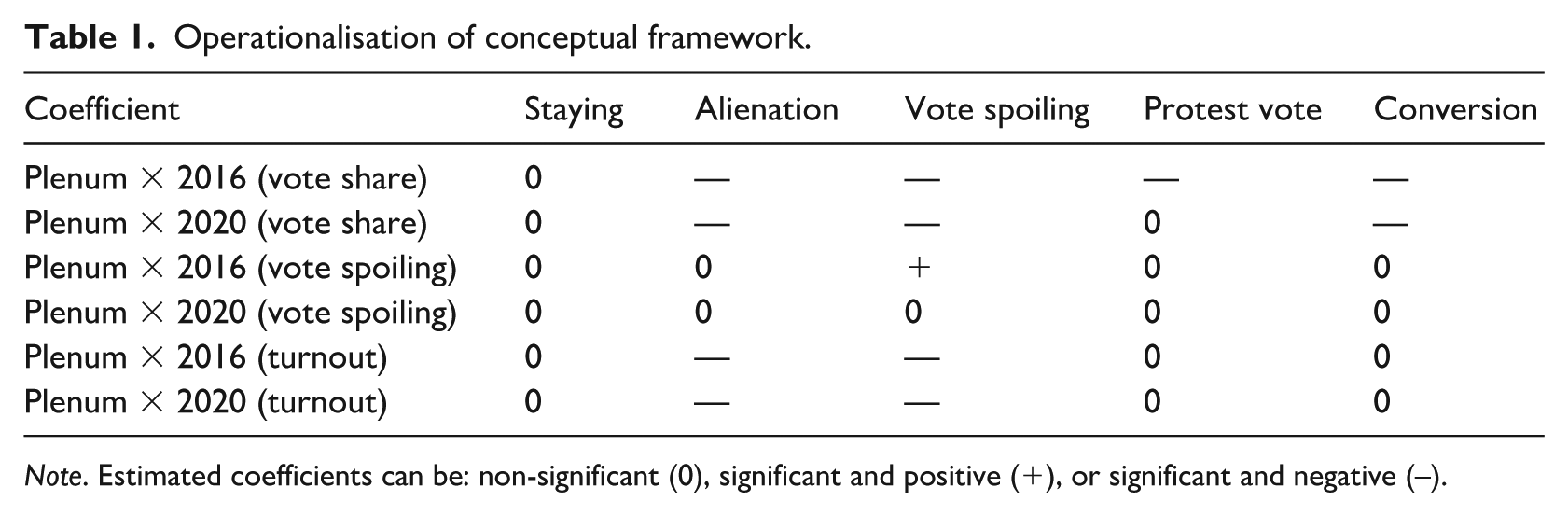
Note. Estimated coefficients can be: non-significant (0), significant and positive (+), or significant and negative (–).
The conceptualised links between non-participant protest exposure, politicisation, (dis)empowerment, and voting behaviour are presented in Figure 1.
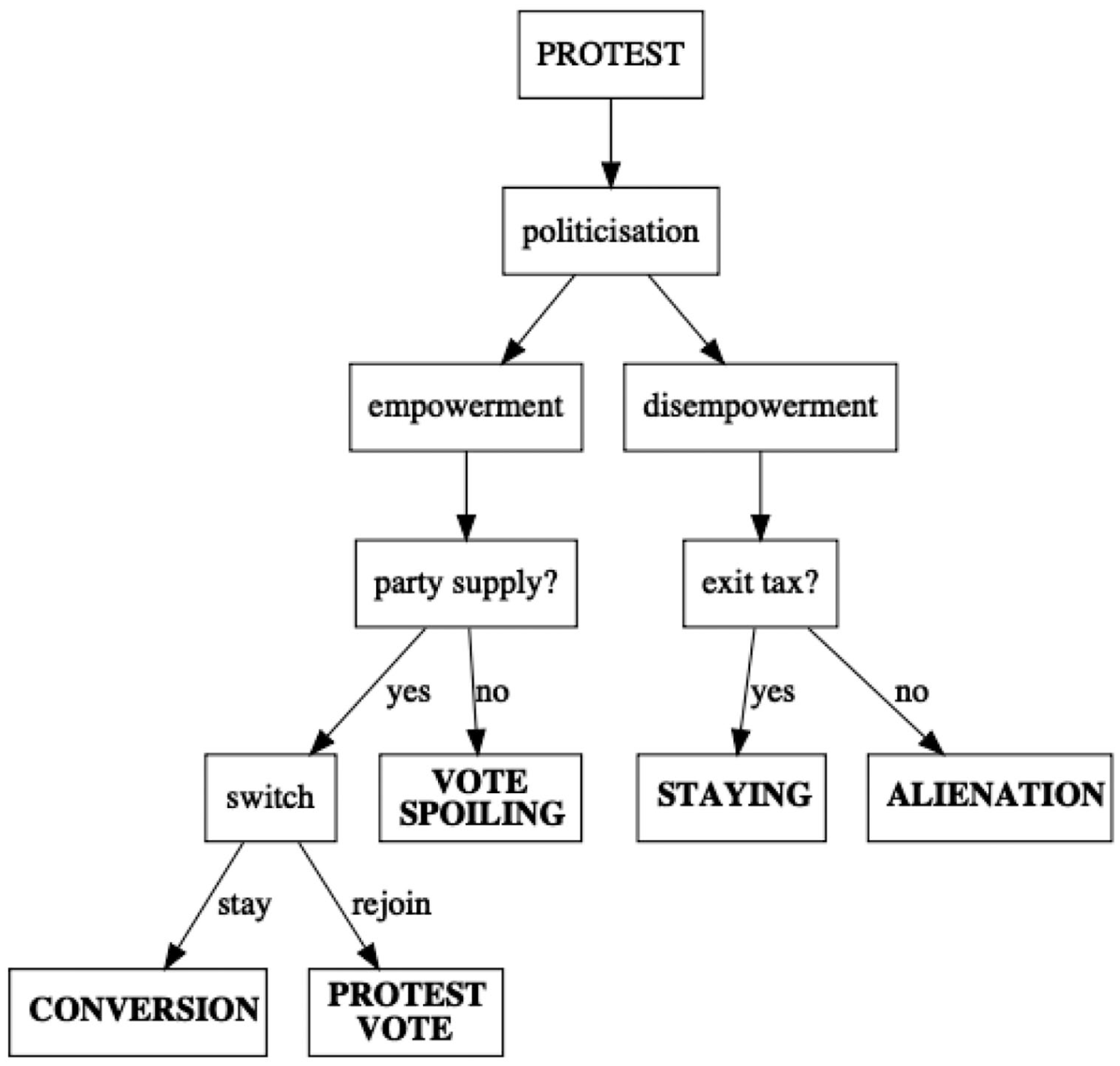
Pathways from protest to vote choice. Observable municipal-level proxies indicated in capital letters.
Having described the conceptual framework, we now outline the data and methods used in the analysis to connect plenums with subsequent electoral outcomes.
Data and methods
Data sources and operationalisation
The following analysis focuses on data from FBiH municipalities because of the congruence between the scale of the plenums and the level of governance in which citizens cast their votes. Data from 2008 to 2020 are covered to include elections both before and after the plenums.
Karamehmedovic (2014) compiled a list of the 22 local plenums/citizen-led actions that led to the issuing of demands to political elites. Of these, Prijedor, Srebrenica and Banja Luka (in RS), and Brčko District are excluded from the analysis, because we are only studying FBiH. Sarajevo is composed of four municipalities that are quite compact in size and close together, so we treat all four Sarajevo municipalities as having plenums.
The list of municipalities with plenum declarations was merged with municipal council elections data 2008–2020 from the Central Electoral Commission website. Our analysis examined municipal council data instead of mayoral elections, because the latter can depend on the popularity of individual candidates independently of the party. Moreover, coalitions were excluded from the analysis, since it was difficult to control for the effects of various coalition formations in different municipalities. Municipal vote-shares for SDA were collected for all local council elections, as well as for the four SDA breakaway parties that contested the 2020 local elections. The number of blank and invalid votes was available for the 2012, 2016, and 2020 local elections, but not for 2008. There was an initial sample of 61 municipalities out of the 79 municipalities in FBiH. The municipal-level percentage of Bosniaks, unemployment rate, percentage of urban population, average age, and population density were collected from the 2013 census data.
We also wanted to find a pre-treatment measure to gauge the supply of electoral alternatives within a municipality. Municipal councils in BiH are elected using a proportional representation electoral system (Election Law of BiH, Article 13.5). One way to measure the supply of alternatives was through electoral competitiveness. However, though there is ample literature on electoral competitiveness, there is no consensus on how to measure this for multi-member elections (Cox et al., 2020). Moreover, there is no agreement on whether the measure should be based on votes, vote share, or seats. This is further complicated by the ethnified support, such that electoral competition is primarily conducted in BiH within ethnic groups.
Using the number of parties in a municipality is also problematic, even if we only include Bosniak parties, since this does not capture their relative strengths and hence viability as alternatives. Ultimately, we opted for a measure of SDA local Bosniak influence based on the 2012 SDA valid vote share divided by the percentage of Bosniaks in the 2013 census. The 2012 election was used, because it was the last pre-treatment local or general election (the 2014 cantonal and general elections were held 10 months after the plenums were established).
The aforementioned data were used to estimate average electoral impact in municipalities that established plenums through DiD analysis with matching, which is explained in the next sub-section.
Methodology
The study employed a DiD approach to examine whether there were any significant electoral effects in places where plenums were established in 2014.
To estimate the DiD, the regression models took the form

where i = unit of interest (i.e., municipalities in FBiH), t = period (2008, 2012, 2016, or 2020), and ϵ = error term. The response variable y was the outcome of interest in our regression models. The parameter λ combined the unobserved across municipality year effects, estimated as coefficients on dummy variables T for year t, and αi were municipal fixed-effects to capture time-invariant confounding.
The ‘treatment’ in the analysis was the dummy variable D, and denoted whether there was a plenum. The plenums all took place in early 2014, were organised across FBiH, and put forward demands at nearly the same time. The plenums were unexpected, disbanded almost simultaneously by May 2014, geographically localised, and relatively few citizens participated. The coefficient δ is of central interest to the analysis, and denotes the estimated average treatment effect on the treated (ATT) municipalities.
Citizen mobilisation could have been taken as an ‘exogenous treatment’ on voters that is used when protests occur randomly. However, the main challenge for estimating the impact of protest on voting in this way is that there are bound to be unobserved factors linked both to the propensity to protest and to political behaviour. To address this issue, we employed an approach used by Wasow (2020) on cross-sectional, time-series data. Since repeated measures of the same place are connected, one way to proceed is to construct treatment groups by matching on key observable pre-treatment factors that are linked to both protests and voting behaviour.
We employed two-to-one nearest-neighbour matching on Euclidean distance with replacement using the MatchIt package (Ho et al., 2011). Two-to-one matching was used to trade off bias versus variance, with one-to-one matching having only slightly better balance but a much smaller set of municipalities (and worsening precision) in an already limited number of units. We matched on the 2013 census data for municipal-level percentage of Bosniaks, percentage urban population, mean age, and unemployment rate, along with the aforementioned measure of SDA local influence. The procedure selected the best matched ‘control’ units leading to a reduced sample of 42 municipalities, as well as calculating weights to be applied in the subsequent regression modelling.
Matching achieved better overall balance between municipalities with and without plenums, improving it substantially for SDA local influence and urban percentage, slightly worsening it for Bosniak percentage and age, and remaining similar for unemployment (online Appendix, Figure 1). Descriptive statistics for the variables used in the analysis are presented separately for municipalities with and without plenums in the online Appendix (Tables 2 and 3).
Changes in SDA vote share between election cycles were examined as a proxy for averaged municipal vote choice, and data were also collected on municipal-level spoiled and blank votes and voter turnout. Combinations of these proxies provided potential signals of averaged or net municipal-level voting behaviour change between elections. For example, if turnout decreased, it did not mean that voters only stopped voting, but rather that more people stopped voting compared with new voters participating.
We operationalised how we could infer evidence about average voting behaviour and whether it suggested staying, conversion, protest voting, vote spoiling, or alienation, and estimated the DiD models as specified previously with SDA vote share, valid turnout, and spoiled/blank votes as outcomes.
Staying: if voters tended to turn out to vote, remained supportive of SDA, and did not spoil their votes, compared with 2012, there would be no statistically significant differences in 2016 or 2020 (coefficients plenum x 2016 and plenum x 2020) for SDA vote share, valid turnout, or blank/spoiled votes.
Alienation: if voters tended to leave SDA, not vote, and not spoil their vote, compared with 2012, there would be no statistically significant differences in 2016 or 2020 (coefficients plenum x 2016 and plenum x 2020) for blank/spoiled votes, but we would expect significant negative differences in 2016 and 2020 for SDA vote share and valid turnout for coefficients plenum x 2016 and plenum x 2020.
Vote spoiling: if SDA voters tended to spoil their votes in 2016 before not turning out in 2020, compared with 2012, there would be a positive statistically significant difference in 2016 (coefficient plenum x 2016) for blank/spoiled votes, and this coefficient would be negative and statistically significant for SDA vote share and valid turnout. There would be no statistically significant differences in 2020 (coefficient plenum x 2020) for blank/spoiled votes, but we would expect significant negative differences in 2020 for SDA vote share and valid turnout for the coefficients plenum x 2020.
If SDA voters turned out and did not spoil their votes and, compared to 2012, tended to vote for other parties in 2016, there would be a negative and statistically significant difference (coefficient plenum x 2016) for SDA vote share, but plenum x 2016 would not be statistically significant for valid turnout and blank/spoiled votes. If these voters tended to return to SDA (protest voting), compared to 2012, there would be no statistically significant difference (coefficient plenum x 2020) for SDA vote share, valid turnout, and blank/spoiled votes. On the other hand, if these voters did not return to SDA (conversion), compared to 2012, there would be a negative statistically significant difference (coefficient plenum x 2020) for SDA vote share, but plenum x 2020 would not be significant for valid turnout and blank/spoiled votes.
We present a summary of the operationalisation of the conceptual framework in Table 1. Crucially, we only observe municipal-level existence of a protest and suggestive evidence of these five responses, but not the intermediate steps in the framework. The observable municipal-level elements of our analysis are indicated in capital letters in Table 1. Since this operationalisation consists of one-sided evidence, one-sided hypothesis tests (at the 5% significance level) were conducted for the relevant estimated regression coefficients.
Moreover, following previous studies (Bertrand et al., 2004), we clustered standard errors by units (municipalities) when conducting a DiD analysis, since errors for a given unit are not independent across time. We used the fixest R package to estimate the fixed-effects models with clustered unit standard errors (Bergé, 2018).
The results of the DiD analysis are presented in the next section.
Results
As mentioned earlier, we estimated three separate regression models, with SDA vote share, valid turnout, and percentage invalid/blank votes as the outcomes. The models included year (with 2012 as the baseline), whether or not a plenum was established in 2014 (with not having a plenum as the baseline), an interaction of year and existence of plenum as explanatory variables, as well as a municipality intercept. The standard errors were clustered by municipality. The results are presented in Table 2, with one-sided statistical significance indicated.
Regression estimates with one-sided p-values for SDA vote share, vote spoiling, and valid turnout, baseline year 2012.
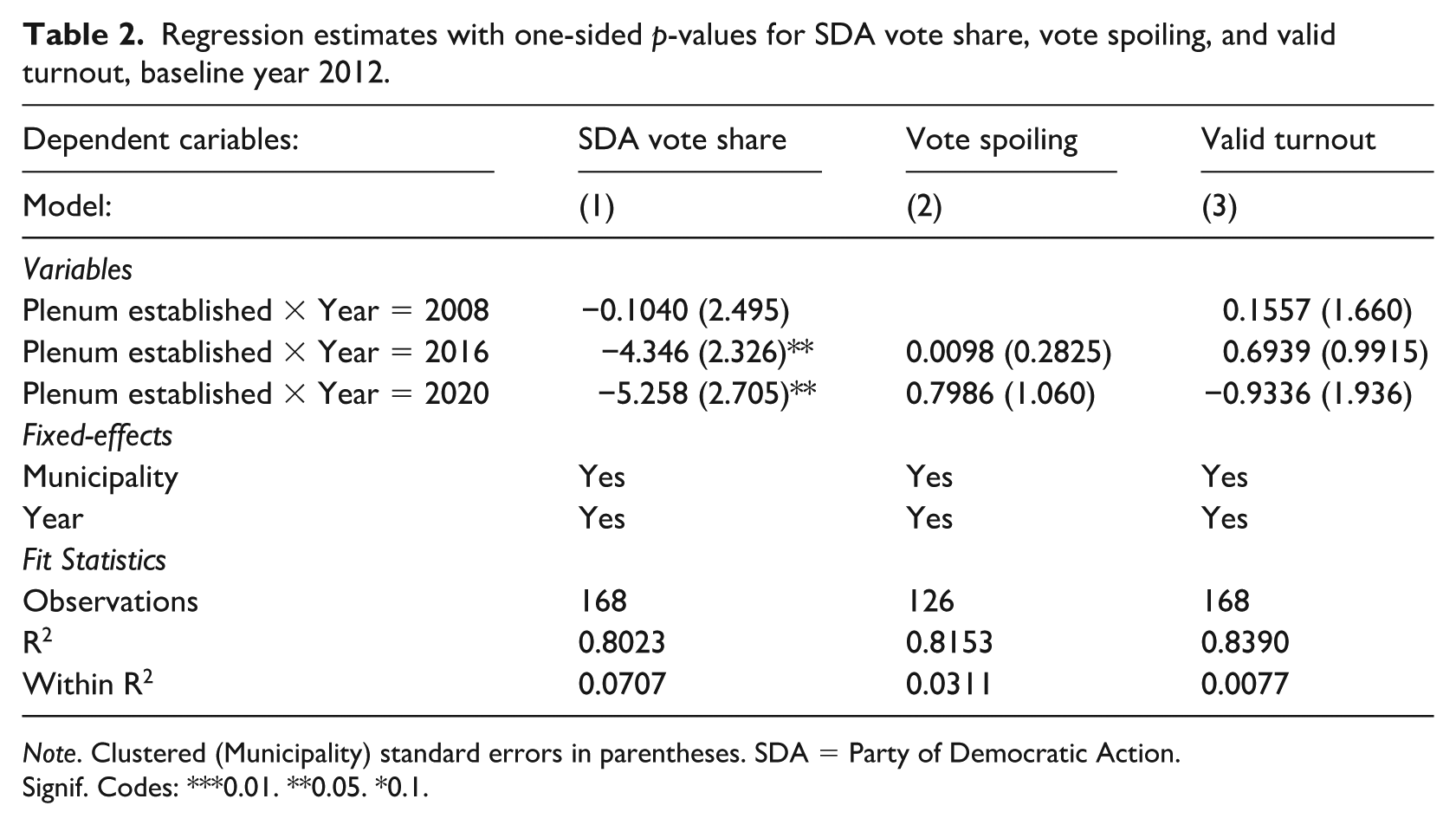
Note. Clustered (Municipality) standard errors in parentheses. SDA = Party of Democratic Action.
Signif. Codes: ***0.01. **0.05. *0.1.
Turning to the main part of the analysis, we see that the coefficients plenum x 2016 and plenum x 2020 are non-significant for Model 2 (vote spoiling) and Model 3 (turnout) in Table 2. This means that there was no significant mean difference in the change in valid turnout or vote spoiling between municipalities with and without plenums, between 2012 and 2016, as well as between 2012 and 2020.
On the other hand, the estimated coefficient for plenum x 2016 in the SDA vote share was negative and statistically significant. This means that the average change in SDA vote share between 2012 and 2016 was significantly more negative in municipalities with plenums compared with places where plenums were not established. Moreover, the estimated coefficient for plenum x 2020 in the SDA vote share was also negative and statistically significant. This means that the average change in SDA vote share between 2012 and 2020 was significantly more negative in municipalities with plenums compared with places where plenums were not established.
To check the assumptions for the DiD approach, we looked at the interaction term plenum x 2008, which represented the difference in average change in SDA vote share, vote spoiling, or valid turnout between municipalities with and without plenums between 2008 and 2012, that is, before the plenums were established. Angrist and Pischke (2008) refer to this as testing whether the consequences precede the posited causes. Such results can indicate anticipatory effects or reverse causality, both of which would undermine the results. Reassuringly, the estimated coefficient plenum x 2008 was non-significant in Models 1 and 3 in Table 2.
Referring back to the operationalisation of the conceptual framework (Table 1), our results showed that the differences in the average change in vote spoiling 2012–2016 (and 2012–2020) between places with and without plenums was non-significant. The same was true for the average change in valid turnout. However, there was an estimated negative impact of plenums on SDA vote share between 2012 and 2016, and this change persists to 2020. Therefore, there was evidence that on average, voters in the municipalities under study experienced conversion, staying within the electoral arena but switching away from SDA and not returning to them in 2020.
The estimated coefficient was even more negative for plenum x 2020 than for plenum x 2016. We checked whether this change between 2016 and 2020 was statistically significant and whether the findings changed when considering SDA breakaway parties in 2020 (Table 3). To do this, we utilised a DiD specification using first differences, which can be presented as

where ∆Yi = change in SDA vote share in the municipality between elections; Di = whether municipality i had a plenum in 2014; and Xi = vote share of breakaway parties in Model 3.
Estimated regression coefficients, changes 2012–16 and 2016–2020.
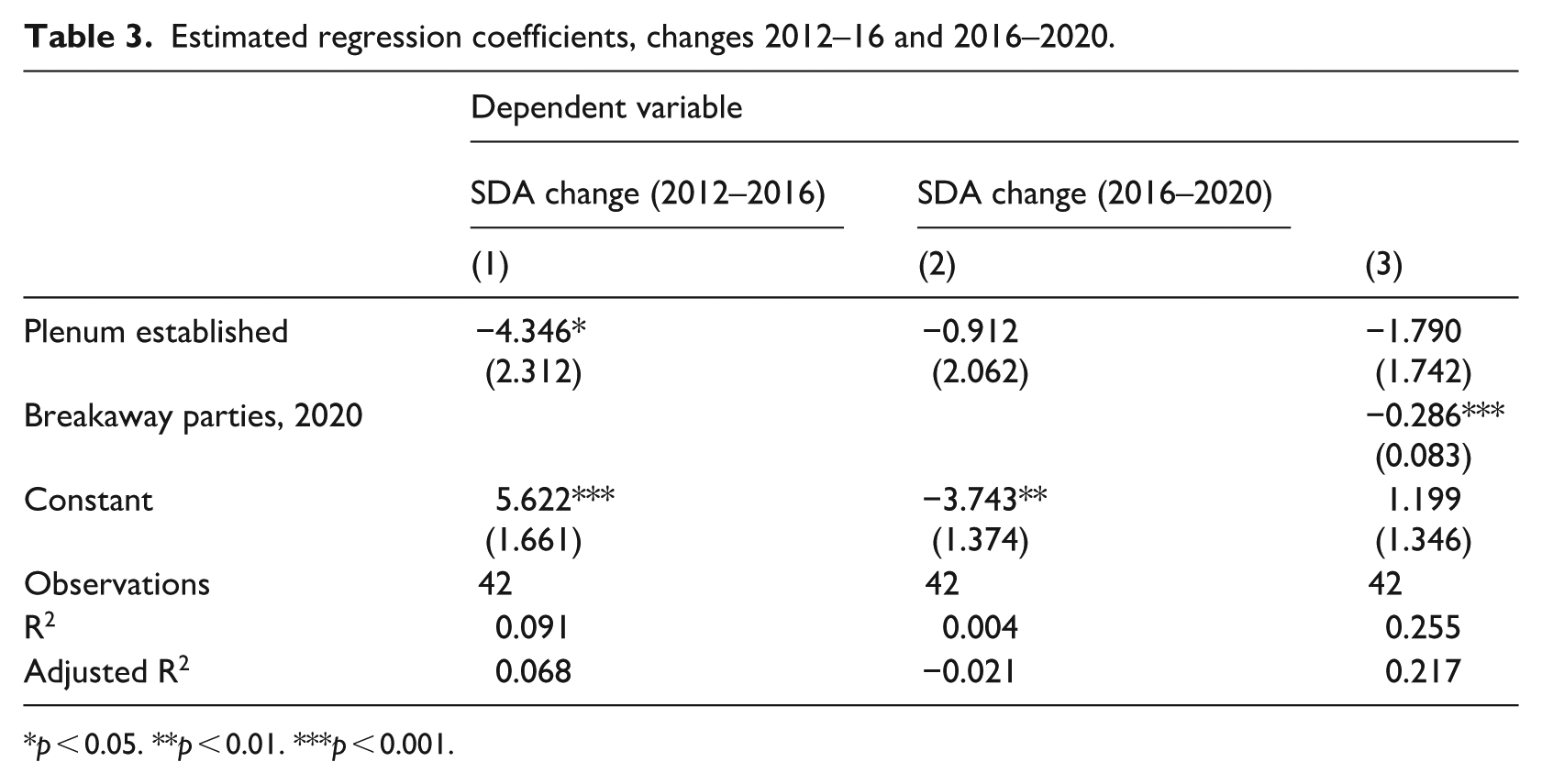
p < 0.05. **p < 0.01. ***p < 0.001.
As a sense check, we first confirmed (Model 1) that this specification resulted in the same estimate as previously for the difference between 2012 and 2016. We then used the same specification but to estimate the DiD between 2016 and 2020, and found that it was not statistically significant (Model 2).
In order to test whether the difference in the change between places with and without plenums depends on the strength of SDA breakaway parties, we added the total vote share of the breakaway parties in 2020 to the model on SDA vote share between 2016 and 2020 (Model 3). The change between 2016 and 2020 was more negative in places that established plenums compared with Model 2, but remained non-significant. This means that the estimated impact of the plenums on SDA vote share was not significantly different between 2016 and 2020, and the result did not change when considering breakaway parties in 2020.
We can translate the estimated DiD coefficient (in Table 2, Model 1) to an estimated average effect size on the ‘treated’. That is, the ATT for municipalities with plenums is -4.35 percentage points. The average SDA vote share in 2012 among municipalities that established plenums in 2014 was 28.83%, which thus corresponds to a non-negligible estimated mean effect size of 100*4.35/28.83 = 15.07%.
Discussion
Our evidence suggests that the existence of plenums had a substantial and statistically significant impact on subsequent electoral outcomes in FBiH for Bosniak electoral politics. Though the protests were civic in character and the grievances addressed the whole citizenry, the plenums were established mainly in Bosniak-predominant areas and affected Bosniak electoral politics.
In places where citizens established plenums, SDA lost ground to other political parties, and there was no significant evidence of voters ‘exiting’ more frequently than in non-plenum municipalities. Although SDA lost support and the estimated effect size in municipalities with plenums was substantial, this was not pivotal to the overall results.
In terms of the framework developed in this article, SDA voters, on average, experienced a conversion, that is, remaining within the electoral arena, voting for other political parties in 2016 and staying away from SDA in 2020. Moreover, the durability of the electoral effects suggests that the plenums took on an afterlife, even six years after their dissolution. However, these results need to be viewed with some caution.
First, aggregate analyses are prone to an ecological fallacy, that is, incorrectly inferring individual relationships from aggregate (in this case, municipal) results. We follow a similar rationale to Kselman and Niou (2011), who posit that aggregate-level results provide suggestive rather than definitive evidence.
Second, individual-level analyses of protests or other citizen-led mobilisation (e.g., Haas et al., 2025) provide not only more fine-grained analyses on who protested, but also how prevalent each of the voter responses was.
Third, the impact of protest events may spill over to neighbouring (untreated) municipalities, which could bias our results. If the spillover effects in neighbouring locations are in the same direction as the ATT, then our estimate is attenuated, while the estimated ATT would be overstated if spillover effects are in the opposite direction. In this instance, if non-participants in neighbouring municipalities are also exposed to plenums, it is plausible that they could be impacted in the same way and less plausible that they would systematically behave in the opposite way. If anything, it is more intuitive to assume that spillovers would attenuate the estimated impact.
Fourth, although we addressed possible confounding by matching plenum and non-plenum municipalities on key pre-treatment covariates (using 2013 census data), there is still some imbalance, and other unobservable or unmeasured covariates could influence the analysis. Hence, the results are presented with a note of caution.
Beyond the empirical results, the conceptual framework developed here integrates the literature on the effects of protest events on the different electoral responses of non-participants. Future comparative explorations are needed to confirm whether the links between politicisation, empowerment, and voting behaviour are connected, and the conditions under which these links strengthen or weaken over time.
The findings in this article are relevant to other post-conflict and post-socialist countries, and also more generally in investigating the link between protest and electoral arenas. The results of the study, notwithstanding the above caveats, show that significant electoral change can persist long after direct-democratic citizen-led mobilization, even in places such as BiH where political elites exert substantial formal and informal power over citizens.
Supplemental Material
sj-pdf-1-ips-10.1177_01925121261446866 – Supplemental material for Protest, empowerment, and voice: Exploring the electoral afterlife of the 2014 Bosnian popular assemblies
Supplemental material, sj-pdf-1-ips-10.1177_01925121261446866 for Protest, empowerment, and voice: Exploring the electoral afterlife of the 2014 Bosnian popular assemblies by Indraneel Sircar in International Political Science Review
Footnotes
Acknowledgements
I am grateful for the insights and advice from Jessie Barton Hronešová, Jack Blumenau, Abigail Ewen, David Hendry, Jouni Kuha, Ben Lauderdale, and Tom O’Grady. The usual disclaimer applies.

Funding
The author received no financial support for the research, authorship, and/or publication of this article.
Declaration of conflicting interests
The author declared no potential conflicts of interest with respect to the research, authorship, and/or publication of this article.
Supplemental material
Supplemental material for this article is available online.
Notes
Author biography
References
Supplementary Material
Please find the following supplemental material available below.
For Open Access articles published under a Creative Commons License, all supplemental material carries the same license as the article it is associated with.
For non-Open Access articles published, all supplemental material carries a non-exclusive license, and permission requests for re-use of supplemental material or any part of supplemental material shall be sent directly to the copyright owner as specified in the copyright notice associated with the article.
