






Abstract
Character strengths, representing positive attributes of individuals, have been linked with several positive psychological qualities, such as life satisfaction and well-being. However, the effects of character strengths and their deployment on married couples, at the dyadic level, have not been studied to date. The present study focuses on married partners’ strengths endorsement and on their opportunities to deploy their strengths in the relationship, and explores the associations between these variables and both partners’ relationship satisfaction. The results reveal significant associations of strengths endorsement and deployment with relationship satisfaction, as expected. However, unexpectedly, men’s idealization of their wives’ character strengths was negatively associated with relationship satisfaction. These findings hold theoretical and practical implications for couples and therapists, regarding dyadic effects of strengths endorsement and deployment, and their perception.
Character strengths reflect the potential positive qualities of human beings, and their deployment demonstrates individuals’ opportunity to thrive, by fulfilling their potential (Peterson & Seligman, 2004). A few studies have empirically shown that the endorsement and application of strengths is correlated with positive individual outcomes such as increased happiness, meaning in life, and job satisfaction, and decreased depression (e.g., Littman-Ovadia & Steger, 2010; Seligman, Steen, Park, & Peterson, 2005). Couple relationships can serve as a fertile soil for such growth and fulfillment, by serving as a source of support (e.g., when facing adversity) and a catalyst for engaging in life opportunities (Feeney & Collins, 2013). The extent to which relationship partners endorse these character strengths and the degree to which the relationship enables and facilitates these strengths’ deployment (i.e., as a kind of personal fulfillment) are hypothesized to be associated with relationship satisfaction. Furthermore, because of partners’ influence on each other (Kelly & Thibaut, 1978), dyadic factors related to character strengths (such as partner’s strengths and their perception) are also hypothesized to be associated with partners’ relationship satisfaction.
Character Strengths and Well-Being
Character strengths are positive human traits that affect individuals’ thoughts, feelings, and behavior providing a sense of fulfillment and meaning (Park, Peterson, & Seligman, 2004). One of the most studied taxonomies of character strengths is Peterson and Seligman’s (2004) Values in Action classification of character strengths, which includes 24 strengths, each related to one of six broader virtues: (a) wisdom and knowledge (includes the strengths of creativity, curiosity, judgment, love of learning, and perspective/wisdom); (b) courage (including bravery, honesty, persistence, and zest); (c) humanity (including kindness, love, and social intelligence); (d) justice (including teamwork, fairness, and leadership); (e) temperance (including forgiveness, modesty, prudence, and self-regulation); and (f) transcendence (including appreciation of beauty, gratitude, hope, humor, and religiousness).
Endorsement of these character strengths have been linked with a host of positive psychological outcomes such as life satisfaction (Littman-Ovadia & Lavy, 2012), self-acceptance, a sense of purpose in life, environmental mastery, physical and mental health (Leontopoulou & Triliva, 2012), and resilience to stress and trauma (Park & Peterson, 2006; 2009). Seligman (2002) hypothesized that character strengths can also contribute to the quality and prosperity of couple relationships, because most of them represent positive individual characteristics that are also related to relationships and their maintenance. For example, love, kindness, gratitude, as well as other strengths, which are focused on supporting and appreciating others (i.e., “strengths of the heart”; Park & Peterson, 2006) have direct theoretical links with relationship satisfaction, although empirical evidence for these links is scarce (e.g., Bartlett, Condon, Cruz, Baumann, & Desteno, 2012; Gordon, Impett, Kogan, Oveis, & Keltner, 2012; Mikulincer, Shaver, & Slav, 2006). In a similar way, additional strengths have a potential contribution to other aspects of couple relationships: Persistence and zest can promote relationship maintenance and defeat burnout, self-regulation and creativity can facilitate constructive conflict management (Gruber, 2006), teamwork can help coping with couples’ tasks (such as raising children, or dealing with financial challenges) and so forth.
Most of these links have not been examined to date, as well as the associations of married partners’ general strengths endorsement (i.e., endorsement of the 24 strengths as an amalgam of these positive attributes) with their relationship satisfaction. Initial support for the potential effects of character strengths on couple well-being can be found in the evidence linking character strengths with personal attributes that contribute to relationship satisfaction, such as self-acceptance, a sense of purpose, and environmental mastery (Brandau, Wade, & Wei, 2007; Leontopoulou & Triliva, 2012). However, this is the first study (to the best of our knowledge) to directly examine the associations between character strengths and married couples’ relationship satisfaction.
Beyond contributing to the individual’s well-being, character strengths are expected to contribute to the welfare of others in the individual’s social environment (Peterson & Seligman, 2004) and specifically to their partner. Evidence from a recent study of dating adolescent couples provides initial support for this claim, indicating that certain character strengths of individuals (i.e., women’s forgiveness and men’s perseverance, social intelligence, and prudence) are associated with their partners’ life-satisfaction (Weber & Ruch, 2012). Although the study does not link strengths specifically with relationship satisfaction, and it is based on a sample of adolescents (with a mean age of 16.5 years) in relatively short relationships (with a mean length of less than a year), it implies a possible dyadic effect on a more general aspect of well-being (life satisfaction).
Based on the above mentioned rationale and initial findings, the following hypothesis was generated:
Strength Deployment
The daily use of strengths (i.e., strengths deployment) is also considered to be a key predictor of life satisfaction and personal fulfillment (Peterson & Seligman, 2004), because it encompasses individuals’ actual daily implementation of their positive attributes. Reflecting the daily practice of character strengths, strengths deployment has been associated with positive outcomes such as life happiness (Duckworth, Steen, & Seligman, 2005), a sense of fulfillment (Seligman et al., 2005), and work adjustment (Littman-Ovadia & Steger, 2010).
In a similar manner, the breadth of opportunities that a relationship provides for daily use of character strengths is expected to be closely associated with partners’ relationship satisfaction. Although the positive effects of strengths deployment in life (e.g., Peterson & Seligman, 2004) and at work (Littman-Ovadia & Steger, 2010) have been discussed by theorists and researchers, the positive effects of strengths deployment in romantic relationships have not been empirically examined. Furthermore, other studies of partners’ positive attributes (e.g., Ozer & Benet-Martinez, 2006) have typically not considered this more applicable aspect of partners’ characteristics, which takes into account not only the perceived qualities of the relationship partners but also their tendency to use them in the relationship context. This tendency is hypothesized to have a dominant influence on partners’ satisfaction, because it reflects the actual manifestation of the positive attributes (i.e., character strengths) in the relationship.
Preliminary support for the potential positive effects of partners’ strengths deployment to couples’ relationship quality can be found in the literature: Seligman (2002) argued that romantic relationships are more successful when they serve as an arena for daily deployment of strengths, because the use of strengths in the relationship helps partners move toward their ideal selves. When accompanied by partner’s approval, this process of self-growth can lead to a greater sense of self fulfillment and satisfaction. Studies of the Michaelangelo phenomenon (Rusbult, Finkel, & Kumashiro, 2009) support these claims, by revealing partners’ role in providing perceptual and behavioral affirmation for individuals’ goals (i.e., movement toward ideal selves), and thus creating an environment which can facilitate individuals’ demonstration of positive aspects related to their ideal selves. Such perceptual and behavioral affirmation of partners’ positive attributes promotes their progress toward these ideal selves.
Because striving for growth is a primary human motivator (Deci & Ryan, 2000), partners who are successfully assisting each other in becoming closer to their ideal self, create a dyadic dynamic that ultimately leads to increased personal and couple well-being (Drigotas, 2002; Drigotas, Rusbult, Wieselquist, & Whitton, 1999). In a similar way, we suggest that perceiving the relationship as providing numerous opportunities for strengths’ deployment will increase partners’ feelings that their relationship promotes their growth, and will thus contribute to their relationship satisfaction.
Furthermore, because the use of character strengths is hypothesized to yield positive effects not only for individuals, but also for their environments (including the people around them; Park & Peterson, 2009), we expected partners’ strengths deployment in the relationship to be associated with both partners’ relationship satisfaction. So that one partner’s increased strengths deployment will be associated not only with their own satisfaction, but also with their partner’s relationship satisfaction: Individuals’ strengths deployment can yield direct benefits for their partner (e.g., if they deploy their gratitude strengths, their partner is expected to be the recipient of gratitude, and thus experience higher relationship satisfaction; Mikulincer et al., 2006). It can also yield indirect benefits, such as enjoying a positive atmosphere resulting from the individual’s satisfaction. Thus, we hypothesized the following:
Partner Idealization and Character Strengths
Another strengths-related aspect of romantic relationships that can effect relationship satisfaction is partners’ perceptions of each others’ strengths. Favorable perceptions of partner attributes have been associated with relationship satisfaction, even when they are unrealistic (e.g., Murray et al., 2011). Specifically, partner idealization, defined as an interpersonal mode of self-deception that makes individuals convey a more positive portrayal of their spouse (O’Rourke & Wenaus, 1998), predicted relationship satisfaction in a host of studies (e.g., Murray, Holmes, Dolderman, & Griffin, 2000). Partner idealization was shown to advance stability and harmony in marriage by enhancing both partners’ appreciation for one another and by encouraging more efficient dispute management (Gottman, 1993; Hazan, 2002). It was also associated with more positive interpretations of partner behavior (Notarius, Benson, Sloane, Vanzetti, & Hornyak, 1989; Weiss, 1980). Dating couples who tended to minimize the importance of partner’s flaws, and even find virtues in them, have created more satisfying relationships (Murray & Holmes, 1999), and newlywed couples who reported partner idealization were more resilient to the natural slow corrosion of relationship satisfaction (Murray et al., 2011) and love emotions (Miller, Niehuis, & Huston, 2013).
In terms of idealization of partner’s character strengths, Seligman (2002) argued for the specific positive effects of favorable perception of partner’s character strengths. He posed that in happy couples, individuals perceive their partners as having more character strengths. Furthermore, idealization of partner’s strengths can operate as a self-fulfilling prophecy (i.e., the Pygmalion effect; Rosenthal & Jacobson, 1968), and enhance partner’s thriving and satisfaction. Based on this literature, we hypothesized that idealization of partner’s character strengths will have similar effects to idealization of other positive attributes of the partner:
Method
Participants
The study comprised 100 Israeli couples, who were married for 1 month to 46 years (M = 9.89, SD = 11.49). About half of them (N = 51 couples) had children. Partners’ ages ranged from 20 to 72 years (M = 33.99, SD = 12.55 for men; M = 32.11, SD = 12.17 for women). Most of the participants had college or university education (51% of the men and 68% of the women), but some also had other, nonacademic secondary education (15% of the men, 11% of the women) or high school education (30% of the men, 18% of the women). Participants did not receive monetary compensation for their participation.
Materials
Character strengths were assessed with an abbreviated Hebrew version of the Values in Action Inventory of Strength (Peterson & Seligman, 2004), developed by Seligman (2002), and validated in Israel by Littman-Ovadia & Steger (2010). This inventory comprises 48 items: Two items assess each character strength, one of which is reversed scored. For example, curiosity was assessed with the items: “I am always curios about the world” and “I get bored easily.” Participants rated each item twice: (1) the extent to which the item describes them well, and (2) the extent to which it describes their partner well. Ratings were provided on a 5-point scale ranging from not at all (1) to very much (5). Cronbach’s alphas were satisfactory for the self-ratings and for the partner’s ratings (ranging from .80 to .83 for men and women).
Partner idealization was computed by subtracting self-reported strengths ratings from partner’s ratings (based on Murray et al., 2000).
Strengths deployment was assessed with a 24-item questionnaire developed by Littman-Ovadia and Steger (2010). The questionnaire was originally developed to assess strengths deployment (of the 24 strengths as a whole) at work, and in the present study its instructions were modified to fit the context of romantic relationships. Specifically, participants were asked to rate their opportunities to use their strengths in their romantic relationship. Ratings were assessed on a 5-point scale ranging from not at all (1) to very much (5). The scale’s Cronbach’s alphas were high (.92 for men and .91 for women).
Relationship satisfaction was assessed with the Hebrew version (Florian & Drori, 1990) of the 16-item well-being scale of the Mental Health Inventory (Veit & Ware, 1983), which was modified to focus on marriage and marital life (e.g., ‘I am happy and satisfied with my marriage’). Items were rated on a scale ranging from (1) not satisfied at all to (5) very satisfied. 1 The scale’s Cronbach’s alpha was high (.93.for men and .92 for women), and there was a significant correlation between partners’ relationship satisfaction ratings (r = .50, p < .001).
Procedure
Four research assistants invited both members of married couples to voluntarily participate in the study. These couples were recruited through advertisements in social networks and billboards. On their agreement, participants met personally with a research assistant, their affiliation was recorded, and each partner received a personal envelope containing a battery of questionnaires. The envelopes were stamped and addressed to the research assistant. Each participant completed the questionnaire battery individually and returned it in a sealed envelope. This way of distributing the questionnaires allowed for pairing the couple questioners without a need for disclosing personal information.
Results
Descriptive Statistics
Means and standard deviations of the variables are shown in Table 1. Paired-samples t tests indicated a gender difference in one variable: Partner’s strengths ratings were higher for women (t [200] = −2.88, p < .01).
Means and Standard Deviations of the Study Variables for Men (N = 100) and Women (N = 100).
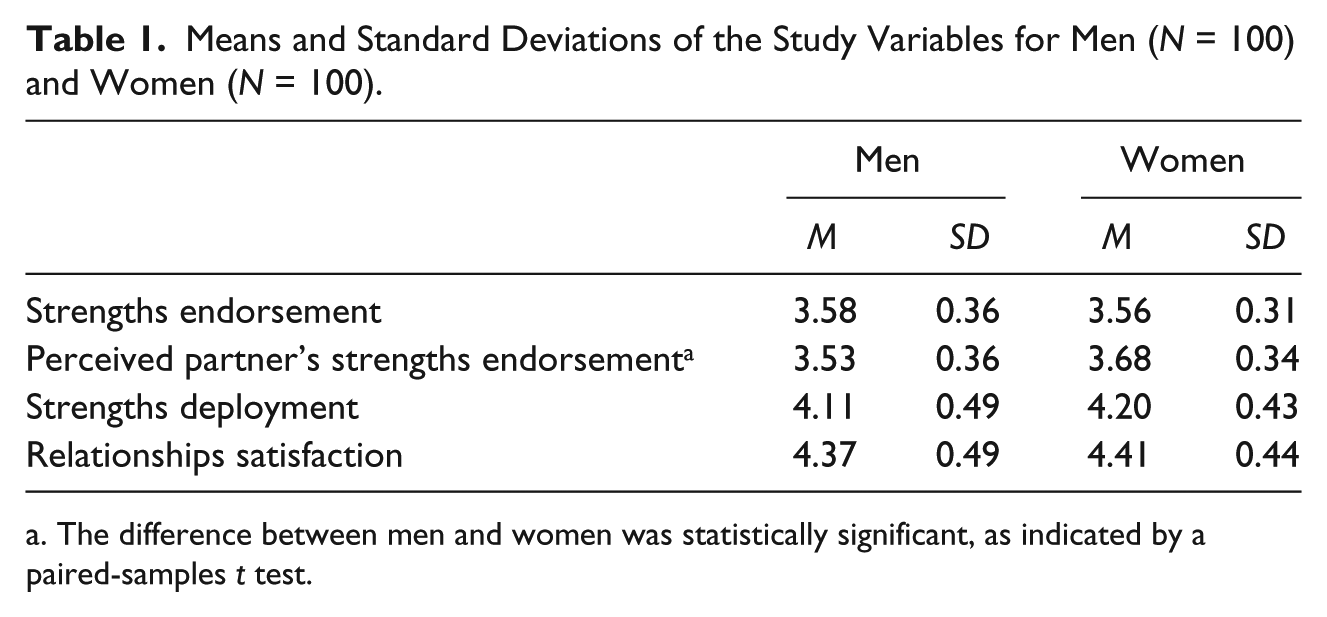
The difference between men and women was statistically significant, as indicated by a paired-samples t test.
In order to examine our hypotheses, we used the actor–partner interdependence model (Kashy, Kenny, & Cook, 2006) to deal with violations of statistical independence associated with dyadic data. In the actor–partner interdependence model, actor and partner effects are based on both members of a couple. However, when couple members are distinguishable on some variable, such as gender, it is possible to ask whether actor and partner effects are qualified by gender. All effects were computed with hierarchical linear modeling (Raudenbush & Bryk, 2002) using full maximum likelihood estimation, as recommended by Campbell and Kashy (2002). We conducted the hierarchical linear modeling analyses in two levels, including data at the person level (Level 1) and at the couple level (Level 2). All the independent variables were grand-mean centered. We included gender, relationship duration, and having children (or not) in all of the analyses, to control for their effects (if they exist).
Character Strengths Endorsement
In order to examine Hypothesis 1, we regressed participants’ own and their partner’s self-reported character strengths, on participants’ relationship satisfaction. Gender and its interactions with the independent variables were also entered to the equation to test for any differences between men and women, and relationship demographics (i.e., relationship lengths and having children) were also entered as control variables. As shown in Table 2, participants’ (actors’) self-reported strengths endorsement and their partners’ self-reported strengths endorsement were positively associated with their relationship satisfaction.
Unstandardized Hierarchial Linear Modeling (HLM) Coefficients: Relationship Satisfaction Predicted by Gender and Partners’ Strengths Endorsement.

p < .01. ***p < .001.
Character Strengths Deployment
We examined Hypothesis 2 by regressing participants’ relationship satisfaction on both individuals’ own and their partner’s self-reported strengths deployment ratings. Gender (and its interactions with the dependent variables), relationship length, and having children (yes/no) were also entered in the equation (Table 3). Results indicated that participants’ (actors’) self-reported strengths deployment ratings and their partners’ self-reported strength deployment ratings were positively associated with their relationship satisfaction.
Unstandardized Hierarchical Linear Modeling (HLM) Coefficients: Relationship Satisfaction Predicted by Gender and Partners’ Strengths Deployment.
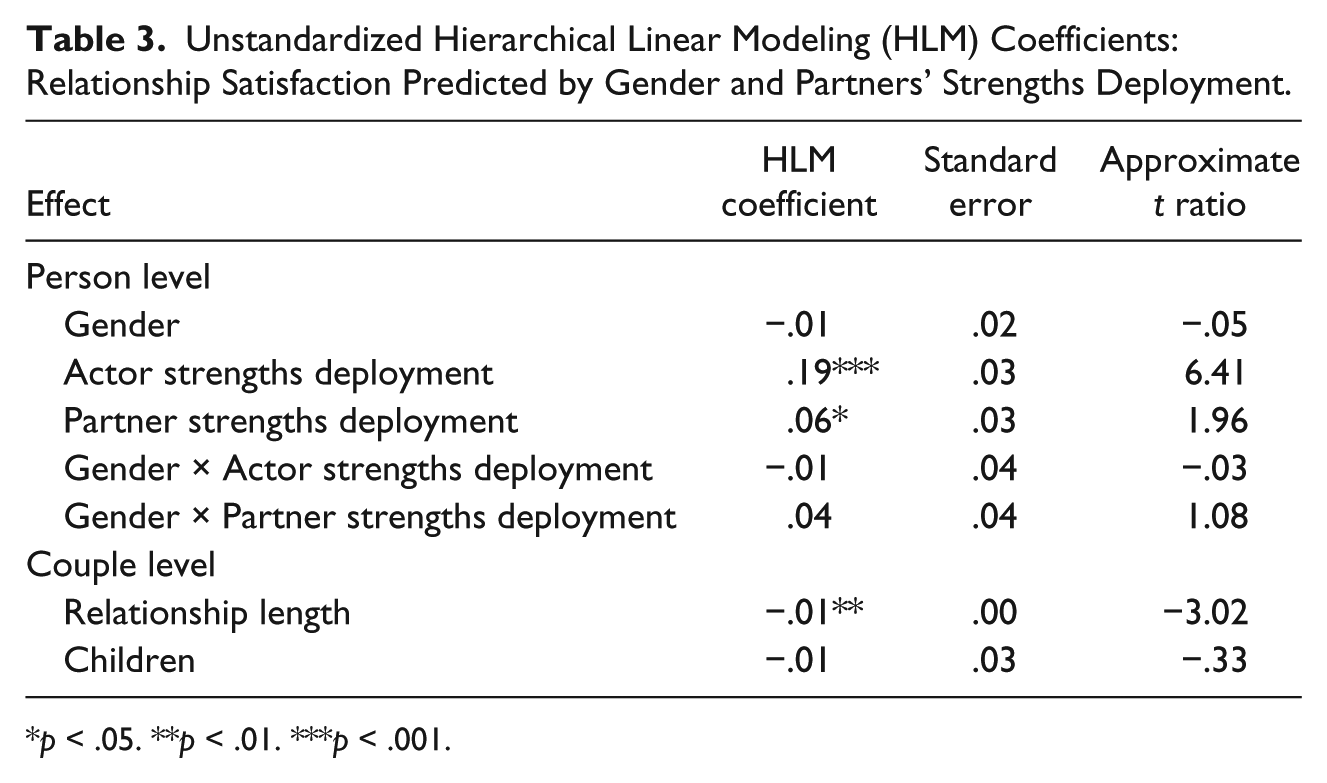
p < .05. **p < .01. ***p < .001.
Partner Idealization
Hypothesis 3 was examined by regressing participants’ relationship satisfaction on their idealization (of their partner). Gender, relationship length, and having children (yes/no) were also entered in the equation (Table 4). There was a significant interaction of partner idealization with gender. Using Preacher, Curran, and Bauer’s (2006) procedure, we found that for men, idealizing their partner (i.e., perceiving her as possessing more strengths than she thinks she possess) was negatively associated with relationship satisfaction (b = −.10, p < .05). For women, this association was positive, but not significant (b = .04, ns; Figure 1).
Unstandardized Hierarchial Linear Modeling (HLM) Coefficients: Relationship Satisfaction Predicted by Gender and Partner Idealization.
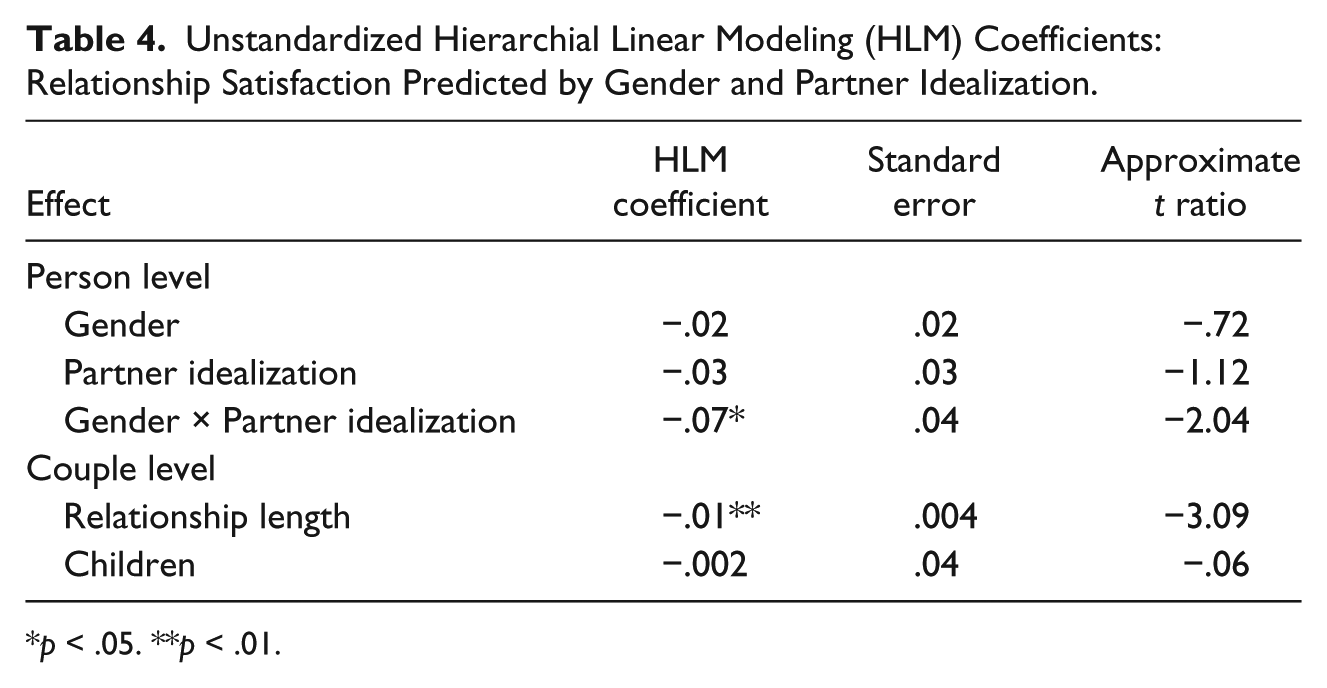
p < .05. **p < .01.
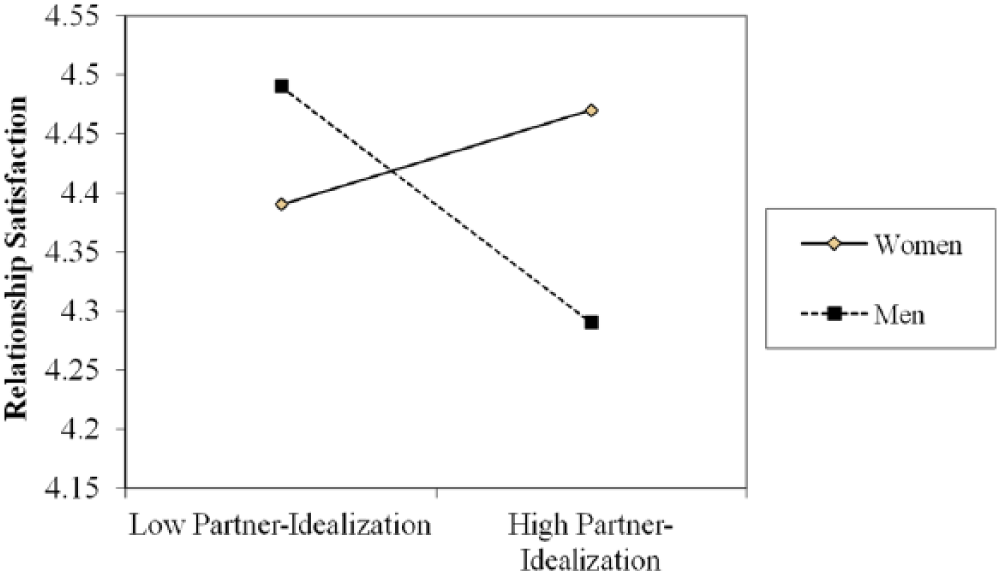
The effect of partner idealization on relationship satisfaction—moderation by gender.
Discussion
This study presents an attempt to explore character strengths in dyads of married couples. It demonstrates positive links of both partners’ strengths and their deployment with partners’ relationship satisfaction. It also suggests gender-specific effects of idealization of partner’s character strengths.
Strengths Endorsement and Deployment
As expected, individuals’ self-ratings of their character strengths, and their partners’ self-ratings of their character strengths were associated with relationship satisfaction. This result corresponds with the claims and empirical evidence linking strengths endorsement with other positive psychological outcomes such as well-being and fulfillment (Duckworth et al., 2005; Park, Peterson & Seligman, 2004; Seligman et al., 2005). The present study’s findings further broaden the suggested implications of strengths endorsement to the dyadic level, by demonstrating the effects of individuals’ strengths endorsement on their partners’ relationship satisfaction.
A similar positive effect showed that relationship partners’ strengths deployment ratings were associated with both partners’ relationship satisfaction. These findings support the claims that marriage is a central life domain for personal realization (Seligman, 2002), and that when the relationship becomes a sphere for such strengths deployment and personal realization it positively effects partners’ relationship satisfaction. However, because the study was correlational in nature (and thus does not infer causality), these results may also suggest that relationship satisfaction enhances partners’ ability to detect opportunities for strengths deployment in the relationship. A longitudinal or experimental study is needed to indicate which variable is the source of the positive effect in this case. Furthermore, the potential positive effects of partners’ strengths deployment on relationship satisfaction call for research of situational and behavioral factors which facilitate partners’ use of strengths in the relationship.
Taken together, the findings linking individuals’ and partners’ strengths’ endorsement and deployment with their relationship satisfaction, add to the limited evidence for potential effects of individuals’ strengths endorsement on others in their environment (e.g., Weber & Ruch, 2012). These effects have been claimed by major theoreticians (e.g., Peterson & Seligman, 2004), but have only been empirically supported by a handful of studies to date.
Partner Idealization
Men’s idealization of their wives (i.e., the positive gaps between men’s perceptions of their wives and their wives’ self-reports of strengths endorsement) was associated with lower relationship satisfaction. This finding, which was not found for women’s idealization of their husbands, does not fit previous findings about idealization of other positive attributes (e.g., Murray et al., 2011). The distinctiveness of character strengths may stem from the fact that they include a wide range of positive attributes, and thus women’s lower self-ratings of their strengths may result in (or reflect) lower self-esteem, which was associated with several negative outcomes, including relationship problems (Sciangula & Morry, 2009). Another explanation, which is also related to the general positive nature of the strengths ensemble examined in this study, may be that unrealistically high evaluations of their wives in this general measure reflect a general/broad lower attunement of men to their wives. Such lack of sensitivity may contribute to relationship dynamics that result in lower relationship satisfaction. Nevertheless, this unexpected finding warrants replication and further investigation in future studies, which will examine potential mediators and moderators of this association.
Practical Implications
Beyond their theoretical contribution of linking character strengths to married couples’ satisfaction and dynamics, the present study’s results also hold practical implications for couples and family therapists: The significant associations between strengths and relationship satisfaction may assist in diagnosis of couples’ difficulties and creation of related interventions. The study’s findings emphasize the potential contribution of strengths deployment in the relationship for both partners, and imply that lack of opportunities for using strengths can impair relationship health. They highlight the potential positive effects of facilitating opportunities for strengths deployment in the relationship, and call for examination of related interventions in couples, as previously done successfully in experimentally designed studies of enhancing strengths deployment at work (e.g., Engel, Westman, & Heller, 2012; Forest et al., 2012). Such efforts can include seeking new ways to deploy strengths in the relationship in existing situations and expending the breadth of situations in which partners can deploy their strengths by performing new activities.
Limitations
The conclusions derived from the present study must be tempered by certain limitations. First, the present study relied on self-reports of couples, which are subjected to social desirability biases. Second, this study is cross-sectional, so causal relations between the variables could not be tested. In addition, because of the measurement strategy we used to assess strengths deployment, we were not able to calculate whether respondents felt they had the opportunity to use their most highly prized signature strength in their relationship. The measure of deployment of strengths used in the present study referred to the degree to which people felt they used all of the strengths. It is likely that stronger relations between strengths deployment and relationship-related outcomes would be found using a measurement approach that allows participants to identify their signature strengths and then asks about deployment of those specific strengths. Finally, the relationship satisfaction measure used in the study is not very commonly used in close relationship research, and the results should be replicated when using other relationship satisfaction measures.
Footnotes
Acknowledgements
We would like to thank the Values in Action Institute on Character, Cincinnati, OH in their support of Yariv Bareli’s work on this research.
Declaration of Conflicting Interests
The author(s) declared no potential conflicts of interest with respect to the research, authorship, and/or publication of this article.
Funding
The author(s) received no financial support for the research, authorship, and/or publication of this article.