







Abstract
This study focuses on two strategies for online parental mediation: active mediation (sharing and discussing activities with children) and monitoring (checking the children’s internet activity after use). Previous studies have shown the importance of respondents’ and children’s characteristics regarding mediation strategies. Using a socioecological model of parenting, this study also considers the characteristics of the other parent in the family. An online survey was conducted of Czech parents of children who are 5 to 17 years old. The results for active meditation show that respondents’ and partners’ characteristics (gender, internet skills, and ability to help children with online problems) play a role, while the children’s characteristics (age, gender and online activities) do not. A different pattern was found for monitoring: the children’s and the respondents’ characteristics predicted monitoring, but the partners’ characteristics did not. The study shows that the socioecological perspective can be effectively applied to online mediation.
Introduction
With the spread of information and communication technologies (ICTs) and their increasing usage among younger children (Ofcom, 2017), parents face a difficult task in navigating their children’s online activities in order to both increase the possible benefits and limit risks and harm (Livingstone et al., 2017). These parental efforts are known as the “parental mediation” of ICTs, and they can be understood as one domain of parenting. Since different mediation strategies are associated with different outcomes for the child (e.g., Khurana, Bleakley, Jordan, & Romer, 2015; Nikken, 2018; Sasson & Mesch, 2014), it is important to understand what determines the parents’ choices for a specific mediation strategy. In our study, we use Belsky’s socioecological model of parenting to determine the predictors of mediation choices, and assess the relation between mediation and three subsystems that are assumed to influence it: an individual parent’s subsystem; the child’s subsystem; and the contextual subsystem, which is represented in our case by the other parent. Previous studies have explored parental mediation strategies predicted by variables from the first two subsystems, but the other parents’ characteristics and their effect on individual engagement in mediation has so far been neglected.
We specifically focus on two mediation strategies, namely, active mediation (when a parent discusses and explains online activities and content with the child) and monitoring (when a parent checks on the child’s online activities) (Talves & Kalmus, 2015). We aim to examine the associations of the three subsystems on each strategy and to compare the dynamics behind them. Since the characteristics from these three subsystems have not previously been investigated together, this approach brings new insights into the individual engagement of parental mediation, and provides a useful theoretical framework for assessing the determinants of mediation.
Theoretical Framework: Mediation as Parenting
Parental mediation strategies are important aspects of contemporary parenting. Children now use the internet from a very early age; they spent more time using ICTs as they grow; and parents are often concerned about what their children do online (Madden, Cortesi, Gasser, Lenhart, & Dugan, 2012; Ofcom, 2017). The presence of ICTs has created a new domain in parenting: ensuring that children’s internet use supports, and does not endanger or hinder, positive development. Minimizing the negative effects of ICTs and maximizing the positive effects is the essence of online mediation (Talves & Kalmus, 2015). When it comes to the examination of the determinants of mediation strategies, the literature on online mediation does not provide a strong theoretical background to help determine what precedes engagement in mediation strategies (Clark, 2011). However, since online parental mediation represents a specific domain in parenting, we can apply parenting theories. One particularly applicable theory that focuses on the factors affecting parenting is the socioecological model of parenting developed by Belsky (1994). Belsky postulated that parenting is multiply determined, and he differentiated the three subsystems that affect it. The first and most crucial one is the individual parent subsystem, that is, individual characteristics, such as personality and well-being. The next is the child subsystem, that is, the child’s individual characteristics. The third subsystem is contextual and covers marital relations, wider social networks, and the parent’s work experiences. From the contextual subsystem, the strongest effect on parenting is assumed to be the partner. Whereas Belsky goes beyond specifying merely the subsystems that affect the parenting and focuses on the concordance between the subsystems, we used the framework to inspire the main agents who, with their individual characteristics, play the dominant role in affecting the individual parenting. Based on the framework, we thus decided to explore the characteristics of the individual, their partner, and their child that should affect the mediation strategies.
Belsky’s model was applied and proved to be useful in research on the usage of ICTs within families. Rudi, Dworkin, Walker, and Doty (2015) focused on the parental use of ICTs to communicate within the family and showed the connections to the three Belsky subsystems. In another study, Walker and Rudi (2014) showed the role ICTs plays in childrearing in the ecological domains derived from Belsky’s model. Despite this, Belsky’s model has not yet been used as the theoretical basis for online parental mediation research. Yet, we believe it is applicable to this parenting domain and it provides a useful framework that delineates the general factors that affect one’s engagement in online mediation. For our study, we will consider the relevant characteristics from each of Belsky’s subsystems, and thus provide a new perspective for the research of online parental mediation.
Parental Mediation Strategies of ICTs
The parental mediation of ICTs covers a range of different strategies. These are often conceptualized and measured differently so the research has produced many inconsistent findings. For instance, in the wide European project EU Kids Online II, Livingstone, Haddon, Görzig, and Ólafsson (2011) distinguish five strategies: active mediation, active mediation of internet safety, restrictive mediation, monitoring, and technical mediation. In their study, Nikken and Jancz (2014) distinguish active mediation, co-use, two types of restrictive mediation (regulating access and content), and supervision. In yet another study, Symons, Ponnet, Emery, Walrave, and Heirman (2017) differentiated six strategies: interaction restrictions, monitoring, access restrictions, supervision with co-use, technical mediation, and interpretative mediation. These studies all considered mediation as a general approach toward any online activity. There are, however, studies that shift from this perspective to focus on how parents mediate specific activities, such as social networking (e.g., Daneels & Vanwynsberghe, 2017) or video games (Martins, Matthews, & Ratan, 2017). Lastly, qualitative studies often add new strategies derived from respondent reports. One such example might be deference, an intentional strategy of granting children the right to do whatever they choose online and that trusts their choices and skills (Zaman, Nouwen, Vanattenhoven, de Ferrerre, & Van Looy, 2016). As is apparent from this brief overview, there is no universal mediation framework.
There are several reasons for this. Generally, the research on online mediation stems from research on the mediation of television (e.g. Clark, 2011; Izrael, 2013). Some typologies and conceptualizations reflect empirical findings for this medium, while others tried to accompany the specifics of quickly changing ICTs. Many studies thus use different ad-hoc sets of mediation practices, which results in different factor structures. The studies further differ in ages—from children as young as 2 years old (Nikken & Jancz, 2014) to those near adulthood (18 years old; Symons et al., 2017). Maturity and the range of online activities affect parents’ mediation choices (Daneels & Vanwynsberghe, 2017; Padilla-Walker, Coyne, Fraser, Dyer, & Yorgason, 2012; Shin, 2015; Smahelova, Juhová, Cermak, & Smahel, 2017), which creates more variation in the mediation typologies due to age of examined sample.
In our study, we specifically focus on two types of mediation strategies: active mediation and monitoring. Whereas restrictive and technical mediation are often the result of discussions and are set on a family level (e.g., the family has, or has not, rules for children’s ICT usage or there is a parental control software installed on the children’s device or not—both common items used to measure these strategies), active mediation and monitoring can easily be applied individually and differently by each parent: each can choose (more freely than in the case of restrictions or technical mediation) how much they engage in active mediation and monitoring. In other words, each parent can engage in different levels of either strategy based on their individual characteristics, such as skills or self-efficacy—which is much harder for the restrictive and technical mediation, where the connections to the examined individual characteristics become less clear. The selected strategies are closer to individual parenting and thus allow us to apply Belsky’s parenting framework and assess the associations of all three subsystems (including the partner characteristics).
Active Mediation and Monitoring
Active mediation includes parents talking to children about their online activities; discussing and sharing online activities; providing instructions for using the internet; and explaining how to cope with bothersome situations (Talves & Kalmus, 2015). In our conceptualization, this mediation strategy includes practices of active mediation, but also co-use. As pointed out by Livingstone and Helsper (2008), it is difficult to distinguish between active mediation and co-use because co-using ICTs with a small screen is unlikely without interaction. Both types of strategies also fell into in the same factor in a study by Symons et al. (2017). The practices of active mediation were reported as the most prevalent strategies among parents in many studies (e.g., Livingstone & Helsper, 2008; Livingstone et al., 2017, Padilla-Walker et al., 2012).
Monitoring is a strategy that provides parents with knowledge of their children’s whereabouts (Khurana et al., 2015). For the internet, it aims to increase knowledge about the children’s ICT usage, and it may include inquiries about children’s online activities and checking their SNS profile(s) or browser history (Talves & Kalmus, 2015). Unlike active mediation, monitoring does not require the presence of the children, and it may happen retrospectively. In our study, we understand monitoring in its retrospective form, as in checking activities after the children have stopped using the internet. This type of monitoring can be efficient and save time for otherwise busy parents (Clark, 2011), but it has also been criticized as intrusive and representing potential privacy infringements (Symons et al., 2017). Literature shows that, in comparison with active mediation, monitoring is less utilized and is popular mainly among parents of younger children (Sonck, Nikken, & de Haan, 2013).
As already noted, mediation strategies are one of the ways parents strive to reduce the risks and harm, and to increase the benefits of being online (Garmendia, Garitaonandia, Martinez, & Casado, 2012). Research focused on the effectiveness of mediation is still limited and mostly correlational; however, several key notions can be derived. While many studies show that restrictive mediation reduces harm (e.g., Kalmus, Blinka, & Ólafsson, 2015; Notten & Nikken, 2016), it also leads to lower opportunities and skills (Garmendia et al., 2012; Livingstone et al., 2017). Active mediation is, on the other hand, connected to more activities and more skills (Garmendia et al., 2012). This is one of the reasons why active mediation is perceived to be more desirable (Shin & Lwin, 2016) despite some studies that show no effect on the risks (e.g., Sasson, & Mesch, 2014). Another reason is that it includes discussion and explanations of media content, which enhances children’s understanding and makes them better equipped to interpret and deal with the media content (Shin, & Lwin, 2016). A study by Wisniewski, Jia, Xu, Rosson, and Carroll (2015) supports this assumption: active mediation, which in their study included monitoring, was positively associated with the remedy/correction of adolescents’ behavior (i.e., technical coping skills), though it did not affect their risky online self-disclosures.
The research on the effectiveness of monitoring yields various results. For instance, a study by Khurana et al. (2015) showed that monitoring, which was defined as knowledge about the adolescents’ general whereabouts and activities (i.e., not solely on the internet), had the strongest effect on reducing the risk of online harassment. The same study showed the indirect positive effect of restriction, which, besides limiting time and websites, also included an item about checking the children’s search history and social networking profile. Kalmus et al. (2015) found a positive effect for monitoring on lower excessive internet use, even though it was small. On the other hand, Sasson and Mesch (2014) found a positive relation between supervision (which mainly included monitoring and some restrictive practices) and risky online behavior. Kalmus et al. (2015), however, urge caution in the interpretation of monitoring cross-sectional relations and note that monitoring is more likely a consequence of negative experience rather than its cause.
Active mediation is thus considered to be the most desirable mediation strategy (Shin & Lwin, 2016). Monitoring can be effective when children encounter unpleasant online experiences (Kalmus et al., 2015), but its retrospective form is controversial and often criticized (Symons et al., 2017).
The Predictors of Parental Mediation: The Three Subsystems
In this section, we focus on the characteristics of the three subsytems of Belksy’s model, and describe those that we assume to affect active mediation and monitoring.
Individual-parent subsystem
In our study, we focus on several parental characteristics that previous research showed to be important for online mediation: demographics (age, gender, and education), self-reported digital skills, perceived ability to help the child with problems encountered online, and attitudes toward ICTs. Regarding demographics, being younger and female were often connected to higher levels of mediation and specifically with active mediation or co-use (e.g., Livingstone et al., 2017; Sonck et al, 2013; Talves & Kalmus, 2015). However, some studies show no demographic differences for these types of mediation among parents (Nikken & Schols, 2015). Similarly, the level of education was found to have no effect (Livingstone et al., 2017; Nikken & Schols, 2015) or a positive effect on active mediation (Nikken & Janzs, 2014; Paus-Hasebrink, Ponte, Duerager, & Bauwens, 2012).
The level of achieved education, as well as age, is closely connected to the level of digital skills, which is another predictor for mediation. The more parents perceive themselves to be digitally skilled, the more they utilize both active mediation and monitoring (Livingstone, & Helsper, 2008; Nikken & Schols, 2015; Talves & Kalmus, 2015). Further, according to Bandura (1982), in order to engage in certain behavior, one has to believe that they can succeed in performing the behavior—a concept known as self-efficacy. The goal of mediation is to prevent risks and harm so the ability to help a child with online struggles should be connected to higher mediation. This positive relation was found for all of the types of mediation strategies by Talves and Kalmus (2015, focused on active mediation, restriction, and monitoring) and by Glatz, Crowe, and Buchanan (2018, focused on restrictive, demanding, active, and mediation through proximity).
Lastly, we also focus on parental attitudes toward ICTs (i.e., their evaluation of the role and impact of ICTs). Nikken and Schols (2015) point out that parents can see the ICTs usage of their children either as beneficial or detrimental. Since active mediation essentially supports ICTs usage, believing that the internet can provide benefits should be positively associated, which was also supported by Nikken and Schols.
Child subsystem
From the children’s characteristics, we focus on age, gender, and online activities. Most studies show that these characteristics play a role; however, the relations to mediation are sometimes in opposite directions. Children’ gender, for instance, was not related to any of the examined types of mediation in Nikken and Schols’s (2015) study, while other studies show that girls tend to be mediated more actively than boys (Livingstone, Kalmus, & Talves, 2014; Sonck et al., 2013), and also perceive themselves to be the target of mediation more often than boys (Livingstone & Helsper, 2008). Higher levels of mediation for girls is ascribed to gendered socialization (Talves & Kalmus, 2015) and to their higher susceptibility to parental instructions (Notten & Nikken, 2016).
Children’s age and online activities also have mixed results. Some studies show that, as a child grows older and engages in more online activities more often, the parents employ more active mediation and monitoring (Livingstone et al., 2017; Nikken & Schols, 2015; Sonck et al., 2013). However, other studies found age to be negatively related to various mediation strategies (Symons et al., 2017). We assume that such inconsistent findings may be the result of the different ages of children in the studies. For instance, Smahelova et al. (2017) point out that parents of young children (7–8 years old) do not engage in mediation strategies because the children’s range of online activities is very limited and parents trust that their children do not engage in problematic activities. Similarly, in a study of 2- to 12-year-olds, Nikken and Jansz (2014) note that the levels of mediation increase when the children start using social networking sites, which seems to be the activity that raises substantial parental concerns (Madden et al., 2012; Smahelova et al, 2017). According to Ofcom (2017), for children under 8, having an active profile on a social networking site is quite rare (4% of 7-year-olds and 7% of 8-year-olds have a profile), whereas the proportion rises to almost one-third of children at ages 9 and 10. Another sharp increase appears between ages 12 years and 13 years, with almost three-quarters of 13-year-olds having active profiles. Thus, for studies that cover preschoolers to middle childhood, children’s ages can be positively associated with the amount of mediation, while for studies covering adolescents, the effect of age might be negative because parents interfere less with what their child does online, trusting their child with his/her own choices (Padilla-Walker et al., 2012). Therefore, the effect of age seems to not be linear across the long period of childhood and adolescence. Hence, in our study, which covers 5- to 17-year-old children, we use age as a categorical rather than an interval variable.
Contextual subsystem: The partner
While Belsky’s model included a wide social circle and even work experience in the contextual subsystem, we focus on the partner, to whom Belsky ascribes the strongest effect. The role of the second parent (if present), and how they influence the mediation strategies of the first parent (who serves as a respondent) is lacking in the existing mediation literature. Yet, we can presume that their role in the first parent’s mediation strategies is substantial. For instance, many studies underscore the labor division in families (Lachance-Grzela & Bouchard, 2010). We assume that labor division exists in parental mediation, with studies showing that mothers are more engaged, especially in active mediation (see earlier). However, online mediation requires some level of digital expertise and confidence. Research shows that women tend to report lower digital skills and lower confidence with technology than men (Ono & Zavodny, 2016). Thus, despite mothers generally being more involved with childrearing, they may delegate online mediation to fathers, who can be perceived to be more efficient in this specific area.
The Present Study
The present study aims to explore the predictors of individual engagement in active mediation and monitoring. Based on Belsky’s socioecological model, we take into account the characteristics from the three subsystems: (a) the respondent (age, gender, education, internet skills and ability to help the child with online problems); (b) their perception of the child (age, gender and frequency of online activities); and (c) their perception of the other parent (their education, internet skills and ability to help the child with online problems). Our study is novel in several aspects. First, Belsky’s model has not been used in online parental mediation research, which gives us an opportunity to test whether the theoretical framework can be used in this parenting domain. Second, the perception of the other parent and its effect on individual engagement in mediation has also been neglected, and this aspect provides a more complex picture of the predictors for individual engagement in mediation. Moreover, with the wide age range of children in our study (from 5 years to 17 years old), we can shed some light onto inconsistent findings related to this demographic in the existing literature.
Method
Procedure and Sample
An online survey of Czech parents was conducted in cooperation with international online security company, KasperkyLab, in August 2016. The participants were recruited through a survey management company, Toluna, which contacted members of their existing panel. Eligibility criteria included being an adult and living with at least one child within the age range of 5 to 17. Toluna used quotas to arrive at the proportional distribution of the sample in terms of the gender of the respondents. The questionnaire included items related to the respondent, to their partner, and to their child. All questions were answered by the individual respondent; that is, the questions about the partner and children reflect the respondent’s perceptions and evaluations. In cases where there were more than one child in the required age range, the system chose one child and respondents were asked to answer child-related question about them. The algorithm for the choice of the child in such cases ensured a balanced representation of the children’s gender and age. In total, 450 questionnaires were obtained, 46.4% filled out by mothers or stepmothers, 39.6% by fathers or stepfathers, 5.6% by grandparents, and 8.4% by other relatives. Respondents were incentivized with Toluna points, which can be used for selected products in the company’s online store. Informed consent was signed online before completing the questionnaire.
For the current analysis, we used a subsample of parents from households in which both parental figures were present (N = 334); that is, we excluded single parents and other relatives. Since we were interested in internet mediation, we further excluded those questionnaires where the child selected by the system did not use the internet (n = 29) and those with missing values (n = 67). The final sample comprised of 238 respondents aged 21-69 (M = 41.26, SD = 7.62; 53.4% females) with children aged 5-17 (M = 10.82, SD = 3.67; 54.6% females).
Measures
Mediation strategies
Respondents were asked to identify the dominant person (if anyone) who specified the mediation practices taken from the EU Kids Online II project (Livingstone et al., 2011), with the answer options of me, my partner, no one, someone else, or do not know. The respondents’ level for each mediation strategy was created by summing the “me” answers.
Parents’ sociodemographic variables
Respondents were asked about their gender (0 = male), age (in years), and education level. The education question was also asked with regard to the respondents’ partners. Respondents chose one of seven possible answers, ranging from unfinished primary education to masters-level university education or higher. Because the two lowest levels (unfinished primary and primary education) were only marginally represented (4.6% of the sample), we dichotomized the variables into not achieving (= 0) and achieving (= 1) university-level education (33.6% of respondents and 28.2% of their partners).
Parents’ internet skills and their ability to help with online problems
Respondents were asked to evaluate how skilled they and their partners were with regard to the use of the internet on a scale from 1 = beginner to 6 = expert (Mrespondent = 4.56, SD = 1.12, Mpartner = 3.77, SD = 1.43). Further, they were asked to evaluate how capable they and their partners were/would be in helping their child with something bothersome online (1 = very much unable to help, 4 = absolutely able to help; Mrespondent = 3.58, SD = 0.54, Mpartner = 3.24, SD = 0.78).
Parents’ attitudes towards their children’s internet use
Respondents answered five items on their attitudes toward their children’s internet use; the items were inspired by Healy and Schilmoeller’s (1985) scale for attitudes toward children’s computer use (e.g., “Children need to learn to use the internet now, to become successful in the future”) on a scale from 1 = strongly agree to 4 = strongly disagree. The principal component analysis revealed the items loaded on a single factor. The reversed items were recoded so that the higher score signified more positive attitudes. The final score was computed by averaging the items, M = 3.09, SD = 0.49, α = .67.
Child’s demographics
Respondents reported the selected child’s gender (0 = male) and age. Considering that the effect of age on mediation may not be linear for a wide age range, such as in our study, we categorized the children’s ages into three categories: age 5–8 (33.2%), age 9–12 (31.9%), and age 13–17 (34.9%). When assessing the effect of age categories in the linear regressions, we treated them as categorical variables and used dummies.
Child’s frequency of online activities
Respondents were asked to designate how often the selected child engaged in eight online activities on the internet (e.g., “playing games,” “using communication tools, such as e-mail, Messenger, and WhatsApp”) on a scale from 1 = never to 5 = daily. The principal component analysis revealed the items loaded on a single factor. The final score was created by averaging the items, M = 3.17, SD = 1.09, α = .90.
Results
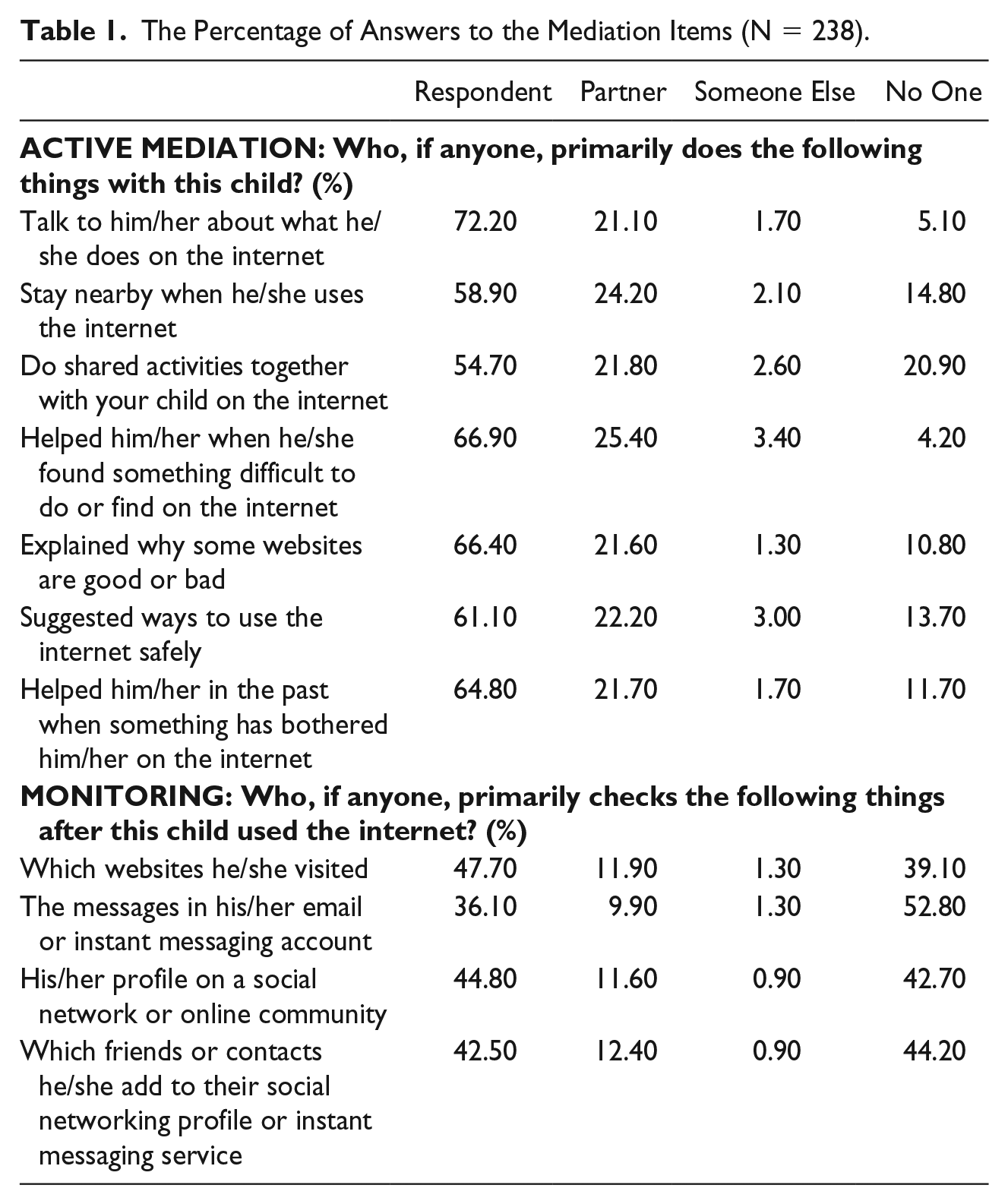
First, we examined the answers to each mediation strategy item. As is apparent from Table 1, only a minority of families in our sample had someone other than the parents primarily responsible for engaging in active mediation or monitoring. For both types of mediation, the respondents reported themselves to more often be the person who primarily employs the mediation. Regarding the overall pattern, active mediation was embraced to a higher extent: the investigated practices of active mediation were present in 80–95% of families, whereas only 47%–61% used monitoring practices.
The Percentage of Answers to the Mediation Items (N = 238).
Next, we correlated the mediation strategies with each other and with independent variables. The two strategies were moderately positively correlated to each other—the more the respondent engaged in one, the more they also engaged in the other (r = .46, p < .001). Active mediation and monitoring were similar in terms of their bivariate relations with a respondent’s internet skills (active mediation r = .25, p < .001, monitoring r = .19, p < .01) and ability to help children with online problems (active mediation r = .27, p < .001, monitoring r = .16, p < .05), which are positively correlated with mediation strategies. The same pattern in both mediation strategies was apparent for respondents’ age, gender, education, attitudes toward children’s internet use, and children’s age (assessed as an interval here), which were uncorrelated. Regarding the differences, there is a negative correlation between a respondent’s active mediation and their partner’s education (r = - .14, p < .05), internet skills (r = - .26, p < .001), and ability to help with online problems (r = -.29, p < .001). These partner characteristics were not correlated with monitoring. Further, for active mediation, none of the child-level variables were correlated (p >.05), whereas having a daughter (r = .20, p < .01) and a child who frequently uses the internet (r = .14, p < .05) were correlated positively with monitoring.
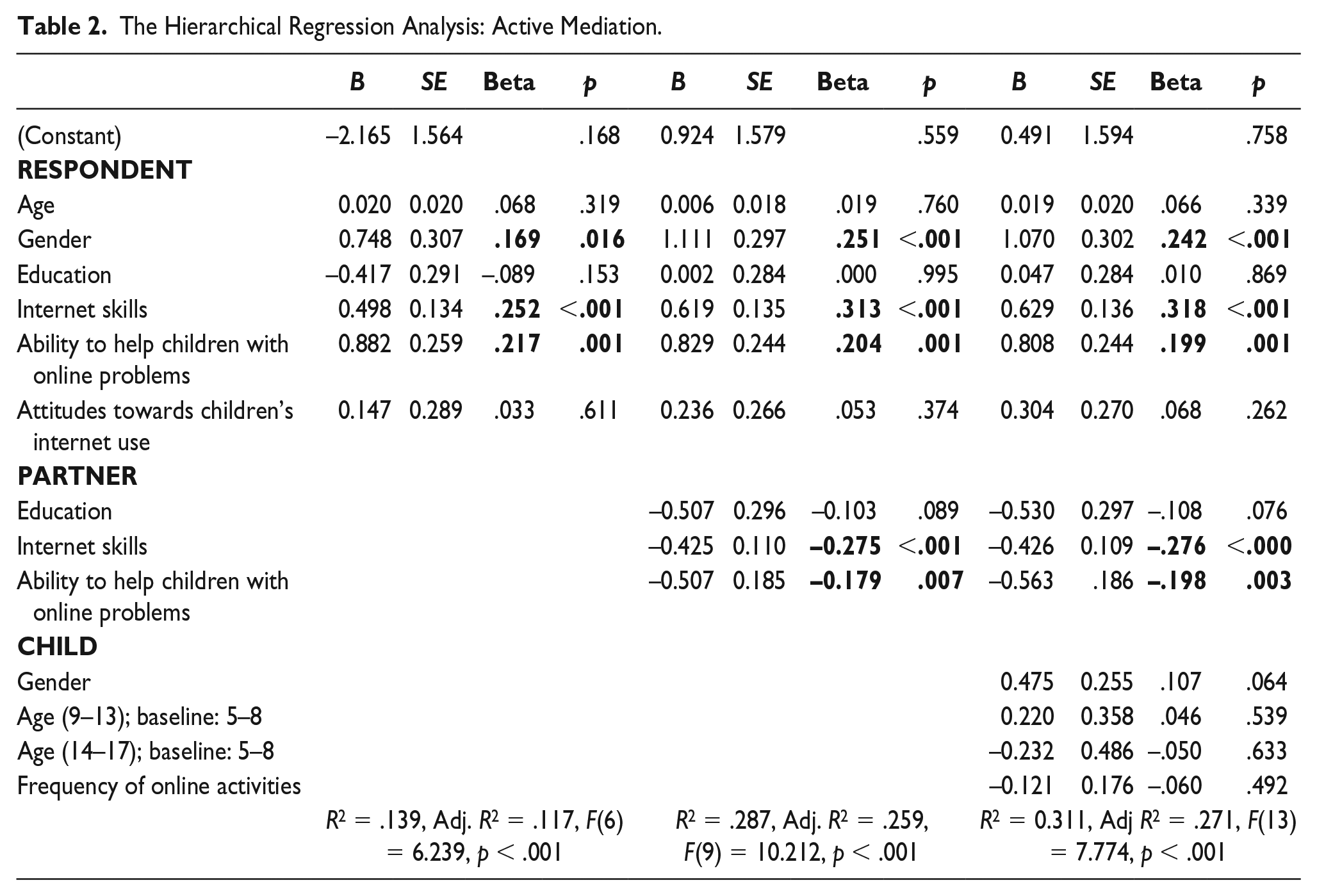
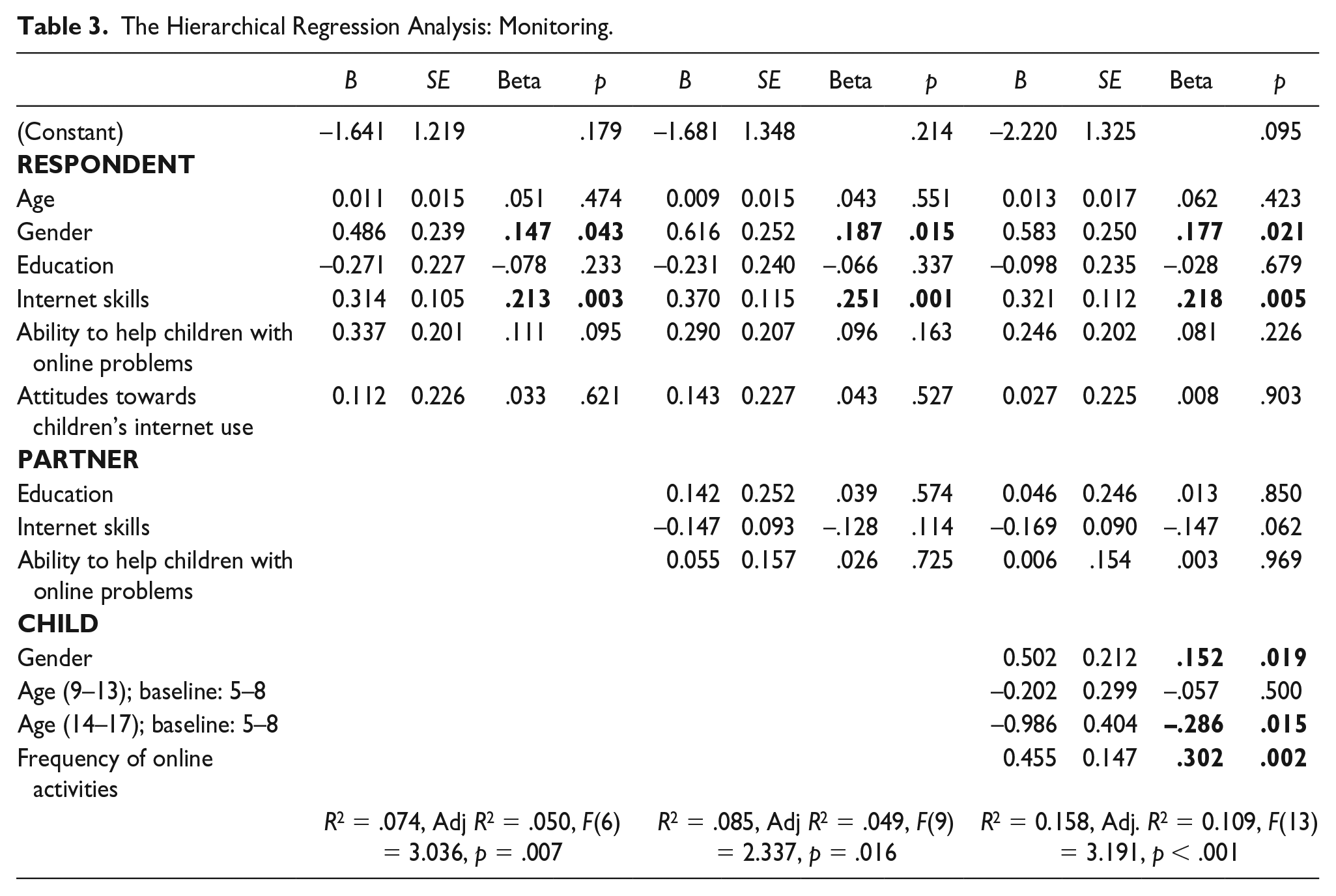
Finally, we conducted two hierarchical linear regression analyses to predict each type of mediation. In each regression, we added respondent characteristics (gender, age, education, internet skills, and ability to help children with online problems) in the first step; we included the partner characteristics (education, internet skills, and ability to help children with online problems) in the second step; and then we completed it with the children’s characteristics (gender, age, and frequency of online activities) in the third step (see Tables 2 and 3). As noted above, due to the expected non-linear relations between mediation strategies and children’s age, we categorized the age and used dummy variables with the youngest group (5–8 years old) as a baseline. The variance inflation factor indicated no problems with multi-collinearity. For active mediation, adding the respondent and partner level added significantly to the model, while adding the children level did not (step 1 R2∆ = .139, p < .001, step 2 R2∆ = .148, p < .001, step 3 R2∆ = .024, p >.05). For monitoring, the partner level did not improve the model, while the respondents’ and children’s characteristics did (step 1 R2∆ = .074, p < .01, step 2 R2∆ = .012, p >.05, step 3 R2∆ = .073, p < .01). The overall pattern of results in terms of the direction of the effects remained the same across the steps.
The Hierarchical Regression Analysis: Active Mediation.
The Hierarchical Regression Analysis: Monitoring.
The variables in the third step in the regression to predict active mediation explained 27% of the variance. Mothers used active mediation more than fathers, even when controlling for partner and child variables. Similarly, more internet-skilled respondents and those who reported being more able to help their child with online problems engaged more in active mediation. A reverse pattern in these variables appeared on the partner level: the partners’ internet skills and their ability to help children with online problems decreased the respondents’ active mediation; that is, the more respondents judged their partners to be skilled and able to help their child, the less active mediation the respondent utilized. The education level of the respondent and their partner, as well as the respondent’s age, did not play significant roles, and neither did the respondent’s attitudes toward their child’s internet use. As already noted, the child-level variables did not add to the model.
The results for monitoring showed similarities in the effect of respondents’ gender (again, mothers monitored their children more) and the non-significant effects of education, age, and the attitudes toward children’s internet use of the respondents. Respondents’ internet skills played a role: those who were more skilled monitored their children more. This effect was not found for the ability to help children with online problems. Unlike the cases of active mediation, partner-level variables did not affect respondents’ monitoring efforts, but child-level variables did. Daughters were monitored more than sons; and, compared to the youngest group of 5- to 8-year-old children, the oldest group in our sample (14- 17-year-olds) was monitored less. There was, however, no difference in the level of monitoring between the youngest group and the middle group of 9- to 13-year-old children. The frequency of a child’s activities also had a substantial effect—the more frequently a child engaged in various online activities, the more they were monitored. It is important to note that the variance explained for the monitoring was lower than for active mediation, with predictors explaining 11% of the variance.
Discussion
Our study focused on two online mediation strategies in Czech families with 5- to 17-year-old children. We used Belsky’s (1984) socioecological model of parenting to determine the agents that should affect online parental mediation, and we analyzed the predictors of active mediation and monitoring. In line with theoretical expectations, our study supports the assumption that the three subsystems suggested by Belsky play a role in parental mediation, and that parental mediation can, in this aspect, indeed be considered to be specific parenting.
Belsky notes that the subsystems do not affect the parenting equally, and this was also apparent in our study because it showed different effects for the same factors in the two examined mediation strategies. Namely, the contextual subsystem, represented in our study by the partner’s characteristics, affected parental engagement of active mediation, but not monitoring. The opposite then appeared for the child’s characteristics that affected monitoring, but not active mediation. This might point to the essentially different functions of these strategies in childrearing. Belsky suggests that competent parenting is most likely in cases where all three subsystems operate in supportive mode (i.e., the parent’s well-being is high, they have support of their partner and social circle, and the child does not exhibit problematic behavior or characteristics), and parenting is least competent if the subsystems operate in stress mode. Thus, in the case of two parenting strategies, where one is considered more desirable (active mediation, Shin & Lwin, 2016) and the second more problematic (monitoring, Symons et al., 2017), Belsky’s model would predict that subsystems operating in supportive mode would more strongly affect active mediation and have a weaker effect on monitoring. We assume that the parental characteristics examined in this study (specifically internet skills and the ability to help children) do point to the supportive mode of the individual parent and their partner’s subsystems. In this aspect, the stronger effect of these subsystems in the case of active mediation as opposed of monitoring (as apparent by betas and in the explained variance), fit nicely within Belsky’s assumptions.
Keeping the assumption that retrospective monitoring is the less desirable strategy, we could also use Belsky’s model to explain the relatively high positive effect of the frequency of a child’s online activities (beyond the effect of age) in the case of monitoring. In line with Belsky, this would suggest that parents perceived the frequent usage of the internet as problematic, thus representing a stress in the child’s subsystem and increasing the likelihood of less desirable strategy (i.e., monitoring). While we assessed the frequency of the child’s online activities in neutral terms, without assigning it a negative tone, the high internet usage is commonly associated with problematic internet use (Helsper & Smahel, 2019). On the other hand, the same factor did not play any role in active mediation (see the interpretation in the Children’s Characteristics and Mediation section). In this context, we believe it would be beneficial for future research to assess in more detail what, in the parents’ eyes, constitutes a problematic pattern for their child’s ICT usage, and how it relates to both active mediation and more stringent mediation strategies. For instance, qualitative studies suggest that, rather than mere frequency of online activity, it is the perceived tendency to crave ICTs usage that leads parents to be more involved (e.g., Smahelova et al., 2017).
As noted in the Introduction, we decided to look at the contextual subsystem somewhat differently than how Belsky conceptualized it. First, we focused only on the partner and neglected the wider social context and, second, while Belsky stressed the partner’s support, we focused on the partner’s individual characteristics. This allowed us to examine how the same feature, possessed by the parents and/or their partners, relate to the individual parental choices for mediation strategies. Our findings thus do not relate directly to Belsky in this aspect. However, a study by Mares, Stephenson, Martins, and Nathanson (2018) shows that these aspects of the parents’ contextual subsystem do play a role in parental mediation. The authors focused on restrictive mediation and also assessed the congruence between parental rules and parental conflict that affected the child’s outcomes—incongruence in parenting increased parental conflict, which was further associated with higher exposure to media violence and relational aggression. Altogether, Belsky’s socioecological model seems to represent a relevant framework for assessing digital parenting.
Parents’ Characteristics and Mediation
Overall, active mediation was utilized more often than monitoring in the families in our sample. This is in line with previous research (Livingstone et al., 2011; Livingstone & Helsper, 2008), and it can be seen as a desirable state, considering that active mediation was also connected to children reaping the most opportunities from ICTs usage and developing digital skills (Livingstone et al., 2017; Shin & Lwin, 2016). Further, respondents in our study reported that all mediation strategies were provided primarily by themselves and not by their partner. This is particularly interesting because, unlike in many other studies, the inclusion criteria did not include the stipulation that respondents were more involved in childrearing, and so our study has a more balanced gender ratio among parents than other studies (see e.g., Talves & Kalmus, 2015). One reason for this finding might be that respondents do not know exactly what (if anything) their partners do with their children, because both of the examined strategies can be done without the presence of the partner. It is also possible that the respondents tended to overestimate their own role in comparison to their partners. Although these motives are unclear, researchers in future studies might want to be cautious in using only one caregiver as a source of information. Nevertheless, in studies on both parents, it would be interesting to also examine how individual engagement in mediation strategies is affected by the engagement of their partner and we urge future research to do so.
Concerning the individual characteristics of the respondents, some of the previous research found that being younger and female were connected to higher levels of active mediation (Livingstone et al., 2017; Nikken & Jansz, 2014; Talves & Kalmus, 2015), even though other studies showed no such effects. Our study found a more active role for mothers in both types of mediation strategies, suggesting that gender-divided labor in families also applies to the domain of mediating children’s ICTs usage.
Previous studies revealed associations between parental digital skills and active mediation and monitoring (e.g., Nikken & Schols, 2015; Talves & Kalmus, 2015). Our research confirmed that the more skilled the parents see themselves, the more they engage in both mediation strategies. We also revealed that the perceived ability of parents to help children with online problems (i.e., task-specific self-efficacy) is associated with active mediation, but not with monitoring. This difference is probably due to the underlying principles of both mediation strategies. Active mediation involves interactions with the children and ICTs, and thus it may involve the need to help with difficulties or problems. Believing in one’s own ability to help solve such problems may be an important precondition for active mediation, which is consistent with Bandura’s (1982) theory of self-efficacy. Retro-spective monitoring, however, represents a different facet of behavior. It does not require a parent to know how to solve potential problems, merely how to check what the child did when using ICTs. The task-specific self-efficacy would, in this case, include parental beliefs that they can effectively learn about their children’s online activities by retrospectively checking.
Respondents’ attitudes towards technology were not linked to any of the studied mediation strategies. One reason may lie in the scale itself: with somewhat lower internal consistency, the scale might not have captured an existing relationship. Some studies, however, show a similar result (e.g., Livingstone & Helsper, 2008). Perhaps in the current day and age, when children engage with ICTs on a daily basis (especially as they grow older and enter school and later puberty; Ofcom, 2017), parents believe that they have to engage in mediation regardless of their own attitudes about technology.
Our research has newly revealed that the characteristics of respondents’ partners are associated with the online active mediation of the respondent. The partner’s perceived internet skills and ability to help children with online problems were negatively associated with the active mediation of ICTs by the respondent: the more the respondent evaluated the partner to be skilled and able to help children, the less active mediation the respondent provided to the child, pointing to a more nuanced division of work in the families beyond simply the effect of gender. Some practices of active mediation are used in almost every family, and it seems to be provided more by the parent who is more literate in ICTs usage. Interestingly, we did not find this pattern in the case of online monitoring, which was not associated with any of the examined characteristics of the respondent’s partner, but—to repeat—was positively associated with the respondents’ own internet skills, suggesting that the skills do play a role in the amount of monitoring. The lack of significance of the partner’s characteristics may be the result of a rather low incidence of monitoring, which did not allow for the capture of the (small) effect, though the significance of the level of the partner’s internet skills (β = -.147, p < .065) may suggest its existence. We would encourage future research to focus more deeply on this interesting finding.
Children’s Characteristics and Mediation
For the characteristics of the children, the results of previous research are mixed. Some research has shown that girls and younger children receive more active mediation and monitoring (e.g., Livingstone et al., 2014; Sonck et al., 2013). This was confirmed in our research only for monitoring; we did not find associations with active mediation. Surprisingly, for active mediation, none of the examined children’s characteristics played a substantial role. Thus, the reported level of active mediation did not differ as the child grew older or engaged more with ICTs. However, interpreting this finding in a way that what the children do online does not matter might be a mistake. The items in our scale asked about a general approach to talking with the child about and sharing his/her online activities. It might mean that this approach reflects a general parenting style embraced in families (Eastin et al., 2006), which stays similar throughout maturation but which changes in content: what online activities are discussed and how are they shared between the child and the parent. For instance, at a younger age, the children frequently engage in simple online games (Ofcom, 2017), so the content of active mediation might be game-oriented. For older children, who start using social networking sites, the content may shift to social networks. We would encourage future research to more deeply examine these possible shifts in the content of active mediation.
In our study, we found that children aged 13–17 years are monitored less online than children aged 5–8 years. This supports the results of other research that revealed that monitoring decreases with the age of the child (Symons et al., 2017). There was no difference in the level of monitoring for those aged 5–8 years and 9–12 years. This may suggest that when controlling for the effects of other characteristics, the important change happens only after the child enters adolescence, when parents learn about their behavior more through disclosure than by retroactive monitoring (Kerr, Stattin, & Burk, 2010), grant more privacy (Symons et a., 2017), and defer to the children’s judgment in the online environment (Padilla-Walker et al., 2012).
Conclusions and limitations
Previous research demonstrated a need to study ICTs usage within the family system (Mares et al., 2018; Nikken, 2017). Our study points out that parental mediation can be understood as a specific parenting domain and, consequently, parenting theories might be applied to develop our understanding of it. Using Belsky’s socioecological model, we were able to show that online mediation is affected not only by one parent and a child, but also by the other parent and, most likely, other caregivers. Mediation is not a stable process, but it is co-constructed in everyday family life. It depends not only on more lasting characteristics and parenting styles (Eastin et al., 2006), but also on the current situation and immediate context (Smahelova et al., 2017). Our research contributes to this line of research and expands it by considering three subsystems in the family. Belsky’s model can be applied in studies that had only one parent as a respondent, and we can argue that when examining the respondents’ individual level of mediation, it is their perception of other members of the family that affects the respondents’ behavior (Livingstone & Helsper, 2008). Yet we still consider this to be a limitation and encourage future researchers to engage in a multi-informant approach. This would allow for a more detailed analysis of the influence of family members.
Another limitation is that our study is based on research carried out through the online panel of a research agency. Although the characteristics of the parents in our sample are similar to the Czech population, it is clear that this sample is not representative. First, not all parents in the Czech population use the internet (although 96% of households with children had internet access at home in 2017; Czech statistical office, 2017). Second, the online panelists might differ in some characteristics from the general population. For instance, in our case, the respondents might have more internet skills and, consequently, they might engage in mediation strategies to a higher extent. The third limitation is related to the quality of measurements. In particular, the scale used to measure attitudes toward children’s use of ICTs had a lower Cronbach’s Alpha and was skewed toward positive attitudes about technology.
Our study also lacked a check for social desirability, which could affect the overall reported engagement in the two mediation strategies. Since active mediation is often encouraged in educational programs, the reported engagement in this strategy might be inflated. On the other hand, retrospective monitoring can be seen as controversial, especially for the parents of adolescents, which could lead respondents to under-report its occurrence.
Lastly, we limited our examination to two mediation strategies, and omitted restrictions, which are otherwise quite popular, especially among parents with younger children (e.g., Nikken & Jansz, 2014). In many studies, including our own, restrictive mediation is understood to be a set of family rules that limit the children’s ICTs usage. The presence/absence of rules for ICTs usage in a family, however, does not necessarily reflect the individual engagement in this strategy, which makes it harder to link it to the individual characteristics, as we did in our study for active mediation and monitoring. Nevertheless, the parents can differ in some aspects of the restrictions (e.g., they can differently control or assert the children’s compliance with the rules). Unfortunately, our project did not assess the restrictions in a way that would allow for the examination of individual predictors and we urge other researchers to do so.
Footnotes
Acknowledgements
The authors acknowledge the support of Masaryk University (project MUNI/E/1347/2017).
Declaration of Conflicting Interests
The author(s) declared no potential conflicts of interest with respect to the research, authorship, and/or publication of this article.
Funding
The author(s) received no financial support for the research, authorship, and/or publication of this article.
