







Abstract
Social characteristics are prominent factors in mate selection, but they are also important for the quality and functioning of intimate relationships. Researchers have shown that the intimate relationships that are considered the most successful often have high levels of partner similarity. Yet this prior work is limited, as it largely focuses on demographic differences (or asymmetries) between intimate partners. In addition to demographic asymmetries, we explored how differences in relational and risk behaviors were associated with intimate partner violence (IPV). Examining data from the Toledo Adolescent Relationships Study (n = 828), we found that young adults in relationships with demographic, relational, and risk asymmetries reported greater frequency of violence. Furthermore, we found that asymmetries in risk behavior had the strongest association with IPV. These findings highlighted the importance of considering different types of asymmetries and provided new insight into the functioning of young adult relationships.
Individuals tend to choose intimate partners who have similar social characteristics or backgrounds. Referred to as homophily or homogamy, shared social characteristics are prominent factors in mate selection, but also play an important role in the quality and functioning of intimate relationships (Blackwell & Lichter, 2004; Schwartz & Mare, 2005). Mäenpää1 and Jalovaara (2014), for example, have argued that intimate partner similarities “. . .foster value consensus between partners on basic life goals and practices, ensure a common basis of conversation, and reduce friction that may arise from dissimilarity in tastes and worldviews” (p. 1771). Indeed, researchers have demonstrated that intimate relationships that are characterized by homophily are often the most successful, with higher levels of satisfaction (Bertrand et al., 2013; Zhang & Van Hook, 2009), less conflict (Atkinson et al., 2005; Kaukinen, 2004), and greater stability (Schwartz & Han, 2014). However, this prior work has tended to conceptualize homogamy in demographic terms, focusing on partner similarity in socioeconomic status, race/ethnicity, and age. In this article, we have argued that partner asymmetries with respect to investing in the relationship, job and school success, and power dynamics, as well as differences in engagement in risky antisocial behavior may have negative implications for relationship quality and functioning. These asymmetries signal differences in views about and experiences within intimate relationships that have the potential to lead to problematic outcomes.
Drawing on data from the fifth interview of the Toledo Adolescent Relationships Study (TARS), we explored whether demographic, relational, and risk asymmetries are associated with the frequency of intimate partner violence (IPV) in young adulthood. Extending prior research, our study made three contributions to the wider family literature. First, we considered a broader range of asymmetries, as opposed to solely focusing on demographic similarities and dissimilarities. Second, we examined the relative importance of each type of asymmetry to determine which had the strongest association with self-reported partner violence. Finally, we assessed whether these patterns were similar or different for men and women. Our research highlighted the importance of accounting for various types of asymmetries, provided new insight into the correlates of IPV, and showed the consequences of asymmetries for the quality of young adults’ intimate relationships.
Background
Intimate Relationships in Young Adulthood
Most young adults are involved in intimate relationships. Estimates have suggested that the majority of young adults are in dating relationships followed by cohabiting and marital unions, respectively (Child Trends, 2013; Sorgi et al., 2016). Regardless of union type, many young adults report poor relationship functioning. Researchers examining data from the National Longitudinal Study of Adolescent to Adult Health (Add Health) (n = 4,134) (Halpern et al., 2009), as well as TARS (Johnson et al., 2015), have shown that violence characterizes many young adults’ relationships. Halpern and colleagues (2009) have demonstrated that nearly a quarter of young adults experienced IPV victimization in the past year. Johnson et al. (2015) found that violence perpetration peaks in early young adulthood (age 20) and declines in subsequent years. Although these studies are important for providing a descriptive overview of partner violence, and much prior work has considered background factors, it is also important to consider couple-level dynamics. Within the realm of dyadic concerns, few investigators have considered the role of asymmetries, particularly if we move beyond those in the demographic realm.
Demographic Asymmetries and Partner Violence
Educational and Socioeconomic Asymmetries
Historically, the notion of a marriage gradient suggests that husbands tend to be better educated and earn higher incomes than their wives. Thus, the meaning of masculinity, as well as the male identity, has been associated with the “breadwinner” role (Anderson, 1997). However, increased numbers of women in the paid labor force (U.S. Census Bureau, 2016) and the reversal of the gender gap in education (Schwartz & Han, 2014) have led to shifts in the educational and employment composition of many couples. These shifts might suggest that relationships characterized by educational and socioeconomic asymmetries that favor the female partner may be characterized by poorer relationship functioning because such differences challenge the gendered expectations that men should be the financial providers (even in the context of increased female labor force participation). Researchers (Atkinson et al., 2005; Kaukinen, 2004) examining survey data have found that relationships characterized by educational, employment, and income asymmetries that favor the female partner are associated with greater frequency of partner violence.
Racial Asymmetries
Estimates suggest that there has been a steady increase in interracial relationships since the mid-1960s (Hattery & Smith, 2009; Livingston & Brown, 2017). Although the rising trends in interracial relationships implies that the social barriers that deterred the formation and maintenance of such relationships in the past are diminishing (Rosenfeld & Kim, 2005), some researchers (Chartier & Caetano, 2013; Fusco, 2010; Martin et al., 2013) have suggested that interracial couples experience greater frequency and more severe acts of partner violence.
Higher levels and greater severity in partner violence may be the function of interracial couples’ exposure to social marginalization, including experiencing a lack of support for their relationships from family members, peers, and community members (Miller et al., 2004), a hesitancy to engage in public and private displays of affection (Vaquera & Kao, 2005), or their reluctance to share experiences of discrimination with each other (Killian, 2001). Thus, previous research has provided evidence suggesting that interracial relationships experience unique challenges that may cause greater interpersonal stress and conflict between partners (Martin et al., 2013). This lends support for the view that racial homogamy may be important for some aspects of relationship functioning, despite the increase in and growing acceptance of interracial relationships.
Age Asymmetries
Another common source of homogamy between partners is age. Estimates from the Add Health have shown that nearly half (44%) of young adult women and a quarter of young adult men are involved in intimate relationships characterized by age asymmetries—or age differences of four or more years (Scott et al., 2011). Previous findings on the association between age asymmetries and IPV are not only varied, but inconclusive. For instance, some researchers (e.g., Catallozi et al., 2011; Peters et al., 2002) have reported a positive association between age asymmetries and partner violence, while others (e.g., Agurcia et al., 2001; Harner, 2004; Volpe et al., 2013) have not found significant associations.
One explanation for these disparate findings on age asymmetries and partner violence may be due to sample differences. Some studies (e.g., Agurcia et al., 2001; Harner, 2004) have examined adolescent mothers who were partnered with adult men, and other studies focused on dating relationships (e.g., Volpe et al., 2011), and no studies have included dating, cohabiting, and marital unions among young adults. Nevertheless, consistent with the homogamy argument, we expect that age asymmetries would be associated with higher odds of IPV.
Relational Asymmetries and Partner Violence
Prior research that has examined associations between asymmetries and partner violence has focused almost exclusively on demographic asymmetries. Thus, our understanding of the association between relational asymmetries and IPV is limited. Despite a lack of empirical research, the broader theoretical framework of attachment theory sheds light on how relational asymmetries may be associated with partner violence in young adulthood.
In brief, attachment theory is concerned with the dynamics of personal relationships and seeks to explain how individuals respond when they feel distant from the individuals with whom they should feel closest or when they believe their relationship is being threatened. (Feeney & Noller, 1990; Finkel & Slotter, 2007). According to Finkel and Slotter (2007) “. . .attachment bonds in intimate relationships are threatened by diverse circumstances, including the perception that one’s partner has become detached or is attracted to somebody else” (p. 902). With respect to partner violence, scholars have argued that individuals who feel that they are being treated unfairly within their intimate relationships will feel angry, which in turn may lead to the perpetration of violence towards their partners (Finkel & Slotter, 2007). Thus, relationships characterized by relational asymmetries, such as those in influence and investment, may be more susceptible to partner violence because they signal differences in partners’ approaches to the relationships. Historically, the field has focused on asymmetries of power (e.g., Jackson & Leone, 2005) as a general heuristic for understanding violence, but little research has examined the idea of a relational mismatch (e.g., one person more invested) or how differential perceptions about success in the larger arenas of career/employment goals may impact IPV. Three asymmetries that we examined included (a) investment in the relationship—that is, who seems more invested in the relationship; (b) perceptions of power—which partner seems to have more power in the relationship, and (c) perceptions of being successful with respect to career/employment goals. We expected that these relational asymmetries would be associated with higher odds of IPV.
Risky Antisocial Behavior Asymmetries and Partner Violence
Although the role of relational asymmetries and partner violence is expected to mirror that of demographic asymmetries, the association between asymmetries in risky antisocial or criminal behavior and IPV may operate differently. Examining TARS, Alvira-Hammond and colleagues’ (2014) found that, compared to relationships in which neither partner engaged in antisocial activities, relationships characterized by any antisocial behavior were associated with greater frequency of partner violence. Yet, Alvira-Hammond et al. did not control for demographic and relational asymmetries. We expected that relationships in which either partner engaged in risk behaviors would be associated with poor relationship functioning and higher levels of conflict, but test whether risk asymmetries were also associated with greater frequency of IPV.
Current Investigation
Using data from TARS, we examined whether demographic, relational, and risk asymmetries were associated with IPV. Next, we assessed the relative importance of demographic, relational, and risk asymmetries to determine which type of asymmetry was more consequential to partner violence in young adulthood. Extending prior research, we considered several types of asymmetries and accounted for variation in IPV experiences. Additionally, we assessed whether the association between asymmetries and partner violence in young adulthood differed for men and women. We hypothesized that asymmetries in demographic characteristics (education, employment, race/ethnicity, and age) and relational dynamics (invested in the relationship, relationship power, and success in employment/work) would be associated with greater frequency of partner violence. We also expected that relationships in which any partner (male, female, or both) engaged in risky antisocial or criminal behavior would be associated with greater frequency of partner violence.
In assessing associations between sociodemographic, relational, and risky behavior asymmetries and IPV, we controlled for a number of key correlates of IPV. Such correlates included gender (e.g., Johnson et al., 2015), race (e.g., Sampson et al., 2005), age (e.g., Johnson et al., 2015), union status (e.g., Brown & Bulanda, 2008), relationship duration (e.g., Giordano et al., 2016), presence of children (e.g., Vest et al., 2002), and parental and friend support of the relationship (Zhang & Van Hook, 2009). By controlling for these correlates, we attempted to account for factors that may potentially confound the association between asymmetries and partner violence.
Method
Data and Sample
We used data from the fifth interview of TARS, a longitudinal study based on a stratified random sample of adolescents registered for the 7th, 9th, and 11th grades in Lucas, County, Ohio during the fall of 2000. Made available through Ohio’s Freedom of Information Act, the initial TARS sampling frame, which was developed by the National Opinion Research Center, drew from student rosters from 62 schools across seven different school districts and included over-samples of Black and Hispanic adolescents. Although the sampling frame of the TARS data was school-based, school attendance was not required for inclusion in the sample. The first interview of TARS occurred in 2001 and the fifth interview in 2012. Compared with descriptive data from the 2011 American Community Survey (ACS), the TARS sample is demographically similar to young adults living in the U.S. in terms of gender, race, educational attainment, employment status, and union status.
The analytic sample (n = 828) consisted of all respondents from the fifth interview with three exclusions. We excluded respondents who did not report a current or most recent intimate relationship (n = 71) at the fifth interview. Additionally, due to small sample sizes, we excluded respondents who reported a same-sex intimate relationship (n = 24) at the fifth interview and respondents who did not report their race/ethnicity or their partner’s race/ethnicity as White, Black, or Hispanic (n = 47 and n = 57, respectively). We used mean and modal imputation to account for missing data.
Measures
Dependent Variables
IPV, measured with 24 items from the Revised Conflict Tactics Scale (CTS2) (Straus et al., 1996), referred to both victimization and perpetration. We asked respondents the following, “During this relationship, how often have [Partner/you] done the following (not because you were playing around)”: (1) “thrown something,” (2) “twisted arm or hair,” (3) “used a knife or gun,” (4) “punched or hit with something that could hurt,” (5) “choked,” (6) “slammed against a wall,” (7) “beat,” (8) “burned or scalded on purpose,” (9) “kicked,” (10) “pushed, shoved, or grabbed,” (11) “slapped in the face or head with an open head,” and (12) “hit.” Responses ranged from 1 (never) to 5 (very often). The non-logged scale ranged from 0 to 24 (α = .95). Due to skewness, we analyzed IPV as a logged, summed scale.
Independent Variables
Educational asymmetries referred to partners’ differences in educational levels, which we measured with two questions: (1) “How far have you gone in school,” and (2) “What is [Partner’s] highest grade level?” Responses ranged from “dropped out of high school” to “graduate or professional school.” We recoded responses into four categories: less than high school, high school, some college, and college or more. We created three dichotomous variables reflecting educational asymmetries: male partner more educated, educational homogamy (reference group), and female partner more educated.
Employment asymmetries reflected responses to the following two questions: (1) “Are you currently working for pay for at least 10 hours a week,” and (2) “Does [Partner] currently have a job?” Responses were “yes” and “no.” We created the following four dichotomous variables: (1) male partner employed, female partner not employed, (2) both male and female partners employed (reference group), (3) both male and female partners not employed, and (4) female partner employed, male partner not employed.
Race asymmetries were measured with two questions: “What is your racial/ethnic background,” and “What is [Partner’s] racial/ethnic background?” We recoded responses as White, Black, and Hispanic. We created two dichotomous variables reflecting race asymmetries: (1) same-race (reference group) and (2) interracial.
Age asymmetries were measured with the question, “How old are/is [you/Partner]?” We took the difference between the respondents’ and partners’ ages. Since the average age difference between young adult partners is three years (Scott et al. 2011), we used three years to assess age asymmetry. We created three dichotomous variables reflecting age asymmetries: (1) male older, (2) age homogamy (reference group), and (3) female older.
Investment asymmetries were measured using the following prompt: “In many relationships, one person is more ‘into’ the relationship than the other. Would you say. . .” Responses included, “you are more into it,” “[Partner] is more into it,” and “you are about the same.” We combined responses with the respondent’s gender to create gender specific asymmetries in relationship investment: (1) male more invested, (2) investment homogamy (reference group), and (3) female more invested.
Power asymmetries were measured with the following statement: “Thinking about your relationship overall, who would you say has the most power in your relationship?” Responses included: “[Partner] does,” “I do,” “We generally both have an equal say,” and “We have not disagreed.” We combined responses with the respondent’s gender to create gender specific power asymmetries: (1) male partner has more power, (2) power homogamy, and (3) female partner has more power.
Success in job/school asymmetries were measured by asking respondents, “Which of the following best describes you and [Partner]?” Responses included: “[Partner] is not as successful in (job, school) as I am,” “We are equally successful,” and “[Partner] is more successful than I am at this point in our lives.” We combined responses with the respondent’s gender to create three asymmetries: (1) male partner more successful, (2) success homogamy, and (3) female partner more successful.
Antisocial behavior asymmetries referred to respondents’ reports of the frequency of their own and partners’ antisocial behavior. We used nine items from Elliott and Ageton’s (1980) antisocial behavior scale. Respondents were asked: In the past 24 months (or 2 years), how often have you/[Partner]: (1) “drunk alcohol,” (2) “stolen (or tried to steal) things worth $5 or less,” (3) “carried a hidden weapon other than a plain pocket knife,” (4) “damaged or destroyed property on purpose,” (5) “stolen (or tried to steal something worth more than $50),” (6) “attacked someone with the idea of seriously hurting him/her,” (7) “sold drugs,” (8) “broken into a building or vehicle (or tried to break in) to steal something or just to look around,” and (9) “used drugs to get high.” Response ranged from 1 (never) to 9 (more than once a day) (respondent: α = .73, partner: α = .75). We considered individuals who scored at least one standard deviation above the mean as antisocial. We created four dichotomous variables: (1) male partner antisocial, (2) both partners antisocial, (3) neither partner antisocial, and (4) female partner antisocial.
Control Variables
We included several sociodemographic variables in the multivariate analyses. Gender (female is reference category), race/ethnicity (White reference group, Black, and Hispanic/Latino), and age, were self-reported at the fifth interview. Current relationship referred to whether the respondent reported on a current (reference category) or most recent relationship. Union status included three dichotomous variables: dating (reference category), cohabiting, and married. We calculated relationship duration based on the number of months and years that respondents have been in their relationship. Presence of children referred to whether the respondent lived with children (reference category).
We measured parental approval of the relationship with the item, “How often do your parents express disapproval of your relationship with your partner (dating, living with, or married to)?” Responses ranged from 1 (never) to 6 (two or more times a week). We measured friends’ approval of the relationship with the following statement: “My friends approve of my relationship with [Partner].” Responses ranged from 1 (strongly disagree) to 5 (strongly agree).
Analytic Strategy
We used ordinary least squares regression to examine the association between demographic, relational, and antisocial behavior asymmetries and frequency of IPV in young adulthood. In the multivariate analyses, Model 1 (baseline model) showed the association between demographic asymmetries and IPV. Model 2 added relational asymmetries to the baseline model and Model 3 included demographic, relational, and antisocial behavior asymmetries. Model 4 added the control variables to the third model and examined the extent to which asymmetries have an independent effect on IPV. Standardized coefficients from Model 4 were assessed to determine the relative importance of demographic, relational, and risk asymmetries.
Results
Descriptive Results
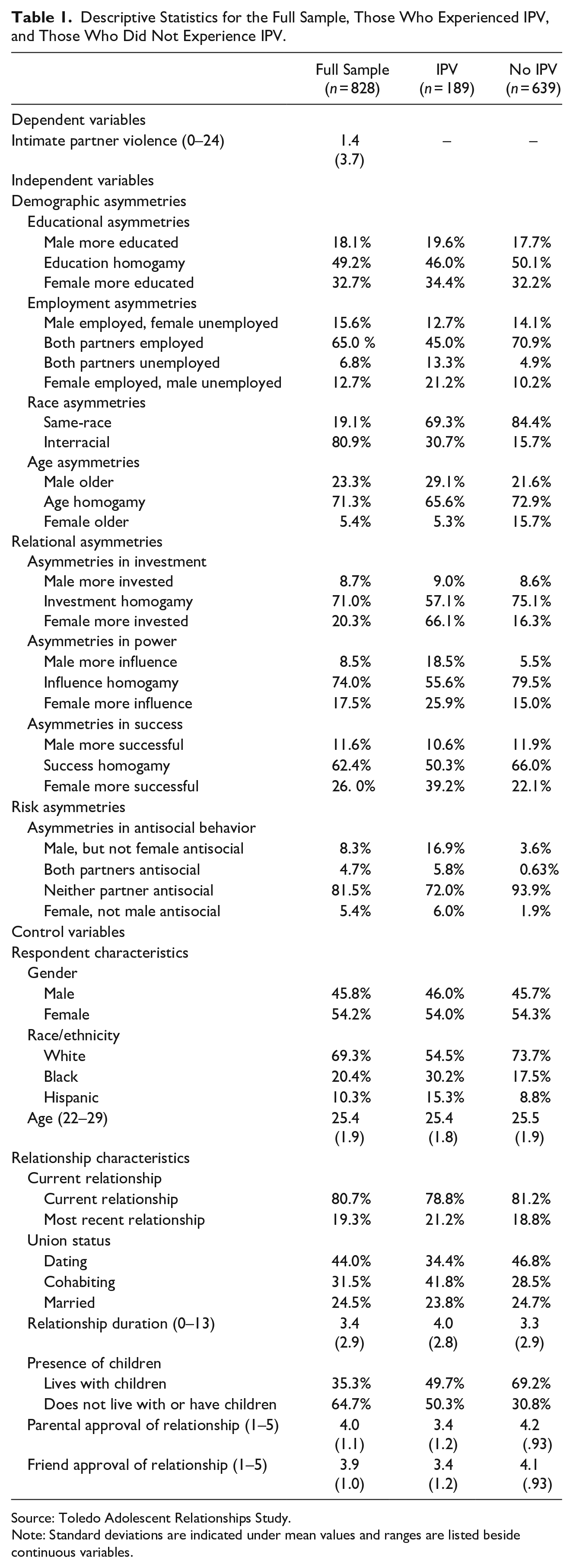
In Table 1, the average level of frequency of partner violence was 1.44 (σ = 3.67), suggesting that respondents reported low frequency of relationship violence. Consistent with Halpern and colleagues’ (2009) work using the Add Health data, about 23% of respondents reported any violence in their current or most recent intimate relationships.
Descriptive Statistics for the Full Sample, Those Who Experienced IPV, and Those Who Did Not Experience IPV.
Source: Toledo Adolescent Relationships Study.
Note: Standard deviations are indicated under mean values and ranges are listed beside continuous variables.
About half (49%) of relationships reflected educational homogamy, whereas in one-third (33%) of the relationships, women reported higher educational levels, and one-fifth (18%) were characterized by greater male education. The majority (65%) of relationships had employment homogamy in which both partners were employed. Unemployment homogamy characterized nearly 7% of relationships. Approximately 16% of relationships were characterized by male, but not female, employment, whereas 13% were characterized by female, but not male, employment. Most relationships (81%) were characterized by racial/ethnic homogamy, whereas a fifth (19%) were interracial relationships. About three-quarters (71%) of relationships were characterized by age homogamy, whereas a quarter (23%) of relationships were characterized by an older male partner. Relationships in which the female partner was older than the male partner were least common, accounting for about 6% of the sample. Collectively, demographic homogamy characterized many intimate relationships in young adulthood, but this varied when examining the subsamples of relationships reporting IPV. That is, relationships with no reports of partner violence appeared to be more demographically homogamous than relationships with any report of violence.
Regarding relational asymmetries, over two-thirds (71%) of relationships involved both partners being equally invested, one-fifth (20%) were characterized by greater investment by the female partners, and less than one-tenth (9%) involved greater investment by the male partners. Similarly, the majority (71%) of relationships were characterized by both partners being equally influential, whereas nearly one-third (29%) were characterized by asymmetries in power. The least common asymmetry in power was found in relationships in which the male partner held more power than the female partner. Over three-fifths (62%) of relationships involved partners who were equally as successful at work or school. Approximately 12% of relationships were characterized by the male partner being more successful and in 26% of relationships the female partner was more successful. Finally, in most relationships (82%), neither partner engaged in antisocial or criminal behavior. This was followed by relationships in which the male, but not female, partner was antisocial (8%). Relationships in which the female, but not male, partner was antisocial accounted for about 5% of the sample, whereas relationships in which both partners engaged in antisocial behavior was the least common. Relationships with no reports of partner violence appeared to be more homogamous in relational and risk behaviors than relationships with any report of violence.
Regarding the characteristics of the respondents, as well as their relationships, a slight majority were female (54%). Additionally, over two-thirds of respondents were White, followed by Black (20%) and Hispanic (10%), and the average age of respondents was 25 (σ = 1.85). Relationship duration, on average, was 3.5 years (σ = 2.87), with the majority of respondents in dating relationships (44%), followed by 30% and 25% of respondents in cohabiting and marital unions, respectively. Additionally, the majority (65%) of respondents did not have children living in the household. Finally, average levels of parental and friend support were high (µ = 4.00 and µ = 3,92, respectively), suggesting that most relationships were supported by the respondents’ parents and friends.
Multivariate Results
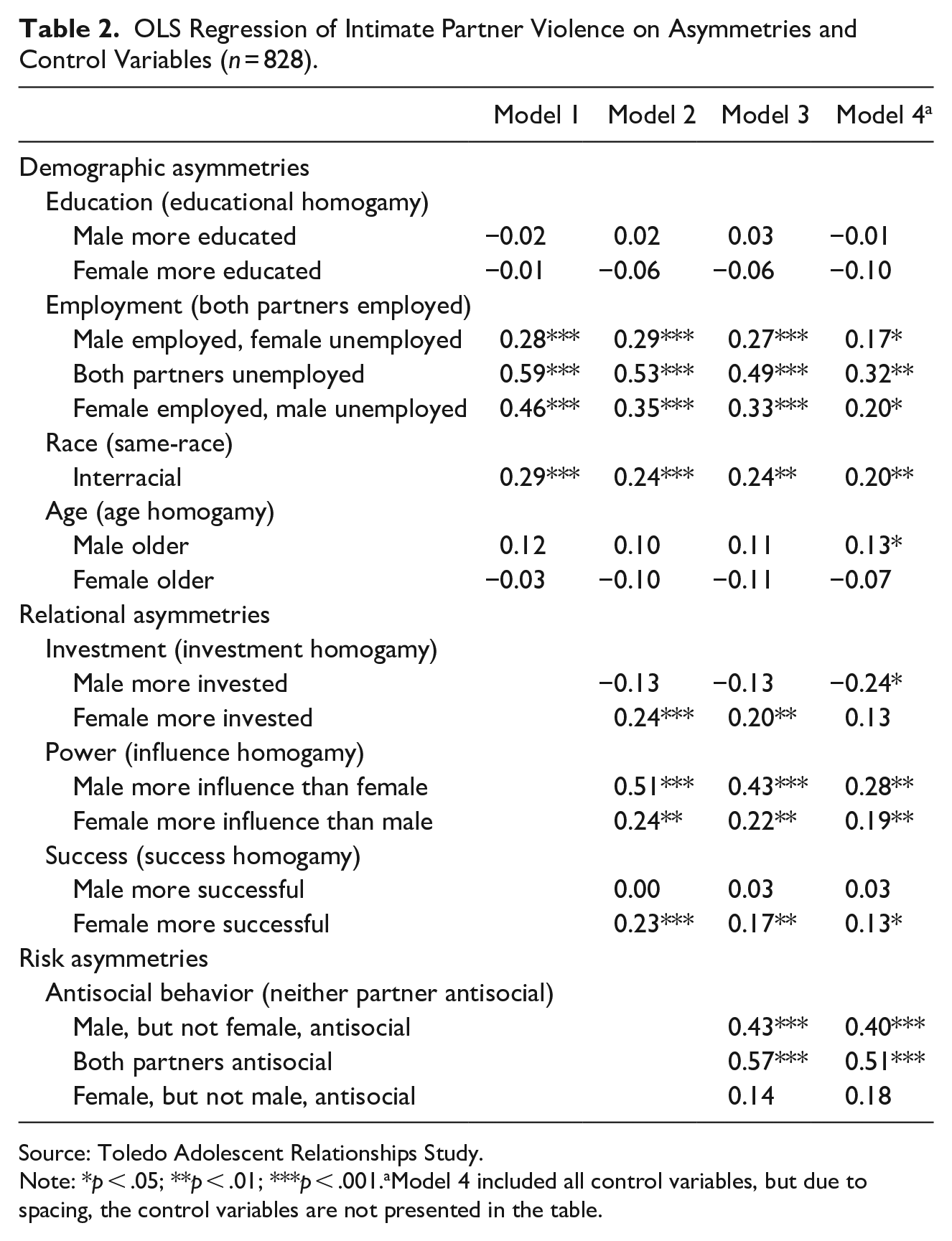
In Table 2, we showed the OLS regression of partner violence on demographic asymmetries, relational asymmetries, antisocial behavior asymmetries, and the control variables. Focusing on demographic asymmetries, Model 1 demonstrated that relationships in which both partners were unemployed reported significantly higher frequency of partner violence than relationships in which both partners were employed. Additionally, relationships characterized by asymmetries in employment reported greater frequency of partner violence than relationships in which both partners were employed. Thus, Model 1 showed that any unemployment is associated with greater relationship violence. Model 1 also demonstrated that compared to same-race relationships, interracial relationships reported higher frequency of partner violence. Educational and age asymmetries were not associated with relationship violence in the baseline model.
OLS Regression of Intimate Partner Violence on Asymmetries and Control Variables (n = 828).
Source: Toledo Adolescent Relationships Study.
Note: *p < .05; **p < .01; ***p < .001.aModel 4 included all control variables, but due to spacing, the control variables are not presented in the table.
Model 2 included both demographic and relational asymmetries. Compared to relationships characterized by homogamy in investment, those in which the female, but not male, partner was more invested reported greater frequency of partner violence. No significant differences were found between relationships characterized by homogamy in investment and those in which the male, compared with the female, partner was more invested. Asymmetries in power were associated with partner violence, such that relationships characterized by any asymmetry in influence experienced higher frequency of partner violence than relationships in which both partners were equally as influential. Additionally, compared to relationships in which partners were equally successful in their jobs or school, those in which the female partner was more successful than the male partner reported more frequent partner violence. No significant differences were found between relationships characterized by homogamy in success and those characterized by greater male success. The findings from the first model remained significant in the second model, net of relational asymmetries.
Model 3 examined the association between asymmetries in antisocial behavior and IPV, controlling for demographic and relational asymmetries. No significant differences were found between relationships in which neither partner was engaged in antisocial behavior and in which the female, but not male, partner was antisocial. Consistent with Model 2, demographic asymmetries in employment and race, as well as relational asymmetries in investment, power, and success in work or school, were associated with IPV in young adulthood.
Model 4 included demographic, relational, and risk asymmetries, net of the control variables. This model corroborated prior models and showed that any unemployment, whether the female, male, or both partners were unemployed, was associated with greater frequency of violence. Additionally, interracial relationships compared with same-race relationships were characterized by higher frequency of violence. Contrary to prior models, asymmetries in age were associated with partner violence in the full model, demonstrating that relationships with an older male partner reported greater frequency of partner violence than relationships characterized by age homogamy.
In terms of relationship asymmetries, this model also showed that compared to relationships in which both partners were equally invested, those with greater male investment reported lower frequency of violence. No significant differences were found between relationships characterized by investment homogamy and relationships with greater female investment. Additionally, relationships with asymmetries in power were associated with higher frequency of IPV than those in which both partners wielded comparable power. Relationships characterized by greater female success reported high frequency of IPV compared to relationships characterized by success homogamy. Relationships with greater male success and those in which both partners were equally as successful did not significantly differ.
Finally, relationships in which both partners were involved in antisocial behavior had greater frequency of partner violence than relationships in which neither partner engaged in antisocial behavior. Furthermore, compared to relationships in which neither partner was involved in antisocial behavior, violence frequency was higher among relationships in which the female, but not male, partner was antisocial. Standardized coefficients (available from authors) showed that relational and risk asymmetries are more consequential to partner violence than demographic asymmetries.
To simplify the table presentation, we did not display the full roster of control variables. These variables operated in the expected manner (available from authors). Black, compared to White, respondents reported greater frequency of partner violence and compared to daters, cohabiting unions reported higher frequency of violence. Greater frequency of partner violence was also found in relationships longer in duration and those in which children were present in the respondents’ households. Finally, parental and friend support were associated negatively with IPV, suggesting that relationships receiving greater support from parents and friends experienced lower frequency of partner violence. Standardized coefficients (available from authors) suggested that out of these control variables lack of parental and friend support of the relationship, as well as relationship duration, have the greatest effects on partner violence frequency.
Discussion
The present study contributes to the literature on intimate relationships in several important ways. First, given the nature of the TARS data, which provides comprehensive measures of relationship dynamics and characteristics, we assessed a wider scope of asymmetries. As such, we were able to perform a more thorough investigation of the role of asymmetries in IPV and further, discern the relative importance of demographic, relational, and risky behavior asymmetries. Second, given the variation in union experiences, we considered a broad range of relationships in young adulthood, including dating, cohabiting, and marital unions. In doing so, we were able to directly assess the influence that asymmetries have on IPV during young adulthood. Finally, our analyses of gender specific couple-level indicators allow us to discern the gender patterns underlying IPV. By taking a more dyadic approach in understanding the etiology of IPV, this research has important implications with regard to partner violence prevention and intervention efforts targeted toward young adults.
Summarizing the key findings associated with demographic asymmetries, employment and race were both associated with greater frequency of violence. Specifically, either partner’s unemployment is associated with greater relationship violence; and, compared to same-race relationships, interracial relationships reported higher frequency of partner violence. Regarding relational asymmetries, differences in investment, power, and success in jobs or school were associated with violence. Relationships in which men were more invested, self-reported violence was lower. Relationships characterized by any asymmetry in power were also characterized by higher frequency of partner violence compared to relationships in which both partners held equal power. Relationships in which the female partner was more successful at school or work compared to the male partner reported more frequent partner violence. Lastly, compared to relationships in which neither partner engaged in antisocial behavior, those in which the male, but not female partner, was antisocial and those in which both partners engaged in antisocial behavior reported greater frequency of partner violence.
Although we have covered new terrain regarding asymmetries and intimate relationship functioning, our study has some limitations. First, we relied on individual-level data that consisted of the respondents’ reports of their partners’ demographic characteristics, relational attributes, and involvement in antisocial behaviors. It is possible that respondents may have provided inaccurate information about their intimate partners and over- or understated their partners’ behaviors within the relationship, as well as their involvement in antisocial behaviors. Future research may benefit from using couple-level data to provide a more comprehensive and dyadic approach of the association between asymmetries and IPV in young adulthood. Second, we did not explore the underlying mechanisms through which these associations operated. The associations between asymmetries and partner violence may operate indirectly through other processes, such as relationship stress or poor communication between partners. Thus, future research should consider the possible mediating mechanisms through which the associations between asymmetries and partner violence operate. Finally, although the TARS sample shares similar sociodemographic characteristics with national averages, it is a regional sample of young adults. Data permitting, future research would benefit from using nationally representative data that is generalizable to the U.S. population of young adults.
Young adult relationships are shifting as individuals wait longer to marry, and increasingly enter cohabiting relationships (family profiles). These relationships are characterized by consequential levels of IPV. As women make gains in education and employment it appears there are some sources of strain. The education and employment composition of couples does not appear to be the source of negative ramifications, but instead, the perceptions of success. When women are more successful in employment or school there appears to be more frequent IPV, but the same is not true when men are more successful. Disruption of traditional gender roles may have implications for the health and well-being of young adult couples.
Footnotes
Declaration of Conflicting Interests
The authors declared no potential conflicts of interest with respect to the research, authorship, and/or publication of this article.
Funding
The authors disclosed receipt of the following financial support for the research, authorship, and/or publication of this article: This research received support from The Eunice Kennedy Shriver National Institute of Child Health and Human Development (HD036223) and the National Institute of Justice, Office of Justice Programs, U. S. Department of Justice (Award Nos. 2009-IJ-CX-0503 and 2010-MU-MU-0031), and in part by the Center for Family and Demographic Research, Bowling Green State University, which has core funding from The Eunice Kennedy Shriver National Institute of Child Health and Human Development (P2CHD050959). The opinions, findings, and conclusions or recommendations expressed in this publication/program/exhibition are those of the authors and do not necessarily reflect the official views of the Department of Justice or National Institutes of Health.
