







Abstract
This study examines how older adults in China reorganize their social support networks following the migration of their adult children. Drawing on the Social Convoy Model (SCM) and Socioemotional Selectivity Theory (SST), the study explores how older adults respond to intergenerational geographic separation through two common arrangements: relocating to live closer to their children or remaining in their place of origin as empty-nest older adults. Based on semi-structured interviews with 20 older adults (10 relocated and 10 empty-nest), the analysis employs Reflexive Thematic Analysis to reconstruct an analytically derived four-part narrative staging of adaptation based on participants’ retrospective accounts. The findings suggest that migration is associated with disruptions in previously taken-for-granted support structures, prompting older adults to renegotiate both relational ties and meanings of support. While relocated older adults often navigate new forms of “proximity without full integration” in unfamiliar social environments, empty-nest older adults often described relying on local peer reciprocity and digitally mediated family contact to maintain continuity in everyday support. By integrating structural insights from the Social Convoy Model with motivational dynamics emphasized in Socioemotional Selectivity Theory, the study offers qualitative insights into how older adults actively reinterpret and reorganize their support networks in the context of migration and demographic change. These findings contribute to a better understanding of how intergenerational migration reshapes support relationships in rapidly aging and highly mobile societies.
Keywords
Introduction
In many contemporary societies, older adults must renegotiate their support relationships as family members become geographically dispersed. In China, large-scale internal migration has increasingly separated older parents from their adult children, creating new challenges for everyday support, emotional connection, and care arrangements in later life. In response to these changes, older adults adopt different strategies: some relocate to live closer to their children, while others remain in their original communities and rely more heavily on neighbors, friends, and local institutions. These strategies are not simply residential choices; they reflect different ways of reorganizing intergenerational support when everyday family care is no longer secured through co-presence. Understanding how older adults reorganize their social networks under these circumstances has become an increasingly important research question.
These transformations unfold within broader demographic and social shifts. China’s rapid urbanization, declining fertility, and the aging of the large cohorts born in the 1950s and 1960s have fundamentally altered the structure of intergenerational support (Hu & Zhang, 2018). Smaller family sizes mean that older adults often have fewer children available to share caregiving responsibilities (Zhang & Harper, 2022), while labor migration has geographically separated many families across cities and regions (National Bureau of Statistics, 2021). Compounding this challenge is China’s underdeveloped formal eldercare infrastructure. Society-based services are unevenly distributed (Luan et al., 2023; Zhang et al., 2024), institutional care remains stigmatized (Peng et al., 2022) or unaffordable for many, and social security systems offer limited coverage for long-term care (Feng et al., 2011, 2012). As a result, traditional expectations of family-based eldercare must increasingly coexist with new forms of mobility and changing family relationships (Heylen et al., 2012; Liu et al., 2018; Zhang et al., 2018).
While eldercare under internal migration has received increasing attention, we still lack a dynamic, comparative understanding of how older adults agentically respond to these circumstances. Much of the existing research treats relocated and empty-nest older adults as separate populations, often portraying them as passive recipients of structural change. Consequently, the dynamic processes through which they actively adapt and reconfigure their emotional and instrumental support networks remain underexplored. To address this gap, this study examines how older parents in China reorganize support after adult children’s migration disrupts everyday intergenerational care arrangements. More specifically, it asks how older adults renegotiate family-based expectations of support and rebuild broader networks of care when living either near to, or apart from, their adult children. By comparatively analyzing the experiences of relocated and empty-nest older adults, this study highlights how family and non-family ties are rebalanced under conditions of geographic separation.
Evolving Patterns of Eldercare in Urbanizing and Aging China: Intergenerational Co-Migration and Empty-Nest Aging
Moving Together: Patterns and Tensions in Intergenerational Co-Migration
In China, one common response to adult children’s migration is for older parents to relocate and live near, or with, their children. This arrangement appears to restore family proximity, but it often introduces new tensions in care, belonging, and everyday intergenerational relations. Drawing on existing typologies (Litwak & Longino, 1987; Longino & Bradley, 2006; Lovegreen et al., 2010), this study focuses on later-life relocation to live near adult children, an arrangement often shaped by expectations of care, emotional security, and future support. This form of eldercare reflects both the enduring influence of familistic values and a flexible reconfiguration of intergenerational obligations.
However, the shift from hometown-based to geographically displaced caregiving presents a set of complex and interrelated challenges. First, institutional exclusion amplifies the vulnerabilities of mobile older adults. Under China’s household registration (hukou) system and territorially bounded welfare regime, older adults with rural hukou often face serious barriers in accessing healthcare, pensions, and other essential services in their new urban locations, placing them in a precarious state of “semi-citizenship” (Chen et al., 2017; Treiman, 2012; Xi et al., 2020). Second, the erosion of existing social networks and the difficulties of cultural adaptation undermine psychosocial well-being. Relocated older adults often experience disrupted friendships, diminished peer interactions, and unfamiliar community environments, which increase their susceptibility to loneliness, anxiety, and depression (Bilecen & Vacca, 2021; Ekoh et al., 2023; Kim et al., 2012). Third, intergenerational co-residence itself can give rise to domestic tension, including value-based conflicts over lifestyles (Tezcan, 2021), changes in household authority structures (Khvorostianov & Remennick, 2015; Zhao & Huang, 2018), and stress from spatial overcrowding (Tosi & Grundy, 2018). Collectively, these challenges not only complicate the dynamics of intergenerational caregiving but also challenge the sustainability of relocated co-residence as an eldercare solution.
Aging Apart: The Emergence and Challenges of the Empty-Nest Model
In contrast, many older adults remain in their hometowns after their children migrate, creating a form of later-life family life marked by geographic distance rather than co-residence (Cohen et al., 2025; Molina-Mula et al., 2020). This prevalent arrangement reflects the structural legacy of multiple intertwined forces. Demographically, the combination of the post-1950s baby boom and the one-child policy has weakened the human resource base for family care (Hu & Zhang, 2018; Zhang & Harper, 2022). Spatially, rapid urbanization has triggered large-scale youth migration, decoupling family functions across geographic space (Heylen et al., 2012; Liu et al., 2018; Zhang et al., 2018). Normatively, cultural transformations have reshaped intergenerational relationships, with traditional filial piety evolving into a more negotiated ethic and a stronger preference for autonomy among older adults (Yan, 2003, 2016). The empty-nest model thus reflects a tacit intergenerational consensus of “separation without alienation” (Li et al., 2021).
Although this model aligns with evolving familial expectations, it exposes older adults to multiple forms of vulnerability. Emotionally, empty-nest older adults report elevated rates of loneliness and depression (Thapa et al., 2018). Physically, they face challenges in accessing timely medical care and managing daily functional needs, particularly in emergencies (Zhou et al., 2015). Institutionally, while community-based eldercare initiatives have emerged, their effectiveness is often constrained by uneven service provision and resource fragmentation, particularly in rural areas (Feng et al., 2011, 2012; Luan et al., 2023; Zhang et al., 2024). These constraints contribute to persistent risks of long-term isolation and unmet care needs among empty-nest older adults.
Toward an Integrated Understanding: A Critical Synthesis and Research Gap
Existing studies have generated important insights into either relocated aging or empty-nest aging, but these two strands of research remain largely separate. As a result, we know much less about how older adults comparatively reorganize support under different forms of geographic separation from adult children. In particular, prior studies have paid insufficient attention to how family-based expectations of care are renegotiated and how non-family ties are mobilized when everyday intergenerational support becomes less available. This study addresses that gap by comparing relocated and empty-nest older adults as two distinct, but related, responses to disrupted family proximity.
Methodologically, much of the existing work relies on either large-scale quantitative survey, which can lack relational depth, or localized case studies that limit cross-group comparisons. Consequently, few studies have systematically and comparatively explored how older adults across these divergent arrangements dynamically reconfigure their support networks in response to separation. We still lack a nuanced understanding of how emotional, instrumental, and symbolic forms of support are reorganized within these evolving family structures.
This study addresses these limitations by comparatively analyzing how older adults with geographically distant children reconstruct their social support networks. Moving beyond static descriptions of care arrangements, this research seeks to uncover the adaptive processes, relational negotiations, and symbolic reframing that shape support structures in later life, thereby providing a more dynamic and agent-centered understanding of eldercare in contemporary China.
Theoretical Framework: An Integrated Model of Social Convoy and Socioemotional Selectivity
To understand how older adults reorganize support after geographic separation from adult children, this study uses a framework that captures both changes in network structure and changes in relational priorities. To achieve this, we integrate two complementary theories: the Social Convoy Model and Socioemotional Selectivity Theory.
The Social Convoy Model (SCM) (Kahn & Antonucci, 1980) helps identify the structure of older adults’ support networks by distinguishing among close family ties, important but less central relationships, and more peripheral forms of support. The SCM conceptualizes social relationships as a multi-layered convoy structured in three concentric circles: a core circle of the most intimate ties (e.g., spouse and children), a middle circle of important relations (e.g., friends and relatives), and an outer circle of more peripheral connections (e.g., community services) (Antonucci et al., 2014; Kahn & Antonucci, 1980). Its key strength lies in analyzing how convoy structures evolve across the life course, as different layers can potentially expand or contract to compensate for changes in others.
However, as the literature review on eldercare in China demonstrates, applying the SCM in isolation reveals critical limitations in this context. The model does not fully account for structural barriers, such as the household registration (hukou) system, which severely constrains the outer circle’s ability to compensate for a weakened family core. Nor does it adequately capture the complex cultural dynamics of modern Chinese families, where expectations of care persist even across vast distances. Critically, while the SCM provides an excellent map of what the support network looks like, it offers less insight into why older adults make the specific choices they do to navigate this changing landscape.
To address this motivational dimension, we integrate the SCM with Socioemotional Selectivity Theory (SST) (Carstensen et al., 1999). SST provides the missing psychological lens, positing that as individuals perceive their future time as more limited, their priorities shift toward emotionally meaningful goals and relationships. It explains the selective logic older adults use to invest their finite social and emotional energy. SST illuminates why an older adult might prioritize emotionally rewarding interactions with a few long-standing friends over building numerous new, superficial ties, or how they recalibrate their emotional expectations of their busy children to preserve relational harmony.
By integrating these two theories, this study employs a robust framework that analyzes both the structural reconfiguration of support networks (the changing “architecture,” guided by SCM) and the emotional-motivational drivers of these changes (the “navigational choices,” explained by SST). Together, these two perspectives make it possible to examine both how support networks change and how older adults interpret those changes.
Research Design and Methods
Research Approach and Design
This study employs a qualitative, comparative research design to explore how older adults adapt their social support networks in the context of intergenerational geographic separation. The analytic approach is guided by Reflexive Thematic Analysis (RTA) (Braun & Clarke, 2006, 2019, 2021) (see Appendix 1). This method is particularly well-suited for this study as it facilitates a nuanced, in-depth exploration of participants’ lived experiences. Rather than fitting data into pre-defined categories, RTA allows us to uncover the subjective processes of adaptation, relational negotiation, and meaning-making, aligning perfectly with our goal of understanding older adults as active agents in their social worlds.
Participants
Between February 2024 and March 2025, this study purposively recruited 20 older adults in China. Participants were recruited through multiple channels, including community centers, neighborhood committees, and personal networks in two urban areas and surrounding rural communities. Community workers assisted with initial outreach by introducing the study to potentially eligible participants who met the inclusion criteria. Recruitment followed a purposive sampling strategy aimed at capturing variation in living arrangement, hukou status, gender, and migration-related experience, rather than statistical representativeness. This study received ethical approval from the Institutional Review Board of the authors’ home institution. All participants provided informed consent prior to the interviews, and all identifying information was anonymized.
Potential participants were eligible if they were aged 70 or above and had at least one adult child who had migrated to another city for work or family reasons. Two groups were included: (1) “relocated older adults,” who had moved to the city where their adult children lived and had resided there for at least 6 months, and (2) “empty-nest older adults,” who remained in their place of origin and did not live in the same city as their children.
Characteristics of Interviewees
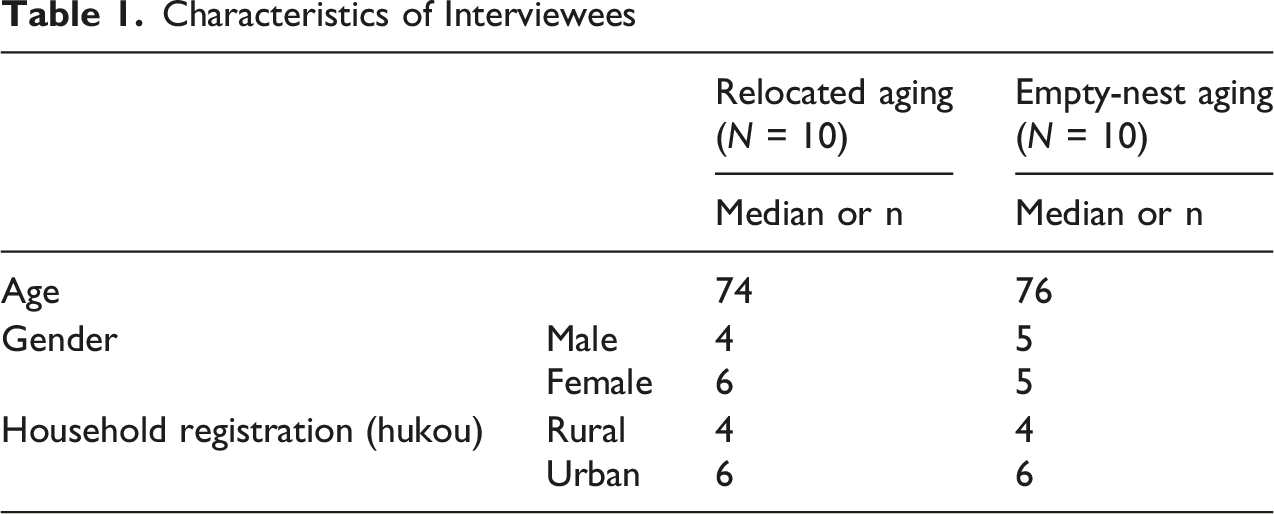
In addition, basic socio-demographic information was collected during the interviews, including marital status, self-reported health status, and the length of time since children’s migration. To enhance comparability across cases, the sampling strategy aimed to minimize major socio-demographic differences among participants. For instance, all interviewees were physically independent in their activities of daily living and did not report significant health or functional limitations, thereby reducing the potential influence of health disparities on the processes of social support network reconfiguration examined in this study.
All participants provided written informed consent, and all identifying information was anonymized.
Data Collection
Data were collected through in-depth, semi-structured interviews conducted remotely via voice or video conferencing. Each interview lasted approximately 50 min. The interview guide was designed to operationalize our integrated theoretical framework.
Questions informed by the Social Convoy Model explored the structure and composition of participants’ support networks across core, middle, and outer layers, probing for changes and compensatory actions. For example, participants were asked questions such as “When you encounter difficulties in daily life, who are the first people you turn to for help?”
In parallel, questions inspired by Socioemotional Selectivity Theory explored the motivations, emotional priorities, and meaning-making processes that shaped participants’ relational choices and adjustments to their new circumstances. For instance, participants were asked questions such as “Which relationships are most important to you at this stage of life?”
These questions allowed participants to describe both structural changes in their networks and the meanings they attached to different relationships.
Data Analysis
All interviews were transcribed verbatim and analyzed using the principles of RTA. Initial coding focused on identifying descriptions of support relationships, perceived disruptions, and strategies of adaptation. Codes were iteratively refined through repeated reading of the transcripts, and broader themes were developed by grouping related codes.
RTA’s emphasis on researcher reflexivity was maintained throughout, and our integrated SCM-SST framework was employed to guide an iterative process of coding and theme development. This involved moving back and forth between the data and theory to construct meaningful patterns. Codes related to network structure, role substitution, and institutional support were primarily interpreted through the lens of SCM, while codes concerning emotional recalibration, selective investment in relationships, and the reframing of intimacy were analyzed using SST.
During the analytic process, particular attention was paid to how participants narrated change over time. Across interviews, accounts often clustered around recurring moments of disruption, adjustment, and reinterpretation. On this basis, the analysis developed an analytically derived four-part narrative of adaptation.
Results
Analysis of participants’ narratives suggests a patterned sequence through which many older adults described adjusting to the migration of their children. Across both groups, participants frequently described four broad phases, analytically reconstructed from participants’ retrospective accounts: (1) previously stable support arrangements before migration, (2) disruption and renegotiation of everyday support following geographic separation, (3) efforts to rebuild practical support networks, and (4) reinterpretation of emotional connections and personal autonomy in later life. Throughout this process, the structural reconfiguration of support networks, explained by the Social Convoy Model (SCM), was consistently intertwined with the emotional and motivational adaptations illuminated by Socioemotional Selectivity Theory (SST).
Foundations: The Pre-Migration Social Convoy
Before their children’s migration, participants’ daily lives were anchored by multi-layered social convoy that provided a stable ecosystem of support. At the heart of this system were close family ties, especially spouses and adult children, who provided both practical assistance and a sense of emotional security. As one reflected, “Before my son moved out, anything small or big, like seeing a doctor or fixing the heater, he was always there” (Male, 74, Empty-Nest Family). This instrumental support was deeply intertwined with emotional reassurance, as another older adult explained, “Just having them around, even if we didn’t talk much every day, made me feel safe” (Female, 75, Relocated Family).
Functioning as a critical buffer, the middle circle—composed of siblings, friends, and neighbors—demonstrated the convoy’s adaptive capacity by creating a web of mutual obligation. This layer offered supplementary support that, while less intense than core family ties, ensured a continuity of care and diversified sources of help. In urban settings, this manifested as robust neighborly reciprocity. “My neighbor used to bring me food when I was sick, and we looked after each other like family” (Female, 78, Empty-Nest Family). In rural areas, these networks were often even more tightly woven due to long-standing familiarity: “In the countryside, everyone knows each other. People help out a lot, like bringing medicine or sharing meals when needed,” a rural participant shared (Male, 76, Empty-Nest Family).
Providing a broader, though more distanced, safety net was the outer circle of institutional resources. These formal connections, while low in intimacy, embedded older adults in a wider societal fabric capable of mobilizing resources when informal networks were strained. This layer often remained latent, activated primarily in moments of need. “There’s a senior center in our block. I don’t go there often, but it is good to know they are there if needed” (Male, 77, Empty-Nest Family). This latent support became critical during emergencies, such as public health lockdowns, when, as one older adult recalled, “During the pandemic lockdown, the community volunteers brought vegetables and medicine to our building. Otherwise, we would have had a hard time even getting food” (Female, 74, Relocated Family).
Finally, digital platforms emerged not as a simple outer circle, but as a unique, cross-cutting dimension that reshaped interactions across the entire convoy. This represents a significant evolution of the traditional SCM, as digital media acted less as a distinct “layer” and more as a “medium” through which the functions of all layers were performed. Participants used WeChat for video calls to maintain intimacy with children in the core circle and joined group chats to sustain camaraderie with friends in the middle circle. As one participant explained, watching health tips on WeChat “keeps me company and also makes me feel like I’m taking care of myself better” (Female, 76, Empty-Nest Family), illustrating how these tools provide a novel form of ambient, self-directed support. A similar pattern was mentioned by a relocated participant, who recalled that even before moving to live near his son, he had already relied on WeChat to maintain everyday contact: “My friends and I chat almost every day in our WeChat group, so even when we live apart, it still feels like we are together” (Male, 74, Relocated Family).
In summary, the pre-migration convoy was a functional ecosystem characterized by a reliable core of kin, a reciprocal middle circle of peers, and a conditional outer layer of institutional support, with all layers increasingly mediated by digital tools. The stability of this entire system, however, was predicated on the physical proximity of the core family circle, rendering it vulnerable to the profound disruption of migration.
Fragmentation and Tension: When Migration Pulls Threads Apart
The migration of adult children triggered a multi-layered fragmentation of the previously stable convoy, introducing profound structural and emotional strains. The most immediate disruption was felt in close family support. The physical absence of children created immediate instrumental care gaps. “Now if I need to see a doctor, I have to find someone else. Before, my son would just drive me there” (Male, 74, Empty-Nest Family). This logistical void was accompanied by a gradual attenuation of emotional intimacy, as mediated communication was often seen as an inadequate substitute for physical presence. As another older adult shared, “They call every week, but it is not the same as seeing them, feeling they are around” (Female, 75, Empty-Nest Family).
While the practical challenges were significant, the emotional toll of this separation was often more profound. For many participants, the emotional consequences of separation were described as more difficult than the practical inconveniences. The theory posits that as older adults perceive their future time as limited, they increasingly prioritize emotionally meaningful relationships. Consequently, the disruption of their most central ties—the very relationships they value most—was not merely a practical inconvenience but a significant threat to their well-being, amplifying the feelings of loneliness and insecurity evident in their narratives.
This core-level rupture then cascaded outward, weakening the network’s overall resilience. The middle circle’s compensatory capacity was eroded as relocated older adults struggled to form bonds in unfamiliar urban environments—“Here, even after years, I do not know my neighbors very well. People are polite but distant” (Female, 74, Relocated Family)—and empty-nesters saw local peer networks thinned by attrition. “Those who used to help each other are old themselves now, or they have moved to live with their children” (Male, 77, Empty-Nest Family).
At the outer layer, institutional supports proved insufficient to fill the voids. Services were often perceived as impersonal and ill-suited to older adults’ needs. Relocated older adults faced technical barriers—“In the city, I do not know how to register for a clinic. It is all online, and I do not know how to use it” (Female, 75, Relocated Family)—while rural older adults faced unreliability. One urban empty-nester poignantly captured the ultimate mismatch: while appreciating emergency help, she concluded, “It is not the same as having my son knock on the door to check on me” (Female, 77, Empty-Nest Family). This highlights a key fragility of the convoy system: when the core anchor is dislodged, the outer layers often lack the relational depth to adequately compensate.
Beyond these structural breaks, migration engendered a deep internal ambivalence. Participants constantly navigated a tension between pride in their children’s success and a personal sense of relational loss. “I know they are busy, and I do not blame them. But sometimes, when the house is too quiet, it really feels empty” (Female, 78, Empty-Nest Family). A relocated older adult expressed a similar sense of dislocation: “I am grateful I can live near them, but I rarely see them during the week. It feels like I changed everything to come here, but life did not change much after all” (Male, 75, Relocated Family). Migration thus fractured not only support systems but also the very meanings and identities older adults attached to family life.
Reworking and Compensation: Mending the Social Fabric
In the wake of migration-induced fragmentation, older adults actively engaged in mending their social fabric through a dynamic process of reworking and compensation. Rather than simply describing decline, participants also described deliberate efforts to rebuild support in everyday life.
Within the core circle, this involved reworking the terms of intimacy. Relocated older adults leveraged physical proximity for crucial instrumental support, as one shared “When I have a doctor’s appointment, my daughter takes time off work to come with me. Without her, I would not even know which department to go to” (Female, 74, Relocated Family). Yet, they often faced a paradox of “proximity without intimacy,” as children’s busy schedules limited sustained emotional contact. Empty-nesters, conversely, relied on digital tools to maintain symbolic connection. “Now they are not around, but when they call or send pictures, I feel at ease for a while” (Female, 76, Empty-Nest Family). SST illuminates why these symbolic acts are so vital: they provide focused, emotionally potent interactions that satisfy the core need for connection with the most important people in one’s life, even if the contact is brief or mediated.
The most active compensation occurred in the middle circle, which showed remarkable adaptive elasticity. Relocated older adults, disconnected from old ties, were often forced to forge new networks. “A neighbor introduced me to a calligraphy class. I never wrote before, but now it gives me something to do and people to chat with” (Male, 76, Relocated Family). In contrast, many urban empty-nesters focused on revitalizing existing, high-quality relationships. “Several of us from the old work unit still meet every week. We have meals together, chat, and if anyone has health problems, we help each other out” (Female, 78, Empty-Nest Family). This strategic difference can be partly understood by SST: with limited energy, older adults are motivated to maximize emotional returns. Revitalizing trusted, long-standing friendships is a low-risk, high-reward strategy, while relocated older adults must invest in new, less certain connections out of necessity. In rural areas, this meant reinforcing thinning but essential neighborly ties, which served as a critical lifeline.
Finally, older adults selectively engaged with the outer circle for pragmatic, functional support. Institutional resources like hired caregivers or residential facilities were used less for emotional warmth and more for “peace of mind,” serving as a functional substitute for family care. “Living here, at least there are nurses if something happens. It is not family, but it gives some peace of mind” (Female, 78, Empty-Nest Family). Digital platforms also played a role here, offering ambient companionship that filled empty hours. “After dinner I usually scroll through some videos on my phone. Hearing people talk, even if they’re strangers, makes the evening feel less quiet” (Male, 76, Empty-Nest Family). This shows the outer layer shifting from a peripheral safety net to an integral component of daily coping, providing instrumental and emotional regulation when other layers fall short.
Taken together, these strategies reveal a process of active and creative cross-layer compensation. Older adults are not passive victims of circumstance but agents who continuously recalibrate their convoy networks, demonstrating that when the core circle is weakened, they purposefully reinvest their energy into middle and outer layers to maintain stability and well-being.
Reframing Support and Care: Re-Weaving the Meaning of Connection
The final and most profound adaptation involved not just restructuring support networks but re-weaving the very meaning of connection. Faced with the realities of separation, older adults engaged in a deep cognitive and emotional reframing, moving beyond practical coping to redefine intimacy, community, and autonomy.
This began with redefining intergenerational intimacy. Participants actively shifted their expectations from co-present, daily contact to a model rooted in symbolic connection. For a relocated older adult, a weekly meal became a cherished ritual: “Just knowing they remember me is enough” (Female, 73, Relocated Family). For an empty-nester, a brief phone call served the same purpose: “Just hearing his voice is enough. It lets me know he still thinks about me” (Male, 77, Empty-Nest Family). These accounts suggest that older adults were not simply accepting less contact; they were reinterpreting what counted as meaningful connection under conditions of separation. Brief and ordinary interactions came to carry considerable emotional weight because they signaled continued care, recognition, and relational continuity.
Alongside this relational work, participants reclaimed personal autonomy as a central source of identity and self-worth. They reframed independence not as a burden, but as a conscious assertion of resilience. “Doing what I can on my own makes me feel steadier,” explained a relocated older adult (Male, 76, Relocated Family). Similarly, an empty-nester viewed her choice to remain as a positive act: “It’s good to rely on myself” (Female, 78, Empty-Nest Family). This cognitive shift transformed their situation from one of being “left behind” to one of active, dignified self-reliance.
However, this process of reframing was not absolute. The narratives were tinged with a persistent longing for physical presence, revealing the limits of symbolic connection. During festivals or illness, the emotional weight of separation was felt most acutely. “We’re close in distance, but it still feels a bit empty inside,” shared a relocated older adult (Female, 75, Relocated Family). An empty-nester echoed this sentiment: “When you’re old, you just want the whole family to sit down and share a hot meal” (Male, 76, Empty-Nest Family). These moments underscore that while older adults are incredibly resilient, their adaptive strategies exist in constant negotiation with a deep, and perhaps irreplaceable, need for embodied familial closeness.
Ultimately, these findings reveal a dual mechanism at play. The Social Convoy Model explains the structural dynamics of loss and cross-layer compensation within support networks. Simultaneously, Socioemotional Selectivity Theory illuminates the motivational logic underpinning these shifts, explaining why older adults prioritize certain relationships and how they emotionally adapt to their changing realities. Their experience is thus a continuous negotiation between structural constraints and the agentic pursuit of meaning in later life.
Discussion and Conclusion
Amid China’s ongoing demographic and social transformations, driven by large-scale labor migration (Heylen et al., 2012; Liu et al., 2018; National Bureau of Statistics, 2021; Zhang et al., 2018), population aging (Hu & Zhang, 2018; Zhang & Harper, 2022), and relatively limited institutional support systems (Luan et al., 2023; Zhang et al., 2024), this study examines how older adults actively reconfigure their social support networks. By comparatively analyzing the experiences of relocated and empty-nest older adults, our findings suggest an analytically reconstructed four-part sequence: the disruption of a stable pre-migration convoy, a period of multi-layered tension, a phase of active reworking and cross-layer compensation, and a final reframing of the very meanings of care and connection. This trajectory demonstrates that older adults are not passive recipients of structural change but instead actively negotiate and navigate shifting family realities through both structural adaptation and deep emotional work.
This study makes several contributions to theories of social support and aging. First, it offers empirical support for and extends the Social Convoy Model (SCM) in a non-Western, high-mobility context. Our findings suggest that migration triggers ruptures in the core convoy circle, diminishing emotional intimacy (Knodel & Chayovan, 2008) and weakening middle-layer peer ties (Badawy et al., 2019). We further show how the model’s mechanism of cross-layer compensation operates when older adults purposefully reinvest in remaining relationships. At the same time, our findings also point to potential structural limitations of the model. The struggles participants faced with fragmented or impersonal institutional services, a finding consistent with prior research on China’s eldercare infrastructure (Feng et al., 2011, 2012; Luan et al., 2023; Zhang et al., 2024), underscore that in contexts of territorially bounded welfare, the outer convoy layer cannot be assumed to be a fully effective substitute for core-level support.
By integrating the Socioemotional Selectivity Theory (SST), we illuminate the motivational logic that drives these structural reconfigurations. SST explains why older adults make specific choices, such as revitalizing high-trust, long-standing friendships over forming new, superficial ties, as a strategy to maximize emotional well-being in the face of a foreshortened future (Carstensen et al., 1999; Quan-Haase et al., 2017). Taken together, these insights suggest a more integrated perspective, showing how structural adaptation (SCM) and emotional selectivity (SST) are two sides of the same coin, jointly shaping older adults’ agentic responses to late-life transitions. From a family studies perspective, the findings suggest that geographic proximity should not be equated with relational integration, and geographic distance should not be equated with weakened family commitment. Instead, intergenerational support in later life is actively renegotiated across different living arrangements, with family ties remaining central even when practical care is redistributed across wider networks.
Furthermore, our research highlights the evolving role of digital technology in mediating social convoys. Rather than conceptualizing digital platforms as a simple addition to the outer circle, our findings show they function as a cross-cutting medium that alters the nature of interaction across all layers. From maintaining core-circle intimacy to finding ambient companionship, technology is increasingly mediating the architecture of social support, reflecting an expanded understanding of later-life relational practices (Kemp et al., 2013; Quan-Haase et al., 2017). Finally, the study underscores the importance of symbolic reframing (Park, 2010) as a critical adaptive strategy. Participants did not merely find new sources of support; they actively redefined what constitutes meaningful care. By imbuing brief phone calls or periodic visits with profound emotional significance, they preserved the functional integrity of their core relationships. This cognitive and emotional labor is a vital, yet often overlooked, dimension of resilience, demonstrating that maintaining a convoy is as much about managing meaning as it is about managing relationships.
Several limitations should be acknowledged. First, the study is based on retrospective narratives collected through cross-sectional interviews. Although participants frequently described changes over time in their support relationships, the four-part staging presented in the analysis represents an interpretive reconstruction rather than a process observed through longitudinal data. Future research using longitudinal designs could provide deeper insights into how support networks evolve over time following migration. Second, the purposive sample and relatively small number of participants limit the generalizability of the findings. The aim of this study is therefore not to provide representative estimates but to offer qualitative insights into the processes through which older adults interpret and reorganize their support networks. Future quantitative or mixed-methods research could test the generalizability of our proposed four-stage model across different socioeconomic strata and regions. Third, by focusing on the perspectives of older adults, this study presents one side of a complex dyadic relationship. Future research incorporating the narratives of adult children would provide a more complete, bidirectional understanding of how families negotiate care, guilt, and obligation across distance. Finally, while we identify the growing importance of digital technology, a more in-depth investigation into the digital divide, which includes issues of access, literacy, and techno-skepticism, is needed to understand who benefits from these new forms of connection and who is left behind.
In conclusion, this study highlights the adaptive ways in which older adults respond to changing family circumstances. Rather than simply experiencing a loss of support, many participants described actively reshaping the social connections that structure their everyday lives. These findings also suggest several implications for policy and practice. In addition to expanding formal service provision, it may be equally important to support the relational infrastructures through which older adults organize everyday assistance and companionship. This may include strengthening community centers as platforms for peer interaction, promoting digital literacy initiatives that help older adults maintain family connections, and developing flexible, community-based support systems that recognize the diverse ways families organize care. Policies should not assume that family support disappears when adult children live away; rather, support systems should be designed to complement families whose care practices are increasingly organized across distance. More broadly, the findings invite greater attention to a profound shift in perspective: to see aging not as a story of inevitable decline or dependency, but as a dynamic process of relational negotiation and creative adaptation in the face of structural transformation.
Footnotes
Acknowledgments
We express our sincere gratitude to all participants for their valuable contributions and to those who provided assistance during the data collection process.

Ethical Considerations
All participants took part in the study voluntarily and provided informed consent in accordance with approved ethical guidelines. The study was reviewed and approved by the Tsinghua University Science and Technology Ethics Committee (Humanities, Social Sciences and Engineering) (Project No: THU-04-2025-1174).
Funding
The authors received no financial support for the research, authorship, and/or publication of this article.
Declaration of Conflicting Interests
The authors declared no potential conflicts of interest with respect to the research, authorship, and/or publication of this article.
Data Availability Statement
The data supporting the findings of this study, including interview data, are not available due to restrictions outlined in the data usage protocol and participant confidentiality agreements.