







Abstract
The social processes that shape women’s emotional responses to abortions are not well understood, including the role of religion. Using a nationally representative sample of women who have had abortions (N = 1,217), we examine the relationships between religious service attendance, salience, and affiliation and negative and positive emotional responses to abortion. We find a higher importance of religious faith and conservative Protestant affiliation are strongly and significantly associated with higher probabilities of negative emotional responses and lower probabilities of positive emotional responses to abortion. These associations are reduced after accounting for women’s feelings about the rightness of their abortion decision at the time of abortion, suggesting these religious differences are attributable in part to moral incongruence. Our findings have important implications for understanding the prevalence and context of post-abortion emotional distress. Disproportionately negative emotional responses among certain religious women may lead religious groups and individuals to overestimate the prevalence of these responses.
Introduction
Most women have an emotional response to their abortion. According to data from The Turnaway Study, 1 week following their abortion, 35% of women reported primarily positive emotions, 24% reported primarily negative emotions, 18% reported mixed emotions, and only 23% reported no or only a few emotions (Rocca et al., 2013). These emotions—both positive and negative—become less common and plateau after about 2 years (Rocca et al., 2015, 2020). Identifying the circumstances and social characteristics associated with negative and positive post-abortion emotions is important for understanding and developing ways to support women who have had an abortion.
The emotional consequences of having an abortion for women have received considerable attention. Systematic reviews conclude that the best evidence does not find increased risk of negative mental health outcomes for women having abortions, with the strongest evidence being for women who have single abortions in the first trimester (Charles et al., 2008; Major et al., 2009). Indeed, much of the work on abortion and mental health seeks to identify the causal impact of abortion on subsequent mental health vis-à-vis carrying an unwanted pregnancy to term. Evidence from The Turnaway Study is perhaps some of the most compelling in this regard, with women’s mental health initially being worse for those who were denied an abortion because they were slightly past the legal gestational age for an abortion, relative to those who had one (Biggs et al., 2015; Foster et al., 2015; Biggs et al., 2017; see Masten et al., 2024 for a review). Evidence of this type is important given its relevance for policy debates and judicial decision-making regarding under what circumstances abortion should be legal ( Gonzalez v. Carhart, 2007 ; Kelly, 2014; Siegel, 2008). Women’s emotional responses to abortion, however, are important components of women’s wellbeing in and of themselves, irrespective of how they compare to the emotional responses of women who carry their unwanted pregnancy to term.
Existing quantitative research on emotional responses to abortion has found that the strongest predictors of negative emotions after abortion are higher scores on a pregnancy planning scale, heightened decision difficulty, higher perceived community abortion stigma, and lower social support (Rocca et al., 2013, 2015, 2020). Qualitative evidence also suggests negative emotional outcomes are more common when women do not have the primary decision-making power and when they do not have emotional support after the abortion (Kimport et al., 2011). Research on more distal factors that may be associated with these more proximal ones is scant. Religion is one potential institution that may shape women’s emotional responses to abortion. Despite its pronounced role in public debates on abortion, religion has received very little scholarly attention with respect to how it may be associated with emotional responses to abortion.
Religion and Abortion
Religion is measured in different ways, but both how religious someone is (i.e., religiosity) and what religious tradition they identify with matter for abortion attitudes and decisions. With respect to attitudes, religious service attendance, self-reported importance of religion, and conservative (or evangelical) Protestant identity are strongly and independently associated with lower levels of support for abortion (Deckman et al., 2023, 2024). Evangelical Protestants stand out even from Catholic Americans, whose opposition resembles the US population as a whole (Pew Research Center, 2022) despite clear opposition to the practice in official Catholic doctrine. The association between religion and abortion attitudes is both sizable and robust: Two reviews of the literature on abortion attitudes call religion the “strongest” (Jelen & Wilcox, 2003:492) and “most popular statistically significant” (Adamczyk et al., 2020:925) predictor of abortion attitudes.
Religious women are likely exposed to disapproving messages about abortion in many religious communities. For example, about 80% of evangelical Protestant clergy report addressing abortion publicly often or very often (Uecker & Lucke, 2011). Further, more than three quarters of evangelical Protestant and Catholic clergy who say they are politically active (about 85% of all clergy in these traditions) address abortion (Roso et al., 2024). If religious women are surrounded by anti-abortion networks and hear anti-abortion messages from religious leaders, they may be especially prone to negative mental health outcomes following their abortions.
The evidence is clear that religious women do have abortions. According to data from the Guttmacher Institute, 62% of women having abortions in 2014 had a religious affiliation (Jerman et al., 2020). Abortion is less likely among women who are more religious because they are less likely to have a nonmarital pregnancy, but religiosity is not associated with the probability of having an abortion among those who do have nonmarital pregnancies (Adamczyk & Felson, 2008). Conservative Protestant women, however, are less likely than other women to have an abortion when they have nonmarital pregnancies (Adamczyk, 2008), although many of these women still do have abortions.
Doan and Ehrlich’s (2017) study of 21 pro-life activists and counselors reveals the types of religious messaging women are likely to hear regarding their decision to abort. In particular, all 21 respondents—16 of whom were counselors at crisis pregnancy centers—described abortion as “[enabling] women to circumvent and usurp God’s natural ordering of the world” (121). Abortion is further characterized as a battle between Christ and Satan for the soul of the woman (Doan & Ehrlich, 2017). Women whose networks take and voice this position may perceive and experience less social support and more social stigma following their abortion.
Not only may women receive less support in these communities, but women who have had an abortion and who internalize this messaging may experience additional deleterious mental health consequences. Women who act out of step with their religious faith, in what has been called “religious incongruence” (Chaves, 2010), could bring about feelings of guilt, divine struggle, and religious strain that have negative consequences for mental health (Ellison et al., 2013; Exline et al., 2000). A similar argument with respect to morality—moral incongruence theory—has been applied to the study of pornography use. Negative mental health consequences of pornography use are evident only for men who believe it is immoral (Perry, 2018). Thus, if women believe their abortion was immoral or sinful, they may experience negative mental health outcomes that they otherwise may not have experienced.
Religion is also tied to pronatalist values (Uecker et al., 2022), which could be an additional source of moral incongruence for women. Religion often gives parent-child relationships a sacred quality, imbuing them with spiritual meaning (Mahoney et al., 2003). Women who choose to have an abortion rather than become a parent may develop negative emotions when exposed to or internalizing pronatalist ideas that are at odds with their abortion decision.
Religion may then be indirectly associated with post-abortion emotional responses through the mechanisms of lower social support, higher perceived stigma, different perspectives on motherhood, and—presuming moral and family values are at play in abortion decisions—decision difficulty and rightness. In this study, we use data from a nationally representative sample of US adults in 2014 to assess whether women who have had an abortion experience different emotional responses based on their religious characteristics. We examine both negative and positive emotional responses, and assess if and how women’s involvement in a religious congregation, their self-reported importance of religious faith, and their religious affiliation is associated with those responses. As a way to test for moral incongruence, we also consider whether these religious differences persist after considering women’s feelings about the rightness of their abortion decision at the time of the abortion.
Methods
Sample
Data for this study come from the 2014 Relationships in America (RIA) survey. The RIA is a survey of American adults between the ages of 18 and 60 years. Data collection was funded by the Austin Institute for the Study of Family and Culture and conducted by GfK (formerly Knowledge Networks). The data were from the GfK KnowledgePanel, an online panel whose members were recruited through probability-based sampling and were representative of the US adult population. Surveys were completed online; those without Internet access were provided computers and Internet access as needed. A total of 25,527 surveys were sent out in both English and Spanish, of which 15,738 were returned, resulting in a completion rate of 62%. GfK constructed a post-stratification weight to reduce the effects of non-response and non-coverage bias. These weights are based on demographic data from the 2013 Current Population Survey (CPS), and in the case of Spanish language surveys, the 2010 Pew Hispanic Center Survey. Weights are applied in all analyses. Data were and can be obtained from The Association of Religion Data Archives at https://thearda.com/data-archive?fid=FS14. More information about the survey and its procedures are also available at that website.
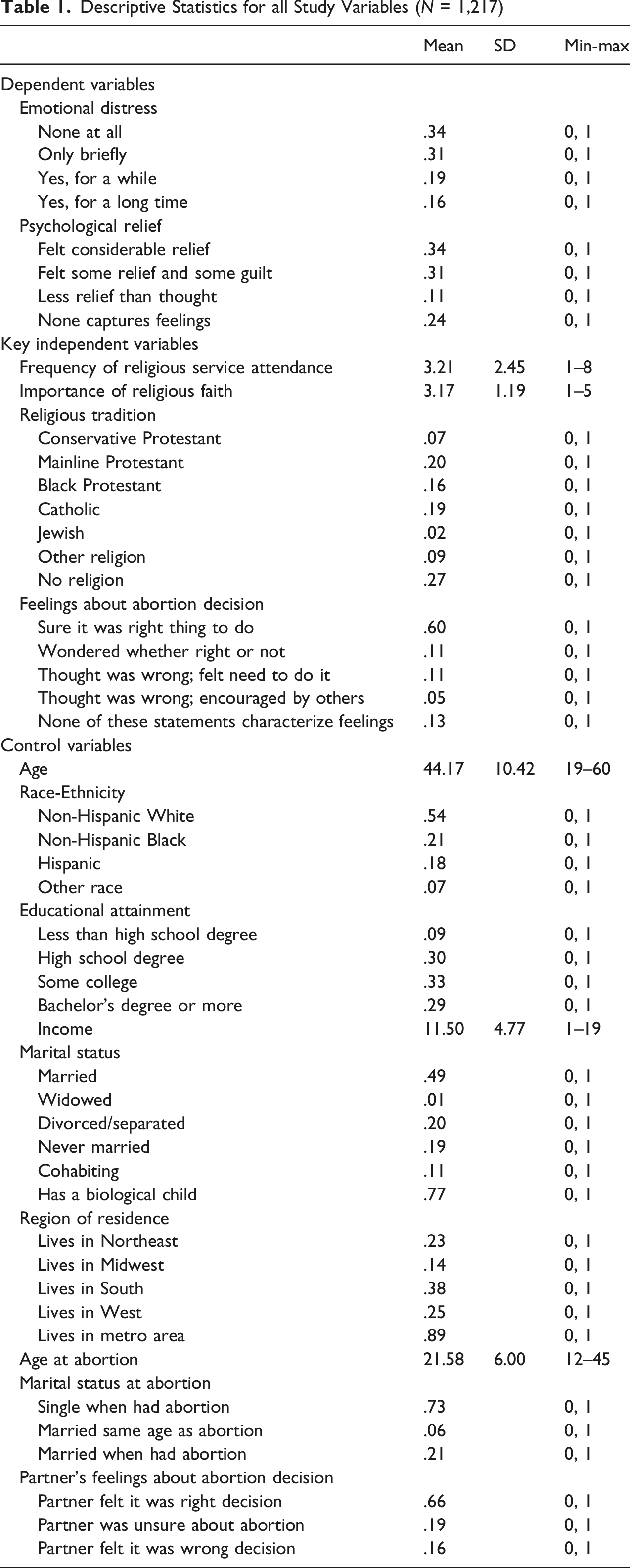
For this study, we limit our sample to respondents who identified as female and reported having had at least one elective abortion. About 20% of all women in the survey reported having had an elective abortion, making the sample size 1,598 women. We dropped 16 respondents who reported an age older at the time of their first abortion than they were at the time of the survey. There were 197 women who had an elective abortion with missing values on one or both of the abortion emotions items (including 167 who were missing on both). We use listwise deletion of missing values for all study variables to arrive at a working sample of 1,217 women.
Measures
Dependent Variables
Our dependent variables include two indicators of respondents’ self-reported emotional responses to abortion. Questions about abortions for those who had multiple abortions are specific to their first abortion. The first dependent variable is a measure we call negative emotions. Respondents were asked, “After the [first] abortion, did you experience any emotional distress, guilt, or other challenging emotions and feelings?” Respondents could indicate they experienced these emotions: (1) “None at all,” (2) “Only briefly,” (3) “Yes, for a while,” or (4) “Yes, for a long time.” Because of the ambiguity in the difference between these latter two categories, we combine these categories in our regression analysis. Results were substantively similar when these categories were separated.
The second dependent variable is a measure we refer to as psychological relief. Respondents were asked, “After the [first] abortion, did you experience feelings of psychological relief?” Response categories include (1) “Yes, I felt considerable relief,” (2) “Yes, I felt some relief but some guilt as well,” (3) “No, I didn’t feel as much relief as I thought I would,” and (4) “None of these captures my feelings about it.”
Key Independent Variables
We include three indicators of respondents’ religious commitment. First, religious service attendance was measured by the question asking, “How often, if ever, do you normally attend religious services (not counting weddings, baptisms, and funerals)?” The responses include (1) “More than once a week,” (2) “Once a week,” (3) “Three times a month,” (4) “Twice a month,” (5) “Once a month,” (6) “Several times a year,” (7) “One to two times a year,” and (8) “Never.” We treat this as a continuous variable and reverse coded it so that larger numbers indicate more frequent religious attendance. In our cross-tabulations (Table 2), we collapse this variable into four categories indicating never attended, attended less than once per month, attended one to three times per month, and attended weekly or more often.
Second, importance of religious faith was measured by the question asking, “How important (if at all) is religious faith to you?” Answers include (1) “Not important at all,” (2) “Not very important,” (3) “Somewhat important,” (4) “Very important,” and (5) “More important than anything else.” We treat this as a continuous variable.
Third, respondents were asked about their religious affiliation. Specifically, they were asked, “What is your present religion?” We classified respondents into the following categories: (1) Conservative Protestant, (2) Mainline Protestant, (3) Black Protestant, (4) Catholic, (5) Jewish, (6) Other religion, and (7) None, roughly following the widely used RELTRAD classification system (Steensland et al., 2000). Conservative and mainline Protestants were differentiated using a self-reported religious identity variable. Those who said they were either “Protestant” or “Other Christian” and indicated they were fundamentalist, evangelical, or Pentecostal were considered conservative Protestants. “Protestants” and “Other Christians” who indicated they were mainline, liberal, or “none of these” identities were considered mainline Protestants. 1 “Protestants” and “Other Christians” who identified as Black were considered Black Protestants.
Lastly, we include a measure that indicates the respondent’s self-reported retrospective feelings about the abortion decision at the time of abortion. Respondents were asked, “Did you feel the decision to have the [first] abortion was the right thing to do at the time?” Respondents could choose one of the five responses: (1) “I was sure it was the right thing to do,” (2) “I wondered whether it was the right thing to do or not,” (3) “I thought it was the wrong thing, but I felt the need to go through with it,” (4) “I thought it was the wrong thing, but I was encouraged by others to do it,” and (5) “None of these statements characterize my feelings about it at the time.”
Covariates
We controlled for respondents’ social demographics, including age, race and ethnicity (non-Hispanic White, non-Hispanic Black, Hispanic, and Other), education (less than high school, high school, some college, Bachelor’s degree or higher), household income, marital status (married, widowed, divorced/separated, never married, and cohabiting), whether the respondent has a living biological child, region of residence (Northeast, Midwest, South, West), and whether they lived in a metro area. We also included a set of abortion experience-related variables in our analyses, including age at first abortion, relationship status at first abortion (unmarried, married in the same year as abortion, married during abortion 2 ), and partner’s feelings about the first abortion (they felt it was the right decision, they were unsure about it, and they felt it was the wrong decision.)
Descriptive Statistics for all Study Variables (N = 1,217)
Analytic Approach
Percentage of Women Reporting Emotional Responses to Their Abortion (N = 1,217)
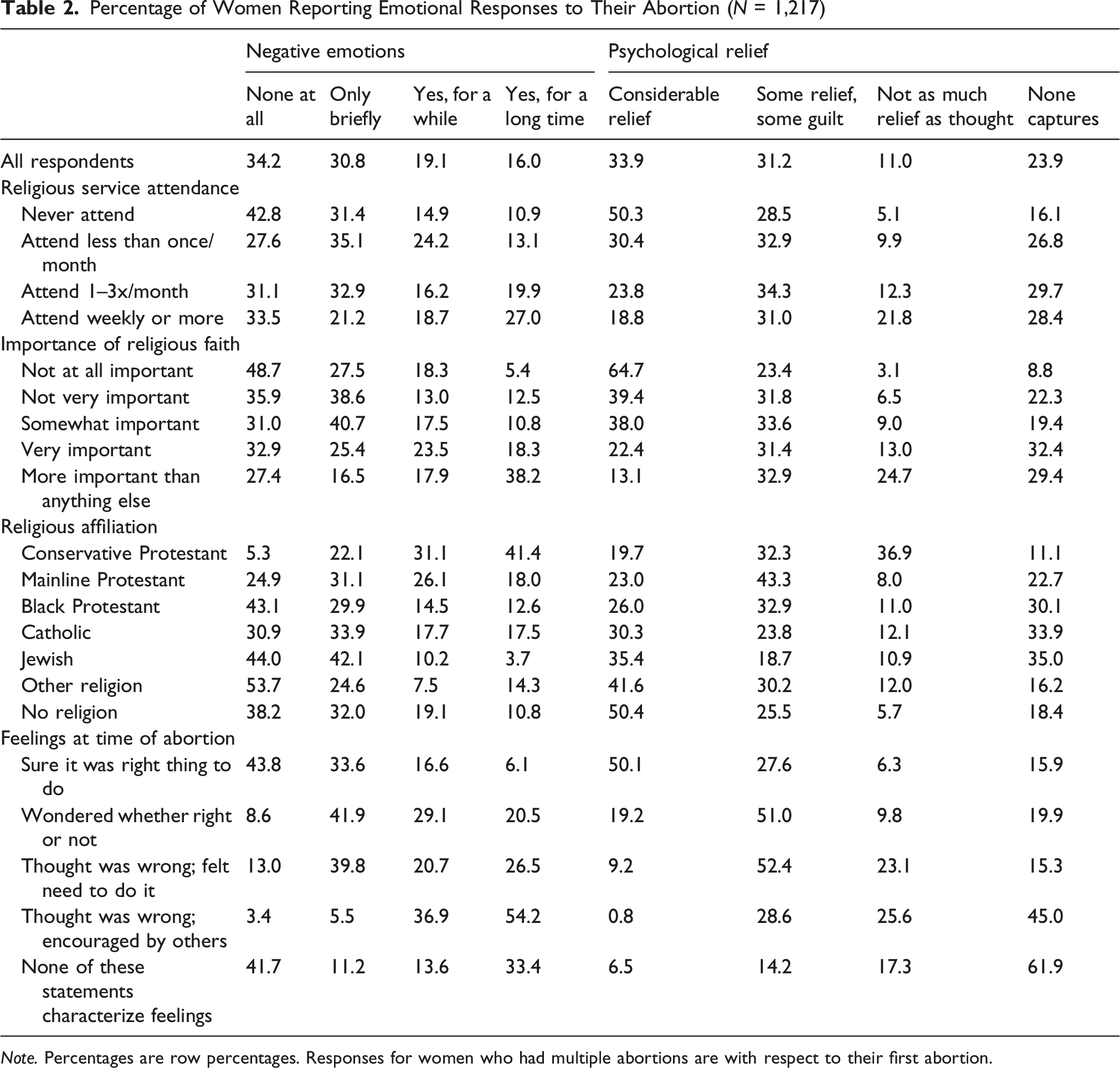
Note. Percentages are row percentages. Responses for women who had multiple abortions are with respect to their first abortion.
Average Discrete Change in Probability, for One-Unit Increase or From Base Category, of Women’s Self-Reported Negative Emotions After Abortion, Generated From Multinomial Logistic Regression Models and Setting All Independent Variables at Observed Value (N = 1,217)
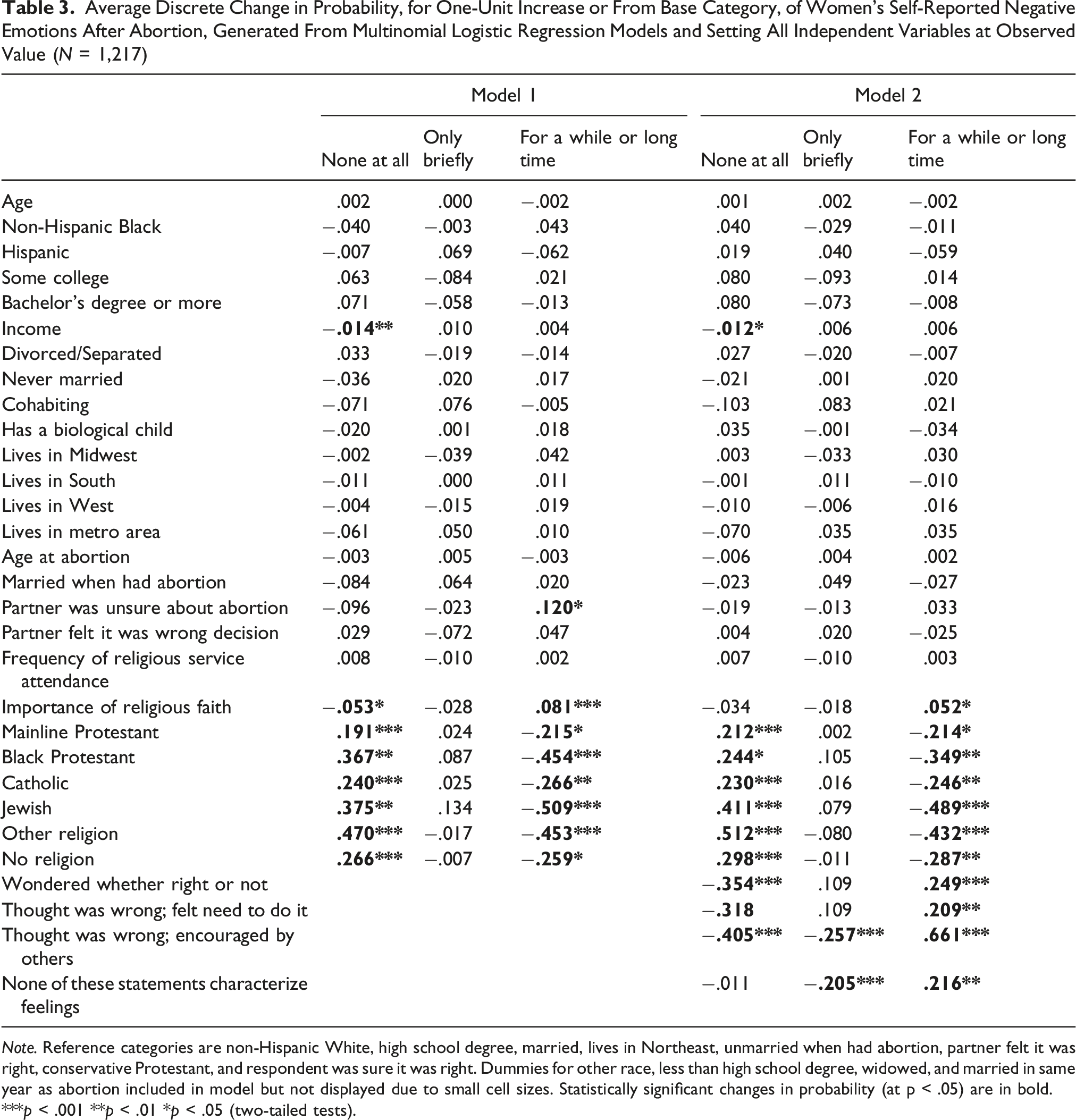
Note. Reference categories are non-Hispanic White, high school degree, married, lives in Northeast, unmarried when had abortion, partner felt it was right, conservative Protestant, and respondent was sure it was right. Dummies for other race, less than high school degree, widowed, and married in same year as abortion included in model but not displayed due to small cell sizes. Statistically significant changes in probability (at p < .05) are in bold.
***p < .001 **p < .01 *p < .05 (two-tailed tests).
Average Discrete Change in Probability, for One-Unit Increase or From Base Category, of Women’s Self-Reported Psychological Relief After Abortion, Generated From Multinomial Logistic Regression Models and Setting All Independent Variables at Observed Value (N = 1,217)
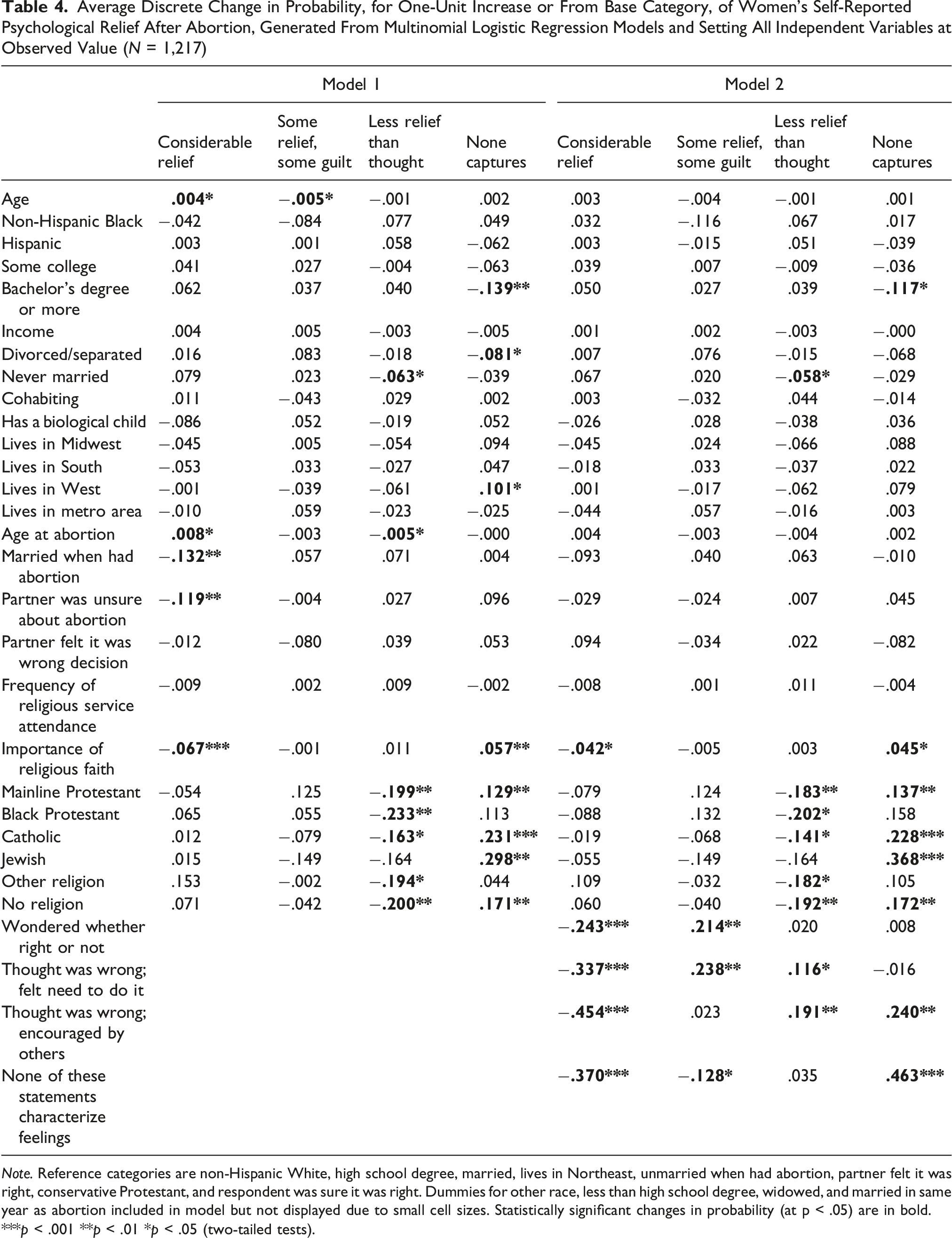
Note. Reference categories are non-Hispanic White, high school degree, married, lives in Northeast, unmarried when had abortion, partner felt it was right, conservative Protestant, and respondent was sure it was right. Dummies for other race, less than high school degree, widowed, and married in same year as abortion included in model but not displayed due to small cell sizes. Statistically significant changes in probability (at p < .05) are in bold.
***p < .001 **p < .01 *p < .05 (two-tailed tests).
Tables 3 and 4 include ADCs from two multinomial logistic regression models. The first includes all control variables and the religion variables. The second adds the respondents’ feelings at the time of abortion. This model-building approach allows us to observe the effect of religious characteristics on emotional responses before and after their feelings about the abortion at the time are considered. Table 3 presents results for negative emotions, and Table 4 presents results for psychological relief.
Results
Bivariate Results
Table 2 presents the percentage of women reporting each type of emotional response to abortion, overall and by religious characteristics. With respect to negative emotional outcomes—emotional distress, guilt, or other challenging emotions—just over one-third (34%) of all women who have had an elective abortion report not having had any negative emotional consequences. A similar number (35%) report having had long-lasting negative emotions, split fairly evenly between those saying they lasted “a while” (19%) and those saying they lasted “a long time” (16%).
These negative emotions appear to be modestly associated with religious service attendance. 43% of women who never attend religious services experienced no negative emotions at all, compared to just 28%, 31%, and 34% of women who attend religious services less than once a month, one to three times a month, or weekly or more, respectively. There is a clearer linear pattern for long-term distress, however. Here, just 11% of women who never attend religious services express having had long-term negative emotions. This rises to 13% for women who attend less than once a month, 20% for those who attend one to three times a month, and 27% for women who attend weekly or more. Thus, weekly attending women are more than twice as likely as those who never attend to have experienced long-term negative emotions. Responses for the middle two categories are not clearly patterned, though it appears the most frequent attenders are the least likely to report only brief negative emotions.
We see larger religious differences across the importance of religious faith variable. Here, nearly half (49%) of the women for whom religion is not at all important report experiencing no negative emotions after their abortion, compared to 27% of women for whom religious faith is the most important thing. Just five percent of women for whom religion is not at all important report long-term negative emotions, compared to 38% of women for whom religion is more important than anything else. Again, the middle two categories do not reveal a clear linear pattern, but the most religious women are the least likely to report only brief negative emotions.
Large differences in negative emotions after abortion are also evident across religious affiliations. Strikingly, only five percent of conservative Protestant women report no negative emotions post-abortion. The next lowest percentage is among mainline Protestants, where 25% of women report no negative emotions. Over 30% of Catholic women, 38% of nonreligious women, 43% of Black Protestant women, 44% of Jewish women, and 54% of women from “other religions” report no negative emotions tied to their abortion. We see similar differences in terms of long-term negative emotions. More than 41% of conservative Protestant women report long-term negative emotions stemming from their abortion, compared to just 18% of mainline Protestant and Catholic women, 14% of women from “other religions,” 13% of Black Protestants, 11% of nonreligious women, and 4% of Jewish women. Jewish women stand out from other women with respect to reporting only brief negative emotions, though the differences for this category are much smaller. Conservative Protestant women are the most likely to say they experienced negative emotions “for a while” (31%), though mainline Protestant women (26%) are also somewhat likely to say this. All other groups are below 20% for this response category.
Negative emotions are clearly tied to feelings at the time of the abortion. Women who were sure their abortion was the right thing to do (who comprise two-thirds of women who had an elective abortion) overwhelming experienced no negative emotions (44%) or only brief negative emotions (34%), with 17% reporting negative emotions lasting “for a while” and only six percent saying they lasted a long time. Those who were unsure at the time of abortion (11% of the sample) were far less likely to report no negative emotions, with only nine percent choosing this option. The modal response among this group of women was only brief negative emotions, with 42% reporting this level of negative emotional response. Another 29% of those who were unsure it was right said their negative emotions lasted “for a while” and 21% said they lasted “for a long time.”
Women who felt it was wrong to get an abortion but still felt the need to do it (11% of the sample) report similar levels of negative emotions as those who were unsure whether it was right. Here, 13% report no negative emotions at all, while 40% said they had brief negative emotions, 21% said they lasted “for a while,” and 27% said they lasted “for a long time.” Women who felt it was wrong to get an abortion but were encouraged by others to do so (five percent of the sample) were clearly the most likely to experience negative emotions. More than half of these women (54%) reported having negative emotions lasting “for a long time,” with another 37% saying they lasted “for a while.” Only six percent said they had brief negative emotions and even fewer (three percent) said they had no negative emotions at all. The final group—those for whom none of the other options described their feelings (13% of the sample)—were likely to report either no negative emotions at all (42%) or negative emotions lasting “for a long time” (33%), with only 11% reporting brief negative emotions and 14% reporting negative emotions lasting “for a while.” It is difficult to know who falls into this group, but given the distribution of negative emotional responses it seems likely that it is a heterogeneous group.
Results for psychological relief are presented in the right half of Table 2. For this outcome, about one-third (34%) of all women who had an elective abortion reported considerable relief afterwards. Nearly another third (31%) reported some relief but also some guilt, and 11% reported less relief than they anticipated. Nearly one quarter (24%) of all women who had an abortion reported that none of these responses captured their experience. Clearly, the response options were not exhaustive. Those who felt modest relief but no guilt, for example, have no clear option. Nor do those who felt little or no relief but also did not anticipate any.
Nevertheless, we observe clear religious differences in this positive emotional response to abortion. With respect to religious service attendance, half (50%) of the women who never attend religious services report having had considerable relief after their abortion, compared to only 19% of women who attend religious services weekly or more. In contrast, only five percent of never-attending women reported experiencing less relief than anticipated, compared to 22% of weekly attenders. Never-attending women are the least likely (at 16%) to say none of the response captured their feelings, while close to 30% of all other women said this.
As with negative emotions, the religious differences are even starker when considering women’s self-reported importance of religious faith. Here, almost two-thirds (65%) of women who never attend religious services reported considerable relief after their abortion, compared to only 13% of women who said religion was more important to them than anything else. Once again, we see a contrasting increase in reporting less-than-anticipated relief as religiosity increases. Only three percent of never-attending women said they had less relief than anticipated, compared to one quarter (25%) of the most religious women. Women for whom religious faith was very important or the most important thing were also the most likely to say none of the responses captured their feelings.
Women from different religious traditions also experienced different amounts of post-abortion psychological relief. Half (50%) of the women with no religious affiliation experienced considerable relief, as did 42% of women from “other” religions, 35% of Jewish women, 30% of Catholic women, 26% of Black Protestant women, 23% of mainline Protestant women, and only 20% of conservative Protestant women. Large differences are apparent across traditions in women experiencing less relief than they expected. This describes 37% of conservative Protestant women, but no more than 12% of any other group, and only six percent of unaffiliated women. Mainline Protestant women are the most likely to report mixed emotions (relief and guilt) at 43%, followed by Black Protestant women (33%), conservative Protestant women (32%), women from “other” religions (30%), unaffiliated women (26%), Catholic women (24%), and Jewish women (19%). Jewish, Catholic, and Black Protestant women were the most likely to say none of the responses captured their feelings, while conservative Protestant women were the least likely.
Women’s feelings at the time of abortion are clearly tied to psychological relief as well. Half (50%) of those who were sure it was the right thing to do experienced considerable relief, compared to 19% of those who were unsure, nine percent who felt it was wrong but still felt the need to do it, and only one percent of those who felt it was wrong but were encouraged by others to do it. Women who felt it was wrong—either because they felt the need to do it anyway or because they were encouraged by others to do it—were the most likely to report less relief than they anticipated—at 23% and 26%, respectively. Only six percent of women who were sure it was the right thing and 10% of women who were unsure reported less relief than anticipated.
Mixed emotions were most common among women who were ambivalent about their abortion at the time. Among those who thought their abortion was wrong but still felt the need to do it, 52% reported both relief and guilt as a result. Similarly, 51% of those who were unsure whether their abortion was the right thing to do reported both relief and guilt. Just under 30% of those who were sure it was right and those who thought it was wrong but were encouraged by others to have their abortion reported this mix of relief and guilt. Notably, the majority of those who said none of the responses about their feelings at the time of abortion characterized their feelings also said none of the relief responses captured their feelings. Clearly, there is a significant group of women for whom their feelings around their abortion and its emotional consequences are more complex and nuanced than these survey items allow.
Multiple Regression Results
Table 3 reports the average discrete change (ADC) in probability of reporting each category of the negative emotions outcome by religious characteristics, feelings at the time of abortion, and control variables. The first model reports ADCs for religious characteristics and control variables, and the second model adds feelings at the time of abortion. There are clear differences in post-abortion negative emotions for women across different religious characteristics. Religious service attendance, however, does not appear to be a distinguishing factor, as it is not significantly associated with negative emotions once importance of religious faith, religious tradition, and control variables are considered. Women’s importance of religious faith, however, is clearly associated with negative emotions stemming from abortion. Setting all other independent variables at their observed value, increasing women’s importance of religious faith from its observed value by one unit is associated with a .053 drop in the probability of reporting no negative emotions at all, and a .081 increase in the probability of reporting experiencing negative emotions for a while or a long time. In terms of predicted probabilities (not reported in table), setting religious salience at “not important at all” results in a .45 probability of reporting no negative emotions (setting other variables at observed values), compared to a .24 probability when setting religious salience at “religion is the most important thing.” In terms of long-term negative emotions, setting women’s religious salience at “not important at all” yields a .20 probability compared to .50 for “religion is the most important thing.”
There are clear differences across different religious traditions as well. Compared to the probability produced by setting religious tradition at conservative Protestant (the reference group), setting religious tradition at any other tradition results in statistically significant higher probabilities of experiencing no negative emotions and statistically significant lower probabilities of experiencing long-lasting negative emotions. The differences in probability for experiencing no emotions relative to conservative Protestant range from .19 for mainline Protestant to .47 for “other” religions. The range is similarly large for long-lasting negative emotions, ranging from a difference of −.22 for mainline Protestant to −.51 for Jewish. The predicted probability (not reported in table) for reporting no negative emotions setting religious tradition at conservative Protestant is only .07, compared to .26 for mainline Protestant, .31 for Catholic, .33 for unaffiliated, .44 for Black Protestant and Jewish, and .54 for “other” religions. In contrast, the probability of reporting long-lasting negative emotions for conservative Protestant is .65 probability compared to just .14 for Jewish, .19 for Black Protestant and “other” religions, .38 for Catholic, .39 for unaffiliated, and .43 for mainline Protestant. 3
In the second model adding women’s feelings about their abortion at the time, some of the religious differences are diminished. The difference across levels of importance of religious faith for reporting no negative emotions is no longer statistically significant, but differences across religions remain substantial. Higher levels of importance of religious faith still produce higher predicted probabilities of reporting long-lasting negative emotions after abortion in the second model, but the change in probability is diminished from .081 to .052. Here too the religious-tradition differences persist and remain sizable, though the difference between Black Protestant and conservative Protestant is somewhat diminished in the second model.
Table 3 reveals at least two other notable findings. First, post-abortion negative emotions are tied closely to women’s feelings at the time of their decision. For example, if all women were sure it was the right thing to do, there would be only a .24 probability of long-term negative emotions, compared to probabilities of .48 for being unsure, .45 for thinking it was wrong but felt they needed to do it anyway, and .90 for thinking it was wrong but were encouraged by others to do it. This is quantitative support for Kimport and colleagues (2011) qualitative finding that women’s agency in their decision is highly salient for subsequent emotions. Notably, religious differences persist even after accounting for this more proximal factor.
Second, very few sociodemographic variables or variables measuring women’s social circumstances around abortion are statistically significant predictors of negative emotions after abortion. Income is the only control variable significantly associated with reporting no negative emotions, such that higher incomes are associated with lower probabilities of reporting no negative emotions. Additionally, having a partner who was not sure the abortion was the right decision is associated with a higher probability of reporting long-lasting negative emotions, and this variable is no longer statistically significant in the second model including the woman’s own feelings. In light of the sparse statistical significance for other variables, the religious differences observed here seem particularly salient.
Table 4 reports the ADCs produced from multinomial logistic regression models predicting women’s post-abortion psychological relief. Similar to what was seen with negative emotions, religious service attendance does not have any independent association in the first model. Importance of religious faith, however, does. Increasing one-unit from the observed value of importance of religious faith is associated with a .067 decrease in the probability of reporting considerable relief after abortion. Setting importance of religious faith at “not important at all” produces a predicted probability of .50 of reporting considerable relief compared to .20 for “religion is the most important thing” (probabilities not reported in table). Reporting more importance of religious faith is conversely related to a higher probability of saying that none of the responses captures their experience with post-abortion psychological relief.
Religious tradition is also associated with psychological relief after abortion. Setting religious tradition at any religious group yields a substantially lower probability, relative to conservative Protestant, of experiencing less relief than they anticipated (though the Jewish difference is not statistically significant). The predicted probability (not reported in table) of reporting less-than-anticipated relief does not exceed .13 for any group except conservative Protestant, which yields a .29 probability of experiencing less relief than expected. There are also differences across religious tradition in the probability of reporting that none of the categories captures their experience. 4
As with negative emotions, the second model of Table 4 shows that feelings about the abortion at the time of abortion are extremely consequential for post-abortion relief. Even so, all the statistically significant religious differences in the first model remain significant in the second model, though the differences are somewhat smaller. However, this suggests that religious differences in post-abortion psychological relief are not fully explained by feelings at the time of abortion. Moreover, the probability differences in this second model for feelings at time of abortion are large, especially with respect to the considerable relief outcome category, where setting the observations to any response other than “sure their abortion was the right thing to do” produced substantially lower probabilities of experiencing considerable relief.
Table 4 also reveals more statistically significant control variables than in Table 3, but these nearly all become nonsignificant when feelings at the time of abortion are controlled in the second model. Age, earning a bachelor’s degree, being never married, living in the West, and age at abortion are all associated with some aspect of relief, but only earning a bachelor’s degree and being never married remain significant in the second model.
Discussion and Conclusion
Our results reveal clear associations between religion and both negative and positive emotional responses to abortion among women, but not all aspects of religion matter the same. What matters most appears to be women’s religious salience—how important their religion is to them—and their particular religious affiliation. Higher personal religiosity and conservative Protestant affiliation are strongly and positively associated with negative post-abortion emotions, and strongly and negatively associated with positive post-abortion emotions. Religious service attendance is not associated with either negative or positive emotions once these other aspects of religion are considered. Moreover, although the strength of the association of women’s importance of religious faith is reduced once their feelings at the time of the abortion are considered, it generally remains associated with negative and positive emotional responses in some capacity even once this is considered. This suggests incongruence—acting out of step with one’s religious or moral convictions—may explain some of religion’s relationship to post-abortion emotions. Moreover, religious tradition differences are not altered much by the inclusion of the feelings at the time of abortion variable with the exception of Black Protestants’ negative emotions.
Interestingly, messaging about post-abortion mental health problems has religious roots (Doan & Ehrlich, 2017), but religiosity and conservative Protestant religious affiliation themselves appear to be strongly associated with these problems. The differences seen here are not small. Some of this appears to be due to religious women being less certain their decision was correct when they made it, but other factors are at play here as well. Although we cannot say what exactly, it is likely some combination of lack of social support (real, perceived, or both) following abortion, more stigma (again, potentially both real and perceived), and attitudes toward motherhood. Whatever the exact mechanisms may be, it is very likely that individuals’ religious commitment creates post-abortion issues. Women with little-to-no religious commitment, or who affiliate with religions like Judaism that are more accepting of abortion (Schiff, 2002), fare much better emotionally after abortion than their counterparts. This has implications for how people perceive the impact of abortion on mental health. Because religion is an important factor in homophily (McPherson et al., 2001), religious people may overestimate how problematic abortion is for mental health—women they know who have had abortions frequently do have negative emotional responses. Similarly, nonreligious people may underestimate the prevalence of negative emotional health responses because the women they know who have had abortions have had more positive experiences.
Our findings also have important ramifications for religious communities and traditions that are theologically and morally opposed to abortion, but who seek to support women who have had an abortion. Women in these traditions may already be dealing with guilt or distress from their abortion, and direct messaging about abortion’s ills could exacerbate these feelings. Anti-abortion messaging could also serve to create guilt or distress among women after their abortion if they were not feeling it already. In either case, it seems prudent and worthwhile for religious groups to be mindful of women’s emotional states when speaking out against abortion, and they should consider pairing such messages with discussions of forgiveness and compassion that are consistent with their faith tradition. Some evidence suggests that believing in divine forgiveness offsets the negative mental health consequences of believing in human sinfulness (Uecker et al., 2016); this may be one approach to dealing with post-abortion distress that is consistent with a religion’s own teachings. Religious communities may also seek to provide both social and material support to women in these circumstances, no matter the moral position they take regarding abortion, as already happens in many cases. 5 Religious communities should also acknowledge and grapple with the fact that it is primarily religious women who are suffering the negative mental health consequences of abortion, and consider the implications of this for how they approach abortion policies that affect women who do not share their religious perspective.
Given the cross-sectional, retrospective nature of our data, there is another possible interpretation to what we see here: Women who have abortions and then suffer mental health consequences may draw support from religious faith, and those who have abortions and do not have negative emotional responses may select out of religious faith. That is, women may seek out institutions and identities that validate their emotional responses. We suspect this is happening at some level, but we doubt this explains all the religious associations we find here. Even if it did, that sort of post-abortion religious sorting would be important. Ultimately, this is a limitation of our analysis that should be addressed with prospective, longitudinal data. But here we can confidently say that whether through causation or selection, abortion responses are very different across religious characteristics. If women who have negative emotional responses to abortion are found disproportionately in religious communities, this could skew both religious and nonreligious people’s understanding of the frequency of these types of abortion responses.
It may also be hasty to conclude that involvement in a religious congregation—measured here by frequency of religious service attendance—is not independently associated with women’s emotional responses to abortion, as our results seem to suggest. It could be that two mechanisms, social support and stigma, are offsetting one another. That is, women who attend religious services more frequently may reap emotional health benefits from social support, but they may also experience heightened distress due to social stigma. Similarly, it could be that women who attend services more frequently in different religious traditions may have more or fewer negative and positive emotional responses. For example, Jewish women may experience both high support and low stigma, while conservative Protestant women may experience low support and high stigma. Our sample size for these groups is not large enough to detect differences in attendance across traditions (i.e., a statistical interaction between attendance and affiliation), especially in multinomial logit models where the dependent variable is divided into multiple groups.
Our results also make clear that the measure of positive emotions used here did not fully capture women’s responses to their abortion. Given that more religious women and conservative Protestant women were more likely to fall in the catch-all category for psychological relief, we suspect that a response of “no relief” would have been appropriate. Additionally, a category for “some relief” that did not explicitly include “some guilt” likely would have been appropriate as well. Despite these limitations, these data are the only large-scale quantitative data in the US, other than The Turnaway Study, that can address the issue of emotional responses to abortion, and we suspect—based on the exclusion of religion variables from research based on The Turnaway Study—the only data that include measures of women’s religious characteristics.
Conclusion
This study provides evidence from nationally representative survey data that women with higher levels of religious salience and conservative Protestant women are especially likely to experience more negative emotions and fewer positive emotions after their abortion. Some, but not all, of this association appears to be explained by women’s feelings about whether their decision was right or wrong at the time they had the abortion, which suggests moral incongruence is one important factor, but not the sole factor, in why religion is associated with emotional responses to abortion. The differences even after accounting for these feelings are sizable, and could reflect differing levels of support and stigma; they could also reflect post-abortion selection processes. Future research using prospective longitudinal data should assess which of these mechanisms may be at work. Our findings here, however, have significant implications for how we think about “post-abortion syndrome” and abortion access in the United States. Women who have suboptimal emotional responses to abortion are disproportionately religious and conservative Protestant; to the extent that people’s social networks are religiously homophilous (McPherson et al., 2001), this could shape what people believe about the mental health consequences of abortion.
Footnotes

Funding
The authors received no financial support for the research, authorship, and/or publication of this article.
Declaration of Conflicting Interests
The authors declared no potential conflicts of interest with respect to the research, authorship, and/or publication of this article.