






Abstract
Widowhood is a significant social and religious phenomenon that transforms women’s identities and roles within their societies. This study investigates the Islamic perspectives on widowhood rights, dignity, and representation within Muslim communities in Eastern Odisha, India. This study is based on ethnographic fieldwork in largely Muslim areas of the Cuttack district. The study highlights the convergence of Islamic theological doctrines with specific cultural practices that affect the lives of widows. Although Islamic doctrines and principles of Shariah advocate for the protection, dignity, and right to remarriage for widows, community practices often enforce constraints, symbolic marginalisation, and gender inequalities. The study examines how widows maintain their identities through narratives and lived experiences within the context of faith, morality, and community expectations. This study employs an interpretive anthropological approach to highlight the disconnect between scriptural ideals and contemporary realities, thereby contributing to a broader discourse on gender, religion, and social justice.
Keywords
Introduction
Women form the foundation of any society, embodying endurance, compassion, and resilience. They navigate multiple roles throughout their lives as daughters, sisters, wives, mothers, and daughters-in-law, each demanding distinct forms of strength and sacrifice. Yet, the question of a woman’s status in society remains unresolved, continually shaped by evolving cultural, social, and religious norms (Abu-Lughod, 2002). From the Islamic perspective, there is no difference between men and women, since the Quran says: ‘And for women are rights over men similar to those of men over women’. (Chapter 2: Verse 228)
The Quran often addresses believers as ‘men and women’, emphasising the notion of equality towards their duties, rights, virtues, and merits. Furthermore, the Quran lays strict guidelines and admonishes men who ill-treat or oppress women (Quran 4:19). The Prophet of Islam (peace be upon him) compares women to twin halves of men, as both are created from the same soul. The most severe misfortune for a woman occurs when her husband dies, leaving her, as a widow, with the obligation of raising the children. In the Eastern World, where women do not consistently participate in the workforce, the challenges of widowhood are profound. The Prophet Muhammad (peace be upon him) championed the rights of widows. The majority of his spouses were widows. During a period when widows were seldom allowed to remarry, the Prophet urged his adherents to wed them. He consistently offered assistance to widows and urged his followers to emulate his actions. Abu Hurairah conveyed that the Prophet stated: ‘The individual who endeavours to assist a widow or a destitute person is akin to a mujahid (warrior) in the service of Allah, or comparable to one who engages in nocturnal prayers and observes fasting during the day’.
One of the most profound intersections in the context of women (especially widows) is that of gender and religion. The study of women within religious frameworks examines not only their roles in faith communities but also how religious doctrines, rituals, and moral expectations define gender identities (King, 2005). According to Mernissi (1991), despite the progress of modern societies toward gender equity, religious institutions often adhere to traditional interpretations. This gives rise to gender hierarchies and occasionally limits the roles and rights of women in society. This duality is clearly visible in the experiences of widows who often live in a defining state, which is both venerated and disregarded in religious and social contexts.
This study is based on fieldwork conducted in the predominantly Muslim inhabited city of Cuttack in Eastern Odisha. The area was chosen purposively to examine the lived experiences of widows and to understand the link between Islamic teachings and traditional practices. The narrative surrounding the widowhood and the community practices underscores the importance of religious principles. This discourse shows how religion offers an environment of disciplined practices and helps empower the widows. The current research, in light of this discourse, aims to examine the widowhood from the perspective of Muslim widows within the Muslim communities. The study uses an interpretive anthropological perspective to highlight the conflict between Islamic theological principles and traditional practices within religious and cultural systems.
The fieldwork for this study was conducted in Cuttack, a predominantly Muslim inhabited area in the eastern part of Odisha. This area provides a rich ground for examining the link between Islamic teachings, local customs, and symbolic meanings in shaping the experience of widows. The narratives and practices within the community show how religion serves as a source of dignity and simultaneously offers an environment for discipline. In light of this context, the current research aims to examine widowhood within Muslim communities by using an interpretive anthropological perspective. It highlights the conflict between Islamic theological principles and traditional cultural practices within the society (Figure 1). Map of Study Area (Source: fieldwork)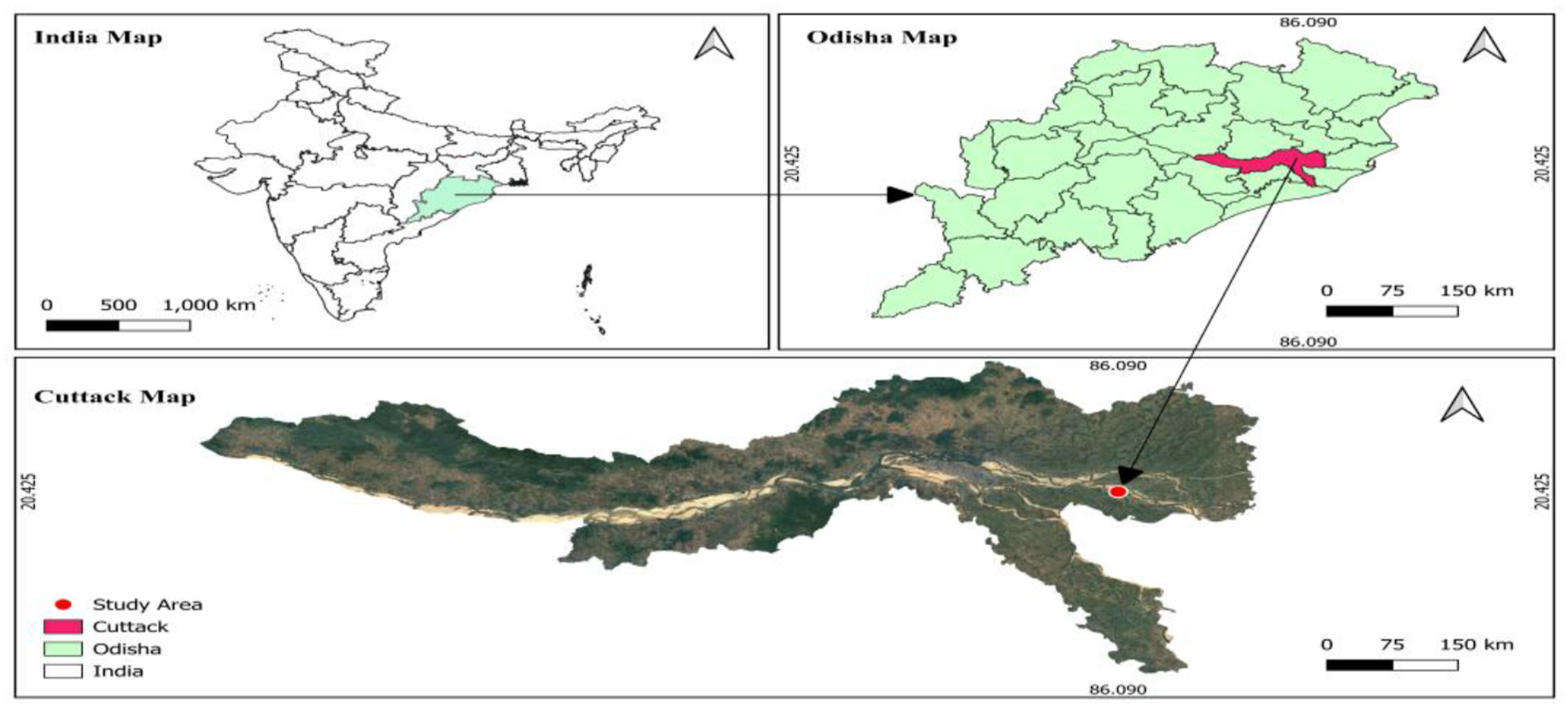
Literature Review
Interpretive Anthropology and Widowhood
The interpretive anthropological perspective examines the significance of widowhood according to the people and the community’s attributive values, beliefs, and identities. Rather than treating widowhood merely as a social category, this approach examines how widows and their communities symbolically interpret widowhood within Islamic tradition. As Clifford Geertz (1973) argued, culture is a system of inherited conceptions expressed in symbolic forms through which people communicate, perpetuate, and develop their knowledge and attitudes toward life.
Islam, when examined through its foundational texts, the Qur’an and Hadith, presents a vision of gender equity and compassion. The Qur’an emphasises moral and spiritual equality between men and women: ‘Indeed, the most noble of you in the sight of Allah is the most righteous of you’ (Qur’an 49:13). Historically, Islamic law granted women rights to property, education, and public engagement (Engineer, 2008). The Qur’an and Hadith further highlight special care for widows, urging communities to protect and support them (Siddiqui, 2009). However, the interpretive reality of how these texts are understood, practised, or overlooked often reveals a different picture.
In many contexts, patriarchal customs override scriptural mandates. Widows frequently report experiences of marginalisation, loneliness, and social exclusion outcomes more reflective of cultural conservatism than religious orthodoxy (Larsen, 2008). Interpretive anthropology allows us to understand such contradictions not as simple deviations but as culturally meaningful practices, rooted in localised understandings of piety, honour, and gender roles (Geertz, 1973).
For instance, widowhood in the study area is often interpreted symbolically through ideas of purity, devotion, and sacrifice. A widow’s silence and social withdrawal may be read as signs of loyalty to her deceased husband or as expressions of piety. These cultural interpretations, not drawn directly from Islamic law, shape the lived realities of widows (Das, 2010). In this sense, widowhood becomes a form of ‘sacred suffering’, a symbolic status that both marginalises and venerates women.
This symbolic construction contrasts with Islamic ideals. The Qur’an states: ‘O mankind, fear your Lord, who created you from a single soul and created from it its mate and dispersed from both of them many men and women’ (Quran 4:1), underscoring the equality of men and women in creation and purpose. Furthermore, Islamic teachings elevate women as mothers (‘Paradise lies at the feet of the mother’), wives (‘The best of you is the one who is best to his wife’ Al-Tirmidhi, Hadith 3895), and daughters, linking their care with divine reward (Badawi, 1971; Engineer, 2008). These scriptural principles emphasise dignity, compassion, and fairness.
Yet, when filtered through cultural lenses, they are often reshaped into restrictive practices. The interpretive anthropological approach helps reveal how such cultural symbols are produced, internalised, and resisted. As Ortner (1984) notes, individuals are not passive recipients of cultural norms but active interpreters who construct their own symbolic worlds. Widows in Eastern Odisha embody this tension, negotiating between religious dignity and social marginalisation.
Thus, widowhood in Muslim communities emerges as a culturally charged symbol, not merely a legal or economic condition. It is interwoven with notions of piety, morality, and communal honour. By reconnecting with the ethical foundations of Islamic teachings and critically interrogating restrictive cultural interpretations, widowhood can be reimagined not as a marker of loss and limitation but as a site for dignity, faith, and agency.
Islam and Widowhood
According to Ibn Qutaiba, a widow is a woman who has no husband, either because her husband has died, she has left him, or she remains unmarried. Her social identity as a widow is linked to the vulnerability arising from the loss of her primary source of economic support after her husband’s death (Sahih Muslim, Hadith 874). In Islamic teachings, however, widowhood does not carry stigma; rather, it is a condition that obliges society to extend greater care and responsibility toward the woman (Engineer, 2008). Islam secures the rights of widows, not only permitting them to remarry but also encouraging the community to facilitate such marriages. The importance and virtue of marrying widows is reflected in the life of the Prophet Muhammad (peace be upon him), whose first marriage was with a widow, Khadijah, and who later contracted most of his marriages to widows (Ali, 2016).
In Islam, the status of a widow is defined by her entitlement to her husband’s inheritance, balancing the obligations and rights. On one hand, widows are required to observe a prescribed mourning period (iddah), while on the other, they are entitled to financial maintenance, inheritance, remarriage, and social support. The primary sources of Islamic jurisprudence, the Qur’an, Hadith (sayings of the Prophet), and Sunnah (prophetic practices) form the basis of these rights. Where ambiguity arises, Muslim jurists apply ijtihad, or independent reasoning, to interpret the Qur’anic principles in their social and historical contexts. This dynamic process of interpretation ensures flexibility within Islamic jurisprudence (Kamali, 2008). The Qur’an itself instructs believers to resolve differences by returning to the words of God and His Messenger (Qur’an 4:59).
The Qur’an provides explicit guidance concerning widows. For example: • ‘If any of you dies and leaves widows behind, they shall wait four months and ten days. When they have fulfilled their term, there is no blame on you if they dispose of themselves in a just manner’ (Qur’an 2:234). • ‘And those among you who die and leave wives behind should make a bequest for their wives: maintenance for one year without being turned out. But if they leave [of their own accord], there is no blame on you for what they do of themselves in an honorable manner’ (Qur’an 2:240).
These verses emphasise that widows are entitled to financial support from their husband’s estate for a full year, in addition to the freedom to remarry after the completion of their ʿiddah. Importantly, the Qur’an grants widow’s autonomy over their own lives and decisions, including the right to contract a second marriage without coercion (Qur’an 2:234–240).
The Qur’an also encourages Muslim men to marry widows, thus challenging social prejudices that marginalise them. This emphasis is reinforced in Hadith literature, which outlines both the duties and rights of widows. Their duties include observing the mourning period and maintaining modesty, while their rights include remarriage, Maher (dower), inheritance, and ongoing maintenance. The Muslim community, in turn, bears the responsibility of supporting widows in fulfilling these duties and accessing their rights (Al-Qaradawi, 1999a; Nasr, 2003).
Scholars have argued that these provisions reveal the progressive nature of Islamic law in protecting vulnerable groups, particularly widows, whose social and economic insecurity could otherwise render them marginalised (Engineer, 2008; Esposito, 2011a). Historically, Islamic reforms in marriage, inheritance, and social responsibility elevated the status of widows in comparison to pre-Islamic Arabian society, where widows were often subject to neglect or exploitation (Hidayatullah, 2014).
Thus, widowhood in Islam is not regarded as a social curse but as a human condition deserving dignity, rights, and communal support. The combination of Qur’anic injunctions, Prophetic traditions, and juristic interpretations provides widows with legal protections and avenues for social reintegration.
Mourning of the Widows
In pre-Islamic Arabia (Jahiliya period), widowhood was marked by extreme practices. According to Zainab bint Abi Salma, a widow was required to mourn for an entire year in isolation. During this period, she stayed in an unclean house, wore the worst clothes, avoided perfumes, and lived in hardship. At the end of the year, she would sacrifice an animal, wash herself, and then be considered free to remarry (Malik ibn Anas, 1989, pp. 597–598).
Islam introduced significant reform by limiting the mourning period (‘iddah) for widows to four months and ten days. The Prophet Muhammad clearly stated that no woman should mourn longer than three days for any relative, except for her husband, in which case the mourning extends to four months and ten days (Sahih Muslim, Hadith 874; Al-Tirmidhi, 864, pp. 500–501).
Hadith reports narrated by the Prophet’s wives, including Umm Salma and Zainab bint Jahsh, clarify the restrictions during this period. Widows were prohibited from adorning themselves with jewellery, perfume, or brightly dyed clothes, as these could signal readiness for remarriage too soon (Robson, 1991, p. 710; Siddiqui, 1976, p. 70). Malik ibn Anas (1989) also noted that widows should avoid beauty practices such as hair dyeing or wearing ornaments. Instead, they were encouraged to dress simply, often in black or plain garments.
At the same time, the Prophet showed concern for widows’ health. For instance, in cases of medical need, he permitted the limited use of collyrium (surma) or mild perfumes (Atar), but with restrictions such as applying them only at night and removing them during the day. This reflects the Islamic principle of taysir (easy), which ensures that religious obligations do not become unbearable (Malik ibn Anas, 1989).
Thus, while Islam retained the idea of mourning as a sign of respect for the deceased husband, it replaced harsh pre-Islamic customs with humane, time-bound, and balanced practices. These reforms highlight the emphasis on dignity, moderation, and the protection of widows’ social status within the Islamic framework
Iddah: The Waiting Period
Iddah is an essential practice in Islamic law, requiring a widow to observe a waiting period of four months and ten days following the death of her husband. The Quran explicitly states: ‘For those men who die amongst you and leave behind wives, they (the wives) must confine themselves (spend Iddah) for four months and ten days’. (Surah Al-Baqarah, 2:234)
The primary purposes of Iddah include ensuring clarity regarding inheritance rights, emotional healing, and confirming potential pregnancy. The following principles govern the Iddah: (i) The widow is supposed to remain at her parents’ home till the period is over, except in an emergency (ii) Remarriage is not allowed (iii) There is a restriction on public grooming and self-beautification
The Iddah period in case of a pregnant widow is up to the birth of the child. This period is calculated irrespective of the time difference between pregnancy and the death of the husband. The Iddah period is perceived as a time of loneliness and emotional instability by many widows. Some widows see it as a time for spiritual growth; nevertheless, many of them struggle with social constraints being imposed upon them.
Community Perceptions of Widows
The relationship between community perception of Muslim widowhood and Islamic principles is complex. Islam guarantees widowhood rights based on the Islamic teachings on dignity, compassion, and entitlement. However, social practices and customs impose restrictions and difficulties on the widowhood rights. The notion of sympathy and compassion is received from close relatives only, while social stigma makes widows vulnerable. In certain communities, widows are labelled as carriers of misfortune, which goes against the tenets of Islamic principles and widowhood rights. This gives rise to social exclusion of widows and subdues their rights and makes them vulnerable to socio-economic hardships during the widowhood period. The suppression of Islamic principles, merely based on cultural norms and practices, turns Iddah into a deep scar and furthers the isolation rather than the mediation and rehabilitation of widows.
Widows’ Personal Perspectives
Research suggested that widows are often seen as subjects of sympathy and individuals confined to social restrictions. This dual nature of widowhood is perceived by some widows as religiously significant from the perspective of Iddah, though with a displeasure towards the rigid social norms.
Widows often experience exclusion due to strict social norms, which limit their interaction with ‘non-mahram’ (no blood relation) male relatives, thereby restricting their freedom of movement. The exclusion is furthered with a ban on grooming and beautification in public life. The widow’s right to inheritance and property is subject to legal obstacles, which otherwise are guaranteed to them by the religious principles. This makes social exclusion more obvious and demoralises the dignity of widows.
The lived experiences of widows reveal a complex relationship between Islamic principles and socio-cultural traditions. The former recognises the dignity and rights of widows, but the latter imposes restrictions on them. There is a need to address these disparities through a coordinated effort of socio-religious practices to ensure the dignified living for widows. Social awareness and educating the community at large towards the widowhood rights and community inclusion can act as a bridge between religious principles and social norms.
The Quran (2:233) specifies the period of Iddah during which a widow must affirm that she is pregnant with her deceased husband's child. The waiting period of Iddah is 4 months and 10 days, as laid down by the Quran, as mentioned in the above principle. A Hadith narrated by Abu Baker bin Saba discusses the appropriate location for a widow to observe her Iddah. Zaineb binti Kab binti Ajra approached the Prophet, informing him that her husband had been killed and had not provided her with a house, maintenance, or inheritance. She asked the Prophet whether she should join her family, who lived far away from her. The Prophet, at first, allowed her to leave her house, but after a while, he called her back and told her to stay in her husband's house till the end of her Iddah (Malik bin Malik ibn Anas, 1989). This Hadith indicates that the Prophet preferred the widow not to leave her husband's house during her Iddah. However, another Hadith allows the widow to leave her house during this time, but only for good reasons and during the day. Sufyan bin Wagi reported that the Prophet allowed a widow to go out to pick fruit from palm trees and told her that she might give Sadaqah or do an act of kindness (Robson, 1991: 709). According to Ibni Abbas that there is no fixed place for Iddah, and the widow can spend it with her family or in any place she wants (Bukhari, 846). It is said that the widow should spend her Iddah in the house of her husband's family, but if she wants to leave it, there is no harm. The Qur’an also advocates the same practice (2: 239). Ibni Umer was among those companions who supported the principle that the widow should stay in the house of her husband’s family till the end of her Iddah and insisted that she should stay in her house and never leave it (Malik bin Malik ibn Anas, 1989). Uthman bin Affan also held the same idea, which was further supported by Ahmad b. Hanbal. Furthermore, Al-Tirmidi mentions that the majority of people adopted this opinion (Al-Tirmidi, 884).
Methodology
This study adopts a qualitative research approach to explore how Muslim widows perceive and navigate their social position within both family and community settings. Through this approach, the researcher captures the lived experiences of widows with an emphasis on Islamic principles of widowhood rights and social representation.
Research Design and Participants
A field-based qualitative design was adopted, combining explorative, semi-structured interviews and household surveys to generate in-depth and contextual data. With the assistance of Md. Taj Ahamad Khan (a local social worker) and Mohamad Iqbal, the Maulvi Saheb of the local Masjid, facilitated access to the community was facilitated in a respectful and culturally appropriate manner.
A total of 29 widows participated in detailed interviews. To broaden the understanding of widowhood within the community, the study also covered 79 Muslim households, where informal conversations with family members and neighbours were conducted. This provided a layered perspective on the rights, respect, and responsibilities associated with widowhood from both widows’ own narratives and the wider community’s social representations.
Data Collection and Analysis
The semi-structured interviews with widows were conducted in private settings to ensure comfort and confidentiality. Each session lasted between 45 and 90 minutes, allowing participants to express their experiences openly. Supplementary household-level interactions helped contextualise widows’ narratives within broader family and community frameworks.
All interviews and conversations were documented through field notes and verbatim transcription. Data were analysed thematically, with attention to recurring issues related to rights (legal, religious, and customary), respect (social recognition and dignity), and responsibility (family duties, economic survival, and moral expectations). The lens of social representations theory guided the interpretation of widowhood as a socially constructed phenomenon shaped by both Islamic teachings and local cultural practices.
Ethical Statement
Ethical considerations were central to this study, given the sensitivity of widowhood as both a personal and social experience. All participants were informed about the objectives of the research, the voluntary nature of their involvement, and their right to withdraw at any stage, with oral consent prioritised to respect literacy variations. The identities of widows and households were protected through pseudonyms, and all identifying details were excluded to ensure confidentiality and anonymity. Special care was taken to respect participants’ vulnerability, avoiding re-traumatisation or emotional distress by allowing them to share only what they felt comfortable with, while interviews were conducted with empathy, patience, and cultural sensitivity. Community access was facilitated through the support of Mohd. Taj Ahamad Khan and Maulvi Mohamad Iqbal, whose role was limited to introductions, thereby maintaining trust without compromising participants’ privacy. During the research process, the researcher maintained reflexivity regarding positionality and potential biases, prioritising the voices of widows while rigorously upholding the principles of dignity, respect, and autonomy.
Discussion
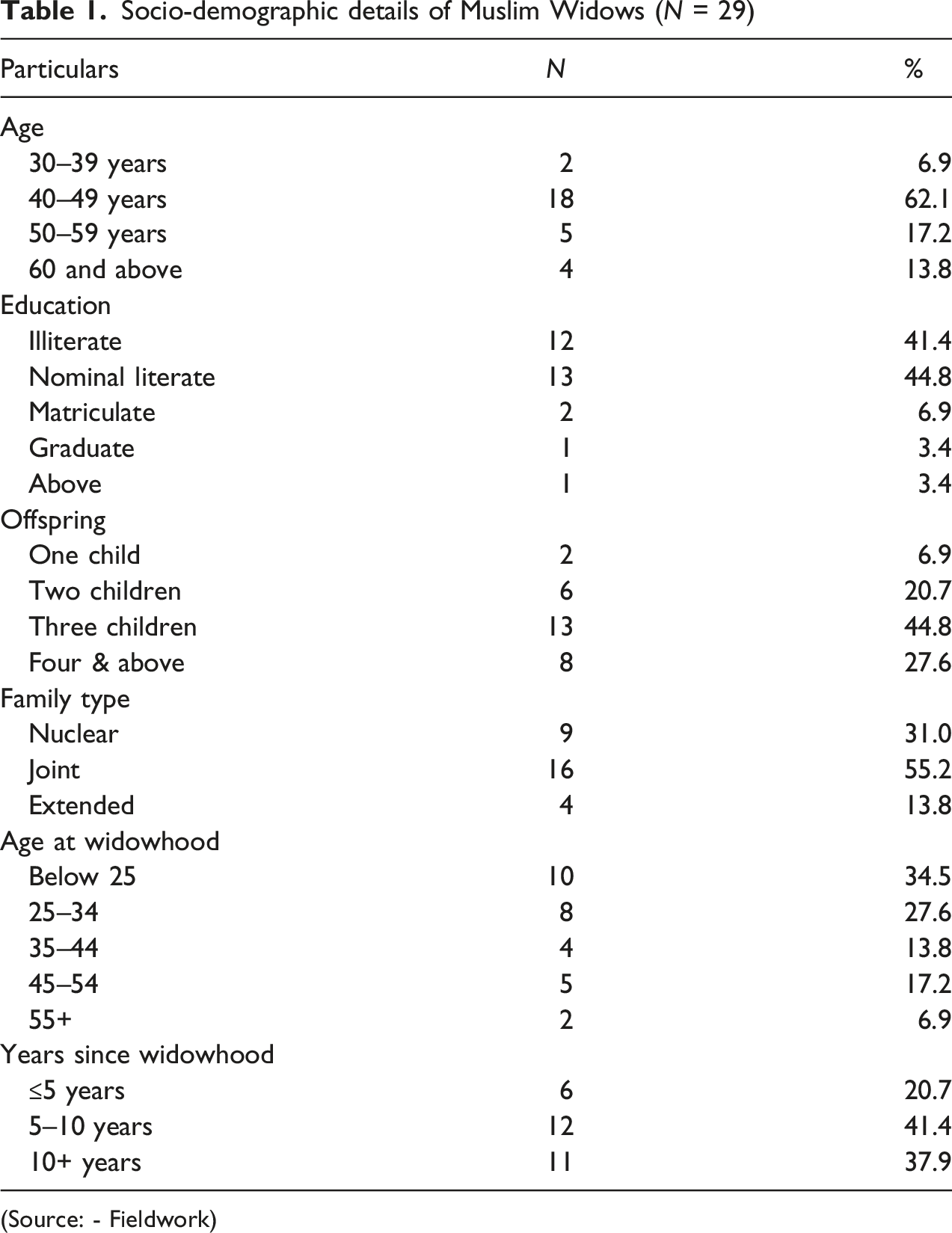
The data were collected from 29 widows whose socio-demographic details are presented in the following section.
Socio-Demographic Profile of Muslim Widows
Socio-demographic details of Muslim Widows (N = 29)
(Source: - Fieldwork)
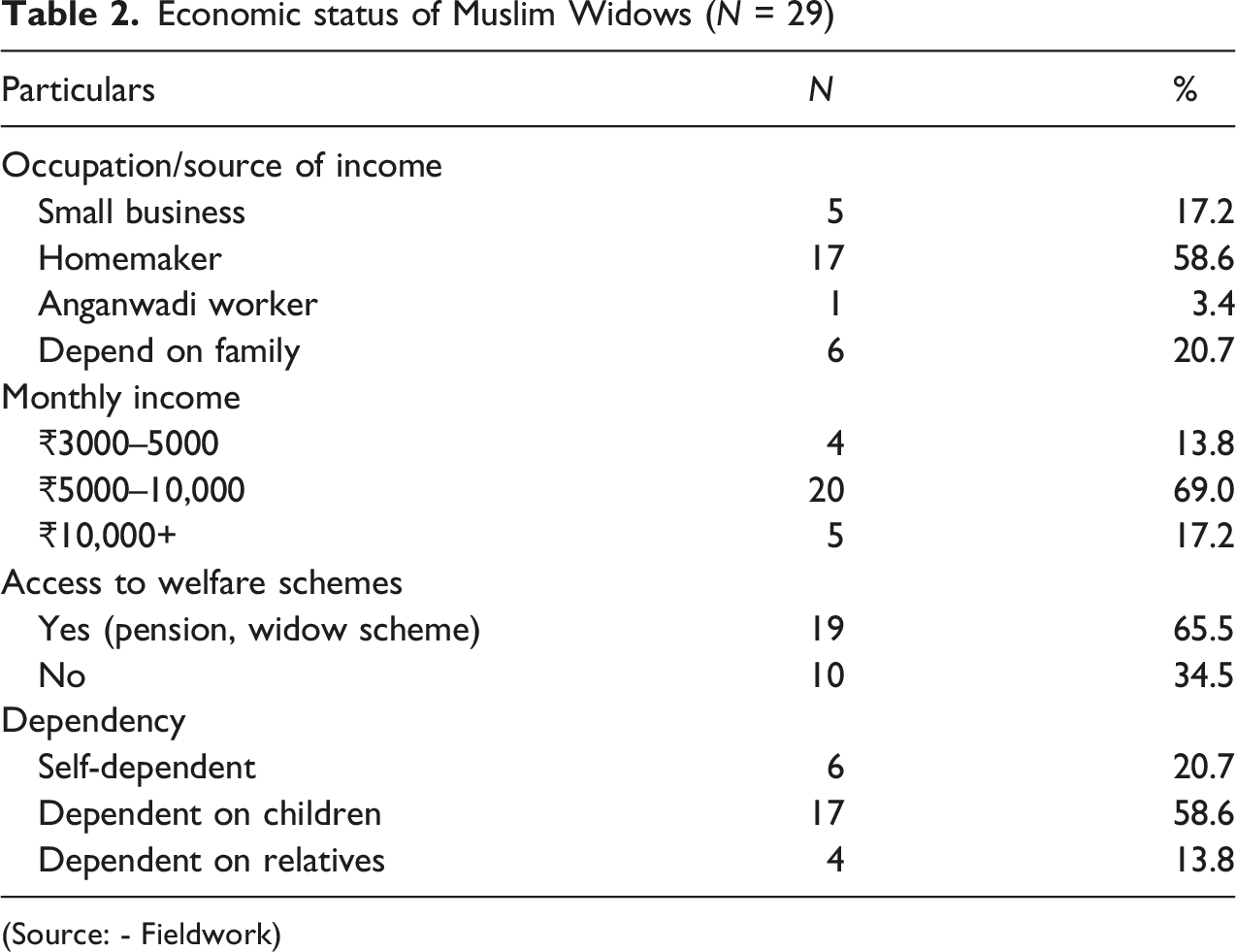
Economic status of Muslim Widows (N = 29)
(Source: - Fieldwork)
Economic Profile of Muslim Widows
In this study, the result shows that the economic and health profile of Muslim widows reflects a condition of sustained vulnerability and dependence. A majority of widows 58.6% are homemakers with no direct source of income, while only a small fraction engage in small businesses 17.2% or work as Anganwadi workers 3.4%, and about one-fifth 20.7% are entirely dependent on family support. Monthly income patterns indicate modest earnings, as nearly seven in ten widows 69% fall within the ₹5,000–10,000 range, while very few 17.2% report incomes above ₹10,000, underscoring limited economic security. Access to welfare schemes such as pensions and widow allowances is reported by 65.5 % of respondents, yet more than one-third remain outside the range of such support. Dependency patterns further reveal that the majority rely on their children 58.6% or relatives 13.8%, with only 20.7 % describing themselves as self-dependent. Health status adds another layer of concern, as most widows perceive their health as either average 44.8% or poor 24.1%, with only a minority 31% reporting good health. The self-reported health status, coupled with financial instability, illustrates the compounded challenges faced by widows, where economic uncertainty directly affects physical health. These findings indicate that the economic marginalisation of Muslim widows is intricately linked to their health vulnerabilities, rendering them a particularly at-risk demographic in need of ongoing welfare and healthcare interventions.
Widows’ Experience of Social Exclusion
Widowhood is not only a personal tragedy as depicted in several cultures, but a social identity which changes the place of a woman in her own community. The narrative analysis from our study shows that widows consistently have to go through an intense struggle of social exclusion and marginalisation. The lived experiences of widows reveal the emotional and economic difficulties alongside the socio-cultural realities. Such experiences reshape their interaction with family and close relatives as well as neighbours, which is based on exclusion and marginalisation.
The story of 75% widows reveals that they are being pushed back to the four walls of their houses after the death of their husbands. Instead of being offered care and solidarity, they are often marginalised and tolerated rather than being embraced. Their identity becomes a matter of suspicion, a stigma, and a misfortune for family and neighbours.
80% widows reported that instead of being offered care, solidarity, and security in the aftermath of their husbands’ deaths, they were often pushed to the margins of their own households. They described how their presence was tolerated rather than embraced, and their roles in family decision-making diminished drastically. Neighbours, too, were said to distance themselves, perceiving widows through a lens of suspicion, stigma, or even misfortune. One such widow, Roshni Bibi, narrated her situation in a deeply moving way. She said: ‘Because of my current status, I have no place in my family. In our society, we are dominated by the male members of our family. We have not been permitted to do anything without their permission. Though the Quran says men and women are both equal in Islam, we have still suffered’.
Roshni Bibi’s narration exposes the broader spectrum of widowhood experiences shared by others in her community. Her story of contradiction between the religious principles of men and women being equal and the lived experiences of subjugation may be a story of an area, but it is a widely spread phenomenon.
Family-Level Exclusion
The widows narrate their experience of being treated as outsiders even within their own homes. This is the story of several women in the area, who spoke about the denial of access to family inheritance and financial support being rendered to them by their families. The inheritance laws, as guaranteed by religious principles, are never implemented, and widows are denied the basic share of their property. The entire property is controlled or distributed among the male heirs of the family, and widows are made to feel dependent at their own mercy.
The patriarchal family structure silences the voices of widows, which has a direct impact on their personal lives as well as on the upbringing of their children. There are instances where woman are silenced or made to restrict their behaviour and social conduct after attaining widowhood.
The emotional impact of this exclusion is found to be very profound. Widows are repeatedly found to use utterances like ‘loneliness,’ ' burden,’ and ‘unwanted’ to describe their existence in their own family. For some, even basic affection and companionship from close family members were withdrawn, making them feel as though they no longer belonged to the intimate circle of kinship.
Community and Neighbourhood Exclusion
The neighbourhood and community environment are the sites of exclusion for widows. The shared lived experiences of widows reveal that neighbours often avoid their presence in local celebrations and family functions. There are instances where widows are labelled as bringing misfortune, ill luck during auspicious occasions. These social taboos marginalised them and have deprived them of community bonding and the social fabric of the kinship relationships.
Even though Islamic teachings emphasise compassion, justice, and equal dignity for widows, many reported that cultural norms and local practices often overshadowed these values. The result was a form of symbolic violence where social structures appeared natural but actually perpetuated inequality and silent suffering.
For instance, Roshni Bibi’s testimony captures the contradiction: while the Quran speaks of justice and equality, her lived experience reflects the denial of autonomy and recognition. Such contradictions highlight how religious ideals are often distorted by patriarchal practices, leaving widows in a vulnerable position.
Gender, Power, and Patriarchy
The gender relations in society are generally shaped by the prevailing patriarchal perspective; as a result, widows’ perspectives were understood in relation to it. The system of patriarchy gives full control to male members over matters of inheritance, decision-making, and societal reputation. The widows are often pushed to the margins and excluded from society, since they have lost their role as a wife, mother, or the one who is dependent on a male head.
The narrations rendered by widows reveal their condition being merely reduced to widowhood rather than being accepted or recognised as an independent individual. This resulted in social vulnerability of widows due to their identity loss from being a wife to an unacceptable widow. This stigmatisation of widows has snatched their freedom, economic independence, and made them a scapegoat of moral sanctions.
The patriarchal social norms have restricted the choices of widows and silenced their voices, as compared to the freedom guaranteed by Islamic principles. The disconnection between Islamic principles being preached and practised, and the prevailing socio-cultural practices, forms the core of widows’ suffering and exclusion from society.
The Emotional Landscape of Widowhood
The social exclusion faced by the widows is not merely a structural change, but it is an emotional disconnect. The stories are narrated by the widows about being left out, stigmatised, and unvalued, and seen as a burden on the family. A few of the widows (preferred not to be named) described their condition as: ‘We are being left out and made invisible from the family gatherings, functions, and rituals, and our opinions are never valued. There are even derogatory remarks being spoken against us. This has diminished our status and made us excluded and isolated from the mainstream society.’
This has given rise to emotional instability, which often leads to psychological distress, such as feelings of depression, anxiety, and hopelessness. The death of a husband for many of the widows was not only a tragedy in life, but a social tragedy of exclusion and isolation from the family. This has a devastating effect on the overall personality of women in general and widows in particular.
Widowhood and Islamic Teachings
The Islamic principles as envisioned in the Holy Quran give widows the right to live a dignified life, including the entitlement to inheritance, maintenance, and the right to remarry. The Prophet Muhammad’s (PBUH) teachings give emphasis on kindness and compassion toward the widows, and call it an act of righteousness.
However, our findings from the study show that the ideals of Islam and the teachings of the Prophet Muhammad (PBUH) were overshadowed by the social norms and practices. The community traditions, patriarchal dominance, and social taboos were given preference rather than the religious principles being practised. The discord between the religious principles and the lived principles (inequality) is a recurring practice that is valued. The case of Roshni Bibi and other anonymous widows strongly shows the discord and acts as proof in this direction.
This indicates the need for religious awakening with a focus on re-learning the religious principles and creating an awareness of the same within the community. This awakening will make it possible to align and reshape the socio-cultural practices in accordance with religious principles for the betterment of society.
Ethnographic Realities
The fieldwork conducted in the study area based on ethnography reveals a continuous experience of exclusions and isolation of widows in the society. Despite the clear directions from the Quran and teachings of Prophet Muhhamad (PBHU), it was found that many widows are denied the basic rights of living and inheritance. According to a 43-year-old widow, Fatima: When I asked for my right to inheritance as per the Quranic teachings and the Prophet’s sayings, my voice was silenced by the in-laws, citing that it will instead go to my son. If I demand it for myself, I am committing an act of greed.’
These findings highlight the discord between religious principles and the dominance of patriarchal principles of kinship and honouring the societal status quo. The exclusion of widows from family decisions and social rituals highlights the anthropological disconnect between religious teachings and their practical implementations.
Coping Strategies and Resilience
Widows, in certain cases, have shown resilience in protecting their dignity despite being excluded through multifaceted techniques and approaches. In this direction, some of the widows have managed to get emotional support through informal solidarity networks, which they managed to create with the widows from other communities. Others engaged in small-scale economic activities such as stitching, selling food items, or working as domestic helpers to reduce dependence on male relatives. A few turned toward spirituality, finding solace in prayer, religious study, or community service.
Still, their struggles were compounded by a lack of institutional support, limited awareness of legal rights, and weak enforcement of social welfare schemes. Their narratives highlight the urgent need for policy interventions, community sensitisation, and empowerment initiatives to restore dignity and agency to widows.
The Remarriage of Widows
Aisha explained the reason for the remarriage of the widow. It was after the Battle of Uhud, during which many Muslim men were killed and left widows and orphans without protection or shelter (Watt, 1956: 276). She said that if a man cannot do justice to orphans, he should marry the mother of the orphans and added that even if a widow has to share her new husband with other wives, half a home is better than none (Siddiqui, 1976: 525). The remarriage of the widow was recognised in the Qur’an and in the Sunnah of the Prophet. Even though the majority of the wives of the Prophet were widows and most of them were not poor widows or in need of support or maintenance (Watt, 1956: 287288), the Prophet disliked the idea of a woman or a widow being alone without a man. The reasons for the marriage of the widows were moral, physical, and religious. When the widows get guardians by marrying again, they are provided with maintenance and comfort. The new husbands stand as pillars for the protection of their life and honour (Siddiqui, 1976:718). In the absence of a widow’s marriage, society still has a moral problem because the natural sexual appetite of the widows and the divorced women is not satisfied (Stern, 1939). Therefore, the main aim is to protect the widow from adultery and prostitution. It is said that polygamy was encouraged in Islam because of the widows to provide them with shelter and a house since they were destitute after losing their husbands (Ali, 1990: 525).
In pre-Islamic times, a widow had to marry the nearest male in her husband’s family, even his son. Her husband’s family could give her in marriage to anyone they wanted, or they could keep her unmarried (Sawar, 1961: 22). Islam made her free in the matter of marriage. A widow can decide for herself about whether she should marry again or stay in her late husband’s house, and whom she should marry. Islam prescribes certain conditions that have a social and moral base for her to be fulfilled before her second marriage. She has to complete her Iddah before remarriage.
In Islam, a widow has the right to marry again after the end of her period of Iddah, which is four months and ten days. But the pregnant widow is allowed to marry again as soon as she gives birth without waiting for the end of her Iddah. There is a Hadith about Subay Al-Islamiya, which says that she was a widow who had lost her husband. She was pregnant and after a few days she gave birth to her child. After a while, she prepared herself for a new marriage (Al-Tirmidi, 884). Some of her relatives believed that she should not remarry until the end of her Iddah as a widow. When she asked the Prophet about her idea of marrying, he gave her permission to marry (Malik bin Malik ibn Anas, 1989). This Hadith is the basis for authorisation for the widow to remarry (Bukhari, 846). Therefore, the majority of the people supported the idea of her marriage immediately after giving birth to her child. In her case, it was just a few days after the death of her husband. Omar bin Khattab said that if a widow gives birth, she can marry again even if her husband’s body has not yet been buried, and Malik agreed upon this and said that it is our Sunnah (Malik bin Malik ibn Anas, 1989). Another great companion, Abu Hurairah, also supports this idea (Muslim, 874). Only Ibni Abbas holds the opposite of this idea and says that the pregnant widow should wait till the end of her Iddah, and if she gives birth, she should observe two periods of Iddah: the Iddah of pregnancy and the Iddah of widowhood. According to him, at the end of two periods of Iddah, she is allowed to marry again. There is no mention of whom the widow should remarry, as the Prophet only said ‘a good man’, and the majority of people say that she should marry a man who can protect her (Makdisi, 1986).
The Dower (Mehar)
The dower of the widow is one of her main rights. The dower is paid at the time of marriage and can be fixed. It can be paid in full or a portion can be paid at the time of marriage and next portion after marriage. The widow has the right to get her unpaid dower and it should be paid to her when her husband dies. However, in the Hadith of the Prophet there is evidence that the Mehar should not be fixed, in other words, the amount of it was not mentioned in the marriage contract. This fact was emphasised by Aisha, the wife of the Prophet who said that the Prophet ordered her to give a girl in marriage to her groom even if he did not give or fix anything for her (Abu Dawud, Sunan, 888).
Islam has a solution to what positions of the widow would be and what happens to her right to Mehar which was not fixed in the event of her husband's death. Among the companions there were two opinions. Some such as Ali bin Abi Talib, Ibni Abbas (Al-Tirmidi, 884) and Zaid bin Thabit believed that if a man dies without announcing the Mehar of his wife, his widow does not have the right to claim or to ask for her Mehar and in this case she can inherit from him. Ibni Umer denied any right for the widow to her Mehar if it was not fixed before the death of her husband (Malik bin Malik ibn Anas, 1989).
However, Ibn Masud Ansari believed that any woman, whose husband died before he had had sexual intercourse with her, or had not announced her Mehar, has the right to her Mehar (Al-Tirmidi, 884).
Only one Hadith is referring to the Prophet in this matter which can be used as a solution to solve this problem. This Hadith is about a widow called Barwu binti Watiq. It was reported that she said to the Prophet that her husband had died before fixing her Mehar. The Prophet's judgement was that she has the right to her Mehar and that she can inherit from her husband, and that she should stay in his house for her Iddah. In the case of the widow, she can have the copy dower (Mehar al-mithl) which means that the amount of Mehar should be similar to the Mehar of women in her family such as her sisters, cousins, and aunts (Ahmad bin Hanbal, 1175). In other words her Mehar should reflect her family's position and wealth (Schacht, 2012: 826-829).
In Islamic marital jurisprudence, mehar (also spelled mahr or dower) is a mandatory payment by the husband to the wife, either at the time of marriage or deferred to a later date, often linked to separation, divorce, or the husband’s death (Esposito, 2001). It is not merely a symbolic gift but a legal and religious obligation that represents the wife’s right and the husband’s duty (Nasir, 2009). As Mir-Hosseini (2000) notes, mehar signifies both financial security and the recognition of women’s rights within the Islamic marital contract.
The narration of Gulsan Bibi reflects the localised understanding of mehar in Eastern Odisha, where the obligation is expressed not only as a financial responsibility but also as a spiritual and moral duty, linked to the validity of funeral rites. This resonates with ethnographic accounts from South Asia, where mehar is perceived as a safeguard for widows and as a binding moral contract that extends beyond the husband’s life (Jeffery & Jeffery, 1996).
The issue of mehar (dower) also emerged during fieldwork. For example, Gulsan Bibi explained how her husband articulated the obligation: ‘At the time of my marriage, my husband fixed a certain amount as my mehar. He declared: ‘It is my duty (karaj) towards my wife, and this duty is her mehar. When my funeral rites are performed, this mehar must be given to her. Without fulfilling this duty, my funeral prayers cannot be offered. Such is the rule of mehar’. This narration highlights how mehar is not only viewed as a legal or financial obligation but also as a spiritual responsibility deeply embedded in local Islamic practices. Scholarly literature supports this interpretation, as mehar is universally recognised in Islamic law as the wife’s right and the husband’s binding duty (Esposito, 2001; Nasir, 2009), while in South Asian contexts, it often takes on additional layers of moral and symbolic significance (Jeffery & Jeffery, 1996; Mir-Hosseini, 2000).
The Inheritance
In Islam, a widow has a clear right to inherit from her husband as outlined in the Qur’an (4:11). If her husband leaves no children, she receives one-fourth of the estate, and if he leaves children, she receives one-eighth. Hadith records confirm the Prophet’s judgement in cases where widows were deprived of their rights, ensuring that widows and their daughters received their rightful shares. Although inheritance for women is generally half that of men, Islam still guarantees widows a secure portion of property, wealth, and even blood-money compensation if their husbands were killed. Historical accounts further show that widows of the Prophet’s companions inherited not only wealth but also houses, establishing this practice as Sunnah. However, after the Prophet’s death, his wives did not claim inheritance, highlighting a nuanced tradition. Overall, Islamic teachings strongly safeguard widows’ economic rights, though cultural practices have sometimes limited their enforcement.
The Maintenance of Widows
Prophet Muhammad (PBHU) gave special priority to widows in matters of care and support, recognising their need for both financial and social assistance. To ensure their well-being, he allocated a portion of zakat (obligatory charity) specifically for widows (Al-Waqidi, 1996). Along with this, widows were entitled to receive their mehr (dower) and inherit from their husbands. The Prophet also emphasised the virtue of supporting widows, stating that one who provides for widows and the poor is equal in reward to a person who fights in the way of God, prays throughout the night, or fasts continuously (Al-Bukhari, 846). After his passing, this responsibility was upheld by his successors. Caliph Umar ibn al-Khattab, in particular, showed deep concern for widows by fixing regular maintenance allowances for them. He ensured that the widows of the Prophet, known as the ‘Mothers of the Believers’, received substantial financial support, granting each of them twelve thousand dirhams, and later increasing this amount, except for Aisha who retained her original allowance (Abu Yusuf, 1969).
Conclusion
Widowhood, both as a social identity and a lived reality, reveals deep tensions between the egalitarian principles of Islam and the patriarchal practices that dominate many cultural contexts. According to the Qur’an, Hadith, and Prophetic traditions, widows are entitled to dignity, protection, and reintegration into society. They are granted inheritance, maintenance, remarriage rights, and communal support (Qur’an 2:234–240; 4:11). Prophet Muhammad (PBHU) himself provided exemplary models of care and respect for widows through his teachings, financial provisions, and his marriages, most of which were to widows. From these references, it is concluded that widowhood is not a state of exclusion and isolation, but rather one that deserves compassion, justice, and acceptance based on religious principles.
Contrary to the above, the findings from the study showed that there is a difference between the Islamic principles and the lived experiences shared by the widows. There is a continuous social exclusion, economic insecurity, and restrictions on the decision-making of widows both within the family and the community. Despite the Quran guaranteeing the right to inheritance and maintenance, the right to dignity and remarry, many widows are denied such privileges. Instead, male members or relatives exercise the power of dominance to control matters related to these rights as guaranteed by the religious doctrines. The socio-cultural taboos have precedence over Islamic principles, which have stigmatised the widows and made them socially and psychologically vulnerable and dependent.
This highlights the dominance of patriarchal principles over religious teachings and principles. This has rendered the position of widows merely a marginalised entity whose presence is considered inauspicious. This has given rise to structural social exclusion and emotional sufferings, such as loneliness, invisibility, and loss of social relevance. Despite these sufferings, the resilience of widows has shown visible marks in the form of informal networks, economic activities, and spiritual development. These adaptive strategies show the widows’ resistance to marginalisation rather than being passive and enduring.
According to the interpretive anthropological perspective, widowhood is not merely a legal status, but it is intertwined with cultural ethos. The notion of cultural symbolism is interconnected with religious principles of purity, piety, and sacrifice (Lamb, 2000). If such symbolic constructions distort the Islamic ideals, the widowhood becomes a marker of stigma rather than dignity. The findings from the current study showed a marked difference in the cultural practices, which are contradictory to the Islamic ideals of equity and compassion. It is concluded from these findings that there is an urgent need to revisit the foundational teachings and cultural practices being practised in the marginalisation of widows.
The rights of widows are both a matter of religious law and social justice, which has its genesis in the Quran and the teachings of the Prophet Muhammad (PBUH). The emphasis of religious principles is not only on the matters of inheritance and maintenance, but also on the freedom of choice to remarry after the prescribed period of Iddah. In such matters, it is the obligation of immediate heirs to provide support to the widows for at least a year (Esposito, 2011b). According to Al-Qaradawi (1999b), widows' rights to mahr (dower), inheritance, and community support have been in practice during the times of the Prophet (PBUH) and as such are the Prophetic traditions. However, from a sociological perspective, it is found that Indian widows are deprived of economic benefits, are socially excluded, and restrictions on freedom are imposed by the patriarchal ideals being practised in the society (Chaudhuri, 2017; Chen, 2000a).
The research findings further revealed that the widows in a developing society have repeatedly faced marginalisation and social exclusion. The case of Roshni Bibi is an example of the dual nature of social practices being followed in a society. The socio-cultural practices negate the Islamic teachings, and as a result, leave widows stigmatised and excluded. This is a harsh reality of how society contradicts the Islamic teachings as demonstrated in the lived experiences of the widows of Cuttack. This inequality and social exclusion of widows call for restructuring and reviving the community perspectives and their attitude towards women.
Therefore, widowhood must be accepted and recognised not merely as a personal loss of a woman, but rather as a social, cultural, and legal issue over and above patriarchal dominance. The sufferings of widows are the social constructs that are repeatedly perpetuated by society,
Therefore, widowhood must be recognised as not only a personal loss but also a cultural, social, and political issue, reflecting the persistence of patriarchal dominance. The suffering of widows is socially constructed and perpetuated, but not avoidable. The dignity of widows can only be guaranteed by revisiting the Quranic principles and going back to the prophetic traditions. This will help in the realisation of ethical principles of compassion, justice, and solidarity, as well as dismantling patriarchal socio-cultural practices. The communities can help in this direction to help achieve the widows ' rights of dignity and self-respect.
This can only be achieved through multilevel interventions, including legalising the inheritance rights through the support of state agencies and the active involvement of religious leadership. The socio-religious and legal perspective must advocate for widow remarriage and the maintenance of widows. The support from civil society and socially initiated activities can help to strengthen the voices of widows and create an atmosphere for support networks towards achieving social inclusion.
The practice of widowhood from the Islamic perspective should not glorify the loss or stigmatise the widows. It should provide an opportunity for civil society to embrace the true spirit of justice, solidarity, and compassion in accordance with the Quranic principles and Prophetic traditions. This recognition of widows’ rights of dignity and self-respect must be considered as a religious obligation and a step towards achieving the goals of social justice. Widowhood must be understood from a socio-cultural, political, and legal perspective rather than a mere personal loss that reflects the patriarchal endurance. The widowhood sufferings are not inevitable, but are socially constructed and perpetuated by the socio-cultural norms, which need transformation as per the changing nature of society. This will help in addressing the socio-cultural inequalities being committed against the widows towards advocating for their rights, respect, dignity, and social justice.
Implications of the Study
The current study highlights the discord between Islamic principles and the lived social realities of Muslim widows in Eastern Odisha, India. The findings showed that Islamic principles lay emphasis on dignity, protection, and self-respect of widows, but socio-cultural practices often negate these principles, which lead to exclusion and isolation of widows. From these findings, the research has two-fold implications.
Firstly, the research contributes to the existing body of literature and highlights the anthropological perspective of widowhood. It highlights how widowhood operates as a socio-cultural construct rather than a mere biological condition, which is depicted in human loss. It also enriches feminist scholarship in South Asia by underscoring how patriarchal traditions reinterpret and often override scriptural guarantees.
Secondly, at the practical level, the study emphasises the urgent need to realign social practices with Islamic principles that safeguard widows’ rights. Interventions by religious leaders, community organisations, and policymakers could help challenge stigma, protect inheritance rights, and ensure widows’ economic and social security. The findings may also guide social workers and NGOs to design culturally sensitive programs that empower widows without alienating them from their religious and community contexts.
Limitations of the Study
While the study provides rich ethnographic insights, several limitations must be acknowledged. The research is geographically limited to Muslim-dominated areas of Odisha Cuttack, which restricts the generalisability of findings to other Muslim communities in India or beyond. The sample size of widows interviewed, though sufficient for qualitative depth, may not capture the full diversity of widowhood experiences across class, age, and sectarian lines. Additionally, the sensitive nature of widowhood meant that some respondents were hesitant to disclose personal or family details, which may have influenced the completeness of the data. Finally, the study focuses primarily on women’s voices and does not extensively capture men’s or community leaders’ perspectives, which could have provided a more holistic view of the social dynamics surrounding widowhood.
Future Scope
Future research could expand the geographical scope to include Muslim widows from other regions of India or comparative studies with Hindu, Christian, or tribal widows to understand the intersections of religion and culture in shaping widowhood. A quantitative dimension, such as large-scale surveys, could complement qualitative ethnography and provide statistical clarity on widows’ socio-economic conditions. Furthermore, future work might examine the role of Islamic institutions, women’s organisations, and state welfare schemes in mediating widowhood, assessing both their effectiveness and limitations. Another promising avenue lies in studying intergenerational perspectives on how younger Muslim women perceive widowhood compared to older generations, which could reveal shifting attitudes within changing socio-economic contexts. Ultimately, longitudinal studies tracking widows’ lives over time would provide deeper insights into resilience, adaptation, and identity reconstruction.
Footnotes

Funding
The authors received no financial support for the research, authorship, and/or publication of this article.
Declaration of conflicting interests
The authors declared no potential conflicts of interest with respect to the research, authorship, and/or publication of this article.