






Abstract
Objective
At our institution, the supraclavicular artery island flap (SCAIF) has become a reliable option for fasciocutaneous coverage of complex head and neck (H&N) defects. We directly compare the outcomes of reconstructions performed with SCAIFs and free fasciocutaneous flaps (FFFs), which have not been reported previously.
Study Design
Retrospective chart review.
Setting
Tertiary academic medical center.
Subjects and Methods
Retrospective review of consecutive single-surgeon H&N reconstructions using fasciocutaneous flaps over 5 years. Reconstructions were divided into 2 groups: SCAIFs and FFFs. Patient demographics, surgical parameters, and outcomes were compared statistically between groups.
Results
Thirty-four flaps were used in H&N reconstruction (18 SCAIFs and 16 FFFs). There was no difference in patient demographics, distribution of defects, or follow-up (SCAIF 9.2 vs FFF 15.13 months, P = .65) between the 2 groups. The SCAIFs were larger than the FFFs (164.6 ± 60 vs 111 ± 68 cm2, P < .05) and had shorter total operative times (588 ± 131 vs 816 ± 149 minutes, P < .05). Intensive care unit (ICU) length of stay was shorter for the SCAIF vs the FFF group (1.8 vs 5.6 days, P < .05). Overall morbidity was not significantly different (SCAIF 39% vs FFF 44%, P = NS).
Conclusion
The SCAIF is a technically simpler and equally reliable sensate fasciocutaneous flap for H&N reconstruction with comparable outcomes, shorter operative time, less ICU stay, and no need for postoperative monitoring when compared with using FFFs. It should be considered a first-choice reconstructive option for complex H&N defects.
Keywords
Current approaches for the repair of complex head and neck (H&N) defects favor free tissue transfer as a first-line option. 1 Historically, pedicled flap options have been limited and are currently used as a second-line option when free flap reconstruction is not possible. The pectoralis major represents the most common pedicled flap used for H&N defects, but its limited reach and significant thickness decrease its utility when thin, pliable tissue is required.
Recently, there has been a resurgence of interest in the use of the cervicohumeral tissue, specifically the supraclavicular artery island flap (SCAIF), for H&N reconstruction.2-16 The SCAIF’s versatility and ease of harvest may signal the beginning of a paradigm shift in the approach to H&N reconstruction away from free flaps as a first-line approach for complex soft tissue defects. 2 The blood supply of the SCAIF is the supraclavicular artery—a branch of the transverse cervical artery that traverses the shoulder cephalad to the clavicular insertion of the trapezius muscle passing laterally toward the deltoid muscle.2-16
Recently at our institution, we have transitioned from free fasciocutaneous flap (FFF) reconstruction as a first-line option for reconstruction of soft tissue H&N defects to using the pedicled SCAIF. 2 We have successfully used this flap for reconstruction of a variety of defects, including the tongue, floor of mouth, pharynx, face, and retrosternal esophagus. We recently described our updated technique of flap elevation and reviewed the evolution and recently published modifications of the SCAIF in H&N reconstruction. 2 Advantages of the SCAIFs include decreased operative times, shorter intensive care unit (ICU) admissions, elimination of postoperative free flap monitoring, preservation of free flap donor sites as well as recipient vessels, and preservation of cutaneous sensation in the flap. The SCAIF donor sites have less need for skin grafting when compared with the radial forearm free flap donor site and are more comparable to the lesser donor site morbidity of the anterior lateral thigh (ALT) fasciocutaneous free flap.
Patients and Methods
We reviewed retrospectively a single surgeon’s (J.W.G.) experience with consecutive H&N reconstructions performed with either FFFs or SCAIFs at Los Angeles County Harbor–UCLA Medical Center from 2006 to 2011. All osseous and muscle flap reconstructions of the H&N (eg, free fibula, free iliac crest, rectus abdominis, free latissimus dorsi, free vertical rectus abdominis myocutaneous, and free transverse rectus abdominis myocutaneous muscle flaps) were excluded as the SCAIF would not represent a comparable alternative in these cases. We have previously described our technique of SCAIF elevation in detail. 2 Figure 1 represents an example of a SCAIF reconstruction from our series. Patients were classified according to type of reconstruction technique used and the etiology of the defect. Consecutive cases were reviewed, and SCAIFs were used increasingly as a first-line option once more familiarity with the technique was achieved. A careful dialogue with the H&N cancer team was always maintained to ensure preservation of the transverse cervical artery and surrounding vessels when possible. The study was approved by the Harbor-UCLA institutional review board (IRB) and was conducted in accordance with Harbor-UCLA IRB guidelines.

Example of a 57-year-old man with laryngeal squamous cell carcinoma who underwent subtotal laryngopharyngectomy. Note the defect size with a near-total circumferential laryngopharyngectomy with posterior mucosal strip (A). Supraclavicular artery island flap (SCAIF) markings with an 8.5-cm flap width (B). SCAIF after tunneling (C). SCAIF after complete flap inset (D). Imaging showing complete flap inset (E). Image showing donor defect after complete healing (F), which required a skin graft.
Demographic data, including age, sex, body mass index (BMI), smoking status, radiation history, diabetes, and peripheral vascular disease, were recorded for each patient ( Table 1 ). Perioperative data, including reconstructive indication, location/type of defect, flap used, flap size, total operative time, length of stay, and number of ICU days, were analyzed ( Tables 1 - 3 ).
Head and neck reconstruction study population: patient demographics.

Abbreviations: ASA, American Society of Anesthesiologists; BMI, body mass index; CAD, coronary artery disease; DM, diabetes mellitus; HTN, hypertension; PVD, peripheral vascular disease.
Head and neck reconstructive indications by flap type.
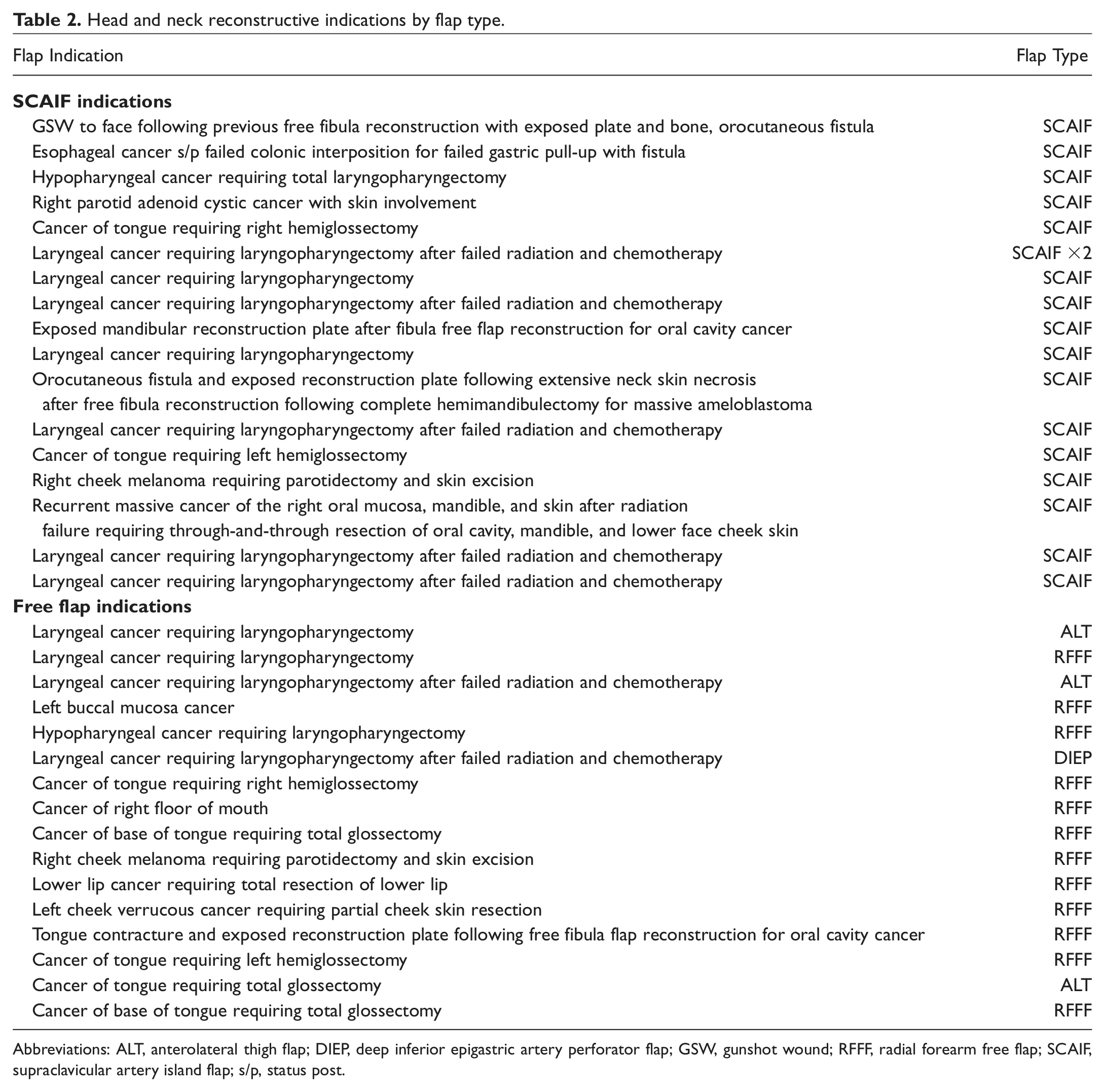
Abbreviations: ALT, anterolateral thigh flap; DIEP, deep inferior epigastric artery perforator flap; GSW, gunshot wound; RFFF, radial forearm free flap; SCAIF, supraclavicular artery island flap; s/p, status post.
Head and neck reconstruction study population: operative characteristics and outcomes.
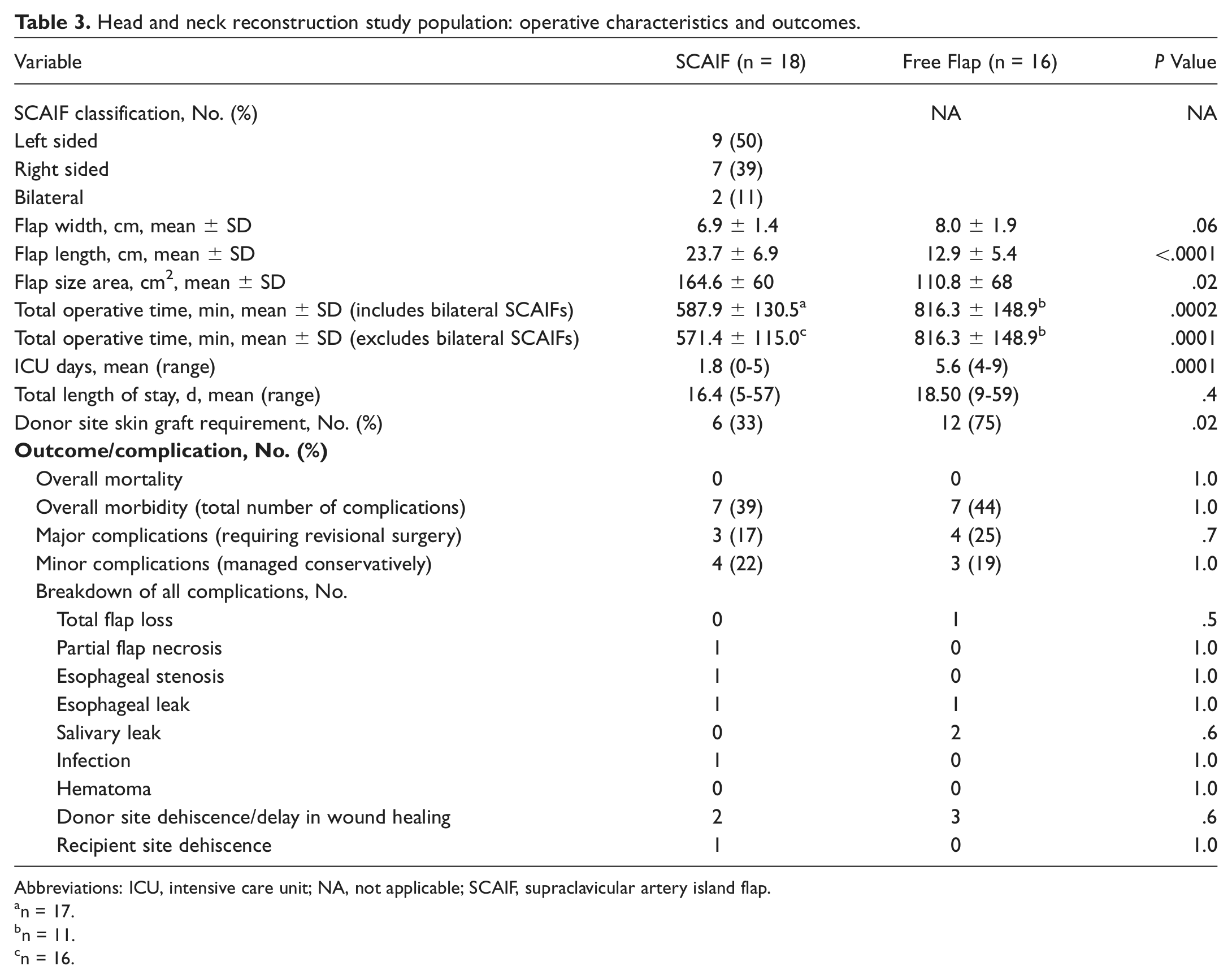
Abbreviations: ICU, intensive care unit; NA, not applicable; SCAIF, supraclavicular artery island flap.
n = 17.
n = 11.
n = 16.
Major and minor complications related to the reconstruction, including total and/or partial flap loss, were recorded for both groups ( Table 3 ). A major complication was defined as one necessitating a return to the operating room. A minor complication was one managed conservatively without a return trip to the operating room. Donor site complications as well as the need for a skin graft for both the free flap and SCAIF groups were also noted.
Baseline frequencies of clinical characteristics of both study populations were gathered with descriptive analysis. Comparison between the 2 groups consisting of the SCAIF group and the FFF group was performed using a 2-sided Student t test for continuous variables and the χ2 test for dichotomous variables. All reported values required a P value of ≤.05 for statistical significance. Statistical analysis was performed with GraphPad Prism 5 software (version 5.04; GraphPad Software, La Jolla, California).
Results
A total of 34 consecutive H&N reconstructions using FFFs or SCAIFs were performed by the senior author (J.W.G.) in a total of 32 patients over 5 years. The distribution of flaps was split evenly with 16 FFFs performed in 16 patients and 18 SCAIFs performed in 16 patients over the study period ( Table 1 ). The overall mean follow-up was 12.0 months. The mean follow-up of patients undergoing SCAIF reconstruction was 9.2 (range, 1.0-26.4) months, and the follow-up for patients undergoing free flap reconstruction was 15.1 (range, 4-65) months ( Table 1 ).
Both SCAIF and free flaps were used successfully to repair a variety of defects, listed in Table 2 . Demographic variables, including of age, sex, BMI, smoking status, medical comorbidities, previous radiation/chemotherapy, and American Society of Anesthesiologists class, were noted to be similar between the free flap and SCAIF groups with the exception of diabetes ( Table 1 ). We included only cases where either an FFF or a SCAIF could have been used. Thus, the differences in defect types treated between the 2 groups represented a natural variation in the presentation of the patient population rather than a bias in flap selection. No medical comorbidities precluded the use of either flap type. The types of neck dissections in both groups were similar, and in no cases were the transverse cervical artery pedicle or surrounding vessels damaged during the tumor ablation. In cases of a midline reconstruction, the side with the stronger Doppler vessel was used for a SCAIF pedicle. In no cases was a SCAIF abandoned due to insufficient Doppler findings. Operative characteristics and outcomes between the SCAIF and FFF are listed in Table 3 . We looked at the mean operative time for SCAIFs vs FFFs and noted a statistically longer operative time in the FFF group at 816 ± 149 minutes vs 588 ± 131 minutes, respectively. The overall length of hospital stay was not statistically different; however, total length of ICU stay was significantly greater in the FFF group ( Table 3 ). The need for skin graft coverage at the donor site was significantly more common in the FFF group at 75% vs 33% with the SCAIF group.
Major complications were compared between the 2 groups and found not to be significant. A major complication occurred in 3 of the 18 flaps (17%) in the SCAIF group vs 4 of the 16 flaps (25%) in the FFF group ( Table 3 ). The first complication occurred in a patient who underwent a total laryngopharyngectomy for squamous cell carcinoma after chemoradiation failure. He was reconstructed with a SCAIF and developed a postoperative salivary fistula that failed 6 weeks’ conservative management with a swallow study showing a persistent leak. He was taken to the operating room, where the small defect was closed primarily and a sternocleidomastoid muscle flap was used for local coverage. The second major complication in the SCAIF group involved the distal necrosis of the SCAIF at the tip of the tongue for a SCAIF repair of a hemiglossectomy defect. In this case, the Doppler signal revealed a short arterial pedicle during flap elevation and excess flap length was taken and inset into the defect. In a subsequent brief procedure, the necrotic area was debrided and the tongue closed directly to the healthy flap remnant. The flap remnant extended to the distal third of the tongue and went on to heal uneventfully. This was the only SCAIF in our series to have partial flap necrosis. We estimate that viable tissue extended approximately 5 cm distal to the most distal Doppler point found at the time of the initial operation. The third major complication was an esophageal-cutaneous fistula that occurred in a SCAIF placed via a median sternotomy approach to repair an anastomotic dehiscence of the proximal repair of a colon interposition. The patient initially had undergone an esophagectomy and gastric pull-up procedure. The anastomosis to the esophagus had a large dehiscence and was subsequently treated with an interposition flap of proximal colon between the proximal esophageal stump and small bowel. This also had a wide dehiscence at the proximal anastomosis, and the SCAIF was used to provide a tubed, soft tissue repair between the esophageal stump and colon. The proximal anastomosis between the SCAIF and esophageal stump also had a significant dehiscence. A second SCAIF was performed that also had anastomotic dehiscences and leaks at both anastomoses (this SCAIF fell outside the data collection period for this study). The dehiscences finally resolved after they were again directly repaired and covered with a pectoralis pedicled muscle flap.
There were no total flap losses in the SCAIF group, but 1 previously described patient had a partial flap loss, for a partial flap loss rate of 5.6%. Within the free flap group, there was 1 patient with total flap loss (6.3%). The total flap loss occurred in a patient who underwent a left radial forearm flap for reconstruction of an inner cheek defect not involving the mandible. The flap had been well up to the time of discharge from the hospital on the 10th postoperative day. The patient failed to return for follow-up until approximately 1 month after surgery, when he presented to the resident clinic with an abscess behind a necrotic flap. Minor complications occurring at the recipient site were recorded for 1 patient (6%) in the free flap group and 1 patient (6%) in the SCAIF group. The minor complication was cellulitis treated with antibiotics in the free flap group and a wound dehiscence treated with local dressing changes in the SCAIF group. All major and minor complications at the reconstructive site for both groups are listed in Table 3 .
Three donor site complications occurred in the free flap group (19%) and 2 occurred in the SCAIF group (11%) ( Table 3 ). Two donor site complications in the SCAIF group were wound dehiscences, which were ultimately treated conservatively with local wound care and healed by secondary intention. Each group had 1 wound infection, which was treated with antibiotics.
Discussion
The use of free flaps by the senior author (J.W.G.) for reconstruction of soft tissue defects of the head and neck largely has been replaced with SCAIFs over the past 5 years ( Figure 2 ). Currently, the primary author uses the SCAIF as a first-line flap when thin, pliable soft tissue is required within reach of the SCAIF pedicle. In our experience, the SCAIF can reliably cover areas ranging from the proximal esophagus to the lower lip, oral commissure, and scalp just cephalad to the level of the external ear. Appropriate free flaps are still used when large bulk or bony reconstruction is required. An online video of the procedure is available at http://otojournal.org.

The use of free flaps (FFs) by the senior author for reconstruction of soft tissue defects of the head and neck has largely been replaced with supraclavicular artery island flap (SCAIF) flaps over the past 5 years.
Since the addition of SCAIF reconstruction to our armamentarium for H&N reconstruction, we have significantly reduced our operative times and our postoperative ICU length of stay, with a slight decrease in the overall length of stay in the hospital. We attribute the shorter ICU times to the fact that postoperative monitoring of a pedicled SCAIF is simpler and less resource intensive than postoperative monitoring for a free flap. It is important to note that the majority of patients treated at our county facility have a poor home environment and often require extended hospitalizations secondary to placement issues. In our experience, the overall length of stays also may be similar because we find that the soft tissue transferred with either a SCAIF or a comparable free flap behaves similarly once it has been inset.
Our total reported operative times include flap elevation and inset and all additional procedures performed under the same anesthetic such as primary H&N resection, tracheostomy, and gastrostomy tube placement. All procedures were performed at a large county hospital, which is a level 1 trauma center, and surgical residents performed the majority of the surgery in most cases. Furthermore, it is important to note that harvest of the SCAIF was performed after completion of the primary H&N tumor resection and neck dissections for the first 16 cases. For the last 2 SCAIFs, flap harvest began earlier, during the contralateral neck dissection but after primary tumor resection and the ipsilateral neck dissection. In contrast, all free flaps were harvested simultaneously with the H&N resection using a 2-team approach. Even with the significantly later team starting time, the SCAIF group had a mean of 245 minutes less total operative time. The time required to elevate a SCAIF at the county facility was approximately 2 to 2.5 hours if performed primarily by the residents and usually less than 1 hour if performed primarily by the attending. We estimate that SCAIF elevation time when performed mainly by an experienced attending surgeon on a busy, private hospital service may approach 30 to 40 minutes. The SCAIFs also benefitted from elimination of the operative time required for microvascular anastomosis. The insetting times for the soft tissue of both the SCAIFs and FFFs were comparable.
Our overall complication rates in the SCAIF and FFF groups were similar and comparable with those reported in the literature.2-4,6,9,10,17 We find that the tissue characteristics of both SCAIFs and FFFs are nearly identical at inset and that the complications are more a function of the recipient site than the type of flap used. In our series, we had a SCAIF survival rate of 100% and feel that the overall rate of total flap losses with the SCAIF will prove to be even lower than the low rate of total flap loss for free flaps. This may be a consideration in patients who might have significant medical comorbidities and who might not tolerate a second, lengthy operation should the initial flap fail. However, the use of a SCAIF might be restricted due to the limited length of its pedicle in a small percentage of cases. We use the side with the stronger Doppler signal in midline reconstructive cases. Of note, in 2 cases our group has performed after this study, a vessel with a stronger Doppler signal that coursed anterior to the acromion was found. Nevertheless, using our method of flap harvest, we have not found pedicle length to be a factor in our repair of nearly all of our H&N defects that required thin, pliable, fasciocutaneous coverage. 2
The characteristics of the SCAIF are favorable when compared with the pectoralis myocutaneous flap, another commonly used pedicled flap in H&N reconstruction. We find that the latter is thicker, is less pliable, and has less reach. Furthermore, it leaves a more significant donor site defect than the SCAIF. 2 In our experience, the SCAIF thickness is comparable to or thinner than an ALT flap in the same patient ( Figure 1 ).
We have noted that our patients appear to tolerate the shoulder donor site of a SCAIF better than that of a radial forearm flap donor site, which almost always required the use of a skin graft. We feel that the donor site is better hidden by clothing, much less likely to cause postoperative functional deficits, and less likely to have healing issues such as tendon exposure ( Figure 1F ). We find the SCAIF donor site to be comparable to that of an ALT flap in the same patient, whose donor site can often be closed primarily.
Another noteworthy finding is that the SCAIF retains cutaneous sensation in most patients, especially if one routinely identifies and preserves the cutaneous branches of the cervical plexus at the flap edges near the posterior aspect of the neck. 2 The flap sensation retains the sensory mapping of the donor shoulder. Patients comment that “touching the flap feels like touching my shoulder” for exposed cutaneous flaps or that ingestion of hot or cold liquids in total laryngopharyngectomy reconstruction cases feels like a “hot or cold shoulder.” This is a significant advantage over conventional free flap reconstruction, which usually results in an insensate flap. We have harvested free flaps with the associated donor site cutaneous nerve, but such procedures require an additional neural anastomosis. Further studies will elucidate the predictability and utility of raising a sensate flap.18,19
Although multiple studies have compared free flap reconstruction with that of the pedicled pectoralis major musculocutaneous flap in H&N reconstructions, to our knowledge, this is the first study directly comparing outcomes of the SCAIFs with that of FFFs and the only study to describe SCAIF and pedicled myocutaneous flaps used to treat defects in the same patient.2,20-22 In a study similar to ours, Paydarfar et al 23 compared outcomes of the submental island pedicled flap with that of the radial forearm free flap for oral reconstruction in 60 patients. They noted that although surgical complications as well as speech and swallowing function were comparable between the 2 groups, the submental flap had shorter operative times and hospitalizations.
Conclusion
Supraclavicular artery island flap reconstruction has largely supplanted free flap reconstruction techniques as the first-line option when thin, pliable soft tissue is required for reconstruction of soft tissue H&N defects in the senior author’s (J.W.G.) practice. Supraclavicular artery island flaps are reliable, and advantages over traditional free flaps include shorter operative times, a technically less demanding harvest, shorter ICU stays, and elimination of the need for postoperative free flap monitoring. Most SCAIFs retain cutaneous sensation. Furthermore, SCAIFs do not “burn any reconstructive bridges” and leave all other free flap donor sites and recipient vessels intact to allow subsequent reconstruction with free tissue transfer if necessary. We expect that SCAIF reconstruction will continue to play an ever increasing role in reconstructions of complex defects of the head and neck.
Author Contributions
Disclosures
Footnotes
Acknowledgements
We thank Dr Ernest Chiu for his inspiration and support in the SCAIF concept. We also acknowledge and thank Dr Neil Tanna, Dr Hubert Shih, and Mr James Lee for their assistance with the initial data collection.
No sponsorships or competing interests have been disclosed for this article.

References
Supplementary Material
Please find the following supplemental material available below.
For Open Access articles published under a Creative Commons License, all supplemental material carries the same license as the article it is associated with.
For non-Open Access articles published, all supplemental material carries a non-exclusive license, and permission requests for re-use of supplemental material or any part of supplemental material shall be sent directly to the copyright owner as specified in the copyright notice associated with the article.
