







Abstract
School discipline research has demonstrated that the labeling of student behaviors as requiring disciplinary action is a selective process in which school staff take into account other factors than the characteristics of the behaviors. We argue that school staff react in a disciplinary way to students with negative attitudes toward the educational system. Concretely, we examined if feelings of futility caused students to suffer disciplinary consequences more often. Multilevel analysis was carried out on data of 2,358 students in 28 Ghentian (Belgium) schools that participated in the International Study of City Youth (ISCY). Results indicate that school staff do not react to students’ sense of futility directly by means of disciplinary actions; however, they impose disciplinary actions following disruptive behaviors on students displaying higher feelings of futility more often.
School discipline, or the use of disciplinary strategies such as suspension, expulsion, and office referrals by school staff in the school environment, has been the subject of controversy in educational academic research for decades. Research has pointed out that no clear-cut relationship exists between the levels of disruptiveness of student behaviors and the disciplinary actions in reaction to these behaviors. In fact, the incongruence between students’ disruptive behaviors in school and the disciplinary actions imposed by school staff has been examined in several sociological studies (Skiba et al., 2002, 2011; Wallace et al., 2008). From these studies it became clear that the labeling of student behaviors as requiring disciplinary action is a constructive process whereby school staff take into account other factors than just the characteristics of the posed behaviors. Previously, disciplinary incongruences have mainly been researched in terms of discipline gaps: the unequal disciplinary treatment of certain groups of students for the same levels of disruptive behavior. For example, ethnic/racial minority and male students are more likely to experience negative interactions with teachers, to be referred to the principal’s office, and to be suspended, when controlling for their actual behaviors (Consuegra, 2015; Skiba et al., 2002, 2011; Wallace et al., 2008).
In this article, we suggest that the occurrence of disciplinary actions imposed by school staff is not only a function of students’ disruptive behaviors or demographic characteristics such as ethnicity, race and gender but is also associated with students’ attitudes toward the educational system. Concretely, we examine whether school staff react with disciplinary actions to the display of sense of futility in students. Students displaying high levels of sense of futility in school feel like they have little chance to succeed in the educational system, despite the effort they put in (Brookover et al., 1978; Brookover & Schneider, 1975). These feelings of frustration have been shown to correlate with the occurrence of disruptive behaviors in students (Demanet & Van Houtte, 2011; Van Houtte & Stevens, 2008), a decline in academic achievement (Agirdag et al., 2012; Brookover et al., 1978), and negative educational decisions like dropping out (Van Houtte & Demanet, 2016).
We hypothesize that students with high levels of sense of futility are disciplined more often compared with students who feel more optimistic about their chances of success in the educational system. This hypothesis is derived from studies that have demonstrated that students who are considered by school staff not to fit well into the educational vision of the school and to persistently disregard the institution’s authority are more often disciplined for their behaviors (Bowditch, 1993; Riehl, 1999; Rumberger & Thomas, 2000). We suggest that students’ expressions of frustration toward the educational system are regarded by school staff as a sign of disregard of the institution’s authority and as incompatible with the school’s educational vision.
To empirically test our hypothesis, we examine whether high levels of futility are associated with high levels of disciplinary actions, regardless of the disruptive behaviors posed by students, and whether school staff react more often in a disciplinary way to disruptive behaviors when it is posed by students who also display high levels of futility. Reacting to students’ frustrations toward school in a disciplinary way, directly or indirectly, may fortify students’ pessimistic views of their chances to succeed in the educational system and increase the probability of them leaving school prior to completion (Van Houtte & Demanet, 2016).
School Discipline Research: Concept and Consequences
School discipline has been conceptualized in terms of a variety of disciplinary practices. First, disciplinary practices may be less or more coercive and punitive in nature (Lewis, 2001; Lewis et al., 2005). For example, Gregory and Cornell (2009) distinguished between an authoritative and an authoritarian disciplinary approach, with the first approach being characterized by structure and support, and the second one by the emphasis on high structure and control with an absence of support. In their research, Lewis et al. (2005) included punishing, rewarding, hinting, involvement in decision-making, discussion, and aggression as approaches to classroom discipline. Second, these disciplinary practices may or may not be officially recorded in a school’s administrative system. For their research on school discipline, scholars have primarily based their analyses on available administrative school data. As such, among the most cited disciplinary outcomes are suspension and office discipline referrals (see for example, Christie et al., 2004; Lacoe & Steinberg, 2019; Martinez et al., 2016).
Furthermore, school discipline researchers have been concerned with identifying the particular characteristics of behaviors that require disciplinary actions according to school staff (Martinez et al., 2016; Skiba et al., 1997; Spaulding et al., 2010). Skiba and colleagues (1997) signaled that behaviors leading to office discipline referrals are primarily nonaggressive in nature, such as insubordination and noncompliance, while Horner et al. (2010) found that aggression and a lack of prosocial behaviors are the most significant predictors of disciplinary actions. Which behaviors should be disciplined is often determined by means of a coherent set of guidelines that constitute the school’s disciplinary policy (Daniel & Bondy, 2008). A well-known example is the zero-tolerance policies. In the 1990s, zero-tolerance policies became the norm in U.S. schools (Gregory & Cornell, 2009; Mallett, 2015; Skiba & Knesting, 2001). These policies can be described as “a method of sending a message that certain behaviors will not be tolerated, by punishing all offences severely, no matter how minor” (Skiba & Knesting, 2001, p. 20).
School discipline research has uncovered a crucial role for disciplinary practices in student outcomes. Studies have demonstrated the importance of a school’s disciplinary climate, defined as student perceptions of the way in which school staff address behavioral issues and of particular behaviors as disruptive (Cheema & Kitsantas, 2014; Ma & Willms, 2004). An improvement in disciplinary climate has a positive effect on student achievement. When students perceive the teacher to be in control and classroom disruption as low, they feel safer at school and perform better. However, educational researchers have also questioned the effectiveness of imposing disciplinary actions on students in keeping them on “the right track” academically and correcting their behaviors (Blomberg, 2004; Gregory & Cornell, 2009; Lewis et al., 2008; Skiba, 2002; Skiba & Knesting, 2001; Way, 2011). Previous research has discussed school discipline as an important predictor for several negative educational outcomes for students, such as declining academic achievement (Lacoe & Steinberg, 2019), student dropout and mobility (Balfanz et al., 2015; Welsh, 2016), and future involvement in the criminal justice system (Curtis, 2014; Heitzeg, 2009; Mallett, 2015; Mowen & Brent, 2016).
School Discipline Research: Discipline Gaps
School discipline practices have been shown to not affect every group of students equally (Curtis, 2014; Skiba & Knesting, 2001; Smolkowski et al., 2016). In fact, school discipline research has revealed “discipline gaps,” or the unequal disciplinary treatment of certain groups of students for the same levels of disruptive behavior. In examining disciplinary inequalities, researchers have primarily focused on demographic characteristics. Studies showed that ethnic/racial minority students are more likely to experience negative interactions with teachers, to be referred to the principal’s office, and to be suspended, when controlling for behaviors (Gagnon et al., 2017; Rocque, 2010; Skiba et al., 2002, 2011; Wallace et al., 2008). The ethnic/racial discipline gap has been of scholarly concern for decades; however, it is worth mentioning that the scientific interest in this ethnic/racial disparity has been primarily American. Gregory et al. (2010) suggested that the ethnic/racial discipline gap in U.S. schools contribute to an overall ethnic/racial disparity in academic outcomes.
Another disciplinary inequality that has received scholarly attention concerns the differential treatment of boys compared with girls. Consuegra (2015) has demonstrated that boys receive more negative feedback from teachers than their female peers. For a range of possible infractions, boys are referred to the office more often than girls (Skiba et al., 2002). Following these findings, Meyenn and Parker (2001) suggested that the social construction of masculinities should be placed on the agenda of teacher training institution to provide teachers with the tools to reflect on their own disciplinary practices. Other demographic characteristics, such as socioeconomic status, have mainly been taken into account to test the robustness of the ethnicity/race–discipline and gender–discipline relationship. Skiba and colleagues (2002) showed that socioeconomic status can be regarded as a predictor of disciplinary actions, while Bradley and Renzulli (2011) demonstrated that socioeconomic status moderates the relationship between race and gender, and the likelihood of being pushed out of school. These findings highlight the importance of exploring mediating and moderating factors with regard to disciplinary inequalities (Wallace et al., 2008).
Current Study
The existence of discipline gaps shows that the labeling of student behaviors as requiring disciplinary action does not solely depend on the nature of the posed behaviors. In fact, discipline gaps can be perceived as incongruences between students’ disruptive behaviors in school and disciplinary actions imposed by school staff that appear to be larger for some groups of students compared with others. In this study, we suggest that the occurrence of disciplinary actions imposed by school staff is not only a function of students’ disruptive behaviors or demographic characteristics but is also associated with student attitudes toward the educational system. Of specific interest are students displaying high levels of sense of futility in school.
The concept of sense of futility reflects student attitudes about their chances of success in the educational system as it is currently organized (Brookover et al., 1978; Brookover & Schneider, 1975). These attitudes toward the educational system originate from the student’s personal experience and material reality (Mickelson, 1990; Van Houtte & Stevens, 2015). Students experience strain when positively valued goals are expected or turn out to be unattainable, such as high grades or credentials (Agnew, 1985, 1992). This strain leads to feelings of futility. Students displaying high levels of sense of futility feel like they have little chance to succeed in the educational system despite the effort they put in (Brookover et al., 1978; Brookover & Schneider, 1975). More specifically, they feel like the educational system is working against “students like me.” High levels of sense of futility have been shown to correlate with the occurrence of a range of negative educational outcomes for students. Students who are pessimistic about their chances in school act out more (Van Houtte & Stevens, 2008), perform worse in math than their peers (Agirdag et al., 2012) and present with lower levels of study involvement (Van Houtte & Stevens, 2010). Finally, students with higher levels of sense of futility are less likely than other students to aspire attaining a high school diploma or credential (Van Houtte & Demanet, 2016).
We hypothesize that students with high levels of sense of futility are disciplined more often compared with students who feel more optimistic about their chances of success in the educational system. In consonance with the structural contingency theory and the institutional theory, studies have demonstrated that students who are considered by school staff not to fit well into the educational vision of the school and to persistently disregard the institution’s authority are more often disciplined for their behaviors (Bowditch, 1993; Riehl, 1999; Rumberger & Thomas, 2000). Specifically, the structural contingency theory states that organizations must actively manage membership boundaries to adapt to constraints and contingencies of the environment they have to survive in (Donaldson, 2001). The institutional theory suggests that organizations manage membership boundaries to maintain legitimacy, that is, to at least appear to be pursuing goals in line with societal expectations (Meyer & Rowan, 1978). Hence, organizations such as schools will force out members who do not contribute to attaining goals and coping with environmental challenges (Rumberger & Thomas, 2000). We suggest that students’ expressions of frustration toward the educational system are regarded by school staff as a sign of disregard of the institution’s authority and as incompatible with the school’s educational vision. Because school staff have been shown to react in a disciplinary way to nonaggressive behaviors such as insubordination (Skiba et al., 1997) and a lack of prosocial behaviors (Horner et al., 2010), it would not be surprising if they also reacted with disciplinary actions to students’ frustration toward the educational system.
Concretely, we hypothesize that school staff react in a disciplinary way to the display of sense of futility in students. More specifically, we expect that students with high levels of sense of futility are disciplined more often, regardless of their levels of disruptive behavior (H1), and that school staff react more often in a disciplinary way to disruptive behaviors when it is posed by students who also display high levels of futility (H2).
Method
Data
The data for this study were derived from the International Study of City Youth (ISCY), a longitudinal project that compares different educational systems in 12 cities around the world in the way they prepare young people for adult life. By surveying 10th-grade students and recontacting them each year in the course of 5 years, ISCY aims to measure a range of noncognitive 21st-century skills, such as school engagement and belonging, and the extent to which they affect student progress and outcomes in distinctive national contexts and institutional arrangements (Lamb et al., 2015). Specifically, the data used for this study were collected in Ghent, a city situated in Flanders, the northern, Dutch-speaking part of Belgium. In Belgium, two school sectors exist: the public and the private. Although state funding for private schools is lower than for public schools, for historical reasons, private schools have always been the most developed (Van Maele & Van Houtte, 2011). The city of Ghent can be considered a metropole when it comes to schooling and education. As capital city of the province of East Flanders it has a well-established public transportation network, which makes it possible for children and adolescents who do not reside in Ghent to attend a Ghentian school. All secondary schools located in the city of Ghent were invited to participate in the ISCY-study. Of 39 schools, 30 schools agreed. Of these 30 schools, 11 fell into the public sector and 19 into the private sector.
The different research waves of the ISCY-study were undertaken on school grounds in computer classes under the overall guidance of the researchers at a therefore fixed moment during a regular school day. Students were asked to fill out their demographic characteristics and to report on various subjects, such as their experiences in school, their perceptions of the student population and school staff, and their political views, by means of a quantitative survey. The first wave of the ISCY-study was elicited in 2013 from 2,354 fourth-year (equivalent to the 10th grade in the U.S. system) students. For the second wave the next year, the ISCY-study successfully reached 81.9% of respondents again. Two schools that participated in the first wave were not recontacted, as they did not offer the fifth- and sixth-year (equivalent to the 11th and 12th grades in the U.S. system). For this article, we made use of the second wave of the ISCY-study, which was collected in 2015 from 2,358 students enrolled in 28 schools in the fifth year of secondary education (equivalent to the 11th grade in the U.S. system), and the fourth year of secondary education in case students were repeating a year. Students who participated in the first wave of the ISCY-study, but transferred the next year to a school that was not part of the study, were not considered.
Design
As students were nested within schools, thus forming a clustered sample, the most fitting statistical method was hierarchical linear modeling. To perform the analysis HLM7, a statistical program that allows for hierarchical linear and nonlinear modeling (Raudenbush et al., 2011), was used.
The very first step in conducting a multilevel analysis is to estimate the unconditional model to determine the amount of variance that occurs on each level with regard to the dependent variable. For our design specifically, this meant that we determined which percentage of the total amount of variance in school discipline was situated between students and which percentage could be assigned to differences between schools.
Next, a first model tested the hypothesis that students with high levels of sense of futility are disciplined more often, regardless of their actual levels of disruptive behavior (H1). We assessed if the direct association between levels of sense of futility and school discipline, controlling for levels of disruptive behavior, was indeed significant. We accounted for several variables to rule out the possibility that this association was actually mediated by a third variable that has been shown to accord with school discipline, such as gender, immigrant status, socioeconomic status, and academic performance (Bowditch, 1993; Skiba et al., 2002). To account for socioeconomic status and academic performance, we made use of substitute variables, respectively, parental educational attainment and retention. We controlled for track, because research has shown that, at least in Flanders, disruptive behaviors are more common in students who are enrolled in a technical/vocational track than in other tracks (Van Houtte & Stevens, 2008). We might suspect that disciplinary actions are also related to student track position. Finally, we accounted for students’ age, as research has revealed that age plays a role in the decision of schools to discipline a student (Riehl, 1999).
A second model tested the second hypothesis that school staff react more often in a disciplinary way to disruptive behaviors when it is posed by students who also display high levels of futility (H2). To test this hypothesis, we created an interaction term by means of student levels of sense of futility and of disruptive behavior.
In both models, all variables except the dichotomous ones were grand mean centered to increase model stability (Raudenbush & Bryk, 2002). Variance components were treated randomly, except for one of the variables indicating enrollment in an arts track as this track is quite exceptional and only offered by a couple of schools. Finally, hierarchical linear modeling has a specific way of handling missing data: Observations with missing data on any variable are deleted during the analyses. The analysis for the second model was computed on the data of 2,200 students.
Variables
Dependent variable
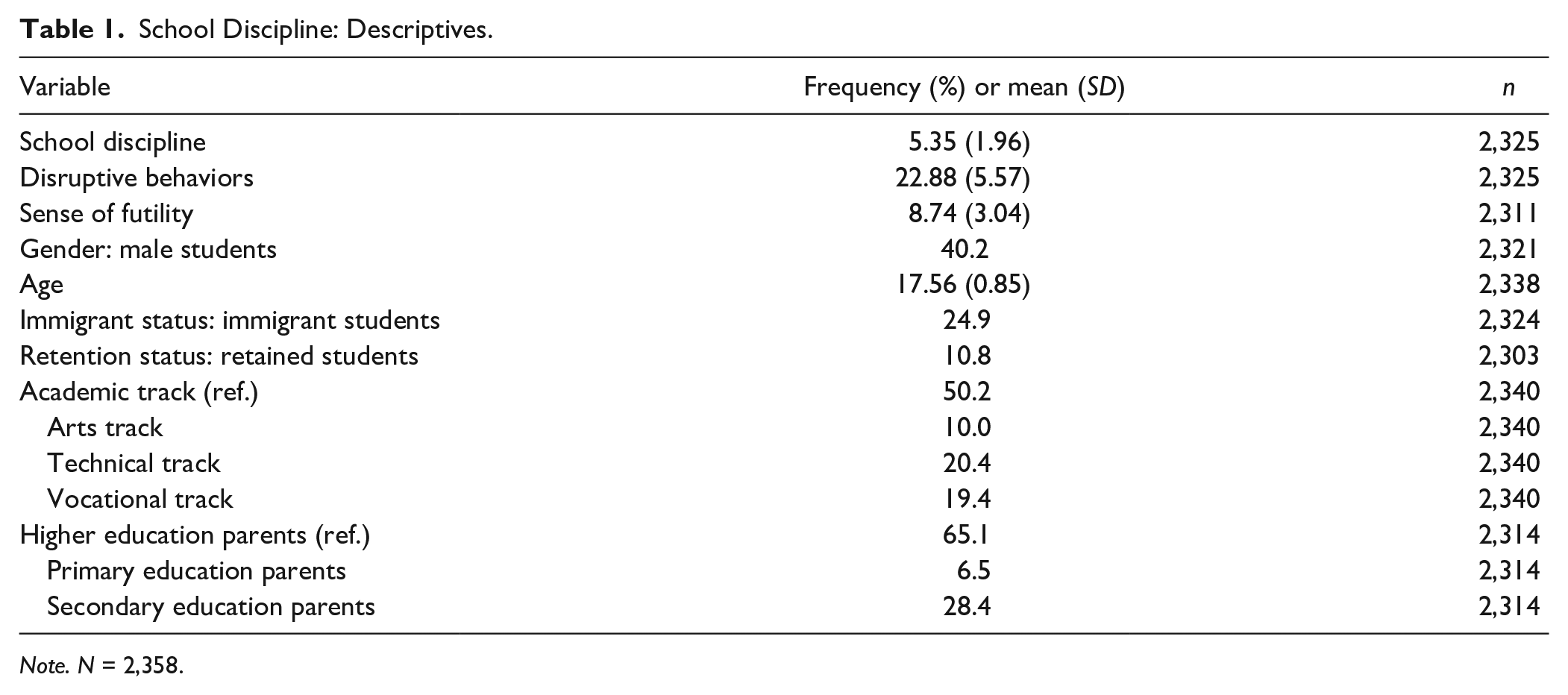
School discipline was measured by means of a scale of four items. Students were asked to indicate how often they were subjected to disciplinary actions, such as detention, detention-work, and suspension, during the ongoing school year. A 4-point Likert-type scale was used. Possible answer categories were never (1), once or twice (2), three or four times (3), and five times or more (4). Students’ answers were summed to a scale, ranging from 4 to 16. Students with a higher score on this scale were subjected to disciplinary actions more often. On average, the students in this study had a score of 5.35. This low value can be explained by the timing of the data collection, as students were questioned about the ongoing school year and most students filled out the survey in the first half of the school year. The low score did not pose a problem to our analyses: Of importance was the variation between students’ scores. This variation was evident (SD = 1.96). Cronbach’s alpha for this scale turned out to be acceptable with a value of .72.
Independent variables
Levels of disruptive behaviors were measured by means of a scale inspired by Stewart (2003). From the items proposed by Stewart, we selected those 14 items that described student behaviors that were not necessarily illegal but were likely to trigger a punitive reaction from school staff and did not in themselves describe any kind of reaction of school staff to student behaviors. For example, we considered “being suspended” as signifying an action taken by school staff, whether or not in proportion to the exhibited behaviors, rather than an indication of disruptive behaviors in students. Cronbach’s alpha for this scale was .79, hence, our scale proved to be reliable. Students were asked how often they had exhibited disruptive behaviors in school, such as consuming alcoholic beverages and arguing with teachers, during the ongoing school year. A 4-point Likert-type scale was used: never (1), once or twice (2), three or four times (3), five times or more (4). The 14 items were summed to a scale theoretically ranging from 14 to 56. The students in this sample scored on average 22.88 (SD = 5.57).
To measure sense of futility, students were asked to indicate on a 5-point Likert-type scale to what extent they agreed with five statements that reflected their feelings about the chances of success they have in the educational system (Brookover et al., 1978; Brookover & Schneider, 1975). Concretely, students reported if they more or less believed in their chances of academic success, of a good job when they worked hard in school, or of opportunities to achieve life goals in general. Only one item “I can do well in school if I work hard” had to be recoded. Students who scored high on this scale had high levels of sense of futility, and thus felt like they had little chances of succeeding in the educational system or later in life. Theoretically this scale ranged from 5 to 25. On average, students had a score of 8.74 (SD = 3.04). This scale proved to be reliable with a Cronbach’s alpha of .78.
Control variables
Gender
The sample for this study consisted of 40.2% male students. As gender is a somewhat fixed student characteristic, we used the longitudinal nature of the ISCY-study to our advantage and substituted the missing values of the second wave with the values of the baseline student survey. As the female students were largest in number, they formed the reference category for this variable.
Age
The age of the students in this sample was computed by subtracting the birth year of the students from the year of data collection. Since birth year, contrary to age, is a fixed characteristic, we again substituted the missing values of the second wave with the values of the baseline student survey. The mean age of the respondents in this study was 17.56 (SD = 0.85) years old, with the youngest students 15 years and the oldest 22 years of age.
Immigrant status
As is traditional in Flemish research, the students’ immigrant status was measured by means of the birth country of the maternal grandmother (Timmerman et al., 2002). When this information was not available, the birth country of the parents was used as indicator of a migration background. Only students with roots in non-Western European countries were considered to be of foreign descent (Duquet et al., 2006; Sierens et al., 2006). We substituted the missing values of the second wave with the values of the baseline student survey. We constructed a dichotomous variable (0 = native, 1 = non-native). Of the students in the sample, 24.9% had a non–West-European background.
Retention status
Retention is an intervention made when students show insufficient educational progress: They have to repeat the entire year. Students in this study were asked in what year they were studying at the time of data collection and during the previous year. Students who were in the same year at both points in time were considered to have been retained. Of the respondents in the total sample, 10.8% indicated that they were currently repeating a year.
Track
Students in the Flemish educational system are grouped into tracks according to their academic abilities. At the time of survey administration approximately half of the students (50.2%) in this study were enrolled in an academic track and probably planned to attend a higher educational institution later on. This group served as the reference category. One fifth was enrolled in a vocational track (19.4%). This track focuses on a specific profession and offers students from the age of 15 and onwards the opportunity of combining a work experience or apprenticeship with a part-time educational program. Another fifth (20.4%) was registered for the technical track, which offers students practical and general training. Finally, 10% of the students were in an arts track.
Parental educational attainment
To control for a student’s parental background, we included a variable that measured the highest educational diploma or credential obtained by at least one of the student’s parents. The reference category contained students who had at least one parent who completed higher education (65.1%). Of the remaining students, 6.5% had parents who had not finished secondary education, while 28.4% had at least one parent who had obtained a diploma or credential of secondary education. Descriptive information for all student variables is summarized in Table 1.
School Discipline: Descriptives.
Note. N = 2,358.
Results
The unconditional model (not shown) revealed that, although the variance at the school level was significant (τ0 = 0.221, p < .001), the largest part of variation in school discipline was situated at the student level. In fact, 94.24% of the total variation in school discipline could be explained by looking at differences between students (σ0 = 3.615, p < .001). Results of the multilevel analyses are shown in Table 2.
Correlates of School Discipline Based on Results of Multilevel Analysis (HLM).
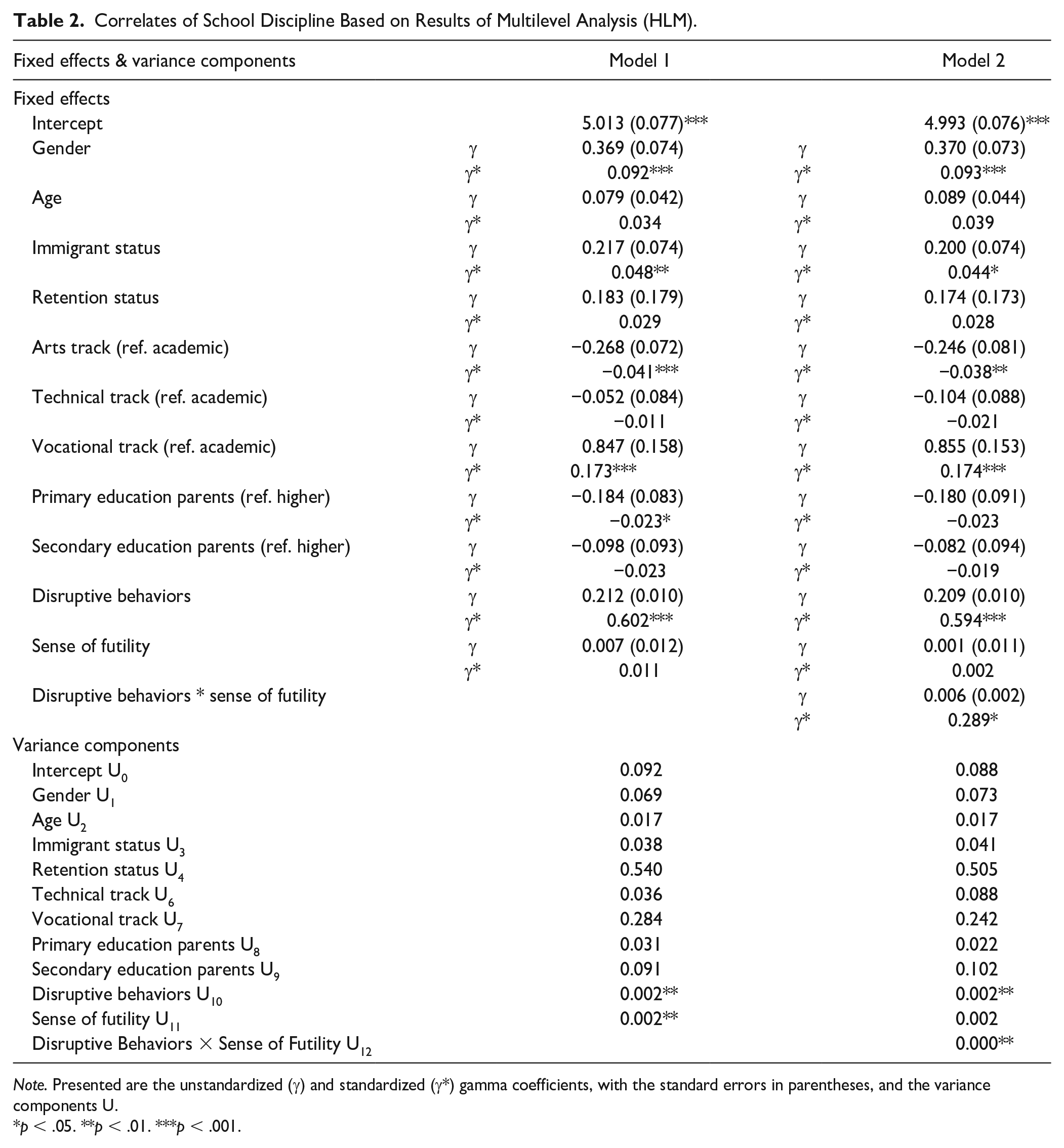
Note. Presented are the unstandardized (γ) and standardized (γ*) gamma coefficients, with the standard errors in parentheses, and the variance components U.
p < .05. **p < .01. ***p < .001.
The results of the first model presented no evidence for the first hypothesis: Sense of futility was not significantly related to school discipline (γ* = 0.011, p > .05). The levels of disruptive behavior proved to be, as one would expect, a strong predictor of school disciplinary actions (γ* = 0.602, p < .001). Several demographic student variables were significantly associated with school discipline as well, regardless of levels of disruptive behavior. In accordance with the literature on discipline gaps, boys compared with girls (γ* = 0.092, p < .001), as well as students with an immigrant background compared with students without immigrant background (γ* = 0.048, p < .01), were disciplined more often by school staff. Furthermore, students who were enrolled in a vocational track were more likely to be disciplined compared with students in an academic track (γ* = 0.173, p < .001). Contrary to this result, students who were enrolled in an arts track were less often disciplined by school staff compared with students in an academic track (γ* = −0.041, p < .001). Finally, students whose parents had not obtained a secondary school diploma or credential were less often disciplined than students whose parents were highly educated (γ* = −0.023, p < .05).
The results of the second model confirmed the second hypothesis: The interaction term between student levels of sense of futility and levels of disruptive behavior was significantly related to school discipline (γ* = 0.289, p < .05). The levels of disruptive behavior still had the strongest association with school discipline compared with the other variables in the model. Like in the first model, being a male student (γ* = 0.093, p < .001), having an immigrant background (γ* = 0.044, p < .05), and being enrolled in a vocational track (γ* = 0.174, p < .001) were student characteristics that resulted in being subjected to disciplinary actions in school more often. Students who were enrolled in an arts track were less often disciplined by school staff compared with students in an academic track (γ* = −0.038, p < .01). The significant difference between students whose parents had not obtained a secondary school diploma or credential and students whose parents were highly educated disappeared in this model.
In both models, students’ age and retention status were not significantly related to the levels of disciplinary actions students experienced in school.
Discussion
In this article, we demonstrated that the occurrence of disciplinary actions imposed by school staff is not only a function of students’ disruptive behaviors or demographic characteristics but is also associated with students’ attitudes toward the educational system. Concretely, our results indicate that school staff do not react to students’ sense of futility directly by means of disciplinary actions; however, they impose disciplinary actions following disruptive behaviors on students who display higher feelings of futility more often. Reacting to students’ frustrations toward school in a disciplinary way, even if indirectly, may fortify students’ pessimistic views of their chances to succeed in the educational system and increase the probability of them leaving school prior to completion (Van Houtte & Demanet, 2016).
Two organizational theories, the structural contingency theory and the institutional theory, state that school staff use disciplinary measures as a tool to maintain the institution’s authority and to manage membership boundaries (Bowditch, 1993; Riehl, 1999; Rumberger & Thomas, 2000). Studies with regard to these theories have demonstrated that students who are considered not to fit well into the school’s educational vision and to persistently disregard the institution’s authority are disciplined by school staff more often. Our results suggest that students who display feelings of frustration toward the educational system are also considered by school staff not to fit well into the educational vision of the school and consequently are disciplined more often when they exhibit disruptive behaviors. By proposing these theories, we do not mean to say that school staff individually and intentionally target these students; however, we observe that these students are disciplined more often when they pose disruptive behaviors and we suggest that, on an organizational level, students who display feelings of futility toward the educational system and who pose disruptive behaviors in school can be considered obstacles to attaining institutional goals and maintaining the institution’s authority.
Our results show that boys compared with girls, as well as students with an immigrant background compared with students without immigrant background, were disciplined more often by school staff, regardless of their levels of disruptive behavior. These results are in accordance with the literature on discipline gaps. Furthermore, our results point to the importance of the role of track position in school discipline. This is not entirely surprising, as Flemish research has previously revealed cultural differences between tracks. On one hand, students in an arts track are less likely to be disciplined than students in an academic track. This result corresponds with an earlier study on school culture in art schools (Gryson, 2019). Student behaviors are less likely to be seen as disruptive and students are stimulated to enter into discussion with teachers. On the contrary, students in vocational tracks are disciplined more often than students in an academic track. According to Stevens and Vermeersch (2010), teachers in vocational tracks perceive their students to demonstrate anti-school behaviors more often than students in other tracks. In our study, student-reported levels of disruptive behaviors do not mediate the association between track position and school discipline. We suggest that future research should aim to determine the interplay between student demographic variables, feelings of futility, and disciplinary practices.
Limitations
The suggested explanation for our findings is situated purely at an organizational level. We have not taken into account individual school staff perspectives on school discipline or individual motivation to use disciplinary actions. It would be interesting to examine in a more in-depth way how individual use of disciplinary measures by school staff contributes to institutional goals. Individual teachers might resist organizational mechanisms and lend extra support to students who feel like the educational system is working against them. Future research could shed a light on teacher motivations to use disciplinary strategies in some cases, but not in others, and on teacher perceptions of disciplinary inequalities.
To measure school discipline and levels of disruptive behaviors, we have surveyed the students, not the school staff. It is possible that students with higher levels of futility feel like they are being disciplined for disruptive behaviors more often than other students. Even though the numeric nature of the answer categories of the school discipline items somewhat diminishes this possibility, we cannot rule out completely that students with higher levels of futility have exaggerated in their responses. Similarly students who do not feel at home in the educational system may feel pride in reporting, and possibly overreporting, their levels of disruptive behavior.
Levels of disruptive behavior were measured by means of a scale. Students were asked to indicate on 14 items how often they had exhibited disruptive behaviors in school, such as consuming alcoholic beverages and arguing with teachers, during the ongoing school year. The items were summed to a scale, without assigning more weight to those behaviors that could possibly be perceived less or more disruptive than others. In other words, by operationalizing disruptive behaviors the way we have, we have neglected the possibility that some behaviors might call for disciplinary actions more readily than others.
Finally, the design of this study is cross-sectional, which excludes the possibility of accurately pinpointing the causality of the mechanisms at work. An alternative explanation for our findings might be that students who are disciplined more often, develop stronger feelings of futility and more distrust toward the educational system. Longitudinal research would allow us to disentangle causal effects in the association between these variables.
Directions for Future Research and Policy
Notwithstanding the limitations, our research results have implications for both research and practice. The discipline gaps most often discussed in scientific literature concern students’ gender and ethnicity/race (Bradley & Renzulli, 2011; Consuegra, 2015; Rocque, 2010; Skiba et al., 2002, 2011; Wallace et al., 2008; Weiner, 2016). In this study, evidence was found for both. As we mentioned before, discipline gaps are primarily of concern to U.S. educational researchers. European studies on discipline gaps are rather scarce. Weiner (2016) reasons that in Europe colorblind ideologies hinder research into the existence of institutionalized racism causing minority educational inequalities. The results of our study demonstrate that the disregard for discipline gaps in European educational contexts is unjustified: The unequal disciplinary treatment of certain groups of students is as much a European issue as it is American.
Although students with high levels of sense of futility who do not pose any disruptive behaviors are not specifically suffering from disciplinary actions imposed by school staff, they as well are at risk of student dropout or mobility (Van Houtte & Demanet, 2016). In dropout prevention programs, schools should focus on the reduction of levels of sense of futility in students and on implementing measures to alter teacher attitudes toward and expectations of their students (Martin et al., 2003). Research has shown that, in schools where teachers in general trust their students, students are less likely to display high levels of sense of futility; hence, when implementing dropout intervention programs, it might be rewarding for schools to invest in faculty trust in students to counter the negative educational outcomes of sense of futility (Van Houtte et al., 2012). Finally, policy makers should reflect on the consequences of creating competitive educational environments that push schools toward the exclusion of students who do not contribute to the attainment of a desirable reputation and position in the school population.
Conclusion
This study has demonstrated that school staff react in a disciplinary way to students’ levels of sense of futility by imposing disciplinary actions following disruptive behaviors on students displaying higher feelings of futility more often. This finding shows that educational researchers should look at, but also beyond, the widely discussed gender and ethnic/racial discipline gaps to accurately identify those students who fall behind in the educational system.
Footnotes
Acknowledgements
We acknowledge the support and contribution made by all students, teachers, and schools participating in the project.
Declaration of Conflicting Interests
The author(s) declared no potential conflicts of interest with respect to the research, authorship, and/or publication of this article.
Funding
This research article uses data from the International Study of City Youth (ISCY). ISCY is an international collaborative project designed and implemented by various research partners from across the world and led by the Centre for International Research on Education Systems (CIRES) at Victoria University, Australia. ISCY has received funding from the Australian Research Council, the Victorian Department of Education and Training, CIRES, and the Research Foundation Flanders (FWO).
