






Abstract
Social psychological research on migration has largely prioritized Global South–to–Global North flows, leaving South–South dynamics underexplored. Addressing this gap, this study investigated how racialized gender microaggressions and impostor feelings jointly shape perceived barriers and coping among Black migrant women from Latin America and Africa working in Brasil’s information technology (IT) sector. We conducted a sequential mixed-methods study with an intra-categorical intersectional design. In Phase 1, data from Black migrant women (N = 72) indicated that impostor feelings were positively associated with microaggressions, which, in turn, were positively associated with racial and gendered barriers. In Phase 2, results from interviews (n = 10) about the same variables from Phase 1 were analyzed to triangulate results. Findings showed that participants’ experiences were shaped by racism, sexism, and xenophobia, contributing to an exhaustion we termed Gendered Racial Migratory Battle Fatigue (GRMBF). Participants’ coping strategies included community-building and rights-claiming. The study advances an intersectional, Global South perspective that reframes microaggressions and impostorism as socially produced outcomes rather than exclusionary perceptions that require individual adaptation.
Introduction
Social psychological research on migration has traditionally focused on flows from the Global South to the Global North, with studies tending to examine acculturation, identity negotiation, and intergroup relations within Western host societies (e.g., Berry, 1997; Esses et al., 2013; Sam & Berry, 2010; Ward et al., 2001). In contrast, relatively little attention has been paid to South–South migration dynamics. This gap is particularly striking given that countries within the Global South, though economically and culturally diverse, are often treated as a homogeneous bloc. Migration within the Global South is shaped by uneven development (Rigg, 2007), colonial legacies (Mamdani, 1996; Mbembe, 2001), and structural inequalities (Castles et al., 2014; Crush et al., 2015), producing distinct cultural, racial, and gendered dynamics not captured by models focused on the Global North (Bond, 1988; Henrich et al., 2010).
As a postcolonial state with persistent racial labor segmentation, Brasil 1 provides an interesting context from which to examine how race, gender, and labor intersect within South–South migration. As the primary destination for migrants from countries like Venezuela, Haiti, and Angola, Brasil is now host to a migrant population of which 70% originate from elsewhere in the Global South (Cavalcanti et al., 2023; Silva & Morais, 2021).
This contemporary migration landscape must be understood not only in demographic terms but as embedded within historically racialized work dynamics that shape how migrant bodies are differentially valued and positioned in the Brasilian labor market. Racialized migrants, particularly Black women, face distinct additional barriers when it comes to employability, including wage and occupational discrimination, despite often being well qualified (Cavalcanti et al., 2023).
Such labor hierarchies reflect historical and colonial legacies rooted in slavery, given that Brasil received the largest number of enslaved Africans in the Americas (Klein & Luna, 2009; Schwarcz, 1993). These legacies contribute to the process known as “blackening” of migration, through which diasporic Black identities are connected across national borders (Joseph, 2021). This transnational racialization, however, does not translate into recognition or protection; Black migrant women, for instance, are triply marginalized by the intersection of racism, sexism, and classism (Gonzalez, 1984; Portela Júnior & Lira, 2022).
At the organizational level, structural inequalities are enacted through everyday processes, including racialized gender microaggressions in the workplace. Because these microaggressions are subtle, cumulative, and psychologically damaging, they reinforce exclusion, silence, and internalized self-doubt (Bernard et al., 2017; Martins et al., 2020). Over time, these dynamics can translate into deeper subjective consequences, such as the impostor phenomenon among Black migrant women. The impostor phenomenon, previously known as a “syndrome,” is characterized by persistent feelings of incompetence, fear of being exposed as a “fraud,” and self-doubt, even in the presence of high qualifications (Chakraverty, 2022; Feenstra et al., 2020, 2026; Peteet et al., 2015).
In this study, we investigate the experiences of Black migrant women from Latin America and Africa working in Brasil’s IT sector. We focus on how microaggressions and impostor phenomenon work together to shape these women's perceptions, responses, and strategies of resistance to systemic oppression. By offering a contextually grounded analysis of race, gender, and labor in the Global South, this research contributes to scholarship on South–South migration and intersectionality. Additionally, by centering the voices of Black African and Latina migrant women in Brasil—and situating their experiences within broader histories of colonialism and racial stratification—this study contributes to the decolonization of social psychological research.
The Brasilian IT Sector and the Intersectional Exclusion of Migrant Women
Globally, the IT sector is often portrayed as fast-growing and a potential gateway to upward mobility, alongside a reputation of being innovative and meritocratic. Nonetheless, the field is structured around informal recruitment networks, flexible contracts, and ideals of technical objectivity which often mask gendered and racialized hierarchies (Rapoport et al., 2026). The gendered nature is exemplified by the persistent female underrepresentation, as women accounted for only 19.4% of ICT specialists in the European Union in 2023 (Eurostat, 2024) and comprised less than 23% of the US “high-tech” workforce in 2022 (U.S. Equal Employment Opportunity Commission [EEOC], 2024).
Research in STEM has attributed this scenario to structural factors rather than to differences in ability, including biased recruitment, evaluation, and promotion processes, as well as limited access to mentoring and role models (Heilman, 2012). In parallel, studies highlight how gendered stereotypes about technical competence, masculine occupational cultures, and exclusionary norms discourage women’s entry into and persistence within IT fields (Cheryan et al., 2017; Leslie et al., 2015).
Although the STEM literature has consistently documented gender disparities in IT, it has only marginally addressed how intersecting axes of inequality shape women’s experiences in the sector. Intersectional analyses that consider gender, race, and migration status remain scarce worldwide. Migration research partially fills this gap by showing that migrant women in Europe, for instance, are significantly more likely than native-born women to experience overqualification and skills underutilization (Akgüç & Parasnis, 2023; Eurostat, 2024). However, a multidisciplinary review on migrant women’s career trajectories indicates that knowledge on the topic remains fragmented, geographically concentrated in economically developed contexts (Yazdankhoo et al., 2025).
Within this global landscape, emerging evidence suggests that the Brasilian IT sector reproduces systemic racial inequalities under a veneer of neutrality and meritocracy (Instituto de Referência em Internet e Sociedade, 2024). Migrant women in Brasil’s IT sector face the undervaluation of their technical skills due to biases associated with accents, documentation status, and cultural differences (Nunes, 2016; Oliveira Lobo et al., 2019; Swim & Barker, 2012). These dynamics frequently result in underemployment or concentration in lower-skilled roles (Bolzani & Grimaldi, 2024). Comparative evidence suggests that discriminatory patters are not unique to Brasil: STEM-trained immigrant women in Canada similarly report intersectional marginalization within the sector (Caidi et al., 2024), while in Australia—despite the relative openness of the IT industry to migrant skills—female migrants experience more difficult labor market transitions than their male counterparts (Alcorso & Ho, 2006).
While IT labor market statistics and career dynamics reveal persistent exclusion, they offer limited insight into the everyday, interactional processes through which workplace barriers are enacted and internalized. Furthermore, the existing barriers also constrain the coping resources available to migrant women, often forcing them to rely on individual adaptation rather than organizational support. In Global South contexts such as the Brasilian, these processes are not only internal but also structural due to colonial legacies and racial hierarchies. This requires attention to how microaggressions operate within IT workplaces and how their effects shape subjective experiences such as the impostor phenomenon.
A Global South Perspective on Racialized Gender Microaggressions and the Impostor Phenomenon
Microaggressions are defined as subtle, routine invalidations, which can be especially harmful when persistent, especially for those at the margins (Sue et al., 2007). They function as interactional barriers that require emotional and cognitive coping, often through self-monitoring, code-switching, and identity negotiation. For Black women, microaggressions take the form stereotypes such as the “angry” or “strong” Black woman (Lewis & Neville, 2015), while migrant status adds layers of xenophobia tied to language, accent, documentation, and “cultural fit” (Ashley, 2013; Caroline et al., 2009; Li, 2001). These intersecting biases erode job satisfaction, mental health, and professional confidence (Opara et al., 2020), often triggering impostor feelings (Chakraverty, 2022).
The impostor phenomenon, defined as feeling like a fraud despite objective competence (Clance & Imes, 1978), has been shown to disproportionately affect marginalized individuals (Churchill, 2019; Feenstra et al., 2020). Organizational cultures that privilege whiteness, middle-class values, and masculinized behaviors, such as STEM fields, frame migrant women’s achievements as exceptional (Peteet et al., 2015). The lack of representation and equitable pay in STEM can also foster self-doubt and imposter syndrome among marginalized women, undermining their sense of belonging and professional identity (Rodriguez & Blaney, 2021).
Rather than isolated psychological phenomena, microaggressions and cultures that fuel impostorism are best understood as mutually reinforcing outcomes of intersecting oppressions. In Brasil, racial stratification, rooted in colonization and slavery, continues to shape exclusions in ways not fully captured by Western theories and samples (Henrich et al., 2010). The experiences of Black migrant women illustrate that race, gender, and migration status do not operate as additive factors but as interlocking, intersectional systems of power (Collins, 2000; Crenshaw, 1989).
For Black women, repeated exposure to racialized and gendered microaggressions has been linked to chronic stress, reduced workplace belonging, and the internalization of stereotypes, often culminating in impostor feelings despite clear markers of competence (Bernard et al., 2017; Lewis & Neville, 2015; Peteet et al., 2015). In the Brasilian context, evidence shows that racialized gender microaggressions significantly predict negative mental health outcomes in Black women, highlighting the psychological toll of normalized exclusion (Martins et al., 2020).
Such dynamics position Black migrant women as hypervisible outsiders in professional spaces, where they often face heightened scrutiny (Iheduru-Anderson, 2025; Rydzik & Anitha, 2020). Yet, in response to these barriers, these women are not passive victims; they actively engage in strategies of resistance such as community-building (Alormele & Robles, 2025; Meyer, 2003). As a result, barriers are seen not only as structural and interactional constraints but also as conditions that elicit individual and collective coping strategies, which shape how exclusion is experienced and sometimes resisted. Reliance on coping should not, however, be interpreted as resilience in the absence of structural change.
Accordingly, this study not only examines how barriers operate but also how Black migrant women navigate and resist exclusion within Brasil’s IT sector. We bring important theoretical contributions by reframing microaggressions and impostorism not as individual vulnerabilities but as socially produced outcomes of intersecting systems of power, highlighting the influence of historical, racial, and colonial contexts. Together, these contributions challenge acculturation perspectives, thereby expanding social psychological theory through a feminist, intersectional, and Global South lens.
The Present Study
This study explores how microaggressions and the impostor phenomenon interact to influence the perception of barriers and coping strategies of Black migrant women in Brasil’s IT sector. Our variables were operationalized to cover interactional, psychological, and structural levels: (a) perceptions of gendered racial microaggressions capture routine interactional manifestations of intersecting racism and sexism in IT workplaces; (b) impostor feelings index the psychological internalization of these experiences; (c) perceived racial and gendered career barriers assess recognition of structural constraints affecting access and progression; and (d) coping strategies capture behavioral and cognitive responses used to navigate or resist these constraints. Finally, the chosen sociodemographic variables (see Table 1) enable intra-categorical intersectional analysis.
Participants’ Demographics (Phase 1).
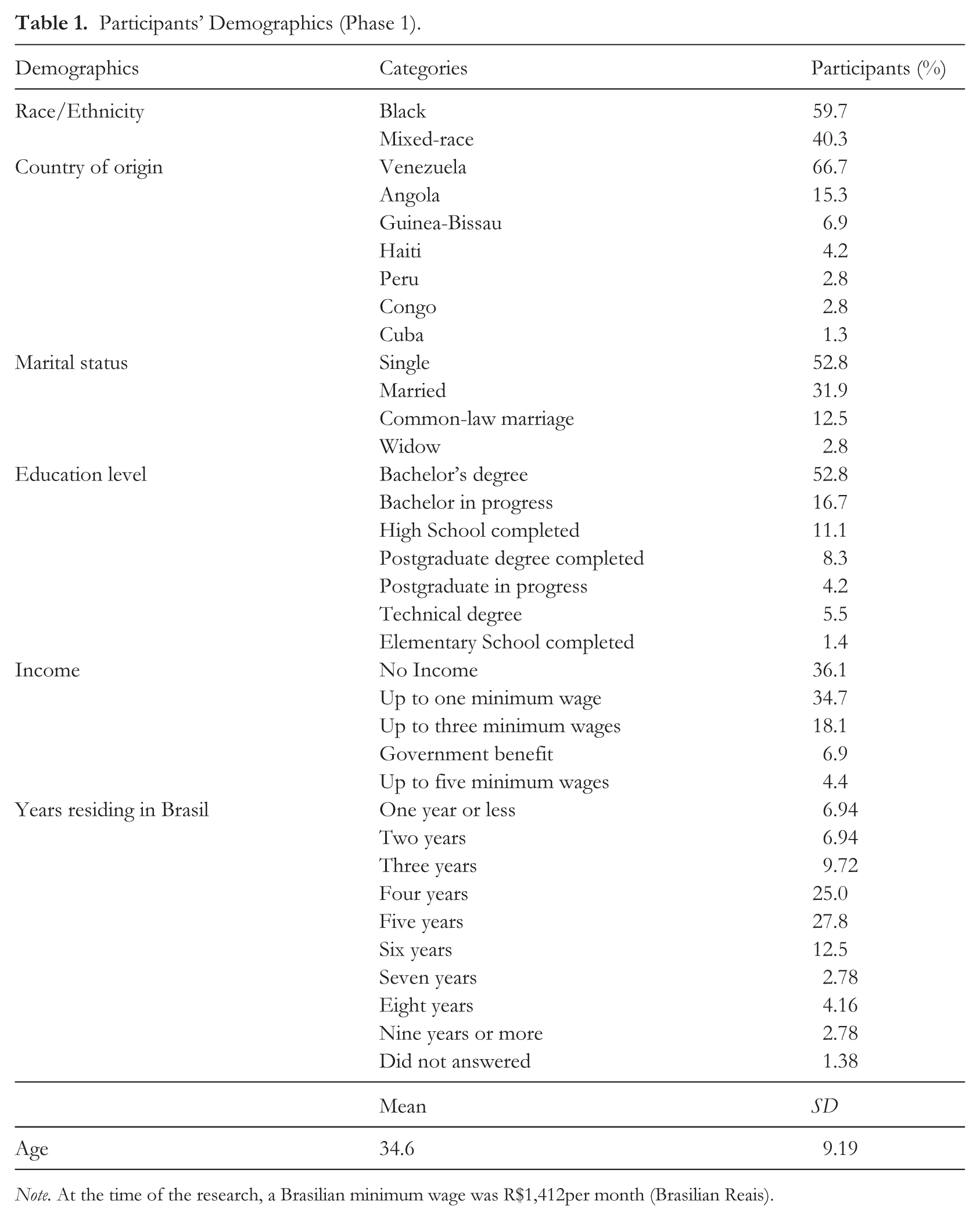
Note. At the time of the research, a Brasilian minimum wage was R$1,412per month (Brasilian Reais).
These variables were analyzed through a two-phase sequential (quantitative–qualitative) mixed-method study with African and Latina migrant women. In the first phase, we collected quantitative data to examine the theorized link between microaggressions and the impostor phenomenon and to analyze how they were associated with perceived barriers and coping. The qualitative phase aimed to deepen and contextualize the patterns identified in the quantitative data by exploring how these dynamics are experienced, interpreted, and resisted in the lived realities of Black migrant women in Brasil’s IT sector.
The datasets are not publicly available due to confidentiality agreements with participants and partner organizations. In accordance with ethical guidelines established by the Brasilian National Health Council (Conselho Nacional de Saúde, Resolução nº 466/2012), the public disclosure of both quantitative and qualitative data is prohibited when it involves potentially identifiable information, particularly from vulnerable populations. Given that participants were recruited through a migration support NGO and many face visa-related vulnerabilities, maintaining full confidentiality was essential to ensure their safety and compliance with national ethical standards.
Phase 1—Quantitative Study
Participants and Procedures
The research was approved by the local ethics committee and was conducted in partnership with a Brasilian institution that trains refugees and migrants for applying for jobs in IT. A power analysis was conducted using G*Power (Faul et al., 2007) to estimate the minimum sample size. Based on prior studies reporting small-to-moderate associations between the impostor phenomenon, microaggressions, and mental health outcomes (e.g., Bernard et al., 2017; Martins et al., 2020), the analysis assumed a medium effect size (r = .30), a two-tailed test, α = .05, and power (1 − β) = .80, resulting in a minimum sample of 84 participants. To ensure alignment with the study’s objectives, participants were excluded if they were under 18 years of age, did not self-identify as Negra (including Black or Mixed-Race [Parda] in the Brasilian context), were not enrolled in an IT degree or had no paid work experience in the sector, or did not originate from the Global South.
The questionnaires were distributed by the partner institution, which invited eligible participants via email to take part voluntarily in the study. Data were collected between June and November 2023, with participant anonymity ensured by restricting the institution’s access to response counts only. All data were securely stored on password-protected computers and accessed exclusively by authorized research team members.
A total of 72 women participated (see Table 1). Because racialized migrant women constitute a hard-to-reach population in Brazil and payment for research participation is prohibited by national ethical guidelines ((Conselho Nacional de Saúde, Resolução nº 466/2012), the final sample represented approximately 86% of the recommended size. Data were analyzed using the JASP statistical software (version .0.17.2.1). Correlational and descriptive analyses were conducted to examine the relationships among variables.
Measures
The scales were administered in their Brasilian Portuguese versions, provided by their respective transcultural validation studies. None of the participants experienced difficulties with answering the questionnaire, since they were bilingual and familiar with Portuguese.
Experiences of racialized gender microaggressions were measured using the seven items from the Gendered Racial Microaggressions Scale (Lewis & Neville, 2015). For stress level, the response ranges were from 1 (“Not at all stressful”) to 5 (“Extremely stressful”), and for frequency they varied from 1 (“Never”) to 5 (“Once a week or more”). The reliability of microaggression’s frequency was ω = .89 and for level of stress was ω = .90. A sample item is: “My comments have been ignored.”
Impostor feelings were assessed using the 20 items from the Clance Impostor Phenomenon Scale (Bezerra et al., 2021). The scale ranges from 1 (“It doesn't describe me”) to 5 (“Fully describes me”). A sample item is: “I have often succeeded on a test or task even though I was afraid that I would not do well before I undertook the task.” McDonald’s omega coefficient was ω = .90.
Perceptions of racial and gendered career barriers and coping were measured using the 13-item Barriers Likelihood and Coping Scales (Frutuoso & Oliveira-Silva, 2023). For each item, participants rated both the likelihood of encountering a specific barrier and their perceived potential to overcome it. Sample items include “Experiencing sex discrimination in hiring for a job” and “Not being paid as much as coworkers of another racial/ethnic group.” For both barrier likelihood and coping scales, the response ranges from 1 (“Not likely”) to 7 (“Very likely”). The following McDonald’s coefficients were obtained: racial barriers likelihood (ω = .85), coping with racial barriers (ω = .93), gendered barriers (ω = .94), and coping with gendered barriers (ω = .94).
Results
As shown in the correlation coefficients in Table 2, impostor phenomenon scores were positively associated with both the frequency and perceived stress of racial–gender microaggressions. The frequency of racialized gender microaggressions was positively and significantly correlated with perceptions of racial and gender career barriers. However, the impostor phenomenon showed negative but non-significant correlations with racial and gender coping.
Descriptive Results and Correlations.
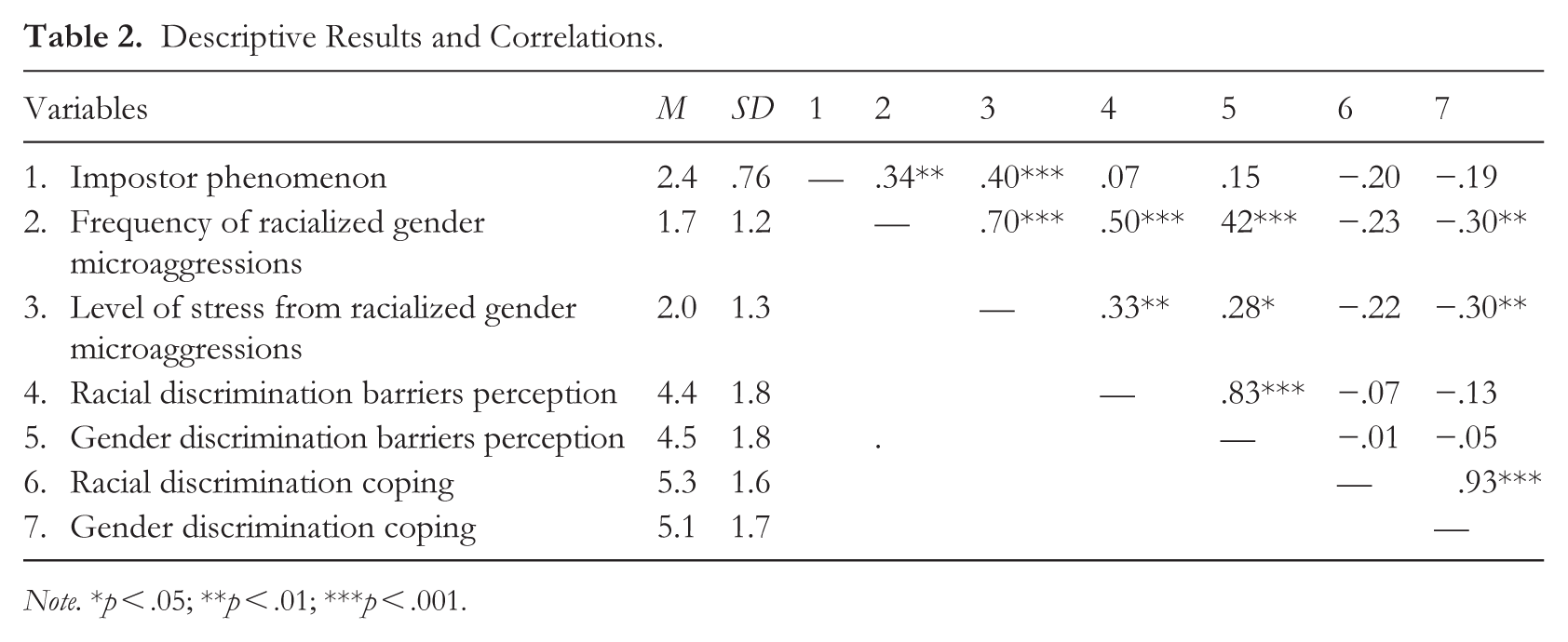
Note. *p < .05; **p < .01; ***p < .001.
Correlations between impostor phenomenon and racialized gender microaggressions were of moderate magnitude (r = .34–.40). Associations between microaggression frequency and both racial and gendered career barrier perceptions were moderate to large (r = .50 and r = .42), while the correlation between frequency and stress related to microaggressions was large (r = .70), suggesting substantial overlap between exposure and subjective impact.
Discussion
Our findings support and expand existing research showing that microaggressions are not isolated events but expressions of systemic bias that erode self-confidence and reinforce internalized doubt, especially for racialized women navigating professional environments. Recent scholarship on the impostor phenomenon, for instance, has reconceptualized it as a socially situated and structurally induced response to environments affected by sexism, racism, and xenophobia (Chakraverty, 2022; Feenstra et al., 2020, 2026). From this perspective, impostorism is better understood as a psychosocial consequence of structural inequality, emerging from enduring patterns of devaluation embedded in institutional norms, workplace cultures, and historical legacies of exclusion (Collins, 2000; Crenshaw, 1989). Our data supported this since racialized gender microaggressions were significantly and positively associated with impostor phenomenon scores. This suggests that impostor feelings are not detached from external context but rather intensified by the constant need to manage subtle, cumulative acts of invalidation in the workplace.
Similarly, our results evidenced that the frequency of racialized gender microaggressions was strongly correlated with perceived racial and gender career barriers. This supports prior research showing that microaggressions are not only psychologically damaging but also function as markers of deeper organizational inequities that restrict advancement and undermine perceptions of fairness (Holder et al., 2015; Sue et al., 2007).
Conversely, impostor phenomenon scores were not significantly related to participants’ perceived ability to cope with racial and gender career barriers. Existing literature also suggests that coping strategies may not buffer the effects of impostorism, especially in exclusionary environments. Bernard et al. (2017) and McClain et al. (2016), for example, argue that impostor feelings can persist even in highly competent individuals when social belonging is undermined. Parkman (2016) further notes that workplace climates play a larger role than personal traits in shaping these feelings. Thus, perceiving oneself as capable of overcoming gender and race barriers does not necessarily translate into psychological protection if the structural context remains hostile.
Phase 2—Qualitative Study
Participants and Procedures
Among the 72 participants of the quantitative phase, 59 expressed interest in the qualitative phase, 25 were invited for an in-depth interview, and 10 were individually interviewed according to the termination criterion of saturation (Minayo, 2017). Pseudonyms were assigned to the participants based on the names of Brasilian Black women intellectuals and/or political activists for the rights of women and marginalized or racialized populations. Table 3 lists participants’ country or origin, age, education level, academic background, and income.
Participants’ Demographics (Phase 2).
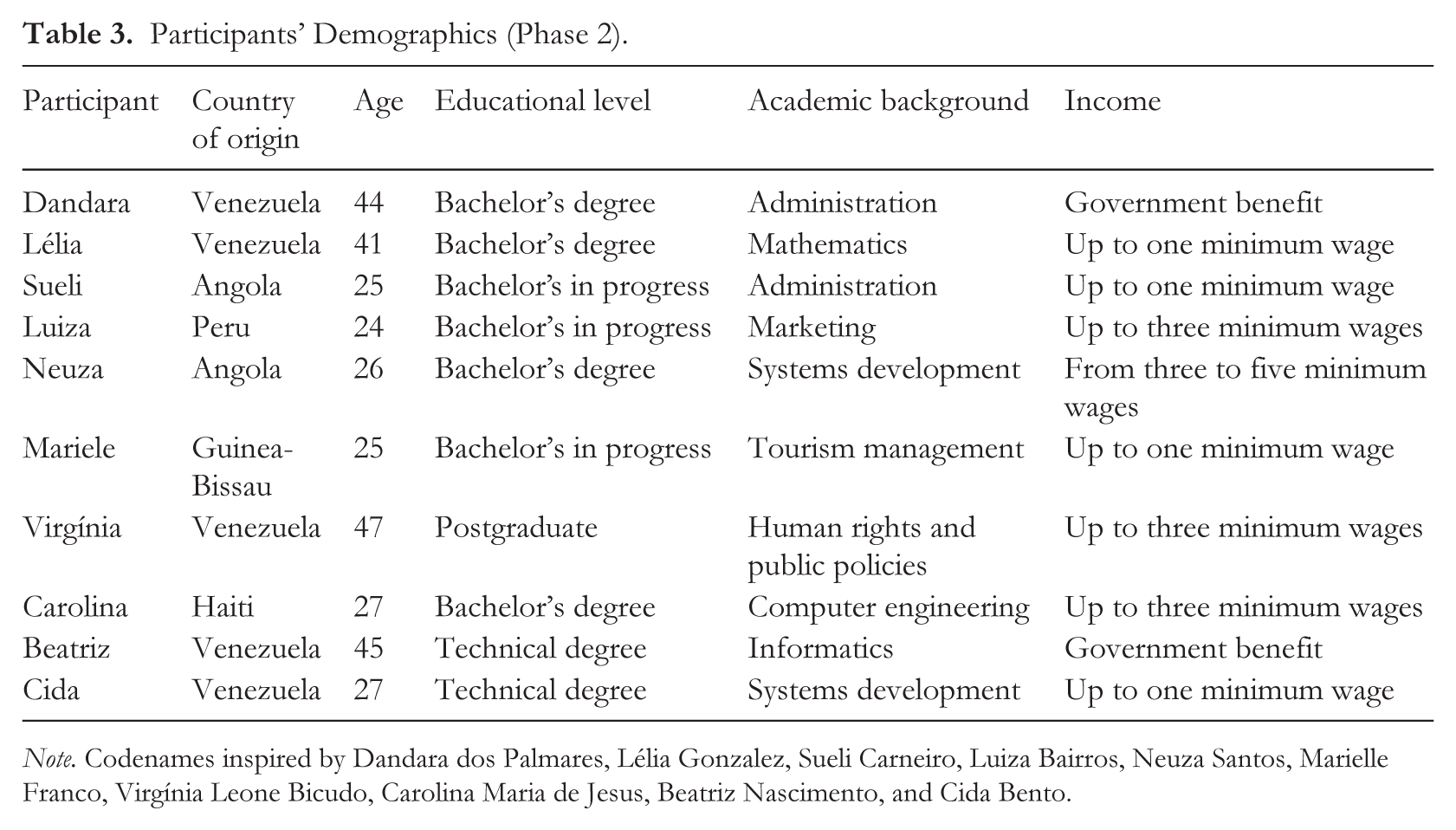
Note. Codenames inspired by Dandara dos Palmares, Lélia Gonzalez, Sueli Carneiro, Luiza Bairros, Neuza Santos, Marielle Franco, Virgínia Leone Bicudo, Carolina Maria de Jesus, Beatriz Nascimento, and Cida Bento.
To explore participants’ lived experiences in depth, we developed an interview script organized around four themes: (1) lived experiences as Black migrant women in the workplace (e.g., “What is it like being a Black refugee and/or migrant woman in the Brasilian labor market?” and “What barriers have you encountered as a Black refugee and/or migrant woman in Brasil?”); (2) experiences of microaggressions (e.g., “What are the subtle forms of differential treatment you notice at work?” and “How do you feel when someone treats you differently at work?”); (3) impostor feelings (e.g., “Have you ever doubted yourself or felt incapable?”, “Have feelings such as fear or insecurity ever held you back or prevented you from doing something?”, “How do you feel when you notice that someone doubts your knowledge or abilities?”, and “How does this affect the way you see yourself?”); and (4) and strategies for overcoming barriers (“What would help you overcome the barriers you have encountered?”).
The interviews lasted an average of 40 minutes and were conducted synchronously via video calls, including audio-recorded with participants’ consent. A pilot interview indicated no comprehension issues with the interview script. Audio recordings were transcribed using Microsoft Word’s automatic transcription feature, generating initial transcripts. The transcripts were reviewed and refined to ensure accuracy and coherence, with minor grammatical adjustments and clarification of word choices. Particular attention was given to expressions from other Lusophone contexts, such as Guinean and Angolan Portuguese, as well as syntactic influences from Kriol or Spanish. The software NVivo was used to link excerpts to codes and themes. Analytic decisions were documented throughout the process, and preliminary codes were discussed within the research team to support triangulation. Member checking was not conducted, since meaning was understood as co-constructed rather than participant-verified.
Initial coding followed the principles of reflexive thematic analysis as outlined by Braun and Clarke’s (2019) six stages: (1) familiarization with the data through repeated reading; (2) generation of initial codes capturing meaningful features of the data; (3) searching for broader patterns by clustering related codes into candidate themes; (4) reviewing themes in relation to the coded data and the full dataset; (5) defining and naming themes to capture their analytic scope; and (6) producing the report. Subsequently, these codes were refined to highlight the triangulation with variables from the quantitative study. Overlapping codes were clustered to reflect the relationship between structural barriers and subjective experience, resulting in two overarching thematic domains: Intersectional Barriers and Resistance and Resources. The concept of Gendered Racial Migratory Battle Fatigue (GRMBF) emerged as a theoretical synthesis that captured the cumulative toll of intersecting racial, gendered, and migratory stressors. A thematic map was developed to provide a visual representation of the analysis (see Figure 1).
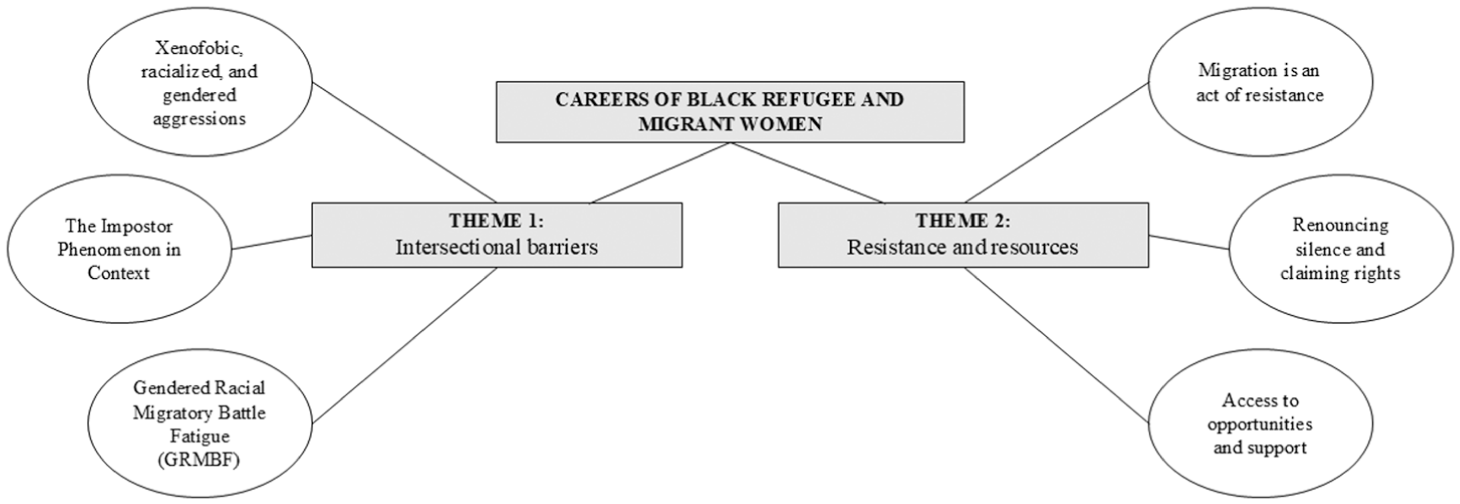
Thematic summary.
Positionality Statement
The qualitative analyses were conducted by the first two authors—both mixed-race Black Brasilian women from working-class backgrounds—whose lived experiences as internal migrants in Brasil shaped their analytical lens. Their social positioning and engagement with Black Brasilian feminist thought informed a critical, situated perspective throughout the research process. The analysis that follows emerged from a reflexive engagement between the study’s theoretical framework, the analyzed variables, participants’ narratives, and the researchers’ situated interpretations.
Results
Our findings reveal that Black migrant women in Brasil’s IT labor market face intense pressure to repeatedly prove their competence while confronting intersecting forms of racism, sexism, and xenophobia. This ongoing struggle results in what we termed the Gendered Racial Migratory Battle Fatigue (GRMBF). Despite challenges, participants demonstrated agency through diverse individual, collective, and structural coping strategies, including drawing on community support and advocating for institutional change. The thematic summary is displayed in Figure 1, reflecting the following major themes:
Intersectional Barriers
Xenofobic, Racialized, and Gendered Aggressions
All participants reported experiences of aggression, ranging from explicit exclusion to subtle delegitimization. We opted not to use the term “microaggressions” here since participants’ accounts demonstrated experiences that could not be considered “micro” but instead heavy, overt forms of violence, making the term “aggressions” more appropriate. Overall, these women situated their experiences within the broader context of South-to-South migration and the intersectional experiences of prejudice faced by racialized migrants in Brasil. Mariele, an immigrant from Guinea-Bissau, described how moving to Brasil forced her to confront intersectionalities in ways she had not before: I come from a context where we didn’t even know what the difference between colors was . . . until I arrived here in Brasil, where I started to feel in my skin that I am a Black woman and that means being treated differently. . . . Imagine for someone who is foreign, who suffers prejudice twice as much—for being Black and for being a foreigner.
Sueli and Lélia reflected on the unequal treatment they observed based on both race and nationality, emphasizing how whiteness afforded European migrants opportunities that were systematically denied to Black migrants: I noticed a difference in treatment mainly because I am a foreigner and African, because I saw that when a person here is a foreigner and European, the treatment is different. (Sueli) A white migrant has an opportunity. The difference with Black migrants is that an Italian can come here as a construction worker in his country and arrive here as a language teacher. They can quickly establish themselves, but a Black person who was a teacher in their country, whether a university professor, here has to be something else, a street cleaner, painter, or nanny. (Lélia)
The Impostor Phenomenon in Context
Insecurity and fear of making mistakes also emerged, but participants contextualized these feelings as responses to structural exclusion rather than as personal deficiencies. In contrast to the original approach to impostor syndrome (Clance & Imes, 1978), participants’ reflections aligned with recent critiques that locate impostorism within environments of discrimination (Feenstra et al., 2020, 2026; Tulshyan & Burey, 2021). This is exemplified by Sueli: But sometimes . . . I would wonder if the mistake was mine or . . . the people I worked with.
Luiza, in turn, linked her insecurity to language prejudice, although acknowledging her cultural background: I was born in a different country, a country that speaks a different language . . . I was actually afraid to speak, because I was worried the person would laugh at me or say they didn’t understand me and make mean jokes. So, this part affected me a lot. There is insecurity because you don’t know if the person is going to laugh at you, if they will understand you.
As shown in our quantitative phase, the impostor phenomenon was positively correlated to racialized gender microaggressions, suggesting that the persistence of this covert aggression and their resulting negative emotions shapes how women view themselves. As Luiza pointed out, the act of laughing or making jokes about her pronunciation erodes her confidence to speak, reinforcing the correlation results. These accounts underscore the need to understand the impostor phenomenon as socially produced, embedded in discriminatory environments that impose additional barriers on Black migrant women’s professional experiences.
Gendered Racial Migratory Battle Fatigue
Evidence from both phases supports the existence of this phenomenon, besides demonstrating that the psychological exhaustion is not an isolated emotional reaction but a patterned response to intersecting oppressions. In the quantitative phase, higher levels of stress were significantly associated with the frequency of gendered racial microaggressions, as well as with the perception of ethnic–racial and gender career barriers. The qualitative findings further illustrate these dynamics, revealing the psychological toll of recurring exclusion in the workplace. Mariele highlighted the emotional strain of enduring such conditions: In the workplace, my experience was one of the most painful experiences I’ve ever had. It affected me a lot psychologically; it reached a point where I would leave home crying to go to work. But I went out of obligation because I really needed to stay here.
For Cida, the fatigue was internalized as guilt tied to her migration status: “Sometimes, I feel guilty, you know? Guilty for being a refugee, for being someone who isn’t from here.” (Cida)
Despite the heavy psychological costs of recurring discrimination, the interviews also revealed strategies of resistance and resources through which they navigate and contest these intersectional barriers, highlighting their active role as agents of survival and resilience.
Resistance and Resources
Migration Is an Act of Resistance
For many participants, migration was not simply a movement across borders but a deliberate act of survival, courage, and resistance. Choosing to leave their home countries and rebuild their lives in Brasil was framed as an expression of agency in the face of structural inequalities and limited opportunities in their places of origin. This reframing challenges views of migrants as vulnerable or passive, instead situating their trajectories within a broader tradition of Black diasporic resistance that links survival with dignity and self-determination (Collins, 2000; Gerber & Nascimento, 1989; Gonzalez, 1984). Mariele reflected this positioning in her statement: The fact that I am here in Brasil, coming from afar, without knowing anyone, and living here, I am already a winner. I am courageous. So I try to face life as it is.
Renouncing Silence and Claiming Rights
Most participants emphasized the importance of raising their voices and asserting their right to recognition and equality. These narratives resonate with bell hooks’s (2019) conception of voice not merely as speech but as a healing and defiant act that affirms marginalized people as subjects of their own history. This also reflects Black feminist traditions in the Global South, which understand voice and testimony as central tools for both survival and resistance (e.g., Gonzalez, 1984; Ribeiro, 2017). Virgínia highlighted this stance: Look, I am a global citizen, I have rights and my duties. I will claim my rights here because the Federal Constitution states that immigrants have the same rights as Brasilians.
Participants highlighted the healing and liberating potential of voice especially when supported by safe spaces for listening and sharing professional journeys. Refusing silence allowed women to reclaim their stories, make sense of the intersections shaping their experiences, and resist narratives that individualize exclusion. Lélia, for example, described how collective dialogue in migrant discussion circles fostered recognition and belonging: Talking makes you realize that you are not a problem . . . You realize through similar stories that it's a social issue. Speaking and listening, seeing someone else who is going through the same situation, it's like getting new air. Social projects are very important for migrants. Since we are alone in Brasil, often not talking to our families, you can be with a group that supports you.
Similarly, Neuza pointed out how sharing her story carried the potential to inspire hope in others: We talked a lot about ancestry, about the career of Black women . . . It’s good to talk; when you’re a foreigner, it’s good to hear the story of another foreigner who managed to overcome . . . it gives you hope that you can still make it
Thus, in speaking and being heard, migrant women transform personal experiences of discrimination into collective narratives of resistance and empowerment. The interviews themselves were also described as empowering moments. For Luiza, it was the first time she had been able to speak openly about her experiences: No one has ever asked me what you asked, and I think that’s important, having a moment like this, where we can let everything out. In the seven or eight years I’ve been living here, I’ve never had the opportunity to talk so openly with anyone.
Access to Opportunities and Support
Women emphasized education, training, and language learning as tools to strengthen their employability and counter stereotypes about competence. They explained the cultural weight placed on education as a survival strategy, as well as support in terms of language training: When I arrived here, I immediately noticed this racial situation . . . So, I sought to join free courses that addressed this topic. There is a saying that Brasilian people often say: the only way out for a poor or Black person is to study. (Neuza) I believe that free Portuguese classes are greatly needed . . . having the opportunity to take Portuguese classes for immigrant women would make things easier for them, especially in the workplace. (Luiza)
Beyond individual strategies, participants directly challenged organizations to move beyond symbolic inclusion and address structural discrimination. Their testimonies show that resistance also takes the form of calling out exclusionary practices and insisting on genuine diversity: They can’t talk about inclusion, about diversity, when in reality, a lot of things are just on paper. (Virgínia) Companies need to train employees working in human resources . . . When Brasil receives people from all over the world, it shouldn’t be a shock to see a foreigner in an interview. (Neuza)
At the same time that women are compelled to continually prove their worth through resilience and skill-building, these very strategies simultaneously expose the failures of policymaking and organizational structures to recognize and value their contributions. The women who participated in this study were qualified, holding higher education degrees in diverse fields as well as technical expertise in technology. Yet, they consistently encountered barriers and discrimination that restricted their access to opportunities and advancement, emphasizing that the issue is one not of skills but of recognition.
Discussion
To contextualize the workplace aggressions experienced by Black migrant women in Brasil’s IT sector, Latin American scholarship offers important insights. Gonzalez (1984), for instance, discusses how racialized, gendered, and classed exclusions in the Brasilian context contribute to excluding Black women not only economically but symbolically, reducing them to "the body." This exemplifies how racialized women’s labor is often undervalued even when they possess high levels of formal education, with institutional norms reproducing colonial hierarchies of whose knowledge and work counts. Our participants’ testimonies reflect these dynamics when they describe being seen as unqualified regardless of their education or professional experience.
Likewise, Fernandes (1972) noted how representations of Black people are shaped by entrenched stereotypes that fix cultural differences and stigmatize “the other” through their image, a process that Bhabha (2007) frames as central to the symbolic reaffirmation of racial and national boundaries. Representations of Black migrant women as the "other" (Akotirene, 2018) also reinforce whiteness and Europeanness as the global norm of civilization and competence. Participants’ reflections on racialized national hierarchies, in which white European migrants are granted credibility and value while South-to-South migrants face compounded devaluation, also resonate with Brasil’s colonial past and racialized immigration policies: at first, millions of Africans were forcibly brought to sustain the economy during slavery (Andrews, 2004); after, in the late nineteenth and early twentieth centuries, successive waves of European migrants, particularly Italians, Germans, and Portuguese, were recruited under state policies aimed at “whitening” the population (Holloway, 1980; Lesser, 2013; Schwarcz, 1993; Seyferth, 2002; Skidmore, 1993). These historical processes entrenched a hierarchy in which whiteness became associated with civilization, competence, and legitimacy, while Blackness and non-European origins were devalued. Considering our participants’ quotes, such legacies continue to inform perceptions of migrant worth in Brasil.
Regarding the Gendered Racial Migratory Battle Fatigue (GRMBF), similar patterns of chronic stress linked to racial-gender microaggressions have been documented among Black Brasilian women (Martins et al., 2020), highlighting how workplace aggressions produce not only emotional strain but also career stagnation. These findings reinforce the notion that “impostorism” is not internal dysfunction but a socially induced psychological response to systemic exclusion (Chakraverty, 2022; Feenstra et al., 2020, 2026).
Despite the numerous obstacles, women do not perceive themselves as passive victims. The strategies of resistance reported by participants resonate with long-standing Black feminist traditions across the Americas. The idea of voice as political reclamation, as articulated by hooks (1989, 2019) and Collins (2000), is echoed in our participants’ attitudes towards speaking out. In Latin America, this notion is powerfully extended by Ribeiro (2017) and Gonzalez (1984), who argue that Black women’s testimony and memory function as both healing and subversive acts. Participants’ acts of pursuing professional training, building networks with other migrant women, and accessing social programs represent not mere survival tactics but forms of political action grounded in dignity and collective solidarity.
Overall, our qualitative data reinforce the understanding of the impostor phenomenon as a socially produced response to exclusion and deepen the intersectionality of racial hierarchies and coloniality in the workplace context. Additionally, they highlight the diversity of the barriers encountered and detail the collective coping strategies, such as reframing migration as an act of agency, exercising voice, accessing education, and building networks.
General Discussion
By centering the voices of Black African and Latina migrant women in Brasil and situating their experiences within broader histories of colonialism and racial stratification, this study contributes to the decolonization of social psychological research. We also propose the concept of "gendered racial migratory battle fatigue,” which describes the psychological exhaustion migrants face due to recurrent discrimination. Finally, we point to the limitations of policies and practices that demand resilience without structural recognition.
To our knowledge, our study is the first to analyze the relationship between microaggressions, imposter syndrome, and resistance strategies from a mixed-method approach. Both quantitative and qualitative findings reinforce how microaggressions and the impostor phenomenon can be associated. Although initially conceived as individual variables, our study provides further evidence of the need to shift the focus to the context. Participants demonstrated that insecurity and fear of mistakes arise not from lack of competence but from systemic exclusion and the burden of navigating multiple forms of oppression, framing impostor feelings as products of microaggressions and discriminatory environments (Feenstra et al., 2020; Tulshyan & Burey, 2021).
Both quantitative and qualitative data evidenced elements of resistance and resources to face adversities. In Phase 1, perceptions of overcoming barriers were greater than perceptions of encountering barriers. In Phase 2, interviewees' accounts pointed to pathways of agency and resistance, suggesting that these women do not see themselves trapped by the social inequality they face. Therefore, our study contributes to telling alternative stories about migrant women, challenging narratives that reduce them to personal vulnerability.
Limitations and Future Research
The relatively small and sector-specific sample can limit the generalizability of the findings to other professions, regions, or migrant populations. The quantitative phase relied on self-report instruments and cross-sectional data, which constrained causal inference. Additionally, although the qualitative analysis benefited from the positionality of the authors as Black Brasilian women grounded in Black feminist thought, reflexivity is needed to recognize how this standpoint may shape interpretation. Finally, other dimensions of intersectionality (e.g., class heterogeneity, sexuality, and disability) were not addressed.
Future research should further investigate how to implement organizational strategies to accommodate Black migrant women's needs, such as implementing intersectional diversity and inclusion policies with measurable targets for hiring, retention, and promotion, as well as creating safe spaces such as resource networks where marginalized employees can share experiences and influence organizational policy. Studies could also explore how abandoning meritocracy-based approaches and instead sensitizing managers and employees to institutional racism, sexism, and xenophobia impacts workplace culture and career outcomes for migrant women.
Conclusion
While prior research has analyzed microaggressions and impostorism in isolation or as individual-level outcomes, mainly through Global North samples, this study exposes how these variables interact to shape the experiences of South-to-South migrant Black women, in a STEM field, in a Global South country. Drawing on our findings that show how barriers and coping experiences are mutually constitutive, we offer the concept of GRMBF as a response to better understand the persistent inequality in a sector widely framed as meritocratic and innovative.
This study offers contributions to social psychological theory by challenging individualistic framings of microaggressions and impostorism within marginalized groups. Additionally, the Gendered Racial Migratory Battle Fatigue (GRMBF) proposition integrates insights from the racial battle fatigue concept (Smith et al., 2011) and intersectionality theory (Collins, 2000; Crenshaw, 1989) to capture the accumulated burden of being a racialized women from the Global South in a STEM field.
This research contributes to the decolonization of social psychological theory by centering Black African and Latina women’s voices as legitimate sources of knowledge, rather than positioning masculinity or whiteness as implicit standards of comparison. From a practical standpoint, it highlights the need for initiatives that amplify women’s voices by valuing their lived experiences and creating spaces in which they can speak for themselves (Bain et al., 2021; Spivak, 1988).