







Abstract
In what ways can a community music education project based on historical re-enactment be a vehicle for transformational learning, empowerment and reconnection with community? In 2018, Serenading Adela was performed to celebrate and remember the 100th anniversary of a moment in history when women sang under the prison cell window of Adela Pankhurst, an anti-conscriptionist. The operatic work, which recruited 100 adult participants, was conceived and developed over almost 2 years and rehearsed for 5 months. The researchers were interested in participants’ motivations and their experiences of engagement with a story of historical injustice. Data were collected by holding interviews and focus groups and analysed using thematic analysis informed by Freirean concepts. Five themes emerged, indicating that the pedagogical approach and ideologies of the directors enabled and nurtured collaborative connections, personal growth, new perspectives, meaning-making and empowerment for a diverse group of adults.
Introduction
This article focuses on a community music education project, a street opera, staged in Australia at Pentridge Prison (8 km north of the centre of Melbourne) in 2018. We argue that the project is an example of transformational learning through its focus on raising awareness of a historical injustice. A small group of politically active leaders with a strong commitment to knowledge exchange led the project, which took almost 2 years of planning and 5 months of rehearsals. Most participants were older adults, however, the overall age range was from teenagers to 80-year-olds. The street opera, Serenading Adela, was developed to remember the 100th anniversary of a forgotten moment in history when approximately 50 women sang under the prison cell window of Adela Pankhurst, imprisoned in Pentridge Prison, Melbourne, for her anti-conscription rallies. The project’s leaders had access to the original prison site, and used historical re-enactment in a creative project which provided opportunities to contribute for all involved. The 100 participants were intensely engaged, researching historical documents, making costumes and billboards and exploring a theatrical re-enactment that drew on both historical and devised words and music.
The project sat within the Brunswick Coburg Anti-Conscription Commemoration Campaign (2016–2018), formed to commemorate the successful anti-conscription campaigns of WW1, when Brunswick and Coburg voted overwhelmingly ‘No’ in the referendums of 28 October 1916 and 20 December 1917 (Culture Victoria, 2016). The Adela story offered a way to challenge pro-war sentiments through a competing story of the suppression of women’s voices and history. This story of Adela Pankhurst (1885–1961), daughter of feminist pioneer Emmeline Pankhurst, was inspired by a newspaper article describing how a group of mainly women had sung, cheered and coo-eed outside Adela’s prison window as a sign of support on 7 January 1918 (Herald [Melbourne], January 8, 1918).
Transformational learning is a Freirean concept and encompasses learning-induced changes for teachers and learners. This pedagogy, in which experiences and knowledge are shared, often examines historical realities as a means to reflection, dialogue, group problem-solving and raising of critical consciousness, referred to by Paolo Freire as conscientisation (Freire, 1972). Known as critical pedagogy and relevant across the life-course, it is generally termed critical geragogy (or critical gerontology) when applied to older adults. Our research aims to fill an important gap in the literature to understand what approaches, aspects and practices make transformational learning possible in a community project. To uncover possible answers, we begin this paper by examining several key aspects of the project through the lens of Freirean (critical) pedagogy. We then draw on interviews and focus groups to investigate the factors that brought participants to the education project; processes that kept them engaged; and ways they experienced change as a result. Throughout this, we acknowledge there is always going to be a need for a flexibility in approach for such projects because people’s contexts, histories and personalities are diverse.
Historical re-enactment
A recent major study by Ryan (2021) reveals that re-enactors of Medieval historical events undertake detailed research to ensure role portrayal and reproduction of artefacts. The study shows that practitioners and cohesive re-enactment groups contribute and share their repositories of equipment and expertise. Knowledge is passed on orally, the re-enactors believing their research and participation contribute to historical debate in the field of medieval history and heritage. These re-enactments also bring emotional connections to the past and an embodied experience of history (Johnson, 2015; Mikula, 2015). As Agnew argues, re-enactment preparation, rehearsals and performances are strongly connected to ‘personal experience, social connections and everyday life’ (Agnew, 2007, p. 300). In Medieval re-enactments, learning is deep and enjoyable, and the performance exchange with the public is highly significant, resulting in confidence building through learning and participation (Ryan, 2021). Pride and a sense of achievement are common experiences and participants often report personal satisfaction and life enhancement, as well as new knowledge (Ryan, 2021). To summarise, re-enactments offer a personal, embodied experience of historical daily living that links to Freirean reflection on historical realities, providing new perspectives, lifelong learning and sense of achievement.
Serenading Adela was foremost a community music project and branded a ‘street opera’. Street music typically encompasses busking, and outdoor performances associated with events, including protests (English, 2020; McKay, 2007). It has a semi-improvised feel, countering the discipline seen in more formal music settings, providing space for individuality. In the UK political choirs involved in street festivals and protests on topics from social justice to environmentalism adopt the term ‘street choirs’ (Campaign Choirs Writing Collective, 2019). In Australia, a capella choirs have been an important part of community musicking since the 1980s, often advancing causes (Rickwood, 2017). For Serenading Adela, the impact of wartime legislation that precluded meetings and music-making indoors inspired use of the term ‘street’ and the inclusion of a street band, referencing times when gatherings, protests and accompanying music had to move outdoors. In a sense the term ‘street’ becomes a moniker for ‘of the people’ through the streets’ and bands’ accessibility. Thus, the term ‘street’ indicates accessibility, the informal, of the people, and forms part of the re-enactment aspect of the opera. Furthermore, the opera can be seen an example of community music activism, relating to community music as an interventionist practice (Higgins, 2020), one whose ‘conscious intention [is] to challenge existing structures’ (Currie et al., 2020, p. 195).
Theoretical framework: Solidarity and critical pedagogy
Critical pedagogy (critical geragogy when referring to older adults) provides possible frameworks for lifelong music learning, based on the teaching of highly influential pedagogue Paolo Freire. In Pedagogy of the Oppressed (1972), Freire states that ‘solidarity requires that one enter into the situation of those with whom one is in solidarity’, reflecting the empathetic approach he advocates for (Freire, 1972, p. 26). Solidarity was an important aspect of the opera, used in a political sense, also coming to mean musical and interpersonal solidarity. The opera organisers and participants were committed to goals of liberation and social change, which align with Freire’s teachings .
Solidarity is a manifestation of the transforming qualities of Freire’s approach. It positions the learner and facilitator as equals in co-creating knowledge through dialogue and problem-solving (Freire, 1972). The purpose is to empower learners and facilitators to question assumptions and values, explained as raising critical consciousness (conscientisation), which in turn leads to awareness of inequities and motivates participants to change their world. The main vehicles to this are dialogue, a cooperative activity based on respect which leads to enhancing community; and praxis, which is a continuous process of reflection-action (Freire, 1972).
Freire draws on what he refers to as ‘historical realities’ to prompt reflection and dialogue (Freire, 1972, p. 72). The collective of facilitator and learners create meaning that is transformative through bringing their own experience and context to a consideration of historical inequities. A Freirean approach to teaching is not limited to any age group and informs pedagogy across the lifespan, including critical geragogy (Glendenning & Battersby, 1990). Critical geragogy is an approach that places the older learner’s voice, context and background at the forefront in learning scenarios.
In music education, Lucy Green is an advocate for a Freirean approach, which underpins her commitment to informal music education as a means to build collaborative learning through dialogic action (Green, 2008; Green & Narita, 2015). In their work with older adults, Creech and Hallam (2015) argue that opportunities for transformation and empowerment follow when the participant’s voice is privileged, and learning encompasses collaboration, dialogue and reflection. In community music, which typically has a high proportion of older learners, Creech and Hallam (2015) also argue that the approach of the facilitator is critical to engaging, motivating and empowering members (Forbes & Bartlett, 2020). In research in Australia with choirs for older adults, Davidson (2011) adds to this list experiences of self-expansion and liberation as part of the transformative process.
We chose to engage with critical pedagogy as a framework for data analysis, noting its relevance to the historical focus and transformational goals of the opera project. We were especially focused on signs of Freirean transformation: that is, solidarity; self-discovery; changes in perceptions of the world; meaning-making and empowerment (Freire, 1972).
Research Questions
In a Freirean learning environment where knowledge is co-created, the collective (learners and facilitators) are empowered to reimagine their worlds through dialogue, meaning-making and solidarity. Drawing on a critical pedagogy framework, we ask (1) ‘what aspects of Freirean pedagogy were present and how did these contribute to the outcomes in terms of participant experience in the opera project?’; (2) ‘how were dialogue and co-creation important in the process of developing the street opera?’ and (3) ‘How did facilitators and participants experience the elements of critical pedagogy, if at all?’.
Methods and materials
A qualitative ethnographic enquiry was conducted to gain deep insights into the participants’ experiences and perceptions. Participants’ names have been replaced by letters (e.g. H or J), apart from the project manager and opera director who wished to be identified. Ethical approval was obtained from the University of Melbourne Ethics Committee (ID144275.1).
Participants
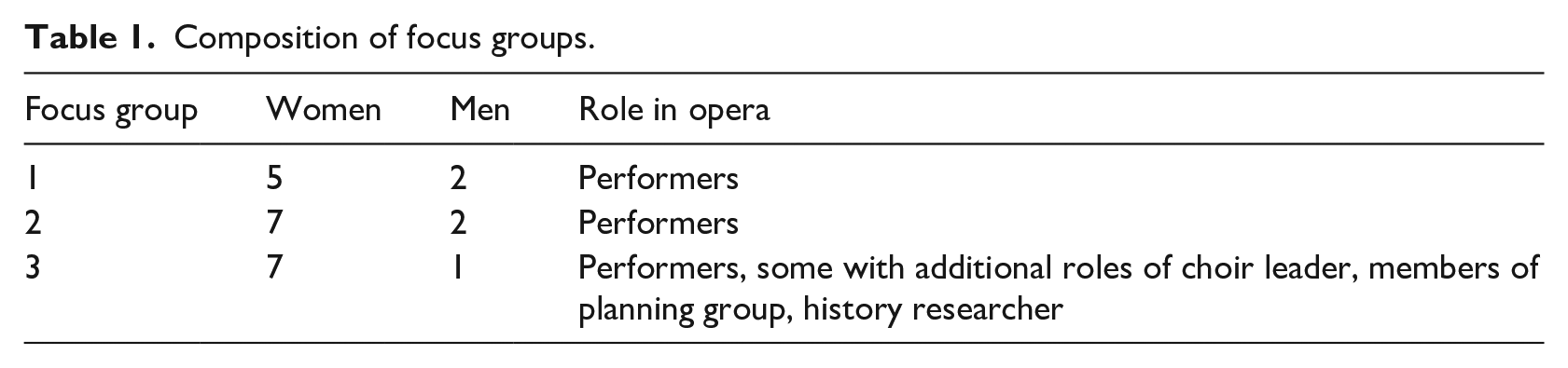
Three focus groups were held with a total of 24 participants, representing one quarter of the total cast. Participation was entirely voluntary, as outlined in the consent form which participants completed ahead of the focus groups. The composition of focus groups is summarised in Table 1 and interviews in Table 2, revealing that the groups varied from 7 to 9 participants, with a ratio of 3.8 women to 1 man. This was representative of the composition of the entire cast. While age of focus group participants was not requested, the researchers were able to categorise participants according to age range, noting that the majority were 55–75 years of age, with only two of the female participants being in the 25–35 age category, one the daughter of an older male participant. The profile of the focus group participants included people with a range of musical experiences and backgrounds, considered to be representative of the overall group. The individual focus groups were formed as people gathered for a post-performance social meeting and grouped themselves around tables which each comfortably sat ten people. The researchers joined each of the three tables in turn to ask questions and stimulate the discussion. By chance, the third group included four people who had roles additional to performers: choir leader, member of planning group and history researcher.
Composition of focus groups.
Project leader interviewees.
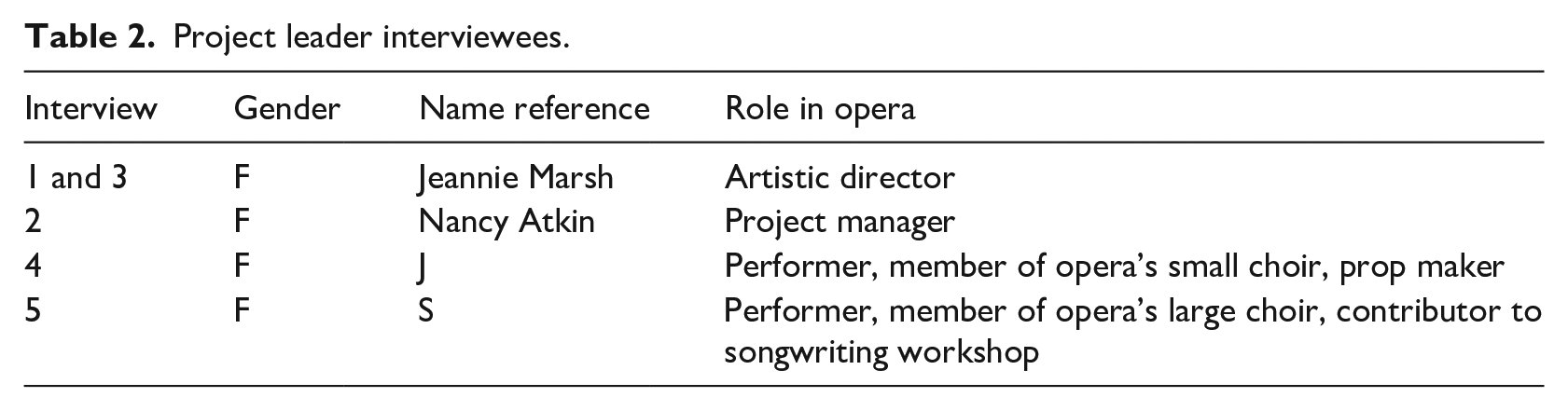
In addition to the focus groups, the researchers carried out two sets of interviews. The first set of interviews took place 2 weeks after the Adela project and aimed to capture details about motivations and a sense of the project’s immediate impact. Interviewees were the artistic director and the project manager. The second group of interviews, taking place 2 years after the initial project, followed up on points around the collaborations and input of participants and explored the longer-term impact of the project. Again, these interviews involved the artistic director and were augmented with input from two further women: one had intensive involvement in the performance as member of the small choir; the other was in the less engaged large choir but attended the development stage workshops.
Data collection tools
Focus groups
The three focus groups were led by the two co-researchers. The following questions were used as starting points for discussion:
Introduce yourself; how did you get involved?
Describe the experience of being in the project. What new learning and skills did you acquire?
Please talk about the project leadership. How was the communication between leaders and participants?
Is there anything particular about the experience of singing? Would the experience have been the same if you’d been acting or reading?
Can you please comment on the commitment of participants, were there people who dropped out?
Bearing in mind the various starting points, what was the overall take-home message?
Interviews
The interviews with the artistic director, project manager and community leaders began with the following questions:
Please talk about who you are and your journey to now. Prompt: What is music/performance for you?
What do you think music’s role in the project is?
What were the high points of the project? (Low points can also be explored)
What skills did you bring? Prompt: musical, material, organisational, others
What do you think of the final product? Prompt: journey, performance, strengths/weaknesses
The second interview with the artistic director used the following questions to initiate discussion:
Community music groups are often described as democratic and inclusive. Please explore this statement from your perspective
In the research and development phase, how did you develop ideas?
Please talk about why you called it a street opera?
Can you tell us what you learned from the process and the participants?
All the interviews were semi-structured, allowing opportunities to follow the interviewee’s lead. This facilitated natural, conversation-like responses, allowing for emergent themes and discussion points to be pursued. The flexibility afforded in the semi-structured approach still permitted the original questions to be addressed.
Procedure
The two authors attended final rehearsals and the performance. They held focus groups the day after the performance, following invitations to cast members from the artistic director. Interviews were held with artistic director Jeannie Marsh and project manager Nancy Atkin 2 weeks later. Further interviews with Marsh and two other participants, community leaders S and J, were held in 2020. All focus groups and interviews were recorded and transcribed later.
Analytical approach
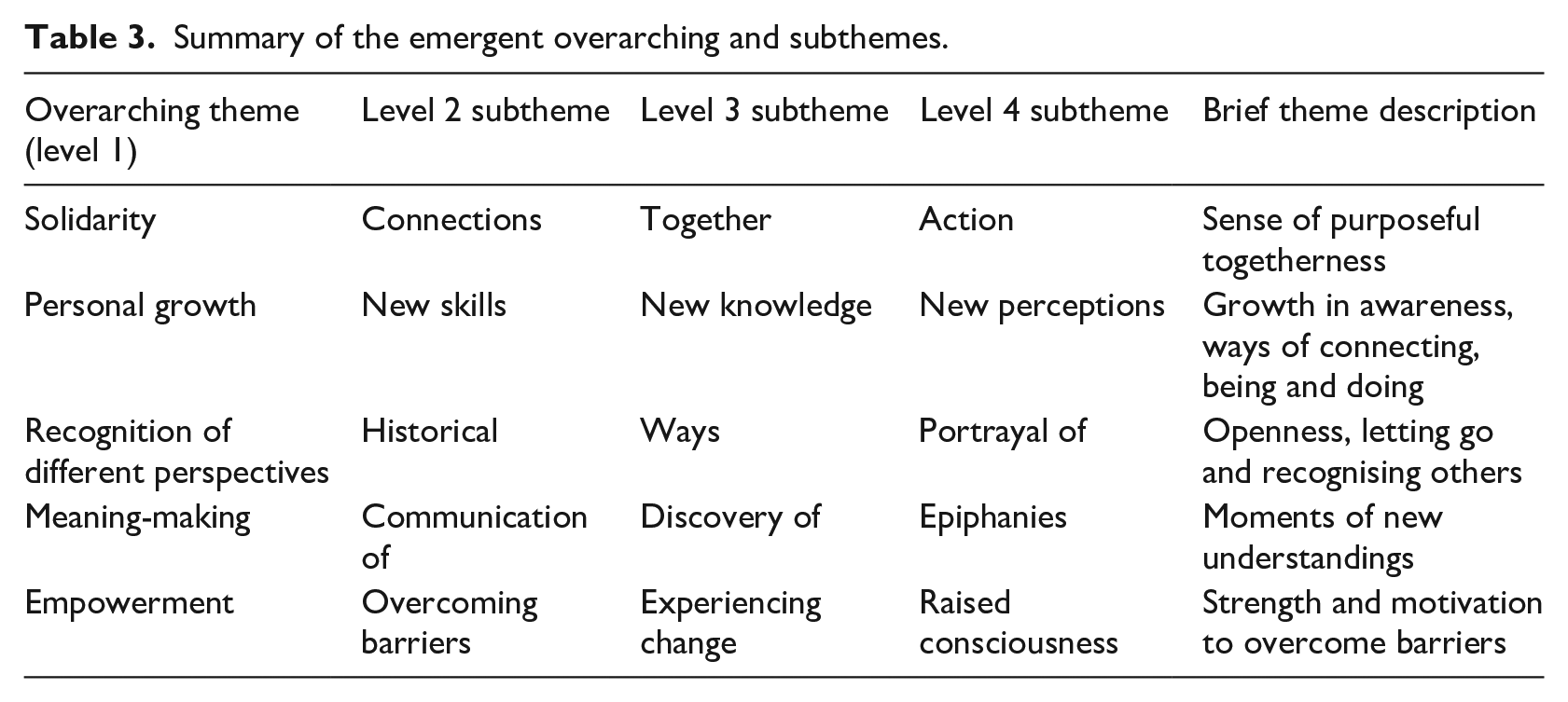
In this research, we allowed a Freirean framework to guide our analysis, keeping in mind his themes of solidarity, critical consciousness, challenging perspectives, co-creation and transformation. We applied Boyatzis (1998) thematic analysis approach, comprising an iterative review of the transcriptions in which the two researchers independently coded the focus group and interview transcripts by hand, reading and marking them up, then conducting a second close re-reading. They next met to discuss the overarching themes. The researchers focused on five themes that resonated with Freire, then returned to the transcripts to identify subthemes as Table 3 summarises.
Summary of the emergent overarching and subthemes.
Results
Five themes emerged of solidarity; personal growth; recognition of other perspectives; meaning-making and empowerment. The five themes are outlined below and discussed in the section following.
Solidarity
The opera included the song Solidarity Forever, which acted as a catalyst for participants to think about the connections and solidarity of the group. Within solidarity, we identified the subthemes ‘connections’, ‘together’ and ‘action’ (see Table 3). Participants described some connections as already formed and motivation for joining the project. They discussed forming more connections during the project and commented, ‘a lot of friendships were remade, and new ones made too’ (P, focus group 3), Singing enhanced the experience, ‘almost like a bonding sort of thing’ (N, focus group 3). The connections led to a feeling of togetherness where ‘you’re all working for the one so you’re working together to make something’ (N, focus group 3). Some described it in powerful language, for example as ‘wonderful magic’ (S, focus group 2) and ‘it was such a feeling of good will and working together’ (G, focus group 2) and a unity that ‘you try to tie yourself into’ (L, focus group 2). This strongly felt dynamic led some to express pride in who they were ‘and the struggles we’ve been part of’ (G, focus group 2) and describe it as ‘a solidness that has come out of the project’, which carried into ‘a different connection to my community’ (L, focus group 3). For those in the opera who had a background in activism, the presence of solidarity leading to action was quickly recognised, as shown in the following: I think everyone . . . could see solidarity. We saw it from our boots up to our ears, and I think that’s common . . . The feeling of singing together, all being different, but we all had a common escape together, and that was the main message that songs were, or the narration was, portraying. S, interview, 2020
In summary, the experience of solidarity as connections supported participants to move together towards action.
Personal growth
Participants were excited about the new skills and knowledge they acquired. They also shared self-discoveries made through bringing together a love of singing, their personal stories and the Adela story. Personal growth comprises the subthemes, ‘new skills’, ‘new knowledge’ and ‘new perceptions’. Participants expressed a sense of wonder at their ability to learn new things, for example, to communicate with emotion and be physical on stage; it was ‘a big change to be theatrical, both in our singing of the song and thinking’ (D, focus group 1) and ‘it’s such a pleasure to actually learn something totally different’ (N, focus group 3). For many this was their first experience of acting, ‘there was a big learning for me in the acting’ (A, focus group 3); and ‘joy and excitement of being extended in the acting’ (L, focus group 3). Participants also rose to challenges to memorise newly-written songs; ‘just really wonderful to have the opportunity to learn them’ (P, focus group 3).
There was new knowledge in learning about anti-conscription history and, in reflection, making self-discoveries. This was described as connecting parts of oneself, bringing together the passion for singing with history and activism: There’s all sorts of stuff I didn’t know about the first World War, I didn’t know about the food shortages, I didn’t know about the Great Strike or I sort of did but I hadn’t connected it, what the civil unrest was, it connected . . . very strongly to my personal story. C, focus group 2 I learned a whole lot of stuff through the project . . . I’ve reconnected with my love of singing and with looking for a choir . . . and then there’s the community I feel more connected to. So I feel like I’ve gained heaps. L, focus group 3
Overall, participants expressed appreciation, even joy, for the challenges they met. They also reflected on the inner connections made between their passions, interests and deeper knowledge of history.
Recognition of different perspectives past and present
The opera’s focus on an untold history allowed participants to reflect on this history and their own personal and family histories. This afforded new perspectives. The story of past injustice led to the subthemes of ‘historical’, ‘ways of doing’ and ‘portrayal of the past’. Adela’s story inspired participants, particularly when the women sang under Adela’s window, one participant noting ‘that women felt that way and were prepared to step out, act and speak and they weren’t too frightened to’ (M, focus group 3). Several participants reflected on different ways of doing things in the project, compared to their previous experiences, ‘this was a big change to be theatrical, both in our singing of the songs and thinking’ (D, focus group 1). The opera seemed to encourage more risk taking and improvisation than participants were used to, ‘we just got straight into it, and we were really achieving each week which felt so great’ (F, focus group 2), and ‘I felt that immediately I could just improvise stuff, so it was great!’ (N, focus group 3). Members’ willingness to try new things was observed by Marsh: This openness when people are doing something for the first time. Sometimes they’re not aware that what they’re doing is actually this really skilled thing . . . they just jump in there Marsh, interview, 2020
Performers had to be open to portray both sides of the conscription divide. Some participants portrayed people on the ‘other side’, those who were oppressing women and anti-conscriptionists: I love that aspect, of course. It is quite funny, I had to, in one part, to be on the side of the pro-conscriptionists (laughs), went against the grain, but I did it. Um, one of my friends in the audience ticked me off about it, “how could you?” J, interview, 2020
Overall, the way in which the opera was developed, and the story itself, were catalysts for reflection on other perspectives by the participants.
Meaning-making
The experience of the project led to discussions of the creation and communication of meaning. In the opera, there are three subthemes of meaning: ‘communication of meaning’, ‘discovery of meaning’ and ‘epiphanies’. Participants commented on communication of meaning as significant. There was no point in singing this story if you did not do it with utter conviction and imbue all the sung lines with meaning. It is ‘the most important thing in this kind of performance’ (S, focus group 3); and you should not ‘sing things that don’t mean anything’ (C, focus group 2).
Discovery of meaning came through the joining of historical stories with participants’ own stories. This was meaning-making through shared knowledge and the experiences of learning and rehearsing the songs and script: It had a meaning and that meaning was shared. . . . brought all of us together in that room and um reconnected, well it reconnected that part of me and my life. M, focus group 2
This sharing took place in a purposeful way a year before the opera rehearsals began when, in two scoping workshops, community members shared their family experiences of wars and the impact on their lives. The workshops enabled community input into early development of the opera when their stories were woven into the song, Ghosts Don’t Lie composed by Stephen Taberner. This song became a focus point of the opera and participants were deeply invested in it. In her interview, S explained the coming together of their knowledge and the skills and creativity of Taberner: He was a highly experienced musician, where we were not. We had the knowledge, so it was very good, and in a way he put it together. I know he drew on what was said, he put it into the music and it was fascinating the way he used the music to illustrate the words, I mean this is very familiar to, to you, but it’s not to me. S, interview, 2020
The bringing together of the story of Adela and participants’ family histories was a catalyst for intensely felt emotions and release. In focus group 2, C commented that the Adela story and other war histories linked ‘very strongly to my personal story, my family story’. For her, the ‘Save our Sons’ posters that participants created ‘brought up emotions that I didn’t know were there from the intensity of that time and the moral decisions that we all had to make’. Overall, the opera was ‘very meaningful’ and an ‘amazing story’ (M, focus group 3) and was a ‘wonderful fusion’ of singing, the restoration of a suppressed history and connections with a group of passionate people (G, focus group 3). In another kind of sharing, participants shared skills in costume and prop-making, an aspect of re-enactment noted by Ryan (2021) that also enables embodied experiences of the past (Johnson, 2015).
Finally, these forms of meaning that came through learning and sharing came into sharp focus on the day the participants entered the historical world of Adela on location at Pentridge Prison. This was a moment of epiphany when the power of the location acted on the creative work and its story: This location is extraordinary, the connection to the past, the fact that everybody’s up for it . . . The minute they walked in they just took it in. They could see there were holes in the ground and it was hot and they just said “Okay, off we go”. Marsh, interview, 2018
One participant described the moment of re-enactment when ‘[we] called out to Adela and she came down and sang to us, I, you know that was really fantastic’ (J, interview, 2020); another the significance of the site: Last night was in the same place 100 years later. It’s been such a long project you know, Ghosts don’t Lie being premiered over a year ago now . . . so last night’s performance was sort of like the cherry on the top of the cake really. P, focus group 3
This last comment summarises how for participants the experience of meaning-making built towards the final rehearsal and performance.
Empowerment
The theme of empowerment came through when participants described how through performance they felt able to communicate the need for change. We identified subthemes as ‘overcoming barriers’, ‘raised consciousness’ and ‘experiencing change’. In the 2020 interview, Marsh revealed her driving motivation to make music projects accessible, as well as providing experiences where, as she put it, participants felt their ‘voices heightened by the artistic process’. This encompassed preparation on her part ‘to ensure they can be proud’ and the incorporation of participants’ ideas, gestures and words into a fully committed piece of theatre.
The history of Adela became part of the desire to overcome barriers because ‘we’re all stuck in that hole that Adela was fighting’ (L, focus group 2) and to make change, ‘what I’d like to see from it is that change’ (L, focus group 2). The story of the opera raised critical consciousness expressed by participants as ‘messages from then you know [that] remain very strong and relevant today’ (M, focus group 3) and for some ‘politically it was very powerful’ (M, focus group 2). Performing the opera was felt as a vehicle for change, ‘I realised that every song had something that was worth saying, that we actually wanted other people to hear, and that we wanted to share together’ (C, focus group 2) and ‘there’s something about the message with music that is much more powerful’ (D, focus group 2), especially ‘purposeful singing’, which is ‘really powerful’ (M, focus group 2). The accessibility of the opera –anyone could participate and it was free for the audience – was an indicator of how things should be. Art should be for everyone, we should all be able to listen, ‘just to hear [the opera] . . . you know somewhere, somewhere accessible’ (S, interview, 2020). In these comments, participants’ tone and enthusiasm also conveyed their sense of empowerment to communicate the message of the opera.
Discussion
As Creech and Hallam’s (2015) work indicates, many community projects embody Freirean principles, notably those taking a collaborative approach in which ‘facilitators and participants focus their energies on discovering new material together’ (p. 46). The community music workshop is a place where creativity is often ‘a means of achieving a democratic space’ (Higgins 2012, p. 144). Community music facilitators are frequently motivated by a desire to give back to community, witness growth in participants’ skills and enjoyment (Hallam et al., 2016) and connect meaningfully (Forbes & Bartlett, 2020). The facilitator therefore has a key role with the power to enable or disable participants’ personal growth (Davidson, 2011; Henley & Higgins, 2020). Freire’s approach uses historical realities to highlight dehumanising practices as a means to raise consciousness and empower participants. The Adela project was designed to be liberating through recognising and addressing wrongs in the documenting of histories, thus aligning closely with Freirean pedagogy. We now re-examine the themes, bringing in more of a theoretical lens, beginning with solidarity.
Solidarity comes through making empathetic connections to others and understanding how a power dynamic links oppressors and the oppressed (Freire, 1972, p. 31). Freire used historical realities to elicit discussion of these inherent power relations (Findsen, 2007). Solidarity comes through this collective understanding, then working together to imagine and promote humanised alternatives (Freire, 1972). In Freire’s work in Brazil, solidarity was a response to oppression of the peasant classes through maintaining illiteracy as a way to maintain absolute power. The creation of Serenading Adela was underpinned by the organisers’ desire to reveal how, through the suppression of certain stories and voices, understandings of history can be manipulated. Most participants were motivated firstly by a love of singing. Many opera participants were drawn in by the war history theme; or motivated as members of activist and political groups; and some were looking to connect with their community. Therefore, not all were aware of the political dimensions of the story; few knew of Adela Pankhurst’s anti-conscription activities, and none knew of the imprisonment story. As noted, there was much to learn and understand, as well as to feel through bodies and emotions, an important aspect of re-enactment that peaked when rehearsals moved to the historical site (Johnson, 2015; Mikula, 2015; Ryan, 2021). During this process, the song Solidarity Forever (1915) provided a focal point for many participants who spoke of solidarity in the creative process and performance, even subconsciously including a play on words when noting a ‘solidness’ that came out of the project. The togetherness of rehearsing, learning and problem-solving (e.g. solving staging challenges) led to action in performance where participants felt deeply connected.
In the project personal growth and associated learning were supported by intense commitment from participants, linked to emotional responses. Anticipating recent work on cognition and emotions, Freire (1998) notes ‘we must dare so as to never dichotomize cognition and emotion’ (p. 3). Participants shared their emotional responses to the war histories and their impact when set to music, some noting fighting off tears (M, focus group 2). The emotions and sense of connection to the subject matter, together with creative engagement, were key to the facilitator and participants’ commitment through the long rehearsal period and contributed to the process of meaning-making.
Entering into each other’s situation requires letting go of assumptions and values and being open to other viewpoints. Recognition of different perspectives is a critical step towards growth of awareness and new perceptions for the individual in which reflection is a key process. Self-reflection was encouraged during the planning and rehearsal processes and was evidently impactful in participants’ comments, in terms of new connections between history, their past selves and community, ‘connections of different parts of my life coming together’ (B, focus group 1); and to the way the historical story affected perceptions of the everyday (English & Davidson, 2020). A poignant example of this last was expressed as reflections on the past in Pentridge Prison’s neighbourhood, ‘where I wander during my day and what it means to be here and what went on before me’ (P, focus group 3). Marsh spoke about her weekly reflections on rehearsals often leading to deeper awareness and actions in the form of subtle changes at the next rehearsal (interview, 2020).
Freire’s use of the concept of meaning-making has a liberating aspect. He looks for the transformation of the learner’s world through a cooperative dialogical approach in which the individual’s interests and experiences are fused with the subject matter in a process of listening, dialoguing and reflecting. The meaning is transformative because in being challenged to see diverse perspectives and loosen/shake out their own values and assumptions, individuals see new possibilities for engaging with and being in the world (Jemal, 2017). Raising critical consciousness is part of this process where we move from our circumscribed worlds to larger spheres and become aware of our own self-awareness (Pearlman, 2014). Some of this self-awareness and shaking up came through in comments about the importance of restoring the Adela story; the embracing of new theatrical and music challenges and the empowerment in singing together with intent.
The theme of empowerment is an important goal in community projects (Creech & Hallam, 2015). Freire states that learners are empowered through the process of creating meaning that is important to them, which is a form of humanising. It is our responsibility to work towards transforming and humanising ourselves and our worlds, ‘maybe we never had such a powerful reality before but even this powerful reality has to be seen as changeable and its transformation depends on our wishes’ (Freire, 2014, p. 55).
Szram (2018) applies this to music-making, arguing that the sense of agency fostered in a Freirean creative environment gives participants the ‘opportunity to re-shape their world, to create new art’ (p. 263). The process of meaning-making through creativity involves reflecting, empathising, taking risks and letting go with others – all empowering actions in contrast to passive learning which accepts the status quo (Kaplan, 2012). Beyond this process, the creative product (‘new art’) has power to reshape participants’ worlds and influence others who act as audience to something ‘beautiful, and moving and . . . worthy’ (Marsh interview, 2018).
In the street opera process, participants felt free to try things out. From the early workshops onwards, participants were contributing their own stories; ideas for staging; improvising in the band; adding spontaneous gestures and movement; and sharing costume and prop-making skills. There was also dialogue out of rehearsal time when participants felt empowered to send the director suggestions, which she reflected on and acknowledged in the next rehearsal. Focus group members expressed empowerment on seeing how the project was developing, following their suggestions (D, focus group 1).
Not all participants were engaged all the time – one shared that she attended the rehearsals over her preferred hobby of hiking, engaging fully when the staging began (C, focus group 1). There were also participants who left because the commitment was too much for their schedules. Notwithstanding, clearly dialogue and co-creation were significant aspects, leading to solidarity and empowerment, and the historical story inspired new perspectives and meanings, aligning with aspects of Freirean pedagogy and principles. In her reflections, director Marsh stated, ‘we were all learning together . . . Everybody was there because they felt this connection to the material and to the living history’.
Conclusion
In this article, we have illustrated that the success of a large-scale politically motivated community street opera rested on principles that align closely with those of Paolo Freire. Although participants clearly had different experiences and levels of empowerment, there was evidence of change, of new ways of being, connecting and performing that carried over into daily lives. The project offered a relevant framework for lifelong learning and transformation to occur. Moving forward, we encourage further exploration of Freire’s work in both the development and critical appraisal of community arts work, as a tool to understand the approaches and practices that foster personal and group transformation.
Footnotes
Acknowledgements
Helen English wishes to thank the Faculty of Education & Arts, University of Newcastle for internal funding support. The authors wish to acknowledge the generous involvement of all participants in the study, especially Jeannie Marsh who helped arrange practical elements of the research process.
Funding
The author disclosed receipt of the following financial support for the research, authorship, and/or publication of this article: This project was supported by the Australian Research Council under Grant (DP 140102679), led by Jane Davidson at University of Melbourne.
