






Abstract
We present a new composite indicator of depressed language and examine its utility to capture depressed affect among three nonclinical samples. Depressed individuals use more first person singular pronouns, more negatively valenced words, and fewer positively valenced words. Building on this previous research, we hypothesize that individuals under conditions of chronic or acute stress, a psychological state likely to evoke depressed affect, will evidence increased use of depressed language when compared with those not under stress. Across three studies examining different populations (university faculty, undergraduate college women, and gay men) using multiple markers of stress (perceived stress, stress appraisals, blood pressure), we find that depressed language is consistently positively associated with both acute and chronic stress. Our findings suggest that this measure of depressed language may serve as a useful tool for identifying depressed affect for both practitioners and researchers.
I lean to you, numb as a fossil. Tell me I’m here.
Does depressed affect have a voice? Can we hear depression in the language of those around us? In modern culture, it is quite common to encourage a friend or colleague to confide in us by suggesting that they “sound down.” While depressed affect is quite evident in the meaning of the words said (as in the quote aforementioned by Sylvia Plath), the colloquial use of “you sound down” is often used to open or begin a conversation. This suggests that we may pick up on more subtle cues to depressed affect before troubling content is divulged. The ability to quantify and measure these subtle cues in text or speech samples could be an invaluable tool for psychologists in a range of disciplines. In the current work, we build on research demonstrating specific linguistic patterns among clinically depressed individuals and test whether a composite measure of this pattern can be used to mark depressed affect.
The Sound of Depressed Affect: Word Use
Depressed affect is reflected not only in what people say but in how they talk including body language (Fisch, Frey, & Hirsbrunner, 1983), speed of speech (Ellgring & Scherer, 1996), vocal pitch (Stassen, Bomben, & Günther, 1991), and the focus of the current research: the type of words people use (e.g., Pennebaker, Mehl, & Niederhoffer, 2003). One purpose of language is to communicate our inner monologue to the outside world. Not surprisingly, depressed people use more negative emotion words and fewer positive emotion words than the nondepressed. For example, depressed college students writing about their “deepest thoughts and feelings about being in college” used more negatively valenced words (e.g., gloom, sad, fight) and marginally fewer positively valenced words (e.g., joyful, share, best) when compared with formerly depressed and never depressed college students (Rude, Gortner, & Pennebaker, 2004). Baddeley, Daniel, and Pennebaker (2011) found increased use of negative emotion words in a case study of a prominent surveyor, who apparently committed suicide in the early 1800s, in writings closer to his death.
In addition, clinically depressed adults (Bucci & Freedman, 1981) and college students (Rude et al., 2004) frequently use more first person singular pronouns (FPSP; e.g., I, me, my) than the nondepressed. This increased use of FPSP is more evident in the writing of suicidal poets relative to nonsuicidal poets (Stirman & Pennebaker, 2001). Furthermore, Mehl (2006) found that use of FPSP is positively associated with self-ratings of depression as well as with (nonclinically trained) observer’s ratings of an individual’s depression level. The use of more self-reference and FPSP is likely due to heightened self-focus, a hallmark of depression (Beck, 1967). Individuals who are placed in a state of self-focus (i.e., in front of a camera or mirror) have higher use of FPSP than those not focused on the self (Davis & Brock, 1975). Depressed individuals may be caught in a negative self-regulatory cycle where depressed affect leads to heightened focus on personal shortcomings, which, in turn, leads to more depressed affect, resulting in more self-focus (Pyszczynski & Greenberg, 1987). Depressed affect may also increase FPSP use. Indeed, FPSP increases when experiencing or recalling distressing life experiences such as describing a romantic breakup (relative to writing about dating; Boals & Klein, 2005) and during a stressful period in a politician’s career (relative to less stressful periods; Pennebaker & Lay, 2002). Thus, the “sound of depressed affect” appears to be reflected in a particular linguistic pattern of increased use of FPSP and negative emotion words, and low levels of positive emotion words.
Measuring Depressed Language: LIWC
Drawing on work by Pennebaker and colleagues (e.g., Newman, Pennebaker, Berry, & Richards, 2003; Slatcher, Chung, Pennebaker, & Stone, 2007; Tausiczik & Pennebaker, 2010), we propose to use Linguistic Inquiry and Word Count (LIWC) software (Pennebaker, Booth, & Francis, 2007) to create a composite variable representing this linguistic pattern for depressed language (DL). LIWC’s primary benefit is that it can take qualitative data, such as speech or text samples, and quickly, and systematically, transform them into a quantitative resource. LIWC calculates rates of word usage for over 70 linguistic categories (e.g., total word count, affective or emotional processes, FPSP) for verbal and written speech samples (Pennebaker et al., 2003; Pennebaker & Graybeal, 2001) and successfully categorizes approximately 80% of words in a text sample (the remaining 20% are generally proper nouns and low frequency words; for more details, see Pennebaker, Chung, Ireland, Gonzales, & Booth, 2007). By using LIWC, the linguistic pattern for depressed affect can be quantified (i.e., percentage of FPSP, negative emotion words, and positive emotion words).
Following procedures used by Slatcher et al. (2007), a composite can be calculated from the average of the standardized indicators of DL to mark the linguistic pattern for depressed affect. This approach has been used successfully to capture linguistic patterns indicative of a variety of psychological constructs including cognitive complexity (e.g., Abe, 2011; Saslow et al., 2014; Slatcher et al., 2007), femininity (Slatcher et al., 2007), and honesty (Newman et al., 2003; Slatcher et al., 2007). Often the indicators used in these linguistic composites are derived from studies examining a wealth of text samples to identify differences between groups (e.g., femininity derived from differences in linguistic patterns in over 14,000 samples from men and women observed by Newman, Groom, Handelman, and Pennebaker [2008]; use of FPSP among suicidal and nonsuicidal poets, Stirman & Pennebaker, 2001). These patterns can then be used as dependent variables in other research. For example, Slatcher et al. (2007) explored language used by political candidates in the 2004 presidential campaign in which the Republican candidate prevailed. Analysis of the linguistic patterns used by the presidential candidates revealed that the Democratic challenger was more likely to evidence linguistic patterns consistent with honesty and depression throughout the campaign than the Republican incumbent.
In the current work, we extend these findings to examine whether a composite measure of DL (+FPSP, +negative affect, −positive affect) can be used to mark depressed affect in nonclinical samples. Importantly, in the current research we focus on the experience of depressed affect, rather than clinical depression. The ability to quantify and measure depressed affect in text or speech samples could be an invaluable tool for psychologists in a range of disciplines. Much of the previous work examining DL, however, has not allowed for the identification of mechanisms that may incite DL patterns. We propose that stress may be one causal factor in the experience of depressed affect and a DL pattern in both naturalistic (e.g., interviews) and controlled experimental settings.
Eliciting Depressed Language: The Role of Stress
In order to demonstrate the utility of our measure of DL, we examine word use during an experience likely to evoke depressed affect: stress. Stress is experienced when people feel overwhelmed by a situation that poses a threat to well-being (e.g., Lazarus & Folkman, 1984). In modern culture, stress is often “psychosocial” and results from a perceived inability to cope with real or imagined social evaluation or rejection (i.e., Dickerson & Kemeny, 2004) and may result in the experience of depressed affect (e.g., Al’Absi et al., 1997; Bolger, DeLongis, Kessler, & Schilling, 1989; Hyers & Swim, 1998). Research has shown that depressed affect may be especially likely to occur during times of social and environmental stress (Monroe, Slavich, & Georgiades, 2014). Stress (chronic and/or acute) can also result from uncertainty and perceiving that important outcomes are out of personal control, which can lead to feelings of hopelessness and depressed affect (Cohen & Edwards, 1989; Dickerson & Kemeny, 2004; Hirsh & Inzlicht, 2008; Monat, Averill, & Lazarus, 1972). Furthermore, perceptions of stress can reduce executive control functioning (e.g., Plessow, Kiesel, & Kirschbaum, 2012), which, in turn, has been shown to decrease the use of positive coping strategies (such as negative emotion regulation) making depressed affect more likely. The acute physical experience of stress has also been shown to be associated with negative cognitive patterns (i.e., rumination) commonly associated with depressed affect (Woody, Burkhouse, Birk, & Gibb, 2015). In fact, the more individuals evidence a decrease in executive control following acute stress, the more vulnerable they are to developing depression over time (Quinn & Joormann, 2015a, 2015b). Collectively, this suggests that examining language use under conditions of stress may be a useful way to assess depressed affect even among nonclinically depressed individuals.
Given the consistent relationships between language use and depression, and between stress and depressed affect, we hypothesize that individuals who face chronic or acute stress will evidence higher use of DL than those not under stress. Our goal in this set of studies was to test these relationships in three different stress contexts, all of which should lead participants to feel uncertain and lacking in control. The first two studies involved a more “chronic” stressor, while Study 3 involved a situational threat. In Study 1, we examined DL among faculty collaborating for the first time on a high stakes interdisciplinary research grant funded by National Science Foundation (NSF). In Study 2, we examined these patterns among first-year college students delivering a speech on the dreaded topic of what career they will pursue after college. Finally in Study 3, we asked young gay men to deliver a speech on why they would make a good friend to a heterosexual male peer. Across all of these studies, we examined the extent to which the use of DL is more evident when participants are stressed (chronic stress, Studies 1 and 2; stress appraisals and blood pressure, Study 3).
Study 1: Faculty and Interdisciplinary Collaboration
Participants in Study 1 were faculty members involved in the second year of a 5-year, 20 million dollar NSF-funded grant. As a condition of funding, researchers associated with the grant were mandated to work in interdisciplinary teams to solve novel, and potentially unsolvable, environmental problems. These requirements generate a working atmosphere that is exceptionally uncertain and consistently uncontrollable which can create stress (Dickerson & Kemeny, 2004; Hirsh & Inzlicht, 2008; Monat et al., 1972). We hypothesized that the more stress faculty reported on a survey about the research team, the more they would evidence DL in a subsequent interview.
Method
Participants and Procedure
In Session 1, 21 faculty members (42.9% women) involved in an interdisciplinary research grant completed a questionnaire that assessed perceptions of the research team, their role on the team, and attitudes and perceptions of others on the team. Embedded within this larger questionnaire, participants were asked to indicate their level of perceived stress. To protect participant confidentiality on a small research project, age and race were not assessed. All studies received approval by the University of Maine’s Institutional Review Board.
Chronic stress
Participants completed Cohen and Williamson’s (1988) widely used 10-item Perceived Stress Scale (e.g., In the past month, how often have you felt nervous and “stressed?” 10 items; α = .83). The response scale was 0 (strongly disagree) to 6 (strongly agree) with higher values indicating more stress.
Depressed language
Several weeks later, a female interviewer conducted a 45-minute structured interview with each participant regarding their involvement in the research project. The interview consisted of 12 questions covering participant’s experience with interdisciplinary research and the research team (all questions were scripted, e.g., What do you think will be the most challenging part[s] of bringing together multiple disciplines? see the appendix). Only audio was recorded throughout the interview.
Participant’s responses were transcribed and prepared following procedures specified by LIWC analysis software (Pennebaker, Booth, et al., 2007). Transcriptions were analyzed with LIWC version 2007. To control for the varying length of responses, the percentage of the total words spoken by the participant in each of the DL categories was recorded: FPSP (e.g., I, me), negative emotion (e.g., ugly, nasty), and positive emotion (e.g., love, nice). Consistent with Slatcher et al.’s (2007) approach for creating a composite variable, 1 each category was first standardized, the positive emotion scores were reversed, and the resultant z scores were summed such that high scores indicate high use of DL (+FPSP, +negative, −positive).
Results
Preliminary Analyses
The transcribed samples were quite long with participants speaking on average a total of 4371.95 (SD = 1961.85) words during the interview. Scores on the DL measure ranged from −2.14 to 2.44 (M = 0.00, SD = 1.32). Scores on the DL measure were marginally positively correlated with number of words spoken (r = .41, p = .07). Importantly, number of words spoken was unrelated to chronic stress (r = .04, p > .25). Text samples from participants who were either relatively high or low in DL use are provided below.
Low depressed language
I think we have some things going for us, um we have [name redacted] who is a great contact and has great ability to inspire people and have that vision so I think we need to sort of protect him so he can do that. Um, but I do recognize um some issues with making sure everybody is on the same page or has the same vision.
Low depressed language
It is interesting actually in terms of the communications [name redacted] and I have been working over the last two years and ah it’s been fun but it’s amazing how it’s fun but uh one’s concepts and language don’t always match up and ah everything but ah it’s it’s just a slice of life. I like that opportunity to uh try to understand how other people think and how that might bring freshness to what I am trying to do.
High depressed language
I really thought of how I used to describe to people how um, hostile, the faculty were to the idea of uh doing problem driven or applied research. And I would describe it like this I would say, their definition of good science is, well, their first criteria to ensure it’s good science is it has no chance whatsoever of solving any real world problem. I said it as a joke but absolutely was ignored.
High depressed language
I have no illusions about how complicated it is to get a project of this magnitude up and running, um, I have no illusions given all the other things we have to do naturally insane environment in which we’re operating. We’re trying to do this, we’re trying to do this really extraordinary set of things that tie with all of us as faculty are essentially being drawn away um to doing other things, um relative to you know, budgets and so on.
Depressed Language and Chronic Stress
Consistent with predictions, the more stress faculty reported on the faculty survey, the more they evidenced DL in their subsequent interview about the research project (r = .46, p < .05). Approximately 21% of the variance in DL use was accounted for by chronic stress. Importantly, these findings hold when controlling for number of words spoken, partial r = .47, p < .05. As these data are from a small sample, we provide a scatterplot of these data in Figure 1.

Study 1: Perceived stress predicts faculty’s depressed language.
Discussion
Study 1 provides initial support for our approach to creating a composite indicator of DL. We examined a real word stressor for academics: forming interdisciplinary research collaborations. Among researchers on this NSF-funded project, the more stress they reported in an online survey of their role on the research team, the more DL they used when discussing the project in a later interview. While our sample size was not large, the effect size is compelling given that stress and DL were measured at different times in very different contexts. Yet, as can be seen in the quotes above, even though the interview was guided with specific questions, there was variability in the topics discussed. In addition, the transcriptions for Study 1 were quite long; with most participants speaking several thousand words. Understanding the utility of DL patterns in relatively short speech samples could be of significant use for practitioners and researchers alike. In Study 2, we extend this research to examine whether stress is associated with DL in much shorter, more standardized speech samples. In addition, in Study 2, we further the findings of Study 1 by examining the validity of our DL measure. We assessed whether our measure relates to a more standard measure of depression as well as to other mood states that are commonly associated with depression.
Study 2: First-Year Women College Students and Future Career
While Study 1 demonstrated that perceived stress was predictive of DL, it did not test for a direct link between DL and depression or lack of positive affect (a symptom commonly associated with depression). In Study 2, we address this limitation by examining the relationship between DL and a well-validated marker of depression, the Mental Health Index (MHI) subscale of the SF-36 (Ware & Sherbourne, 1992) in a nonclinical sample. The MHI is a strong predictor of depression and depressive disorders (e.g., Friedman, Heisel, & Delavan, 2005; Silveira et al., 2005). In addition, deficits in the ability to experience positive emotions (American Psychiatric Association, 2000) or positive affect (e.g., Lovejoy & Steuerwald, 1995; Peeters, Nicolson, Berkhof, Delespaul, & deVries, 2003) are classic symptoms of depression. To further validate that our measure of DL can be utilized as an indication of depressed affect, we examine additional evidence of discriminant and convergent validity of our DL measure using a discrete emotions approach (i.e., Gruber, Oveis, Keltner, & Johnson, 2011; Shiota, Keltner, & John, 2006). We test the hypothesis that DL is negatively associated with specific positive emotions known to be lacking among depressed individuals (i.e., pride, contentment, hope) but unrelated to other positive emotions that are not consistently associated with depression (i.e., amusement).
We examined these relationships in a context likely to induce stress and uncertainty in college freshman: delivering a speech about one’s ideal future career. Both public speaking and thinking about what they will be doing after college are aversive to many college freshmen. Furthermore, we initially examine this hypothesis among those college freshmen most likely to suffer from depression: women. Women are consistently more likely to be diagnosed with depression and often experience greater severity of depressive symptoms when compared with men (e.g., Kornstein et al., 2000; Zender & Olshansky, 2009). We hypothesized, consistent with Study 1, that the higher a woman’s perceived chronic stress, the more they would use DL during the 5-minute speech on their future career. Furthermore, we hypothesized that DL use would be positively associated with depression (MHI), negatively associated with the experience of contentment, pride, and hope and unrelated to the experience of amusement.
Method
Participants and Procedure
Women (N = 86; Mage = 18.19, SD = 0.73; 94.2% White) in their first year of college were recruited for a longitudinal study on “Women’s College Student Health” for credit in an introductory psychology course. Data from the first session were used in the current analysis. Participants completed a large survey instrument that included measures of perceived chronic stress, depression, pride, hope, contentment, and amusement. Unless otherwise noted, the response scale for all measures was 0 (strongly disagree) to 6 (strongly agree).
Chronic stress
Participants completed the same 10-item Perceived Stress Scale used in Study 1 (Cohen & Williamson, 1988; α = .92).
MHI depression
Participants completed the 9-item MHI from the SF-36 (e.g., How often during the past 4 weeks have you felt have you felt downhearted and blue? α = .90). These items were asked on a 1 (all of the time) to 6 (none of the time) scale. Appropriate items were reverse coded such that higher numbers indicate higher levels of depression.
Positive emotions
Participants completed several subscales from the Dispositional Positive Emotions Scales (Shiota et al., 2006). Contentment was assessed with five items (e.g., When I think about my life I experience a deep feeling of contentment; α = .89). Pride was assessed with five items (e.g., I am proud of myself and my accomplishments; α = .75). Amusement was assessed with five items (e.g., I am very easily amused; α = .78).
Hope
Participants completed a seven-item hope scale (e.g., When I think about the future, I have a strong feeling of hope; α = .90) developed by Shiota and Keltner (2002) and Fredrickson, Tugade, Waugh, and Larkin (2003).
Speech task
After completing the survey packet, participants were taken to a room with a digital video camera and instructed to spontaneously give a 5-minute speech about their future career. Participants were instructed to detail both their strengths and weaknesses for the desired position. Without receiving any time to prepare, they were directed to speak into the camera because “your speeches are being recorded for later assessment by trained evaluators.” Speeches were transcribed and analyzed using LIWC 2007 as described in Study 1.
Results
Preliminary Analyses
The transcribed samples were much shorter than those used in Study 1. Participants spoke an average of 605.74 (SD = 173.36) words during the 5-minute speech. Scores on the DL measure ranged from −3.37 to 3.94 (M = 0.00, SD = 1.70) and were independent of the number of words spoken (r = .05, p = .63). Excerpts from participants relatively high and low in use of DL are provided below.
Low depressed language
Really it was the best feeling ever, because they all treated me like I was their granddaughter, yet I was doing all these things for them that they couldn’t do on their own and they were grateful they said thank you every day and that was the best feeling, that’s the best reward I could ever have for that job.
Low depressed language
And I’m really excited to get back into a classroom. Um it’s so rewarding to watch them learn and grow and change just in the course of one year and um that pride you feel just because you helped influence their some part of their life and their education and their um experience in school and just be a part of that I feel like it’s really a blessing.
High depressed language
I do not see a lot of weaknesses in myself sometimes, but um I can be very um I guess I can be I can get angry very easily, that is one of my weaknesses with people. So like when I was a leader I had to learn not to be angry, because I used to yell at my class, which was a bad idea. I did that one time, and that was not, that is a bad weakness to have is to get angry very easily, you have to be calm, and approach the situation very openly.
High depressed language
I’m a little bit emotional, I would say, not to the point where it would affect my work, but um, in that same situation, uh the [name redacted] situation, my, um one of the customers walked up to the host stand and yelled at me. And you know usually, usually the hosts don’t get yelled at, the servers get yelled at for, whatever, messing up a food order, or something like that. But this woman yelled at me, and at first I was upset, I was angry, but then I started having doubts, like “wow, I must have really upset this woman, I can’t help her, what do I do,” and just the general feeling of helplessness really is what made me, you know, a little emotional.
Hypothesis Testing
Bivariate correlations of all Study 2 variables are presented in Table 1. Consistent with Study 1, the higher a woman’s perceived stress, the more DL during the speech. Importantly, the more depressed a woman was on the MHI depression scale, the more DL she used during the speech.
Bivariate Correlations for All Study 2 Variables.
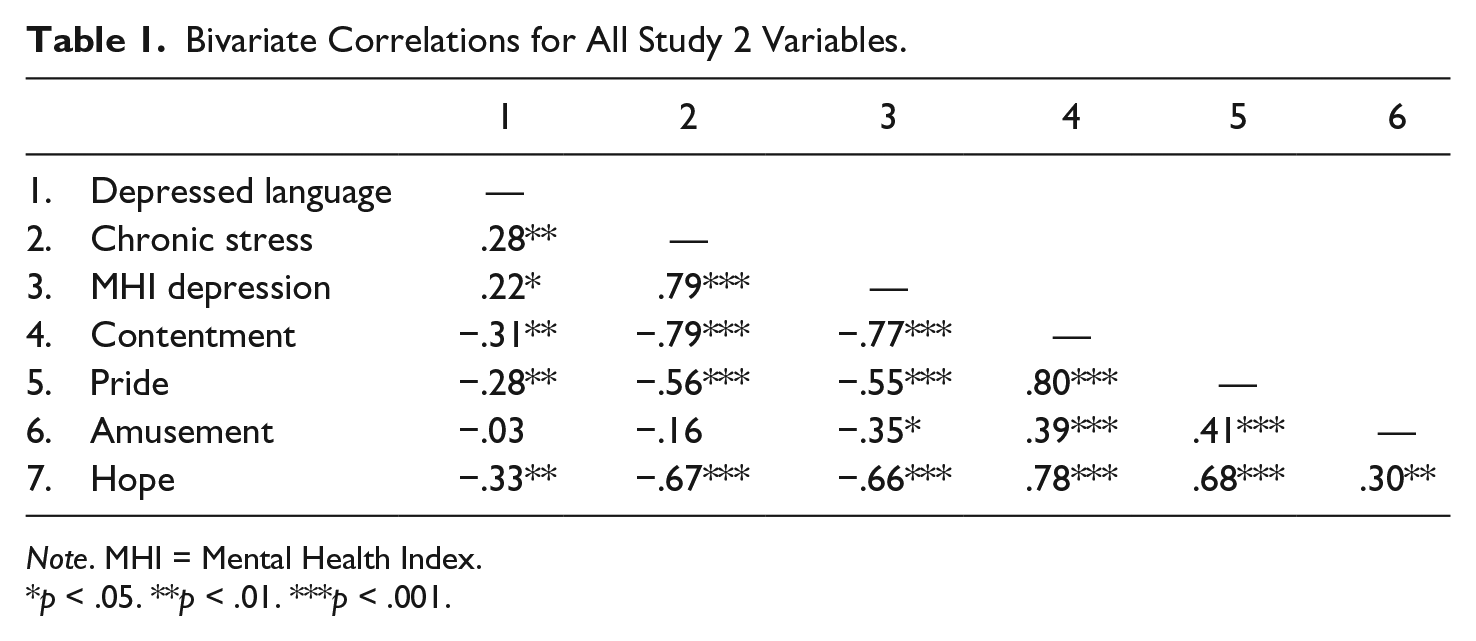
Note. MHI = Mental Health Index.
p < .05. **p < .01. ***p < .001.
We used a discrete emotions perspective to further assess the validity that our DL measure can be used to indicate depressed affect. Consistent with research examining positive emotions in depressed individuals (Gruber et al., 2011), we found that higher levels of contentment and pride, but not amusement, were associated with lower levels of DL use during the speech. Women who were lower in hope also used more DL during the speech.
Discussion
Study 2 extends the utility of our measure of DL to a much shorter speech sample in a more controlled, typical research setting. We examined the relationship between perceived chronic stress, depression, positive emotion, and DL use in a setting likely to be threatening for college freshman: giving a speech about a future career. In this setting, the higher women were in perceived chronic stress, the more DL when talking about their future career. Importantly, we were able to further the findings in Study 1 by demonstrating that DL use during a laboratory speech is significantly predicted by a woman’s level of depression. Finally, we demonstrated some specificity of the DL measure using a discrete emotions approach. Positive emotions known to be associated with depression (contentment, pride) were predictive of DL use during the speech, while a less depression-relevant positive emotion (amusement; Gruber et al., 2011) was not.
Overall, Study 2 extends the findings of Study 1 by demonstrating the utility of DL for marking depressed affect in a more typical experimental setting. In both Studies 1 and 2, we used relatively stable perceptions or dispositions to predict language use. One question that remains is whether DL might be associated with more momentary, acute, stress appraisals, and reactivity. Furthermore, both Study 1 and 2 examined the relationship between stress and DL in the context of a potentially threatening situation: being interviewed about a difficult research collaboration (Study 1), giving a speech on a future career (Study 2). Yet the extent to which these contexts were perceived to be threatening was not assessed. In Study 3, we measured threat with postspeech stress appraisals and online recording of blood pressure in a context designed to be stressful (out-group friendship formation) and one designed to be less stressful (in-group friendship formation).
Study 3: Gay Men Interacting With an Out-Group Member
Our findings from Studies 1 and 2 examined chronic perceptions of stress and affect and the association to DL in a subsequent speech sample. While these results are compelling, evidence that DL may mark vulnerability to acute stressors might be particularly useful for clinicians and researchers. In Study 3, we extend the findings of the previous two studies by examining DL in a controlled context likely to induce acute stress and uncertainty among gay men: delivering a speech about friendship to a heterosexual man. Stressful interpersonal interactions can result in longer term negative mood than many other daily stressful events (Bolger et al., 1989) and increase the risk of clinical depression. Interactions with out-group members, in particular, can lead people to experience stress, threat, and anxiety (Dovidio, Kawakami, & Gaertner, 2002; Mendes, Blascovich, Lickel, & Hunter, 2002; Stephan & Stephan, 1985). We hypothesized that, among gay men in an uncertain and stressful out-group interaction, the more the situation is appraised as stressful, the higher their DL would be. We also examined the hypothesis that acute stress reactivity is associated with greater DL use. Blood pressure, or mean arterial pressure (MAP), is a commonly used marker of physical threat (e.g., Blascovich, Spencer, Quinn, & Steele, 2001; Scheepers & Ellemers, 2005). Social identity threats have been shown to increase MAP and anxiety (e.g., Blascovich et al., 2001; Osborne, 2007). Accordingly, when delivering a speech to a heterosexual man, we hypothesized that the higher gay men’s stress appraisals and MAP, the higher their DL use would be. We hypothesized that intensity of the interpersonal interaction threat would moderate participant’s DL use and, thus, did not expect these associations when the context was less threatening: talking about friendship to another gay man.
Method
Participants
Gay men were recruited for a paid study ($15.00) on “friendship formation” via an online posting in a campus-wide announcements folder. Participants (N = 37; Mage = 21.68, SD = 5.58; European American) first completed an online survey to confirm their sexual orientation, measure a control variable (membership within the in-group), and obtain contact information to schedule the lab session.
Procedure
On arrival to the lab, participants learned that they would be participating in a “get to know you exercise” with another person. Ostensibly to facilitate this interaction, participants first completed a brief questionnaire that assessed demographics (including sexual orientation) as well as hobbies and interests to be shared with the interaction partner. All participants opted to reveal their sexual orientation on this form to their interaction partners. The experimenter then applied a wrist cuff to monitor blood pressure throughout the study and left the participant alone for a 5-minute relaxation period.
Partner sexual orientation manipulation
At this point, the participant learned that each interaction partner would deliver a speech on the topic of “why I make a good friend” over a video link and that they would go first. They also learned that this speech would be recorded for later evaluation. To facilitate the interaction, participants were led to believe that the “get to know you questionnaires” would be exchanged, and they received a questionnaire ostensibly completed by the other participant. Thus, participants believed their partner knew they were gay, and they learned that their partner was either a gay man or a heterosexual man.
Speech
Participants then delivered a 5-minute speech on why they would make a good friend that was digitally recorded for later transcription and analysis with LIWC software as described in Study 1.
Stress appraisals
Following the speech, participants completed a three-item measure assessing the extent to which they found the speech task to be a negative, stressful experience (i.e., “The task was very demanding,” “The task was very stressful,” “I performed poorly on this task”; α = .71). The response scale for all self-report measures was 0 (strongly disagree) to 6 (strongly agree).
Blood pressure reactivity
Blood pressure was measured every 15 seconds through a wrist blood pressure cuff during the baseline rest period and the speech via BioPac. Using BioPac’s Acqknowledge software analysis tool, MAP = (2 × diastolic) + (systolic/3) was calculated for the last minute of the rest period to serve as our baseline measure. As blood pressure can habituate fairly quickly to stress (Kamarck et al., 1992), we used the average MAP for the first 2-minute of the speech to serve as our peak stress measure. To measure the extent to which MAP increased during the stressor, baseline MAP was subtracted from MAP during the speech creating a reactivity score.
Covariate: Membership
Gay men vary in their prior experience and involvement with the in-group (e.g., D’Augelli & Patterson, 1995) and this variability has the potential to influence responses to both in- and out-group interactions. In order to control for this preexisting difference, participants completed a four-item membership scale examining the extent to which they perceived themselves as a “good” member of the in-group (e.g., “I am a worthy member of the gay community,” “I feel I don’t have much to offer the gay community”; Luhtanen & Crocker, 1992). Items were recoded and averaged such that high numbers indicate stronger membership in the gay community (α = .73).
Debriefing
All participants received a thorough debriefing at the end of the study that included detailed information about the study’s procedure and hypotheses. No participants reported any distress about this experimental design following the debriefing.
Results
Preliminary Analyses
In all analyses, we included membership as a covariate. Membership did not differ by condition, t(33) = −.41, p > .25, and the assumption of homogeneity of regression was met for each analysis. We successfully manipulated the perceived stressfulness of the task using the group membership of the partner. Gay men delivering a speech about friendship to a partner they believed to be heterosexual reported significantly higher stress appraisals (M = 3.31, standard error [SE] = 0.27) than those who believed their partner to be a gay man, M = 2.47, SE = 0.28; F(1, 32) = 4.84, p = .035; partial η2 = .14. There was, however, no difference by condition in MAP reactivity, F(1, 32) = 2.38, p = .133; partial η2 = .07. 2 Partial correlations between all study variables are presented in Table 2.
Partial Correlations Among Study 3 Variables by Interaction Partner Condition.
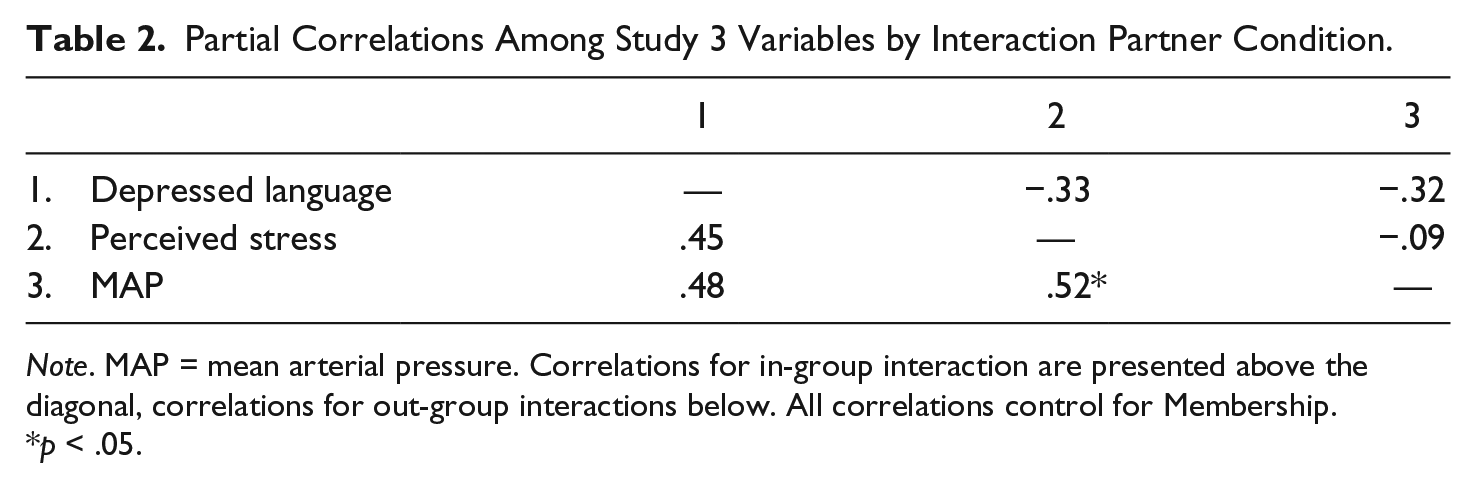
Note. MAP = mean arterial pressure. Correlations for in-group interaction are presented above the diagonal, correlations for out-group interactions below. All correlations control for Membership.
p < .05.
Depressed language
Participants spoke an average of 632.57 (SD = 173.37) words. Word count did not differ by condition, t(33) = 1.55, p = .13, and was unrelated to DL use (r = .15, p > .25). The overall mean, standard deviation, and range of scores for DL in Study 3 were similar to those observed in Studies 1 and 2 (M = −0.01, SD = 1.58; range: −3.55 to 3.91). Although gay men with a heterosexual partner had descriptively higher levels of DL (M = 0.15, SE = 0.38) than gay men speaking to a gay partner (M = −0.18, SE = 0.42), this difference was not significant, F(1, 34) = 0.34, p >.25; partial η2 = .01. Examples from participants with relatively high and low levels of DL are provided below.
Low depressed language
Um I love spending time with my friends. I love hearing what they have to say. I love hearing their issues and I love trying to help people with their issues and whatnot. Um being a good friend, I think you need a lot of like honesty and reciprocation and everything. Um I surround myself with positive people and try to take out the toxic people out of my life.
Low depressed language
I’ve always been um, relatively secure with myself and I feel that that’s a positive influence on others. Um, through my confidence, and um, self support I am able to um, show others that it’s okay to be who you are and to not be afraid of other people’s opinions of you.
High depressed language
If somebody suggests hey let’s go do this I’ll be like sure. Um, I rarely ever get really angry with people, unless they do something that’s really bad that makes me insanely upset, but when I do I tell them, I don’t just shut down or walk away or ignore people. I just I’m upfront all the time. Um, uh let’s see. What else makes me a good friend?
High depressed language
You can tell I am one not to judge other people based on anything really. So um, I am also honest, I will tell people like what I feel, if I am feeling like I don’t know—like if I am mad I am not afraid to like say I’m mad like I am really forward about it, but not in a bad way.
Hypothesis Testing
We hypothesized that higher levels of stress in the out-group condition would be associated with greater use of DL during the speech. To test these hypotheses, we conducted hierarchical moderated regression analyses (Aiken & West, 1991) entering the covariate (centered on the mean), condition (0 = heterosexual partner) and stress variable (on the mean) on Step 1, with the interaction between condition and stress variable entered on Step 2. To follow up significant interactions, simple slopes were derived from the overall model and graphed at 1 standard deviation above and below the mean of the stress variable. Unstandardized coefficients and semipartial r2 as an indicator of effect size are reported.
Stress appraisals
Consistent with predictions, the interaction was significant on Step 3, indicating that the strength of the relationship between stress appraisals and DL differed by condition, b = −1.22, ΔR2 = .14, F(1, 30) = 5.75, p = .023. The overall model was significant as well accounting for 28% of the variance in use of DL during the speech, F(4, 30) = 2.84, p = .041. As predicted, the more stressful gay men found the speech, the more they used DL during their speech to a heterosexual man (b = .88, p = .051; sr2= .10, see Figure 2). This relationship was not evident when participants were in the less stressful condition of speaking to a fellow in-group member (b = −.34, p = .21; sr2= .04).

Study 3: Perceived stress and partner moderate use of depressed language.
Blood pressure reactivity
Consistent with predictions and self-reports of stress, the interaction was significant supporting that the relationship between MAP reactivity and DL differed by condition, b = −.16; ΔR2 = .14, F(1, 30) = 6.17, p = .019. The overall model accounted for 30% of the variance in DL use during the speech, F(4, 30) = 3.22, p = .026. The higher participant’s blood pressure when giving a speech to a heterosexual partner, the more they used DL (b = .11, p = .038; sr2= .11, see Figure 3). This relationship was not observed when the interaction partner was also gay (b = −.05, p = .218; sr2 = .04).

Study 3: Blood pressure and partner moderate use of depressed language.
Depressed language composite comparison across three studies
Drawing on the literature, we created a composite measure of DL using use of FPSP, negative emotion words, and positive emotion words. While we believe the composite best captures the essence of DL, it could certainly be the case that our effects could be driven by only one component of our composite. For example, Bernard, Baddeley, Rodriguez, and Burke (2016) recently found that depression rates were positively related to FPSP but did not find significant relationships between depression and positive or negative emotion words. To examine the possibility that the association between stress and DL use could be driven by one of the individual components of our DL measure (FPSP, negative emotion words, and positive emotion words), we present correlations among these components and the three operationalizations of stress we used within each study (chronic perceived stress, stress appraisals, and MAP) in Table 3. We did not find that FPSP or emotion words were consistently correlated to stress across all three studies. Rather, different components of the composite drive the relationship under different circumstances. Collectively, this provides support that our measure of DL predicts depressed affect in response to stress better than the individual components alone across these very different situations. This is likely because our composite measure simultaneously accounts for several distinct characteristics of depression (self-focus, negative mood, and reduced positive mood).
Correlations of Depressed Language Components and Stress.
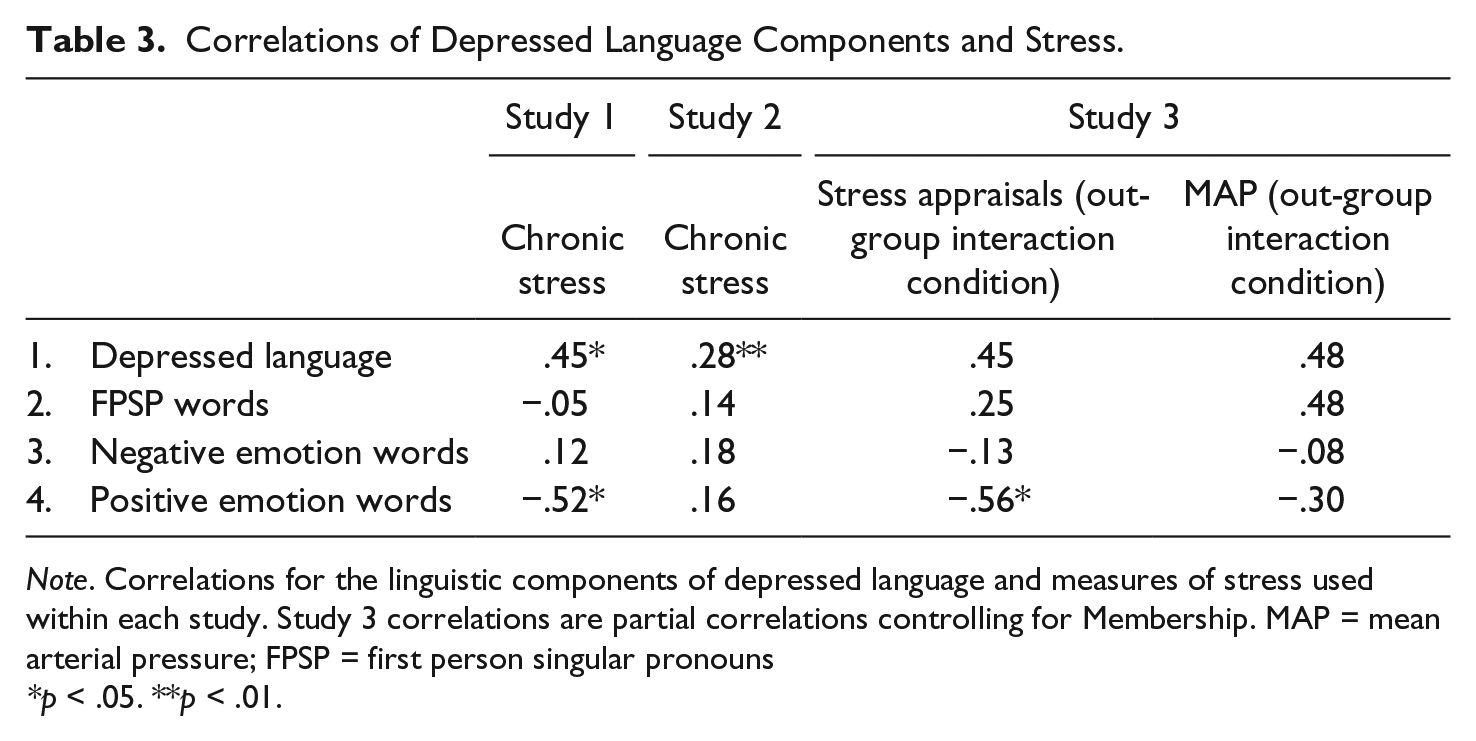
Note. Correlations for the linguistic components of depressed language and measures of stress used within each study. Study 3 correlations are partial correlations controlling for Membership. MAP = mean arterial pressure; FPSP = first person singular pronouns
p < .05. **p < .01.
Discussion
The findings of Study 3 provide additional support for the utility of our measure of DL. In contrast to Studies 1 and 2, which examined the role of chronic perceptions of stress, Study 3 examined DL use in an acutely stressful situation as compared with a less stressful situation. Because social interactions can lead to strong stress responses, with out-group interactions being especially stressful (e.g., Mendes et al., 2002), we hypothesized that the association between stress and DL use would be most prevalent among gay men who were asked to interact with a heterosexual out-group member. As predicted, in the intergroup context, the more stressful gay men appraised the situation, the higher their DL use. This result was conceptually replicated when examining blood pressure reactivity; the higher gay men’s blood pressure reactivity in the intergroup context, the higher the use of DL during the speech. We did not observe these relationships in the condition appraised as less stressful: speaking to an in-group member.
It is important to note that we did not observe a condition difference in use of DL. Even though gay men appraised the heterosexual partner context as more threatening than the in-group partner context, we did not see a significant difference in the mean level of DL in these conditions. Rather, in the more stressful intergroup context, we observed greater use of DL among those gay men higher in stress appraisals and blood pressure reactivity. In this case, individual differences in stress experience moderated the use of DL in the intergroup context. Consistent with Quinn and Joormann (2015a, 2015b) and classic stress and coping literature (Lazarus & Folkman, 1984), it is likely that individuals vary in their vulnerability to the link between stress and depression (Aldao, Nolen-Hoeksema, & Schweizer, 2010; Joormann & Siemer, 2014; Mazure, 1998). DL may be a relatively easy way for researchers and clinicians to assess this individual difference in stress and depression vulnerability. In addition, it may be that not all stressors will result in similar effects. In Study 3, the stressor was an acute interpersonal one. We chose an interpersonal stressor because social evaluation and rejection are strong predictors of stress (e.g., Dickerson & Kemeny, 2004) and it is common for these sorts of stressful interpersonal interactions to lead to depression (e.g., Hammen, 2003). It will be important for future research to examine whether DL is associated with vulnerability to other life stressors (i.e., failing to meet a personal goal, time pressure). It is compelling, however, that across three different populations (faculty, college women, gay men) with multiple markers of stress (chronic perceived stress, stress appraisals, blood pressure), we find a consistent positive association with use of DL.
General Discussion
We began our research with the question of whether depressed affect could be captured in text analysis. The ability to quantify and measure depressed affect in text or speech samples could be an invaluable tool for psychologists in a range of disciplines. Based on research demonstrating specific linguistic patterns among clinically depressed individuals (e.g., Baddeley et al., 2011; Bucci & Freedman, 1981; Rude et al., 2004), we tested whether the use of first person singular words, negative emotion words, and the absence of positive emotion words could mark depressed affect in nonclinical samples. We hypothesized that perceptions of chronic or acute stress would relate to higher use of DL when compared with those who are not under stress. Across three studies, we found support for our hypothesis; the more stress participants reported or experienced, the higher their use of DL. This association was evident both in long text samples from interviews (Study 1), as well as short 5-minute speech samples commonly found in psychological research (Studies 2 and 3). Furthermore, the association replicated in different samples (faculty members, first-year college students, and gay men) with several different operationalizations of stress.
In Study 2, we demonstrated convergent and divergent validity for our DL measure. Importantly, self-reported depression was positively associated with DL use. Furthermore, we showed that DL is not negatively associated with all measures of positive affect—but rather may be limited to positive emotions closely related to depression: pride, contentment, hope (e.g., Gruber et al., 2011). This suggests that our measure is capturing psychological properties of depression. Finally, the results of Study 3 suggest that the association between DL and stress may be most prevalent in stressful interpersonal interactions in which individuals feel threatened. Together these studies provide initial support for the utility of our DL measure in psychological research to mark depressed affect when under conditions of psychological stress and threat.
This novel measure of DL also provides some innovative opportunities for clinicians, researchers, and their clients. DL can be used to assess depressed affect through observation of language use, especially in situations where traditional self-report assessments may be difficult or time consuming to obtain. Through simple linguistic analysis of taped sessions, clinicians could potentially gauge a client’s depressed affect and the trajectory of depressed affect over the course of treatment. Future research will be needed to assess whether DL could be useful as an at home tool for clients and clinicians to assess risk for relapse and need for additional intervention. Indeed, the National Institute of Mental Health’s (2012) Research Domain Criteria framework encourages researchers and practitioners to adopt multiple ways of assessing disorders across a wide variety of symptoms with a special call to develop behavioral assessments that can measure specific psychological states (e.g., Cuthbert & Insel, 2013; Woody & Gibb, 2015). Our research suggests that DL may be a relatively easy method for monitoring and assessing risk for depressed affect.
Although compelling, these data leave some important questions that future research should address. We have selected the term depressed affect to describe our linguistic measure because the components were derived from the depression and mood literatures. It is possible, however, that our measure assessing increased FPSP and depressed affect may also capture elements of anger rather than pure depressed affect. For example, many of our participants who used higher levels of DL used statements that were quite angry (e.g., a high DL participant from Study 2 indicated “I can get angry very easily, that is one of my weaknesses with people”). It will be important for future research to tease apart the distinctions between depressed affect and anger affect to examine whether DL is primarily exhibited in situations that are perceived to be threatening, stressful, and anger provoking. While DL may be a useful measure of depressed affect, it may be the case that the associations we observed between DL and depressed affect during stress are stronger (or weaker) among some individuals. Emotional lability, level of literacy, and personality factors may all potentially influence DL use and remain open questions for future research.
The current research examined whether depressed affect can be captured by measuring the use of FPSP, negative, and positive emotion words. We hypothesized that DL would be most present when people are in an experience that is likely to evoke depressed affect (i.e., stressful situations). As predicted, DL was negatively related to positive emotion, and consistently positively related to perceptions of stress, especially under threating conditions. Thus, people really can “sound so down.” Our findings suggest that researchers and practitioners alike can capture vulnerability to depressed affect under conditions of stress in relatively small speech samples through our DL measure.
Footnotes
Appendix
Acknowledgements
We would like to thank the two anonymous reviewers and the editor, Howard Giles, for their helpful comments on an earlier draft of this article.
Declaration of Conflicting Interests
The author(s) declared no potential conflicts of interest with respect to the research, authorship, and/or publication of this article.
Funding
The author(s) disclosed receipt of the following financial support for the research, authorship, and/or publication of this article: This work was supported by National Science Foundation award EPS-0904155 to Maine EPSCoR at the University of Maine.