







Abstract
It remains unclear what institutional characteristics determine the publication of press releases by constitutional courts. Research has revealed that courts use press releases to disseminate information; however, little is known about when exactly courts choose to publish a press release on a ruling. By focusing on institutional elements, this study argues that press releases form a part of judicial public relations and are used to enhance openness and transparency surrounding specific court rulings. This argument is tested empirically via a novel dataset on the activities of the German Federal Constitutional Court. Based on 1131 senate rulings decided between 1996 and 2018, this study demonstrates that proceeding types and changes to the status quo are the main characteristics that determine the publication of court press releases, whereas intra-judicial and internal conflicts are revealed to be less influential.
Keywords
Introduction
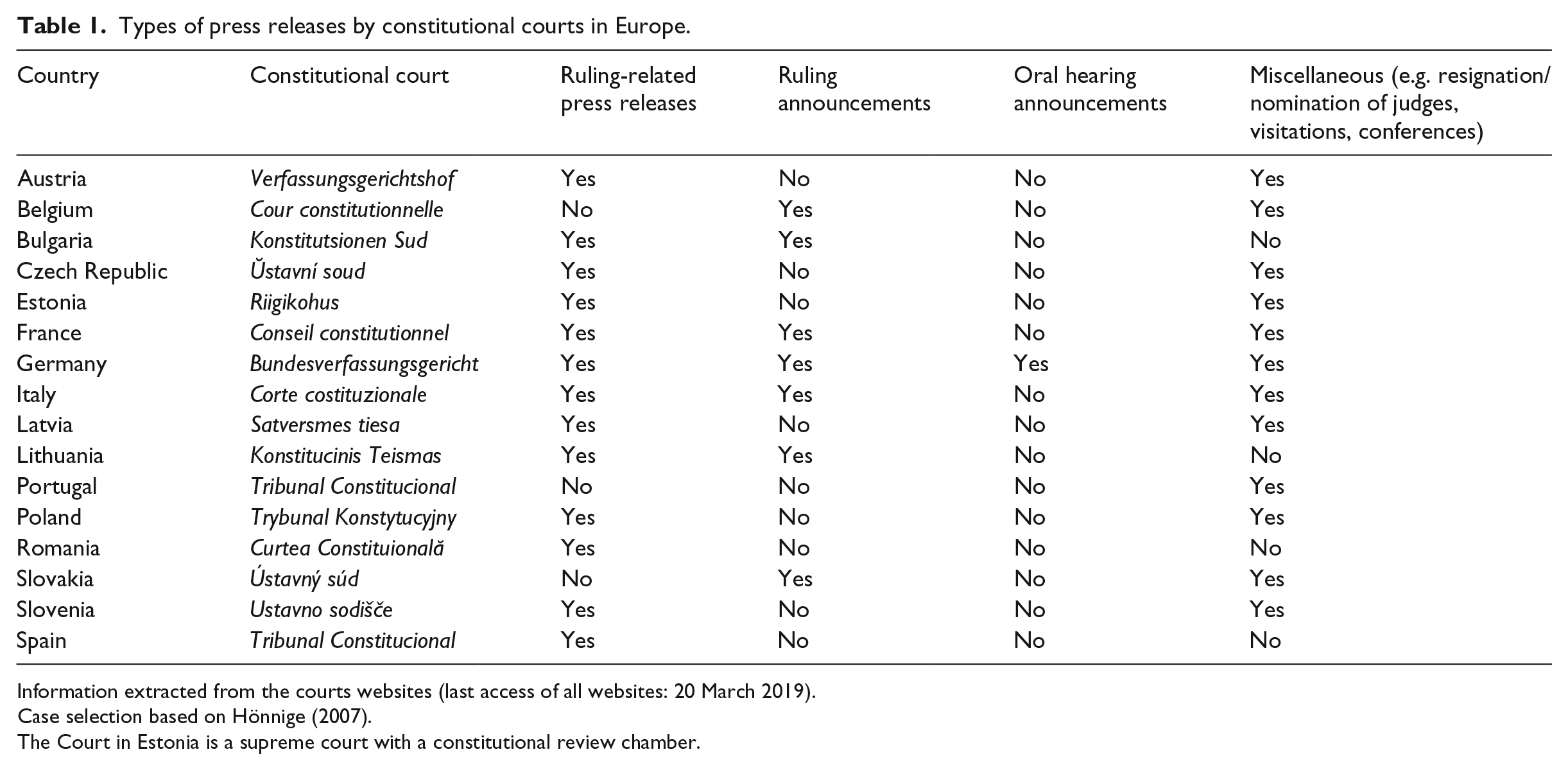
Judiciaries around the world have recognized the need to communicate their decisions to the public more effectively in order to foster institutional reputation and legitimacy (Garoupa and Ginsburg, 2015). To achieve these goals, courts can disclose and disseminate authoritative information via press releases (Peleg and Bogoch, 2014; Staton, 2010). Table 1 illustrates the fact that press releases by high courts are a common phenomenon across Europe. Supreme and constitutional courts in the Americas also pursue an active press release publication strategy (Staton, 2010). However, research has revealed that press releases vary in both quantity and quality. For example, while the US Supreme Court only announces forthcoming rulings (Hitt et al., 2019) and the Australian High Court briefly summarizes its rulings (Spencer, 2017), the South Korean Supreme Court publishes irregular and infrequent press releases (Park and Youm, 2017). Despite these differences, no comprehensive research has yet been conducted that analyses which institutional conditions influence the publication of press releases. Thus, the following question arises: Which institutional characteristics determine the publication of press releases by constitutional courts?
Types of press releases by constitutional courts in Europe.
Information extracted from the courts websites (last access of all websites: 20 March 2019).
Case selection based on Hönnige (2007).
The Court in Estonia is a supreme court with a constitutional review chamber.
In general, press releases are focused messages sent to the public. The public and the news media serve as the general audience for press releases. Research has revealed that political institutions as well as businesses consider press releases a major tool in the free, one-way communication of information (Boumans, 2017; Klüver and Sagarzazu, 2016). Courts are no exception. Furthermore, publicity and the dissemination of information have been argued to help courts generate and cultivate institutional reputation and legitimacy (Garoupa and Ginsburg, 2015); however, scholars have mostly ignored the efforts taken by the judiciary to shape public information (Staton, 2010).
The German Federal Constitutional Court (hereafter FCC) is a particularly suitable case for analysing how a constitutional court makes use of press releases. As a consequence of mistakes in communicating and explaining two highly controversial rulings (which caused a major loss in public trust 1 ), the Court professionalized its communication by establishing a public relations department in 1996 (Holtz-Bacha, 2017). Since then, around 100 rulings per year have been accompanied by detailed press releases. Given that Table 1 reveals that European courts share similar press release types and that similar press releases are made by courts around the world (Johnston and McGovern, 2013; Peleg and Bogoch, 2014), the FCC is a prime example of a court that actively disseminates decisions via press releases.
This study argues that judicial public relations are best described as one-way communication in which information is solely disseminated with the purpose of informing the public (Grunig and Hunt, 1984). Judicial public relations are further characterized by efforts to maintain openness and transparency surrounding court rulings. These efforts are characterized by the principle of open justice, which states that the rule of law is ‘not only transparent and accessible, but open to external scrutiny’ (Johnston, 2018: 525). As the emphasis on procedural elements is assumed to allow the courts to emphasize the openness and fairness of the judiciary (Gibson and Caldeira, 2009), this study argues that certain institutional characteristics of court rulings increase the likelihood that a court will issue a press release.
This study analyses press releases that deal with rulings issued by the FCC between 1996 and 2018 in order to show which institutional characteristics determine the publication of the press releases. 2 Based on 1131 senate rulings made by the FCC between January 1996 and December 2018, this study uses logistic regression models with year-fixed effects to analyse institutional characteristics that are considered influential in the publication of press releases. The considered characteristics range from oral hearings, the publication of dissenting opinions, and invalidations of the status quo to rulings that overrule lower court cases and specific proceeding types. The results show that the FCC is eager to publish press releases to communicate legal and political conflicts (e.g. status quo changes and concrete reviews) as long as the conflicts are not internal or instances of intra-judicial dissent (e.g. dissenting opinion or an overruling of a lower court case). This study thereby contributes to a better understanding of the currently neglected aspect of judicial communication and to the research on judicial politics in general.
State of the art: Courts, the public, and the media
Courts in democracies have ‘neither FORCE nor WILL, but merely judgment; and must ultimately depend upon the aid of the executive arm even for the efficacy of [their own] judgments’ (Federalist Papers No. 78 quoted in Rosenberg, 2008: 15). This statement still holds true today as courts are unable to enforce compliance with their rulings. However, scholars have shown that courts are able to influence compliance. Two elements are crucial here: first, the public’s ability to exert pressure on political actors to comply with court decisions (Slotnick and Segal, 1998); second, the degree of diffuse public support (Gibson et al., 1998). Politicians fear the costs of public backlash if they ignore the rulings of a publicly supported court. Thus, public support helps courts enforce their decisions (Vanberg, 2005). However, these mechanisms are only effective if the political environment is transparent, which is the case when the public are aware and informed. Therefore, an informed public ‘serves as a baseline source of power’ (Staton, 2010: 13) for courts. However, since courts normally do not publicly explain their decisions, they depend on the media to inform the public (Davis, 1994).
Scholars have mainly focused their research on two elements: (1) the quantity and type of coverage and (2) the aspects that influence media coverage. Davis (1994) has described general trends in the media coverage of the US Supreme Court that show, for example, that its argumentation is frequently misinterpreted. More recent analyses have dealt with the relationship between the Court and the press in general, thereby illustrating recent and historic strategies of and incentives for the Court to go public (Davis, 2011). Another line of research is focused on explanations for different levels of media coverage. Sill, Metzgar, and Rouse (2013) and Vining and Wilhelm (2010) have shown that decisions are more likely to be covered if they contain newsworthy elements (e.g. evidence of conflict or sensationalism). Research focused on the work of journalists has found that coverage of court rulings varies in quality (Slotnick and Segal, 1998) and scope (Hoekstra, 2003) as well as between newspaper and television (Spill and Oxley, 2003).
Studies on how the media receive information about court decisions are rare. Staton (2010) has demonstrated that the media use court press releases when covering rulings and that courts strategically promote rulings when they change the status quo. Johnston and McGovern (2013) used a single-case study to illustrate how courts use different strategies to disseminate information and to interact with the media. Garoupa and Ginsburg (2015) have argued that courts use the media to shape their reputation; however, they have not tested this argument empirically. This literature review reveals that judicial public relations remain under-researched in two crucial aspects: (1) there is no theory to explain how courts interact with the public in the first place, 3 and (2) there are no quantitative-empirical studies that focus on judicial public relations.
Theoretical considerations of judicial public relations
For courts, public awareness is crucial since if the public are ‘aware of [c]ourt decisions, and feel duty-bond to carry them out, [c]ourt orders will be implemented’ (Rosenberg, 2008: 16). In other words, a court’s assertiveness vis-á-vis the political branch rests equally on what it does as on how it communicates what it does (Davis, 2011).
Exactly how do courts communicate? According to previous findings, court communication is executed by a public information model of one-way communication (Johnston and McGovern, 2013; Peleg and Bogoch, 2014). This one-way communication is defined as the process of transmitting information without the possibility of receiving a response (Grunig and Hunt, 1984). Johnston and McGovern (2013: 1681) argue that courts are focused on disseminating accurate and accessible information and that they ‘have been found to have an information-out approach to communication’. Generally, courts do not have incentives to publicly engage in media discussions or two-way communication as they fear being ‘treated like other policy actors and los[ing] their status [as] resolvers of public conflict’ (Davis, 2011: 18). Johnston (2018) refers to this type of communication as public-interest communication. 4
What kind of information do courts communicate? Existing research is rare and has focused on the influence of judicial communication in the media. To date, no study has yet aimed to explain and examine when courts publish press releases. To bridge this gap, this study now turns to the principle of open justice and its often-interchangeably used elements of openness and transparency (Alemanno and Stefan, 2014; Grimmelikhuijsen and Klijn, 2015; Johnston, 2018).
There is no universally acknowledged definition of the concept of openness in political science or law (Alemanno and Stefan, 2014). Alemanno and Stefan (2014: 104) have argued that the principle of openness consists of (1) a passive right of citizens to receive information and (2) a pro-active institutional duty to communicate this information. Hence, citizens have the right to access information, which needs to be ‘carried out in an accessible and understandable way’. Transparency is defined as ‘the availability of information about an organization or actor allowing external actors to monitor internal workings or performance’ (Grimmelikhuijsen and Klijn, 2015: 997). Transparency can therefore be understood as a method of enhancing the legitimacy of institutional actions by enabling the public to recognize and monitor political decision-making processes.
The open justice principle is based on Jeremy Bentham’s notion that ‘the rule of law [is] not only transparent and accessible, but open to external scrutiny’ (Johnston, 2018: 525). This legal publicity creates opportunities for the public to make individual assessments of the arguments made within a dispute. Hence, courts create the conditions for the public to legitimize or delegitimize court rulings by assessing ‘whether a certain judgment took into account all the arguments put forward in the case, and whether the law was observed’ (Alemanno and Stefan, 2014: 107). Open justice thus strengthens a court’s neutrality, institutional legitimacy, and the level of public trust (Grimmelikhuijsen and Klijn, 2015). Empirically, open justice encompasses actions designed to open the courtroom to the public, thereby granting access to television broadcasts of trials and guaranteeing access to documents. However, the most common form of open justice is the textual provision of relevant information by the courts, which is why court press releases are important tools (Grimmelikhuijsen and Klijn, 2015; Johnston, 2018).
To realize open justice, courts need to communicate (1) what arguments were made, (2) cases that were conflictual, and (3) cases that are – either politically or legally – relevant to the public. Generally, each court ruling contains institutional characteristics that are helpful cues in assessing when court press releases are more likely. Therefore, the following theoretical expectations connect the three elements of court communication with institutional characteristics of court rulings in order to enable us to theorize which of these internal characteristics increases the likelihood that a court will publish a press release:
The communication of the legal arguments should be straightforward since constitutional courts have the option to hold oral hearings. Oral hearings provide insights into ‘otherwise typically closed judicial processes’ (Krehbiel, 2016: 991). They increase the case’s level of public awareness during the trial. However, as awareness influences the overall perception of courts (Hitt et al., 2019), the courts should be keen to maintain the degree of openness that the oral hearing provided in the first place. Therefore, I expect that if an oral hearing is held, the ruling should be associated with an increased likelihood that a press release will be published.
The most common indicator of conflictual cases is dissenting opinions. Kranenpohl (2010) has demonstrated that judges perceive of the communication of dissenting opinions to the public as being particularly important to the court in order to maintain its public deference. Generally, the communication of dissenting opinions by the court allows the public ‘to grasp information from the debate [that the] judges had on particular points of law’ (Alemanno and Stefan, 2014: 132). Furthermore, dissenting opinions hold the respective judges accountable and allow the court to signal mediating messages to the losing parties (Garoupa and Ginsburg, 2015). Hence, I expect that a ruling accompanied by a dissenting opinion should be associated with an increased likelihood that a press release will be published.
Indicators of whether or not a ruling is relevant – either politically or legally – are connected to the perceived potential impact of a ruling. To identify characteristics that indicate relevance and impact, research on the newsworthiness of court cases provides helpful cues (Vining and Wilhelm, 2010).
Most obviously, rulings considered politically relevant are those in which a court opposes the political branch by declaring statutes unconstitutional. Since courts do not possess the power to sanction noncompliance with their rulings, they face the threat of evasion, which could cause a loss of legitimacy. This effect is reinforced by the fact that governments have a vital interest in such cases (Vanberg, 2005). However, Vanberg (2005) has shown that statute invalidations do not automatically cause noncompliance or the risk of evasion. Nevertheless, in the light of the principles of open justice, these processes require an explanation as they change the status quo of the political system, regardless of whether they are desired by the political branches. In fact, Staton (2010) has shown that courts strategically use press releases to promote cases that invalidate statutes in order to increase the transparency surrounding the case and to avoid potential political evasion. I thus expect that a ruling that declares a statute unconstitutional should be associated with an increased likelihood that a press release will be published.
While changes to the status quo are politically relevant, the overturning of decisions made by lower courts serves as an indicator of legally relevant rulings (Garoupa and Ginsburg, 2015). Such rulings have a direct impact on the respective litigants as well as on future claimants, which is why open justice is of great importance to the public. In fact, cases that question the decisions of lower courts have particular advantages for the judicial protection of individual rights. Moreover, the jurisdiction of the European Court of Justice (ECJ) reveals that ‘nearly all the cases by which the ECJ has “constitutionalized” the treaties, and thus extended its own review powers[,] have been reference cases’ (Shapiro, 2003: 18). Hence, I expect that a ruling that overrules a lower court case should be associated with an increased likelihood that a press release will be published.
In addition, the different types of constitutional procedural law also serve as indicators of relevance. First of all, abstract and concrete reviews need to be mentioned (Vanberg, 2005). However, constitutional complaints – in which ordinary citizens complain about statutes that they believe violate their constitutional rights – and conflicts between political branches regarding their constitutional relationship and competences are of equal importance. Although the ruling outcomes described above, changes to the status quo, and the overruling of decisions made by a lower court are connected to the proceeding types, not all court rulings overturn or discard previous political or legal decisions. Generally, for apex courts, the different types of proceedings have the purpose of strengthening and extending their position vis-à-vis the political and legal branches (Shapiro, 2003) since they extend political and legal debates – which precede each ruling – by constitutional means. I thus expect an increased likelihood that courts will publish a press release if a ruling is concerned with one of the following types of proceedings: an abstract review, a concrete review, constitutional complaints, or disputes between constitutional organs regarding their competencies.
Thus far, the discussion has focused on institutional characteristics; however, external factors that influence the probability of publishing a press release also exist. On one hand, political actors (e.g. government parties) could have a vital interest in judicial outcomes (Krehbiel, 2016; Vanberg, 2005). For court press releases, Staton (2010) has shown that these can be a tool for a court to strengthen its position vis-á-vis the political branch by catching the public’s attention. Hence, if a political actor announces interest in a specific court case, the court could be forced to issue a press release in order to enhance transparency and avoid potential political evasion (Vanberg, 2005). On the other hand, the literature on judicial politics reveals that some rulings are more salient than others due to their inherent policy issues (Sill et al., 2013; Vining and Wilhelm, 2010). These rulings should therefore lead to a greater likelihood that a press release will be published as they could foster the public’s support for the court’s actions as well as enhance the public’s satisfaction with the court’s policy in general.
Although these external characteristics are undoubtedly important to fully understanding the dynamics of press releases, investigating them would go beyond the scope of this study. As the literature review has revealed, our understanding of the internal processes that influence a court’s choice to issue a press release is sparse. Furthermore, regarding issue salience, preliminary findings suggest that court press releases become more diverse and more evenly distributed across policy issues over time, whereas court rulings are mostly focused on a rather small set of issues. Court press releases hence seem to not respond to issue saliency in general. 5 The lack of knowledge and these preliminary findings therefore justifies the parsimony of this study and its focus on institutional characteristics. Nevertheless, the external elements mentioned above need to be addressed and discussed in the future.
To conclude, press releases help courts enhance judicial openness and transparency. The likelihood that a court will issue a press release increases if a ruling contains one or several internal institutional characteristics. The characteristics that are identified as relevant for the publication of press releases are oral hearings, dissenting opinions, status quo changes, rulings that overrule lower court cases, and several specific proceeding types.
Case selection and data
Table 1 shows that judicial public relations has a variety of institutional manifestations. The websites of the courts listed in Table 1 reveal that the usage rates range from scant use in the case of the Constitutional Court in Belgium to regular published press releases in the cases of the Constitutional Courts in Austria, Italy, and Germany. Therefore, and since the German Federal Constitutional Court (FCC) is an institutional role model for courts worldwide (Holtz-Bacha, 2017), it is a suitable starting point for analysing the publication of press releases by apex courts.
The FCC is a ‘highly visible institution in [the German] political system’ (Vanberg, 2005: 39), and some of its decisions are followed closely by the media. It is a specialized court that exercises ‘the power of constitutional review in a “European Model”’ (Vanberg, 2005: 77). The court is divided into two senates, each of which consists of eight judges, whereby each senate forms three to four chambers with three judges each. Its competences are varied and wide-ranging, from abstract reviews to electoral complaints. 6 Chambers and senates are authorized to decide on cases; however, only the senates are able to declare a statute void or unconstitutional (Vanberg, 2005), which is why this study focuses on senate rulings. Finally, the Court has two types of rulings: judgements and orders. Judgements have fundamental jurisdiction in most cases, while orders are concerned with smaller issues, fines, and dismissals.
The principles of open justice in Germany are regulated by the Court Constitution Act (GVG, §169). In the case of the FCC, the sessions are open to the public until the pronouncement of the general aspects of the Court’s decision and are closed during detailed explanations. Free access to court files and documents is not legally defined. Since its establishment in 1996, the FCC’s public relations department (Pressestelle) has indicated the Court’s aim to foster open and transparent constitutional justice (Holtz-Bacha, 2017). The leading press officers (Pressesprecher) are trained judges who are selected for two to three years by the FCC’s president. In addition to the regular publication of press releases, the department’s obligations encompass organizing the yearly press conference and publishing ‘essential’ (wesentliche) rulings on their website.
By December 2018, the FCC had published 1548 ruling-related press releases, including both senate- and chamber rulings. Press releases that accompany a ruling have a clear structure. The first paragraph contains a summary of the ruling’s general theme and principles, and the second paragraph deals with the circumstances of the ruling as well as the presentation of arguments and motivations of the disputing parties (Sachverhalt und Verfahrensgang). The final paragraph presents the essential considerations (wesentliche Erwägungen). Press releases usually constitute two to four pages. Other types of FCC press releases (see Table 1) deal with announcing oral hearings and informing consumers about visits, anniversaries, distinctions, and obituaries. 7 However, these are not of interest here and should be analysed separately in a future study.
Empirically, all senate rulings made by the FCC between 1996 and December 2018 are examined here. Within this time period, the Court made 1131 senate rulings (orders and judgements). The Court publishes detailed ruling characteristics (e.g. press release publications or proceeding type) and the full text of all senate rulings on its website. Both the characteristics and the full texts were taken from the website in order to create a dataset that treats each ruling as an individual observation and the ruling characteristics as its manifestations. Furthermore, the full texts were used to create additional variables to identify whether or not a ruling overruled an action by a lower court or altered the status quo. A detailed description of the data gathering and variable creation process can be found in the Technical Appendix (available as online Supplementary Material).
Dependent variable
Given the nature of the research question, the logic of the analysis is binary: A press release accompanying a ruling is either published or not. Consequently, the publication of press releases serves as the dependent variable in this study. The dependent variable is coded dichotomously with the value 1 if a press release was published to accompany a ruling and with the value 0 if it was not.
Independent variables
The independent variables mirror the institutional characteristics that were identified as being theoretically relevant for the likelihood that a press release will be issued. This method ignores elements such as the ruling’s potential media impact, the salience of the policy issue, and potential conflicting interests of political actors. These elements are undoubtedly important; however, the need for parsimony and the lack of previous research justifies the focus on basic institutional variables. The variables used here are briefly discussed in the following section (variable names are displayed in italics).
Oral hearings are granted for abstract review cases and occur only occasionally in cases concerned with concrete reviews and complaints (Krehbiel, 2016). Hearings are nevertheless important for the public to be able to obtain insights into normally closed judicial processes (Krehbiel, 2016). A binary variable measures whether an oral hearing was held (1) or not (0).
Dissenting opinions are statements ‘following the main ruling. Judges – alone or together with other colleagues – express their dissatisfaction with the decision by elaborating on points of the majority decision they do not agree with’ (Wittig, 2016: 57). The FCC has allowed judges to issue dissenting opinions since 1971; however, these opinions appear only infrequently (Wittig, 2016). A binary variable measures whether a dissenting opinion was written (1) or not (0).
Politically, courts are most influential when invalidating statutes – that is, when they change the status quo. To test whether changes to the status quo affect the publication of press releases, a binary variable measures whether a court has declared a statute unconstitutional (1) or not (0).
Legally, constitutional courts are influential when they overrule actions taken by lower courts. To test the effect on the publication of press releases, a binary variable measures whether the Court overrules a lower court action (1) or not (0).
Abstract reviews are a posteriori controls of the constitutional compliance of statutes and can be initiated by governmental actors, legislators, federal states, and regional governments. Concrete reviews – initiated by lower courts – are used to settle current jurisdictional conflicts and are concerned with specific questions about the constitutionality of issues. They are further used for statutory issues and to settle conflicts between lower court branches. Constitutional complaints can be initiated by ordinary citizens and deal with statutes believed to violate the plaintiff’s constitutional rights (Hailbronner and Martini, 2017). Constitutional disputes between federal organs and those between the Federation and the Länder deal with disputes regarding the constitutional competencies of the different political branches. These different proceeding types are deemed politically and legally relevant and could therefore increase the likelihood that the FCC will issue a press release. To test this, five binary variables were created that identify whether a ruling is concerned with one of these proceedings (1) or not (0).
Control variables
To address potentially omitted variable bias, the analysis controls for the following elements. First, the two senates are characterized by a division of labour. In short, the first senate is concerned with issues of fundamental rights, whereas the second senate deals mostly with constitutional law (Holtz-Bacha, 2017). This difference is reflected in the division of the senates into the various proceeding types, with constitutional disputes reserved for the second senate and abstract and concrete reviews reserved for the first senate. However, the sharp rise in the number of constitutional complaints in the last few years has largely nullified this division of labour (Hailbronner and Martini, 2017). Nevertheless, to control for the distinction between both senates, a binary variable was created and assigned the value of 1 if the second senate was the deciding branch and the value of 0 for the first senate.
Second, as described above, FCC rulings are either an order or a judgement, and each type contains a different degree of relevance. To control for whether this distinction influences the publication of press releases, a binary variable indicates whether a ruling is a judgement (1) or an order (0). Third, to control for possible high-profile cases, the ruling length was used. Research reveals that the length of a ruling is a suitable indicator of the workload that judges put into writing it, which in turn indicates its potential impact (Vining and Wilhelm, 2010). The length was measured as a word-count variable.
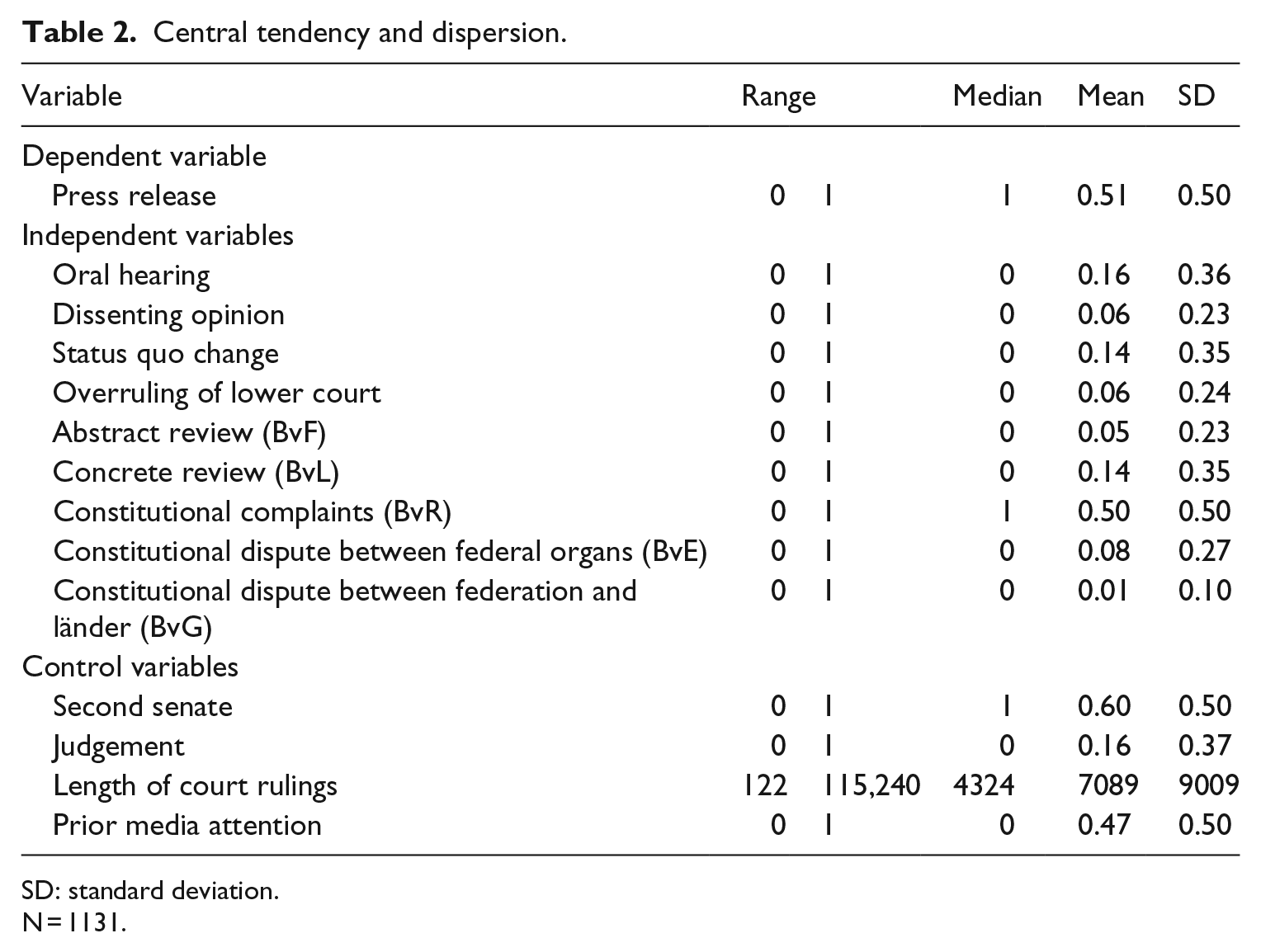
Finally, research has shown that courts anticipate media attention prior to a ruling by altering their behaviour (Vining and Wilhelm, 2010). To measure prior media attention, a web-based search was conducted on the newspaper archive of Lexis-Nexis that was restricted to national and regional daily and weekly newspapers (35 different news media outlets in total) and based on the search term ‘Bundesverfassungsgericht’ (a similar strategy was used by Vining and Wilhelm, 2010). This procedure resulted in 20,560 newspaper articles that mention the Court. To detect media attention prior to a ruling, document pairs were created by using each ruling as a starting point and matching it with every newspaper article published within 10 days prior to the respective ruling. The 10-day restriction ensured that weekly outlets were also captured. Furthermore, only front-page coverage was measured as it has proven to be a reliable and valid indicator of media attention (Vining and Wilhelm, 2010). The final binary variable measures whether the FCC is mentioned in a front-page article 10 days before a ruling at least once (1) or not at all (0). Table 2 lists the central tendency and dispersion of all variables.
Central tendency and dispersion.
SD: standard deviation.
N = 1131.
Analysis
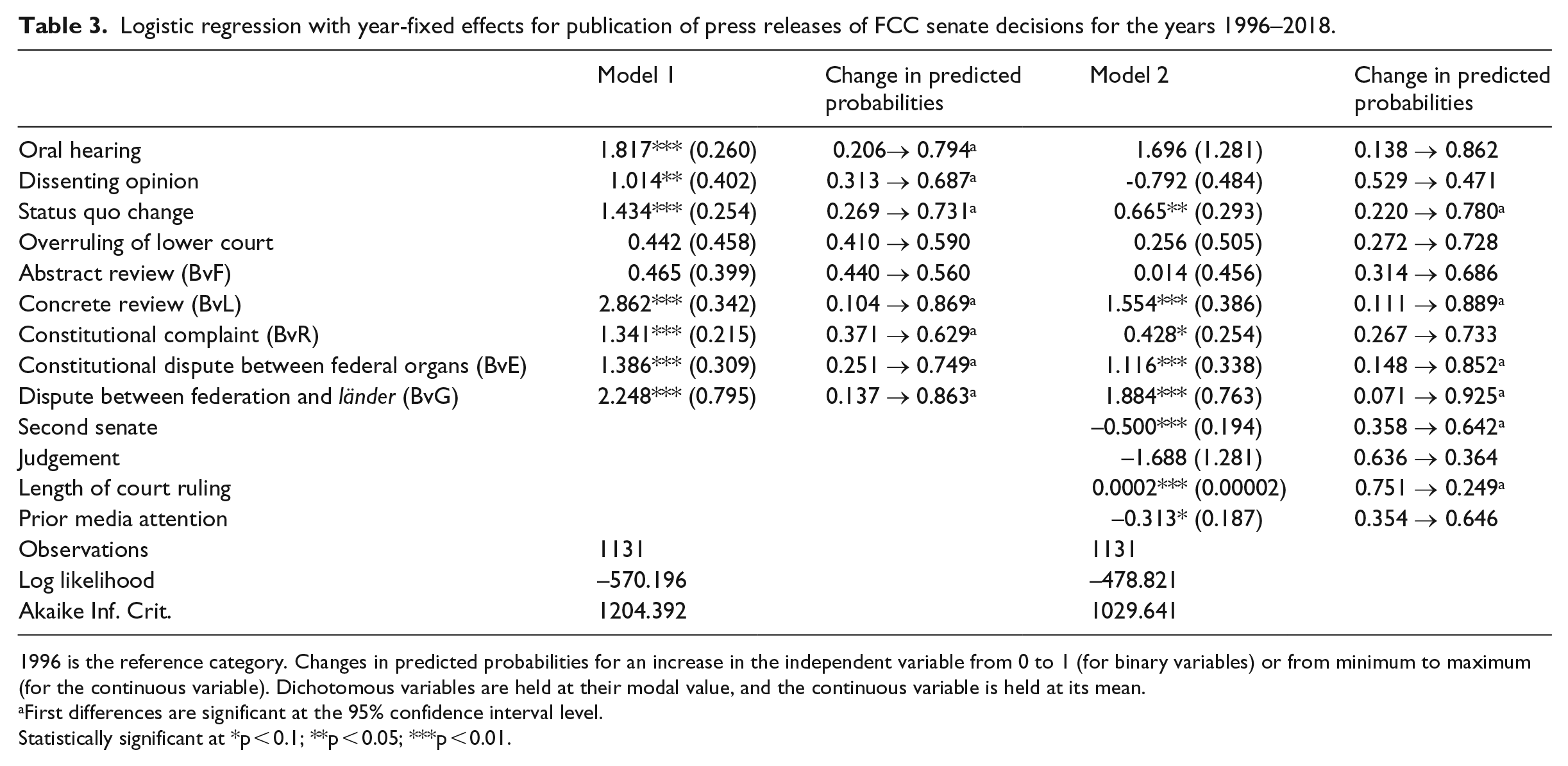
Given the binary nature of the dependent variable, logistic regression with year-fixed effects was conducted. The results appear in Table 3 and are expressed as logistic regression coefficients with standard errors in parentheses. Table 3 shows two regression models. The first model displays only the independent variables, and the second adds the control variables. It also details the estimated changes in the predicted probability of each independent variable with all other variables held at their modal value (dichotomous) or at their mean (continuous).
Logistic regression with year-fixed effects for publication of press releases of FCC senate decisions for the years 1996–2018.
1996 is the reference category. Changes in predicted probabilities for an increase in the independent variable from 0 to 1 (for binary variables) or from minimum to maximum (for the continuous variable). Dichotomous variables are held at their modal value, and the continuous variable is held at its mean.
First differences are significant at the 95% confidence interval level.
Statistically significant at *p < 0.1; **p < 0.05; ***p < 0.01.
The interpretation of changes in predicted probabilities is relatively simple. The probability that a press release is published changes as the value on the independent variable changes. For dichotomous independent variables the values can change from 0 to 1, and for continuous variables the values change from the minimum to the maximum.
In Model 1, all but two independent variables are statistically significant and behave as expected. The coefficient sizes indicate that concrete review cases and constitutional disputes have the largest substantive impact on the publication of press releases. Interestingly, coefficient estimates for abstract review cases as well as for overruling decisions made by lower courts are non-significant. The Court seems to not want to amplify political conflicts brought before it (abstract reviews) or legal conflicts (lower court overruling). For the latter element, one explanation could be that the Court tries to secure the judicial branch’s collective reputation by not highlighting constitutional misinterpretations by a lower court (Garoupa and Ginsburg, 2015). In contrast, the results of concrete review cases indicate that they are more likely to be accompanied by a press release. This pairing is reasonable as concrete reviews help constitutional courts ‘to establish a degree of control over a traditionally depoliticized and deferential judicial system’ (Garoupa and Ginsburg, 2015: 144).
When adding the control variables, the coefficient estimates regarding dissenting opinions and oral hearings lose their statistical significance (Model 2). In the case of dissents, the Court seems to not want to invite public interest as it fears its own reputation (Garoupa and Ginsburg, 2015). Another explanation could be that both variables interact with the second senate variable. The same holds true for the different proceeding types since, in theory, the Court’s internal division of labour binds the senates to different specific proceedings. However, alternative results for logistic regressions with interaction effects between the senates and the proceeding types did not produce substantially different results, and they are therefore not reported here. 8
Changes to the status quo positively increase the likelihood of press releases in both models, which indicates that the Court is more keen to create transparency in the wake of rulings in which it opposes governmental branches (Staton, 2010). However, since logistic regression coefficients are not directly interpretable, the changes in the predicted probabilities are more informative and are considered in the following section.
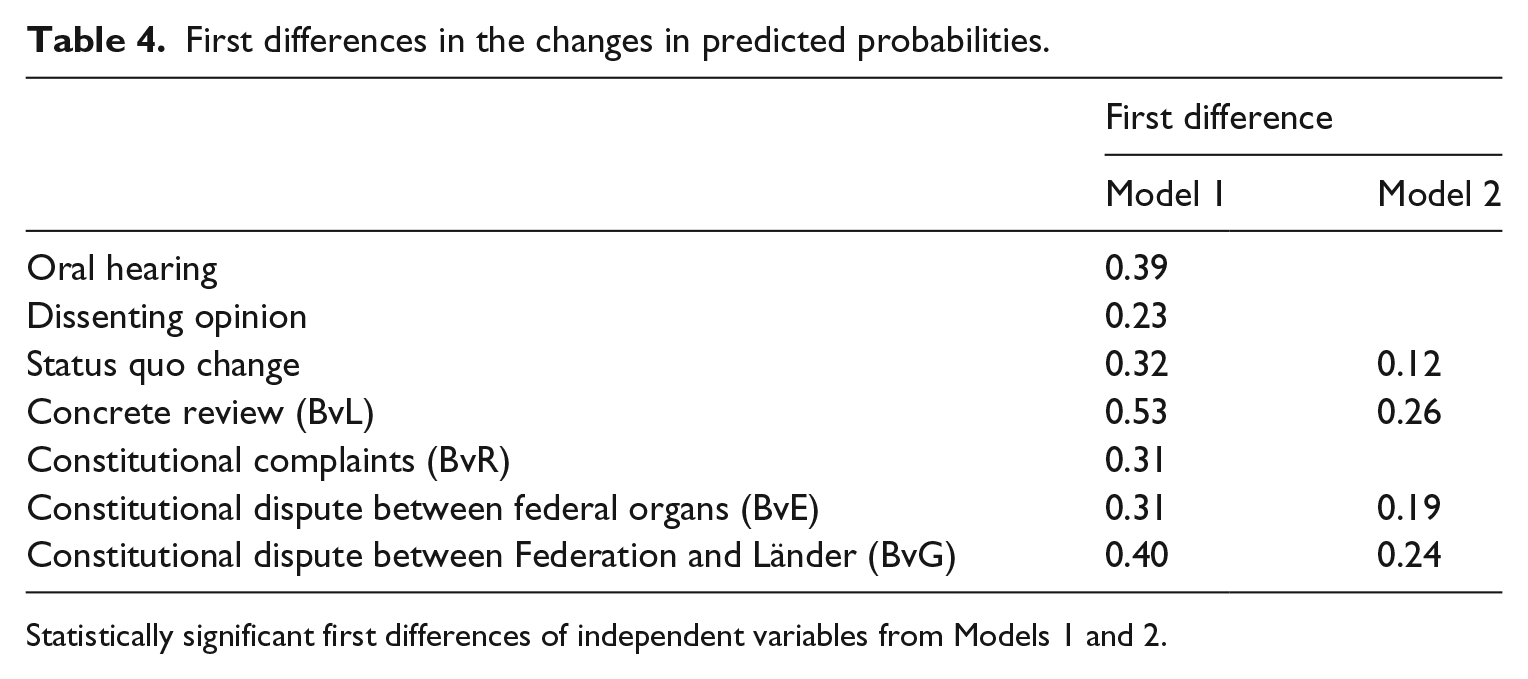
The changes in predicted probabilities are displayed in Table 3. To further enhance our understanding of the results, Table 4 displays the statistically significant first differences of the independent variables from both models. The reported uncertainty is at the 95% level. The case of an oral hearing helps to illustrate how both tables should be read. All else being equal, the average court case with an oral hearing had a 79% probability of being accompanied by a press release (Table 3). The difference between the average case with and without an oral hearing was 39% (Table 4).
First differences in the changes in predicted probabilities.
Statistically significant first differences of independent variables from Models 1 and 2.
In the following section, I concentrate on the first differences that are statistically significant in both models. For concrete reviews, the probability of the publication of press releases increases from 0.1 to 0.8 in Model 1. The changes are similar for Model 2; however, the first differences decrease from 53% to 26%. Changes to the status quo increase the probability that a press release will be issued from 0.3 to 0.7 in Model 1 and from 0.2 to 0.8 in Model 2. Similar effects are reported for constitutional disputes (BvE) and disputes between the Federation and the Länder (BvG).
Constitutional courts deal with both a general public and a legal audience. Both audiences rely on different signs of communication. The public audience is more focused on court actions in which courts control or shape legislation actions. This focus is reflected in the results for status quo changes, which show that the FCC is more likely to promote a ruling when it invalidates a statute. According to Staton (2010), these actions increase the transparency of the respective ruling and create a certain degree of compliance pressure on the legislature. The legal audience, on the other hand, is more interested in ‘concrete review cases, since implementation often (though not always) requires cooperation between the constitutional court and ordinary courts’ (Garoupa and Ginsburg, 2015: 149). Furthermore, concrete reviews enable a court to ‘develop a specific legal reasoning in terms of rhetoric and judicial syntax’ (Garoupa and Ginsburg, 2015: 151). Hence, the results illustrate that the FCC tries to proactively communicate with the legal audience by issuing press releases for concrete reviews cases.
Two main findings can be drawn from the results. First, the FCC seems to be eager to open up its adjudication and to communicate legally as well as politically relevant elements. This eagerness is evident in the effects of changes to the status quo, concrete reviews, and constitutional disputes, all of which – as theoretically expected – increase the likelihood of the publication of press releases. Second, the willingness to open the adjudication seems to hold true only until the FCC faces situations in which there is either internal dissent or the Court opposes lower courts. In these two scenarios, court rulings are less likely to be accompanied by a press release. The FCC thus seems to be trying to secure the reputation of the entire judiciary on one hand and its own reputation on the other hand (Garoupa and Ginsburg, 2015).
Conclusion
In times of increasing judicialization in politics and in which judges interfere in the political and social sphere, ‘it is only natural that there will be greater interest in the operation of the judiciary and demands for greater judicial accountability’ (Garoupa and Ginsburg, 2015: 49). Accordingly, today’s courts must provide trustworthy information to the public. However, existing research has found comparatively less about the communication of courts with the public. This study therefore investigated what institutional characteristics determine the publication of press releases by constitutional courts. To answer this question, courts were argued to publish press releases to create openness and transparency. The subsequent analysis relied on a novel dataset covering 1131 senate rulings by the German Federal Constitutional Court spanning the period from 1996 to 2018. Several institutional variables were identified as being characteristic of openness and transparency, which are referred to as the open justice principle. Logistic regression with year-fixed effects was used and supported by predicted probabilities and first differences to enhance our understanding of the analysis. The results reveal that the FCC’s press release strategy is compatible with principles of open justice as long as its rulings do not indicate internal dissent or intra-judicial conflicts. In particular, rulings concerned with concrete reviews, constitutional disputes, and status quo changes are associated with an increased likelihood that the FCC will publish a press release. In a nutshell, this study demonstrated when and why court press releases are published, and its results thereby contribute to the sparse knowledge on judicial communication and add a new research avenue for the literature on judicial politics in general.
Given the lack of previous research and a desired parsimony, this study focused exclusively on institutional characteristics. There are certainly numerous other external factors that could impact a court’s decision to issue press releases. Two are mentioned here: (1) the policy issue of a ruling and (2) potential government interest and potential interest of political actors in general (Vanberg, 2005). For example, Vanberg (2005) has shown that governmental interests in court cases alter the court’s behaviour, especially when a ruling changes the status quo. The same holds true for the effect of the policy issue of a court ruling, for the court could be more eager to publish a press release for specific rulings solely due to the respective issue saliency. However, we lack the necessary theoretical and empirical knowledge for both factors mentioned. Future research thus needs to investigate the effects of potential external influences on the publication of press releases at both the micro- and the macro level.
Another caveat of this study is its ignorance of other promotion tools. For example, the FCC additionally uses more implicit methods of promoting a ruling, such as off-the-record conversations (Kranenpohl, 2010); however, their effects on the Court’s assertiveness are unknown. Hence, in order to obtain a detailed picture of judicial public relations, future research needs to analyse all possible tools that courts have to promote their rulings.
In addition, the findings presented here should pave the way for further research on the court–media relationship. For example, the literature on court–media relations argues that the quality of court case coverage differ as journalists tend to misinterpret decisions due to lacking legal training (Davis, 1994; Staton, 2010). Although we know that press releases are used to disseminate information, we do not know how court press releases are used by journalists, how they influence the quality of the media coverage, and how the court’s policy frames – promoted by press releases – influence policy frames in the news media.
Finally, since media dynamics are of major importance to representative democracies and to the manner by which representation is realized, government agencies need to consider public relations as relevant aspects of their daily work. Press releases can be tools for political actors to promote and enhance political transparency and democratic accountability in general. Thus, this study is the first step in understanding public relations and its implications for the representative quality of democratic political institutions and democratic political systems as a whole. The next step should be a comparative study on the use of public relations strategies by democratic institutions. As Table 1 illustrates, several constitutional courts conduct public relations and use similar types of press releases. The research design presented in this study – which focused on internal institutional characteristics – could be used for a comparative analysis of judicial public relations, which would contribute to the future research agenda proposed above.
Supplemental Material
POL885753_Codebook_FCC_PR_appendix – Supplemental material for Judicial public relations: Determinants of press release publication by constitutional courts
Supplemental material, POL885753_Codebook_FCC_PR_appendix for Judicial public relations: Determinants of press release publication by constitutional courts by Philipp Meyer in Politics
Supplemental Material
POL885753_final_data_appendix – Supplemental material for Judicial public relations: Determinants of press release publication by constitutional courts
Supplemental material, POL885753_final_data_appendix for Judicial public relations: Determinants of press release publication by constitutional courts by Philipp Meyer in Politics
Footnotes
Acknowledgements
I am very grateful to Christoph Hönnige, Philipp Köker, Dominic Nyhuis, Christoph Garwe, Sebastian Nickel, Martin Örtzen, and two anonymous reviewers for their suggestions on how to improve this paper. I would also like to thank Monika and Norbert Meyer and Katrin Aschmann for their moral support. Earlier versions were presented at the CAP Annual Conference 2018 and the EPSA Annual Conference 2018. I am particularly grateful for attendees who discussed the work with me and provided helpful feedback.
Funding
The author(s) received no financial support for the research, authorship, and/or publication of this article.
Data availability statement
The data that support the findings of this study are available via figshare. To access the dataset, go to https://doi.org/10.6084/m9.figshare.7628729.v2. The dataset is accompanied by a codebook. The Technical Appendix (available as online Supplementary Material) explains the creation of the dataset. These data were derived from the following resources, which are available in the public domain:  (accessed 1 October 2019).
Supplementary Information
Additional supplementary information may be found with the online version of this article.
Technical Appendix Figure A1. Steps to create the data set.
Notes
Author biography
References
Supplementary Material
Please find the following supplemental material available below.
For Open Access articles published under a Creative Commons License, all supplemental material carries the same license as the article it is associated with.
For non-Open Access articles published, all supplemental material carries a non-exclusive license, and permission requests for re-use of supplemental material or any part of supplemental material shall be sent directly to the copyright owner as specified in the copyright notice associated with the article.
