







Abstract
While populists are often helped into power by anti-corruption rhetoric, they are not exempt from corruption (allegations) that could threaten their credibility and political survival. This article aims to explain how populist leaders manage corruption and remain resilient in competitive authoritarian (hybrid) regimes. Building on the literature on authoritarian regime stability and autocratic legitimation, it identifies three interrelated strategies – institutional, partisan, and discursive – corresponding to the functional pillars of stability – repression, co-optation, and legitimation. Comparative case studies of Hungary and Turkey illustrate that populist leaders recalibrate these strategies over time to sustain resilience to corruption: they rely primarily on partisan strategies early on, shift towards institutional strategies as regimes consolidate, and increasingly employ discursive strategies under heightened constraints, often alongside aggressive measures targeting both opposition actors and, when necessary, insiders. The article contributes to the literature on populism and corruption by theorising corruption management as a central component of populist rule and resilience.
Introduction
Viktor Orbán in Hungary and Recep Tayyip Erdoğan in Turkey gained power with strong anti-corruption claims. Yet, both countries have been marred by significant corruption allegations. However, the two leaders have managed to maintain their power and secured consecutive electoral victories in the past decade, despite existing knowledge that corruption generally undermines the legitimacy and thus the capacity for the political survival of a government (Entman, 2012). So, how do populists in power get away with corruption and remain resilient?
Populist regime resilience generally relies on authoritarian institutional control (Gerschewski, 2023; Grzymala-Busse, 2019; Kostadinova, 2023; Müller, 2016; Weyland, 2024) and the (re-)distribution of the spoils of office to political allies and their business associates (Ádám, 2019). To sustain power, populist leaders weaken institutional checks and balances, crush independent media, and spin the agenda (Guriev and Treisman, 2022). The dismantling of institutions prevents the investigation and prosecution of corruption and enables populists to escape accountability mechanisms and corruption convictions (but see Gehrke and Yang, 2025). However, there is a limited understanding of how populists withstand corruption allegations and remain resilient when they lack full institutional control or when such authoritarian control fails to prevent the exposure of corruption cases.
To address this gap, the article builds on the literature on regime stability and autocratic legitimation (Dukalskis, 2021; Dukalskis and Gerschewski, 2017; Gerschewski, 2013, 2023; Kailitz and Stockemer, 2015; Schneider and Maerz, 2017) and extends it to the study of populist rule in hybrid regimes. We identify three interrelated corruption management strategies – institutional, partisan, and discursive – that correspond to Gerschewski’s ‘three pillars of stability’ – repression, co-optation, and legitimation. The institutional strategy entails controlling law enforcement and the media to repress or neutralise corruption allegations. The partisan strategy selectively targets individual allies to shield the leader’s image and maintain cohesion within the party and the co-opted elite networks. The discursive strategy legitimises the regime by reframing such allegations to portray the leader as a victim of corrupt elites and/or foreign actors, often amplified by loyalist media and intensifying under pressure. Overall, corruption management becomes a key adaptive mechanism in regime stability and populist endurance.
Following the dynamic recalibration of autocratic legitimation strategies (Dukalskis, 2021; Dukalskis and Gerschewski, 2017; Gerschewski, 2023), populist regimes are expected to evolve through three phases, each marked by a distinct approach to managing corruption: an emerging phase dominated by partisan scapegoating; a consolidated phase characterised by institutional capture; and a constrained phase in which discursive tactics, along with increasingly aggressive measures targeting the opposition and its allies, substitute for declining performance. As regimes mature and constraints shift, the relative effectiveness/costs of each strategy change, producing the observed sequencing. The article looks at Hungary and Turkey, two paradigmatic cases of hybrid or competitive authoritarian regimes (Bozóki and Hegedűs, 2018; Esen and Gümüşçü, 2016), and traces how Orbán and Erdoğan have combined institutional, partisan, and discursive strategies over time to remain resilient, and how these combinations have shifted in response to domestic and external constraints.
This study makes three main contributions. First, it advances the study of populist governance by conceptualising corruption management as a deliberate and evolving strategy of power maintenance. Second, it bridges research on populism, corruption, and authoritarian resilience by adapting Gerschewski’s (2013, 2023) ‘three pillars of stability’ to populist regimes that rely on institutional, partisan, and discursive strategies to secure system survival. Third, the article provides a first analysis of ‘corruption management’ cases in Hungary and Turkey and sheds light on corruption cases in detail (see Supplemental Appendix I).
The article is structured as follows: first, a concise literature review is provided on populism and corruption. Then we present our theoretical framework on corruption management, the justifications for our case selection, and our data and methods. Our empirical analysis demonstrates how, in each phase, Orbán and Erdoğan governments employed populist strategies to weather the effects of corruption allegations and sustain their resilience. We then conclude our findings and discuss the implications of our research for future studies.
Populism, corruption, and regime stability
Populism, defined as a thin-centred ideology (Mudde, 2004, 2017), divides the population into two united and antagonistic groups: the ‘pure people’ and the ‘corrupt elite’. Populist rhetoric legitimises attacks on established institutions and promises moral renewal (Engler, 2016) from the opposition. Yet, corruption scandals involving a populist government may undermine the moral contrast (Foresta, 2020) and become a threat to the regime’s own survival. The link between populism and corruption remains conceptually fragmented and empirically underdeveloped (Mendilow and Phélippeau, 2021). corruption, typically defined as the misuse of public office for private gain, undermines trust in institutions and may fuel populist mobilisation (Engler, 2020; Hanley and Sikk, 2016; Sanz et al., 2022). Evidence shows that corruption often intensifies under populist rule (Kostadinova, 2023; Zhang, 2023). This paradox arises because populist incumbents rely on clientelistic exchanges to reward loyalty (Ádám, 2019; Grzymala-Busse, 2019) and seek to weaken institutional checks and balances deemed unrepresentative of the ‘people’s will’ (Müller, 2016; Weyland, 2024). Looking at real-world cases, existing comparative research on Hungary and Turkey shows that both Viktor Orbán and Recep Tayyip Erdoğan initially mobilised public support by portraying previous elites as corrupt (Bátory, 2015; Hisarlıoğlu et al., 2022), and once in power, consolidated control through state capture, judicial overhaul, and media domination (Fazekas and Tóth, 2016; Soyaltin-Colella, 2022). Although corruption increased, both leaders maintained power through authoritarian consolidation (Csehi, 2022; Kutlay and Öniş, 2024).
The literature leaves two relevant gaps. First, most analyses focus on institutional control and overlook a wider repertoire of corruption management strategies, particularly the discursive and partisan dimensions that allow populists to reframe corruption allegations, discipline allies in their co-opted networks, and sustain legitimacy when institutional control alone is insufficient. Second, studies rarely incorporate temporal dynamics: they tend to treat authoritarian consolidation as static rather than as a process shaped by evolving constraints, such as political competition, electoral sanctions, and external pressure (Ayan-Musil and Yardımcı-Geyikçi, 2024; Bozóki and Hegedűs, 2018; Esen and Gümüşçü, 2024). Addressing these gaps through regime stability and autocratic legitimation literature (Dukalskis and Gerschewski, 2017; Gerschewski, 2023; Kailitz and Stockemer, 2015; Schneider and Maerz, 2017), this article makes two arguments. First, corruption strategies become functional equivalents to ‘three pillars of stability’: repression, co-optation, and legitimation, all crucial for regime survival. And second, corruption management goes through different phases that capture how populist regimes recalibrate institutional, partisan, and discursive strategies as their sources of legitimacy and control change. Consequently, corruption management operates as a key mechanism of populist resilience.
Theoretical framework
From regime stability to corruption management
Research on authoritarian consolidation defines three core pillars of regime stability: repression, co-optation, and legitimation (Gerschewski, 2013; Kailitz and Stockemer, 2015). These pillars represent functional mechanisms that sustain autocratic rule despite social, economic, or institutional pressures. Subsequent studies emphasise their dynamic and interdependent nature, arguing that regimes recalibrate their reliance on each pillar over time (Gerschewski, 2023; Schneider and Maerz, 2017). Populist incumbents in hybrid regimes operate under similar pressures but within formally democratic settings where overt repression is constrained. In such contexts, it is argued here, corruption management strategies become functional equivalents of these classical pillars: they provide control without coercion but repression, co-optation without full ideological alignment, and legitimation through moralised discourse (Dukalskis and Gerschewski, 2017). This approach integrates insights from regime survival theory into the study of populism and corruption.
Three strategies of corruption management
Populist governments deploy three interrelated corruption management strategies that mirror the classic mechanisms of authoritarian survival: institutional, partisan, and discursive. The institutional strategy corresponds to the pillar of repression and involves control and the selective use of state institutions – law enforcement, courts, audit bodies, and the media – to suppress, delay, or neutralise corruption allegations. This ‘soft’ form of control (Gerschewski, 2023; Levitsky and Way, 2012) allows populist leaders to contain scandals without overt coercion. The partisan strategy parallels co-optation and consists of disciplining or scapegoating individual elites implicated in corruption to preserve the leader’s moral credibility and maintain intra-party cohesion and support of co-opted elites (Kailitz and Stockemer, 2015). The discursive strategy embodies legitimation: populist leaders frame corruption allegations as politically motivated attacks, casting themselves as victims of a corrupt establishment or foreign conspiracies. This mechanism, supported by loyalist media – and occasionally state institutions – transforms vulnerability into moral strengths (Dukalskis, 2021; Dukalskis and Gerschewski, 2017).
Temporal dynamics: Phases of populist resilience
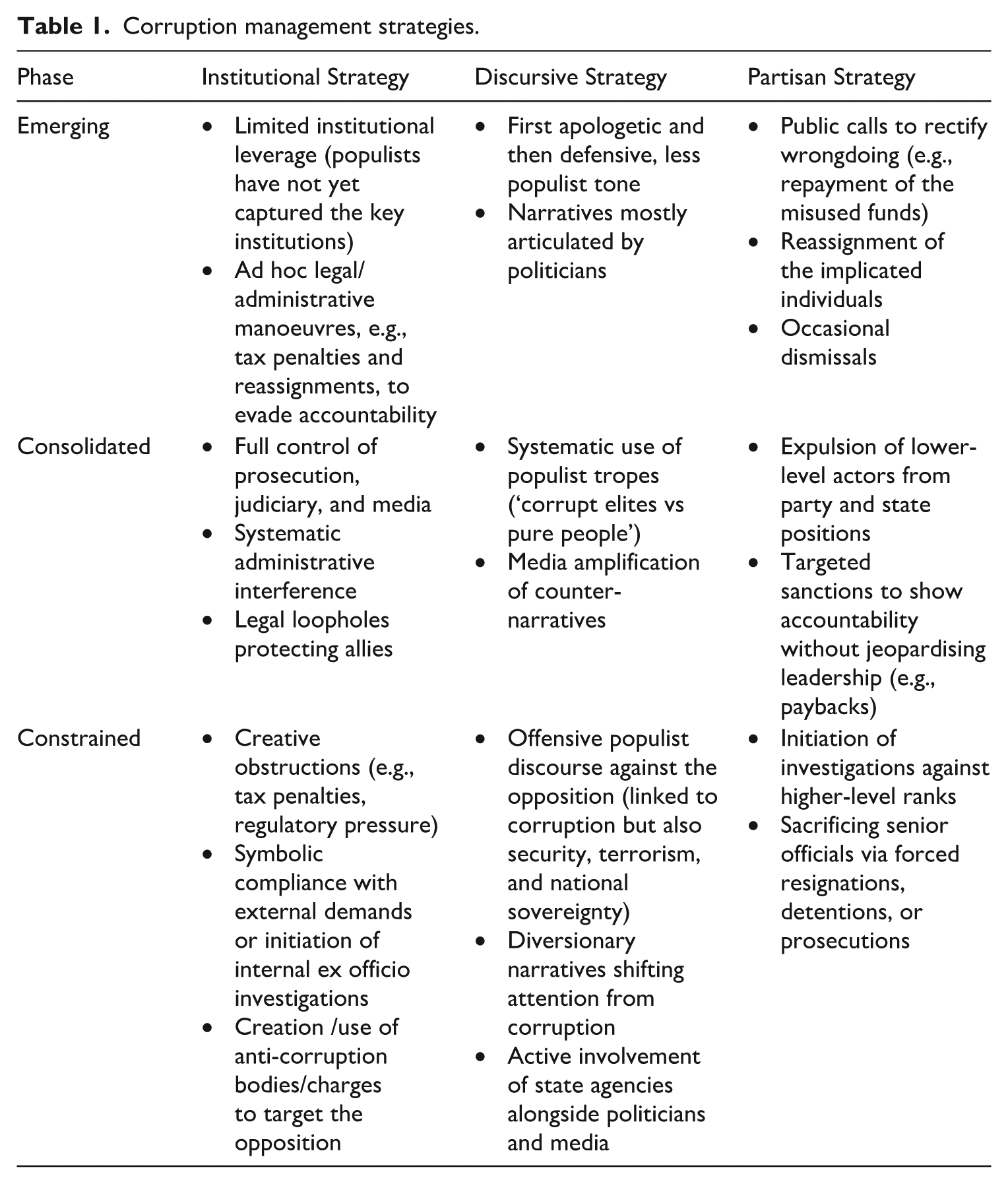
Recent scholarship on authoritarian endurance conceptualised regime stability as a dynamic process rather than a static condition (Gerschewski, 2023). Regimes learn, adapt, and rebalance their strategies. Following this logic, corruption management strategies in authoritarian regimes unfold across three temporal phases. The emerging phase refers to the regime’s initial years following an electoral victory, during which the legal reforms are designed to be presented to parliament or the public for confirmation. In the consolidated phase, extensive constitutional reforms in key institutions take place (courts, prosecution, media, resource allocation) while the regime packs them with loyalists to facilitate a comprehensive institutional takeover. However, authoritarian control becomes increasingly constrained when incumbents confront political competition, electoral sanctions, economic downturn, and/or increased external pressure.
Given the lack of full control over the institutions during the emerging phase, partisan strategies and ad hoc measures are dominantly used to counter corruption allegations. Typically, selective punishment is used where implicated individuals are reassigned, dismissed, or forced to pay back questionably used public funds to protect the leader’s integrity, to shield the regime from early scandals, and to reinforce internal solidarity (Gherghina and Soare, 2021). Ad hoc strategies are taken specifically to target the prosecutors, police officers, or media outlets that are involved in the corruption allegations. The discursive strategy is used in a complementary fashion to defend the government.
Once power is consolidated, authoritarian control extends across state institutions, granting leaders broad authority over resources, the media, and law enforcement. Corruption increases in this phase since oversight mechanisms weaken, and the rents expand. Yet, corruption cases are often dismissed, ignored, or silenced through more systematic institutional control. Ministries do not process the complaints, prosecutors start no investigation or pursue them on the wrong basis, courts lift orders, and cases are closed. State of emergency measures can further expand executive power and reduce transparency. Independent media are curtailed through administrative burdens and restrictions. While the institutional strategy dominates, discursive strategies are applied in a complementary manner, especially in the grand cases (major cases in the higher political ranks involving a significant amount of money), and generate further support for the institutional measures portraying opposition as corrupt. Discourse is expected to be more refined and amplified by state-controlled media and/or loyalist outlets with populist interpretations. Partisan strategy can target individuals implicated in petty cases (minor cases in the lower ranks or local level involving rather small amounts of money), such as dismissals or paybacks, aiming to punish wrongdoers and protect the leader’s credibility (Tsai, 2021) and its co-opted network. However, sustained rent distribution creates distortions and deepens corruption, which results in more cases.
In the constrained phase, the institutional control remains relevant, yet the populist regime’s ability to contain allegations comes under pressure by economic crises, electoral setbacks, opposition cohesion, or credible challengers, international pressure (e.g., from the EU), or civil society pushback. Under these conditions, discursive and partisan strategies are used dominantly. The former seeks to deflect blame and delegitimise the opposition, while the latter ensures the intra-party cohesion (Lisi, 2024). The discourse becomes more offensive as populists accuse opposition parties, anti-corruption institutions, or independent media outlets that reveal corruption scandals of being part of a Western-led alliance or a global conspiracy network that stands in conflict with the interests of ‘the people’ and undermines national security and sovereignty (Csehi and Zgut, 2020; Hisarlıoğlu et al., 2022). They also portray themselves as unfairly targeted victims or shift the agenda from their failings to a matter that was easier to create a positive, albeit antagonistic and populist narrative (Gherghina and Mitru, 2024; Haughton et al., 2022). Supportive media and government agencies contribute to populist interpretations of the allegations. Institutionalist strategies might include establishing anti-corruption units without real authority or weaponising anti-corruption measures against political opponents. In this phase, partisan strategies may return in the form of dismissals and even detention, this time targeting higher-level cadres to foster perceptions of a ‘link of fate’ among the co-opted elites as a new incentive for loyalty (Levitsky and Way, 2012: 871). Table 1 below summarises the different strategies across the various phases with indicators.
Corruption management strategies.
Data, methods, and operationalisation
Case selection
The article relies on a comparative case study of Hungary and Turkey, based on different selection criteria. First, both countries are led by leaders who are habitually regarded as populist in the literature (Bátory, 2015; Csehi, 2019; Hisarlıoğlu et al., 2022; Kutlay and Öniş, 2024). Second, both Orbán and Erdoğan have spent considerable time in power, providing a sufficient number of corruption cases to study different response strategies. Third, both countries have been marred by corruption allegations over the years. Although both governments have significant control over media and public access to information by now, corruption allegations do break light sometimes. Finally, both countries experienced a trajectory of authoritarian consolidation that has, in recent years, come under mounting pressure. Existing literature has already noted the rising similarities between these two regimes in terms of populist policies (Apaydin et al., 2025; Aydın-Düzgit, 2025; Hisarlıoğlu et al., 2022). Yet, comparing the management of corruption in Hungary and Turkey provides another comparative aspect to draw generalisable lessons from the two cases.
Data sources and operationalisation
A simple keyword search for ‘corruption’ in the online archives of independent media outlets, primarily HVG in Hungary and Birgün in Turkey, reveals numerous cases for the entire temporal scope of the research. We double checked the results with other independent sources, such as the online outlet 24.hu in Hungary; for Turkey, we used Transparency International Turkey media monitoring reports until 2011. We focused on a certain number of corruption allegations (see Supplemental Appendix 1), which were both politically salient, publicly reported, and representative of broader patterns in the government’s use of institutional, partisan, and discursive strategies. The scope provides a manageable sample size for in-depth qualitative analysis, while still broad enough to identify recurring strategies and patterns.
We employ a temporal approach and divide the authoritarian regime evolution of Hungary and Turkey into three phases: emerging, consolidated, and constrained. In Hungary, the emerging phase (2011–2012) was short as the government moved rapidly after its 2010 landslide victory and adopted a new constitution in 2011, facilitating authoritarian control over the judiciary and public institutions (Kovács and Trencsényi, 2019). With the new constitutional framework coming into force in 2012, the institutional takeover had taken full effect, dismantling the checks and balances. The phase of authoritarian consolidation (2012–2022) intensified with media restructuring: key outlets like TV2 and origo.hu were brought under government influence, culminating in the closure of the opposition daily Népszabadság in 2016 (Csehi, 2022). Despite opposition gains in the 2019 municipal elections, the authoritarian regime retained control over rent distribution by redirecting resources to Fidesz-dominated county regions (Kovarek and Littvay, 2022). Also, during the pandemic, the government used the state of emergency to ‘punish’ opposition-led municipalities financially through extra taxes. Public referendums also served as a tool for the government to validate its agenda in opposition to EU elites (Gherghina et al., 2024). Yet, the EU pressure, conditionalities, and financial sanctions started to constrain the authoritarian power of the government after the 2022 election.
In the constrained period (2022–), the Orbán regime witnessed growing external and internal pressures, both linked to corruption. On the one hand, the EU has initiated the conditionality mechanism against Hungary based on the rule of law, and among them, corruption-based charges, which effectively led to freezes of EU funds from the EU’s post-pandemic recovery package. On the other hand, by early 2024 the government faced both an economic and a political challenge: inflation skyrocketed, economic growth came to a halt, and the party was hit by a pardoning scandal that involved a paedophile, and ultimately led to the resignation of the President of the Republic, and the Justice Minister, Judit Varga who was supposed to lead the party’s list in the upcoming European Parliamentary election. Out of the political crisis emerged a new political actor, Péter Magyar, the ex-husband of Varga, a former diplomat and ex-member of the ruling Fidesz party. His party (Tisza) managed to challenge the government politically and mobilised large crowds in big cities. As a (former) insider, he posed a direct threat to Fidesz by sharing with the public secret recordings that exposed high-ranking government officials (Kovarek, 2025). Coupled with the European Parliamentary elections, where Tisza established itself as the largest opposition party, Fidesz launched a corruption investigation against Magyar (Baranyai et al., 2025).
In Turkey, the emerging phase (2002–2013) lasted longer compared to Hungary. The institutional overhaul was finalised in 2014 with the implementation of the constitutional amendments approved in public referendums in 2007 and 2010, through which the government justified its agenda against the secular elites (Soyaltin-Colella, 2022). After its election victory in 2002, the AKP government initiated legal reforms enabling authoritarian control over the military, judiciary, and regulatory agencies. While the reforms were portrayed as compliant with the EU conditionality, they eliminated the hegemony of the secular elites in the state institutions and facilitated political discretion and wealth transfers to the new Islamist business group with close links to AKP, feeding grand corruption in the early phases of the regime (Gürakar, 2018; Soyaltin, 2017).
The authoritarian consolidation (2014–2021) was achieved with the implementation of the constitutional amendments and gained pace after the 2016 coup attempt, with the judiciary and media being brought under firm control through emergency decrees (Soyaltin-Colella, 2022). The 2017 shift to a presidential system granted Erdoğan expansive powers. Though the opposition CHP (Cumhuriyet Halk Partisi, the Republican People’s Party) won big cities (including Istanbul and Ankara) in the local elections in 2019, the regime countered with state-of-emergency measures adopted during the pandemic, but also tax inspections, minister notices, and criminal complaints. The appointments of trustees to more than a hundred opposition municipalities, especially in the south-east, also counterbalanced potential losses in the big cities (The Union of Chambers of Turkish Engineers and Architects (TMMOB), 2023). Erdoğan’s centralised and even personalised power enabled fast enforcement of reforms without much intra-party debate (Celep 2021).
Yet, in the constrained period (2021-), the regime came under domestic pressure with the lifting of pandemic-related state-of-emergency measures and the formation of new challenger parties in 2021 by two senior members of the AKP – the Future Party of former Prime Minister Ahmet Davutoğlu and the Democracy and Progress Party (DEVA) of former Minister of Foreign Affairs Ali Babacan. Both parties revealed growing discontent towards the authoritarian nature of the leadership (Tanca, 2024) and rising nepotism and corruption in the AKP (Çevik, 2020: 3). The emergence of splinter parties increased the risk for incumbents, as former insiders were more likely to possess information about government corruption. Although Erdoğan won the 2023 presidential and parliamentary elections, the deepening of the economic crisis with high inflation and currency devaluation, as well as opposition parties’ local electoral victories, increased pressure on the regime. The latter also shifted rent distribution dynamics (Esen and Gümüşçü, 2024).
We trace indicators for each strategy as shown in Table 1 above. Institutional strategies are assessed through practices that indicate institutional takeover, ranging from ad hoc measures, legal loopholes, and administrative interference to the creation of symbolic anti-corruption bodies. In terms of the discursive strategy, the analysis is based on the actual narrative that governments and loyal media outlets have built around the corruption cases, including populist tropes, blame-shifting, and diversion, which vary in tone and intensity across phases. Partisan strategy is assessed through the distancing between the party leader (or the party) and implicated individuals, involving measures such as calls for paybacks, reassignment, expulsion, or even high-level investigations and detentions.
Corruption management strategies in Hungary and Turkey
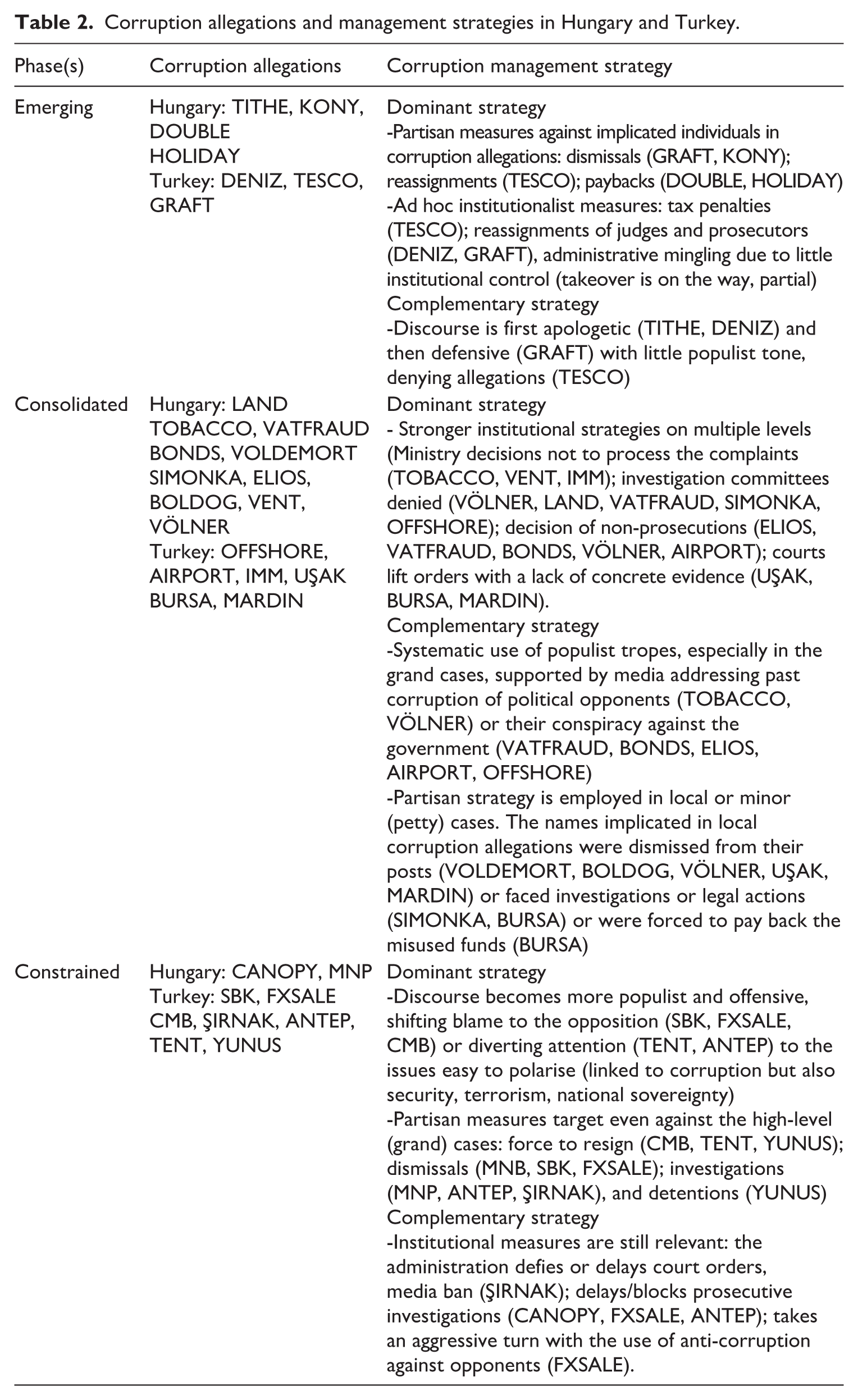
Our empirical section illustrates the authoritarian regime evolution over three phases in each country and corresponds directly to the corruption management strategies with explicit connections to the corruption allegations (see Supplemental Appendix 1). Table 2 summarises our main findings. The comparative analysis of two cases suggests that both regimes exhibit largely parallel dynamics. In the initial phase, both rely on partisan interventions; as authoritarian rule becomes more consolidated, they turn to institutional mechanisms; and under growing constraints, they combine discursive tactics with more aggressive measures directed not only at political opponents but also, when necessary, at friends and allies within their own ranks.
Corruption allegations and management strategies in Hungary and Turkey.
Emerging phase
In the emerging phase, corruption allegations were scarcer in both countries. While cases in Hungary were petty and confined to local politics, grand corruption involving high-ranking politicians was also present in Turkey. Due to limited institutional control, strategic responses were largely partisan and ad hoc, targeting the individuals implicated in corruption or involved in its investigation/prosecution. In Hungary, the biggest attention was given to a petty corruption case (DOUBLE), where double allowances were taken by MPs who also served as mayors, deputy mayors, or city council members in municipalities, which was against the law. The issue was resolved by the repayment of the unauthorised benefits. Another petty issue (HOLIDAY) involved 12 county leaders of the party who, along with family members, participated in a conference at the Azores Islands. Eventually, they also paid the costs of their trip back. As these examples indicate, instead of getting rid of ‘bad apples’, given the type of corruption, issues were resolved with corrective action. The only exception was the KONY extortion case, where local politicians who sent the State Audit Office of Hungary to investigate their political opponent were kicked out of the party.
We witness similar phenomena in Turkey. When a deputy party chief of AKP was accused of taking bribes for a real estate purchase (TESCO) in Istanbul, he was forced to resign. In the same year, fraud investigations targeting Turkish officials of the Lighthouse e.V. charity (Deniz Feneri) for embezzling donations in Germany widened to media groups and companies close to the ruling AKP. Several Turkish bureaucrats were accused of transferring money to Turkey and the AKP; however, the prosecutors were dismissed in the DENIZ investigations. This is where Turkey deviates from Hungary slightly. There were other instances where ad hoc institutional measures were used: the largest media group, Doğan, was charged with tax penalties after reporting the cases of TESCO and DENIZ. The case was largely covered up as the implicated names resigned from their posts. Similar measures were used to counter the GRAFT case, targeting several ministers and businesses close to the government with allegations of illicit money transfers to Iran and bribery for construction projects. The government immediately sacked Istanbul’s Chief of Police, who initiated the corruption investigations. Prosecutors and judges were also taken off the case weeks after the police raids. Erdoğan later dismissed ministers whose names were involved in the GRAFT investigations, while one of the ministers was reassigned to a lower-ranking diplomatic role. With the consolidation of the regime, GRAFT and DENIZ cases were closed as newly appointed public prosecutors decided not to proceed against the suspects.
Discourse within this period was mainly apologetic and defensive: people claimed they were unaware of regulations (TITHE) or that they didn’t mean to do harm. Also, in Hungary, the faction leader also highlighted multiple times that the governing party had to act differently compared to its predecessors and thus had to pursue common as opposed to personal interests. Similarly, regarding the allegations in the DENIZ, Erdoğan pledged that firm measures would be taken and that no tolerance would be shown towards those involved in corruption. Against the TESCO scandal, he toughened the discourse against the media reporting the case instead of making amendments. Close to the end of the phase, he started to embrace more populist discourse, defending his government against alleged attacks. The GRAFT case, for example, was framed as a plot by global forces to discredit the power of the AKP ahead of local elections in March 2014.
Consolidated phase
In the consolidated phase, institutional measures became the dominant strategy in both countries. In Hungary, in most cases, we witness similar patterns: there are both political and legal hurdles set along the way of investigating corruption cases. As for the former, in some instances, parliamentary investigation committees were not allowed, or when the opposition managed to create one, Fidesz members did not appear, so there was no quorum; a practice often replicated at the local level, as happened in the case of investigations for ventilator purchase during the pandemic (VENT). Eventually, the government changed the rules to make it more difficult to set up investigation committees. In addition, rules about data requests were made more costly and difficult to obtain. Alternatively, for example, Fidesz-led municipalities denied the publication of documents that could indicate corruption. When Orbán’s son-in-law was involved in the investigations of misuse of EU funds (ELIOS), contracts were not publicised.
As for legal hurdles, prosecution was very slow in investigating claims of corruption and oftentimes started investigations on the ‘wrong basis’. In the TOBACCO case, investigations concerning partisan distribution of concessions was based on ‘misuse of personal data’ as opposed to ‘influence peddling’, which was denied on legal grounds: they claimed that the minister’s decision to ‘transfer the right to retail tobacco products fell within the scope of managing national assets’ and, as such, ‘did not fall within the prosecutor’s jurisdiction of legality control as defined in the Act on the Prosecutor’s Office’. Also, when they were requested to release documents (e.g. in the TOBACCO or LAND cases about evaluation documentation), ministries or responsible agents could deny requests as they had sent applications back, so no legal claim could be made, as changing the documents afterward could not be prevented this way. Questionable internal investigations were always found in order, based on a claim that ‘closure of cases internally was based on professional grounds, so there was no need to investigate on criminal grounds’. In the ELIOS case, which involved Orbán’s son-in-law, the prosecution and the police could not recover documents that the European anti-fraud agency, OLAF, managed to do. Despite the OLAF reports, the prosecution in Hungary has found no proof of any wrongdoing. Eventually, the government paid back the requested sum to the European Commission.
The VENT case was also helped through the state of emergency, as public procurement requirements were eased, which made corruption less visible and the whole purchase less transparent. Calls for an investigation into VENT allegations were ignored, and once the state of emergency was repealed, the Finance Ministry simply denied an investigation. While the Ministry of Foreign Affairs and Trade, which was responsible for the contracts on ventilator purchases, did not share any information on the brokerage companies despite court rulings, and even destroyed documentation about the background checks of these companies, the issue never reached the court. The State Audit Office never checked the contracts, and the Police denied an investigation, arguing that ‘the government’s aim to sell the ventilators was proof of responsible handling of public finances’ in the first place. In the VÖLNER case, the head of Hungary’s Chamber of Bailiffs allegedly paid bribes to State Secretary Pál Völner in exchange for the abuse of his office to secure kickbacks from partisan appointments. Although the prosecution initiated an investigation, it was widely criticised for being concluded too quickly. Likewise, in the case of fraud allegations in the VAT schemes, the internal investigations of tax audit concluded even over a weekend (VAFRAUD).
In the VOLDEMORT case, the prosecution did not investigate the contradictory confessions of ministry officials on the matter, whereas in the SIMONKA case, the legal process has been restarted twice already since 2020 because of a change in the personnel of the judicial proceedings. Also, in Hungary, major changes happened in the media by the end of 2014 (with the acquisition of a major online newsarticle and commercial TV channel by close-to-government businesspeople), and grand corruption cases were discussed less and less within the media afterward.
In Turkey, the dominance of institutional control through political and legal means was also evident in the management of various grand corruption cases. When a motion was submitted by the CHP to investigate a money transfer by President Erdoğan’s family members and friends to an offshore company in the Isle of Man, the prosecution declined to pursue the accusations, stating that ‘there is no such thing as dirty money’. However, the receipts of money transfer disclosed by the CHP leader were reported as legitimate. The AKP rejected the parliamentary proposal for an investigation. Instead, the investigations targeted the CHP leader, who was later ordered to pay compensation to the Erdogan family for the non-pecuniary damage. State-controlled media prevented the OFFSHORE corruption allegations from reaching the public. Likewise, in 2018, CHP members revealed fraud in procurement at Istanbul airport (AIRPORT) and reported the unfair payments made to the contractors: Cengiz, Kolin, Limak, MAPA, and Kalyon Joint Venture Group. These holding companies won major infrastructure tenders over the years in energy distribution and metro lines (Gürakar, 2018). The Court of Accounts auditors identified tender irregularities in the Istanbul airport (Soyaltin-Colella, 2023). Yet, the excessive control over the judiciary left no chance of prosecution of the allegations.
We also witness a similar style of management in the petty corruption cases that came out in the AKP-led Istanbul Metropolitan Municipality (IMM). The new Istanbul Municipality that took power after 2019 local elections, led by the CHP, started investigating various corruption files including the allocation of luxury official vehicles by IMM to some government friendly foundations and associations, irregularities in the procurement process in the IMM urban transformation schemes in Istanbul and payment of the bills of the Turkish Youth Foundation (TUGVA) managed by the President’s son from the budget of IMM. The public loss in these cases was reported as $1.5 billion in the IMM case (Birgün, 2023). The files were transferred to the Ministry of Interior, yet inspectors decided ‘not to process the complaint’ while the government immediately banned access to news of the corruption investigations. Similarly, various petty corruption cases in the AKP-led or trustee-run municipalities (such as UŞAK, MARDIN, BURSA) were largely covered up by institutional control (TMMOB, 2023). The opposition’s proposals to investigate corruption allegations in these cases were rejected by the votes of AKP deputies and their nationalist allies in the Parliament, prosecution offices found the accusations ‘groundless’ and opted for non-prosecution.
Discursive and partisan strategies played a complementary role in tackling the increasing number of grand corruption cases in this phase. The incumbents typically relied on denial or adopted a more populist discourse, with state-controlled media actively promoting the government’s narrative. In cases of local or petty corruption, partisan measures were employed to sanction wrongdoers, often through dismissals or restitution to protect the internal solidarity within the party and co-opted elites.
In Hungary, this period has witnessed a slight shift in discursive tone. In the beginning, during the LAND case (partisan redistribution of agricultural land), the government simply contrasted its action to the previous government’s corrupt dealings in this policy area, stressing how they wanted to help people in their agricultural businesses. The first narrative change occurred about the TOBACCO case. The government developed a populist message, although it did so about the tobacco law as opposed to the scandalous distribution of tobacco licences. They claimed that all criticism was driven by multinational tobacco companies, their lobby, and the opposition as their allies. In their defence, they also claimed that the objective was to divert money from multinational companies into the hands of Hungarian families. Otherwise, they downplayed the political influence in the process, arguing that there might be close-to-government people who benefited from the concessions, but that was pure coincidence, not the result of decisions void of full transparency. In later cases, the populist tone grew ever stronger. It reached its peak during the BONDS, VENT, and ELIOS cases. In the BONDS (the sale of green cars through offshore companies), the government accused their critics of being pro-migration, who wanted to settle terrorists and criminals into the country as opposed to the economy-based programme of the settlement bonds with full-scale scanning of migrants. In the case of ELIOS, the government claimed that the opposition and Brussels wanted to interfere in the 2018 elections with the case, and also tried to shift the focus to corruption cases against the previous administration. In the VENT case, given the gravity of the pandemic situation, the government has easily built a populist narrative around the issue, portraying any criticism of the government’s handling of the pandemic as an attack on the Hungarian people’s lives. On numerous occasions, the government claimed that the opposition was interested in prolonging the health crisis, increasing the number of patients, and obstructing a successful battle against the virus. Pro-government outlets echoed and amplified these populist messages.
In Turkey, the discursive strategy was used rarely but in a more populist tone in this phase to delegitimise the opposition or to divert the agenda. In the case of the OFFSHORE, Erdoğan harshly denied the allegations and accused the opposition leader of using false and inaccurate documents and cooperating with ‘foreign enemies’ of Turkey. In the case of AIRPORT, the discursive strategy was used to divert attention to the debates regarding the name of the new airport (Atatürk was removed from the name of the new airport). Yet, the populist interpretation of allegations was amplified by the captured state media. The national agency published a report on the Istanbul Airport to show the ‘smear campaigns of global powers and their domestic collaborators that were carried out against the rise of Turkey’ (Anadolu Agency, 2018).
Within the consolidated period, we have seen very little use of the partisan strategy. None of the grand corruption schemes in Hungary (LAND, TOBACCO, VATFRAUD, BONDS, ELIOS) ended with major partisan decisions. In the beginning, there were still cases where, similar to the emerging phase, politicians felt the need to correct questionable actions (e.g., family members giving back land leases or tobacco concession contracts), but this was an outgoing trend. The few outliers who had to face consequences concerned either local politicians (from whom distance was easy to maintain) or petty corruption. The VOLDEMORT and the VÖLNER cases were much smaller in scale (about a few million Forints) as compared to billions in the SIMONKA or BOLDOG cases. They also triggered a slightly different partisan strategy. While parliamentary immunity was stripped in all cases, Mengyi (VOLDEMORT) was not made a candidate for the party in the 2018 elections. Although Simonka sat in Parliament throughout the 2018–2022 period to help the party maintain its constitutional majority, a legal case was already pursued against him. Boldog and Völner were simply not nominated as candidates in the 2022 election cycle. In Turkey, the partisan strategies were used in petty cases to enhance the co-optation strategy in the internal circles of the regime. In AKP-run municipalities (UŞAK, MARDIN), the names implicated in local corruption allegations were dismissed from their posts or forced to pay back the misused funds (BURSA).
Constrained phase
In the constrained phase, numerous corruption allegations have been brought to light not only by opposition parties but also by former allies of the government (particularly in Turkey). Yet, legal actions remained limited, and institutional measures (such as ex officio investigations or media bans) were employed instead to delay or even obstruct the enforcement of court decisions and water down public reactions. However, amid mounting domestic and external pressure, the governments’ strategies shifted once again. Institutional responses remained relevant but took a different direction. In Hungary, anti-corruption bodies were formed to delegitimise dissidents, while in Turkey, anti-corruption measures were used strategically to target political opponents.
More specifically, Orbán’s government established the Integrity Authority in late 2022, which was supposed to prosecute corruption cases that involved EU money. However, the authority was deemed by experts and practitioners as rather ‘toothless’ as it lacks the much-needed authority for in-depth investigations. Later in January 2025, the institution itself became entangled in a graft probe after prosecutors started investigations alleging the misuse of funds. In addition, the government established the Sovereignty Protection Office (SPO), the purpose of which is to counter attacks on national sovereignty. Since its foundation, the office has launched ‘comprehensive inquiries’ against the Transparency International Hungary Foundation (TIH) and the investigative journalist online outlet, Átlátszó.hu. The latter was responsible for uncovering a famous corruption case in March 2023 involving a local mayor who used EU funds to build a canopy walkway without a canopy, as all the trees had been cut before the walkway was constructed. While the CANOPY case is rather petty, it is currently being investigated by the Integrity Authority. SPO inquiries deplete the human resources of anti-corruption organisations by constantly pushing them to react to the office’s requests.
In Turkey, institutional responses remained crucial to tackle corruption allegations. No legal actions were taken against official complaints filed by opponents. For example, the prosecution office decided that ‘there is no need for an investigation’ for the unaccounted sales of foreign exchange (FX) from the Turkish Central Bank’s treasury to the domestic market in 2021. Yet, the opposition this time initiated a nationwide political campaign to question the unaccountable FXSALE and covered the streets and billboards with posters, banners, and posters of ‘Where’s the US$128 billion?’ The sum refers to the sale of FX by state banks during the period when Berat Albayrak, the son-in-law of President Erdoğan, was the Minister of Finance, without disclosing its disbursements and the exchange rate applied during sales. The FXSALE case was concluded following the prosecutor’s investigation into the posters, which were alleged to contain ‘insults to the President’’. Although security forces removed the posters, institutional control proved insufficient to contain public backlash, particularly after new corruption allegations were disclosed by former allies of the government. As a result, the government came under mounting pressure to adopt corrective measures.
First, the accusations were directed at the then Minister of Interior, who was accused of facilitating the escape of a Turkish businessman (identified by the initials S.B.K.) from Turkey to evade legal proceedings. The businessman had been indicted in the United States on charges of money laundering. The government adopted institutional measures, including detention and asset-freezing decisions based on evidence of illicit financial activities reported by the Financial Crimes Investigation Board. Later, in 2022, corruption allegations targeted high-profile officials who allegedly formed a bribery network in the Capital Markets Board (CMB) and asked for money from companies trading on the stock exchange. The prosecution office launched an investigation, and detention warrants were issued for the implicated names, including the head of CMB, who allegedly stored US$180 million in two flats and a villa.
In the case of allegations of bid rigging and bribery in the AKP-led municipality of ŞIRNAK, the government again launched an ex officio investigation into the mayor. Yet, the investigations blocked the enforcement of the court’s decisions or delayed the ruling, while the application of a media ban prevented transparency of the investigation. Likewise, investigations were requested against the AKP-led municipality by the prosecution concerning several buildings demolished in the February 2023 earthquake in ANTEP. The Ministry of Interior deemed it ‘unnecessary’ to authorise an investigation against the mayor.
However, in response to the recent allegations (January 2025) of tender rigging and fraudulent invoicing within the government-controlled Yunus Emre Foundation, the case (YUNUS) was transferred to the criminal court following a complaint filed by the public prosecutor’s office. While these institutional measures may have been intended to reassure the public of the existence of accountability mechanisms, they also revealed instances of misconduct within the government itself. To restore its credibility, the government reoriented institutional measures to target political opponents. Sixteen elected mayors, including the popular mayor of Istanbul who was announced as the CHP’s presidential candidate (Ekrem Imamoğlu), were detained and jailed on corruption charges, while arrest warrants were issued for hundreds of other officials in an intensifying crackdown on opposition since March 2025.
Discourse grew increasingly populist and offensive in this period, portraying the opposition as colluding with external enemies and threatening national security and sovereignty. In Hungary, the SPO delegitimised anti-corruption organisations by claiming that they operate in line with foreign interests. In their ‘report’ on TIH, the Office ‘confirms that the organization under inquiry pursues its activity to exert political pressure as part of a global lobbying network’, and ‘pursues its disinformation–based influence, which stigmatises Hungary and Hungarian state institutions’. The ‘report’ also stated that Átlátszó ‘operates in line with the foreign interest and with foreign state funding’.
In Turkey, discursive measures were heavily shared and amplified by state-controlled media. In the case of FXSALE, Erdoğan responded to the allegations in the Parliament with a cine-vision show called ‘CHP’s Lie Strategy’ and accused CHP of carrying out a ‘campaign of lies to discredit Turkey, damage its credibility, and undermine the confidence of investors’. He also extended the enemies beyond the borders and accused the collaborators of opposition parties in the international arena, such as ‘colonialists and the triangle of evil of interest rates, exchange rates, and inflation’, which he labelled as the ‘people’s enemies’.
Alternatively, the discursive strategy was used to divert the agenda to the corruption allegations involving the main opposition party members. Pro-government media contributed to the diversion by extensively covering the embezzlement and tender rigging investigations of 2021 in the CHP-led Municipality in a small town (Yalova) (in contrast to the media ban in the case of ŞIRNAK). In his election campaign, Erdoğan even traced back to the 1990s to bring back the corruption allegations against the CHP leader. In addition, the President was also given a chance to reply on TV to the misconduct in the Red Crescent, where tents were sold to a charity instead of being donated after the earthquake that hit Turkey in February 2023. Erdoğan diverted attention from the TENT scandal and also ongoing corruption investigations in the AKP-led ANTEP municipality to his government’s quick reconstruction plans in the region. He also blamed the opposition for being busy with the CMB corruption allegations and engaging in politics on such a day when ‘unity and solidarity were needed the most’. Against the bribery allegations in the CMB, Erdoğan again relied on an offensive discursive strategy and framed the corruption allegations as attacks on the government and blamed opposition parties for marching with terrorist organisations, ‘sworn enemies of Turkey, such as the Gülen and the PKK (Kurdistan Workers’ Party), and now criminal gangs threatening national security’.
As for partisan strategies, higher-level investigations were launched within inner circles to target implicated figures, with some sacrifices made in the form of detentions. In Hungary, allegations of misappropriation involving the National Bank (MNB), its governor, and his family prompted high-level investigations. The MNB foundations scandal erupted when Governor György Matolcsy allegedly diverted around €1.25 billion of its profits into opaque, quasi-private foundations managed by political allies. Following a formal criminal complaint filed by the State Audit Office, investigations were launched against Matolcsy. These unfolded as he became increasingly vocal in criticising Hungary’s economic trajectory. After 12 years in office, he was removed, marking a clear rupture in his political alliance with Orbán. The government reframed the affair as a case of mission drift, accusing the bank of engaging in non-core activities.
In Turkey, ongoing conflicts regarding the centralised nature of the leadership intensified after the formation of rival parties by former high-level AKP members (Çevik, 2020). The political rift prompted Erdoğan to take more aggressive partisan measures against grand corruption cases (Baykan, 2024). As a reaction to the FXSALE case, Erdoğan’s son-in-law and the former Minister of Finance abruptly ‘resigned due to health reasons’, just a day after the central bank governor was also sacked, related to the FXSALE case. To reconsolidate his divided base, ‘worn-out’ names, as called by Erdoğan, were excluded from the parliamentary candidate list for the upcoming elections, including the key figures reportedly close to the Minister of Finance and the AKP parliamentarian linked to the bribery network in the CMB case. Erdoğan further dismissed high-ranking officials whose names had surfaced in the same CMB allegations. Likewise, dissatisfaction with the Minister of Interior’s alleged ties to the SPK (the minister later had to accept that he used the SBK’s private jet during the election activities in 2017) led Erdoğan to exclude him, a long-standing member of his inner circle, from the new cabinet following the May/June 2023 elections. In the case of YUNUS, heavier partisan penalties were applied against the co-opted elites. While the relatives of the government partners were forced to resign and thus were saved from prosecution, the president of the foundation was detained. After this high-level sacrifice in the case of YUNUS, Erdoğan swiftly appointed a replacement.
Conclusion
This article examined how populist regimes adapt their corruption management strategies over time. Building on the literature of authoritarian regime stability, it was argued that institutional, partisan, and discursive strategies correspond with the survival strategies of repression, co-optation, and legitimation, and that their use may differ with the maturity of the regime. Our analysis shows that Hungary and Turkey display broadly similar patterns, relying on partisan measures in the early years, institutional strategies as the regime consolidates authoritarian control, and discursive strategies coupled with aggressive measures targeting opposition but also their inner circles (when necessary) under heightened constraints to reconsolidate power and ensure regime stability against the corruption allegations in petty and grand forms. The populist resilience argument could also be applied to other forms of corruption that are not covered in this article, such as budget clientelism (see Gherghina and Volintiru, 2023).
This similarity suggests that the framework we propose captures dynamics that travel across different contexts of authoritarian consolidation. That said, there are several differences. In Hungary, the presence of EU membership and associated conditionality mechanisms have not prevented corruption but shaped its management. For instance, EU oversight has encouraged Hungarian authorities to adopt façade reforms and legalistic justifications that allow institutional strategies to appear compliant with EU norms, even as they undermine accountability domestically. By contrast, Turkey, lacking the EU’s democratic leverage after the stalled accession process, has been freer to deploy even more aggressive institutional capture that has further entrenched authoritarian governance in the post-2023 period. The AKP government did not hesitate to use institutional measures to repress the opponents (jailing opposition mayors on corruption allegations) without needing to justify these moves in the language of compliance, while the Fidesz government relied mostly on discursive measures to tackle the opposition (at least until now). Discursive strategies also differ slightly: although both regimes delegitimise opposition actors, Hungary often frames EU institutions themselves as hostile actors, whereas Turkey tends to frame domestic opposition and external conspiracies together in a more nationalist-populist narrative.
Yet, these differences do not fundamentally change the underlying logic of populist resilience. Therefore, we believe that our theoretical model could apply to cases of populists in power under competitive authoritarian regimes. For example, in the emerging phase of authoritarian consolidation in India, the Modi government initially avoided overtly offensive rhetoric, instead framing corruption allegations as politically motivated attacks of the corrupt elite, a strategy resembling Erdoğan’s early approach. However, as the opposition alliance has begun to make electoral inroads into Modi’s strongholds, populist narratives have assumed a more offensive tone, paralleling developments in Turkey. Similarly, in contexts such as Serbia and Georgia, where authoritarian practices face increasing constraints from EU pressure, populist leaders have responded to corruption allegations by adopting partisan strategies that isolate implicated allies, while simultaneously escalating discursive and institutional tactics to delegitimise and suppress political opposition.
In democratic systems, we expect that corruption exposure leads to political costs and accountability. Yet, the elements of our framework may also travel to liberal democracies with populists in government, albeit with limitations. For example, partisan and discursive strategies can also be observable in democratic contexts, but the effectiveness of institutional strategies is constrained by stronger checks and balances and independent media (the United States, for example).
Despite these insights, important questions remain unanswered, opening several avenues for future research. A key issue concerns the role of opposition parties, independent institutions, and civil society actors in countering corruption management strategies without risking themselves. Understanding how opposition forces challenge these tactics, whether through electoral mobilisation, legal battles, or alternative narratives, can offer valuable insights into potential democratic resilience, especially at a time when populist measures are becoming more aggressive and repressive. Future research can deepen our understanding of the interplay between populism, corruption, and democratic erosion, offering insights into how these regimes sustain their stability and how they may eventually be challenged.
Supplemental Material
sj-pdf-1-pol-10.1177_02633957261416106 – Supplemental material for Populist resilience to corruption: Institutional, partisan, and discursive strategies in Hungary and Turkey
Supplemental material, sj-pdf-1-pol-10.1177_02633957261416106 for Populist resilience to corruption: Institutional, partisan, and discursive strategies in Hungary and Turkey by Digdem Soyaltin-Colella and Robert Csehi in Politics
Footnotes
Acknowledgements
We would like to thank the participants of our co-chaired Workshop on Corruption and Populism at the ECPR Joint Sessions at Leuphana University in Lüneburg, held on 26–28 September 2024, for their valuable suggestions on earlier versions of this article
Funding
The authors received no financial support for the research, authorship, and/or publication of this article.

Supplemental material
Supplemental material for this article is available online.
Author biographies
References
Supplementary Material
Please find the following supplemental material available below.
For Open Access articles published under a Creative Commons License, all supplemental material carries the same license as the article it is associated with.
For non-Open Access articles published, all supplemental material carries a non-exclusive license, and permission requests for re-use of supplemental material or any part of supplemental material shall be sent directly to the copyright owner as specified in the copyright notice associated with the article.
