







Abstract
This article discusses contemporary professional understandings of the UK Government’s attitudes to and policies around the management of child sexual abusers. This study is based upon empirical qualitative research with a range of professionals' working in or around the area of child sexual abuse (practitioners, academics and members of the media) (n = 28). The research used semi-structured interviews which were interpreted through qualitative (thematic) content analysis. Results indicate that the professionals sampled believe that the government misperceives child sexual abuse, focusing on risk reduction and public protection rather than treatment and reintegration. The participants also argued that although there are currently some good policies and intra-agency relationships around child sexual abuse in the UK, these could be built upon. The majority of the participants were against the public disclosure of sex offender information, believing that it is not a realistic approach in reducing the sexual abuse of children and therefore it should not be implemented in the UK. These findings suggest that current and future policy on child sexual abuse should be grounded, realistic and not be populist or punitive in nature.
Introduction
Child sexual abuse, especially paedophilia, is a high profile social issue, media story and moral panic in modern society (Davidson, 2008; Thomas, 2005), making it a central concern for the UK Government and central to a number of government agendas (i.e. education, welfare, crime and justice) as well as their public protection focus. This means that child sexual abuse in general, and more specifically the management of said population, have become highly politicized issues in the UK, evidenced by the frequency of politician, policy maker and gatekeeper commentary within the media coverage of child sexual abuse; the inclusion of child sexual abuse in the recent UK general election debates (i.e. the second leaders’ debate, Bristol 2010); and new policies enacted by the previous Labour and the current Coalition Government. Government attitudes to, understanding of, and policy surrounding child sexual abuse develop from a variety of sources (i.e. media coverage, public attitudes, professional practice and research) and has a wide impact influencing professional practice, policing, organizational funding and research innovation. Consequentially, as a broad range of professionals play a central role in the development of government attitudes and policy around child sexual abuse, this research aims to uncover how these professionals understand, interpret and assess said policy.
In recent years there has been a series of high profile changes in UK policy and legislation in the area of child sexual abuse (Home Office, 2007). These policy and legislative changes have developed in reaction to the politicized and nature of crime, justice and sexual offending (i.e. general election debates, political spin and coverage, inclusion on policy agendas); high profile media stories (i.e. Sarah Payne; Holly Wells and Jessica Chapman; Vanessa George); reactionary public attitudes (i.e. the riots on the Paulsgrove estate, vigilante attacks on (mis)identified child sexual abusers); and evidence based research (Davidson, 2008; Grubin, 1998; Pawson, 2001, 2002; Thomas, 2005). These policy developments include, but are not limited to, the Crime and Disorder Act 1998; the Sex Offenders Act 1997, which established the sex offender’s register; the expansion of the Criminal Records Bureau (CRB); the Criminal Justice and Court Services Act 2000, which introduced Multi-Agency Public Protection Arrangements (MAPPA); and the establishment of the Child Exploitation and Online Protection Centre (CE0P) in 2006. Current UK child sexual abuse policies and legislative changes have had varying degrees of success with MAPPA and COEP being seen as effective when responding to high risk offenders (Lewis, 2007; National Probation Service, 2006; Rowe, 2009), whereas there have been problems with CRB and adoption background checks (BBC News, 2006; Taylor, 2006).
The most controversial and punitive strategy for the management of child sexual abusers is the public disclosure of sex offender information (i.e. ‘Sarah’s Law’), which proposes that the public at large should have easy and unlimited access to the names as well as addresses of known sex offenders within their communities (Fitch, 2006). This initiative was originally spearheaded in the USA, where it is called Megan’s Law (Fitch, 2006) and was promoted in the UK by the News of the World and Sara Payne (McCartan, 2010; Silverman and Wilson, 2002). This issue has been thoroughly debated in the UK and America often with inconsistent conclusions being drawn regarding its effectiveness, legality, levels of public safety and impact (Fitch, 2006; Kemshall et al., 2010; Levi, 2000; Pawson, 2002; Silverman and Wilson, 2002). The UK government therefore has a varying attitude to public disclosure, initially rejecting it on public protection grounds (Dodd, 2000; Morris, 2000; Plotnikoff and Woolfson, 2000), then reconsidered and provisionally agreed to implement it (Assinder, 2006; The Sun, 2007), before quickly backtracked and discounted the scheme (Travis, 2007). It was then agreed that the partial public disclosure of sex offender information was a more realistic alternative (Home Office, 2007), resulting in the addition of ‘lay advisers’ to MAPPA panels, an increased use of CRB checks, an increased use of CEOP to publically disclose the names of dangerous, prolific sex offenders, and the introduction of circles of support and accountability pilot schemes. Recently the government has agreed and started to implement the limited public disclosure of sex offender information in England and Wales, dismissing the need for full public disclosure similar to America (Home Office, 2010a). This move is based upon the results of a pilot study revealing low inquiry rates by the public, high degrees of public confidentiality and no public disorder or vigilantism (Kemshall et al., 2010). However, there do seem to be differences in the piloting of, support for and implementation of the current limited public disclosure scheme throughout the four countries of the UK (i.e. England, Scotland, Wales and Northern Ireland). Hence, even though the scheme was piloted in England and Wales, all the police forces were English and none Welsh; with the scheme having clearly delineated roll out dates in England, but not Wales, instead only having a general implementation target of early 2011 (Home Office, 2010a); a similar pilot study was undertaken in Scotland leading to a rapid implementation of a similar scheme prior to the end of 2010 (Chan et al., 2010; Sex Offender Disclosure Pilot, 2009); and there are no plans to develop and/or roll out a pilot study in Northern Ireland (BBC News, 2010). As such, does this indicate a lack of commitment to the scheme by the UK government, emphasizing divisions around its effectiveness or is this just a reflection of broader issues in current criminal justice legislation in the UK? Interestingly, the public disclosure of sex offender information, although being a highly politicized issue in its own right, reinforces the politicized nature of child sexual abuse in the UK as both Labour and the Conservatives agreed to implement this scheme regardless of who won the upcoming general election (Home Office, 2010b; Travis, 2010).
Hence, child sexual abuse policy and legislation in the UK seems to differ based upon which country of the UK it is based in (i.e. England, Wales, Scotland and/or Northern Ireland), and is quite conservative, tentative and in a constant state of flux (Home Office 2007), potentially resulting in a degree of professional uncertainty. This led the former Labour Government to admit that more can and should be done to protect children from sexual abuse (Home Office, 2007) with a commitment that this would happen in the new parliament (Travis, 2010). However – given the new Coalition Government, a new approach to criminal justice and the implementation of new austerity measures – how likely this is to happen is debatable. Child sexual abuse does, however, remains a key government priority and no politician and/or government with an eye towards (re)election would carelessly cut its funding.
The current research aims to examine professional perceptions of, and attitudes to, the UK government’s perceptions of, as well as management of, child sexual abusers. It is a salient given that government attitudes play a central role in the rehabilitation, treatment, allocation of resources and societal discourses around child sexual abuse; and these attitudes are based in part upon professional (i.e. practitioners, media representatives, academics and policy makers) attitudes, research and practice.
Method
Design
This research is qualitative in nature, consisting of a series of semi-structured interviews (n = 28) with a broad range of professionals who work in and around the area of child sexual abuse. The semi-structured interviews allow the participants to give in-depth, reflective and personalised responses (Bryman, 1992; Mason, 2002).
Sampling and participants
The research focuses on professionals who work in, and around, the area of child sexual abuse (probation, charities, non-government organizations [NGOs], the police, members of the media, academia and therapists) (Table 1), all of whom were selected via purposive and/or snowball sampling techniques (Robson, 2008). The current sample was selected as it reflects the multi-faceted and multidisciplinary nature of those professionals who are engaged in practice, policy, research and the reporting of child sexual abuse. Therefore allowing for a better rounded, more in-depth and more applied understanding of professional attitudes to child sexual abuse policies and legislation.
The composition of the three different participant groups
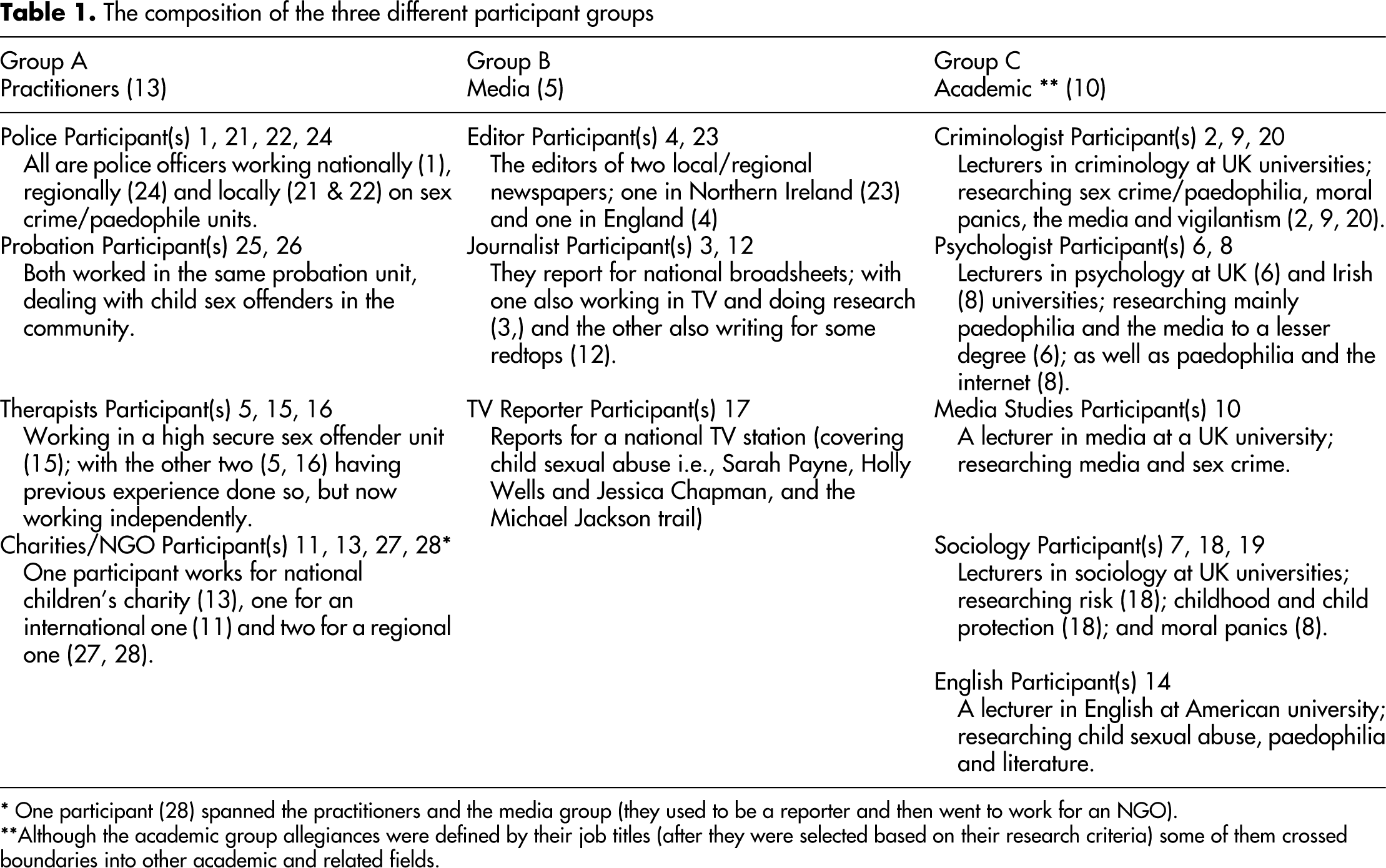
* One participant (28) spanned the practitioners and the media group (they used to be a reporter and then went to work for an NGO).
** Although the academic group allegiances were defined by their job titles (after they were selected based on their research criteria) some of them crossed boundaries into other academic and related fields.
Materials and procedure
Each interview lasted approximately one hour, being conducted in accordance with the ethical research guidelines set out by the British Psychology Society (BPS) (2000) and the British Society of Criminology (BSC) (2008). The interview questions and prompts focused around specific topics; however, the flexibility of the research approach allowed participants to influence the direction of the interview, capturing topics and issues which were relevant to the participants (Mason, 2002). Consequentially, the interviews were mainly participant focused and participant led (Mason, 2002). Post transcription, the participants were given the opportunity to check the transcript of their interview and/or have a copy of their interview transcript.
Data analysis
The data was then examined via qualitative content analysis (Krippendorff, 2004; Miles and Hubermann, 1994; Neuendorf (2002), or what can sometimes be called thematic qualitative analysis (Flick, 2006). This data analysis technique was selected as it fits with the exploratory aims and objectives of the current research (Krippendorff, 2004). When the themes where identified, checked and verified they were then contextualized in terms of how they related to: the other themes, the overall findings from the research, the existing literature and to the participants (Table 1). Throughout the qualitative data analysis care was taken to ensure that the themes established themselves (Hycner, 1985), particularly via the use of other researchers to independently analyse and verify the main researchers findings.
Results
The research produced two interconnecting and distinct themes around professional perceptions of the UK government’s approaches to managing child sexual abusers, specifically, what the government believe paedophilia to be and how the government monitors convicted offenders in the community. The professionals believe that the government view child sexual abuse in terms of risk management and public protection, rather than in terms of prevention and/or rehabilitation. Many of the participants, especially practitioners, believe that current UK policies for the management of child sex abusers in the community are the best they have ever been, although they could be improved. However, they do not feel that the public disclosure of sex offender information is a realistic or responsible means of management of child sex abusers in the community.
Government understandings and responses to paedophilia
A broad cross section of the participants (46%, n= 13), mainly practitioners and academics, discussed the UK government’s understanding of, attitude towards and policies around child sexual abuse. These participants argue that the UK government had an unrealistic, stereotyped and negative understanding of child sexual abuse, especially paedophilia: … [the government] sort of subscribes to the more extreme image of sex offenders being prolific, dangerous and all the rest of it. (Participant 6, Psychologist) … the government chooses to sort of see sexually offending against children as being, or paedophilia in particular, as being something that is difficult to treat, that is something that is a risk management issue. (Participant 25, Probation) So anything which effectively helps children avoid getting into abusive situations, report them early and all the rest of it. Its preventative measures which need to be funded…. (Participant 6, Probation)
A small sample of this cross section of participants (16%, n= 2), both practitioners, stressed that the UK government could do more in response to child sexual abuse. These participants argued that in order to develop more realistic child sexual abuse policies the government needed to listen to professional advice more, interact better with practitioners, as well as emphasize an evidence-based approach to policy making. However, one of these practitioners cautioned against the acceptance of all professional advice as balanced, realistic and effective. … NGOs bring specialist advice to the table, which is sometimes professional, sometimes semi-professional, some times down right dangerous… [as such]…. There are NGOs that work in a very constructive way in terms of protection, providing refuge, sources of care for children, and prominently lobby the government for the right funding at the right time. There are NGOs which, to be frank, are just bonkers, and you know need to be given a chill pill, and told to get out there and deal with the world realities as it is. (Participant 28, NGO Representative)
This recognition that professional opinion is sometimes biased, augmented by organizational policy and can be quite emotive/personalized is built on by one participant who believes that these issues also extend to the national government’s response to child sexual abuse. This participant argues that government policy, especially regarding child sexual abuse, is highly reactionary and therefore primarily motivated by public opinion, not necessarily by evidence, research or rationality. … looking at the national, you know sort of London government, you know people clap hands today and they desperately serve something up tomorrow, it’s often very ill thought out, hugely riddled with holes, it serves… it appeases people at the time, but there’s no medium or long term benefit from it because it’s so ill thought out. (Participant 22, Police)
The belief voiced by this criminal justice practitioner, that the UK government misunderstands and misperceives child sexual abuse, is not surprising and seems to reflect previous research (Grubin, 1998; Scourfield and Walsh, 2003). The idea that the government misperceives child sexual abuse seems plausible given that they mirror public and media attitudes towards child sexual abuse which are negative and overly punitive (Davidson, 2008; McCartan, 2010). This is reinforced by police participants who argue that recent policy changes regarding child sexual abuse are a result of public concerns and not developed from reasoned, planned professional debate or research. As such, it raises the question of whether the UK government’s current attitude to child sexual abuse is limiting how effectively they respond to it? Does the government’s attitude to child sexual abuse mean that they are only concerned with convicted child sexual abusers and that they are only interested in professional discourses which support policies they want to introduce? Consequentially, the professionals believe that the UK government needs to readdress its understanding of child sexual abuse so to move away from dangerousness and risk discourses to ones rooted in child protection and offender rehabilitation/reintegration.
Monitoring and policing sex offenders in the community
The majority of the sample (84%, n= 23) discussed the current strategies for policing and monitoring sex offenders in the UK, including the Sexual Offences Act 2003, MAPPA, the sex offenders register and the public disclosure of sex offender information. These participants believed that the recent changes to the sex offender policy and legislation has been positive, helping to streamline and simplify previous legislation; meaning that the current UK sex offender policies are the best they have ever been: The first thing is that it’s new and we haven’t done it before [Sex offender registration and monitoring], we are trying to get to grips with it. So, I think it is very new with a lot of positive moves going on and it’s something that will refine over the next 10 or 15 years. (Participant 5, Therapist)
However, these professionals go on to state that there is room to improve current child sexual abuse legislation in the UK, as not all the relevant policies and agencies are working as effectively as possible. Interestingly, some criminal justice practitioners suggest that they do not feel that that they are making any constructive impact upon the offending behaviour of the sex offenders that they are working with. Instead, they feel like they are encouraged to go through the motions, tick the relevant boxes, be seen to engage with the offenders and highlight their public accountability. This was particularly true with many of the ‘new’ reforms that have been brought in recently, such as MAPPA, as many of these reforms were viewed as a rebranding existing of packages, therefore politicizing and giving renewed public exposure to the work already being done. This resulted in some criminal justice practitioners questioning whether current child sexual abusers policy and legislation was about actual public protection or, rather, about perceived public protection?: … I mean it comes down to MAPPAs, I have got my own old policeman’s cynics view on this… it’s a self perseveration exercise, a process, if it goes wrong somebody turn round and say we have done this and done that, and he was registered; we’ve got them whispering in our ear. We don’t do any more work with them [sex offenders] now than we would have done 15 years ago…. So I am a little bit of a cynic unfortunately. (Participant 21, Police)
The legitimacy of current child sexual abuse legislation and policy feed in to a discussion, by all of these participants, of the public disclosure of sex offender information. A small selection of this cross section of participants’ (26%, n= 6), mainly criminal justice practitioners, firmly believed that the current UK sex offenders register and method of disclosure was the best way of monitoring, controlling and policing child sexual offenders. … I think that we have within the UK a 95–97% successful registration, or compliance, if that is the correct term? With registration? So we have 95–97% of people who should be on the register having actually registered. If you compare that to some of the states in the United States, where Megan’s Law is enforced, you have some states where 45–50% compliance rate is the norm. (Participant 16, Therapist)
The majority of the aforementioned small cross section of participants (53%, n= 13) did not believe that the public disclosure of sex offender information was an effective means for monitoring sex offenders in the community and would therefore not be introduced in the UK. These participants went on to argue that there was no evidence that outing child sexual abusers in the community works in reducing child sexual abuse, instead believing that it is more likely to drive paedophiles underground and lead to public order issues: … you know I’m sort of wary of the benefits of, if we have a sort of system where we are going to be told ‘there’s six sex offenders in the community’, so what? So what are you going to do about it?’ So there’s six sex offenders living in the community, there’s probably six others that you don’t know about anyway. The other sort of thing is, so how are you going to use that information? (Participant 6, Psychologist) In my view it’s an unworkable law, Sarah would still have been kidnapped, sexually abused and murdered had there been a Sarah’s law. I think it gave vent to people’s frustration that you can’t stop paedophilia, and you won’t, and there will always be abductions and sexual killings of children by strangers. (Participant 17, TV Reporter)
However, a minority of the participants who discussed the public disclosure of sex offender information (16%, n= 4) suggested that there were some possible positive outcomes to this policy. … where is the public in ‘public protection’? It’s non-existent and it needs to be there… it should happen; people should have the right to know that the person that they think is Mr Nice is actually Mr Paed…. Of course public disclosure is important, why is it important? Who is at the grassroots level of the community, the people, they can be the eyes and ears where the police can’t be all the time, or the probation officers can’t, they can be the people who monitor these things. (Participant 2, Criminologist)
A small minority of the practitioners and academics who discussed the public disclosure of sex offender information (11%, n= 3) discussed partial public disclosure. Interestingly, there was an occupational split in terms of how professionals viewed partial public disclosure, with practitioners believing it is a positive step and a good idea as opposed to non-practitioners who felt it did not go far enough: … the benefit of informing head teachers, headmasters, headmistresses, and even looking at agencies within the National Health Service, if that manager knows, and then…. And even though it might be restricted in what they can tell others, if the manager knows and it’s discussed correctly that manager can also use that information to also be the watchful eye. Because a lot of this can be used proactively as a watchful eye and that does happen, we do use that frequently. (Participant 22, Police) [So] it makes not one bit of difference whether the headmaster is told, it doesn’t, or the local vicar, or whatever. It doesn’t, for they are not allowed to tell anyone…. I mean it’s ridiculous. There is no in-between, because if you are looking at a continuum and the effectiveness of it, it won’t have any effect either way if you only tell one or two people. (Participant 2, Criminologist)
The professionals, especially the practitioners, had a positive, but cautious, attitude towards current child sexual abuse legislation which is unsurprising given that they work in the field, have personal experience and an in-depth knowledge of the offences and offenders. They therefore are better placed to see how government attitudes, policies and legislation around child sexual abuse have changed over recent years; with their firsthand experience allows them to realistically appraise what can realistically work in practice. This practical experience may explain why some practitioners, mainly police, seem to have a negative, almost cautious attitude towards MAPPA which seems to be at odds and inconsistent with existing research (Fitch, 2006; Home Office, 2006; National Probation Service, 2006).
The vast majority of participants disagreed with the introduction of the public disclosure of sex offender information suggesting that it is a negative, conservative, punitive and a potentially problematic approach to dealing with child sexual abuse (Bell, 2002; Fitch, 2006; Guest, 2007; Silverman and Wilson, 2002). These professionals believed that it would be underutilized and not have a significant impact, which was borne out by both the UK and American research, and lead to reactionary public disorder, which was found in the USA research but not in the UK research (Fitch, 2006; Kemshall et al., 2010). Professionals seem to suggest that the public disclosure of sex offender information is counterproductive, reactionary and a dated response to sex offender management; because even though there are potential ties to aspects of restorative justice these are outweighed by links between public disclosure and retributive justice as well as ‘policing by the community’. In spite of professional reservations the limited public disclosure of sex offender information is being piloted and implemented in the different countries of the UK (Chan et al., 2010; Kemshall et al., 2010; Travis, 2010); but is not a UK-wide piece of legislation, like Megan’s Law is in America. If the government decided to implement public disclosure of sex offender information across the whole of the UK what would this mean in regard to Northern Ireland, which already has a culture of community action and retributive justice?
Conclusion
Overall this qualitative research indicates that professionals who work in and around child sexual abuse believe that the government only perceive child sexual abuse, and therefore child sexual abusers, to be solely about dangerousness and risk. Therefore current child sexual abuse legislation and policy focuses on risk reduction and public protection, not on treatment, prevention and/or reintegration. However, given the fact that the broad societal discourse surrounding child sexual abuse is rooted in ideas around dangerousness, violent sexual offending, punitatitive responses and greater public disclosure; does this mean that the government is simply acknowledging and reacting to perceived social attitudes when developing legislation? If so, this implies that politicians and policy makers capitalize and politicize child sexual abuse, as well as related issues, to get votes, to be seen as having parity with public opinion and therefore reaffirm the broader societal construction; rather than challenging it and running the risk of being condemned and/or ostracized.
Generally, the participants support the steps that the government are taking in regard to child sexual abuse legislation, although they do not believe that the public disclosure of sex offender information is a viable strategy. Both the practitioners and academics involved in the study seem to suggest that the government feel that preventing and responding to child sexual abuse is a personal protection issue, therefore the individuals’ or their care givers’ responsibility, not a macro level societal issue and hence it’s not the government’s and/or the criminal justice system’s responsibility to protect individuals from child sexual abuse (Levi, 2000). This shifts the responsibility of preventing child sexual abuse away from the state back towards the victim, double victimizing them in the process and placing the community at the forefront of public protection.
The majority of the participants sampled believe that the government needs to develop a realistic understanding of child sexual abuse through informed debate, not popular punitiveness or reactionary politics. This greater government interaction around child sexual abuse would hopefully result in a coherent national sex offender strategy being developed which would improve responses to child sexual abuse across the board.