







Abstract
This article reports on the observations of a combined level 2 and 3 Multi-Agency Risk Assessment Committee (MARAC) over a 12 month period. It considers agency representation and discusses this in respect to attendance and the nature of relationships between representatives. The key findings are structured around the experiences of three identifiable groups of panel members and leads to a discussion of how the status of agencies and the informal roles adopted by the different members are defined by power relationships based on possession of knowledge. These relationships reflect cultural traditions in working with high risk offenders, but are also shaped by statutory responsibilities placed on different agencies within the MARAC forum.
Introduction
Agencies working with convicted violent and sexual offenders have been required to engage in local Multi-Agency Public Protection Arrangements (MAPPA) since the implementation of the Criminal Justice and Court Services Act 2000 in April 2001. These arrangements are intended to provide a joined up framework for criminal justice and other relevant agencies to share information regarding violent and sexual offenders in order to inform risk assessments and to implement detailed and holistic risk management plans. These arrangements involve relevant offenders being assessed as low, medium or high risk of causing serious harm and/or reoffending and then categorized as requiring level 1, level 2 or level 3 MAPPA intervention. Level 1 offenders are assessed as normally only requiring the intervention of one agency. Level 2 and 3 offenders are assessed as requiring the intervention of two or more agencies from across the statutory and independent sectors. The agencies involved in level 2 and 3 MAPPA discuss the offenders in regular formalized Multi-Agency Risk Assessment Committees (MARAC) and in irregular Multi-Agency Public Protection Panels (MAPPP) as required. In these forums information regarding offenders is shared and risk management decisions and action plans are developed (Maguire et al, 2001 National MAPPA team, NOMS and PPU, 2009).
It is has been well noted previously (cf. Bryan and Doyle, 2003; Kemshall, 2003; Kemshall and Wood, 2007a, 2007b; Robinson, 2002) that MAPPA (including MARACs and MAPPPs) are the observable practice of the criminological discourse around risk and managerialism pervading the criminal justice system. This discourse is characterized by a strategic and pragmatic rejection of rehabilitative ideals in favour of controlling crime rates. This change within the ethos of work with offenders has been coupled with a growing realization that individual risks cannot be managed by focused work undertaken by single agencies working independently to their own aims. Rather a concerted, multi-faceted approach, drawing upon the experience, skills and resources of a range of agencies pulling together is essential (Robinson, 2002).
Explicit within this discourse and changing practice is the need to include in MAPPA (and more specifically MARACs and MAPPPs) the routine involvement of a range of key agencies and the occasional representation of other agencies when required for specific cases. MARACs have a standing membership which forms the basis of the regular meetings, whilst MAPPPs involve those agency representatives relevant to the case being discussed, as MAPPPs are forums to deal with complex or high risk, level 3 MAPPA cases outside of the normal MARAC arrangements. Traditionally this area of work has been undertaken by police and probation services, which, in conjunction with prison services, are the responsible authorities for organizing and implementing MAPPA as set out in the Criminal Justice Act 2003. However, the Act also draws in other agencies which have a duty to co-operate in MAPPA; these include social services, housing services, health agencies, educational and leisure services where appropriate (Maguire et al, 2001 National MAPPA Team, NOMS and PPU, 2009). Maintaining effective representation and co-operation from a wide range of agencies has been considered crucial to ensuring that MAPPA frameworks provide a strong and consistent basis for multi-agency work with violent and sexual offenders (Lovell, 2002). Within the Criminal Justice Act 2003 co-operation is not defined, but rather left to each MAPPA area to negotiate. However, practice guidance (National MAPPA team, NOMS and PPU, 2009) is clear that other than a standing MARAC membership of responsible authority representation, agencies which have a duty to co-operate must only attend panels to discuss specific cases they are actively involved in, and must not be present at discussions of other offenders. Thus, their engagement within MAPPA and MARACs is limited.
Kemshall and Wood (2007a) discuss the model of public protection and risk management that is reflected within the structure and working practice of MAPPA. They argue that MAPPA embodies a community protection model of public protection, in which high risk offenders are regarded as unwilling recipients of probation (or other) interventions, and whose risks to the public need to be managed through exclusionary tactics. The model assumes that sex offenders need to be excluded from society (or at least risky activities or places within society) as much as possible, and that the public is not able to appropriately manage offenders’ risks or information about those risks and so are also excluded from the process of risk management. (This is, of course, being eroded by increasing public representation on MARAC and MAPPPs (Kemshall, 2009). The effect of the community protection model, in excluding high risk offenders and removing the public from decisions and actions to manage risks of offenders, is a process in which risk assessment, decision-making and planning are the preserve of experts. Kemshall and Wood (2007a) note that these experts are primarily the responsible agencies, but work in partnership with duty to co-operate agencies. However, very little research has considered the nature of these working relationships or the manner in which decisions on risk are made between those agencies involved in MAPPA.
This article considers the membership of Multi-Agency Risk Assessment Committees (MARACs) and the involvement of those agency representatives that attend. Few studies have considered agency representation or engagement in MAPPA, with even less consideration afforded to MARACs. These issues are, however, of importance because:
The effectiveness of MAPPA depends largely on close working relationships between the Responsible Authority (RA), that is, the Police, Prison, Probation Services and their relationship with their local Duty to Co-operate (DTC) agencies. (National MAPPA team, NOMS and PPU, 2009: 37)
The study
Twelve separate meetings of a MARAC in one probation area were observed between February 2004 and March 2005 as part of a larger study into the experiences of sex offenders in a Probation Approved Premises. The MARAC remit covered a third of a single co-terminous police and probation area as the region was split into three sections for the purposes of holding MARAC meetings: west, central and east. The panel observed was the west MARAC.
MARAC meetings were scheduled monthly a year in advance and discussed level 2 and 3 offenders. In these all-day meetings individual offenders were timetabled for approximately 15 minutes of discussion each (although this was not strictly adhered to). In each MARAC between 15 and 20 offenders were normally discussed. If extraordinary level 3 meetings were required to discuss the complex needs of an offender categorized as critical risk these MAPPPs would be added to the schedule when necessary. Only one extraordinary MAPPP was held in the 12 months of the study; as the membership for this was restricted to agencies relevant to the single case it has not been included in this article.
At each meeting the membership of the MARAC was noted (and agency affiliations). There were two broad categories of MARAC members: the standing members who were present throughout each meeting; and those that came to discuss specific offenders and then left the meeting. Contrary to recent guidance (National MAPPA team, NOMS and PPU, 2009), non-standing members were often allowed to attend the whole meeting if they wished, but tended to only attend for cases outside of their workload if they happened to be early to the meeting. In addition, research notes were taken on the discussions taking place as they occurred and included not only the speech but the behaviour and reactions of the MARAC members. After being typed these field notes were imported into Nvivo 2.
Nvivo is a software package that facilitates the management and organization of qualitative field data, providing an electronic project within which data can be stored, easily retrieved, coded, cross-referenced and commented upon; thus documenting a trail of preliminary findings and conclusions through to the final detailed and in-depth analysis. Nodes (themes) were developed in Nvivo from the transcripts based on thematic and analytical coding derived from the observed speech and behaviour of the MARAC members. The data were coded to nodes line by line and then explored using the node explorer function to intersect nodes and so investigate relationships between themes. Throughout the coding the emerging findings were grounded in a constant iterative process whereby coded data are checked by returning to the original transcripts to ensure that the context of meaning has been preserved in the node categories. Initial analyses can then inform further exploration and development of analytical nodes as well as the emerging conclusions.
In the following discussions members of the MARAC are identified by their professional role and offenders are identified by a code number preceded by either an O or R. Those identified by an R were resident in the Probation Approved Premises in which the MARAC was always held during the fieldwork phase of the research; those identified by an O were either living in the community or awaiting release from prison.
Agency representation within MARAC
Researchers and practitioners such as Bryan and Payne (2003) have noted that MARAC, MAPPP and MAPPA are more broadly contributing to the development of positive partnership working, which they equate with successful co-operation between police and probation services. Similarly, Kemshall and Maguire (2001) comment that police and probation services are committed to MAPPA; characterizing their relationship as ‘harmonious’. However, the relationship between the statutory criminal justice sector and other agencies is more fragmented, and their engagement in MAPPA is weaker:
The commitment and co-operation of other agencies (e.g. health, housing and social services), by contrast, was marginal in some areas. (Maguire, 2001: v)
Representation by agency in each of the 12 MARACs.
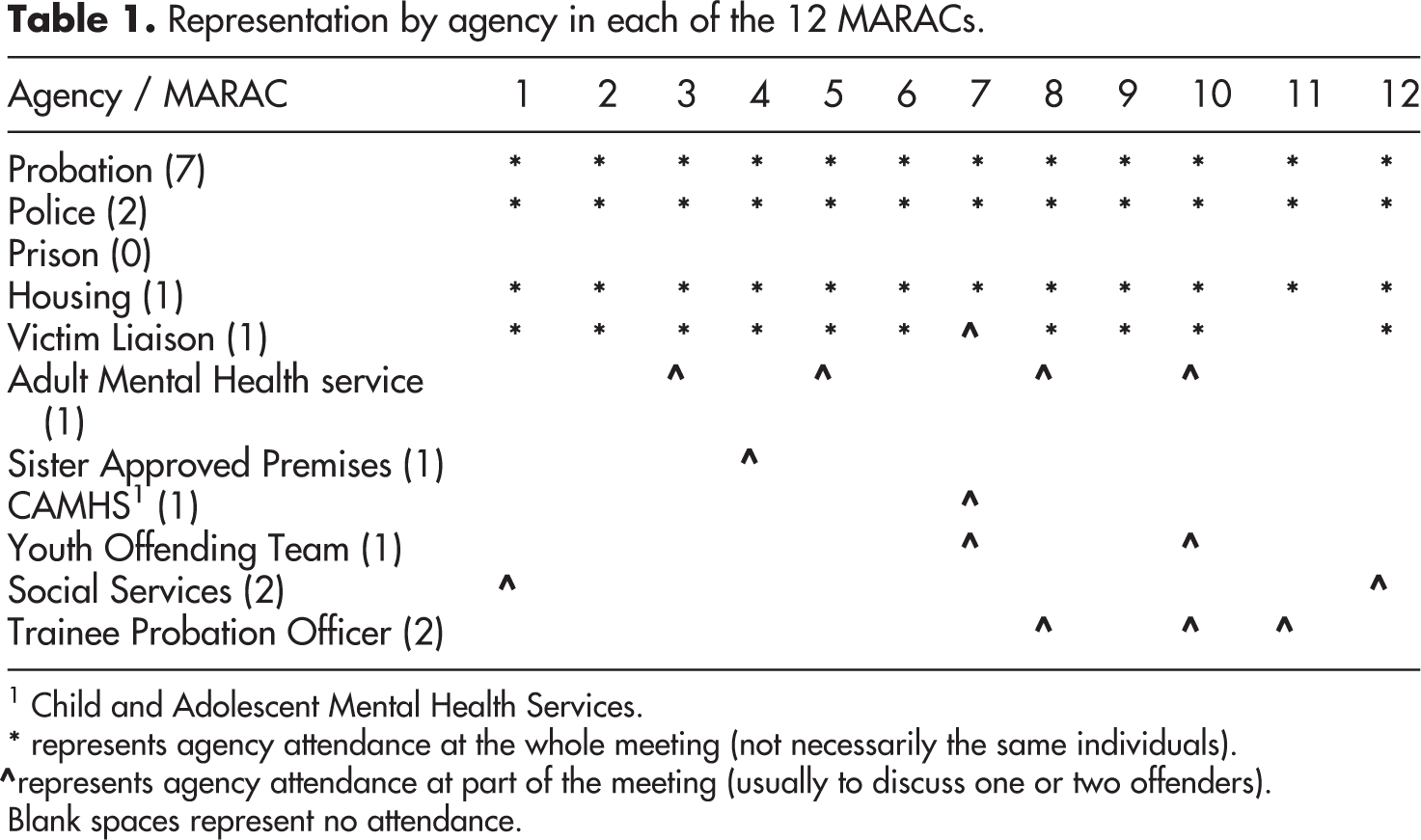
1 Child and Adolescent Mental Health Services.
* represents agency attendance at the whole meeting (not necessarily the same individuals).
⁁ represents agency attendance at part of the meeting (usually to discuss one or two offenders).
Blank spaces represent no attendance.
As can be seen from Table 1, only the statutory sector was represented in the MARACs, with no private or voluntary sector representatives being invited to any of the meetings. Standing members comprised probation, police (including the public protection officer and victim liaison officer seconded to probation) and housing services. These were the only agencies to have representation at every meeting for the whole meeting. In the case of probation, three or four primary officers were normally present throughout the meetings with other officers attending to discuss specific offenders (these were offender managers but were referred to as key workers in MARAC, so this article will follow suit). The standing Probation Officers consisted of the Area Chief Probation Officer (as chairman) and Senior Probation Officers, including the host Approved Premises Manager and Deputy Manager. For MARACs 1-7 this latter officer was also a Sex Offender Group Programme (SOGP) facilitator.
The over-representation of probation is partially explainable through their role as the responsible authority for MAPPA in the local area, in which they had assumed sole responsibility for the management, organization and administration of level 2 and 3 MARACs. Police were routinely present as a standing member, but prison (the third of the triad of responsible authorities) did not have representation at any of the MARAC meetings. The lack of prison representation may be due to the large geographical distances between the MAPPP location and receiving prisons for the area, which were prohibitive. However, while much previous work on MAPPA, MAPPP and MARAC engagement has tended to ignore the role of the prison service, Nash and Walker (2009) also commented on the lack of involvement of the prison service but were unsure as to why this relationship was not effective; they hypothesized about cultural working differences and problematic information sharing protocols, but these problems are also noted between probation and police services without the same effect.
Many agencies with a duty to co-operate were represented within the MARACs, if only for individual cases. Against expectations housing services can be regarded as a standing member (cf. Maguire et al., 2001 and McAlinden 2005; both of which found that housing services in particular were excluded from MAPPPs and MARACs, indicating that they were not invited to the panels by the co-ordinating officer). This unexpected committed representation from housing services may be because the MARAC tends to discuss offenders at ‘flashpoints’ in their progression through the penal system. These are at unsettled times when offenders are thought to feel least secure and at a high risk of reoffending, including release from prison and the hostel hosting the MARAC. This resulted in offenders being commonly brought to the MARAC when accommodation was a central issue of concern. A typical example is that of R17, convicted of multiple rapes and indecent assault against his 12 year-old daughter. He was brought to MARAC 7 when he first entered the hostel, at which stage his risks were discussed:
[….] He has been in the hostel for one week and is assessed as medium risk on Thornton and OASys to children. [….] Completed ETS [Enhanced Thinking Skills programme) and SOTP [Sex Offender Treatment Programme] in prison. He accepts full responsibility and shows good motivation. […] registered on SOGP [Sex Offender Group Programme]. MAPPP chairman: ‘We’ll leave him off MARACs until move-on [from hostel] stage’. (MARAC 7)
Representation of other agencies with a duty to co-operate was limited. Health services were only represented by mental health services (and mainly adult mental health as all offenders discussed were over the age of 17 years). Education, Training, Employment (Job Centre), and Leisure services were not invited to attend any MARAC: their involvement was confined to MARAC authorized disclosures about individual offenders and subsequent management plans discussed outside of the MARAC forum. Perhaps more surprising was the lack of Social Services representation (although, this has again been noted in previous literature, c.f. Maguire et al., 2001 and Nash and Walker, 2009). In this study what was most concerning was that despite being repeatedly invited to MARACs (unlike other duty to co-operate agencies apart from housing services), Social Services did not attend except to discuss one case (discussed in two MARACs as can be seen from Table 1). For the majority of MARACs Social Services did not inform the Probation Officers leading the case that they would not be attending and so often these officers would be expecting Social Services to attend the meeting. In some instances this led to cases not being fully discussed in the forum because the presenting officers were not in full command of all relevant information, reports or risk assessments. This, in conjunction with the small number of agencies represented in the MARACs, considerably slowed down the decision making process and led to action points arising from the meeting focusing on the need to liaise with (or gather information from) agencies not present at the MARAC before further decisions on risk management could be taken. This was illustrated in the discussions surrounding R41, a sex offender against children, who was demanding to visit his ex-partner and their children:
[….] MARAC chairman wants Social Services to arrange supervised visits to manage this. Report from Social Services previously indicated that contact may not be allowed. However, R41 attended the birth of his baby recently and all was OK at the hospital. He now wants to return to live at his ex-partner’s on release from the hostel. However, the risks to his ex-partner are high as he assaulted her last time he was released, and she hid him as well – he controls her. Probation key worker: ‘[R41] said over the weekend that if he starts drinking again he could murder someone – however, he says he will not drink again’. MARAC core panel agrees to keep the no contact with his children at present but want a Social Services case conference urgently. Will bring him back to the next MARAC after this has been done. (MARAC 12)
The experts
Despite the push towards multi-agency working, emphasis on the central role of the criminal justice sector has remained and is reflected in the naming of police, probation and prison services as responsible authorities for MAPPA, giving them statutory responsibility for the strategic management and evaluation of local MAPPA (Nash, 2006; NPS, 2004). This statutory role is mirrored in cultural practices that are rooted in long-standing traditions. It is police and, in particular, probation that have customarily taken on an ‘expert’ role in working with offenders, which is echoed in the practice and talk surrounding MAPPA and MARACs.
Membership of the MARAC was restricted and controlled through invitations to the meetings. A core panel comprising the MARAC chair, deputy chair and co-ordinating officer (all senior Probation Officers), with input from the Police Public Protection Officer, decided what agencies could or should be invited to any particular MARAC, or to discuss any particular offender. Invitations were given to those agency representatives deemed able to:
provide significant information to the MARAC which Probation Officers (offender managers) could not (or not as effectively) relate to the forum; provide general or specific advice on systems or working with offender/s; discuss specific cases with Senior Probation Officers to explore what that invited agency could provide for the offender within a risk management plan.
This is one of the statutory roles of the responsible authority: to determine which cases should be discussed in MARACs, when and by whom; but it is also a mechanism by which power is exercised in the forum. Those core probation representatives decided who should be invited to attend the MARAC based on their determination of the value of the agency in risk assessment and management planning. This value was primarily dependent upon the officers’ view of how much information regarding specific offenders agencies in question may be able to bring to the MARAC. If they perceived the agency could have no or little information then they were not invited; if they may have significant information then they were invited. Thus, it was probation that not only limited attendance, but decided what information was important and what information needed to be shared in the MARAC forum, based upon their own intelligence needs and assessments. The core panel’s mechanism of determining invitations to the MARACs further impacted upon the operation and function of the forum. As duty to co-operate agencies were invited only when it was assessed that they had pertinent information to provide (and not solely to be provided with information) the meeting developed a hierarchical structure in which information was offered to the MARAC by members outside of the core panel but was not necessarily reciprocated.
MARACs as experienced by the core panel of ‘experts’
Agency representatives’ roles varied within MARACs, loosely following the standing membership divide. Notably, these roles were stable for agencies, even if the representative changed. As noted above, these forums were intended to provide space for collaborative decision making, based on effective communication and information sharing; responsible and duty to co-operate agencies should provide general advice and case-specific expertise as appropriate. However, in practice, informal roles were followed. It was observed that while each agency representative was regarded as expert in their own field, only senior probation and police representatives (the core panel members) were viewed as experts in offender management and public protection. This meant that they had control over the meetings and other agency representatives deferred to them. This control was not only cultural but also structural as noted above (in their role as responsible authority, chairman and secretary of the meetings), as well as physical (although the room was square and there was no table to be ‘head of’ everyone turned to face the chairman who usually sat with the other core members; in addition the MARACs were hosted by the only Probation Approved Premises in the geographical remit of the MARAC).
The MARACs were used differently by the core panel to other members of the forum. For the panel MARACs provided an opportunity for them to (1) gather information regarding individual cases from probation key workers (predominantly on offenders’ progress through the penal system and current behaviour and attitudes) and (2) gain an overview of the high risk sexual and violent offenders within their remit. The panel had a different role in respect to both these elements of their MARAC work. On individual cases the core panel used the information gained to re-assess their own intelligence on the offender, prior risk assessments and management plans, and make changes accordingly. As a result they provided advice and guidance to the probation key worker as well as taking decisions on issues such as home leave applications (from prison or probation hostels), additional license conditions, risk classifications, assessment requirements and offence disclosures. In respect to the overview of cases in the area; the core panel used the information in a number of ways. For example: to manage risks associated with the ‘clumping’ of offenders in particular towns or housing estates; to manage the development of personal relationships considered to indicate an escalation in risk (for example between offenders); or to ensure that systems in place to monitor and manage the risks of offenders operated efficiently at the frontline of offender management and public protection work. Both of these functions were exemplified during the discussions of O10 during MARAC 6. Offender 10 was convicted of attacking a nightclub doorman and off-duty police-officer with a machete, He also had 128 previous convictions including sexual offences. It had previously been agreed that he would reside in the host hostel although he was a case originating from outside their geographical remit:
The police public protection unit officer (OP3) does not want him, but he had been assessed in the original MARAC [in O10’s home area] ‘as one of the critical few’. [The current] MARAC chairman (OP1) commented that the first two cases discussed today were out of area cases that are both ‘nasty and fierce’ and he was worried that the area locally was becoming a ‘dumping ground’. All members [of the core panel] agreed that he should be taken to a level 3 MAPPP. OP1, hostel manager (S2) and OP3 decided to refuse residency in the host hostel […]. OP1 asked if O10 should be recalled anyway: ‘Where’s he staying now? We don’t know… and he’s a sex offender… that’s the bottom line’. Probation key worker noted that he had previously always returned to his sister’s address and that he remained in contact with her throughout his prison sentence. S2: ‘If he’s at his sister’s there might be kids there, that’s the most worrying thing. [He] needs to be dealt with as a matter of urgency. We can’t ignore that.’ OP1 and OP3 decide to go for recall if he’s staying at his sister’s address as they suspect. (MARAC 6)
This relationship of the core panel of ‘experts’ to duty to co-operate agency representatives may be shaped by their responsibilityfor risk management and the need to make decisions on risk that can be defendable with hindsight. The significance of defensible decisions in determining the process of decision making in respect to sex offenders should not be underestimated. Kemshall (2009) discusses the emphasis on defensible decisions and decision making processes within the climate of fear that surrounds the release and management of sex offenders (and other high risk offenders) in the community. This has meant that the professionalism of the MAPPA process is one which requires responsible agencies to assert and maintain their expert status so that risk decisions are made in light of the best evidence-based practice. Kemshall and Wood (2007a) have noted that a consequence of this emphasis on expert decision making is to exclude the public from taking part in risk management (as well as to exclude high risk offenders, and particularly sex offenders, from active community involvement). However, in the MARAC observed, this was expanded to also largely exclude duty to co-operate agencies from the decision-making, moving them to a position in which they provided information to MARAC and supported MAPPA through their expertise in other areas of work. This supporting role of the duty to co-operate agencies is emphasized in their statutory role whereby the MAPPA process in which risk decisions are taken is the responsibility of the police, probation and prison services, but in this MARAC forum the way in which this duty of responsibility was exercised resulted in other agencies being afforded less power and status in the process, which does not accord easily with the joint partnership approach (and rhetoric) surrounding MAPPA.
MARACs as experienced by probation key workers
Probation key workers brought their cases to the MARAC and primarily used the forum as a line management exercise to gain advice and guidance from senior officers. Key workers presented offenders’ current status, attitudes and behaviours, occasionally making suggestions as to possible issues for risk management planning. These issues were then discussed by the ‘expert’ core panel and a conclusion was reached (with some limited involvement of other MARAC members where required). This usually entailed requests for more information by the next MARAC meeting but could be action points or risk category allocation. Most often the advice given to key workers was in respect of how to approach or work with the offender, and what aspects of their behaviour to monitor most closely. This was typically illustrated when a key worker was asked what an offender did with his time as he was not working:
The MARAC chairman asks what he is doing with his time. The key worker does not know. The police public protection officer does not like this. Key worker says the offender tells her that he is trying to get work, but his assertions have not been challenged. The chairman and S2 (Hostel Manager) agree that they would like him to go on an employment scheme so the MARAC can maintain a link with services about him so that they know what he is doing. They do not want him to drift as this increases his risk. (MARAC 11) Need to look into his mental health issues and ability to live independently. The sister hostel manager has not related any problems whilst he’s resided there and previous MARAC discussions have been positive. But R70’s key worker thinks he needs more time. S2 (hostel manager hosting MARAC) believes it is time and that as R70 wants to move near to his hostel he will offer R70 an immediate place if things do not work out and so act as a ‘safety net’. OP1 (MARAC chairman) agrees to S2’s plan. (MARAC 8)
Whilst probation key workers were not part of the ‘expert’ core panel due to their lack of official seniority (they were not Senior Probation Officers), they nevertheless worked in a manner that maintained the ‘expert’ status of the probation service more generally. This was illustrated in their belief that duty to co-operate agencies were not fully cognizant of appropriate public protection interventions or understood risk management and risk classifications; actions and activities which are central to modern probation work and which probation representatives regarded as defining their professional identity. This was most evocatively highlighted in a comment during a lunch-break when a key worker expressed their concern that OASys reports (probation risk assessment tool) were often given out in the MARAC:
I have a real problem about everybody having copies of OASys because if you don’t work in our system it doesn’t mean anything. (MARAC 8)
MARACs as experienced by duty to co-operate agency representatives
The information and knowledge gatekeeping activities of the core panel were not confined to invitations to the MARAC, they also reduced information-sharing through their own limited offering of intelligence to the forum. As the core panel tended to use the MARAC as an opportunity to gather information and consider it holistically in respect to that which they already knew there was little reason for them to give information to the other members of the MARAC. As noted above key workers did share information from the past month (or since the last time the offender was discussed at a MARAC), but this was often summarized and lacking in detail, and if the duty to co-operate agency had not been present at earlier MARAC discussions or were unaware of actions and events stemming from previous MARACs, they were rarely reviewed for their benefit: thus they could miss out on potentially crucial information. (This again illustrates that information was judged as appropriate to discuss in the MARAC from the perspective of probation key workers and the core panel.) The tendency for information to be presented in a concise form that left non-core members disadvantaged was due to the structure of the MARAC; monthly meetings discussing many offenders allowed very little discussion time per case, however, if the core panel thought longer discussions were needed these were arranged outside of the MARAC between the relevant parties or within an extraordinary MAPPP. However, the nature of the MAPPPs meant that only agencies currently working with the offender were considered for invite. Other agencies were not invited to provide general advice or to gain an understanding of the issues and systems for future work with this offender or similar cases. This limitation of the invitations was in the interests of confidentiality and also to maintain a tight focus on the offenders’ needs and management (National MAPPA Team, NOMS and PPU, 2009); however, an unintended consequence was to further assert the ‘expert’ status of probation and police services and to limit knowledge to other agencies.
Of interest is the lack of objection raised to this use of the MARAC forum to benefit core members but to provide little support to non-core members. This may be due to very few duty to co-operate agencies attending the MARAC in a non-standing capacity but may also be because informal cultural roles are routinely adopted within such partnership arrangements (Hymans, 2008) and it was observed that these roles had become well-established and were rarely resisted. One occasion of challenge was, however, noted. This occurred when it was stated by the MARAC chairman that a particular offender indicated a danger towards women and so should be assigned a male Probation Officer (on the transfer of the previous Probation Officer), the Housing Officer (a standing member of the MARAC) objected that this information had not been shared previously:
Housing officer comments that they are dealing with R34 as well, but did not know that he was being discussed today or that there were such severe concerns for staff – they would have preferred this information to have been passed on before as young female staff have been going to his home on their own. Housing officers’ concerns raised after key worker said, rather casually as though already widely known, that R34 was a high risk to known staff and adults and that his domestic assault charge was originally rape: ‘We’ve all had a slight worry about him really. It doesn’t sound very professional; unscientific’. (MARAC 11)
This dissatisfaction with information sharing was exacerbated by the large amount of debate and discussion on MARAC cases outside of the MARAC forum. The probation area, though geographically large, was small in terms of staffing. This meant that officers routinely engaged in public protection work were regularly and frequently meeting each other and informally sharing information throughout the month between MARAC meetings. This informal information exchange included agencies and individuals not normally present within the MARAC meetings such as social services and Probation Officers facilitating relevant interventions (such as the Sex Offender Treatment or Group Programme, anger management courses, drugs and alcohol addiction therapies or the Enhanced Thinking Skills courses). Thus, information was sometimes not thoroughly discussed in the MARAC because key workers or the core panel assumed the information to be common knowledge amongst MARAC members, but which had not always reached all parties who would find the information useful to their own practice.
The role of the criminal justice liaison nurse for adult mental health services was unique in the MARAC. She was the only person outside of the core probation and police dyad who was deferred to and asked to comment on cases outside of her specific case-load. Although any member present could comment on any case being discussed, other duty to co-operate agencies were rarely looked to for advice outside of their own cases and (other than housing services) were only invited to discuss cases they were currently working with (though they may be present in the MARAC for other cases whilst waiting for their case on the schedule: this practice has since been prohibited by the National MAPPA Team, NOMS and PPU, 2009). However, the nurse did not accept a standing member role in the MARAC, only attending for cases she was already involved with and sometimes sending written reports rather than attending in person. Thus, this representative was the exception to the rule: her expertise was valued and requested by the core panel but she only gave general advice on a couple of occasions when she happened to be early to the meeting for her own cases. She was, however, often consulted outside of the MARAC forum if an offender was thought to require mental health assessment or intervention. When asked why she did not accept the standing member role offered to her the nurse commented:
I’ve got better things to be doing with my day, this takes up all day and most of the time you’re just sitting there bored and not saying anything. You don’t get anything back for your effort. I don’t need to be here to talk about the cases I’m involved with, I always send a written report if I’m not going to be here. (MARAC 10)
Conclusion
It is evident in the light of a consideration of the roles taken in the MARAC that possession of knowledge defines agency representatives’ positions and maintains the core panel of standing probation and police representatives’ ‘expert’ status above other members. Knowledge literally was power, and so a hierarchical structure was observable wherein knowledge was held by the core panel and information was relayed from duty to co-operate agencies to them. Thus, MARACs are not homogenous bodies operating on an egalitarian, democratic basis, but rather there is a structural inequality evident in the holders and keepers of knowledge, who have power to direct the MARAC and limit the release of knowledge to other members.
This operation and hierarchical structure of MARACs reflects statutory guidance in the Criminal Justice Act 2003 which clearly states that agencies with a duty to co-operate in MAPPA are required to ‘enable’ responsible authorities to perform their statutory responsibilities effectively (Home Office, 2003: 20). This indicates that the relationship between agencies should be as observed; duty to co-operate agencies supply support to the responsible authorities (the core panel) in order to facilitate well-informed risk management planning and to work with them to provide that management in the community. Thus, the power disparities between agencies reflected the degree of responsibility that those agencies had for ensuring defensible decisions were taken on risk management. Power (and knowledge) inequalities, therefore, may be based on the differences in responsibility for the MAPPA process and the need for that process to be rigorous, transparent and justifiable (Kemshall and Wood, 2007a).
However, the hierarchical relationships inherent within the MARAC, on occasion, resulted in tensions between agencies. These tensions arose from two sources: firstly, that information was not always passed back to duty to co-operate agencies, forcing them to work with offenders without always having the necessary knowledge to support safe practice; secondly, that incidents resulting from the above and the general lack of reciprocity in MARACs meant duty to co-operate agencies became less engaged in MAPPA. This lack of engagement was limited in that agencies recognized the important role they had to play in supporting responsible authorities but were critical of the support they received in turn and of the value placed upon them as collaborative ‘experts’ in public protection.
From these findings it can be concluded that although MARACs may operate in accordance with statutory regulations and that these structures dictate information flow and knowledge possession. However, the relationships engendered by traditional and cultural roles as well as organizational hierarchies may sometimes be counter-productive to MAPPA aims. It is suggested from this study that further work into the consequences for risk assessment, planning and management is essential, and that the concept of multi-agency in this context may need to be redefined in order to embed reciprocal arrangements between members. Such arrangements could address cultural and practical concerns. Culturally it may help address power and status disparities between agencies and increase engagement in MAPPA processes by duty to co-operate agencies. Practically it may ensure that all agencies are utilizing appropriate strategies in respect to the risks presented by offenders.