






Abstract
People with visual disabilities encounter multiple barriers in their life experiences, placing them at a social disadvantage compared to sighted individuals. These barriers manifest in a limited access to and exercise of their rights, situations perceived as unfair or inequitable. The present research aimed to understand how inequities are configured in people with visual disabilities, based on practices and perceptions of fairness/unfairness and their expression in relation to access to material goods and services. An instrumental ethnographic case study was conducted within a community-based institution in Bucaramanga, Colombia, focusing on rehabilitation and social inclusion processes for individuals with visual disabilities and their families. Twenty-two semistructured interviews and 37 participant observation exercises were carried out and documented in a field diary. The emerging categories were (1) the family can be an obstacle or an aid in overcoming social injustices; (2) visual disability is a label, it is in the environment, in the way society recognizes it; and (3) from social exclusion to willingly-given inclusion. Our results indicate that inequities are configured primarily in relation to how people close to those with visual disabilities perceive and act towards them, constituting scenarios of cultural injustice (non-recognition). Part of the meanings and practices that people uphold are based on the view of a body considered outside the canon of normality and the non-recognition of a full citizenship, conditioning discriminatory (such as charity and infantilization), stigmatizing and excluding practices. The inclusion of this population group is mediated by the sensibility of the sighted other, a situation that conditions that the access and full enjoyment of rights is a matter of will.
Keywords
Introduction
According to data projected by the World Health Organization (WHO), by the year 2050, the number of visually impaired people is expected to increase. In 2020, the WHO estimated a total of 43.3 million blind people, 295 million with moderate-to-severe visual disability (low vision), and 258 million with mild visual disability (visual impairment), by 2050 a significant increase is expected: 61 million people will be blind, 474 million will have low vision and 360 million will have mild visual disability (Bourne et al., 2021).
The increase in visual disability can be partly attributed to population growth and aging, leading to a significant rise in the incidence of age-related eye diseases causing disability, such as cataracts, glaucoma, and macular degeneration. This situation is deemed more severe considering that 90% of this population resides in low and middle income countries (Cunningham, 2001; Thylefors, 1998). Rising numbers of people with visual disability raises concerns about exacerbating inequities as people face barriers to participation in social, economic and cultural life, excluding them from opportunities for employment, education, and full participation.
Braveman et al. (2011) defines inequities as inequalities or differences that negatively affect socially disadvantaged groups, are systematic and plausibly avoidable, and can arise due to factors such as skin colour, socio economic status (reflected in income, wealth level, education, occupation), sexual orientation, and disability. These categories indicate the advantages or disadvantages that determine the position of an individual or group in a social hierarchy. Inequities become important in the context of social justice, may arise from intentional or unintentional discrimination or marginalization, and are likely to reinforce the social disadvantage and vulnerability of the affected groups.
The definition provided by Braveman et al. (2011) underscores that inequities need to be assessed within the framework of social justice. It is in this context where Breihl’s assertion gains relevance by defining inequity as synonymous with injustice (Breilh, 1998). Part of the injustice experienced by people with visual disability has historical roots. Since ancient times, disability has been negatively signified by devaluing the lives of those who are different. People were considered possessed, the object of divine punishment, and fell victim to belittling practices such as infanticide and neglect (Aguado, 1995).
The unfair practices mentioned above find a justification in the social convictions that have prevailed historically, according to Honneth (1997a), since ancient ethics, there has been a belief that only those individuals whose actions can contribute to the realization of common social goals are considered worthy of leading a good life in the polis. Individual capacities and actions are valued to the extent that they cooperate with socially defined values (Honneth, 1997b). This perspective has influenced how society has perceived and treated people with disabilities, contributing to the perpetuation of discriminatory practices and social exclusion.
Another factor that contributes to reinforcing injustice and discrimination is related to how Western society has symbolically, socially, and culturally constructed the human body (Le Breton, 2002). Its significance stems from two patterns: first, the notion of ‘normality’ configured from the development of positivism and the biomedical model of disability that defines standards of functioning (statistical frequency) and capacity; second, aesthetic issues, whose standards of beauty define a valid body, generating a stereotype of perfection. The functionally fit, athletic, tall, slim, smooth-skinned, and those with beautiful and symmetrical faces are socially accepted, reinforcing the ideal of the perfect and healthy body.
The body of a person with visual disability is perceived by others as different, ‘abnormal’. The facial appearance resulting from the ocular pathological deficiency results in physical traits that aren’t considered acceptable by socially established beauty standards, all of this contributes to others devaluing individuals with imperfections, seeing them as outside the socially constructed canon of ‘normality’ and aesthetics.
The unjust practices of discrimination and exclusion find concrete expression in data that significantly reveal inequities. These data exposure differences or inequalities in various aspects where life unfolds. In relation to work, the study carried out by the UK Biobank Eye and Vision Consortium, showed that individuals with visual impairment have 3 times the risk of being unable to work, twice the risk of being unemployed and of having a lower status job (RR, 1.24 [95% CI, 1.09-1.41]), even those with slightly reduced vision in one eye are already considered at a disadvantage (Cumberland & Rahi, 2016).
In Pinilla’s study in Latin American countries, disability increases levels of multidimensional poverty. Twenty-two percent of people with disabilities and their families are multidimensionally poor. Their average number of deprivations is significantly higher compared to those faced by households without disabled members in countries such as Brazil, Chile and Mexico (Pinilla, 2018).
In Colombia, preliminary reports from the 2018 Population Census reported an overall disability prevalence of 7.1% (3.065.361 people) and visual impairment constituted 18.7% (Instituto Nacional para Ciegos, 2020). According to the 2020 Quality of Life Survey, the population with disabilities was estimated to be 2.65 million, representing 5.6% of people aged 5 years and older; of these, 54.6% are women and 45.4% are men (Departamento Administrativo Nacional de Estadística, 2022).
In relation to education, in Colombia the percentage of people over 5 years of age who cannot read or write is 20.5% and only 12.9% attend an educational establishment. A considerable percentage of children and young people do not study due to their disability and lack of economic resources. This situation has repercussions on the precarious living conditions of the population, reinforces poverty in their homes, their life projects are of little scope, and the opportunities for labour qualification and income generation are scarce, making the possibilities of an independent and dignified life low (Moreno & Rubio, 2011).
Given the marked presence of inequities faced by this population group, it became necessary to investigate how these injustices manifested in their daily lives. For this reason, this study aimed to explore how inequities are configured in people with visual disabilities, focusing on practices and perceptions regarding fairness/unfairness and their expression in relation to access to material goods and services by actors of a community-based institution dedicated to inclusion processes in the city of Bucaramanga, Colombia. This research not only sought to document the reality of this group but also aimed to provide empirical evidence that could contribute to guiding policies and practices to promote equal opportunities and social justice. The methodological choice of an instrumental ethnographic case allowed for the assessment of practices underlying injustice and social exclusion, offering a deeper understanding of the mechanisms perpetuating these inequities.
Method
An ethnographic instrumental case study was carried out, given that the main interest lies in using the case to understand a specific phenomenon. This type of study was chosen for the purpose of understanding something else (Galeano, 2018; Stake, 2007), in other words, our focus was on the phenomenon of inequities studied through a community-based institution in the city of Bucaramanga, Colombia. What we came to understand about the way inequities are configured was achieved through the analysis and interpretation of how the social actors who are part of it think, feel, relate and act.
When conducting an instrumental case study, any number of cases can be chosen to investigate the topic (Simons, 2009); however, the selection of this institution was not arbitrary; it was based on particularities that made it relevant to the study’s objectives, such as its long history of 52 years, which acts as a reflection of changes in national and local public policies related to disability.
This institution stands out in the city of Bucaramanga for comprehensively addressing the inclusion of the visual disability community, offering various services, ranging from education and comprehensive rehabilitation to artistic development and sports training. By bringing together people with disabilities of different ages and their families, as well as establishing interaction with different institutions, it becomes a setting that provides an important context for exploring the challenges faced by this population group.
The ethnographic gaze, being naturalistic, seeks to understand the behaviour of the subjects in the usual context (Bray, 2013), these are translated into practices that go through a construction of meanings and values that are expressed in the individuals’ own experiences, different practices generate scenarios of social injustice. The ethnographic case study itself differs from ethnographic research that has traditionally involved a prolonged immersion in the field; however, the fact that this study was conducted over a period of 10 months does not detract from the rigour and depth of the ethnographic method employed (Simons, 2009).
Following the COREQ checklist as an element for assessing the quality of qualitative research (Tong et al., 2007), the research team has extensive experience in public health, social inequities, and visual disability. The fieldwork was conduced by the first author, a sighted woman, optometrist and doctoral candidate in public health, aspects that make her sensitive to the living conditions of people with visual disability.
To access the institution and conduct fieldwork, communication with the director was initiated thanks to the relationship of friendship and previous collaborative work that the first author had carried out there. Initially a meeting was organized with the board of directors, the support team and some beneficiaries. The first author presented the research objectives, methodology, benefits, and procedures, and clarified doubts regarding participation and the overall research process. Some members expressed interest in participating.
In the next step, the first author contacted each person who expressed interest in participating by telephone. Individual appointments were scheduled to read and clarify any doubts and to obtain informed consent (which was provided to each participant in Braille and read aloud). Finally, participants voluntarily agreed to participate and signed the consent form.
The position of the first author as a sighted person could generate power imbalances between her and the participants; therefore, throughout the research process, we worked with sensitivity and empathy, respecting their integrity, their right to self-determination, and their privacy. Prior to the fieldwork, the first author conducted training on how to interact with people with visual disabilities. At all stages of the research, care was taken to use inclusive language (non-derogatory), highlighting in the dialogues what people could be and do for empathetic and respectful communication (language focusing on capabilities). The times, spaces, and methods for conducting the interviews were jointly arranged, allowing individuals to feel comfortable and safe sharing their experiences, safeguarding their privacy and confidentiality.
The start of the fieldwork was interrupted by the COVID-19 pandemic, a situation that forced the institution to suspend face to face activities; thus, during the period of isolation, communication was established via WhatsApp and phone calls with a certain number of people, where daily conversations, fears and uncertainties about the pandemic were shared, which allowed relationships of trust to be consolidated, and after three months, interviews and observations could begin in a formal manner.
The research involved 16 people, eight with visual disabilities and eight sighted individuals. Of the people with visual disabilities, their ages ranged from 20 to 56 years. Two had low vision and six were totally blind. Two were women. Of the eight sighted people, five were part of the institution’s administrative technical team, including the secretary, the psychologist, the occupational therapist, the music teacher, and the legal representative (who was also interviewed in the role of a parent). One parent agreed to participate. Two national governmental actors were interviewed. Table 1 shows the characteristics of the participants.
Characteristics of the participants.
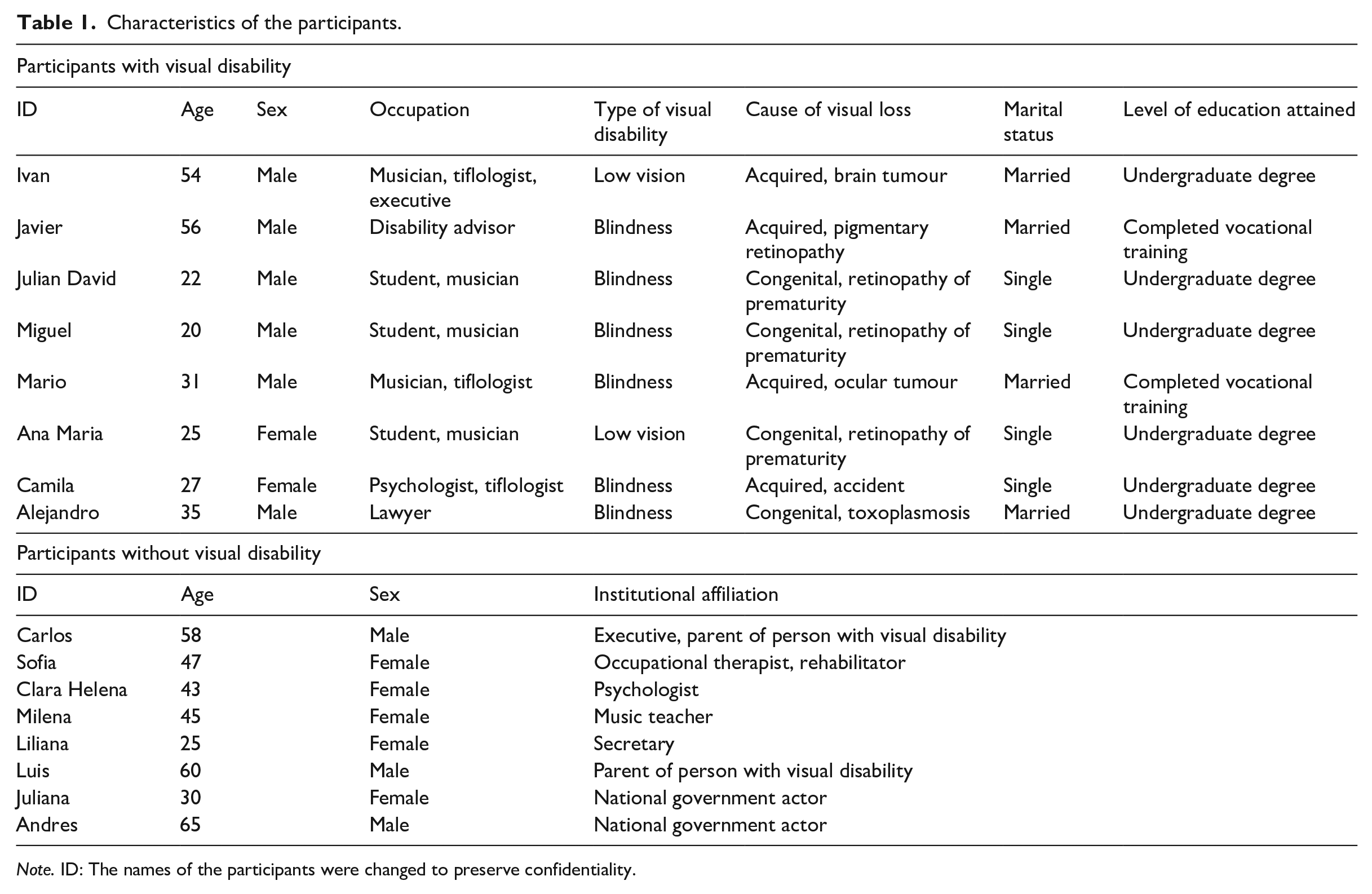
Note. ID: The names of the participants were changed to preserve confidentiality.
Twenty-two semi structured interviews were carried out, which lasted three to four meetings of 1 to 2 hr of conversation. Some were conducted in person, others by video call (using platforms such as Zoom or Meet) or phone call, depending on the interviewee’s preferences. The information gathered from the participants revolved around life experiences, management of the condition within the family and relationships with others close to them, perceptions of injustice, experiences in education, work, and leisure. Sighted people were asked about their experience of sharing with people with disabilities and their perceptions of injustice. The conversation with governmental actors focused on regulatory issues in disability and their degree of compliance. Each conversation was fully recorded and transcribed, with prior consent, the transcripts were returned to the interviewees for their respective revision, with the aim of refining their content, omitting or expanding on any type of information that they considered necessary.
Thirty-seven participant observation exercises were conducted, some in person, mainly rehearsals and musical performances, as well as some celebrations such as Friendship Day, Christmas, and birthdays. Virtual observations primarily consisted of music classes and some meetings with external actors. The face-to-face meetings lasted a minimum of 4 hr and the virtual ones no more than 2 hr. The main objective of the observations was to pay attention to any occasion in which individuals, through their actions (practices), implicitly or explicitly invoked conditions of injustice and exclusion. These approaches provided a better understanding of their everyday dynamics, how they build relationships, their behaviours, emotions, discourse, and ways of interaction with others outside the institutional environment; in other words, their practices. At the end of each observation and interview, the information was recorded in a field diary.
The data analysis involved a back-and-forth process between the field and reflexivity; that is, an interactive and iterative process, the lead author analysed each transcript, the codes and categories were refined with the research team for a collective reflection and broadening of the analysis. The phases or moments of analysis proposed by Angrosino (2012) were taken into account, consisting of a descriptive and a theoretical-narrative phase. The descriptive analysis began with an intensive reading of the interviews and field diaries, defining descriptive codes by identifying relevant themes according to the research objectives. Analytical codes were also identified by making theoretical inferences under the question: What does the statement mean, and does it have a sense or relationship with the theoretical? Finally, reflexive codes were defined, which included reflections on the role of the researchers in relation to otherness and its transformations. All codes were organized into emergent categories, allowing the identification of convergences and disparities in the discourses.
In the narrative theoretical moment, it was proposed to generate a comprehensive model through the construction of an argumentative narrative text (Gibbs, 2012). This was generated from the emerging categories, using mental maps that helped to see the relationships between them and thus begin the writing of the text. It is important to mention that the comprehensive model is inscribed in Geertz’s dense description, whose essential characteristic is to interpret the discourse of the participants, rescuing ‘what is said’. Geertz (2003) states that dense description is a second- and third-order interpretation and is done by ‘thinking and reflecting’, ‘thinking thoughts’ and ‘explaining explanations’.
The study had the approval of the ethics committee of the National Faculty of Public Health of the Universidad de Antioquia (act No. 21030002-00389-2019, session 223). Informed consent was requested from each of the participants, the ethical, anonymous and confidential handling of the information was guaranteed, and the names of the interviewees were changed.
Findings
For the participants, the inequities they experience are mediated by how their close others (family, partners, co-workers, teachers, and people in general) perceive them and act towards them. This dynamic conditions scenarios of stigmatization, discrimination, attitudes of charity, and infantilization, unjust practices that violate their dignity and restrict their enjoyment of rights.
From the analysis, three central categories with their subcategories emerged, the first category focuses on family practices, which can serve as either an obstacle or facilitator for overcoming social injustices. The second category addresses the perception of people with visual disabilities by their close environment, conditioning unjust practices of stigmatization, discrimination, charity, and infantilization, it is in this context where disability is conceptualized as a label, determined by the environment and how society recognizes it. Finally, the third category, ‘from social exclusion to willingly-given inclusión’ highlights the factors contributing to social exclusion, conditioning that inclusion is subject to the will of the sighted other. Figure 1 graphically presents each of the mentioned categories and subcategories, which will be explained in detail below.
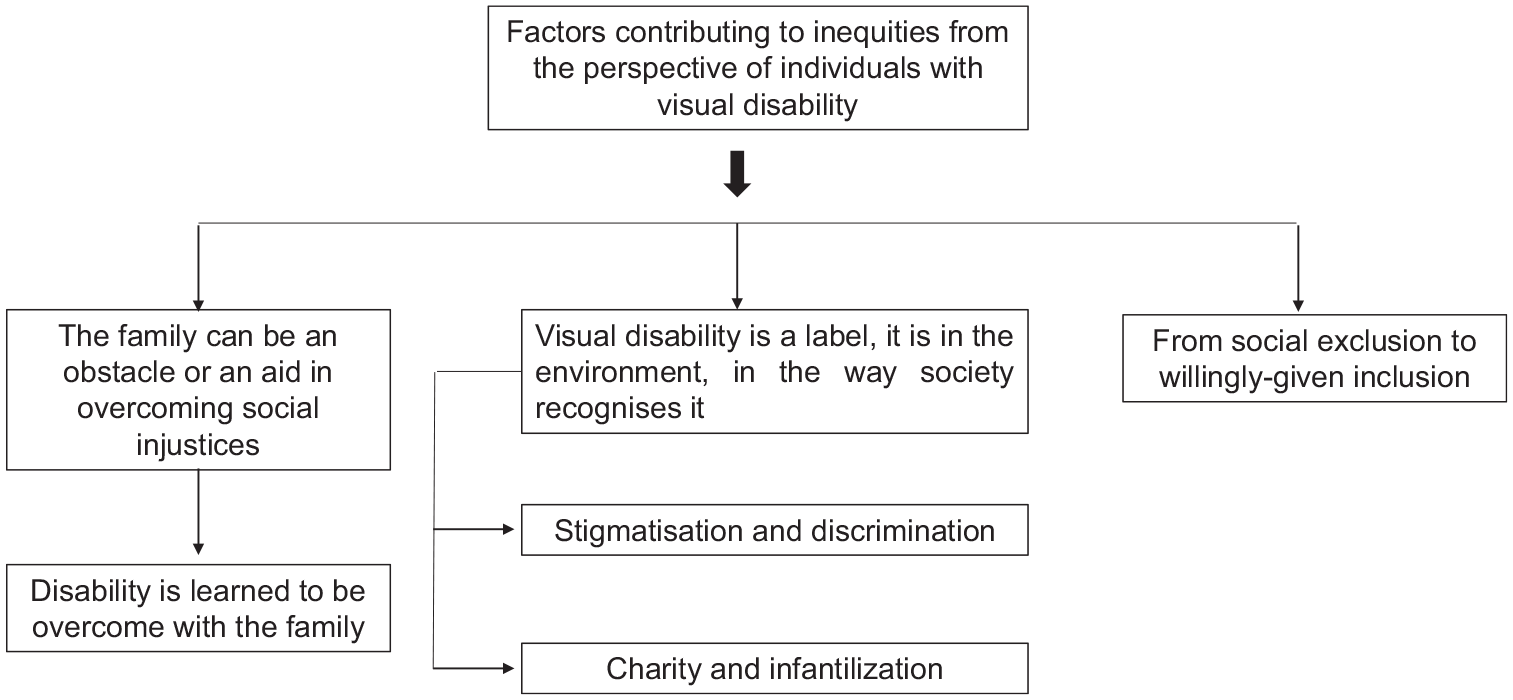
Core categories and subcategories.
The family can be an obstacle or an aid in overcoming social injustices
In families, there are positive and/or negative aspects that enable people to overcome or not the barriers they face in their life experience. In the negative aspects, some families have a reduced knowledge to assume the disability of their children or relatives, increasing the welfare and charity vision of disability, some parents justify themselves in the disability of their children not to look for a job, or use them to ask for help, they victimize and revictimize the person. This is how Ivan relates it: . . . the father victimises himself because he has a child with a disability and re-victimises that person, he turns him into a problem for society because that person is used to living on pity, to living on his complex and that he is good for nothing and society does not accept him, when that is false. (Ivan, manager of The Institution, person with visual disability)
The condition of disability in some cases had an impact on the conformation of families, breaking family ties, this being expressed in distancing, forgetfulness or denial of the existence of the person with a disability, which is a painful situation. Ivan shared his experience: . . .that my son’s mother would have taken advantage of my visual disability to separate me from him, many times he was three or four metres away from me and I would have been able to greet him, but she forbade him to speak to me and he had to pass by in silence, so using my disability for things like that seems cruel to me, it seems very unfair. (Ivan, manager of The Institution, person with visual disability)
In some cases, instances of mistreatment by one of the parents towards the child with a disability occur, as recounted by Alejandro: My mum was very strict, she loved me, but she hit me for everything, they were hard blows . . . for absolutely for everything she hit me and insulted me, and they were not simple blows but it was like smashing me against the floor, I had to put my hands: you why don’t you die . . ., very hard things. (Alejandro, person with visual disability)
Although there are perceptions and experiences that shape negative practices, from another perspective, there are families that constitute a support for overcoming disability, shaping issues of a positive order. Hence, the following subcategory.
Disability is learned to be overcome with the family
My dad took me out of the clinic, they took me home and they started playing with me, I didn’t play with them because I couldn’t see, all that hurt me to remember it, now I remember it and it makes me laugh, one has learned to overcome it with the family. (Julian David, person with visual disability)
Julian David’s testimony, expresses the importance of family as an essential element for individuals to face the challenges of living with a disability, their unconditional love and constant presence provide a sense of belonging and acceptance, while also helping to strengthen resilience and determination to confront challenges. The family becomes a fundamental pillar in the process of adaptation and overcoming disability, providing an environment of emotional support for the well-being of individuals.
The family’s ability to understand the needs of each member with a disability, as well as their willingness to adapt and provide an inclusive and welcoming environment, are essential for ensuring effective support. Their sensitivity to the experiences and challenges of their loved ones with disabilities is fundamental to their ability to thrive and reach their full potential.
The involvement of the family and their sensitivity is fundamental for the success of the rehabilitation and educational process, social inclusion and the development of the life project: My wife learned Braille, we had to do it for (our son’s) homework support, so that he could continue to be integrated in mainstream schools, the mother was the one who trained the teachers: treat my son like this, give him these reliefs. She was a very important support for the boy to be accepted, not to be seen with fear. (Carlos, father of a person with visual disability) My sisters supported me, they have always been encouraging me to achieve my goals, to study. My dad has been the one who has supported me the most, in the case of studying music he was the first one who gave me support, not only in economic resources. I have an uncle, when he knew I was going to study music he gave me a saxophone and a piano. (Ana Maria, person with visual disability)
Thanks to the support network provided by the families, some of the participants have the capacity to overcome material barriers, which has enabled them to have the financial means to lead a dignified life.
Visual disability is a label, it is in the environment, in the way society recognizes it
I don’t present myself as a person with a disability, however I am labelled in that group, but it is more a question of label than of reality. (Ivan, manager of The Institution, person with visual disability)
Ivan’s testimony highlights how visual disability is perceived and labelled by society, even when individuals do not primarily identify themselves as a person with a disability. This perception, rooted in the environment and the way society recognizes it, carries with it unjust practices that violate dignity and rights; thus, stigma, discrimination, charity and infantilization are direct manifestations of these labels that contribute to exclusion and vulnerability. In the following paragraphs, the results illustrate how these unjust practices affect people’s daily lives and influence their experience of social inclusion.
Stigmatization and discrimination
Ivan’s testimony refers to the way in which stigmatization processes are generated, which arise from the labels that sighted people impose on people with disabilities.
Stigmatization is a situation of rejection and disqualification experienced by any person who does not enjoy social acceptance; social labelling stigmatizes people and devalues their identity (Vargas, 2012).
Ivan recounts how he was disqualified from pursuing his aspiration to become a priest, and how his identity was devalued, a situation he felt was unjust: The unfair thing that seemed to me was that at the time I lost my sight I had all the illusion of being part of the church to which I belonged, I wanted to be a priest. When I lost my sight, the first thing the priest in my village said to me was: ‘You can no longer be a priest, you can no longer belong to the priestly guild, nor to this community because God wants perfect children’. (Ivan, manager of The Institution, person with visual disability)
Stigmatization leads people to be perceived as limited, pitiful, and lacking in abilities. Miguel recounts an incident he had with one of his professors at the university: ‘I had several problems with her, one day in front of the whole class she said to me: “Miguel, you have to understand that you are limited’. That bothered me. I told her: ‘Ma’am, I’m sorry, I am not limited, I have a disability, yes, but I’m not limited’. (Miguel, person with visual disability)
Participants judge stigmatization as unjust as it leads to their discrimination; although the Colombian state has made progress in terms of legislation for the recognition of equality and non-discrimination (constitutional jurisprudence, adoption of the Convention on the Rights of Persons with Disabilities, among others), discriminatory acts still persist and are expressed in the social relations that people establish with others, especially in the labour, educational, love and family scenarios. Some testimonies highlight this fact.
Mario experienced discrimination in the workplace through some mockery from his co-workers.
With my co-workers, after being so friendly with me at some point, they wanted to mock me . . . They saw me as an object of ridicule. (Mario, person with visual disability)
Luis recounts how his son was discriminated against in school due to his visual disability: When he started studying in primary school, there were big problems because at school, they relegated him to a corner, they didn’t treat him normally as they would a regular person. He told us: ‘-Dad, they leave me there, they don’t ask me anything, they don’t tell me anything – So, we talked to the principal for the teacher to pay more attention to Julian David. That was a lengthy process’. (Luis, father of a person with visual disability)
In the romantic scenario, Miguel tells the lack of sensitivity from his partner, expressed by ending the relationship because he cannot do certain things, a situation perceived as unfair.
Some time ago, I had a relationship with a girl, and she became interested in someone else. I asked her: Why are you telling me this, that you’re interested in someone else? she said: ‘Well, with him I can do things that I can’t do with you. For example, skating, not being afraid of falling’ very visual things that I do but I don’t enjoy them. She told me: He will enjoy them, and so will I . . . That seemed very unfair. (Miguel, person with visual disability)
Charity and infantilization
Charitable practices and infantilizing glances have also accompanied the social relations that people establish with other sighted people, permeating their life experiences.
The actions that make charity concrete, far from generating a social bond of solidarity towards people with disabilities, reproduce their domination and their exposure to various forms of violence (symbolic and overt). When charitable giving occurs, it reinforces their perception as bearers of a personal medical tragedy, reproducing the structural conditions of their oppression. When charitable giving is absent, people who survive by begging are attacked and held responsible for a non-individual situation, hiding the social and economic processes that lead to begging as an unchosen livelihood (Ferrante, 2017).
This can be contrasted in the testimonies of the participants; for them, the practices of charity are based on the reduced view that sighted people have of disability as a matter of alms, precariousness and of lesser value, a situation that contributes to violating their integrity and therefore expressions of symbolic violence: Once I was going to the university on the bus and a lady saw me, she wanted to give me alms, I didn’t accept it, society has a prejudice towards disability. (Carmen, person with visual disability. Field diary note, Observation No. 25) The official from the ombudsman ends his intervention. I notice he positions himself facing a cell phone camera, with his back to the youngsters, holding one of the gifts, saying: we are carrying out an integration session in this month of love and friendship, also sharing with them a great detail! A food kit . . . Once this activity is over, I approach Ana Maria to help her organize her things in her bag. She says: It’s so infuriating, those people always come and bring us food, they always think we are starving. (Field diary note, Observation No. 8)
Charitable perceptions have also permeated families, as Alejandro narrates ‘My aunt used to say to me: “Do you see? – referring to something on television – there are some blind people there, they sell lottery tickets, they do that, why don’t you?’, And I would reply: aunt, I don’t want that for my life, ‘Oh, it is because you are conceited!’. (Alejandro, person with visual disability)
In terms of infantilization, individuals with disabilities are not represented as the adults they truly are; often, they are not seen as capable of self-determination and are seen as needing care in all aspects of their lives (Trescher, 2017). This creates an environment where a presumed innocence prevails in desires, intentions, interests, behaviours, an almost desexualized life. The construction of ‘eternal childhood’ has been favoured, deploying an artificially infantilized territory where individuals are forced to remain indefinitely (Contino & Micheletti, 2019).
The primacy of innocence is expressed in Ana Maria’s story, for her infantilization is unfair: We are talking about being adults, we are not children, just because we have a disability does not mean that we are children, that we do not have a life, that we cannot work, that we cannot move around, that we cannot lead a normal life like any other person. (Ana Maria, person with visual disability)
There are some situations in which people with visual disabilities have been treated like children, some of which are expressed in the language that some sighted individuals use to refer to them: ‘We started the musical presentation, the kids began to play as they usually do. At some point, a young man (wearing a badge around his neck that accredited him as a public official) approached me and asked the name of the group, and I gave it. Once the activity was over, that man took the microphone and introduced the kids by saying: ‘Well, let’s congratulate the children from the Blind institution’s music group who have accompanied us today!’. Ana Maria, upon hearing the comment about ‘children’, got upset and said: ‘It’s always the same, what a nuisance’. (Field diary note, Observation No. 28)
The aforementioned unjust practices can manifest in the denial of educational, employment, and social opportunities. Consequently, in the next category, ‘from social exclusion to inclusion given by will’”, the factors contributing to exclusion are explored, as a reflection, it emerges that social inclusion should not be determined by the glances or perceptions of “abnormality” made by the sighted, but rather should be a fundamental right, intrinsic to human dignity.
From social exclusion to willingly-given inclusion
Exclusion of persons with disabilities is defined as the weakening or breaking of the bonds that connect the individual with society, caused by social stigma derived from organic ‘abnormalities’ (Cruz & Hernández, 2006; Gacitua & Davis, 2000) expressed in unequal access to labour markets and social protection, exclusion from participatory mechanisms in society and unequal access to and exercise of rights (Avaria, 2001).
Social exclusion is regarded as unjust, restricting access to different life spaces. Participants highlight the deprivation of access to education and decent employment as the main reasons for injustice. These are manifested in the lack of entitlement to fair economic remuneration according to abilities and potentials, and the absence of access to education deprives opportunities for training, dignification, and future access to economic resources. This was mentioned by a former official from the Ministry of the Interior: The greatest injustice . . . not being able to have decent employment is an undoubtedly tough issue. More than having decent employment is the fact that people with disabilities don’t have real access to education . . . If you don’t have education, you won’t have a more dignified job. (Former official, Ministry of the Interior)
Social exclusion in the labour sphere is an aspect that favours begging, as Javier explains: . . . unfair thing is not having access to the right to work, because many people have been forced to beg. I think that is very unfair. Some of my colleagues have to subject themselves to the sun, to the rain, at a traffic light, on a street corner, asking for a coin to have a daily livelihood. (Javier, person with visual disability)
Mario recounts a time in his life when he resorted to begging: I was at the Plaza Campesina in Mesa de los Santos
1
with my saxophone, and in two hours, I had 140,000 pesos [35 USD], I needed money. Truth be told, I’ve done many things, I’ve worked on the Transmilenio
2
playing the bongo and guitar with a friend and singing. In my early days, I used to ask for coins at a traffic light twelve or thirteen years ago. (Mario, person with visual disability)
People face attitudinal barriers due to the lack of sensitivity from sighted individuals, such as not believing in their abilities, labelling them as underperformers, pointing them out as deserving charity, and becoming victims of heavy jokes. These situations make them vulnerable, causing pain and making them fearful of not being accepted, contributing to their social exclusion.
Ivan mentions how people with visual disabilities are signified by exclusion: People with disabilities, simply because they have more difficulties, are always seen from the outside as having lower performance, lacking abilities, often without having tested them, but it’s the lack of credibility . . . (Ivan, manager of The Institution, person with visual disability)
Camila’s testimony reflects how she was vulnerable due to her condition: When I entered school, there were some girls who played heavy jokes on me. On two occasions, during break time, they took me to the side of some trees where there were wires. They made me pass through those wires, saying there was no other way to go. I scratched myself with the wires; they didn’t let me touch them, saying it was someone scratching me . . . Once they threw dirt in my eyes. Another girl, when I passed by her, insulted me, saying: blind! (Camila, person with visual disability).
There are practices that reveal that inclusion depends on the willingness of the sighted other. In the social relationships established, their sensitivity or lack thereof towards disability is pivotal.
The sensitivity of the teachers is expressed in apathy or not, Miguel recounts his experiences at school: Few teachers were closed-off, others were good . . . my chemistry teacher was lovely. Some teachers were not committed, others were. Some teachers are closed-off when it comes to disability . . . but there are others who are committed to doing something interesting and making an impact . . . the apathetic teachers didn’t care if one was in class; they wrote on the board and didn’t dictate. I have a blind person in my class, I don’t care if I have to adapt some of the subjects for them, it’s all the same to me. (Miguel, person with visual disability)
In contrast, in Julian David’s case, his teachers have been accessible and understand his disability: The platform’s accessibility is very good, and the teachers are very approachable. If you tell the teacher, ‘I can’t see images’, they respond: Alright! I’ll speak with the program coordinator to assist us in transcribing those images into a text-based PDF. There’s a specific style used by the university called the Tarabian style, which is challenging for us, the blind. So, if you say: ‘No, teacher, I can’t do the Tarabian style, I can do APA style, which is easier for me’, they change the Tarabian to APA for me. (Julian David, person with visual disability)
Discussion
Findings reveal issues that, from the perspective of individuals with visual disability, contribute to the configuration of inequities, conditioning scenarios of injustice in their life trajectories. Part of the inequities are configured in relation to symbolic aspects, to the way in which other sighted people interpret and act in relation to them, creating cultural injustice, which implies the non-recognition (Butler & Fraser, 2016) of people in their diversity and capacities. For individuals to achieve self-fulfilment, they require respect or acknowledgement from their counterparts in interactions; recognition stems from the positive appraisal bestowed by others. Individuals with visual disability, in some instances, are not positively appraised, experiencing moral wounds that affect their self-realization (Honneth, 1997b) highlighting that the exclusion, stigmatization, charity, and infantilization they experience are aspects of non-recognition.
The participants experience disdain from the sighted, partly due to the conceptualization of disability as an illness, abnormality, and incapacity, having a body with a different anatomical and physiological appearance and function than the standard renders them unfit for social cooperation; consequently, the negative view of the body plays a significant role in societal disdain and, therefore, cultural injustice.
Thus, individuals are stigmatized due to their condition of not having a ‘normal’ body. This has led others to engage in discriminatory, offensive, infantilising, and excluding practices, such as the physical and verbal attacks that Camila was subjected to by her schoolmates, the derogatory language used by Miguel’s teacher referring to his disability, the teasing from co-workers as recounted by Mario, the lack of appreciation as a partner that Miguel received from his girlfriend and the mistreatment Alejandro faced in his childhood from his mother.
While individuals may experience disdain, as Alejandro recounted, from another perspective, acts of recognition by families express actions that enable people with disabilities to feel loved and valued. In this sense, emotional reciprocity emerges; that is, individuals, upon feeling recognized by their loved ones, also respond to such appreciation by acknowledging their importance in overcoming barriers. Therefore, the statement that ‘disability is learned to be overcome with the family’ arises from this.
Families carry out certain practices that are manifestations of recognition. For example, getting involved in the processes of educational inclusion, as Miguel’s mother did, who accompanied her son in the regular classroom, the support that Ana Maria obtained from her relatives to carry out her wishes to become a professional. The importance of families in overcoming disability was also reported in the study by Bassey and Ellison (2022) who investigated the implications of acquiring a visual impairment and the effect on social support, they concluded that social, emotional and financial support allow people to adapt to new circumstances and rebuild their life project.
Despite the crucial role that families play in recognizing and supporting individuals with disabilities, unfortunately, these displays of affection and support are not always replicated in other areas, especially in romantic relationships, as Miguel experienced, this can be contrasted with Hunt et al’’.s (2017) study where he shows that sighted individuals have a negative attitude towards the prospect of forming an emotional relationship with a person with a disability. These barriers are related to social stigma and concerns about the caregiving burden that the relationship may impose.
Stigmatization has been reported in various studies; for instance, Tekkar and Tripathi (2022) showed that stigmatization negatively affects the self-esteem and self-fulfilment of people with visual disability. Their social participation is hindered by the stereotypical beliefs that society creates around them, labelling them as old, contagious and dependent (Fraser et al., 2019). These stereotypes lead to stigmatization, as these individuals were considered different and inferior to sighted people in physical, psychological, moral, and emotional aspects (Scott, 1969).
Bolt (2014) describes an ocularcentric epistemology, which is a perspective that places vision at the centre of human experience, considering it the supreme sense for understanding the world and acquiring knowledge, undervaluing other forms of sensory perception, such as hearing, touch or smell, contributing to the marginalization of those who do not have full use of this sense; thus, blindness is equated with lack of knowledge.
Bulk and colleagues (2020), demonstrated in their qualitative study with blind individuals in Canada that ocularcentrism contributes to stigmatization, as stigma operates culturally, socially, politically, and economically to shape opportunities among blind adults. In an ocularcentric world, stigmatization occurs socially through processes of labelling, stereotyping, segregation, discrimination, and loss of status; there is an interaction between ocularcentrism and stigmatization, as each feeds off the other, and individuals’ opportunities are limited by ocularcentrism.
The cultural injustice presented is reflected in the difficulties people face in accessing and maintaining education, as well as obtaining decent employment that ensures fair compensation to meet their basic needs. For example, in Colombia, despite the Integrated Household Survey estimating that there were 1.9 million working-age people with disabilities, they represented only 1.9% of the country’s workforce. Among working-age people with disabilities, only 21.9% participated in the workforce between April and December 2021, compared to 63.6% of people without disabilities (Departamento Administrativo Nacional de Estadística, 2022). This lack of access to employment forces some individuals and their families to resort to begging practices, as recounted by Javier and Mario.
In the educational context, there is a disparity between persons with and without disabilities; 16.2% of persons with disabilities have no education at all, compared to 2.6% of persons without disabilities, 37.7% of persons with disabilities have basic primary education, while this is 26.9% for persons without disabilities, only 14.3% of persons with disabilities have attained university education (Departamento Administrativo Nacional de Estadística, 2022).
Inequalities in access to work and education are also explained by attitudes of disdain from teachers, educational institution directors, and employers towards people with visual disabilities. Stigma labels them as incapable of learning or efficiently performing a job; as a result, inclusion is subject to the will of the sighted person, depending on their sensitivity, either facilitating or hindering the teaching process or the willingness to hire them.
The educational inclusion poses a dichotomy between recognition and disdain. Recognition is manifested in the sensitivity to understand the experience of others, as illustrated by Julian David’s experience, where his university’s professors adapted educational materials to his needs and engaged in reciprocal dialogue to adjust evaluative processes. In contrast, disdain arises when individuals are not valued in their diversity and are denied recognition of their different learning styles, revealing structural deficiencies in the educational system that need to be addressed.
According to the Saldarriaga Concha Foundation, in Colombia there are still deficiencies in the implementation of inclusive education principles in universities and teacher training schools (Correa & Castro, 2016). Out of the 443 existing education programmes, very few (18 programmes) adequately address inclusive education, and even fewer offer instruction on the use of typhlological tools to support inclusion in the classroom. This deficiency underscores the need to establish constructive and receptive dialogue among teachers, administrators, and government entities to develop policies that recognize and address teachers’ needs regarding educational diversity, thus promoting more inclusive and equitable teaching (Correa & Castro, 2016).
Conclusion
The inequities experienced by people with visual disabilities are primarily shaped by how those in their immediate surroundings perceive and behave towards them, resulting in an experience of cultural injustice. The meanings and practices are based on the vision of the body outside the standards of normality and with it, the nonrecognition of citizenship and full value for society, conditioning discriminatory practices (charity and infantilisation), stigmatizing and excluding. These practices often make inclusion largely dependent on the sensitivity of sighted individuals, and as a result, access to and participation in fundamental rights become a matter of willingness, reflecting a power dynamic where the sighted individual exercises a form of subordination over people with visual disabilities.
This research has implications for building equity, for which it is necessary to address cultural injustice from a multidimensional perspective; in this sense, a public health approach is needed to enable the recognition and development of capabilities, creating spaces for vindication and building ways to stop considering people as objects of charity and assistance, but as subjects of rights, with capabilities and potential to lead the life they want. This transformation implies addressing not only economic barriers, but also attitudinal barriers, promoting empathy, respect and understanding towards people with disabilities at all levels of society; therefore, it is important for disabled groups to fully participate in the scenarios of social policy construction, betting on the reconfiguration of a citizenship based on diversity, which implies de-medicalization and terminological change, so that disability is not understood as an illness, impairment or retardation, terminology derived from the biomedical model.
Addressing cultural injustice requires intersectoral collaboration and coordination. This entails working together with governments, non-governmental organizations, academic, health, and business sectors, as well as civil society, to implement comprehensive and sustainable approaches that promote equality of opportunities, recognizing human diversity.
The involvement of the family is a fundamental aspect that contributes to access to opportunities for its members with visual disabilities. In addition to providing emotional and financial support, families play an active role in social inclusion. To achieve this effectively, it is crucial that families receive specific training and support on issues related to visual disabilities, including understanding the needs and challenges of their loved ones, as well as strategies to address them effectively. Hence, the importance of their involvement in rehabilitation and habilitation processes with psychosocial support.
Limitations
This research was affected by the COVID-19 pandemic, a situation that led to a rethinking of the fieldwork and with it the way of approaching people. Even though it was possible to make a change in order to achieve this objective through participation in virtual and some face-to-face activities, social distancing limited interactions. It is necessary to go deeper into the way men and women with visual impairment perceive and experience social injustice, an aspect that can contribute elements for the discussion of inequalities with respect to gender relations, hence the importance of working this category under an intersectional approach.
In relation to methodological issues, the intention in the ethnographic case study is not generalization; rather, dissemination to audiences outside the case allows others to learn from it, and the knowledge gained informs decision-making, policy formulation, and practice (Simons, 2009).
Footnotes
Acknowledgements
The authors express their gratitude to all research participants who generously shared their life experiences.
Declaration of conflicting interests
The author(s) declared no potential conflicts of interest with respect to the research, authorship, and/or publication of this article.
Funding
The author(s) received no financial support for the research, authorship, and/or publication of this article.
