







Abstract
In line with a family systems perspective, this study examined the association between two aspects of family climate, that of coparenting (cooperation, triangulation) and parenting (autonomy support, dependency-oriented and achievement-oriented psychological control) and their relation to adolescent personal identity formation (commitment making, identification with commitment, exploration in breadth, exploration in depth, ruminative exploration, reconsideration of commitment). Using structural equation modeling (SEM), we tested the hypothesis that coparenting would be associated with adolescent identity formation via parenting. Cross-sectional self-report data were collected from 1,105 Swiss adolescents (aged 13–18 years; 51% female). SEM revealed associations between coparental cooperation and more adaptive identity formation via parental autonomy support. Conversely, coparental triangulation was associated with maladaptive identity dimensions via parental dependency-oriented psychological control. These associations were not moderated by age, gender, or family structure.
Introduction
It is well accepted that from a very young age social context plays a paramount role in shaping who we become, as established by Erik Erikson’s seminal theory of psychosocial development (Erikson, 1968). The family context is the first social milieu that a child is exposed to and continues to play a significant role in the lives of adolescents. During these adolescent years, a critical developmental task is the formation of a coherent sense of identity, that is, a coherent set of goals, values, and commitments that define who one is. Unsuccessful resolution of this developmental task has repercussions on adolescents’ future well-being and psychosocial functioning (Erikson, 1968; Waterman, 2007; Waterman et al., 2013). In fact, adolescents who lack a coherent sense of identity are more at risk for maladjustments, including internalizing (Crocetti, Klimstra, Keijsers, & Hale, 2009; Schwartz et al., 2011) and externalizing difficulties (Crocetti et al., 2009).
While identity formation has often been considered to be an internal psychological process, identity is in fact formed through interactions between person and context (Erikson, 1968; Kroger, 2004) and needs to be examined within the different ecological environments in which it is embedded (Bronfenbrenner, 2005). Among proximal contexts, the importance of the parent–child relationship and parenting behaviors has received much attention from identity researchers and its influence on identity formation has been widely supported (e.g., Beyers & Goossens, 2008; Luyckx, Schwartz, Goossens, Beyers, & Missotten, 2011; Luyckx, Soenens, Vansteenkiste, Goossens, & Berzonsky, 2007; Sartor & Youniss, 2002). However, in line with family systems theorists (Bowen, 1978; P. Minuchin, 1985; S. Minuchin, 1974), families are composed of a number of interacting relationships that should be understood as an organized whole and are not reducible to the sum of their parts. Thus, the family context must not simply be reduced to this parent–child relationship. A number of family theorists contend that the coparental relationship, defined as the collaboration between parents in regard to child-rearing, provides a more comprehensive understanding of family functioning (see Feinberg, 2003; McHale, 2007; McHale & Rasmussen, 1998). In this light, the general aim of this study was to examine the associations between perceived coparenting and adolescent personal identity formation, which to the best of our knowledge remains unexplored in the literature, thereby testing whether perceived parenting would act as an explaining mechanism between coparenting and personal identity formation.
Adolescent identity formation
In Marcia’s (1966) operationalization of Erikson’s theory of identity development, identity formation was presented as being a function of adolescents’ degree of exploration (i.e., the process of exploring different identity alternatives in varying life domains) and commitment (i.e., the adherence to a set of values and beliefs). More recently, several authors have stressed the importance of a deeper understanding of the underlying processes at play in identity formation and have developed models that aim to better capture these processes (for reviews, see Crocetti & Meeus, 2015; Luyckx et al., 2011). In an extension of Marcia’s work, Luyckx and colleagues (Luyckx et al., 2008; Luyckx, Goossens, Soenens, & Beyers, 2006) proposed a dual-cycle model of identity formation in which the authors “unpacked” the dimensions of exploration and commitment. The first cycle, commitment formation, refers to a general exploration of identity commitments (exploration in breadth) with the forming of initial identity commitments (commitment making). The second cycle, commitment evaluation and maintenance, involves a thorough evaluation of one’s existing commitments (exploration in depth), and should these initial commitments seem adequate, they will be integrated and internalized (identification with commitment). Should these identity commitments not seem adequate, they will be reevaluated and reconsidered for other alternatives (reconsideration of commitment; see Crocetti, Rubini, & Meeus, 2008; Skhirtladze, Javakhishvili, Schwartz, Beyers, & Luyckx, 2016; Zimmermann, Lannegrand-Willems, Safont-Mottay, & Cannard, 2015). Lastly, an individual may find themselves stuck in a process of ruminative exploration, in which they feel incapable of closing down the exploration process and are unable to make firm commitments. In research mainly conducted in western societies, it was found that these later two identity processes (reconsideration of commitment and ruminative exploration) have been associated with poorer psychosocial outcomes in adolescents (Beyers & Luyckx, 2016) whereas the four former identity processes (exploration in breadth, commitment making, exploration in depth, and identification with commitment) would rather indicate positive identity development (i.e., a sense of identity coherence; Eichas, Meca, Mongomery, & Kurtines, 2015), as they have been associated with a host of positive outcomes, including academic adjustment and self-esteem (e.g., Luyckx, Goossens, & Soenens, 2006; Luyckx, Soenens, Goossens, & Vansteenkiste, 2007).
Coparenting and identity formation
Over the past 40 years, personal identity formation has been more so conceived as an intraindividual process (Côté & Levine, 1988; van Hoof, 1999). However, in Erikson’s original writings (1968, 1974, 1980), he emphasized the importance of person–context interaction for the development of a personal identity. Thus, the development of a coherent sense of self results from the interaction between a person and the different contexts that surround them, with one of the most important contexts being that of their family. More recently, several authors have refocused on the importance of context for identity formation, using process-oriented models to examine the associations between the parent–child relationship and identity formation (e.g., Beyers & Goossens, 2008; Crocetti, Branje, Rubini, Koot, & Meeus, 2017; Luyckx, Soenens, Vansteenkiste, et al., 2007; Smits et al., 2008). Although these studies typically focused on the role of the parent–child relationship, family systems theory posits that the family is composed of a number of interacting systems, with the parent–child relationship being just one (S. Minuchin, 1974). Another important relationship that adolescents are implicated in and that has received far less empirical attention is the coparental relationship (S. Minuchin, 1974).
Coparenting refers to the collaboration between parental figures in regard to the rearing of a child for whom they share responsibility and can be characterized as a family group-level dynamic (Feinberg, 2003). In other words, the coparental relation can be seen as encompassing all exchanges or actions occurring between parental figures having to do either implicitly or explicitly with the taking care of their child (McHale, 1997). Coparenting can be distinguished from parenting, which has to do specifically with the individual relationship each parent has with his or her child. While both parental figures are implicated in the coparental relation, it remains separate from the marital (romantic) relationship between parental figures (Belsky, Crnic, & Gable, 1995) as well as the individual parent–child relationship (S. Minuchin, 1974). In fact, coparenting has emerged as a unique construct separate from that of parenting, accounting for additional variance in regard to the prediction of child adjustment (Belsky, Putnam, & Crnic, 1996; Caldera & Lindsey, 2006).
Often studied facets of coparenting include cooperation and triangulation (Margolin, Gordis, & John, 2001; Teubert & Pinquart, 2010). Cooperation refers to the interparental exchange of information concerning the child, as well as support and respect between parents in regard to child-rearing issues, creating an environment of open communication and mutual loyalty (Teubert & Pinquart, 2010). Triangulation is characterized by the implication of the child in parental arguments concerning child-rearing matters in an effort to form a coalition between one parent and the child in order to exclude or undermine the other parent (Teubert & Pinquart, 2010). Interactions involving triangulation can often be conflictual in nature, and thus triangulation is sometimes considered to be a specific type of coparental conflict (Favez & Frascarolo, 2013).
Given adolescents’ increasing need for independence and their exposure to new social experiences, the coparenting relationship may be of particular importance during this developmental period (Feinberg, Kan, & Hetherington, 2007). A secure and consistent base is crucial for healthy development, however, during adolescence this can become more challenging for parents to provide. Given that coparenting implicates a coordination between parents, they are confronted with the need for regular readjustment and high levels of coordination as adolescents explore new aspects of themselves and test certain limits (Steinberg & Silk, 2002; Teubert & Pinquart, 2011a). In fact, coparental discord and the use of coparental triangulation has been associated with adolescent antisocial behavior and internalizing symptoms (Baril, Crouter, & McHale, 2007; Buehler & Welsh, 2009; Feinberg et al., 2007). While the majority of research on coparenting and adolescence focuses on the implications of suboptimal coparenting on maladaptive psychosocial development, less research has investigated the relation between coparenting and more developmental processes, such as identity formation. Given that identity formation is the key developmental task of adolescence and that coparenting can be especially challenging during this time, it is of particular importance to explore the potential relationship between these two constructs.
On a theoretical level, Bowen (1978) alluded to the relationship between identity formation and triangular interactions in families in his theory of family systems. According to Bowen (1978), triangulation may be employed by either one or both parents as a manner of reducing the tension between them, given that a two-person system can tolerate much less stress than a three-person system. By including a third person in this tension, it helps to off-load the stress from one person onto another. However, this implication of the child blocks his ability to differentiate from the family and hence he does not have the ability to explore self-determined interests and values, therefore impinging on identity formation (Perosa, Perosa, & Tam, 2002).
Although alluded to theoretically, no empirical research to date has explored this relationship between coparenting and adolescent identity formation. Existing evidence has suggested a relationship between coparenting and constructs associated with identity such as adolescent adjustment. For example, Buehler and Welsh (2009) found coparental triangulation to be longitudinally associated with higher levels of internalizing problems in adolescents. In another longitudinal study, Feinberg, Kan, and Hetherington (2007) showed coparental conflict to predict adolescent maladjustment. Thus, in line with theoretical suggestions as well as findings supporting the relationship between the identity processes of ruminative exploration and reconsideration of commitment and internalizing problems in adolescents (Beyers & Luyckx, 2016), we expected to find a relationship between coparental triangulation and these two maladaptive processes of identity formation. Furthermore, Shoppe-Sullivan and colleagues (2009) found coparental cooperation to prevent increases in externalizing behaviors in children. Given empirical research findings suggesting an association between coparental cooperation and psychological adjustment in adolescents, we expected perceived coparental cooperation to be associated with the identity processes of commitment making, identification with commitment, exploration in breadth, and exploration in depth.
Moreover, we expected that such associations between perceived coparenting and identity would be explained by adolescents’ perceptions of parenting. In accordance with family systems theory (S. Minuchin, 1974), the different familial relationships do not exist in isolation. In fact, the different relationships within a family can be highly interconnected and, thus, what occurs in one relationship may have an effect on others (Cox & Paley, 2003). In light of this, the spillover hypothesis (Erel & Burman, 1995) postulates an interdependence between familial relationships and suggests that emotions and experiences from one relationship (e.g., between parents in the coparental relationship) can spillover onto and influence other relationships (e.g., how parents interact with their children), which in turn may impact the development of the child (Teubert & Pinquart, 2011b). In fact, several researchers have found parenting to either partially or fully mediate the association between coparenting and children’s internalizing and externalizing problem behavior (Jones, Shaffer, Forehand, Brody, & Armistead, 2003; Shook, Jones, Forehand, Dorsey, & Brody, 2010). In order to best understand how the family plays a role in the functioning of each of its members, it is important to consider the family not just as one system but as an interaction of a number relationships (Cox & Paley, 2003). Drawing upon the spillover hypothesis, we expected to observe an association between more optimal coparenting and parenting as well as an association between more negative coparenting and parenting with perceived parenting serving as an explanatory mechanism between perceived coparenting and adolescent identity processes.
Parenting and identity formation
Building upon the family systems theory of Bowen (1978) and in line with previous work linking perceived parenting and identity formation (e.g., Beyers & Goossens, 2008; Luyckx, Soenens, Vansteenkiste, et al., 2007), two dimensions of parenting appear to be of particular importance in regard to adolescent identity processes, those of autonomy support and psychological control (Barber, 1996; Barber & Harmon, 2002). Parenting behaviors that are autonomy supportive are those that are supportive of a child’s point of view and encourage the child to explore and act upon his/her personal interests and values (Ryan & Deci, 2000; Soenens et al., 2007). Parental support of autonomous functioning allows adolescents to become self-governing individuals, as they are able to base their actions on personal interests and values and hence feel a sense of freedom and engagement in their choices (Soenens et al., 2007). Abundant findings support the association between perceived autonomy-supportive parenting and adaptive adolescent functioning, including higher well-being and adjustment (e.g., Grolnick, Deci, & Ryan, 1997). Conversely, parental psychological control refers to parenting behaviors that intrude on a child’s thoughts and feelings and are often characterized by the use of manipulative techniques such as guilt induction, shaming, conditional regard, and love withdrawal (Barber, 1996; Barber & Harmon, 2002). Hence, previous research consistently found perceived psychological control to relate to maladaptive adolescent outcomes, including lowered well-being (e.g., Soenens, Vansteenkiste, Luyten, & Duriez, 2005), psychopathology (e.g., Barber, Stolz, & Olsen, 2005), and problem behavior (e.g., Pettit, Laird, Dodge, & Bates, 2001).
Based on Blatt’s theory (1974), two forms of psychological control have recently been elaborated, those targeted at maintaining interpersonal closeness or relatedness (dependency-oriented psychological control) and those that relate to issues of academic achievement (achievement-oriented psychological control; Soenens, Vansteenkiste, & Luyten, 2010). For example, a parent who becomes upset with their child whenever their child wishes to go play with friends would be demonstrating dependency-oriented psychological control, whereas a parent who is friendly with their child only when they succeed on an exam would be exhibiting achievement-oriented psychological control. While both types of psychological control have been associated with internalizing difficulties in emerging adulthood (Soenens & Vansteenkiste, 2010), they remain unique from one another, demonstrating differing paths of action, with dependency-oriented psychological control acting through dependency and achievement-oriented psychological control through self-criticism (Soenens et al., 2010). In the present study, we differentiated between these two types of psychological control to examine whether they would have differing associations with identity dimensions. Specifically, we predicted that dependency-oriented psychological control would be associated with less adaptive and more maladaptive exploration, given that exploratory behaviors may entail a separation from parental figures, whereas achievement-oriented psychological control rather would be associated with less commitment to identity alternatives, given the elevated pressure an adolescent might feel to make the correct choice.
A number of researchers have used process-oriented models of identity formation (i.e., exploration in breadth, commitment making, exploration in breadth, and identification with commitment) to assess the associations between perceived autonomy-supportive and psychologically controlling parenting with adolescent personal identity (e.g., Beyers & Goossens, 2008; Luyckx, Goossens, & Soenens, 2006; Luyckx, Soenens, Goossens, et al., 2007; Luyckx, Soenens, Vansteenkiste, et al., 2007). Overall, the findings of these studies suggest psychologically controlling parenting to be associated with higher levels of exploration in breadth and lower levels of commitment making and identification with commitment, whereas autonomy-supportive parenting showed the opposite pattern of results. These studies, however, did not include an integrated six-dimensional model of identity and hence were unable to assess associations with the more maladaptive dimensions of ruminative exploration and reconsideration of commitment along with the four adaptive identity dimensions. In the same way, authors of these studies did not differentiate between dependency-oriented and achievement-oriented psychological control. In the present study, we propose a more refined examination of the association of parenting with identity and its potential role as an explanatory mechanism between coparenting and adolescent personal identity.
The present study
In line with family systems theory (Bowen, 1978; S. Minuchin, 1974), the general aim of the present study was to examine how multiple familial subsystems interact to ultimately be associated with adolescent identity processes. More specifically, our goal was to examine the relationship between coparenting, parenting, and adolescent identity processes. To our knowledge, no research has included coparenting in regard to adolescent identity processes, supporting the novelty of the current study. Furthermore, we used a more fine-grained model to assess identity as well as two subtypes of psychologically controlling parenting, that is, achievement-oriented and dependency-oriented psychological control. In doing so, we hope to help elucidate not only how multiple familial relationships influence adolescent identity formation but also help fill the gap in the literature in regard to the potential relationship between coparenting and adolescent development.
More specifically, we first expected more adaptive coparenting (high levels of cooperation) to be associated with more adaptive parenting (high levels of autonomy support) and conversely more maladaptive coparenting (high levels of triangulation) to be associated with more maladaptive parenting (high levels of psychological control). In turn, we predicted autonomy-supportive parenting to be positively related to adaptive identity processes and negatively to maladaptive identity processes. Similarly, we also predicted psychologically controlling parenting to be positively related to maladaptive identity processes and negatively associated with positive identity processes, with achievement-oriented control mainly being linked to the commitment dimensions and dependency-oriented control especially relating to the exploration dimensions. Figure 1 depicts the hypothesized general model.
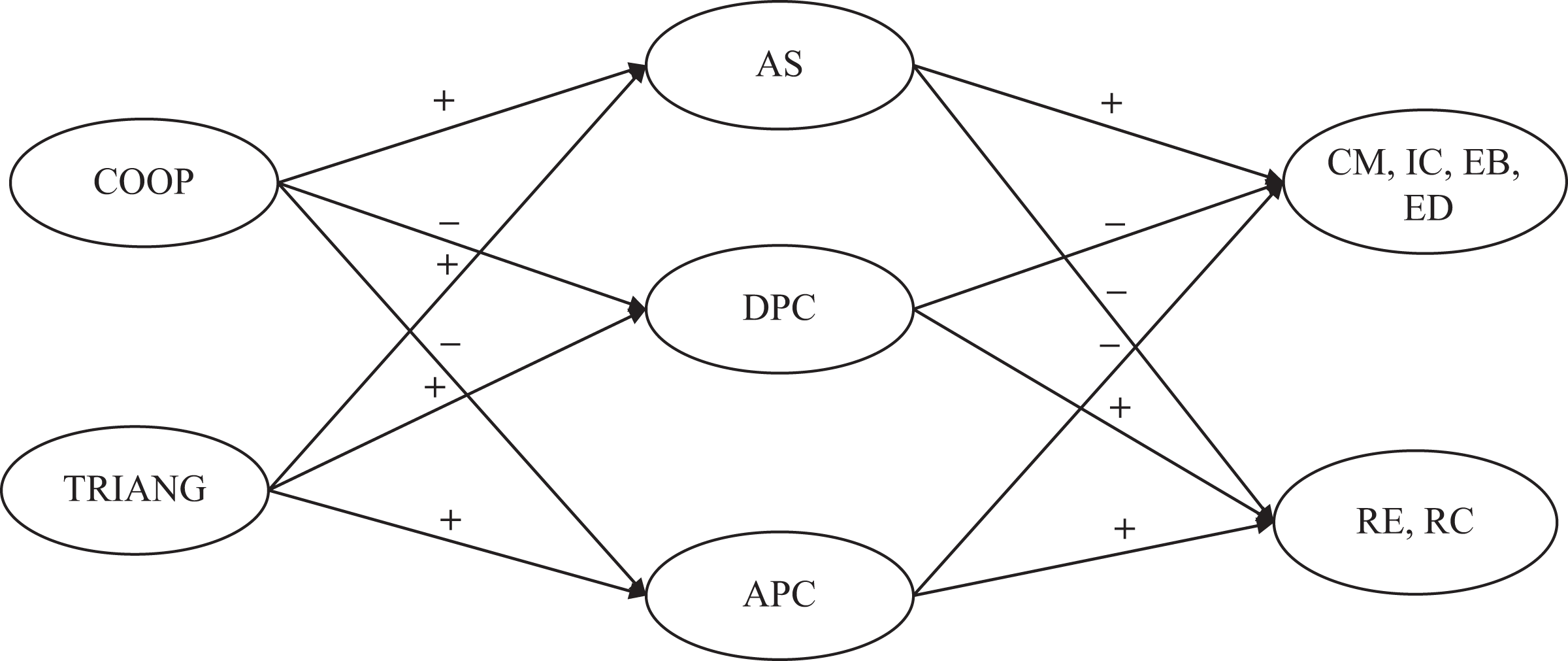
The hypothesized general model relating coparenting (cooperation and triangulation), parenting (autonomy support [AS], dependency-oriented psychological control [DPC], and achievement-oriented psychological control [APC]), and identity dimensions (commitment making [CM], identification with commitments [IC], exploration in breadth [EB], ruminative exploration [RE], exploration in depth [ED], and reconsideration of commitment [RC]). A “+” sign denotes a hypothesized positive relationship and a “−” denotes a hypothesized negative relationship. In the interest of clarity, adaptive and maladaptive dimensions of identity have been grouped together, however, in the structural model, these relationships were tested separately.
Finally, we also examined the role of age, gender, and family structure. In line with previous research, mean-level differences in age, gender, and family structure were expected for some of the variables. For instance, Luyckx, Vansteenkiste, and Goossens (2009) found girls to score higher on exploration in depth and ruminative exploration, while in another study, Luyckx and colleagues (2008) found greater levels of commitment making and lower levels of exploration in breadth as a function of age. In spite of these hypothesized mean-level differences, we expected structural relations to be similar across age, gender, and family structure. This is in line with previous research which examined the associations between parenting and identity and found an absence of moderation by these variables (Crocetti et al., 2017; e.g., Luyckx, Soenens, Vansteenkiste, et al., 2007).
Method
Participants and procedure
The data for this study were collected as part of a larger longitudinal study, which was in compliance with the ethical code of the Swiss Society of Psychology. All participants were in their last year of mandatory secondary school (i.e., 9th grade). Self-report questionnaire packages were group administered in class in the presence of two trained members of the research team. In total, 1,105 adolescents (51% female, 49% male) agreed to participate. Participants had a mean age of 15.08 years (SD = .64), with 98% of adolescents falling between the ages of 14 and 16 years old. The majority of participants were of Swiss nationality (71%) with French being the predominantly spoken language at home (84%). In terms of family structure, 71% of participants reported coming from intact homes (i.e., living with both biological parents), 24% from separated/divorced families, and 5% from other family structures (e.g., one parent deceased). Overall, 1.86% of the data was missing. This information was likely to be missing at random, as Little’s Missing Completely at Random (MCAR) test was nonsignificant, χ2(181) = 199.66, ns. Therefore, missing data were dealt with through a procedure of full information maximum likelihood (FIML) (Enders & Bandalos, 2001).
Measures
French versions of all questionnaires were administered, which, for the majority of scales, were already available. For those that were not, a back translation procedure in accordance with the International Test Commission we employed (Hambleton, 2001).
Identity
Personal identity formation was assessed using the 25-item Dimensions of Identity Development Scale (Luyckx et al., 2008; Luyckx, Goossens, Soenens, et al., 2006; Zimmermann et al., 2015). This self-report questionnaire evaluates identity processes in relation to adolescents’ future plans and ideas for future life paths. Items were rated on a 5-point Likert-type scale, ranging from 1 (strongly disagree) to 5 (strongly agree). Sample items include “I have decided on the direction I want to follow in my life” (commitment making; 5 items); “I sense that the direction I want to take in my life will really suits me” (identification with commitment; 5 items); “I think actively about different directions I might take in my life” (exploration in breadth; 5 items); “I regularly talk with other people about the plans for the future I have made for myself” (exploration in depth; 2 items); “I think about whether the aims I already have for my life, really suit me” (reconsideration of commitment; 3 items); “I keep wondering, which direction my life has to take” (ruminative exploration; 5 items). Cronbach’s α were comparable to those found in other studies (e.g., Skhirtladze et al., 2016; Zimmermann et al., 2015): .88 for commitment making, .86 for identification with commitments, .80 for exploration in breadth, .35 for exploration in depth, .57 for reconsideration of commitment, and .81 for ruminative exploration. While exploration in depth demonstrated a lower reliability than the other scales, given that α coefficients decrease with fewer items (Iacobucci & Duhachek, 2003) and that this scale has only 2 items, this α was considered acceptable given that the inter-item correlations was .21 (p < .001), which is comparable to previous research (e.g., Zimmermann et al., 2015). Confirmatory factor analyses (CFAs) were performed to check the factor structure of each questionnaire. Model fit was evaluated using the combined cutoff of .06 for the root mean square error of approximation (RMSEA) and .08 for the standardized root mean square residual (SRMR) (Hu & Bentler, 1999). The comparative fit index (CFI) of 0.95 was also used as an indicator of good model fit (Marsh, Hau, & Wen, 2004). A CFA indicated that the six-factor model fit the data adequately, χ2(258) = 879.34; p < .001, SRMR = .06, RMSEA = .05, CFI = .94.
Perceived coparenting
Adolescent perceptions of coparenting were assessed using the cooperation and triangulation subscales of the parental dyad subsection of the Coparenting Inventory for Parents and Adolescents (CI-PA; Teubert & Pinquart, 2011a). Adolescents completed the 4-item parental cooperation subscale (e.g., “If I have a problem, my parents solve it together”) and the 4-item triangulation subscale (e.g., “I get involved in my parents’ arguments”). Items were responded to on a 5-point Likert-type scale, ranging from 0 (not at all true) to 4 (completely true). The subscales demonstrated high levels of internal consistency (α = .82 for cooperation and α = .83 for triangulation). The CI-PA demonstrated a satisfactory model fit, χ2(19) = 67.83; p < .001, SRMR = .05, RMSEA = .05, CFI = .98.
Perceived parenting
Adolescents also reported on their perceptions of parental autonomy support and dependency-oriented and achievement-oriented psychological control. Items of all subscales were rated on a 5-point Likert-type scale, ranging from 1 (strongly disagree) to 5 (strongly agree). Autonomy support was assessed using 7 items from the autonomy support subscale of the Perceptions of Parents Scale (e.g., “My mother/father helps me to choose my own direction”; Grolnick, Ryan, & Deci, 1991; Mantzouranis, Zimmermann, Biermann-Mahaim, & Favez, 2012). Cronbach’s α was .74 and a CFA indicated an adequate fit of the one-factor model, χ2(21) = 1,153.41; p < .001, SRMR = .03, RMSEA = .05, CFI = .97. The two subtypes of psychological control were assessed using the 17-item Dependency-Oriented and Achievement-Oriented Psychological Control Scales (Soenens, Vansteenkiste, & Luyten, 2010; Mantzouranis et al., 2012). Sample items include “My parents are only happy with me if I rely exclusively on them for advice” (dependency-oriented psychological control, 8 items) and “My parents are less friendly with me if I perform less than perfectly” (achievement-oriented psychological control, 9 items). Both subscales demonstrated acceptable internal consistency (α = .78 for dependency-oriented psychological control and α = .91 for achievement-oriented psychological control). A CFA revealed an acceptable fit, χ2(116) = 567.54; p < .001, SRMR = .05, RMSEA = .06, CFI = .92.
Results
Preliminary analyses
Descriptive statistics and correlations among study variables are presented in Table 1. To examine the potential role of background variables, a multivariate analysis of covariance was conducted with gender and family structure as independent fixed variables, age as a covariate, and the dimensions of coparenting, parenting, and identity as dependent variables. A significant multivariate effect based on Wilk’s λ was obtained for age, F(11, 977) = 3.50, p < .05, η2 = .04; gender, F(11, 977) = 8.78, p < .001, η2 = .09; and family structure, F(11, 977) = 14.92, p < .001, η2 = .15. Subsequent univariate analyses were completed, indicating that older adolescents perceived more parental achievement-oriented psychological control, F(11, 977) = 15.68, p < .01, b = .17; more dependency-oriented psychological control, F(11, 977) = 9.57, p < .01, b = .11; as well as less parental autonomy support, F(11, 945) = 9.39, p < .01, b = −.10. Older adolescents also expressed more reconsideration of commitment as compared to younger adolescents, F(11, 977) = 6.17, p < .01, b = .11. Furthermore, as for family structure, more cooperation as well as less triangulation and achievement-oriented psychological control were reported in intact families as compared to nonintact families (see Table 2). Lastly, girls demonstrated more exploration in breadth, ruminative exploration, exploration in depth, and reconsideration of commitment and less commitment making, identification with commitment and parental achievement-oriented psychological control, as compared to boys. Given these results, we controlled for age, gender, and family structure in the primary analyses.
Means, SD, and correlations among variables.
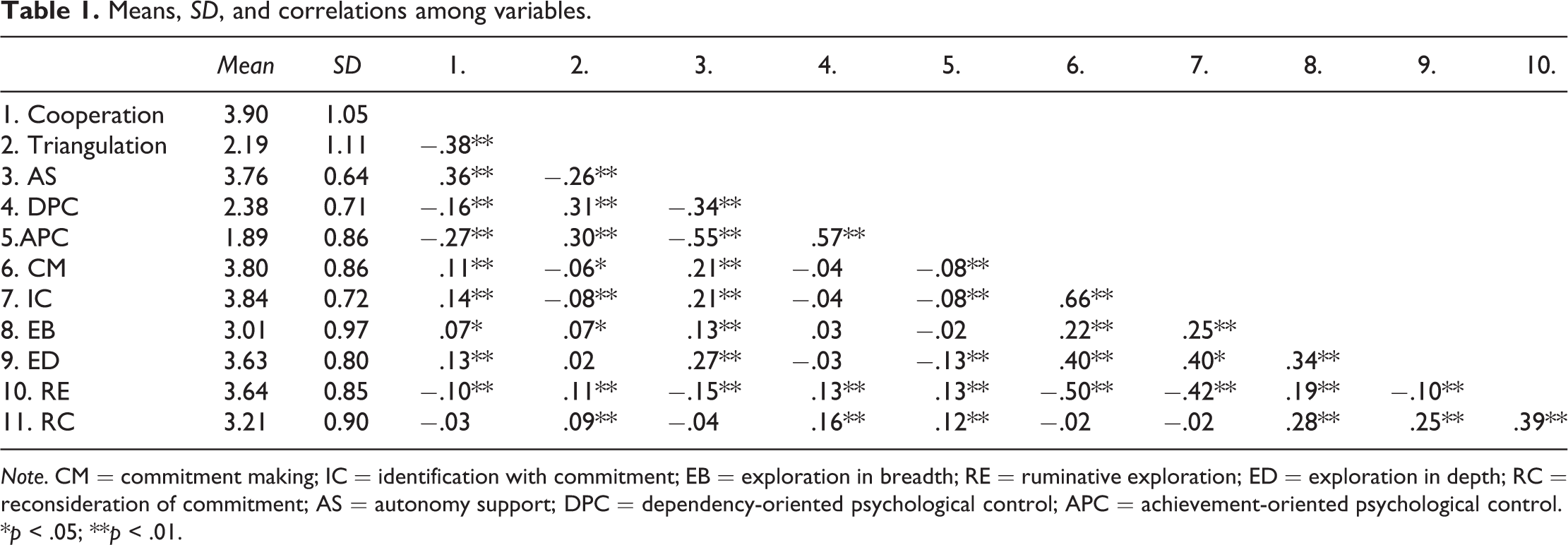
Note. CM = commitment making; IC = identification with commitment; EB = exploration in breadth; RE = ruminative exploration; ED = exploration in depth; RC = reconsideration of commitment; AS = autonomy support; DPC = dependency-oriented psychological control; APC = achievement-oriented psychological control.
*p < .05; **p < .01.
Mean differences on study variables, as a function of gender and family structure.
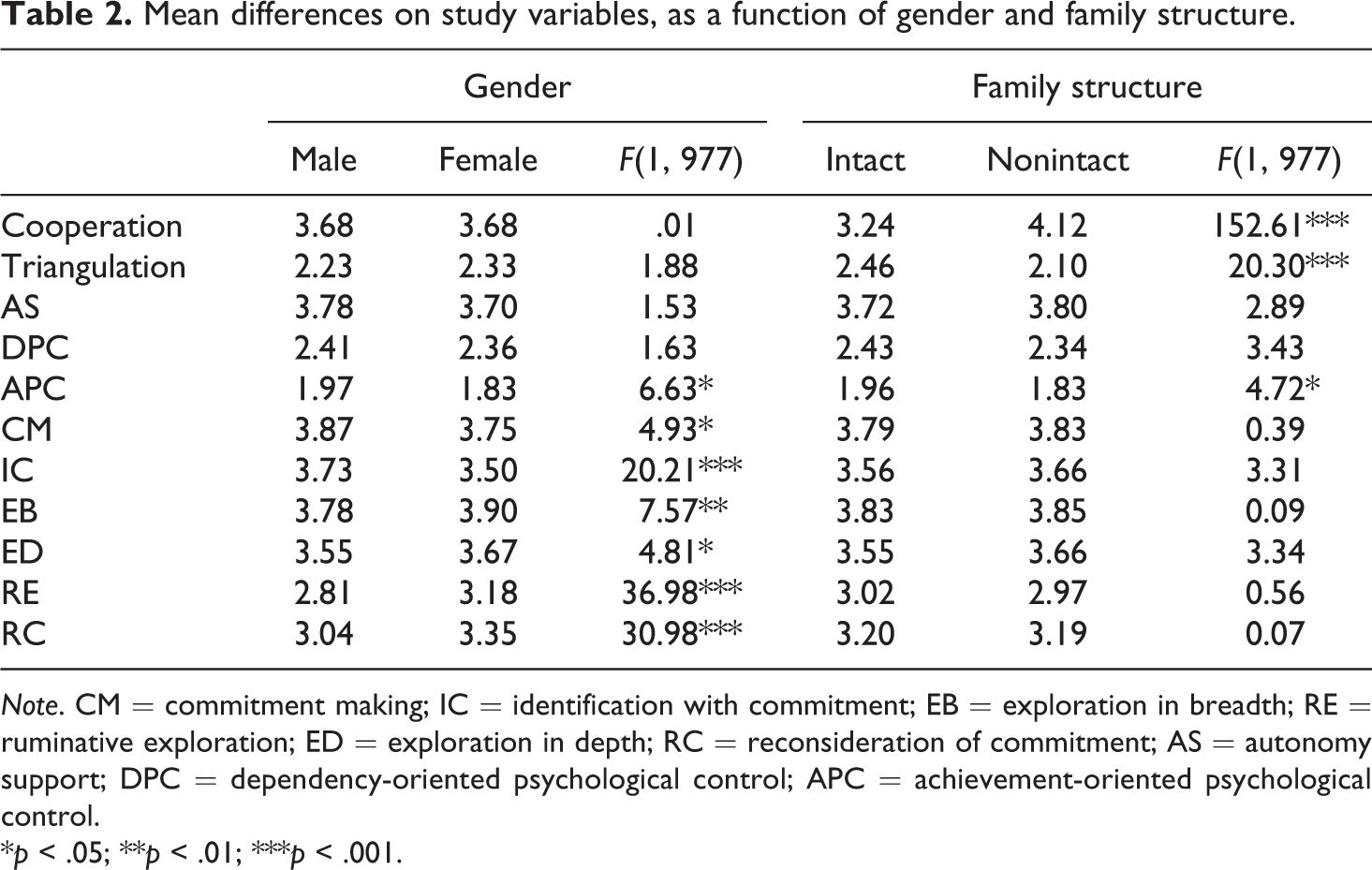
Note. CM = commitment making; IC = identification with commitment; EB = exploration in breadth; RE = ruminative exploration; ED = exploration in depth; RC = reconsideration of commitment; AS = autonomy support; DPC = dependency-oriented psychological control; APC = achievement-oriented psychological control.
*p < .05; **p < .01; ***p < .001.
Structural relations between coparenting, parenting, and identity
Structural equation modeling (SEM) was used to test the hypothesized model using robust maximum likelihood estimation in Mplus 7.00 (Muthén & Muthén, 2012). We modeled our variables as latent variables, which were indicated by three parcels each, composed of randomly assigned items of the appropriate scales.
The estimated measurement model yielded a good fit, χ2(409) = 1,012.13, p < .001; RMSEA = .04; SRMR = .04; CFI = .96, with high factor loadings for all indicators (ranging between .40 and .94, p < .001), demonstrating that latent variables were successfully related to the observed variables. We then tested the hypothesized model, in which each of the coparenting variables were modeled as predictors of the parenting variables, which in turn were modeled as predictors of the identity variables. Correlations between variables at the same level were allowed. The final structural model fit the data well, χ2(535) = 1,318.93, p < .001; RMSEA = .04; SRMR = .05; CFI = .95, and is shown in Figure 2. In general, both coparenting variables were related to specific aspects of parenting, which were in turn related to specific identity dimensions. More specifically, perceived coparental cooperation was found to relate to more autonomy-supportive parenting and to less achievement-oriented psychological control. Perceived coparental triangulation, on the other hand, was related to less autonomy-supportive parenting and more achievement- and dependency-oriented psychological control. Perceived autonomy-supportive parenting, in turn, was related to more commitment making, identification with commitments, exploration in breadth, and exploration in depth and less ruminative exploration. Furthermore, perceived parental dependency-oriented psychological control was related to more ruminative exploration and reconsideration of commitments. Achievement-oriented psychological control, by contrast, did not relate significantly to any of the identity dimensions.
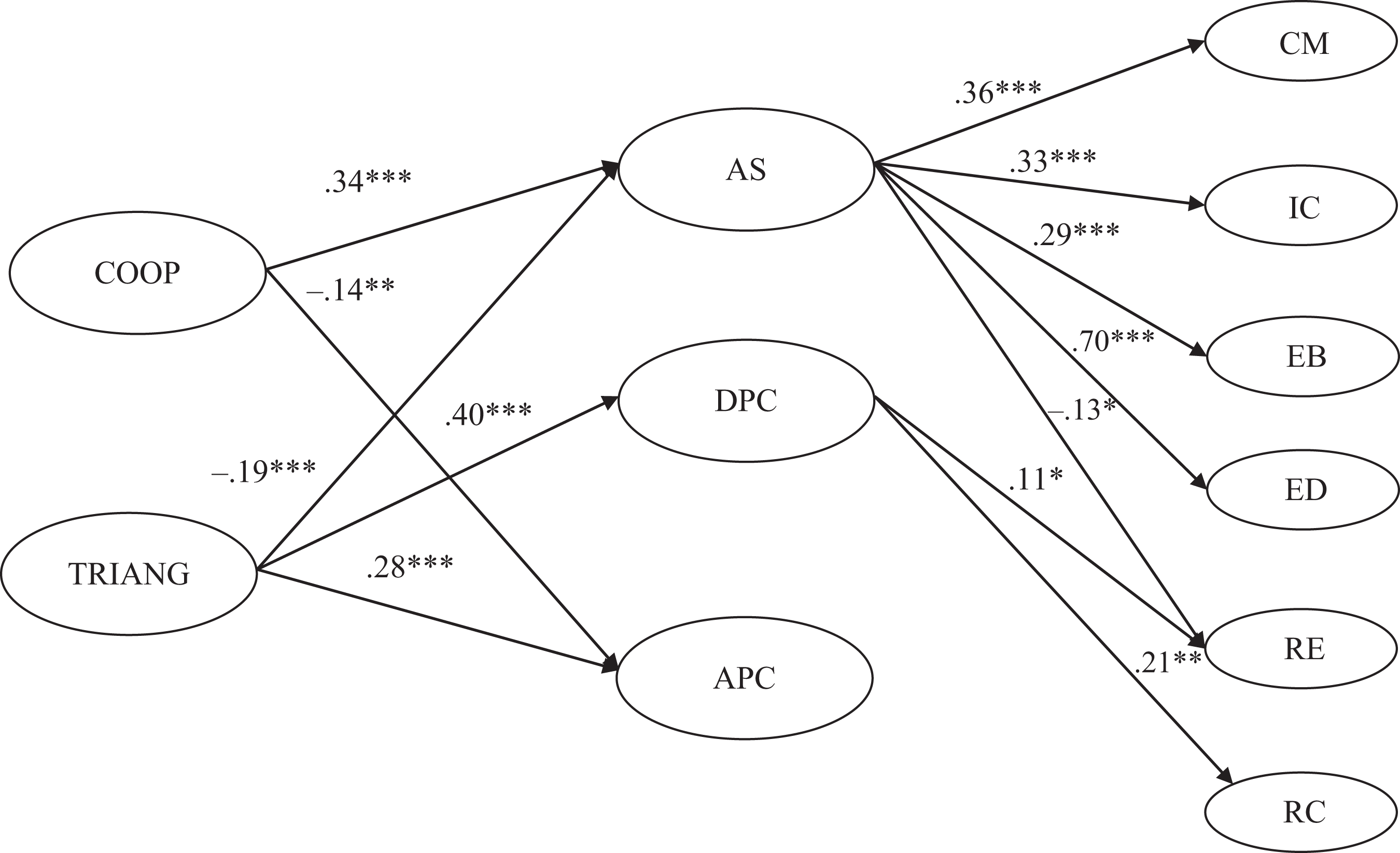
Structural model of the relationship between coparenting (cooperation and triangulation), parenting (autonomy support [AS], dependency-oriented psychological control [DPC], and achievement-oriented psychological control [APC]), and identity dimensions (commitment making [CM], identification with commitments [IC], exploration in breadth [EB], ruminative exploration [RE], exploration in depth [ED], and reconsideration of commitment [RC]). *p < .05; **p < .01; ***p < .001.
Multigroup comparisons were performed to test whether the structural model would hold across age, gender, and family structure. Comparison of the constrained and unconstrained models were tested based on differences in CFI (ΔCFI), which should be less than .01 (Cheung & Rensvold, 2002). First, we tested for measurement equivalence across groups by comparing a freely estimated model (unconstrained) with a constrained model in which factor loadings were set equal between groups. When measurement invariance was obtained, structural models were compared by comparing a freely estimated model (with all structural paths set free) and a constrained model (with all paths set equal across groups). For age, gender, and family structure, multigroup comparison provided evidence for measurement equivalence (ΔCFI = .000, ΔCFI = .001, ΔCFI = .001 for age, gender, and family structure, respectively), suggesting that scales were interpreted in the same way independent of age, gender, and whether adolescents were from intact or nonintact families. Evidence for structural equivalence was also obtained across age, gender, and family structure (ΔCFI = .000, ΔCFI = .001, ΔCFI = .003), suggesting that the structural relations presented in Figure 2 are valid across age, gender, and intact and nonintact families.
Discussion
The present study sought to provide a more comprehensive understanding of how the family environment contributes to adolescent identity formation by explicating the relationship between coparenting, parenting, and adolescent identity processes. While the findings from numerous studies have established the importance of parenting for adolescent personal identity (Beyers & Goossens, 2008; Luyckx, Soenens, Goossens, et al., 2007; Luyckx, Soenens, Vansteenkiste, et al., 2007), to our knowledge, the present study is the first to bring to light the role of coparenting as a family systems dynamic in regard to adolescent identity. Coparenting takes account of the individuals in a family within a larger family system and can thus provide a clearer idea of the overall family environment as compared to parenting which focuses specifically on the unique relationship between each parent and child. Results of the present study largely supported the hypothesized model, finding perceived coparental cooperation and coparental triangulation to be associated with each of the personal identity dimensions. These associations held true for age, gender as well as for adolescents who lived with both biological parents and for those whose parents were no longer together.
In line with previous research and the hypothesized model, more adaptive coparenting was associated with more adaptive parenting (Bonds & Gondoli, 2007; Easterbrooks & Emde, 1988). Parents who were perceived as more cooperative in their coparenting relationship were also perceived as being more supportive of their adolescents’ autonomy and less psychologically controlling in regard to achievement, creating an atmosphere of collaboration, acceptance, and support. Conversely, adolescents who perceived their parents as using more triangulation also reported more dependency-oriented and achievement-oriented psychological control and less autonomy support. In other words, these adolescents experience a familial environment that is more manipulative and controlling. These associations between coparenting and parenting provide further support for a potential spillover from one familial relationship to another as theorized by the spillover hypothesis (Erel & Burman, 1995), that is, negative interactions between parents in their coparental relationship may spillover into the parental relationship resulting in more negative interactions between parent and child. This spillover is not limited to negative interactions, but a positive spillover may also be observed between coparenting and parenting. It thus seems that, while these two subsystems are unique from one another (Belsky et al., 1996; Caldera & Lindsey, 2006), they are intimately related.
In regard to the main goal of the present study, the family system as a whole was associated with the intrapsychic development of adolescents, as alluded by Bowen (1978). More specifically, the way that parents collaborate in their child-rearing responsibilities appears to have an influence on their adolescent’s intrapsychic world via the parenting relationship the adolescent has with each of their parents. Autonomy-supportive parenting seemed to encourage the proactive processes of identity formation and, more specifically, commitment making, identification with commitment, exploration in breadth, and exploration in depth. Thus, when parents acted in a way that was encouraging of self-directed exploration in line with their adolescents’ personal interests and values, adolescents were in turn better able to explore different identity possibilities, form initial commitments, and ultimately identify with and integrate these commitments into their sense of identity (Ryan & Deci, 2000; Soenens et al., 2007). Furthermore, a lack of autonomy-supportive parenting seemed to promote ruminative exploration in adolescents. When parents gave less support to their adolescents to pursue goals and desires that were in line with the adolescents’ personal values, adolescents had a harder time with the developmental process of identity formation, demonstrating a constant cycle of worry over identity-related decisions and an inability to close the exploration process. In this light, autonomy-supportive parenting appears to be of particular importance. Not only does its presence promote a positive resolution of this developmental task, a lack thereof appears to leave adolescents in a state of worry over identity-related issues. This may suggest that it is important for adolescents to feel supported but not controlled by their parents. When adolescents feel supported it may provide them with a sense of security to explore identity possibilities, whereas if they feel unsupported or alone with this difficult task, the number identity-related possibilities may be experienced as overwhelming, leaving adolescents in a state of indecisiveness out of fear of making the wrong decision.
One specific dimension of identity formation that has demonstrated contradictory results in past studies in regard to parenting is that of exploration in breadth. Past findings have suggested autonomy-supportive parenting to be negatively related to exploration in breadth and psychologically controlling parenting to be positively related to exploration in breadth (Beyers & Goossens, 2008; Luyckx, Soenens, Vansteenkiste, et al., 2007). The results of the present study are not in line with previous empirical results, as parental autonomy support was found to be related to more exploration in breadth and parental dependency-oriented psychological control to be unrelated to broad exploration. Furthermore, dependency-oriented psychological control was found to be positively associated with ruminative exploration. These results are, however, in line with the recent distinction between a proactive exploration in breadth and a dysfunctional ruminative exploration (Beyers & Luyckx, 2016; Luyckx et al., 2008). In fact, these results may provide further clarification as to the once “contradictory” aspects of exploration in breadth, finding it to be related to both adaptive (e.g., openness) and maladaptive (e.g., anxiety and depression) outcomes (Kidwell, Dunham, Bacho, Pastorino, & Portes, 1995; Luyckx, Soenens, & Goossens, 2006). Thus, adolescents whose parents use more manipulative techniques express more maladaptive exploration, whereas, adolescents whose parents are supportive of their autonomy express more broad exploration. Given that past studies in which researchers explored the association between parenting dimensions and exploration in breadth did not make the distinction between exploration in breadth and ruminative exploration, the results of the present study provide new empirical support for this distinction in relation to parenting.
Contrary to our hypotheses, only dependency-oriented psychological control and not achievement-oriented psychological control was related to identity processes. More specifically, dependency-oriented psychological control was associated with more maladaptive exploration (i.e., ruminative exploration and reconsideration of commitment) and unassociated with adaptive exploration. These findings are in contrast to the recent findings of Ingoglia, Inguglia, Liga, and Coco (2017), whom found achievement-oriented psychological control to be uniquely associated with identity and unrelated to dependency-oriented psychological control. This may be partially due to a methodological difference between the two studies. Specifically, Ingoglia and colleagues (2017) consisted of emerging adults for whom the issue of academic success may be central for parents, as compared to adolescents for whom issues may center more so around independence. Parents high in dependency-oriented psychological control typically attempt to encourage their children to maintain a certain dependency on them (Soenens et al., 2010). This type of control would particularly impede adolescents in their individuation process and their ability to be in touch with their personal desires. Indeed, as the present results suggest, dependency-oriented control seems to especially hamper adolescents’ exploration of appropriate identity alternatives, leaving them in a process of continuous self-doubt and reconsideration. In terms of achievement-oriented psychological control, this type of control may be experienced by teenagers as something relatively normative, given the constant pressure they receive from numerous sources (i.e., parents, school, society, etc.) to achieve (Currie et al., 2009; Gilliéron Giroud, 2012) and may become of greater importance during emerging adulthood (Ingoglia et al., 2017). However, these results do not suggest that achievement-oriented psychological control has no effect on adolescents, but rather may be associated with other outcomes, such as internalizing difficulties (Ingoglia et al., 2017).
Overall, our findings suggest two potential pathways relating coparenting with adolescents’ personal identity processes: an adaptive and a maladaptive pathway (Cordeiro, Paixao, Lens, Lacante, & Luyckx, 2018). In the adaptive pathway, coparental cooperation promotes autonomy-supportive parenting, which ultimately encourages adolescents to engage in healthy identity formation (i.e., commitment making, identification with commitment, exploration in breadth, and exploration in depth) as well as less ruminative exploration. Thus, when parents are able to work cooperatively creating a feeling of collaboration within the family, parents are better able to support their adolescents’ volitional functioning, which then ultimately results in healthier psychological development. Conversely, in the maladaptive pathway, coparental triangulation is carried over and expressed via the use of dependency-oriented psychological control with parents ultimately undermining adolescents’ identity formation, and these adolescents then rely on the maladaptive identity processes of ruminative exploration and reconsideration of commitment. Coparents who seek to pull their child into a coalition against the other parent intrude on their child’s intrapsychic development through the use of techniques such as psychological control. These two pathways are in line with Bowen’s (1978) postulations and highlight the importance of not only considering families as being composed of the unique parent–child relationship but also the importance of taking into account the triadic coparental subsystem and the intricacies of interaction between these subsystems on adolescent development. The way in which coparents collaborate in their role of the raising of their child has important consequences on the intrapsychic development of their child. This association between coparenting and adolescent identity formation appears to act via the parenting relationship each parent has with their child.
Limitations and future research
Although the results of this study aid in the elucidation of the role of coparenting in identity formation, a number of shortcomings and potential directions for future work must be considered. First, the present study used a single-informant self-report methodology. While self-report has been deemed the most appropriate for the gathering of information concerning internal and subjective processes such as identity, in regard to parenting and coparenting, a multi-informant design may provide a more complete understanding as to these external processes. Furthermore, the use of a multi-method approach, for example, a combination of observational and self-report data could provide additional information in regard to participant bias.
Second, in our assessment of perceived parenting and coparenting, we did not differentiate between mothers and fathers, but instead instructed adolescents to respond in regard to their mother and/or father in an attempt to get at the general parenting relationship. Authors of previous studies have, however, reported differential effects of mothers and fathers in regard to the relation between parenting and adolescent identity formation (Benson, Harris, & Rogers, 1992; Beyers & Goossens, 2008). Further, although we did not obtain evidence for moderation by gender, some researchers suggest that mothers and fathers potentially have a differential effect on daughters and sons (Beyers & Goossens, 2008). For this reason, future research should have adolescents respond in regard to their mother and father separately.
Another area of future work would be to explore the longitudinal relationship between coparenting and adolescent personal identity processes. Given the cross-sectional nature of the present study, “causal” conclusions cannot be drawn, however, longitudinal examination of these relationships would permit an examination of these dynamics over time as well a further exploration into the potential bidirectional influences. That is, certain identity processes may elicit certain parenting and coparenting behaviors (Beyers & Goossens, 2008; Luyckx, Soenens, Goossens, et al., 2007; Luyckx, Soenens, Vansteenkiste, et al., 2007). For instance, more commitment may elicit more parental support (Beyers & Goossens, 2008).
Future research may also focus on specific types of family constellations, such as single-parent or stepparent families. Our sample consisted of mostly two-parent biological families, therefore, one should be cautious about making inferences about other family constellations. Furthermore, families are not only made up of intergenerational relationships (i.e., parent–child) but can also include intragenerational relationships (i.e., between siblings). Exploring the importance of sibling relationships in regard to identity formation would be of great interest given the potential modeling effect between siblings (Bandura, 1977), which thus far remains mostly unexplored (see Crocetti et al., 2017).
Conclusion
In conclusion, the present study provides initial support for the importance of coparenting for adolescent personal identity formation. In the present study, we found that perceived coparental triangulation was related to ruminative exploration and reconsideration of commitment through perceived dependency-oriented psychological control. Furthermore, perceived coparental cooperation was positively related to commitment making, identification with commitment, exploration in breadth, and exploration in depth and negatively related to ruminative exploration via perceived autonomy-supportive parenting. Thus, the family environment is made up of a number of interacting relationship, which taken together can help elucidate the effect of the family context on adolescent development.
Footnotes
Acknowledgments
The authors would like to thank the adolescents and their parents who kindly agreed to participate in this study, without whom this project would have not been possible as well as the Youth Department of the Canton of Vaud (Direction générale de l’enseignement obligatoire—DGEO). The authors also thank Marlène Carvalhosa Barbosa for her assistance in the running of the project as well as the following research assistants for their help in collecting and recording the data: Vanessa Brumana, Kim Da Silva Fernandes, Saskia Degli-Antoni, Mathilde Dols, and Zoé Rosselet.
Funding
The author(s) disclosed receipt of the following financial support for the research, authorship, and/or publication of this article: This research was supported by a grant from the Swiss National Science Foundation (FNS nos. 10014_156155/1).