






Abstract
Previous research has demonstrated substantial relational, mental and physical health benefits associated with affectionate touch in romantic relationships; however, given ongoing stigmatization, it remains unclear whether these benefits are readily available to individuals in interracial relationships. We conducted an online survey assessing public affection sharing practices of those in White relationships (i.e., both partners White; n = 1119) versus interracial relationships (i.e., here, one partner White, the other racialized; n = 267). Both types of couples engaged in public affection sharing equally frequently; however, those in interracial relationships perceived less support from others for doing so. Overall, engaging in affectionate touch with one’s partner in public was associated with better relational, mental, and physical well-being, but those associations were weaker or even non-significant for individuals in interracial relationships. Discussion focuses on ongoing challenges in affection sharing among those in interracial relationships, including managing trade-offs between potential stigmatization if they engage in public affection-sharing and potential visual dislocation (i.e., failing to be perceived as a romantic couple) if they do not.
It is well-established that touch, especially affectionate touch, is crucial for healthy development and well-being throughout the lifespan (Cascio et al., 2019; Packheiser et al., 2024) and within romantic relationships specifically (Jakubiak, 2022; Jakubiak & Feeney, 2017). But are all couples equally able to glean the benefits of physical affection sharing in public spaces? In this study, we investigate whether links between frequency of public affection sharing and well-being outcomes are weaker for those in interracial relationships (here, one White partner and one racialized partner) than those in relationships where both partners are White. We also assess whether three specific types of affection-related challenges are heightened for those in interracial relationships (i.e., affection-related vigilance, lower perceived support for affection-sharing, lower perceived alignment between the couple members in their approach to affection-sharing), and if so, whether those challenges account for any reduced association between affection-sharing frequency and well-being.
Affection Sharing and Well-Being
Research shows a positive association between affectionate touch and a range of mental and physical health indicators, such as lower physiological markers of stress (Holt-Lunstad et al., 2008; Schneider et al., 2023), better immune functioning (Cohen et al., 2015), and higher psychological well-being (Debrot et al., 2013; Floyd et al., 2009). On a relationship level, affectionate touch is associated with perceptions of closeness (e.g., Ben-Ari & Lavee, 2007), sexual satisfaction (e.g., Muise et al., 2014), easier conflict resolution (e.g., Gulledge et al., 2003), and heightened feelings of support (Jakubiak & Feeney, 2017). Most past research has failed to distinguish between frequency of affection sharing in private versus public spaces. However, our own past research (Blair et al., 2023) shows that both private and public affection sharing are associated with better relationship well-being. Based on past research, then, we predict that more frequent public affection sharing will be associated with better relational, psychological, and physical well-being. But will these potential benefits extend equally to all couple types?
Frequency of Affection Sharing in Interracial Versus White Relationships
In North America, interracial relationships have long faced stigma and discrimination. Interracial marriages were illegal in the United States until 1967 (Guzman & Nishina, 2017). Although they were never illegal in Canada, they still faced systemic barriers and severe discrimination (Chambers, 2017). Support in principle for interracial relationships has risen greatly in recent decades, along with their prevalence (Bialik, 2017). Nevertheless, these couples still face negative bias, discrimination, and sometimes even disgust (Irby-Shasanmi & Erving, 2022; Skinner & Hudac, 2017; Skinner & Rae, 2019; Watanabe & Laurent, 2021).
Given this potential for stigmatization, those in interracial relationships may face unique stressors not experienced by White couples, associated with their need to monitor and manage their identity, especially in public (i.e., Minority Stress Theory; Brooks, 1981). Such minority stress can be experienced by both partners in interracial relationships even though only one partner is racialized (i.e., couple-level minority stress; LeBlanc et al., 2015); for example, White women are perceived to be of lower social status when they are partnered with a Black man than with a White man (Stillwell & Lowery, 2021). Therefore, individuals in interracial relationships, irrespective of their race, may have to engage in compensatory behaviors to manage the potential for stigma and discrimination towards their relationship.
When it comes to public affection sharing, those in interracial relationships may face a paradoxical bind. If they do not share physical affection, they may experience a phenomenon known as “visual dislocation”, wherein they are more likely than those in White relationships to be assumed to be strangers or friends, rather than a romantic couple (Steinbugler, 2005). Perhaps for this reason, one past study (Mederos, 2015) found that interracial couples actually exhibit more “tie signs” (i.e., actions that provide evidence that two people are in a relationship; Goffman, 1971) than same-race couples. Because these tie signs could take a variety of different forms, however (e.g., eye contact, use of nicknames), it is unclear whether physical gestures of affection were actually more frequent in interracial couples.
When they do engage in physical affection sharing in public, those in interracial relationships report encountering heightened experiences of visibility (Steinbugler, 2005), in which they perceive themselves to be attracting stares or unwanted attention. Some might manage this unwanted attention by engaging in public affection sharing less frequently, as shown in one previous study (Vaquera & Kao, 2005). Our own past research (Blair et al., 2022) showed that individuals in other types of marginalized relationships (i.e., same-sex, gender-diverse) shared public affection less frequently, were less comfortable doing so, and refrained from doing so more often compared to those in non-marginalized (mixed-sex) relationships, despite having a stronger internal desire to do so.
Thus, those in interracial relationships might potentially share more, or less, physical affection than those in White relationships, and/or they may be incentivized to enhance their affection in some safer public contexts and minimize it in others where they anticipate judgement. Given the contradictions in the very limited past research, we leave it as an open research question as to whether the frequency of public affection sharing will differ between those in interracial versus White relationships.
Affection-Related Challenges for Those in Interracial Relationships
If they should choose to engage in public affection sharing, those in interracial relationships may face several challenges to a greater extent than those in White relationships.
Affection-Related Vigilance
First, those in interracial relationships may experience heightened levels of vigilance when sharing affection with their partner. Vigilance is a heightened awareness of and attention towards one’s environment when under threatening, stressful, or aversive conditions (Krohne, 1993). Heightened vigilance is a trait for some people (Krohne, 2001), but it can also be a state that can change depending on one’s context (Shaw et al., 2010). We know that for Black Americans, perceptions of discrimination are associated with heightened levels of general vigilance and in turn more stress (Himmelstein et al., 2015). Steinbugler’s (2005) qualitative research found that some interracial couples perceived heightened danger when they were coded as relationship partners; they therefore engaged in constant self-regulation when sharing physical affection, as a form of “proactive defense” in the face of potential risk. In a similar vein, we have shown (Blair et al., 2022) that those in other marginalized relationship types (i.e., same-sex, gender-diverse) showed heightened levels of PDA-related vigilance (i.e., vigilance when engaging in public displays of affection) relative to those in mixed-sex relationships; furthermore, heightened PDA-related vigilance was associated with lower levels of relational, psychological, and physical well-being. We therefore expect that those in interracial relationships will report higher levels of PDA-related vigilance than those in White relationships, and that more PDA-related vigilance will generally predict lower well-being.
Perceived Social Support for Public Affection-Sharing
Along with those in other types of marginalized relationships (e.g., same-sex, highly age-discrepant), those in interracial relationships perceive lower levels of support for their relationships from others around them (e.g., friends, family, the general public; Lehmiller & Agnew, 2006). Such perceptions may be consequential, as lower perceived support is associated with reduced investment in the relationship (Lehmiller & Agnew, 2006) and/or lower relationship well-being (Blair et al., 2023). Our past research shows that those who perceive lower general support for their relationship also perceive less support for public affection sharing within their relationship (Blair et al., 2023). In qualitative research, Steinbugler (2005) found that interracial couples reported experiencing lingering stares or comments, especially when they were being physically affectionate, likely signaling disapproval or a lack of support. Thus, we expect those in interracial relationships will perceive lower levels of support for engaging in public affection sharing than those in White relationships, and that lower perceived support for affection sharing will generally predict lower well-being scores.
Perceived Discrepancies in Affection-Sharing Preferences
The final affection-related challenge that those in interracial relationships might potentially face is related less to others’ perceptions of their relationships and more to internal relational dynamics. Certainly, some White couples might come from different ethnic or cultural backgrounds; however, it seems plausible that the percentage of intercultural relationships might be higher in an interracial relationship group. Individuals from different cultures show variations in their affection-sharing preferences and norms (Kocur et al., 2025; Regan et al., 1999), suggesting that in situations where the two partners within a relationship come from different ethnic or cultural backgrounds, they might have to work harder to manage their differences (Seshadri & Knudson-Martin, 2013). Although to our knowledge no one has yet investigated this issue in the context of interracial relationships, we have found that in general, greater discrepancies between partners in terms of their comfort with physical affection sharing predict lower relational well-being (Sgambati et al., 2025). Thus, we tentatively hypothesize that those in interracial relationships might experience more perceptions of discrepancies between partners in terms of their affection-sharing preferences, compared to those in same-race (White) relationships; also, greater perceived discrepancies (i.e., lower perceived alignment in the partners’ approaches to affection sharing) will generally be associated with worse well-being.
Relationship Type as a Moderator of the Association Between Frequency of Affection Sharing and Well-Being Outcomes
In general, then, past research suggests that more frequent public affection sharing is likely to predict better relational, psychological, and physical well-being. However, if those in interracial relationships experience more challenges related to public affection sharing, they may not be able to derive the same level of benefit from any public affection sharing they engage in, compared to those in relatively more privileged White relationships. We therefore expect the associations between frequency of public affection sharing and well-being outcomes to be less positive for those in interracial relationships than those in White relationships. Depending on the degree of challenges experienced, the associations might still be positive for those in interracial relationships, just weaker; however, it is also possible that the association between public affection-sharing frequency and well-being might be zero, or even negative, for those in interracial relationships. We will first explore the relevant associations without taking the three affection-related challenges noted above into account. We will then enter measures of the three challenges into the analyses as covariates, and explore whether taking them into account might be associated with changes in any relationship type effects. For example, any potential relationship type differences in the strength of association between public affection-sharing frequency and well-being measures might be lessened or even disappear if the affection-sharing challenges are taken into account.
Finally, if those in interracial relationships face challenges in terms of affection sharing, and affection sharing matters for well-being, they might well experience lower levels of well-being overall. However, it is also possible that other compensatory strategies might help them to maintain levels of well-being equal to those in White relationships. For example, Lehmiller and Agnew (2006) found that those in marginalized relationships fared worse in some predictors of commitment than those in non-marginalized relationships (i.e., investment in their relationship), but they were comparable in other aspects (i.e., relationship satisfaction), and even higher in others (i.e., perceiving fewer equally-satisfying alternatives to their relationship). Such compensatory strategies might help to explain why some previous research has found that those in interracial relationships fare just as well as those in same-race relationships in terms of relationship functioning (Gaines & Ickes, 1997), relational quality, and conflict patterns (Troy et al., 2006). In contrast, Hohmann-Marriott and Amato (2008) found lower relationship quality in interracial relationships. Some past research has found that those in interracial relationships self-reported worse physical and psychological well-being than those in same-race relationships (see Calderon et al., 2022, for a review). However, that research was conducted exclusively on those in mixed-sex relationships living in the United States; findings may or may not generalize to our broader sample. Accordingly, we leave it as an open research question as to whether the relationship groups will differ in their overall levels of relational, psychological, and physical well-being.
The Current Study
To address these issues, we re-purposed a dataset originally collected to assess affection-sharing experiences in same-sex versus mixed-sex relationships (Blair et al., 2022, 2023; Sgambati et al., 2025), re-coding the data to explore affection-sharing experiences in White relationships (both partners White) versus interracial relationships (one White partner, one racialized partner) 1 . To summarize, our hypotheses (H) and research questions (RQ) are as follows:
Will those in interracial and White relationships differ in terms of frequency of public affection sharing?
Will there be differences in average levels of a) relational, b) psychological, and c) physical well-being for those in interracial versus White relationships?
Those in interracial relationships will experience more challenges related to public affection sharing than those in White relationships, specifically a) higher levels of PDA-related vigilance, b) lower levels of perceived support for their affection sharing, and c) lower levels of perceived alignment with their partner in terms of affection-sharing approaches.
Overall, more frequent public affection sharing will be associated with better a) relational, b) psychological, and c) physical well-being.
The association between frequency of public affection sharing and well-being will be less positive for those in interracial relationships than those in White relationships; it might potentially be zero or even negative.
In general, the three affection-related challenges noted in H1 will be associated with worse well-being outcomes
2
.
To what extent, and how, might the three affection-related challenges account for any relationship type differences found?
Method
Recruitment and Procedure
All procedures were approved by the relevant universities’ Research Ethics Boards. Participants 18 years and older currently in a romantic relationship were recruited for an online study on affection-sharing practices between January and July of 2019, using a variety of methods (e.g., social media advertisements, flyers, emails, snowball sampling from existing participants, course participation pool). Eligible participants consented and were directed to complete a series of questionnaires, a subset of which are explored in the current study. Participants were compensated with course credit or entry into a series of prize draws.
Participants
A total of 1386 individuals met the requirements for the current study, after excluding those with incomplete data or who did not provide adequate race information. Participants reported both their own race/ethnicity and their partner’s by responding to the question “What best describes your [your partner’s] ethnicity?”, using a drop-down menu with the options Asian, Black/African-American/African-Canadian, White, Hispanic/Latino, Indigenous, and Other - Write In. Two groups were created: White couples, in which both partners were White (n = 1119, coded 0 in all analyses), and interracial couples, in which one partner was White and the other was any race/ethnicity other than White (n = 267; coded 1). See Supplemental Materials Part 1 for full details on how these groups were created. The racial backgrounds of the racialized partners were 29% Asian, 26% mixed-race, 20% Hispanic, 13% Indigenous, and 11% Black.
Sample Demographics, Overall and by Relationship Type, With Comparisons
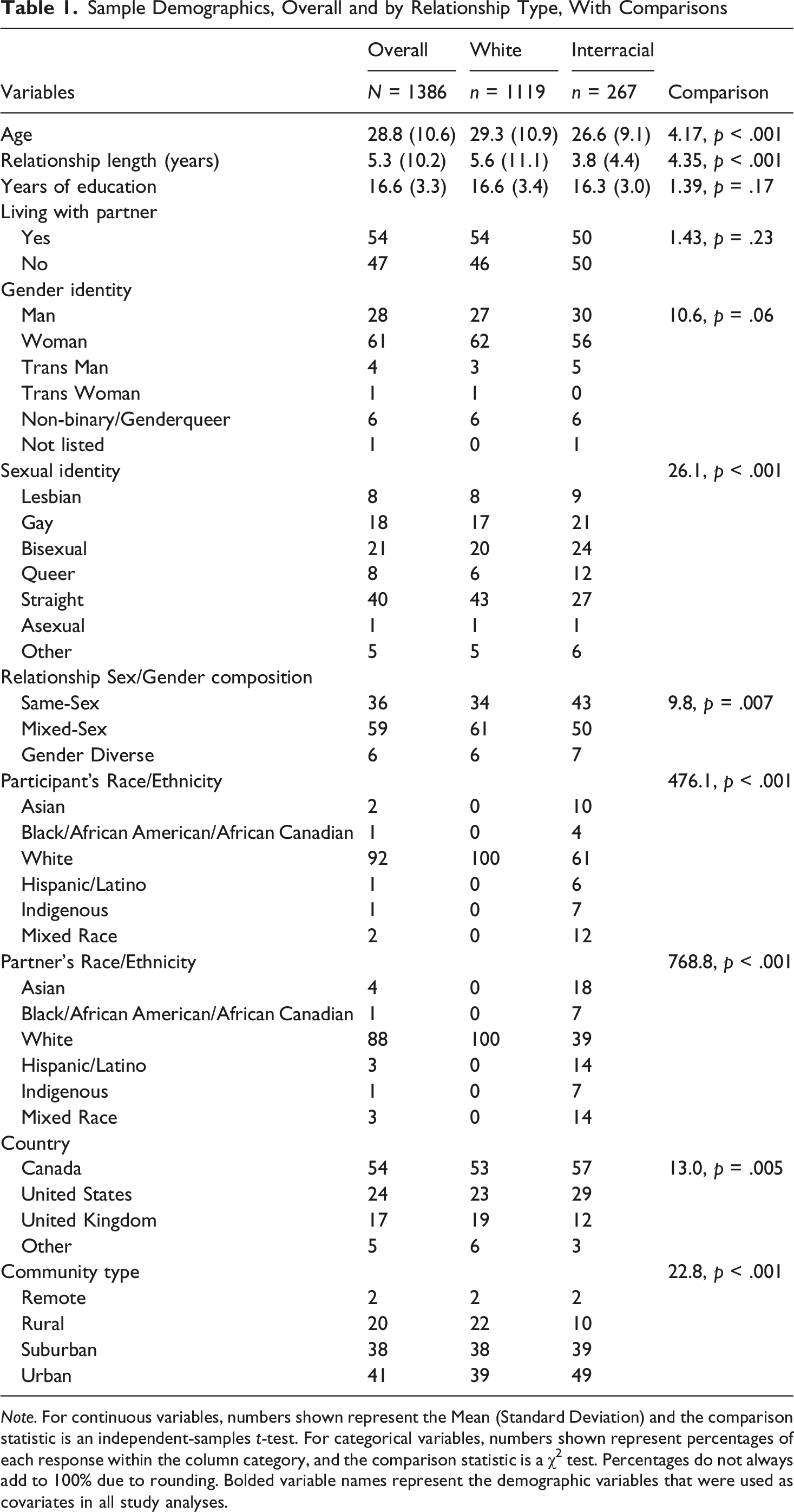
Note. For continuous variables, numbers shown represent the Mean (Standard Deviation) and the comparison statistic is an independent-samples t-test. For categorical variables, numbers shown represent percentages of each response within the column category, and the comparison statistic is a χ2 test. Percentages do not always add to 100% due to rounding. Bolded variable names represent the demographic variables that were used as covariates in all study analyses.
The White and interracial groups were compared on demographic variables. As can be seen in Table 1, relative to those in White relationships, those in interracial relationships were significantly younger and in shorter-term relationships, as well as more likely to live in urban areas, be in a same-sex relationship, and live in Canada or the US (vs. other countries). To control for any potential demographic confounds between groups, all analyses reported in this paper controlled for these differences; however, we focus only on the results for the core study variables within the body of the paper. Supplemental Materials, Part 2, explains precisely how all covariates were constructed and entered into the analyses, and also re-reports all analyses with the results for the demographic covariates displayed.
Measures
Cronbach’s Alphas, Group Comparisons, and Effect Sizes for all Study Variables
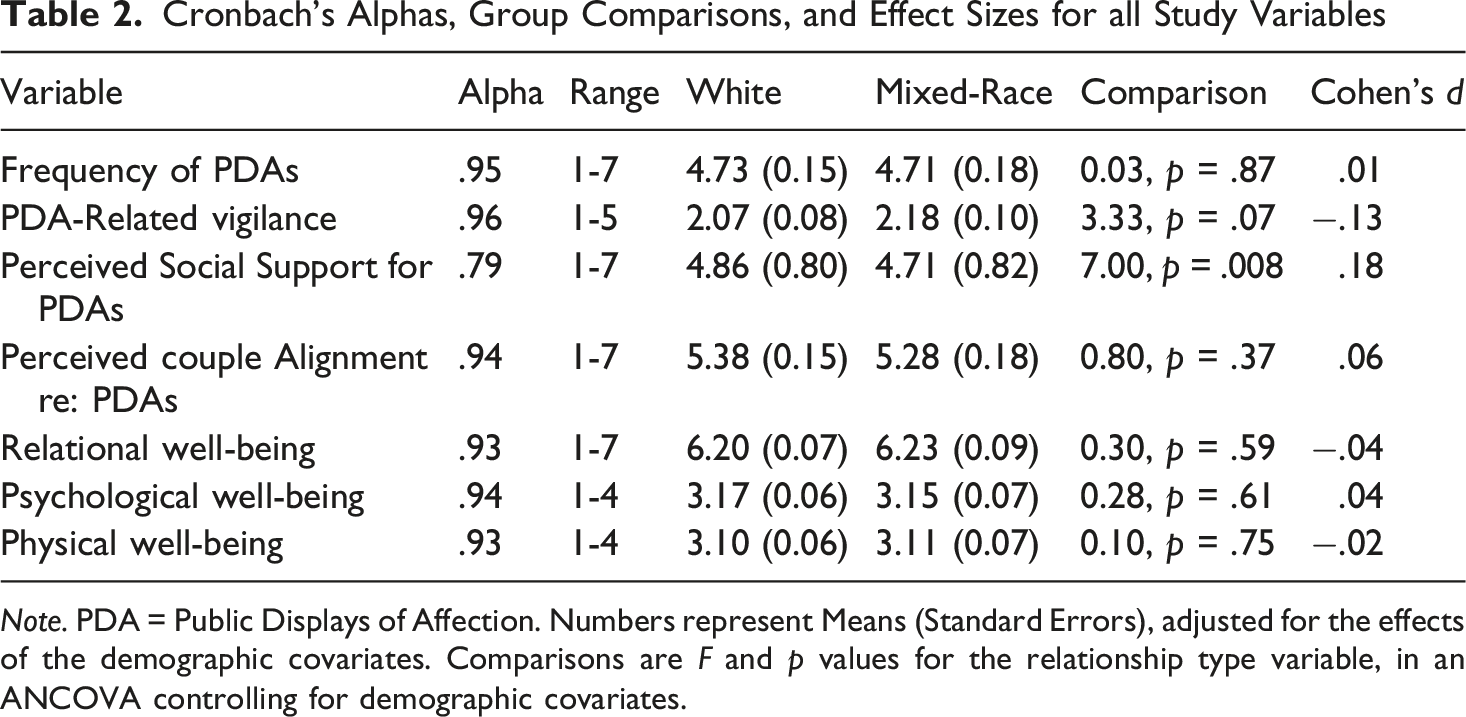
Note. PDA = Public Displays of Affection. Numbers represent Means (Standard Errors), adjusted for the effects of the demographic covariates. Comparisons are F and p values for the relationship type variable, in an ANCOVA controlling for demographic covariates.
Affection-Sharing Measures
Affection-sharing measures were created for the larger study, as no pre-existing measures tapped into the constructs desired. At the beginning of the study, affection sharing was defined as “your preferred method of sharing physical affection with your partner in a non-sexual manner; ” examples were provided (e.g., holding hands, linking arms). Public was defined as situations where “others are present.” See Supplemental Materials Part 3 for full details on measure creation, including exact wording of all items.
Frequency of Public Affection Sharing assessed participants’ subjective self-reports of how often they and their partner shared physical affection in public settings (e.g., “When I am in public … I often share physical affection with my partner”). The scale contained five items, with responses ranging from 1 (strongly disagree) to 7 (strongly agree).
PDA-Related Vigilance assessed the extent to which participants felt vigilant or hyper-focused on their surroundings when engaging in public affection sharing with their partner, using 11 items with response scales ranging from 1 (not at all like me/never true) to 5 (very much like me/always true). Five items were adapted from the Brief Hypervigilance Scale (Bernstein et al., 2015) and the rest were created for the current study (e.g., “I am more aware of my surroundings when sharing affection in public”).
Perceived Support for Public Affection Sharing assessed the extent to which participants believed others around them (friends, family, the general public) approved of them sharing affection with their partner (e.g., “My sharing physical affection with my partner is generally accepted by society”). Items were adapted from measures of general relational support (Lehmiller, 2012; Sprecher & Felmlee, 1992). There were ten items with response scales ranging from 1 to 7, with endpoint labels varying across items.
Perceived Alignment in Public Affection Sharing assessed the extent to which participants believed they and their partner had similar approaches to public affection sharing (e.g., “My partner and I are well matched in terms of how much physical affection sharing we enjoy”). There were five items, with responses ranging from 1 (strongly disagree) to 7 (strongly agree).
Well-being Measures
Well-being was assessed using existing, well-validated scales. For ease of interpretation, items were reverse-coded as necessary so that higher scores always indicated better well-being (e.g., fewer mental or physical health symptoms).
Relational Well-being was assessed using Fletcher et al.’s Perceived Relationships Quality Components Inventory, an 18-item measure assessing six components of overall relationship quality (satisfaction, commitment, intimacy, trust, passion, love), which has shown strong reliability and validity in past research (Fletcher et al., 2000a, 2000b). Items (e.g., “How satisfied are you with your relationship?”) are answered on scales ranging from 1 (not at all) to 7 (extremely).
Psychological Well-being was assessed using a reverse-scored Depression, Anxiety, and Stress Scale, Shortened (DASS-21; Lovibond & Lovibond, 1995), consisting of 21 items assessing participants’ self-reported experiences with mental health difficulties over the previous week (e.g., “I felt down-hearted and blue”), with responses on scales ranging from 1 (Did not apply to me at all) to 4 (Applied to me very much, or most of the time). The DASS-21 has shown good internal consistency and convergent validity in past research (Lovibond & Lovibond, 1995).
Physical Well-being was assessed using a reverse-coded Cohen-Hoberman Inventory of Physical Symptoms (CHIPS; Cohen & Hoberman, 1983), which asks participants to rate how much 33 minor physical symptoms (e.g. headache, nausea, cough) have bothered them over the past month, with responses ranging from 0 (not a bother) to 4 (an extreme bother). The CHIPS has shown strong construct validity in past research (Allen et al., 2017).
Results
Group Mean Comparisons
RQs 1 and 2 and H1 all related to potential mean differences in study variables between those in White versus interracial relationships. A series of between-subjects ANCOVAs were run, comparing the two relationship type groups on each study variable, while controlling for the demographic covariates 3 (see Table 2). Both RQ1 and RQ2 were answered in the negative: the two groups did not differ in their frequency of affection sharing, or on any of the three well-being measures. H1 was only partially supported. As predicted, those in interracial relationships perceived lower levels of support for their public affection sharing than those in White relationships. However, they were only marginally higher in affection-related vigilance, and there were no significant differences in perceived alignment in affection-sharing practices between the two couple types.
Frequency of Affection Sharing and Couple Type Predicting Well-being
Regression Analyses Predicting Well-being Measures
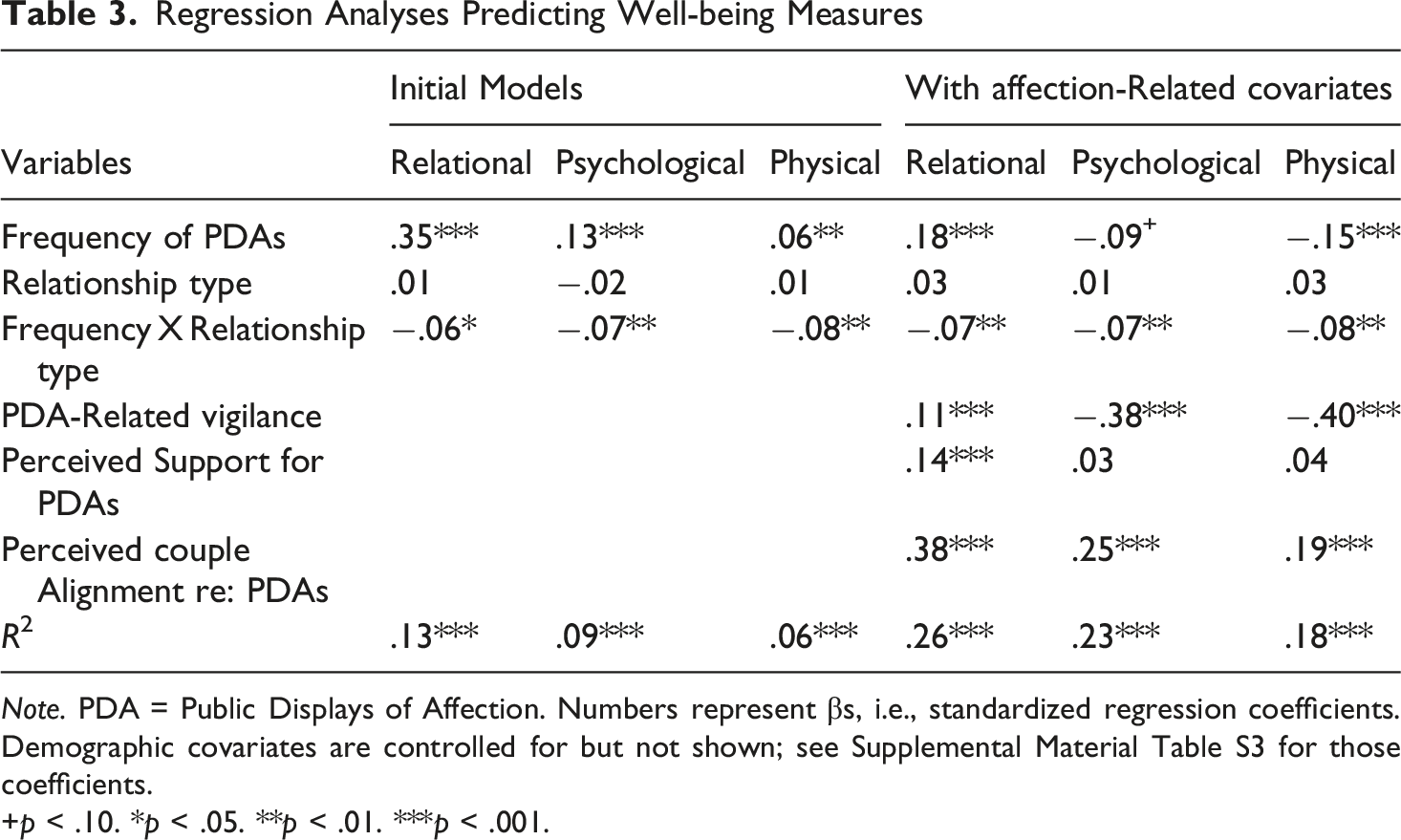
Note. PDA = Public Displays of Affection. Numbers represent βs, i.e., standardized regression coefficients. Demographic covariates are controlled for but not shown; see Supplemental Material Table S3 for those coefficients.
+p < .10. *p < .05. **p < .01. ***p < .001.
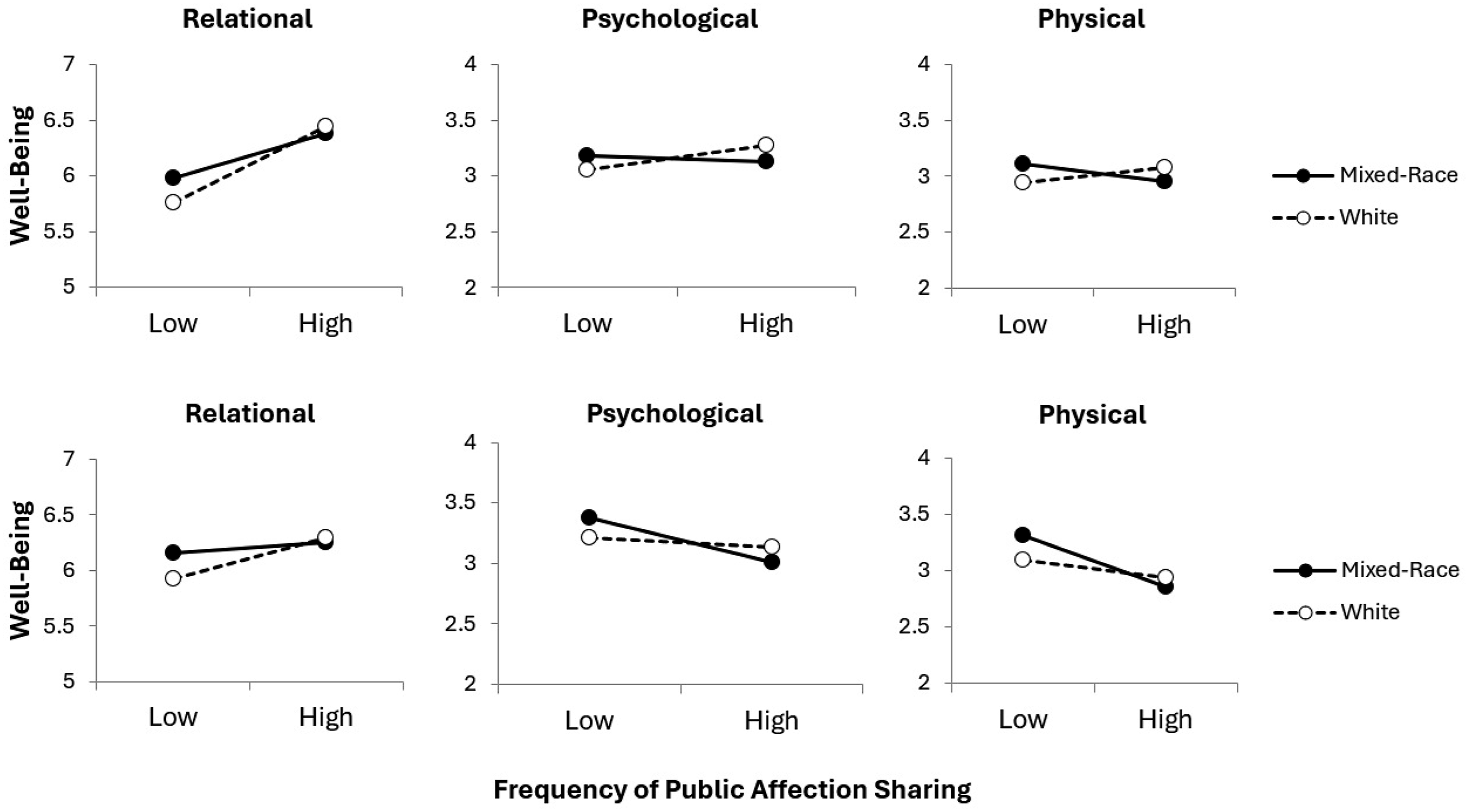
Associations Between Frequency of Public Affection Sharing and Well-being Outcomes, as Moderated by Relationship Type
Controlling for Affection-Sharing Challenges
To re-assess H2, as well as test H4 and RQ3, the above regression analyses were repeated, but with measures of the three affection-sharing challenges included (Table 3, right-hand side). H2 was now only partially supported. The association between frequency of physical affection sharing and relational well-being was still positive and significant as expected for relational well-being; however, it was now (surprisingly) significantly negative for physical well-being, and trending the same way for psychological well-being.
H4 received mixed support. As predicted, greater perceived alignment in couple members’ public affection-sharing preferences was associated with higher levels of all three types of well-being. Greater perceived support for affection sharing was associated with better relationship well-being, as predicted, but it was not associated with either psychological or physical well-being. More PDA-related vigilance was associated with worse psychological and physical well-being, as predicted, but unexpectedly was associated with better relationship well-being, when other variables were controlled.
Addressing RQ3, controlling for the three measures of affection-related challenges did not greatly shift the existing group differences. As before (addressing RQ2), there continued to be no significant differences between groups in terms of well-being. Also as before (addressing H3), significant interactions between frequency of public affection sharing and relationship type were present and significant for all three well-being measures, with almost identical directions and magnitudes. However (addressing RQ3), inclusion of the affection-related covariates did shift the pattern of the interactions slightly (see Figure 1, bottom panel). Now, associations between frequency of affection sharing and each well-being outcome tended to be closer to zero for those in White relationships (relationship: b = .10, se = .01, p < .001; psychological: b = −.02, se = .01, p = .08; physical: b = −.04, se = .01, p = .001), but shifted more towards being slightly negative for those in interracial relationships (relationship: b = .02, se = .03, p = .44; psychological: b = −.09, se = .02, p < .001; physical: b = −.12, se = .02, p < .001). Another way to describe all interactions is that at high levels of public affection sharing, well-being was always slightly higher for those in White relationships than those in interracial relationships, whereas at low levels of public affection sharing, that pattern was reversed.
Discussion
Our key goal in this paper was to assess whether public affection-sharing dynamics and associated well-being outcomes varied by relationship type (i.e., interracial vs. White). Despite substantial similarities between the groups, our findings suggested that, as expected, those in interracial relationships were less able to share in the benefits associated with more frequent public affection sharing, compared to those in White relationships.
Mean Differences (and Similarities) Between the Relationship Types
The two relationship types were more similar than different in many respects. Unlike other marginalized relationship types such as same-sex or gender-diverse (Blair et al., 2022), those in interracial relationships did not engage in less frequent public affection sharing compared to those in White relationships (RQ1). It is possible that interracial relationships are simply no longer particularly taboo, at least for those in our sample, who were predominantly living in a North American context. Given relatively high societal acceptance of interracial relationships (Bialik, 2017), those in interracial relationships might feel free to share affection with their partner precisely as much or as little as they choose. Supporting this view, even in the one previous study from two decades ago that found significant group differences in public physical affection sharing (Vaquera & Kao, 2005), the magnitude of the group difference was very small (i.e., those in interracial relationships were 1.5% less likely to report holding hands with their partner in public than those in same-race relationships). The good news is that the stigmatization of interracial relationships in the 21st century in a North American context seems to have been reduced to a level such that overall frequency of public affection sharing is very similar for those in interracial and White relationships.
However, despite quite similar mean levels, those in interracial relationships may still feel a need to be more strategic in their public affection-sharing practices, compared to those in White relationships. If those in interracial relationships engage in “too much” affection sharing in certain contexts, they may still face uncomfortable and intrusive comments or stares; if they engage in “too little”, they risk experiencing visual dislocation, such that they are no longer perceived as a couple (Steinbugler, 2005). Balancing off these competing forces (consciously or unconsciously) might result in similar overall affection-sharing frequency between the two relationship types, but still leave those in interracial relationships facing greater stigma and challenges.
Supporting that interpretation, our expectation that those in interracial relationships would report experiencing more affection-related challenges than those in White relationships (H1) was partially supported. Those in interracial relationships perceived significantly less support from others for their affection sharing, and reported marginally higher experiences of vigilance related to public affection sharing, both novel contributions to the literature. Affection-related challenges seemed to come from outside the relationship, rather than inside, however, given that those in interracial relationships perceived themselves and their partner to be just as well-aligned in terms of their approach to affection sharing as did those in White relationships.
Reflecting some past research (e.g., Troy et al., 2006), we saw no differences in well-being for our two relationship types (RQ2). In our sample, those in interracial relationships had relationships of equal quality, and were just as psychologically and physically healthy, as those in same-race relationships. These findings contradict other recent research showing deficits in physical and psychological well-being for those in interracial relationships, compared to those in same-race relationships (e.g., Calderon et al., 2022; Pittman et al., 2024). Potentially, these differences could be attributable to methodological or sample differences. We controlled for a variety of demographic differences between the groups; also, our sample contained more participants in same-sex and gender-diverse relationships, and more from outside the United States, compared to previous research. However, in exploratory analyses we removed the demographic covariates and focused only on those in mixed-sex relationships living in the United States. We still found no group differences in physical or psychological well-being in our sample. Possibly the discrepancies might arise from volunteer bias. Most previous research on these topics has used data from large-scale, nationally representative US samples, in surveys primarily focused on different topics. As our study was explicitly focused on romantic relationships in its recruitment, those in self-perceived healthier relationships may have been more willing to volunteer. A recent study (Hoan et al., 2025) found no evidence of such volunteer bias in very brief on-line studies conducted on the platform Prolific, but notes that findings may well differ in studies using other recruitment techniques or requiring more time commitment. Overall, the reasons why our study does not show the same pattern of deficits in well-being as seen in some previous research remain unclear. Still, our patterns support past findings (e.g., Gaines & Ickes, 1997) that there is nothing inherently problematic about interracial relationships.
Frequency of Affection Sharing and Well-being, as Moderated by Relationship Type
H2 was fully supported in the initial analyses, in that more frequent affection sharing was associated with better relational, psychological, and physical well-being, in line with much past research (see Jakubiak & Feeney, 2017, for a theoretical model and a review). We extended past research by showing that these positive associations still held when affection sharing was done in public; most past research either did not specify a context or else focused only on the private context. The current research demonstrates that when considered on its own, public affection sharing is still positively associated with well-being outcomes. Note, however, that our past research shows that when both are considered together, private affection sharing is generally a stronger predictor of well-being outcomes than public affection sharing (Sgambati et al., 2025).
Once other affection sharing variables are controlled (Table 3, right-hand side), though, the association between frequency of affection sharing and well-being outcomes weakens or disappears. This pattern suggests that more subjective affection-sharing constructs, such as PDA-related vigilance and perceived alignment with one’s partner, are more important to understanding affection sharing’s association with well-being than frequency is. What affection sharing means in your relationship and what you experience when you engage in it may relate more strongly to well-being outcomes than a simple assessment of how often you share affection in public.
The association between frequency of affection sharing and the well-being outcomes was moderated by relationship type, precisely as expected (H3; see top panel of Figure 1). For those in White relationships, more frequent public affection sharing was always positively (albeit weakly) associated with well-being. Jakubiak and Feeney (2017) posit that such positive associations might occur via two pathways: a relational-cognitive pathway (i.e., touch as signaling social inclusion and safety) and a neurobiological pathway (i.e., production of oxytocin and endogenous opioids dampens stress reactions).
However, our work highlights that these paths may not work precisely the same for those in marginalized relationships. For those in interracial relationships, the association between public affection sharing and relational well-being was weaker than it was for those in White relationships, and the associations of public affection sharing with psychological and physical health were not significant. Those in interracial relationships may still experience some of the benefits of touch, perhaps through the neurobiological pathway. However, it is plausible that the relational-cognitive pathway may not work the same for marginalized couples, when they engage in public affection sharing. Rather than affectionate touch signaling feelings of social inclusion and safety, it may instead signal social exclusion and threat for those in interracial relationships, particularly in contexts where the potential for disapproval of their relationship is higher. For these couples, then, affectionate touch in public may still have some benefits, but it could also have some drawbacks, leaving only null associations with psychological and physical health overall.
Controlling for Affection-Related Challenges
In our second set of regressions, we controlled for three affection-related challenges. We expected that controlling for these variables (i.e., removing any associated variability and statistically evaluating everyone in the sample as being equal on these measures) might reduce the magnitude of any relationship type differences. To our surprise, it did not reduce the magnitude of the relationship type interactions described above; instead, it simply shifted them to a somewhat different pattern (see Figure 1, bottom panel).
First, we note that the variables assessing affection-related challenges were generally associated as expected with the well-being outcomes, supporting H4. Perceiving greater agreement with one’s partner in affection-sharing practices and preferences was always associated with better well-being (see also Sgambati et al., 2025). Perceiving greater social support for engaging in affection sharing with one’s partner was associated with significantly better relationship well-being (see also Blair et al., 2023). The associations between perceived social support and psychological/physical well-being were not significant in these regressions; however, in simple bivariate correlations they were significant and positive, suggesting the issue was simply that other more important affection-sharing variables such as vigilance and perceived alignment absorbed overlapping variance and emerged as stronger unique predictors. As expected, more PDA-related vigilance predicted worse psychological and physical well-being (see also Blair et al., 2022). Thus, in general, the affection-related challenge variables did indeed function as expected, predicting worse well-being scores overall 4 .
Once these challenges were controlled for, the association between frequency of public affection sharing and well-being became weak or non-significant for those in White relationships. One possible explanation is that controlling for these variables removed the relative privileges of those in White relationships regarding affection sharing. Statistically, we eliminated their privileges of engaging in public affection sharing whenever they wish, without a second thought (i.e., relatively low PDA-related vigilance), and feeling confident that others around them are likely to approve of that behavior (i.e., relatively high perceived support for PDAs). After those aspects are removed, there may be few advantages of more frequent public affection sharing left. Other benefits of touch for well-being, perhaps through the neurobiological pathway, might primarily be fueled via more sustained touch in a private context.
Unexpectedly, once the three affection-related challenges were controlled for, associations between more frequent affection sharing and well-being tipped over to become slightly negative for those in interracial relationships, at least for psychological and physical well-being. Why would controlling for affection-related challenges actually make the association between sharing affection in public and well-being worse for these individuals?
One possibility, admittedly speculative, is that we did not have a measure in our dataset to control for one final affection-sharing challenge that those in interracial relationships face more than those in White relationships: the concept of visual dislocation (Steinbugler, 2005), in which interracial couples who are not visibly asserting their couplehood via tie signs (Mederos, 2015) tend to be miscategorized as friends or strangers rather than a romantic couple. Once other affection-related constructs are controlled, one may still have those in interracial relationships engaging in public affection sharing not so much because they naturally wish to do so, but rather to disambiguate their relationship status in the eyes of onlookers. Such strategic management of affection-sharing practices is unlikely to be associated with better well-being. Instead, decisions to share public affection might become a form of stigma management, in which interracial couples must work to manage their level of visibility and associated stigma in public (i.e., “public interraciality”; Steinbugler, 2012). Past research suggests efforts at identity concealment and management tend to be associated with poor well-being outcomes (e.g., Shepherd & Brochu, 2024), and thus may possibly account for the negative associations we see in the current study for those in interracial relationships. Future research that explicitly assesses the reasons people choose to engage in affection sharing would be valuable, as would research on the subjective experiences of those whose romantic relationship is often miscategorized as a non-romantic relationship by others.
One final observation is that although those in interracial relationships face many subtle affection-sharing challenges relative to those in White relationships, they may also have one advantage. When frequency of public affection-sharing levels were low, those in interracial relationships consistently showed slightly higher well-being scores than those in White relationships (see Figure 1). Concerns around stigmatization, societal disapproval, vigilance, etc. all pose challenges, but they do at least provide readily available external attributions as to why one or both partners in a interracial relationship might prefer not to engage in much public affection sharing. The more-threatening internal attribution of “my partner does not want to touch me in public because they do not love me” is less likely to arise, therefore buffering those in marginalized relationships from well-being challenges at low levels of affection sharing (i.e., attributional ambiguity; Mendes et al., 2008). We have seen similar buffering patterns emerge for those in same-sex relationships (Blair et al., 2022; Sgambati, 2024). This buffering effect provides one small silver lining for those in interracial relationships. Otherwise, though, although the effects are subtle, they consistently point towards those in interracial relationships still facing slightly more challenges than those in White relationships in the area of public affection sharing.
Strengths, Limitations, and Implications
Our study has many strengths. It extends existing research on the benefits of affectionate touch into the public domain, and suggests that for those in marginalized relationship types such as interracial, public affection sharing may have some costs, in addition to the benefits noted by Jakubiak and Feeney’s (2017) model. Our sample was a large one, and a variety of affection-sharing constructs were available to us (although unfortunately not one assessing visual dislocation experiences). However, because we did not initially focus on interracial relationships, we also did not ask participants how others passing them on the street would perceive their relationships. We may therefore have some relationships categorized as interracial that would be “read” by others as being White; note, though, that such categorizations would likely only dilute our findings. We also neglected to collect other demographic information, such as the student status or disability status of our participants.
Because of our initial focus on same-sex relationships, our sample had a much higher proportion of participants in same-sex and gender-diverse relationships than most studies. Although not the main focus of the current study, this sample composition allowed us to explore an issue of intersectionality, specifically whether the racial composition of the couple might interact with the gender composition of the couple (i.e., mixed-sex vs. same-sex/gender-diverse [SSGD]) to predict unique outcomes. As noted in Footnote 3, the answer was no; there were no significant interactions between the racial composition of the couple and the gender composition of the couple on any measures in the study. These results suggest an additive model. Those in relationships that are both interracial and SSGD experience the strongest challenges related to public affection sharing of any group, but the challenges are only as strong as one would expect by adding together the challenges couples experience from being interracial and the challenges they experience from being same-sex/gender diverse – no more, no less.
Furthermore, as can be seen in Table S1 in the Supplemental Materials, the bulk of the challenges these doubly marginalized couples face come from being in SSGD relationships. Compared to those in mixed-sex relationships, those in same-sex relationships reported considerably lower frequency of public affection sharing, higher levels of PDA-related vigilance, and lower perceived support for affection sharing in their relationship; they also reported marginally higher levels of misalignment between themselves and their partner in terms of their approach towards public affection sharing. The stigma those in SSGD relationships face when sharing affection in public is considerably stronger than that faced by interracial couples, at least in our educated North American sample. Still, as can be seen in our main analyses, even when the gender composition of the relationship is statistically controlled, small but significant challenges related to being in an interracial relationship still remain. It is true these effects were quite small in size, only detectable because of our large sample. Still, even if they are small, the cumulative effect felt over years and decades of affection sharing makes these challenges worthy of careful attention. Examination of the challenges faced by those in other types of visibly marginalized relationships (e.g., highly age-discrepant, one or both partners with visible disabilities) would also be worthy of further investigation, to assess the relative degree of stigma remaining in our culture regarding different relational compositions.
Even though we were fortunate to have many in interracial relationships in our sample, we did not have enough couples in different configurations to consider those in relationships where both partners were racialized; we also could not break out our analyses by different races of the racialized partner. Exploratory analyses described in Supplemental Material Part 1 showed few differences between the experiences of the White and racialized partners in the interracial group; however, it is possible that more subtle differences might emerge on other measures. Overall, both quantitative and qualitative work focusing on the public affection-sharing experiences of those in a variety of different racial configurations would be valuable. Understanding the experiences of same-race and interracial couples when both partners are racialized would be an especially important addition (see Walter, 2022).
The greatest limitation of our study is its cross-sectional nature. In the absence of experimental manipulation, we cannot say for sure that any of our variables caused any others. Indeed, we expect the truth to be that all the variables are inter-related. For White couples, more frequent public affectionate touch likely fosters better well-being, which in turn creates conditions in which affectionate touch comes more naturally. Frequent public touch, if it elicits no negative reactions, then increases the sense that affection sharing with one’s partner is supported by others, and one can then engage in such touch freely and comfortably, without giving it deep thought. All these interconnections are likely somewhat more challenging for those in interracial relationships, along with those in other marginalized relationship types (e.g., same-sex, gender-diverse, highly age-discrepant; Lehmiller & Agnew, 2006).
Those in interracial relationships themselves, as well as those who support them (e.g., therapists, friends and family) might benefit from being aware of these dynamics. Discussing the potential challenges openly might help interracial couples decide how they can best manage the issues, together. They might choose to engage in less-frequent public affection sharing but compensate when in private. They might still engage in frequent public affection sharing but make an (initially) conscious effort to focus their attention on the feelings of connection and support they derive from their partner’s touch, while disregarding others’ reactions. If one or both partners experience PDA-related vigilance only in some social circumstances, partners might develop subtle signals they can use with each other to indicate when they desire more, versus less, public affection sharing.
All these strategies might help those in interracial relationships to manage the challenges associated with their public affection sharing, and achieve the full potential of their relationships. Nevertheless, in line with Minority Stress Theory (Brooks, 1981), having to manage these challenges is an inequitable burden that those in relatively more privileged White relationships do not have to consider. In an ideal world, individuals of any race, gender, sexual identity, age, etc., could experience the many potential benefits associated with frequent, careless, relaxed public affection sharing with one’s partner.
Supplemental material
Supplemental Material - Mix and Match: Frequency of Public Affection-Sharing as a Predictor of Well-being in White versus Interracial Relationships
Supplemental Material for Mix and Match: Frequency of Public Affection-Sharing as a Predictor of Well-being in White versus Interracial Relationships by Marissa A. Walter, Diane Holmberg, Amber Myatt, Karen L. Blair in Journal of Social and Personal Relationships
Footnotes
Acknowledgements
This article is based in part on the master’s thesis of Walter (2022). Portions of this research were presented at the Association for Psychological Science. Research based on the same dataset appears in Blair et al. (2022, 2023) and  . We thank Chelsea Hudson for her contributions to measure development and data collection.
Ethical Considerations
This study was approved by the Acadia University Research Ethics Board, approval number 19-03. Participants completed a written (electronic) informed consent form.
Funding
The authors disclosed receipt of the following financial support for the research, authorship, and/or publication of this article: The project was funded by the Social Sciences and Humanities Research Council of Canada (SSHRC) (430-2017-00944, 435-2020-0772) and the Society for the Psychological Study of Social Issues (Clara Mayo Grant). Walter and Myatt were supported by funding from SSHRC and Research Nova Scotia.
Declaration of Conflicting Interests
The authors declared no potential conflicts of interest with respect to the research, authorship, and/or publication of this article.
Data Availability Statement
We did not obtain consent from participants to share their data on a public repository. However, anonymized copies of the relevant data will be shared with accredited researchers upon reasonable request.
Open Research Statement
The data used in the research cannot be publicly shared, but can be made available to accredited researchers in an anonymized manner upon request to the corresponding author (kblair@trentu.ca). The materials used in the research can be publicly posted and are available in the supplementary materials document associated with this article, including links to elements previously published: https://doi.org/10.1177/026540752210906; .
Supplemental material
Supplemental material for this article is available online.
Notes
References
Supplementary Material
Please find the following supplemental material available below.
For Open Access articles published under a Creative Commons License, all supplemental material carries the same license as the article it is associated with.
For non-Open Access articles published, all supplemental material carries a non-exclusive license, and permission requests for re-use of supplemental material or any part of supplemental material shall be sent directly to the copyright owner as specified in the copyright notice associated with the article.
