






Abstract
As an important area of exploration within spoken dialogue systems (SDSs), empathetic spoken dialogue systems (E-SDSs) can provide emotional support for interlocutors, and this feature has the potential to be embedded in language teaching, learning, and assessment. However, the potential of E-SDSs in second language (L2) oral assessment remains underexplored, particularly regarding their ability to elicit interactional competence (IC) and learners’ perceptions of the two systems. To address these gaps, this study compares learners’ interaction with a neutral spoken dialogue system (N-SDS) with limited empathetic capability as a reference condition and an E-SDS, with an aim to explore its potential for L2 oral assessment. Twenty-five L2 learners completed two tasks (E-SDS and N-SDS). Their oral performances between the two tasks were examined in terms of IC features, and their perceptions of the E-SDS were also investigated through semi-structured interviews. Results indicated the E-SDS tends to elicit higher frequencies of certain IC features. Learners generally perceived the E-SDS as a competent, trustworthy, and emotionally supportive interlocutor, but certain concerns were also expressed concerning system design and technical limitations.
Keywords
Introduction
Real-world communication conveys a wide range of emotions in addition to linguistic and informational features. The ability to perceive, express, and engage with emotions is an important component of interactional competence (IC). As such, an authentic assessment of IC needs to include emotional cues as well. However, current research on spoken dialogue systems (SDSs) in language testing has paid limited attention to the systems’ empathetic capability. This study explores the potential of Large Language Model (LLM)-based empathetic spoken dialogue systems (E-SDSs) for second langauge (L2) oral assessment. We designed an E-SDS as a classroom-based, low-stakes assessment tool that aims to enhance interactional authenticity by integrating affective elements. We examined the extent to which the E-SDS and a neutral one (N-SDS) elicit similar IC features and test-takers’ perceptions of the two systems. The findings provide preliminary insights into the potential of employing SDSs to design authentic and engaging assessment tasks for IC.
Literature Review
The Multifaceted Nature of Interactional Competence
Interactional competence (IC) refers to the ability to produce contextually appropriate speech in response to real-time communicative stimuli and is best viewed as a co-constructed, shared process between interactants (Bachman, 1990; Ockey & Li, 2015). Initially grounded in the theory of “communicative competence” (Bachman & Palmer, 1996; Canale & Swain, 1980), IC was later reconceptualized to encompass the ability related to social interaction, such as recipient design, which means competent participants can tailor their turns to specific interlocutors (Pekarek Doehler, 2019). Galaczi (2014) argued for a broad conceptualization of IC that includes features such as topic development and organization, listener support strategies, and turn-taking management. This conception was later refined by Galaczi and Taylor (2018) as the ability to purposefully and meaningfully co-construct interactions while attending to sociocultural and pragmatic contexts. This ability is realized through micro-level resources, including topic management, turn management, interactive listening, breakdown repair, and nonverbal or visual behaviors. Building directly on this framework and previous studies, Gokturk and Chukharev-Hudilainen (2024) provided a detailed framework for defining and operationalizing different sub-constructs of IC in their investigation of SDSs.
Spoken Dialogue Systems
A dialogue system is a computer program that naturally communicates with a human user and can operate across multiple modalities, including text-based and speech-based interfaces (Ni et al., 2023). Focusing on the spoken modality, SDSs are “systems with which humans interact on a turn-by-turn basis” using “spoken natural language” as the primary means of communication (Fraser, 1997, p. 564). In language assessment, SDSs offer distinct advantages. By reducing reliance on human examiners, they provide more standardized, reliable, and fair evaluation conditions and can elicit core IC features, thereby supporting their construct validity (Davis, 2009; Galaczi, 2014; Gokturk & Chukharev-Hudilainen, 2024; He, 2024; McNamara, 1997; Yang & Zhao, 2024).
From a technological perspective, SDSs have evolved substantially over time, from early rule-based and retrieval-based architectures to deep neural networks and, more recently, LLM-based spoken dialogue models (Yi et al., 2025). Researchers in L2 assessment have made commendable efforts to explore the effects of LLM-based SDSs on oral interaction. For instance, Eguchi et al. (2025) focused on LLM-integrated multimodal dialogue systems in role-plays, while Timpe-Laughlin et al. (2025) compared GPT-based agents with intent-based agents, the latter mapping user utterances onto predefined intents and entities. Although their focuses varies across studies, they generally suggest that SDSs hold promise for oral proficiency assessment. However, current LLM-based SDSs still exhibit notable shortcomings, including hallucinations, interruptions (e.g., Eguchi et al., 2025; Gokturk & Chukharev-Hudilainen, 2024; Karatay & Xu, 2025), and sycophancy, which refes to a tendency of LLMs to overly align with users’ positions, sometimes at the expense of truthfulness (Cheng, Lee, et al., 2026). Such limitations prompt deeper inquiries into the design and implementation of LLM-mediated language assessments.
Empathetic Dialogue Systems
Empathetic dialogue systems (EDSs) have emerged as a research focus, driven by recent advances in socially intelligent technologies. Built on affective computing, these systems possess emotional awareness, enabling more emotionally engaged interactions (Picard, 1997; Raamkumar & Yang, 2023).Recent progress in LLMs has provided a stronger foundation for the design of dialogue systems. Furthermore, when specialized techniques such as prompting are applied, dialogue systems can better understand user input and generate contextually appropriate responses (e.g., Qian et al., 2023).
Empathetic dialogue systems comprise three components—emotion, personalization, and knowledge—that work collaboratively to ensure smooth and natural conversation flow (Ma et al., 2020), distinguishing them from neutral systems. The first component is the ability to perceive and express emotion, which enables the system to identify the user’s current feelings and integrate emotional information into the interaction (Ma et al., 2020). The second component focuses on caring for each individual, as providing personalized responses can enhance user experience and engagement (Liu et al., 2023). However, rule-based, task-oriented designs may limit flexibility and prevent user-specific adaptation (Marge et al., 2022; Yamazaki et al., 2023). The third component involves “casting into knowledge” (Ma et al., 2020, p. 51). Commonsense knowledge plays a crucial role in capturing both the flow and characteristics of dialogue and the emotional dynamics (Ghosal et al., 2020). Systems with empathetic capability hold the potential to facilitate deeper, more meaningful, and more individualized interactions with greater knowledge-accessibility (e.g., Chang & Wu, 2025; Guo & Ning, 2024).
Given their dynamic responsiveness to users’ emotional states, EDSs can be argued to have the potential to solve some longstanding problems in L2 speaking assessment. Previous research suggests that systems with empathetic capability can, for example, alleviate negative emotions and improve performance through appropriate feedback, such as encouragement phrases (e.g., Ortega-Ochoa et al., 2024). Chatbots equipped with empathetic capability can also boost academic productivity by delivering real-time feedback to learners (e.g., E. H.-K. Wu et al., 2020). Together, these findings suggest that by creating a more equitable and emotionally supportive assessment environment, EDSs have the potential to elicit richer and more authentic language production than neutral communicative language tasks.
To date, most research on SDSs in language testing and assessment, whether rule-based or LLM-based (e.g., Eguchi et al., 2025; Karatay & Xu, 2025; Timpe-Laughlin et al., 2025), has paid limited attention to the affective dimension of dialogue systems. When addressing this dimension, many studies employ the term “neutral” in contrast to “empathetic,” where “neutral” describes a system that focuses primarily on task completion with limited empathetic capability and relatively neutral responses (e.g., Reguera-Gómez et al., 2025; Saffaryazdi et al., 2026). In the broader literature, systems capable of affective interaction are often referred to as EDSs, an umbrella term encompassing different modalities. However, because the present study focuses specifically on spoken interaction, we use the term empathetic spoken dialogue systems (E-SDSs) to refer to systems with empathetic capability and neutral spoken dialogue systems (N-SDSs) to refer to systems with limited empathetic capability.
Users’ Perceptions of SDSs
Participants’ perceptions of SDSs influence their behaviors. Gokturk and Chukharev-Hudilainen (2024) noted that partner modeling, which denotes participants’ mental representation of the other’s knowledge and intentions, may shape perceptions of their interlocutors, thereby affecting their engagement in interaction-related behaviors (Fischer, 2016). They found that speakers orient to their communication partners’ appearance when formulating their utterances. Similarly, participants’ lexical alignment behaviors can be mediated by their perceptions of the interlocutors (Branigan et al., 2011). In addition, from a sociological perspective, research indicates that individuals form stronger bonds with agents that mirror their emotional traits (e.g., Kang et al., 2017). This phenomenon is rooted in the theory of homophily, which posits that individuals generally tend to bond with others who they believe share similar attributes and values (Lazarsfeld & Merton, 1954). Therefore, investigating participants’ perceptions is essential, as it can not only inform the design of SDSs but also provide validity evidence for SDS-mediated speaking assessments.
The Present Study
The present study is motivated by two key gaps in the literature. First, although research on SDSs has examined reliability, validity, and linguistic output (Gokturk & Chukharev-Hudilainen, 2024; Ockey & Chukharev-Hudilainen, 2021), the potential of E-SDSs remains largely underexplored. Specifically, previous studies have not fully investigated their capacity to elicit IC. Second, given that learners’ perceptions of an interlocutor can influence their engagement in IC-related behaviors, understanding these perceptions is critical for designing a more effective and authentic L2 oral assessment tool. To address these gaps, this study examines the potential of an E-SDS for assessing IC and explores learners’ perceptions of the system.
Accordingly, the present study aimed to answer the following two research questions (RQs):
Research Design
Participants
Participants were 25 undergraduate students recruited from universities in China, aged between 19 and 24 (M = 21.16, SD = 1.31). All had passed the College English Test, Band 4 (CET-4), which corresponds to China Standards of English (CSE) level 5, a proficiency level that we considered sufficient for L2 speakers to demonstrate IC. Of these, 18 volunteered to participate in a subsequent semi-structured interview.
Procedures
The study employed a within-subjects design. Each participant completed two tasks, one in the E-SDS condition and one in the N-SDS condition, using Coze, an online platform provided by ByteDance for self-designing AI-based chatbots (https://www.coze.cn/). The order of conditions was counterbalanced, with at least 24 h between sessions. Participants accessed and interacted with the two systems remotely via designated web links. In the E-SDS condition, learners interacted with an intelligent agent with empathetic capabilities (e.g., encouragement and empathy). In the N-SDS condition, the task format was identical, but the agent was neutral. After completing both tasks, semi-structured interviews were conducted with a subset of 18 participants to explore their perceptions of the E-SDS. The study was approved by the ethics committee at the School of International Studies, Zhejiang University.
Coders
The second and third authors, who are MA students in applied linguistics, processed the data under the supervision of the first author, who is an expert in language testing.
Instruments
SDS-Mediated Discussion Task
This study employed the paired discussion task from the oral component of CET-4 (i.e., CET-SET4). The discussion duration was extended to approximately 10 min to elicit richer interactional data. The discussion topics in the two conditions covered everyday topics, such as personal experiences (e.g., a significant achievement) and general social commentary (e.g., the influence of social media), to reduce potential topic effects. This standard national exam format was adopted because the ultimate goal of designing the E-SDS is to support students’ preparation for future speaking assessments.
IC Feature Coding Scheme
The IC Feature Coding Scheme (Supplemental Appendix A) was adapted from Gokturk and Chukharev-Hudilainen (2024) with one modification: turn management was not included because the platform could not record the latency periods between speakers.
The Semi-Structured Interview Protocol
The semi-structured interview protocol (Supplemental Appendix B), informed by the Source Credibility Scale (SCS) (McCroskey & Teven, 1999), was designed to investigate learners’ perceptions of the E-SDS in L2 interaction. The SCS measures learners’ perceptions of their interlocutor’s competence, trustworthiness, and caring. 1 This scale has been widely used in both instructional settings and human-computer interaction research (e.g., Abendschein et al., 2021, 2024; Brubaker et al., 2021; Finkel & Krämer, 2022). For the present study, the scale was adapted in three ways. First, closed-ended items were reframed as open-ended questions to elicit more elaborate responses. Second, the wording was tailored to the specific context of the E-SDS. Third, the interviews were conducted in Chinese to ensure full comprehension. Both the interview protocol and relevant excerpts were translated into English by the two research assistants.
The SDSs
The E-SDS was carefully designed with three key features: (1) emotion perception and expression, achieved through prompt engineering (Supplemental Appendix C) using the Doubao LLM; (2) personality-awareness, implemented via the AI’s memory function, that is, the system’s capacity to store, retrieve, and utilize information from prior interactions to enhance its responses and engagements (Y. Wu et al., 2025). The SDSs used in this study have a 32k context window (i.e., they can process up to 32,000 tokens at once), which is sufficient to retain the approximately 10-min dialogue context, thereby simulating aspects of human memory and enabling personalized responses; and (3) knowledge-accessibility, supported by model services that retrieve and integrate real-world information into the dialogue.
The N-SDS shared the baseline capabilities of personality-awareness and knowledge-accessibility. The key difference between the two systems (see Figure 1) lies solely in prompt engineering (Supplemental Appendix C), which was used to control emotion perception and expression.
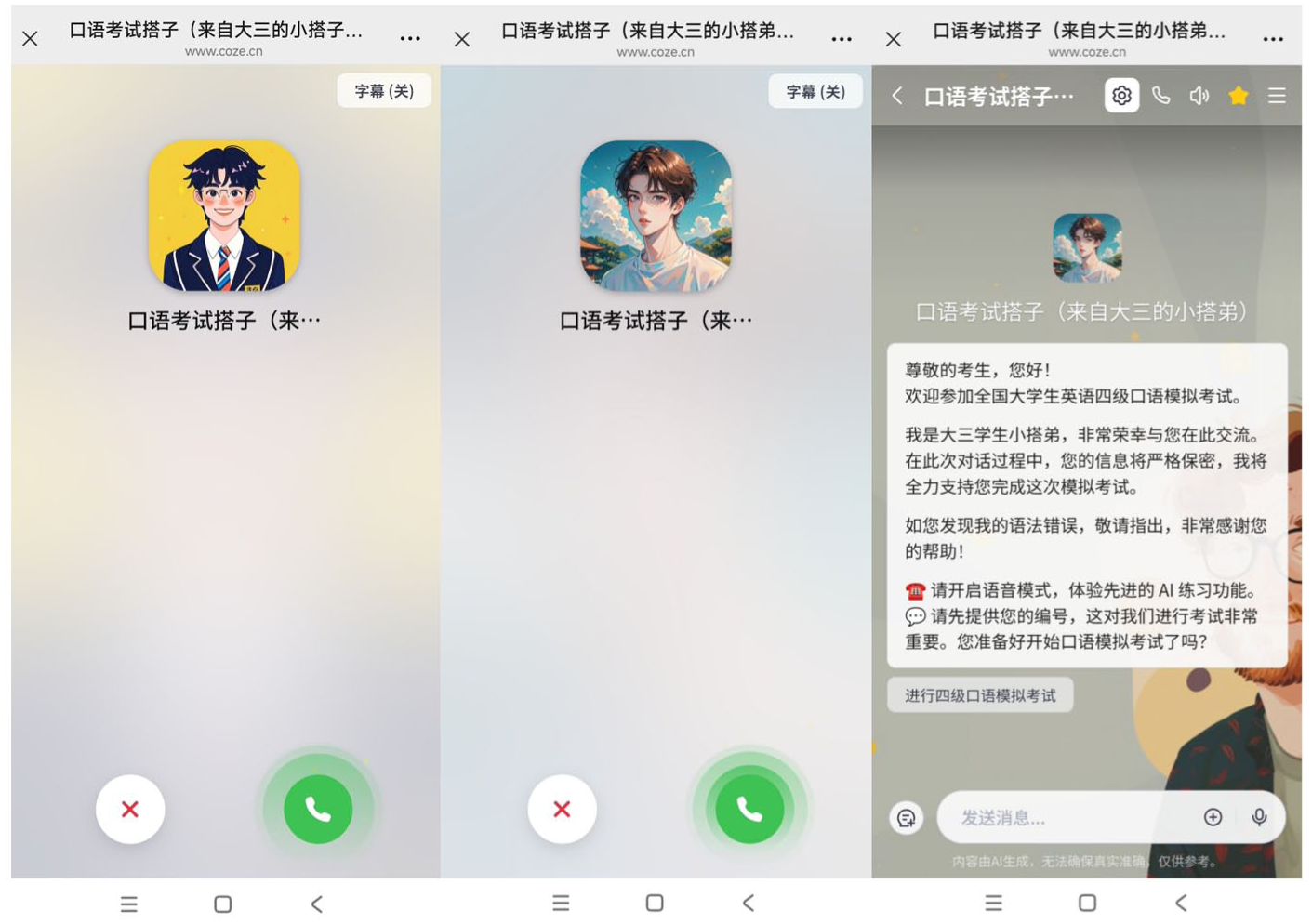
Screenshots of the SDSs.
Data Analysis
With the participants’ consent, audio recordings of the discussions were transcribed using an automated transcription service and then manually verified by the research team. The verified transcripts were segmented into turns, defined as “one or more streams of speech bounded by the speech of another, usually an interlocutor” (Crookes, 1990, p. 185). These turns were then analyzed using the IC Feature Coding Scheme to determine the presence or absence of each IC feature. To ensure inter-coder reliability, the two research assistants each independently coded a randomly selected subset of transcripts (about 16% of the total data). Inter-coder reliability, calculated as Krippendorff’s alpha coefficient, was .83 (Hayes & Krippendorff, 2007). The remaining data were then coded solely by one research assistant, the second author.
Frequencies of IC features were normalized by minute, following the approach used in Gokturk and Chukharev-Hudilainen (2024) and Leaper and Brawn (2019). Raincloud plots (Allen et al., 2021) were used to visualize the raw participant-level data, kernel density estimates, and boxplot-based summary statistics for each IC feature across the two conditions. These summary statistics included the medians, interquartile range, whiskers representing the non-outlying range, and mean values.
To investigate how EFL learners perceive the E-SDS as an interlocutor in speaking assessment, semi-structured interviews conducted with 18 participants were analyzed qualitatively. The audio-recorded interviews were first transcribed verbatim. The transcripts were then divided into meaning units following the procedures described by Campbell et al. (2013) and subsequently coded using the two-cycle coding method developed by Saldaña (2013). The first cycle generated a coding scheme consisting of 15 sub-themes (see Table 2), and the second cycle led to the development of overarching themes. The analysis of the interview data combined a top-down approach, in which the categorization of themes was informed by selected elements of the SCS, with a bottom-up approach that allowed new insights to emerge from the data. To ensure inter-coder reliability, the two research assistants each independently coded a random sample of 6 transcripts (exceeding 30% of the dataset). The resulting Krippendorff’s alpha was .90, indicating a high degree of agreement between the coders (Hayes & Krippendorff, 2007). The remaining transcripts were then coded solely by the second author.
Results
Frequency of IC Features
As shown in Table 1, initiating topics (IC1) and developing self-initiated topics (IC2) occurred more frequently in the E-SDS than in the N-SDS. IC1 was observed in 22 participants in the E-SDS condition and in 19 participants in the N-SDS condition. The mean frequency was higher in the E-SDS (M = 0.235, SD = 0.158) than in the N-SDS (M = 0.144, SD = 0.112), representing a mean difference of + 0.091 occurrences per minute. This pattern is also reflected in the number of individuals who demonstrated this difference or change across conditions (referred to as individual change henceforth): 18 participants exhibited higher IC1 frequencies in the E-SDS, compared to five in the N-SDS. A similar trend was observed for IC2, with a higher frequency in the E-SDS (M = 0.904, SD = 0.512) than in the N-SDS (M = 0.722, SD = 0.420), with a mean difference of +0.182. Individual change revealed that 16 participants exhibited higher IC2 frequencies in the E-SDS, whereas nine showed higher frequencies in the N-SDS.
Descriptive Statistics for Standardized Frequencies of IC Features.
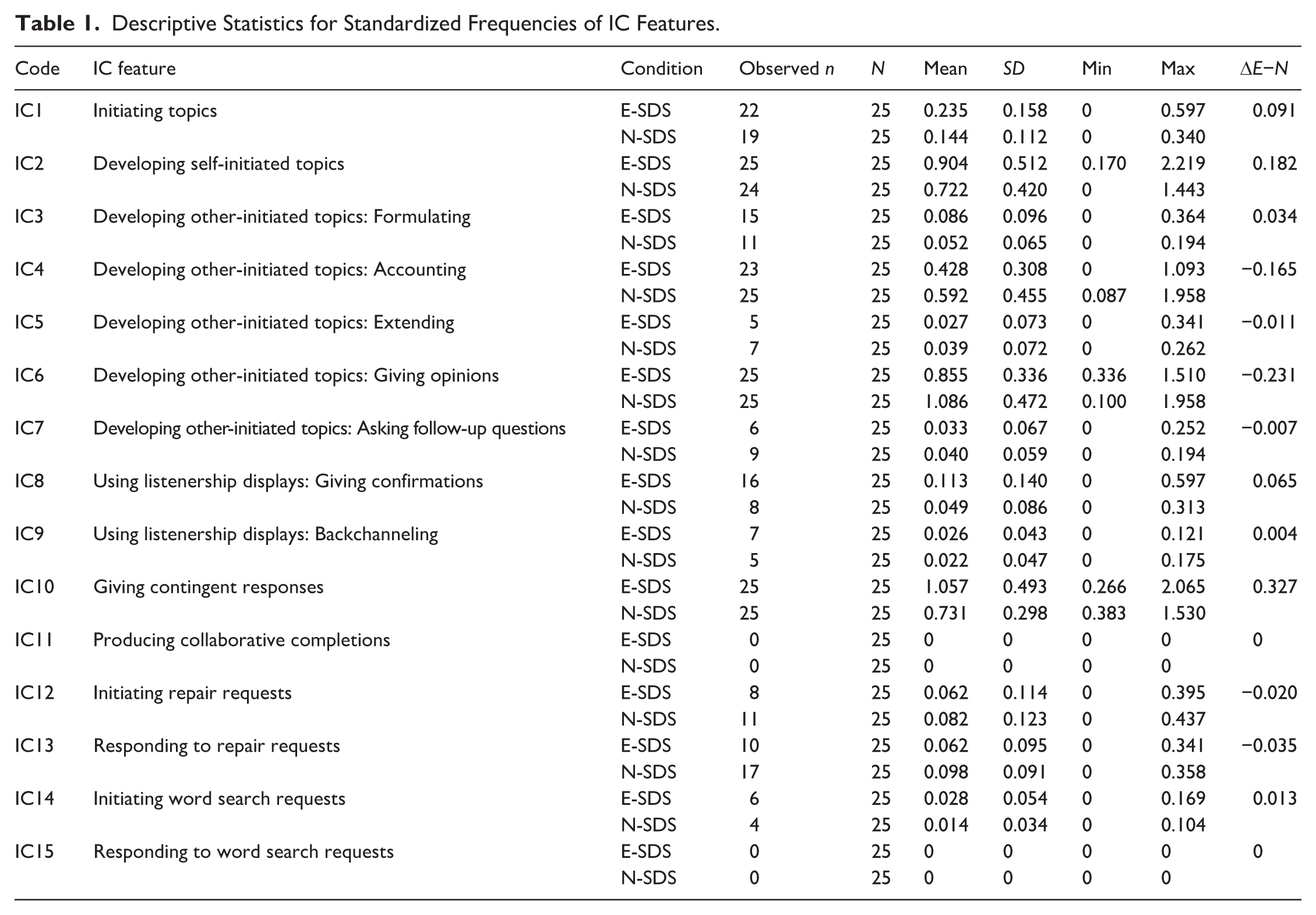
In contrast, a different trend emerged for developing other-initiated topics: accounting (IC4) and developing other-initiated topics: giving opinions (IC6). IC4 occurred less frequently in the E-SDS (M = 0.428, SD = 0.308) than in the N-SDS (M = 0.592, SD = 0.455), yielding a mean difference of −0.165 occurrences per min. Individual change was consistent with this pattern: 15 participants showed higher IC4 frequencies in the N-SDS, compared to 10 in the E-SDS. A similar tendency was observed for IC6. Specifically, the E-SDS elicited lower frequencies (M = 0.855, SD = 0.336) than the N-SDS (M = 1.086, SD = 0.472), with a mean difference of −0.231. Individual change further revealed that 19 participants produced IC6 more frequently in the N-SDS, whereas six did so in the E-SDS.
Among the 15 IC features, giving contingent responses (IC10) showed the largest mean difference for interactive listening. This feature was observed in all 25 participants in both conditions and occurred more frequently in the E-SDS (M = 1.057, SD = 0.493) than in the N-SDS (M = 0.731, SD = 0.298), yielding a mean difference of + 0.327. Individual change further revealed that 19 participants produced IC10 more frequently in the E-SDS.
The remaining features showed no noticeable differences between the two SDSs. Some features, namely IC3 (+ 0.034), IC8 (+ 0.065), IC9 (+ 0.004), IC12 (−0.020), IC13 (−0.035), and IC14 (+ 0.013), exhibited only small mean differences. Others, including IC5, IC7, IC9, IC12, and IC14, were relatively low-incidence features. IC11 and IC15 were absent in both conditions.
Overall, the findings suggest differences between the two systems in the elicited IC features rather than a uniform advantage for either system. The E-SDS appeared to be associated with higher frequencies of IC1, IC2, and IC10, whereas the N-SDS was associated with higher frequencies of IC4 and IC6. This pattern suggests that the two systems may have created different opportunities for displaying IC.
Consistent with the descriptive statistics, the raincloud plots (Figure 2) revealed rightward distributional shifts for IC1, IC2, and IC10 in the E-SDS, and for IC4 and IC6 in the N-SDS.
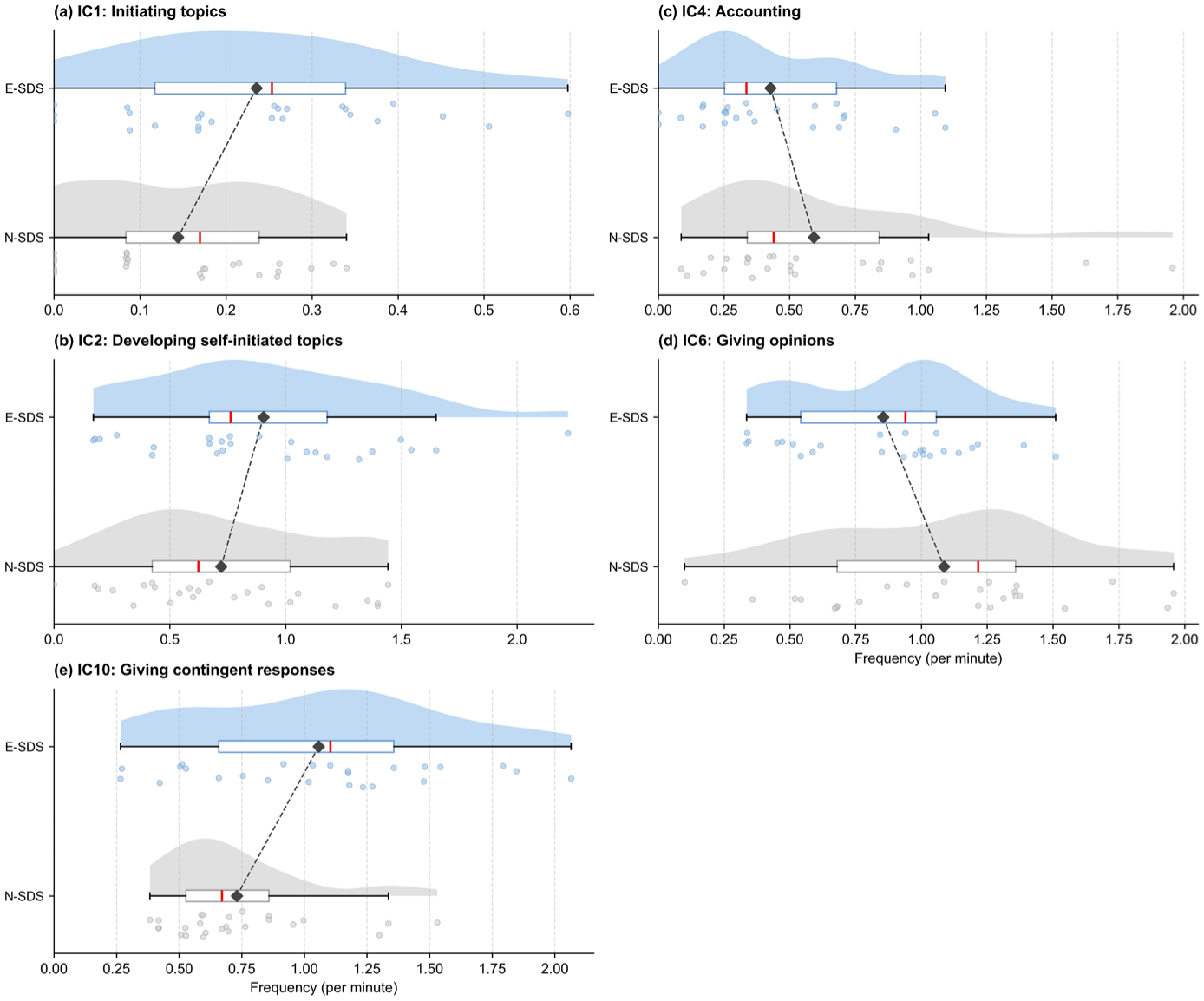
Raincloud plots for selected IC features.
Perceptions of the E-SDS
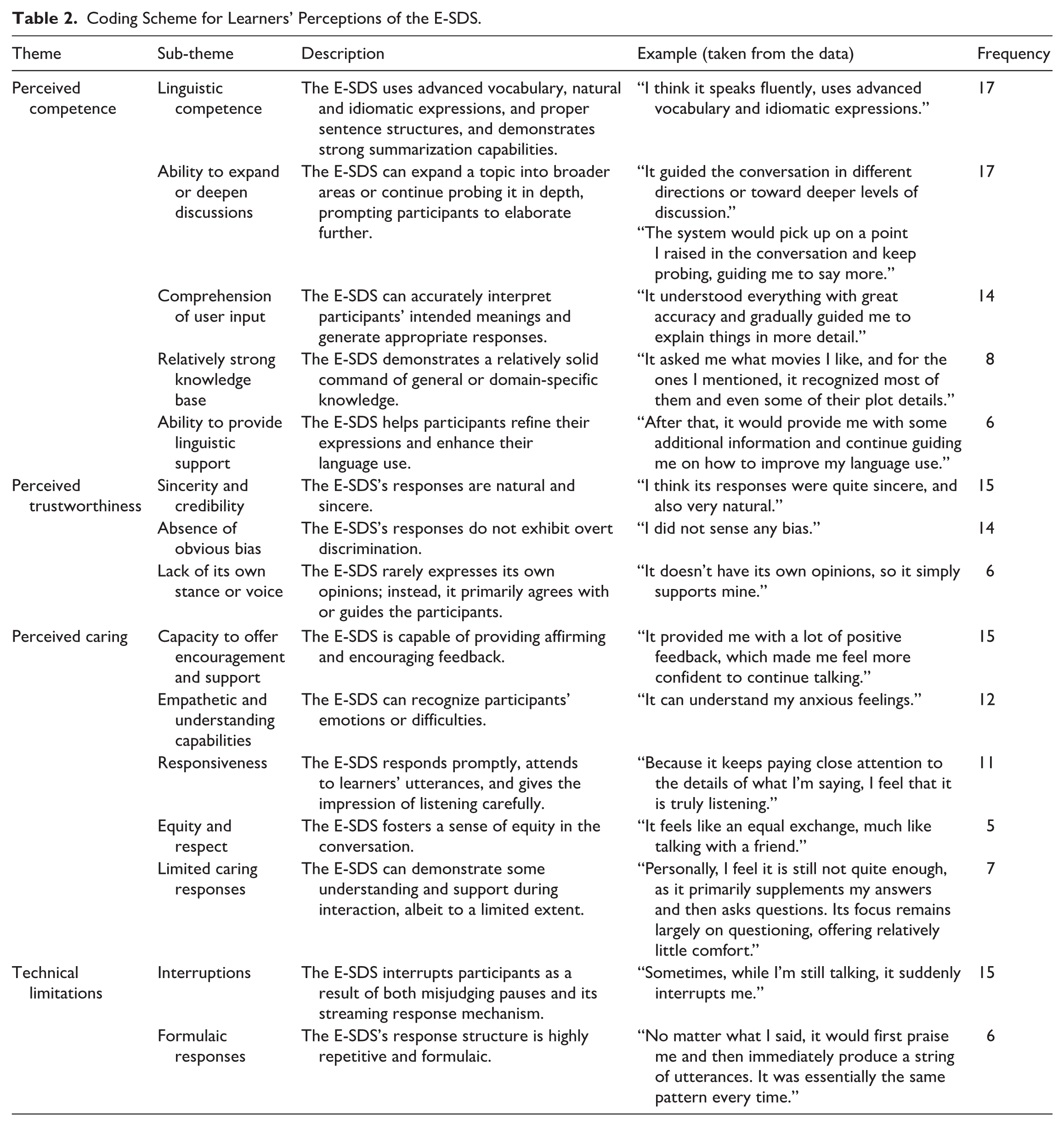
Four main themes emerged from users’ perceptions of the E-SDS: perceived competence, perceived trustworthiness, perceived caring, and technical limitations. Overall, interviewees viewed the E-SDS as linguistically competent and emotionally supportive, though the analysis uncovered nuanced and mixed attitudes toward specific aspects of the system. Table 2 presents raw frequencies of the themes and sub-themes, along with descriptions and illustrative examples from the data.
Coding Scheme for Learners’ Perceptions of the E-SDS.
Perceived Competence
The first theme concerns interviewees’ perceptions of the E-SDS’s competence. Analysis of the transcripts revealed the following five sub-themes.
Nearly all interviewees (n = 17; 94.4%) recognized the E-SDS’s linguistic competence, noting its lexical richness, syntactic variety, and smooth flow, with several describing the system’s English as “native-like”. An equally high percentage of interviewees (n = 17; 94.4%) highlighted the system’s ability to expand or deepen discussions. As one interviewee reported, “The system would pick up on a point I raised in the conversation and keep probing, guiding me to say more” (Interviewee 12). Furthermore, the majority (n = 14; 77.8%) observed its capacity for comprehension of user input, reporting that it seemed to accurately understand what participants meant and provide appropriate responses. Additionally, some interviewees (n = 8; 44.4%) mentioned that the system demonstrated a relatively strong knowledge base, indicating a solid command of general or domain-specific knowledge. Finally, several interviewees (n = 6; 33.3%) mentioned its ability to provide linguistic support, which helped participants refine their expressions or improve their language use.
Perceived Trustworthiness
The second theme encompasses socially and ethically relevant dimensions. Overall, interviewees perceived the E-SDS as a trustworthy interlocutor, though some noted that the system lacks its own stance or voice.
Specifically, most interviewees (n = 15; 83.3%) cited the E-SDS’s sincerity and credibility, describing its responses as “quite sincere” and “very natural” (Interviewee 5). Furthermore, the majority (n = 14; 77.8%) acknowledged the system’s absence of obvious bias, noting that its responses did not exhibit overt discrimination. However, a few interviewees (n = 6; 33.3%) identified a specific shortcoming: the system’s lack of its own stance or voice. The E-SDS primarily functioned to agree with or support the users’ stances, a tendency that may be attributed to the prevalence of social sycophancy in AI models (Cheng, Lee, et al., 2026). As one interviewee noted, “It doesn’t have its own opinions, so it simply supports mine” (Interviewee 14).
Perceived Caring
The third theme addresses the “caring” dimensions of interaction, highlighting the E-SDS’s ability to show empathy, provide encouragement, and demonstrate responsiveness.
A majority of interviewees (n = 15; 83.3%) highlighted the system’s capacity to offer encouragement and support. Two-thirds (n = 12) acknowledged its empathetic and understanding capabilities, noting that it could sense their emotions or understand their challenges. Furthermore, 11 interviewees (61.1%) noted the system’s responsiveness, reporting that it responded promptly, attended to learners’ utterances, and appeared to listen carefully. Additionally, five interviewees (27.8%) reported a sense of equity and respect, with one likening the interaction to “talking with a friend” (Interviewee 5).
Despite these positive perceptions, seven interviewees (38.9%) felt that the E-SDS offered only limited caring responses. While acknowledging that the system could show some understanding and support, these interviewees noted that it did so to a limited extent.
Technical Limitations
The fourth theme concerns the inherent capabilities and constraints of the underlying LLMs.
The majority of interviewees (n = 15; 83.3%) reported experiencing interruptions. As one noted, “Sometimes, while I’m still talking, it suddenly interrupts me” (Interviewee 18). This occasional interruption stems from the system’s misjudgment of conversational pauses and its streaming response mechanism, a technical problem in human-computer interaction that warrants further attention. Additionally, six interviewees (33.3%) identified formulaic responses, pointing out repetitive structural patterns such as praising the user first and then immediately producing a string of utterances.
Discussion
This section discusses the exploratory potential and challenges of E-SDSs for eliciting IC in L2 oral assessment, followed by an analysis of learners’ perceptions of the E-SDS, including its perceived strengths, constraints, and technical limitations.
The Exploratory Potential of E-SDSs for Eliciting IC
E-SDS in Topic Management
The first key finding was that learners interacting with the E-SDS demonstrated descriptively higher frequencies of initiating topics (IC1) and developing self-initiated topics (IC2). The system’s use of emotionally and mentally oriented language may have created more opportunities for learners to display these IC features by fostering a better understanding of their interlocutors’ perspectives and emotions, an important element in oral assessments (Bell et al., 2024). Moreover, learners appeared to engage with the system as a shared space for exchanging ideas and developing new subtopics, which may have led to more personalized and in-depth responses. The E-SDS’s emotional features may have encouraged learners to act as proactive co-constructors, aligning with a contemporary view of speaking that emphasizes its social and interactional nature (Galaczi & Taylor, 2018) over purely cognitive dimensions of language use. This pattern suggests that the E-SDS may have created interactional conditions in which learners were more likely to take initiative and participate in topic co-construction on a more equal footing.
In contrast, accounting (IC4) and giving opinions (IC6) were more frequent in the N-SDS condition. One possible explanation is that the E-SDS’s supportive stance reduced learners’ need to justify, defend, or elaborate on their positions in response to the system.
E-SDS in Interactive Listening
The second key finding was a notable difference in giving contingent responses (IC10), which showed the largest positive mean difference in favor of the E-SDS. Giving contingent responses, a hallmark of active listening that explicitly links a speaker’s utterance to the prior turn, is central to the co-construction of meaning (Lam, 2018; Sert, 2019). This difference may be explained by partner modeling and alignment. Partner modeling can guide speakers’ linguistic behaviors during interaction (Gokturk & Chukharev-Hudilainen, 2024). Specifically, the E-SDS provided attentive and responsive prompts, which may naturally prime learners to hold a positive attitude toward the system and reciprocate its interactive style, thereby producing more contingent responses.
No marked descriptive difference was found for lower-level listenership behaviors such as giving confirmations (IC8) (e.g., “yeah,” “I see”) and backchanneling (IC9). Two factors may help explain this. First, dialogue is a cognitively demanding task (Field, 2011). By guiding learners to invest their cognitive resources in giving contingent responses, the E-SDS may have inadvertently reduced the opportunities for the more automatic use of signals such as giving confirmations and backchanneling. Second, research suggests that as language proficiency increases, learners tend to use fewer backchannels (Galaczi, 2014). Given the participants’ oral proficiency level, their baseline use of such signals was likely already low, making any measurable increase difficult to detect.
Challenges of the E-SDS
In terms of repair management, no marked descriptive differences were observed in initiating repair requests (IC12), responding to repair requests (IC13), and initiating word search requests (IC14). This finding can be interpreted in two ways. First, it is possible that because both systems scaffolded conversations effectively, communication breakdowns seldom occurred, thereby limiting opportunities for learners to demonstrate repair-related skills. Second, emotional factors may exert a less direct influence on repair behaviors than on other aspects of interaction; instead, participants’ perceptions may play a more substantive role. As Corti and Gillespie (2016) note, individuals are more likely to repair misunderstandings with agents perceived as humans, whereas the awareness of interacting with an artificial system may suppress the intersubjective effort required. While our goal was to provide sufficient opportunities for demonstrating IC, these findings suggest that emotional design alone may be insufficient; the nature of the agent’s interface may be more critical.
Moreover, producing collaborative completions (IC11) and responding to word search requests (IC15) were entirely absent in both conditions, a pattern also noted in related research (Gokturk & Chukharev-Hudilainen, 2024). In the present study, because both SDSs consistently produced complete sentences, participants may have had little opportunity to demonstrate these skills. If this is indeed the case, this finding underscores a key design tension: an overly supportive system may fail to elicit the compensatory strategies that are central to the construct of IC.
Perceptions of the E-SDS
The qualitative findings reveal that learners generally held positive perceptions of the E-SDS as an interlocutor. This is broadly in line with prior SDS-related work suggesting that such systems can serve as potential partners in L2 interaction, albeit with certain technical limitations (Gokturk & Chukharev-Hudilainen, 2024; Ockey & Chukharev-Hudilainen, 2021).
The E-SDS demonstrated potential as an appropriate interlocutor for participants. First, regarding perceived competence, the system exhibited an integrated competence that enabled students to engage in meaningful interaction. Second, the perceived trustworthiness of the E-SDS could be partly attributed to a sense of homophily between users and the system (Lazarsfeld & Merton, 1954). In the present study, the E-SDS displayed richer emotional expressiveness than the N-SDS, showing greater similarity to human interaction, which may foster trust and connection. Third, the E-SDS demonstrated several promising features, including responsiveness, an important aspect of the perceived caring theme. This sub-theme involves “acknowledging another person’s communicative attempts” and reacting quickly and attentively (McCroskey & Teven, 1999, p. 92). Such responsiveness aligns with the inherent capabilities of LLM-based systems, which effectively transcend traditional temporal constraints to offer immediate, continuous, and on-demand interaction.
Despite these strengths, the findings highlight notable areas for improvement. The design of the system may partly account for the limited caring responses, and participants’ past experiences and assumptions may also play a role. For instance, interviewees’ framing of the E-SDS as a functional tool for interaction may have inhibited their willingness to seek out caring responses. Additionally, the system’s lack of its own stance or voice may be related to sycophancy (Cheng, Yu, et al., 2026). Such AI sycophancy, observed across leading LLMs, may weaken users’ ability to self-correct and make responsible decisions (Cheng, Lee, et al., 2026) and should therefore be carefully mitigated in future system designs.
As for technical limitations, the interruptions that occurred may stem from misjudgments of pauses and streaming responses. As effective turn-taking remains a common issue across SDSs (e.g., Eguchi et al., 2025; Gokturk & Chukharev-Hudilainen, 2024; Karatay & Xu, 2025), additional technical adjustments, such as introducing multimodal cues, may be necessary. The combination of several cues can potentially lead to more accurate recognition or prediction of a partner’s intentions (Skantze, 2021). Regarding formulaic responses, speaking tasks could allow participants to co-design the agent’s persona. Drawing on similar interactive designs recently explored in writing tasks (e.g., Xiao et al., 2025), this approach may be vital for fostering more authentic human-AI interactions.
Overall, the emergent themes and sub-themes from the qualitative analysis can not only deepen our understanding of co-constructed IC in human-machine interaction but also provide valuable insights for refining E-SDS design for future use in assessments. These insights are particularly valuable: while the E-SDS is currently viewed as a competent and supportive interlocutor, future design iterations must move toward deeper levels of empathy and overcome ecological limitations to realize a truly authentic, human-like interactive experience.
Conclusion
The present study suggests that E-SDSs hold exploratory potential for eliciting certain IC and supporting co-construction in speaking assessment. To fully realize this potential, future system development should prioritize enhancing technological authenticity and refining emotional design, thereby fostering a more genuinely collaborative human-computer partnership.
This study contributes to research on IC assessment by broadening the range of interlocutors to include a system with empathetic capability. Affective factors play a critical role in communication; they “pull the levers of our lives” (Picard, 1997, p. 5) and thus warrant careful consideration in the design of authentic assessment contexts. The findings suggest that E-SDSs may serve as valuable formative tools for technology-mediated speaking practice and classroom-based language assessment.
Several limitations point to specific directions for future research. First, the findings are based on a small, homogeneous sample of Chinese EFL undergraduates, limiting their generalizability. Future research should validate and extend these findings with more diverse learner populations. Second, turn management was not included in the analysis due to methodological constraints. Third, frequency alone may not fully capture IC performance; future studies should complement frequency-based analysis with qualitative evaluations of interactional quality. Finally, exploring participants’ perceptions of the N-SDS would be valuable for informing the design of future SDSs and should be integrated into follow-up research.
Interaction can be non-linear, unpredictable, and shaped by a range of personal cognitive elements and contextual conditions (Galaczi & Taylor, 2018). Today, technological affordances enable researchers to examine these complexities more effectively than ever before. Within this paradigm, technology-driven speaking interactions, particularly those leveraging systems such as the E-SDS, become increasingly valuable for capturing the richness and dynamism of IC.
Supplemental Material
sj-docx-1-ltj-10.1177_02655322261459025 – Supplemental material for “I Feel Like Talking With a Friend”: Exploring the Potential of Empathetic Spoken Dialogue Systems in Assessing Interactional Competence in L2 Oral Assessment
Supplemental material, sj-docx-1-ltj-10.1177_02655322261459025 for “I Feel Like Talking With a Friend”: Exploring the Potential of Empathetic Spoken Dialogue Systems in Assessing Interactional Competence in L2 Oral Assessment by Lianzhen He, Ruixue Liang and Yang Zhao in Language Testing
Footnotes
Acknowledgements
We gratefully acknowledge the editor and reviewers for their valuable feedback and suggestions, which have greatly enhanced this paper. We also thank all participants for their active involvement and patience during the experiments.

Author Contributions
Funding
The authors received no financial support for the research, authorship, and/or publication of this article.
Declaration of Conflicting Interests
The authors declared no potential conflicts of interest with respect to the research, authorship, and/or publication of this article.
Disclosure of the Use of Artificial Intelligence
During the preparation of this manuscript, the authors used ChatGPT and DeepSeek as writing and editorial support tools (accessed between 2025 and 026) for language polishing and grammar checking.
The tools were not used to design the study, generate materials, collect data, conduct statistical analyses, code interactional data, produce results, or make final methodological or interpretive decisions. All AI-assisted text was critically reviewed, revised where necessary, and approved by the authors, who take full responsibility for the final content of the manuscript.
Supplemental Material
Supplemental material for this article is available online.
Notes
References
Supplementary Material
Please find the following supplemental material available below.
For Open Access articles published under a Creative Commons License, all supplemental material carries the same license as the article it is associated with.
For non-Open Access articles published, all supplemental material carries a non-exclusive license, and permission requests for re-use of supplemental material or any part of supplemental material shall be sent directly to the copyright owner as specified in the copyright notice associated with the article.
