







Abstract
This article examines the determinants of customer orientation and the quadratic effects of customer orientation on export performance. The relationship between customer orientation and export performance has been assumed to have a linear relationship, neglecting the possibility of non-linear relationships. While most studies have been conducted in developed countries, we test our model in Brazil, an emerging market economy. The findings suggest that technology intensity and competitive intensity are key determinants in explaining success in an export market. Our findings also indicate that the relationship between customer orientation and export performance is quadratic (U-shaped) rather than linear. The implications of these findings are discussed.
Keywords
Introduction
Exporting activity is important for improving international competitiveness and also for individual firms as it serves as a catalyst for growth (Boso et al., 2012; Czinkota, 1994). Exporting is a particularly appropriate mode of entry for small and medium-sized firms (SMEs) from the developing countries wishing to enter foreign markets as it offers flexibility, minimal resource commitment and limits exposure risks (Deng et al., 2003; Sousa and Novello, 2014). Research has shown that export performance reflects the outcomes of export behaviour in firm-specific and environment-specific circumstances (Diamantopoulos, 1998; Wheeler et al., 2008). Since the seminal works by Kohli and Jaworski (1990) and Narver and Slater (1990), several studies have shown that customer orientation is a central element in explaining firm performance (Hortinha et al., 2011; Jaworski and Kohli, 1993). Although there is a consensus regarding the positive impact of customer orientation on export performance (Sousa et al., 2008), there are still questions about its robustness (Shoham et al., 2005). Moreover, the studies that have been conducted in this area assume that the customer orientation–export performance relationship is linear, neglecting the possibility of non-linear relationships (Atuaheme-Gima et al., 2005; Cadogan and Cui, 2004; Cadogan et al., 2009). However, the differences that exist between the linear and quadratic relationships and their impact are important aspects to consider in export operations. For instance, if the relationship between customer orientation and export performance is quadratic, failure to recognize that export performance may decline with too much customer orientation may have a significant impact on export success. Therefore, SMEs must be knowledgeable of the type of relationship that exists between customer orientation and export performance.
The literature is also limited by a focus on the developed countries, particularly in the United States and Western Europe. To date, few studies exploring customer orientation have been reported from the developing nations (Ellis, 2005). This is a surprise since emerging markets play an increasingly important role in the global economy (Gaur et al., 2014), and most emerging economy governments (e.g. Brazil and China) now actively encourage local enterprises to go global. Given the differences between the developed and developing economies, the generalization of prior research to firms in a developing country may be inappropriate (Pangarkar and Wu, 2012). A major gap in the literature is, therefore, the knowledge about whether our current understanding can be successfully generalized to firms in other countries, especially those from emerging markets.
Thus, our study provides the following contributions to the literature. First, we examine the impact of customer orientation on export performance. In the case of export operations, research into the effect of customer orientation is still in an early stage of development since most conceptual and empirical studies of customer orientation have been in the context of domestic markets (Racela et al., 2007). While exploring the role of customer orientation, we also investigate whether it mediates the effect of the firm’s internal resources on export performance. In addition, we develop a model that examines whether the relationship between customer orientation and export performance is quadratic rather than linear. Previous research assumed a linear effect between customer orientation and performance, disregarding potential non-linear effects. However, the examination of potential non-linear effects has significant theoretical and managerial implications in terms of how we view the development of customer orientation in a firm. Finally, we examine the determinants of export performance and test these relationships in the context of an emerging market, namely, Brazil. As a country in this category, Brazil is particularly interesting as it is South America’s largest economy being responsible for about one-third of the total gross domestic product (GDP) for Latin America and the Caribbean. According to the World Bank, Brazil is the seventh largest economy in the world in terms of GDP (World Bank, 2014). In addition, Brazil is part of the BRIC (Brazil, Russia, India and China), the fastest-growing set of economies from the developing world.
In the next section, the theoretical background to the research is presented, along with the development of specific research hypotheses. This is followed by a description of the research methodology and test results. After presenting the discussion and implications of the results, the article concludes with limitations and suggestions for further research.
Theoretical background and hypotheses development
Customer orientation
There are differing views about the role of the various elements of market orientation (Zhou et al., 2007). According to Narver and Slater (1990), there are three components: (a) customer orientation, (b) competitor orientation and (c) inter-functional coordination. In our study, we focus on customer orientation; it has been identified as the critical element of the marketing orientation construct and is regarded as synonymous with market orientation (Deshpandé et al., 1993; Deshpandé and Farley, 1998). Tyler and Gnyawali (2002) also conclude that managers find customer orientation to be the most important aspect of market orientation. Similar arguments have been found in the literature (e.g. Matsuo, 2006; Wren et al., 2000) which emphasize the importance of analysing the customer orientation construct; this refers to a ‘sufficient understanding of one’s target buyers to be able to create superior value for them continuously’ (Narver and Slater, 1990: 21). In order to create value for target markets, firms have to gather knowledge about the current and future customers and then disseminate that knowledge throughout the firm (Jaworski and Kohli, 1993; Lafferty and Hult, 2001). Firms with a strong customer orientation have a competitive advantage as they afford priority to the creation and maintenance of customer value (Hortinha et al., 2011; Olson et al., 2005). Not surprisingly, it has been argued that the interests of the customers should be the first concern to develop long-term profitability (Deshpandé et al., 1993). This is particularly the case for SMEs where their marketing advantage is linked to the close relationships that exist between them and their customers due to the much shorter line of communication (Jones and Rowley, 2011; Weinrauch et al., 1991). Thus, in the literature, customer orientation is acknowledged to be a key driver of business performance (Jaworski and Kohli, 1993; Zhou et al., 2007).
Conceptual framework
The conceptual model guiding this study is based on two theoretical structures present in the marketing literature, namely, the resource-based view (RBV) and the structure–conduct–performance (SCP) paradigm. These theories are not usually applied together to explain export performance, particularly in the case of SMEs. While we use the RBV approach to focus on the internal variables, SCP theory is selected to justify the external element in our conceptual model.
The RBV approach has been used as the cornerstone to understand how firms compete in their environments. The model indicates how resources are applied and combined and what makes competitive advantage sustainable (Peteraf, 1993). The resource-based approach posits that internal resources are key determinants in defining performance and profitability (Barney, 1991; Wernerfelt, 1984; Wright et al., 1994). In that sense, the raw materials available for deployment by a firm’s business units are essential for defining its success in the export market (Barney, 1991; Morgan et al., 2004). According to Barney (1991) and Conner and Prahalad (1996), the resource-based theory focuses on how sustained competitive advantage is generated by a unique set of firm resources and knowledge. Moreover, the RBV is associated with the creation of superior value to consumers through the utilization of specific and scarce resources (Peteraf and Barney, 2003).
SCP theory, however, suggests that external factors such as environmental elements may affect a firm’s export performance. According to Morgan et al. (2004), SCP theory proposes that export performance is directly affected by the firm’s market structure (i.e. competitive intensity). A fundamental assumption in SCP theory is that the structural forces that determine competitive intensity in a market have a strong impact on firm performance (McGahan and Porter, 1997; Scherer and Ross, 1990). This theory suggests performance is a function of differences in market conditions (Chen, 1999). Based on the SCP paradigm, Morgan et al. (2004) argue that the external environment (i.e. competitive intensity) is a major antecedent of export performance. Moreover, the nature and type of market environment have different effects on the firm’s export performance.
The RBV and SCP perspectives share a common objective in trying to understand how firms achieve better performance. We can, therefore, suppose that performance may be influenced by the use of certain practices (in the RBV) or the conditions of a particular market (in the SCP). Considering those propositions, we support the adoption of both perspectives (SCP and RBV) to give a balanced view of the factors that influence export performance, whether these are external or internal. Specifically, we propose to focus on both perspectives to understand the export performance of Brazilian SMEs as an outcome of internal and external elements from the firm and the marketplace. Based on both approaches, we identify a set of internal and external factors that may affect the export performance of Brazilian SMEs. The internal resources we consider are customer orientation, managerial experience and technological intensity.
Customer orientation refers to the analysis and comprehension of the needs and demands of customers and provides direction in respect of what the firm should be doing in terms of products and services (Narver and Slater, 1990). As such, it can be considered as a resource, since it is an intangible property of the firm that will enable it to convert information into actions, thereby creating superior value for customers (Armario et al., 2008; He and Wei, 2011; Hunt and Lambe, 2000). The other internal factors proposed in this study (managerial experience and technological intensity) find support in Penrose’s (1959) proposition that managerial and technological resources should encompass the resource domain of the firm. Among resources, intangible ones stand out as they are more difficult to imitate and the most likely to generate sustainable competitive advantages (Galbreath and Galvin, 2008). Not surprisingly, several studies suggest that intangible, rather than tangible, resources are far more likely to underlie performance (Amit and Schoemaker, 1993; Barney, 2001; Hitt et al., 2001). In this context, managerial experience has to be considered an important intangible resource that affects the export operations of firms, since export market knowledge accumulated through experience constitutes a valuable resource which is difficult to imitate (Brooks and Rosson, 1982; Sousa et al., 2008). Among intangible resources, technological resources are particularly significant as they provide an innovative capacity important for the creation of competitive advantage in foreign markets (Higón and Driffield, 2011; Rodríguez and Rodríguez, 2005). In this regard, Basile (2001) and Sousa and Novello (2014) have emphasized the role of technology as one of the main factors contributing to the success of the firm’s international operations. In relation to technological resources, while technological intensity has not received much attention in the literature (Dhanaraj and Beamish, 2003), it has been considered a key element to explain the internationalization process of the firm (Buckley and Casson, 1991). Therefore, the firm’s technological intensity has been incorporated in the proposed model as an important internal component to explain the export activities of SMEs.
Finally, the SCP theory posits that external components in the marketplace are vital to determine firm performance (Porter, 1980). In line with previous studies, we argue that the external environment is a factor that may directly affect the customer orientation and the export performance of the firm (Jeong et al., 2006; Morgan et al., 2004). The external factor present in our model that may affect export performance is the market’s competitive intensity. Additionally, export performance literature (Lages and Montgomery, 2005) suggests that foreign competition is a key issue that needs to be considered. The hypothesized relationships among variables are presented below, based on the two theoretical approaches that support our propositions. An overview of the conceptual framework is presented in Figure 1.
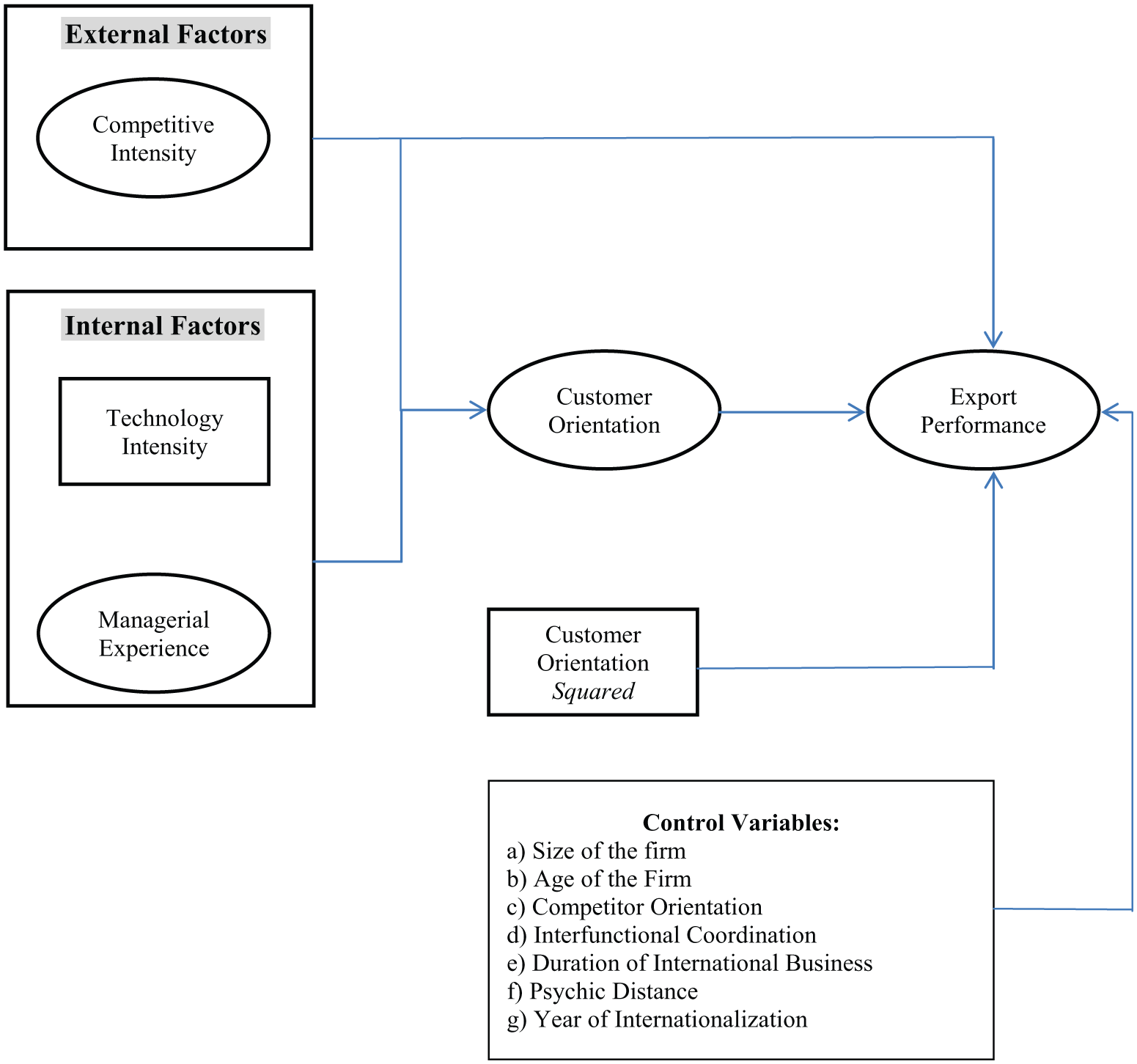
Conceptual model.
Research hypotheses
The more competitive the market, the more difficult it is for the firm to acquire market share that ensures survival (Mudambi and Zahra, 2007). As a result, intense competition in the export market increases the need to actively monitor customers and competitors and respond to change in the environment (Awuah, 2008). It is particularly important to ensure that the firm engages in adequate promotion, delivers on time, properly maintains service and develops the right product for its markets (Terpstra, 1987). Thus, firms operating in export markets under intensely competitive conditions are more likely to emphasize the need for more expertise in monitoring customers and paying special attention to their needs. This need to emphasize the understanding of the customer is directly linked to firm survival in the foreign market. Unfamiliarity with the requirements of the foreign environment endangers survival (Sui and Baum, 2014). Not surprisingly, studies have indicated that the survival of the firm hinges on the development of competences such as customer orientation (Knight and Kim, 2009). Customer orientation, in this context, means to create superior value for the customer and continuously meet customer expectations with quality products and services in markets where competition is intense (Narver and Slater, 1990). Firms able to provide superior customer value will build loyalty and commitment and reduce the motivation to switch to competitors (Homburg et al., 2002). This is critical when competitive intensity is high since there is a greater degree of competitive marketing activity with the aim of increasing the customer response to competitive marketing efforts. In a highly competitive market, firms need to be more attentive to the changing needs of customers (Lusch and Laczniak, 1987). Adopting a customer orientation approach is one of the key ways in which this can be accomplished; therefore, firms with higher levels of customer-oriented practices will be more able to cope with the intense competition of foreign markets. Based on the above, we propose the first hypothesis:
H1: The greater the level of competitive intensity in the export market, the higher the degree of customer orientation of the firm.
In this article, we hypothesize that technological intensity will have a positive impact on customer orientation. The rationale behind this proposition being that marketing a product with a high degree of technological complexity in a foreign market generates a greater need for understanding the market, customer and competitor practices (Bradley, 2002). While technological competencies are important for success and survival in the foreign market, it is important that the introduction of technologically complex products is accompanied by understanding of the market and customers, thereby reducing the odds of failure (Cantwell, 1989; Mudambi and Zahra, 2007). Purchasers of technically sophisticated items are more likely to place demands on manufacturers to focus on the underlying needs and purchasing requirements of customers (Bello et al., 2003). Also customers for technologically intensive products tend to demand more value-added services. As the technical nature of the product increases, these added services become increasingly important so the expectations of customers must be addressed through products and services (Celly and Frazier, 1996; Sousa and Bradley, 2009). Moreover, as the product complexity increases, customers may require more support in operating and maintaining the products (Venohr and Meyer, 2009). Therefore, firms that produce technologically based goods must invest in more training and technical support activities in order to be able to market and service the product adequately (Cavusgil and Zou, 1994; McGuinness and Little, 1981). Thus, technology-intensive products lead companies to adopt a higher degree of customer-oriented behaviour. Based on these arguments, we propose the second hypothesis:
H2: The greater the level of technological intensity of the product, the higher the degree of customer orientation of the firm.
The relationship between managerial experience and customer orientation has not received great attention in the marketing literature. We argue that a strong relationship exists between those two components, since the manager’s knowledge of the foreign market will lead to a better comprehension of the customer which is a central aspect of the customer orientation behaviour. The concept of absorptive capacity in the organizational learning literature could be useful in this context. Absorptive capacity is the firm’s ability to recognize the value of new, external information, assimilate it and apply it (Cohen and Levinthal, 1990). The term ‘absorptive capacity’ can be used to explain a firm’s ability to turn experiences into useful knowledge in an ongoing business (Eriksson and Chetty, 2003). Previous experience adds to the manager’s human capital by providing valuable knowledge and absorptive capacity relevant to the international operations of the firm (Filatotchev et al., 2009). Knowledge development is a cumulative experience, insofar as prior experiences generate knowledge that is applied as managers make decisions about their ventures (Hultman et al., 2011). Experience from foreign operations will facilitate learning about the foreign market (Carlsson et al., 2005). The previous international business experience of decision-makers represents an important organizational resource which allows the firm to obtain specific knowledge of the process of identifying and serving foreign customers (Filatotchev et al., 2009). In that sense, managers who have higher levels of international experience can provide firms with a better appreciation of the potential market, enabling their companies to access information about customers and competitors, leading to a higher level of customer orientation. O’Hara et al. (1991) propose that more experienced workers, familiar with the customer’s needs, are more likely to present customer-orientated behaviour, if compared to less experienced employees. Franke and Park (2006) also provide support for the assumption that workers with higher experience perform better and present customer-oriented behaviour. Based on the above discussion, we propose the next hypothesis:
H3: The higher the level of the manager’s international experience, the greater the customer orientation of the firm.
The relationship between competitive intensity and export performance has been explored in the marketing literature (Ambler et al., 1999; Lages and Montgomery, 2005; McGahan and Porter, 1997; Morgan et al., 2004; Scherer and Ross, 1990) but with mixed outcomes, suggesting a need for a greater understanding of the relationship. According to Sousa et al. (2008), market competitiveness is alleged to have an important influence on export performance. Competitive markets tend to be more dynamic with frequent changes in competitive conditions and shifts in customer tastes and needs. These changes can create uncertainty for the firm and make long-term planning difficult (Zahra et al., 1997); such uncertainties create additional difficulties increasing the possibility of poor decisions, and thereby reducing the export performance of the firm (Sousa and Bradley, 2008). Not surprisingly, O’Cass and Julian (2003) argue that lack of competition in an export market contributes positively to export performance. Our hypothesis is based on the proposition that firms operating in less competitive markets will perform better. This is consistent with the study by Sriram and Manu (1995) who found that firms exporting to less competitive markets tend to achieve better results. Thus, the following hypothesis is proposed:
H4: The higher the competitive intensity, the lower the degree of export performance.
According to RBV theory, as a resource, customer orientation generates a sustainable competitive advantage that can lead to superior performance (Slater and Narver, 1995); the construct refers to analysing target buyers to continuously create superior value (Narver and Slater, 1990). To achieve such value, the firm has to understand customer needs and wants; identifying and responding to these preferences will satisfy customers and enhance performance against competitors (Cadogan et al., 2002). Simply put, customer-oriented firms perform better (Deshpandé et al., 1993). In the export marketing literature, the relationship between customer orientation and export performance has been assumed as a positive linear relationship, implying that to achieve greater levels of export performance, firms must continuously invest in customer-oriented behaviours. This rationale is grounded in the RBV paradigm such that increasing efforts in market-oriented behaviours positively affect performance (Hunt and Morgan, 1995; Katsikea and Morgan, 2003; Sørensen, 2009). Therefore, our fifth hypothesis explores the positive linear relationship between customer orientation and export performance:
H5: There is a positive linear relationship between customer orientation and export performance.
We also propose an alternative hypothesis to H5. This explores the possibility that the customer orientation–export performance relationship is quadratic rather than linear. A small number of studies (Cadogan and Cui, 2004; Cadogan et al., 2009) explore the non-linear relationship between market orientation constructs and export performance, revealing an area that requires further analysis. H5 postulates that firms will perform better when customer-oriented behaviour is higher; as such, export performance will increase with greater investment in customer orientation. However, based on the theory of firm growth, expansion is limited by management capabilities and resources which restrict growth (Penrose, 1959). In effect, firms operate under limited budgets and have to prioritize their resource investments to gain optimal returns (Cadogan et al., 2009). Additionally, although customer orientation is an important tool for developing competitiveness and enhancing performance, other value-enhancing strategic orientations must be leveraged to meet customer demands (entrepreneurial, innovation, learning and technological orientation) (Cadogan et al., 2009; Gatignon and Xuereb, 1997; Hult and Ketchen, 2001). Indeed, firms should never be locked into one approach since environmental conditions are transient and fluid (Slater and Narver, 1994). Also, constantly screening customer needs would be harmful to other strategic dimensions (Ulwick, 2002), as constant change in demand would prevent the development of specific technological skills (Atuaheme-Gima et al., 2005). Thus, budgets have to be parsimoniously allocated in order to accommodate resource demands from different strategic areas.
Taking these arguments into consideration, as firms begin to invest in customer-oriented behaviours, export performance will increase as they become more knowledgeable about related needs and demands. However, further investment in customer orientation after an optimal point leads to harmful results; this suggests an inverted U-shaped relationship between customer orientation and export performance. Therefore, we propose the following hypothesis:
H6: There is an inverted U-shaped relationship between customer orientation and export performance.
Exploring the role of customer orientation is important to understand the relationships among the constructs informing this study. Thus, we analyse whether customer orientation mediates the effect of internal resources on export performance. While it has not been extensively studied, the possible mediating role of customer orientation has been previously examined (Williams and Attaway, 1996). As indicated above, technological intensity and managerial experience are expected to have a positive impact on customer orientation, which in turn is an important predictor of export performance. Consequently, it is proposed that it is through the development and leveraging of intangible resources (i.e. technological intensity and experience) into customer orientation that firms are able to achieve superior export performance. Thus, the following hypotheses will be tested:
H7a: Customer orientation mediates the influence of technology intensity on export performance.
H7b: Customer orientation mediates the influence of managerial experience on export performance.
Methodology
Sample and data collection procedure
The study was conducted using a sample of exporting firms based in Brazil. We used a multi-industry sample to increase the observed variance and to strengthen the generalizability of the results (Morgan et al., 2004). The research was based on a survey of 700 SMEs randomly generated from the trade association database of non-government agencies. In line with the Organisation for Economic Co-operation and Development’s (OECD) 1994 definition, we use 500 employees as the dividing line between a SME and a large firm (please see Appendix 1 for sample characteristics).
The structured questionnaire used was originally written in English and translated into Portuguese by a bilingual expert. Academic experts who were familiar with the topic under investigation assessed the content validity of the items. As suggested by Churchill (1979), the measures were then refined through interviews with people capable of understanding the nature of the concept being measured, that is, managers involved in export operations. The questionnaire was, therefore, given to a pre-test sample of eight managers. Based on their feedback, the survey was revised. The questionnaire was then back-translated into English and checked for consistency with the original translated version to enhance ‘translation equivalence’ (Craig and Douglas, 2005; Van de Vijver and Leung, 1997). The effective response rate was 19% (132 usable questionnaires). This result constitutes a fairly high response rate, considering that the average top management survey response rates are in the range of 15%–20% (Menon et al., 1999), and it is considerably higher than other studies conducted in countries with a developing economy (e.g. Zou et al., 1997).
To explore the issue of non-response bias, we tested for differences between early and late respondents (Armstrong and Overton, 1977). As recommended by Weiss and Heide (1993), early responses were defined as the first 75% of returned questionnaires. The last 25% were considered late responses and representative of firms that did not respond to the survey. Using a t-test, early and late respondents were compared on all the variables and no significant differences were found (at the conventional 0.05 level); this suggests that non-response bias was not an issue. Moreover, since anonymity was guaranteed, bias associated with those who did not wish to respond for confidentiality reasons was also reduced (Bialaszewski and Giallourakis, 1985).
Particular attention was paid to the identification and selection of the most appropriate person in each firm to participate in the study. Because of involvement and direct responsibility in decision-making, the manager was considered to be a major force behind the initiation, development, sustenance and success of a firm’s foreign activities. To ensure the reliability of the data, the respondents selected were senior managers with responsibility for foreign operations. The approach suggested by Huber and Power (1985) of using a single key informant was also adopted, with a view to minimizing the potential for systematic and random sources of error.
Measures
This study uses the main export venture, the most important product exported to the most important foreign market, as the unit of analysis. The use of the export venture allows us to identify and isolate specific antecedents of export performance (Morgan et al., 2004). For all constructs in the theoretical model, the identified unit of analysis was the firm’s main export venture to its primary export market.
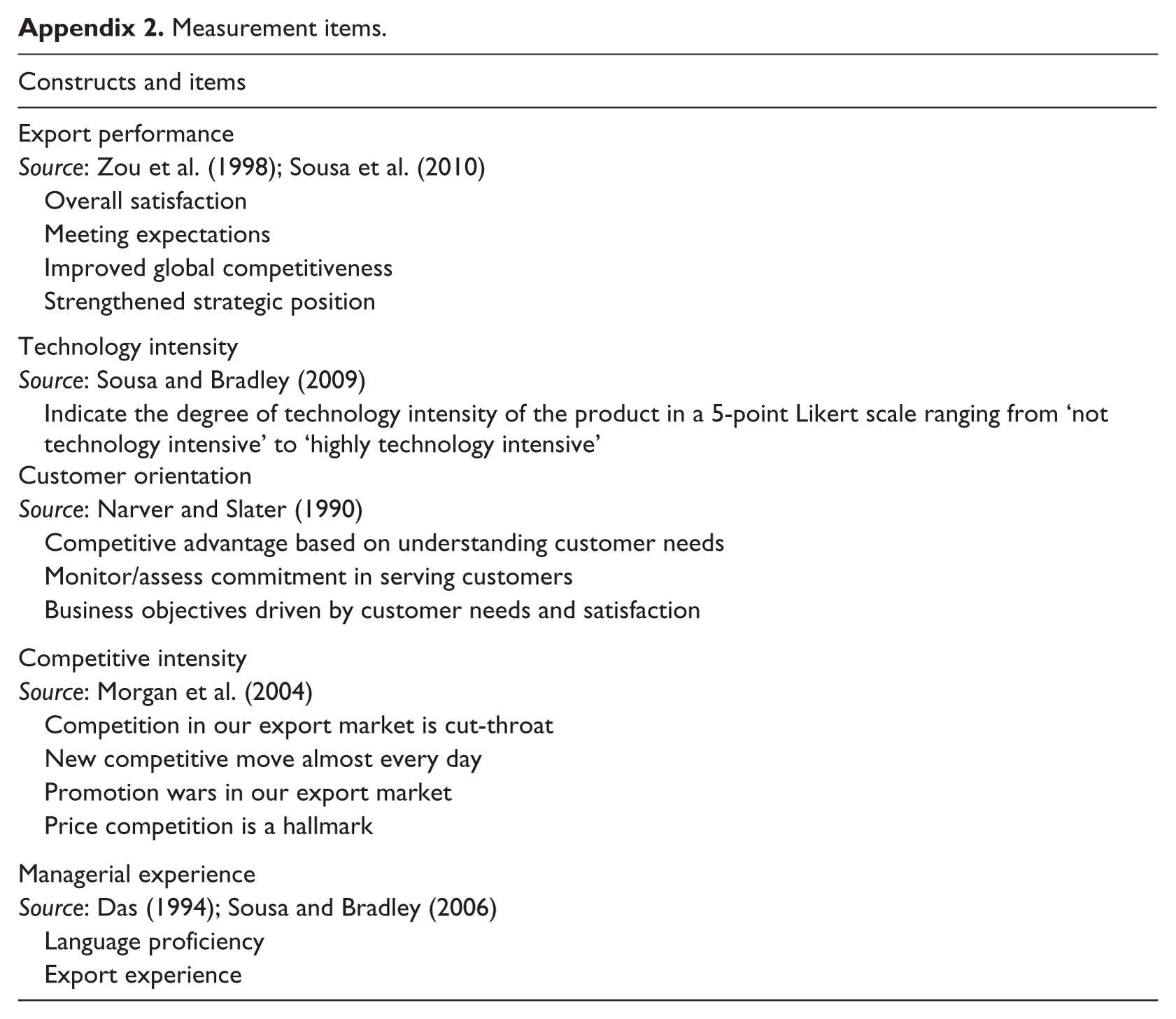
In order to measure export performance, the following items were used: overall satisfaction, meeting expectations, improved global competitiveness and strengthened strategic position. In relation to competitive intensity in the main export market, we relied on the scale developed by Morgan et al. (2004). Technology intensity of the product was assessed by asking respondents to indicate the degree of technology intensity of the product on a 5-point scale ranging from ‘not technology intensive’ to ‘highly technology intensive’. The experience of the manager was measured by asking respondents to indicate their degree of professional exporting experience and their level of proficiency of the language spoken in the main export country (Das, 1994; Sousa and Bradley, 2006). Finally, customer orientation was measured using the Narver and Slater (1990) scale (see Appendix 2).
In addition to the variables specified in our model, the following control variables were included: size of the firm, competitor orientation, inter-functional coordination, psychic distance, year of internationalization, duration of international business in the export market and age of the firm. Following previous studies, firm size was measured by using the number of employees (Brouthers and Nakos, 2005). The scales provided by Narver and Slater (1990) were used to measure competitor orientation and inter-functional coordination. Psychic distance was measured using the scale provided by Sousa and Bradley (2006). The respondents also indicated how many years the firm has been involved in the export market, year of internationalization and the age of the firm.
Assessment of common method bias
As common method, bias may be an issue in international research, and considering that we have used a single respondent from each company to collect our data, some procedures have been adopted to safeguard our constructs from the effects of systematic errors that either inflate or deflate the relationship between them. The first procedural remedy was on the designing process and administering the questionnaire. We mixed the order of the questions and used different types of scales and metrics. Here, we followed the procedure proposed by Podsakoff et al. (2003), who suggested that researchers should use different scale endpoints. In the case of our questionnaire, there are three different types of scale endpoint. By applying that procedure, ‘respondents cannot easily combine related items to cognitively “create” correlation needed to produce a CMV-biased pattern of responses’ (Chang et al., 2010: 180). Second, we guaranteed to all participants that their participation was anonymous and confidential, and that there was no right or wrong answer. These procedures should reduce evaluation apprehension and prevent editing to make answers socially acceptable and consistent with perceived researcher preference. Third, respondents were not aware of the conceptual model that supported our study preventing them from creating correlations between constructs.
Additionally, the Harman single-factor test was performed. This test consists of loading all items used to measure the constructs onto one single factor using exploratory factor analysis (EFA). Common method bias is an issue when one factor emerges from the EFA or when the majority of variance of the sample is explained by one factor. The solution obtained by the EFA for all items provided five factors, all with eigenvalues higher than 1. The first factor accounted for less than 30% of the total variance. Following Morgan et al. (2004), we also used confirmatory factor analysis (CFA) to test a single method factor. The fit indexes for a single-factor model (comparative fit index (CFI) = 0.257; Tucker–Lewis fit index (TLI) = 0.122; incremental fit index (IFI) = 0.269; root mean square error of approximation (RMSEA) = 0.231) suggest a poor model fit, indicating that common method bias is not likely.
Finally, in addition to the above tests, we conducted the marker variable technique (Lindell and Whitney, 2001). This test consists of introducing a theoretically unrelated variable and assessing its correlations with the other variables of interest. The correlations between the marker variable and the other variables are signs of common method bias (Malhotra et al., 2006). The marker variable here is the age of the manager. The correlation results indicated that this marker variable (age of manager) is not related to the variables of interest included in our model. The correlations varied from .01 to −.12, and the average correlation between the marker variable and the other variables of interest is .05. Using structural equation modelling, we included the marker variable in the theoretical model to have an effect on each indicator of our latent variables and compared the model with and without it. The results indicated that there were no significant changes in both models. Considering the findings of the three statistical tests conducted and the other procedural remedies aforementioned, we can conclude that common method bias was not a concern in our sample.
Model estimation
We used structural equation modelling with maximum likelihood (ML) approach to test the hypothesized relationships and model. Statistical software AMOS 20.0 was used to estimate the model parameters. The model estimation was conducted in two steps. In the first step, we assessed the overall measurement model through CFA. Construct validity was also assessed at that stage. In the second phase of the estimation, we tested the hypothesized structural relationships of the model presented in Figure 1.
We followed Ping’s (1995) estimation technique proposition to calculate the quadratic effect tested in the model. The quadratic effect of customer orientation was obtained by using a single indicator created by squaring the mean of the observed variables that composed that construct. As the powered term was highly correlated with the customer orientation variable from which it was derived, we used the residual centring procedure (Little et al., 2008). This allowed us to avoid problems related to the estimates’ instability of the regression coefficients, that is, to avoid the possibility that these estimates of the main effects may change when higher-order terms enter the model.
One of the purposes of this study was to assess whether the relationship between customer orientation and export performance is quadratic rather than linear. Thus, we paid special attention to the criteria used to establish whether that relationship is linear or curvilinear. A quadratic relationship might be represented by a linear and a quadratic term, such as Y = α1X + α2X2, or solely by the quadratic term Y = α2X2 when α1 is 0. In the particular case of an inverted U-shaped relationship between the quadratic term of customer orientation and export performance, α2 must be negative (McCallum et al., 2010). In that case, the relationship will be represented by a concave function. Support for the contention that the relationship between customer orientation and export performance is linear (H5) is provided if the regression coefficient that represents that hypothesis is positive and significant and the coefficient for hypothesis H6 is not significant. However, support for hypothesis H6 (inverted U-shape relationship between customer orientation and export performance) is provided if its regression coefficient is negative and significant.
Analysis and results
Reliability and validity
We began by evaluating the psychometric properties of export performance, competitive intensity, managerial experience, customer orientation and export performance. We initially performed EFAs, computed item to total correlations and calculated Cronbach’s (1951) alpha coefficients. All measures were now unidimensional and showed accepted reliability levels with all alpha coefficients equal or above 0.62.
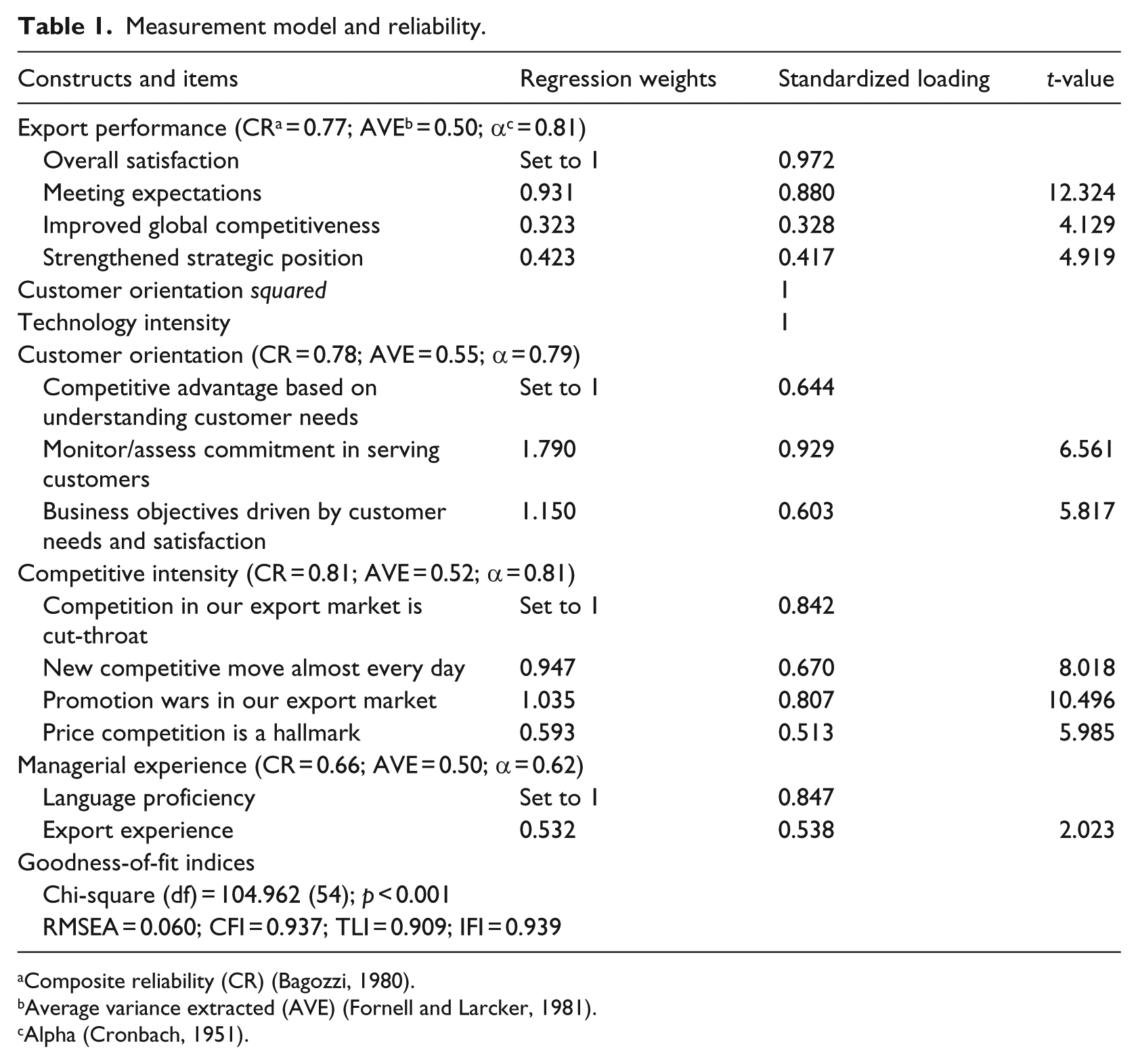
We then assessed discriminant validity, convergent validity and scale reliability with CFA, in line with the paradigm advocated by Anderson and Gerbing (1988). Tables 1 and 2 display the results obtained from the estimation of the CFA model. The results indicate that the overall chi-square for this model was 104.962 (p < 0.001) with 54 degrees of freedom (dfs). Four measures of fit were examined: the CFI = 0.937, TLI = 0.909, IFI = 0.939 and the RMSEA = 0.060. The results of the CFA model also show that the items employed to measure the constructs were both valid and reliable. More specifically, convergent validity is evidenced by the large and significant standardized loadings (t > 1.96, p < 0.05) of the items on the respective constructs.
Measurement model and reliability.
Composite reliability (CR) (Bagozzi, 1980).
Average variance extracted (AVE) (Fornell and Larcker, 1981).
Alpha (Cronbach, 1951).
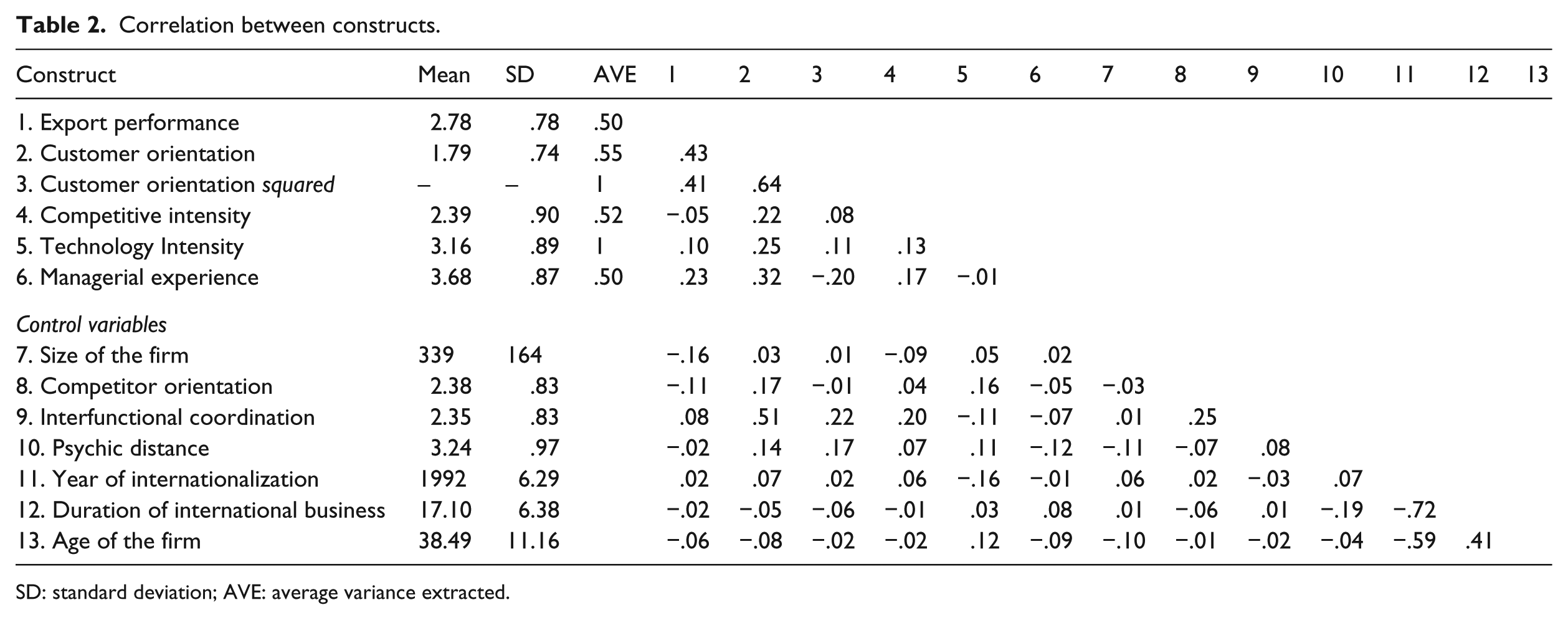
Correlation between constructs.
SD: standard deviation; AVE: average variance extracted.
We used two methods to assess discriminant validity of the measures. First, we examined the chi-square difference by running pair-wise tests for all the scales. All chi-square differences have high significance (e.g. the test for customer orientation and export performance, Δχ2(1) = 18.01, p = 0.00), which indicates the discriminant validity (Anderson and Gerbing, 1988). Second, discriminant validity was assessed by observing the construct inter-correlations. These were significantly different from 1, and the shared variance between any two constructs (i.e. the square of their inter-correlation) was less than the average variance explained in the items by the construct (Fornell and Larcker, 1981) (see Table 2).
As far as the reliability is concerned, all constructs present acceptable levels of composite reliability (CR): export performance (CR = 0.77), customer orientation (CR = 0.78), competitive intensity (CR = 0.81) and managerial experience (CR = 0.66). In terms of variance extracted, all constructs were equal or exceeded the recommended level of 0.5. We conclude, therefore, that for all constructs, the indicators were sufficient and adequate in terms of how the measurement model was specified.
Testing the hypotheses
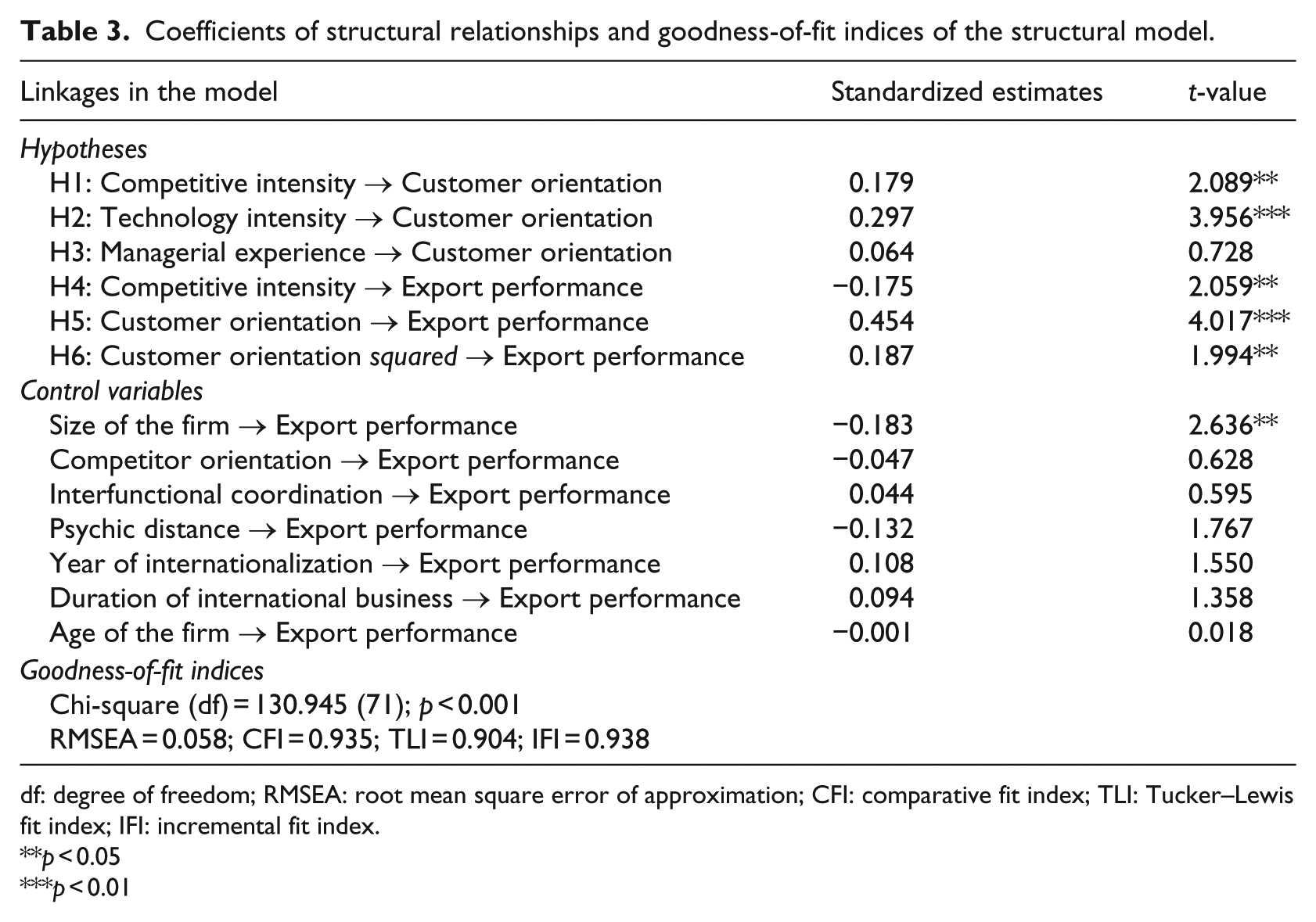
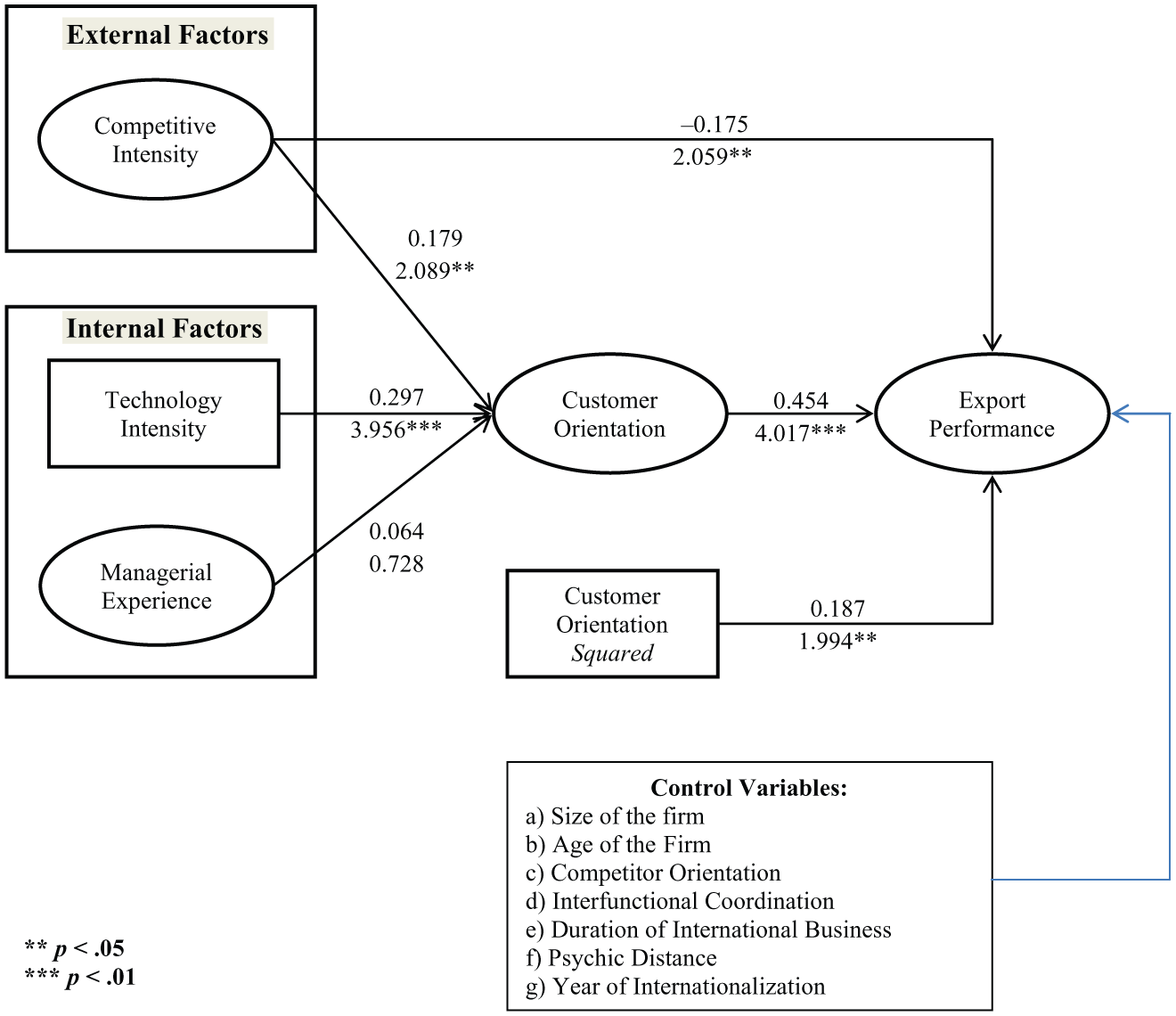
Because of the complexity of the model and the need to test the relationships between the constructs simultaneously, structural equation modelling was used by applying the ML method (AMOS version 20.0). The overall chi-square for the model exhibited in Figure 1 was significant (chi-square = 130.945, df = 71, p < 0.001). We therefore, examined the structural diagnostics for relative global fit according to the procedures suggested by Bollen (1989). As with the CFA model, the other measures of fit were as follows: CFI = 0.935, TLI = 0.904, IFI = 0.938 and RMSEA = 0.058. Given that all the fit indices were inside the cut-off values suggested by the literature, the model was deemed acceptable (Vandenberg and Lance, 2000). The relationships proposed in the model were examined next and the standardized path coefficient estimates are presented in Table 3 and Figure 2.
Coefficients of structural relationships and goodness-of-fit indices of the structural model.
df: degree of freedom; RMSEA: root mean square error of approximation; CFI: comparative fit index; TLI: Tucker–Lewis fit index; IFI: incremental fit index.
p < 0.05
p < 0.01
Final model.
Consistent with hypothesis H1, the results indicate that the greater the level of competitive intensity in the export market, the higher the degree of customer orientation of the firm as indicated by a parameter estimated of 0.179 (p < 0.05). Similarly, as predicted by H2, the level of technological intensity of the product has a significant positive impact on the degree of customer orientation of the firm (0.297; p < 0.01). Surprisingly, the results for H3 (0.064; p > 0.10) fail to provide support for the notion that a manager’s international experience is positively related to the degree of customer orientation of the firm. In relation to H4, the results support our hypothesis that competitive intensity has a negative effect on export performance of the firm (−0.175; p < 0.05).
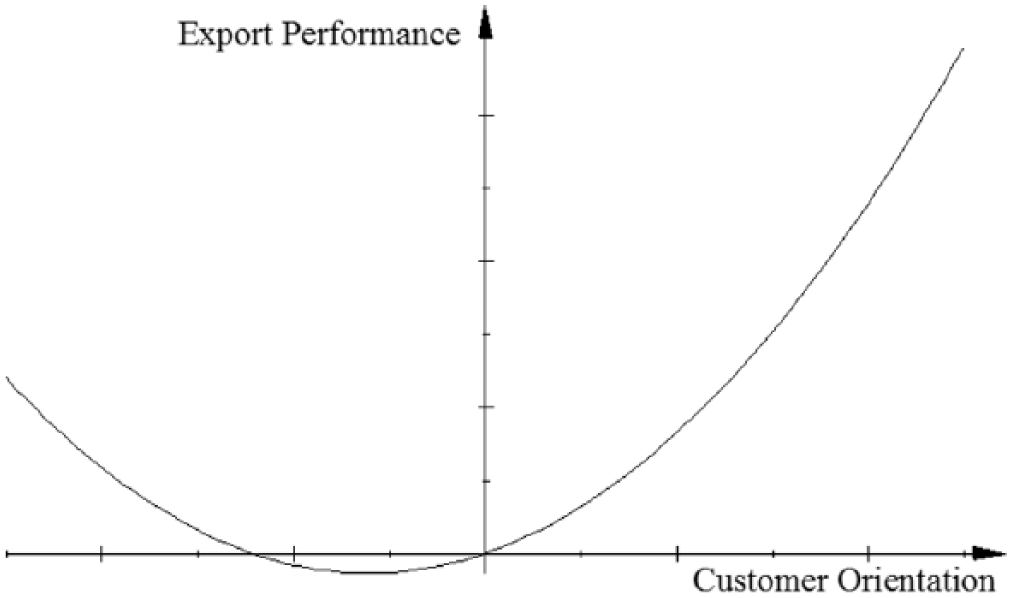
As the estimated coefficient of customer orientation on export performance is positive and significant (0.454; p < 0.01), and the coefficient that represents the relationship between customer orientation squared and export performance is also positive and significant (0.187; p < 0.05), both hypotheses H5 and H6 are rejected. However, taken together, those results reveal that the relationship between customer orientation and export performance is U-shaped rather than an inverted U-shape as predicted in hypothesis H6. The argument that the relationship between customer orientation squared and export performance is positive (U-shaped) rather than negative (inverted U-shaped) is that the regression coefficient that represents the linear relationship is significant (α1, H5) but the regression coefficient α2 (H6) is also positive and significant. Thus, the relationship between customer orientation and export performance is quadratic and positive, being represented by a concave curve. Figure 3 shows the quadratic function of export performance in relation to customer orientation.
Non-linear relationship between customer orientation and export performance.
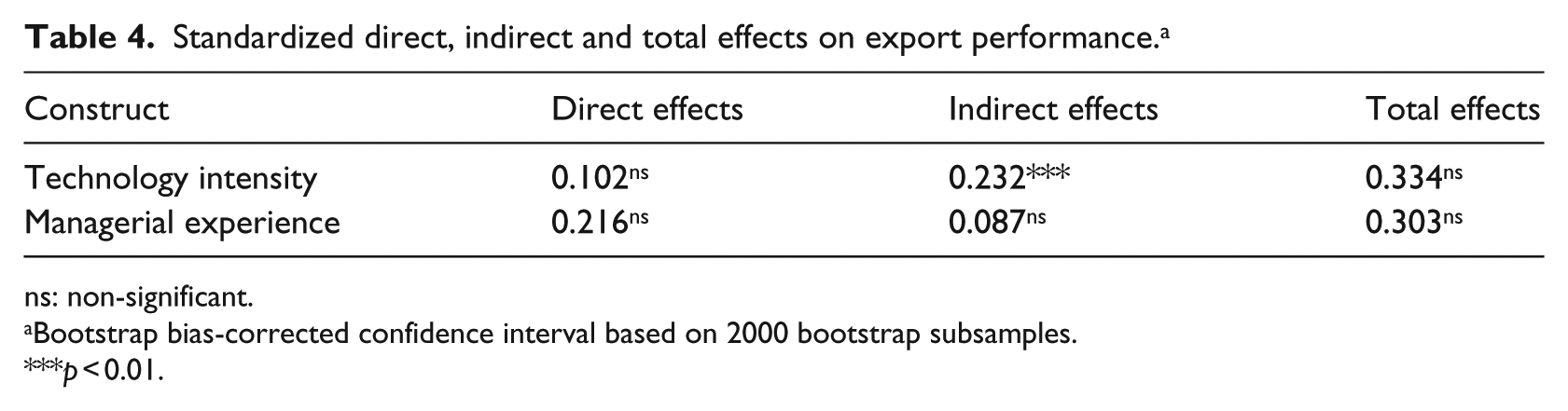
Besides the direct effects specified in the model, we estimated the mediating role of customer orientation between the internal resources technology intensity and managerial experience, and export performance. The mediation is employed to reveal the existence of a significant intervening effect of the mediating variable (customer orientation) between resources (technology intensity and managerial experience) and export performance. We tested whether the mediating variable in the model (i.e. customer orientation) accounts for a proportion of the relationship between predictor (technology intensity and managerial experience) and criterion variables (export performance). In order to test the mediating effects of customer orientation, we decided to adopt the bootstrapping method. The bootstrapping method has been recommended over the Baron and Kenny (1986) approach because it provides a higher level of power and reasonable control over the Type 1 error rate (Cheung and Lau, 2008). Table 4 displays the direct, indirect and total effects of technology intensity and managerial experience on export performance via customer orientation. The results indicate that none of the direct effects of technology intensity or managerial experience on export performance was significant (respectively, 0.102; p > 0.10 and 0.216; p > 0.10). In terms of indirect effects, we found technology intensity to have a significant effect on export performance (0.232; p < 0.01), whereas the indirect effect of managerial experience is not significant.
Standardized direct, indirect and total effects on export performance. a
ns: non-significant.
Bootstrap bias-corrected confidence interval based on 2000 bootstrap subsamples.
p < 0.01.
Discussion and implications
Discussion
Although the direct link between customer orientation and firm performance has received empirical support, there are still questions about its robustness, particularly in the case of export operations as the majority of studies focus on domestic markets. Additionally, most explored the customer orientation–export performance relationship as linear, neglecting other types of effect, such as quadratic relationships. Moreover, to date, very very little research has reported from developing nations. To address such gaps, we developed a model that examines these relationships in the context of a developing country, namely, Brazil. In this model, we investigated whether customer orientation mediates the effect of the firm’s internal resources on export performance. In addition, we examined the linear and non-linear effects of customer orientation on export performance. The results indicate a strong relationship between the internal and external aspects present in the marketplace and the export performance of Brazilian SMEs, thereby providing support for the idea that the RBV and SCP approaches have to be taken into consideration when evaluating the success of SMEs in international settings.
Initially, our results indicate that market intensity has a strong and positive effect on customer orientation; it seems to be more important for firms that develop activities in highly competitive markets (Sousa and Bradley, 2009). Customer-oriented behaviour is necessary where switching providers is simple (Cadogan et al., 2003). Fostered by the level of competition, firms are driven to develop customer-oriented actions and behaviour, enabling them to perform better, even where competition is intense. It also supports claims that survival in foreign markets is linked to an understanding of the customer and therefore, the development of competences such as customer orientation (Knight and Kim, 2009; Sui and Baum, 2014).
The technological intensity of the product, and its relationship with customer orientation, has also been addressed. As the results revealed, for those SMEs where the product is highly technological, there will be a higher degree of customer orientation. The notion that technological intensity has an indirect effect on export performance via customer orientation is also supported. This is consistent with the proposition that marketing highly technological products demands a better understanding of customers, markets and competitors, leading to a higher level of customer-oriented behaviour (Bradley, 2002) with positive impacts on performance. Thus, firms with such characteristics must be better prepared for competition in foreign markets; this suggests the need for greater employee training and technical product support (Cavusgil and Zou, 1994; McGuinness and Little, 1981).
As expected, the results support our hypothesis that high competitive intensity has a negative impact on export performance; this is particularly relevant for emerging markets. Firms from such markets who intend to enter more developed economies must continuously monitor competitors and change product and service offerings frequently (Matanda and Freeman, 2009). As a result, the greater competitive intensity in developed markets requires the deployment of more resources to enhance product and service offerings to meet customer needs and demands. This, in turn, tends to reduce profitability in the export market (Sriram and Manu, 1995). Contrary to our expectations, however, the results revealed that management international experience has no significant impact on customer orientation. While this is somewhat surprising, it is consistent with studies which found that international experience had no significant role in explaining the foreign activities of a firm (Contractor et al., 2005; Leonidou and Katsikeas, 1996; Nakos and Brouthers, 2002).
Customer orientation has long been discussed in the marketing literature and represents a cornerstone in the field (Narver and Slater, 1990). Our findings suggest that the relationship between customer orientation and export performance is quadratic rather than linear. Moreover, the positive sign of the path coefficient between the quadratic term of customer orientation and export performance reveals a U-shaped relationship rather than an inverted U-shape as predicted in H6. This means that at very low and very high levels of customer orientation, SMEs perform well in foreign markets. However, if firms develop mid-range customer orientation practices, they may be outperformed by competitors (Cadogan and Cui, 2004). This is consistent with Narver and Slater (1990) that at very low levels of market orientation, firms are more internally focused – particularly upon finance and profitability – and thereby more likely to remain efficient. Cadogan and Cui (2004) also hypothesized that export agents who are less market-oriented achieve higher performance if they leave market-oriented activities to other partners in the export value chain. In these conditions, exporters do not have to incur costs associated with the development of market-oriented behaviours. On the other hand, mid-range levels of customer orientation have a detrimental impact on export performance. The rationale behind this argument being that when firms begin to invest in market-oriented actions, such as customer orientation, they have not channelled sufficient resources to become truly customer-oriented. Under these conditions, they are neither fully customer-oriented nor internally focused. As a result, they lose a clear focus on internal activities and are not as able to compete with more customer-oriented firms. As SMEs become more knowledgeable regarding market characteristics and customers, they will become more effective.
The Barney and Wright (1998) framework appears to provide further support for this U-shaped relationship; they argue that resources provide a source of competitive advantage only if the firm is able to exploit and capitalize them. Organizations should focus attention on systems rather than single actions in order to capture resource contributions that lead to sustained competitive advantages. Practices are most effective when they exist as a coherent system (Barney and Wright, 1998). Thus, we argue that, at mid-range levels of customer orientation, firms are not able to fully capitalize on this type of resource since organizational arrangements or systems have not been fully developed to capture its contribution to success. Moreover, at this point, the firm has moved away from its internal focus that was responsible for superior performance at the very low level of customer orientation. Thereby, as the firm intensifies its investment in customer orientation, and this strategic orientation becomes an embedded function, returns are more likely to be achieved.
Overall, the empirical results provide broad support for our theoretical model. From an RBV theory perspective, strong support was found for the role of technological intensity and customer orientation to explain the export performance of the firm. Contrary to expectations, managerial experience was found to be less important than RBV theory suggests. A possible explanation is that the direct determinants of export performance are derived from resources, such as customer orientation, that result from managerial decisions influenced by market forces (Ferrier, 2001; Luo and Peng, 1999). Consistent with the SCP theory, our findings also indicate that competitive intensity is important in affecting the export operations of the firm. This result provides further support to a key SCP premise that structural forces that determine competitive intensity in a market have a strong impact on firm performance (McGahan and Porter, 1997; Scherer and Ross, 1990).
Implications for business marketing practice
These findings have practical implications for SME export operations. First, firms that experience high levels of competition in foreign markets should strive to develop a better approach toward customer-oriented behaviour with an informed understanding of the market and customers. To facilitate such understanding, firms should apply tools and expertise to monitor customer characteristics, needs and wants. Second, we found the firms who deliver technologically intense products offer a higher level of customer orientation. This is of some importance for export managers as they prepare a customer-oriented stance; thus, for technology-led firms, training and technical support activities must be undertaken in order to achieve successful results in the marketplace. Intensive and continuous employee training should be prioritized.
Regarding the results of the customer orientation–export performance relationship, we found a positive U-shaped relationship between these two constructs. This indicates that the relationship will be beneficial when the level of customer orientation is very low or very high. Therefore, we recommend that SMEs should adopt either of two patterns of behaviour; first, concentrating on developing expertise on internal activities that improve efficiency. From this perspective, investments in customer-oriented activities would have to be undertaken by other partners in the value chain. This approach is particularly recommended for SMEs with low budgets that must make optimal allocations of resources; as such, more effort should be channelled to improving industrial processes and the development of financial controls. The second approach suggests heavy investment in customer-oriented activities, avoiding what Narver and Slater (1990) called the tentative market-oriented adopters. In that case, SMEs operating under small budgets would have to find the necessary resources to develop customer-oriented activities that overcome the mid-range investment point and become truly customer-oriented.
Limitations and directions for further research
Every empirical study has certain limitations that should be acknowledged. First, it is possible that the generalizability of the findings may be restricted. To test the general validity of our findings, it would be necessary to replicate our study to other countries. However, while our empirical analysis was focused on Brazil, we believe that our results should be of relevance to other emerging markets because of the similarities such as growth rates, relatively short history of competition in foreign markets and the role of the governments in actively encouraging local firms to go global. Additionally, while the study has provided strong empirical support for most of our hypotheses, the use of a cross-sectional research design cannot capture the dynamic aspects of the constructs incorporated in the model. Thus, a longitudinal study might offer further interesting insights on these relationships over time. Moreover, the model could be expanded to incorporate additional internal and external factors. Examples are export dependence, export commitment, openness to innovation, marketing program standardization and cultural distance. Finally, while in this article we explore the mediating role of customer orientation, future studies are also encouraged to examine the mediating role of other marketing orientation dimensions (e.g. competitor orientation). In the future, the analyses of these variables together with those adopted in our study will certainty add to our understanding of SME export operations. Our study also sheds light on a relationship that has been neglected in the literature: the quadratic effects of customer orientation on export performance. This warrants more research effort in the area.
Conclusion
While most studies on customer orientation have been conducted in domestic markets, our research extends this literature by assessing our model in an exporting context. Moreover, focusing on an emerging market (Brazil) addresses a gap in the literature as most existing research explores developed economies (Pangarkar and Wu, 2012). Recognizing the growing importance of analysing the behaviour of firms from emerging economies, who enter foreign markets, our research focuses on the impact of customer orientation on export performance.
We integrate the RBV approach and the SCP paradigm to develop our conceptual model. While the RBV approach is used to support the selection of the internal variables, SCP theory is selected to justify the external element in our conceptual model. Our results indicate that researchers who draw on the SCP theory regarding the effect of external elements should not simply examine the direct effect of the firm’s market structure (e.g. competitive intensity) on performance, but should also focus on the effect of such structural characteristics on the firm’s ability to implement a customer-oriented approach to achieve higher export performance. From an RBV theory perspective, the results support the notion that internal resources (i.e. technology intensity and customer orientation) are key determinants in achieving success in the export market.
We also extend previous work by examining the non-linear effect of customer orientation on export performance. The results suggest that the relationship between customer orientation and export performance is quadratic (U-shaped) rather than linear. This finding has significant implications in terms of how we view the development of customer orientation. And given the increasing importance of customer-oriented approaches in determining success in foreign markets, additional studies are needed to promote further understanding of this issue. Despite the need for such research, we believe that this study provides new insights regarding the role of customer orientation and the drivers of export performance and so offers a good foundation for advancing understanding in this area.
Footnotes
Appendix
Measurement items.
| Constructs and items |
|---|
| Export performance |
| Source: Zou et al. (1998); Sousa et al. (2010) |
| Overall satisfaction |
| Meeting expectations |
| Improved global competitiveness |
| Strengthened strategic position |
| Technology intensity |
| Source: Sousa and Bradley (2009) |
| Indicate the degree of technology intensity of the product in a 5-point Likert scale ranging from ‘not technology intensive’ to ‘highly technology intensive’ |
| Customer orientation |
| Source: Narver and Slater (1990) |
| Competitive advantage based on understanding customer needs |
| Monitor/assess commitment in serving customers |
| Business objectives driven by customer needs and satisfaction |
| Competitive intensity |
| Source: Morgan et al. (2004) |
| Competition in our export market is cut-throat |
| New competitive move almost every day |
| Promotion wars in our export market |
| Price competition is a hallmark |
| Managerial experience |
| Source: Das (1994); Sousa and Bradley (2006) |
| Language proficiency |
| Export experience |
Funding
The author(s) received no financial support for the research, authorship, and/or publication of this article.