






Abstract
Leveraged finance is an important market for professional advisory firms such as investment banks, financial sector law firms and the ‘Big 4’ consultancies. As well as researching the leveraged finance market, researchers and information professionals in these firms are often asked to find the underlying documentation for high yield bonds and leveraged loans. In this article Ian Hunter discusses the availability of these documents and considers the best sources.
Keywords
Introduction
Researchers and information teams in professional advisory firms are often asked to research the leveraged finance market, usually broken down into its component parts of high-yield (HY) bonds and leveraged loans. Previously I looked at researching the market size and trends, 1 in this article, I focus on how to find leveraged finance documents.
Why is leveraged finance documentation useful?
Drafting leveraged loan agreements and HY bond offer documents is a large part of the work of many investment banks, and reviewing them a large part of the work of many financial sector law firms. As a result, these firms will often need to find the examples of previous documents, in particular for:
the wording of certain clauses;
covenants – restrictions or conditions imposed, usually on a borrower: for example, not letting certain financial ratios go above or below an agreed limit; and
market flex – flexibility which allows the lender to increase the pricing of a loan: for obvious reasons, this is often keenly negotiated.
The firms may not even be drafting or reviewing the documents themselves, they may simply want to be well informed about market practice when talking to client companies (often leveraged finance issuers/borrowers themselves).
Firms will also want to see any trends in the wording or covenants common in the market. For example, ‘cov-lite’ or ‘convergence’ has been an area of interest in recent years, where the relatively lax covenants and ratios typically found in HY bond offer documents are beginning to appear in leveraged loan agreements. Another example is the first appearance of a Brexit clause in an HY bond.
The documentation
The key document for HY bonds is the offering memorandum (OM), also known as a prospectus in certain situations. 2 The document is usually between 200 and 600 pages long with a title page which includes the name of the issuer, the amount of the issue, the issue date, maturity date and coupon (the interest rate payable on the bond) if applicable. Most bonds will also have a unique identifying number known as an International Securities Identification Number (ISIN) which can be used to identify the correct document. Usually a banker or lawyer will want the original ‘base prospectus’, not the shorter pricing supplements which are issued later.
The key document in a leveraged loan is the facilities agreement – also known as a credit agreement or just facility – and is generally not publicly available unless there is a US party involved. Companies which file with the US Securities Exchange Commission (SEC) may be obliged to make the facilities agreement public, or at least a summary of the loan details. Even in the US, the vast majority of loans are private arrangements between the borrower and the lender. Loans are usually identified by borrower, price (the interest rate payable), tenor (length of the loan) and amount.
Sources – HY bonds
Offering memoranda for HY bonds are generally publicly available either via the issuer’s website or the relevant stock exchange website. Most European HY bonds, for example, are listed on the Irish or Luxembourg stock exchanges. There may be many documents by the same issuer so attention needs to be paid to details such as the issue date, amount and in particular the ISIN.
As well as looking for specific bonds, firms may wish to find the examples of a particular type of bond or bonds from issuers in a particular industry sector. This type of search would be time-consuming at best and definitely not comprehensive via a free internet search – the best strategy would be a search on the bond type (e.g. French pharmaceutical ‘HY’) in the hope that any such bonds were noteworthy enough to have been picked up by relevant news websites.
However, commercially available databases such as Filings Expert, Factset, DebtXplained and Xtract Research offer searching by very detailed criteria such as deal type, maturity date, coupon or industry sector, allowing users to find bonds meeting specific criteria without knowing the name of the issuer.
Xtract and DebtXplained also include their own summaries of the covenants in each OM and rate each one on the strength of those covenants. While holding a much smaller number of OMs than databases such as Filings Expert and Factset, they are highly valued for this feature.
Some bonds will be described as private placements, in which case, the OM is not usually available at all.
Sources – Leveraged loans
When searching for leveraged loan documents, the borrower is usually known: it is less usual to search for loans by type. There are few sources for identifying leverage loan deals by type but the Thomson Reuters LPC database is one.
We have seen that leveraged loan agreements with a US involvement may be filed with the US SEC, and the SEC’s EDGAR database is free to search via the SEC website. The agreement is usually filed in an Exhibit 10 (a type of appendix) to a current report (known as an ‘8-K’) or annual or interim report (‘10K’s and ‘10Q’s).
If the loan agreement is not available in an exhibit to the 8 K, the financing details may be summarized elsewhere in the document, often just in a single paragraph. The document may appear unrelated and concern an acquisition, for example, which the loan is being used to finance.
While agreements for non-US leveraged loans are not usually available, a credit rating from one of the ratings agencies, often in the form of a press release, may contain high-level financing details such as pricing. These are usually freely available and may in turn be summarized by other news websites. The financing details may also be summarized in a related prospectus or offer document if there is one.
Some organizations have begun to anonymize and aggregate data from loan agreements to which they are privy but are not in the public domain and sell the result on as a commercial database. The user can then tell from the database that x per cent of loan agreements (in the database) include a particular covenant without ever having access to the loan agreements themselves. Despite being anonymized, this kind of data can be useful when trying to gauge market practice, often in order to negotiate the inclusion or otherwise of that particular covenant. This is a relatively recent but growth area; the leading aggregator databases are currently DebtXplained RLT and the Xtract Leveraged Loans database.
Trends in the documentation
Trends in the wording and covenants used in HY bonds and leveraged loans are often highlighted by journals such as International Financial Law Review, Global Capital or International Financing Review. These journals are all subscription only but occasionally client publications from professional advisory firms will cover this as well: these publications are usually freely available on the firms’ websites. Databases such as Capital Structure, DebtXplained and Xtract Research also publish annual or semi-annual reviews of the market, as do the big three rating agencies. Generally these are also only available to subscribers but may be summarized on other news websites.
Sources – Summary table
Table 1 contains a summary of the types of document with key sources. With the exception of SEC EDGAR, all the databases listed here are subscription only.
Sources for leveraged finance documents.
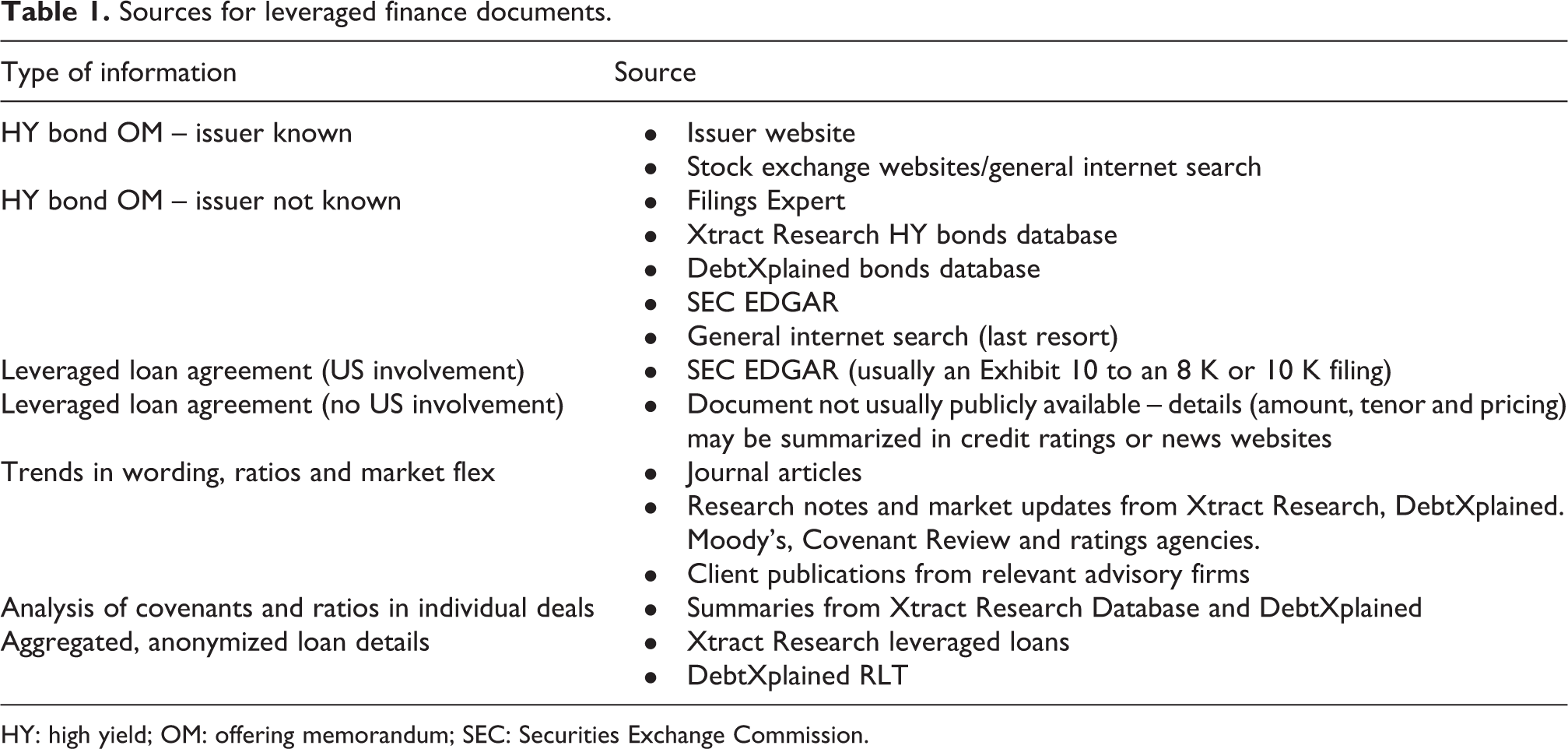
HY: high yield; OM: offering memorandum; SEC: Securities Exchange Commission.
Conclusion
Leveraged loan agreements and HY bond offering memoranda are highly valued by many professional advisory firms for precedent purposes.
While the offering memoranda for HY bonds are usually publicly available (often the difficult part is identifying the correct document from a long list), the documentation for loan agreements is generally not available for loans without US involvement. For both US and non-US loans, however, even if the loan agreement itself is not available, a summary of the details (pricing, tenor etc.) may be.
Footnotes
Declaration of Conflicting Interests
The author(s) declared no potential conflicts of interest with respect to the research, authorship, and/or publication of this article.
Funding
The author(s) received no financial support for the research, authorship, and/or publication of this article.