






Abstract
Generative AI is increasingly used by students as a source of academic information, yet less is known about how they judge, verify, and rely on AI-generated content. Grounded in Source Credibility Theory and informed by information literacy and digital verification perspectives, this study examines associations among perceived credibility, trust, verification behaviour, and reliance. Survey data from 650 undergraduate and postgraduate students across four universities in Nepal were analysed using covariance-based structural equation modelling. Perceived credibility was positively associated with trust, while trust and verification behaviour were positively associated with reliance. The direct association between perceived credibility and reliance was not significant after trust was included, whereas the indirect association through trust was significant. Because the data are cross-sectional, this pattern is interpreted as an indirect association rather than causal mediation. The study positions generative AI as an academic information source requiring credibility judgement, verification, and cautious academic incorporation.
Keywords
Introduction
Generative AI has rapidly entered the information environment of higher education. University students increasingly consult systems such as ChatGPT and Claude for explanations, summaries, argument development, writing support, and rapid responses to academic questions (Bittle and El-Gayar, 2025; Blahopoulou and Ortiz-Bonnin, 2025; Cao et al., 2025). Students find these systems appealing because they provide immediate and accessible academic assistance, and many now treat Generative AI as part of routine academic information-seeking channels. However, broader understanding of how students judge, verify, and rely on these outputs remains limited (Hwang and Jeong, 2025).
Yet its academic value cannot be judged solely by convenience, as AI-generated outputs may contain fabricated references, inaccurate claims, incomplete explanations, or confident statements with limited evidentiary grounding (Bittle and El-Gayar, 2025; Hwang and Jeong, 2025). In academic settings, the central issue is therefore not simply whether students use Generative AI, but how students assess the information quality of content AI produces and how those assessments shape subsequent use. This issue becomes germane to the present study because reliance on AI-generated academic information depends not only on access or convenience, but also on credibility judgement, trust, and verification.
This problem is only partially captured by adoption-oriented research. Many recent studies have examined Generative AI in higher education through frameworks centred on acceptance, perceived usefulness, satisfaction and behavioural intention (Faraon et al., 2025; Shuhaiber et al., 2025). Such work has been valuable in explaining why students engage with these systems. However, it is less well suited to explaining how students evaluate the information quality of AI-generated content once those outputs enter academic work, whether they trust it enough to use, whether they verify it against other sources, and under what conditions they rely on it. These questions differ analytically from adoption questions because they concern information evaluation rather than tool acceptance.
An information-centred approach is especially important because Generative AI differs in important ways from conventional academic sources. Journal articles, textbooks, and institutional materials usually provide visible cues of authorship, publication context, and evidentiary basis. By contrast, Generative AI often produces fluent, authoritative-sounding responses without making the provenance, certainty, or source of those responses clear (Schilke and Reimann, 2025). As a result, students may treat surface coherence as a cue of reliability even when the underlying informational basis is uncertain. For research concerned with information services and use, this shifts attention from access alone to the evaluative processes through which AI-generated content becomes credible, trusted, cross-checked, and academically usable.
The Nepalese setting is relevant to this information-development focus because it situates Generative AI use within the context of higher education in a developing country. In such contexts, students’ access to academic resources, formal information-literacy support, and institutional guidance on AI use may vary across universities and disciplines, and students’ perceived and actual information-literacy capacities may not always align (Tasmim and Atikuzzaman, 2025). Recent cross-regional evidence also shows that students’ AI use is shaped by academic leadership perspectives, institutional anxieties, and guidance strategies (Duque-Rengel and Puertas-Hidalgo, 2026). Related higher education digital-transformation research further shows that technology use is shaped by perceived usefulness, perceived risk, motivation, and self-efficacy (Nguyen et al., 2025). Generative AI may therefore function not only as a study-support tool, but also as an informal academic information source used to obtain explanations, summaries, and direction for academic tasks. Examining students in Nepal helps situate the credibility–trust–verification–reliance relationship within a context where academic information practices are still adapting to rapid AI use and where evaluation, verification, and responsible information use remain central concerns (Bearman et al., 2024; Kunz et al., 2024).
Despite rapid growth in the literature, three limitations remain. First, a large share of existing work remains descriptive, documenting prevalence, perceived benefits, and broad concerns without specifying how central evaluative constructs are related (Bittle and El-Gayar, 2025; Park, 2025). Second, studies that address trust, caution, or responsible use are often confined to single institutions, disciplines, or classroom settings, which limits broader interpretation and use beyond those contexts (Barus et al., 2025; Blahopoulou and Ortiz-Bonnin, 2025). Third, fewer studies explicitly treat Generative AI as an academic information source and examine the combined roles of perceived credibility, trust, verification behaviour, and reliance within one explanatory framework (Bittle and El-Gayar, 2025; Park, 2025). More importantly, existing research still does not adequately explain how seemingly plausible AI-generated output becomes information that students are actually willing to use in academic work.
The present study addresses this problem by focusing on the transition from plausible AI-generated output to information used in academic contexts. Grounded primarily in Source Credibility Theory and informed by an information literacy and digital verification perspective, the study investigates how perceived credibility is associated with trust, how trust is associated with reliance on AI-generated academic information, and how verification behaviour relates to reliance in academic contexts (Appelman and Sundar, 2016; Kunz et al., 2024; Park, 2025). This study thus makes three contributions. First, it shifts the analytical focus from generative AI adoption to the evaluation of AI-generated academic information, thereby distinguishing information use from technology acceptance. Second, it clarifies perceived credibility, trust, verification behaviour, and reliance as related but conceptually distinct elements of students’ academic information practices. Third, it positions Generative AI within scholarship on information behaviour, information literacy, and academic information services by treating Generative AI as an academic information source whose outputs must be judged, validated, and incorporated under conditions of limited source transparency, particularly in a developing-country higher education context where formal information-literacy support and institutional AI guidance may vary (Kunz et al., 2024; Park, 2025; Stojanov et al., 2024).
Literature review
Generative AI in higher education
Generative AI is now part of routine academic work. Students use these systems to summarise readings, clarify concepts, generate ideas, refine writing, and obtain academic assistance (Baig and Yadegaridehkordi, 2024; Blahopoulou and Ortiz-Bonnin, 2025). Much of the existing literature has interpreted this expansion primarily through adoption-oriented constructs such as perceived usefulness, ease of use, attitudes, and behavioural intention (Faraon et al., 2025; Shuhaiber et al., 2025). The adoption perspective is useful for explaining students’ willingness to engage with Generative AI as a tool, but it is less effective for explaining how students evaluate the information quality of AI-generated content once those outputs enter academic work. The analytical problem, therefore, shifts from technology acceptance to information evaluation.
Generative AI as an academic information source
Treating Generative AI as an academic information source changes the unit of analysis. When students request Generative AI to explain a theory, compare viewpoints, summarise a concept, or suggest a direction for an assignment, they are engaging in academic information seeking (Holland and Ciachir, 2025). The key question is not only whether the system is used, but whether the resulting information is judged suitable for academic purposes.
This distinction matters because AI-generated outputs differ from conventional academic sources. Journal articles, textbooks, and institutional materials usually provide cues of authorship, publication context, references, and evidentiary basis. By contrast, Generative AI often produces fluent responses without clearly revealing the provenance, certainty, or source basis of its claims (Hwang and Jeong, 2025; Schilke and Reimann, 2025). Students may therefore use coherence and convenience as proxies for quality even when the informational basis of a response is uncertain.
This difference changes the unit of evaluation, not merely the technology being used. With conventional academic sources, students often evaluate information through visible markers of authorship, publication legitimacy, and traceable evidence. With Generative AI, those source-level cues are often obscured or absent, so evaluation shifts more directly to the plausibility of the output itself and to the user's willingness to validate it before it is used for academic purposes. The issue is therefore not simply whether a new tool has been adopted, but how unverified yet plausible content is judged, checked, and incorporated into academic work. This framing aligns the study with scholarship on information services and use, particularly work on information quality judgement, digital source evaluation, and responsible information behaviour (Bearman et al., 2024; Kunz et al., 2024; Lao et al., 2025).
Theoretical grounding: credibility, trust, verification, and reliance
This study is grounded primarily in Source Credibility Theory, originally developed in communication research by Hovland and colleagues, which explains how users evaluate information in terms of perceived believability, reliability, and trustworthiness of a source or message (Hovland et al., 1953; Appelman and Sundar, 2016; Lao et al., 2025). In AI-mediated environments, credibility judgements are especially important because source cues are often incomplete.
Within this study, perceived credibility refers to a plausibility judgement: whether AI-generated academic information appears believable, accurate, and dependable enough to merit academic consideration. Trust is conceptually distinct. Whereas credibility concerns the assessment of informational quality, trust refers to the willingness to depend on that information under uncertainty. A student may judge an AI-generated response to be plausible yet still withhold trust if its evidentiary basis remains unclear (Appelman and Sundar, 2016; Nazaretsky et al., 2025). Reliance is also distinct from both credibility and trust because it refers to the academic incorporation of AI-generated information into study-related tasks. In this framework, credibility is an evaluative judgement about the information, trust is a willingness to depend on that information under uncertainty, and reliance is the use-oriented response. A student may therefore perceive an AI-generated output as credible without fully trusting it, and may trust it without necessarily relying on it for academic work.
Source Credibility Theory alone, however, does not fully explain what students do after that initial plausibility judgement. For this reason, the study also draws on an information literacy and digital verification perspective. This perspective emphasises that responsible academic use of digital information requires checking, comparing, and interpreting information before integrating it into scholarly work (Bearman et al., 2024; Kunz et al., 2024). In the present context, verification behaviour refers to uncertainty management: the extent to which students cross-check AI-generated outputs against textbooks, peer-reviewed sources, lecture materials, or instructor guidance before relying on them for academic purposes (Martín-Moncunill and Alonso Martínez, 2025).
Reliance, in turn, refers to academic incorporation: the degree to which AI-generated information is actually used for academic tasks such as explanation, planning, summarisation, or coursework completion (Stojanov et al., 2024). Verification is theoretically important because it could plausibly work in two directions. On one hand, checking AI outputs may reduce reliance by exposing errors, fabricated claims, or weak reasoning. On the other hand, in academic settings it may increase reliance when cross-checking confirms that the information is usable. The present study predicts the latter pattern because reliance in this context is conceptualised not as uncritical acceptance, but as selective academic use after evaluative scrutiny. Together, these perspectives support a four-construct framework linking plausibility judgement, willingness to depend, uncertainty management, and academic incorporation (Appelman and Sundar, 2016; Martín-Moncunill and Alonso Martínez, 2025; Nazaretsky et al., 2025; Stojanov et al., 2024).
Research gap and conceptual framework
The unresolved problem in the literature is not simply that prior studies are limited, but that the field still lacks a tested explanation of how evaluative judgement becomes consequential academic use. Existing research has documented prevalence, perceived benefits, and broad concerns, and some studies have examined trust or verification in more isolated ways (Baig and Yadegaridehkordi, 2024; Bittle and El-Gayar, 2025). However, the literature still does not adequately explain how students move from encountering plausible AI-generated content to judging whether it is trustworthy, sufficiently checked, and suitable for academic incorporation.
The present study addresses this gap by treating Generative AI as an academic information source and by linking perceived credibility, trust, verification behaviour, and reliance within one framework. In addition, the study examines whether the proposed relationships operate similarly across undergraduate and postgraduate students as a supplementary group comparison. The direct path from perceived credibility to reliance is also estimated to assess whether trust explains this association. Figure 1 presents the conceptual framework depicting the association between these constructs.
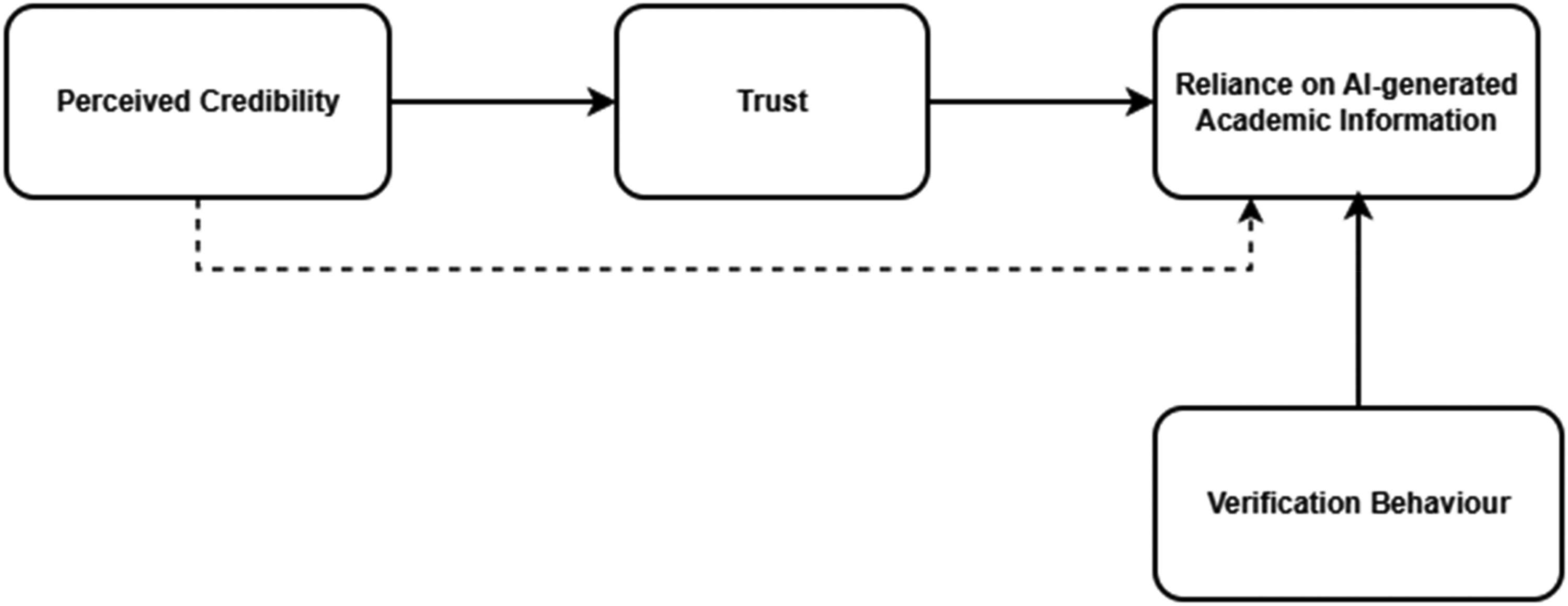
Conceptual framework of students’ use of generative AI as an academic information source. Note. The dashed arrow indicates the direct path from perceived credibility to reliance estimated as part of the indirect-association assessment.
Hypotheses development
Perceived credibility is expected to be positively associated with trust in AI-generated academic information. Users are more likely to trust information they judge to be believable and dependable (Appelman and Sundar, 2016; Nazaretsky et al., 2025).
Trust is expected to be positively associated with reliance. Trust reduces uncertainty and increases willingness to depend on information despite incomplete assurance (Visser et al., 2025; Wang and Li, 2024).
Verification behaviour is also expected to be positively associated with reliance. Although verification could reduce reliance when checking reveals weaknesses in AI-generated output, the present study expects a positive association in academic contexts because students who verify information successfully may become more confident in using content that withstands scrutiny. In this sense, reliance reflects selective and validated academic use rather than passive acceptance (Bearman et al., 2024; Hou et al., 2025).
Trust is further expected to carry the indirect association between perceived credibility and reliance. Reliance is more likely when credibility judgements are accompanied by a willingness to accept the information as dependable for academic purposes (Appelman and Sundar, 2016; Ferrario, 2025; Wang et al., 2025).
In addition to H1-H4, this study also examined whether the structural relationships differ between undergraduate and postgraduate students. This comparison is treated as a supplementary robustness question rather than as a central theoretical hypothesis, given that the core contribution of the study lies in explaining the evaluative pathway from credibility to reliance.
Methodology
Research design
This study used a cross-sectional, multi-university survey design to examine how undergraduate and postgraduate students evaluated and used Generative AI for academic purposes. It was designed to model associative patterns among perceived credibility, trust, verification behaviour, and reliance across institutional settings rather than test an intervention or establish causal ordering (Baig and Yadegaridehkordi, 2024; Blahopoulou and Ortiz-Bonnin, 2025).
Study setting, population, and sampling
The study was conducted across four universities in Nepal: Kathmandu University, Tribhuvan University, Pokhara University, and Purbanchal University, and included both undergraduate and postgraduate students. This multi-university setting provided institutional variation while supporting comparison across students with different levels of academic experience (Barber and Anderson, 2025; Nazaretsky et al., 2025).
The target population comprised students who had used any Generative AI tool for at least one academic task within the previous six months. Academic tasks included idea generation, summarisation, concept explanation, drafting support, language refinement, and assignment-related assistance (Blahopoulou and Ortiz-Bonnin, 2025; Wang et al., 2025). Students with no prior academic use of Generative AI were excluded because the focal constructs required direct experience with AI-generated academic information.
A multi-stage non-probability sampling strategy was employed. First, the four universities were selected because they are among the major university systems in Nepal and provided access to students from different academic levels and broad disciplinary areas. Second, students were approached across study levels and broad academic disciplines through accessible university channels, including online circulation and supervised in-class administration where institutional access permitted. Because recruitment was conducted through accessible university channels rather than a centralised invitation list, an exact response rate could not be calculated. This approach suited the study because the aim was to test theoretically specified relationships across a heterogeneous student sample rather than estimate nationally representative prevalence rates (Yang and Banamah, 2014). Because university-wise identifiers were not retained for institution-level analysis, the findings should be interpreted as evidence from a heterogeneous multi-university sample rather than as university-specific or nationally representative estimates.
A total of 650 valid responses were retained for analysis. Valid responses were those that met the eligibility requirement, were usable for analysis, and did not display obvious response problems during screening. The sample size was adequate for confirmatory factor analysis and structural equation modelling, given the number of latent constructs and hypothesised paths (White, 2023; Yang et al., 2025). Although a formal a priori power analysis was not conducted, the retained sample exceeded commonly used SEM adequacy expectations for models with multiple latent constructs and observed indicators. The final sample provided sufficient cases for CFA, structural path estimation, bootstrapped indirect-association testing, and supplementary multi-group comparison by study level.
Instrument development
Data were collected using a structured and self-administered questionnaire administered in English. The instrument adapted established measures from prior research on message credibility, trust in automated systems, verification behaviour, and reliance on ChatGPT for learning (Appelman and Sundar, 2016; Jian et al., 2000; Stojanov et al., 2024; Tifferet, 2021). These source measures had previously been used in studies of credibility, trust, verification, or AI-supported learning, while the adapted instrument was evaluated in the present study through expert review, pilot testing, reliability assessment, confirmatory factor analysis, and validity checks. Item wording was revised to fit Generative AI in higher education and academic use. The adapted items were reviewed for content relevance, conceptual alignment, clarity, and suitability for students’ academic use of Generative AI before full data collection.
The questionnaire comprised five sections. The first section recorded demographic and academic background information, the second captured patterns of academic use, and the remaining sections measured perceived credibility, trust, verification behaviour, and reliance.
All substantive construct items were measured in a five-point Likert format ranging from 1 = strongly disagree to 5 = strongly agree (Garratt et al., 2011). Before full administration, the instrument underwent expert review by seven reviewers to assess content relevance, clarity, conceptual alignment, and contextual appropriateness (Mokkink et al., 2025). It was then pilot-tested with 30 eligible students to identify ambiguous wording, estimate completion time, and refine difficult items (Presser et al., 2004). Revisions focused mainly on language refinement, clearer wording of source-verification items, and closer alignment of selected items with academic-use contexts. The questionnaire structure, response scale, construct item wording, item-level descriptive statistics, source notes, and standardised loadings are reported within the manuscript, particularly in Section 3.3, Section 4.2, and Table 2.
Measures
Perceived credibility captured students’ judgements about whether AI-generated academic information was believable, accurate, dependable, and worthy of academic consideration (Appelman and Sundar, 2016).
Trust referred to students’ confidence in, and willingness to accept, AI-generated academic information as sufficiently dependable for academic purposes (Jian et al., 2000). Trust was treated as distinct from credibility: credibility reflected judgement of quality, whereas trust reflected readiness to depend on that information under uncertainty.
Verification behaviour referred to the extent to which students cross-checked or validated AI-generated academic information before using it in study tasks, assignments, or academic decision-making (Tifferet, 2021).
Reliance referred to the degree to which students depended on Generative AI outputs in academic information seeking and task completion (Stojanov et al., 2024; Wang et al., 2025). It therefore captured academic dependence rather than the simple frequency of use.
Control variables included frequency of Generative AI use, prior AI experience, level of study, and broad academic discipline (Blahopoulou and Ortiz-Bonnin, 2025; Nazaretsky et al., 2025). Accordingly, reliance was treated as the academic incorporation of AI-generated information, whereas trust was treated as a willingness to depend on information under uncertainty rather than as another label for perceived credibility.
Data collection procedure
Data were collected through a combination of online distribution and supervised in-class administration, depending on institutional access and feasibility. Approximately 40% of responses were collected online, and 60% were collected through supervised in-class administration. Participation was voluntary and anonymous. Before participation, respondents received an information sheet explaining the study purpose, eligibility criteria, completion time, confidentiality protections, and the voluntary nature of participation. Only those who indicated informed consent proceeded to the survey (Sagitova et al., 2024; Yang et al., 2025).
To reduce common method concerns, the questionnaire used clear, non-leading wording, followed a logical sequence, emphasised anonymity, and informed respondents that there were no right or wrong answers (Yao and Xu, 2024). Screening items confirmed prior academic use of Generative AI and ensured eligibility.
Data analysis
Data analysis was conducted in R statistical software using lavaan, semTools, and psych for measurement evaluation, covariance-based structural equation modelling, indirect-association testing, and measurement invariance assessment. The first stage involved data screening, including checks for incompleteness, excessive missingness, patterned responding, and distributional irregularities (Stosic et al., 2024; Yao and Xu, 2024). After eligibility and quality screening, 650 responses were retained for analysis.
The second stage reported descriptive statistics and evaluated reliability using Cronbach's alpha and composite reliability. Construct validity was examined using confirmatory factor analysis, including standardised factor loadings, average variance extracted, and discriminant validity indicators (Cheung et al., 2024).
The third stage tested the hypothesised relationships using structural equation modelling. Model fit was evaluated using the chi-square to degrees-of-freedom ratio, comparative fit index, Tucker-Lewis index, root mean square error of approximation, and standardised root mean square residual (Hu and Bentler, 1999). The indirect association between perceived credibility and reliance through trust was examined using bootstrapped indirect-association analysis. In the controlled SEM, trust was regressed on perceived credibility and the control variables, while reliance was regressed on perceived credibility, trust, verification behaviour, and the same control variables. Because the data were cross-sectional, indirect-association results were interpreted as associative rather than causal.
Finally, multi-group analysis was used to examine whether the structural relationships differed between undergraduate and postgraduate students, with measurement invariance assessed before group comparison (Sterner et al., 2025).
Ethical considerations
This study adhered to the ethical principles set out in the Declaration of Helsinki. The study involved an anonymous minimal-risk educational survey of adult participants, collected no personally identifiable or sensitive data, and did not involve intervention, deception, or vulnerable participants. In the participating context, formal ethical review was not required for this type of anonymous minimal-risk survey. Participation was voluntary, informed consent was obtained before the survey, and all data were used only for academic research purposes and stored securely (Sagitova et al., 2024; Yang et al., 2025).
Results
Respondent profile and patterns of generative AI use
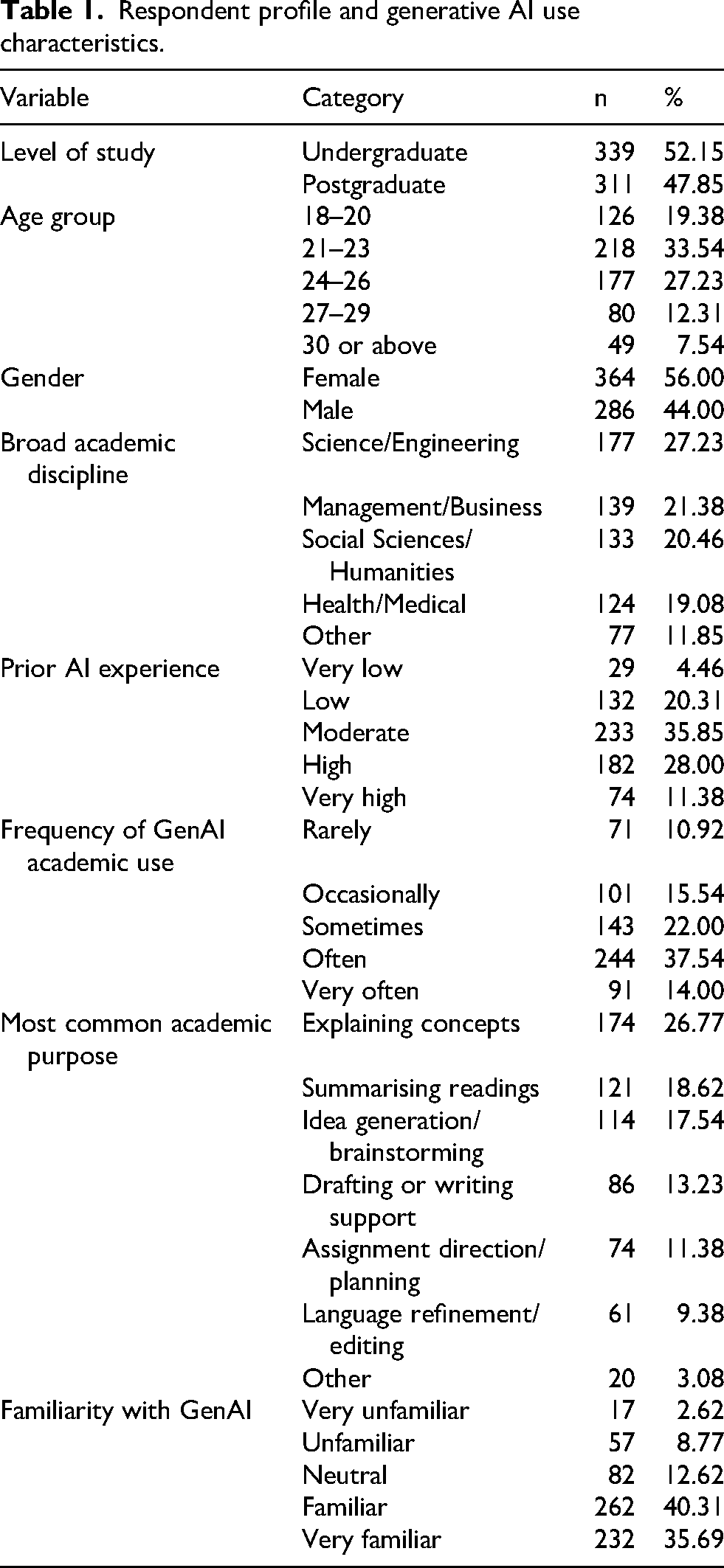
As shown in Table 1, the sample comprised 650 students drawn from four universities, including 339 undergraduate students (52.15%) and 311 postgraduate students (47.85%). The sample was broadly distributed across age groups, gender, and disciplines, with the largest disciplinary group from Science/Engineering (27.23%), followed by Management/Business (21.38%), Social Sciences/Humanities (20.46%), Health/Medical (19.08%), and Other disciplines (11.85%). Respondents also had prior exposure to Generative AI: most reported moderate or high prior AI experience, and the largest group reported using Generative AI often for academic purposes. Explaining concepts was the most common academic purpose, followed by summarising readings and idea generation or brainstorming. Overall, the profile indicates that the analysis concerns students with practical experience of Generative AI rather than first-time or purely hypothetical users.
Respondent profile and generative AI use characteristics.
Descriptive statistics and measurement quality
Table 2 reports the descriptive statistics and measurement properties of the four latent constructs. Verification behaviour recorded the highest mean (M = 3.93, SD = 0.72), indicating relatively frequent checking or cross-validation of AI-generated academic information before use. Reliance showed a moderate mean (M = 3.33, SD = 0.90), while perceived credibility (M = 3.22, SD = 0.90) and trust (M = 3.13, SD = 0.89) were also moderate. This pattern suggests that although respondents did not rate AI-generated academic information as uniformly highly credible or highly trustworthy, they still reported substantial engagement with verification and a moderate level of reliance in academic contexts.
Measurement items, descriptive statistics, and standardised loadings
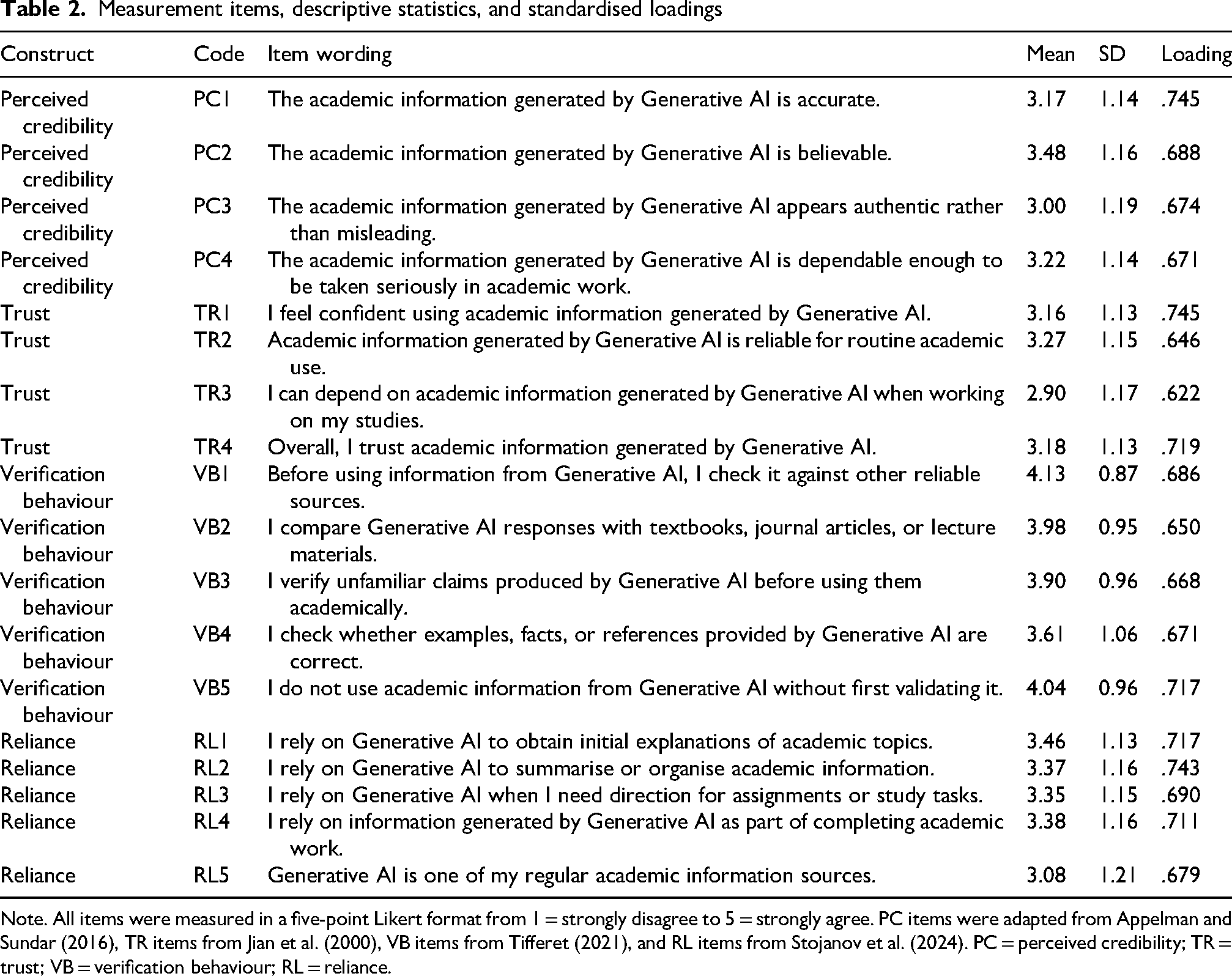
Note. All items were measured in a five-point Likert format from 1 = strongly disagree to 5 = strongly agree. PC items were adapted from Appelman and Sundar (2016), TR items from Jian et al. (2000), VB items from Tifferet (2021), and RL items from Stojanov et al. (2024). PC = perceived credibility; TR = trust; VB = verification behaviour; RL = reliance.
The measurement properties were acceptable, although convergent validity required cautious interpretation for three constructs. Cronbach's alpha values ranged from 0.775 to 0.834, composite reliability values ranged from 0.778 to 0.834, and standardised factor loadings ranged from 0.622 to 0.745. AVE was above 0.50 for reliance and slightly below 0.50 for perceived credibility, trust, and verification behaviour. Following Fornell and Larcker (1981), these marginal AVE values were retained with caution because composite reliability was acceptable, all standardised loadings were statistically significant, discriminant validity was supported, and the proposed four-factor CFA model outperformed competing models. To examine whether the modest AVE limitations affected the SEM results, a post-hoc sensitivity analysis was also conducted and is reported in Table 3.
Additional validity and robustness checks
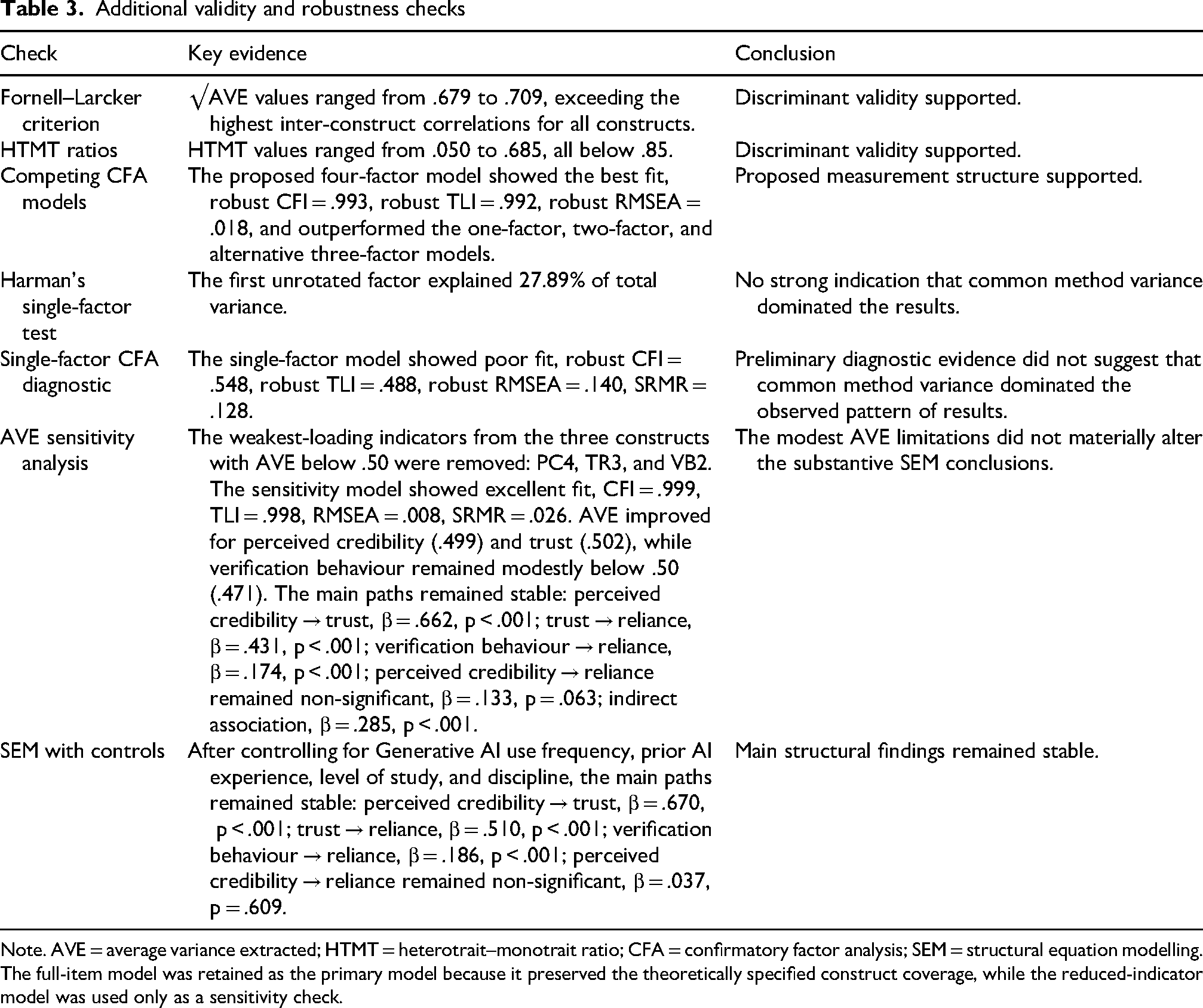
Note. AVE = average variance extracted; HTMT = heterotrait–monotrait ratio; CFA = confirmatory factor analysis; SEM = structural equation modelling. The full-item model was retained as the primary model because it preserved the theoretically specified construct coverage, while the reduced-indicator model was used only as a sensitivity check.
Additional validity and robustness checks
As shown in Table 3, additional checks supported the distinctiveness and robustness of the measurement and structural models. First, discriminant validity was supported using both the Fornell–Larcker criterion and HTMT. For all constructs, the square root of AVE exceeded the corresponding inter-construct correlations, and all HTMT ratios were below 0.85. Second, the proposed four-factor CFA model fitted the data substantially better than the alternative one-, two- and three-factor models, supporting the empirical distinctiveness of perceived credibility, trust, verification behaviour, and reliance. Third, common method diagnostics were treated as preliminary checks rather than definitive evidence and did not suggest that common method variance dominated the observed relationships. Harman's single-factor test showed that the first unrotated factor accounted for 27.89% of total variance, and the single-factor CFA model showed poor fit. Fourth, because AVE values for perceived credibility, trust, and verification behaviour were marginally below .50, a reduced-indicator sensitivity analysis was conducted by removing the weakest-loading indicators from these constructs. The main SEM conclusions remained substantively stable. Finally, the structural relationships also remained stable after including controls for Generative AI use frequency, prior AI experience, level of study, and academic discipline. Taken together, these checks support the proposed four-factor structure and indicate that the main SEM findings were not materially dependent on measurement or control-variable specifications.
Structural model and hypothesis testing
The structural model showed a very good fit to the data, with CFI = 0.993, TLI = 0.992, RMSEA = 0.017, and SRMR = 0.028. The model explained 46.6% of the variance in trust and 34.0% of the variance in reliance, indicating that the proposed framework accounted for a meaningful share of students’ evaluative and use-related responses toward Generative AI as an academic information source. Table 4 presents the structural path estimates and hypothesis-testing results, while Figure 2 summarises the supported structural relationships visually. As shown in Table 4 and Figure 2, perceived credibility was positively associated with trust (β = 0.683, p < .001), supporting H1. Trust was also positively associated with reliance (β = 0.497, p < .001), supporting H2. Verification behaviour was positively associated with reliance (β = 0.177, p < .001), supporting H3. By contrast, the direct association of perceived credibility with reliance was not statistically significant (β = 0.069, p = .327), indicating that credibility alone did not show a direct association with reliance once trust was included in the model. The indirect-association analysis showed that the indirect association of perceived credibility with reliance through trust was positive and statistically significant (β = 0.339, p < .001), thereby supporting H4. Because the indirect association was significant while the direct association was not, the findings are consistent with an indirect-only association pattern. The total standardised association of perceived credibility with reliance was 0.409 (p < .001).
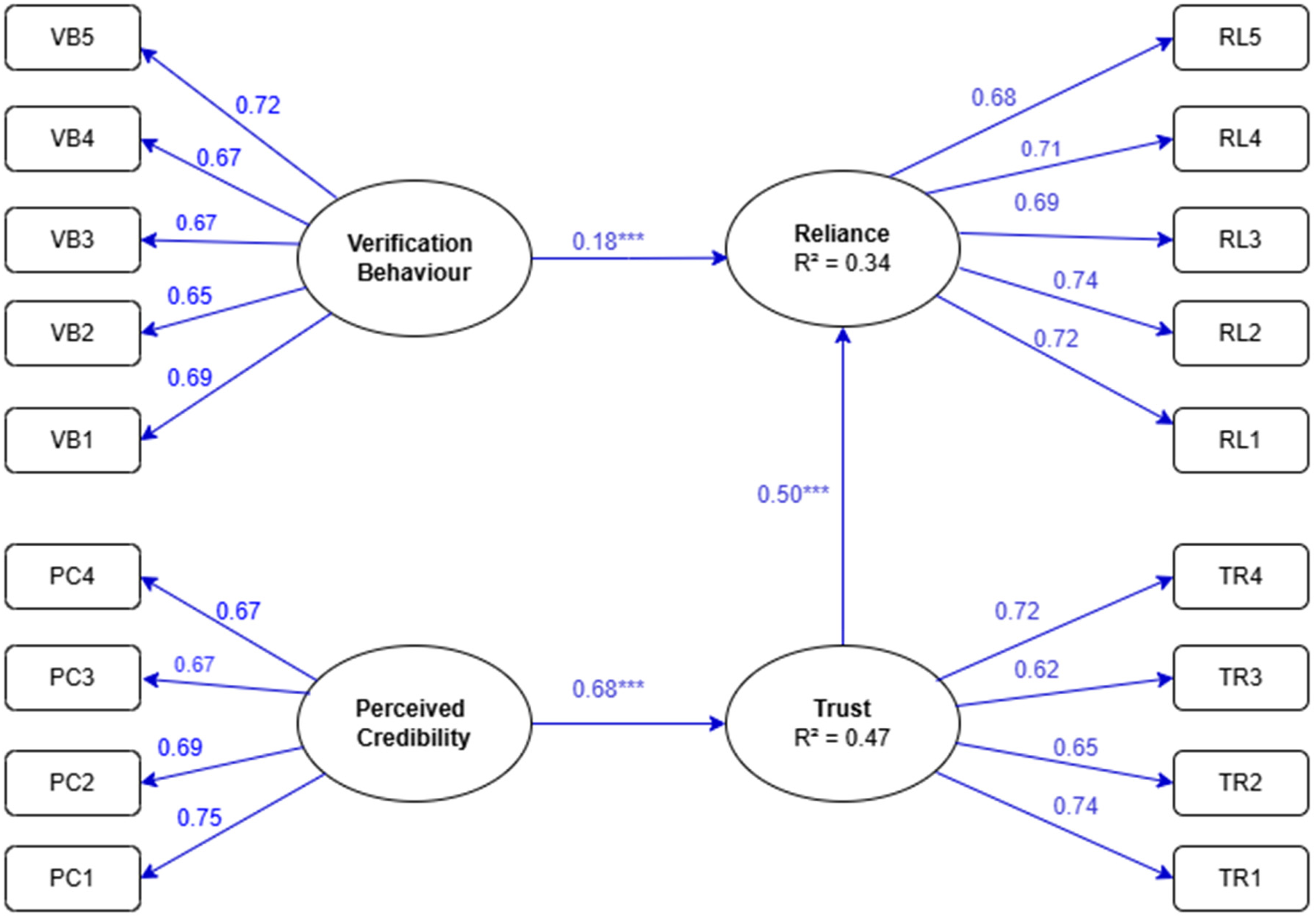
Structural model showing standardised path coefficients and factor loadings. Note: Only statistically supported structural paths are displayed for visual clarity. The non-significant direct association between perceived credibility and reliance is reported in Table 4. PC1–PC4 = perceived credibility items; TR1–TR4 = trust items; VB1–VB5 = verification behaviour items; RL1–RL5 = reliance items.
Structural model results and hypothesis testing.
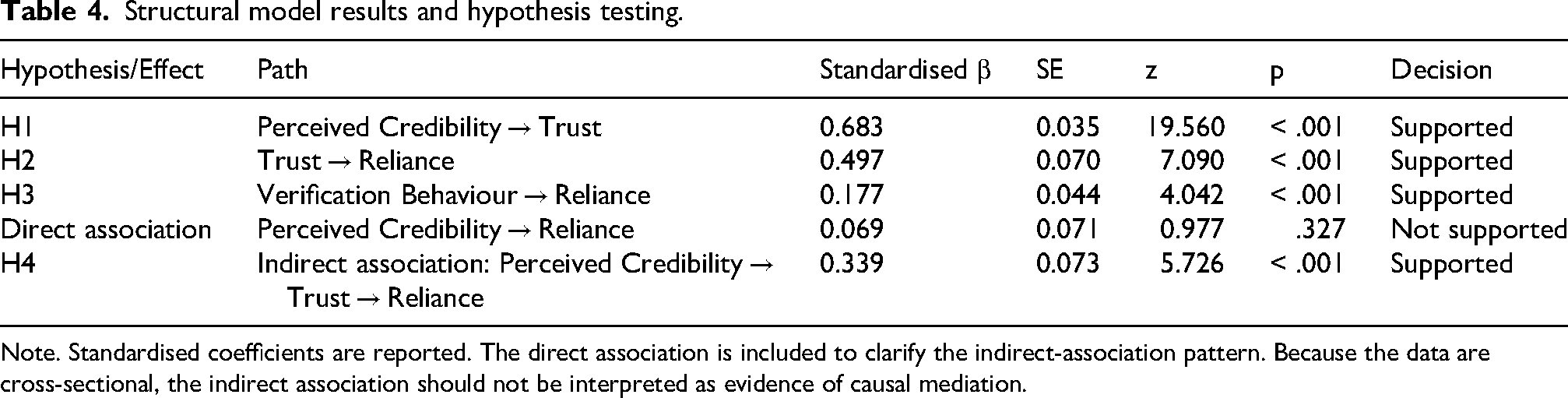
Note. Standardised coefficients are reported. The direct association is included to clarify the indirect-association pattern. Because the data are cross-sectional, the indirect association should not be interpreted as evidence of causal mediation.
Overall, the results are consistent with an indirect-association pattern in which trust statistically links credibility judgements to reliance, while verification behaviour is also independently associated with students’ use of Generative AI in academic contexts. Because the data are cross-sectional, this pattern should be interpreted as a concurrent association rather than evidence of causal or chronological mediation.
Multi-group analysis by level of study
A multi-group analysis was conducted as a robustness and generalisability check to examine whether the measurement and structural relationships differed between undergraduate and postgraduate students. As shown in Table 5, the measurement invariance tests supported configural, metric, and scalar invariance, as changes in robust fit indices were negligible across increasingly constrained models. The configural model showed good fit, and imposing equality constraints on factor loadings and then on intercepts did not materially reduce model fit. The robust chi-square difference tests for both the configural-to-metric comparison (p = .659) and the metric-to-scalar comparison (p = .525) were non-significant. These findings indicate that the four latent constructs operated comparably across the two study levels. Table 5 also shows that constraining the structural paths to be equal across undergraduate and postgraduate students did not significantly worsen model fit (Δχ2 = 2.166, Δdf = 4, p = .705). The group-specific path estimates showed closely similar patterns in both groups. Therefore, the supplementary group comparison did not indicate meaningful structural differences between undergraduate and postgraduate students, suggesting that the proposed model operates in a broadly stable and comparable manner across the two study levels.
Measurement invariance and multi-group comparison by level of study.

Panel B. Structural invariance and group-specific paths.

Note: Structural invariance test: Δχ2(4) = 2.166, p = .705. * p < .05, *** p < .001.
Discussion
This study examined Generative AI as an academic information source rather than merely as a technological tool, with particular attention to how students’ credibility judgements relate to trust, verification behaviour, and reliance. The findings support an evaluative pattern in which credibility is associated with trust, and reliance is associated not only with trust but also with verification behaviour. Taken together, these findings suggest that students’ reliance on AI-generated academic information is associated less with immediate credibility judgements alone than with whether those judgements are accompanied by trust. This pattern directly addresses the study's central concern that the key issue in academic AI use is not simply adoption, but how students evaluate and then use AI-generated information in contexts where source transparency is often limited (Baig and Yadegaridehkordi, 2024; Bearman et al., 2024).
The positive association between perceived credibility and trust is consistent with the study's grounding in Source Credibility Theory. In the present context, students appear to use credibility judgements as an initial evaluative filter when deciding whether AI-generated academic information is dependable enough to accept. This is especially relevant in AI-mediated environments, where responses may appear fluent and authoritative even when their evidentiary basis is unclear. The result therefore suggests that credibility continues to matter in digital information assessment, but its role is better understood as being associated with trust rather than directly associated with reliance (Appelman and Sundar, 2016; Lao et al., 2025).
A central contribution of the study is the indirect-association pattern involving trust. The non-significant direct association between perceived credibility and reliance, combined with the significant indirect association through trust, indicates that favourable credibility judgements do not, by themselves, correspond directly to students’ reliance on AI-generated academic information. Instead, students appear more likely to report reliance when the information is not only viewed as credible but also accepted as trustworthy enough for academic purposes. This is an important distinction because it shifts the explanation of reliance away from surface plausibility alone and towards students’ reported willingness to depend on information under uncertainty. In this sense, trust functions as the proximal statistical link between credibility judgements and reliance in this sample. Given the cross-sectional design, this pattern should be interpreted cautiously as an indirect association rather than as evidence of causal or chronological mediation (Georgeson et al., 2025; Nazaretsky et al., 2025; Wang et al., 2025).
The positive association between verification behaviour and reliance is also noteworthy. At first glance, verification might be expected to reduce reliance by making students more cautious. However, the present results suggest a more selective pattern. In academic contexts, students who verify AI-generated outputs may become more willing to use them because the information has been checked against textbooks, journal articles, lecture materials, or other trusted sources. This interpretation aligns with the study's information literacy and digital verification perspective, which assumes that responsible academic use of digital information involves checking rather than passive acceptance. The finding therefore suggests that reliance on Generative AI in higher education should be interpreted as selective or conditionally validated use rather than blind dependence (Bearman et al., 2024; Martín-Moncunill and Alonso Martínez, 2025).
At the same time, the verification finding should be interpreted carefully. In this study, verification behaviour was measured as students’ self-reported checking practice before using AI-generated academic information. It was therefore modelled as a practice associated with academic incorporation rather than as an antecedent of perceived credibility or trust. This specification reflects the study's focus on whether students rely on Generative AI after reported checking, not whether checking changes their underlying credibility judgement or trust. However, reported verification does not necessarily mean high-quality verification. Students may engage in rigorous cross-checking against textbooks, journal articles, lecture materials, or instructor guidance, but they may also conduct superficial web searches or confirmatory checks that simply reinforce an AI-generated answer. The findings therefore show that students who report more verification also report greater reliance, but they do not establish that such verification is always rigorous, independent, or sufficient for academic quality assurance. This distinction is important for information literacy because students need to learn not only that AI-generated information should be checked, but also how to conduct verification that is independent, evidence-based, and resistant to confirmation bias.
This interpretation also connects with work on adaptive AI platforms and critical thinking. Onuh (2025) suggests that active engagement with AI systems can support critical thinking when learners are required to question, compare, and refine AI-generated responses. In the present study, verification behaviour is therefore best understood as an active evaluative practice rather than as a mechanical act of checking.
Finally, the multi-group results showed that the structural relationships did not differ significantly between undergraduate and postgraduate students. Although these groups may vary in academic experience, the same general association pattern appears across both levels of study. Credibility is associated with trust, trust is associated with reliance, and verification behaviour is positively associated with reliance. This suggests that the evaluative logic underlying students’ academic use of Generative AI may be structurally similar across study levels, even if the intensity or context of use differs. Overall, the study supports an information-evaluation interpretation in which trust is closely associated with the relationship between credibility judgements and reliance, while verification behaviour is associated with more selective and responsible use of AI-generated academic information (Bearman et al., 2024; Lao et al., 2025; Tasmim and Atikuzzaman, 2025).
Practical implications for information literacy and academic governance
The findings have practical implications for academic libraries, information professionals, and university governance. For academic libraries and information professionals, Generative AI should be incorporated into information literacy instruction as an academic source-evaluation issue, not only as a tool-use issue. Training should help students distinguish fluent AI-generated text from evidence-based information, verify claims against textbooks, journal articles, lecture materials, and trusted databases, and document how AI-generated information has been checked before being used for academic purposes. At the institutional level, universities should move beyond individual student responsibility and develop clear guidance on acceptable AI use, verification expectations, citation or disclosure practices, and discipline-specific standards for academic work. Administrators, curriculum planners, and academic leaders thus have a role in embedding AI verification expectations into assessment policies, course guidance, and information-literacy provision. Such guidance can support responsible use while reducing the risk that students rely on plausible but insufficiently verified AI-generated information.
Limitations
This study has several limitations. First, the cross-sectional survey design supports interpretation in associative rather than causal terms, particularly for the indirect-association results. The observed pattern should therefore be understood as a concurrent association among credibility, trust, verification behaviour, and reliance, not as evidence of temporal ordering or causal mediation. Second, all constructs were measured through self-report, so the findings reflect perceived rather than directly observed verification and reliance behaviour. The study was therefore unable to determine whether reported checking reflected rigorous source validation, superficial checking, or confirmatory practices that merely reinforced AI-generated outputs. Third, the use of a multi-university but non-probability sample limits broader generalisability beyond the institutions and student groups included in the study. The findings should therefore be interpreted as evidence from a heterogeneous student sample rather than as nationally representative estimates. Fourth, the study focused only on students with recent academic experience with Generative AI, which means it does not explain the views of non-users or students who deliberately avoid such tools.
In addition, although the validity checks supported construct distinctiveness, the conceptual proximity among credibility, trust, verification behaviour, and reliance remains a limitation that should be interpreted with care. Finally, covariance-based SEM estimates linear associations among predefined constructs and cannot fully capture the adaptive and iterative ways in which students use Generative AI, revise prompts, compare outputs, and apply critical judgement during academic work. These limitations point to future research using longitudinal or experimental designs, behavioural measures of actual verification practices, and comparative studies across disciplines, institutions, or national contexts (Baig and Yadegaridehkordi, 2024; Georgeson et al., 2025).
Conclusion
This study examined Generative AI as an academic information source by focusing on how students’ credibility judgements relate to trust, verification behaviour, and reliance. Moving beyond adoption-centred accounts, the study shows an evaluative association pattern in which trust statistically links credibility judgements to reliance, while verification behaviour is associated with more selective use. Its main contribution is to position Generative AI not simply as a tool that students adopt, but as an academic information source whose outputs must be judged, trusted, checked, and incorporated into academic work with caution.
Theoretically, the study extends source credibility reasoning into the context of Generative AI by showing that perceived credibility is more closely associated with reliance through trust than through a direct association. For information-development scholarship, the Nepalese case is important because it examines these relationships in a developing-country higher education context, where students’ perceived and actual information-literacy capacities may not always be the same (Tasmim and Atikuzzaman, 2025). The findings suggest that universities should not focus only on whether students use AI, but also on whether students can evaluate AI-generated information, verify claims against credible sources, and distinguish convenience from academic reliability (Bearman et al., 2024; Kunz et al., 2024).
Practically, the findings suggest that universities, academic libraries, and information professionals should strengthen information literacy instruction, verification routines, source-checking habits, and critical judgement in order to enhance responsible and analytical use of AI-generated content by university students. Clear institutional guidance on acceptable AI use and verification expectations is also needed. Future research should examine these relationships using longitudinal, experimental, or behavioural designs to observe how students actually verify and incorporate AI-generated information over time.
Footnotes
Acknowledgements
The author thanks the participating students and universities for their support during data collection. The author also acknowledges the reviewers/experts who provided feedback during the instrument validation process.

Ethics approval statement
This study adhered to accepted ethical principles for human-participant research. Formal institutional ethical approval was not obtained because the study involved an anonymous, low-risk survey, collected no personally identifiable information, and did not involve intervention, deception, vulnerable participants, or sensitive personal data.
Informed consent statement
Informed consent was obtained from all participants before participation. Participation was voluntary and anonymous, and all data were used only for academic research purposes and stored securely.
Author contribution statement
Sanjaya Pudasaini was responsible for the conceptualization, methodology, data collection, formal analysis, writing, and final approval of the manuscript.
Funding
The author received no financial support for the research, authorship, and/or publication of this article.
Declaration of conflicting interests
The author declared no potential conflicts of interest with respect to the research, authorship, and/or publication of this article.
Generative AI use statement
Generative AI tools were used only for minor language editing and clarity improvement during manuscript preparation. All intellectual content, research design, data analysis, interpretation, and final revisions were completed by the author. The author takes full responsibility for the final version of the manuscript.
Data availability statement
The data supporting the findings of this study are available from the corresponding author upon reasonable request.