






Abstract
Introduction
It has been well documented that adults with intellectual disabilities have suboptimal levels of cardiovascular fitness compared to persons without intellectual disabilities.1,2 Several reasons for these impaired fitness are a sedentary lifestyle, associated pathophysiological problems, like hypotonia, mitochondrial dysfunction and an increased prevalence of congenital cardiovascular diseases.3,4 The decreased muscle strength, aerobic capacity, fat-free mass and the increased fat mass are associated with an unfavourable lipid profile and increased resting blood pressure.3,5 As a consequence, this population has an increased risk for obesity, diabetes and cardiovascular disease.6,7
Regular physical activity seems to be a key stone in the prevention and treatment of this increased risk profile. In adults without intellectual disabilities, it has been proven that endurance training, strength training and combined endurance and strength training have a positive influence on body composition, physical and metabolic fitness, with the combined mode as the most optimal. 8 – 10
Concerning the effects of supervised training programmes in persons with intellectual disabilities, most of the reported data focused on endurance training with a small positive effect on body composition (weight, body mass index (BMI), fat mass, fat free mass) and large positive effects on cardiovascular endurance (peak oxygen consumption, peak ventilation, peak exercise capacity, time to exhaustion) and muscle endurance. 11 – 17 Few studies focused on strength or resistance exercises with a small positive effect on body composition (increased fat free mass) and muscle strength (1RM, hand grip strength). 18 – 20
Concerning combined exercise training Heller 21 and Rimmer 22 reported on the same sample after a combined cardiovascular (30 minutes) and strength exercise (15 minutes) training for 12 weeks, three days a week for 45-minutes per session in 53 adults with Down’s syndrome (M age = 39.7 years) a significant improvement in endurance and muscular strength and a slight but significant reduction in body weight.
In these studies only the combined exercise training method was compared with a control group and not with another training method. From these results it is only possible to evaluate if exercising is positive, but not if one method is more beneficial to another. In addition, the sample consisted only of Down’s syndrome adults. They have a specific pathophysiological profile and it is not possible to generalize to a larger population with intellectual disability. Data evaluating the effect of exercise training on lipid profile in adults with intellectual disability are not available, but in children and adolescents, Elmahgoub 23 reported beneficial effects of a combined exercise training programme compared to no training.
Due to the above mentioned arguments, the purpose of this study is to investigate the influence of combined endurance and strength training on indices of body composition, resting blood pressure, lipid profile and physical fitness in adults with intellectual disabilities. Furthermore, using a controlled approach we aim to compare this training mode with endurance training to investigate the most beneficial training mode.
Material and methods
Influence of combined endurance and strength training twice respiratory three times a week on indices of anthropometry and lipid profile in adults with intellectual disabilities

Data are presented as mean (standard deviation). Repeated measures ANOVA with post hoc Bonferroni was used to evaluate time and interaction effects. AET, aerobic exercise training; BMI, body mass index; COT, combined exercise training; DBD, diastolic blood pressure; HDL, high-density lipoprotein; IQ, intelligence quotient; LDL, low-density lipoprotein; SBD, systolic blood pressure; Total chol., total cholesterol.
p < 0.05 significant different evolution COT v Control or AET v Control
p < 0.05 significant different evolution COT v AET There are no significant differences found at baseline.
Influence of combined endurance and strength training twice respiratory three times a week on indices of physical fitness in adults with intellectual disabilities

Data are presented as mean (standard deviation). Repeated measures ANOVA with post hoc Bonferroni was used to evaluate time and interaction effects. 1RM LL maximal strength lower limb (sum of quadriceps and hamstrings; bilateral); 1RM UL maximal strength upper limb (sum of biceps and triceps; bilateral); 6MWD, 6-minute walk distance; AET, aerobic exercise training; COT, combined exercise training; peakVO2, peak oxygen consumption; peak HR, peak heart rate.
p < 0.05 significant different evolution COT v Control or AET v Control
p < 0.05 significant different evolution COT v AET There are no significant differences found at baseline.
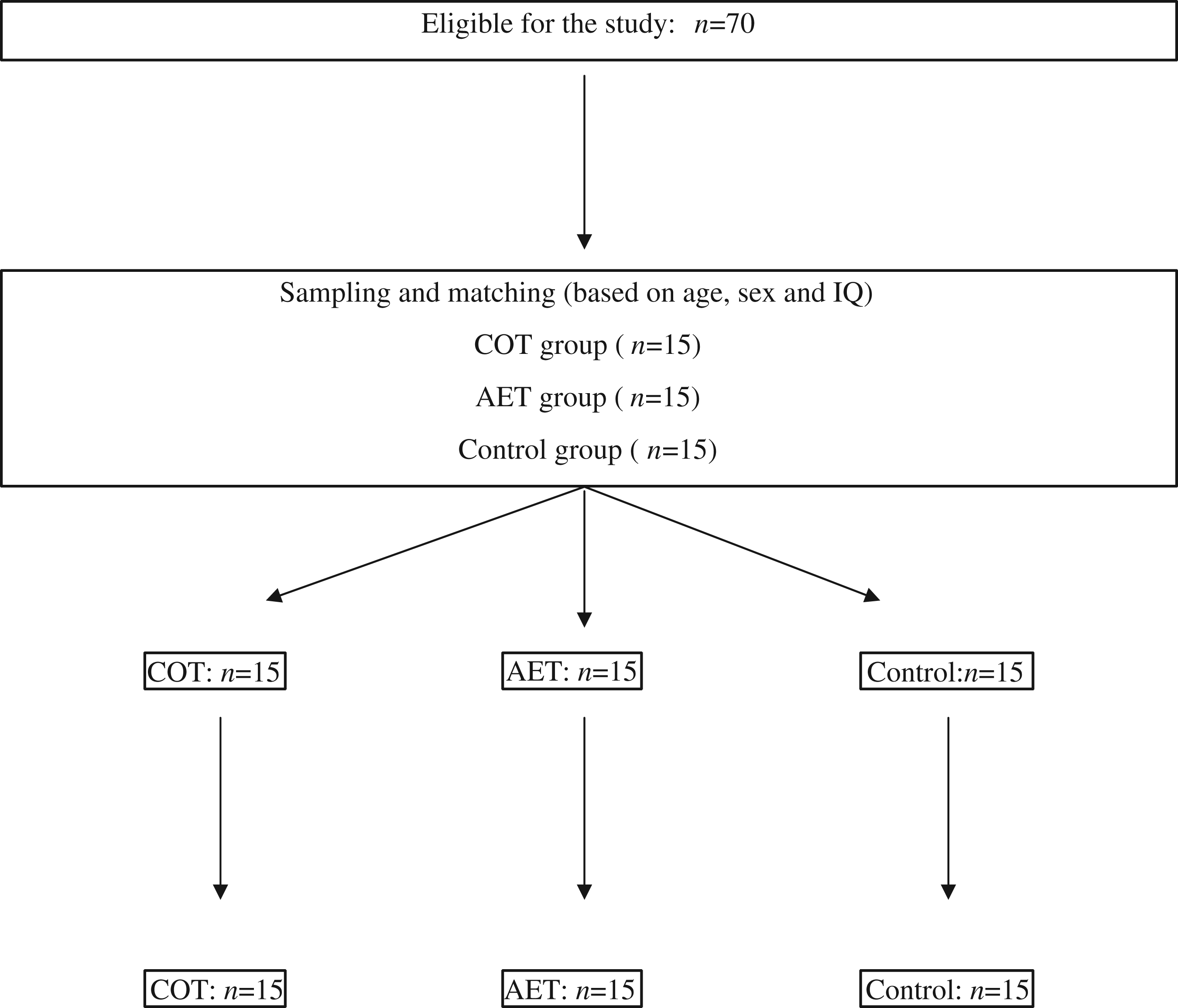
Participants’ flow diagram depicting that no subjects dropped out during the trial. AET, aerobic exercise training; COT, combined exercise training.
The combined exercise training group followed a 20-week training programme (40 sessions) containing strength and endurance exercises. The adults exercised twice a week for 70 min per session. The training sessions were integrated in the daily programme and were supervised by two physiotherapists.
Each training session included warming up (5 min), cycling (10 min), strength training of the biceps brachii and triceps brachii (10 min), stepping (10 min), strength training of quadriceps and hamstrings (10 min), running (10 min), functional training of abdominal and back muscles (10 min) and cooling down (5 min).
The aerobic part of the training (cycling, stepping, running) involved individually prescribed exercise regimens starting at 90% of the ventilatory anaerobic threshold (VAT) which increased up to 100% after 10 sessions and to 110% after 20 sessions. The participants used stationary bicycles, cross trainers and a treadmill.
Strength exercises were performed using appropriate fitness equipment (vertical traction, chest press, leg extension and curl, abdominal muscle trainer). Functional exercises for low back muscles were bridging in supine position, ball bridging and unilateral bridging (bridging with extension of the left/right leg). Intensity of strength training was calculated from the one-repetition maximum (1 RM) values. The starting level was 20 RM (two sets of 15 repetitions), which progressed up to 15 RM (two sets of 12 repetitions) after 10 sessions and to 10 RM (three sets of eight repetitions) after 20 sessions. The last set of repetitions was executed until exhaustion and between two sets; a resting period of 60 seconds was observed.
The endurance training group followed a 20-week training programme (40 sessions) containing only endurance exercises. The participants exercised twice a week during 70 min per session. The training procedure was similar to the combined exercise training group, except for the strength components which were replaced by endurance components such as cycling, stepping, walking/running. The same intensity thresholds and time points were used to build up the training programme as in the combined exercise training group.
The subjects in the control group participated in daily activities without supervised exercise training.
The measurements of the examined variables were performed by blinded assessors. They examined the participants without being aware of the programme followed by each individual.
Before and after the training programme lipid profile and physical fitness (primary outcome), blood pressure and anthropometric data (secondary outcome) were registered.
Height was measured to the nearest 0.1 cm using a stadiometer (Holtain Ltd., UK). Weight was measured to the nearest 0.1 kg on a digital balance scale (Seca, maximum 200 kg, Germany) with the subject wearing lightweight clothing and no shoes. BMI was calculated from weight and height. Waist circumference was measured by a tape measure at the level of the umbilicus. Body composition was assessed by bio-impedance (Bodystat 1500 MDD). Subjects were in supine position for at least 5 min. Surface electrodes were attached to the dorsal side of the right foot and the dorsal side of the right wrist. Fat mass and fat-free mass were calculated using the formula of Kyle. 24
Blood pressure was measured with a manual sphygmomanometer while seated on a chair after measurements of body composition and before the complete physical test procedure started.
Blood samples were obtained after overnight fasting. The following variables were evaluated using diagnostic kits (Roche Diagnostics) for high-density lipoprotein (HDL)-C (PEG + cholesterol-oxidase), triglycerides (glycerol phosphate-PAP) and total cholesterol (cholesterol-oxidase-PAP). Low-density lipoprotein (LDL)-C was calculated from total cholesterol and HDL-C.
In order to evaluate the aerobic capacity, participants performed a maximal cardiopulmonary exercise test on a computer-driven cyclo-ergometer (Marquette Case, Marquette Electronics, Milwaukee, WI, USA) using a gradual protocol starting at 30 W with gradual increase of 15 W every minute. 23 Twelve-lead electrocardiogram and heart rate were recorded continuously during the test, whereas blood pressure was measured with a manual sphygmomanometer every 2 min. Subjects were encouraged to perform exercise testing to the self-determined limits of their functional capacities or until the physician stopped the test because of severe adverse events. 25 Respiratory gas measurements were obtained using a Metalyzer 3B (Cortex, Germany). The oxygen consumption (VO2), carbon dioxide production (VCO2), minute ventilation, tidal volume, respiratory rate and mixed expiratory carbon dioxide concentration were measured continuously by mixed chamber analysis. PeakVO2 was expressed as the highest attained VO2 during the final 30 seconds of exercise. In order to determine VAT, we plotted ventilatory equivalents (VE) for O2 and CO2. The point at which VE/VO2 increased without an increase in VE/VCO2 was accepted as the VAT. 25
All patients performed a standardised, self-paced 6-minute walk test (6MWT) in a 20-metre long corridor. They were asked to cover as much distance as possible within 6 minutes without running. Patients were allowed to stop at any time but were encouraged to restart as soon as possible. During the test, patients were instructed and encouraged continuously. Covered distance after 6 minutes was measured to the nearest metre. In a recent reproducibility and validity study (Elmaghoub. Disabil Rehabil 2010 submitted) we found that the reproducibility in this population is relatively high with an intraclass correlation coefficient (ICC) = 0.82 and validity (association between 6-minute walk distance and peakVO2 measured by cyclo-ergometer test) is strong with a Pearson r-value of 0.79.
One-repetition maximum was determined bilaterally with the indirect Holten method using commercial available strength-training equipment (Steens, Belgium) for biceps brachii, triceps brachii, quadriceps and hamstrings. For back and abdominal muscles flexion and extension devices of the Tergumed Line (Proxomed, Germany) were used. A physiotherapist defined for each patient a test weight so that patients would be able to achieve six to 12 repetitions at the most. From this number of repetitions, the 1 RM was calculated using the Holten diagram. The Holten diagram relates the number of repetitions to the percentage of maximum strength. 23 A global score for upper limb strength was calculated by adding up the biceps brachii and triceps brachii scores. Similarly, a score for the lower limb was found by adding up the quadriceps and hamstrings scores. This test provides a valid and reproducible way to assess strength and changes in strength. 26
The sit-to-stand test measures the maximum number of repetitions within 30 seconds an individual is able to rise to a full stance from a seated position on a chair, without pushing off with the arms. The number of completed stances (up–down) was considered the participant’s score. This test is developed in a population of older adults and is highly correlated with strength of the lower limbs. 27
Hand grip strength of the participant was evaluated in a standing position, arms in 90° flexion alongside the body. The participant was asked to squeeze the dynamometer (Jamar) with as much force as possible, being careful to squeeze only once for each measurement. Three trials were made with a resting period of about 10–20 seconds between the efforts to minimize the effects of muscle fatigue. For the same reason, left and right hand were alternated. Only the best score was registered. It has been reported that the hand grip strength has a high reliability in adults with intellectual disabilities with an ICC for dominant and non-dominant hands of 0.96 and 0.94 respectively. 28
Muscle fatigue resistance of the participant was measured in the same position as described for the hand grip strength. This time, the subject had to squeeze the dynamometer with as much force as possible and as long as possible. The test was finished when grip strength dropped to 50% of its maximum during sustained contraction. 29
Data are expressed as means and standard deviations. Data are analyzed with a commercially available statistical software program (Statistical Package for the Social Sciences, SPSS 15.0, SPSS, Chicago, IL, USA). To evaluate significant time (pre-post differences within groups) and interaction effects (different evolutions between groups) a repeated measure ANOVA post hoc Bonferroni test is performed. Significance level is set at P < 0.05. To measure effect sizes Cohen’s d was calculated. Effect sizes of 0.2 to 0.3 were classified as ‘small’ effects, around 0.5 as ‘medium’ effects and 0.8 to infinity, as ‘large’ effects. 30
Results
Groups were matched for age, gender and IQ. At baseline, there were no significant differences between the groups for cause of intellectual disability, associated disorders, weight, length, BMI, waist, fat mass, fat-free mass, LDL, HDL, total cholesterol, 1 RM upper and lower limb, hand grip strength, muscle fatigue resistance, sit-to-stand test, 6MWT, (relative) peak oxygen consumption, peak power and peak heart rate (Tables 1 and 2).
There was a high programme compliance and a low number of adverse effects were observed. All participants performed a minimum of 36 and a maximum of 40 training sessions within the 20 weeks. Adverse events depending on the exercise programme were very rare and mild (mainly musculoskeletal complaints at the level of the lower limb). Occasionally, the training programme had to be interrupted for one week (two training sessions) due to illness (three subjects).
After training, there were no significant differences for weight, height, BMI, fat mass, fat free mass and waist within or between the three experimental groups (Table 1).
After the training programme systolic blood pressure was significantly decreased in the combined exercise training group (P = 0.012) as well as in the endurance training group (P = 0.024), compared to the evolution in the control group (no significant changes). Furthermore, the decrease in the combined exercise training group was significantly larger compared to the endurance training group (P = 0.03). There were no significant effects for diastolic blood pressure within or between the three experimental groups (Table 1).
Concerning the lipid profile, there were no significant effects on HDL or LDL within or between the three experimental groups. However, total cholesterol was significantly decreased in the combined exercise training group (P = 0.01), while in the endurance training and control groups no significant changes were observed (Table 1).
Effect sizes for cardiovascular risk factors were medium to large as expressed by the Cohen’s d for total cholesterol (0.5) and systolic blood pressure (1.2).
After 20 weeks of combined exercise training, (relative) peak oxygen consumption (P = 0.015), peak power (P = 0.02), six-minute walk distance (P = 0.008), 1 RM of upper limb (P = 0.013) and lower limb (P = 0.003), upper abdominal muscles (P = 0.03), hand grip strength (P = 0.012), muscle fatigue resistance (P = 0.024) and sit-to-stand performance (P = 0.021) increased significantly compared to no significant changes in the control group. After endurance training only peak power (P = 0.021), six-minute walk distance (P = 0.03) and muscle fatigue resistance (P = 0.026) increased significantly compared to no significant changes in the control group.
Changes in the combined exercise training group in 1 RM upper (P = 0.01) and lower limb (P = 0.01) and upper abdominal muscles (P = 0.03), hand grip strength (P = 0.025), muscle fatigue resistance (P = 0.03) and sit-to-stand performance (P = 0.03) were significantly different from the evolution in the endurance training group.
Effect sizes (combined exercise training compared to endurance training) were small for peakVO2, relative peakVO2, peak power (Cohen’s d = 0.3; 0.26 resp. 0.29), medium for six-minute walk distance, strength of abdominal muscles, hand grip strength (Cohen’s d = 0.49; 0.50 resp. 0.31) and large for strength upper and lower limb, muscle fatigue resistance and sit-to-stand (Cohen’s d = 1.13; 1.85; 1.01 resp. 0.91).
Discussion
Our data indicate no significant effects on body composition. This is in line with other data published concerning endurance training in people with intellectual disability.2,11–13,15– 18 Nevertheless, after combined exercise training Heller 21 and Rimmer 22 reported a slight, though significant decrease of body weight in people with Down’s syndrome. Our population contained a mixed group of diagnoses and associated problems including Down’s syndrome. It is therefore possible that the population we tested is less homogenous compared to the studies of Heller 21 and Rimmer. 22 Another possible explanation is given by Hagobian 31 based on adult men and women without intellectual disabilities who completed four bouts of exercise while energy-regulating hormones and appetite were measured. In both sexes appetite was increased and the level of energy-regulating hormones altered in a way that stimulated energy intake. It is possible that our population compensated with more eating resulting in no decrease of body weight and alteration of body composition.
Concerning the effects on blood pressure, we found a significant decrease of systolic blood pressure after combined exercise training and endurance training, with a larger impact of the first training mode. The beneficial effect of physical training (endurance, strength and/or combined exercise training) on resting blood pressure in people without intellectual disabilities is well documented with the most beneficial effect after combined aerobic and strength training and in those with hypertension. 32 – 34 In people with intellectual disabilities no data are available. In this population, however, the prevalence of hypertension is larger compared to their peers without intellectual disabilities. 5 In our population a mixed group of normotensive and hypertensive adults were included.
The antihypertensive effect of exercise is believed to be mediated by reduced sympathetically induced vasoconstriction in the trained state, and decreased catecholamine levels. 35 Patients with hypertension often also have dyslipidemia. Physical activity and exercise have beneficial effects on the blood lipid profile in adults without intellectual disability.36,37 In our results we see that only in the combined exercise training group there was a significant reduction of total cholesterol, while in the endurance training group there were no significant differences. Together with the influence on the nervous system, this may explain the larger effect on blood pressure in the combined exercise training group compared to the endurance training group.
Our study only revealed a significant effect on total cholesterol in the combined exercise training group. Data in adults with intellectual disabilities are not available, but in adolescents we could observe a similar medium-sized effect after combined exercise training. 23 In adults without intellectual disabilities positive effects after endurance exercise, strength training and combined exercise training on HDL, LDL and/or total cholesterol were reported.8,37,38 Also here it has been observed that the combined exercise training tended to have more positive results. 9 Pedersen 8 reported in his meta-analysis that the largest effects were seen in those people who had dyslipidemia. In this study a mixed population of people with dyslipidemia and normal lipid levels were included (normal levels total cholesterol <190 mg/dl; LDL <115 and HDL >40). As we look at the data of the lipid profile in more detail, we see that the levels of HDL were mostly in the normal range. For LDL, and certainly for total cholesterol levels, there were more participants with levels out of the normal range. This could be a possible reason why there is a larger effect on total cholesterol.
Concerning physical fitness, overall significant positive effects were noticed after combined exercise training with the largest effects on the strength components respiratory functional tests compared to endurance training.
Concerning aerobic capacity, only peak power significantly increased after endurance training, whereas peak oxygen consumption did not significantly change. The fact that peak oxygen consumption did not change for a higher level of peak power may indicate an increase in aerobic capacity. These results are supported by several authors.2,11,14– 16 After combined exercise training, there was a significant increase in aerobic capacity, expressed as (relative) peak oxygen consumption and peak power. This is in line with the results of Heller 21 and Rimmer 22 who trained adults with Down’s syndrome (mean age 39.4 years) for 12 weeks, three days a week for 45 minutes (30 minutes cardiovascular exercise and 15 minutes strength exercise). Comparing combined exercise training with endurance training, combined exercise training tended to have more impact although the difference between both evolutions was not significant. Peak oxygen uptake is determined by the oxygen transport system (pulmonary, cardiac and vascular system) and the oxidative capacity of the skeletal muscle (O2 use in the mitochondria). The larger impact of combined exercise training on these systems can possibly be explained by the larger impact on the peripheral system after combined training than after endurance training alone. 38
The 6 MW distance increased by 55 metres in the combined exercise training group, which is a significant and clinical relevant change. 39 Main determinants of this test in patients without intellectual disabilities are strength of quadriceps and peakVO2.39,40 In our study strength of lower limb and more specific quadriceps strength and peakVO2 in the combined exercise training group indeed increased significantly. Also in the endurance training group an increase of 36 metres in the 6 MW distance was observed. The smaller (though significant) outcome in this training mode can be explained by the smaller impact on quadriceps strength and peakVO2 of endurance training.
Both upper and lower limb strength and abdominal muscle strength increased in the combined exercise training group, while it remained almost stable in the endurance training and control group. Besides a training effect 18 – 20 there may, however, be an important learning effect leading to this substantial increase. During the first testing and during the training programme, adults learned to perform a correct starting position for every exercise and got acquainted with appropriate technical performance in these exercise tasks. The improved exercise performance may have contributed to a better score during assessment trials. We found that strength of lower limb muscles ameliorated much more than upper limb muscles. This can be explained by the fact that the training included cycling and stepping exercises besides the strength exercises and thereby addressed lower limb muscles even more explicitly. This is partly supported by the results of the endurance training group with a small, not significant, increase in lower limb strength which can also be explained by the fact that cycling, walking/running and stepping were main components of the programme affecting lower limb muscles.
Hand grip strength and muscle fatigue resistance increased in the combined exercise training group, and these changes were significantly different from the results in the endurance training and control group. The increase of hand grip strength and muscle fatigue resistance can be explained by the increased overall strength. Literature indicates a positive correlation between overall strength and hand grip. 23 Therefore, the increased upper limb strength in our study may also have contributed to the improved hand grip strength. Muscle fatigue resistance is closely related to daily functioning. Muscle fatigue resistance improved in the combined exercise training and endurance training group, while it remained stable in the control group. The positive change within the intervention groups may be explained by the increased muscle strength and a better neurological functioning after the exercise programme as it is stated that these factors, together with psychological factors like emotion and motivation, 29 are determinants of fatigue resistance. The better evolution in combined exercise training compared to endurance training can thus be explained by the fact that in the first group there was a significant increase in muscle strength, while in the endurance training group there was no significant change in muscle strength.
Finally, scores on the sit-to-stand test ameliorated in the combined exercise training group. As quadriceps strength is a predictor for sit-to-stand scores, the increase of lower limb strength in this study can explain the amelioration of sit-to-stand scores in this group. 41
Strengths and limitations of the study
This is the first controlled trial to investigate the effects of combination exercise training in people with intellectual disabilities compared to endurance training and no training. The participants were trained by very competent, experienced and enthusiastic physiotherapists, who carefully guided training and coached test sessions. As a result, we obtained accurate and favourable results, while almost no adverse effects were noticed and a high compliance of the participants was seen.
However, the overall positive outcome must be tempered. A strict randomization of the participants was not possible. For it to be a true randomized controlled trial, every potential participant in the pool would have an equal chance of being allocated or not being allocated into one of the conditions. Due to the fact that strong heterogeneity in this population is present, matching for different criteria is necessary. In this study, groups of three participants based on matching criteria were made. Hereby, not all of the eligible participants had equal chances to be allocated to one of the three groups. This could have biased the experimental groups. The power in this study is relatively low, which means that generalization to a greater population of people with intellectual disability is difficult. The participants who were eligible for the study were those with no severe musculoskeletal, neurological and cardiovascular problems and those willing to participate in the study. The outcome of the study may therefore be influenced by a motivational bias.
Most of the tests used in this study were applied previously in other research programmes within this population, but validity and reliability of, for example 1 RM testing and tests of muscle fatigue resistance, are not proven for participants with intellectual disabilities. On the other hand, the test results after training were obviously better than before, therefore we can conclude that there is a tendency towards a more beneficial effect of combined exercise training compared to endurance or no training.
Clinical messages
In people with lifelong severe intellectual disabilities, exercise improves fitness and mobility and reduces some cardiovascular risk factors. A combination of strength and endurance training is more effective than endurance training alone.
Footnotes
Acknowledgements
We thank the directors and physiotherapists of the special centers for people with intellectual disabilities Sterrenhuis (Brasschaat) and Emiliani (Lokeren) for selecting and encouraging the participants and for their local support of this project.
Funding
This research received no specific grant from any funding agency in the public, commercial, or not-for-profit sectors.