







Abstract
The official response to forced marriage in the majority of European countries has been to criminalise the practice. Based on racial stereotypes and outdated Orientalist perspectives, this overlooks the prior need for appropriate empirical analysis in order to better understand the reality of the practice being regulated, and fails to provide victims with the means of protection they need beyond the framework of criminal law. Devising a suitable and effective strategy to address this form of victimisation instead requires an in-depth understanding of the effects that victims of these practices endure, and of what the victims themselves would consider best practice in terms of assistance and protection. In view of these primary objectives, after the existence of forced marriages in Spain had been demonstrated by the corresponding quantitative research, a qualitative research study followed, which was conducted through interviews with victims of forced marriage. The results are presented here. The secondary aim of the study was to draw up the basic guidelines for an integrated programme of action to address this process of victimisation.
Keywords
Introduction
Forced marriage is generally understood as a marriage that is held without the consent of one or both parties (FRA, 2014). The most traditional definitions only recognise cases in which coercion or agreement under duress is used to force one or both parties to marry, thus differentiating the practice from arranged marriage (Anitha and Gill, 2011a; Home Office, 2000; HM Government, 2010; Igareda, 2017). However, it has increasingly become the norm to understand such cases within a framework of gender-based violence (Bunting et al., 2016; Gill and Anitha, 2011a) and through an intersectional lens, according to which processes of power and subordination in postmodern society are not only explained by the binary system of sex and gender, but by a multiplicity of factors, such as race, class and gender (Crenshaw, 1989, 1991; Nixon and Humphreys, 2010; Sokoloff and Dupont, 2005). Applying this approach to the phenomenon under analysis here results in the adoption of a concept of forced marriage less attached to the binary conceptualisation of coercion and consent (Anitha and Gill, 2011a) and, as a consequence, a more comprehensive definition, thus blurring the distinction between this category and arranged marriage. According to this more contemporary conceptualisation of forced marriage, also sustained here, it is accepted that methods of force might not necessarily involve violence or the threat of violence, but could also be carried out by means of coercive control (Anitha and Gill, 2009, 2011a). Moreover, as well as being forced to enter into a marriage against their will, victims may continue to endure coercion throughout its term, which could prevent any potential termination (Gangoli et al., 2011). In addition, if forced marriage is understood as a process – a pattern of behaviour more than an event, among other possible consequences of the assumption of a broader concept of this phenomenon – it can also encompass cases in which women have not yet been forced into marriage but are at risk of being so (Chantler and McCarry, 2019), as is shown in this article.
Various international bodies and non-governmental organisations (NGOs) have condemned the practice of forced marriage on a global scale, particularly marriages in which one or both of the parties are under age (UNICEF 2001, 2008, 2014). Eurocentric perspectives (based on Orientalist ideas) on the patronising western representation of eastern societies as static and undeveloped (Naber, 2010; Said, 1979) and on racial stereotypes have often led to an improper association of the practice with cultural minorities. In recent years, however, studies conducted in western countries have refuted such ideas to reveal that forced marriage is a reality that also occurs in western societies as a form of gender-based violence (Anitha and Gill, 2011b; Chantler et al., 2009; Patton, 2018; Razack, 2004). In effect, a UNICEF report issued in 2014 indicated that, although uncommon, forced marriage was indeed practised in western countries as well (UNICEF, 2014). In the USA, although this question has only very recently received legal attention (Love et al., 2018; Martin, 2018), an extensive research study was conducted by the Tahirih Justice Centre in 2011 in which a total of 500 assistance organisations revealed that there had been as many as 3000 cases in the country in the preceding two years (Tahirih Justice Centre, 2011). In Europe, the Forced Marriage Unit was created in 2005 as a victim support unit in the UK and has published annual quantitative data on forced marriage in the country since 2012, claiming to have made between 1,200 and 1,400 annual interventions since then. In 2017, the number of cases assisted was 1,196, with a high proportion involving victims under the age of 18 (29.7%), as well as women and girls (77.8%); the countries of origin were also diverse (Home Office, 2018). Germany has also conducted a national assessment of forced marriage (Mirbach et al., 2011), which revealed that in 2008 as many as 3,443 women and girls sought advice from various entities and organisations. Of these, 70% were under the age of 21, and 30% were under the age of 18. In Italy, a research study conducted in 2009 by the organisation Associazione Trama di Terre detected 33 cases in the Emilia-Romagna region (Trama di Terre, 2014), all except three of which involved women and girls. A study conducted by Hamel in 2011 demonstrated the existence of the practice in France, and showed that the proportion of non-consensual marriages was higher among immigrant women aged between 51 and 60 than among those aged between 26 and 30, which led them to conclude that the practice was in clear decline in France (Hamel, 2011). In Spain, data on the subject have been very limited until very recently. Most have been sourced from police records in Catalonia, although qualitative data were also obtained more recently from the MATRIFOR project, which identified risk factors among specific women forced into marriage (Igareda et al., 2016). In 2017, the first quantitative mapping study on the incidence of forced marriage in Spain was carried out through an online survey issued to a real sample of 150 victim service providers. Sixty-two of these providers identified victims of forced marriage and completed datasets for 57 victims. These results showed that all victims were women and 77% were under the age of 21 (of whom 33% were under the age of 18). The highest proportion of victims originated from the Maghreb (42%) and sub-Saharan Africa (25%), whereas 21% were Spanish, mainly Muslim (69%) (Villacampa and Torres, 2019).
The legal approach to forced marriage taken by the majority of European countries, based on the aforementioned patronising ideas emanating from the West about the East, has been to criminalise it as a specific offence and to settle cases exclusively through the use of criminal justice (Ebeturk and Cowart, 2017; FRA, 2014; Gill and Anitha, 2011b; Sabbe et al., 2014), especially after the approval of the Council of Europe Convention on preventing and combating violence against women and domestic violence in 2011 (Istanbul Convention). Other measures have included raising the legal minimum age for marriage (Gangoli and Chantler, 2009; Hester et al., 2008) and preventing family reunification spouses under the age of 18 (Wijffelman, 2017). The effectiveness of such measures in eliminating the practice of forced marriage or adequately addressing victims’ needs for protection remains far from established. A significant number of European countries 1 have taken the approach of criminalising forced marriage as a specific offence. In 2015, for example, Spain criminalised cases in which violence or serious intimidation is used to force one or both parties into marriage. This has drawn criticism from scholars, not only in terms of the privilege accorded to such crimes over others that might also be considered cases of forced marriage, but also due to the general ineffectiveness of criminal law as the primary measure of restraint. Such an approach fails to acknowledge the difficulties of intervention in such private family affairs, and provides no other supportive measures (Maqueda, 2016; Torres, 2015; Villacampa, 2018). Moreover, in Spain, as in the majority of cases, such legislation was adopted without any prior empirical analysis being conducted to determine the effects such practices have on victims, and how best to legally address these.
Forced marriage is a complex reality, related not only to individual freedoms but also to gender-based and family violence, as well as to certain harmful traditional practices (Gangoli and Chantler, 2009; Gangoli et al., 2011; Gill and Anitha, 2011a). In order to be able to devise suitable strategies for detection, assistance and victim protection, it is important to tackle the scale of the issue with the use of both quantitative and qualitative data and an understanding of the perspectives of the victims themselves. In view of these points, we decided to conduct qualitative research on victims’ experiences. Having demonstrated through the above-mentioned quantitative research study that forced marriage is, indeed, conducted in Spain (Villacampa and Torres, 2019), it was decided that a qualitative analysis of the experiences of those who have endured the practice would be an appropriate method of determining the impact on victims and the protection they need. The use of a qualitative methodology would allow for a more comprehensive study (Corbin and Strauss, 2008; Denzin and Lincoln, 2002; Marshall and Rossman, 2006; May, 2005), specifically analysing how victims cope with the experience, what official support they receive and what they consider to be most suitable in terms of protection. In order to overcome the limits of policies that criminalise forced marriage, which are based on Orientalist perspectives focusing only on the cultural aspects of the practice, and which tend to alienate non-western cultures, such questions must be understood. This is also crucial in moving towards victim-centred strategies that address the practice as a form of gender-based violence requiring an intersectional approach (Anitha and Gill, 2009; Ebeturk and Cowart, 2017; Sabbe et al., 2014; Villacampa, 2018), not only because it has been shown how forced marriages can involve other forms of abuse (Swegman, 2016), but primarily because this type of victimisation is explained by different subordinate intersecting factors beyond gender, which need to be addressed in order to deal appropriately with victims.
R esearch methodology
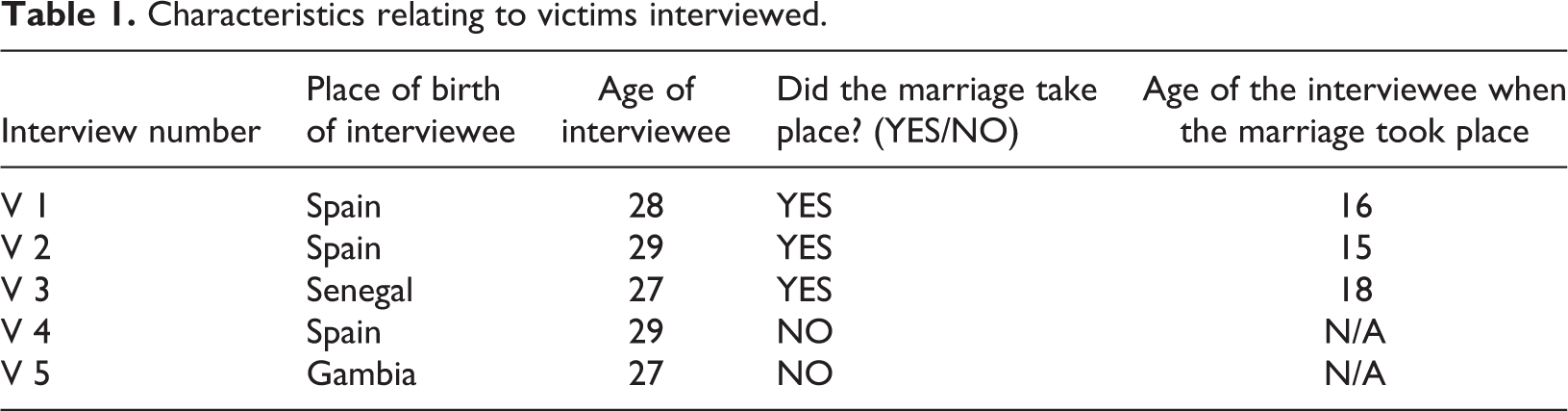
Having completed the quantitative research study, for this next stage of research we opted for a system of purposive sampling that would lead to the selection of a group of victims with whom we would carry out a series of semi-structured, in-depth interviews. The sample finally selected was a group of five victims, all of whom were women because no male victims had been identified in the quantitative study. This reflects the majority of studies on the practice of forced marriage (Mirbach et al., 2011; Psalia et al., 2016; Tahirih Justice Centre, 2011). The characteristics of the five victims are set out in Table 1.
Characteristics relating to victims interviewed.
Access to the interviewees was facilitated by the NGOs that had taken part in the previous quantitative study; in completing an online survey they had demonstrated that they had supported victims of forced marriages. After victims had been approached initially by the organisation conducting the research and had consented to take part, they were then approached by the research team, who outlined the content of the interview and, again, requested their consent to be interviewed.
This research study initially aimed to analyse a larger number of victim testimonies; however, given the huge difficulty of finding survivors of the practice of forced marriage who would consent to being interviewed, we were able to access only a small number. In spite of this, the testimonies presented in the interviews were considered to be sufficiently representative of the experiences endured by victims, the effects on them and what they might, therefore, hope for in terms of official protection. Ethical approval for this research was not received from any institution because it was not required by the Spanish ministry funding it. In addition, the ethics committee from the university in which the research was conducted, although currently reporting on the ethical aspects of any proposed research, at the time the research was being carried out was only reporting on ethical issues in relation to biomedical research. However, ethical aspects of the research were taken into consideration both when designing and executing the research project, especially those aspects relating to the consent of victims to take part in this study.
The methodology used for data collection consisted of semi-structured, in-depth interviews that were carried out face to face and lasted between 30 and 90 minutes. Interviews were conducted in Spanish or Catalan depending on the preference expressed by the interviewees, provided that all of them were fluent at least in one of these languages. The interview model used started with a set of questions about the personal experience the victim had endured. Depending on how and when facts emerged, interviewees were asked about the place the marriage was held or was intended to be held, their response to the marriage, the impact on them and the consequences of the process, and their personal situation at the time of interview. A second set of questions focused on the help the interviewee had received in order to resolve the situation. They were asked to provide details on what had led them to seek help, the precise support they were looking for, the organisations they had approached, the kinds of resources they were offered and how they would evaluate the assistance they received and the level of knowledge of the professionals involved. Finally, a third set of questions was aimed at determining the interviewees’ views on best practice for victim protection, that is, what support measures they believed should be implemented, and what the role of criminal justice should be in resolving such conflicts.
The interview model was used as a guideline, rather than a set of rules that would dictate the tone of the interview and conversation. Participation in the study was voluntary and express consent was given. The interviews took place throughout July 2018 in various cities in Catalonia, and were recorded and later completely transcribed.
The data were analysed using a thematic analysis methodology (Guest et al., 2012), following the stages that comprise this: familiarisation with the data; generating initial codes for the data; developing and reviewing the themes; and then defining and naming these themes (Braun and Clarke, 2006).
Results from the victim interviews
Victims’ experiences: Personal circumstances and methods of victimisation
As Table 1 shows, three of the five women interviewed were married to their intended spouses, whereas the remaining two had faced the threat of a marriage that did not, in the end, take place. Of these two women, one had been in a situation of imminent risk: the interviewee herself knew that she was engaged to be married to an identified family member. The risk the other interviewee faced was less clear, suggesting that the prospective spouse was undecided. Plans had been made, however, to send her back to her country of origin, allegedly to spend her school holidays, but unlike her two younger brothers, who were to fly on different days and with a return ticket, she had a one-way ticket.
The five interviewees revealed that it was at a very early age when they were informed by their closest family members that they would have to marry a spouse they had not chosen. Some had barely reached puberty at this stage and the marriages took place at a later point in time. This reflects the findings of the quantitative study (Villacampa and Torres, 2019) and previous research (Gangoli and Chantler, 2009; Kazimirski et al., 2009; Mirbach et al., 2011). Because the person I was supposed to marry had been arranged since I was very young (V 1) Yes, they tried to marry me off. The first time I experienced this was when I was 13. They told me that I was old enough now, I was very developed, I had breasts and it was about time that I got married. I first experienced this when I was 13, with a cousin. (V 2) In my case, it was when I was 14 when they had me engaged to a cousin who lived in the USA. As in, someone I only knew from talking to him a few times on the phone, but had never seen in person. We hadn’t agreed anything. You see, I was a child. (V 4) and it turned out that that person had three wives and I was going to be the fourth. He had children, and they were older than I was…And when they introduced us, he turned out to be a relative of mine. We weren’t even second cousins, but cousins, cousins, because the man’s mother and my own mother had the same father, as in, we were blood relatives, blood relatives…We were about 25 years apart in age. In other words, it felt like being in a relationship with my own father. (V 1) Yes – well, my uncles. Because when marriages are arranged and it’s not your parents who are in charge, it’s got to be an uncle. My parents are in charge of their nephews and nieces, and their parents are in charge of me. (V 2) Eventually, it came to a final conclusion. My uncles all got together – there were three of them – and some other older people, I don’t remember who anymore, and they told me that I had to get married. And I said I didn’t want to. My mother was there for the whole thing, right? And she didn’t say anything, she didn’t express any opinion. (V 2) It was my father’s family who made the proposal, in fact. My father is very particular, he’s very reserved, that’s what he’s like about religion…I don’t think my mother would ever have considered it if my father hadn’t kind of gone for it by himself to make sure the whole thing happened. So it was my father’s family who tied it all up in the end, I don’t think my mother’s family had much to do with it. The man is the one with the most say in the matter and it’s him who has the final say about who his daughter marries. (V 4) I had no choice…Anyway, I didn’t accept it, because I had been engaged once before, but they broke it off because I didn’t want to get married at that point either. So it was like…I’m a bad daughter, I’m the stubborn one, I say no to every man they suggest…I said that I didn’t want to, but they told me that anyway I couldn’t stay at home then, with all my friends getting married and me here not wanting to get married. (V 3) Yes. In the end they gave me an ultimatum: I had a month to find a husband who I wanted to marry, otherwise I would have to marry my cousin. And if I didn’t marry my cousin, they would take me to Africa and then. (V 2) I’m telling you, in my mind I never wanted to, it was just to please my family. Once I got there I was in my family’s town and then they took me to a town in the middle of nowhere…it’s a bit complicated, but…as a kind of punishment for all those years that I abandoned my family and for what I put them through, they kept me in one of those small towns that hardly exist anymore where there are no buses, where there’s nothing at all…they kept me there for a week, tied up, abused, anyone who came by could beat me…basically, they could do anything they wanted to me. (V 1) The party ended. I didn’t speak to my mother, nobody came to explain anything to me, they just told me that I had a husband. And after about a week, I went to ask my aunt why people were telling me I had a husband. And she told me that I was married now. And I told her that nobody had said anything to me. And she said, ‘how could nobody have said anything to you? You were at the party as well!’ And that’s how I knew I was married.’ (V 2) My father went off, took my NIE [identity document for foreign residents in Spain], and had me married off there…When he came back, he came back with just a marriage certificate and he said, ‘Oh, XXX, you have an appointment in court, because you need to get the man here.’ Thank God, I booked an appointment at the court, I signed the papers, but thank God, I don’t know what happened, but it turned out that the marriage certificate wasn’t valid. (V 1)
Finally, with regard to the location where the marriage took place or was intended to take place, this is more difficult to determine in the case of the two interviewees who, in the end, did not get married. As far as those who did are concerned, only one of the victims born in Spain was married within Spanish territory, which reflects the low incidence of marriages held in Spain (30%) demonstrated in the quantitative study (Villacampa and Torres, 2019). The other interviewee was taken to her parents’ country of origin, where she was married, before relocating to Spain in the company of her spouse.
Consequences of the experience for victims of forced marriage
As shown, the use of violence as a means to coerce the victim was not the general trend in the cases analysed here. However, invariably, in the three cases in which the marriage took place, the situation became increasingly violent. An in-depth analysis reveals that these are, unquestionably, cases that turn into forced marriage, even according to the traditional and narrow understanding of the term not assumed here. As for the different forms of violence and abuse experienced by victims, it will be shown how the findings of this investigation are consistent with those of previous studies showing that forced marriages are usually connected with other forms of physical, psychological and sexual abuse (Swegman, 2016).
In one of the cases, violent conduct had already been a reality for a long time. The violence used by the victim’s family before the marriage continued after it had taken place, because the victim remained living with her mother in Spain, separately from her spouse, who was still based in Senegal. She had been abused by her mother since childhood and this did not relent after her marriage. She was also sexually abused by her spouse every time she was taken to Senegal to visit him over the course of the 10 years during which these events took place. In this case, therefore, the victim endured both parental and marital violence. I didn’t have any children, I made sure to avoid that. I was married to him from the age of 16 to 25 and every year they made me go to Senegal to have sex with him, to make a kind of life with him. I would get injections so I couldn’t get pregnant, but always in secret, as obviously if my family found out…but even with these precautions, I’m telling you, it was rape…Every year I went and stayed there for a month, sometimes a month and a half, and I came back. Basically, it was a month and a half of hell every year. (V 1) Yes, I had to come and live here with him [when she turned 18; she had continued living with her parents after she was married at the age of 15]. I put a bolt on the bedroom door because I didn’t want anything to do with him. In the end, he was really strong and always ended up breaking down the door. And when I arrived here I made good friends with one of the neighbours, who was an old lady, and she helped me a lot, because I told her to call the police if she heard me scream or if she heard a lot of noise in the house. I escaped from the house many times because this person didn’t let me go out, and I went through my neighbour’s house…but when I came back home there would be more beatings, more rows. (V 2) I left because I always had problems with him, he beat me…Yes, we’ve had quite a lot of problems. And in the end, he told me he couldn’t do it anymore and I said that I couldn’t either, and so he brought me here to see if I would reconsider, if I would behave myself and be with him…And since he brought me here, other people also came to ask me to go back to him. And I didn’t want to because of everything he’d done to me, he had abused me, he had beaten me and everything, and above all because I didn’t love him and he told me that he would never be separated from me. (V 3)
In the cases analysed, the relationships broke down and, consequently, the spouses ceased to cohabit. Invariably, the victims experienced this as a real liberation. When I finished taking all my things away from the apartment (taking advantage of one day when my husband was away on a trip) the ‘cockroach’ was going up in the lift as I was running down the stairs, but without looking back. There was one moment, like in a movie, when he was going up in the lift and I was going down and we crossed paths, and I said to myself, ‘this is my path to freedom’. And I ran away without looking back, I jumped on the motorbike of my current husband, and then I looked behind for a second and thought, ‘it’s over!’ (V 2)
Victims’ responses and emotional reactions
When they were told that they were engaged or that they had to marry, most of the interviewees, at least those who were based in Spain at the time, initially resisted the arrangement and made it clear that they had no intention of marrying the person selected. In cases in which the interviewee was older and felt more socially influential when the engagement or the marriage itself took place, they directly refused to accept the circumstances. I said I didn’t want to, that I didn’t want anything to do with him, and the day I found a partner I would run away, I would leave. And of course he got angry and hit me. He said to me, ‘You’re very young, you’ll change your mind and love me in the end.’ And I replied that I never would, I was very sure about that. (V 2) Well, from the moment they first brought it up, obviously I completely rejected the marriage. A while later, I started going out with a boy who lived nearby and that made the situation a whole lot worse, because I was already engaged, even though it was against my will…I said to them, ‘Look, you might as well deal with it, because for me it’s as if the marriage doesn’t exist, I’ve never consented and I don’t love him, so you’re going to have to break it off when you see that it’s not going anywhere.’ (V 4) [To her father:] I’m only 16 years old, I haven’t even finished school, I have to look for a job and make a living here. I’m very grateful that you’ve brought me here, so don’t take me back there [to Africa] now. (V 5) Desperate, I went to my neighbour, who I always say is my ‘white grandma’, she’s always looked after me since I was small, she would come to collect me from school, I would stay with her, she would help me with homework…that kind of thing, basically she’s my white grandma. I told her what was happening and she went to talk to my parents, which was how I managed to delay it for two years, until I was 15. (V 2) When I got engaged to that guy [a previous fiancé], in the end they broke it off because I wouldn’t stop crying, I made myself ill by not eating for almost three days…yes, I made myself ill but they still wanted to tie me up and take me to get married in that state. (V 3) It’s like an attack on your freedom, on your sense of self, on you as an individual, and on your power to make decisions. You feel like your opinion is worth nothing, you’re like a puppet and you have to do what others want. It’s kind of this feeling of fury and of not having the power to say anything, damn, they don’t even tell you what’s going on! It’s frustrating, because you try to say no, that this isn’t normal, that they can’t force you into it, but they think it’s all fine: ‘How is it not normal? This is what we did, what our parents did, our whole culture, there’s nothing wrong with it!’ (V 4) I was most angry with my mother, as I said to her, ‘Mama, you are a woman like me, how could you let them do this to me?’ (V 2) It was something that my father would do. But my mother…in fact, at one point, I said to her, ‘how can you let them do this to me?’ (V 4) That’s just how it is and I’ve got to do it and I’ve got to accept it. Eventually, I just accepted it…or I basically accepted it…I didn’t think I had any way out of that life.’ (V 1) And they took his side! He punctured the tyres of my car so I couldn’t go out to study, he beat me, but I was the one in the wrong! Eventually, I ended up believing that I had been the one in the wrong the whole time. If the whole world was against me, I thought I must have been somehow in the wrong. (V 2) I felt as if I had been raped again, I felt…as if I were worthless, as if I were just a rag that people could use and throw away whenever they wanted. I don’t know…I felt insulted, despised, as if I were nothing…I’m telling you, there was a point in my life between the ages of 16 and 25 when I felt like – excuse me – a complete shit, something people could do what they wanted with, and well that’s basically what happened, they did what they wanted with me. (V 1) For me things were quite bad, because I lost people who I had really loved all my life, people who had treated me well too, who I didn’t want to lose. But, anyway, it’s too late now, because that’s what happened, that’s what happened…You know, when it’s been some time since a relationship broke down, because of resentment, when it’s painful, if you’ve been cut off for a long time, it’s very difficult to make things right. (V 3)
The role of the family and the community
As demonstrated under the previous subheadings, the role that the victim’s family plays in the arrangement and celebration of forced marriages is unquestionable. In the three cases of contracted marriage we were able to analyse, the victims even remained in abusive marriages precisely because of family pressure, to avoid being a disappointment to their parents.
In effect, particular worldviews, ways of life and attitudes towards gender roles and women are being passed on from generation to generation through the nuclear family unit, and also through extended family. In addition, these norms are dictated by the wider community of origin. In the media, rather than in academic research, a clear link has been established between the practice of forced marriage and certain religions or belonging to certain communities (Anitha and Gill, 2011b; Chantler et al., 2009; Gangoli et al., 2011; Kazirmirski et al., 2009; Razack, 2004). However, although the results of the previous quantitative study showed that a majority of victims (69%) were Muslim (Villacampa and Torres, 2019), from the results of the qualitative research it is difficult to determine if the practice of forced marriage is more clearly linked with certain cultures, rather than with the practice of certain religions. It’s not about religion, it’s about culture, I think. I don’t think it’s just about religion, it’s a mix between religion and culture, because there are people who don’t force you, who are Muslims but don’t force you to get married. (V 3) My mother didn’t take it very well because women are always under a lot of pressure with their daughters’ upbringing; as in, if I do something wrong, they’ll blame her for not having brought me up well, or in other words they’ll think things are going wrong because she hasn’t brought me up well, because she should have been stricter. So, mothers bear the brunt of what happens with their daughters, and there’s nothing really they can do to escape that. (V 4) I didn’t want to back down in the face of family pressure, because I was always about to finally go for it and then my family would come and start drilling into me and talking and talking…and I would end up giving in. Giving in because I thought about my father and mother who kept saying, ‘What will people say? I don’t want a daughter who is divorced!’ So I would be disappointing my parents. (V 2)
In these circumstances, it is unsurprising that it is the family themselves who pressure their daughters most overtly when faced with the prospect of marital separation, as the woman begins to try and start a new life. At this point, the family pressure that aims to get everything back to ‘normal’ can become even more intense. In cases in which parental violence had been used before the forced marriage was arranged, the pressure reached the point of blackmail, whereas most cases saw the methods of coercion become stronger to some degree. And what happened [after the separation]? I got calls from this person, and from my family, telling me to go back to him. How dare I leave home and leave my husband alone! Open the door and let him in! (V 2) When all of this happened, the husbands of black friends I had told them not to associate with me because I was a divorcee. They started to avoid me. They stopped calling me and coming to see me.…Yes, it’s crazy, because I’m generally very resilient, I’m a fighter and all that, but the community was destroying me. (V 2) When people saw me in the street they would say, ‘Your father’s in hospital because of you.’ Friends who turned their backs on me because I had reported him. But I hadn’t reported him, I had only told the judge that I didn’t want to go [to Gambia]. (V 5) They always try to pressure you, to manipulate you. They do it because they think it’s the right thing for you. I always want to make it clear that I don’t want them to be thought of as monsters or bad people. I mean that the culture they know and understand is…it’s passed from generation to generation, it’s what they see as normal, it’s what they themselves experienced in their families. (V 4)
The initial separation from their respective families, according to the women’s testimonies, empowered them and allowed them to regain control of their lives. Two of them – those with a stable emotional life, who later began to raise a family with a chosen partner – have been able to rebuild their relationship with their parents and siblings. Another interviewee also seems to be in the process of rebuilding such a relationship. The cases of these three women suggest that this process of sudden separation from their daughters forced the families to reflect and reconsider their outlook on the situation. In some cases, this even seemed to be a kind of regret. They tend to call me a lot, ask me a lot of questions…[My father] needs to do it to feel at ease. I think it is his way of asking for forgiveness. Of course, I’m very distant as well, and since they were responsible for something that caused me so much grief, I need my space, you know? It’s fine if they reach out to me, but not if they smother me. (V 5) They’ve failed because it’s also a part of the culture, the culture they themselves have lived through. And they tried to make their children follow that culture, that tradition, call it what you want. It’s hard, because it’s thanks to what I went through that my sisters didn’t have to go through it.…Yes, my sister is 23 years old and she’s chosen her own partner and that’s fine. My parents have got tired of fighting it all. (V 2) I have sisters, but they haven’t been through the same thing. I was the first one it happened to and because of that they didn’t do it to my sister…They’ve never even suggested it to her. Also, my sister is a bit of a character too…and my parents must have thought that they’d already been through so much trouble, let’s let her do her own thing. In fact, she lives in England; she went about four years ago and has been single there the whole time, and they haven’t caused any trouble about her not being married. (V 4) I love my parents very much. They are the best in the world. Yes, they were wrong, but I wouldn’t change them for anything in the world. (V 2)
Assistance received by victims and intended models for support
The victims we were able to interview were women who had received assistance from NGOs that provide support for victims, and who had maintained contact with these organisations. One had not received any such support at the time she left her parents’ home, but the other four interviewees had been assisted at some point by these bodies. However, this position did not hinder their ability to describe the support they had relied on beyond these organisations. They were also able to put forward their views on how best to assist women who endure forced marriage, based on their own experiences.
Four of the interviewees considered the assistance they had received from the above-mentioned specialist organisations to be a determining factor in resolving the conflict. Apart from this support, the assistance they had received tended to be fairly unprofessional, as some previous studies have already demonstrated (Chantler and McCarry, 2019; Love et al., 2018). One of the interviewees told us how, at the point when she left her parents’ home, she believed that the conflict between them was more a question of ideology or worldview than anything else. Therefore, rather than emotional or psychological support, she sought economic support to allow to her to live independently. In other cases described by interviewees, informal support was provided by neighbours, friends or even employers who found out that the women were going through a complicated situation and tried to help them. In all five cases, the interviewees referred to such informal support with affection, suggesting that it was sometimes unskilled, but always well intentioned. They expressed regret for the fact that it was not always effective, as the providers were unable to understand the complexities of the family situation. In contrast, two of the interviewees declared strong criticisms about social workers who had attended to them at some point in the process. They believed that far from having any understanding of the problem, these professionals had even made the situation worse by intervening. I went to the social services at XXX, I explained to them that I had run away from home and they told me that I had to explain everything. They contacted the social worker at XXX [the family’s location], who told them to go and see my siblings – basically, it obviously got a whole lot worse…and I said that above all I didn’t want it to get out…but they made it public, and that was painful. (V 1) I looked for some kind of mediator around here in the social services and I don’t know how the whole thing got turned around and they took [my father’s] side…‘Well, he doesn’t want to hurt you, why don’t you make the journey and if you can’t go through with it, then come back.’ And I thought, ‘Come on, do you know what you’re saying? Do you know what it will mean if I go away with my ID card expired and then come back? Will you help me when I can’t get back?’ It’s obviously very easy to say all that, but when you’re in the situation. (V 5) I think it’s very important to distance yourself from your family, because if not…I kept going back because I was getting closer to my family. You have to keep some distance, complete distance, until you feel strong enough…Lots of distance, mainly, and privacy, complete privacy. (V 1) It’s a lengthy process. If someone comes to you about this kind of thing you can’t kick them out, you can’t settle the case and think that in a year it’ll all be over, because that’s not how it works. It needs years of work, follow-up and support, obviously more at the beginning and increasingly less if the person starts to feel empowered. (V 4)
In addition to the criteria mentioned above, the support provider should consist of individuals who are able to understand the situation that the woman in question is going through, and who are aware of the codes of conduct operating in the community she belongs to. You have to have a kind of mentor, for example, someone who has been through the same thing and can make everything a bit clearer for you, someone who’ll understand…So people who provide support for women who are going through it need to understand a bit about the family context, because you can’t help someone going through it if you don’t understand what’s going on for them at home, in their family…The woman needs to see that the person trying to help her understands the situation, that she at least has a bit of knowledge about how it works in the culture, how things are done in that community, because otherwise it feels a bit like, if you don’t even understand what I’m going through, you can’t help me. (V 4) There are mediators who are African, but who are ‘mediators’ in name only really, because they get on very well with the community and with the white community as well, because when they are with the African community they adapt so they aren’t rejected, and when they are with the white community they adapt to them as well so they can keep their jobs. I think they play a double game and that’s not acceptable; if you are a mediator and you really help the women, and you have to argue with their parents so their daughter doesn’t leave, then you do it, you see? (V 5) Also, I think a lot of work has to be done in education, especially at school, because I think you have to start preparing these girls from the age of 12, so the teachers are vigilant about it as well, so that they are aware that it’s going on – because sometimes they don’t know and the girls go on holiday to their countries of origin – so that they are kind of in a state of alert…so that they can give the warning signal to an organisation working on the issue. (V 4)
Adequacy of the criminal justice system
Drawing to a conclusion, the positions of the interviewees were far from unanimous with respect to the role that the criminal justice system should play in resolving such cases. No general trend can be identified, because the different views were numerous and, again, varied according to personal experience.
One interviewee was clearly hopeful for the possibility of conflict resolution as might be expected from the criminal justice system and, therefore, openly in favour of the use of criminal law and retributive justice. She revealed that she had endured family violence constantly from a very early age. However, in her case, the potential she attributed to the criminal justice system had to do with its effectiveness in putting a stop to the kind of family abuse she had experienced, rather than putting an end to the forced marriage she had experienced afterwards.
The interviewees who, once married, had been subjected to family violence from their spouse, also appeared hopeful that the criminal justice system might be able to put an end to this kind of abuse, especially so if the victim in question was looking for a way out of the forced marriage. Yes, definitely [the police can help], because a lot of women are scared to take this step. I always see those kinds of adverts on TV where you have to call a domestic abuse helpline, but to take that step is very difficult, even though you know you have to do it and you just need to dial three buttons and talk to someone. But it’s very difficult. I took almost 10 years to report it. I knew I had to do it, but I was scared, and being scared can do you a lot of harm (V 2) I think that the role of the police, if the girl is under age, is to be more worried about her. But if the girl is over 21, she’s the one who has to decide, even if she was forced into it, if she wants to stay married or not. If the man doesn’t want her to leave and abuses her, then that could be reported of course. But if she’s legally an adult and she doesn’t want to leave, what can the police do? (V 3) I didn’t want the social services to get behind them because I didn’t want criminal justice proceedings either. It’s not a solution to the problem, because what happens with my father in prison? I mean, what good is that going to do for me and him? In fact, he never abused me physically, it’s more a kind of clash of ideologies, that’s all…If I had ended up getting married that would be different, if they had forced me into marriage, if I had been ‘recruited’ as they say, then that would be different, because there are cases where they have girls trapped in these situations. But in my case, he was far away and I’m here. The only issue was the conflict between me and my parents, but there’s always different degrees of that. (V 4)
As a final point, with a note of caution that family conflicts still persist in some cases in which direct violence was not used, when the interviewees were asked about the possibility of mediation instead of retributive criminal justice as a way out of such situations, they were sceptical about this providing a potential solution. Their misgivings were related to the perceived danger that mediation could possibly be used as a way to pressure women into staying in the marriage. Only one interviewee considered that this could be an effective long-term solution, insisting, however, that it would be ill advised to resort to this at the time of the conflict. It would only be useful at a later point, when the victim had put some distance between themselves and their family of origin and the parents had had time to reflect on what was really happening, and even to change their minds. The interviewee also insisted that at this later point the mediator still needed to understand both points of view.
Discussion and conclusion
The objectives of the qualitative study came down to two main areas of focus: on the one hand, reaching a deeper understanding of the effects of forced marriage on victims; and on the other, identifying their needs for protection. With regard to the first point, the study has led us to conclude that although the strongest means of coercion are hardly ever used (or are at least rarely seen in the initial stages of forced marriage), victims are expected to be passive participants in the circumstances in which their families agree to a marriage or engagement on their behalf. They are not allowed or expected to make decisions for themselves and lack agency in the matter despite their attempts to challenge the situation. In cases in which the marriage does take place, the methods used to force the victim into submission become increasingly stronger and more violent as the process unfolds. This is such that we can clearly state that the three cases in which marriage took place became cases of forced marriage, and even according to the narrow and traditional concept of this. Therefore, these aspects must be taken into account if we are to characterise forced marriage accurately, that is, as a process rather than as an event (Chantler and McCarry, 2019). This would include cases in which mechanisms such as violence or intimidation are used, not only to persuade someone to enter into an unwanted marriage, but also to remain in it (Gangoli et al., 2011), as well as those in which coercive control is the means used to force such a marriage (Anitha and Gill, 2009, 2011a) or situations of risk in which the marriage has not yet taken place (Chantler and McCarry, 2019).
Victims’ accounts also pointed to the fact that having to suffer such abuse brought about the breakdown of the marriage. This was a liberation for the women, albeit it was also intrinsically linked to the much more emotionally painful process of separation from their families of origin. The women’s initial response to the announcement that they had to marry was often characterised by defiance or, occasionally, resignation. Throughout the process of forced marriage, the victims also experienced feelings of fury, defencelessness and frustration, as they realised their families would not yield. Furthermore, they experienced the huge emotional toll of having to live between two worlds: their own, and the one in which their family was settled.
With regard to the victims’ specific needs for protection, the kind of assistance the interviewees considered most suitable varied according to the severity of their experiences. However, they all agreed on the necessity of an empowerment process in which victims could be listened to and understood, and on the need for distance from their family of origin, at least on a temporary basis. During the empowerment process, which should be extended for a period of time, the victim must receive comprehensive assistance – emotional and psychological support, emergency shelter and longer-term accommodation, and professional training – from individuals with an understanding of the complexities of the family conflict. Finally, the interviewees did not consider the use of the criminal justice system to be the best solution, except in cases in which extreme violence was used by the family of origin or the spouse. Neither did they welcome the use of restorative justice mechanisms before the victim is able to put some distance between herself and her family of origin and begin the empowerment process.
In spite of the limitations of this study due to the small size of the sample, the testimonies of the victims themselves lead us to conclude that an effective approach to forced marriage must treat the practice as a form of gender-based violence, rather than as a question that is only related to the cultural communities in which the women are integrated; however, the relevance of their origins in explaining this type of victimisation must be acknowledged. The official response to forced marriage must not, therefore, be limited to criminalisation of the practice, as Orientalist views have advocated (Ebeturk and Cowart, 2017; Sabbe et al., 2014). Instead, a victim-centred approach made up of preventative measures and, above all, victim protection as well as prosecution, is crucial (Villacampa, 2018). From this perspective, given that the women may suffer many different kinds of discrimination when subjected to these experiences, an integrated approach addressing the variety of subordinate factors that converge in this form of gender-based violence must be the starting point for dealing with it (Arnold and Ake, 2013; Crenshaw, 1989, 1991; Nash, 2005; Nixon and Humphreys, 2010; Sokoloff and Dupont, 2005). The measures of prevention and protection adopted must consider all the kinds of discrimination experienced by victims, not only those linked with gender, but also those related to their cultural background and social or economic position. With a view to prevention, information programmes should be devised and implemented through the education system for girls and young people, especially among groups at risk. These should be determined not on the basis of cultural prejudices against certain minorities, but by scientific outcomes from victimisation surveys, leading, where possible, to the implementation of strategies for the secondary prevention of victimisation. In order for these to be effective, multi-agency working would be crucial, with teams composed of social work, education and victim assistance professionals who could design awareness-raising and education programmes as well as establish a mechanism for the referral of women in situations of risk from the education system to victim assistance services.
Measures of protection should go beyond the criminal justice system, because it has been shown how a solely criminal approach to this reality has not only dubious efficiency in preventing these cases from happening, but also in improving the welfare of those who have suffered these situations, forcing the victims to report their closest relatives to obtain any kind of protection. Fundamentally, civil measures, similar to those included in the Forced Marriage (Civil Protection) Act 2007 (UK), must be adopted, which, although helping to prevent or put an end to unwanted marriages, might also allow the victim to reconnect with her family of origin when she is empowered enough and the risk of revictimisation has vanished. That is, at least in cases in which forced marriages take place in contexts of coercive control; however, in cases in which violent behaviours have not surfaced, the legal system should provide for non-criminal protective measures and assistance policies enabling the victim to rebuild family ties through the reeducation of families with regard to respecting their daughter’s opinions and decisions once victims have overcome the initial crisis. This requires victim assistance services to be staffed by professionals equipped with cultural training and an understanding of the complex mix of factors at work in the practice of forced marriage in order to prevent betrayal of victims, which may occur if certain untrained administrative services are used, as previous research has shown (Chantler and McCarry, 2019). On the protective level, a multi-agency working scheme would be appropriate, because, again, not only victim assistance, but also education and forensic professionals are needed to assess the adequacy of protective measures and to check their execution. Putting into place this structure for the teams in charge of victims’ protection in cases of forced marriages would enable them to avoid the danger either of overreacting by separating the victim from her family when it can be counterproductive or, on the contrary, of being too passive by refraining from intervention in situations of subtler family abuse leading to forced marriage.
Finally, even in cases in which the use of violence renders criminal justice unavoidable, we must endeavour to find a model that does not force victims to choose between protection and contact with their family of origin, at least in those cases in which maintaining family bonds can benefit the victim to some extent. This holistic and integrated approach towards forced marriage needs to occur within the framework of a criminal justice system that is culturally sensitive and able to communicate with victims and their families and offer them support, potentially including restorative, instead of retributive justice mechanisms to deal with cases in which it is considered beneficial after technical assessment.
The legal victim-centred treatment of forced marriage proposed here is far from the legal approach to gender-based violence adopted in Spain since the approval of the Organic Law 1/2004 of 28 December on Integrated Protection Measures against Gender Violence. The legal policy on gender-based violence in Spain is focused primarily on recourse to the criminal law. It is very punitive and has little concern for the needs expressed by victims, on the assumption that they expect prosecution of the offender rather than their protection from the system. As a result, the protection system adopted to combat any form of gender-based violence consists merely of the criminalisation of certain behaviours and the implementation of criminal procedural protection measures. Furthermore, the legal approach to gender-based violence so far looks like it will remain, because the State Pact against Gender-Based Violence signed by the Spanish government in December 2017 insists on the adoption of this perspective and has announced the approval of punitive legislative reforms, which also apply to more contemporarily identified cases of gender violence, such as forced marriage, without any major change in the legal and institutional approach to them. This is why the adoption of the aforementioned victim-centred approach to forced marriages in Spain would require not only a shift in the legislature’s sensitivity to forced marriage itself, but rather that it should encompass the phenomenon of gender-based violence as a whole.
Footnotes
Note
Acknowledgements
This research was funded under the project RTI2018-094686-B-C21, from the Spanish Ministry of Science, Innovation and Universities.