







Abstract
Childhood maltreatment is a well-established risk factor for adolescent suicide, yet it remains unclear which specific types of maltreatment are most central in relation to suicide risk and how regulatory emotional self-efficacy (RESE) may shape this relationship over time. To address this gap, the present study aimed to identify the core types of childhood maltreatment, examine their longitudinal associations with adolescent suicide risk, and test the mediating role of RESE. A sample of 1,246 Chinese middle school students (Mage = 13.58 ± 0.76) was assessed at three time points over a 12-month period. Network analysis identified emotional abuse and emotional neglect as the core types of childhood maltreatment most strongly interconnected with suicide risk. Latent growth modeling revealed that the overall level of suicide risk among adolescents decreased over a year, whereas RESE showed a linear increase over the same period. A longitudinal mediation model further indicated that the initial level of RESE partially mediated the associations of emotional abuse and neglect with initial suicide risk, and fully mediated the associations between these maltreatment types and the rate of change in suicide risk over time. These findings suggest that emotional abuse and neglect have stronger predictive effects on adolescent suicide risk than other types of childhood maltreatment, and that enhancing RESE may be a promising target for prevention and intervention.
Suicide ranks among the most prevalent causes of death for adolescents aged 10–19 worldwide, garnering widespread concern globally (Richardson et al., 2024). In China, suicide is also a severe issue among adolescents. A meta-analysis indicated that the prevalence of suicidal ideation among Chinese middle school students ranged from 16.4% to 17.8%, with suicide attempts ranging from 2.8% to 4.2% (Zhang et al., 2022). Another survey found that 41.5% of Chinese adolescents were categorized as at elevated suicide risk (Xu et al., 2018). Childhood maltreatment experiences have been shown to be closely associated with suicide risk among adolescents (Gómez-Vallejo et al., 2025). However, although some studies have begun to differentiate between maltreatment subtypes and compare their associations with suicide risk (Angelakis et al., 2020; Berardelli et al., 2022), most have relied on cross-sectional designs or used clinical or Western samples, and relatively few studies have systematically compared which subtype is most closely linked to suicide risk among Chinese community adolescents. Furthermore, regulatory emotional self-efficacy (RESE) has been shown to exert a protective effect between childhood maltreatment experiences and suicide risk (Wang et al., 2024; Wu et al., 2023), but there remains a gap in understanding its impact on the developmental trajectory of suicide risk. From the perspective of developmental psychopathology, suicide risk undergoes dynamic development during early adolescence—a period of marked fluctuation driven by physical, emotional, and cognitive developments (Oppenheimer et al., 2022; Sisk & Gee, 2022). As an important indicator for comprehensively measuring an individual’s level of suicide danger (Park et al., 2018; Osman et al., 2001), a thorough exploration of its developmental trajectory and influencing mechanisms can facilitate the adoption of more precise measures for preventing and intervening in suicidal behaviors among early adolescents.
Childhood Maltreatment and Suicide Risk
Suicide risk is a multidimensional construct encompassing suicidal ideation, planning, and attempts (Posner et al., 2007; Silverman & Berman, 2014). Specifically, suicidal ideation refers to thoughts of engaging in suicide-related behavior, while suicide attempt refers to non-fatal self-directed injurious behavior with intent to die (Posner et al., 2007; Silverman et al., 2007). Suicide risk typically arises from exposure to stressful or traumatic events (Li et al., 2025). As a prevalent form of adverse childhood experiences, childhood maltreatment constitutes one of the most critical risk factors for suicide (Moreno-Gamazo et al., 2025). Childhood maltreatment encompasses acts of commission or omission by caregivers or guardians that inflict actual or potential harm to a child’s health, survival, development, or dignity, mainly including physical maltreatment, emotional maltreatment and sexual abuse (Bernstein et al., 1997; Hibbard et al., 2012). Emotional maltreatment predominantly encompasses emotional abuse and emotional neglect. Emotional abuse refers to verbal assaults (e.g., belittling remarks, threats) or humiliating behaviors by caregivers that directly undermine a child’s self-worth or psychological well-being, while emotional neglect involves caregivers’ persistent failure to fulfill children’s fundamental emotional and psychological needs, including love, belonging, nurturance, and support (Bernstein et al., 2003). Researchers have posited that emotional abuse and neglect exert detrimental effects on cognitive and emotional functioning, manifesting as internalizing problems such as anxiety and depression, which severely compromise adolescents’ psychosocial development (Kairys et al., 2002; Strathearn et al., 2020; Zhang et al., 2024). Critically, individuals subjected to emotional maltreatment by primary caregivers are systematically deprived of familial affection, respect, and validation within their core social support system. This chronic emotional deprivation amplifies susceptibility to negative emotions (e.g., hopelessness, self-loathing) and maladaptive cognitions (e.g., perceived burdensomeness), thereby escalating risks of self-harm or suicidal behaviors (Tucker et al., 2018). According to the Interpersonal Theory of Suicide (IPTS), such chronic emotional deprivation may operate specifically through thwarted belongingness and perceived burdensomeness, which are core drivers of suicidal desire (Van Orden et al., 2010).
A growing body of research has established that childhood maltreatment is a significant risk factor for adolescent suicidality. Recent umbrella reviews and meta-analyses have demonstrated that childhood physical, emotional, and sexual abuse are associated with similarly elevated rates of suicide attempts and self-injurious thoughts and behaviors (Angelakis et al., 2020; Chia et al., 2025). Despite this well-established association, which specific type of childhood maltreatment most strongly predicts suicide risk remains debated, particularly in the Chinese context. For example, a cross-sectional study found that physical abuse, rather than emotional abuse, predicted suicidal ideation among Shanghai adolescents (Kwok et al., 2013). In contrast, recent longitudinal evidence suggests that emotional maltreatment may have stronger predictive effects than physical abuse among Chinese adolescents (Yang et al., 2025). These discrepancies underscore the need for further investigation into the relative importance of different maltreatment types in this population. Yet, previous studies using factor analysis or latent class analysis have primarily focused on patterns of co-occurrence rather than directly identifying which specific type is most central to suicide risk, leaving intervention targets unclear. To address this gap, the present study employed network analysis to identify which types of childhood maltreatment are most central in relation to suicide risk among Chinese adolescents.
Moreover, cross-sectional studies have failed to capture the baseline characteristics and evolving trajectories of suicide risk among adolescents with different types of childhood maltreatment experiences (Low et al., 2017; Wu et al., 2023). Grounded in developmental psychopathology, suicide risk dynamically evolves during early adolescence, thus identifying trends in these changes and their influencing factors can help tailor preventive and intervention measures to reduce the occurrence of suicidal behavior (Oppenheimer et al., 2022). To address this gap, the present study aims to investigate the developmental trajectories of suicide risk and the influence of core types of childhood maltreatment using latent growth modeling (LGM).
Regulatory Emotional Self-Efficacy as a Longitudinal Mediator
Regulatory emotional self-efficacy (RESE) refers to an individual’s perceived confidence in effectively regulating emotional states, encompassing self-efficacy in expressing positive emotions, managing painful or distressing emotions, and controlling anger/irritation (Bandura et al., 2003; Caprara et al., 2008). As a crucial psychological mechanism influencing emotion regulation and ultimately shaping individual emotional experiences (Caprara et al., 2008), RESE development is shaped by multiple factors. Childhood emotional maltreatment, in particular, emerges as a critical risk factor. Previous studies have indicated that childhood emotional maltreatment can impair adolescents’ abilities in emotion recognition, comprehension, and regulation, and even lead to emotion dysregulation (Cicchetti, 2016; Heleniak et al., 2016). According to the Cry of Pain Model (Pollock & Williams, 2001), individuals who experience prolonged abuse may develop a sense of frustration stemming from the perception that they cannot escape their current predicament, fostering feelings of helplessness and despair that can lead these individuals to view suicide as the only way out of their suffering. In addition, the Hopelessness Theory posits that suicidality arises from perceived incapacity to escape from negative emotional states or situations (Abramson et al., 1989). These theories suggest that adolescents who have experienced prolonged maltreatment may exhibit diminished resilience due to repeated failures in alleviating distress. This may increase their vulnerability to maladaptive coping strategies, such as self-harm or suicide (Andover et al., 2012; Calvo et al., 2024).
Existing cross-sectional studies have preliminarily identified RESE’s mediating role between negative childhood experiences and suicide risk (Ying et al., 2020; Zeng et al., 2018). Longitudinal evidence further supports the mediating role of self-efficacy in the relationship between specific types of adverse childhood experiences and later outcomes (Leiting et al., 2024). Moreover, developmental trajectories of adverse childhood experiences have been shown to predict subsequent suicidal ideation and self-harm in adolescence (Watkeys et al., 2025). However, how RESE evolves during early adolescence with age and environmental shifts, and how the temporal dynamics of RESE modulate suicide risk trajectories, are questions that previous studies have failed to address. From the perspective of developmental psychopathology, early adolescence is characterized by rapid physical, cognitive, and social transitions, including pubertal maturation, middle school transition, and peer relationship reorganization (Sisk & Gee, 2022). These changes can substantially alter protective and risk factors within a short timeframe, making a 12-month longitudinal design with three waves appropriate for capturing developmental trajectories of suicide risk and RESE (Duprey et al., 2023; Oppenheimer et al., 2022). Meta-analytic evidence indicates gender differences in RESE among Chinese adolescents: boys report higher overall RESE than girls, although girls show higher self-efficacy in expressing positive emotions (He et al., 2019). Gender differences are also well documented in childhood maltreatment, with girls reporting more emotional and sexual abuse than boys (Moody et al., 2018), and in suicide risk, where girls have a higher risk of suicide attempts whereas boys have a higher risk of suicide death (Miranda-Mendizabal et al., 2019). Given these differences, the present study employed latent growth modeling (LGM) with gender as a covariate to (1) track trajectories of RESE and suicide risk over one year, respectively, and (2) explore the longitudinal mediating role of RESE between the core types of childhood maltreatment and suicide risk.
The Present Study
The associations among childhood maltreatment, RESE, and suicide risk during early adolescence are well-grounded in both theoretical frameworks and empirical evidence. However, previous studies have explored the relationship between childhood maltreatment and suicide risk (e.g., Kwok et al., 2013; Yang et al., 2025), yet which specific maltreatment type is a stronger predictor for Chinese adolescent suicide risk remains debated. Furthermore, what role RESE plays between childhood maltreatment experiences and the trajectory of suicide risk is still unclear. To bridge these gaps, the current study first used network analysis to identify core types of childhood maltreatment that are most central to suicide risk. Then, the study then employed LGMs to track changes in suicide risk over one year, examining how the identified core types of childhood maltreatment predict suicide risk trajectory, while testing the longitudinal mediating role of RESE, with gender as a covariate. From the perspective of developmental psychopathology, early adverse experiences shape individuals’ vulnerability traits and create relatively stable psychological damage that continues to influence subsequent development (Cicchetti & Toth, 2009). Therefore, the present study used emotional abuse and neglect measured at T1 as predictors to examine their long-term effects on the developmental trajectory of adolescent suicide risk.
Guided by the theoretical and empirical evidence, the following hypotheses are proposed. Hypothesis 1: Emotional abuse and emotional neglect emerge as central nodes within the childhood maltreatment network, exhibiting the strongest predictive effects on Chinese adolescent suicide risk. Hypothesis 2: Emotional abuse and emotional neglect will longitudinally predict subsequent suicide risk. Hypothesis 3: RESE will mediate the longitudinal associations between emotional abuse and emotional neglect and suicide risk.
Methods
Participants and Procedures
The data were derived from a large-scale longitudinal study on Chinese adolescent mental health. Participants included 1,414 seventh- and eighth-grade students recruited from a middle school in central China. The study comprised three waves of data collection at 6-month intervals over a 12-month period from May 2021 to May 2022, with the baseline assessment conducted in May 2021. Attrition analysis revealed that 168 adolescents (11.9%) were lost to follow-up due to absence, school transfers, or dropout. Little’s MCAR test (Little, 1988) indicated that missing data were random (χ 2 (24) = 30.40, p = .17). The final analytic sample consisted of 1,246 adolescents (88.1% retention rate) who completed all three assessments. At baseline, participants’ ages ranged from 11 to 15 years (M = 13.58, SD = 0.76), with 601 boys (48.2%) and 645 girls (51.8%); 344 urban residents (27.6%) and 902 rural residents (72.4%); 677 seventh graders (54.3%) and 569 eighth graders (45.7%).
The study received ethical approval from the ethics committee of the authors’ institution. Active consent was obtained from the school authorities. For parents/guardians, passive parental consent (opt-out) was used: they were informed about the study and could decline their child’s participation; only those who actively refused were excluded. Student assent was also obtained from each participant prior to each wave. All self-report surveys were administered during regular school hours under the supervision of trained postgraduate psychology students and classroom teachers to ensure standardized procedures.
Measures
Childhood Maltreatment
Childhood maltreatment was measured using the Childhood Trauma Questionnaire Short Form (CTQ-SF; Bernstein et al., 2003). The questionnaire consists of 25 items assessing five types of abuse (physical abuse, physical neglect, emotional abuse, emotional neglect, and sexual abuse), rated on a 5-point Likert scale (1 = Never, 5 = Always), with higher scores indicating more severe abuse and neglect experienced during childhood. This scale has demonstrated good reliability and validity among Chinese adolescents (Zhao et al., 2005). Consistent with prior longitudinal studies (e.g., Angelakis et al., 2020; Leiting et al., 2024), childhood maltreatment was conceptualized as a historical exposure that is relatively stable over time; therefore, it was assessed only at Time 1 (T1) to capture the cumulative effect of past maltreatment experiences, with the primary analytic focus on its predictive role in subsequent developmental trajectories. The Cronbach’s α coefficient for the CTQ-SF total score at T1 was 0.84; the coefficients for the five subscales were: emotional abuse = 0.73, physical abuse = 0.75, physical neglect = 0.71, emotional neglect = 0.73, and sexual abuse = 0.70.
Regulatory Emotional Self-Efficacy (RESE)
RESE was assessed using the Regulatory Emotional Self-Efficacy Scale (RESE-S) (Caprara et al., 2008). This scale comprises 12 items across three dimensions: self-efficacy in expressing positive emotions, self-efficacy in regulating despondency/distress and self-efficacy in managing anger/irritation. Responses were recorded on a 5-point Likert scale (1 = Strongly disagree, 5 = Strongly agree), with higher scores indicating stronger RESE. The scale has been proven to have good reliability and validity among Chinese adolescents (Wen et al., 2009). In the current study, Cronbach’s α coefficients for the three subscales (POS, DES, ANG) were 0.81, 0.78, and 0.79 at T1; 0.89, 0.82, and 0.86 at T2; and 0.92, 0.91, and 0.88 at T3, respectively. The overall RESE-S α coefficients across the three waves were 0.85, 0.89, and 0.94.
Suicide Risk
Suicide risk was measured using the Suicidal Behaviour Questionnaire-Revised (SBQ-R; Osman et al., 2001). The scale consists of 4 items, with response options ranging from 0 (Never), 1 (Once) to 2 (Two or more times). Total scores range from 3 to 18, where higher scores indicate greater suicidal risk. In this study, the total SBQ-R score was treated as a continuous variable in all analyses to represent the suicide risk levels. The SBQ-R has demonstrated good reliability and validity in Chinese populations (Xu et al., 2018). In the current study, the Cronbach’s α coefficients for the SBQ-R across three measurement waves were 0.78, 0.80, and 0.81, respectively.
Common Method Bias Test
To mitigate potential common method bias arising from self-reported data, reverse scoring was applied to selected items in the questionnaire. Harman’s single-factor test (Podsakoff et al., 2003) was conducted to assess common method bias. The results revealed that the first common factor accounted for 19.13% of the total variance, which is below the critical threshold of 40%. This indicated no severe common method bias in the current study.
Data Analysis
Preliminary data analysis was conducted using SPSS 25.0. Network analysis was performed with R 4.4.1 to explore the relationships among five types of childhood maltreatment, suicide risk and RESE. Network analysis models the entire system of interconnections without assuming independent observations and has been widely used to identify central symptoms or risk factors in psychopathology research (Borsboom & Cramer, 2013). Unlike factor analysis, network analysis offers several distinct advantages: (1) it treats observed variables as interacting nodes without assuming latent traits, estimating partial correlations to reveal unique direct associations; (2) centrality metrics (e.g., Strength, Expected Influence) identify the most influential nodes, and bridge centrality captures cross-community connections, providing quantitative evidence for targeting interventions; (3) regularization techniques (e.g., EBICglasso) automatically shrink weak or spurious edges to zero, controlling for multicollinearity and retaining only robust associations, while visualization aids intuitive interpretation of complex patterns. These features directly address the research aim of identifying which maltreatment type is most central to suicide risk and complement traditional methods (Borsboom & Cramer, 2013; Robinaugh et al., 2016). In the present study, only the baseline (T1) data were used for network analysis, as the aim was to identify the cross-sectional structure at the initial assessment. The analysis consisted of three steps. First, for network estimation and visualization, the bootnet package was used to estimate a Gaussian graphical model with LASSO regularization using the EBICglasso algorithm (Epskamp & Fried, 2018), which shrinks partial correlations to obtain a sparse network and selects the optimal regularization parameter via the Extended Bayesian Information Criterion. The network was visualized using the qgraph package (Epskamp et al., 2012), with edge thickness indicating association strength, blue for positive correlations, and red for negative correlations. Second, for centrality assessment, node centrality was measured using Strength, Expected Influence, bridge strength, and bridge expected influence. Strength (sum of absolute edge weights) and Expected Influence (sum of signed edge weights) reflect a node’s direct influence and net influence, respectively (Opsahl et al., 2010; Robinaugh et al., 2016). Bridge strength (sum of absolute edge weights to nodes in other communities) and bridge expected influence (sum of signed edge weights to other communities) capture a node’s role in connecting different communities (Jones et al., 2021). Third, for stability testing, the bootnet package was used to evaluate network stability via case-dropping bootstrap to calculate the correlation stability coefficient (CS-coefficient) for centrality indices, with CS ≥0.25 considered acceptable and ≥0.5 good (Epskamp et al., 2018). Non-parametric bootstrap was used to estimate 95% confidence intervals for edge weights.
Latent growth models (LGMs) were constructed using Mplus 8.3. First, separate LGMs were developed to examine the longitudinal trajectories of RESE and suicide risk. Second, a multivariate LGM was established to investigate relationships between the intercepts and slopes of the variables, with mediation effects tested using the bootstrap method. Model fit was considered acceptable if the following criteria were met: (1) Comparative Fit Index (CFI) > 0.90; (2) Tucker-Lewis Index (TLI) > 0.90; (3) Root Mean Square Error of Approximation (RMSEA) < 0.08; and (4) Standardized Root Mean Square Residual (SRMR) < 0.05 (Hu & Bentler, 1999). In this study, Maximum Likelihood Robust (MLR) was utilized to estimate parameters and Full Information Maximum Likelihood (FIML) was used to handle missing values (Wang & Wang, 2019).
Results
Descriptive Statistics
Means, Standard Deviations, and Correlations Among Study Variables
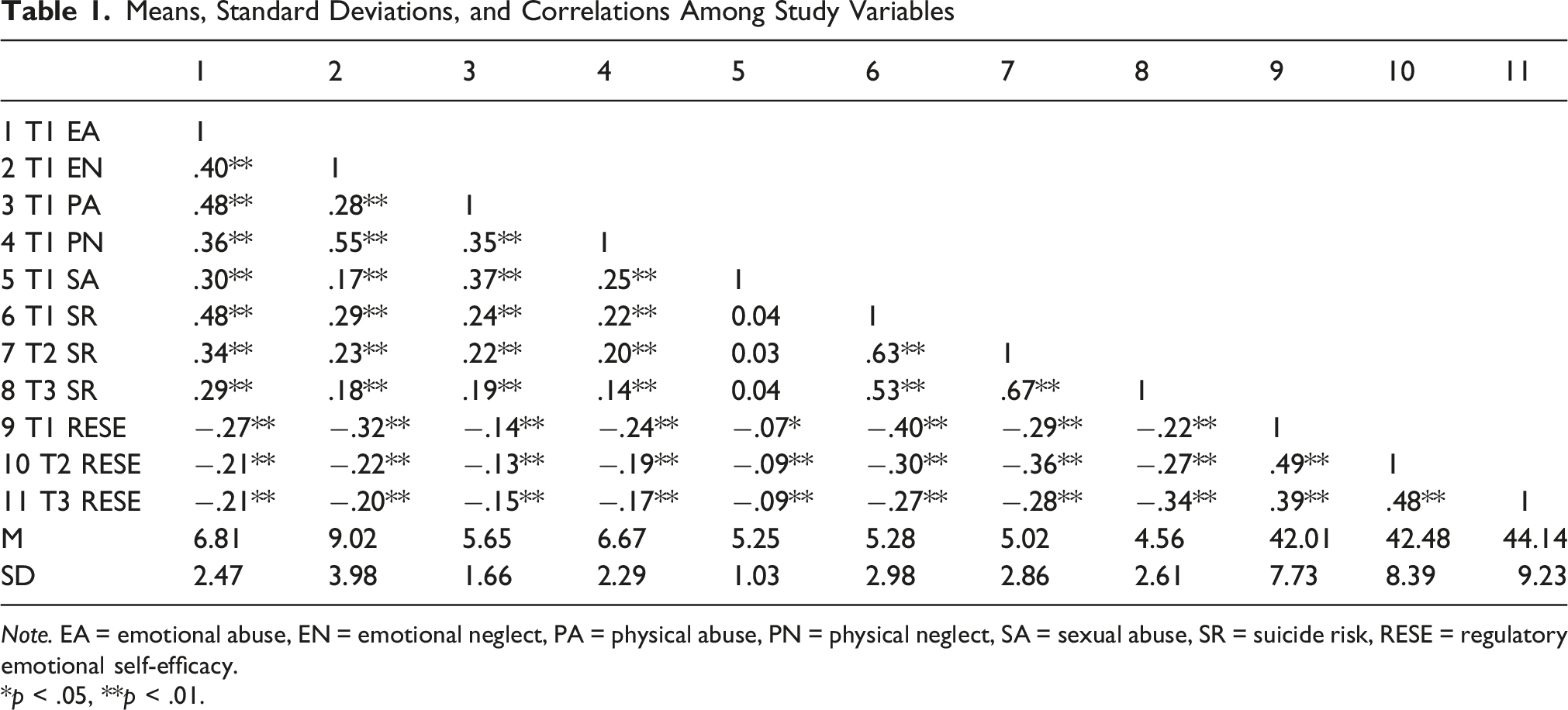
Note. EA = emotional abuse, EN = emotional neglect, PA = physical abuse, PN = physical neglect, SA = sexual abuse, SR = suicide risk, RESE = regulatory emotional self-efficacy.
*p < .05, **p < .01.
The result of gender differences test revealed that girls reported significantly higher suicide risk than boys at all three assessments (T1: t = −5.60, p < .001; T2: t = −4.53, p < .001; T3: t = −5.16, p < .001). RESE scores were lower among girls than boys at T1 (t = 3.16, p = .002) and T2 (t = 2.72, p = .007), but no significant difference emerged at T3 (t = 0.84, p = .40). No significant gender difference was observed in childhood emotional abuse and neglect at T1 (t = 1.12, p = .26).
Network Analysis
Network analysis was conducted using only baseline (T1) data to examine the cross-sectional relationships among five types of childhood maltreatment, suicide risk, and RESE. The network (Figure 1) comprised seven nodes: emotional abuse (EA), emotional neglect (EN), physical abuse (PA), physical neglect (PN), sexual abuse (SA), suicide risk (SR), and RESE. After EBICglasso regularization, 17 of 21 possible edges (80.95%) were retained. Four edges were shrunk to zero: SR–SA, PA–RESE, EN–SA, and SA–RESE, indicating no direct associations between these variable pairs after controlling for other nodes. The absolute partial correlations of retained edges ranged from 0.03 to 0.44 (mean = 0.14). The strongest edge was between EN and PN (0.44), followed by EA–SR (0.29) and RESE–SR (−0.29). Negative edges (e.g., RESE–SR) indicate an inverse relationship: higher RESE is associated with lower suicide risk. Regarding associations between maltreatment types and suicide risk, EA showed the strongest positive association with SR (0.29), followed by EN (0.06). PA (0.04) and PN (0.03) showed weak positive associations, whereas SA was not directly associated with SR (edge shrunk to zero). RESE was negatively associated with all maltreatment types (strongest with EA, EN, and PN) and showed a moderate negative association with SR (−0.29). The complete list of edge weights (partial correlations) is provided in Supplemental Table S1. Network Structure of Five Types of Childhood Abuse, RESE and Suicide Risk at T1. Note. Lines (edges) between nodes represent partial correlation coefficients between variables, with blue solid lines indicating positive correlations and red dashed lines indicating negative correlations. The width and color saturation of the edges reflect the strength of the associations. EA = emotional abuse, EN = emotional neglect, PA = physical abuse, PN = physical neglect, SA = sexual abuse, SR = suicide risk, RESE = regulatory emotional self-efficacy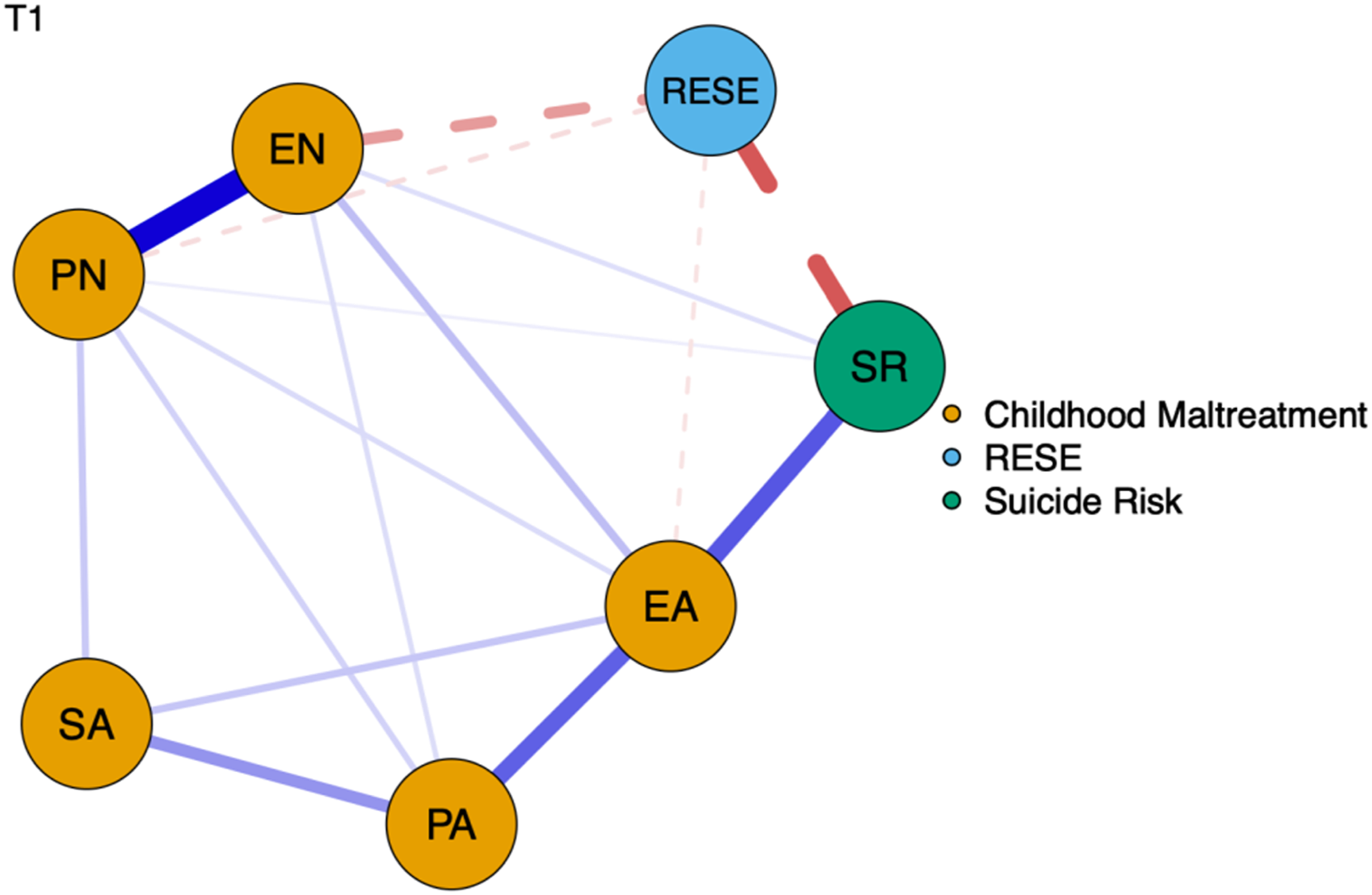
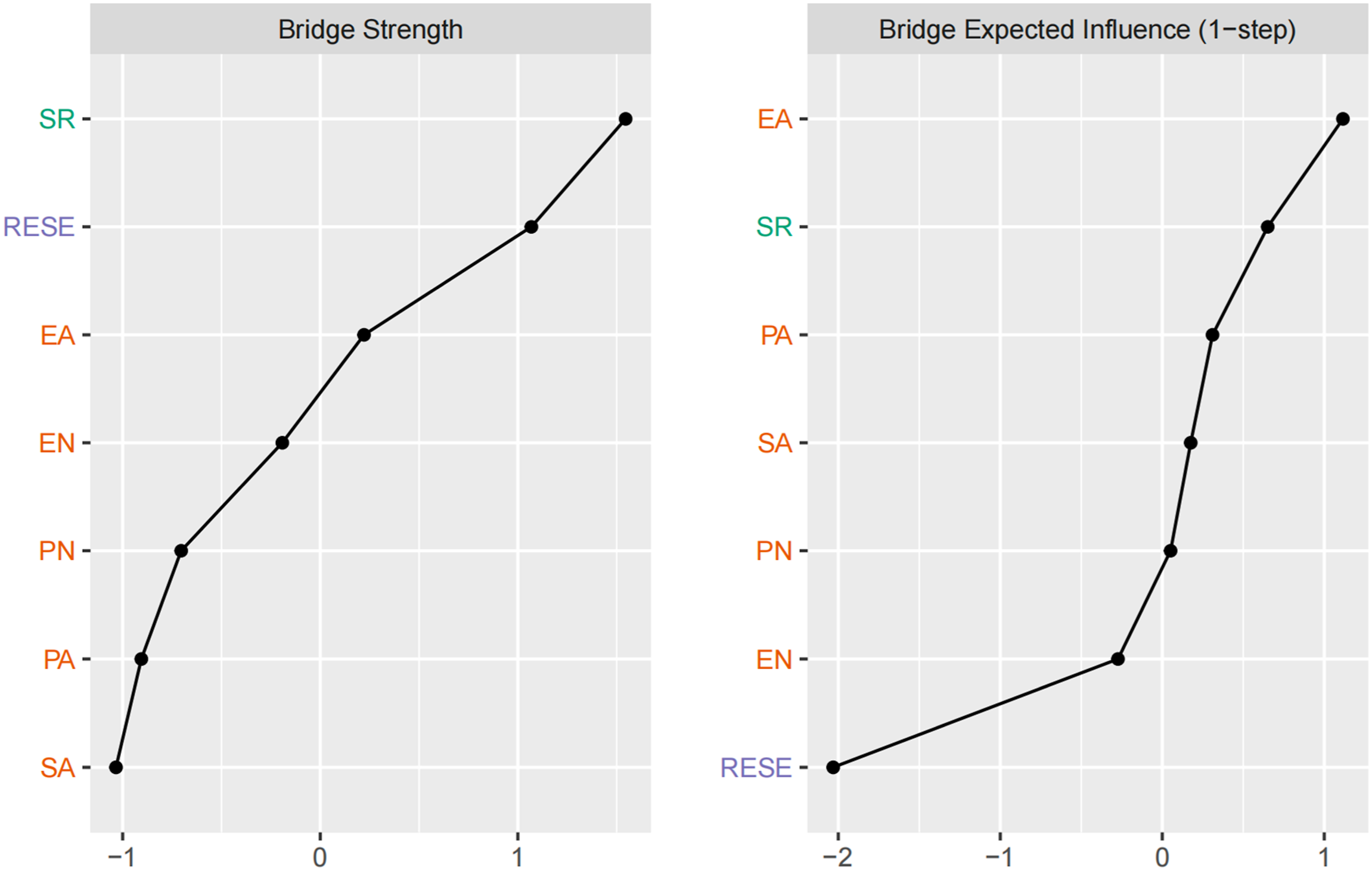
Node centrality (Figure 2) indicated that EA exhibited the highest Strength (Z = 1.28) and Expected Influence (Z = 1.32), followed by EN (Strength Z = 1.03, Expected Influence Z = 0.24). RESE showed negative Expected Influence (Z = −1.85), consistent with its protective role. Bridge centrality analysis (Figure 3) revealed that suicide risk had the highest bridge strength (0.71), followed by RESE (0.57), indicating that suicide risk receives influence from the maltreatment cluster and RESE. Among maltreatment types, emotional abuse showed the highest bridge strength (0.34) and bridge expected influence (0.25), confirming its role as a key connector between the maltreatment cluster and other nodes. RESE exhibited negative bridge expected influence (−0.57), consistent with its inhibitory function across communities. Detailed centrality indices (raw and standardized Z scores) for all nodes are presented in Supplemental Table S2. Centrality indices for each node of the Network. Note. Strength (left panel) and Expected Influence (right panel) are presented as standardized z-scores. Higher values indicate greater centrality. EA = emotional abuse, EN = emotional neglect, PA = physical abuse, PN = physical neglect, SA = sexual abuse, SR = suicide risk, RESE = regulatory emotional self-efficacy Bridge centrality indices for each node of the Network. Note. Bridge Strength (left panel) and Bridge Expected Influence (right panel) are presented as standardized z-scores. Higher values indicate greater centrality. EA = emotional abuse, EN = emotional neglect, PA = physical abuse, PN = physical neglect, SA = sexual abuse, SR = suicide risk, RESE = regulatory emotional self-efficacy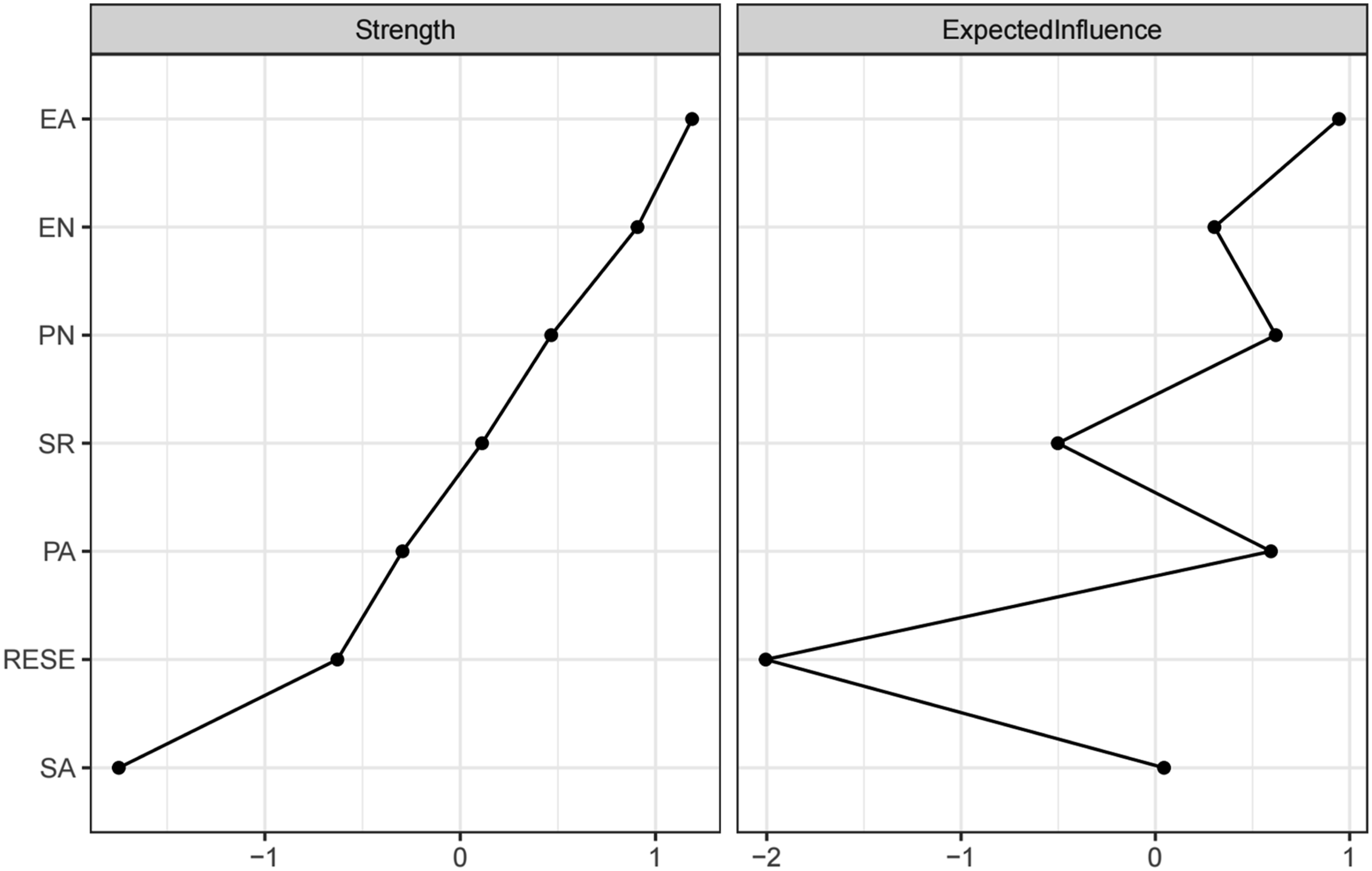
Network stability testing showed that non-parametric bootstrap estimates of edge weights had narrow 95% confidence intervals, with high overlap between the bootstrapped values and original sample estimates, indicating good precision of edge weight estimation (Supplemental Figures S1). Case-dropping bootstrap yielded correlation stability coefficients (CS-coefficient) of 0.75 for Strength, Expected Influence, and bridge expected influence, all exceeding the recommended threshold of 0.50 (Epskamp et al., 2018), indicating excellent stability. The stability curves remained above 0.7 even after removing up to 75% of the sample, further confirming the reliability of the centrality estimates (Supplemental Figures S2).
These findings indicated that emotional abuse and emotional neglect constitute the core types of childhood maltreatment most robustly linked to adolescent suicide risk, thereby confirming Hypothesis 1. Building on these results and the prior literature, this study combined the scores of both types and further investigated the longitudinal mechanisms through which childhood emotional abuse and neglect experiences influence adolescent suicide risk trajectories.
Univariate Latent Growth Models
Model Fit Indices for Developmental Trajectories of Suicide Risk and RESE

Note. I M = the mean of intercept, S M = the mean of slope, I SD = the standard deviation of intercept, S SD = the standard deviation of slope, I with S = the relationship between intercept and slope.
*p < .05, **p < .01, ***p < .001.
Multivariate Latent Growth Mediation Model
Based on the network analysis results that identified emotional abuse and emotional neglect as the core types most strongly linked to suicide risk, and given that both are forms of emotional maltreatment that jointly impair the self-system (Cicchetti & Toth, 2009), the following longitudinal analyses focused exclusively on these two types to examine their combined predictive effects on suicide risk trajectories and the mediating role of RESE. A multivariate latent growth mediation model was constructed to analyze the mediating role of RESE between emotional abuse & neglect and suicide risk, with gender included as a control variable. The goodness-of-fit indices indicated excellent model fit: χ
2
(13) = 64.42, CFI = 0.98, TLI = 0.96, RMSEA = 0.056, SRMR = 0.019. The final model is presented in Figure 4. Multivariable LGM of Emotional Abuse and Neglect, RESE and Suicide Risk. Note. EA & EN = emotional abuse and neglect, RESE = regulatory emotional self-efficacy, SR = suicide risk. *p < .05, **p < .01, ***p < .001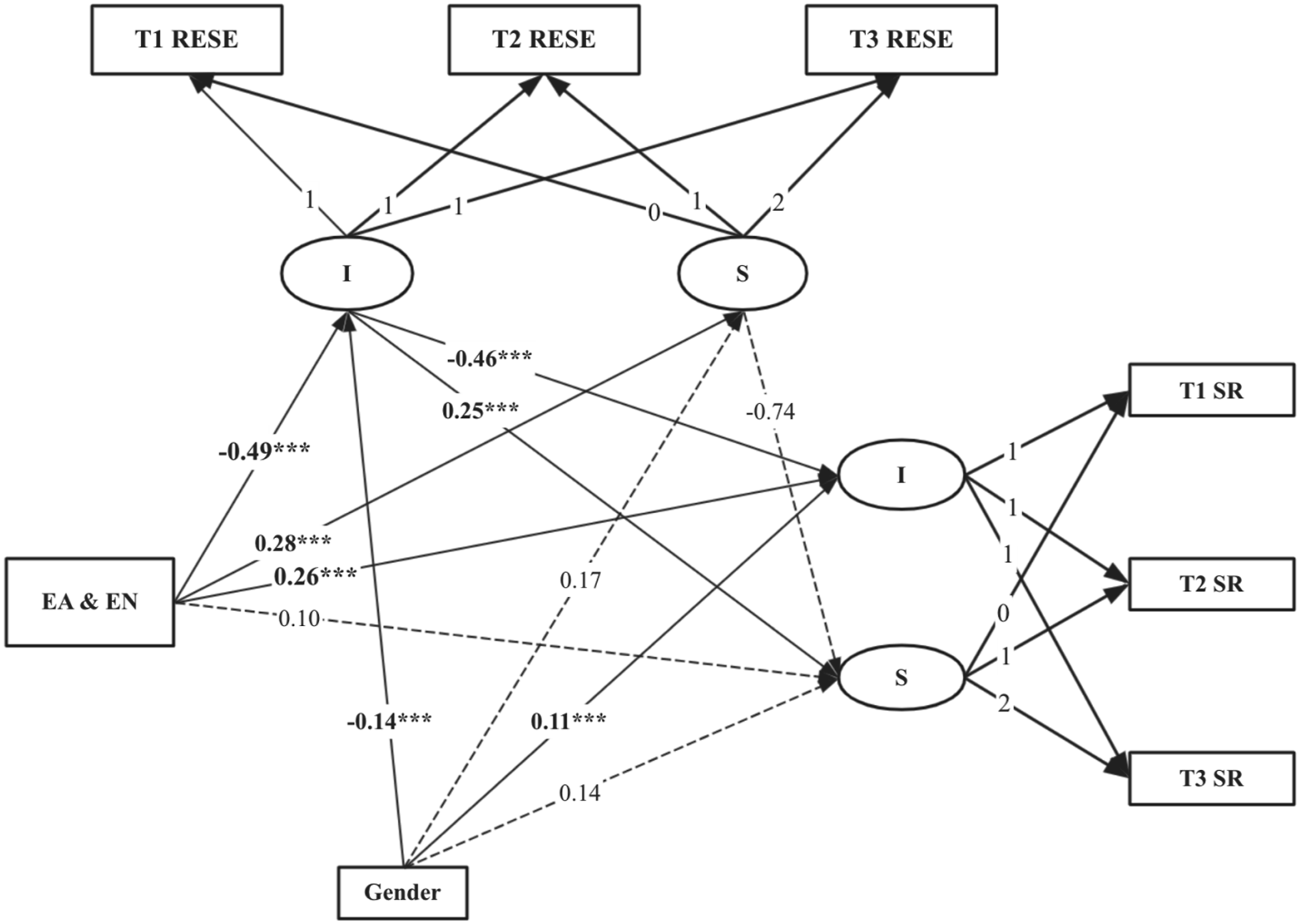
Emotional abuse and neglect at T1 were significantly associated with a higher baseline level of suicide risk (β = 0.26, p < .001), a lower baseline level of RESE (β = −0.49, p < .001), and a steeper increasing developmental trend of RESE (β = 0.28, p < .001). However, emotional abuse and neglect showed no significant effect on the changing trend of suicide risk (β = 0.10, p = .62). These findings suggested that adolescents with more severe childhood psychological maltreatment experiences exhibited lower initial level of RESE and higher initial level of suicide risk, and greater improvement on RESE over time. The baseline level of RESE was associated with a lower baseline level of suicide risk (β = −0.46, p < .001) and a faster rate of decline in suicide risk over time (β = 0.25, p < .001), indicating that higher RESE at T1 was associated with lower initial level of suicide risk and accelerated risk reduction over time.
Mediation Effects of Multivariate LGM
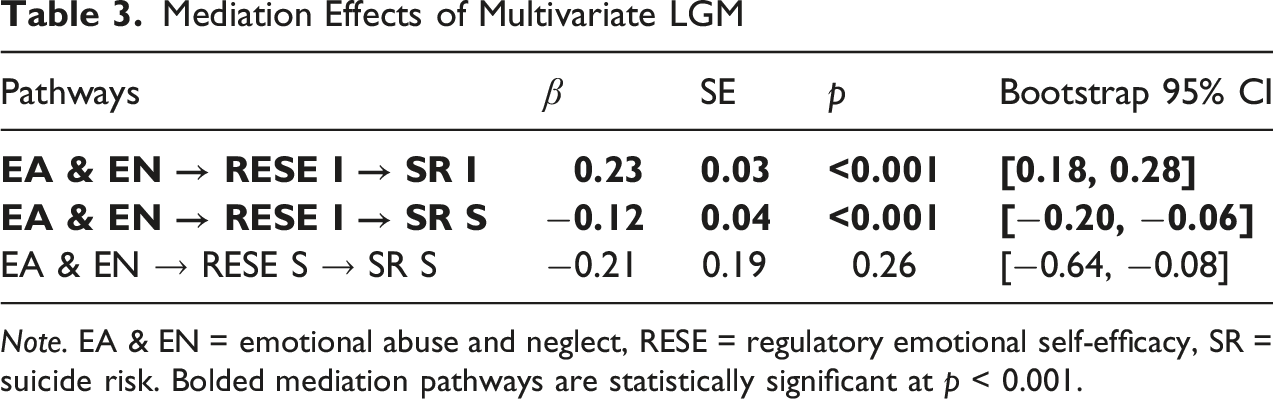
Note. EA & EN = emotional abuse and neglect, RESE = regulatory emotional self-efficacy, SR = suicide risk. Bolded mediation pathways are statistically significant at p < 0.001.
Discussion
Prior research examining the relationship between childhood maltreatment and adolescent suicidality has predominantly treated maltreatment as a unitary construct or focused on isolated subtypes, with cross-sectional designs limiting insights into the dynamic mechanisms through which core types of childhood adversity influence suicide risk trajectories. To address these gaps, guided by developmental psychopathology frameworks and the IPTS, this study first used network analysis to identify core types of childhood maltreatment (i.e., emotional abuse and neglect) and then employed latent growth modeling to examine longitudinal associations among these identified core types, RESE and suicide risk among Chinese early adolescents. The findings revealed that emotional abuse and neglect emerged as central types within the network, directly predicting baseline levels of adolescent suicide risk. RESE partially mediated the association between emotional abuse and neglect and baseline levels of suicide risk, while fully mediating the developmental trajectory of suicide risk. These findings advance our understanding of the dynamic mechanisms underlying suicide risk in early adolescence.
Emotional Abuse and Neglect as the Core Types of the Network
Network analysis revealed unequal significance among childhood maltreatment subtypes within the network. Emotional abuse emerged as the most central type, demonstrating the highest node strength, Expected Influence, bridge strength, and bridge Expected Influence, with robust connections to all other four subtypes, thereby constituting the core node of the network and serving as a key connector between the maltreatment cluster and other nodes. Moreover, emotional abuse and neglect exhibited the strongest direct connections to suicide risk, indicating that emotional maltreatment is a stronger predictor of suicide risk among Chinese early adolescents than physical maltreatment—a finding consistent with Hypothesis 1. This pattern further validates the IPTS and aligns with recent empirical studies (Gong & Zhou, 2025; Peng et al., 2023). Although physical abuse often co-occurs with emotional maltreatment (Norman et al., 2012), a growing body of literature suggests that emotional abuse and neglect may have unique and more persistent detrimental effects on cognitive and emotional functioning. Unlike physical abuse, which is often episodic and may leave visible signs, emotional abuse and neglect are typically chronic, invisible, and embedded in daily parent-child interactions. These features make them particularly harmful to the developing self-system, including self-worth, emotion regulation, and interpersonal trust (Cicchetti & Toth, 2005; Teicher & Samson, 2016). This pattern has been observed across diverse cultural contexts, including Western and Chinese samples, suggesting that the unique impact of emotional maltreatment is not culture-specific but rather reflects fundamental developmental processes (Spinazzola et al., 2014; Zhang et al., 2024). While physical and sexual abuse are undoubtedly severe, emotional abuse and neglect often operate through insidious, cumulative mechanisms that are easily overlooked. Their inherent complexity and hidden nature lead to underestimation by society (Ye et al., 2024): because there are no physical scars, parents, teachers, and even victims themselves may normalize such experiences (e.g., viewing harsh verbal discipline as “for the child’s good”), thereby allowing chronic harm to accumulate and manifest as internalizing problems over time.
This pattern differs from the findings of Berardelli et al. (2022), who reported a direct effect of sexual abuse on suicidal ideation in adult psychiatric inpatients. In the present Chinese adolescent community sample, sexual abuse showed a weaker association with suicide risk than emotional abuse and neglect. Several factors may explain this discrepancy. First, the difference in sample characteristics (clinical inpatients vs. community adolescents) may partly account for the divergent findings. Second, cultural factors likely play a role. Research on Chinese child sexual abuse survivors has identified that children’s shame due to social and cultural stigmatization of sexuality, along with fear of retaliation and fear of harming family relationships, is a significant barrier to disclosing sexual abuse experiences (Tian et al., 2024), thereby attenuating the observed association between sexual abuse and suicide risk.
Developmental Trends of Suicide Risk and RESE
By constructing separate univariate LGM, this study investigated the developmental trajectories of suicide risk and RESE among Chinese middle school students over a 12-month period. Suicide risk exhibited an overall declining trend, consistent with prior research (Shen et al., 2024; Wang et al., 2025). This declining pattern aligns with the core premise of Positive Youth Development (PYD) theory, which posits that adolescents are not passive containers of risk but active agents capable of adaptive growth (Damon, 2004; Lerner et al., 2005). Several factors may account for this decline. First, the transition to middle school represents a critical adaptation period. Although initial adjustment may be stressful, as adolescents gradually adapt to school routines, academic expectations, and peer networks, their sense of competence and belonging improves, which can buffer against suicidal ideation (Eccles et al., 1993). With increasing adaptation to the middle school environment, adolescents may build new peer relationships and receive teacher support, thereby enhancing psychological resilience and reducing suicide risk. Second, early adolescence is marked by rapid cognitive growth, including improvements in abstract reasoning, future-oriented thinking, and problem-solving skills (Sisk & Gee, 2022). These cognitive advances enable adolescents to reframe negative experiences and generate alternative coping strategies, reducing the likelihood of suicidal thoughts. Third, contextual factors within a single school year, such as teacher support and extracurricular involvement, can promote psychological resilience (Lerner et al., 2005). Together, these developmental and environmental changes contribute to a normative decline in suicide risk during the first year of middle school.
Concurrently, RESE showed a general upward trajectory. Several mechanisms may explain this increase. First, the middle school transition involves a process of adaptation: initial uncertainty and stress are common, but as adolescents gradually adjust to new academic demands and social norms, their confidence in managing emotions improves (Aikins et al., 2005; Eccles et al., 1993). Second, cognitive maturation strengthens self-efficacy in emotion regulation through enhanced metacognitive abilities and perspective-taking (Sisk & Gee, 2022). Third, the transition to middle school marks a shift in adolescents’ primary activity setting from family to school, making peers an increasingly important source of social interaction. Successful peer interactions provide positive feedback and role modeling, which can enhance regulatory emotional self-efficacy (Aikins et al., 2005). Moreover, peer support may partially compensate for perceived family deficiencies, further enhancing confidence in regulating emotions (Romeo, 2010). Thus, despite the challenges of early adolescence, the school environment, cognitive development, and adaptive processes collectively foster an upward trend in RESE.
Notably, although suicide risk showed a general declining trend, significant individual heterogeneity existed in its developmental trajectory. The intercept and slope of suicide risk were significantly negatively correlated, indicating that adolescents with higher initial suicide risk exhibited slower rates of decline. Higher initial suicide risk may reflect accumulated psychological distress, limited emotion regulation resources, or weak social support networks, which collectively impede the normative decline of risk (Oppenheimer et al., 2022). Moreover, significant individual differences were observed in both suicide risk and RESE trajectories. This pattern aligns with the PYD perspective that developmental trajectories are not uniform but depend on complex person-environment interactions (Lerner et al., 2005). Some adolescents are able to mobilize internal and external resources to achieve positive growth despite adversity, whereas others may remain in a persistent state of risk. These findings underscore the necessity of targeted interventions for adolescents with elevated initial suicide risk to interrupt the “high risk-slow decline” cycle and promote positive development.
Relationships Among Emotional Abuse and Neglect, RESE, and Suicide Risk
The results indicated that emotional abuse and neglect were associated with an increased baseline level of suicide risk, partially supporting Hypothesis 2 and aligning with prior research (Pollock et al., 2024; Zhong et al., 2024). However, emotional abuse and neglect did not significantly predict the developmental rate of suicide risk. One possible explanation is that for adolescents entering middle school, teachers and peers gradually become important sources of social support outside the family (Furman & Buhrmester, 1992). Grounded in Social Support Theory (Lan et al., 2023), adolescents with high social support are better able to utilize the psychological resources provided by social support when facing setbacks and stressful situations, thereby mitigating the impact of negative emotions on mental health. Therefore, good teacher-student relationships and peer relationships may buffer the negative emotions stemming from adverse childhood experiences, thereby reducing adolescents’ suicide risk (Miller et al., 2015).
Consistent with developmental psychopathology perspectives and prior findings (Ying et al., 2020; Zeng et al., 2018), emotional abuse and neglect negatively predicted the baseline level of RESE. Paradoxically, it was associated with a steeper increase in RESE over time—a finding that may be explained by two reasons. First, traditional Chinese educational beliefs hold that “harsh discipline conveys familial love” and that “to spare the rod is to spoil the child.” In such a cultural context, some parents may view beating and scolding their children as a form of care and education instead of maltreatment (Ling & Kwok, 2017). As adolescents grow and their cognitive abilities improve, they may start to adopt a dialectical perspective on their parents’ beatings and scoldings, accepting and understanding this inappropriate disciplinary method. This cognitive reappraisal process appears to enhance their perceived efficacy in regulating negative emotions. Secondly, as adolescents enter middle school, their primary activity setting gradually shifts from the family to the school, and peer relationships significantly increase, potentially compensating for the limited social support they receive from their family. Social support from peers can buffer the adverse effects of the family (Romeo, 2010), gradually enhancing adolescents’ confidence in their emotional regulation abilities.
Furthermore, the initial level of RESE negatively predicted the initial level of suicide risk and a faster rate of decrease in suicide risk over time. RESE fosters adaptive emotion regulation strategies over maladaptive avoidance or suppression, thereby reducing the accumulation of hopelessness and helplessness—core affective drivers of suicidality (Bandura et al., 2003; Alessandri et al., 2023). This reduction in hopelessness is notable because hopelessness has been shown to mediate the link between childhood maltreatment and suicidal ideation (Berardelli et al., 2022). This also indicates that, despite the difficulty in changing past negative experiences, there is still considerable room to intervene in adolescents’ suicide risk, for example, by enhancing RESE.
The Mediating Role of RESE
Mediation path analyses identified two significant pathways, partially validating Hypothesis 3 (childhood emotional abuse and neglect experiences indirectly influenced both the baseline level and developmental trajectory of suicide risk through the initial level of RESE).
First, the initial level of RESE partially mediated the association between emotional abuse and neglect and the initial level of suicide risk. Specifically, psychological maltreatment negatively predicted the initial level of RESE, which in turn negatively predicted the initial level of suicide risk. These findings further support the buffering hypothesis of suicide (Johnson et al., 2011), which posited that positive cognition and belief can mitigate the impact of trauma on suicidal ideation and behaviors.
Second, the initial level of RESE fully mediated the relationship between emotional abuse and neglect and the developmental trajectory of suicide risk. In other words, emotional abuse and neglect indirectly slowed the decline of suicide risk over time by reducing RESE’s baseline level. This result reinforced developmental psychopathology perspectives, suggesting that adolescents with experiences of childhood maltreatment, having failed to develop adequately at the appropriate age, are more likely to encounter difficulties in handling subsequent developmental tasks and are more prone to adopting maladaptive regulatory strategies such as self-harm or suicide due to poor adaptation (Cicchetti & Toth, 1995; Kwok et al., 2019). Chronic maltreatment may disrupt normative emotion regulation development (Yates, 2004), perpetuating low RESE as a persistent vulnerability that hinders the reduction of suicide risk.
In summary, while emotional abuse and neglect compromises RESE, RESE itself exerts protective effects by lowering initial level of suicide risk and accelerating its decline. Thus, future prevention and intervention efforts should prioritize equipping adolescents with emotion regulation skills and cultivating RESE, creating a virtuous cycle to reduce suicide risk.
Limitations and Implications
This study has several limitations. First, the sample was restricted to seventh- and eighth-grade students from a single middle school in central China, limiting the generalizability of findings to broader populations. Future studies should expand recruitment across multiple regions to enhance representativeness. Second, reliance on self-report measures may introduce biases such as social desirability or recall inaccuracies, particularly for retrospective assessments of childhood maltreatment. Future studies could benefit from employing multiple-informant methods to strengthen validity. Third, the 12-month longitudinal design captured only short-term dynamics; longer follow-ups spanning critical developmental transitions are needed to examine how RESE and suicide risk trajectories evolve across adolescence. Additionally, Angelakis et al. (2020) covered young people up to age 25; longer follow-ups are needed to test whether RESE’s mediating role persists beyond early adolescence. Fourth, the present study did not examine cumulative ACE severity scores. Leiting et al. (2024) found that ACE severity predicts outcomes through self-efficacy over 10 years; future research could adopt severity-weighted measures. Finally, future research could also examine whether RESE and hopelessness operate as sequential mediators between childhood maltreatment and suicide risk, as prior work has identified hopelessness as a mediator in this pathway (Berardelli et al., 2022).
The study also provides several theoretical and practical implications. Theoretically, this study extended prior research by innovatively applying network analysis to identify core types of childhood maltreatment (emotional abuse and emotional neglect) most salient to suicide risk, while elucidating RESE’s longitudinal mediating mechanisms. These insights deepen understanding of how culturally specific maltreatment patterns shape suicidality in Chinese early adolescents. Practically, the findings underscore RESE’s role in mitigating the long-term impacts of negative experiences and accelerating the reduction of suicide risk. School educators can implement targeted mental health curricula to enhance RESE through emotion regulation skill-building, particularly for high-risk adolescents with elevated baseline suicidality. For instance, teacher-led workshops could integrate role-playing scenarios to practice adaptive coping strategies, fostering a virtuous cycle where improved RESE reinforces resilience against future stressors.
Conclusion
The findings demonstrated that emotional abuse and emotional neglect constitute core types within the childhood maltreatment network most robustly linked to adolescent suicide risk, suggesting that emotional maltreatment exerts more enduring mental health impacts compared to other subtypes. While RESE exhibited an upward developmental trajectory and suicide risk a downward trend overall—signaling positive adaptation in most adolescents—those with higher baseline suicide risk showed slower rates of improvement, necessitating prioritized intervention. Critically, RESE served as a longitudinal mediator between emotional maltreatment and suicide risk trajectories. These results provided novel insights into the understanding of the relationship between childhood maltreatment and adolescent suicide, and offer necessary information for effective measures to reduce suicide risk in early adolescence.
Supplemental Material
Supplemental Material - Childhood Emotional Maltreatment, Regulatory Emotional Self-Efficacy, and Suicide Risk in Chinese Adolescents: A Network Analysis and Latent Growth Modeling Approach
Supplemental Material for Childhood Emotional Maltreatment, Regulatory Emotional Self-Efficacy, and Suicide Risk in Chinese Adolescents: A Network Analysis and Latent Growth Modeling Approach by Zhongjie Wang, Fuqu Liu, Juanjuan Zheng, Kaiyuan Lu, and Xuezhen Wang in The Journal of Early Adolescence
Footnotes

Ethical Considerations
All procedures performed in this study were in accordance with the recommendations of the Research Ethics Committee of the first authors’ institution (Approval No. ZZUIRB2022-023) and with the 1964 Declaration of Helsinki.
Consent to Participate
Informed consent was obtained from all individual participants included in the study.
Funding
The authors disclosed receipt of the following financial support for the research, authorship, and/or publication of this article: This work was supported by the National Social Science Foundation of China (24BSH116).
Declaration of Conflicting Interests
The authors declared no potential conflicts of interest with respect to the research, authorship, and/or publication of this article.
Data Availability Statement
The data used and/or analyzed during the current study are not publicly available in order to protect participants privacy but are available from the corresponding author on reasonable request.
Supplemental Material
Supplemental material for this article is available online.
Author Biographies
References
Supplementary Material
Please find the following supplemental material available below.
For Open Access articles published under a Creative Commons License, all supplemental material carries the same license as the article it is associated with.
For non-Open Access articles published, all supplemental material carries a non-exclusive license, and permission requests for re-use of supplemental material or any part of supplemental material shall be sent directly to the copyright owner as specified in the copyright notice associated with the article.
