







Abstract
Keywords
Clinical practice guidelines (CPGs) provide health care recommendations and are meant to help both clinicians and patients make decisions about their health care. 1 However, CPGs have traditionally been developed to communicate information to clinicians, but CPGs could provide very useful information to the general population, that is, patients (including carers) and other members of the public. There is a wealth of information in CPGs, such as information about the effects of tests or treatments, the quality of that evidence, and clear recommendations that factor in patient values and preferences, resources, feasibility, and other issues such as equity. 2 To tailor this information to patients, guideline producers could consider the expanding evidence base about how to produce patient information and for what purpose. Dixon-Woods 3 has identified a variety of purposes for patient information to educate and empower. Information to educate people is traditionally about conditions and treatments to save time during consultations and to enhance compliance with recommendations. In contrast, materials for patient empowerment build upon patient education and also include information to help people consider their own experiences, preferences, and resources to inform decisions. 3 While building on the research for communicating research to patients is helpful, our recent systematic review of the literature about patient and public attitudes to CPGs found that there may be unique factors to consider when communicating guidelines. 4 Our review found that people may not always perceive guidelines positively. Some people thought CPGs could limit their decision making by providing rules about their treatment options, may not be trustworthy or credible, and may not be applicable to their own situations. Nevertheless, others thought that patient versions of CPGs could provide information about how to manage their own care, could be used as a tool when speaking with their health care providers, and could potentially help them make decisions if the right information was provided.
Although attention has recently been directed toward the development of patient decision aids to help people participate in health care decisions that are based on guideline recommendations,5,6 a number of guideline producers have already been developing patient versions of CPGs: SIGN (Scottish Intercollegiate Guidelines Network) has produced over 30 patient versions based on its CPGs, and NICE (National Institute for Health and Care Excellence) has over 150 CPG patient versions available. A survey conducted by Kryworuchko and colleagues 7 from 1994 to 2005 found that 42% of guideline producers are targeting patients with versions different from the CPGs, and a recent review of international programs to involve patients and the public revealed that 18 of 71 of the organizations involve patients in the development of products for patients and the public based on CPGs. 8 Given this work, guideline producers now have the opportunity to learn from what is currently being developed and build on that knowledge base while considering the unique factors that may play a role in the use of guidelines by patients and the public. The aim of this descriptive qualitative study is to describe patient versions of CPGs available using a directed content analysis. We include a description of the format of patient versions and the content, with a particular focus on the stated and latent purposes of the patient versions. Based on the analysis, we describe the landscape of patient versions, compare it to the views of patients and the public, and make suggestions for future research.
Methods
Study Design
We conducted a qualitative descriptive study with a directed content analysis of a sample of patient versions available from key institutions producing CPGs. 9 A directed content analysis is a research method used to systematically classify and analyze the text from documents. While content analysis can be quantitative (e.g., counting the frequency in which certain words are used), the qualitative analysis used in this study allows for an interpretation of the text to identify explicit and inferred meanings. 9 Below are the detailed methods we used to describe the characteristics of the patient versions, summarize and quantify the type of information provided, identify the purpose of the patient versions, and briefly describe how recommendations and evidence are communicated.
Sample: Identification of Patient Versions
Because our overarching aim is to learn from guideline producers with experience currently producing patient versions, we conducted a search to identify patient versions of CPGs published between 2012 and April 2014 by key institutions producing guidelines or recommendations. We defined a key institution as a national, public, or professional organization with a mandate to produce guidelines and which had produced at least 6 clinical guidelines since January 2012. To develop the list of key institutions, we reviewed the members’ list of a large guideline network: the GRADE Working Group (an informal international group of people interested in methods for guideline development), including members of GRADE’s DECIDE project (a project for Developing and Evaluating Communication Strategies to Support Informed Decisions and Practice Based on Evidence). We visited the websites of those institutions to search for patient versions. We also searched databases that include guidelines: the International Guideline Library produced by the Guidelines International Network (GIN), the CMA Infobase (a database of guidelines from the Canadian Medical Association); the National Health and Medical Research Council Clinical Practice Guidelines Portal from Australia; and the NICE Evidence Search in the United Kingdom. We searched these databases for guidelines produced between 2012 and 2014 by restricting to those dates. We organized the search from each database by organization and then deleted institutions that produced fewer than 6 guidelines. We visited the websites of those institutions to determine if they had produced patient versions (see inclusion criteria below for a definition of patient version). We also searched the National Guideline Clearing House (NGC) using the advanced search and restricted to 2012–2014 and used the filter for “only include guidelines that have/incorporate: patient resources” to find institutions producing patient versions. One investigator screened through the institutions from the search using the a priori inclusion criteria. We compiled a list of all included institutions and a list of all patient versions according to the criteria below.
Inclusion Criteria
From each institution, we randomly sampled 2 patient versions produced between January 2012 and April 2014 by using the random function in Excel. The selection of 2 samples was based on a preliminary analysis of 4 patient versions from 2 institutions that, when analyzed, had provided very similar results. We included patient versions that met all of the following criteria: 1) defined as a patient version/information by the organization; 2) based on a CPG or recommendations for clinicians; 3) produced by organizations with experience producing patient versions, indicated by more than 4 topic-specific patient versions produced between 2012 and 2014; 4) available publicly; and 5) published in English.
Data Extraction
We took a directed (deductive) approach to content analysis as described by Hsieh and Shannon. 10 We developed a coding form and data abstraction sheet for manifest and latent content based on categories informed by the literature about patient education materials and research into disseminating guidelines and recommendations to practitioners.2–4,11 Key components of the patient versions were extracted: format of the patient versions (e.g., length, booklet), types of information provided (background, tests or treatments, evidence, recommendations, and additional information), the purpose of the patient versions, and communication of recommendations and evidence (see Supporting Information for the key components extracted and themes). We used the work from Dixon-Woods 3 to develop a list of the purposes of patient versions; we identified recommendations using the criteria outlined by Hussain and others 11 ; identified important factors unique to guideline recommendations, such as patient values and preferences using the GRADE approach 2 ; and used the themes found in the systematic review of patient and public attitudes toward CPGs (personalization, credibility, purpose, and format issues). 4 Two investigators piloted the form using 4 patient versions and discussed results to check intercoder reliability and consistency, and then revised the form accordingly. They independently extracted the data and compared. When new categories arose during data extraction, the investigators discussed and agreed and reextracted data from the documents.
Data Analysis
Data were managed using an electronic database. The 2 investigators compared the quantitative data abstracted for discrepancies and resolved disagreements. We calculated frequency data as proportions of guidelines that included a component and calculated a median and interquartile range (IQR) for continuous data (e.g., percentage of document that was background information). For content related to the purpose of the documents, we created separate tables and compared our assessment of the presence or absence of a purpose. Disagreements were discussed between the 2 investigators until consensus was reached. We provided a qualitative description of the purpose of the patient versions and illustrated the purpose through examples.
Results
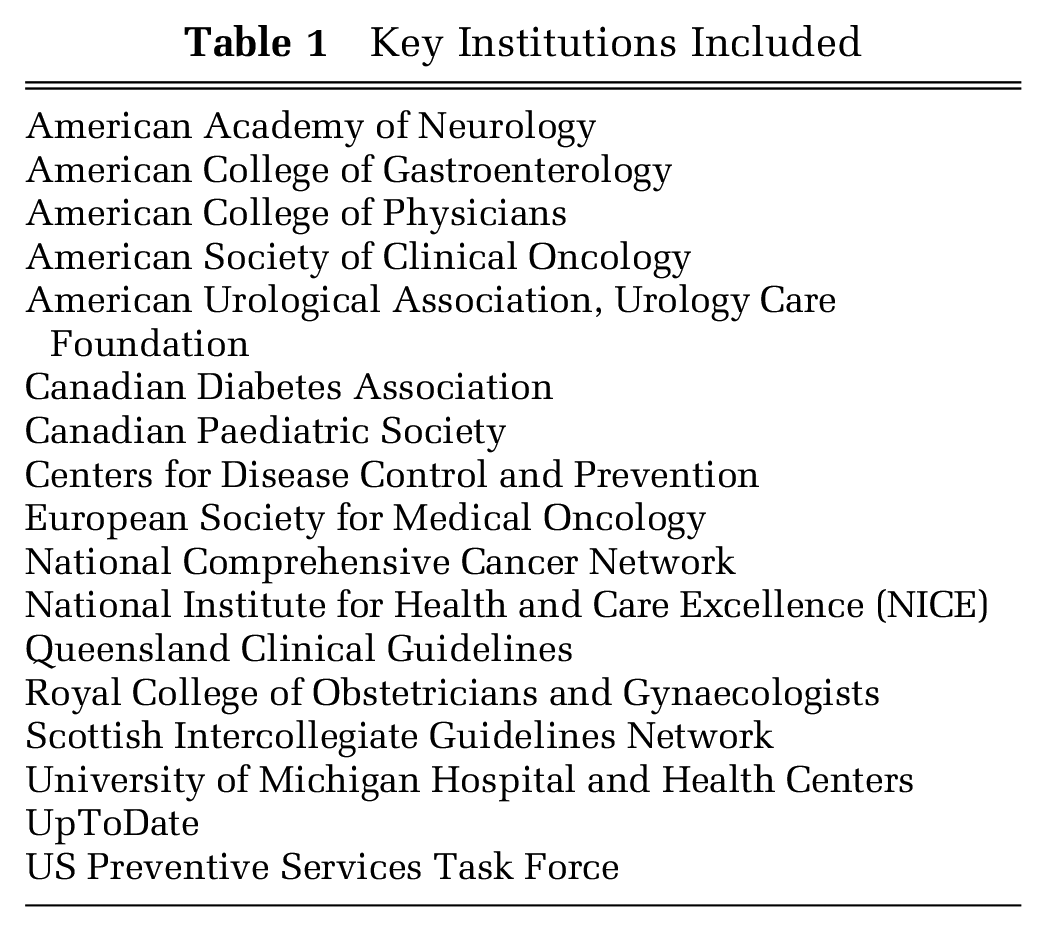
We found 38 key institutions that met our inclusion criteria and 21 institutions from NGC using the “patient” limits. Of these, 42 had not produced more than 4 patient versions between 2012 and April 2014. We therefore included 17 organizations that had produced from 4 to 53 patient versions each. We sampled 2 patient versions from each for a total of 34 patient versions (see Table 1). A variety of medical topics were covered, including cancer (breast, lung, prostate, esophageal, pancreatic, and melanoma), women’s health and reproduction, gastrointestinal conditions, diabetes, and mental health. Most patient versions (24/34) primarily focused on guidelines about treatment, but many also covered diagnosis, screening, and/or prevention. A summary of the characteristics of the patient versions is available in Table 2 and described below.
Key Institutions Included
General Characteristics of 34 Patient Versions
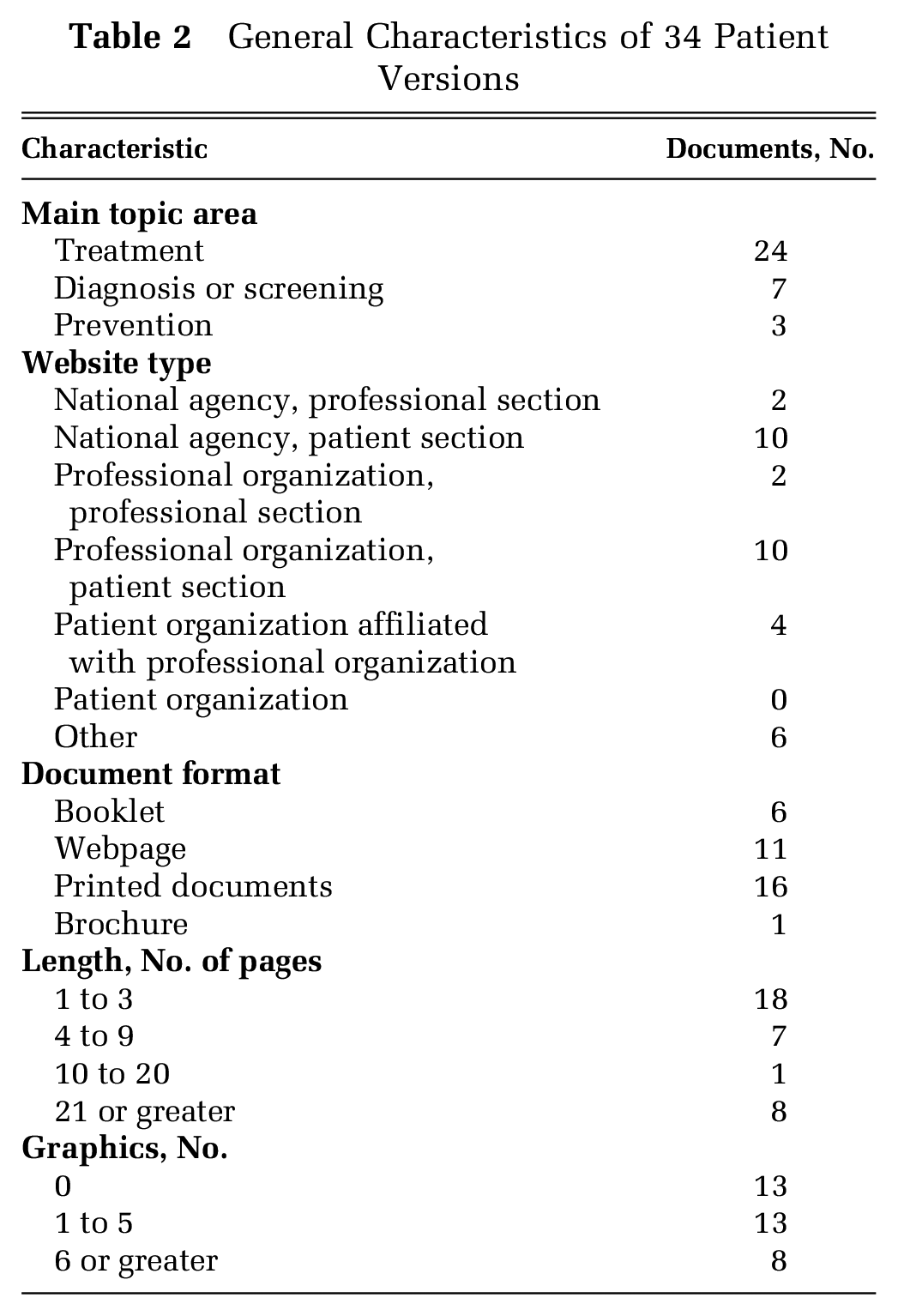
Location of Patient Versions
Over half of patient versions (20/34) were found in dedicated patient sections of national and professional agency websites (e.g., in sections “For patients” or “Patient Education”) or linked directly from the professional version of the CPG (18%). A small number (4/34) were found on patient dedicated websites that were affiliated with the professional organizations. Almost half of the patient versions (16/34) were available on websites as a printed document only and 11 of 34 as webpages, which were printable. Patient versions were called a variety of names by different organizations and were typically referred to simply as “patient information.” Thirteen indicated that they were based on guidelines. For example, the European Society for Medical Oncology (ESMO) titles its versions as “Patient information based on ESMO Clinical Practice Guidelines” and the American Academy of Neurology (AAN) as “Summary of Evidence-based Guideline for PATIENTS and their FAMILIES.”
Information Provided in the Patient Versions
The documents provided a diversity of information about the disease, anatomy, risk factors, symptoms, and incidence. However, few documents included information about the prognosis of the disease or condition. Proportionately little information consisted of background (16%; IQR, 12%–23%), and there was essentially no information (0%; IQR, 0%–6%) about the health care system or how to navigate through the system. In the documents that did provide health care system information, it typically described the health care team involved in care. A little over one-third of the documents did not include pictures, graphics, or figures, but those that did often depicted the anatomy of the body affected by the condition or disease.
Many patient versions (27/34) referred to or linked directly to the professional versions of the guidelines, but only half included a description of what a guideline is or how the guideline was developed. When guidelines were described in the patient version, it was usually at the back of the document. Emphasis was placed on the “experts” or committees of professionals and patient representatives who developed the guidelines: 21 documents stated that patients were involved in the development or review of the material. The amount of information about guidelines varied from a single statement to multiple paragraphs. NICE wrote, “NICE clinical guidelines advise the NHS [National Health Service] on caring for people with specific conditions or diseases and the treatments they should receive.” In contrast, the United States Preventive Task Force (USPSTF) patient summaries describe what are guidelines, how guidelines are produced, and how the evidence is graded. In addition to providing text within the document, SIGN also provided a link to a separate patient information booklet about the development of guidelines, and NICE included additional information on its website.
The majority (26/34) of patient versions provided links or contact information (such as telephone numbers) for additional information and support, typically at the end of the document (although sometimes within the document). However, the credibility of these links was sometimes compromised as some patient versions (4/26) also included a caveat about not being responsible for the content in those recommended sites. The majority of patient versions also encouraged people to talk to their health care provider for more information, but only 5 provided a section for “questions to ask your doctor.”
Credibility of the Information
In addition to referring to or providing a link to the professional version or providing the methods for development, the most common method used to convey credibility was the use of the logo of the professional association and, if applicable, the affiliated patient organization (32/34). NICE and the Royal College of Obstetrics and Gynaecology also referenced the Information Standard, SIGN referenced Crystal Mark/Plain English Campaign, and the Canadian Paediatric Society referenced the Health on the Net Code of Conduct.
Purpose of the Patient Versions
Twenty-one patient versions explicitly stated their purpose. All 21 aimed to educate or equip people with information. Eight stated an additional purpose: 6 stated that the goal was to empower people to obtain the “best care,” 1 version about human immunodeficiency virus (HIV) and pregnancy provided information for self-care and to stay healthy, and another about overactive bladder empowered patients to become more active by openly talking about the condition.
Our qualitative analysis identified latent purpose(s) of the patient versions and was organized into categories adapted from Dixon-Woods. 3 Although we did not find additional categories, we did refine categories. We did not find examples for some categories: persuasion for the use of specific interventions, to reassure or provide a second opinion, and to replace the health care consultation or counseling. Table 4 provides a list of the purposes we found and examples. Below we highlight these results.
Similar to the stated purpose of the patient versions, the most common purpose from our qualitative analysis was to provide education about or equip people with information about the disease, the tests or treatments, and the recommendations. Even when the document was short, it still directed people to more information and resources. Links to additional websites, telephone numbers, and names of other organizations were provided whether for background information, treatment or test information, or support. There was, however, little information about benefits and harms, and again most documents advised people to speak with their health care providers, who should provide information about the risks and benefits of treatments: “During your care and treatment, your healthcare team should give you information (including written information) about fertility problems and treatments to help you make informed decisions” (NICE, assessment and treatment for people with fertility problems). When information about benefits and harms was provided, it was generally vague, and very few patient versions provided quantitative data about how often benefits and harms occur (Table 3). For example, the guide for non–small cell lung cancer from ESMO explains that treatment “has the potential to significantly reduce the risk of disease recurrence and significantly improve survival,” and the USPSTF explains that cervical cancer screening “may also lead to additional tests or procedures that aren’t needed or that may cause harms for some women, including problems with future pregnancies.” Although many versions indicated that the information could be used to make decisions and should be discussed with the health care provider to make decisions, it was often not accompanied by other information to assist with decision making. Information about what beliefs, values, or preferences have an impact on the decision or information about the accessibility, costs, or feasibility of the interventions was rarely addressed. When these other factors were mentioned (e.g., in the patient version from NICE for hyperphosphatemia in chronic kidney disease), the information was not specific about how these factors might play a role in the decision: “your healthcare team will take into account which type you prefer, how easy they are to take, and other factors when deciding which is the most suitable for you.”
Information Provided in 34 Patient Versions
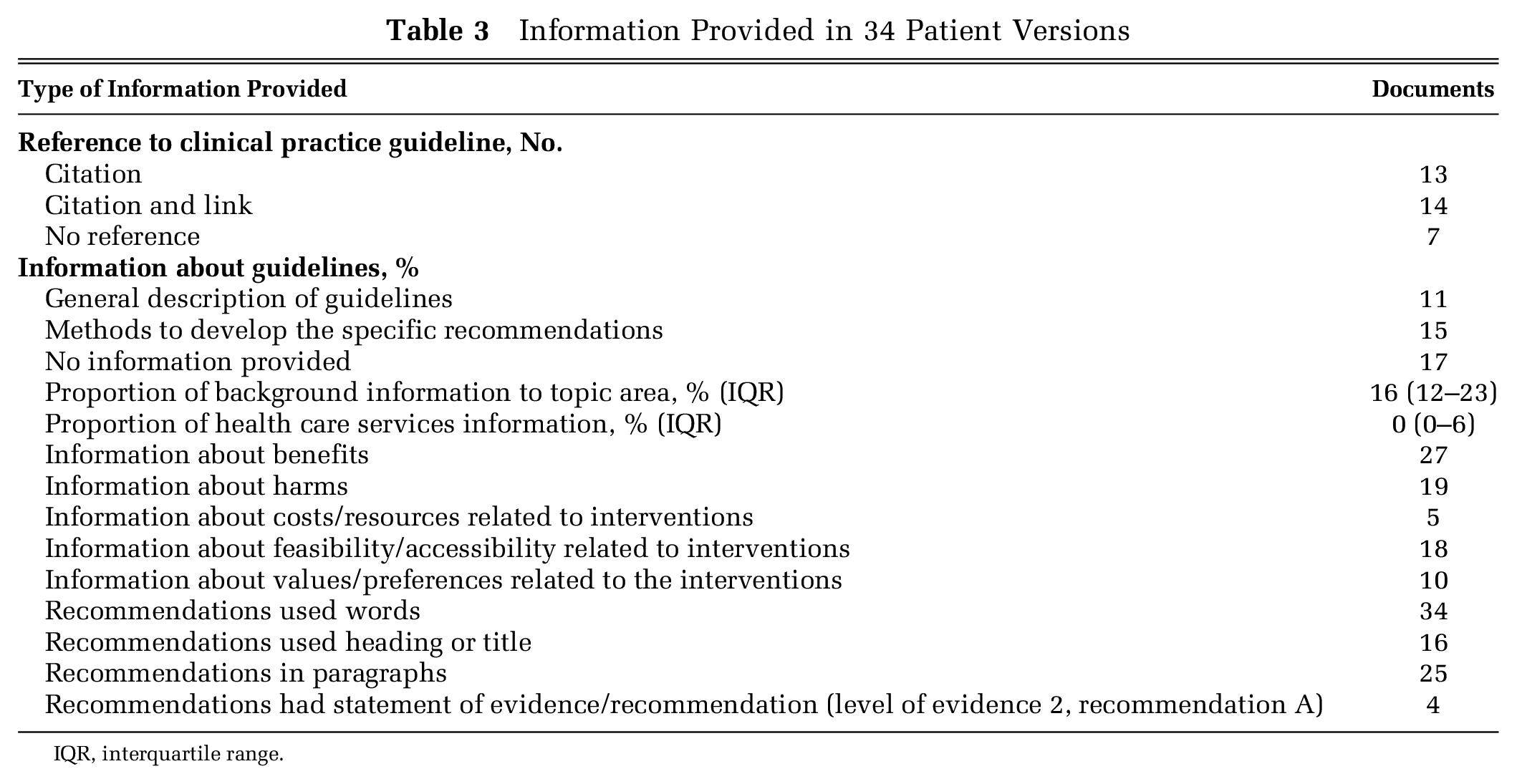
IQR, interquartile range.
Most patient versions presented multiple options for tests and treatments, enhanced choice, and did not appear to be about persuading people to use particular interventions. For example, both patient versions produced by the National Comprehensive Cancer Network not only provided a list and description of the treatments available for esophageal and pancreatic cancers but also described and provided additional resources for information about complementary and alternative medicines (CAMs). Even documents that presented information about one treatment noted that other options should be discussed with health care providers. The patient version from the AAN for vagus nerve stimulation (VNS) advised readers to “talk with your doctor about therapies for treating seizures. Be sure you understand all the options available, including VNS.” In contrast, the patient version describing what to expect after stillbirth appeared to focus only on options for seeing the baby or taking the baby home for a period but not on other options. For example, it stated, “If you made the decision not to see your baby after the birth, and then change your mind, you can still ask to see your baby.”
As indicated previously, there was little information to help people understand or navigate the health care system. When this type of information was provided, it was limited and only identified the different types of health care providers and what type of care they provide. Nevertheless, all but one of the documents were organized in a typical care pathway to reflect a health care journey, starting with diagnosis, treatments, and follow-up care. The Managing Schizophrenia booklet produced by SIGN also included information before diagnosis and what to do when first feeling unwell, and the Brain Injury Rehabilitation in Adults, also from SIGN, included information at the end of the document about returning home and to work or study.
Few patient versions were clearly about empowering readers beyond providing information for decision making. There were, however, some notable exceptions. Both patient versions from the National Comprehensive Cancer Network (NCCN) included a section describing 2 roles that patients could take in their treatment plan: “Some patients want to be involved as little as possible. Others want to know everything and share decision making with their doctors.” The NICE patient versions conveyed that the patients have power over their care, using statements such as, “You should have the opportunity to ask any questions you have” and “If you think that your treatment or care does not match this advice, talk to your healthcare team.” Other patient versions provided information for self-care, recognizing symptoms and knowing what to do, and tips about what people could do at home to manage their own care. The patient versions for Fibre and Diabetes, from the Canadian Diabetes Association, and Gastroesophageal Reflux Disease (GERD), from the University of Michigan Hospital and Health Centers, provided practical guidance about what foods to eat to increase fiber in the diet while at home and strategies to prevent or reduce reflux. No patient versions, even those that provided self-care strategies, were about replacing consultations or counseling. However, while providing information could, in fact, be interpreted as a replacement or a second opinion, almost all patient versions included a statement advising readers that the information did not replace the advice of health care providers. There was also no document that was prescriptive when describing how to take medicines; adherence was not an explicit purpose. Instead, reasons for why it was important to follow prescribed medications were provided (see the example from the Canadian Diabetes Association in Table 4). Other documents encouraged individuals to participate in the health care provider consultation by advising readers that decisions should be made along with their doctors. Some patient versions explained which type of health care providers would be encountered and their role in management (e.g., a radiologist or oncologist). In addition, as indicated earlier, there were sections to help people plan for a successful consultation, which provided “questions to ask your doctor.”
Common Purposes of Patient Versions of Guidelines and Examples
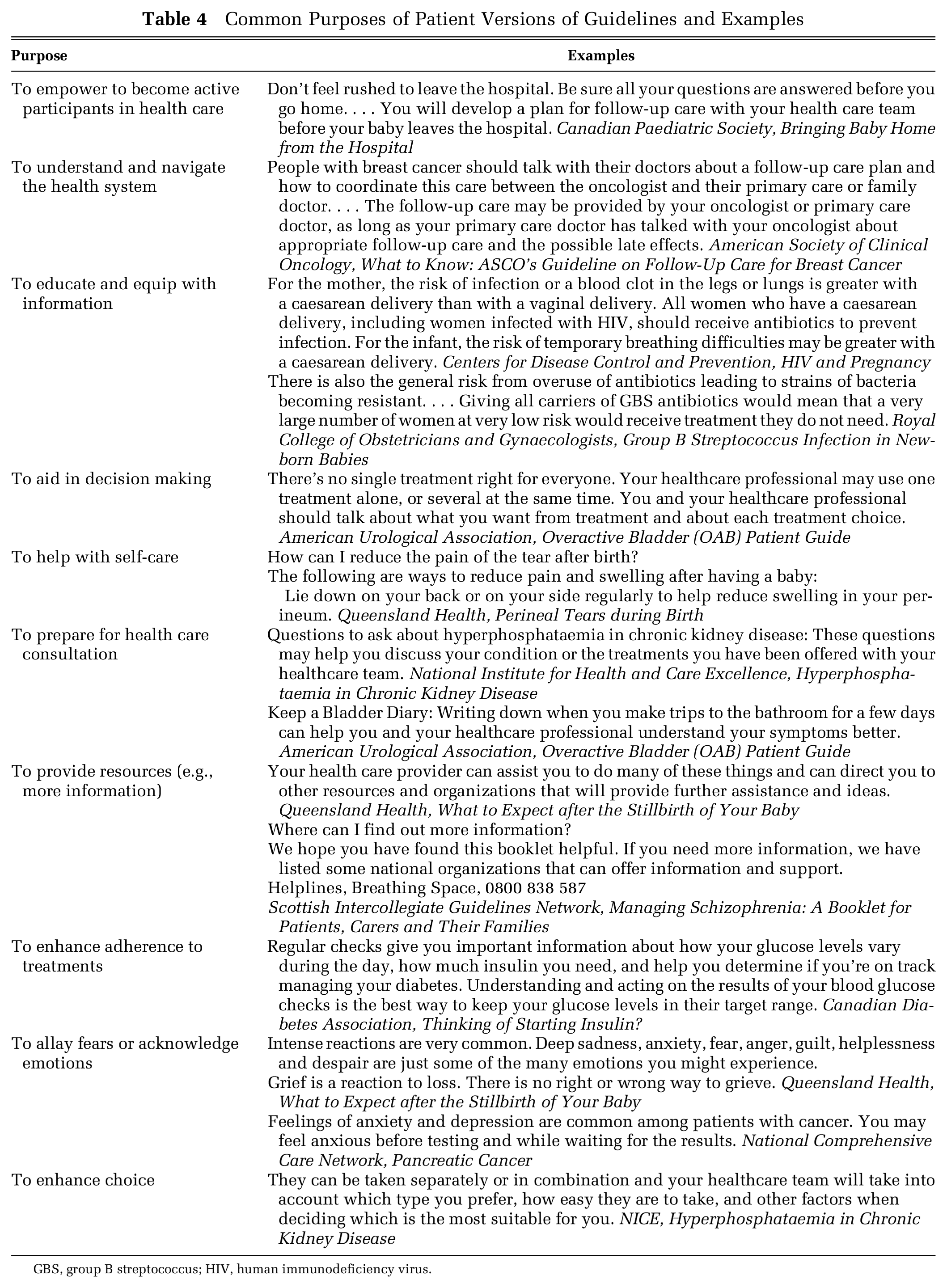
GBS, group B streptococcus; HIV, human immunodeficiency virus.
Some documents were also written to allay fears and address emotional issues. There was acknowledgment of emotional concerns and issues for sensitive topics, such as stillbirth, mental health issues, and cancer (see Table 4). The patient version about what to expect after a stillbirth from Queensland Health also provided information about how to deal with and tell family members, and the National Comprehensive Care Network, Pancreatic Cancer, included a section about emotional challenges and relationships with family and friends. Emotional concerns were also covered in other topics that may not be perceived as particularly sensitive. The patient version from the Canadian Diabetes Association about starting insulin included text throughout the document recognizing that the amount of information could be overwhelming and that starting insulin injections may be scary. In contrast to allaying fears, some documents may have accomplished the opposite. The patient version for the influenza vaccine from the Centers for Disease Control and Prevention provided a proportionately large amount information about adverse reactions, how to find help if adverse reactions occur, how to report adverse reactions, and how to be compensated for adverse reactions.
Personalization of the Information
Many patient versions (27/34) made attempts to personalize the information. The words you and I were often used to personalize within the text and in headings (e.g., “What you need to know” or “How much fiber do I need?”). Some documents personalized the information by providing background information about how the condition might affect feelings and personal situations in life, particularly for sensitive topics such as mental health issues. The SIGN version for managing schizophrenia stated, “Tiredness and a lack of energy are often described, and may mean you are doing a lot less than you used to (sometimes this may be due to the side effects of medication).” Very few provided personal stories (1/34) or scenarios (3/34). One patient version featured an introduction from a representative of the NCCN, who wrote about her experience with pancreatic cancer and to advocate for more patient information. Five other documents provided brief information about how other people felt or managed in similar situations (e.g., “You can resume sexual activities whenever it feels right for you. . . . Some women feel like sex earlier than six weeks but many women want to wait even longer than this”). When used, scenarios were very brief and usually as a section header, for example, “I am HIV infected and pregnant. When should I start taking anti-HIV medications?” or “I have epilepsy, and my current therapy is not helping me. How can I know if [vagus nerve stimulation] is right for me?” Another way to make the information more personally relevant was to include a section at the beginning of the document about to whom the information applies (11/34).
Presentation of Recommendations and Evidence
We collected data about whether recommendations were recognizable (an important factor in professional guidelines) using the 4 criteria set out by Hussain and others. 11 It was challenging to assess, but we found that recommendations were recognizable using at least 1 of the 4 criteria. All guidelines used common words to communicate the recommendations, such as “your doctor should” and “your doctor may offer,” which were easily recognizable. Other times, it was difficult to determine if the statements were simply about what the treatment will be. For example, the guide from ESMO for melanoma listed the tests that would be used, and it was not clear whether it was based on a recommendation. Specifically, it stated, “Sentinel lymph node biopsy is a procedure performed for all stage I and stage II patients, except for patients whose tumors are 1 mm thick or less.” In most documents (25/34), recommendations were easily recognizable as they were separated out into a paragraph indicating what should be done and for whom. An equal number of patient versions did or did not include a heading or title to highlight the recommendations; sometimes this was more clear in some versions (e.g., the heading “The Task Force Recommendations on Screening for Cervical Cancer: What Do They Mean?”) than in others (e.g., the heading “Tests you should not be offered”). Only the patient versions from the USPSTF and one from the AAN provided recommendations followed by a statement of the strength of the recommendation and/or the level of evidence. The USPSTF versions were also the only ones to present the system for grading the recommendations and the evidence. As indicated above, the evidence on which the recommendations were based was rarely provided as quantitative data about effects, and when described in words, interventions were often vaguely described as “effective” or “helpful.”
Discussion
This study is the first to analyze patient versions of CPGs currently available. From our comprehensive search of institutions with experience producing patient versions, we randomly sampled 34 patient versions. We conducted a directed content analysis using themes about purpose and content important to patients and the public, and based on this analysis and our systematic review of research about patient and public attitudes and beliefs of clinical practice guidelines, we have found some gaps in what is provided and what patients and the public perceive as helpful and provide some suggestions for future work (see Table 5).
Implications
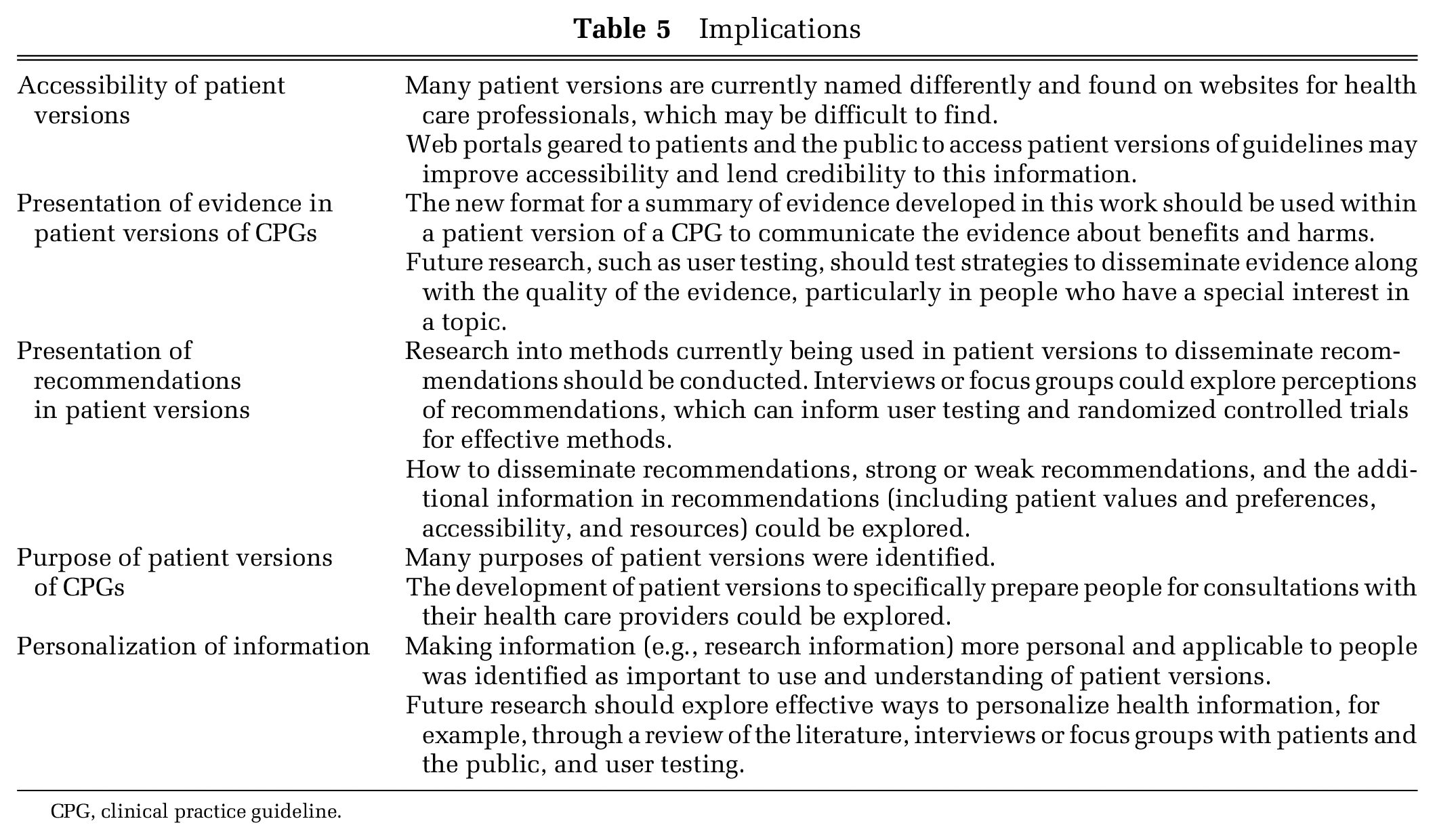
CPG, clinical practice guideline.
First, it is questionable whether patients would be able to find these patient versions and then identify whether it is credible advice. We found these patient versions primarily through professional organization websites, and the versions were called a variety of names. For health care professionals, CPG databases and portals overcome this challenge, and perhaps a similar website or portal of patient versions by topic may be useful for patients and the public. Our review of qualitative research about attitudes and beliefs about guidelines indicated that people do not necessarily trust information from guidelines. 4 While most patient versions included logos of national and professional organizations that may convey credible sources, logos do not convey that these patient versions are providing recommendations that are based on a rigorous process, which should be emphasized in these versions.
Second, the review of the literature of patient and public attitudes toward CPGs also revealed that patients want background information about their health conditions and about the evidence used to make the recommendations. 4 Background information was adequately provided in the patient versions, but there was less specific evidence about benefits and harms, and instead they were advised to speak to their doctors for that information. This seems contrary to the model of empowering an individual. Direct links to the professional-oriented CPGs may be helpful to some patients, but there is a large body of literature around the need to tailor the presentation of evidence to patients and the public to make it more user-friendly, and therefore guideline producers may need to consider how to present evidence for benefits and harms in patient versions.
Third, the main purpose of all patient versions of guidelines was to provide information or direct people to more information. This in itself is a form of empowerment by equipping patients with information, but in the patient empowerment discourse used by Dixon-Woods, 3 the patient versions should provide other information useful to decision making, such as information and guidance about values and preferences, feasibility, or costs in some settings. We found that less than half of the patient versions included this additional information, and few provided self-care advice, again limiting what people can do for themselves and their sense of control over their health care situation. Some patient versions did, however, provide specific recommendations and information to use in one’s personal life or unique situation (e.g., how to increase fiber in the diet). This perhaps could be a goal of patient versions: focus on a recommendation and then provide practical information about how people can achieve it.
Fourth, the need for more personalized information has also been identified by patients and the public as important to interpreting health information.4,12 In this analysis, we saw a variety of different methods used to personalize the information. The words you and I were used often in these versions, but only one version included a personal story. Other documents personalized the information in small ways by framing the information under a brief personal scenario. Additional exploration of methods to personalize research information has been previously advocated through the use of personal stories and decision aids. 12
These comments are based on the strengths of our analysis, but there are some limitations. Although 2 investigators extracted data and analyzed the results, we were not reading the patient versions as people directly affected by the topic of the patient version. Instead, the 2 investigators have experience in guideline development (and one has also conducted research to communicate evidence to patients and the public), and the team has expertise in both quantitative and qualitative research methods. The data extractors were also both informed by the review of the literature of patient and public attitudes toward guidelines and the role of patient materials. An inherent limitation of using an informed framework to direct the analysis is the risk of only finding text to fit the framework. We, however, found text that informed a variety of new purposes of the patient versions and little text to address all purposes previously identified. Our search was for key institutions that produce patient versions of guidelines, but we did not determine how many institutions produce guidelines and do not produce patient versions. We hope that work in future could explore reasons for or against the production of patient versions through interviews, focus groups, or surveys of guideline producers. We believe our search was comprehensive, but we only included English and freely available versions. We searched large databases that include national and international clinical practice guidelines and visited each website to search for patient versions. We found patient versions from North America, United Kingdom, and Australia. It is unclear, however, whether the methods to personalize information and the different purposes identified from those patient versions might be similar to other countries and cultures that may or may not have a longer history of patient communication. We know, in fact, that many international organizations have been active in this area, such as the German Agency for Quality in Medicine and the Institute for Quality and Efficiency in Health Care, Duodecim in Finland, and other institutions of members of the GRADE Working Group. We also know that private organizations, such as Kaiser Permanente in the United States, provide patient information based on guidelines, but these are not publicly available. We are currently working with these groups and others under the umbrella of the GRADE/DECIDE project to contribute to this work and to conduct user testing into new strategies to communicate CPGs to patients and the public and determine if patient versions based on those new strategies meet their needs.
Conclusions
This study presents the landscape of patient versions of CPGs publicly available to patients and the public, which may not be addressing the views of patients and the public. Future work in this area could focus on how to provide content that personalizes the information, empowers people to manage their own care or navigate the health care system, or supports conversations with health care providers. More specifically, research is also needed into how to clearly communicate the recommendations, as well as the evidence, patient values and preferences, and other feasibility and accessibility issues. Finally, it appears that it would likely be challenging for the public and patients to find recommendations and CPGs, and therefore an exploration of how they could access the credible wealth of information found in CPGs would be warranted.
Footnotes
DECIDE Workpackage 3 Group: Margaret Callaghan, Karen Graham, Robin Harbour, Ilkka Kunnamo, Helena Liira, Kirsty Loudon, Emma McFarlane, Karen Ritchie, Duncan Service, and Judith Thornton.
Work was completed at McMaster University, Department of Clinical Epidemiology and Biostatistics, Hamilton, Canada. Part of this work was presented at the Guidelines International Network (G-I-N) Conference, Melbourne, Australia, 23 August 2014, and during a G-I-N/North America Webinar Series, 5 February 2015.
Financial support for this study was provided to Nancy Santesso from a Canadian Institutes of Health Research Fellowship in Knowledge Translation. Financial support for this study was provided by the Canadian Institutes of Health Research Fellowship in Knowledge Translation and for the DECIDE project from the European Union’s Seventh Framework Programme under grant agreement number 258583. The funding agreement ensured the authors’ independence in designing the study, interpreting the data, writing, and publishing the report.

References
Supplementary Material
Please find the following supplemental material available below.
For Open Access articles published under a Creative Commons License, all supplemental material carries the same license as the article it is associated with.
For non-Open Access articles published, all supplemental material carries a non-exclusive license, and permission requests for re-use of supplemental material or any part of supplemental material shall be sent directly to the copyright owner as specified in the copyright notice associated with the article.
