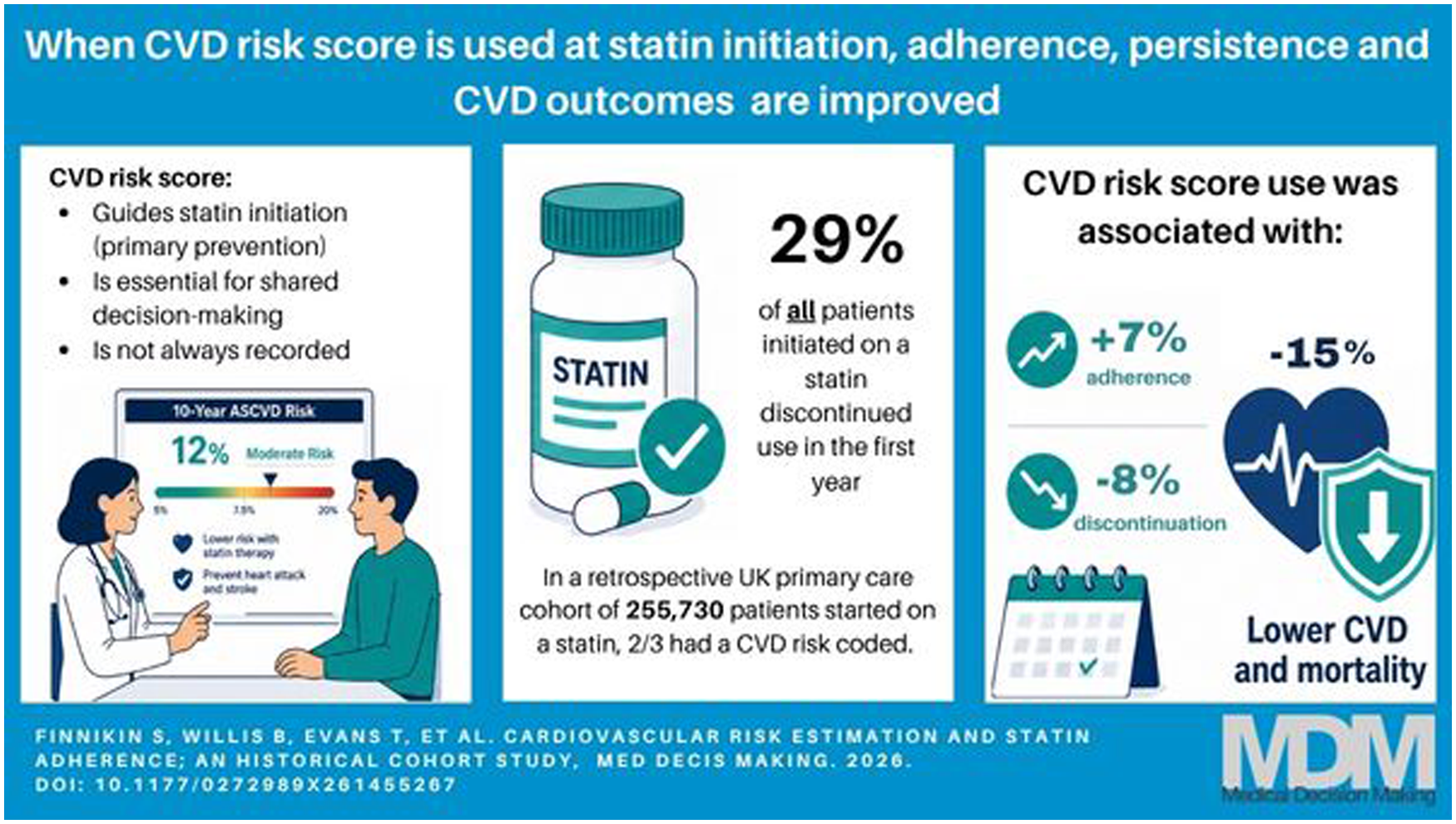
Adherence to statins for the primary prevention of cardiovascular disease (CVD) is low but may be improved through shared decision making (SDM). CVD risk estimation is fundamental to SDM at statin initiation, and the absence of a CVD risk score may indicate that SDM has not taken place. This study explores statin initiation decisions by investigating whether CVD risk is associated with adherence to statins and CVD outcomes.
A cohort of statin-naïve patients aged 40 to 84 y initiated on statins for primary prevention between 2017 and 2020 was identified and categorized by the presence or absence of a CVD risk score at statin initiation. Multivariable modeling determined the association between CVD risk score and statin adherence and persistence. A secondary analysis investigated the relationship with CVD outcomes and death.
A total of 255,730 patients were included with a mean follow-up of 4.6 y. The presence of a CVD risk score (67.7% of patients) was associated with a 7% increase in adherence and an 8% reduction in discontinuations as well as a 15% reduction in CVD and all-cause mortality.
The presence of a CVD risk score is associated with improvements in both adherence and persistence, which could indicate that the quality of initiation consultations, and a focus on SDM, improves the utility of statins. In addition, CVD risk scoring is associated with a large decrease in CVD/death, which cannot fully be explained by improvements in statin adherence and persistence, an important finding necessitating further investigation.
Efforts to improve the integration of CVD risk scores and SDM in statin initiation consultations may significantly improve statin utilization and CVD outcomes.
We present a comprehensive assessment of the adherence to and persistence with statins for the primary prevention of CVD, which, for the first time, is linked to the presence or absence of CVD risk scoring.
CVD risk scoring is associated with improvements in both adherence and persistence as well as significant reductions in CVD and all-cause mortality.
There should be renewed focus on the content of statin initiation consultations ensuring that CVD risk is communicated using a shared decision-making approach.
Further consideration should be given to the important discrepancy in CVD and death seen when CVD risk scoring is, and is not, used in practice.
This is a visual representation of the abstract.