






Abstract
Keywords
Criteria for adequate informed consent are rooted in the history of human experimentation (Nuremburg Code; Helsinki Declaration) as well as medical case law (e.g., Schloendorf v. New York Hospital). 1 Although 60 y have passed since the basic elements of adequate informed consent were established, several studies have demonstrated that, among surgery patients2,3 as well as cardiac surgery patients,4,5 these criteria are not met in most cases. These studies demonstrated poor comprehension of medical information including the disease process itself, the therapy proposed and its attendant risks, as well as the alternatives available. In the reality of the clinical setting, informed consent has arguably come to be viewed as bureaucratic legalism rather than an integral part of patient care.6–8
More recently, respect for patient autonomy, as articulated by the Institute of Medicine in its call for “Patient Centered Care”, have stimulated ways to optimally provide information about risks, benefits and treatment options and facilitate patient control over decision making about their care. A more formalized approach to decision making has subsequently evolved, termed ‘Shared Decision Making (SDM)’.9,10 In cardiac surgery, formal SDM processes are untested.
We have previously demonstrated that patients referred for cardiac surgery are older and more commonly frail. Between 2001 and 2010, we described an increase in octogenarians from 7% to 12% of cases, an increase in frail patients from 4% to 10% of cases, and a shift from isolated coronary bypass procedures to more complex and higher risk valve and valve-coronary bypass procedures. 11 Further, we have shown that frail patients undergoing cardiac surgery are at considerably higher risk for mortality and, perhaps more importantly, prolonged institutional care. 12 These vulnerable patients experience an unprecedented degree of equipoise between the options of cardiac surgery and continued medical treatment, calling for a redoubled effort to engage patients in decision making.
As a first step in establishing effective SDM among vulnerable patients referred for cardiac surgery, we sought to determine the critical information patients would need in order to be informed about their choices, and to identify barriers and facilitators to effective communication, comprehension, and decision making.
Methods
A qualitative study was conducted within the Capital District Health Authority (CDHA) Division of Cardiac Surgery. The CDHA Division of Cardiac Surgery is the sole provider of cardiac surgical care for The Province of Nova Scotia as well as a portion of The Province of Prince Edward Island. We recruited focus groups of former and current patients as well as care team members representing the spectrum of providers.
Study Setting and Recruitment
Early post-op patients were recruited from among the inpatient units at CDHA. Former patients were recruited through poster advertisements placed in the cardiac rehabilitation units serving our patients, local YMCAs and grocery stores, follow-up clinics and outreach clinics at the Cape Breton District Health Authority (CBDHA). Diversity in geographic residence and case complexity among patients were sought. Providers were recruited within the CDHA Division of Cardiac Surgery. The rationale for separate focus groups was to obtain diversity in the context and content of information while maintaining homogeneity and methodological integrity in each of the separate groups.
Inclusion Criteria (Patient)
Inclusion criteria for patients and former patients included those who underwent Coronary Artery Bypass Graft (CABG), Valve, or CABG +Valve surgery, who were 65 y of age or older, and were within 2 y of their surgery. Patients were specifically sought from the following groups: within 8 wk of surgery; 8 wk to 2 y post-operatively; and those with a complicated post-operative course. Three focus groups were convened in Halifax and one in Cape Breton.
Inclusion Criteria (Providers)
Providers were invited to participate from the following groups: cardiac surgeons, cardiac anesthetists, cardiac intensivists, Intensive Care Unit, floor and operating room nurses, occupational therapists, and physiotherapists. Four focus groups were convened in Halifax, 2 for nurses, physiotherapists and occupational therapists and 2 for physicians. Physician/Surgeon focus groups were held separate from those for nurses and allied medical professionals. The rationale for separating provider groups was to encourage open and candid discussion on topics regarding patient care.
Informed Consent
All participating patients and staff consented to taking part in audio-recorded focus groups. Written informed consent was obtained by patient and provider groups. The study had full approval of the CDHA Research Ethics Board (CDHA-RS/2012-237).
Data Collection
Focus group data were collected from April 2012 until December 2012. All groups involved a session moderator and were audio recorded. Session moderators (RG, GH) worked through a series of prepared questions for patient, nurse, and physician groups in a semi-structured interview format. Session moderators had training in conducting qualitative focus groups (RG), and clinical expertise relating to the topic of informed consent (GH). These questions focused on individual level experience of the informed consent process, key clinical information required for effective decision making, the identification of barriers and facilitators toward an optimal consent process, and avenues for improvement (Appendix 1a-c).
Decision Aids
In addition to these questions, moderators introduced an example of a decision aid that could be used during the SDM process with patients (Appendix 2). These decision aids included individualized background information as well as individualized risks for mortality and prolonged institutional care. Both high- and low-risk patient examples were included for discussion. These aids were used to generate discussion and presented participants with examples of text that reinforced the concepts of SDM with larger font, reduced language complexity, and methods to present individualized risk. Graphic dots (Figure 1) and Kaplan–Meier plots were used to display risk information. Risk prediction was based upon either our own published models (mortality, stroke, etc.) or validated external models. This allowed the possibility of individualized risk prediction for each patient. The value of individualized risk prediction models and decision aid material in general was explored in the focus group.
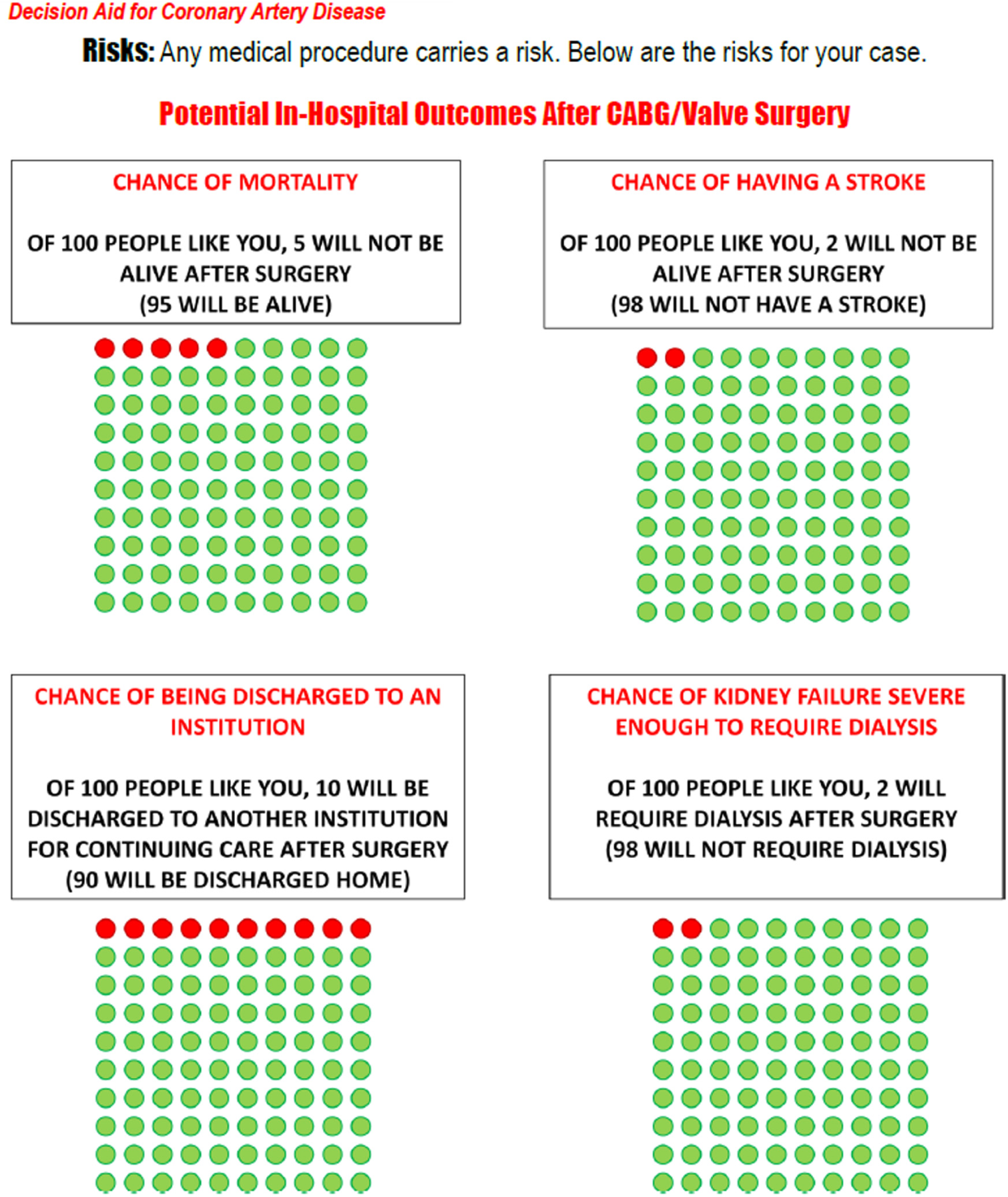
Example of individualized risk plots. CABG, coronary artery bypass graft.
Audio recordings were transcribed verbatim and de-identified to ensure confidentiality. Analysis began immediately following the first focus group and data collection was closed when saturation was achieved and no new key issues were identified in subsequent groups.
Analysis
Thematic analysis was chosen as the methodological framework within which to analyze data generated from the focus groups. This form of analysis is data driven, and broader assumptions, structures and meanings are theorized as underpinning what is articulated in the data. 13 Nvivo 9 software was used to organize the data and develop consistent and comprehensive themes. Using an inductive process, initial codes were generated across the entire data set, collating data relevant to each code. Potential themes were developed by collating initial codes into a thematic map of the analysis. Ongoing analysis led to refinement of each theme and the overall story of the analysis, generating clear definitions and names for each theme. Data analysts (RG, JD, RsG) were trained by a Dalhousie University qualitative instructor on qualitative data collection and thematic analysis prior to enrollment.
Validity and Transferability
The biases inherent in the authors’ assumptions relating to the informed consent process will be reflected in any pre-set questionnaire. To mitigate the effect of this bias, we employed an open-ended style of communication, thus avoiding suggested answers embedded in the question and encouraging spontaneous responses. The primary coder, RG, moderated each focus group and wrote or reviewed all transcripts before data analysis to ensure data familiarization. Triangulation was promoted by JD and RsG, who reviewed patient and care team transcripts and coding independently and then reached a consensus. Separating nurse and surgeon focus groups was based on the expectation of perceived hierarchies, which would influence the dialogue encouraged in focus group settings. The PI (a cardiac surgeon) attended the surgeon focus groups, as it was felt the perceived hierarchy was less influential, and the expertise would be a valuable addition. The varied experiences of patients in time since discharge (less than 8 wk to 2 y) and postoperative course (complicated and uncomplicated) added transferability to our study. Transferability was also promoted by the variety of participants recruited to the care team staff, including ICU and IMCU nurses along with anesthesiologists, intensivists, and cardiac surgeons.
Results
Focus Group Demographics
Patients
Three patient focus groups were held; the demographics and selected outcomes from each are represented in Table 1. Group 1 were patients late post-op (1 to 2 y post-op); Group 2 were patients early post-op (within 8 wk of surgery); Group 3 were patients who experienced a significant complication post-operatively. See Table 1.
Demographics and Outcomes of Patient Participants

CABG, coronary artery bypass graft; AVR, aortic valve replacement; MVR, mitral valve replacement.
Providers
Four provider focus groups were held. Group 1 were operating room and floor nurses, physiotherapists and occupational therapists (n = 13). Group 1 included 1 male and 12 females. Group 2 were Intensive Care Unit nurses (n = 5). Group 2 were all females. Group 3 included surgeons, anesthetists and cardiac intensivists (n = 12). Due to size and scheduling limitations, Group 3 participants were separated into two separate focus groups: Group 3a and 3b. Group 3a (n = 7) included 1 female and 6 males, whereas Group 3b (n = 5) included 1 female and 4 males.
Each focus group session lasted approximately 1 to 2 h. The major themes identified across patient, nurse, and physician groups were: Obstacles in Educating the Patient; Facilitators in Educating the Patient; Patient Autonomy; Patient and Family Expectations; and Advocates in Decision Making (Table 2). Interestingly, similar themes emerged across groups as patients recounted personal experiences, and care staff recounted interactions with patients and perceptions of the patient’s experience.
Major Themes following Reduction of Categories in the Initial Coding Framework

Obstacles in Educating the Patient
Patient groups identified structural and conceptual barriers with the consent form document used before treatment. Structural issues included consent form language complexity and small font, whereas conceptual barriers centered on seeing the form as nothing more than a liability waiver. Very few of the patients recollected any aspect of the standard form when shown:
RG (Moderator): I’m wondering if you remember this form, this is the consent form to have cardiac surgery. Would you have read through it, is it something –
Patient 4: No, I’ve never seen it before. [P3, P1, P2 “That’s true”,“I’ve never seen it”]
Surgeon 3: Having consented many patients for high-risk studies in sepsis, where we tell them up front the mortality is 40%, they just say where do I sign? We’ve got an 18-page consent form and they go straight to the bottom line
Surgeon groups reaffirmed the diminished value of the consent form, arguing a disconnect between it and the actual decision making process:
Surgeon 3: The document, I don’t think, has anything to do with decision making. By the time you get to that the document the decision has been made. I don’t often find myself helping patients make decisions. Unless there is ambiguity about what the right way to go is.
Patients noted external and internal locus of control issues when discussing demand for information regarding surgery and engagement in the consent process. Nurse and physician groups expressed that older patients typically showed a tendency to externalize the locus of control through deference to physicians, less direct engagement in asking questions to the care team, and heavier reliance on family advocates:
Patient 3: I think, to a point, this is out of my hands. What will be, will be. I’m just along for the ride.
Patient 5: Yeah, I think knowing these numbers would help me be better prepared. It may not impact the surgery but, down the road, I think I’d feel like I’d have a bit more awareness; control.
Nurse 5: I think younger people may question….you know, if you are 40 or 50 or 60; but once you start getting over 75, it’s like they just say…the doctor says I need it…so they will just do it.
Surgeon 4: I can’t remember the last time that an over 70-y-old really asked a relevant question. Unless they are just trying to be polite, but really they’re just looking for somebody to tell them what the best thing to do is.
Patient 5: Once I’m there, I’m in their hands. It’s up to them how things are going to go.
Time was expressed as a significant barrier in providing cohesive, relevant and meaningful education in a way that would provide patients with the tools necessary to fully comprehend the nature of their disease, the risk, benefits, and options.
Surgeon 2: We’re thrust into that situation all the time. The schedule gets changed, we go to 6.2 to find a morbidly obese diabetic with hypertrophic ventricle and poor distal vessels. And the night before surgery, we start the conversation. That’s the type of thing you’d like to have the family in the office 2 months beforehand.
Facilitators in Educating the Patient
Both groups identified several key components to a positive educational experience in the decision process. Focus group participants expressed that patients are hesitant to communicate when they do not understand information. Patient groups were in favor of being offered an array of strategies in a decision aid to communicate the same information. Nurse groups supported this idea while also pointing out that patients will not typically ask for different methods of receiving information, in part because they do not want to slow the process down, or because they do not want to seem incompetent to the physician. As a result, nursing groups felt it was incumbent on care teams to provide options that cater to a patient’s specific informational needs and limitations.
Nurse 9: Letting people have options… so you might appreciate reading, I might appreciate just talking to somebody who has been through it before. So if you are providing options, patients and families feel more prepared. Or have different ways of getting more prepared.
When groups were presented with the decision aid, all groups expressed strong support for the use of individualized risk, the use of dot graphics in presenting absolute risk, the larger font, and the reduced length and language complexity.
Patient 1: The graphic dots are definitely a good idea, I’d remember that. Good to have it adjusted for your own risk.
Patient 3: Yeah I like this. It seems more to the point; it’s not paragraph after paragraph of stuff. The graphics help too.
Nurse 3: The dot plots in addition to the words to convey information is good for the patient. It is something they can see, it is simple and it is clear.
Surgeon 4: If we are talking about the sick, frail guy who has a creatinine of 150 and his EF is 30 and is in hospital. He needs to know about dialysis, ventilator dependence, discharge to an institution. But the healthy 70-y-old doesn’t need to know that. He needs to know he might have a stroke and he might die and those are small chances.
Care team groups were supportive of presenting medium- and long-term outcomes with survival curves; however, patients felt presenting the information in this way was confusing.
Patient 3: Not this here [survival curve]. The dots I get immediately; this one doesn’t appeal to me. I think patients will get confused by this. And why have it? You have the dots already.
Time was seen as crucial for any other part of the education to be effective. This includes both the length of time allocated to the discussion and the point in time at which the discussion takes place. Patients were careful to note that, although decision aids were a welcome addition, if they were not deployed earlier in the care process, it would result in little change to patient education and engagement.
Patient 1: I think even with this here the day before surgery, you know, even with this form here and the day before or same day as the surgery, it’s not going to give you time to consider it.
Patient 2: I think I would be more inclined to read it if I had the time to read it.
Patient Autonomy
Many patients raised the importance of cultivating a relationship of mutual respect between the patient and the care team.
Patient 5: Let me get this straight, they were fantastic up there, the nurses and the doctors, and they just work right off their feet. But it just felt that, I was left out, they were talking about me.
Patients desired personal autonomy through a greater opportunity for individual choice; however, the perception of an asymmetric power relationship with physicians seemed to overshadow these expressions of personal autonomy.
Patient 1: You’re just part of the assembly line, you might slow the assembly line down, stall it a little bit or something.
Decision making was centered on developing trust and faith in the surgeon rather than weighing different decision options. Nurse and physician groups indicated the passivity of patients could be partly attributed to their perception of little to no choice in their options.
Nurse 4: Not uncommon for them to say, “I don’t have any choice.” You say, “So are you ready to go ahead?” and they say, “Well, I don’t have a choice.” I think a lot of them probably don’t even realize that they can refuse. They just come in and say, this is what the doctor says, I am going to sign it, the doctor says.
Surgeon 5: I think patients in hospital feel pressured that there is only one option. They don’t feel there is a choice.
Patient and Family Expectations
Expectations of surgery and its outcomes came from a number of sources, such as friends or family members experiencing similar cardiac events, media coverage, or reviews online. Nursing groups discussed the discrepancy between the patient’s expectations and the reality of postoperative care.
Nurse 1: Even an uncomplicated patient doing well… they had no idea they would have a breathing tube in and that they would be waking up, etc, just the routine course of an uncomplicated recovery… they don’t know anything about what comes after.
Nurse 3: Especially given what they say afterwards if they are a month in to recovery and they wished they had never done it, had they known. “if I had known what this was going to be like… I would have never gone through it.”
Nurses stated that better communication and education preoperatively would have to occur in order for patients and their families to reorient unrealistic expectations towards something more in line with scenarios they could experience following cardiac surgery:
Nurse 6: We just had a surgical case that resulted in a stroke postoperatively. The family was upset because, even though they had the consent, they said ‘our father did sign up for surgery, but he didn’t sign up for a stroke’.
Without sufficient time to educate and realign expectations of care, patients tended to generate erroneous expectations for their treatment based on anecdotal evidence, such as personal family experience:
Patient 4: With my sister, they put a valve in that was too small, I thought ‘well, the same thing will happen to me.’
Patient 2: I knew what to expect because my mother had it done 4 y ago.
Advocates in Decision Making
Patients expressed the importance of having family members or close friends to attend the consent process. Patients would depend on advocates to acquire information and ask questions but also to act as a third party between the patient and the physician.
Patient 4: My brother got information any time he wanted. I mean, he’s a well-educated guy and he knew what questions to ask, unlike me. So, I mean, he was there, he was in my corner, that always helped, knowing that.
Surgeons identified the role of family as an important factor in the consent discussion, as it tended to encourage a more supportive educational experience and preparedness on behalf of the patient:
Surgeon 3: I get shivers when I only meet the patient and there is not a family member. Where are they? I get very uncomfortable and all my bad experiences have been alone.
All groups were also interested in adding a decisional coach into the process of care. The decisional coach would be someone (e.g., a nurse) who could prepare patients and families preoperatively to provide continuity, understand patient-specific values and goals of care, and relay issues to physicians in preparation for the patient–physician encounter.
Nurses were supportive of patients having more opportunities to discuss postoperative events with a decisional support person, arguing a coach ‘in the patient’s corner’ would help to alleviate perceptions of inequality in the patient–physician relationship dynamic.
Nurse 1: At another hospital I worked at, they had a coordinator who would organize the operations and talk to every patient beforehand. Give them a tour where the ICU is, what it looks like, etc. I think the visit made a huge difference. Wherever you could fit that in would be a good start. You could hit on a few points, ‘remember we discussed this, you have the tube in a little longer’. Patients remembered that.
Discussion
The process by which patients are educated to the point of understanding their disease process and the risks and options of a proposed treatment is superseded by the legal requirements of obtaining consent. 14 Through formal discussion with patients and providers, we sought to determine key components to effective informed consent discussions. Core findings found that both patients and providers would prefer consent and access to decisional supports earlier, and a decisional coach who would meet with patients and families to act as a navigator through the course of care (both groups identified an RN as the most appropriate choice to serve as decisional coach). Patients and providers supported the use of individualized decision aids with graphic dot plots in communicating information and educating patients and families on benefits and risks of a given procedure, along with treatment options for care. Interest in supporting patient autonomy was an important factor in developing options that would better engage patients and families earlier in the decision making process.
Timing of Decision Making Discussions
Both patient and provider groups identified a lack of adequate time as a major barrier to an optimal informed consent process. Provider groups indicated that meaningful engagement in decision making by patients and families is best achieved by involving patients and families both earlier in the patient’s course and over multiple conversations as compared with a single, typically brief, encounter. Conceptualizing consent as an ongoing communication with patients should be emphasized to promote a consistent and adequately timed dialogue that allows for comprehension to increase over time. 15 Using time stamps within IMedConsent for patients undergoing invasive surgery, Fink and others 16 found total consent time to be the strongest predictor of patient comprehension. Thus, our data strongly support earlier engagement of patients and families over multiple conversations to allow meaningful engagement in decision making.
Decisional Coach
All groups in our study were strongly supportive of the addition of an RN decisional coach to guide patients and families before surgery. In concert with effective decision aids, a decisional coach will generate a meaningful rapport, allowing the patient and the decisional coach to identify issues of concern or rectify areas of poor comprehension before the patient meets the surgeon. Both patients and providers expressed that an RN would be best suited to fulfilling the role of a decisional coach, and serve as an effective advocate in engaging patients. In support of this idea, Flory and Emanuel 17 argue that efforts to improve understanding through the use of multimedia and enhanced consent forms alone have only limited success. They noted that the most effective way of obtaining improvement was having a study team member or a neutral educator spend more time talking one-on-one with study participants. Sudore and others 18 demonstrated the efficacy of a similar approach in vulnerable patient populations.
Decision Aids
Patients and providers supported the idea of working with tools that would facilitate the decision making process. To date, most efforts to improve consent in surgery have focused on decision aids— tools designed to assist patients in making optimal healthcare decisions.19,20 In support of using a coach in concert with decision aids, it has been demonstrated that learning is more effective with simultaneous auditory and visual delivery, and comprehension can be enhanced when information is conveyed in multiple forms. 21 How risk information is presented (e.g., graphically, visually, or verbally) is important, and influences the degree to which perceived risk will affect behavioral change, such as with cardiovascular risk information. 22 A Cochrane review of 22 randomized controlled trials suggests that, compared with general risk information, personalized risk communication in the context of screening tests can lead to more accurate risk perception, improved knowledge, and increased uptake of screening tests. 23 Edwards and others 24 reviewed 41 studies involving 28,700 people, and found that 45.2% of participants who received personalized risk information made informed choices as compared with 20.2% of participants who received generic risk information.
The decision aids developed by our team for review by focus groups were based on an individualized approach. A personalized decision aid is developed for each individual patient with individual-level risks for outcomes of interest based on validated predictor models. Graphic dot representations were used to communicate risk levels (Figure 1). Both providers and patients were strongly supportive of the individualized decision aids that we developed and felt they would, in concert with an RN decisional coach, overcome many of the barriers to meaningful patient and family engagement in decision making.
Patient Autonomy
Provider groups identified patient locus of control as an important factor in determining how patients would respond to information regarding surgery. For those in groups who felt they had control over their health, patients were typically more supportive of receiving additional materials preoperatively to supplement the decision making process than patients who externalized control and deferred decision making to their care team. Patients with an internal locus of health control are typically better informed about their disease process. 25 Educating patients earlier in the referral process with decision making supports may serve to strengthen patient autonomy and expand the level of their involvement in making decisions towards care. 26 Although patients did not directly comment on the value of elucidating patient preferences and values, their perceived lack of engagement, underestimation of risk and overestimation of benefit, and the reality of a growing population of frail, older patients who experience increased clinical equipoise in outcomes argue for a formalized approach to SDM.
Limitations
There were several limitations to this study. A small number of patients and providers were recruited from a single center in Canada, limiting generalizability of the study. The Halifax Infirmary is the sole tertiary care center for the province of Nova Scotia. The most recent Statistics Canada data identify Nova Scotia as well below the national average in socio-economic status (Mean index score: 0.24). Patients in this area are typically more prone to accept a paternalistic model of decision making. The education level of the participants was not included in this study.
Conclusions
Identifying the barriers and facilitators to patient and caretaker engagement in decision making is a key step in the development of a structured, patient-centered SDM approach. It is clear from this work that intervention early in the decisional process, the use of individualized decision aids that employ graphic risk presentations, and incorporating a dedicated decisional coach were identified by patients and providers as approaches with a high potential for success. The impact of such a formalized shared decision making process in cardiac surgery on decisional quality will need to be formally assessed. Given the increase in the referral of frail, older patients for cardiac surgery who are vulnerable to loss of life and independence, the need for an effective shared decision making process is compelling.
Footnotes
This work has been presented at the International Shared Decision Making 2013 Conference in Lima, Peru and the Quality of Care and Outcomes Research 2013 Conference in Baltimore, MD.
Financial support for this study was provided in part by a 2011 grant from the Canadian Institute of Health Research.
The funding agreement ensured the authors’ independence in designing the study, interpreting the data, writing, and publishing the report.

References
Supplementary Material
Please find the following supplemental material available below.
For Open Access articles published under a Creative Commons License, all supplemental material carries the same license as the article it is associated with.
For non-Open Access articles published, all supplemental material carries a non-exclusive license, and permission requests for re-use of supplemental material or any part of supplemental material shall be sent directly to the copyright owner as specified in the copyright notice associated with the article.

