






Abstract
Background
Concordance between a person’s values and the test or treatment they ultimately receive is widely considered to be an essential outcome for good decision quality. There is little research, however, on why patients receive “discordant” care. A large, randomized trial of decision aids for colorectal cancer (CRC) screening provided an opportunity to assess why some patients received a different test than the one they preferred at an earlier time point.
Methods
Of 688 patients who participated in the trial, 43 received a different CRC screening test than the one they selected after viewing a decision aid 6 mo prior. These patients answered 2 brief, open-ended questions about the reasons for this discordance. The research team analyzed their answers using qualitative description.
Results
Patient responses reflected 6 major categories: barriers or risks of initially favored test, benefits of alternative test, costs or health insurance coverage, discussion with family or friends, provider factors or recommendation, and health issues.
Conclusions
Some of the patients’ explanations fit well with the informed concordance approach, which infers poor decision quality from the existence of discordant care, since in these cases it appears that the patient’s values and preferences were not adequately respected. Other statements suggest that the patient had an informed rationale for changing their mind about which test to undergo. These cases may reflect high-quality decision making, despite the existence of discordance as measured in the trial. This analysis highlights a major challenge to a popular approach for assessing decision quality, the difficulty of normatively assessing the quality of decision making when apparent discordant care has been provided, and the need to assess patient values and preference over time.
Highlights
Value-choice concordance is an accepted measure for assessing decision quality in decision aid trials, but greater exploration of apparently discordant care challenges key assumptions of this method; this study provides evidence that discordance as typically measured may not always reflect low-quality patient decision making.
Researchers evaluating decision aids and assessing decision quality should consider the use of qualitative methods to supplement measures of decision quality and consider assessing patient preferences at multiple time points.
The “informed concordance” approach used by the Multidimensional Measure of Informed Consent 1 and Decision Quality Instruments2,3 counts a patient’s decision as high quality if the individual 1) has adequate understanding of the options and their risks and benefits and 2) receives the option that best fits their preferences and values. This approach has important advantages over other methods of assessing decisions, such as the subjective Decisional Conflict Scale 4 or Decision Regret Scale, 5 and observational measures such as OPTION5, 6 which assess decision process rather than outcomes. 7 The informed concordance approach faces 2 types of challenges, however. The first is determining which facts an individual must understand, and in which ways, for them to qualify as having “adequate knowledge.”8–11 A second challenge is determining which treatment or screening option best fits the patient’s values and preferences, necessary to determine if they received value concordant care. 12 Here, we focus on the second challenge, using the example of colorectal cancer (CRC) screening.
CRC screening is recommended for all people older than 45 y, and those with average risk (i.e., no first-degree relatives with early CRC, no predisposing gastrointestinal or genetic condition) can choose from a range of approved tests. 13 The 2 most common tests are colonoscopy and stool testing, which have a range of advantages and disadvantages. Colonoscopy is most sensitive for finding polyps and cancers and allows for the removal of most polyps found, but it requires strong laxatives beforehand and carries some risks, including perforation and hemorrhage. Stool tests such as the fecal immunochemical test (FIT) are noninvasive but must be performed more frequently, are less sensitive for polyps and cancers, and require follow-up colonoscopy if positive.
To determine whether a patient received “value-concordant” screening, one must first determine which test best matches their values. This initially appears completely feasible. Colonoscopy, for instance, is best for people who value having the most complete test, want to be tested infrequently, are willing to undergo the bowel preparation, and accept the risks of the procedure. Stool testing, in contrast, would be the value-concordant choice for people who value avoiding the risks and burdens of colonoscopy and are comfortable with a test that is slightly less sensitive and specific. For some people, not being screened may be value concordant, if they wish to avoid all contact with the health care system and are willing to accept their baseline risk for CRC.
On closer examination, however, important difficulties arise for deciding which test best fits the patients’ values. The key problem is that many of the relevant values are held by most people to some degree—including wishing to protect one’s health, maximize lifespan, and avoid the risks and burdens of medical procedures—so determining which option is value concordant for an individual depends on assessing the strength of each of the values for an individual and the balance between them. Such an assessment is extremely difficult to do, and varying approaches will produce differing results.14,15 The deeper challenge is that people’s values and preferences are not fixed but instead are vague, changeable, and influenced by a variety of extrinsic factors. 16
These difficulties have led some commentators to propose that the best approach is to assume that an individual’s value-concordant option is the one they say they want after they have been adequately informed about the options. 14 According to this approach (which we will assume in the current article), if the individual receives a different option from the one they said they originally wanted, they count as not having received value-concordant care. According to the informed concordance approach, they did not make a high-quality decision.
No previous studies, however, have examined cases of discordant care to determine why the individual did not receive their preferred test or treatment. In a large, randomized trial of decision aids for CRC screening, those who received a different test than the one they said they preferred 6 mo earlier were asked to explain why they received a different test. In this article, we describe and categorize the reasons that patients gave in order to attain a better understanding of the causes of discordant care and improve its assessment by informed concordance measures in the future.
Methods
Study Design
A total of 688 patients, aged 50 to 75 y, who had average risk for CRC, were due for screening, and had an upcoming primary care appointment in the Indiana University and Eskenazi Health systems, participated. Indiana University Health is a large, academic health care system in the Midwestern United States, and Eskenazi Health is composed of several urban, federally qualified health centers in the same state. Patients viewed a decision aid that provided information about CRC and CRC screening, describing the 2 most common strategies in those health care systems: colonoscopy and the FIT. Half of patients were randomized to view a decision aid with verbal information alone (verbal arm) and the other half viewed a decision aid with quantitative information in addition to verbal information (quantitative arm). Immediately after viewing the decision aid (T1), patients identified their preferred test choice (colonoscopy, FIT, other, or no screening). Six months later (T2), the electronic health record was checked for which test the patients underwent, if any, and patients were interviewed. The study was conducted from June 2015 to June 2017, and the primary outcomes of the study may be found elsewhere. 17 This study was carried out as part of a larger research program aimed at understanding the impact of decision aids, including on the quality of decision making. 17 All patients were consented for this study as a part of the larger trial.
Data Collection
At T2, all patients were asked question 1: “Can you tell me a little more about why you did . . . [Colonoscopy / FIT / No screening]?” Patients whose intended screening behavior (T1) did not match their self-reported screening behavior (T2) were also asked question 2: “On one of the questionnaires you filled out six months ago, you indicated that you preferred to have a [FIT/ COL/ No screening] and today you told me that you had a [FIT/ COL/ No screening]. Can you say a little bit about what changed your mind?” Research assistants were instructed to transcribe their answers verbatim. We included only transcripts from patients who chose colonoscopy or FIT at T1 and then had the other test at T2. We excluded patients who had not been screened by T2, which was a large proportion of the trial, 17 and those who stated a preference at T1 for not being screened. We excluded these patients since screening is strongly encouraged by health professionals, which means that the choice to be screened or not is not “preference sensitive” to the same degree as choice of colonoscopy or FIT, both of which are recommended. In addition, previous research into why patients fail to be screened despite intending to do so has identified a high prevalence of barriers unrelated to decision quality, such as cost or issues with transportation.18–21
Data Analysis
Transcribed responses were anonymized and grouped together according to test preference at T1 and actual test behavior at T2, resulting in 2 groups: those who stated a preference for colonoscopy at T1 but had a FIT before T2 and those who stated a preference for FIT at T1 and underwent a colonoscopy before T2. If the response to question 2 was unclear or referenced their response to question 1, the response from question 1 was included in the transcript for analysis. The 2 sets of transcripts were independently analyzed using NVivo 11 software (QSR International, Burlington, MA, USA). Since our primary objective was to describe and categorize the reasons patients expressed for discordance, we used a qualitative description methodology.22,23 In particular, we used qualitative content analysis, as opposed to thematic analysis, given the brevity of our open-ended questions and also because content analysis is generally more accepted in areas of previously understudied phenomena. 24
Four members of the research team individually coded each set of responses using an open coding process by labeling segments of responses with descriptors to capture important areas. Patients’ answers could be classified under multiple data labels if their responses seemed to address multiple issues. The lead investigator met with the rest of the research team to compare results among the team, adjudicate disagreements, and group labels into higher-order categories when appropriate. Categories were also compared among the 2 different sets of transcripts and revised to match common categories among the 2 groups. To improve the trustworthiness of the analysis, an additional member of the research blinded to the work of other members independently coded the 2 sets of transcripts using a similar process. These results were then compared with the lead investigator through discussion and deliberation of current and past findings, adjudicated, and revised. Although our sample size was limited by the number of patients with discordant care, we did reach informational saturation.
Results
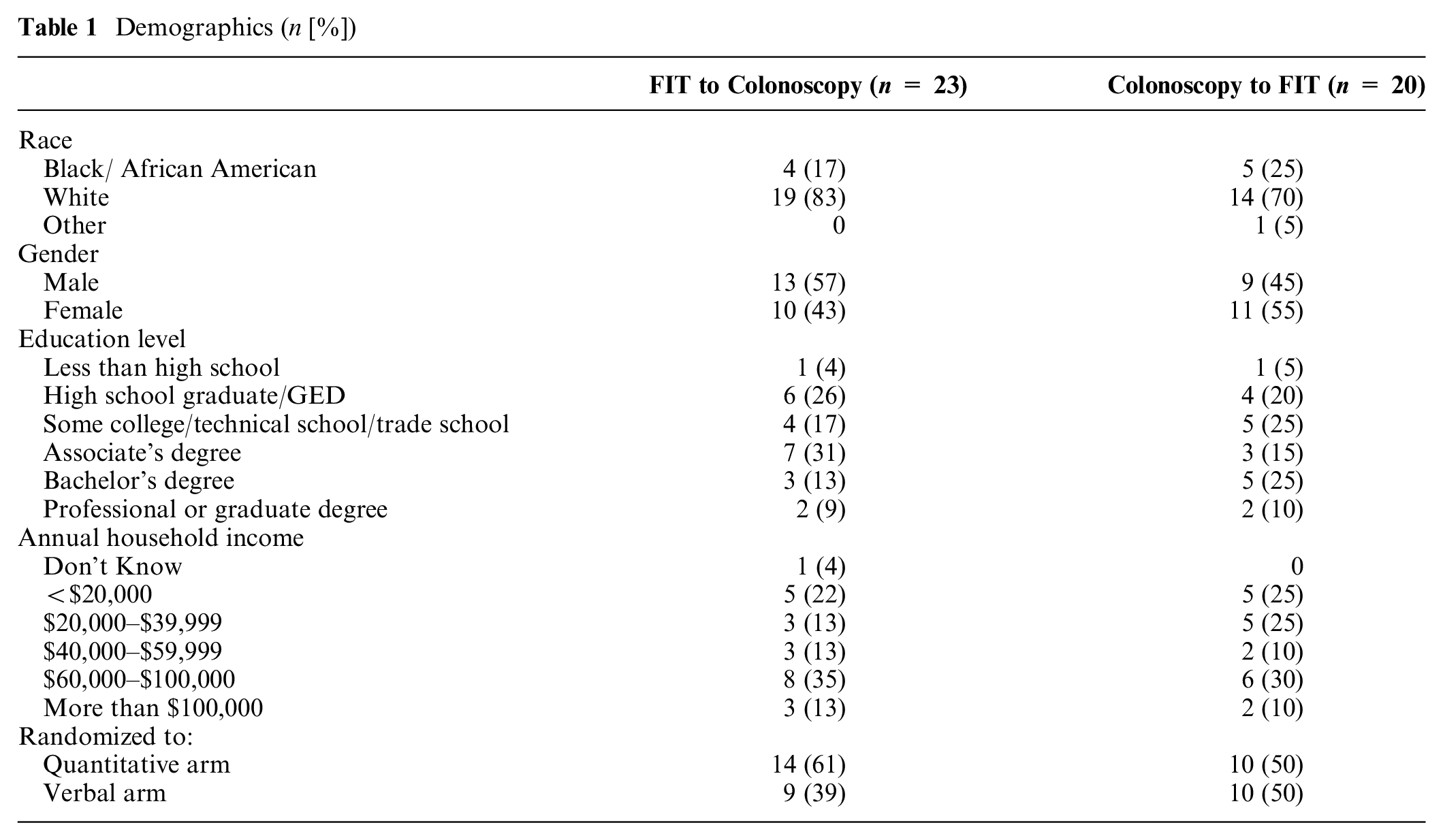
Forty-three patients underwent CRC screening tests that were different from their preferred test at T1, and all provided us with responses. Twenty-three patients who initially chose FIT underwent colonoscopy; 20 patients who initially chose colonoscopy underwent FIT at T2 (Table 1). The reasons patients gave for why they underwent a different CRC screening test than the one they chose after viewing the decision aid clustered in 6 major categories: 1) barriers or risks of their initial test choice, 2) benefits of the alternative test, 3) cost or health insurance coverage, 4) discussion with friends and family, 5) provider recommendations, and 6) competing health concerns (Table 2). Illustrative patient quotes are presented in Table 2 for each category. Some patients made comments that fell in multiple categories (IDs: 11242, 23367, 24189, 22414).
Demographics (n [%])
Categories of Explanations for Discordant Care with Illustrative Quotes
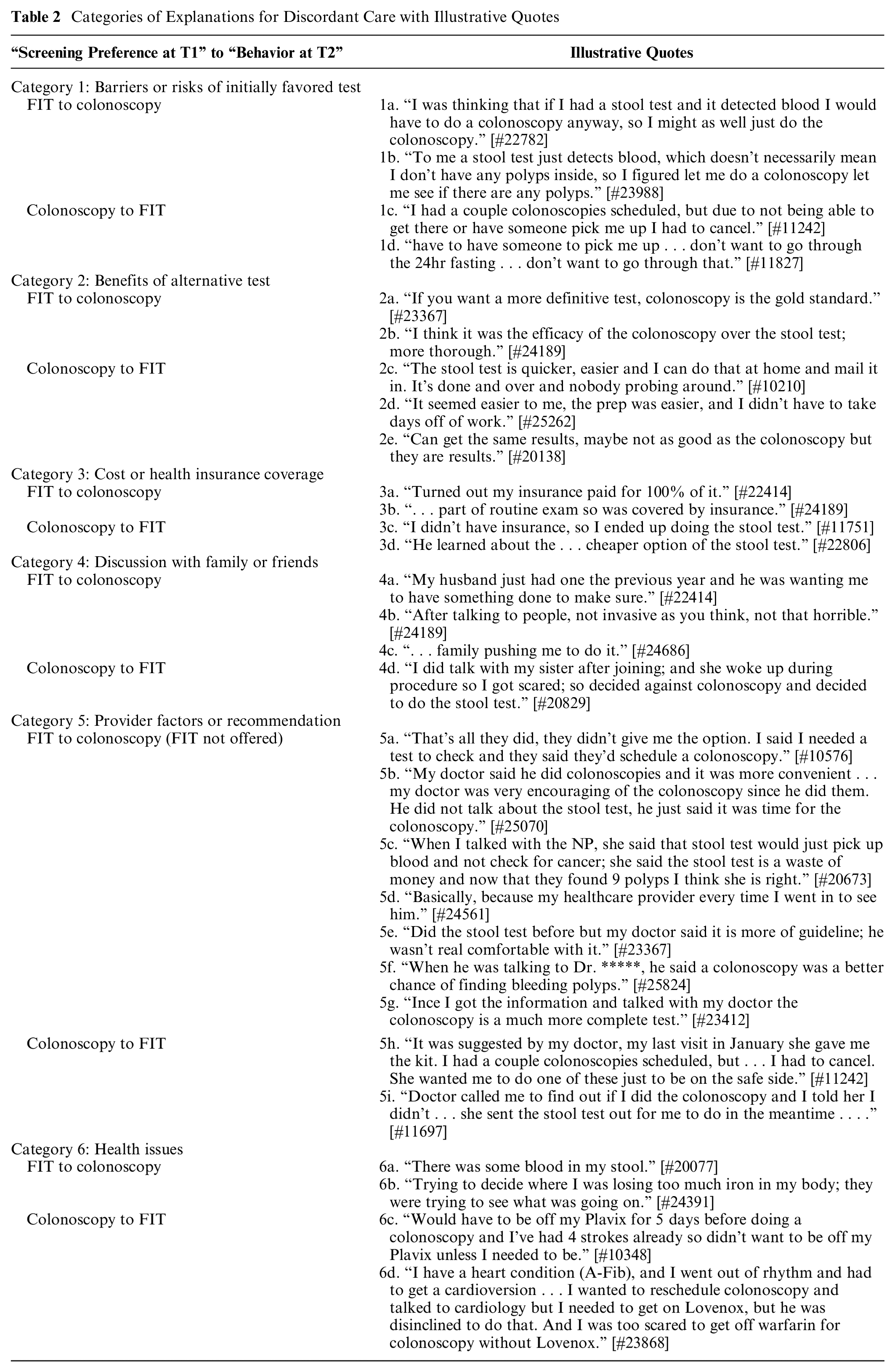
Barriers or Risks of Initially Favored Test
Of those who moved from preferring FIT to getting a colonoscopy, several patients identified common barriers or risks of FIT as a CRC screening tool. These involved the inability of FIT to detect nonbleeding polyps and remove them, the fact that a positive FIT would lead to colonoscopy, the relative novelty of FIT, the need for annual testing, and uncertainty regarding how to perform FIT at home.
Of those who underwent FIT despite initially preferring colonoscopy, some patients identified common barriers and risks of colonoscopy as reasons for changing their preference. These included the invasiveness of colonoscopy, the need for bowel preparation with a strong laxative, and not being allowed to eat after midnight before the procedure. These patients also identified logistical difficulties such as needing time off work and the time required for the procedure and recovery. Patients also commented on the associated risks and challenges of moderate sedation, such as potential adverse events of anesthesia (e.g., undersedation) and needing transportation home afterward.
Benefits of Alternative Test
Many of those who underwent colonoscopy after initially preferring FIT cited the screening benefits of colonoscopy as the reason for their change. Responses in this category often stated correctly that colonoscopy provides a more complete examination of the colon with the ability to locate and remove any polyps. This group of patients also cited colonoscopy’s greater ability to detect CRC.
Some of those who underwent FIT despite preferring colonoscopy at T1 commented on the main advantages of FIT, especially its noninvasiveness. One patient (ID 20138) acknowledged that colonoscopy is a more sensitive and specific screening test but stated that FIT would still provide them a reliable result.
Cost or Health Insurance Coverage
Some patients who elected to undergo colonoscopy after specifying FIT as their preferred CRC screening test at T1 stated that one reason was discovering that the colonoscopy would be covered either completely or mostly by their insurance. Some patients who underwent FIT said they did so in part because they did not have health insurance and wanted some type of affordable screening or discovered that FIT would be the less expensive option for CRC screening.
Discussion with Family or Friends
Several patients who underwent colonoscopy after previously stating a preference for FIT cited discussion with their family or friends to do so. One patient’s response (ID 24686) suggested possible pressure from family to have a colonoscopy. For a couple of patients, the direct experience (in these cases, good experience) of these family members and friends played a role in their change of test.
Only 1 patient (ID 20829) who initially wanted colonoscopy but underwent FIT cited discussion with family or friends as playing a role in their decision to switch to FIT. Specifically, this person cited a negative experience of a family member with colonoscopy as the rationale for switching.
Provider Factors or Recommendation
Several patients who underwent colonoscopy despite preferring FIT at T1 commented that they did so at the behest of their health care provider. These responses varied in tone and nature. Some said they were simply not given the option of FIT or that their provider recommended colonoscopy without further rationale. Others indicated that their provider’s assertion that colonoscopy is better than FIT at detecting CRC played a significant role in changing from FIT to colonoscopy.
One patient’s recall of their conversation with their provider included the provider downplaying the barriers and risks of colonoscopy (ID 25070). Multiple patients indicated that their provider had a negative sentiment toward FIT. One patient indicated that their provider wanted them to get a colonoscopy since this was their first time being screened.
A couple of patients who said they wanted a colonoscopy ultimately got a FIT based on their provider’s recommendation. Both patients said they had missed a scheduled colonoscopy or failed to schedule one, and in response their provider sent or recommended FIT.
Health Issues
Some patients who underwent colonoscopy after previously preferring FIT said they did so because the colonoscopy was indicated to evaluate a medical condition they had developed (changing this from a screening colonoscopy to a diagnostic colonoscopy). One patient (ID 20077) began having blood in their stool, and another developed iron deficiency anemia, 2 conditions that may be assessed with a colonoscopy. Two patients who had a FIT despite earlier preference for colonoscopy cited a medical concern that made colonoscopy potentially more burdensome or risky, in this case worry about stopping anticoagulation (ID 23868) or antiplatelet therapy (ID 10348) for the procedure.
Discussion
In this descriptive study, we found that patients’ reasons for discordant care clustered around 6 major categories. Some of the explanations given by patients in our study for the discrepancy between the test they selected and the one they received fit well with an approach that infers poor decision quality from the existence of discordant care, since in these cases it appears that the patient’s values and preferences were not adequately respected. Explanations given by other patients, however, suggest that they may have simply developed different preferences, for reasons they state, about what test to undergo. These cases thus may reflect high-quality decision making, even though there was discordance between the patient’s earlier stated preference and the test they eventually received. Examining patients’ explanations yields important insights about the strengths, weaknesses, and proper future use of the informed concordance approach and about the challenges of assessing decision-making quality in general.7,11,25
Perhaps the clearest examples in which the patient’s values and preferences appear not to have been respected fall under the category of “Provider factors or recommendations,” especially cases in which patients said that they preferred FIT at time T1 but later received a colonoscopy. A number of studies have shown that many doctors offer only colonoscopy for screening, failing to describe other approaches or portraying them as unacceptable.26,27 Some patients in our study who got a colonoscopy although they previously preferred FIT appeared to describe a similar phenomenon, such as one who said, “that’s all they did, they didn’t give me the option. I said I needed a test to check and they said they’d schedule a colonoscopy” (Table 2, quote 5a), and another who said that “my doctor was very encouraging of the colonoscopy since he did them. He did not talk about the stool test, he just said it was time for the colonoscopy” (Table 2, quote 5b). The conclusion that these were not high-quality decisions using the informed-concordance approach is upheld, it appears, by the patient’s explanation for the discordance.
In contrast, there are many cases in which the patients provide what appears to be a reasonable rationale for changing their mind about what screening test to have. The cases grouped under “Barriers or risks of the initially favored test” (quotes 1a–1d, Table 2) or “Benefits of alternative test” (quotes 2a–2e, Table 2) provide good examples. In these cases, the patients point to established risks or burdens of the testing strategy they initially preferred or benefits of the test they did not initially prefer, providing a clear rationale for a change. If these were truly the reasons for the change, then the decision could well have had high quality, 7 even though there was discordance between the initially stated preference and the test received. This possibility undermines the assumption that discordance as measured in this study and others necessarily indicates low-quality decision making.
Previous research has documented changes in patient preferences over time, for instance regarding end-of-life decisions. 28 There also may be concrete reasons for changing perception of risks and benefits: as a planned colonoscopy becomes more imminent, the risks or burdens could take on increased importance in a patient’s mind, providing a stimulus to reevaluate their choice.
Many other quotations from our patients suggest that the patient may have changed their mind about which test to undergo based a clear and informed rationale, rather than pressure or some form of coercion, although it is impossible to be sure in specific cases. There are multiple examples under “Health issues,” such as patients switching from FIT to colonoscopy due to having visible blood in the stool or developing iron deficiency anemia (Table 2, quotes 6a and 6b) or switching from colonoscopy to FIT after being informed of the need to stop anticoagulation before colonoscopy (Table 2, quote 6c).
Similarly, examples under “Cost or health insurance coverage” cite potentially strong rationales for changing one’s preferred screening test, such as one patient switching to colonoscopy after learning it was fully covered (Table 2, quote 3a) and another choosing FIT since it is cheaper (Table 2, quotes 3c and 3d). It is certainly regrettable that cost considerations and other logistical issues may interfere with a patient getting the test they prefer, 18 but taking cost into account could also be part of a high-quality decision-making process. In fact, some authors have recommended disclosing cost as a potential “adverse event” to consider in decision making for many areas. 29
Some patients even reported multiple different rationales for changing from one test to the other. One such patient (ID 24189) explained their switch from preferring FIT to receiving colonoscopy based on colonoscopy’s higher effectiveness (Table 2, quote 2b), the fact that their insurance covered it (Table 2, quote 3b), and hearing from others that the colonoscopy is not as bad as they previously thought (Table 2, quote 4b). Switching from FIT to colonoscopy for any or all of these reasons could be a case of high-quality decision making, despite this patient being labeled as failing to receive value-concordant care.
A significant limitation of our study is that we cannot be confident regarding the causal process that led to the change in selected test. “Citing barriers or risks of the initially favored test” (category 1) or “Benefits of the alternative test” (category 2), for instance, may obfuscate pressure that was applied that did not take the patient’s preferences into account, including perhaps a provider exaggerating some risks or benefits to impart pressure on the patient to change their mind. It is even possible that a patient’s reevaluation of the risks and benefits is an after-the-fact rationalization for why they did not get the test they wanted, consistent with well-documented cognitive biases and heuristics in other areas of decision making. 30
While some of the quotations under the category “Discussion with family or friends” present potentially strong rationales for switching tests (e.g., Table 2, quotes 4b, 4d), others indicate subtle or explicit pressure that could have led the patient to undergo a test they did not prefer (e.g., Table 2, quote 4a, 4c). Once again, it is impossible to be sure whether the lack of concordance with the initially stated preference indicated poor-quality decision making or informed and reflective decision making. Understanding how the involvement of family members in the decision-making process affects medical choices is an understudied area 12 but is highlighted by our work here.
Our study highlights that decision making takes place over a period of time, not at any one time point. 31 A patient’s choice at time T1 may have reflected their values and preferences at that point, but as time passed, important changes may have occurred in their situation, their understanding of key facts, or their perception of risks and benefits, and these changes may have led to a change in which course of action best fits their values. There likely is not any one time that is best for assessing a patient’s values, preferences, and situation to determine the right course of action for them. 14 Choosing a time point significantly before the test is performed allows for changes at later time points. Going to the other extreme—assessing values and preferences just in the short period before the test is performed—fails to consider the process that led to the patient having that set of values and preferences. The fact that a patient’s preferences and values at one time match the test they receive 5 min later tells us little about the quality of the decision-making process and decision itself. While one study has shown relative stability in patient preferences over time looking back at a treatment, 32 the stability of screening decisions over time before testing has not been examined. Further, for patients who do not get screened, there is no time point at which the test is performed to help guide when to assess patient values or preferences and yet this decision may still be high quality. An optimal approach, it appears, would assess values and preferences over time in some way, paying close attention to the patient’s reasons for any changes that occur. These approaches will be necessary for a full assessment of how decision aids, and other interventions, affect decision quality and shared decision making.
Limitations
Our analysis is limited by the short responses collected in our trial. Being limited to patient recollection, with no way to objectively evaluate conversations and changes in preferences as they occurred, meant that we were limited in the strength of conclusions that we could draw about actual causes. Recordings of discussions with providers or others, or contemporaneous interviews with patients during the 6-mo follow-up period could help address these limitations, potentially in a future study. If the follow-up period had been longer than the 6 mo supported by the trial, more patients would have completed screening, potentially providing more examples of patients who underwent a different test than they initially preferred, which could have possibly allowed us to identify more categories of rationales for discordant care. Thus, we cannot fully exclude the possibility that informational saturation was not achieved. Patients in this study were part of a larger decision aid trial; thus, a selection bias may exist among patients in the study, potentially affecting the generalizability of our findings.
Conclusion
The core insight of the informed concordance approach remains sound: that a key element of high-quality decision making is that the patient receives care that matches their values. In settings where the patient is fully informed of the options and the pros and cons of each, their stated preferred option should be the one they receive. Our study, though, highlights the fact that the lack of concordance may reflect a change of heart by the patient, based on new understanding, new information, or a new perspective, rather than a low-quality decision-making process. This undermines the practice of inferring that a decision-making process must have been low quality if there was discordance. In addition, it highlights the problems with fixing a time point when the patient’s values or preferences should be assessed and the difficulty, if not impossibility, of evaluating the reasons an individual gives for discordance.
Various approaches could be taken to strengthen the informed concordance approach, such as performing multiple evaluations of the patient’s values and preferences over time as well as assessing changes in values or preferences. Any approach would require a nuanced assessment of the patient’s reasons and would require a qualitative analysis or mixed-methods approach. Any analysis of decision quality that used this approach would also probably be strengthened by assessing the decision using other approaches too, including subjective measures such as the Decisional Conflict Scale and Decision Regret Scale and observational measures such as OPTION5.
Footnotes
Authors’ Note
Those interested in accessing the data and materials used in this study should contact the senior author, Peter Schwartz, at
The authors declared the following potential conflicts of interest with respect to the research, authorship, and/or publication of this article: Support for JBR at the time of this submission was provided by the Department of Veterans Affairs, Veterans Health Administration, Health Services Research and Development Service; the views expressed in this article are those of the authors (JBR) and do not necessarily reflect the position or policy of the Department of Veterans Affairs or the United States government. The authors disclosed receipt of the following financial support for the research, authorship, and/or publication of this article: The work for this study was conducted at the Indiana University School of Medicine. Support is provided by a Patient-Centered Outcomes Research Institute (PCORI) Award (CDR-1403-11040; PHS, KKS).
