







Abstract
In today’s rapidly changing “TV everywhere” environment of ubiquitous and always-connected screens, and instant social media interaction around and with complex and compelling television storylines and characters, perhaps it is time to take another look at media effects from a more social perspective. In this study, we provide that social perspective by examining imagined interactions, parasocial interactions (PSIs), and parasocial relationships (PSRs) as manifestations of intrapersonal communication. In the past decade, parasocial phenomena have become a hot topic in entertainment studies; yet, few researchers have worked to establish a strong theoretical foundation for this phenomenon. This study provides significant contributions to the literature by exploring and describing the attributes of imaginative processes revolving around parasocial contact with mediated personae. Specifically, we borrow from imagined interaction theory and identify the most salient relationships among attributes of the PSRs and PSIs with television personae that take place in our imaginations. We also isolate the attributes of PSRs with the greatest power to predict the frequency with which one imagines interacting with a television persona: retroactivity and variety.
Keywords
In the 1980s, consumers adopted cable television and its wide selection of channels. In the mid-1990s, consumers quickly accepted the Internet and its even wider selection of information. In the late 1990s, technology supporting Web 2.0 transformed the Internet into a highly interactive and visual medium. Each of those media technologies obliterated its predecessor in both speed and scale of adoption, and in the 2000s, wireless technology and social media became the fastest growing technology in history, effectively mobilizing and converging “always-on” access to a seemingly endless supply of content. Mobile, through distribution platforms such as YouTube, Netflix, Hulu, iTunes, and Amazon On Demand, has effectively placed an unlimited supply of video content in the pocket of the consumer. In 2014, while Americans are spending far more leisure time with television than we do communicating with each other (American Time Use Survey, 2013), we find ourselves living in the richest media landscape ever known. Potter (2004) explains, We live in an environment that is far different than any environment humans have ever experienced, and the environment changes at an ever-increasing pace. This is due to the accelerating generation of information, the sharing of that information through an increasing number of media channels, and the heavy traffic of media vehicles traversing those channels. Messages are being delivered to everyone, everywhere, constantly. We are all saturated with information. (p. 7)
One outcome of our media-rich and increasingly complex media environments is more frequent and more compelling opportunities for parasocial contact and processing. Parasocial interactions (PSIs) leading to parasocial relationships (PSRs) have always been a by-product of television viewing, but it is only in the past few decades that researchers have invested serious attention to parasocial phenomena. “Every time,” Caughey argues, “an American enters a movie theater, turns on a media machine, or opens a book, newspaper, or magazine, he or she slips mentally out of the real world and enters an artificial world of vicarious social experience” (1984, p. 34). More social forms of media offer new ways for audiences to extend the time they spend in those vicarious experiences. Within hours of television content airing, recaps of specific shows appear online from outlets ranging from traditional sources (e.g., Entertainment Weekly, The Washington Post), to 1990s era web startups (e.g., Salon, Slate) to Web 2.0 era blogs (e.g., Vulture), the content of which are then shared and discussed ad nauseum on Facebook and Twitter.
What do these new PSRs look like? We know that a large portion of our relationships with people whom we know in “real life” takes place in our imaginations (Honeycutt, 2003). Imagined interactions (IIs) are a form of daydreaming in which we intrapersonally build scripts for our behavior based on imagining how other people would respond to us in various imagined scenarios (Honeycutt, 2003, 2010). IIs have often been studied from a functionalist perspective in terms of their attributes and practical functions they serve in our lives. PSRs share striking similarities with II with real-life personae, as both our relationships with real people and our relationships with mediated personae require some imaginative work to flourish. In light of such similarities, the present study brings the concept of II into media effects research, and we examine the attributes of PSRs in such terms.
Why is this an important topic to investigate? Scholarly research of PSIs and PSRs has the potential to “provide significant insight into the audience-media relationship” (Auter & Palmgreen, 2000, p. 79). As control shifts from media producers to media consumers, the relationships that we develop with a variety of mediated characters may even be more influential than a program’s content when it comes to viewers’ expectations and intents regarding entertainment and relaxation through watching TV (Conway & Rubin, 1991). Furthermore, several studies suggest that audiences’ imagining interacting with television characters leads to repeat program watching (e.g., Klimmt, Hartmann, & Schramm, 2006) through selective exposure. Stronger parasocial experiences may also lead to greater commitment to social norms as well as greater enjoyment of programming (Hartmann & Gooldhorn, 2011).
In the present study, we acknowledge that PSR requires some degree of imaginative work on the part of an audience. Consequently, using a survey, we begin to break ground in the area where II and PSI/PSR overlap. The following section offers reviews of both the parasocial and II literature. We then synthesize our knowledge and offer research questions (RQs) for exploration of the role of imagination in PSRs.
Literature Review
To understand the state of the extant parasocial literature, we must distinguish between PSI and PSR, although Klimmt et al. (2006) have noted that both lack broadly accepted definitions. Regardless of competing definitions advanced by different researchers, we can be certain that dismissing parasocial thinking and experience in our quest to understand media effects would be premature. Something imaginative is definitely going on among audiences using the characters and scenarios we see on television, and the phenomenon is worth studying.
Caughey (1984) argued that “in a single week an average American plays roles in hundreds of social situations beyond those of actual social experience” (p. 39). Playing such roles in response to television personae is a reaction previously identified by Horton and Wohl (1956) and many others as PSI, referring to the various one-sided actions performed by audiences in response to a sort of “coaching” by television characters. PSI is a “synching up” that audiences do in response to TV characters (Horton & Wohl, 1956) in terms of cognitions, affects, and behaviors (Schramm & Hartmann, 2008). What happens in our minds after exposure to television characters?
Rubin and McHugh (1987) described PSR that refer to one-sided relationships with television personae that result from PSI. Schramm and Wirth (2010) note Gleich’s (1997) findings and argue that a first PSI sequence between a viewer and a persona is able to constitute a PSR after media exposure, while this PSR is in turn able to influence future motivations and selection processes as well as PSI processes in subsequent media exposure sequences. (p. 27)
In more recent years, researchers have looked at parasocial processing (Schramm & Hartmann, 2008), which is a set of cognitive, affective, and behavioral processes induced by parasocial contact. By processing characters we see on the screen, we may develop relationships of varying intensities with them. Some of this processing involves identification, empathy, and changes in behavior (Schramm & Hartmann, 2008). The PSI Process Scales developed by Klimmt et al. (2006) assess more of the details of processing characters than did previous studies. The researchers proposed a model for explaining the effects of PSRs/PSIs in which various predictor variables, such as a desire to escape loneliness, make us more likely to expose ourselves to some choices of fare rather than others. During the entertainment experience, various PSR/PSI processes lead us to a sense of enjoyment, upon which we might reflect upon at a later date when deciding what to watch. The postconsumption effects, they find, may include changes in our PSR/PSIs toward the characters we have observed, social learning, comprehension, and agreement/disagreement with the messages we receive during the experience. We also argue that audiences engage in certain degrees of visualization and imaginative work after exposure, forming PSRs in the process.
Parasocial Phenomena and II
Watching TV normally leads to some degree of PSI (Perse & Rubin, 1989), and a growing body of experimental (e.g., Schiappa, Gregg, & Hewes, 2005), survey (e.g., Rubin, Perse, & Powell, 1985), and qualitative research (e.g., Caughey, 1984) has examined the determinants and outcomes of interactions audiences have with television personae. PSRs are one such outcome of PSI. They exhibit many of the same cognitive aspects but lack the intensity and behavioral components of real-life relationships (Cohen, 2003). PSRs also tend to express themselves beyond the viewing experience, as our thoughts may wander to the television shows we watched the night before.
Parasocial phenomena have been studied in relation to attachment styles (Greenwood, Pietromanco, & Long, 2008; Theran, Newberg, & Gleason, 2010), loneliness (Wang, Fink, & Cai, 2008) and solitude (Greenwood & Long, 2009), “breakups” with persona through cancellation of TV shows (Cohen, 2003; Eyal & Cohen, 2006), wishful identification and identification (Chory-Assad & Yanen, 2005), and personality traits (Sun, 2010), to name but a few. Indeed, returning to theories developed within the older discipline of interpersonal communication continues to be a fertile approach to building theories of mass communication within our media-rich environments, especially as our media become more social, mobile, and personal.
II is an intrapersonal communication process. IIs are generally defined as a type of daydreaming in which we imagine interacting with other people for the purpose of developing internal scripts for various real-life actions or encounters that we anticipate having in the future (Honeycutt, 2003). IIs are a type of daydreaming that uses verbal and visual imagery as people recall or anticipate the scene of the interaction. Honeycutt (2003) discusses how some people are high in visual imagery as they can report where the interaction takes place, clothing worn, and so forth. In addition, in terms of television, there are numerous shows that show retroactive IIs in terms of flashbacks. Television characters are reflecting on prior conversations. For example, an entire television series called Lost had numerous flashbacks.
Many people admit to having IIs on a regular basis (Honeycutt, 2010). Although PSRs are often treated as hedonic outcomes of PSI rather than functional processes for everyday activities, II research has consistently identified key practical functions of imaginative processes: relationship maintenance, catharsis, conflict linkage, self-understanding, rehearsal, and compensation (Honeycutt, 2003).
In addition to various functions, IIs tend to exhibit eight different attributes: frequency, retroactivity, variety, proactivity, discrepancy, valence, self-dominance, and specificity (Honeycutt, 2003). IIs occur exclusively in the minds of individuals and provide a useful set of constructs for examining the interpersonal behavior that arises from intrapersonal communication, as IIs often precede behavioral and cognitive decisions.
II research may also provide useful concepts for media effects researchers, as we seek to explain human cognition, emotion, behavior, and media decisions as results of media exposure. To date, little research exists regarding IIs and entertainment. We do know that movies or television may trigger conflict-related IIs (Honeycutt, 2010) and that mood management may result from IIs associated with computer-mediated communication (Berkos, 2010). Some research shows that heavy ritualistic television viewing may interrupt internal rehearsal processes (Zillmann & Bryant, 1985), which leads to decreases in the rehearsal, conflict, self-understanding, and relationship maintenance functions of IIs (Madison & Porter, 2012).
Madison and Porter (2012) also found that our PSRs (or “parasociability” as they referred to it) functions as a means of maintaining relationships with TV personae, catharsis, and keeping conflicts among TV characters alive in our minds. The researchers also made the compelling argument that parasociability functions as a means of developing our own self-understanding. By imagining ourselves interacting with personae, we are able to assemble our thoughts and get a clearer picture of our viewpoints and better understand our perspectives on various issues. As a result, television personae provide imaginary conversation partners with whom we may develop scripts for real-life interactions with others.
Building PSRs after parasocial contact resembles II, as Honeycutt (2003, 2010) argues that relationships between two people exist in the imagination in the form of IIs. Unlike II, however, what occurs in our imaginations with a television persona is usually exclusively the relationship we have with that persona. We do not generally have opportunities to use or test scripts on characters with whom we have PSRs; yet, such IIs may indeed influence our thinking and behaviors.
Perse and Rubin (1989) found that after exposure to media content, people engage in various mental activities that lead to behavioral changes. Internal rehearsal has been proposed as a basis of social learning from television (Tan, 1986), and discussion of television content may lead to trial and adoption of innovations. As Honeycutt (2003) has pointed out, behaviors become scripted through the II process and, therefore, influence interpersonal communication when the time for interaction comes. Such notions suggest that PSI/PSRs may also influence IIs, which, therefore, influence our behavior by providing scripts for interaction. PSI/PSRs are also likely to provide a source of internal scripting. Such influences would manifest in our interpersonal interactions, and using catchphrases and other lines from movies in our daily conversation may offer anecdotal evidence of this. In other words, we know that our relationships with other people exist largely in our imaginations, and a good deal of parasocial research suggests that our relationships with television personalities do as well. It seems only natural that II and parasocial research (the “throughput” or “processing” of communication) be taken into consideration when assessing media choices (input) and effects (output) on interpersonal communication.
Attributes of II Applied to PSI and PSRs
Based on extensive reviews of the II and PSI/PSR literature, we argue that building PSRs is a form of intrapersonal communication that takes place after parasocial contact and serves similar functions and displays similar attributes regarding engagement with programming content, much as IIs do for anticipated interactions.
Miller (1986) argued that “mass media and interpersonal communication are psychologically interconnected in fundamental ways, that the influence of one domain pervades communicative activities in another” (p. 138). We assume in the study at hand that one of the fundamental connections between mass media effects on behavior and interpersonal communication may be found within a person’s imagination, or intrapersonal communication. More specifically, we describe the attributes of our PSI in terms previously used to describe IIs and test the concepts to determine if other terms used in describing intrapersonal communication with real-life people may also work for describing intrapersonal communication with mediated personae.
First, IIs can be characterized by the frequency of their occurrence. Chory-Assad and Yanen (2005) operationalized the term frequency as how often one views one’s favorite performer, but found no relationship between frequency of exposure and PSI. For our study, we operationalized frequency as how often one thinks about one’s favorite television persona.
According to Honeycutt (2010), “valence refers to the amount and diversity of emotions that are experienced while envisioning conversation” (p. 5). Valence of IIs appears to differ by gender; females have been observed to have more pleasant IIs than men (Honeycutt, Edwards, & Zagacki, 1989–1990). In its simplest terms, valence refers to a continuum ranging from negative affect to positive affect. For the study at hand, we measured valence to reflect how pleasant one perceives their PSI/PSR to be. Pleasant PSI should lead to greater PSI, which has been demonstrated to lead to repeated viewing of a program (Conway & Rubin, 1991).
Retroactivity in the II literature refers to IIs that “occur after a real interaction has taken place” (Honeycutt, 2010, p. 3). When applying the concept to PSI, retroactivity suggests that a part of a PSR involves thinking back to scenarios involving a persona or dialogue between a persona and other personae, possibly ruminating upon them. For the current study, we adapted PSI/PSR measures from II scales to assess how often a person thinks back to mediated scenarios involving their favorite persona and how much they have used these scenarios in their PSI to write internal scripts for use in real life with others.
Variety is another attribute of IIs identified in the literature. Just as we have a variety of topics, partners, and scenarios in our IIs with real people, so too should we include a variety of circumstances with our favorite mediated personae. Anecdotal evidence suggests that one moment we may be cursing a politician, imagining what we would say if we met them in person, and another moment we may be praising our favorite sports figure, imagining what we would tell them in person after they scored the winning goal. Honeycutt (2010) argues that “IIs which involve various individuals and different topics are related to the imaginer’s internal locus of control” (pp. 3–4). To date, nothing in the PSI/PSR literature has addressed the issue of multiple favorite TV personae or how one imaginatively engages personae in various imagined scenarios. For the purposes of this study, “variety” refers to imagining interacting with multiple TV personae under multiple circumstances (e.g., scenarios, locations, etc.). We should not confuse variety with specificity. Specificity is an attribute of IIs that describes the detail of the imagery involved in PSR. Honeycutt (2010) refers to specificity as a measure of “the level of detail and distinction of images contained within IIs” (p. 5). Specificity of people’s personal imagery involving television personae has not been directly addressed in the parasocial research, and we therefore explore it in this study.
Finally, Honeycutt (2010) tells us that “self-dominance occurs when individuals imagine they are doing most of the talking in their IIs” (p. 4). Self-dominance is also associated with unpleasant IIs (see Valence); rehearsal, proactivity, and retroactivity are attributes quite relevant to intrapersonal communication characterized as self-dominant. Self-dominance is a particularly important concept to study regarding PSR, as PSR is one-sided and self-dominance is likely to be a variable associated with—or affected by—other variables running through a sample. The extant parasocial research has not explored the degree of self-dominance in parasocial behaviors among audiences; for this study, self-dominance was easily contextualized according to an established II self-dominance scale.
Two of the II attributes identified throughout the literature, discrepancy and proactivity, are more difficult to argue as attributes of PSR. Discrepancy, especially, is difficult to translate to parasocial thinking. With IIs, “discrepancy is the characteristic that provides for the incongruity between IIs and the actual interaction they address. Research suggests that individuals who are lonely have highly discrepant IIs” (Honeycutt, 2010, p. 4). Because PSI/PSR is one-sided, it may not be possible to measure discrepancy unless the imaginer has actually met or will meet their favorite persona. Even then, it is likely that meeting one’s favorite persona will be highly discrepant, as real-life meetings with famous personae tend to be brief (Caughey, 1984) or never occur. For this reason, we excluded discrepancy from analysis for the sake of internal consistency.
Proactivity is another attribute of IIs discussed by Honeycutt (2010) that refers to IIs that “occur before an anticipated encounter” (p. 3). Proactivity with IIs is associated with the rehearsal function; yet, with PSI/PSR, the relationship between viewer and persona is one-sided. Therefore, proactivity as an attribute is limited as a means of determining how a person builds a script for interaction, based only on parasocial processes. Proactively thinking about one’s favorite persona, however, is likely to influence selective exposure, or repeated viewing. Measuring repeated viewing or viewing intentions is beyond the scope of this study, and for the sake of consistency among our concepts, proactivity was deliberately excluded from our analysis.
Despite the fact that proactivity and discrepancy may have limited use regarding PSI/PSR, the majority of II attributes does provide a collection of measures that may contribute to our understanding of PSI/PSR regarding various personae and scenarios. Moreover, measuring those attributes of IIs with TV personae may be of great use for those involved in entertainment production, as well as scholars who seek to better understand the widespread phenomenon of audiences–personae relationships.
Measurement of PSI/PSR attributes provides an important contribution to the literature, as most studies have simply tried to measure whether they exist among members of an audience, to what extent they exist in audiences, and how intense the parasocial experience may be. Furthermore, treating PSR as a form of intrapersonal communication allows us to gauge how involved an audience may be with personae and gives us a hint as to whether audiences will continue to watch a series, or abandon it for something else.
In summary, II research consistently identifies eight different attributes of such interactions: frequency, retroactivity, variety, proactivity, discrepancy, valence, self-dominance, and specificity (Honeycutt, 2003). For this study, we limit the conceptualization of PSRs to mulling over mediated (or imagined, based on initial contact) scenarios in which we, rather than other personae, are the ones imagining interacting with a personae. As defined by Honeycutt (2010), the concepts of discrepancy and proactivity work well when we have real-life outcomes with which to judge the accuracy or effectiveness of our IIs. Because the persona–audience interaction is one-sided, we excluded these attributes from analysis for the purpose of maintaining a conceptual consistency among the other attributes. The attributes we included, therefore, reflect reports of respondents placing themselves within an imagined context in which they imagine interacting with a favorite persona. These attributes were valence, retroactivity, frequency, specificity, self-dominance, and variety. With this in mind, the following RQs guided the efforts behind this study. RQ1: Do the attributes of IIs reflect the attributes of PSIs/PSRs? RQ2: How are the imaginative attributes of PSR related to each other? RQ3: Which attributes of II with the persona(e) lead to thinking more frequently about the persona(e)?
Methods
Participants
The sample in this study comprises 250 students enrolled in mass communication courses at a large southern university. Our sample was 25% male and 73% female, 20.01 years old (SD = 2.54), and had an average of 15 years of formal education (SD = 1.46). Eighty-seven percent reported earning less than $20,000 per year, with 9% reporting an income between $20,000 and $100,000 per year.
Procedure
In the tradition of previous II and PSI/PSR studies, we used a survey to collect data on the attributes of PSR. This research received no specific grant from any funding agency in the public, commercial, or not-for-profit sectors. We obtained the necessary permissions for using human subjects through the institutional review board. In exchange for participation, we offered students extra course credit. We relied heavily on psychometric scales established in both II and PSI/PSR literature. After contextualizing existing II scales to reflect PSRs with favorite television personae, we programmed an online survey and distributed links to undergraduate students enrolled in mass communications courses at a prominent southern university. Links were delivered to the students through a system used by the university to maintain the anonymity of responses while still allowing researchers to award credit for participation.
Measures
We measured PSR attributes on similar 7-point Likert items developed by Honeycutt (2003) for measuring II attributes. As Honeycutt (2010) recommends, we contextualized II questions to reflect II with a favorite television persona rather than a real-life conversation partner. Such questions were designed to assess how well the II concepts of frequency, proactivity, retroactivity, variety, discrepancy, self-dominance, valence, and specificity may apply to PSR with television personae. An example from the frequency scale includes “I imagine interacting with my favorite TV character many times throughout the week.” We then compiled items into scales reflecting each attribute provided from the II literature.
In addition to the aforementioned measures, we asked several demographic questions: age, education, income, and gender. Contextualizing II attribute scales for the purpose of exploring PSR with favorite television personae showed acceptable reliability measures, indicating that the attributes of IIs and PSR may be measured using similar II scales when appropriately contextualized for mediated personae.
Results
Means, Standard Deviations, and Scale Reliability.
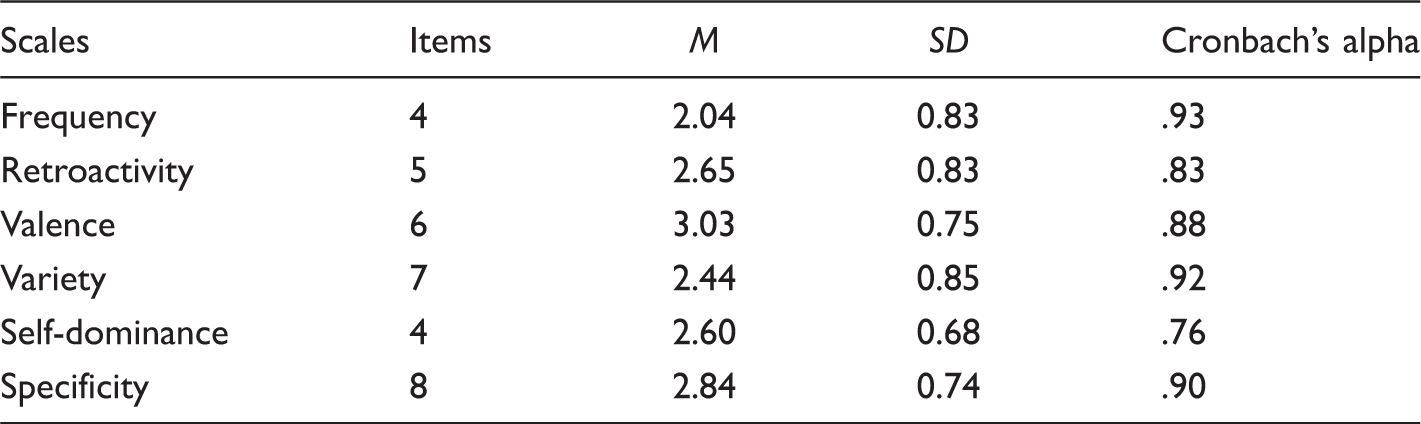
RQ1 asked if the attributes of IIs reflect the attributes of PSIs/PSRs. To explore this question, we ran principal components analyses with Varimax rotation for each of the attributes scales to refine them and remove items that did not work for the contextualization. We then followed up with reliability analyses of the scales derived from the best performing items in the factor analyses (see Table 1).
Factor Analyses.

Note. II = imagined interaction.
Eigenvalues: Frequency = 3.28, Retroactivity = 3.02, Variety = 4.76, Self-dominance = 2.35, Specificity = 4.68, Valence = 3.75
Items that loaded above .60 were then included in the attributes scale indexes. Table 1 provides the means, standard deviations, and Cronbach’s alphas of the various scales used in this study, after eliminating items through the principal components analyses. Contextualizing II function scales for the purpose of exploring the attributes of PSIs/PSRs with favorite TV personae exhibited acceptable reliability, indicating that the attributes of IIs and PSI/PSR do reflect each other and in fact, may be measured using similar scales.
Correlations Among PSR Attributes.
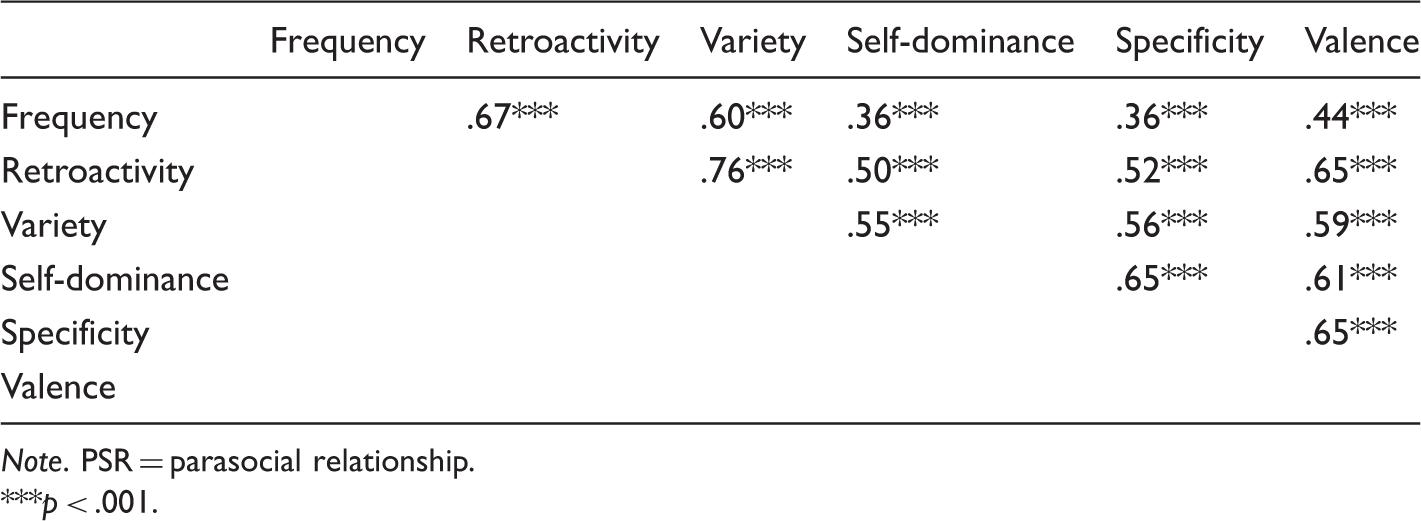
Note. PSR = parasocial relationship.
p < .001.
OLS Regression Analysis of Predictors of Frequency of PSI.
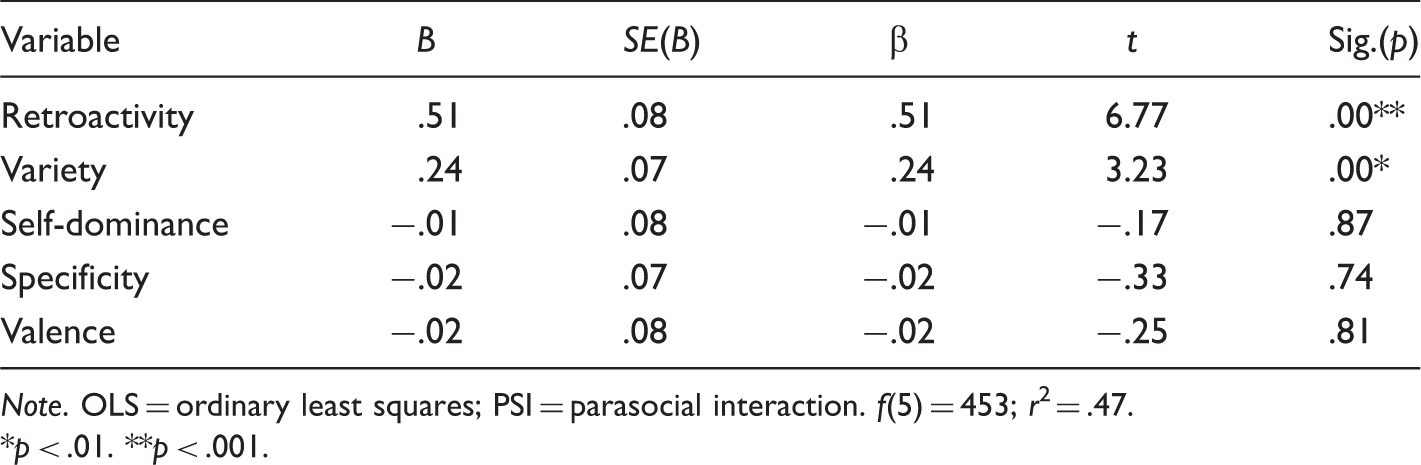
Note. OLS = ordinary least squares; PSI = parasocial interaction. f(5) = 453; r2 = .47.
p < .01. **p < .001.
The attributes of retroactivity and variety had the greatest predictive power for the frequency attribute, while self-dominance, specificity, and valence were not significant.
Discussion
This study contributes some important findings to the parasocial literature regarding attributes of our parasocial thinking and expands II research to include mediated personae. IIs seem to reflect PSIs and PSRs. In fact, our data showed that the II attributes scales originally developed by Honeycutt (2003) can be successfully contextualized for measuring the attributes of PSI. Initially, the revised scale items exhibited good face validity, as they were easily reworded to measure the attributes of PSI with mediated personae; yet, we did have to make some minor wording changes. The ease of conversion and the results in our data suggest that measuring specific attributes of parasocial experiences has the ability, based on factor and reliability analyses, to produce quantified descriptions of PSRs.
Furthermore, we found that the different attributes of PSRs with mediated personae are significantly related to and highly correlated with one another. Some of the more salient correlations involve the attribute of retroactivity. Retroactivity, as we have defined it in regard to PSRs, refers to thinking back to interactions we have seen on television and adding our own imaginative input to various interactions and scenarios. As our data suggest, we do this frequently and may often add a variety of our own content to the scenario. The correlation with valence indicates these scenarios are pleasant, and when we put ourselves into the imagined scenario, we tend to be an equal participant. We also include a lot of variations on the original TV setups in our mind, which is exactly what we do when building scripts involving real-life acquaintances, but we tend to be less specific regarding the details.
This retroactivity in thinking about mediated personae may point to the same conclusion to which many critics of television (i.e., Mander, 1978; Postman, 1985) have come—viewing television makes us dependent on the show’s producers for the basic components of the TV reality. On the other hand, our data suggest that people do retroactive imaginative work on top of “borrowing” things from television. It suggests TV shows give us a starting point from which our imaginations fill in or add on details. Today’s complex television environment induces the audience’s participation in constructing reality, and it appears to be a dynamic process. Furthermore, we take to social media during and after the show to share this retroactivity.
The correlation between self-dominance and valence is particularly interesting. We may interpret this finding as (a) we enjoy imagining ourselves interacting with TV characters, and this results in a self-dominant role in the imagined scenario, or (b) imagining ourselves as self-dominant leads to more positive-valenced IIs when we bring in TV characters or scenarios. Perhaps self-dominance is a natural perspective when considering the way today’s digital media empowers users to access content how and when they want. When we are in complete control of our media environment, we also tend to dominate PSI as we imagine them. Regardless, when we imagine ourselves playing a dominant role in interactions with TV characters, the content, as self-reports indicate, tends to be more pleasant. Such pleasant scenarios may include themes of romance, justice, heroism, or any number of themes that we tend to enjoy.
Frequency of II with TV personae was most strongly correlated with retroactivity and variety. People who (relatively) frequently imagine themselves interacting with TV characters are likely thinking back to many different scenarios they have seen on television and “testing the water” by adding elements. In previous II research, this process of imaginatively testing contingencies is among the identified functions of IIs and is related to rehearsal and self-understanding (Honeycutt, 2010). IIs, whether with real people or TV characters, allow us to develop cognitive scripts for later use. In IIs with TV characters, the case appears to be that the frequency of such IIs revolves around thinking back to the more compelling scenes we have seen on television.
With this in mind, the finding that variety affects the frequency of II with personae, and therefore our PSRs with personae, is compelling. It suggests that frequent parasocial thinking is (a) a result of more diverse imaginative work or (b) that television, as others argue, has become more compelling and filled with variety. With a greater variety of characters and scenarios, we have more raw imaginative material to work with. With more imaginative material, we have more opportunities through which to develop PSRs with the characters and ultimately, the shows themselves. With more ways to share our own thoughts about this imaginative material, these effects may become more enduring.
Part of this variety in our PSRs may be based on the very nature of contemporary TV characters themselves. Ambiguous or antihero-type characters may force us to do more imaginative work to “fill in the blanks” as part of our process of forming affective dispositions toward them. In addition, today’s television shows involve increasingly complex plotlines and numerous characters than even recent television history (Johnson, 2006). For example, the sheer number of characters in this decade’s Lost and Breaking Bad and even the 1990’s E.R. and NYPD Blue are significantly higher in number than those on such popular television dramas of the 1980 s such as the long running Magnum P.I. and The Equalizer.
Why did the attributes of specificity, self-dominance, and valence fail to predict the frequency of IIs with television personae? Various studies (i.e., Edwards, Honeycutt, & Zagacki, 1988) have assessed specificity in IIs. It is an attribute associated with a secure attachment style and various dimensions of conversational sensitivity. Specificity as a nonpredictor may be explained as a consistent attribute. Individuals may have very specific IIs with TV personae, or such IIs may be less detailed. The details in the IIs themselves may have no bearing on how frequently one imagines interacting with a TV character; yet, the IIs may maintain a consistent level of detail. This points to a weakness of this study, which we will discuss in the conclusion; data on II content would expand this data and provide greater insight into the attributes of PSR.
Self-dominance and valence also failed to predict the frequency with which we have IIs with television personae. Self-dominant IIs are associated with negative-valenced IIs and tend to revolve around unpleasant, interpersonal conflicts we have with others (Honeycutt, 2010). With television characters, we lack the same levels of emotional and physiological response to characters (Cohen, 2003) when thinking back to them. PSRs lack the ability to be perceived as intense as our real-life relationships. There is simply not as much at stake with mediated characters. With less affective stake in our IIs with TV characters, we are probably less likely to think about them than we would be the conflicts we have with our real-life acquaintances. In addition, many of today’s television characters—think Breaking Bad’s Walter White or House of Cards’ Francis Underwood—are at best, morally ambiguous. While we may live our lives vicariously through them, we do not appear to need to be dominant in those relationships or feel the need to ascribe valance to our IIs. Therefore, valence and underlying need for a feeling of dominance are unrelated to the frequency with which we think about TV characters.
Conclusion
In this study, we demonstrated that II scales can be successfully applied to measure the attributes of PSI and PSRs with television personae and explored the relationships among the different attributes of PSRs. Finally, we determined that retroactivity and variety are attributes with strong predictive power regarding the frequency with which we imagine interacting with TV characters. Until now, most media effects research has tended to avoid looking at intrapersonal processes, while interpersonal communication studies have tended to avoid exploring media effects on interpersonal communication. This study provides significant contributions to both bodies of literature by bridging the disciplines and exploring the attributes of imaginative processes revolving around parasocial contact with mediated personae.
Despite these intriguing findings, this study also suffered from several limitations. First, all the respondents were students, and it is not possible to generalize these findings to other populations. Second, though our study does examine the attributes of II with mediated personae, our work does not examine the actual content of such IIs. In fact, the most salient limitation of this study is its Rorschach test-like analysis regarding the correlations among the different attributes. All of the attributes of PSRs are moderately to highly correlated and dependent upon one another. Future research should include qualitative interviews with people to refine the attributes of PSRs and search for others that may exist that have not been identified in the II or parasocial bodies of research. By qualitatively exploring the content of IIs with mediated personae, we may find that IIs and PSR may be the same process or two separate processes with similarities in terms of function and attributes. Furthermore, future work will involve applying these newly defined scales and concepts to activities within social media. Researchers can examine the content posted in social media surrounding television personae and see how sharing, commenting, or posting affects PSRs and resulting interactions.
Finally, though we excluded the concepts of discrepancy and proactivity from our analysis, future research should try to accommodate them through reconceptualization. Many audience members spend time trying to predict how a show or a series will end. Although these concepts may be limited in their use in describing the intersection between an audience member’s life and that of a TV persona, proactivity and discrepancy could feasibly be worded to reflect how we anticipate our favorite TV personae will fare within the context of the stories in which they appear. The limited, yet growing body of literature on TPIIs, or third-party IIs (Porter, 2012), an imaginative phenomenon in which we imagine others interacting with one another, may offer a foundation for research into the proactivity and discrepancy attributes. Sample items might include “I spend time imagining how events will pan out for my favorite character,” and “I find my favorite TV character’s situations often differ from how I imagine they will turn out.”
The study at hand addresses only the characteristics of imagery cognition and television characters. Future research could expand this work by including an abbreviated version of the Parasocial Process Scales as advanced by Schramm and Hartmann (2008). These scales measure a sort of “synching up” with TV characters in terms of cognition, affect, and behavior. Parasocial processing occurs before the imaginative work we do beyond the viewing experience—in showers, during commutes, meetings, and so forth. What aspects of parasocial processing lead to different types of IIs after viewing? Does the cognitive domain of parasocial processing affect some functions and attributes of PSRs while affective parasocial processing affects other functions and attributes? How does the behavioral domain of parasocial processing (yelling at the TV screen, cheering, or other viewing behaviors) affect postviewing imaginative work and development of PSRs?
Footnotes
Declaration of Conflicting Interests
The authors declared no potential conflicts of interest with respect to the research, authorship, and/or publication of this article.
Funding
The authors received no financial support for the research, authorship, and/or publication of this article.
Author Biographies
His research is located between interpersonal and mass communication and examines the functions, characteristics, and processing of media messages. Ever-increasing attention to multimedia entertainment puts his work at the cutting edge of our understanding of media effects. He has presented original work at numerous conferences and published peer-reviewed articles in the American Communication Journal; Journal of Imagination, Cognition, and Personality; Louisiana Communication Journal, and online. In 2014, he marked an item off his bucket list by giving a TEDx talk at Stephen F. Austin State University.
He currently chairs the Digital Media Initiative in the Manship School at LSU. He teaches digital media and advertising courses at the undergraduate and graduate levels. His research on digital, social, and mobile media effects has appeared in numerous journals and books devoted to advertising, journalism, public relations, and sport. He holds a joint appointment with the Center for Computation and Technology (CCT) and is a member of the AVATAR faculty. He won the 2009 LSU Alumni Faculty Excellence Award and was the 2010 American Advertising Federation Donald G. Hileman Memorial Educator of the Year in the seventh district. Porter earned his PhD from the University of Georgia where he helped create the New Media Institute.