






Abstract
Nontimber forest products are used for a wide variety of purposes, including household consumption, income, and culture. However, the cultural dimensions and significance are considerably understudied. This article reports on a study of the cultural significance of two types of sticks (induku and umnqayi) carried by males of the Xhosa ethnic group in South Africa. Each of the sticks is made or given to males who have just been through initiation from boyhood into manhood. An induku is a multipurpose stick and symbolizes what it means to be a Xhosa man (amadoda EsiXhosa). An umnqayi is also associated with male identity but is interpreted as a symbol of peace and is carried at different times to an induku, mostly notably when approaching a family with a proposal of marriage. Most of the study participants described amadoda EsiXhosa who did not have an induku and umnqayi in negative terms. Both types of sticks are crafted from specific, locally harvested species, with Olea europaea subsp. africana being the most commonly used for induku and Diospyros lyciodes and Mystroxylon aethiopicum (among others) for umnqayi. Although many amadoda EsiXhosa craft their own sticks, there is a growing trade with crafters selling Xhosa sticks alongside busy roads and earning what they deemed as a meaningful income. Despite the deep cultural significance of Xhosa sticks, there was some commentary that urbanization was perhaps diminishing the practice of carrying an induku, but not an umnqayi. This study provides a novel case example of the biocultural basis of NTFP use.
Introduction
Nontimber forest products (NTFPs) are an extremely diverse array of wild biological resources that are used by rural and urban communities around the world to fulfill a number of consumptive and nonconsumptive needs (Magry et al. 2024). Widely used examples include wild foods, firewood, building materials, traditional medicines, resins, and fibers. The five main uses relate to (i) household use and consumption, (ii) cash savings from such household use, (iii) safety nets in adverse times, (iv) income generation from selling raw NTFPs or value-added products, and (v) cultural uses and contributions to identity (Shackleton 2015). There is extensive literature globally on the first four uses, but Cocks, López, and Dold (2011) and Lake et al. (2018) observe that research on the cultural use and significance of NTFPs is considerably more limited, other than perhaps medicinal plants (e.g., Aparicio et al. 2021; Anju and Kumar 2024). This article seeks to add a case study to this limited yet important literature through examining the cultural significance of particular types of sticks carried by Xhosa men in south-eastern South Africa.
Sticks have been carried by humans around the world for a variety of purposes since the dawn of humanity (Schoch et al. 2015; Hrnčíř 2023), including as offensive and defensive weapons, providing physical support for the aged or infirm, as hunting and digging aids or for symbolism of a particular identity, occupation, or status. They have ranged in size, shape, and extent of modification and decoration. Many cultures employed or continue to employ sticks in traditional sports and during cultural events. This is not restricted to rural or Global South regions. For example, Peter the Great of Russia allegedly discouraged competitive, recreational stick fighting in 1682 because he wished to avoid injuries to prospective soldiers (Tausk and Clements 2001). Fighting with sticks was popular in the United Kingdom in the 18th and 19th centuries (Brough 2021) and among the bourgeoisie in Barcelona (Spain) in the early twentieth century (Torrebadella and Gutiérrez-Garcia 2022), while Filipino Martial Arts with sticks found much support in Canada in the late 1980s onward (Pauha 2024). Sticks of various types are also intimate to some of the ritualized martial arts of Southeast Asia, such as silambam in India, bōjutsu and kendo in Japan, and kali in the Philippines, as well as parts of Venezuela (e.g., Ryan 2015).
To our knowledge (and after a scoping search in January 2024 using Scopus and the Web of Science), there are no published works on the use, significance, and ethnobotany of cultural sticks among the Xhosa ethnic group in South Africa, other than a section in the ethnographic book by Dold and Cocks (2012). There is an insightful article on the significance of stick fighting by Zulu males (a related, yet distinct ethnic group) in South Africa by Carton and Morrell (2012), while Bhana et al. (2021) explored the associations between stick fighting with broader expressions of Zulu masculinity and violence in contemporary South African society. Earlier, Coetzee (2002) provided a detailed treatise on the nature and practice of Zulu stick fighting. These three studies focus on the practice and ritualism of stick fighting, whereas our study sought to assess the cultural significance of the sticks themselves, as NTFPs, carried by amadoda EsiXhosa and the basic ethnobotany of the species used. While nearly all amadoda EsiXhosa possess sticks, there are different types for different purposes. During casual conversations with local men during the original scoping of our study, we were made aware of five types of sticks, the first two of which nearly every amadoda EsiXhosa possesses. These two are the focus of this article because of their widespread use and cultural significance.
The first, called an induku in the isiXhosa language, is a stick that is carried by amadoda EsiXhosa as a symbol of being a man. Those who have not been through male initiation (usually as a teenager) into manhood cannot carry an induku. It can also be used in defense or in attack if required. The second, known as an umnqayi, is a stick that is given to young males who have just completed initiation rites marking their transition from adolescence to manhood. It is regarded as a symbol of peace. It is carried when attending bridewealth negotiations and visiting one's in-laws. It may also be carried at other important times, but it is never regarded as a stick that could be used in fighting (Dold and Cocks 2012). One dies with it. Over and above these two types of sticks, we were made aware of another three types that are carried and used by particular groups or for particular purposes. A kholo is used as a defensive tool to block strikes during ritual stick-fighting displays or competitions, whereas an intonga yamagqirha stick is carried only by traditional healers. The handle is usually decorated with different colored beads and hair from a cow`s tail. A variant of this, an intonga, is used by young boys when playing stick fighting before they are old enough to go through initiation; most young boys, particularly in rural areas, have two intonga, which are swapped for a single induku after initiation. The last (udondolo) is a long, functional stick that is carried by an individual who leads any group of people crossing a river or water body, and is used to gauge the depth of the water for crossing.
Within this context, the objective of this research was to understand the nature and cultural significance of two types of Xhosa sticks (induku and umnqayi) made from locally harvested species. We did so through addressing three research questions, namely (i) What does having one or both an induku and umnqayi mean to amadoda EsiXhosa? (ii) Is the cultural meaning associated with these sticks changing? and (iii) What species and processes are used when crafting Xhosa sticks?
Study Area
The study participants were located in the towns of Makhanda (33.310°S; 26.528°E) and Peddie (33.197°S; 27.120°E) and also rural villages in the Kat River valley (approx. 32.643°S; 26.656°E). All these localities are found in the Eastern Cape province, South Africa. The Eastern Cape is the poorest province in the country, underlain by a large rural population with low formal education and high unemployment. A large proportion of rural households have family members working in the large metropolitan areas of the country. Rural communities typically engage in a mix of livelihood strategies, including migrant labor to urban centers, formal off-farm employment, receipt of government social grants, home gardening, some livestock husbandry, collection of NTFPs, and home-based entrepreneurship. Urban areas also suffer from high unemployment rates and high dependency on government social grants and unskilled and insecure jobs.
Rural and urban communities in the area have a deep biocultural affinity for natural landscapes and the use of NTFPs for cultural, consumptive, and income purposes (Shackleton and Shackleton 2006; Cocks, Dold, and Vetter 2012; Dold and Cocks 2012; Davenport, Shackleton, and Gambiza 2012). This is founded in the traditional Xhosa worldview that reveres the ancestral spirits, which are believed to reside in nature (Cocks, Dold, and Vetter 2012; Dold and Cocks 2012), and as such, there is no direct separation or duality between humans and nature (Pröpper and Haupts 2014). Consequently, acknowledging the ancestral spirits is what maintains balance, harmony, and well-being in one's life. Misfortune can be ascribed to displeasing the ancestors. As such, there is extensive biocultural appreciation of sacred natural sites and natural landscapes in shaping one's well-being and even identity (Dold and Cocks 2012; Cocks et al. 2016; Walsh 2021; Møller, Cocks, and Vetter 2023). This also translates into widespread use of medicinal and cultural plants in everyday life and particular rituals and ceremonies (Dold and Cocks 2012). For example, Cocks and Wiersum (2003) determined that 58 percent of the economic value placed on plant resources used by rural Xhosa households was for cultural purposes. Moreover, many urban households also use wild plant resources for cultural reasons, but increasingly they purchase them rather than collect them for themselves (Cocks and Dold 2004; Cocks and Møller 2002).
Methods
A qualitative approach was used, in which we engaged in semistructured interviews and in-depth conversations with 13 amadoda EsiXhosa who possessed one or both of the sticks (and induku and an umnqayi), as well as three men who make and sell Xhosa sticks. Since this is the first systematic work on the cultural significance of Xhosa sticks and the objective was to explore personal perceptions, beliefs, and emotions of a specified group, an in-depth qualitative approach was adopted. This was based on a small sample size for depth of understanding, rather than a quantitative, replicated sample for generalizability (Rust et al. 2017). This is viable for relatively homogenous groups who have recognized knowledge or expertise in the topic being researched and who respond to an identical and clear survey instrument (Guest, Bunce, and Johnson 2006). The accumulative analysis of code saturation achieved through thematic analysis by Guest, Bunce, and Johnson (2006) and Hennink, Kaiser, and Marconi (2017) indicated that a sample of 9–12 in-depth interviews is sufficient for code saturation, but double that is recommended for meaning saturation (Hennink, Kaiser, and Marconi 2017).
Respondents were between 30 and 80 years old and were purposively identified via personal networks of the primary author, who is also an adult Xhosa male, or friends of those initially contacted (i.e., a snowball sample approach). The sample included men living in rural villages and also the towns of Makhanda and Peddie. Interviews were conducted in isiXhosa as the home language of the respondents and the lead author. They took 1–2 h and were tape-recorded for later transcription. If certain details were unclear or additional information was required, we held additional conversations with a respondent. The project and topic prompt sheet were approved by the Human Ethics Committee of Rhodes University (number: 2023-7363-7762). The interviews were conducted between October 2023 and March 2024.
The tape-recordings were transcribed and translated into English. Data analysis was via deductive thematic analysis, in which the interview transcripts were each read several times, and themes were identified and coded. As a deductive coding approach, most of the themes corresponded to some degree to the prompt topics of the original open-ended interviews. A couple of more emergent themes or subthemes included details around a third type of stick used by churchgoers, as well as the distance over which customers will travel to purchase a stick from a particular well-known crafter. Quotes were highlighted to epitomize particular themes.
Results
Here, we describe the cultural use and significance of induku and umnqayi sticks (Figure 1) to the respondents. This includes how amadoda EsiXhosa procure each type of stick and the species used. We do so for the two types of sticks individually, followed by consideration of the perceptions of traders in Xhosa sticks.

Induku and umnqayi sticks for sale besides a public road outside Makhanda, South Africa. The dark-colored sticks on the right are umnqayi (Photo: M. Ntshudu).
Induku Sticks
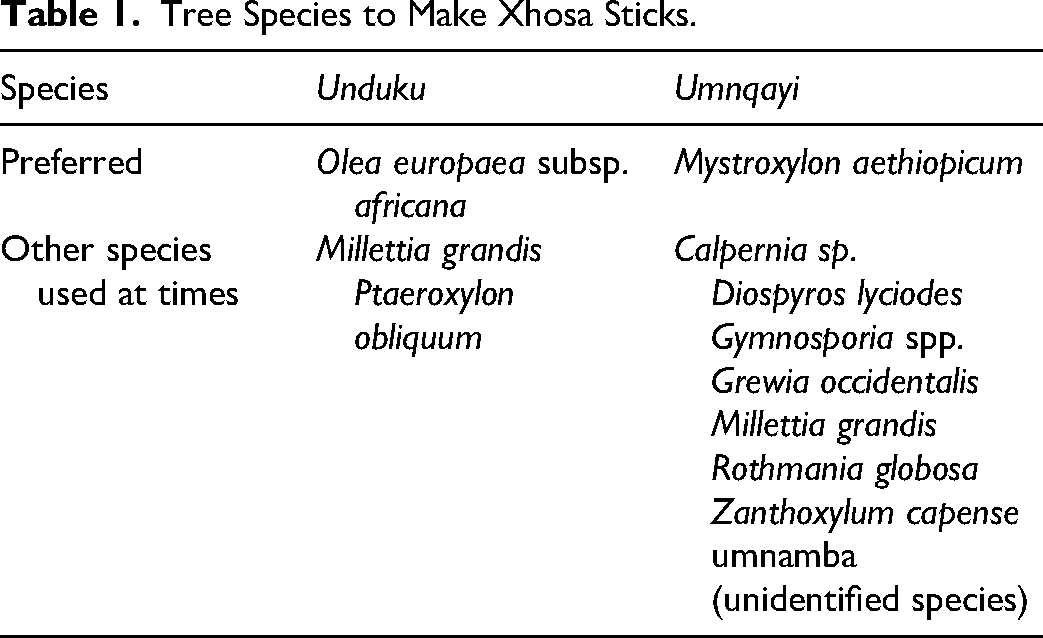
All the respondents had an induku. Most had acquired them as a teenager and thereafter will keep them for the rest of their lives unless it is lost or broken, in which case they will make or buy another one. Most cut and crafted the stick themselves, but three respondents noted that the first induku they ever possessed had been a gift from an elder brother. Some also observed that while they had made their own induku it was not uncommon nowadays for people to buy an induku rather than craft one. Although the wood of several tree species can be used to make an induku, the clear species of choice was for one crafted from umnquma wood (Olea europaea L. subsp. africana (Mill. P.S.Green)) because of its hardness, and some added that it does not rot or decay. Other species used include Millettia grandis (E.Mey) Skeels and Ptaeroxylon obliquum (Thunb.) Radlk. with the choice of species most likely being influenced by local availability (Table 1).
Tree Species to Make Xhosa Sticks.
Most induku are made by first choosing a long (approx. 0.9–1.3 m), straight branch on the selected tree species. It is cut and carried home, where the bark is stripped off. However, some mentioned that an induku can also be made from the roots of the selected tree, which they felt provided a stronger stick. Those crafted from a branch are known as umasebeni, and those from a root are termed umila. Often, the upper end is carved or etched to help improve the grip (Figure 1). Alternatively, the head of the stick can be crafted into a “ball” that fits comfortably in the hand; this stick is then called an igqudu. If the intention is to craft an igqudu, then a thicker branch or root is cut. The stick is dried for approximately one week, after which it is ready for use. However, most mentioned rubbing the fresh stick in cow dung or animal fat to help “cure” it, which they perceived made it stronger. Some did both, first the dung for 2–3 days, followed by the animal fat. A few reported burying the fresh stick in dung/compost or soil for a few days, which helped prevent cracking. One mentioned hanging it above the cooking fire to dry it, which also makes it black. If it is not sufficiently straight, then it is straightened by placing it under heavy stones.
Most boys, especially in rural communities, are introduced to stick fighting as a game (umdlalo) when quite young. However, as soon as they have gone through initiation into manhood, they swap their “boys” sticks for an induku, which they will carry for the rest of their lives. It is a symbol of manhood, but also a functional “tool” that can be used to kill snakes, prod cattle while herding, or used in attack or defense if ever needed. As stated by participant #2: Induku is very important, it is everything as it protects you. You feel like a real amadoda EsiXhosa.
Or, as stated by participant #6: It makes me feel respected as an amadoda EsiXhosa, I feel like an amadoda EsiXhosa when carrying induku. I feel proud when attending meetings and see other men carrying induku. Amadoda EsiXhosa don’t go bare-handed.
While participant #10 observed: I am a man, I cannot live without it, it symbolizes who I am.
Despite these assertions of the cultural and gender identity significance of an induku, all but two of the participants said that the worth of induku was changing. They commented that increasing numbers of amadoda EsiXhosa no longer carried an induku, even at traditional meetings. They felt that elderly men still carried an induku, but not so the younger generation. As stated by participant #9: No, it is not the same, the youth […..] do not follow this tradition. There is just a total disrespect, especially of the elders and traditions by today's young people.
The declining prevalence of carrying an induku among the younger generations was attributed to urban lifestyles (meaning that young boys are not raised in the tradition of stick fighting), westernization, and preference for knives or firearms for protection. Some viewed this as a cultural betrayal, such as participant #6 (who is 45 years old): They abandoned their background and turned away from their own history.
Or, that those without an induku are regarded as not really amdoda EsiXhosa: They are hooligans. (participant #2) They are cowards. (participant #4) To me that man has abandoned isiXhosa traditions. An amadoda EsiXhosa must own and carry induku. (participant #6)
It is generally not required to carry an induku at all times. Rather, most mentioned the necessity to carry one when attending community meetings, rituals, and ceremonies. Other times included when herding cattle and maybe walking at night or in the forest as a means of protection. Two participants added that the side on which one carries an induku symbolizes its purpose. If carried in the left hand, observers would interpret it to mean one is coming in peace, but if carried in the right hand, it would signify that one is angry and ready for a fight.
Umnqayi Sticks
Nine of the 13 participants had an umnqayi at home. The other four noted that they used to have an umnqayi but no longer do so as they mislaid theirs some time ago. These four observed that an umnqayi is most important when seeking a prospective wife, after which it loses its importance in one's life. However, two noted that it can also be carried at other important life occasions or ceremonies that require particular respect and reverence, such as welcoming initiates home after their period of ritual seclusion. It is a symbol of peace and should never be used in fighting; an induku is used if a fight occurs, never an umnqayi. As explained by participant #12: Umnqayi is not for hitting people, it is for doing beautiful things in the family. If I send a boy to the initiation school, I carry umnqayi. If I am bringing the boy back [….], I carry umnqayi. I carry the same umnqayi when I have been sent to get a wife for my son. This is a relationship-building stick. […] For example, you can’t just use it to fetch cows from the veld. The only time you’d use it for cattle is when you are herding the cattle to the bride's family to pay lobola. In fact, you can have both induku and umnqayi, the induku can be used to herd cattle but when you get to the bride's family you will only use umnqayi because you are there to build a relationship.
Similarly, participant #3 stated: Our grandfathers used to say you carry it when going to pay lobola for a girl. They say umnqayi is an important [….] you do not use it to hit […] anyone. […]. Umnqayi is very important compared to induku, there are secrets about umnqayi.
This was echoed by participant #8, who also commented on the manner in which it is carried: Umnqayi is the most important stick in the Xhosa tradition, you can’t go ask for a wife if you do not have umnqayi. For example, you can’t carry induku when you are going to ask for a wife; that will imply that you are fighting. […]. We always tell them [young men] to take care of it and to never use it as a stick to hit people. Even the way you hold it is different to how you hold an ordinary induku. You hold it in the middle, not in the end. We have wives because we used umnqayi to get them.
Some noted that an umnqayi need not be “owned” by a specific individual but can be used by several males in the same household, including across different generations. Thus, it can take on significance as a family heirloom. In all instances, it is “given” to a male family member who has just completed initiation into manhood. Carrying it at that time for up to 3 months further symbolizes and advertises that he is now a man. He then keeps it until the time he wishes to marry and needs to go to his future in-law's house. When he does so, he must carry an umnqayi. Similarly, when bridewealth negotiations are entered into between the families of the prospective couple by a male member or members of the groom's family, they must carry an umnqayi: Umnqayi is used when you are going to ask for a wife. You can’t go there without umnqayi. You will be fined if you are carrying anything other than umnqayi; you will be considered as disrespectful. You must have umnqayi, a coat and a hat. (participant #6)
In contrast to the induku, all participants stated that the meaning and significance of umnqayi had not changed during their lifetimes. They emphasized that it is regarded as a symbol of building relationships, which are always important to family and community life. Hence, the importance and significance of umnqayi will endure. Most also noted that acquiring an umnqayi was a symbol of manhood, which made them proud: It symbolizes manhood and respect as it was given to me when I became a man. (participant #2) It makes me feel proud, when I look at umnqayi, it brings memory of all the counsel that I received when it was given to me. (participant #8) Umnqayi gives me dignity and respect as an amadoda EsiXhosa, I must not borrow it. I must have my own. (participant #13)
Despite the significance of umnqayi, half the participants were uncertain if all amadoda EisXhosa had one. They noted that since umnqayi are only carried at certain special occasions, it was hard to know if a particular man had one in his household or not. They commented that umnqayi could be lost when people move to new houses or perhaps destroyed in a fire. Then, when an occasion arose where an umnqayi was required, they might suddenly find that they don’t have one. In which case, they are likely to borrow one. Most of the participants frowned upon the idea of borrowing one but noted that most participants at a gathering would not know if a particular person was carrying a borrowed umnqayi or their own. Nevertheless, they felt that losing an umngayi was serious and was generally regarded as being negligent or disrespectful of Xhosa traditions: Losing umnqayi is losing your dignity, without umnqayi there is no dignity. You’d be given a tough time even in the bride's family if you are not carrying umnqayi. (participant #4) Perhaps I am incorrect, but I see that kind of man as isilerhe (useless man). He has forsaken Xhosa traditions as a man can’t live without umnqayi. (participant #5) I get shocked to see such a man, I doubt their manhood. I do not see value in them. (participant #13)
Six of the participants said that they had made their own umnqayi, while seven had received it as a gift from a family member (father, uncle, brother) or, in one case, the “traditional surgeon” of the initiation school. Several tree species were mentioned as providing wood suitable for an umnqayi (Table 1) with umbhongisa (Diospyros lyciodes Desf.) and umnqayi (Mystroxylon aethiopicum (Thunb.) Loes.) being the most frequently mentioned. Others included umqaqoba (Gymnosporia spp.), umnqabaza (Grewia occidentalis L), umsipha (cf. Calpernia sp.), and umlungu-mabele (Zanthoxylum capense (Thunb.) Harv.). Several participants stated that a key criterion is that the wood must be dark or black in color, which is what differentiates an umnqayi from an induku. If the wood from some unsuitable or nontraditional species is used, it is then colored black with charcoal, or it is hung above a cooking fire for several days. One stated that battery acid can also be used to make the wood black. However, most said that the new stick is hung above the cooking fire for several days to cure and color it, irrespective of whether the natural color of the wood was dark or not. However, others argued that umbhongisa (Diospyros lyciodes) is not a suitable species because the wood is not naturally black, and expressed their disapproval of the use of such unsuitable species (e.g., participant #8): Unfortunately, these days there many fake umnqayi. Some community members just pick any tree and make umnqayi. So, by doing that they are diluting the tradition, slowly eroding it.
Some even felt that misbehaviors could be attributed to the use of “incorrect” species in making an umnqayi: … we become suspicious when you hear that a young man with three months into manhood stole a pig, we blame it on umbhongisa. You blame the fact that umnqayi wasn’t there when the young man was advised about manhood, I suspect that is why we have misbehaving young men. A lot of damage has been done by replacing umnqayi with umbhongisa. (participant #4)
Otherwise, the preparation of an umnqayi was the same as described for an induku.
Carvers and Traders of Xhosa Sticks
Two of the three traders interviewed had been making Xhosa cultural sticks for over two decades, while trader #2 had been doing so for 10 years. Two said that they had taught themselves as young boys to carve sticks, while one said he was taught by his uncle. All shared that they had started carving and selling Xhosa sticks due to a lack of employment, and now they were able to earn an income and care for their families. Two estimated that their income from selling Xhosa sticks was between R1,000 and R1,500 per month (US$50–75), whereas trader #3 said his was R11,000 per month (US$550). An induku was sold for R40–R50 (US$2–2.50), although ones with a rounded head (igqudu) were sold for R100 each (US$5). An umnqayi was marginally cheaper at R30–R50 each (US$1.5–2.5). All of them sold Xhosa sticks at the side of busy roads on the edge of town to catch prospective customers in passing traffic. Thus, peak income months were associated with national holidays during which the volume of passing traffic increased markedly. The December period was also unusually busy because that is the time when most male initiation rituals are held. During nonholiday months, they relied on passing traffic and local buyers, while also building up stock for the peak periods.
All three traders made and sold induku, umnqayi, and another type of stick (imisimbithi), which they stated was sought after by churchgoers, especially during significant church occasions such as Easter (these were sold for R100 each). All said that induku must be made from umnquma wood (wild olive) because it is hard and does not break when used for hitting. Customers typically asked that it has been made from umnquma. However, carver #3 said at times he also used umthathi (Ptaeroxylon obliquum) to make induku, and that customers from the Ngcobo area (approx. 350 km away) preferred umthathi. He commented that he is originally from that area, and people know of him. This renown from distant areas might explain why he earns a significantly higher monthly income than the other two traders. A wider range of species were used to make umnqayi, including umnqayi (Mystroxylon aethiopicum), umgcube (cf. Rothmania globose (Hochst.) Keay), umbhongisa (Diospyros lyciodes), umsimbithi (Millettia grandis), and umnamba (unidentified species) (Table 1). However, all said that it was not possible to use wood from just any tree species. All three traders felt that there were plenty of trees of the preferred species available for them to harvest sticks, and all felt that their harvesting had no effect on the tree stocks. They observed that they remove only a small proportion of a tree at any time (a few sticks), and that most species coppice from the cut surface. Trader #1 commented that: The number of trees has increased. We have learnt to harvest in such a way that the tree does not die. I teach the youngsters how to harvest these trees safely…[….], this is because we take only a little at a time.
which was echoed by trader #3: The trees are increasing. Our numbers as sellers do not threaten these trees because there are very few of us who harvest these trees and we only take a few sticks from a tree.
None of them felt that carving cultural sticks conferred any particular status on them in their local communities. However, trader #3 said that he is well known in his tribal area (Ngcobo) and thus people from that area would travel to buy Xhosa sticks from him. Trader #2 said that while his trade did not confer any special status, he was proud of making culturally important items: Very proud, I am happy to make these stick and especially when I come across people carrying my sticks when we meet in a traditional ceremony.
And trader #1 observed that it is a respected occupation because Xhosa sticks are needed by people of the region: During our time not everybody was making sticks, today you see everyone making them because people can earn money from making them. There was no specific name given to stick maker but was someone respected in the community. […[ you will be compensated by livestock, you might be given a chicken and some cases you might have more livestock because of making sticks for people and that will make you famous.
Discussion
The results revealed the biocultural significance of different NTFP sticks to amadoda EsiXhosa in the Eastern Cape province of South Africa. This is embodied in various facets of the acquisition, use, and meaning ascribed to the sticks. Both induku and umnqayi sticks are acquired immediately after male initiation, which symbolizes the multifaceted transition from boyhood into manhood. Going through male initiation instructs and prepares an adolescent for the roles and obligations of being a man (more specifically, a Xhosa man), as is common in many traditional societies around the world (e.g., Siweya, Sodi, and Douglas 2018; Nakitende and Anywar 2022; Pehlivanli and Gedik 2025). Thus, acquiring or being gifted an induku and an umnqayi immediately upon the completion of this life-changing ritual demonstrates how significant they are to constructions of amadoda EsiXhosa identity. The carrying of the sticks throughout manhood extends well beyond the more ephemeral significance of several other plant species used during the actual circumcision ritual and immediate postoperative care (Maroyi 2021; Nakitende and Anywar 2022). For example, in South Africa, this includes the plant species used to construct the traditional hut where the initiates are housed and secluded, the medicinal plants used to help the wound heal, and the ritual use of several plant species to invoke the blessing of the ancestors (Van Vuuren and de Jongh 1999; Dold and Cocks 2012; Maroyi 2021).
Their cultural value is further reinforced by the gravity of the occasions at which amadoda EsiXhosa are expected to carry one or the other. An induku is expected to be carried when attending all cultural ceremonies and rituals, as well as during important family or community meetings. It can also be carried at less important times (such as when herding cattle), but that is by choice, rather than expectation. That said, cattle are also central to Xhosa worldviews and belief systems (Ainslie 2013), and hence owning and herding them also has cultural connotations. Historically, an induku was also carried at times of conflict, as a weapon to defend one's home, community, or the Xhosa nation, thus being a cultural instrument intimate to defending the very existence of Xhosa lives and beliefs and hence identity. As such, our case study advances the “biocultural knowledge and memory lens” as described by Hanspach et al. (2020). In a similar way, carrying an umnqayi is deemed essential when approaching another Xhosa family to negotiate for one of their daughter's hand in marriage. Several of the respondents stated that it is not possible to enter into such interfamily conversations without having an umnqayi because the prospective bride's family will look down on a man or male members of the family who do not have an umnqayi with them on that specific occasion. This could make the prospective bride's family decline the proposed union. This firmly illustrates the broader and shared social construction of the cultural significance of these sticks (Ishihara 2018) and their representation of biocultural, relational values (Tajima et al. 2025). And, while the carrying of these sticks is strictly gender-based, as is common with many biocultural artifacts (Hanspach et al. 2020), their significance is understood and acknowledged by all community members, irrespective of gender.
The deep personal, yet socially prescribed meaning attached to having both an induku and an umnqayi as an amadoda EsiXhosa was exemplified by how many of the participants viewed and described in negative terms men who lack one or the other stick. Such individuals were described as not being “a man,” not being “a Xhosa” and being “worthless” or “cowards.” In other words, amadoda EsiXhosa who do not have these sticks are looked down upon. This is likely to be tied to the often disparaging terms and viewpoints that circumcised amadoda EsiXhosa apply to uncircumcised males (Venter 2013). Males who have not been through the ritual of male circumcision are not regarded as men but rather as still boys (Venter 2013). And since the carrying of an induku or an umnqayi is expected of amadoda EsiXhosa men at particular times, the act of not carrying one immediately indicates that one is not a man.
Although culture is not static (Ishihara 2018), some elements can persist through time even as they are reshaped and rearticulated (Cocks, López, and Dold 2011; Ishihara 2018). In this way, several of the participants felt that the significance and carrying of an induku and its associated relational value were changing. They perceived a growing generational gap as younger and more urban amadodo amaXhosa males did not learn stick fighting as young boys and hence were not exposed to the repeated experiential opportunities and stories that reinforced the cultural role of these sticks, which are key pathways for knowledge transmission of cultural practices and artifacts (Kim, Tropser, and Mohs 2012). Consequently, they did not fully appreciate the significance of an induku as they reached adulthood, thereby reshaping the relational values. They may be given an induku after initiation, but it was argued that they do not value it in the same way or carry it to community events and rituals as is the expectation in rural communities. In contrast, the participants perceived the cultural significance of umnqayi to still be deeply embedded, and it was not waning in any way. Additionally, two traders mentioned the increasing adoption or appropriation of what they deemed to be cultural sticks by some church denominations in a merger of traditional and modern symbolisms. This was not mentioned by any of the other participants because we structured our conversations with them around induku and umnqayi, and we only learnt about umsimbithi from the traders. Thus, there are three types of sticks, and the importance of one (induku) is showing nascent signs of decline, one remains firmly part of local bioculture (umnqayi), and one, according to the traders, is new and growing (imsimbithi). Dold and Cocks (2012) also note that some members of particular church groups carry them, but state that their use is not restricted to religious groups. Rather, they describe umsimbithi as “ceremonial sceptres” that indicate the “dignity of the holder” and are carried by people of certain stature, most notably traditional leaders and their praise poets.
The growing urbanization in South Africa, including in the Eastern Cape province, has provided an opportunity for some people to commercialize the crafting of Xhosa sticks, making and selling sticks to those who cannot make their own, or do not know how. This mirrors the increasing local trade in other NTFPs in southern Africa (e.g., Shackleton et al. 2008; Galloway, Wynberg, and Nott 2016; Mahonya, Shackleton, and Schreckenberg 2019; Thondhlana, Pullanikattil, and Shackleton 2020) and globally (e.g., Meinhold and Darr 2019; Dinda, Ghosh, and Chatterjee 2020; Chew et al. 2023). These growing NTFPs markets may be oriented to local consumers for utilitarian as well as cultural goods for which the cultural significance is understood by the purchaser, or to tourist markets where the purchaser has limited knowledge of the cultural origins, symbolism, or significance of the artifact they are buying. In the former, the nature of the marketed items is shaped or dictated by local cultural norms and relational values (e.g., Cocks and Dold 2004; Mjoli and Shackleton 2015). In the latter, the nature of cultural goods can be partially or substantially refashioned to cater for the different, and often changing, tastes of consumers from around the world who are unfamiliar with the original cultural basis or significance of the item (e.g., Thondhlana, Pullanikattil, and Shackleton 2020; Pullanikkatil, Thondhlana, and Shackleton 2021). This reshaping to meet commercial consumer preferences may, in time, feedback into how the original, traditional designs are viewed and retained, or not.
The study participants named three species used for carving an induku. However, they were unanimous that they mostly use umnquma (wild olive), which was also confirmed by the traders, who stated that umnquma is the species that most customers request. This is because it has very dense and hard wood and is therefore less likely to break when used to strike something or someone. This knowledge extends current understandings of the biocultural significance of umnquma in the region because it has previously been highlighted as an essential species for certain rituals and ceremonies (Dold and Cocks 2012). For example, Cocks and Wiersum (2003) and Cocks and Dold (2008) described its importance for creating a “platter” (a bed of umnquma branches and leaves) on which the meat of a sacrificial animal in honor of the ancestors is served, and people will go to great lengths to get it. It is also a favored species in the construction of cattle kraals (briars) (Cocks and Wiersum 2003), as well as cultural wood stacks (igoqo) maintained by married woman, both of which have deep significance in Xhosa culture (Cocks and Wiersum 2003). The species also has multiple uses as a traditional medicine (Long, Tilney, and van Wyk 2010; Balogun and Ashafa 2019). Collectively, the extensive use of umnquma in various cultural activities strongly indicates that this species being a cultural keystone species (CKS) for the Xhosa people (Dold and Cocks 2012), echoing Shackleton, Ticktin, and Cunningham (2018) argument that many NTFPs can be considered CKS. Despite the expressed preference for umnquma, one trader reported a regional preference for Millettia grandis in the Ngcobo area, about 350 km from our study region, perhaps due to there being limited stocks of umnquma in that area. Coetzee (2002) provided the vernacular names of six species used in the crafting of Zulu fighting sticks and further stated that species may differ according to family lineage. Wild olive was one of the six, along with Brachylaena sp., Kigelia africana (Lam.) Benth., Monanthotaxis caffra (Sond.) Verdc., Protea roupelliae Meisn. subsp. roupelliae and Ptaeroxylon obliquum. We did not come across any mention of species differences by family lineage.
Although a few species were favored for the carving of umnqayi, several other species were also mentioned as being used. In contrast, Dold and Cocks (2012) reported that Mystroxylon aethiopicum was the primary species for umnqayi. In this respect, the key criterion was observed to be species that had dark wood. Interestingly, the heartwood of umnquma is black, yet it was not mentioned as a suitable species for an umnqayi, perhaps because of the need to ensure an umnqayi is readily identifiable and separate from an induku, with the one symbolizing peace and the other a potentially threatening weapon. However, some participants decried the use of “incorrect” species for making umnqayi, which they felt was responsible for misbehaviors by the recipient. It is tempting to speculate that the adoption of inferior species is a manifestation of a declining availability of the preferred species, as has been documented elsewhere, such as some woodcarving species in Kenya (Choge 2004), fuelwood in South Africa (Madubansi and Shackleton 2007), and some wild food species in Burkina Faso (Leßmeister et al. 2015). However, the three crafters all felt that there were more than sufficient stocks of the species that they favored.
This study extends existing knowledge of the deep biocultural relationships between Xhosa people, their beliefs, and wild plant species. Cocks and Wiersum (2003) calculated that 58 percent of the economic value of plant resources used by rural Xhosa households was for cultural, rather than utilitarian uses, although acknowledging that some “uses” could be for both. The cultural significance is further exemplified by the persistence of the use of some plant resources by urban populations. For example, Cocks and Møller (2002) estimated that 30 percent of the purchases of medicinal plants from urban street vendors and shops were for culturally related needs. In a similar manner, 59 percent of grass brooms purchased by urban Xhosa consumers were for cultural purposes (Cocks and Dold 2004). Our study now adds Xhosa sticks to this body of knowledge, with a strong example of the importance of biocultural diversity encapsulated in the relational values of what these sticks mean to Xhosa culture, and amadoda EsiXhosa in particular. However, many of our study participants felt that urbanization was a contributing factor to a perceived decline in the cultural significance of induku. Why urbanization might affect the use of some cultural species, but not others, requires further elucidation. Multiple studies have shown that there is frequently a loss of knowledge about wild species and their uses with urbanization (e.g., Arjona-Garcia et al. 2021; Lemoine et al. 2023). However, the concept of CKS posits that their use will persist to some degree because of their cultural significance (Garibaldi and Turner 2004).
In conclusion, this study has shown the deep-held biocultural significance of NTFP sticks crafted and carried by amadoda EsiXhosa. This significance transcends the mere functional utility of the sticks. This is because both the induku and umnqayi are acquired immediately after the life-stage transition from boyhood to manhood, as well as what that symbolizes when they are carried at socially important personal and community occasions, ceremonies, and rituals. This deep biocultural significance has implications for both amaXhosa culture and the conservation of the species used to make Xhosa sticks, as any changes in one will catalyze feedback to the other. Such feedback may be positive or negative. Positive feedback will involve the conservation of both the practices and beliefs associated with Xhosa sticks as well as the species and landscapes in which the species are found. As previously voiced by Dold and Cocks (2012), this can provide a culturally relevant entry point for conservation and sustainability initiatives.
Footnotes
Acknowledgments
The authors are deeply grateful to the study participants for sharing their time and knowledge on a subject with deep meaning to them.

Ethical Considerations
The project and topic prompt sheet were approved by the Human Ethics Committee of Rhodes University (number: 2023-7363-7762).
Consent to Participate
All participants provided verbal informed consent to participate.
Author Contributions
Monde Ntshudu contributed to investigation, methods, and review and editing. Charlie M. Shackleton contributed to conceptualization, formal analysis, funding acquisition, methods, writing original, and review and editing.
Funding
The authors disclosed receipt of the following financial support for the research, authorship, and/or publication of this article: This work was supported by the South African Research Chairs Initiative of the Department of Science and Innovation and the National Research Foundation of South Africa (grant no. 84379). Any opinion, finding, conclusion, or recommendation expressed in this material is that of the authors, and the NRF does not accept any liability in this regard.
Declaration of Conflicting Interests
The authors declared no potential conflicts of interest with respect to the research, authorship, and/or publication of this article.
Data Availability Statement
Data may be shared via contacting the primary author.