







Abstract
Two experiments were aimed at investigating whether the implementation of voluntary saccades in White participants could be modulated more strongly by gaze distractors embedded in White versus Black faces. Participants were instructed to make a rightward or leftward saccade, depending on a central directional cue. Saccade direction could be either congruent or incongruent with gaze direction of the distractor face. In Experiment 1, White faces produced greater interference on saccadic accuracy than Black faces when the averted-gaze face and cue onset were simultaneous rather than separated by a 900-ms asynchrony. In Experiment 2, two temporal intervals (50 ms vs. 1,000 ms) occurred between the initial presentation of the face with direct-gaze and the averted-gaze face onset, whereas the averted-gaze face and cue onset were synchronous. A greater interference emerged for White versus Black faces irrespective of the temporal interval. Overall, these findings suggest that saccadic generation system is sensitive to features of face stimuli conveying eye gaze.
Introduction
The great salience of eye-gaze stimuli for human beings is well known since the pioneering eye movement studies conducted by Alfred L. Yarbus (1967). In his most famous studies, individuals were asked to look at pictures of social scenes portraying one or more individuals. Overall, more saccades were made toward the eye region rather than toward other parts. Importantly, such pattern was further modulated by the specific instruction given to participants. These instructions required, for instance, to make some judgments about these pictures or to look at them freely. This, in turn, suggests that processing goals and social factors can have a profound impact on the control of saccadic eye movements (see also Tatler, Wade, Kwan, Findlay, & Velichkovsky, 2010).
After Yarbus, several paradigms have been proposed to study the influence of eye-gaze stimuli on eye movements. Ricciardelli, Bricolo, Aglioti, and Chelazzi (2002) used the averted gaze of a centrally placed face as a task-irrelevant distractor, and participants were asked to perform a saccadic eye movement either leftwards or rightwards, in response to a symbolic centrally placed directional cue. The results showed that saccadic accuracy was poorer when the spatial vector conveyed by the directional cue was incongruent with that of the gaze distractor (see also Kuhn & Benson, 2007; Kuhn & Kingstone, 2009). Recent studies have also shown that this effect can be modulated by several features characterizing the facial stimuli employed in the experiment, such as physical similarity with the participants (Porciello et al., 2014), age (Ciardo, Marino, Actis-Grosso, Rossetti, & Ricciardelli, 2014), and group membership (Liuzza et al., 2011, 2013). For instance, Liuzza et al. (2011) have shown that conservatives and liberals are less influenced by the gaze direction of their respective outgroup leaders.
The aim of the present study was to investigate, in two experiments, whether the implementation of saccades in White individuals could be modulated differently by gaze distractors embedded in White and Black faces. In both experiments, we expected to observe greater interference on saccade generation in response to White rather than to Black faces. This prediction is based on the idea that we prioritize the gaze of individuals we are particularly likely to appreciate and trust (e.g., Liuzza et al., 2011; Süßenbach & Schönbrodt, 2014), and race is indeed one key factor affecting our social evaluations (e.g., Devine, 1989). Importantly, we also investigated the temporal dynamics underlying this modulation. In Experiment 1, the temporal interval between the direct-gaze face and the averted-gaze face onsets was fixed (1,000 ms), whereas we manipulated the temporal interval between the averted-gaze face and the directional cue onset (Stimulus Onset Asynchrony, SOA) that could be either simultaneous (i.e., 0-ms SOA) or separated by a 900-ms SOA (see Figure 1). This allowed us to estimate whether the greater interference effect in response to White than to Black faces, if any, decays with time. In Experiment 2, a single 0-ms SOA was used, whereas we manipulated the temporal interval between the direct-gaze face and the averted-gaze face onset (i.e., 50 ms vs. 1,000 ms). This was aimed to address whether the greater interference effect in response to White rather than to Black faces emerges even when participants have a very brief time to process facial stimuli.
Illustration of stimuli (not drawn to scale) and sequence of events in Experiments 1 and 2 for (a) a congruent trial with a White male and the “×” direction cue and (b) an incongruent trial with a Black female and the “+” direction cue. Note that in these examples, the “×” direction cue is associated to the request to make a rightward saccade, whereas the “+” direction cue is associated to the request to make a leftward saccade. Schematic eyes below each frame illustrate the correct gaze behavior requested to participants on each trial.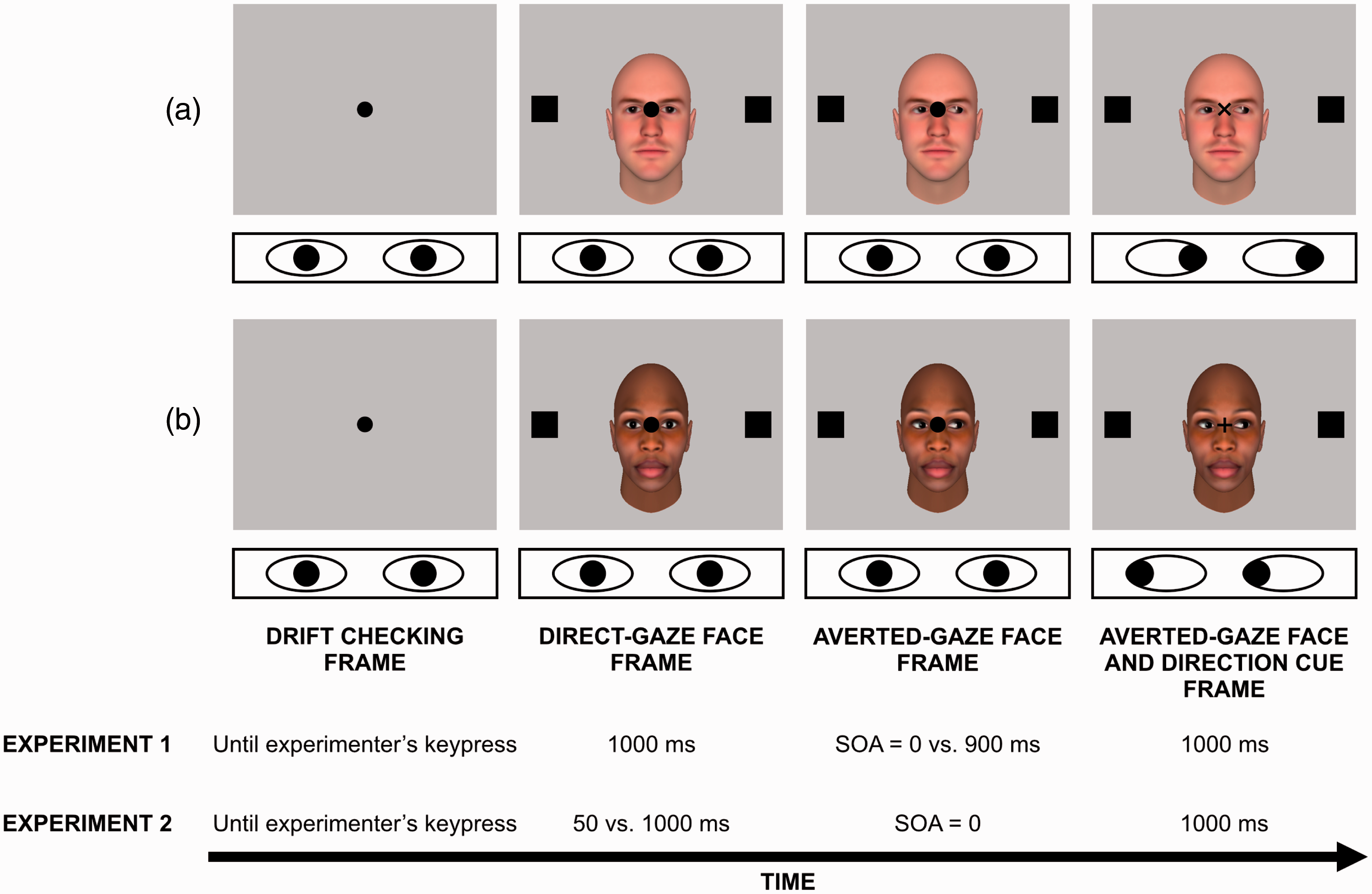
Methods
Participants
Twenty-five Caucasian students participated in Experiment 1 (Mean age = 24 years, SD = 3.34, four males). Twenty-four Caucasian students participated in Experiment 2 (Mean age = 23 years, SD = 1.72, four males), but data from two participants were excluded from the analysis as they had difficulties in calibration and tracking. All participants reported normal or corrected-to-normal vision were naïve to the purpose of the studies and provided a written consent. The studies were conducted in accordance with the Declaration of Helsinki.
Stimuli, Apparatus, and Procedure
Sixteen 3-D full-color avatar faces were used (four White males, four White females, four Black males, and four Black females; see Pavan, Dalmaso, Galfano, & Castelli, 2011 for full details about the stimuli). For each face, there were three different versions: one with direct gaze, one with gaze averted rightwards, and one with gaze averted leftwards.
Eye movements were recorded monocularly (1,000 Hz temporal and<.01° spatial resolution) using an EyeLink 1,000 Plus (SR Research Ltd, Ottawa, Canada). Participants sat approximately 65 cm away from a 24-inch monitor (1,280 × 1,024 pixels, 120 Hz). A display PC running Experiment Builder (SR Research Ltd, Ottawa, Canada) handled timing and stimuli presentation.
Color background was set to grey (R = 180, G = 180, B = 180). Participants were firstly asked to perform a nine-point calibration, followed by a validation procedure. The calibration was accepted if the average error was below 0.5°. Prior to the beginning of each trial, participants were asked to fixate a black central fixation circle (0.45° in diameter). Afterwards, the experimenter initiated the trial through the host PC. This procedure ensured that participants fixated the center of the screen and allowed us to perform a drift checking (see Figure 1, Drift checking frame). Each trial began with a centrally placed face (9.5° height × 7.5° width) with direct gaze flanked by two solid black placeholders (0.85° of side, 10° from fixation). The central fixation point remained visible between the eyes (Direct-gaze face frame). In Experiment 1, after 1,000 ms, the picture of the same face with gaze averted leftwards or rightwards was superimposed, thus conveying the impression of the eyes looking leftwards or rightwards. After either 0 or 900 ms, depending on SOA, the fixation point was replaced by either a “+” or a “×” (0.45° height × 0.45° width; Averted-gaze face and direction cue frame). Half of the participants were instructed to make a saccade toward the placeholder placed rightwards when they saw a “+” symbol or toward the placeholder placed leftwards when they saw a “×” symbol. The other half responded with an opposite mapping. In the case saccadic direction and gaze direction were identical, participants performed a congruent trial; in the case saccadic direction and gaze direction were opposite, participants performed an incongruent trial. Unlike previous studies in which the directional cues were obtained by changing the color of the fixation point (e.g., Ricciardelli et al., 2002), here, we focused on shape in order to prevent any potential bias associated to color processing. Participants were instructed to move their eyes as quickly and accurately as possible toward the correct placeholder. Moreover, they were asked to ignore the gaze direction, because it was uninformative with respect to saccade direction. Finally, after 1,000 ms, the display was replaced by a blank screen for 1,500 ms, during which participants returned to fixate the center of the screen.
In Experiment 2, the method was the same as in Experiment 1 with the following exceptions: two different direct-gaze face durations were employed (50 vs. 1,000 ms) and a single SOA (0 ms) was used. A practice block (16 trials) was followed by two experimental blocks (128 trials each). Each experimental condition was randomly presented with the same frequency. The whole procedure lasted about 45 min.
Results
Experiment 1: Assessing the Time Course of the Effects of Gaze Distractors
Eye movement onset latency was measured as the time elapsing from the directional cue onset to the initiation of the first saccade. The first saccade was defined as the first eye movement with a velocity and acceleration exceeding 30°/sec and 8,000°/sec2, respectively, and with a minimum amplitude of 1°. Trials in which participants blinked during the first saccade were discarded from the analyses (1.99% of trials). Saccadic directional errors were analysed separately (4.45% of trials). Saccadic latencies less than 80 ms or greater than three SD above the mean of each participant were classified as outliers and were therefore discarded from the analyses (1.14% of trials).
Saccadic latencies
Mean Saccadic Latencies (sRT) for Correct Responses and Percentage of Errors (%E) for all Experimental Conditions in Experiments 1 and 2.
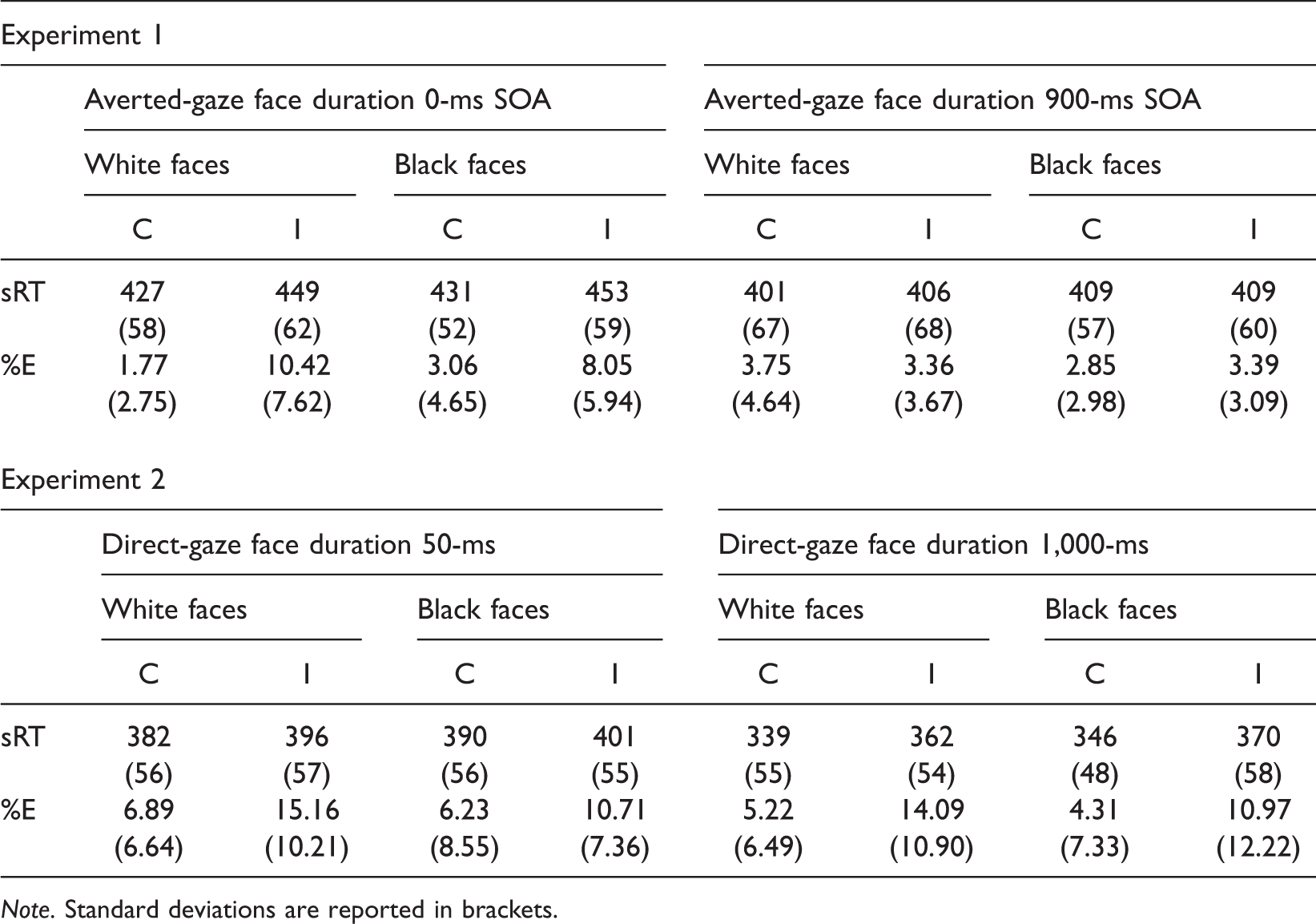
Note. Standard deviations are reported in brackets.
Saccadic errors
A repeated-measures ANOVA was conducted on the percentage of saccadic directional errors with cue-gaze spatial congruency (2: congruent vs. incongruent), SOA (2: 0 vs. 900 ms), and race (2: White vs. Black) as within-participants factors. The main effect of cue-gaze spatial congruency was significant, F(1, 24) = 27.543, p < .001,
Anticipatory saccades
In the present experiment, participants were asked to ignore the face distractor and to perform a saccade only after the instruction cue onset. However, at the 900-ms SOA, namely when the averted-gaze face onset preceded the instruction cue onset, anticipatory saccades were possible. Following the approach proposed by Kuhn, Pagano, Maani, and Bunce (2015), anticipatory saccades were defined as saccades initiated after the averted-gaze face onset and prior to the directional cue onset. Only 10 participants showed anticipatory saccades (4.2% of total trials). Anticipatory saccades were further divided as a function of the spatial congruency with respect to gaze direction and race. Interestingly, the tendency to execute anticipatory saccades congruent with gaze direction was stronger in response to White than to Black faces, t(9) = 2.264, p = .049, d = .445. No differences emerged as concerns anticipatory saccades executed opposite to gaze direction, t(9) = .620, p = .551, d = .228. These results further confirm that participants were more influenced by the gaze of White than Black faces.
Experiment 2: Assessing the Early Onset of the Effects of Gaze Distractors
Data reduction was performed as in Experiment 1. Blinks (1.06% of trials) and outliers (1.23% of trials) were removed. Saccadic errors (9.8% of trials) were analysed separately.
Saccadic latencies
A repeated-measures ANOVA was conducted on mean latencies for correct saccades with cue-gaze spatial congruency (2: congruent vs. incongruent), direct-gaze face duration (2: 50 vs. 1,000 ms), and race (2: White vs. Black) as within-participants factors. The main effect of cue-gaze spatial congruency was significant, F(1, 21) = 28.126, p < .001,
Saccadic errors
A repeated-measures ANOVA was conducted on the percentage of directional saccadic errors with cue-gaze spatial congruency (2: congruent vs. incongruent), direct-gaze face duration (2: 50 vs. 1,000 ms), and race (2: White vs. Black) as within-participants factors. The main effect of cue-gaze spatial congruency was significant, F(1, 21) = 23.038, p < .001,
Discussion
In two experiments, we investigated White participants’ ability to produce voluntary saccadic eye movements when task-irrelevant eye-gaze embedded in White and Black faces acted as distractor. Overall, participants committed more directional errors when they were presented with a task-irrelevant incongruent gaze belonging to White rather than Black faces, while no similar pattern emerged for saccadic latencies. It is likely that in the current task, in which participants were required to perform instructed saccades in the presence of highly salient distractor stimuli such as eye gaze, errors were a more sensitive measure, as shown also in previous studies (e.g., Ricciardelli et al., 2002). In addition, we examined the temporal features characterizing this effect. In Experiment 1, the greater interference observed for the gaze of White than for the gaze of Black faces seemed to decay with time, namely when the face with the averted gaze was presented 900 ms before the onset of the directional cue. In Experiment 2, we further observed that individuals can rapidly extract social information from faces (see also Dalmaso, Castelli, Coricelli, & Galfano, 2014). Indeed, even when participants had a very short time (50 ms) to process the face before the appearance of the directional cue, a different pattern of saccadic interference emerged in response to Black rather than to White faces. This result fits well with independent observations according to which individuals can effectively extract social information very quickly, even when this is not relevant to the task at hand (e.g., Macrae & Bodenhausen, 2001).
These results are consistent with those reported in a previous study (Pavan et al., 2011) that employed the same facial stimuli as here. However, Pavan et al. (2011) only focused on covert orienting of attention and manual responses rather than eye movements were recorded. More importantly, in that work, both White and Black individuals were tested, and the results showed that low-level features of the face stimuli (e.g., skin color) could not account for the observed modulation of attentional shifts, supporting an interpretation based on social, rather than perceptual, factors. However, in future studies, Black participants will have to be included in order to ensure that this interpretation holds true also for experimental paradigms assessing saccadic eye movements.
The study of covert orienting in response to gaze cues and the potential role of different social variables in shaping this process has been widely investigated (e.g., Cui, Zhang, & Geng, 2014; Dalmaso, Galfano, Tarqui, Forti, & Castelli, 2013; Dalmaso, Pavan, Castelli, & Galfano, 2012; Jones et al., 2010). However, it is important to note that, in everyday life, individuals tend to allocate attentional resources in response to social spatial cues provided by others mainly through eye and head movements. For this reason, oculomotor measures may be considered as more precise and sensitive measures for investigating spatial attention processes (e.g., Kristjánsson, 2011). The study of social-attentive processes through the analysis of oculomotor responses is shedding new light on our ability to shift attention in the environment (e.g., Ciardo et al., 2014; Gregory & Hodgson, 2012; Kuhn et al., 2015; Liuzza et al., 2011, 2013; Porciello et al., 2014), following the scientific legacy left us by Yarbus.
Footnotes
Acknowledgements
We are grateful to Alessia Bilato and Marta Brocca for their assistance during data collection and to Kurt Debono, Marcus Johnson, and Pietro Scatturin for helpful technical advice. We are also grateful to Gustav Kuhn and to an anonymous reviewer for insightful comments on a previous draft.
Declaration of Conflicting Interests
The author(s) declared no potential conflicts of interest with respect to the research, authorship, and/or publication of this article.
Funding
The author(s) disclosed receipt of the following financial support for the research, authorship, and/or publication of this article: The present research was financially supported by the Italian Ministry of Education, University, and Research (Futuro in Ricerca, 2012 Grant RBFR12F0BD).