





Abstract
This paper investigated the influence of the addition method and quantity of rare earth Ce on the modification of Al-containing inclusions in Q355C steel. When the rare earth Ce element was added in the forms of an Al–Ce alloy and a Ce–Fe alloy, respectively, the Al2O3 inclusions were both modified into Ce-containing composite inclusions with blunt shapes. When added in the form of an Al–Ce alloy, the average size of the inclusions was 1.93 μm, smaller than 2.87 μm when added in the form of a Ce–Fe alloy, indicating that the modification effect of the Al–Ce alloy was better than that of the Ce–Fe alloy. When the rare earth Ce was added in the form of an Al–Ce alloy with a content of 58 ppm, the modification effect was the best.
Introduction
Q335C steel is an alloy steel that is widely used in the construction field. Despite its extensive application, the inherent alumina inclusions in the steel are a problem that cannot be ignored. These inclusions have a negative impact on the mechanical properties of the steel, specifically manifested as reducing plasticity and toughness and shortening the fatigue life. Meanwhile, they also deteriorate the processability of the material and promote the occurrence of corrosion.1–3 As a hard and brittle inclusion, alumina is commonly present in steel and usually has a very high melting point. This hard–brittle characteristic makes it prone to crack formation when the steel is subjected to external forces.4–10 As potential crack sources, alumina inclusions can seriously damage the service life of Q335C steel, thus posing a threat to the safety of the entire structure and being unfavourable to the seismic resistance and durability of Q335C steel in structural applications such as buildings and bridges. 11
Wang et al. 12 investigated the influence of cleanliness on the effect of rare earth elements on modifying inclusions. After adding approximately 0.01% Ce to the bearing steel melts with initial oxygen contents of 0.0005%, 0.001% and 0.0015%, respectively, the inclusions gradually evolved from Ce2O2S and CeS to phases such as Ce2O3 and CeAlO3. The average size of the inclusions increased significantly from 0.7 to 2.16 μm. Qiao et al. 13 improved the corrosion resistance performance of metallic materials by adding rare earth elements La and Ce to enhance the reliability and service life of the materials in practical applications. Wang et al. 14 studied that the addition of yttrium could significantly change the morphology of alumina inclusions, transforming them from blocky or angular shapes to near spherical shapes. The size distribution of the inclusions became more uniform, with a significant increase in the proportion of small-sized inclusions and a notable decrease in the proportion of large-sized inclusions. Yttrium reacted with elements such as oxygen and sulfur in the steel to form new composite inclusions (e.g., Y2O3 and Y2S3), which had lower melting points and better dispersion distribution characteristics. Han et al. 15 confirmed the effectiveness of rare-earth Ce in improving inclusions in Q345 steel. The addition of rare-earth Ce gradually changed the inclusions, which were originally in long-strip, dot-like or irregular shapes into spherical or near-spherical shapes. Zhang et al. 16 found that when the Al content was 0.0053 wt.%, the stable phase in the steel was Ce2O3; when [Al] reached 0.0171 wt.%, the stable phase changed to CeAlO3; when the Al content reached 0.0578 wt.%, CeAl11O18 became the stable phase. Liu et al. 17 found that the Al–Ce alloy has a better effect on the modification of inclusions in 20CrMnTi, but there has been no specific study on the modification of Al2O3 in steel. Although previous studies have confirmed the positive role of rare earth Ce in modifying inclusions in steel, which can effectively improve the morphology, size and distribution of inclusions, most of the existing studies focus on the action mechanism of the Ce element itself, while there are relatively few studies on the specific effects of different addition methods on Al-containing inclusions. Different addition methods can change the behaviour of inclusions in steel, such as their buoyancy and aggregation tendency,18–21 thus affecting the quality of the steel. Based on this, this work uses thermodynamic calculations and experimental methods to study in detail the effects of adding methods such as the Ce–Fe alloy and Al–Ce alloy, as well as the amount of rare earth Ce added, on the modification effect of Al-containing inclusions in steel.
This paper takes Q355C steel as the research object and uses a method combining experiments and thermodynamic calculations to study the influence of different addition methods and amounts of rare earth Ce on the modification behaviour of Al-containing inclusions in the steel. The research focuses on exploring how to effectively control the size, morphology, distribution and type of inclusions. Meanwhile, the modification mechanism of rare earth Ce acting on Al-containing inclusions is deeply explained, thereby further enriching and improving the directional modification theoretical system of Al-containing inclusions in Q355C steel.
Experimental methods
An experimental steel was smelted using a silicon–molybdenum resistance furnace with a protective atmosphere, as shown in Figure 1. The materials used in the steel-making process included industrial pure iron rods, graphite, ferrosilicon, ferromanganese, ferrochrome, aluminium wires, titanium wires, Ce–Fe alloy and Al–Ce alloy. The content of rare earth Ce in both Ce–Fe alloy and Al–Ce alloy is 30%.
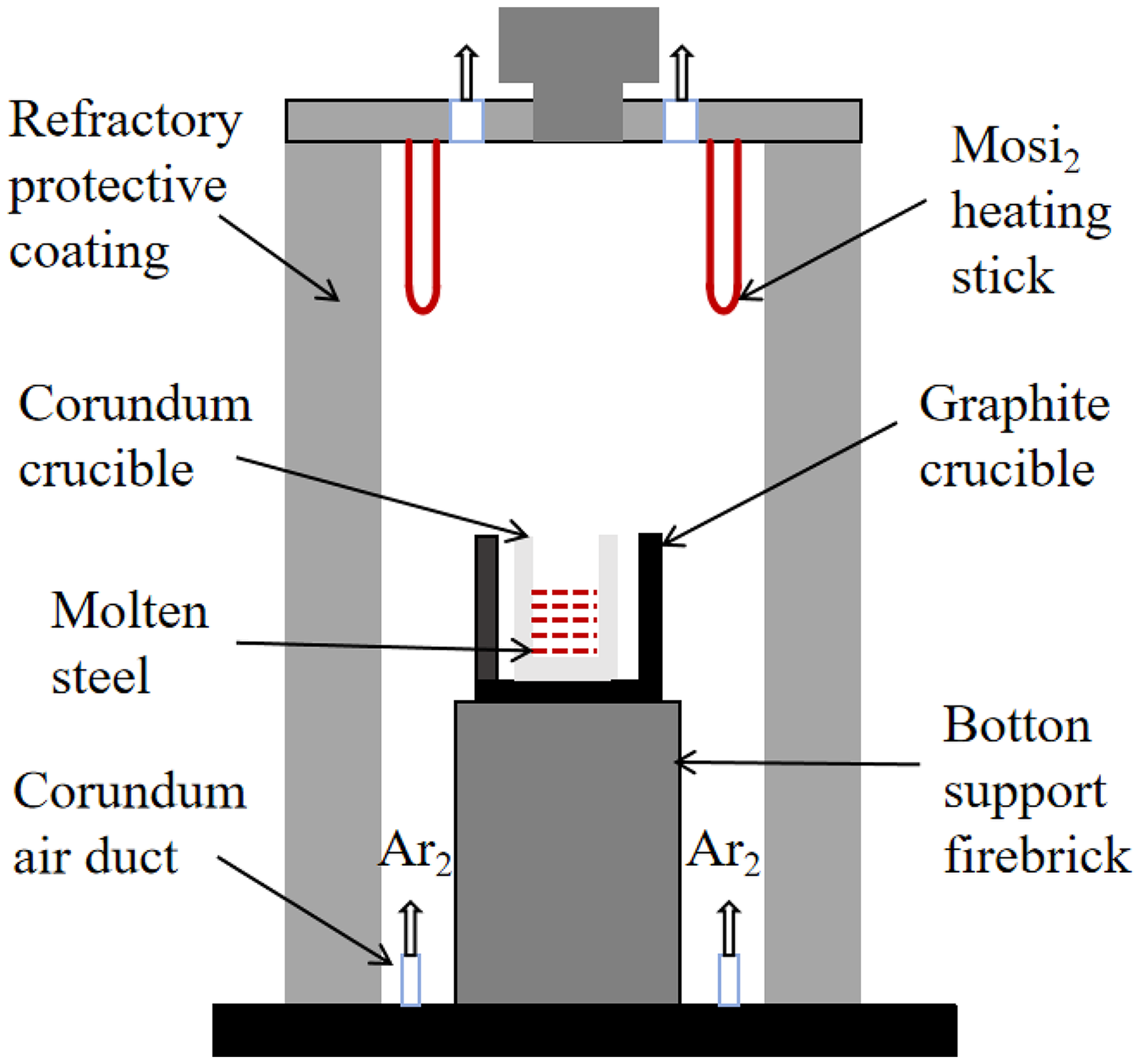
Schematic diagram of the smelting furnace.
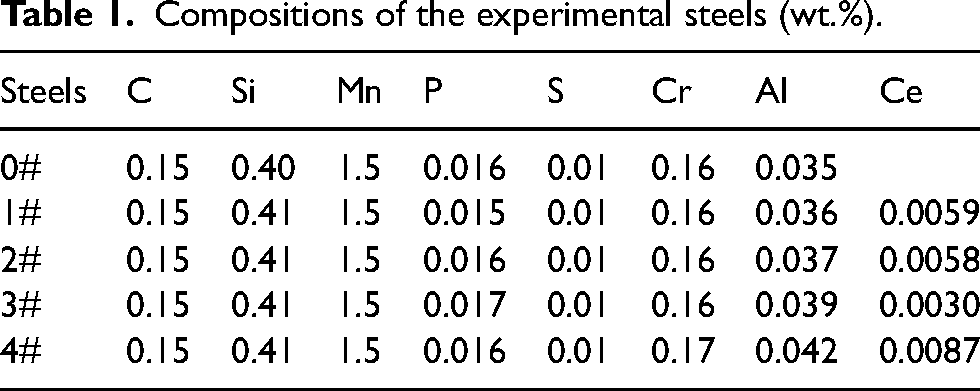
The smelting processes of the experimental steels are as follows. After rust removal of industrial pure iron, it is placed into a corundum crucible with an outer graphite crucible together with a carburant, ferrosilicon and ferrochrome, and placed in a furnace, with the temperature being increased at a rate of 8 °C/min. After the temperature rises to 1600 °C, it is kept for a period of time. After the materials in the crucible are melted, secondary feeding is carried out. The feeding sequence is aluminium wire, ferromanganese, titanium wire and rare earth alloy, with an interval of 2 min each time to ensure the full melting of the alloys. After the feeding is completed, the crucible is taken out and air-cooled. To study the influence of adding rare earth Ce on the inclusions in the steel, the compositions of each experimental steel were analysed and are shown in Table 1. The alloy without rare earth addition is the 0# steel grade, the one with Ce–Fe alloy addition is the 1# steel grade, and the 2#, 3# and 4# steel grades are those with Al–Ce alloy addition. To clarify the influence of rare earth Ce on the modification of inclusions in the steel, first, the FactSage software was used to study the influence of rare earth Ce on the precipitation of inclusions in the steel, and at the same time, the calculation and research on the stable phase diagram of inclusions in the Ce–Al–O–S–Fe system with rare earth Ce were carried out. Then, experimental research was also conducted. For steel grades with different compositions, after the samples were ground, polished and cleaned, a field emission scanning electron microscope was used to observe the morphology of inclusions in the experimental steel, and an EDS energy dispersive spectrometer was used to analyse the elemental composition of the inclusions, and statistical analysis of the number and size of the inclusions was carried out. The statistical software was automated, and each sample contained over 500 inclusions, ensuring the reliability of the data. The working voltage of the electron microscope was set to 20 kV, and the magnification was 1000 times. During the statistical process, the statistical area for inclusion counting in each sample was 4.14 mm2.
Compositions of the experimental steels (wt.%).
Results and discussion
Thermodynamic calculation of the influence of rare earth Ce on the precipitation of Al-containing inclusions in steel
Figure 2 shows the influence of rare earth Ce content on Al-containing inclusions in steel. When no rare earth Ce is added, the Al-containing inclusions in steel exist in the form of Al2O3. As the content of rare earth Ce in steel increases, the content of CeAl11O18 in steel begins to increase. When the rare earth Ce content is 0.001%, the content of CeAl11O18 reaches the maximum, which is 0.004%. As the content of rare earth Ce continues to increase, the content of CeAlO3 in steel begins to increase. When the rare earth Ce content is 0.006%, the content of CeAlO3 in steel reaches the maximum, which is 0.009%. As the content of rare earth Ce continues to increase, the content of CeAlO3 in steel begins to decrease, accompanied by the formation of Ce2O2S. From the above analysis, it can be seen that as the Ce content increases, the evolution path of Al-containing inclusions in Q355C steel is: Al2O3 → CeAl11O18 → CeAlO3 → CeAlO3 + Ce2O2S.
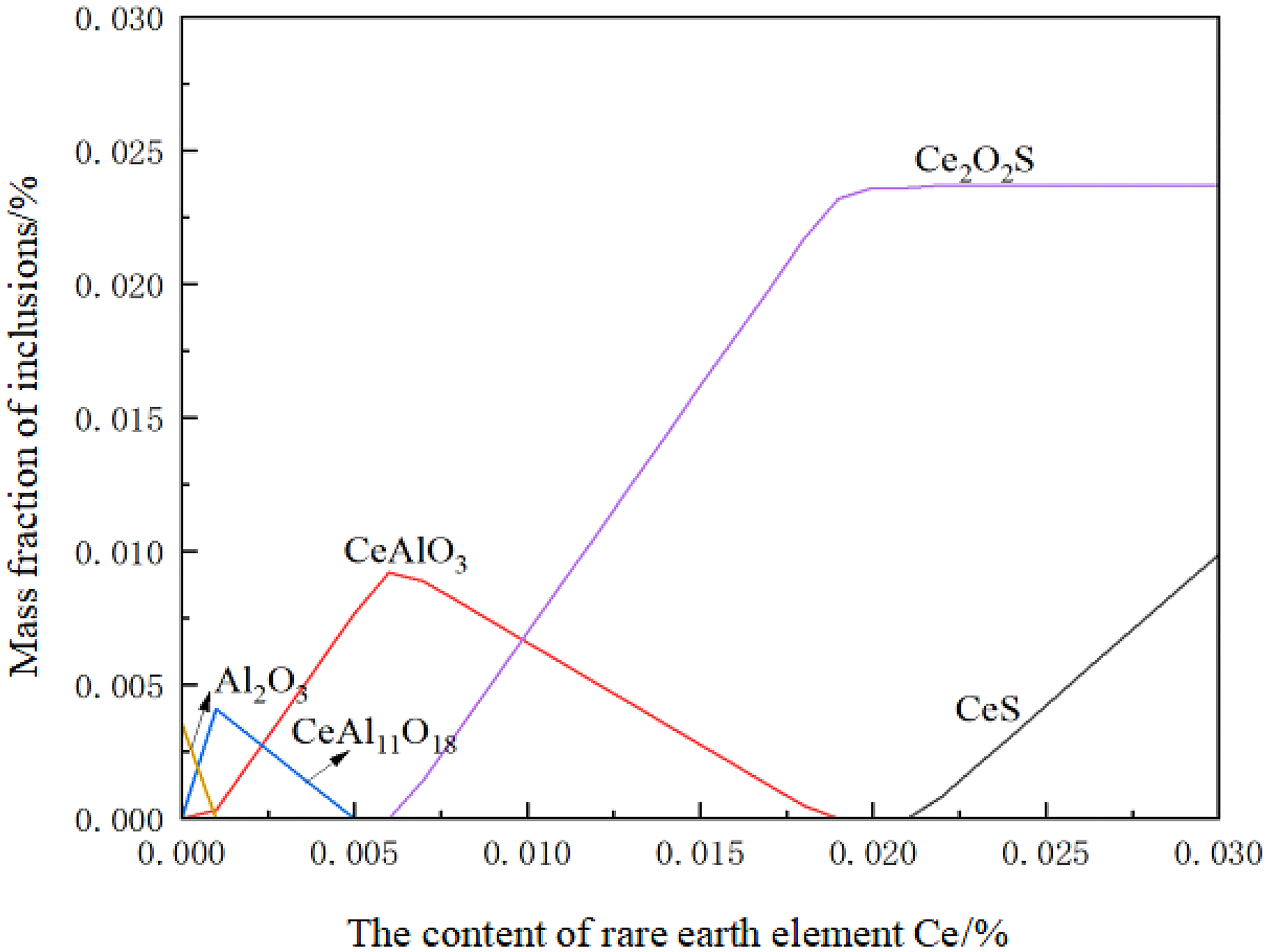
Effect of rare earth Ce content on the inclusions in steel.
Figure 3 shows the influence of the rare earth Ce content on the stable existence forms of rare earth inclusions in the Ce–Al–O–S–Fe system at 1600 °C. As the Al and Ce contents in the steel change, the stable phase regions of the rare earth-containing inclusions in the steel also change. According to the compositions of the steel grades being smelted, the rare earth inclusions in steels 1# and 2# are in the stable phase region of CeAlO3, those in steel 3# are in the CeAlO3 + CeAl11O18 phase region, and those in steel 4# are in the CeAlO3 + Ce2O2S phase region. When adding rare earth alloys to steel while generating CeAlO3 inclusions, the Gibbs free energy of CeAlO3 is lower compared to using only Al deoxidation to generate Al2O3 inclusions, resulting in more stable CeAlO3 inclusions. 21
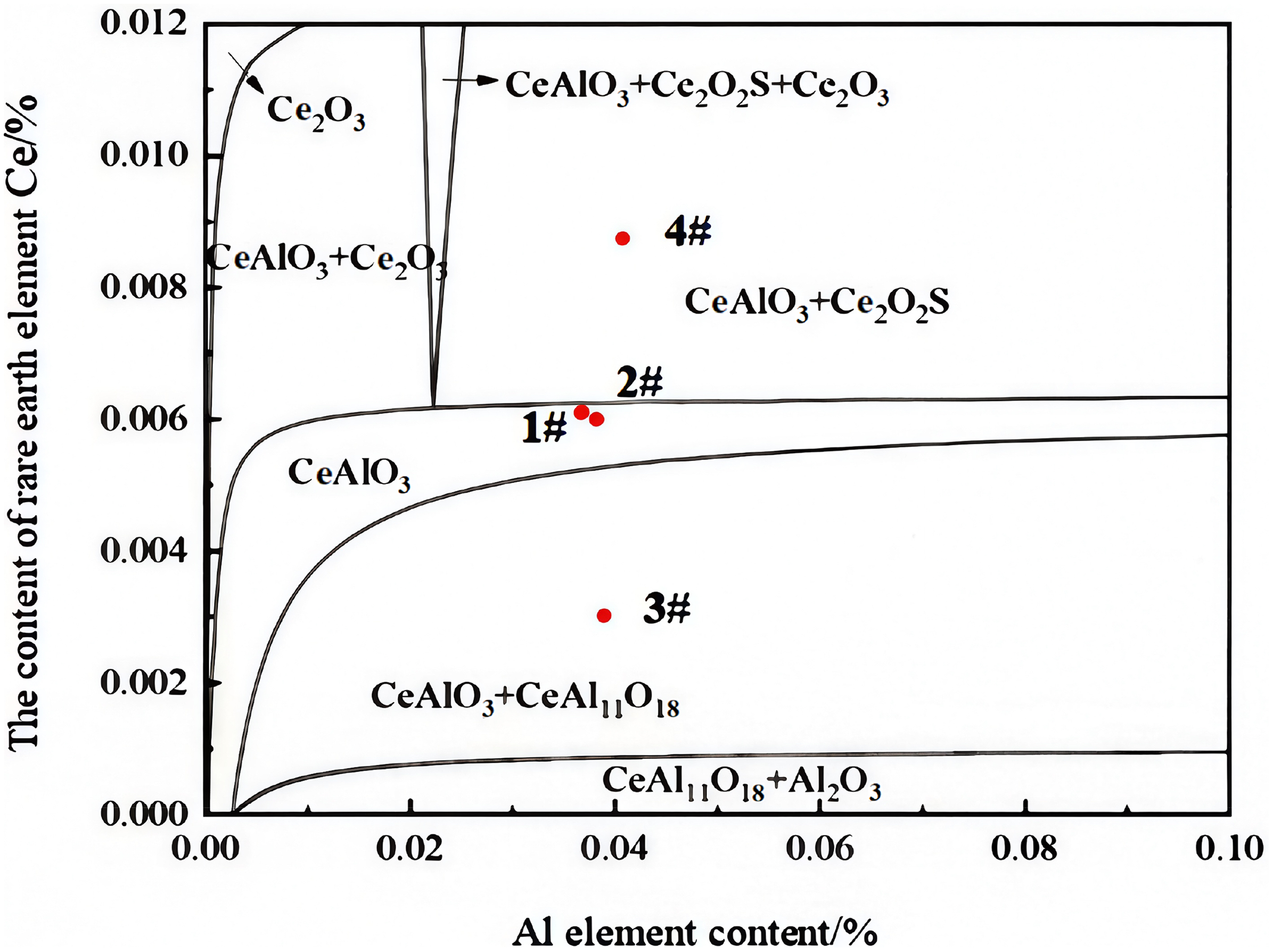
Stable phase diagram of the inclusions in the Ce–Al–O–S–Fe system.
Influence of the rare earth Ce addition method on the morphology and size of Al-containing inclusions in steel
Figure 4 shows the changes in the distribution and morphology of inclusions in steel before and after the addition of rare earth Ce. (a) represents the inclusion distribution in Steel 0# without the addition of rare earth Ce, (b) represents the inclusion distribution in Steel 1# with the addition of a Ce–Fe alloy and (c) represents the inclusion distribution in Steel 2# with the addition of an Al–Ce alloy. Without the addition of rare earth Ce, the inclusions in the steel are relatively large and angular. When rare earth Ce is added in the form of Ce–Fe and Al–Ce alloys, the size of inclusions in the steel decreases, and the shape is mainly oval. When Ce is added in the form of an Al–Ce alloy, the inclusions are even smaller. The above research results indicate that adding rare earth Ce to Q355C steel can effectively reduce large-sized inclusions, and the modification effect of the Al–Ce alloy on inclusions in steel is better than that of the Ce–Fe alloy.
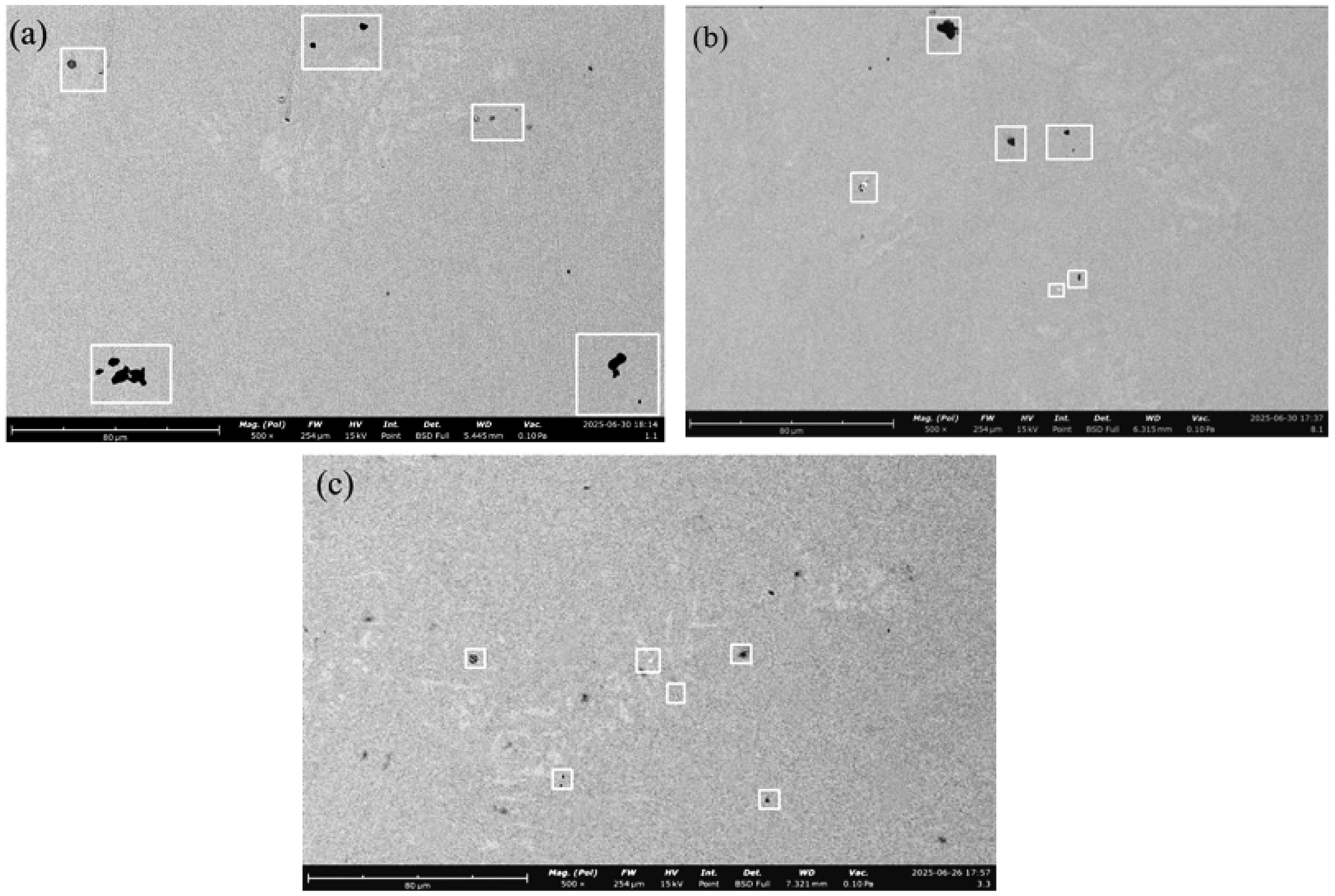
The distribution of inclusions in steel before and after the addition of rare earth Ce. (a) Distribution of inclusions in 0# steel without the addition of rare earth Ce; (b) distribution of inclusions in 1# steel with the addition of a Ce–Fe alloy; and (c) distribution of inclusions in 2# steel with the addition of an Al–Ce alloy.
The morphology and energy spectrum of inclusions in 0# steel are shown in Figure 5. Based on the atomic fraction ratio in the figure, it can be determined that the inclusions are mainly Al2O3 inclusions. When rare earth Ce is not added, the Al2O3 inclusions in the steel are mainly angular and have relatively large sizes.
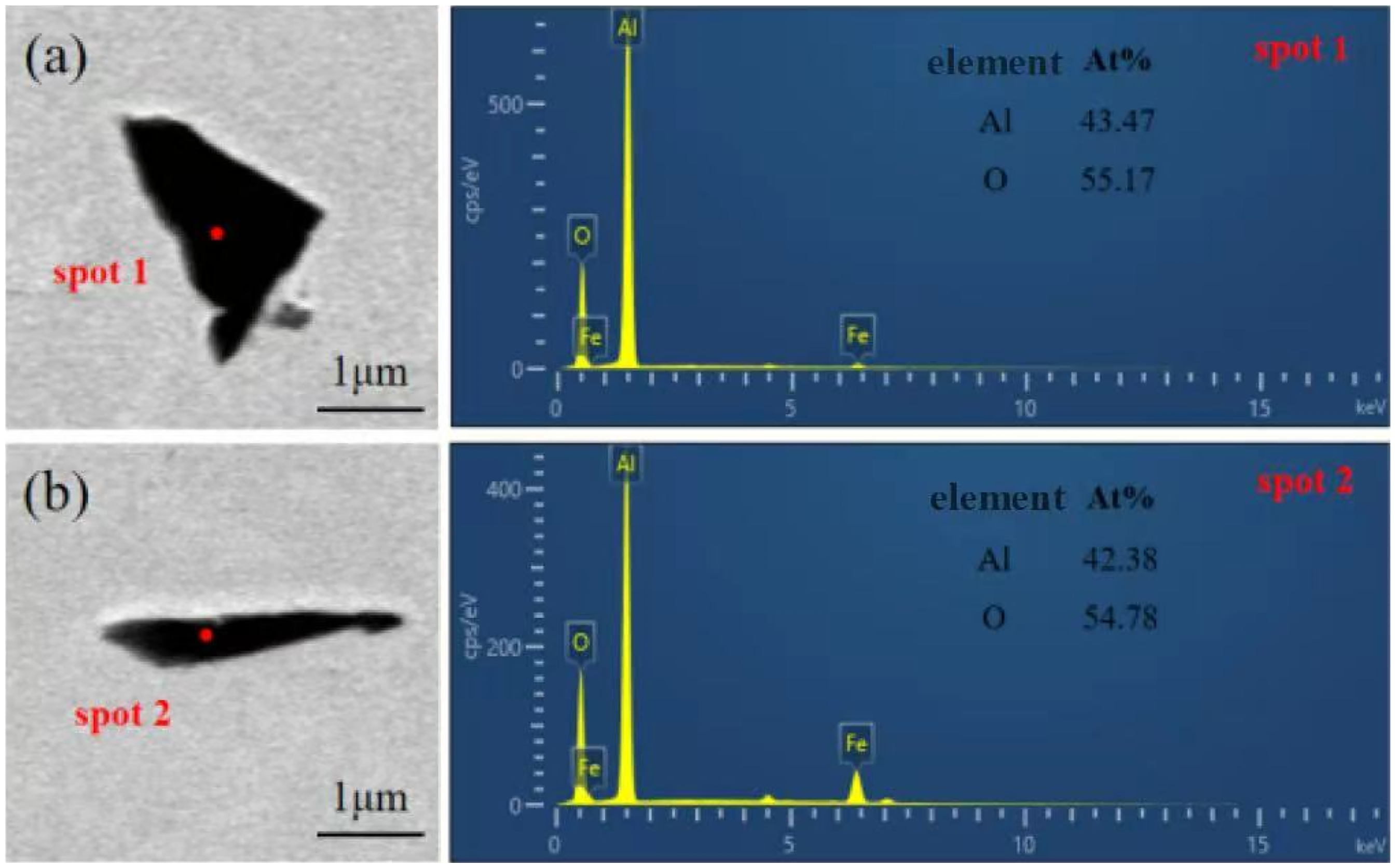
Morphology and energy spectrum of Al-containing inclusions in 0# steel. (a) and (b) are typical Al2O3 inclusions in steel.
After adding rare earth Ce to steel, the quantity and size of inclusions decrease, as shown in Figures 6 and 7. To further clarify the influence of the addition method of rare earth Ce on Al-containing inclusions in steel, the morphology and size of Al-containing inclusions in steel under the conditions of adding Ce–Fe and Al–Ce alloys were analysed. At this time, when rare earth Ce was added in the form of a Ce–Fe alloy, the Ce content in steel was 59 ppm (Steel #1), and when rare earth Ce was added in the form of an Al–Ce alloy, the Ce content in steel was 58 ppm (Steel #2). When rare earth Ce was added in the form of a Ce–Fe alloy, the atomic fractions of Ce, Al and O elements in the typical inclusions in Steel #1 were 17.72%, 15.27% and 44.19%, respectively. According to the previous thermodynamic calculations and the atomic ratios of elements, it can be judged that the inclusions were mainly CeAlO3 inclusions. When rare earth Ce was added in the form of an Al–Ce alloy, the typical inclusions in steel were mainly composed of Ce, Al and O elements. The atomic fractions of Ce, Al and O elements in the typical inclusions were 15.92%, 14.82% and 41.65%, respectively. According to the previous thermodynamic calculations and the atomic ratios of elements, it can be judged that the inclusions were mainly CeAlO3 inclusions. It can be seen that when the rare earth Ce content in steel was about 60 ppm; whether rare earth Ce was added in the form of an Al–Ce alloy or a Ce–Fe alloy, the Al2O3 inclusions in steel will be modified into approximately spherical rare earth inclusions – CeAlO3.
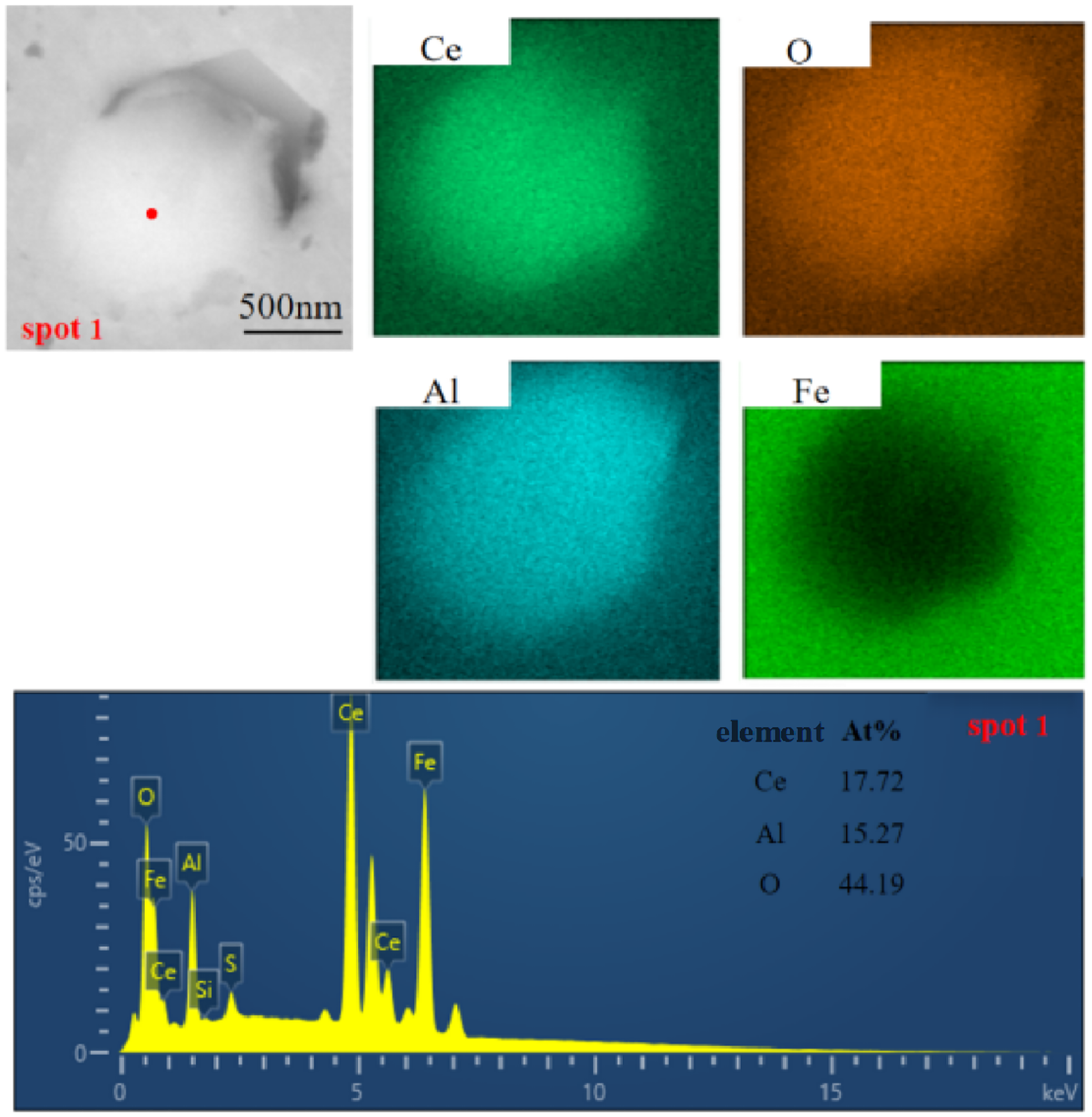
Morphology and elemental distribution of Al-containing inclusions in 1# steel.
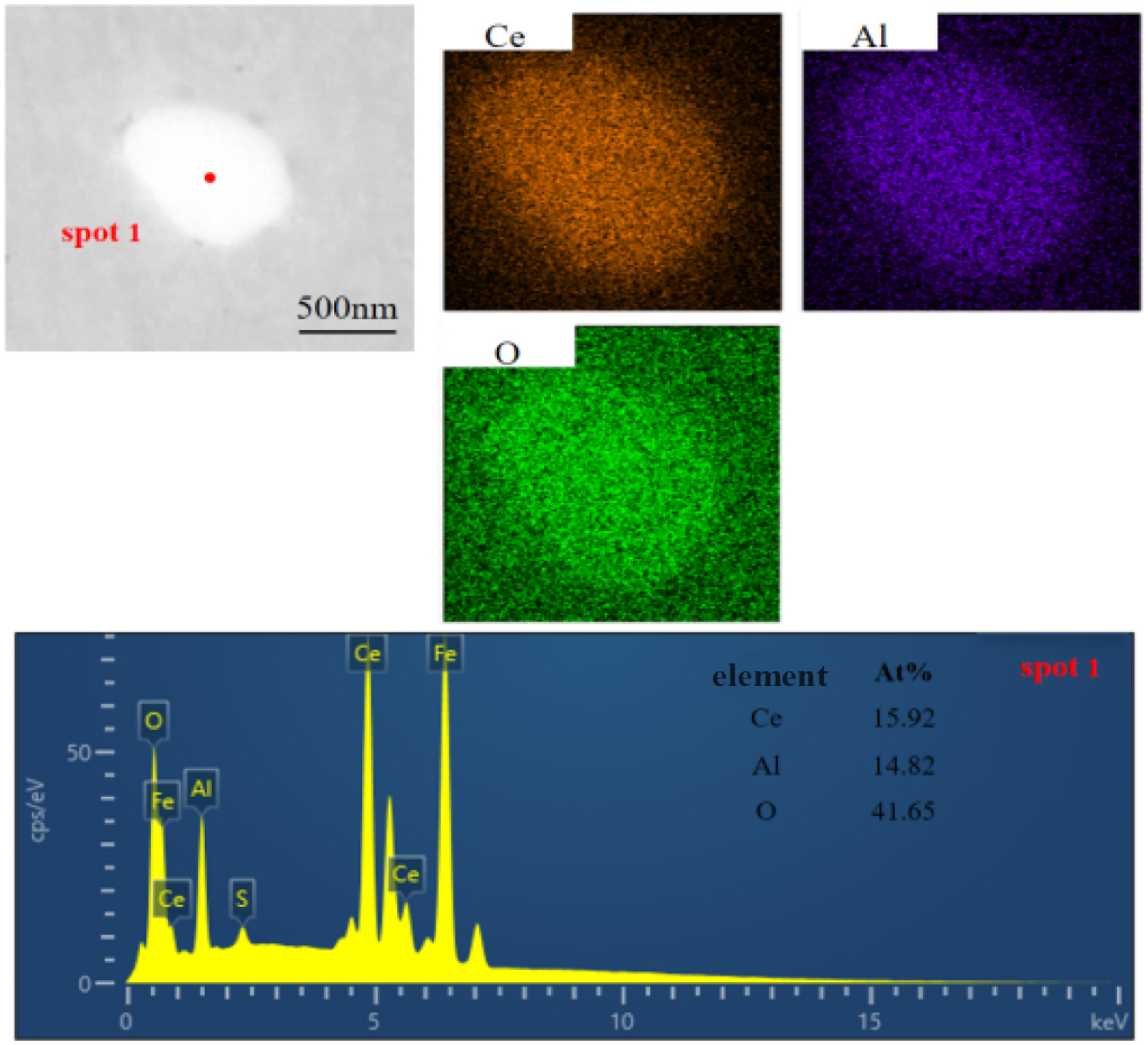
Morphology and elemental distribution of Al-containing inclusions in 2# steel.
To further investigate the influence of the addition method of rare earth Ce on the quantity and size distribution of Al-containing inclusions in steel, the average sizes of Al-containing inclusions in steels 0#, 1# and 2# were statistically analysed, as shown in Figure 8. Without the addition of rare earth Ce, the average size of Al-containing inclusions in steel 0# was 3.85 μm. After adding the rare earth Ce–Fe alloy, the average size of Al-containing inclusions in steel 1# was 2.87 μm. After adding the rare earth Al–Ce alloy, the average size of Al-containing inclusions in steel 2# was 1.93 μm. Compared with 0# steel, the average size of inclusions has decreased by 1.92 μm. It can be seen that the average size of Al-containing inclusions in steel decreased significantly after the addition of rare earth Ce. When rare earth Ce was added in the form of an Al–Ce alloy, the average size of Al-containing inclusions in steel was smaller than that when added in the form of a Ce–Fe alloy.
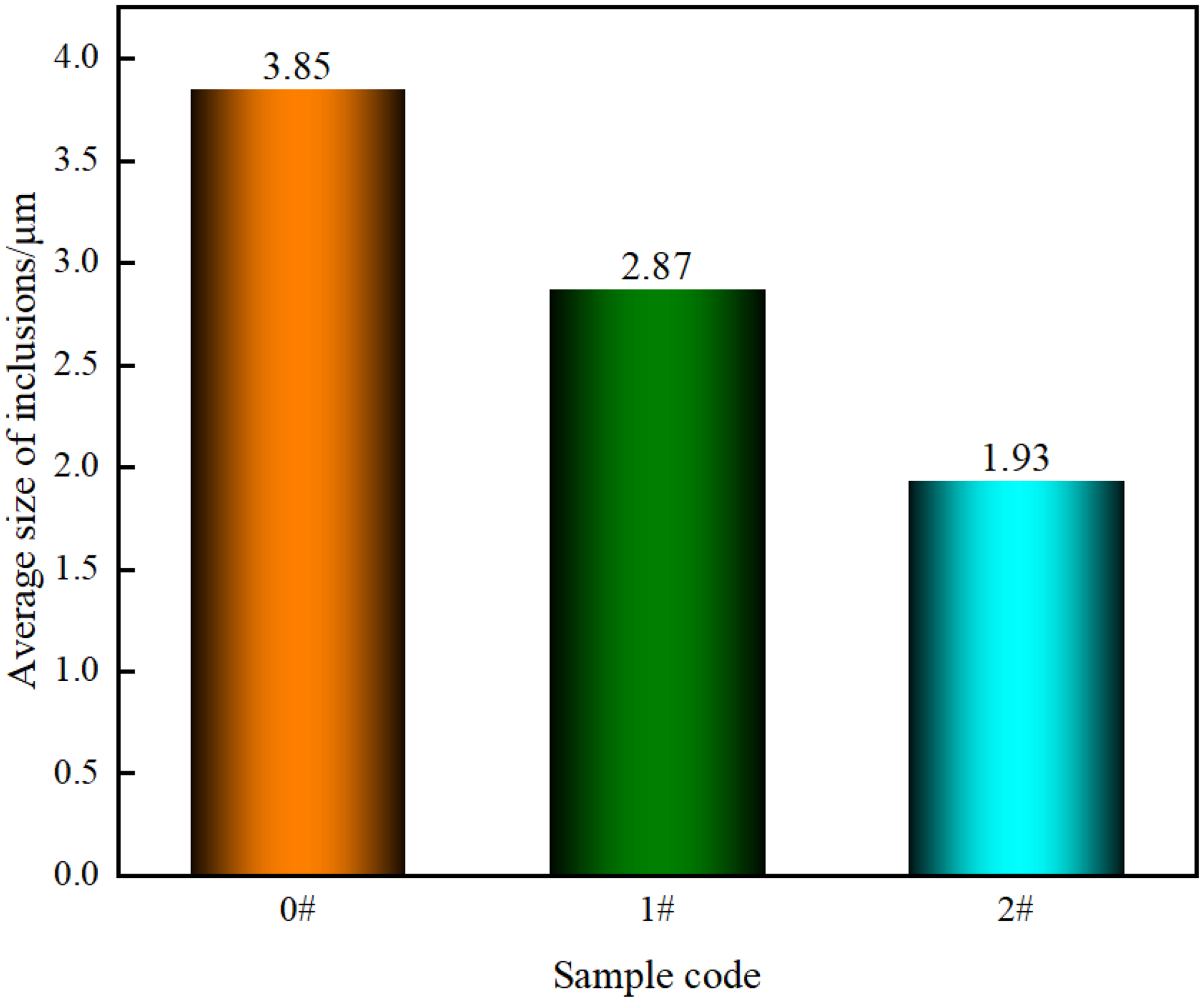
Influence of the rare earth Ce addition method on the average size of Al-containing inclusions in steel.
The size distributions of Al-containing inclusions in steel without Ce addition, with Ce–Fe alloy addition and with Al–Ce alloy addition are shown in Figure 9. In the 0# steel without rare earth Ce addition, the proportion of inclusions with a size of 1–2 μm was as high as 41%, while the proportion of inclusions with a size less than 1 μm was only 4%. In the 1# steel with Ce–Fe alloy addition, the proportion was mainly concentrated in the range where the inclusion size was less than 2 μm, accounting for nearly 60%. It can be seen that after adding the Ce element, more small-sized inclusions were generated. In the 2# steel with Al–Ce alloy addition, the proportion of inclusions with a size greater than 5 μm was only 2%, and the proportion of inclusions with a size less than 1 μm was as high as 64%. Compared with the 1# steel with Ce–Fe alloy addition, with a similar Ce element content, it can be seen that the size distribution of inclusions in the steel obviously shifts towards a smaller size range. That is, the proportion of small-sized Al-containing inclusions was higher when adding the Al–Ce alloy, and the modification effect was more significant. In summary, when rare earth Ce is added in the form of an Al–Ce alloy, elements such as [O] in steel and [Al], [Ce] in rare earth alloys can combine to form inclusions containing rare earth Ce. Compared with the addition of a Ce–Fe alloy, the deoxidation depth of the Al–Ce alloy was higher, and the size of the generated inclusions was smaller. Therefore, the addition of an Al–Ce alloy has a better effect on the modification of Al-containing inclusions in steel.
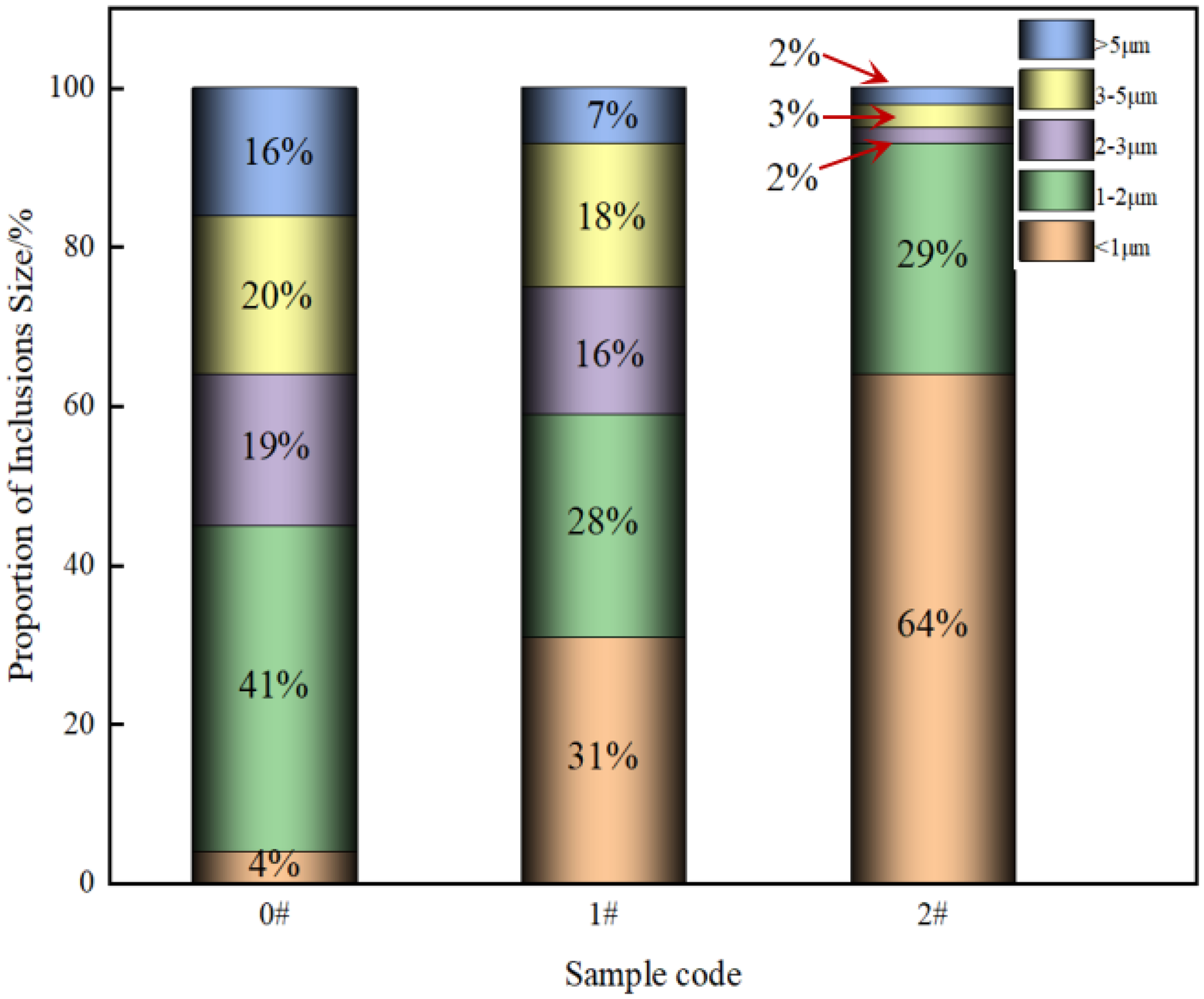
Influence of the rare earth Ce addition method on the size distribution of Al-containing inclusions in steel.
Research on the influence of rare earth Ce content on the modification of Al-containing inclusions in steel
The above research indicates that the modification effect of an Al–Ce alloy on Al-containing inclusions in steel is superior to that of a Ce–Fe alloy. However, the influence behaviour of the rare earth Ce content on the modification of Al-containing inclusions in steel after adding the Al–Ce alloy urgently needs to be clarified. Therefore, this paper further studied the modification behaviour of Al-containing inclusions in steel affected by the rare earth Ce content under the addition form of an Al–Ce alloy.
Figure 10 shows the morphology and distribution of inclusions in steels 2#, 3# and 4# after adding different amounts of rare earth Ce (in the form of an Al–Ce alloy). (a) represents the inclusion distribution in steel 3# containing 30 ppm of rare earth Ce, and (b) represents the inclusion distribution in steel 2# containing 58 ppm of rare earth Ce and (c) represents the inclusion distribution in steel 4# containing 87 ppm of rare earth Ce. It can be found that the inclusions are more dispersedly distributed and all are elliptical. When the Ce content in steel 4# is 30 ppm, the inclusion size is relatively large; while when the Ce content in steel 2# is 58 ppm, the inclusion size is the smallest. This indicates that when rare earth Ce is added in the form of an Al–Ce alloy, the best modification effect on Al-containing inclusions is achieved when the Ce content is 58 ppm.
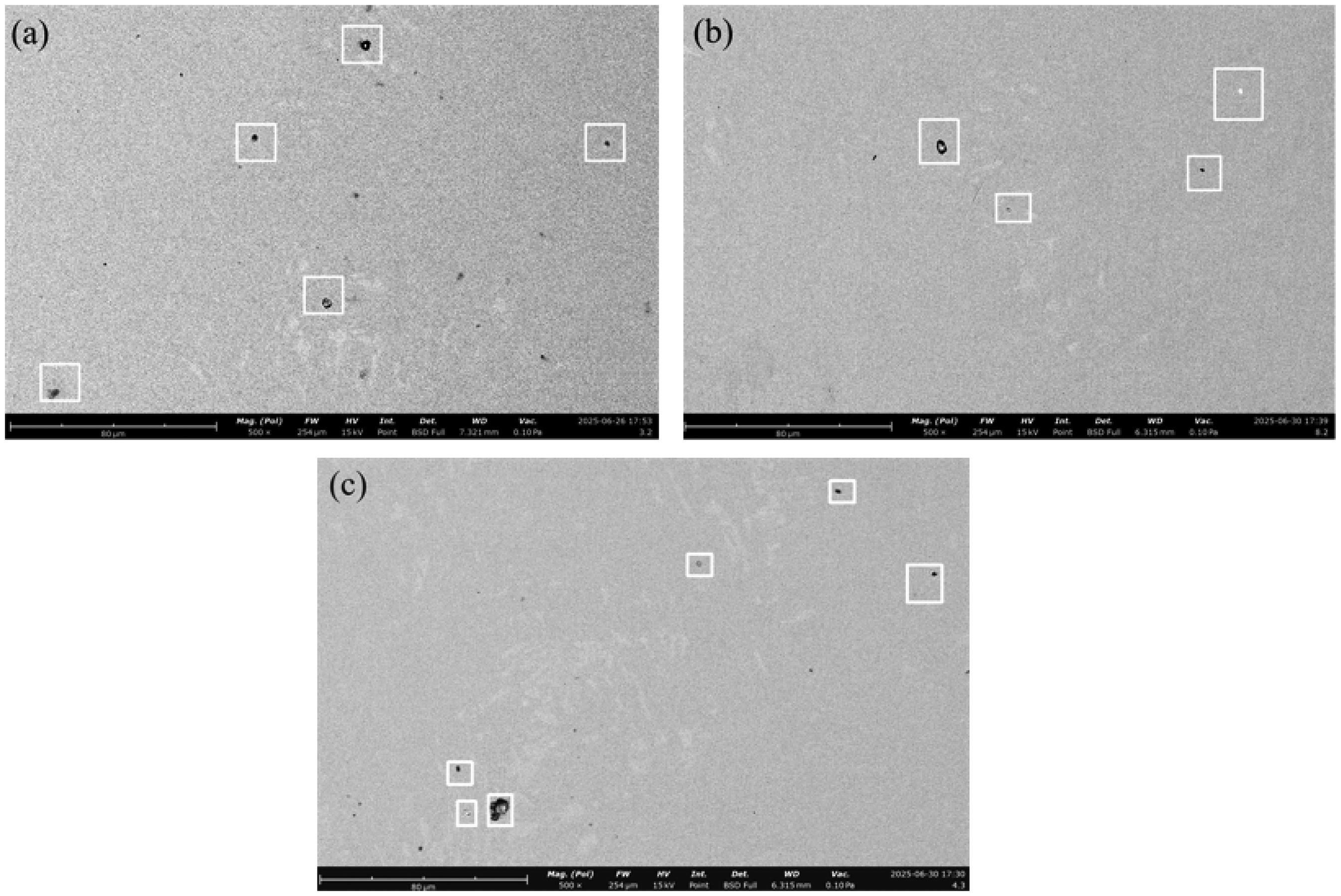
Influence of the rare earth Ce content on the modification of inclusions in steel. (a) Distribution of inclusions in 3# steel containing 30 ppm rare earth Ce. (b) Distribution of inclusions in 2# steel containing 58 ppm rare earth Ce. (c) Distribution of inclusions in 4# steel containing 87 ppm rare earth Ce.
Figure 11 shows the morphology and elemental analysis of typical Al-containing inclusions in Steel 3# with a Ce content of 30 ppm. As can be seen from Figure 11(a), the inclusion is mainly composed of Ce, Al and O elements. At spot 1, the atomic fraction of Ce is 3.86%, that of Al is 34.34%, and that of O is 53.1%. Based on the previous thermodynamic calculations and the atomic ratios of the elements, it can be determined that this inclusion is mainly CeAl11O18. The inclusion shown in Figure 11(b) appears white under an electron microscope, and the Ce, Al and O elements are uniformly distributed. At spot 2, the atomic fraction of Ce is 14.29%, that of Al is 16.32% and that of O is 44.55%. According to the previous thermodynamic calculations and the atomic ratios of the elements, it can be judged that this inclusion is mainly CeAlO3. The above research indicates that after adding 30 ppm of rare earth Ce to the steel, the Al-containing inclusions in the steel are mainly CeAlO3 and CeAl11O18.
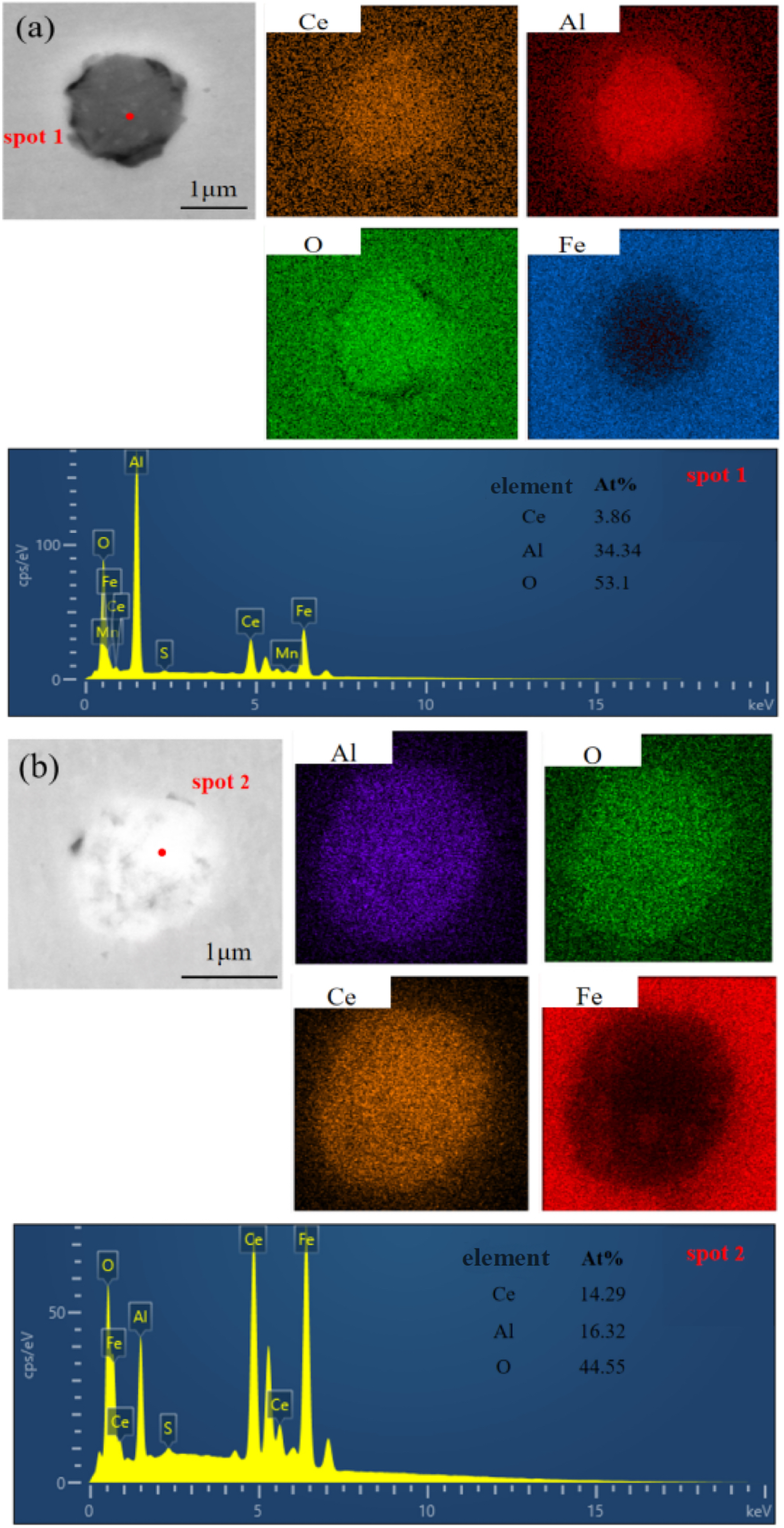
Morphology and elemental distribution of Al-containing inclusions in 3# steel. (a) and (b) are typical Al-containing inclusions in steel.
When the added rare earth Ce content is 87 ppm, the morphology and elemental distribution of typical inclusions in Steel 4# are shown in Figure 12. As can be seen from Figure 12(a), this inclusion is mainly composed of Ce, Al and O elements. At spot 1, the atomic fraction of Ce element is 18.51%, that of Al element is 19.35%, and that of O element is 53.18%. Based on the previous thermodynamic calculations and the atomic ratio of the elements, it can be judged that this inclusion is mainly CeAlO3 inclusion. This indicates that when the rare earth Ce content in the steel is 87 ppm, CeAlO3 inclusions are also formed in the steel. Meanwhile, new rare earth inclusions are formed in the steel. The inclusion shown in Figure 12(b) appears as a uniform bright white under an electron microscope. According to the EDS scanning results, this inclusion is mainly composed of Ce, S and O elements. At spot 2, the atomic fraction of Ce element is 34.19%, that of O element is 35.08% and that of S element is 15.92%. Based on the previous thermodynamic calculations and the atomic ratio of the elements, it can be judged that this region is mainly Ce2O2S inclusion.
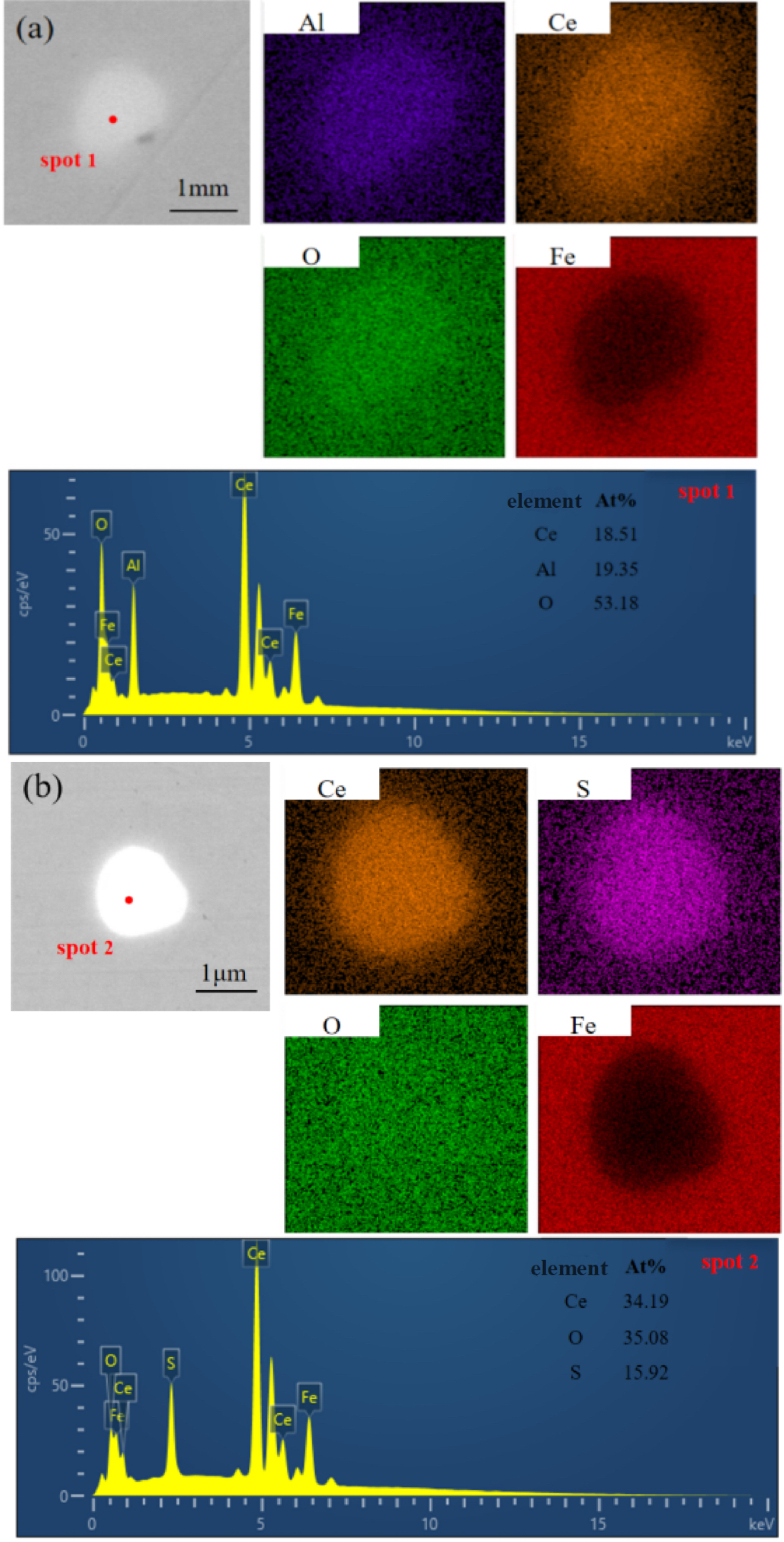
Morphology and elemental distribution of Al-containing inclusions in 4# steel. (a) and (b) are typical Al-containing inclusions in steel.
In summary, adding rare earth Ce to steel can modify the Al2O3 inclusions in Q355C steel, and the modified products vary with the change of Ce content. When the Ce content in 3# steel is 30 ppm, the Al2O3 inclusions can be modified into CeAl11O18 inclusions and CeAlO3 inclusions; when the Ce content in 2# steel is 58 ppm, the Al2O3 inclusions can be modified into CeAlO3 inclusions; when the rare earth Ce content in 4# steel is 87 ppm, the Al2O3 inclusions can be modified into CeAlO3 inclusions, and at the same time, Ce2O2S inclusions are generated in the steel.
Figure 13 shows the influence of the rare earth Ce content on the average size of Al-containing inclusions in steel after the addition of an Al–Ce alloy. When the Ce content is 58 ppm, the average size of Al-containing inclusions in steel reaches the minimum value of 1.93 μm. Secondly, when the Ce content is 87 ppm, the average size is 2.05 μm. When the Ce content is 30 ppm, the average size is the largest, reaching 2.88 μm. It can be seen that when the Al–Ce alloy is added to the steel, with a Ce content of 58 ppm, the average size of Al-containing inclusions in the steel is the smallest, indicating the best modification effect.
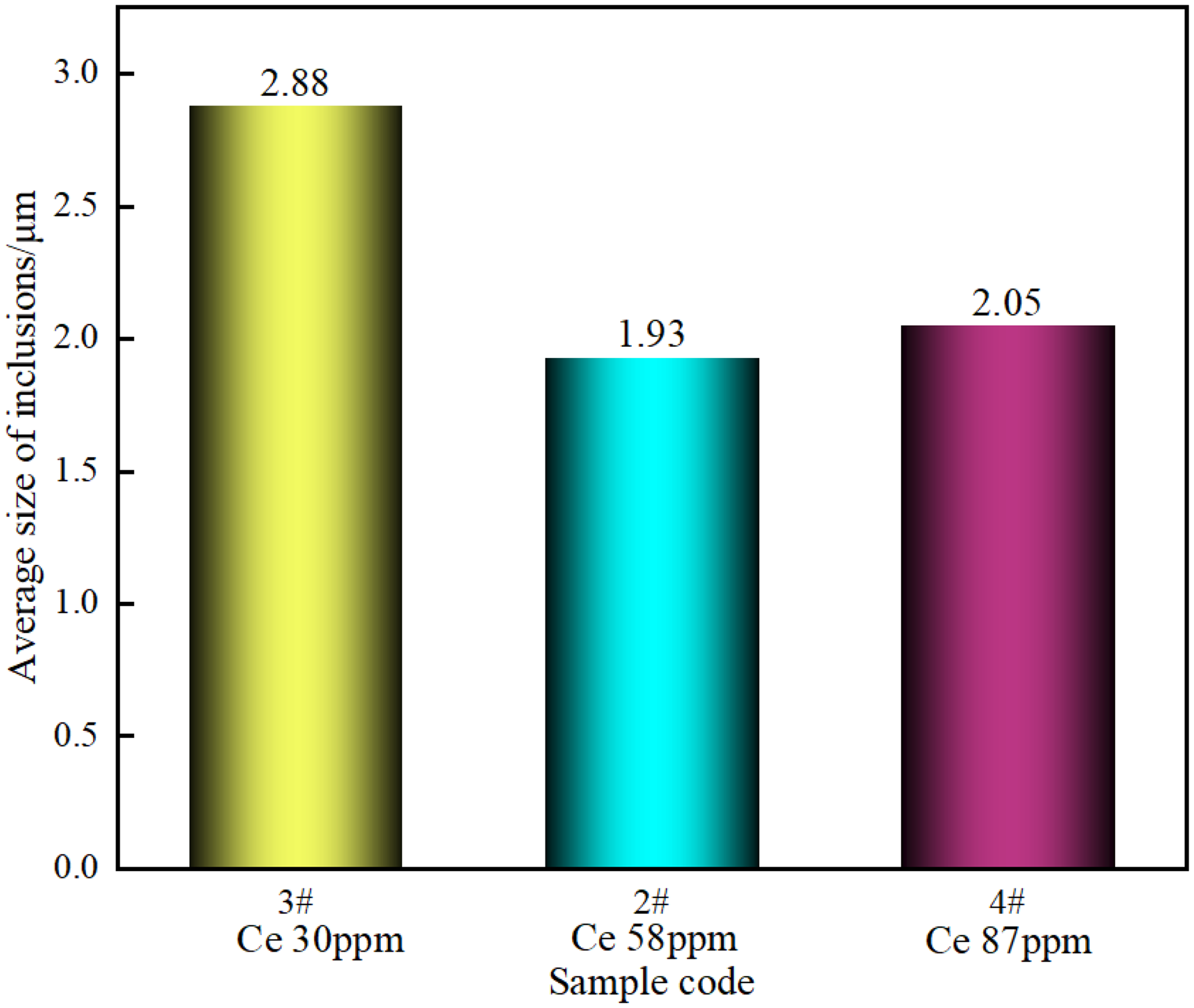
Average size of Al-containing inclusions in steels with different Ce contents.
Figure 14 shows the size distribution of Al-containing inclusions in steels with different Ce contents. In 3# steel with 30 ppm of rare earth Ce, the proportion of inclusions with a size < 1 μm is 43%, and the proportion of those with a size > 2 μm is only 36%. In 2# steel with 58 ppm of rare earth Ce, the proportion of inclusions with a size < 1 μm is 64%, the proportion of those with a size > 2 μm is only 7% and the proportion of those with a size > 5 μm is 2%. In 4# steel with 87 ppm of rare earth Ce, the proportion of inclusions with a size < 1 μm is 54% and the proportion of those with a size > 2 μm is 13%. After adding rare earth Ce to the steel, the proportion of Al-containing inclusions with a size > 2 μm in the steel decreases significantly, while the proportion of inclusions with a size < 1 μm increases remarkably. This indicates that 58 ppm of rare earth Ce can more effectively inhibit the precipitation of large-sized Al-containing inclusions in the steel and reduce the size of Al-containing inclusions in the steel.
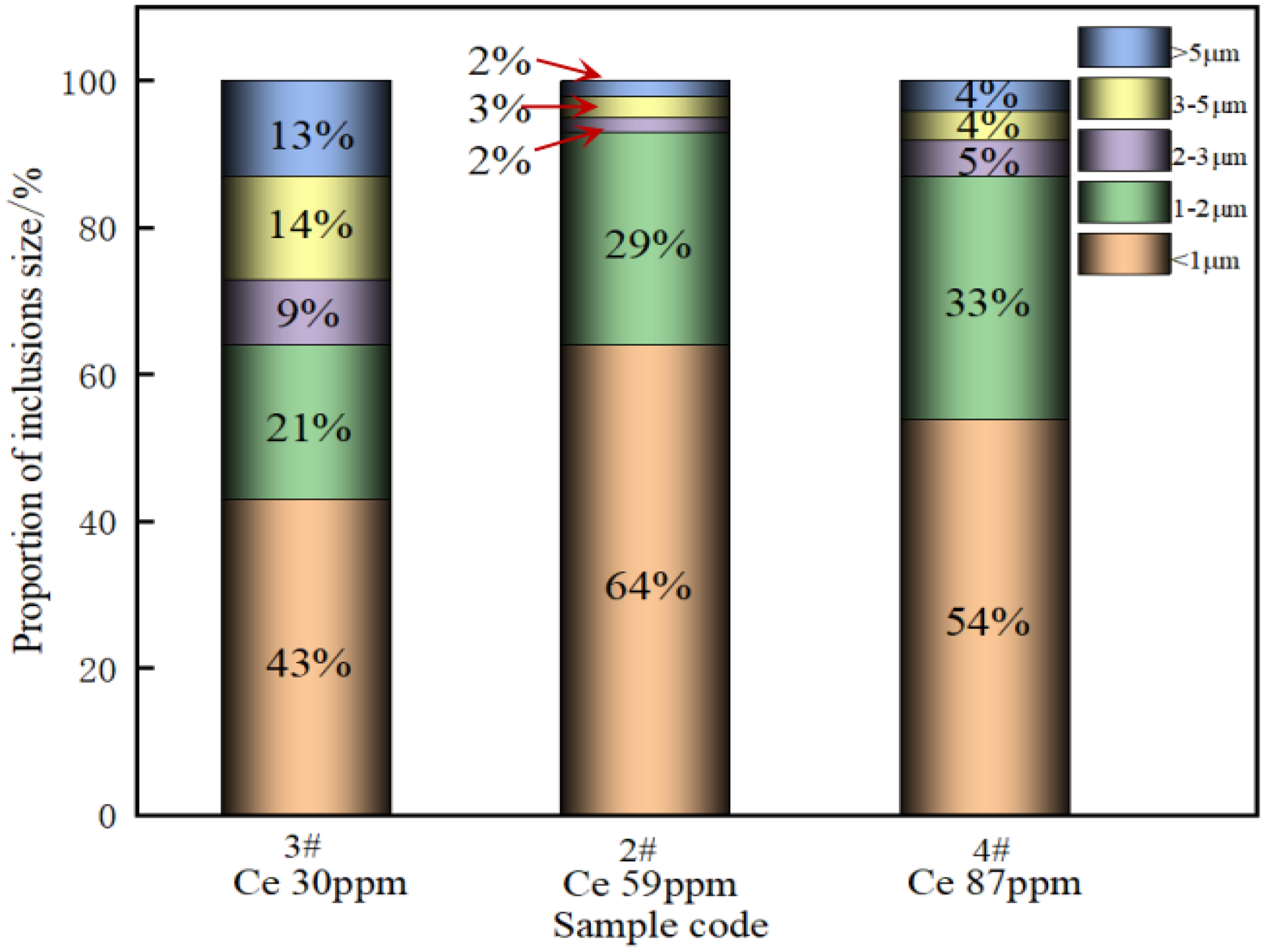
Influence of rare earth Ce content on the size distribution of Al-containing inclusions in steel.
Analysis of the mechanism of the influence of rare earth Ce on the modification of Al-containing inclusions in steel
Figure 15 shows the influence mechanism of different Ce contents on the modification of Al-containing inclusions in Q355C steel. In the case of no rare earth Ce added, the Al-containing inclusions in the steel are mainly of the alumina type. When the Ce content reaches 30 ppm, the Al-containing inclusions in the steel change to CeAl11O18 and CeAlO3. With the increase of the Ce content, when the Ce content reaches 58 ppm, the Al-containing inclusions in the steel are modified to CeAlO3. When the rare earth Ce content reaches 87 ppm, the Ce-containing inclusions in the steel are mainly CeAlO3 and Ce2O2S.
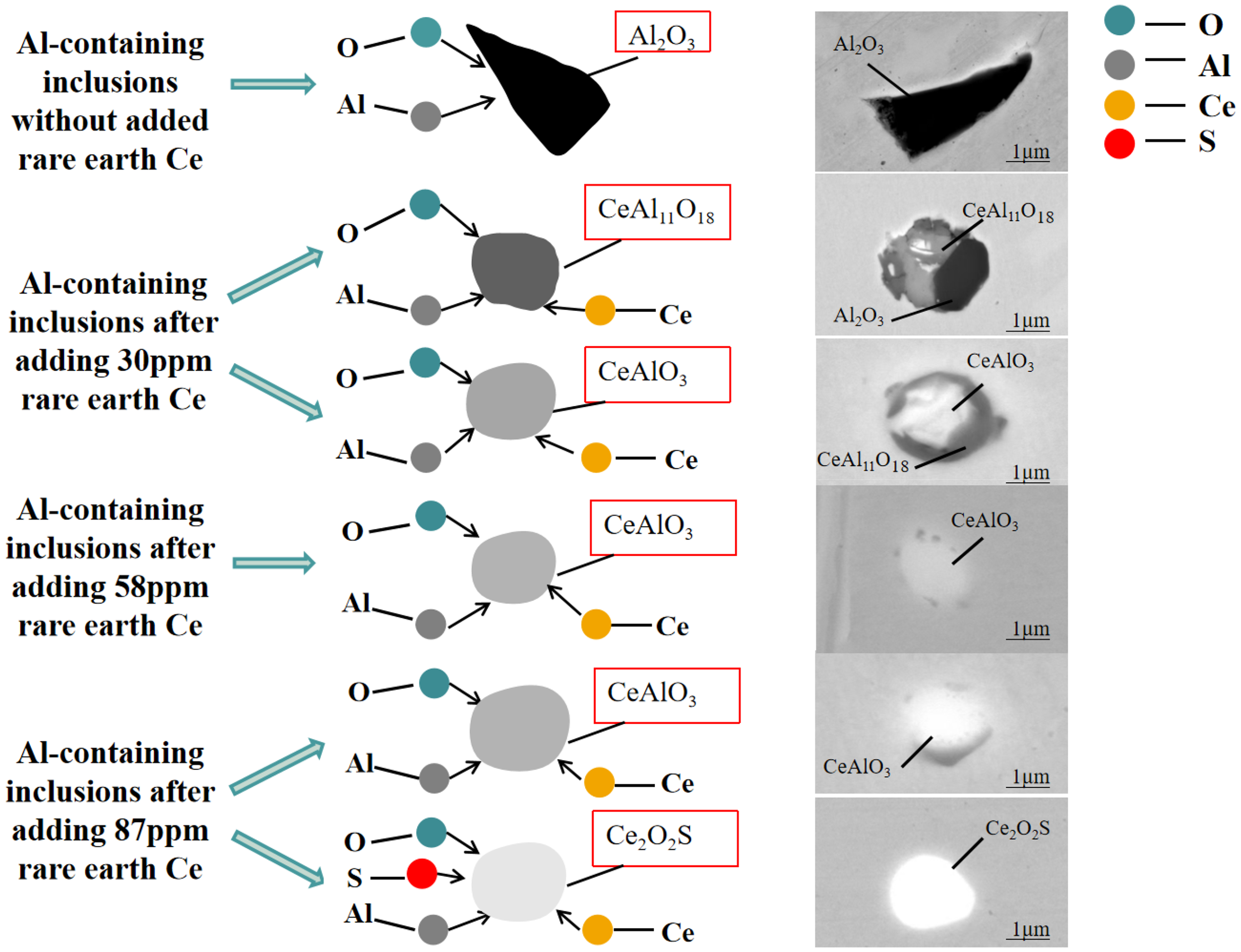
Evolution process of Al-containing inclusions modified by rare earth Ce.
Conclusions
When rare earth Ce is not added, the average size of Al-containing inclusions in Q355C steel is 3.85 μm, and the edges of these inclusions are sharp. After adding rare earth Ce, the size of Al-containing inclusions in the steel is significantly reduced, and no large-sized inclusions with sharp edges are observed. The method of adding rare earth Ce has a significant influence on the modification of Al-containing inclusions in the steel. Compared with the Ce–Fe alloy, the Al–Ce alloy performs better in improving the inclusions in the steel. After adding the Ce–Fe alloy, the average size of Al-containing inclusions in the steel is reduced to 2.87 μm; after adding the Al–Ce alloy, the average size of Al-containing inclusions in the steel is further reduced to 1.93 μm.
The stable phase diagram of the Ce–Al–O–S–Fe system in Q355C steel can be divided into five typical regions: CeAl11O18 + Al2O3, CeAl11O18, CeAl11O18 + CeAlO3, CeAlO3 and CeAlO3 + Ce2O2S. The content of rare earth Ce has a significant influence on the types of Al-containing inclusions in the steel. When the Ce content is 58 ppm, all the Al-containing inclusions in the steel exist in the form of CeAlO3.
Rare earth Ce was added in the form of an Al–Ce alloy. When the Ce content was 58 ppm, the modification effect of Al-containing inclusions was the best, with an average size of 1.93 μm, which was superior to 2.88 μm at a Ce content of 30 ppm and 2.05 μm at a Ce content of 87 ppm. When the Ce content exceeded 60 ppm, Ce2O2S inclusions began to precipitate in the steel.
Footnotes
Declaration of conflicting interests
The authors declared no potential conflicts of interest with respect to the research, authorship, and/or publication of this article.
Funding
The authors disclosed receipt of the following financial support for the research, authorship, and/or publication of this article: the Special Research Project for First-Class Discipline of Metallurgical Engineering at the Inner Mongolia University of Science and Technology (YLXKZX-NKD-048 and YLXKZX-NKD-002) and the Basic Research Funds for Directly Affiliated Universities in the Inner Mongolia Autonomous Region (grant numbers: 2023RCTD026, 2024QNJS130 and 2024QNJS131).
