






Abstract
Accurate evaluation of the caking property of non-coking coals, which generally exhibit limited metaplast-generation capacity during carbonisation compared with coking coals, is crucial for unlocking their utilisation potential in both cost reduction and efficiency improvement. Herein, an improved caking test was developed to distinguish weakly/non-caking coals under practical blending conditions. Structural characteristics of coals and macerals were quantified by Fourier Transform Infrared Spectroscopy with peak deconvolution, forming an integrated ‘petrology + structure’ framework for establishing quantitative correlations with caking indices. Results indicate that lean coal possesses superior blending potential compared to long-flame coal. Despite similarly limited metaplast-generation capability, lean coal forms a stronger carbon skeleton due to its higher degree of aromatisation and structural condensation. In contrast, long-flame coal exhibits more extensive aliphatic branching, higher thermal reactivity and a looser structural configuration, resulting in weaker cohesion and insufficient skeletal support. The generation potential of hydrocarbon (P) was identified as the most reliable predictor of caking behaviour owing to its consistent trends in both raw coals and their macerals. Accordingly, the theoretical P-value of blended coal (
Introduction
Coal utilisation is transitioning from high-emission and inefficient methods such as direct combustion and pyrolysis towards the development of high-value coal-based functional materials, 1 including carbon foam, 2 activated carbon 3 and porous carbon. 4 However, the production of these advanced carbon materials generally requires high-quality coking coals, 5 since their ability to form a strong carbon skeleton during carbonisation ensures the structural integrity and performance of the final product. 6 As reserves of high-quality coal continue to diminish,7,8 incorporating low-cost non-coking feedstocks such as weakly caking or non-caking coals with low levels of harmful elements has become an attractive strategy to reduce costs and improve resource efficiency. 9 To realise this potential, a better understanding of the physicochemical characteristics of such low-grade coals is urgently needed.
A key property in this regards is the caking ability of coal, which refers to the capacity of its pyrolytic metaplast to infiltrate and adhere to inert particles and ultimately determines the strength of coal-based materials.10–12 Among numerous evaluation approaches, the widely used caking index (GR.I) method, adopted as an international standard ISO 15585:2019, 13 is valued in the related industry for its operational simplicity. 14 The experiment involves co-pyrolyzing the coal sample with excess standard anthracite and measuring the drum strength of the resulting semi-coke briquette. 15 While the GR.I of the blended coal can be theoretically estimated by the weighted average of its individual components, 16 the test exhibits significant limitations in distinguishing weakly caking or non-caking coals.17,18 Specifically, when the amount or quality of metaplast is insufficient, the resulting briquette lacks strength, rendering the GR.I effectively unmeasurable. 19 Thus, to effectively assess the potential of these coals for coal blending applications, it is imperative to enhance current testing methods for improved resolution in the low-caking range.
Furthermore, the fundamental factors controlling the caking properties of coal remain only partially understood. From a petrological perspective, the primary maceral components, vitrinite and inertinite, act as a binder and carbon matrix formers during the coking process, respectively.20,21 This suggests that the vitrinite content plays an important role in governing the caking quality of coal.22,23 Nevertheless, significant variations in pyrolysis behaviour are still observed among different coal sources with comparable vitrinite contents. 24 For example, vitrinite from gas coal with poor caking property typically has a higher volatile matter content, releases more pyrolytic gases and exhibits a shorter thermoplastic stage, whereas vitrinite from coking coal with excellent caking property exhibits stronger thermal expansibility and fluidity. 25 Additionally, studies on both high-rank and low-rank coals have shown that the thermal behaviours of different macerals tend to converge, 26 further complicating predictions of caking performance.
Building on this, research has increasingly focused on the molecular structure and chemical composition of individual macerals, 27 aiming to elucidate the relationship between these structural features and caking properties. 28 Numerous studies suggest that thermally active vitrinite generally contains more aliphatic and fewer aromatic structures than thermally stable inertinite.29,30 Correspondingly, coal blends enriched in aliphatic-rich vitrinite often exhibit higher caking indices, as their thermally unstable microstructures promote the formation of cohesive and well-connected semicoke networks during carbonisation. 31 These findings imply that coal maceral composition and its associated molecular structures can be regarded as key factors controlling plastic phase generation and carbon skeleton development during coking, which ultimately determine the caking performance reflected by the caking index. Therefore, establishing a quantitative relationship between the structural characteristics of coal macerals and caking behaviour appears to be a feasible pathway for improving the interpretability and predictive capability of caking evaluation.
Unfortunately, despite advancements in multi-scale characterisation techniques for coking coal structures, 32 current structural indicators remain insufficient as stand-alone predictors of caking ability. 33 This limitation is largely due to the qualitative nature of existing analyses, which often emphasise the mere presence or relative abundance of structural features rather than establishing quantitative relationships. 34 Although the influence of coal's structural features on its pyrolysis behaviour has been established, 35 researchers have yet to effectively establish a systematic quantitative relationship between structural parameters and caking properties, making such structural information of limited practical value for industrial blending design and particularly ineffective for enabling the utilisation of weakly caking or non-caking coals. 36 Consequently, an urgent need exists to develop an evaluation system capable of translating coal's microstructural parameters into quantifiable caking indices, aimed at achieving the goals of scientific coal blending and performance prediction.
To address these challenges, this work employs applied coal petrology as the theoretical foundation. The overall research framework of this study is illustrated in Figure 1. A modified testing protocol was developed to better assess the caking potential of weakly caking and non-caking coals. Then, Fourier Transform Infrared Spectroscopy (FTIR) combined with peak deconvolution and curve fitting was used to quantitatively analyze the aromatic and aliphatic structures of individual macerals across different coal types. Finally, polynomial curve fitting (PCF) was applied to establish a predictive model correlating petrological structure parameters with caking indices of blending coal. The economic feasibility of this approach was also evaluated to promote scientific coal blending and enable the high-value utilisation of non-coking coal resources.

Research framework of this study.
Materials and methods
Materials
Eight on-site coal samples from a certain enterprise were used in this work, including one long flame coal (LFC), two 1/3 coking coals (1/3CC1 and 1/3CC2), four coking coals (CC1, CC2, CC3 and CC4) and one lean coal (LC). These samples were collected from major coal-producing regions of China, including Shaanxi (LFC), Guizhou (1/3CC1, CC1 and CC2), Yunnan (1/3CC2), Shanxi (CC3) and Sichuan (CC4 and LC). The detailed testing methods for their fundamental physicochemical properties have been described in our previous studies,22,37 and the corresponding results are presented in Table 1. Based on vitrinite reflectance (R0) values, the lowest and highest rank coals could not be evaluated for their caking indices using the standard method, which hinders an accurate assessment of their blending potential.
Analysis of physicochemical properties of all coal samples.
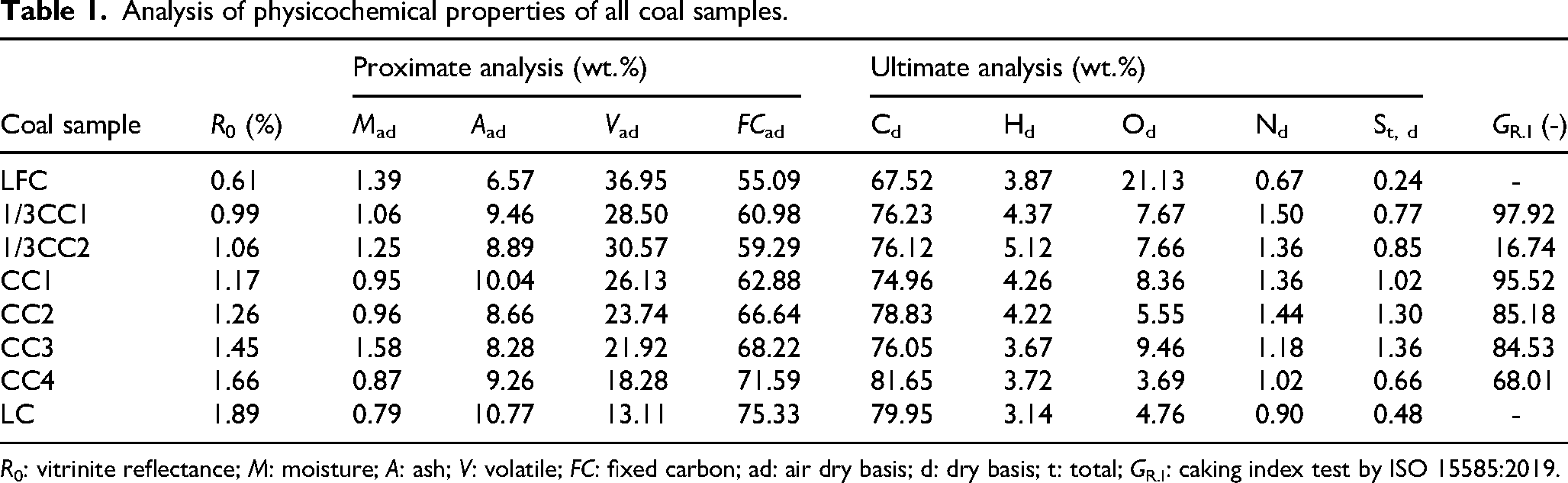
R0: vitrinite reflectance; M: moisture; A: ash; V: volatile; FC: fixed carbon; ad: air dry basis; d: dry basis; t: total; GR.I: caking index test by ISO 15585:2019.
Separation of coal maceral
For maceral separation, 50 g of raw coal with a size fraction of 0.074–0.125 mm was subjected to stepwise thermal float-sink separation in ZnCl2 heavy liquids with densities of 1.33, 1.36 and 1.39 g/cm3. The fraction with a density lower than 1.33 g/cm3 was enriched in vitrinite, whereas the 1.36–1.39 g/cm3 density fraction was predominantly enriched in inertinite. Detailed experimental procedures have been described in our previous study. 37 A fully automatic digital coal petrography analyzer (MY 9000, China) was employed to quantify the maceral composition of the raw coal and separated fractions under oil immersion at 50× magnification. For each sample, 500 measurement points were recorded across four distinct regions to ensure representative statistical analysis and minimise potential segregation effects during sample preparation. The relative abundance of each maceral group was determined before and after separation to assess the enrichment performance. The results are presented in Figure 2. For all coal types, the maceral purity was improved, with inertinite generally exhibiting a higher degree of purification efficacy compared to vitrinite. After separation, the vitrinite and inertinite contents of most samples reached approximately 80% and 60%, respectively. According to our previous experimental experience, such enrichment levels are sufficient to reveal the differences in pyrolysis behaviour among macerals from different coal types. 25

Effectiveness of vitrinite and inertinite separation in different coals.
Enhanced assessment of coal caking properties
As shown in Table 1, the caking indices of the two weakly caking or non-caking coals could not be determined using the standard method. Informed by previous research and considering the inevitable involvement of high-quality coking coal in industrial practice, 18 this study adopted a mass ratio of 1:1 for 1/3CC1 to test coal, following established methods. Experimental validation confirmed that this ratio effectively distinguishes the caking indices of weakly caking coals. Specifically, 1/3CC1, the coal with the highest caking capacity among the eight samples, was selected as the binding component to provide sufficient cohesiveness for the caking-deficient weak coals, enabling them to effectively bond the abundant anthracite skeleton.
For co-carbonisation tests, the target coal was first blended with 1/3CC1 at a mass ratio of 1:1 (1 g test coal mixed with 1 g 1/3CC1). The resulting blend was then diluted with standard anthracite at a ratio of 1:5 (1 g blend mixed with 5 g anthracite) and placed into a corundum crucible. A nickel–iron press block was positioned centrally and the assembly was compressed for 30 s. The covered crucible was then placed in the constant-temperature zone of a preheated muffle furnace (XL-6A, China) at 850 °C. The furnace temperature returned to 850 °C within 6 min and was maintained at 850 ± 10 °C for 15 min. After heat treatment, the crucible was removed and allowed to cool naturally to room temperature. The heating programme and drum testing conditions strictly followed the ISO 15585:2019 standard.
14
The modified caking index 
where
Characterisation of carbonaceous structures
The FTIR spectrometer (Nicolet™ iS20, USA) was employed to analyse the carbon structures of all coal macerals. The samples were ground to pass a 200-mesh sieve and dried at 105 °C prior to analysis to remove residual moisture. Spectroscopic-grade KBr was also pre-dried at 105 °C before pellet preparation to minimise moisture interference. The dried samples were then mixed with KBr at a mass ratio of 1:100 and ground uniformly in an agate mortar. The mixture was pressed into transparent pellets under 20 MPa for 1 min. Spectra were recorded over the wavenumber range of 400–4000 cm−1 with a resolution of 4 cm−1 by co-adding 32 scans. Peak-differentiating and imitating were performed using PeakFit software (SeaSolve, USA) to enable semi-quantitative analysis of different structures. The detailed experimental procedures are described in our previous work.
28
The coking process during coal pyrolysis is primarily driven by interactions between aromatic and aliphatic carbon structures,
38
so this work focused on two characteristic absorption regions, the aromatic absorption band (approximately 700–900 cm−1) and the aliphatic absorption band (approximately 2800–3000 cm−1).28,39 Several representative structural parameters were derived from these regions, and their corresponding calculation formulas are provided in equations (2)–(5)28,39:



where I is the degree of aromatisation (-);
Data processing
All carbon structural parameters and caking index data were analysed using Origin 2025 (OriginLab, USA). The built-in PCF function was employed to construct relationships between caking behaviour and structural contents and parameters.
Results and discussion
Comparison of caking properties determined by the standard and improved methods
The caking indices of all coal samples obtained by the two methods are shown in Figure 3. The improved method is capable of measuring the caking behaviour of both non-coking coal types and clearly distinguishing between them, with LC showing greater potential for blending than long-flame coal. Although the trends obtained by the improved method are broadly consistent with those of the standard method, systematic differences can be observed for certain coal ranks. For coals with strong caking ability, the values measured by the improved method tend to be slightly lower. In particular, the caking index of CC1 decreases from 95.52 to 80.49, and the differences between CC1 and the other two coking coals (CC2 and CC3) become relatively smaller. In contrast, for coals with weak or undetectable caking behaviour under the standard method, the measured values are significantly enhanced. For instance, the caking index of 1/3CC2 increases from 16.74 to 47.06 when evaluated using the improved method.

Comparison of coal caking property testing results between the standard (GR.I) and improved methods (G0).
These differences can be understood by considering the requirements for coke formation. Coke formation requires not only a binder phase but also a carbonaceous framework. 40 Conventional evaluation methods mainly focus on the ability of a coal sample to independently generate a metaplastic phase when provided with a carbon skeleton. However, in practical coking operations, caking coals dominate the blend composition, 41 providing the main plastic phase and structural framework. As a result, the coal blend exhibits a relatively high tolerance for low-quality coals that generate a little or no plastic phase. In contrast, coking coals generally possess a relatively balanced composition that supports both plastic phase formation and structural framework development. The addition of an external binder may partially disturb this balance, leading to a slight reduction in the measured caking index.
From a chemical perspective, the improved approach better couples the liquid-phase generation capacity of coal from its solid-phase skeleton formation capacity, explaining why it can reveal the caking potential of coals that appear to have little or no caking ability when evaluated using the standard method. To better assess the blending potential of individual coals, especially those of lower quality, the testing process should include both an inert component and an additional binder. The effect of the test coal on the quality of the resulting semicoke under such conditions can then be used to determine its suitability for industrial use.
Carbon structural characteristics of different coals and their macerals
Difference in carbon structure content
To determine the structural differences in carbon structure among various raw coals and their macerals, FTIR was employed to characterise the aromatic and aliphatic structures of all samples. As shown in Figure 4, the spectra within the relevant wavenumber ranges were subjected to peak deconvolution. The fitting results are satisfactory, with well-defined peak shapes and minimal overlap, providing a reliable basis for subsequent quantitative structural analysis based on peak areas.

Peak-fitting results of Fourier Transform Infrared Spectroscopy (FTIR) spectra for different coals and their macerals: (a) aromatic structures; (b) aliphatic structures.
Figure 5 illustrates the relative abundance distribution of various carbon structural units in different samples. Regarding aromatic structures, the coals and their macerals are primarily composed of three types: ortho-disubstituted arenes, ortho-trisubstituted arenes and pentasubstituted benzenes. Among them, ortho-disubstituted arenes dominate in almost all samples, while pentasubstituted benzenes are the least abundant. With increasing coal rank, the proportions of all three aromatic structures in the raw coals show an overall upwards trend, indicating a progressive enhancement of aromaticity. In contrast, the variation trends of aromatic structures in vitrinite and inertinite exhibit a ‘mountain-shaped’ pattern, peaking at intermediate coal ranks before slightly declining. This may be attributed to differences in the structural evolution mechanisms of the macerals, suggesting that the increase in aromaticity within different macerals does not follow a strictly linear progression.

Trends in aromatic and aliphatic structural variations of all materials: (a) raw coal; (b) vitrinite; and (c) inertinite.
Regarding aliphatic structures, the samples are predominantly composed of three types of functional groups: methyl (-CH3), methylene (-CH2) and methine (-CH). Among these, the methylene content is significantly higher than that of the other two, while the other two are present in comparable amounts. Notably, in both raw coals and their macerals, the abundances of all aliphatic structures also exhibit a ‘mountain-shaped’ trend with increasing vitrinite reflectance, reaching the lowest values in two weakly caking or non-caking coals. This pattern closely aligns with the results of previous caking property tests, suggesting that variations in aliphatic structure content may, to some extent, reflect coal plasticity and caking ability, and may play a critical role during coal pyrolysis.29,30
Differences in carbon characteristic parameters
The FTIR characteristic parameters of the raw coals and their macerals, calculated based on structural contents, are shown in Figure 6. Among the raw coals, long-flame coal exhibits the lowest I value and DOC value, while LC shows the highest values. For raw coals with good caking ability, the variation ranges of all four parameters are relatively narrow. In terms of macerals, inertinite generally exhibits higher I and DOC values, whereas vitrinite shows higher S and P values. For raw coals with strong caking ability, the I, S and P of the vitrinite, as well as the I and S of the inertinite, are all clustered in the yellow region of the figure. This suggests that the caking behaviour of a coal is manifested in its structural characteristics.

Comparative Fourier Transform Infrared Spectroscopy (FTIR) characteristic parameters of all materials: (a) raw coal; (b) vitrinite; and (c) inertinite.
To make a preliminary attempt at distinguishing the caking properties of raw coals based on structural parameters, we focused on the three coal samples that exhibited the largest differences in caking ability according to both methods described above. These samples are highlighted in the figure with distinct symbols, while the extent of their differences is represented by the red quasi-triangular region. The red region indicates that I, S and P of raw coal, as well as the DOC and P of vitrinite, can effectively distinguish the caking properties of the three representative coals. However, the trends of structural parameters with increasing vitrinite reflectance reveal that the patterns of I and S display almost opposite patterns, both of which deviate from the caking property trend. The pattern of DOC in macerals partially aligns with the caking trend but differs from those in raw coals. In contrast, the pattern of P shows a consistent trend across raw coals and macerals, suggesting that P could serve as a unified indicator of the caking behaviour of both raw coals and macerals.
Overall, I and DOC reflect the characteristics of aromatic carbon structures, where higher values indicate denser structures and higher coal rank. 42 S and P are both indicators of aliphatic thermal reactivity; the former primarily correlates with the generation of volatile matter during pyrolysis, whereas the later is more directly related to metaplast formation, 43 consistent with the observations reported in our previous study. 28 Based on the present results, LC exhibits a more developed graphitic structure compared to long-flame coal. Although both weakly caking coals show similarly low potential for metaplast generation, as reflected in their comparable P values, long-flame coal possesses a higher degree of branching that suggests greater thermal decomposition activity. Nevertheless, LC demonstrates a clear advantage in forming the carbon skeleton required for coke formation. This structural distinction explains the inferior coking ability and limited blending potential of long-flame coal. Meanwhile, compared with other high-quality caking coals, the 1/3 coking coal sample 1/3CC2 shows relatively higher I and S values but a significantly lower P value. This suggests that it possesses a relatively strong carbon skeleton but lacks sufficient components for generating a binding phase. This characteristic further accounts for the higher caking index obtained using the improved method relative to the standard method, as discussed previously.
Correlation of coals and their maceral structural characteristics with caking property of raw coal
Relationship between carbon structure content and caking property of raw coal
Figure 7 presents the relationship between the content of different structures in various coal-based samples and the cohesiveness of raw coal. Since standard methods cannot measure the caking properties of weakly caking coals, the parameter G0 was utilised for analysis.

Relationship between structural composition of various coal-based samples and raw coal caking property.
For aromatic structures, the contents of ortho-disubstituted arenes, ortho-trisubstituted arenes and pentasubstituted benzenes in raw coal exhibit parabolic relationships with caking ability. The strongest caking occurs when their contents are approximately 1.5–3.0%, 1.2–2.5% and 0.5–1.7%, respectively. Among the macerals, both vitrinite and inertinite show positive correlations between aromatic content and the caking property of the parent coal. For aliphatic structures, in both raw coal and macerals, the caking ability increases with the content of the three examined aliphatic structural types, and the fitting between these three aliphatic structures and caking ability is better for vitrinite than for inertinite.
In summary, different structural types in coal exhibit distinct relationships with caking ability. The present results suggest that the caking performance of coal cannot be explained solely from the perspective of individual macerals, and their carbon structural characteristics must also be taken into account. Notably, the consistent influence of aliphatic structures across raw coals and macerals indicates considerable potential for developing caking predictive relationships based on aliphatic content.
Relationship between carbon structure parameters and caking property of raw coal
Building on the previous analysis, the relationships between the parameters S and P, which characterise aliphatic structures, and the caking ability of raw coal were fitted. As shown in Figure 8, the correlation between S and G0 varies significantly across different coal samples and macerals. For raw coal, a clear negative correlation is observed, suggesting that an excessively high content of branched structures may generate more low-molecular-weight products during pyrolysis, thereby reducing the components that form the plastic phase and ultimately weakening caking ability. In contrast, both vitrinite and inertinite exhibit parabolic relationships with G0. The inconsistency between raw coal and its macerals suggests that the S may not serve as a reliable indicator for evaluating the caking ability of raw coal. It is worth noting that P shows a consistent positive correlation with G0 in both raw coal and macerals. The fitting accuracy is higher for raw coal and vitrinite than for inertinite, possibly because aliphatic structures in raw coal and vitrinite are more distributed and more readily form a plastic phase during pyrolysis.

Relationship between aliphatic structural parameters of different coal-based samples and caking properties of raw coal.
To explain why these two parameters, although both related to aliphatic structures, show different relationships with the development of caking behaviour, their mathematical expressions were further examined. According to equations (4)–(5), S is constructed from the asymmetric stretching vibrations of long-chain aliphatic -CH2- groups (2915–2940 cm−1) and short-chain -CH3 groups (2950–2975 cm−1), 44 thus mainly reflecting the structural characteristics of aliphatic side chains. In contrast, P is derived from the absorption band of aliphatic C-H stretching vibrations in the range of 2800–3000 cm−1 together with the aromatic C = C skeletal vibration near 1600 cm−1, 45 thereby linking aliphatic structures with the aromatic framework of coal. Consequently, compared with S, the P parameter better reflects the structural evolution involved in the development and solidification of coal caking behaviour.
Overall, although the structural contents and characteristic parameters of raw coal and its macerals are all correlated with caking ability to some extent, the aliphatic structural parameter P is the only one that exhibits a consistent variation trend across different coal types and macerals. Therefore, P will be adopted as the primary basis for constructing the subsequent coal blending caking property predictive model.
Integrated petrographic-structural modelling for predicting coal blend caking properties
Model construction and prediction accuracy
To verify the applicability of the P-value method in coal blending for coking, a blending scheme was proposed based on the current coal blending practices of an enterprise, as shown in Table 2. The coal blending strategy was guided by two considerations: (1) each weakly caking or non-caking coal was individually incorporated into the blend to evaluate its economic feasibility in reducing production costs while maintaining acceptable coke quality; (2) the proportions of the remaining coals were adjusted to keep the Aad and Vad content of the blended coal within a narrow range, thereby minimising the influence of compositional variations on the experimental results. Considering that the caking property of each blended coal can be measured in practice, all blending structures were evaluated using the GR.I index to align with current industrial applications.
Coal blending scheme for model construction and prediction.

Due to the significant difference in magnitude between the original GR.I and P, directly performing polynomial fitting would result in regression coefficients with large numerical value. By taking the base-10 logarithm of GR.I, its numerical range is compressed, which reduces the magnitude difference between the dependent and independent variables and leads to a more concise and interpretable regression equation. It is necessary to compare the performance of caking property predictive models based on the raw coal P-value and the coal maceral P-value to determine which approach offers greater advantages. The specific parameter conversion ways for the blended coals are given in equations (6)–(7):

where
Guided by the principle of Occam's razor, model parsimony is essential when working with limited samples.
46
A linear fit yields an inadequate goodness-of-fit, while quadratic functions involve three parameters, and higher-order functions introduce even more. Additional parameters increase model variance and elevate the risk of overfitting to sample-specific noise, rather than capturing the true underlying relationship. Therefore, a quadratic regression model was selected for data analysis in this work. Figure 9 illustrates the prediction performance of the two methods, with all the obtained models following the quadratic form lgGR.I = a

Comparative analysis of caking property predictions based on raw coal P-value and coal maceral P-value.
Economic and environmental evaluation of the model
Further evaluation was conducted on the potential economic and environmental implications of the coal maceral P-value method. It should be noted that labour costs were not included in the economic estimation due to the limited experimental scale.
As illustrated in Figure 10(a), the economic advantages of the coal maceral P-value method mainly arise from reductions in raw material consumption and electricity usage. In terms of raw materials, although the new method requires heavy medium (ZnCl2 solution) for maceral separation and potassium bromide for FTIR analysis, the associated costs are relatively low, and the separation reagents can be reused. In contrast, the method avoids the use of standard anthracite and crucible consumables required in conventional tests, resulting in an estimated saving of 37.50 CNY per test. Regarding electricity consumption, calculations based on equipment operating parameters show an additional saving of 6.47 CNY per test compared with conventional pyrolysis methods. Taking the case of caking property testing for coking coal blending in a domestic enterprise as an example, and assuming an annual testing frequency of 1800 tests, the method could potentially reduce costs by 79,464.35 CNY per year, corresponding to a reduction of approximately 98% compared with the conventional testing procedure. These results suggest that the proposed method may offer notable economic benefits under practical operating conditions.

Economic and environmental assessment of caking property prediction method based on coal maceral P-value: (a) cost reduction; (b) emission reduction.
Figure 10(b) highlights a qualitative comparison of the potential environmental impacts. Conventional pyrolysis testing generates large volumes of combustible gases such as methane, which even after treatment, produce about 30% carbon dioxide and thus contribute to greenhouse gas emissions.47 In addition, discarded crucibles generate solid waste during routine testing. By contrast, the coal maceral P-value method eliminates the need for pyrolysis, thereby reducing harmful gas generation at the source. Moreover, the liquid waste burden is mitigated because the ZnCl2 heavy liquid used in this method can be recycled and reused after filtration, reducing reagent consumption and waste generation. When the solution becomes unsuitable for further use due to prolonged operation or contamination, it is collected and treated in accordance with hazardous waste management regulations. Despite these additional operational requirements, the overall method still offers potential environmental advantages compared with conventional testing procedures.
Conclusions
After quantitatively evaluating the blending potential of weakly caking and non-caking coals, this work employed FTIR to determine the carbon structures of raw coals and their macerals. By clarifying the relationship between coal caking properties and carbon structure, a predictive model for caking behaviour was established based on a ‘petrographic + structure’ method, highlighting its potential for industrial application. The main conclusions are as follows:
The improved caking property testing method can significantly quantify the practical applicability of different coals in blending compared with the standard method. The new method successfully assessed the blending potential of weakly caking and non-caking coals, demonstrating the superior blending suitability of LC with less adverse impact on caking behaviour than long-flame coal during actual blending. Although long-flame coal and LC exhibit similar abilities to generate metaplast, their key difference lies in their carbon structural characteristics. Long-flame coal has a more branched and loose structure with stronger thermal decomposition reactivity, whereas LC exhibits a higher degree of graphitisation, contributing more effectively to the formation of a stable semi-coke skeleton during carbonisation. Multiple carbon structural features of raw coal and its vitrinite show quantifiable relationships with the caking properties of raw coal. Compared with aromatic structures, aliphatic structures exert a stronger influence on caking ability. Among all structural parameters, the generation potential of hydrocarbon (P) of both raw coal and its macerals shows the most consistent correlation with the caking characteristics of raw coal. The quadratic function model based on the maceral P-value provides an economical and environmentally friendly approach for evaluating the caking properties of blending coals. For cases involving weakly caking or non-caking coals and their mixtures, the model can broaden the operational window for coal blending by accommodating a wider range of numerical variation.
The framework established in this work applies not only to metallurgical systems but also to coal-based advanced carbon materials, where caking behaviour plays a decisive role in determining carbon skeleton integrity and material performance. Nevertheless, several limitations of this work should be noted:
The current maceral separation method involves relatively complex procedures, limiting its immediate scalability for industrial applications. The model is system-specific, as the reference binder was selected as the strongest caking coal within the studied system, restricting direct comparison across different coal systems. The dataset used for model construction was limited to a small number of coal samples, which may constrain its applicability across a broader spectrum of coal ranks and geological origins.
Challenges and future directions
Although the proposed methodology effectively distinguishes weakly caking and non-caking coals, further validation across a broader range of coal types is necessary to confirm its general applicability, particularly through the identification of a compositionally stable standard binder. In addition, improvements in separation efficiency and automation are required to enhance the economic feasibility of the maceral separation procedure. From a modelling perspective, the current ‘petrographic + structure’ framework relies on a single structural parameter; future efforts will focus on developing composite parameters grounded in coal coking mechanisms to further improve predictive accuracy.
Footnotes
Acknowledgments
The work is supported by the National Natural Science Foundation of China (Project No. 52474348 & 52074055), the Graduate Scientific Research and Innovation Foundation of Chongqing (Project No. CYS22001), and the Chongqing Talent Program (Project No. cstc2021ycjh-bgzxm0108). The authors also thank Mr Weijun Bai (Beijing Precise Instrument Co., Ltd) for his guidance in coal petrographic identification.
Abbreviations

Funding
The authors disclosed receipt of the following financial support for the research, authorship and/or publication of this article: This work was supported by the Graduate School, Chongqing University, National Natural Science Foundation of China, Chongqing Talent Program, (grant number CYS22001, 52074055, 52474348, cstc2021ycjh-bgzxm0108).
Declaration of conflicting interests
The authors declared no potential conflicts of interest with respect to the research, authorship and/or publication of this article.
Data availability
Data will be made available on request.